Arora, Introduction to Optimum Design, 4e
4-177
4.129_______________________________________________________________________________
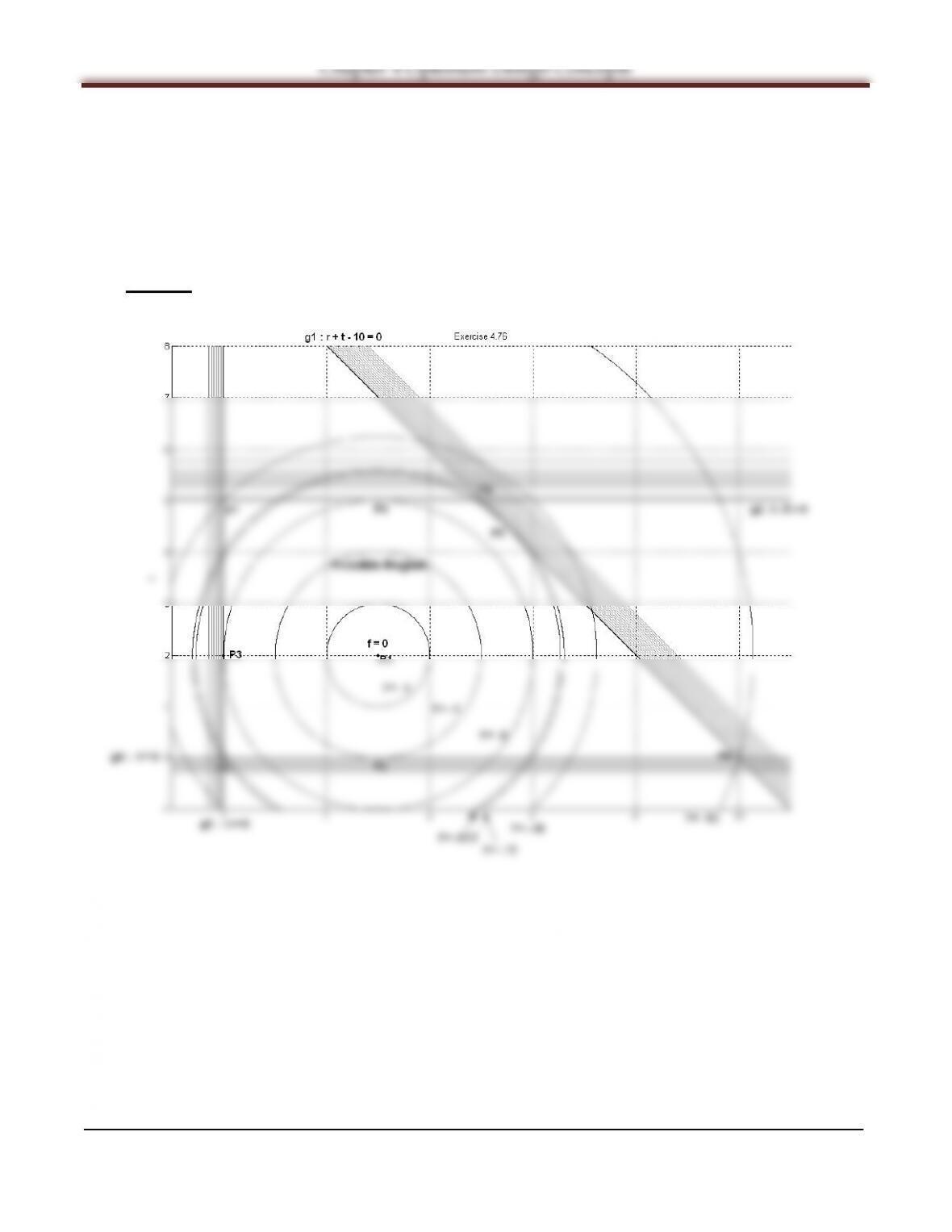
Exercise 4.76
Maximize (,)= (−3)2+ (−2)2
subject to 10 ≥+
≤5
,≥0
Solution
Chapter 4 Optimum Design Concepts
We need to find isolated or local minimum point(s) which satisfy both KKT necessary conditions and
sufficient or the second order necessary conditions.
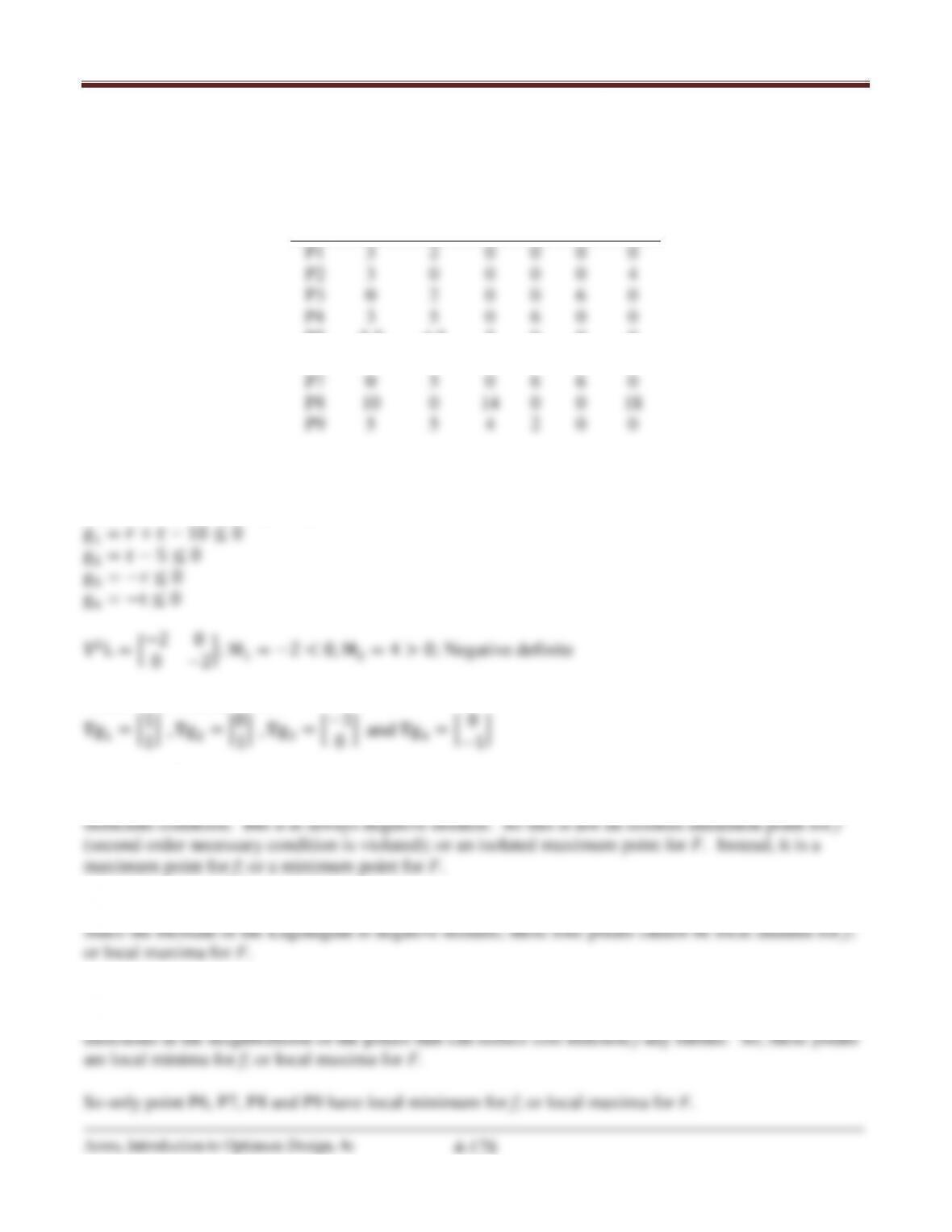
Referring to Exercise 4.76, the points satisfying the KKT necessary conditions are
r
t
u1
u2
u3
u4
P1
3
2
0
0
0
0
P2
3
0
0
0
0
4
P3
0
2
0
0
6
0
P4
3
5
0
6
0
0
P5
5.5
4.5
5
0
0
0
P6
0
0
0
0
6
4
P7
0
5
0
6
6
0
P8
10
0
14
0
0
18
P9
5
5
4
2
0
0
SECOND ORDER CONDITIONS ARE DISCUSSED IN CHAPTER 5
(,)=−(−3)2−(−2)2
Gradient of constraints are
1. At point P1 (3, 2)
Since no constraint is active, Hessian of Lagrangian must be positive definite throughout to satisfy
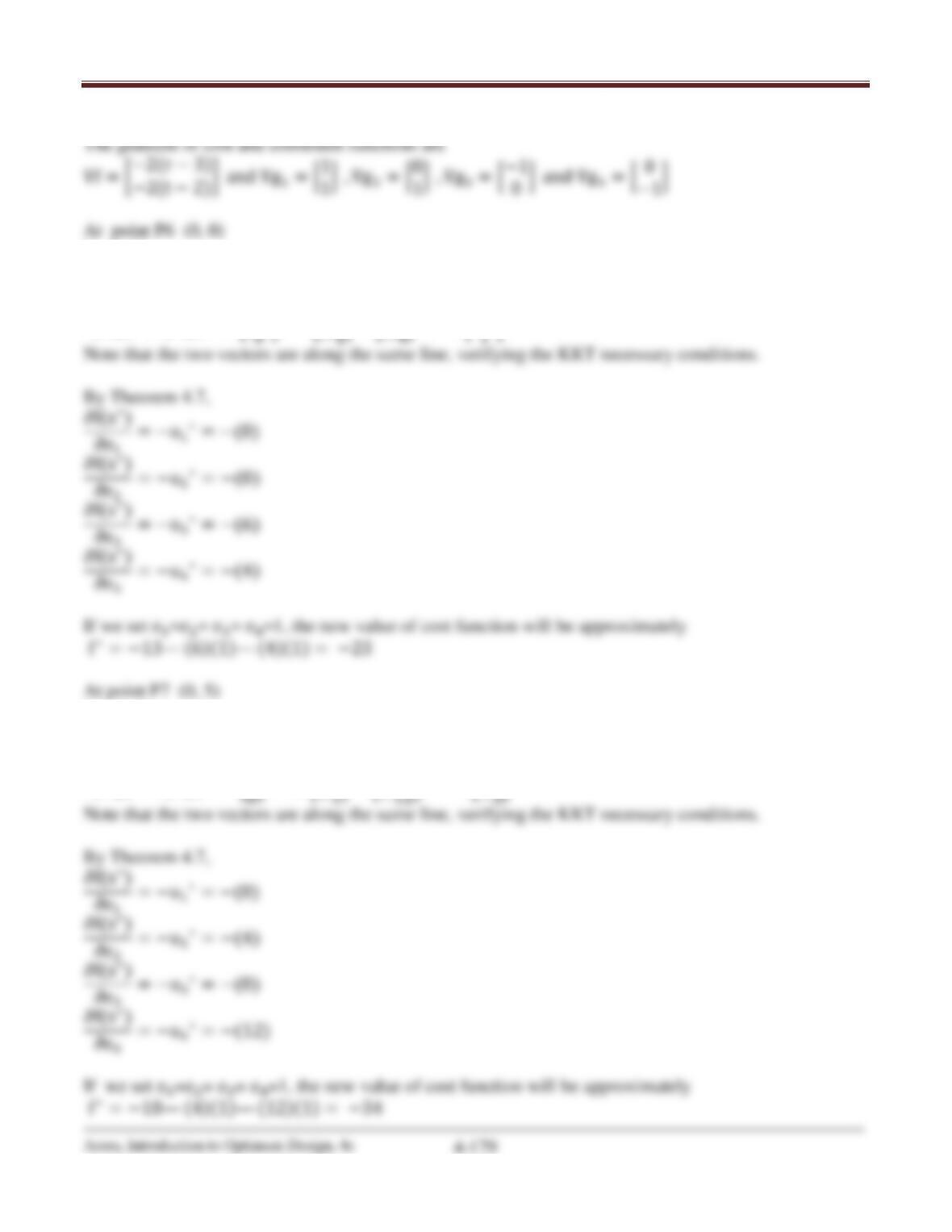
2. At points P2 (3, 0), P3 (0, 2) , P4 (3, 5)and P5 (5.5, 4.5)
3. At points P6 (0, 0) , P7 (0, 5 ), P8 (10, 0 ) and P9 (5, 5 )
The number of active constraints is equal to the number of design variables. There are no feasible
Chapter 4 Optimum Design Concepts
By (4.52),
−∇f(0, 0)=−�−2(0 −3)
−2(0 −2)�=−�6
4�=−4�1.5
1� and
u3∇g3+ u4∇g4= 6 �−1
By (4.52),
−∇f(0, 5)=−�−2(0 −3)
−2(5 −2)�=−4�1
−3� and
u2∇g2+ u4∇g4= 4 �1
MATLAB Code for Exercise 129
clear all
axis equal
[r,t]=meshgrid(–1:0.01:11, –1:0.01:8);
f=(–1)*((r–3).^2+(t–2).^2);
cv1=[0:0.05:0.8];
const1=contour(r,t,g1,cv1,‘g’);
cv1=[0 0.01];
const1=contour(r,t,g1,cv1,‘k’);
cv2=[0:0.05:0.8];
const4=contour(r,t,g4,cv4,‘k’);
fv=[0 –1 –4 –9 –12.5 –13 –18 –53];
fs=contour(r,t,f,fv,‘b’);
a=[3 3 0 3 5.5 0 0 10 5];
b=[2 0 2 5 4.5 0 5 0 5];
Chapter 4 Optimum Design Concepts
Arora, Introduction to Optimum Design, 4e
4-182
Exercise 4.77
Maximize (,)= (−8)2+ (−8)2
subject to +≤10
≥0
≤0
Solution
Referring to Exercise 4.77: Minimize
( ) ( ) ( )
22
, 8 8;f rt r t=−− −−
1
subject to g 10 0;rt= +− ≤
23
g 0; g 0;rt=−≤ =−≤
No KKT solution. No candidate minimum.
Chapter 4 Optimum Design Concepts
Arora, Introduction to Optimum Design, 4e
4-183
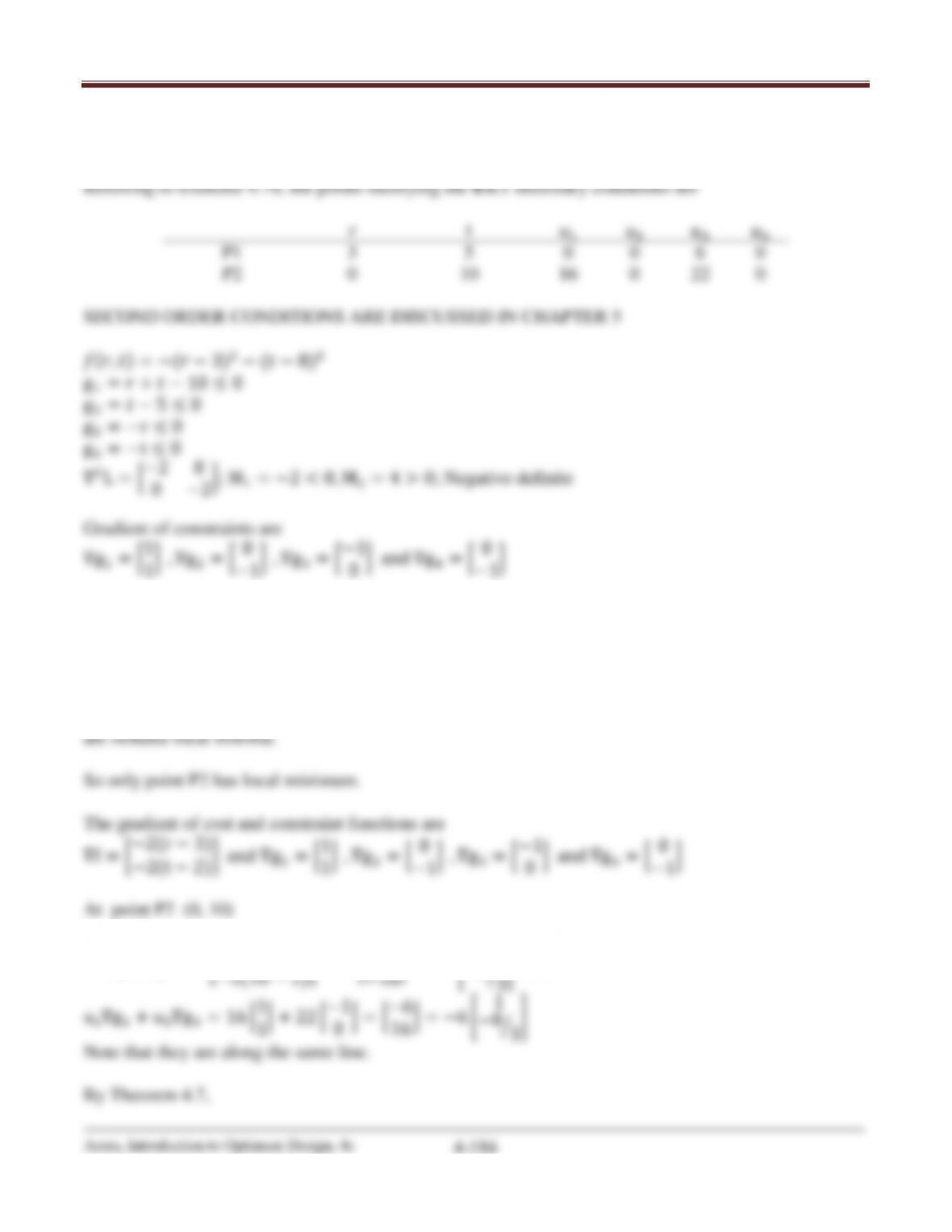
Exercise 4.78
Maximize (,)= (−3)2+ (−2)2
subject to 10 ≥+
≥5
,≥0
Solution
Chapter 4 Optimum Design Concepts
We need to find isolated or local minimum point(s) which satisfy both KKT necessary conditions and
sufficient or the second order necessary conditions.
1. At point P1 (3, 5)
Since the Hessian of the Lagrangian is negative definite, the four points cannot be local minima.
2. At points P2 (0, 10)
The number of active constraints is equal to the number of design variables. There are no feasible
directions in the neighborhood of the points that can reduce cost function any further. So, these points
By (4.52),
−∇f(0, 10)=−�−2(0 −3)
−83
Chapter 4 Optimum Design Concepts
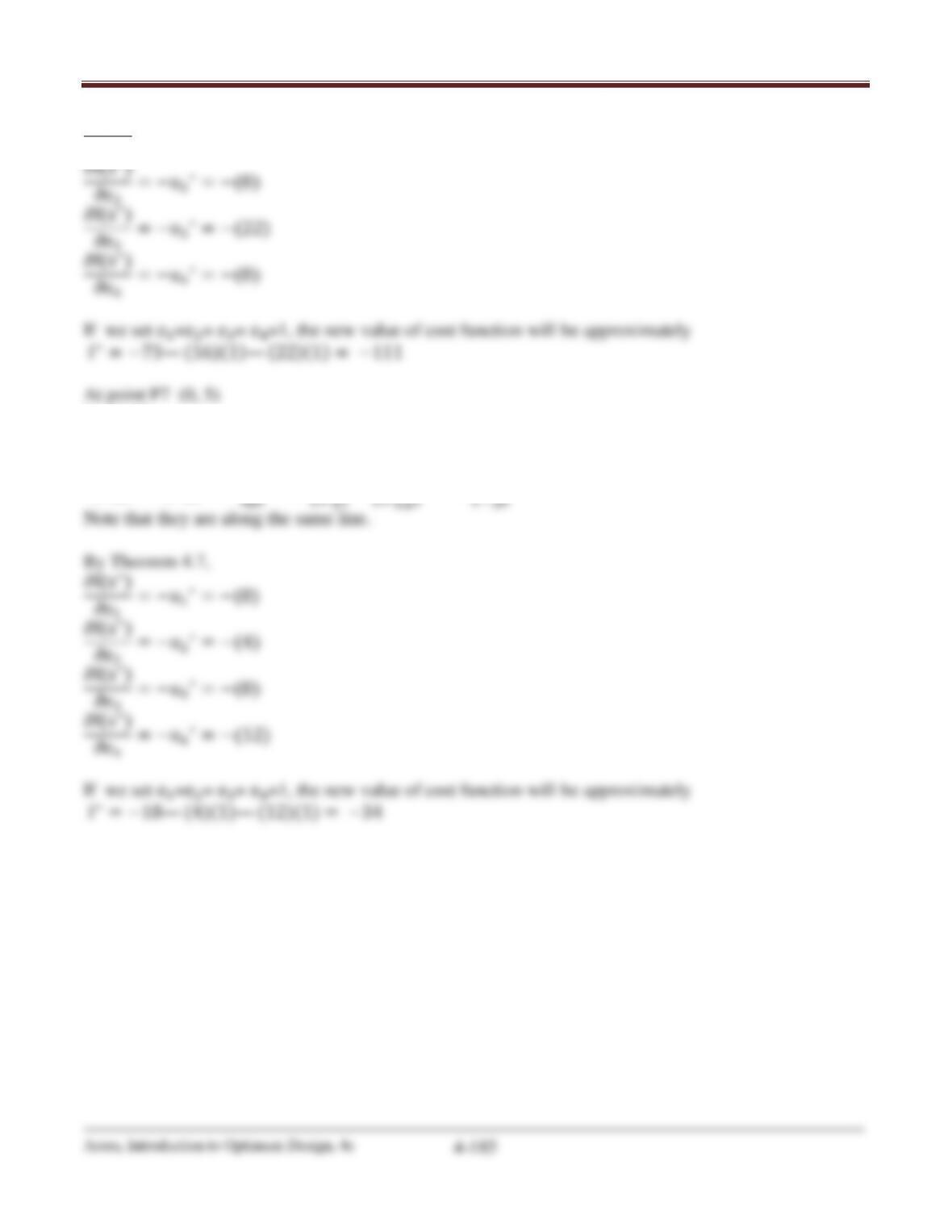
∂f(x∗)
∂e1=−u1∗=−(16)
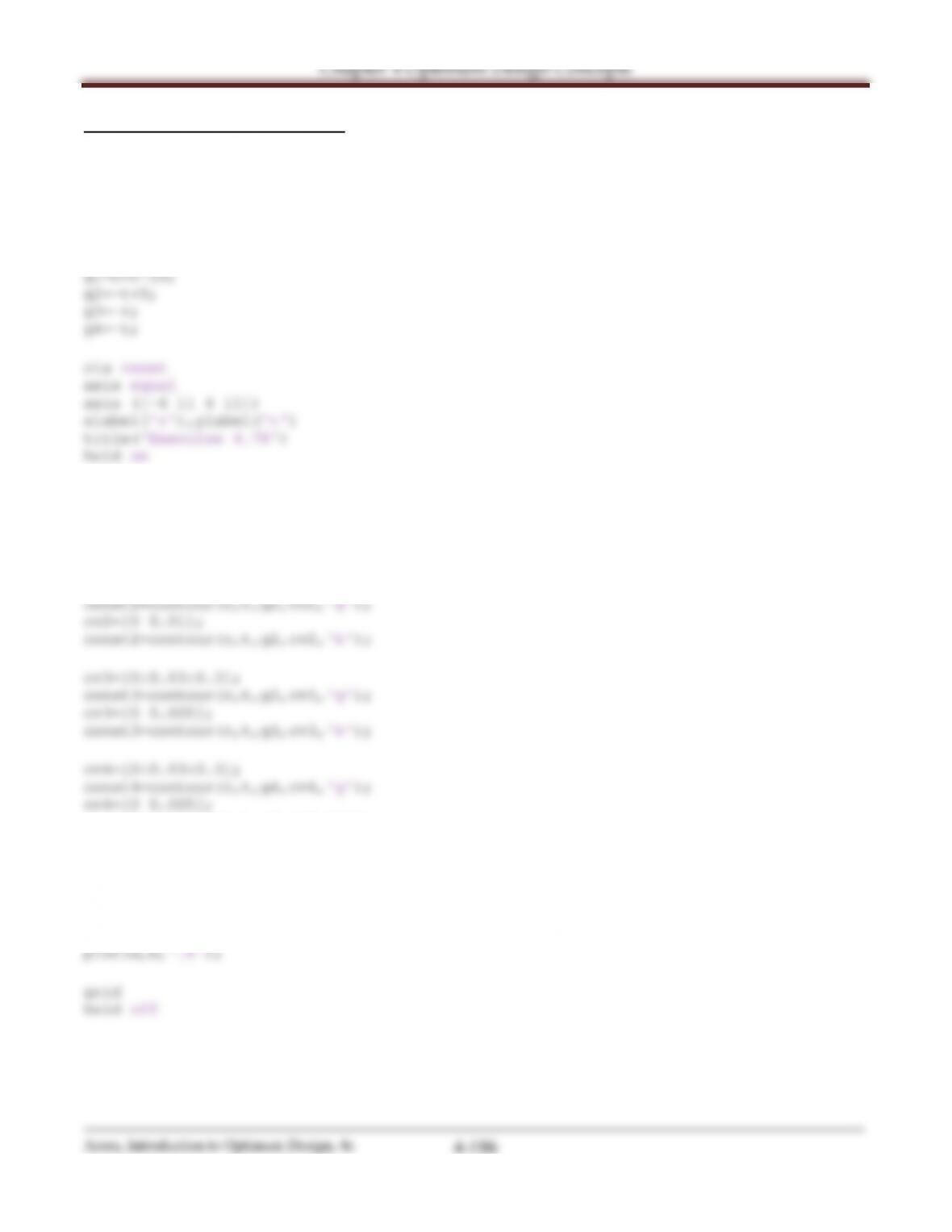
By (4.52),
−∇f(0, 5)=−�−2(0 −3)
−2(5 −2)�=−4�1
−3� and
u2∇g2+ u4∇g4= 4 �1
MATLAB Code for Exercise 131
clear all
axis equal
[r,t]=meshgrid(–4:0.01:11, 4:0.01:11);
f=(–1)*((r–3).^2+(t–2).^2);
cv1=[0:0.05:0.8];
const1=contour(r,t,g1,cv1,‘g’);
cv1=[0 0.01];
const1=contour(r,t,g1,cv1,‘k’);
cv2=[0:0.05:0.8];
const4=contour(r,t,g4,cv4,‘k’);
fv=[–9 –35 –73 –79];
fs=contour(r,t,f,fv,‘b’);
a=[3 0];
b=[5 10];
Chapter 4 Optimum Design Concepts
Section 4.8 Global Optimality
4.132_______________________________________________________________________________
Answer True or False
2. A linear equality constraint always defines a convex feasible region.
True
4. A function is convex if and only if its Hessian is positive definite everywhere.
False
6. A convex programming problem always has an optimum solution.
False
8. A nonconvex programming problem cannot have global optimum solution.
False
9. For a convex design problem, the Hessian of the cost function must be positive semidefinite
10. Checking for the convexity of a function can actually identify a domain over which the
4.133_______________________________________________________________________________
Using the definition of a line segment given in Eq. (4.71), show that the following set is convex
={|1
2+2
2−1.0 ≤0}
Solution
Assume
22 22
12 12
10; 10S xx S yy→ + −≤ → + −≤
εε
xy
;
( ) ( )
( )
11
22
1
1;
1
xy
xy
+−
+− =
+−
αα
αα
αα
xy
If we can show that
( )
[ ]
( )
[ ]
0111 2
22
2
11 ≤−α−+α+α−+α yxyx
, then S is a convex set.
( ) ( )
( ) ( ) ( ) ( )
2
2
22
11 2
22 22 22 22
1111222
11
21 1 21 1
x yx y
xxyyxxyy
αα αα
α αα α α αα α
+− + +−
= + − +− + + − +−
( )
( )
( )
( )( )
( ) ( )
12221121
121
222
2
2
2211
2
2
2
1
2
2
2
2
1
2
=α−α+α+α−+α=α−α+α−+α≤
+α−α++α−++α yxyxyyxx
where
22 22
12 12
1, 1xx yy+≤ +≤
and
11 2 2 1xy xy+≤
are used.
The first two inequalities are derived by definition. The last inequality is derived as follows:
( )
11 2 2
cos ,xy xy+ =⋅=xy x y xy
.
Since
( )
22 22
12 12
1; 1; cos 1,xx yy= +≤ = +≤ ≤x y x, y
it follows that
1
2211
≤+ yxyx
.
4.134_______________________________________________________________________________
Find the domain for which the following functions are convex: (i) sin x , (ii) cos x.
Solution
1.
xfxfxf sin“ ,cos‘ ;2x0 ;sin −==π≤≤=
For a single variable function to be convex, its second derivative must be nonnegative, i.e.,
0sin“≥−= xf
, or
ππ
2≤≤ x
2.
cos ; 0 2 ; sin , cos 0, so 2 3 2f x x f xf x x= ≤≤π =− =− ≥ π ≤≤π‘”
4.135_______________________________________________________________________________
Check for convexity of the following function. If the function is not convex everywhere, than
determine the domain (feasible set S)over which the function is convex.
(1,2)= 31
2+ 212+ 22
2+ 7
Solution
( )
7223 ,
2
221
2
121
+++= xxxxxxf
12
12
12
62 62
; ; 6 0; 20 0
24 24
xx
f MM
xx
+
= = =>=>
+
H.Ñ
Function f is convex everywhere since its Hessian is positive definite.