Chapter 4 Optimum Design Concepts: Optimality Conditions
seen that
( )
7.161973 20,
is a minimum point where
1
g
(surface area constraint) and
3
g
(max. radius
constraint) are active.
MATLAB Code for Exercise 4.85
clear all
[R,H]=meshgrid(3:1:25,–2:1:35);
f=–pi*R.^2.*H;
g1=2*pi*R.*H–900;
const1=contour(R,H,g1,cv1,‘g’);
cv1=[0 0.01];
const1=contour(R,H,g1,cv1,‘k’);
cv2=[0:0.05:1];
const2=contour(R,H,g2,cv2,‘g’);
cv5=[0:0.1:1];
const3=contour(R,H,g5,cv5,‘g’);
cv5=[0 0.1];
const5=contour(R,H,g5,cv5,‘k’);
fv=[–14000 –9000 –5000];
b=[7.161973];
plot(a,b,‘.k’);
Chapter 4 Optimum Design Concepts: Optimality Conditions
Arora, Introduction to Optimum Design, 4e
4-62
4.86________________________________________________________________________________
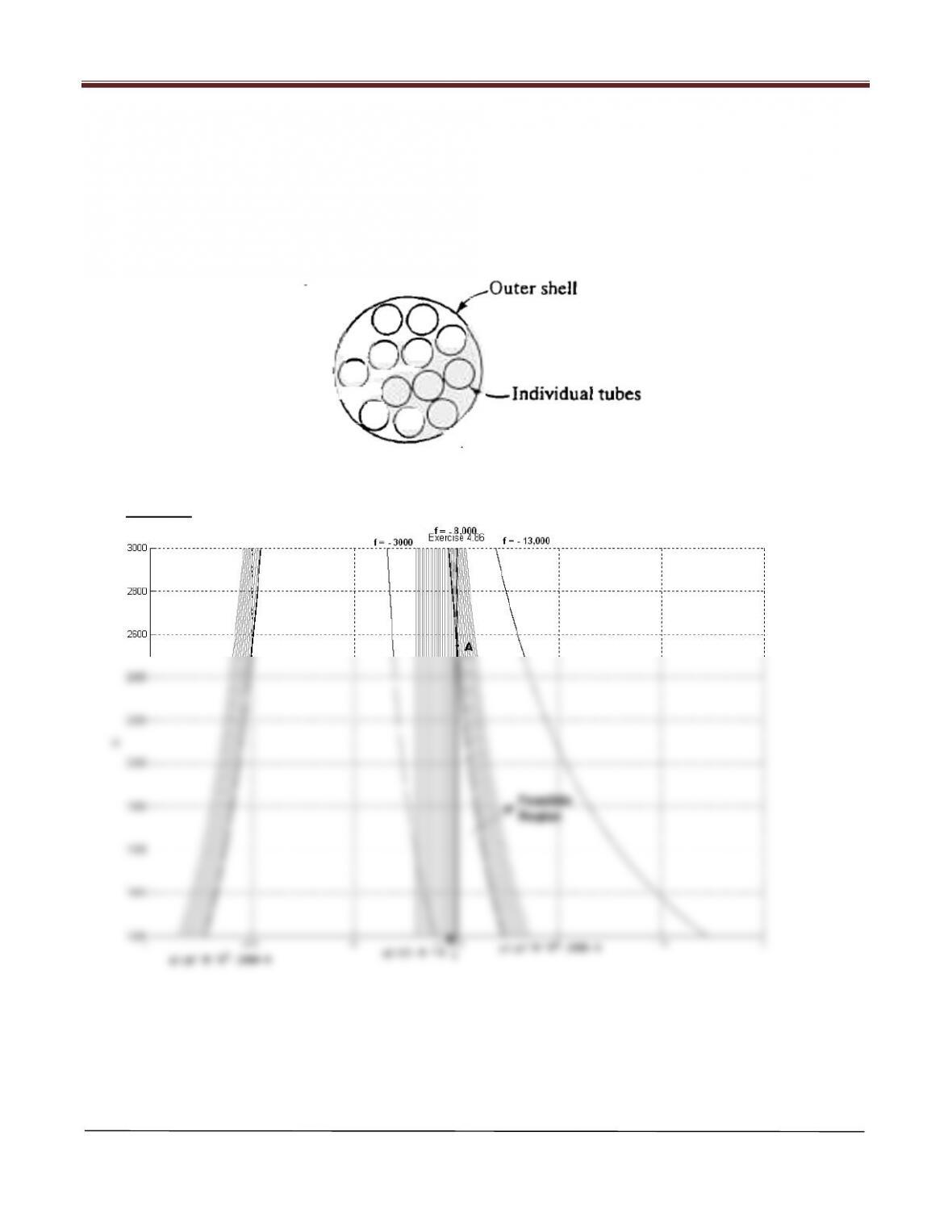
A company is redesigning its parallel flow heat exchanger of length l to increase its heat transfer. An
end view of the units is shown in Fig. E2.4. There are certain limitations on the design problem. The
smallest available conducting tube has a radius of 0.5 cm and all tubes must be of the same size.
Further, the total cross sectional area of all the tubes cannot exceed 2000cm2 to ensure adequate
space inside the outer shell. Formulate the problem to determine the number of tubes and the radius
of each tube to maximize the surface are of the tubes in the exchanger.
FIGURE E2.4 Cross section of heat exchanger.
Solution
Chapter 4 Optimum Design Concepts: Optimality Conditions
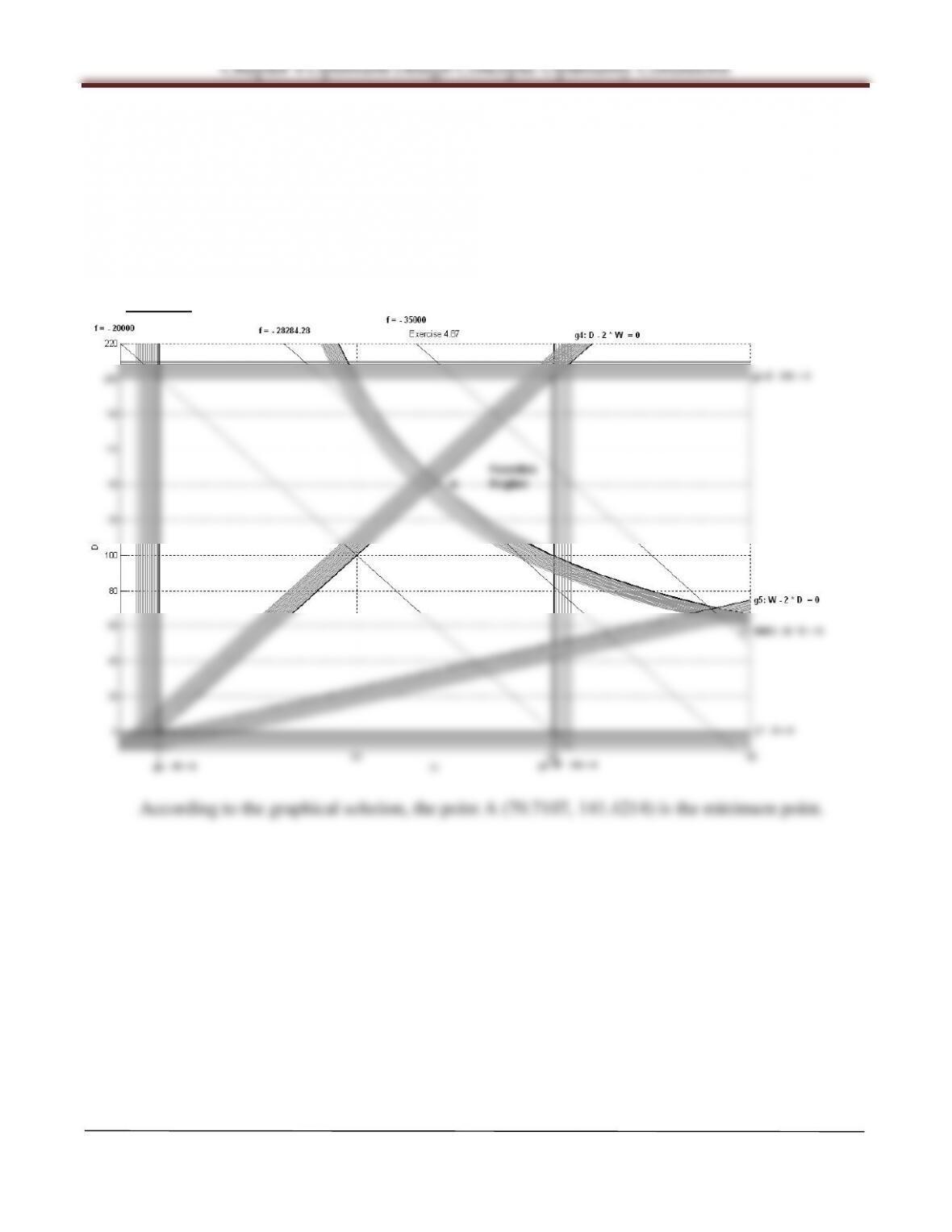
According to the graphical solution, the point A (0.5, 2546.5) is minimum point.
Referring to the formulation in Exercise 2.4, we have for unit length l = 1:
Minimize
NRNRlf π−=π−= 22
,
Chapter 4 Optimum Design Concepts: Optimality Conditions
MATLAB Code
clear all
[R,N]=meshgrid(–1:0.1:2, 1200:1:3000);
f=–2*pi*1*N.*R;
g1=0.5–R;
g2=pi*N.*R.^2–2000;
g3=–N;
cla reset
axis ([–1 2 1200 3000])
a=[0.5];
b=[2546.5];
Arora, Introduction to Optimum Design, 4e
4-65
4.87________________________________________________________________________________
Proposals for a parking ramp having been defeated, we plan to build parking lot in the downtown
urban renewal section. The cost of land is 200W + 100D, where W is the width along the street and
D the depth of the lot in meters. The available width along the street is 100m, while the maximum
depth available is 200 m. We want to have at least 10,000 m2 in the lot. To avoid unsightly lots, the
city requires that the longer dimension of any lot be no more than twice the shorter dimension.
Formulate the minimum cost design problem.
Solution
Chapter 4 Optimum Design Concepts: Optimality Conditions
Referring to the formulation in Exercise 2.5, we have
Minimize f = 200W + 100D
subject to
1
g 100 0=−≤W
2
g 200 0=−≤D
3
g 10,000 0= −≤WD
4
5
g 20
g 20
=−≤
=−≤
DW
WD
67
g 0; g 0WD=−≤ =−≤
( ) ( ) ( ) ( )
2
44
2
33
2
22
2
11
2000,10200100100200 sWDusWDusDusWuDWL +−++−++−++−++=
( ) ( ) ( )
2
77
2
66
2
55 2sDusWusDWu +−++−++−+
02100 ;02200 7543265431 =−−+−+=∂∂=−+−−+=∂∂ uuuWuuDLuuuDuuWL
There are in all 128 cases because there are 7 inequality constraints. We shall examine one case
which yields a solution. The case is identified as
0
76521 ===== uuuuu
, giving the solution
as
34
70 7107, 141 4214, 1 41421, 0, 28284 28W D u uf= = = = =. .. .
;all other constraints are
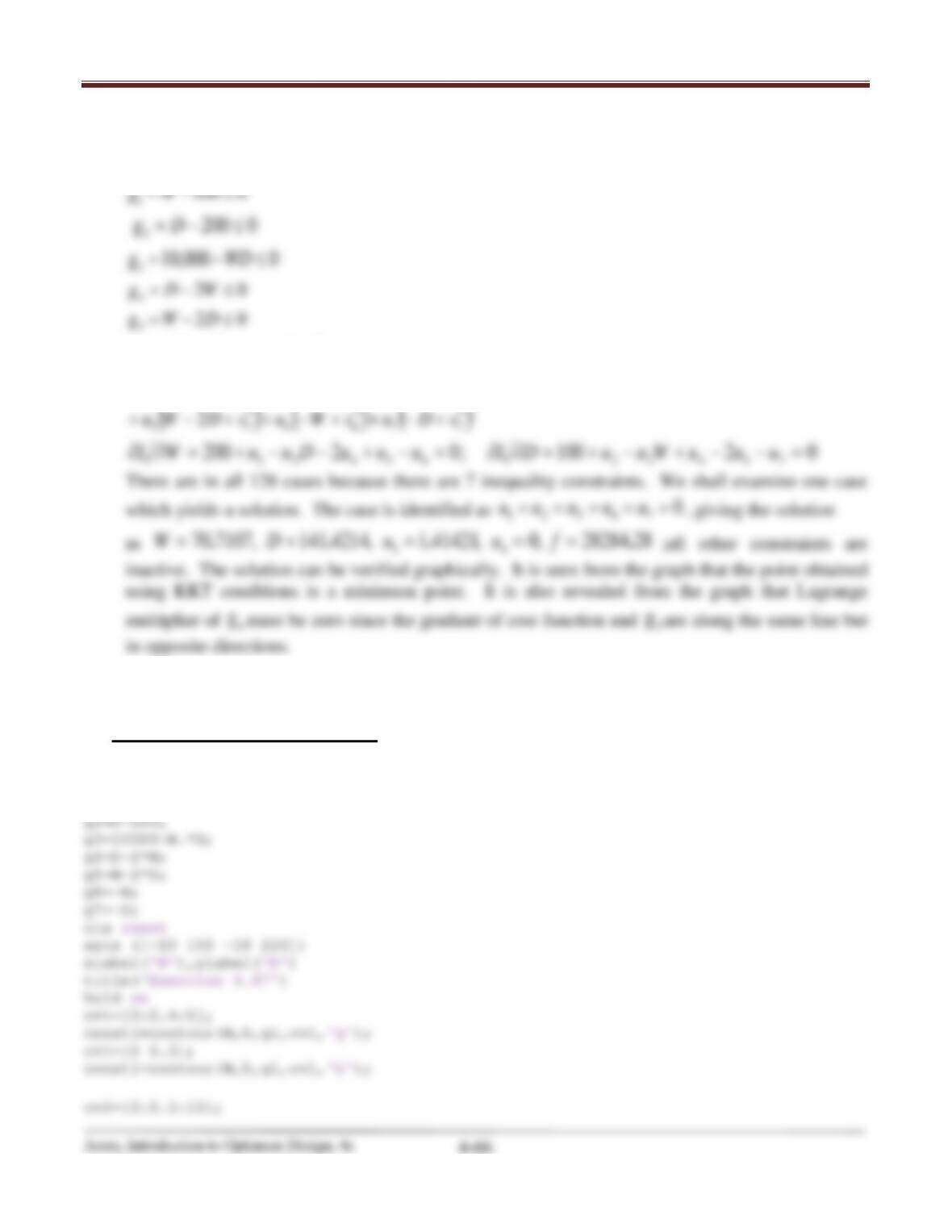
inactive. The solution can be verified graphically. It is seen from the graph that the point obtained
using KKT conditions is a minimum point. It is also revealed from the graph that Lagrange
multiplier of
4
g
must be zero since the gradient of cost function and
3
g
are along the same line but
in opposite directions.
MATLAB Code for Exercise 4.87
clear all
[W,D]=meshgrid(–10:5:150 , –10:10:220);
f=200*W+100*D;
g1=W–100;
Chapter 4 Optimum Design Concepts: Optimality Conditions
const2=contour(W,D,g2,cv2,‘g’);
cv2=[0 0.2];
const2=contour(W,D,g2,cv2,‘k’);
a=[70.7107];
b=[141.4214];
plot(a,b,‘.k’);
4.88________________________________________________________________________________
A manufacturer sells products A and B. Profit from A is $10/kg and from B $8/k g. Available raw
materials for the products are: 100 kg of C and 80 kg of D. To produce 1 kg of A, 0.4 kg of C and
0.6kg of D are needed. To produce 1 kg of B, 0.5kg of C and 0.5kg of D are needed. The markets for
the products are 70kg for A and 110kg for B. How much A and B should be produced to maximize
profit? Formulate the design optimization problem.
Solution
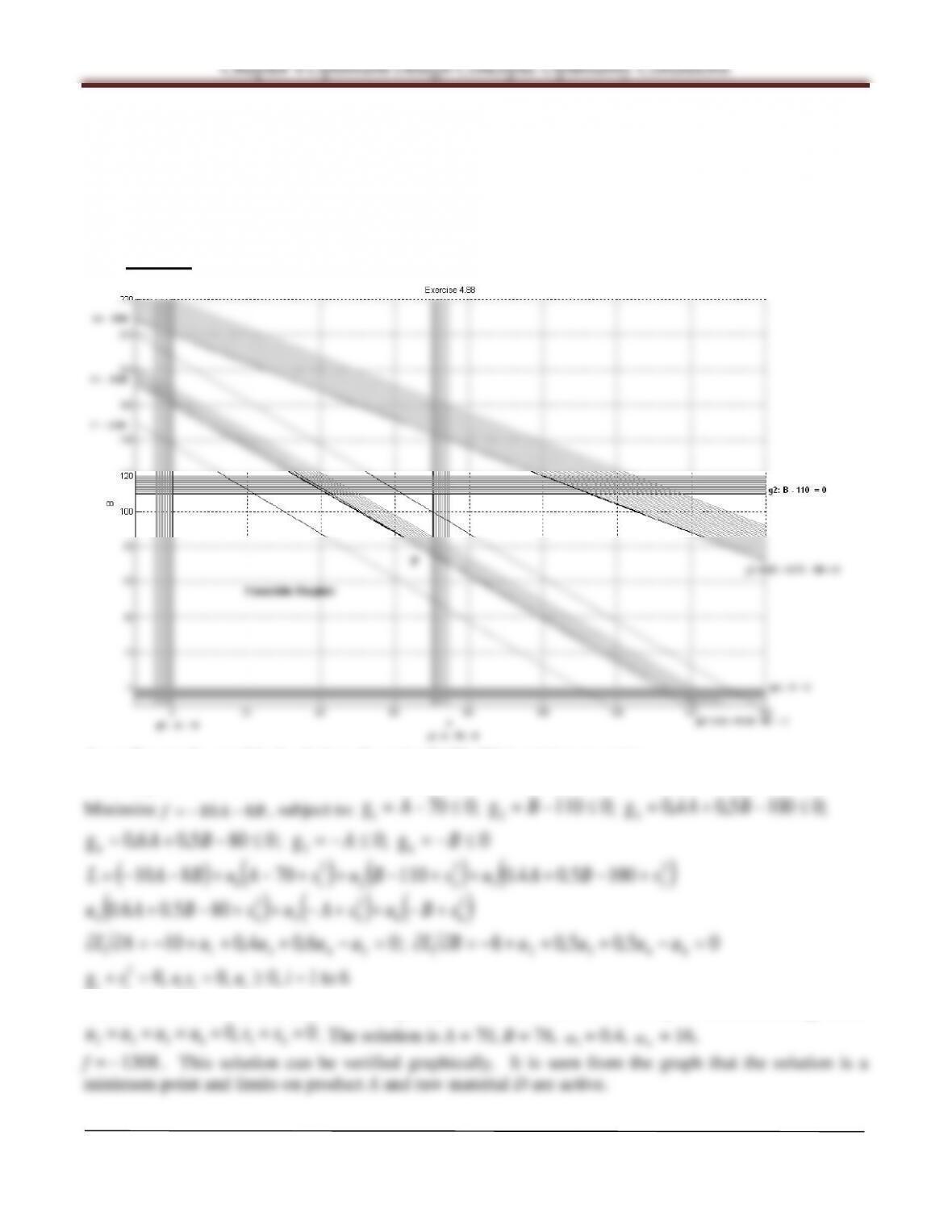
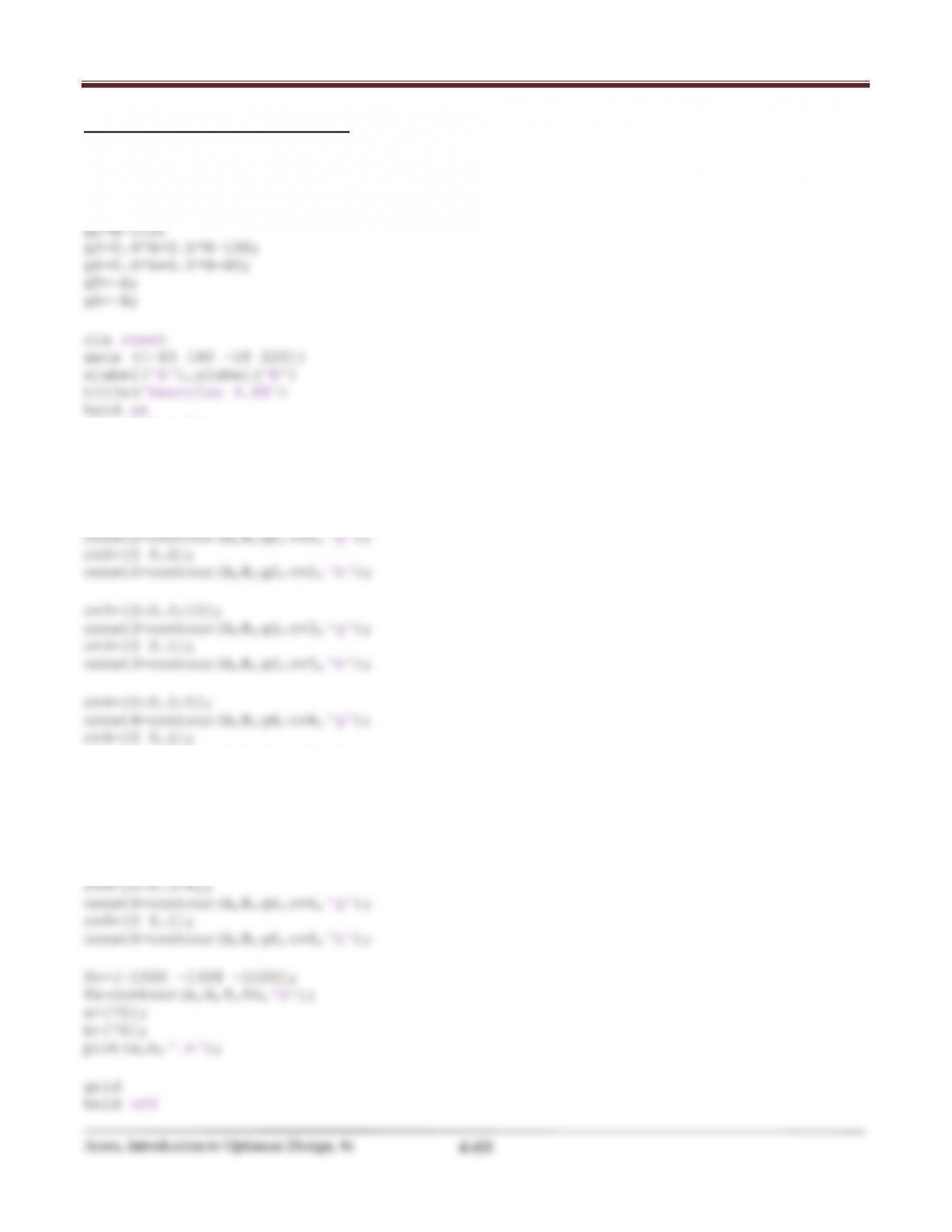
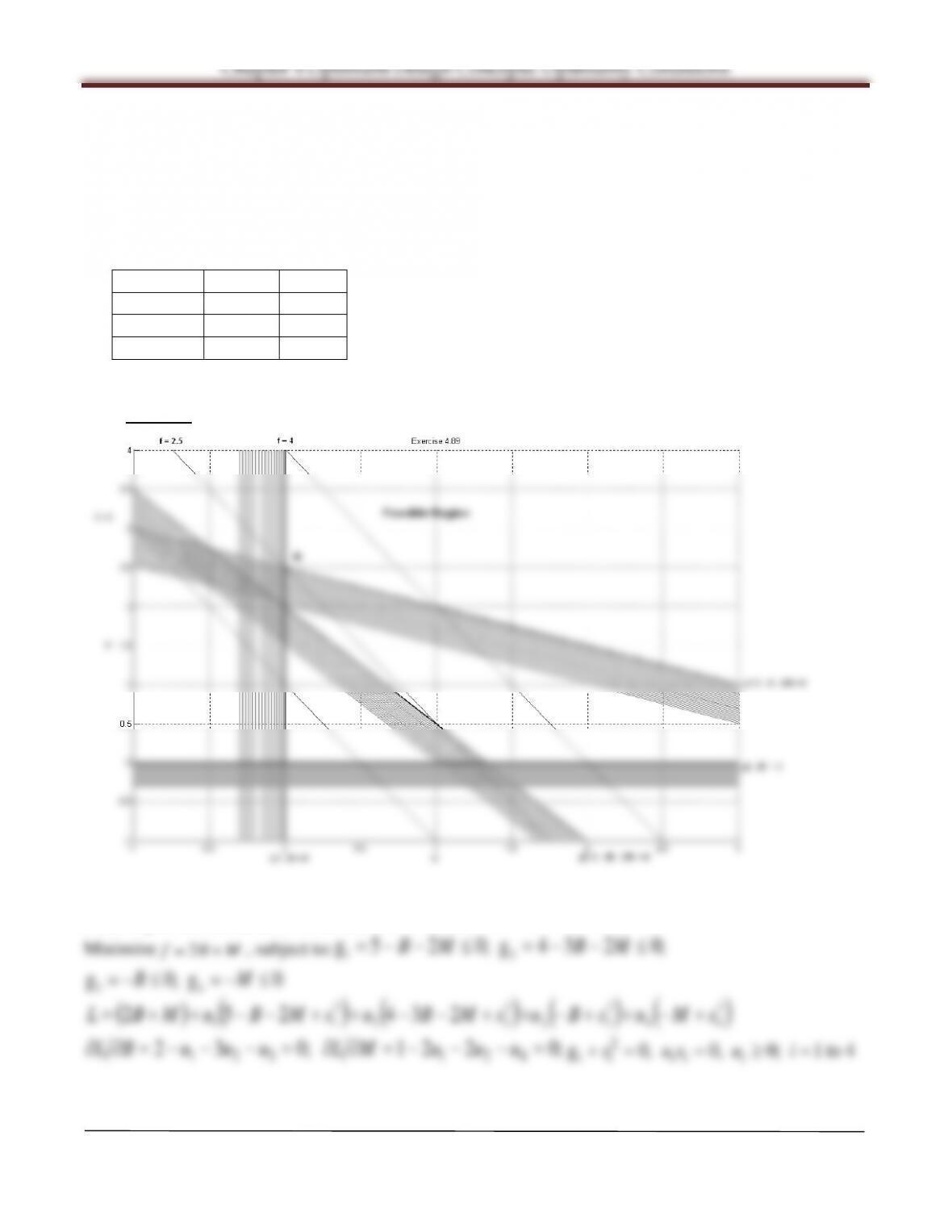
According to the graphical solution, the point P (70, 76) is minimum point.
Referring to the formulation in Exercise 2.6, we have
Chapter 4 Optimum Design Concepts: Optimality Conditions
MATLAB Code for Exercise 4.88
clear all
[A,B]=meshgrid(–10:5:160 , –10:5:220);
f=–10*A–8*B;
g1=A–70;
cv1=[0:0.4:5];
const1=contour(A,B,g1,cv1,‘g’);
cv1=[0 0.3];
const1=contour(A,B,g1,cv1,‘k’);
cv2=[0:0.5:10];
const4=contour(A,B,g4,cv4,‘k’);
cv5=[0:0.3:5];
const5=contour(A,B,g5,cv5,‘g’);
cv5=[0 0.1];
const5=contour(A,B,g5,cv5,‘k’);
Arora, Introduction to Optimum Design, 4e
4-70
4.89________________________________________________________________________________
Design a diet of bread and milk to get at least 5 units of vitamin A and 4 units of vitamin B each day.
The amount of vitamins A and B in 1kg of each food and the cost per kilogram of food are given in
Table E2.7. Formulate the design optimization problem so that we get at least the basic requirements
of vitamins at the minimum cost.
Table E2.7 Data for the Diet Problem
Vitamin
Bread
Milk
A
1
2
B
3
2
Cost/kg
2
1
Solution
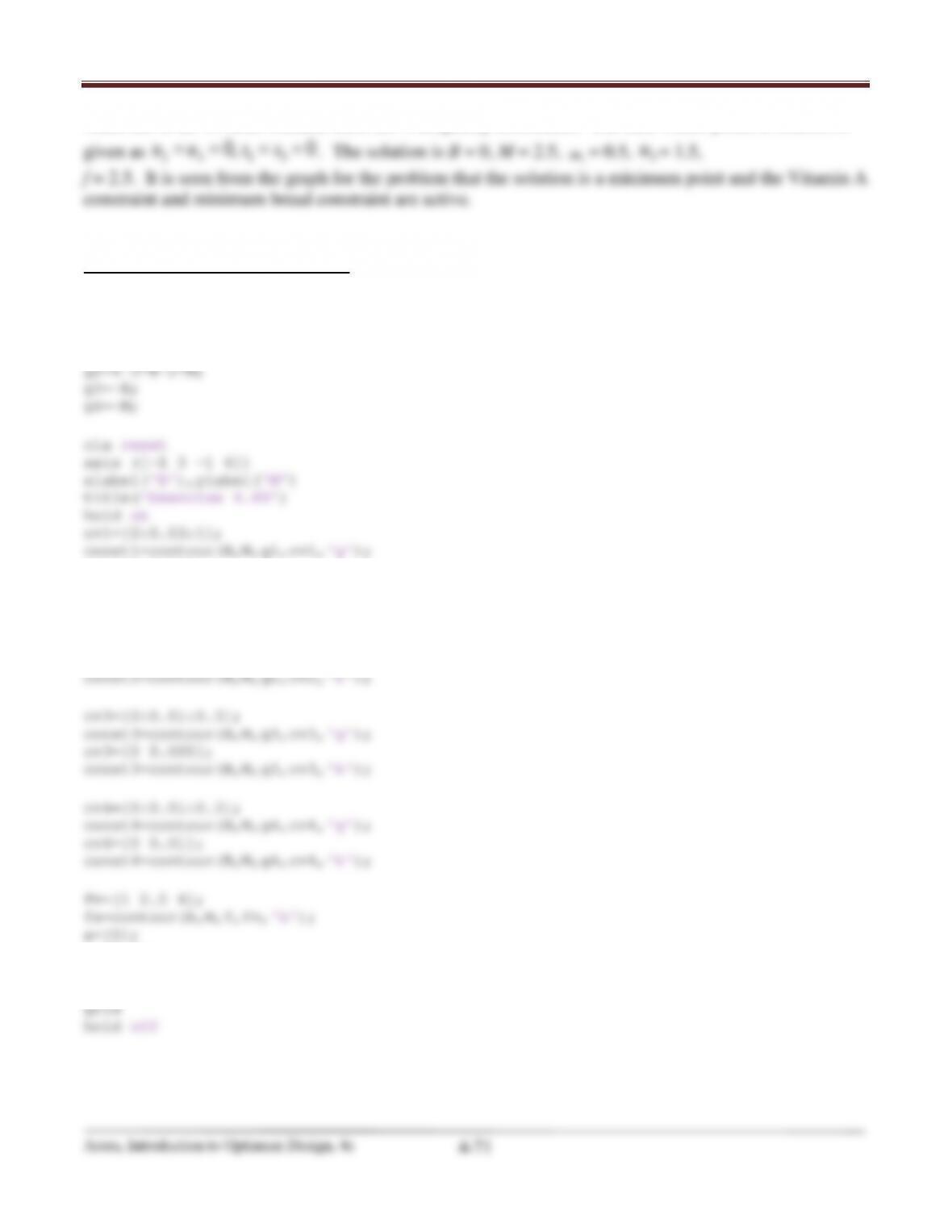
According to the graphical solution, the point A (0, 2.5) is minimum point.
Referring to the formulation in Exercise 2.7, we have
1 23 1 24
i
i ii i
Chapter 4 Optimum Design Concepts: Optimality Conditions
There are in all 16 cases because there are 4 inequality constraints. The case which yields a solution is
MATLAB Code for Exercise 4.89
clear all
[B,M]=meshgrid(–1:1:3 , –1:1:4);
f=2*B+M;
g1=5-B-2*M;
cv1=[0 0.01];
const1=contour(B,M,g1,cv1,‘k’);
cv2=[0:0.03:1];
const2=contour(B,M,g2,cv2,‘g’);
cv2=[0 0.01];
b=[2.5];
plot(a,b,‘.k’);
Arora, Introduction to Optimum Design, 4e
4-72
4.90________________________________________________________________________________
Enterprising chemical engineering students have set up a still in a bathtub. They can produce 225
bottles of pure alcohol each week. They bottle two products from alcohol: (i) wine, 20 proof, and (ii)
whiskey, 80 proof. Recall that pure alcohol is 200 proof. They have an unlimited supply of water but
can only obtain 800 empty bottles per week because of stiff competition. The weekly supply of sugar
is enough for either 600 bottles of wine or 1200 bottles of whiskey. They make $1.00 profit on each
bottle of wine and $2.00 profit on each bottle of whiskey. They can sell whatever they produce. How
many bottles of wine and whisky should they produce each week to maximize profit? Formulate the
design optimization problem. (created by D. Levy)
Solution
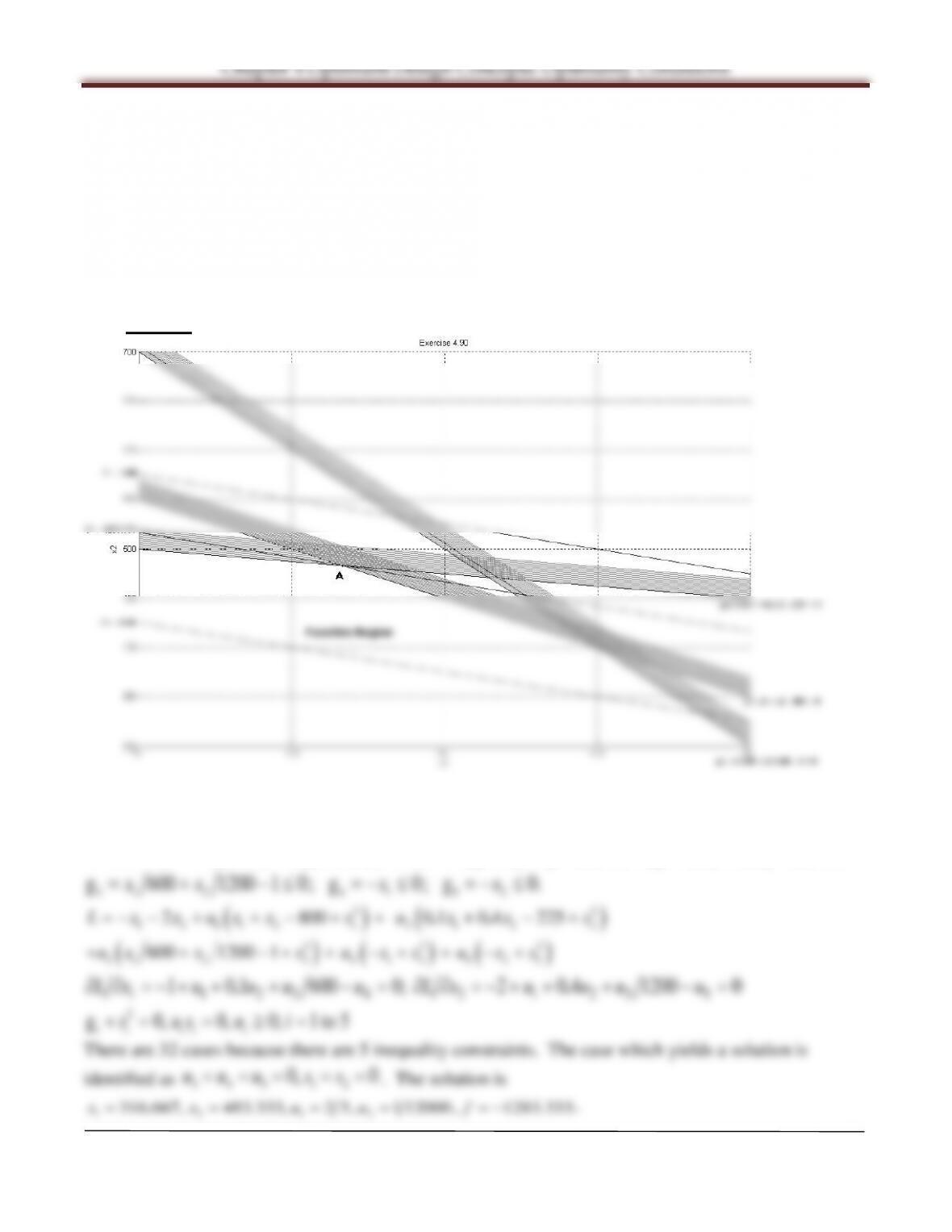
Note : 4=−x1,5=−x2 are not shown on the graph.
According to the graphical solution, the point A (316.667, 483.333) is minimum point.
Referring to the formulation in Exercise 2.8, we have
Minimize
( ) ( )
whiskey2wine 21 xxf −−=
, subject to
112
g 800 0xx=+− ≤
;
212
g 0 1 0 4 225 0xx= + −≤..
31 2 4 1 5 2
g 600 1200 1 0; g 0; g 0.xx x x= + −≤ =− ≤ =− ≤
( ) ( )
22
1 2 11 2 1 2 1 2 2
2 800 0 1 0 4 225L x x ux x s u x x s=−− + + − + + + − +..
( ) ( ) ( )
22 2
31 2 3 4 1 4 5 2 5
600 1200 1ux x suxsuxs+ + −++−++−+
1 1 23 4 2 1 23 5
1 0 1 600 0; 2 0 4 1200 0Lx u u u u Lx u u u u∂∂=−+ + + − = ∂∂ =−+ + + − =..
2
g 0, 0, 0; 1 to 5
i i ii i
s us u i+= = ≥ =
There are 32 cases because there are 5 inequality constraints. The case which yields a solution is
identified as
0 ,0 21543 ===== ssuuu
. The solution is
3331283 ,120001 ,32 ,333483 ,667316 2121 .fuu.x.x −=====
.
Arora, Introduction to Optimum Design, 4e
4-74
4.91________________________________________________________________________________
Design a can closed at the end using the smallest area of sheet metal for a specified interior volume
of 600 m3. The can is a right circular cylinder with interior height h and radius r. The ratio of
height to diameter must not be less than 1.0 and not greater than 1.5. The height cannot be more
than 20 cm. Formulate the design optimization problem.
Solution
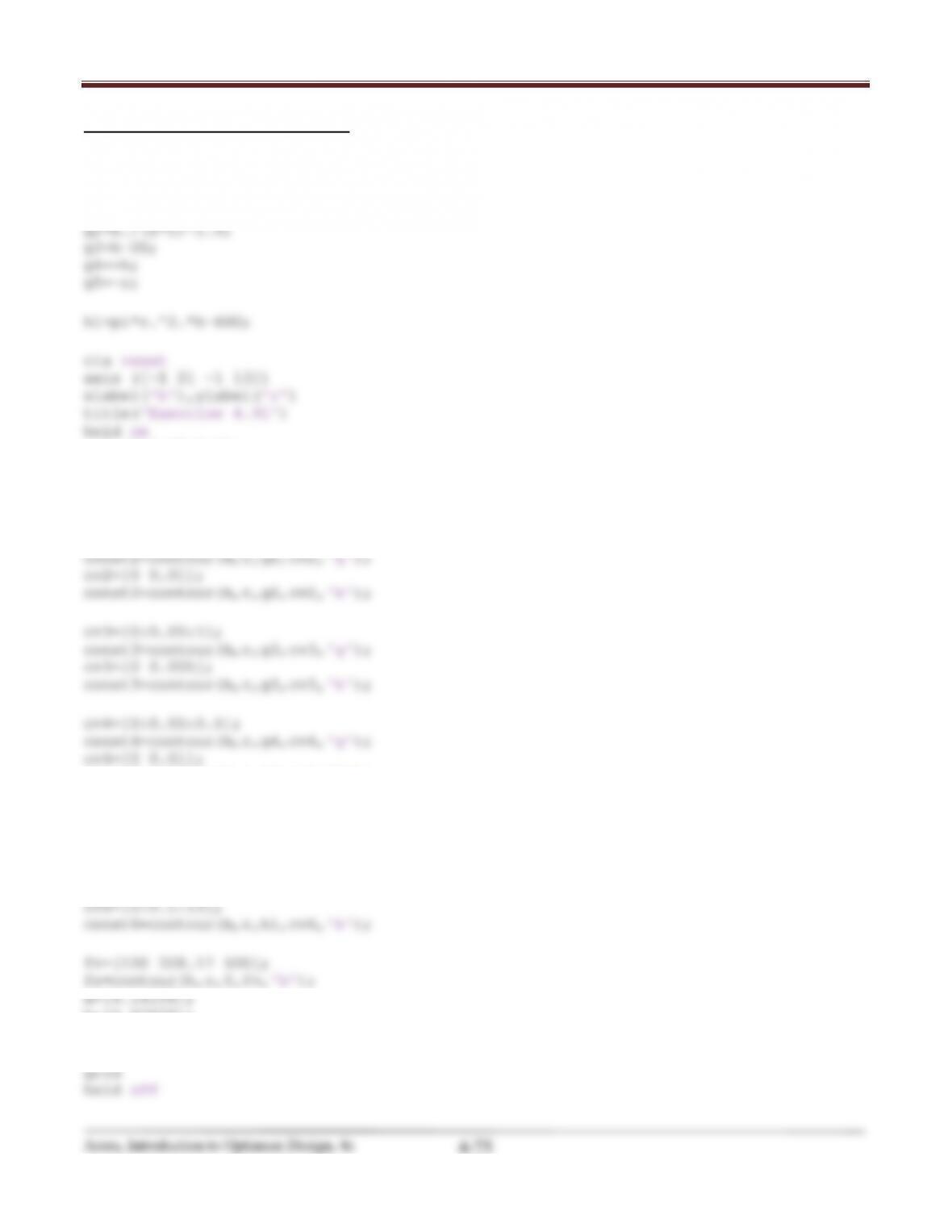
According to the graphical solution, the point A (9.14156, 4.57078) is minimum point.
Referring to the formulation in Exercise 2.9, we have
Minimize
rhrf π+π= 2
2
, subject to
2
11
h 600 0; g 1 2 0rh h r=π− = =− ≤
;
2
g 2 1 5 0;hr= −≤.
3 45
g 20 0; g 0; g 0h hr= − ≤ =−≤ =−≤
( ) ( ) ( )
2
22
2
11
2
1
2
512216002 srhusrhuhrvrhrL +−++−+−π+π+π= .
( ) ( ) ( )
2
55
2
44
2
33
20 srushushu +−++−++−+
( ) ( )
022222
5
2
2
2
11
=−−+π+π+π=∂∂ urhurhurhvhrrL
0222 43211
2=−++−π+π=∂∂ uururuvrrhL
22
1
h 600 0; g 0, 0, 0; 1 to 5
i i ii i
r h s us u i=π − = += = ≥ =
There are in all 32 cases because there are 5 inequality constraints. The case which yields a solution is
Chapter 4 Optimum Design Concepts: Optimality Conditions
MATLAB Code for Exercise 4.91
clear all
[h,r]=meshgrid(–1:0.1:21 , –1:0.1:13);
f=pi*r.^2+2*pi*r.*h;
g1=1–(h./(2*r));
cv1=[0:0.03:0.2];
const1=contour(h,r,g1,cv1,‘g’);
cv1=[0 0.001];
const1=contour(h,r,g1,cv1,‘k’);
cv2=[0:0.05:0.5];
const4=contour(h,r,g4,cv4,‘k’);
cv5=[0:0.05:3];
const5=contour(h,r,g5,cv5,‘g’);
cv5=[0 0.1];
const5=contour(h,r,g5,cv5,‘k’);
b=[4.57078];
plot(a,b,‘.k’);