Arora, Introduction to Optimum Design, 4e 2-1
CHAPTER
2
Optimum Design Problem Formulation
2.1___________________________________________________________________________
A 100 ×100 m lot is available to construct a multistory office building. At least 20,000 m2 total floor
space is needed. According to a zoning ordinance, the maximum height of the building can be only
21 m, and the area for parking outside the building must be at least 25 percent of the total floor area
of all the stories. It has been decided to fix the height of each story at 3.5 m. The cost of the building
in millions of dollars is estimated at 0.6h +0.001A, where A is the cross-sectional area of the building
per floor and h is the height of the building. Formulate the minimum cost design problem.
Solution
Given: The lot size, building floor space and parking area requirements, and the data given in the
Step 1: Project/Problem Statement
Shown above
Step 2: Data and Information Collection
Area of the lot =100×100 = 10,000 m2
Step 3: Definition of Design Variables
A = cross–sectional area of the building for each floor, m2
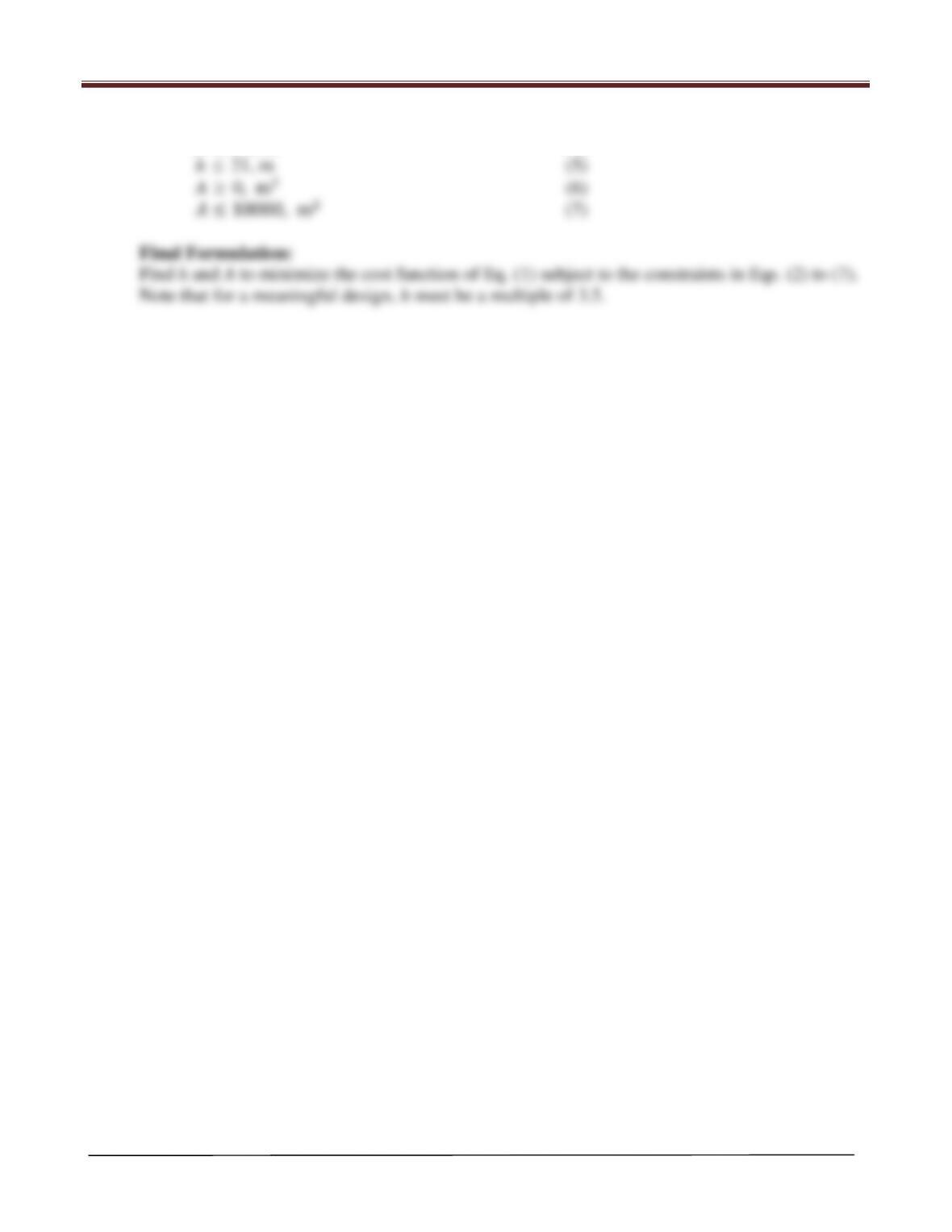
Step 4: Optimization Criterion
Step 5: Formulation of Constraints
Floor Space Constraint:
Chapter 2 Optimum Design Problem Formulation
Arora, Introduction to Optimum Design, 4e
2-2
Explicit Design Variable Constraints:
h
≥
3.5, m (4)
≥
≤
Chapter 2 Optimum Design Problem Formulation
Arora, Introduction to Optimum Design, 4e
2-3
2.2_________________________________________________________________________________
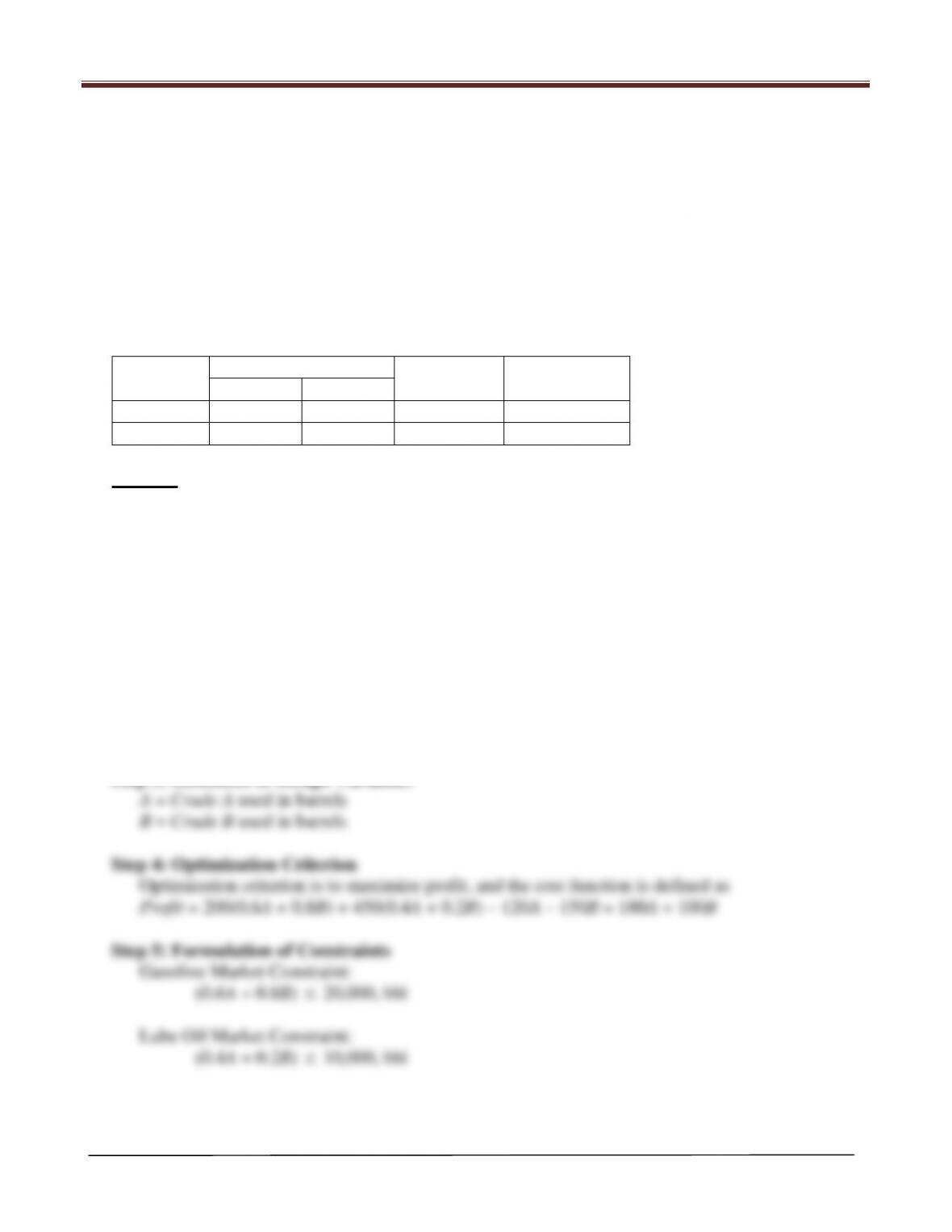
A refinery has two crude oils:
1. Crude A costs $120/barrel (bbl) and 20,000 bbl are available.
2. Crude B costs $150/bbl and 30,000 bbl are available.
The company manufactures gasoline and lube oil from the crudes. Yield and sale price barrel of the
product and markets are shown in Table E2.2. How much crude oils should the company use to
maximize its profit? Formulate the optimum design problem.
Table E2.2 Data for Refinery Operation
Product
Yield/bbl
Sale Price
per bbl ($)
Market (bbl)
Crude A
Crude B
Gasoline
0.6
0.8
200
20,000
Lube oil
0.4
0.2
450
10,000
Solution
Given: The cost of two crude oils per barrel, the amount of barrels available for each type, and all
information shown in Table E2.2.
Required: It is desired to find the amount of each crude oil which should be used, subject to the
above constraints, to maximize profit.
Procedure: We follow the five step process to formulate the problem as an optimization problem.
Step 1: Problem Statement
Shown above
Step 2: Data and Information Collection
Shown above
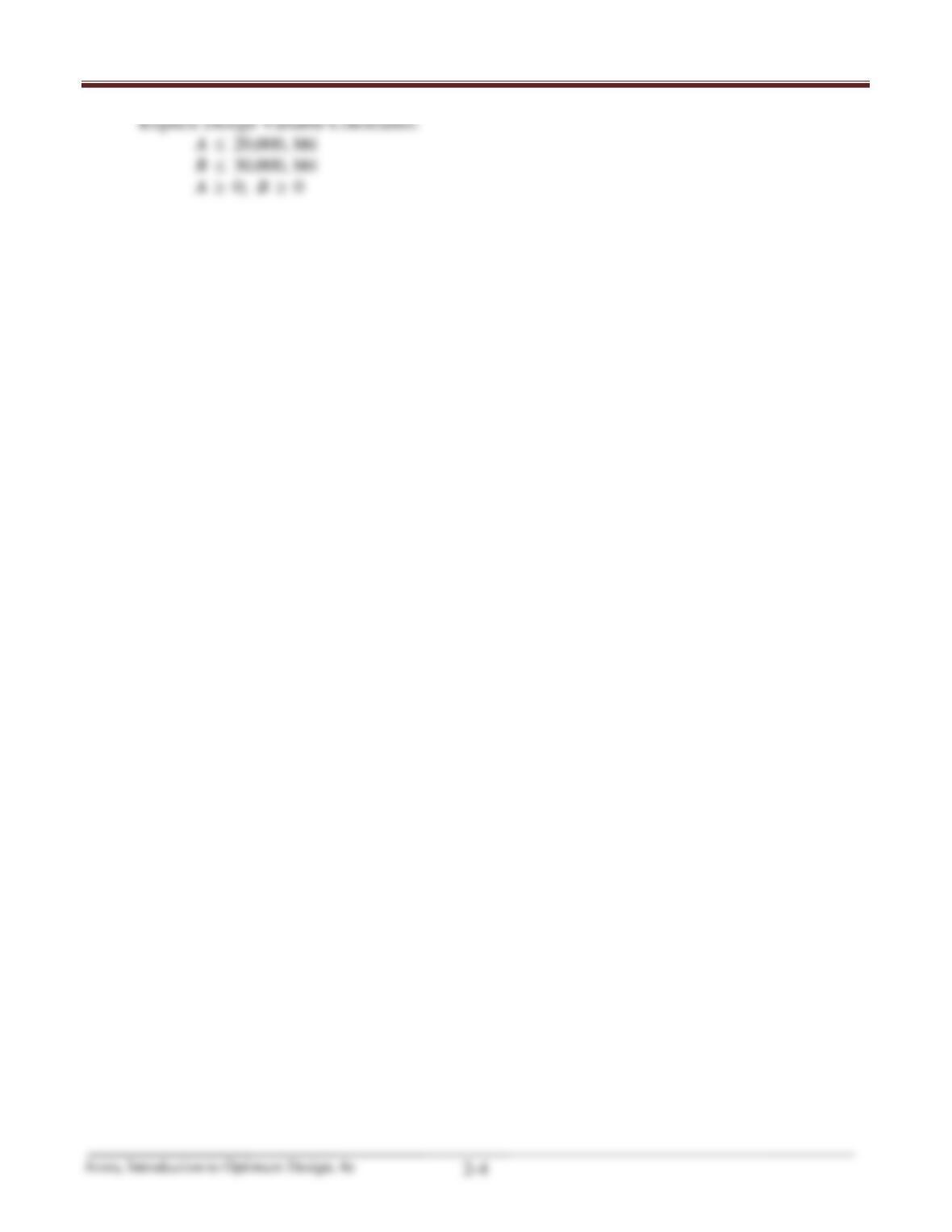
Step 3: Definition of Design Variables
Chapter 2 Optimum Design Problem Formulation
Arora, Introduction to Optimum Design, 4e
2-4
Explicit Design Variable Constraints:
A
≤
20,000, bbl
B
≤
30,000, bbl
A
≥
0; B
≥
0
Arora, Introduction to Optimum Design, 4e
2-5
2.3_________________________________________________________________________________
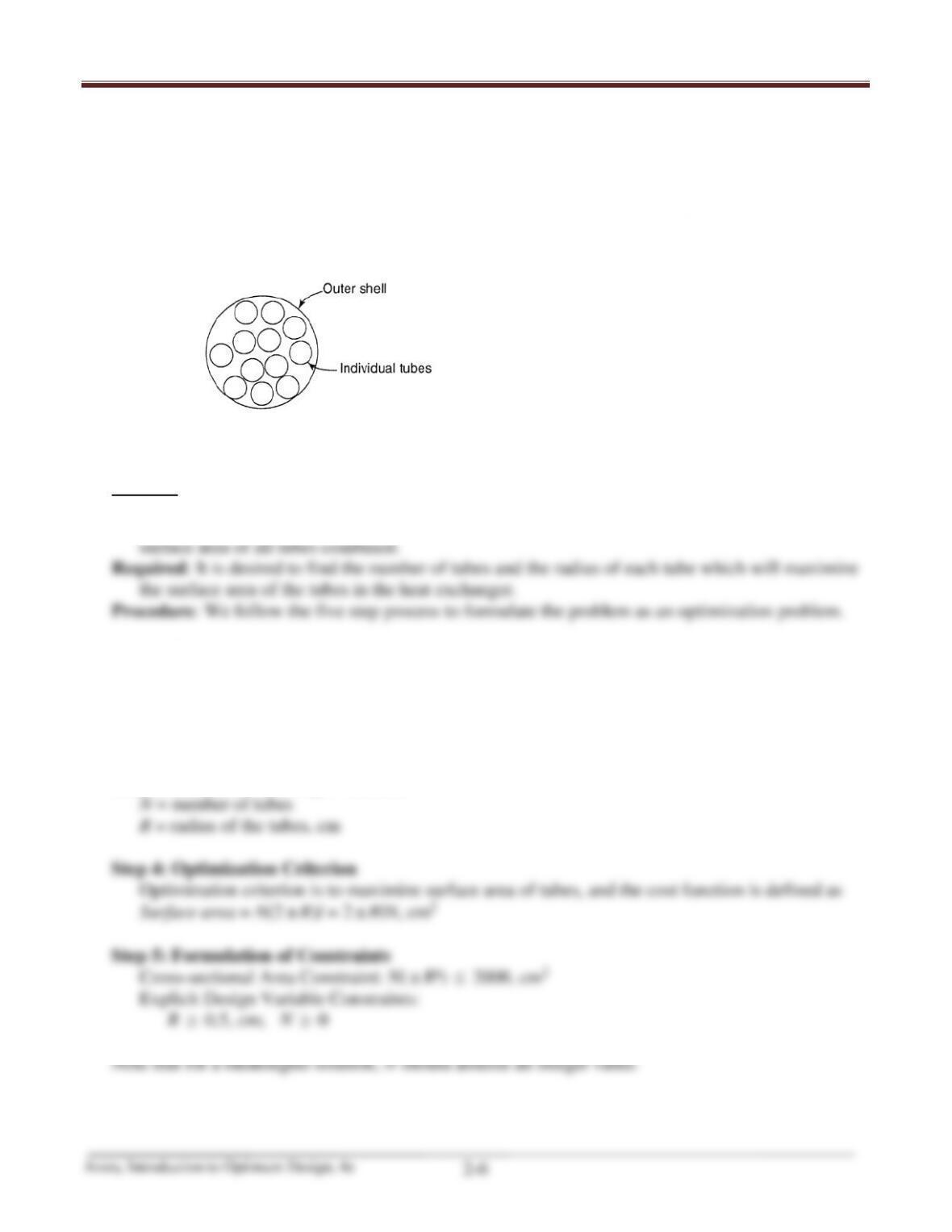
Design a beer bug, shown in Fig. E2.3, to hold as much beer as possible. The height and radius of
the mug should be not more than 20 cm. The mug must be at least 5 cm in radius. The surface area
of the sides must not be greater than 900 cm2 (ignore the area of the bottom of the mug and ignore
the mug handle – see figure). Formulate the optimum design problem.
FIGURE E2.3 Beer mug.
Solution
Given: The maximum and minimum radius of the mug, the maximum height of the mug, and the
Step 1: Problem Statement
Shown above
Step 2: Data and Information Collection
Shown above
Step 3: Definition of Design Variables
R = radius of the mug in cm
Chapter 2 Optimum Design Problem Formulation
2.4_________________________________________________________________________________
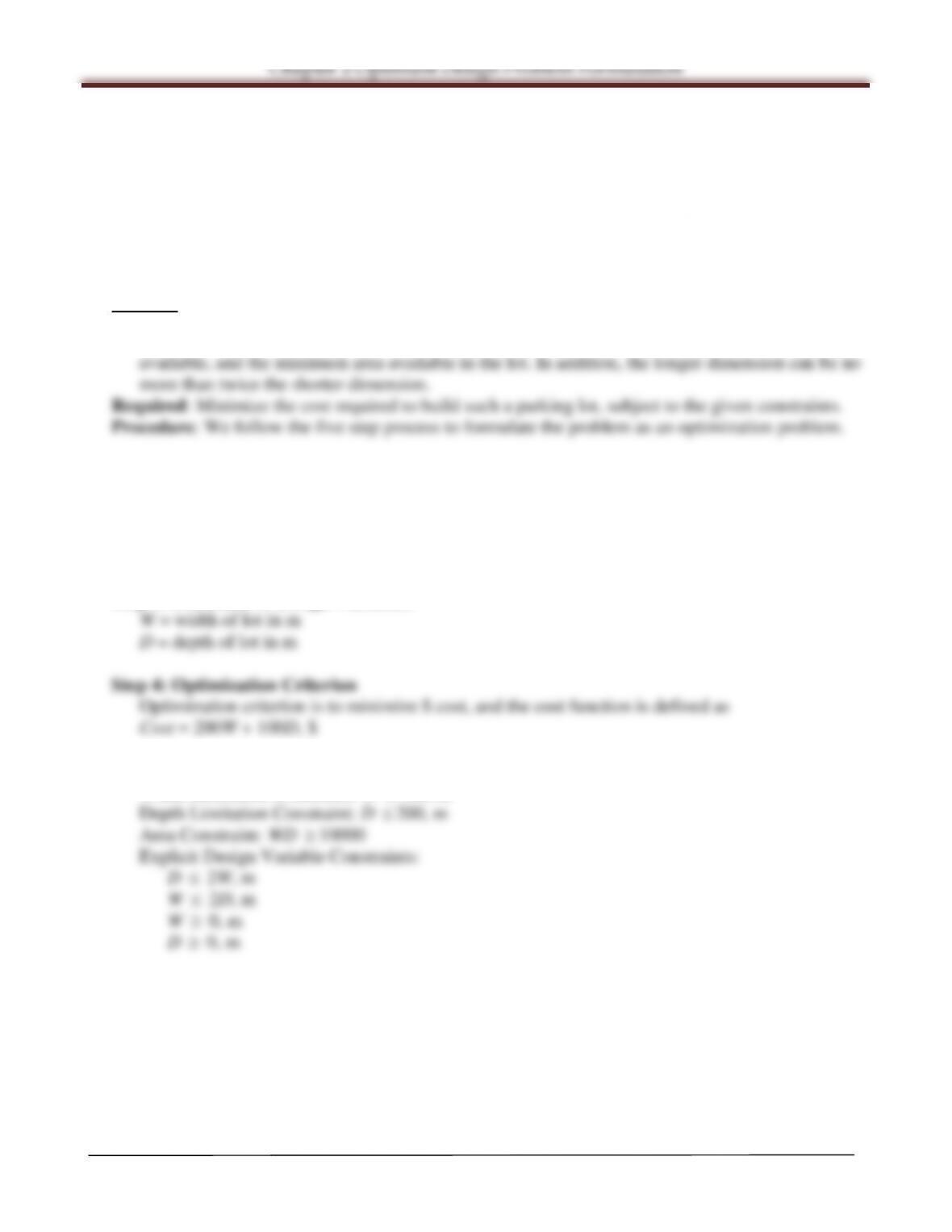
A company is redesigning its parallel flow heat exchanger of length l to increase its heat transfer. An
end view of the units is shown in Fig. E2.4. There are certain limitations on the design problem. The
smallest available conducting tube has a radius of 0.5 cm and all tubes must be of the same size.
Further, the total cross sectional area of all the tubes cannot exceed 2000 cm2 to ensure adequate
space inside the outer shell. Formulate the problem to determine the number of tubes and the radius
of each tube to maximize the surface area of the tubes in the exchanger.
FIGURE E2.4 Cross section of heat exchanger.
Solution
Given: The minimum radius of each tube, the similarity between each tube, and the maximum
Step 1: Problem Statement
Shown above
Step 2: Data and Information Collection
Shown above
Step 3: Definition of Design Variables
Arora, Introduction to Optimum Design, 4e
2-7
2.5_________________________________________________________________________________
Proposals for a parking ramp have been defeated, so we plan to build parking lot in the downtown
urban renewal section. The cost of land is 200W + 100D, where W is the width along the street and D
the depth of the lot in meters. The available width along the street is 100 m, while the maximum
depth available is 200 m. We want to have at least 10,000 m2 in the lot. To avoid unsightliness, the
city requires that the longer dimension of any lot be no more than twice the shorter dimension.
Formulate the minimum–cost design problem.
Solution
Given: The cost of land in the downtown urban renewal section, the maximum width and depth
Step 1: Problem Statement
Shown above
Step 2: Data and Information Collection
Shown above
Step 3: Definition of Design Variables
Step 5: Formulation of Constraints
Width Limitation Constraint: W
≤
100, m
≤
≥
≤
≤
≥
Chapter 2 Optimum Design Problem Formulation
Arora, Introduction to Optimum Design, 4e
2-8
2.6_________________________________________________________________________________
A manufacturer sells products A and B. Profit from A is $10/kg and is $8/kg from B. Available raw
materials for the products are 100 kg of C and 80 kg of D. To produce 1 kg of A, we need 0.4 kg of
C and 0.6kg of D. To produce 1 kg of B, we need 0.5 kg of C and 0.5 kg of D. The markets for the
products are 70 kg for A and 110 kg for B. How much A and B should be produced to maximize
profit? Formulate the design optimization problem.
Solution
Given: The profits from selling products A and B, the amount of raw material available of products
Step 1: Problem Statement
Shown above
Step 2: Data and Information Collection
Shown above
Step 3: Definition of Design Variables
Step 5: Formulation of Constraints
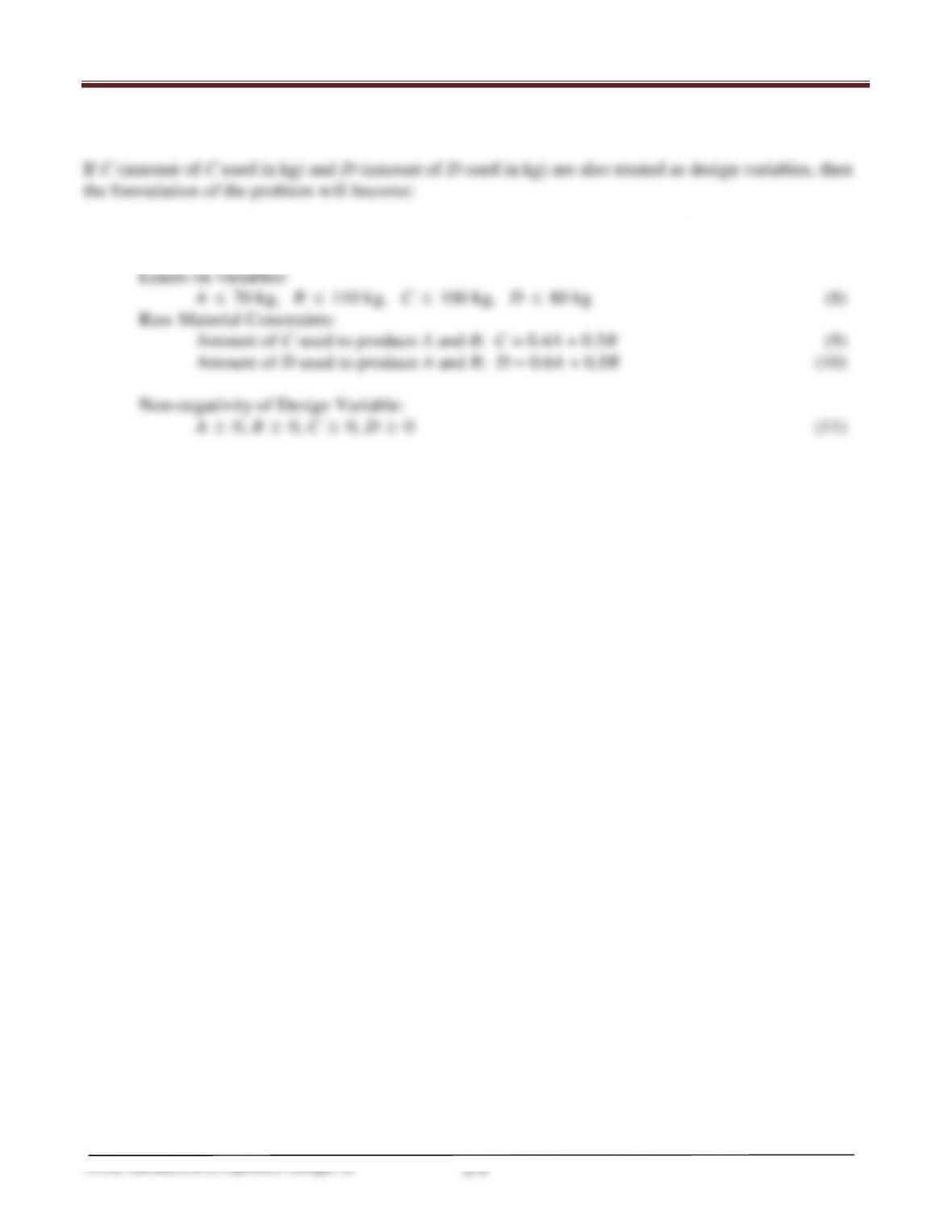
Limits on Products Constraints:
Chapter 2 Optimum Design Problem Formulation
Alternate Formulation
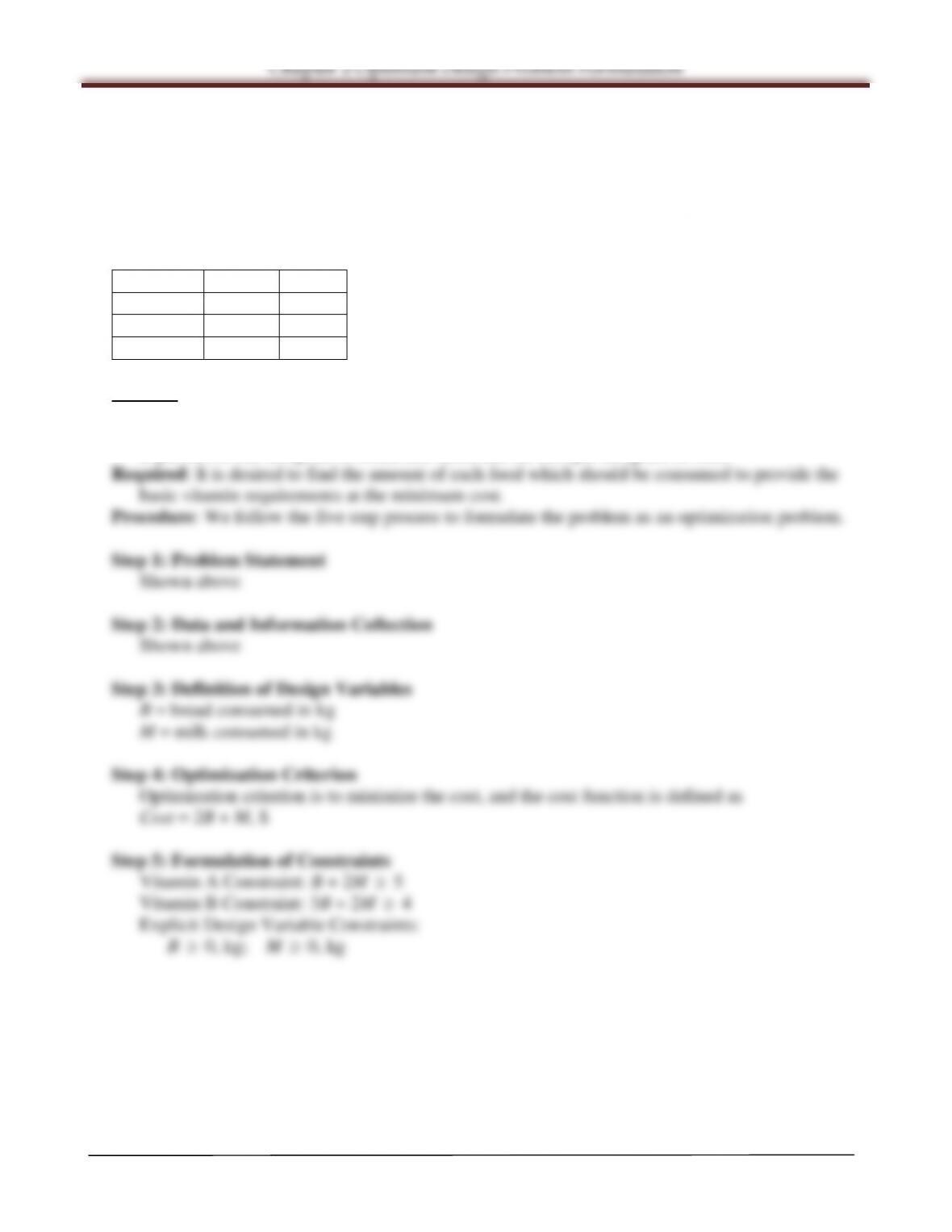
Formulation: Find A, B, C, and D to maximize the profit in Eq. (1) subject to the constraints:
Arora, Introduction to Optimum Design, 4e
2-10
2.7_________________________________________________________________________________
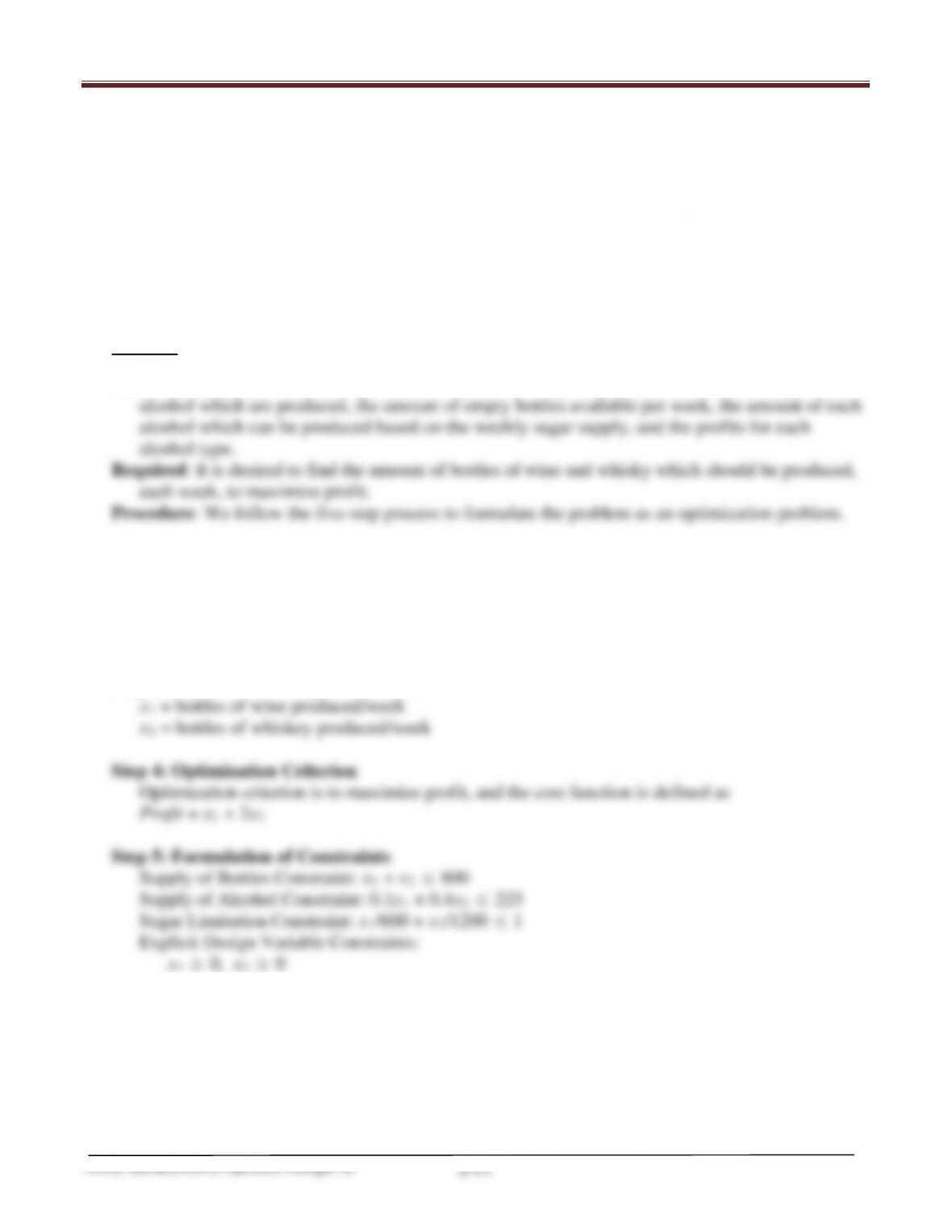
Design a diet of bread and milk to get at least 5 units of vitamin A and 4 units of vitamin B each day.
The amount of vitamins A and B in 1 kg of each food and the cost per kilogram of food are given in
Table E2.7. Formulate the design optimization problem so that we get at least the basic requirements
of vitamins at the minimum cost.
Table E2.7 Data for the Diet Problem
Vitamin
Bread
Milk
A
1
2
B
3
2
Cost/kg
2
1
Solution
Given: The minimum amount of vitamins A and B required each day, the amount of vitamins A and
B present in one kilogram of bread and milk, and the cost per kilogram of food.
Chapter 2 Optimum Design Problem Formulation
2.8_________________________________________________________________________________
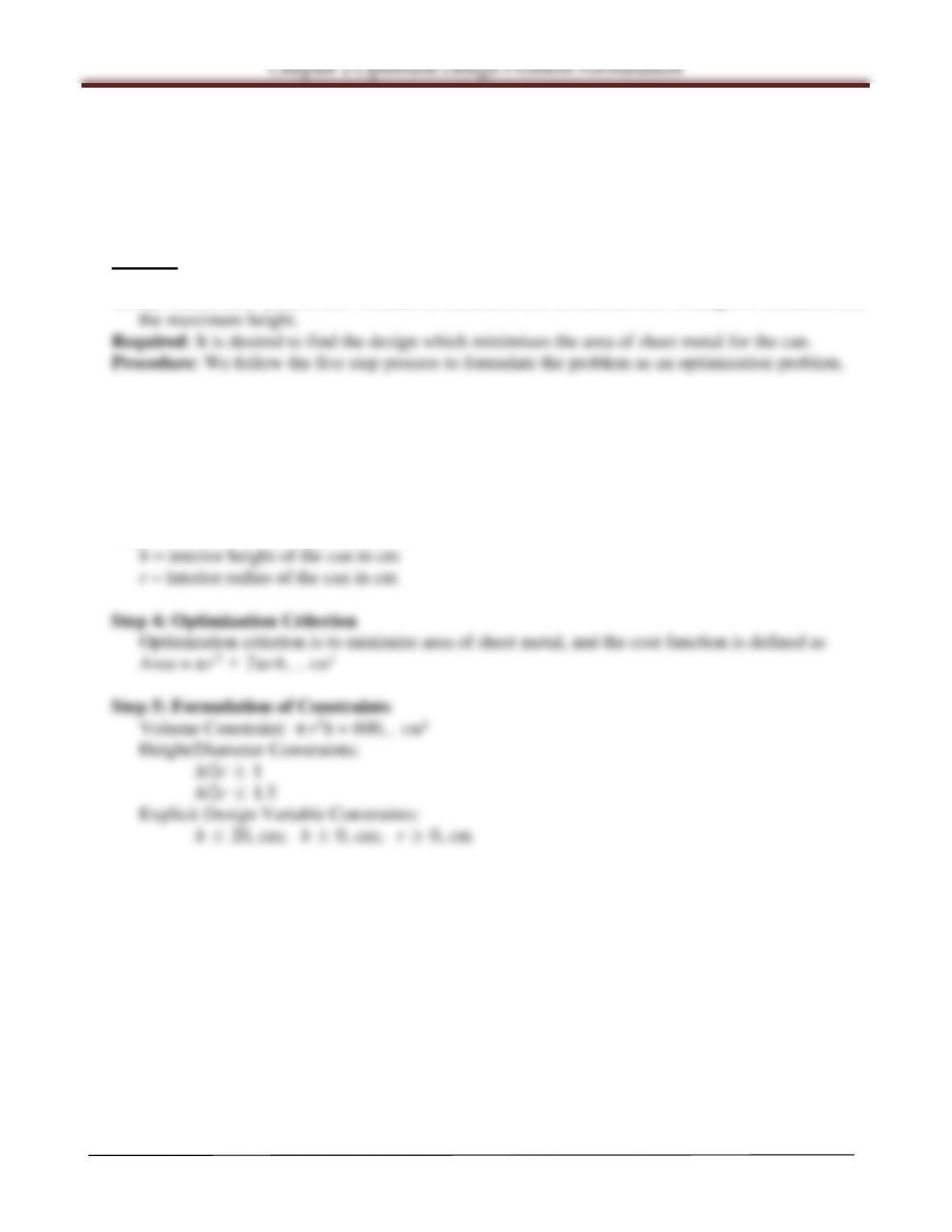
Enterprising engineering students have set up a still in a bathtub. They can produce 225 bottles of
pure alcohol each week. They bottle two products from alcohol: (i) wine, 20 proof, and (ii) whiskey,
80 proof. Recall that pure alcohol is 200 proof. They have an unlimited supply of water but can only
obtain 800 empty bottles per week because of stiff competition. The weekly supply of sugar is
enough for either 600 bottles of wine or 1200 bottles of whiskey. They make $1.00 profit on each
bottle of wine and $2.00 profit on each bottle of whiskey. They can sell whatever they produce. How
many bottles of wine and whisky should they produce each week to maximize profit? Formulate the
design optimization problem. (created by D. Levy)
Solution
Given: The amount of bottles of pure alcohol which can be produced each week, the two types of
Step 1: Problem Statement
Shown above
Step 2: Data and Information Collection
Shown above
Step 3: Definition of Design Variables
Arora, Introduction to Optimum Design, 4e
2-12
2.9_________________________________________________________________________________
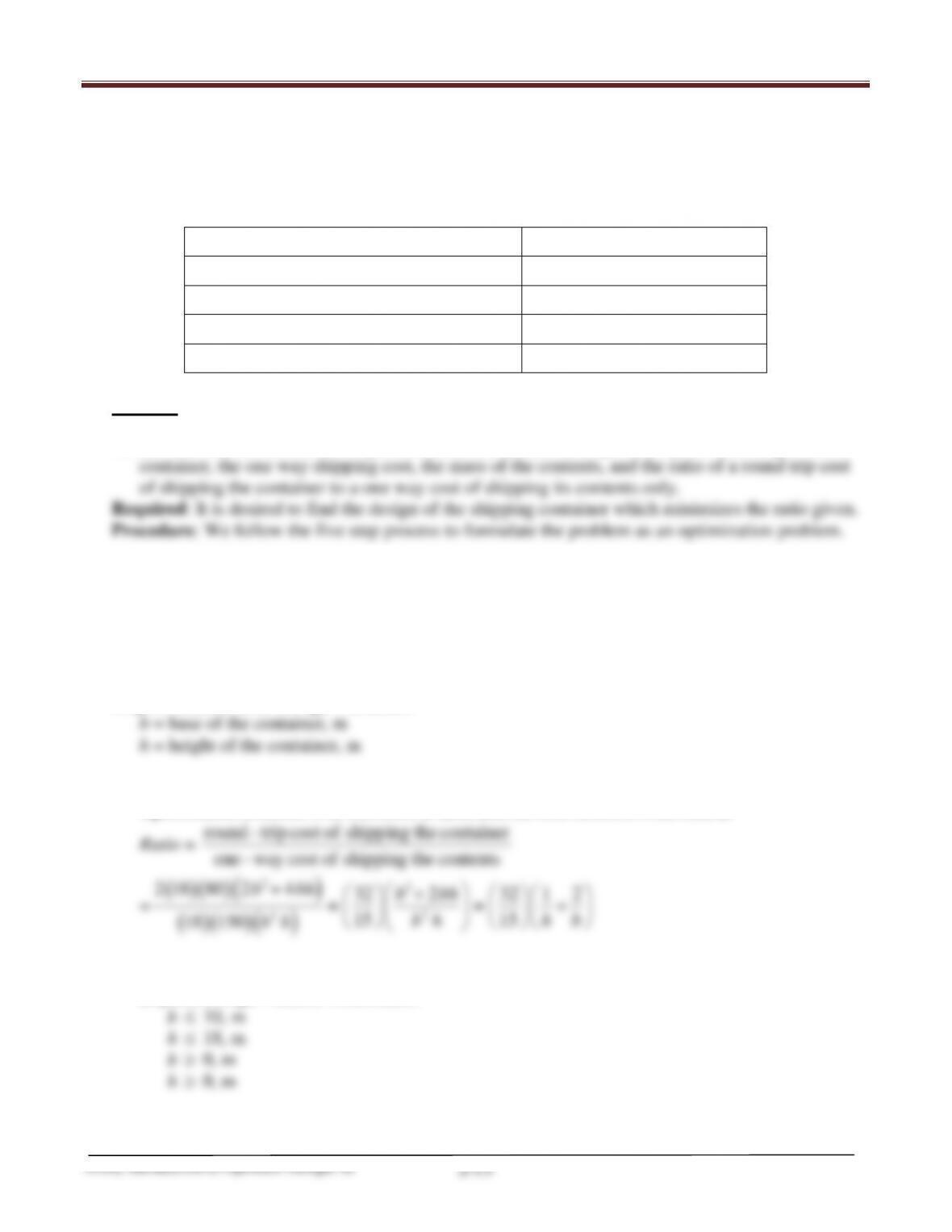
Design a can closed at one end using the smallest area of sheet metal for a specified interior volume
of 600 cm3. The can is a right circular cylinder with interior height h and radius r. The ratio of height
to diameter must not be less than 1.0 nor greater than 1.5. The height cannot be more than 20 cm.
Formulate the design optimization problem.
Solution
Given: The desired interior can volume, the minimum and maximum ratio of height to diameter, and
Step 1: Problem Statement
Shown above
Step 2: Data and Information Collection
Shown above
Step 3: Definition of Design Variables
Chapter 2 Optimum Design Problem Formulation
2.10________________________________________________________________________________
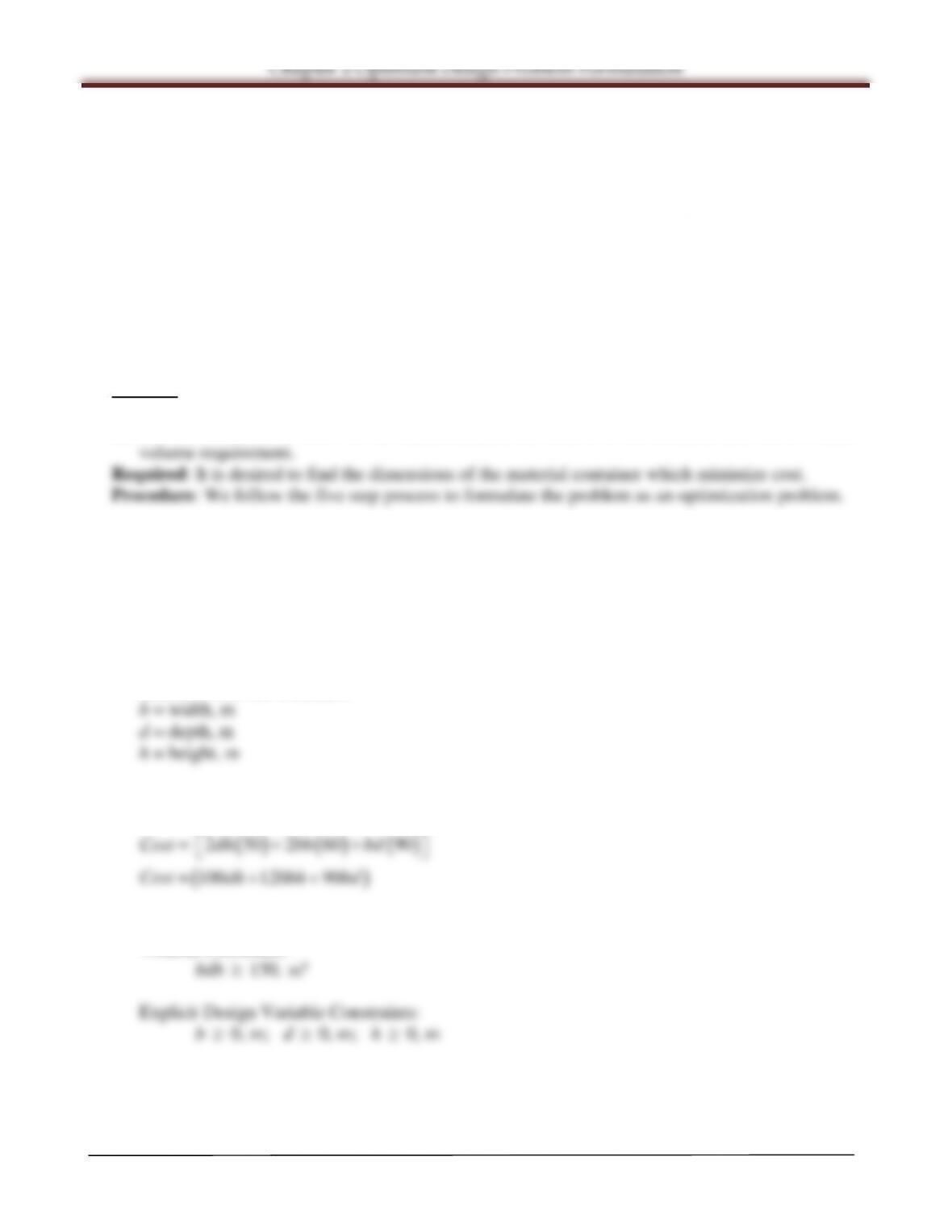
Design a shipping container closed at both ends with dimensions b × b × h to minimize the ratio:
(round-trip cost of shipping the container only)/(one-way cost of shipping the contents only).
Use the data in the following table. Formulate the design optimization problem.
Mass of the container/surface area 80 kg/ m
2
Maximum
b
10 m
Maximum h 18 m
One-way shipping cost, full or empty $18/kg gross mass
Mass of the contents
150 kg/ m
3
Solution
Given: The mass of the container per unit area, the maximum height and square base length of the
Step 1: Problem Statement
Shown above
Step 2: Data and Information Collection
Shown above
Step 3: Definition of Design Variables
Step 4: Optimization Criterion
Optimization criterion is to minimize a ratio, and the cost function is defined as
container theshipping ofcost trip–round
( )( )
( )
2
2
15 15
18 150
hb
bh
bh
Step 5: Formulation of Constraints
Explicit Design Variable Constraints:
Arora, Introduction to Optimum Design, 4e
2-14
2.11________________________________________________________________________________
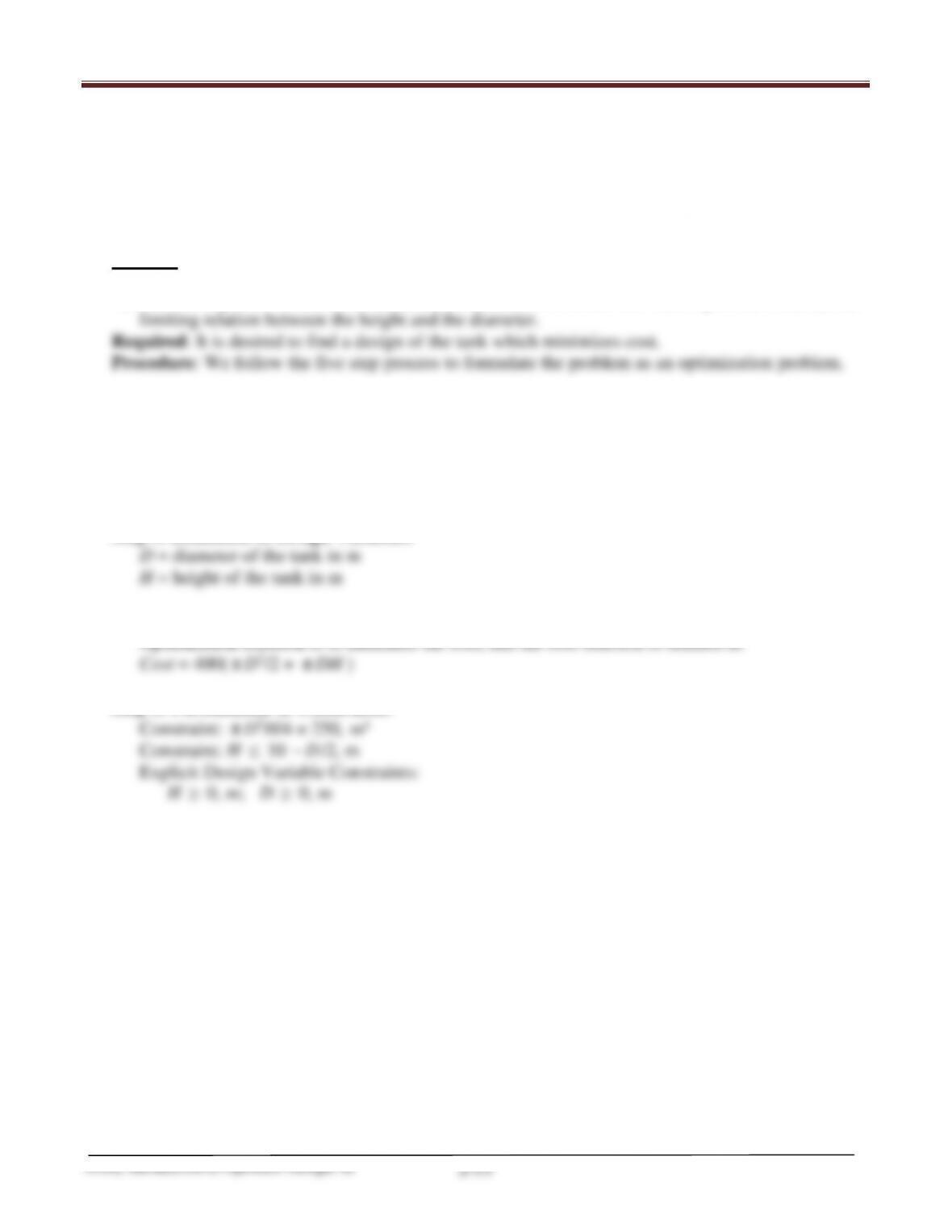
Certain mining operations require an open top rectangular container to transport materials. The data
for the problem are as follows:
Construction costs:
– Sides: $50/m2
– Ends: $60/m2
– Bottom: $90/m2
Minimum volume needed: 150 m3
Formulate the problem of determining the container dimensions for minimum present cost.
Solution
Given: The construction costs for the sides, ends, and the bottom of the container and the minimum
Step 1: Problem Statement
Shown above
Step 2: Data and Information Collection
Shown above
Step 3: Definition of Design Variables
dimensions of the container;
Step 4: Optimization Criterion
Optimization criterion is to minimize total present cost, and the cost function is defined as
Step 5: Formulation of Constraints
Volume Constraint:
Chapter 2 Optimum Design Problem Formulation
2.12________________________________________________________________________________
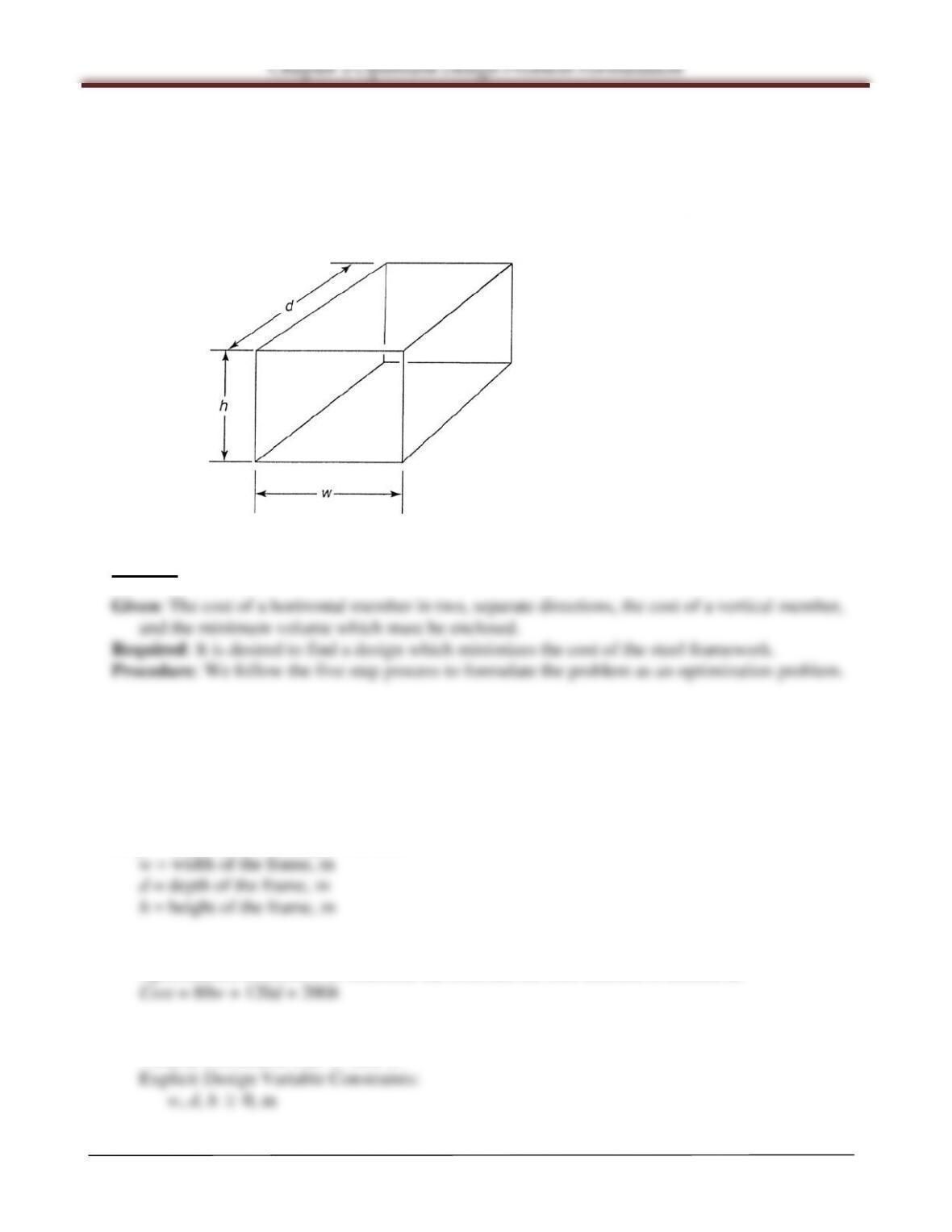
Design a circular tank closed at both ends to have a volume of 250 m3. The fabrication cost is
proportional to the surface area of the sheet metal and is $400/m2. The tank is to be housed in a shed
with a sloping roof. Therefore, height H of the tank is limited by the relation H ≤ (10 – D/2), where D
is the tank’s diameter. Formulate the minimum-cost design problem.
Solution
Given: The required volume of the tank, the fabrication cost of the sheet metal per unit area, and the
Step 1: Problem Statement
Shown above
Step 2: Data and Information Collection
Shown above
Step 3: Definition of Design Variables
Step 4: Optimization Criterion
Optimization criterion is to minimize the cost, and the cost function is defined as
Step 5: Formulation of Constraints
Arora, Introduction to Optimum Design, 4e
2-16
2.13________________________________________________________________________________
Design the steel framework shown in Figure E2.13 at a minimum cost. The cost of a horizontal
member in one direction is $20w and in the other direction it is $30d. The cost of a vertical column
is $50h. The frame must enclose a total volume of at least 600 m3. Formulate the design optimization
problem.
FIGURE E2.13 Steel frame.
Solution
Step 1: Problem Statement
Shown above
Step 2: Data and Information Collection
Shown above
Step 3: Definition of Design Variables
Step 4: Optimization Criterion
Optimization criterion is to minimize the cost, and the cost function is defined as
Step 5: Formulation of Constraints
Volume Constraint: wdh
≥
600, m3
Chapter 2 Optimum Design Problem Formulation
2.14_______________________________________________________________________________
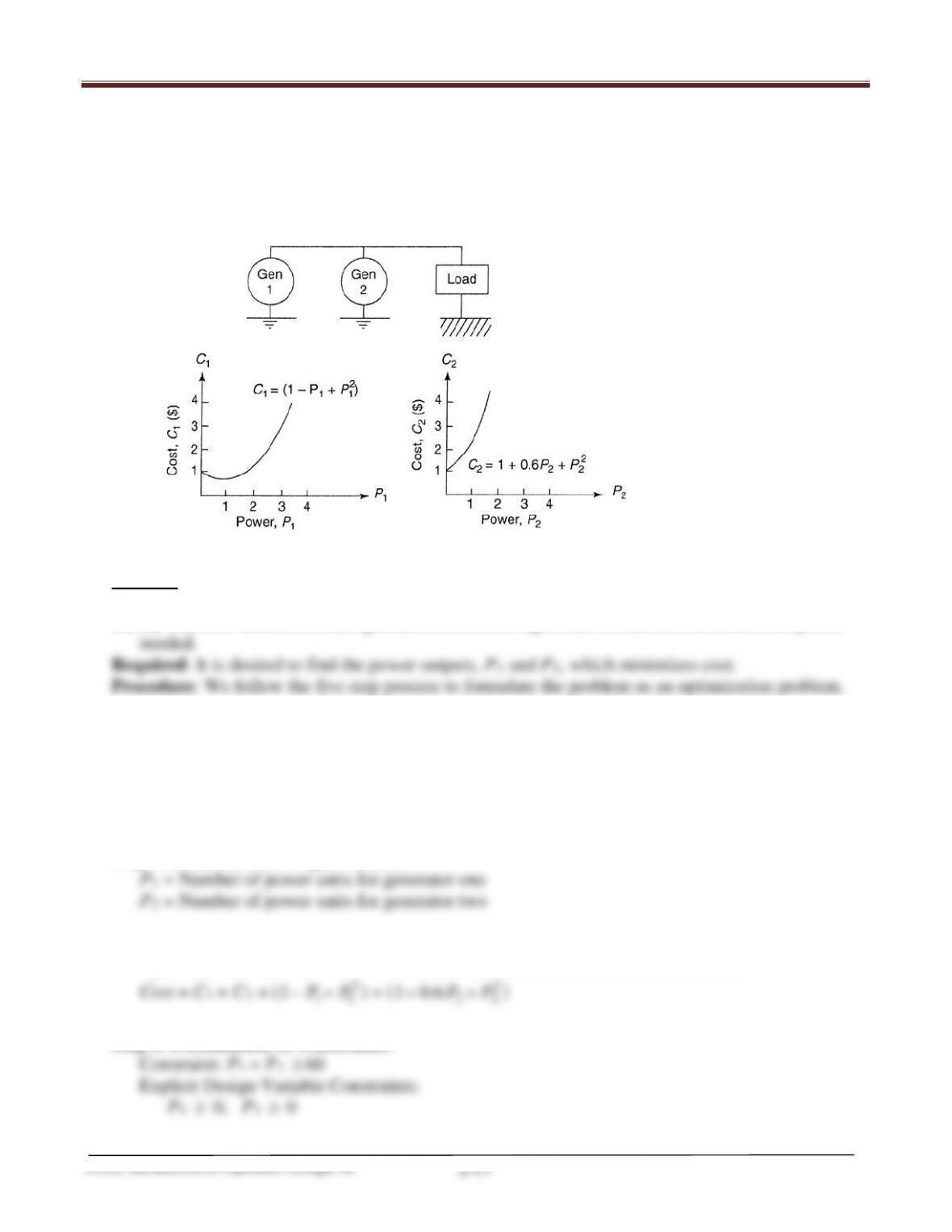
Two electric generators are interconnected to provide total power to meet the load. Each generator’s
cost is a function of the power output, as shown in Figure E2.14. All costs and power are expressed
on a per unit basis. The total power needed is at least 60 units. Formulate a minimum-cost design
problem to determine the power outputs P1 and P2.
FIGURE E2.14 Power generator.
Solution
Given: The cost function of each generator, shown in Figure E2.14, and the minimum total power
Step 1: Problem Statement
Shown above
Step 2: Data and Information Collection
Shown above
Step 3: Definition of Design Variables
Step 4: Optimization Criterion
Optimization criterion is to minimize the cost, and the cost function is defined as
2
11
2
22
Step 5: Formulation of Constraints
Arora, Introduction to Optimum Design, 4e
2-18
2.15________________________________________________________________________________
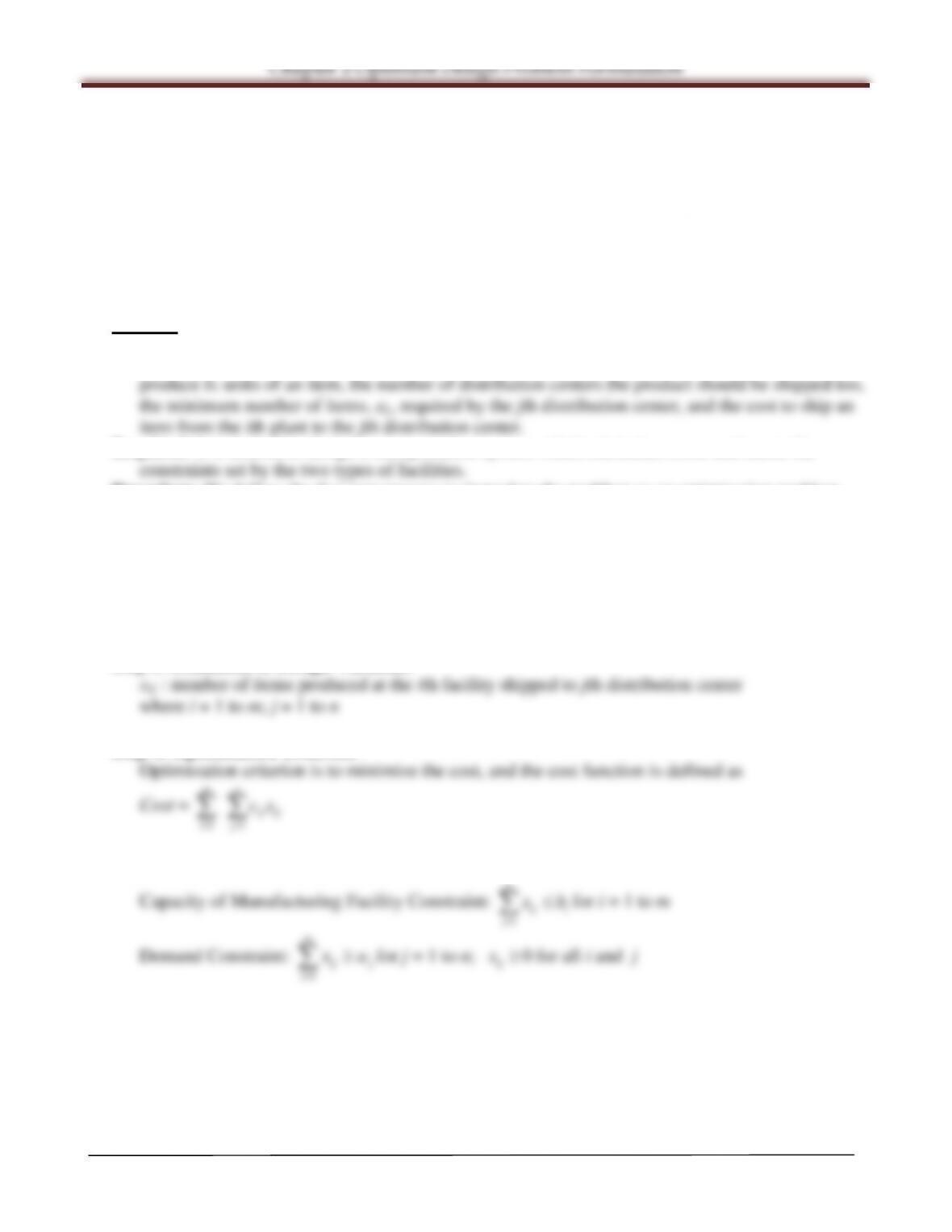
Transportation Problem. A company has m manufacturing facilities. The facility at the ith location
has capacity to produce bi units of an item. The product should be shipped to n distribution centers.
The distribution center at the jth location requires at least aj units of the item to satisfy demand. The
cost of shipping an item from the ith plant to the jth distribution center is cij. Formulate a minimum–
cost transportation system to meet each distribution center’s demand without exceeding the capacity
of any manufacturing facility.
Solution
Given: The number of manufacturing facilities the company owns, the capacity of the ith facility to
Required: It is desired to design a transportation system which minimizes costs and meets the
Procedure: We follow the five step process to formulate the problem as an optimization problem.
Step 1: Problem Statement
Shown above
Step 2: Data and Information Collection
Shown above
Step 3: Definition of Design Variables
Step 4: Optimization Criterion
∑∑
==
j
ijij
i
11
Step 5: Formulation of Constraints
n
Chapter 2 Optimum Design Problem Formulation
Arora, Introduction to Optimum Design, 4e
2-19
2.16________________________________________________________________________________
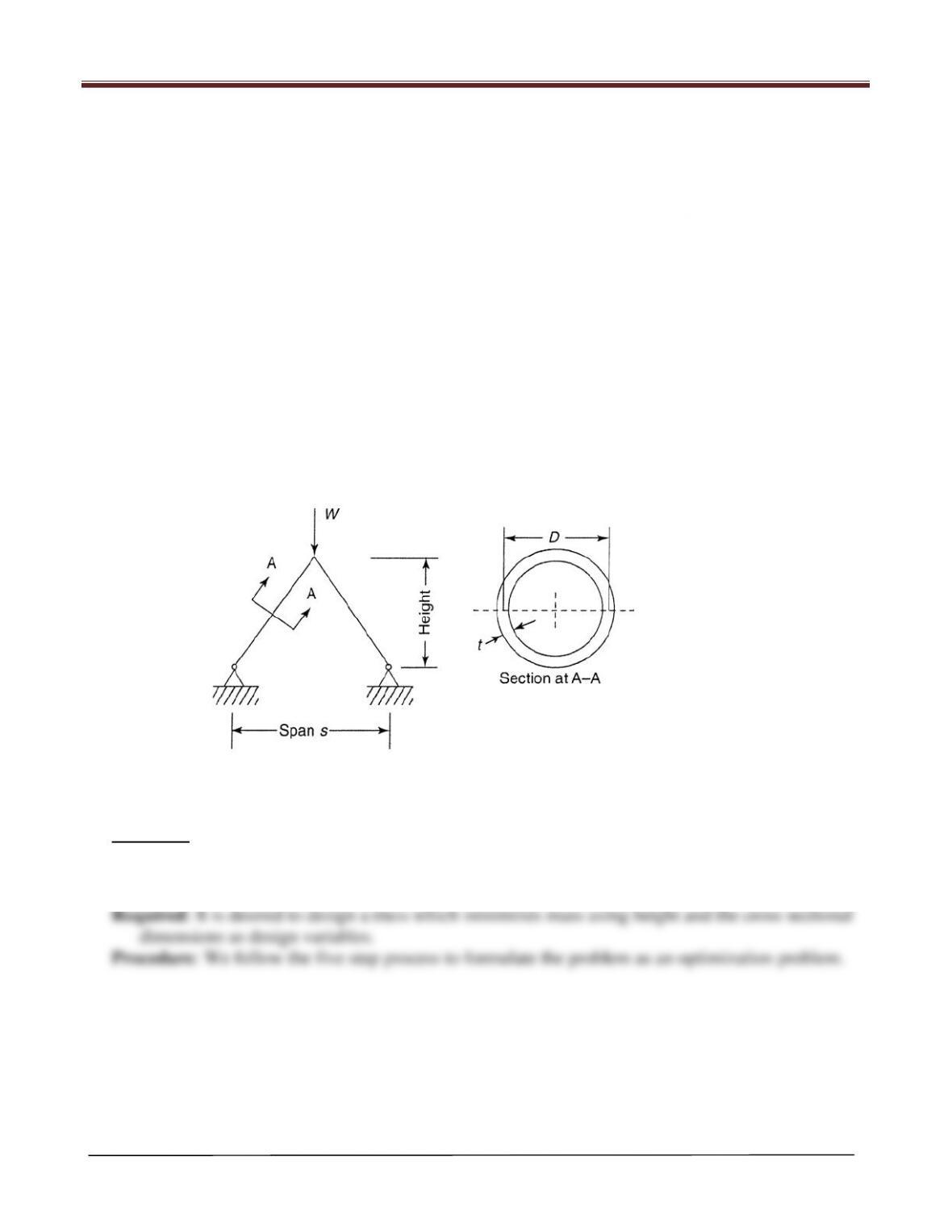
Design of a two-bar truss. Design a symmetric two–bar truss (both members have the same cross
section), as shown in Fig. E2.16, to support a load W. The truss consists of two steel tubes pinned
together at one end and supported on the ground at the other. The span of the truss is fixed at s.
Formulate the minimum mass truss design problem using height and the cross-sectional dimensions
as design variable. The design should satisfy the following constraints:
1. Because of space limitations, the height of the truss must not exceed b1, and must not be less
than b2.
2. The ratio of the mean diameter to thickness of the tube must not exceed b3.
3. The compressive stress in the tubes must not exceed the allowable stress, σa, for steel.
4. The height, diameter, and thickness must be chosen to safeguard against member buckling.
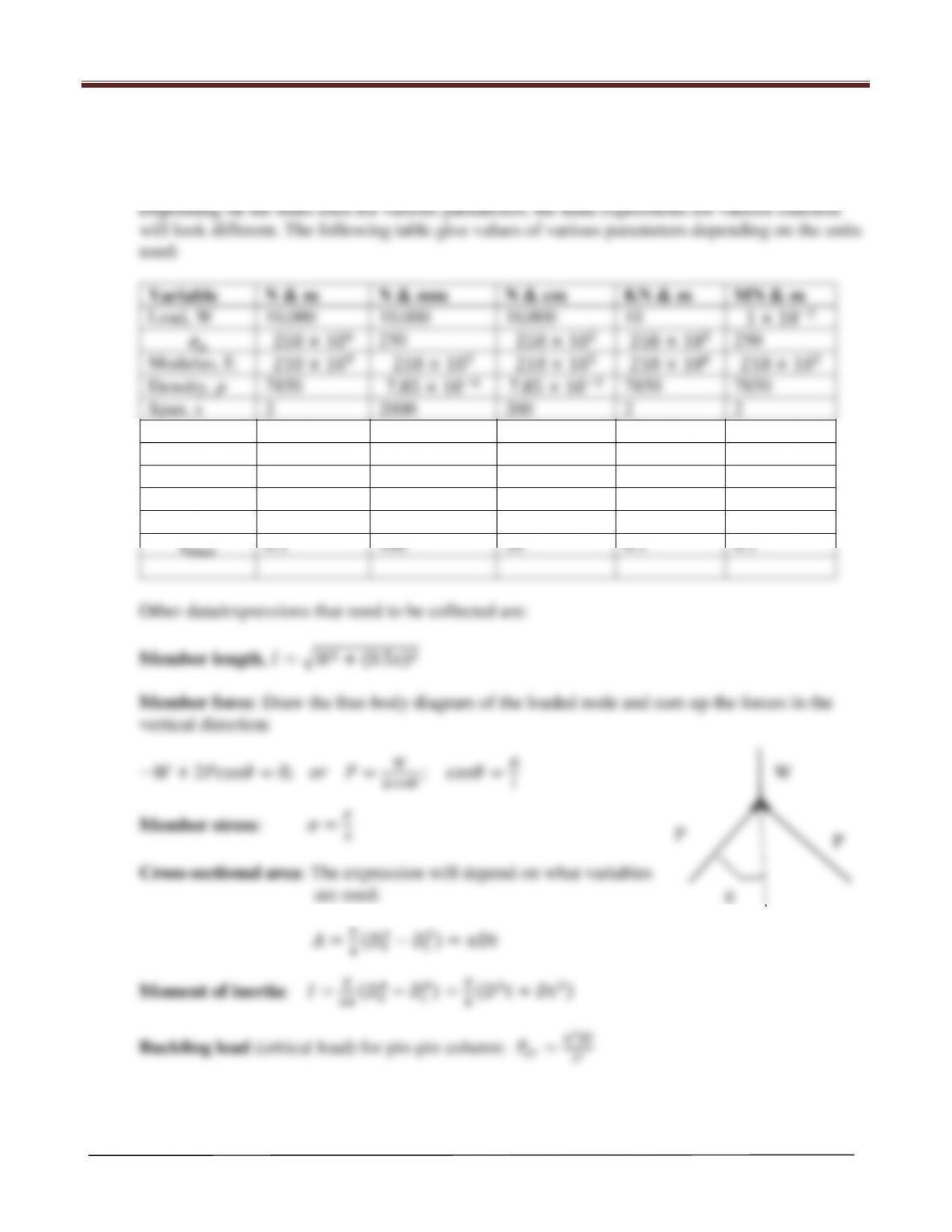
Use the following data: W = 10 kN; span s = 2 m; b1 = 5 m; b2 = 2 m; b3 =90; allowable stress, σa
=250 MPa; modulus of elasticity, E = 210 GPa; mass density,ρ =7850 kg/m3; factor of safety against
buckling; FS=2; 0.1 ≤ D ≤ 2, m) and 0.01 ≤ t ≤ 0.1, m.
FIGURE E2.16 Two–bar structure.
Solution
Given: Constraints 1-4 listed above and the factor of safety against buckling in the data section
above.
Chapter 2 Optimum Design Problem Formulation
Step 1: Problem Statement
Shown above
Step 2: Data and Information Collection