Chapter 14 Practical Applications of Optimization
Solution
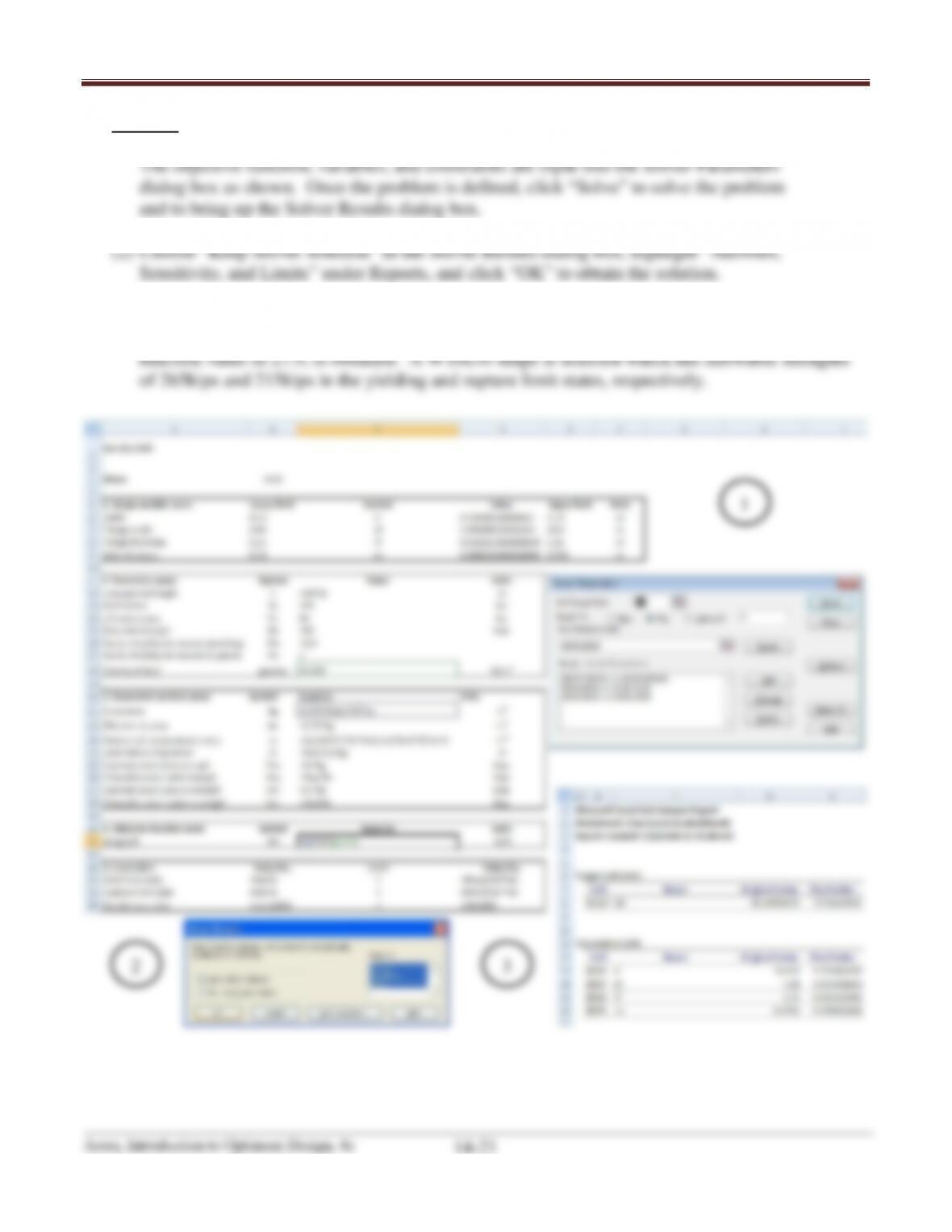
(1) One possible format for setting up the Excel worksheet for this problem is shown below.
(3) The answer report shows that for initial design variable values of d=10.565, bf=7.18, tf=0.73,
and tw=0.4725 a solution of d=9.73, bf=4.59, tf=0.516, and tw=0.398, which gives an objective
Chapter 14 Practical Applications of Optimization
Arora, Introduction to Optimum Design, 4e
14-22
Section 14.9 Optimum Design of Compression Members
14.35_______________________________________________________________________________
Solve the following problem using the Excel Solver:
Solve the W-shape optimization problem of Section 14.9 where a W14 shape is desired.
33
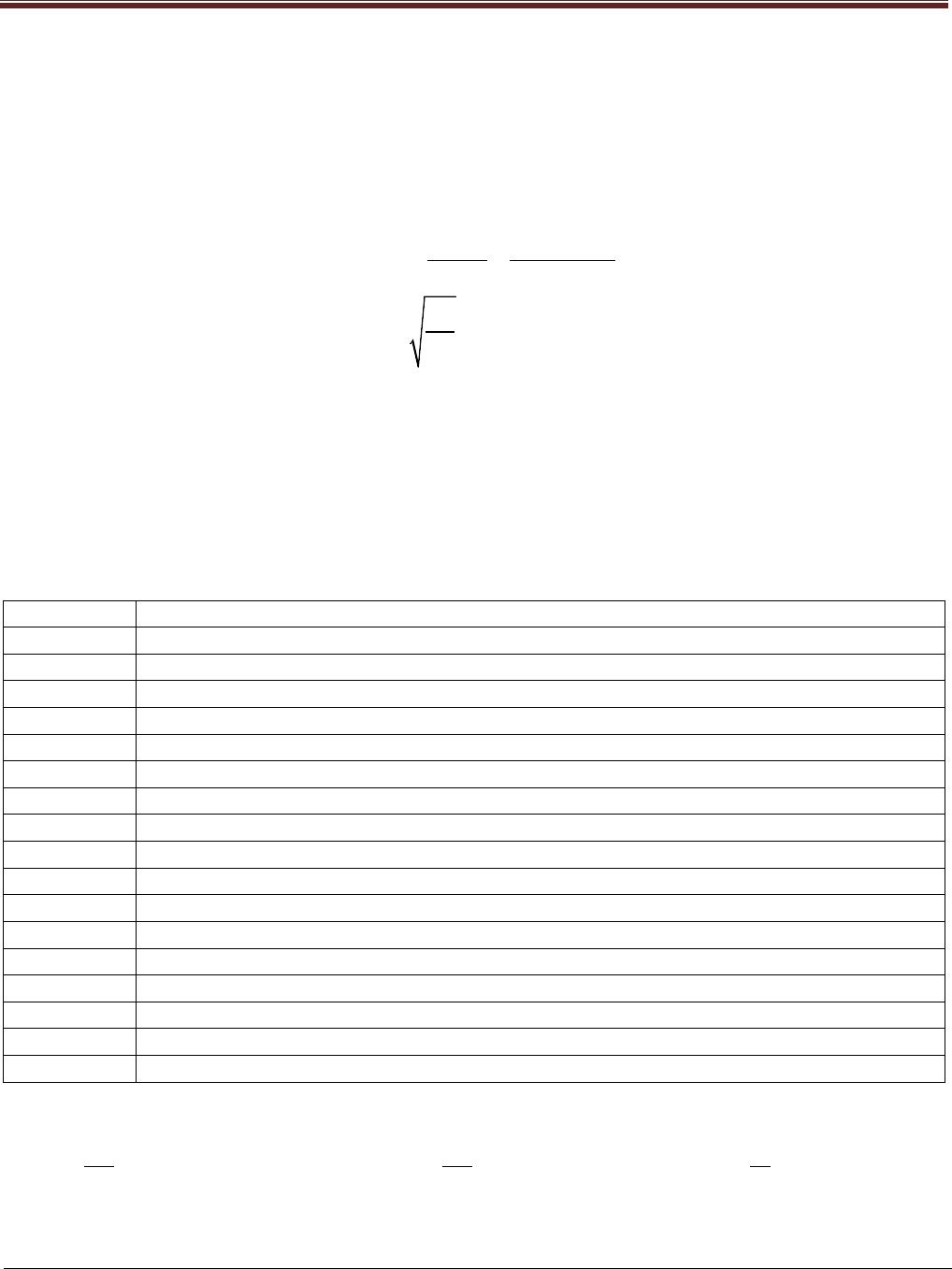
2 ( 2)
( ) ( 2)
212 12
g ff f w
ff f w
y
y
y
g
A bt d t t
tb d t t
I
I
rA
= +−
−
= +
=
Design variables for the W-shape optimization problem are defined as a vector
x = (d, bf, tf, tw)
The optimization function for the mass minimization problem is given as
12 , lbs/ft
g
fA
γ
=
TABLE E14.35
Notation
Data
Ag
Gross area of the section, in2
An
Net area (gross area less cross-sectional areas due to bolt holes), in2
Ae
Effective net area, Ae=UAn, in2
bf
Width of flange, in
d
Depth of section, in
Fy
Specified minimum yield stress, 50 ksi for A992 steel, ksi
Fu
Specified minimum ultimate stress, 65 ksi for A992 steel, ksi
L
Laterally supported length of member, in
Pn
Nominal axial strength, kips
Pa
Required strength, kips
ry
Least radius of gyration, in
tf
Thickness of flange, in
tw
Thickness of web, in
U
Shear lag coefficient: reduction coefficient for net area
x
Distance for plane of shear transfer to centroid of tension member cross section, in
Ωt
Factor of safety for tension, 1.67 and 2.00, for yielding and rupture, respectively
γ
Density of steel, 0.283 lb/in3
The constraints for the W-shape design problem are given as
; 0.6 , ; 0.5 , 300
ny nr
a ny y g a y g a nr u e a u e
t ty
PPL
P P FA P FA P P FA P FA r
≤ = →≤ ≤ = →≤ ≤
ΩΩ
Chapter 14 Practical Applications of Optimization
Solution
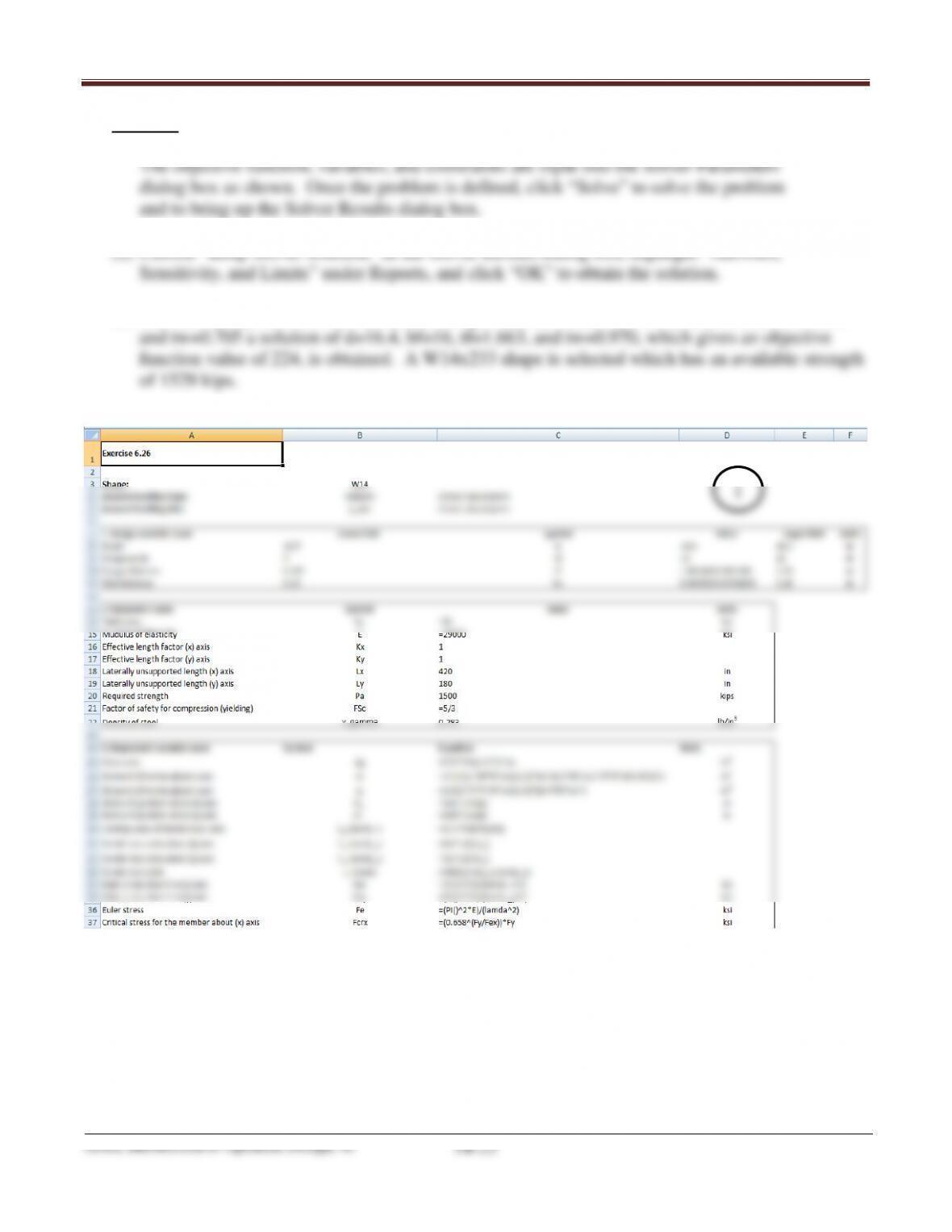
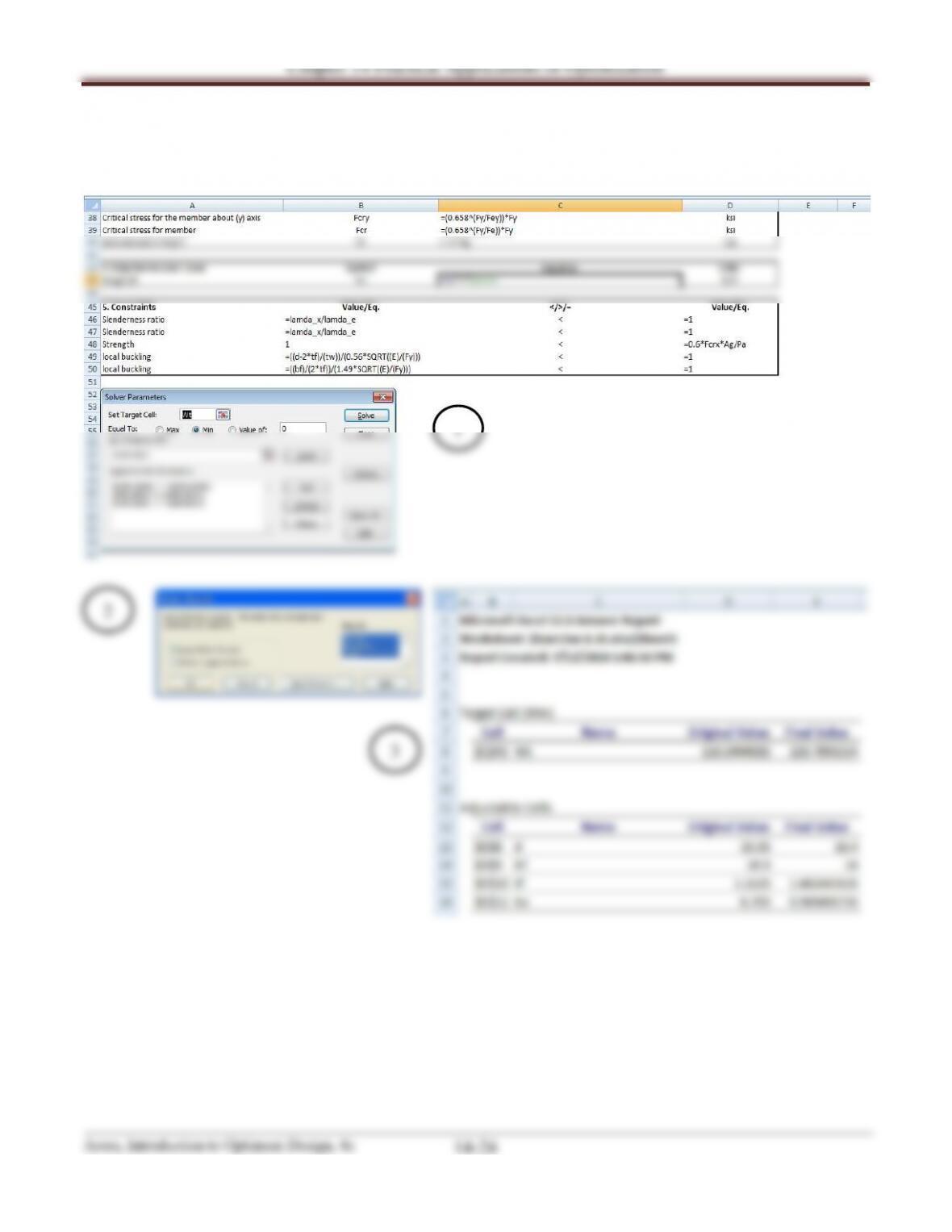
(1) One possible format for setting up the Excel worksheet for this problem is shown below.
(2) Choose “Keep Solver Solution” in the Solver Results dialog box, highlight “Answers,
(3) The answer report shows that for initial design variable values of d=15.05, bf=10.5, tf=1.1125,
1
6.26 ________________________________________________________________________________
Continued.
3
2
1
Chapter 14 Practical Applications of Optimization
Arora, Introduction to Optimum Design, 4e
14-25
14.36_______________________________________________________________________________
Solve the following problem using the Excel Solver:
Solve the W-shape optimization problem of Section 14.9 where a W12 shape is desired and required
strength Pa is 1000 kips.
33
2 ( 2)
( ) ( 2)
212 12
g ff f w
ff f w
y
y
y
g
A bt d t t
tb d t t
I
I
rA
= +−
−
= +
=
Design variables for the W-shape optimization problem are defined as a vector
x = (d, bf, tf, tw)
The optimization function for the mass minimization problem is given as
12 , lbs/ft
g
fA
γ
=
TABLE E14.36
Notation
Data
Ag
Gross area of the section, in2
An
Net area (gross area less cross-sectional areas due to bolt holes), in2
Ae
Effective net area, Ae=UAn, in2
bf
Width of flange, in
d
Depth of section, in
Fy
Specified minimum yield stress, 50 ksi for A992 steel, ksi
Fu
Specified minimum ultimate stress, 65 ksi for A992 steel, ksi
L
Laterally supported length of member, in
Pn
Nominal axial strength, kips
Pa
Required strength, 1000 kips
ry
Least radius of gyration, in
tf
Thickness of flange, in
tw
Thickness of web, in
U
Shear lag coefficient: reduction coefficient for net area
x
Distance for plane of shear transfer to centroid of tension member cross section, in
Ωt
Factor of safety for tension, 1.67 and 2.00, for yielding and rupture, respectively
γ
Density of steel, 0.283 lb/in3
The constraints for the W-shape design problem are given as
; 0.6 , ; 0.5 , 300
ny nr
a ny y g a y g a nr u e a u e
t ty
PPL
P P FA P FA P P FA P FA r
≤ = →≤ ≤ = →≤ ≤
ΩΩ
Chapter 14 Practical Applications of Optimization
Arora, Introduction to Optimum Design, 4e
14-26
Solution
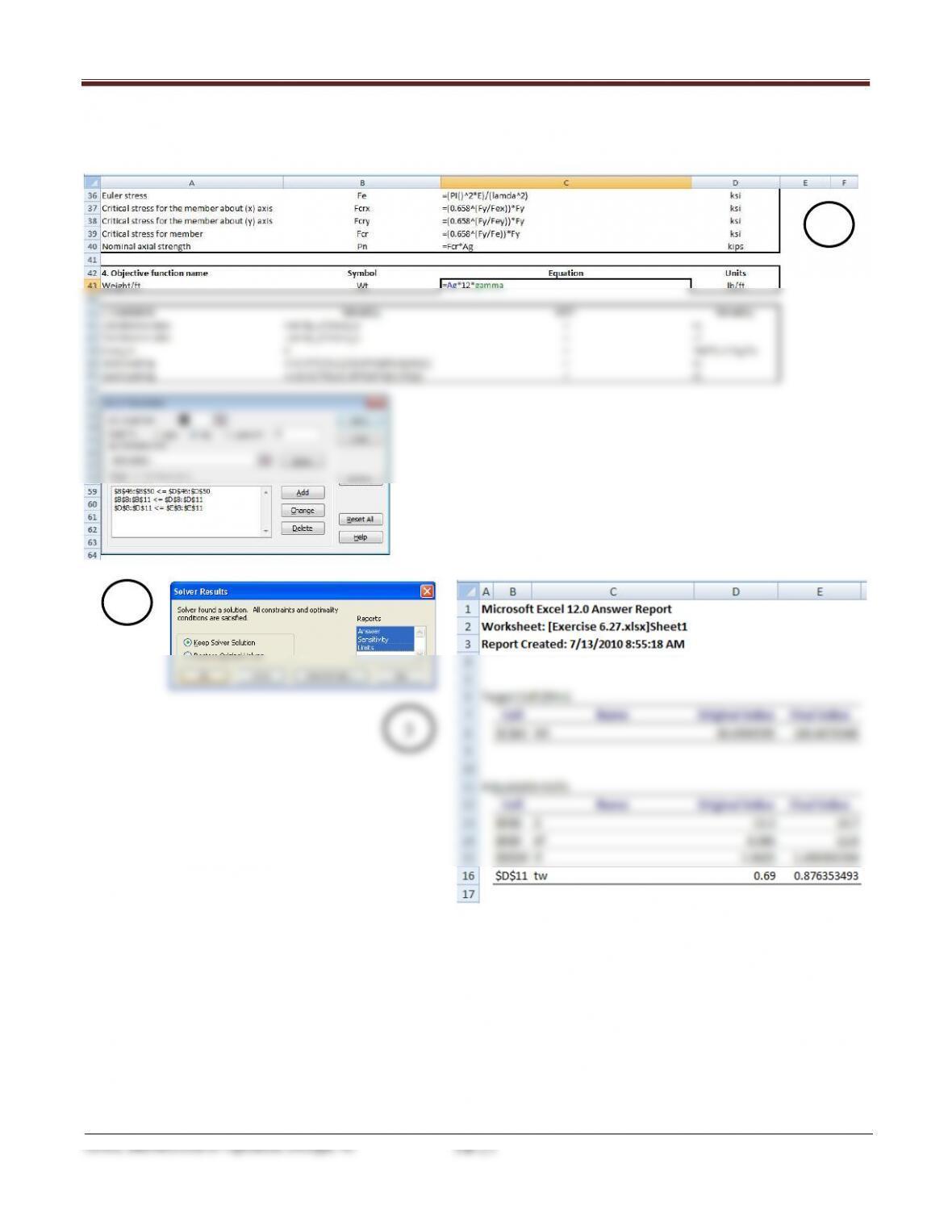
(1) One possible format for setting up the Excel worksheet for this problem is shown below.
(3) The answer report shows that for initial design variable values of d=13.3, bf=8.385, tf=1.0625,
1
Chapter 14 Practical Applications of Optimization
6.27 ________________________________________________________________________________
Continued.
3
2
1
Arora, Introduction to Optimum Design, 4e
14-28
14.37______________________________________________________________________________
Solve the following problem using the Excel Solver:
Design a compression member to carry a load of 400 kips. The length of the member is 26 feet, and
the material is A572 Grade 50 steel. The member is not braced. Select W18 shape.
33
2 ( 2)
( ) ( 2)
212 12
g ff f w
ff f w
y
y
y
g
A bt d t t
tb d t t
I
I
rA
= +−
−
= +
=
Design variables for the W-shape optimization problem are defined as a vector
x = (d, bf, tf, tw)
The optimization function for the mass minimization problem is given as
12 , lbs/ft
g
fA
γ
=
TABLE E14.37
Notation
Data
Ag
Gross area of the section, in2
An
Net area (gross area less cross-sectional areas due to bolt holes), in2
Ae
Effective net area, Ae=UAn, in2
bf
Width of flange, in
d
Depth of section, in
Fy
Specified minimum yield stress, 50 ksi for A992 steel, ksi
Fu
Specified minimum ultimate stress, 65 ksi for A992 steel, ksi
L
Laterally supported length of member, 312 in
Pn
Nominal axial strength, kips
Pa
Required strength, 400 kips
ry
Least radius of gyration, in
tf
Thickness of flange, in
tw
Thickness of web, in
U
Shear lag coefficient: reduction coefficient for net area
x
Distance for plane of shear transfer to centroid of tension member cross section, in
Ωt
Factor of safety for tension, 1.67 and 2.00, for yielding and rupture, respectively
γ
Density of steel, 0.283 lb/in3
The constraints for the W–shape design problem are given as
; 0.6 , ; 0.5 , 300
ny nr
a ny y g a y g a nr u e a u e
t ty
PPL
P P FA P FA P P FA P FA r
≤ = →≤ ≤ = →≤ ≤
ΩΩ
Chapter 14 Practical Applications of Optimization
Solution
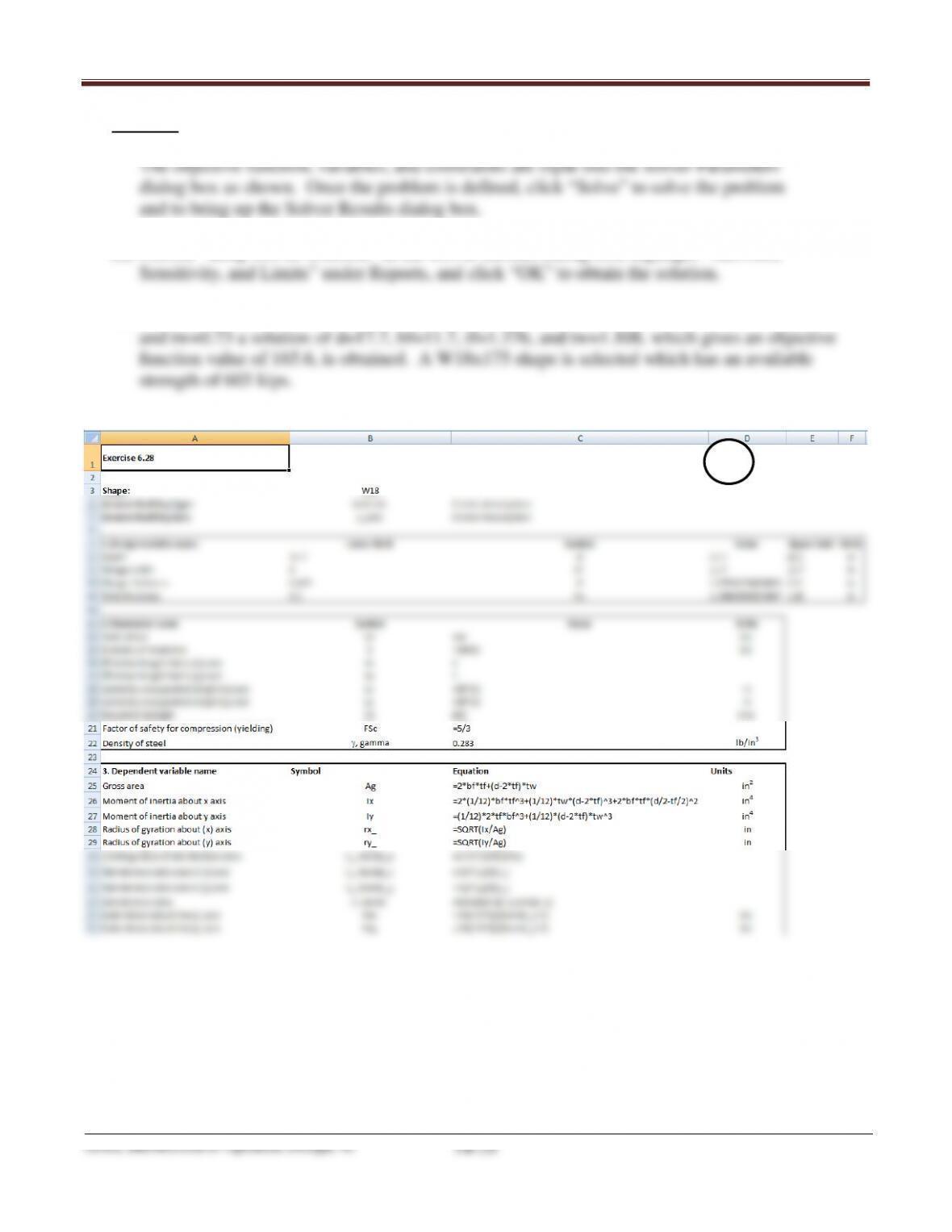
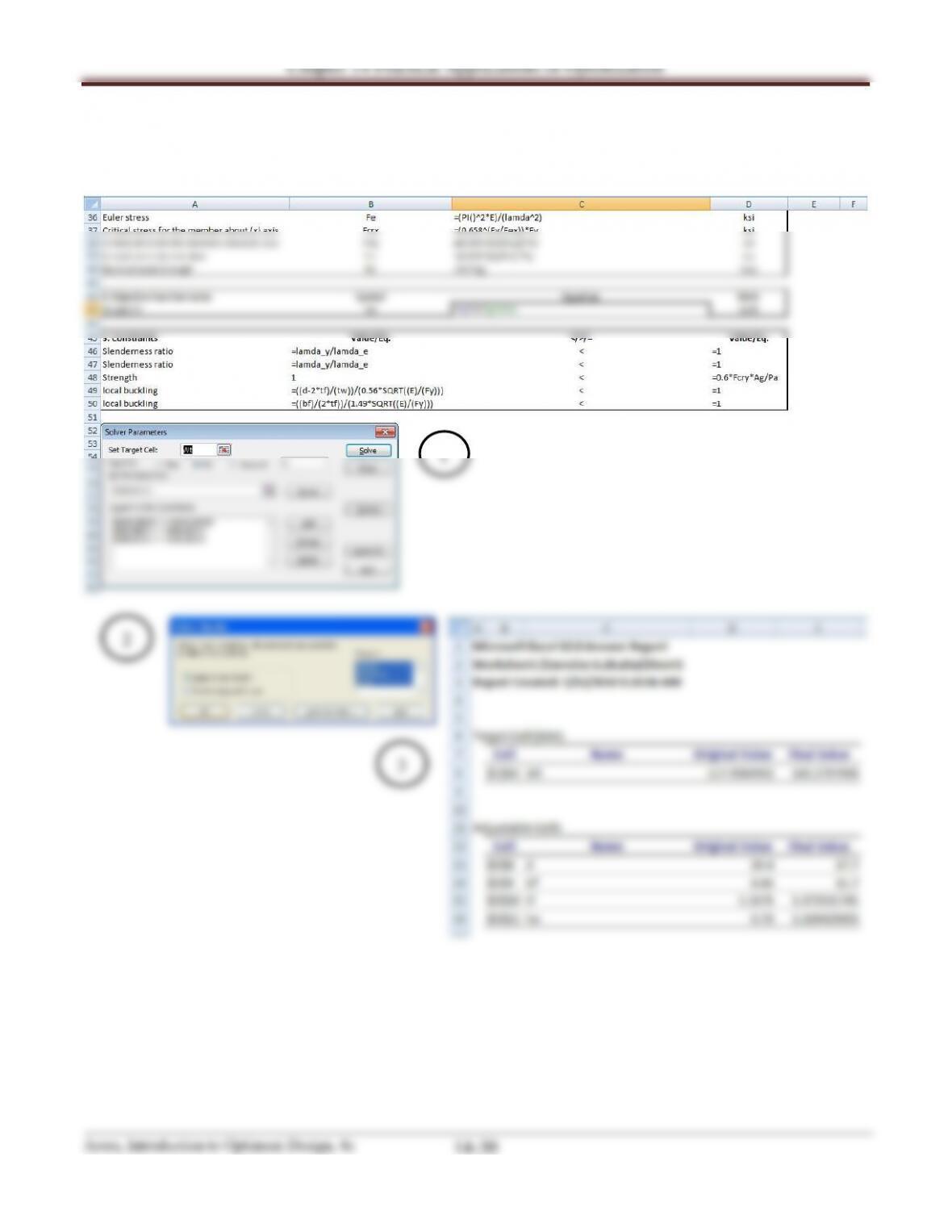
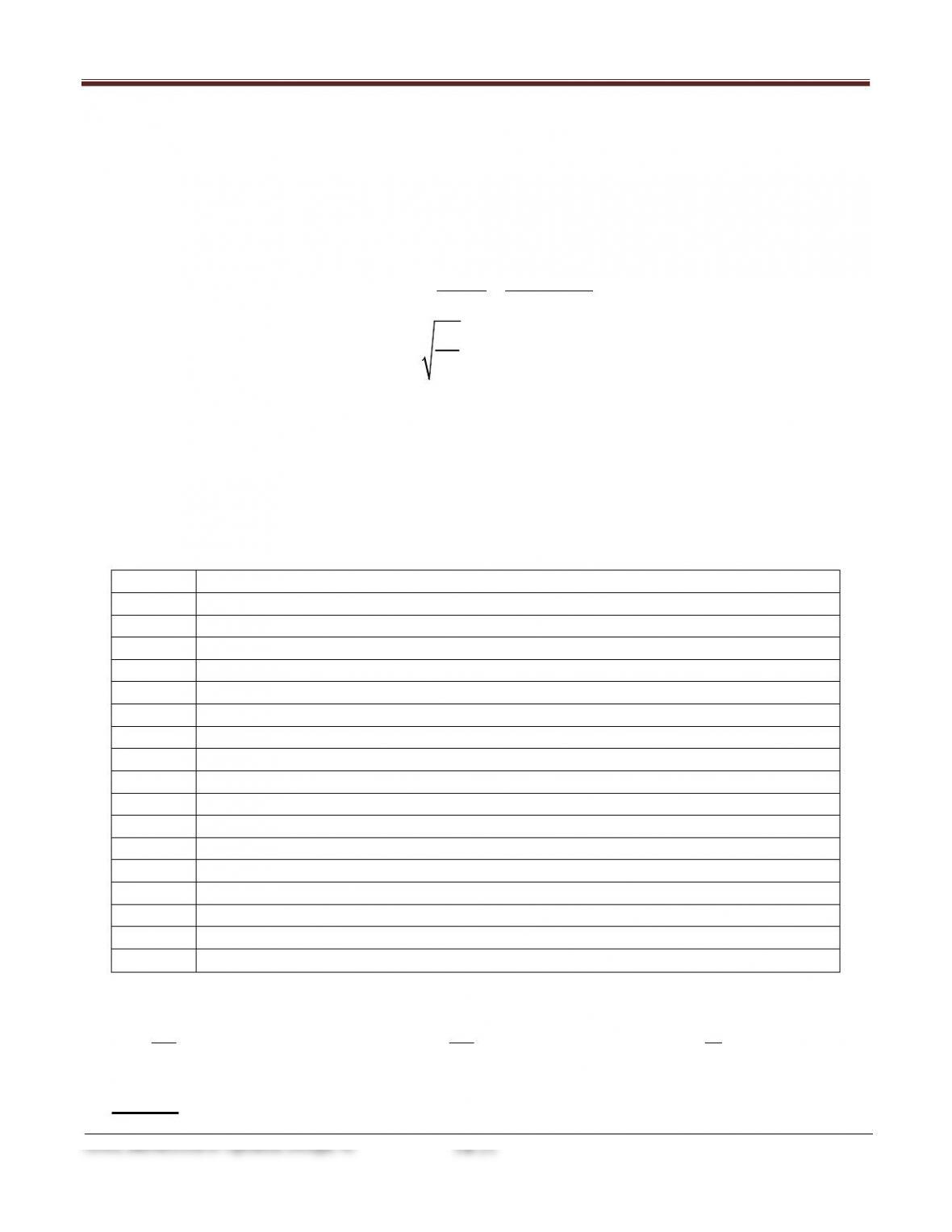
(1) One possible format for setting up the Excel worksheet for this problem is shown below.
(2) Choose “Keep Solver Solution” in the Solver Results dialog box, highlight “Answers,
(3) The answer report shows that for initial design variable values of d=19.4, bf=8.85, tf=1.2675,
1
6.28 ________________________________________________________________________________
Continued.
3
2
1
Chapter 14 Practical Applications of Optimization
14.38______________________________________________________________________________
Solve the following problem using the Excel Solver:
Design a compression member to carry a load of 200 kips. The length of the member is 13 feet, and
the material is A572 Grade 50 steel. The member is not braced. Select W14 shape.
33
2 ( 2)
( ) ( 2)
212 12
g ff f w
ff f w
y
y
y
g
A bt d t t
tb d t t
I
I
rA
= +−
−
= +
=
Design variables for the W-shape optimization problem are defined as a vector
x = (d, bf, tf, tw)
The optimization function for the mass minimization problem is given as
12 , lbs/ft
g
fA
γ
=
TABLE E14.38
Notation
Data
Ag
Gross area of the section, in2
An
Net area (gross area less cross-sectional areas due to bolt holes), in2
Ae
Effective net area, Ae=UAn, in2
bf
Width of flange, in
d
Depth of section, in
Fy
Specified minimum yield stress, 50 ksi for A992 steel, ksi
Fu
Specified minimum ultimate stress, 65 ksi for A992 steel, ksi
L
Laterally supported length of member, 156 in
Pn
Nominal axial strength, kips
Pa
Required strength, 200 kips
ry
Least radius of gyration, in
tf
Thickness of flange, in
tw
Thickness of web, in
U
Shear lag coefficient: reduction coefficient for net area
x
Distance for plane of shear transfer to centroid of tension member cross section, in
Ωt
Factor of safety for tension, 1.67 and 2.00, for yielding and rupture, respectively
γ
Density of steel, 0.283 lb/in3
The constraints for the W-shape design problem are given as
; 0.6 , ; 0.5 , 300
ny nr
a ny y g a y g a nr u e a u e
t ty
PPL
P P FA P FA P P FA P FA r
≤ = →≤ ≤ = →≤ ≤
ΩΩ
Solution
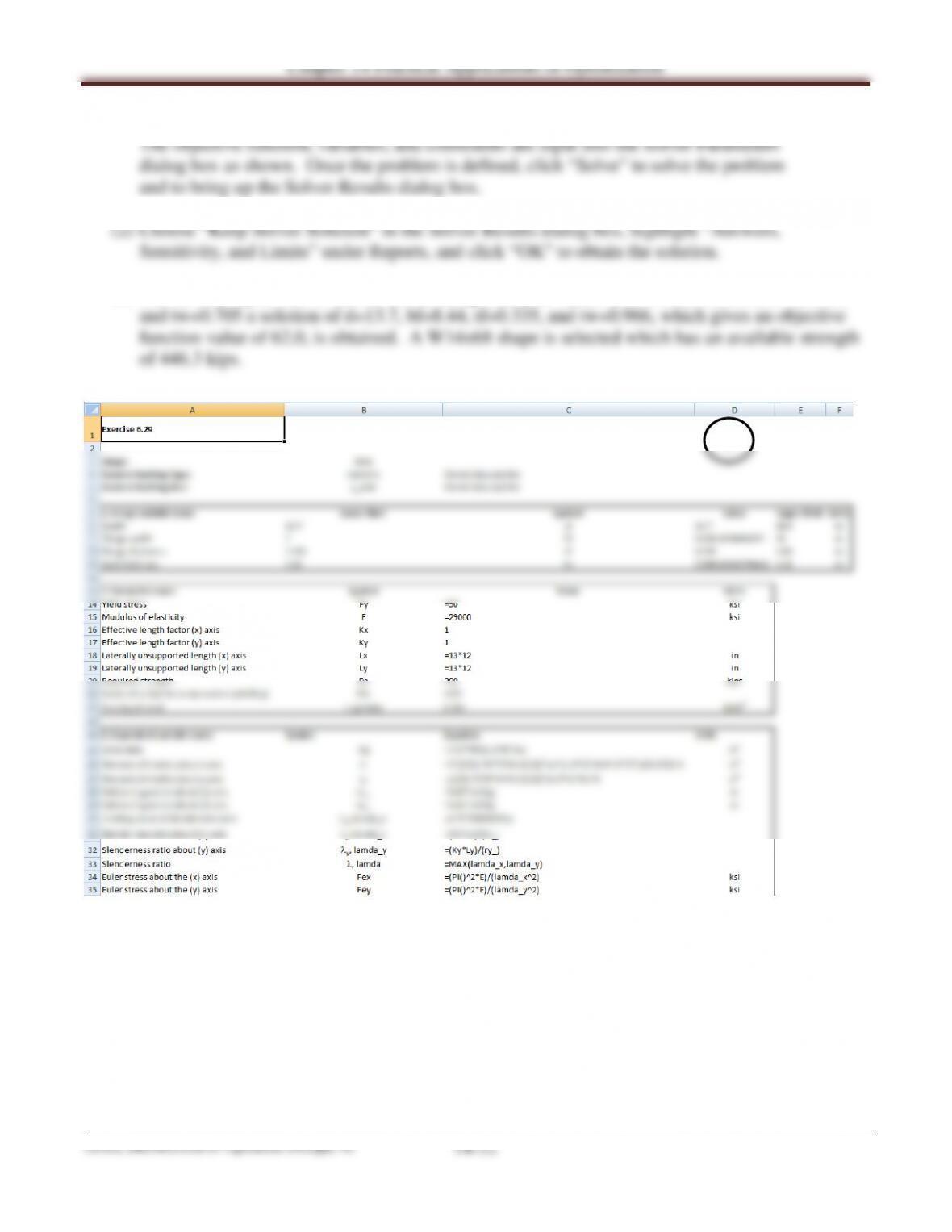
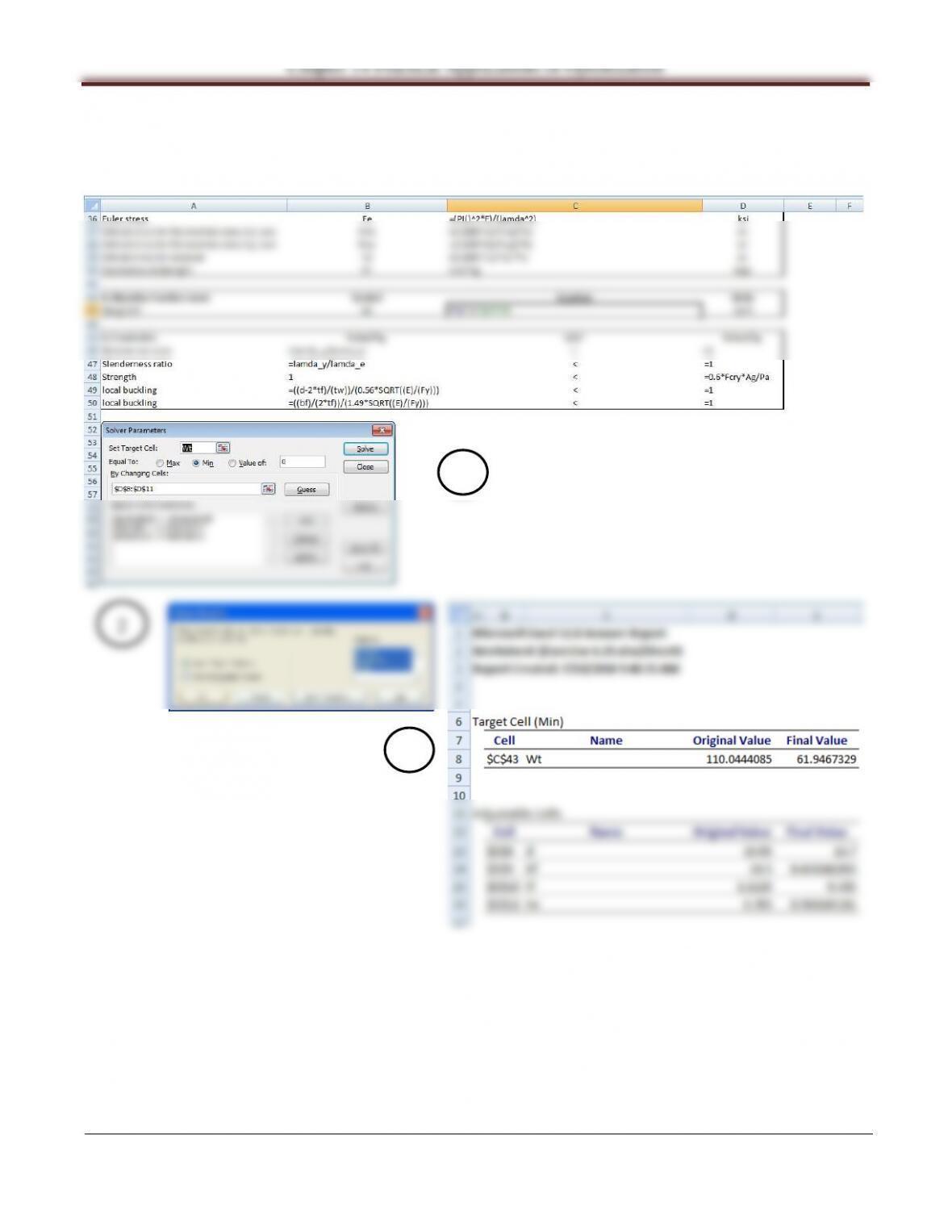
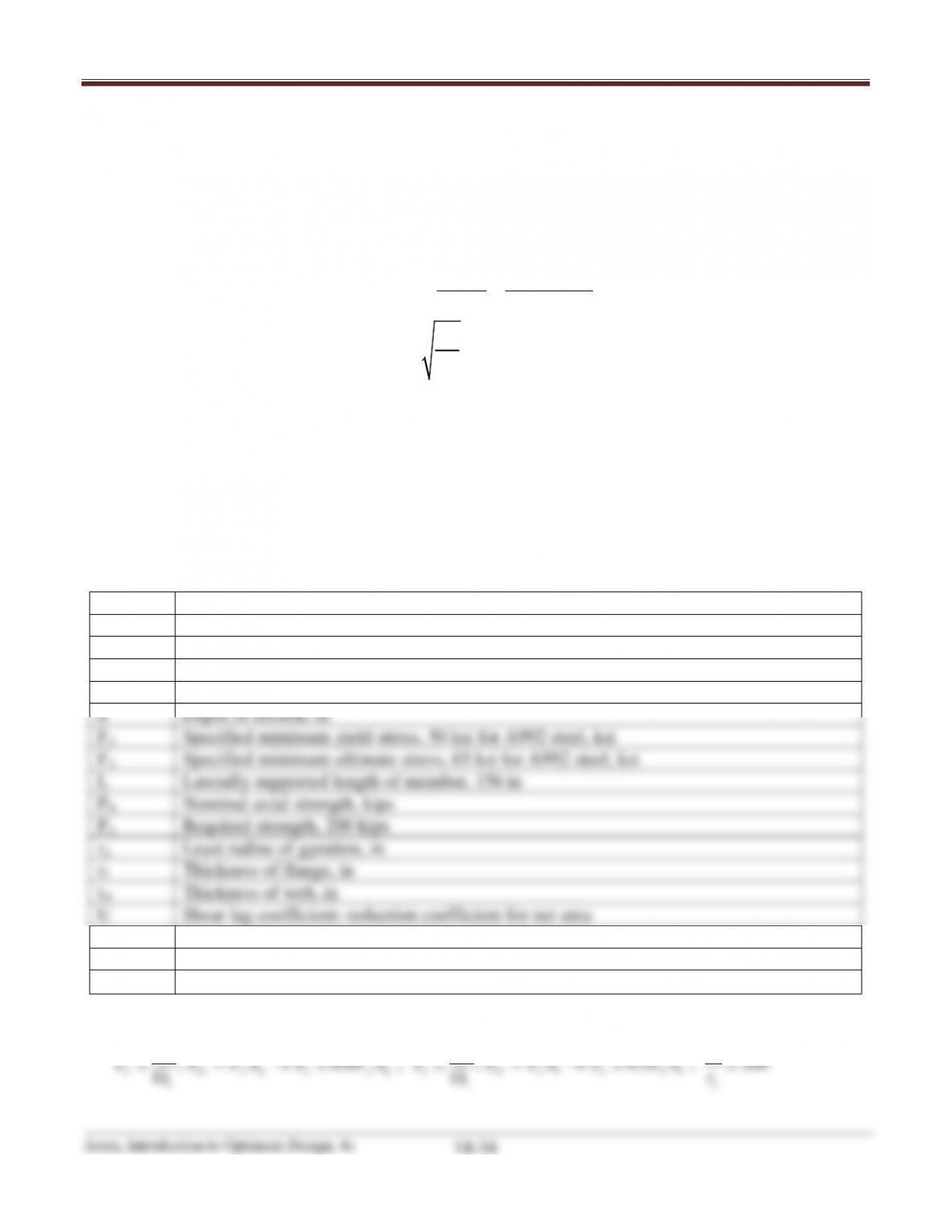
(1) One possible format for setting up the Excel worksheet for this problem is shown below.
(3) The answer report shows that for initial design variable values of d=15.05, bf=10.5, tf=1.1125,
1
Arora, Introduction to Optimum Design, 4e
14-33
6.29 ________________________________________________________________________________
Continued.
3
2
1
Chapter 14 Practical Applications of Optimization
14.39_______________________________________________________________________________
Solve the following problem using the Excel Solver:
Design a compression member to carry a load of 200 kips. The length of the member is 13 feet, and
the material is A572 Grade 50 steel. The member is not braced. Select W12 shape.
33
2 ( 2)
( ) ( 2)
212 12
g ff f w
ff f w
y
y
y
g
A bt d t t
tb d t t
I
I
rA
= +−
−
= +
=
Design variables for the W-shape optimization problem are defined as a vector
x = (d, bf, tf, tw)
The optimization function for the mass minimization problem is given as
12 , lbs/ft
g
fA
γ
=
TABLE E14.39
Notation
Data
Ag
Gross area of the section, in2
An
Net area (gross area less cross-sectional areas due to bolt holes), in2
Ae
Effective net area, Ae=UAn, in2
bf
Width of flange, in
d
Depth of section, in
Fy
Specified minimum yield stress, 50 ksi for A992 steel, ksi
Fu
Specified minimum ultimate stress, 65 ksi for A992 steel, ksi
L
Laterally supported length of member, 156 in
Pn
Nominal axial strength, kips
Pa
Required strength, 200 kips
ry
Least radius of gyration, in
tf
Thickness of flange, in
tw
Thickness of web, in
U
Shear lag coefficient: reduction coefficient for net area
x
Distance for plane of shear transfer to centroid of tension member cross section, in
Ωt
Factor of safety for tension, 1.67 and 2.00, for yielding and rupture, respectively
γ
Density of steel, 0.283 lb/in3
The constraints for the W–shape design problem are given as
; 0.6 , ; 0.5 , 300
ny nr
a ny y g a y g a nr u e a u e
t ty
PPL
P P FA P FA P P FA P FA r
≤ = →≤ ≤ = →≤ ≤
ΩΩ
Chapter 14 Practical Applications of Optimization
Solution
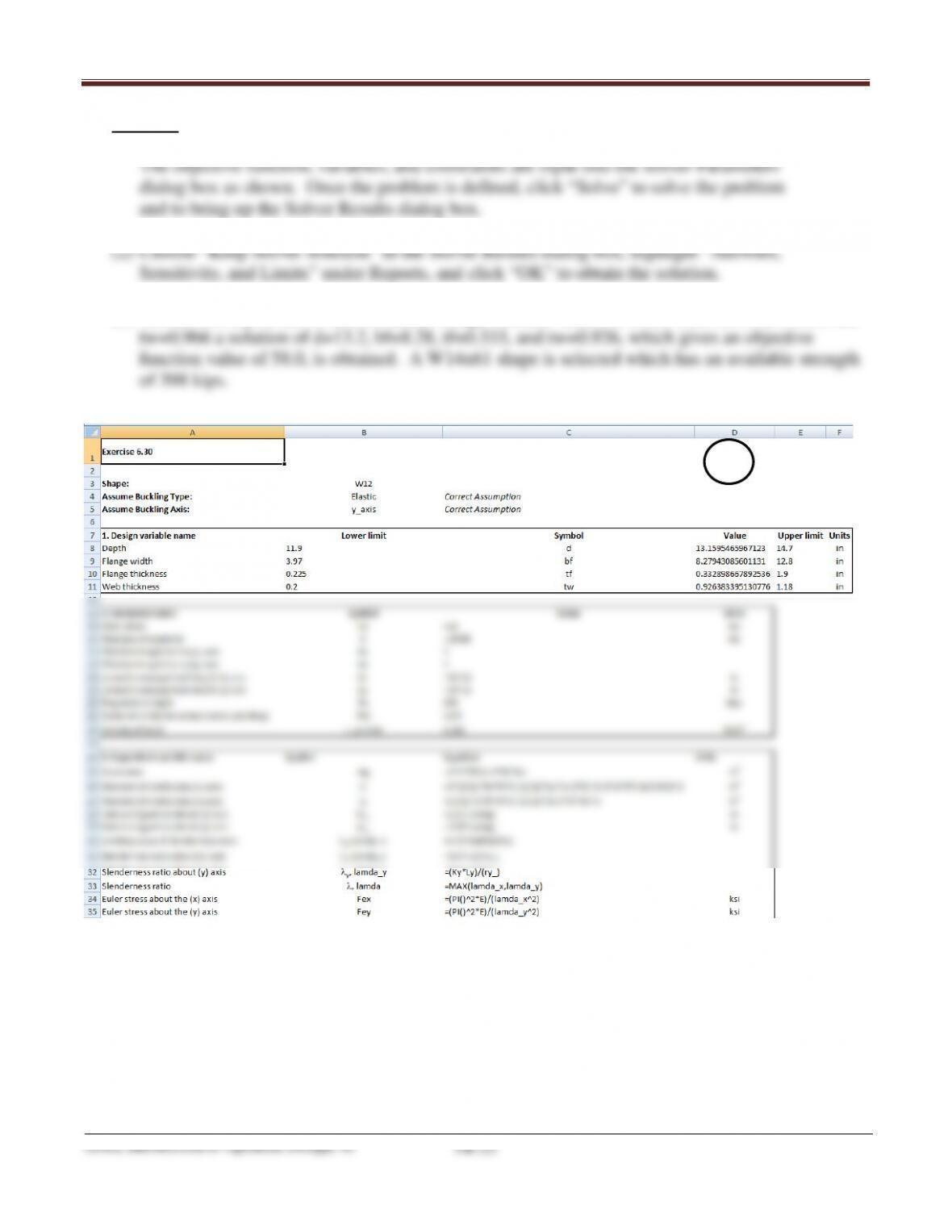
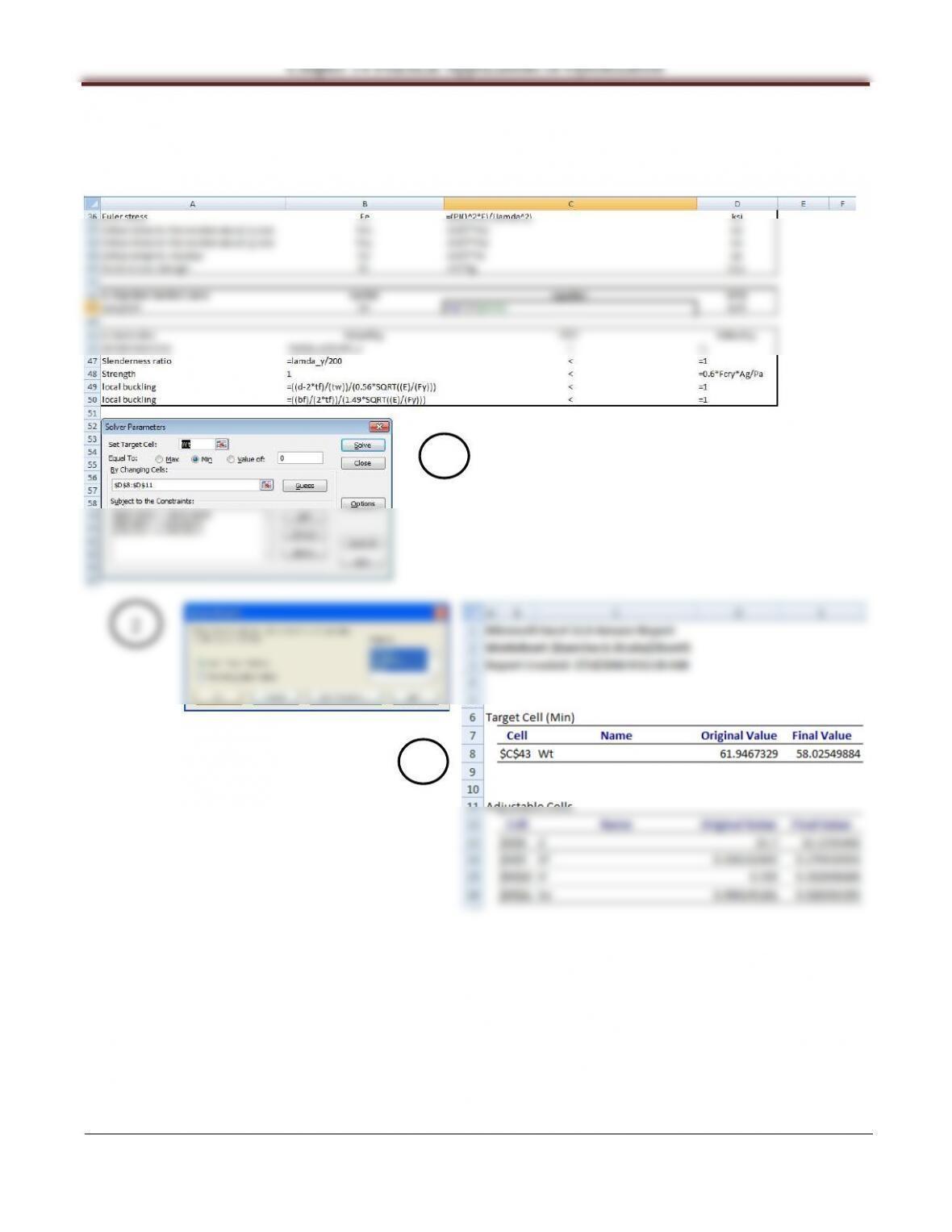
(1) One possible format for setting up the Excel worksheet for this problem is shown below.
(3) The answer report shows that for initial design variable values of d=13.7, bf=8.44, tf=0.335, and
1
Arora, Introduction to Optimum Design, 4e
14-36
6.30 ________________________________________________________________________________
Continued.
3
2
1
Chapter 14 Practical Applications of Optimization
Section 14.10 Optimum Design of Members for Flexure
14.40_______________________________________________________________________________
Solve the following problem using the Excel Solver:
Solve the problem of Example 14.7 for a beam of span 40 ft. Assume compact shape and inelastic
LTB.
337.5 kip-ft, 37.5 kips
λ λ and λ λ
, 0.6 M
13.7 16.4, 5.0 16.0, 0.335 1.89, 0.23 1.18
aa
f pf w pw
pbr
n pa n
f fw
MV
LLL
M MM
db t t
= =
≤≤
<≤
≤≤
≤≤ ≤ ≤ ≤ ≤ ≤ ≤
Solution
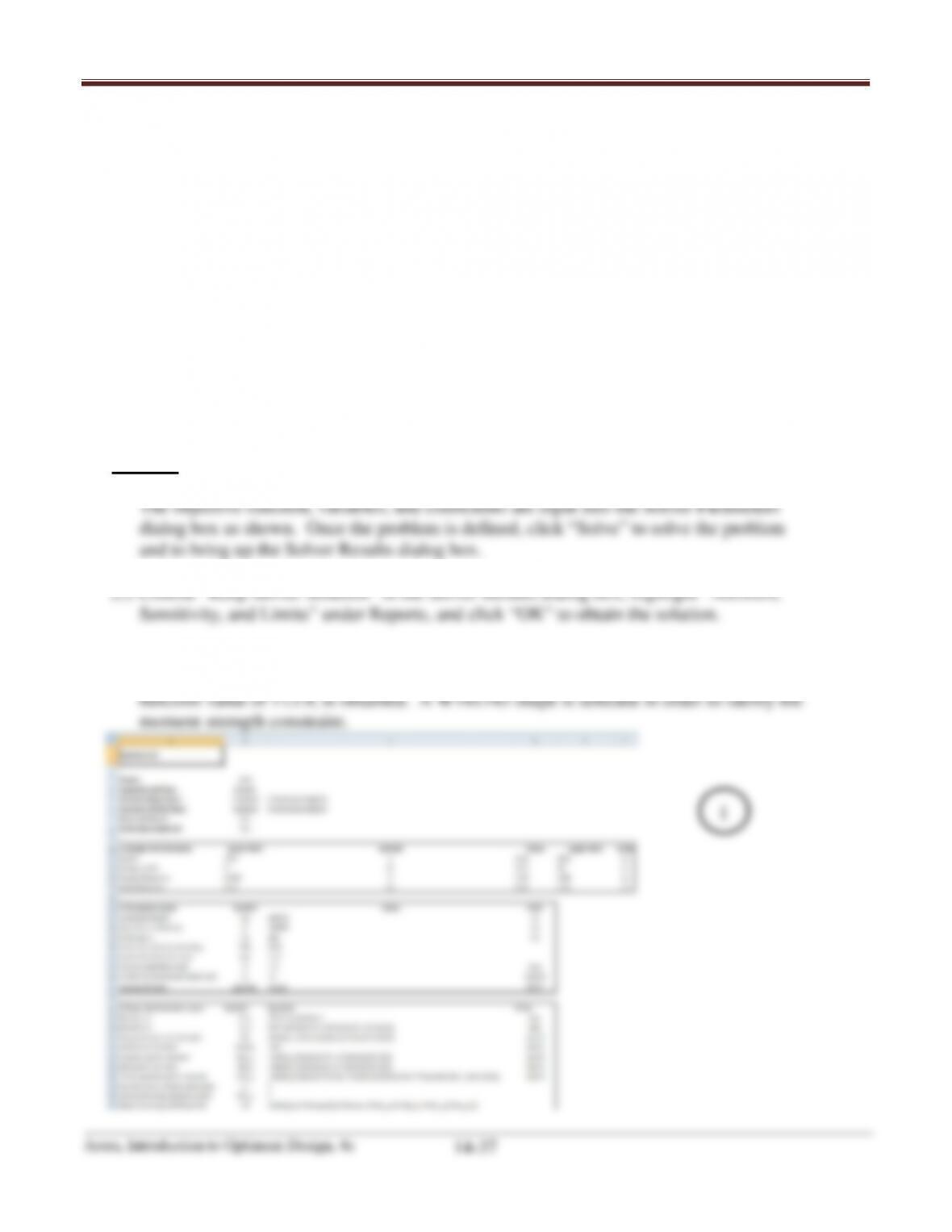
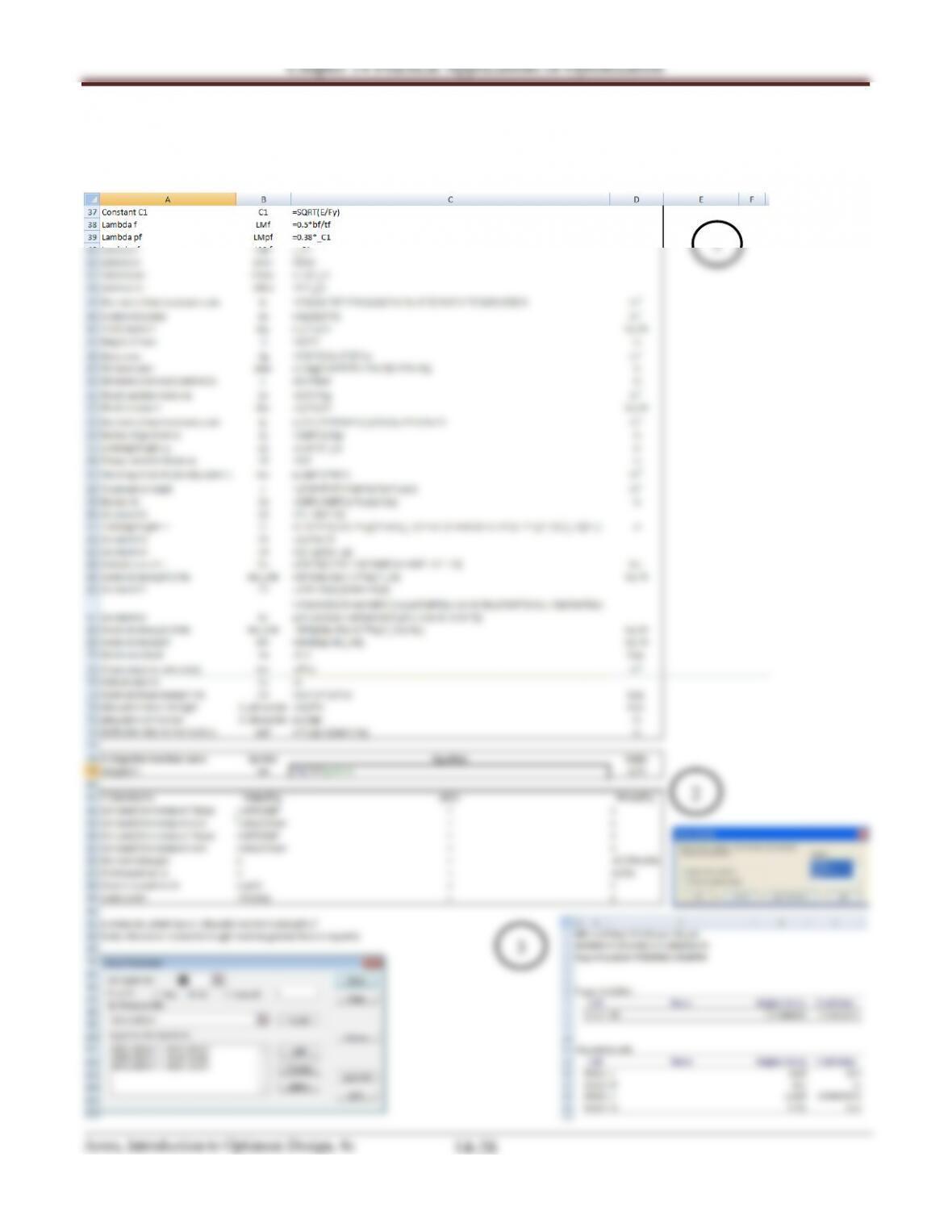
(1) One possible format for setting up the Excel worksheet for this problem is shown below.
(3) The answer report shows that for initial design variable values of d=15.05, bf=10.5, tf=1.1125,
and tw=0.705 a solution of d=16.4, bf=16, tf=0.944, and tw=0.23, which gives an objective
14.40_______________________________________________________________________________
Continued.
3
2
1
Chapter 14 Practical Applications of Optimization
14.41_______________________________________________________________________________
Solve the following problem using the Excel Solver:
Solve the problem of Example 14.7 for a beam of span 40 ft. Assume compact shape and elastic
LTB.
337.5 kip-ft, 37.5 kips
λ λ and λ λ
, 0.6 M
13.7 16.4, 5.0 16.0, 0.335 1.89, 0.23 1.18
aa
f pf w pw
pbr
n pa n
f fw
MV
LLL
M MM
db t t
= =
≤≤
<≤
≤≤
≤≤ ≤ ≤ ≤ ≤ ≤ ≤
Solution
(1) One possible format for setting up the Excel worksheet for this problem is shown below.
(3) The answer report shows that for initial design variable values of d=15.05, bf=10.5, tf=1.1125,
moment strength constraint.
1