
Acknowledgements
We are grateful to the following for permission to reproduce copyright material:
Tables
Text
Mission statement on p. 26 from British Heart Foundation; Lyric on page 47 from Hardly
1. Introduction
Exploring Strategy represents one of the most comprehensive packages of material and support
for teachers and students of strategy. The following materials and assistance are now available:
The text with improved design and layout to assist readers including objectives for each
Thirty-five case studies (text and cases version only) together with comprehensive teaching
notes (in this manual and on the website). The case collection contains a rich mixture of
material, including long and short cases from many different sectors and different countries.
For students:
Revision aids (flashcards, key concepts and glossary (in six languages))
For tutors:
This Instructors Manual

2. Using this manual
This manual is designed for the assistance of teachers of strategy in planning how to gain
maximum advantage from the text Exploring Strategy and the associated teaching and learning
materials. It should provide help with:
Planning a teaching approach to suit the type of participants, time available, etc.
Deciding on how to use the text, illustrations, case examples, readings and case studies in a
teaching scheme.
3. Planning your approach
This section provides some general guidance on how the design of a strategy course can be
3.1 Purpose of the course
Strategy courses can be designed to meet many different needs. At one extreme, the course may
mainly be concerned with raising awareness of why organisations need to change and develop

8
If skills development is most important, then the purpose of the text should be to help
participants understand concepts and analytical tools which they can apply and practice.
Most of the case examples and case studies lend themselves to an analytical approach, and
participants should be set tasks that require them to produce detailed and practical solutions.
Work assignments for the illustrations and at chapter ends should be useful to test skills
development and the understanding of key concepts. With some groups, it may be possible
3.2 Level of participant
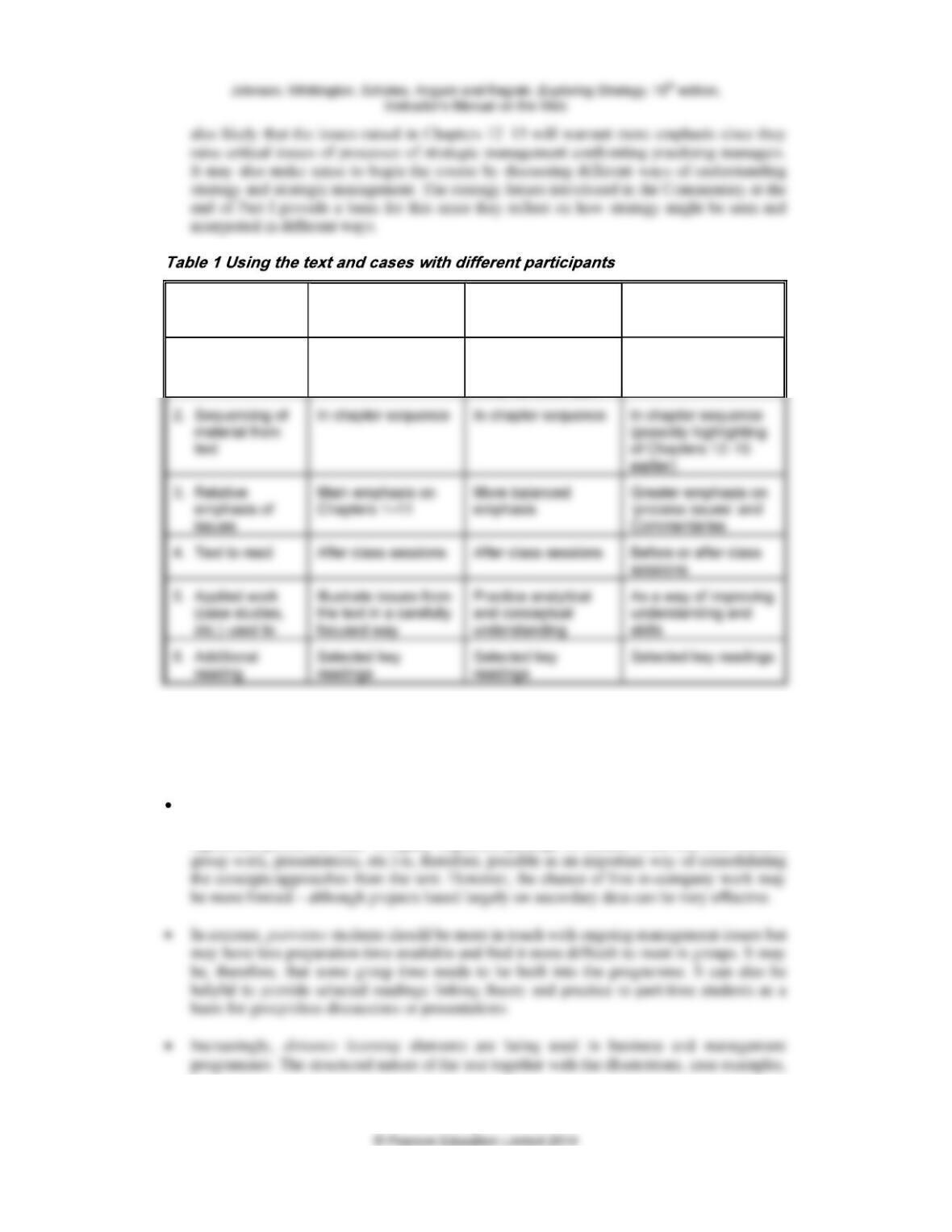
The purpose of a strategy course is likely to differ with the level of participant (see Table 1). For
example, this could relate to their age, job function or type of course which they are studying.
For younger people with little full-time work experience the text should prove useful in
providing a systematic approach and illustrations of strategy in practice. The illustrations
and case examples in the text (and associated work assignments) should be used to relate
theory to practice. Case studies and the video material should be used in fairly focused ways
9
No work experience Limited work
experience
Experienced
managers
1. Typical groups Undergraduates Sandwich degree
students, supervisory
level, full-time MBA
Part-time MBA, in-
company courses
3.3 Study mode
The mode of study should also influence course design.
For full-time courses, a good level of preparation of case study work should be expected.
Such preparation provides an opprortunity for smaller groups to work together on tasks for
significant periods of time. A tightly organised package of student work (the case studies,

10
readings, case studies, video, work assignments and website material lends itself to form the
backbone of learning modules. Section 4 below, which reviews work assignments, provides
guidelines on how the issues and materials in the book can be used to provide a structured
learning path for students.
3.4 Time available
The study hours available will also influence the course design and the use of text and cases.
For long programmes (50 hours +) it should prove possible to use the text and cases
extensively and to supplement the course with other materials and activities.
For shorter programmes, a more selective use of the materials is possible. For example, a
course concerned largely with strategy formulation could confine the use of the text to
4. Designing the teaching scheme
4.1 Pre-course work
It should be clear from the above that there are many circumstances where pre-course work
could be essential. The text and case studies are designed to facilitate this. Where pre-course
work is needed, it is suggested that it is prescribed in the following way:
The appropriate chapters of the book with a few suggested issues to bear in mind. For
example, it might prove useful for participants to read Chapter 1 and be expected to discuss

Johnson, Whittington, Scholes, Angwin and Regnér, Exploring Strategy, 10th edition,
Instructors Manual on the Web
11
4.2 Starting the course
The specific requirements of each course will vary but here is some guidance on how courses in
strategy might be started:
A traditional approach would be to run through the issues in Chapter 1 and relate them to
the structure of the course. This is most successful if the course follows the text quite
closely and in chapter sequence.
4.3 Planning the topics
The text lends itself to a range of different treatments and we encourage teachers to use it in a
way which suits their own style and the needs of the participants. Some approaches might be as
follows:
The most straightforward teaching scheme is one that follows the sequence of topics from
the text. For example, on a final year undergraduate programme the text can be covered in

12
4.4 Balance of the course
The teaching scheme will need to be balanced in relation to many of the needs identified in
Section 3 in two different ways:
The degree of emphasis given to different topics as discussed above.
The mixture and sequencing of lectures, seminars, case studies, group work, etc. These are
largely determined by the circumstances for which the programme is designed as outlined in
Section 3. It is useful to look at some typical ways in which this mix can be planned:
Case study/applied material only courses, where the text is used as pre-reading and/or
follow-up. This approach is not very common on open access courses but can be very
4.5 Assessment
Many courses will require participants to be assessed. The text and cases (and the above advice
on course design) provide opportunities for a wide variety of different assessments. For example:
Formal examinations can be used to test understanding of the key concepts presented in the
text. There are dangers that students give overly theoretical answers to questions. One way

Case study examinations are a commonly used method of assessment. There are typically
two approaches here.
i) The case study is distributed before the examination, but not the questions. Students are
then able to prepare, perhaps in groups. The questions are then provided in the
Project-based assessment involves students (or groups of students) applying the concepts
and techniques in the book to a real organisation. This could be done, for example, by part
time students working on their own organisations. Or it can be done with students working
on nominated organisations using secondary data.
Student presentations are another method of assessment, popular with many strategy
A note on Group Projects. Group projects can be an excellent form of learning and therefore
lend themselves to be incorporated into the assessment package. The group project provides an
extra learning dimension from the individual project namely, the process by which the group
undertook the project and managed themselves. We would advise that the project write-up
should include issues of process as well as content. Many teachers shy away from group
projects because they feel that the assessment of individual contributions can be difficult (which
14
4.6 Sample teaching plan
This is an example of a teaching plan for a 500-strong cohort of level 3 undergraduates taking
strategic management as a core double-weighted module over two semesters. Total contact
hours are 36 hours, group work comprises 110 hours and independent study 154 hours. The
The strategic management module has two main learning components:
Acquiring theory and concepts in strategy
Successful studying for the module requires the following:
Working through the Exploring Strategy interactive study guide together with the textbook
Reflecting this balance, the module has three elements of assessment:
1. Online assessment (10%). A range of question types to test students basic understanding
2. An individual written assignment, including a copy of the group presentation (30%).
This requires application of the theory to a chosen organisation. Group work involves
3. A two-hour case study-based examination (60%). This requires application of the theory
to a case study that is issued two weeks before the exam and students analyse it in their
study groups prior to the exam.
The course structure is as follows:
Lectures: All students attend 11 two–hour lectures 8 in Semester 1 and 3 in Semester 2.
Workshops: Each study group has 7 two-hour interactive workshop sessions. They
commence in week 3, Semester 1 and run throughout the year.
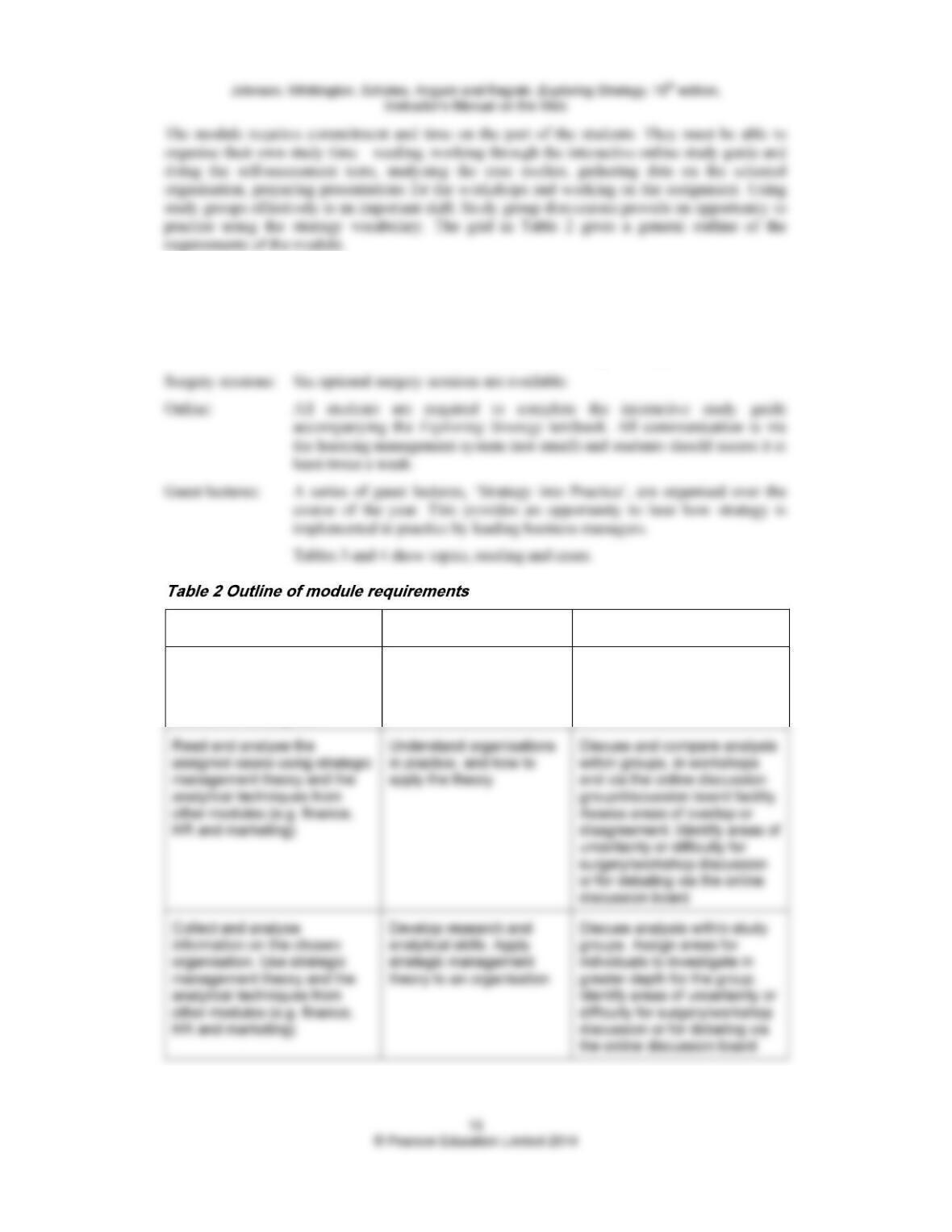
Work area Purpose Group work
Read the core text (Exploring
Strategy), other recommended
reading and work through the
interactive study guide
Understand the theory Discuss the ideas in groups;
consider how to apply them
and what their implications are
Work area Purpose Group work
Develop group presentation Simulate a team-based
work situation and a
presentation to
management develop
communication and
influencing skills
Discuss who is going to make
the presentation, how all group
members can be involved,
what format it will take.
Rehearse and polish the
presentation and prepare
answers to questions that
might arise
the issues
Lecture
(2 hours)
Topic Preparation for lectures
(Exploring Strategy
text and online interactive
study guide)
Semester 1
Week 1 Introducing strategy Chapter 1 text and online
Week 2 The environment Chapter 2 text and online
Week 3 Strategic capabilities Chapter 3 text and online
17
Week 10 Evaluating strategies Chapter 11 text and online
Week 11 Surgery session
Semester 2
Workshop Analytical focus Preparation
1 Business environment: PESTEL,
Five Forces
Case Example Chapter 2. Global forces
and the advertising industry
2 Organisational resources: value
chain, strategic capability
Case Example Chapter 3. Rocket
Internet will the copycat be imitated?
Workshops 26 allocate 30 minutes for group presentations.
5. A guide to using the work assignments
This section contains guidance for using the work assignments that appear with each illustration,
case example and at the end of each chapter in Exploring Strategy. These notes are not intended

18
Standard are straightforward applications of concepts or frameworks to specific situations.
Advanced require a fuller analysis usually linking two or more concepts and/or situations and
requiring reading round the issues.
The sections below provide chapter-by-chapter guidance on how tutors might use the work
assignments to consolidate students understanding of the concepts in Exploring Strategy. There
are, however, a few general guidelines that you may wish to consider in deciding how to gain
most benefit from incorporating these work assignments into the students programme of study:
Remember there are many different ways in which you can use these assignments. For
example as:
Although many of the work assignments draw on illustrations and/or case studies in
Exploring Strategy, we have tried to write them in a way that does not make them entirely
dependent on this specific source material. Most of these work assignments should be
useable in a situation of the tutors/students choice.
6. A guide to using the case studies
Section 12 contains comprehensive teaching notes for each of the case studies that appear in
the text and cases edition of Exploring Strategy. These notes have been prepared by the
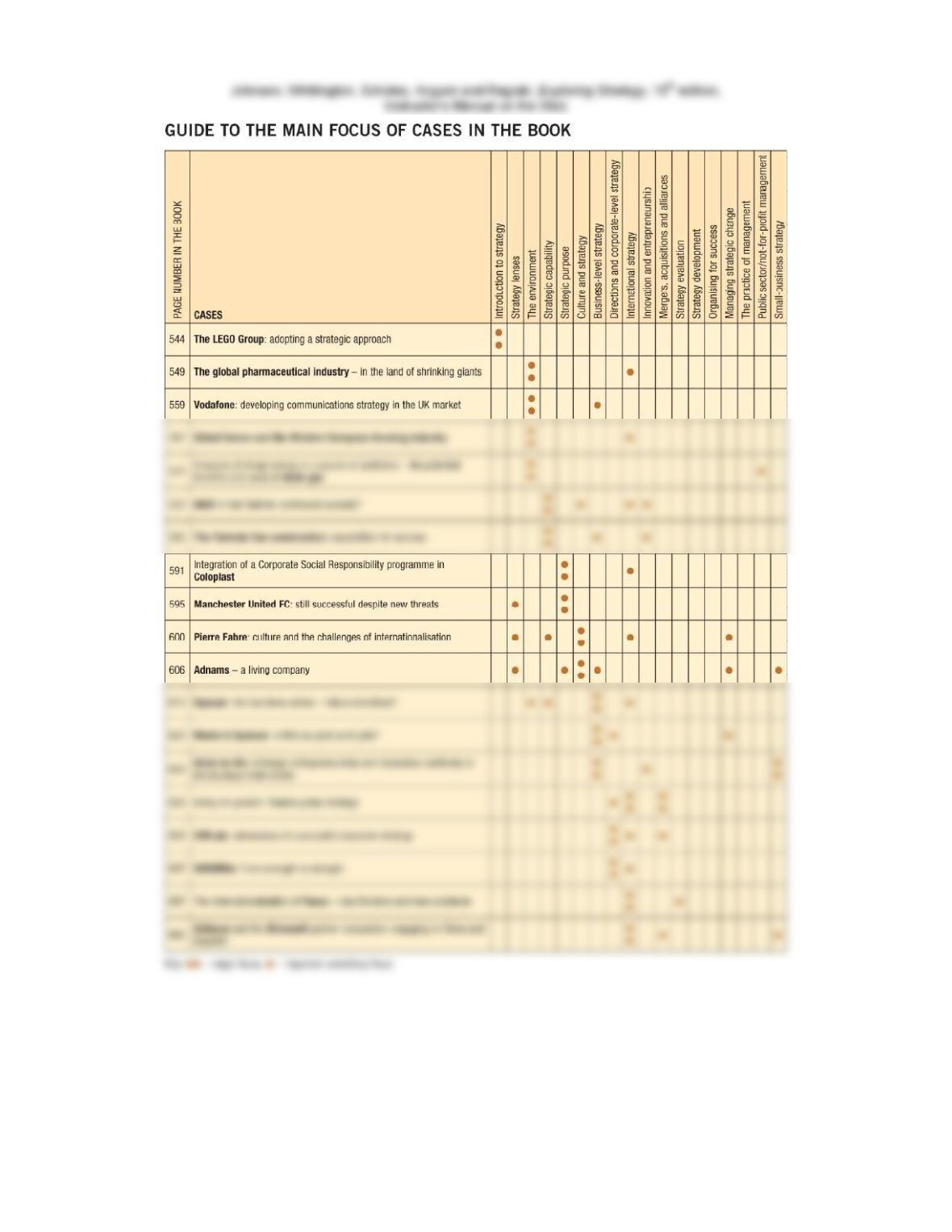
authors of each case study and edited by Steve Pyle. The facing page is a guide to the main

The case studies have been chosen (or specifically written) to provide readers with a core of
cases, which together cover most of the main issues in the text. As such, they should
provide a useful backbone to a programme of study but can be supplemented by other
20
© Pearson Education Limited 2014
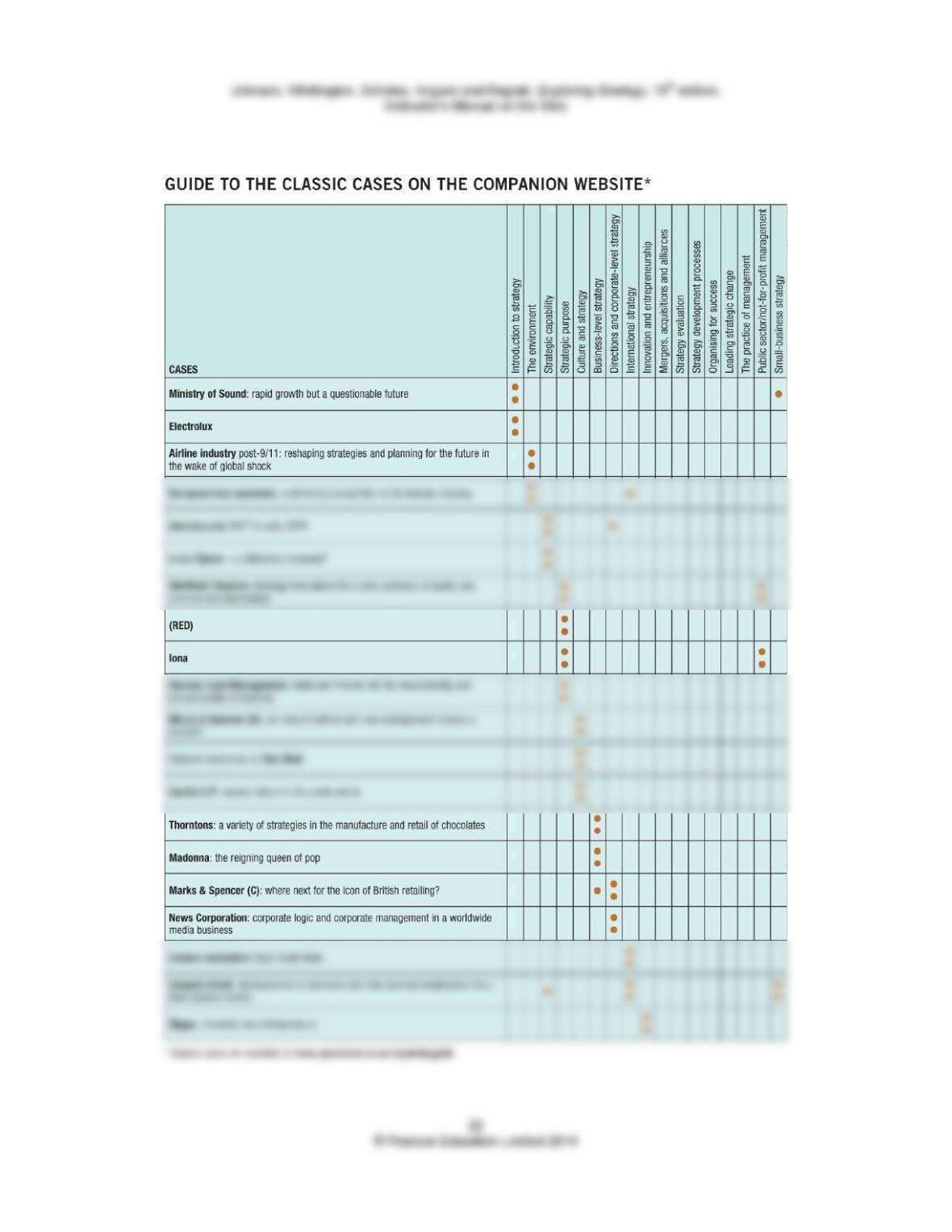
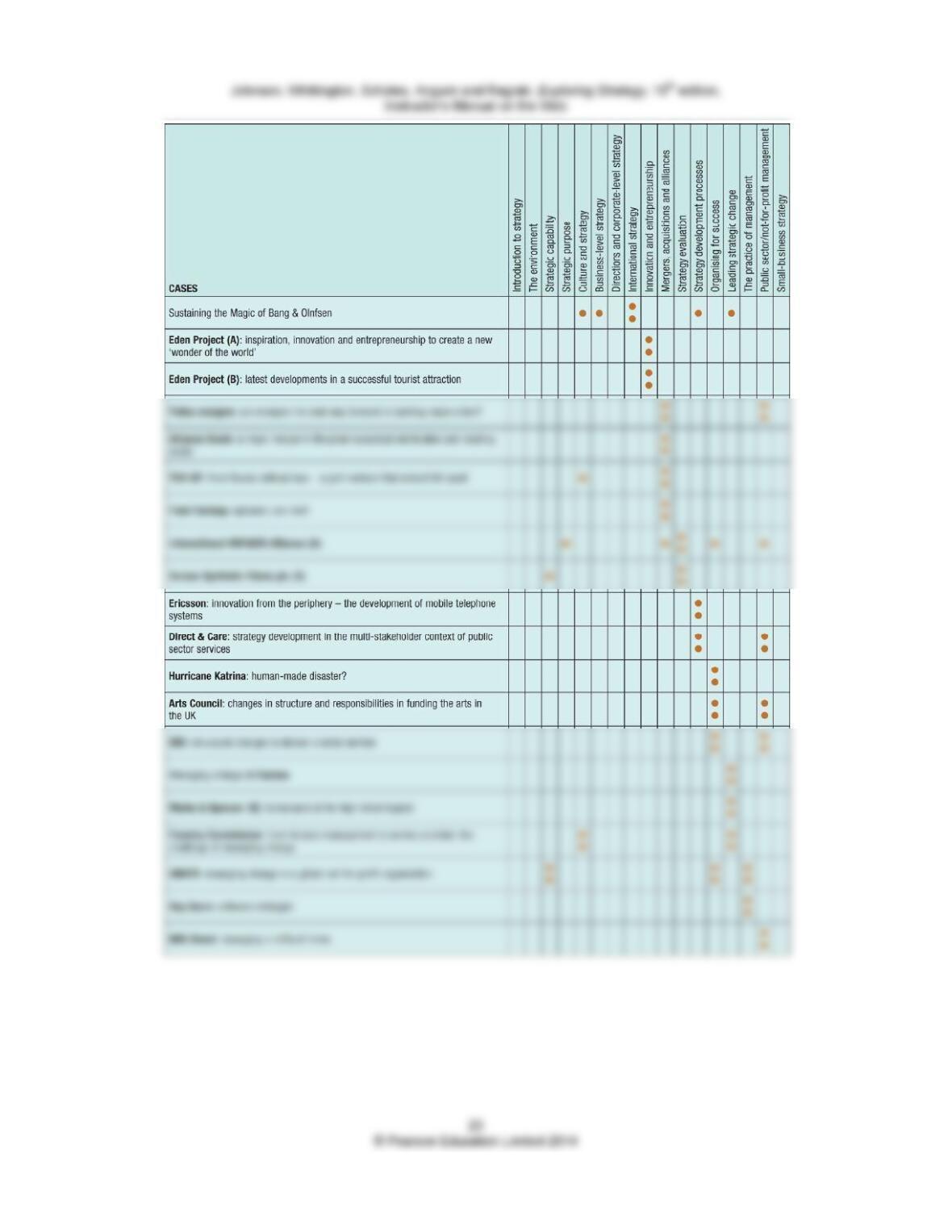
There are also available on the website classic cases from previous editions of Exploring
Strategy. These are summarised below:

24
7. MyStrategyLab
Material for students and tutors is added and updated on a regular basis.
For students:
Dynamic eText that can be bookmarked and annotated
For tutors:
PowerPoint slides
8. Exploring strategy teachers workshops
Each year since 1989, the authors have held one-day workshops for teachers who use Exploring
Strategy or are considering doing so.