Waterways Continuing Problem 1
Waterways Continuing Problem
WCP1 Waterways Corporation is a private corporation formed for the purpose of pro-
viding the products and the services needed to irrigate farms, parks, commercial projects,
and private homes. It has a centrally located factory in a U.S. city that manufactures the
products it markets to retail outlets across the nation. It also maintains a division that
provides installation and warranty servicing in six metropolitan areas.
The mission of Waterways is to manufacture quality parts that can be used for effec-
tive irrigation projects that also conserve water. By that effort, the company hopes to sat-
isfy its customers, provide rapid and responsible service, and serve the community and
the employees who represent them in each community.
The company has been growing rapidly, so management is considering new ideas to
help the company continue its growth and maintain the high quality of its products.
Waterways was founded by Will Winkman who is the company president and chief
executive officer (CEO). Working with him from the company’s inception was Will’s brother,
Ben, whose sprinkler designs and ideas about the installation of proper systems have been
a major basis of the company’s success. Ben is the vice president who oversees all aspects
of design and production in the company.
A partial list of Waterways’ accounts and their balances for the month of November
2016 follows.
Accounts Receivable $ 275,000
Advertising Expenses 54,000
Cash 260,000
Depreciation—Factory Equipment 16,800
Depreciation—Office Equipment 2,400
Direct Labor 42,000
Factory Supplies Used 16,800
Factory Utilities 10,200
Raw Materials Inventory, October 31 38,000
Raw Materials Purchases 184,500
Rent—Factory Equipment 47,000
Repairs—Factory Equipment 4,500
Salaries 325,000
2Waterways Continuing Problem
Instructions
(a) Based on the information given, construct an organizational chart of Waterways
Corporation.
Waterways Continuing Problem 3
Waterways Continuing Problem
(This is a continuation of the Waterways Problem from Chapter 1)
WCP2 Waterways has two major public-park projects to provide with comprehensive
irrigation in one of its service locations this month. Job J57 and Job K52 involve 15 acres
of landscaped terrain which will require special-order sprinkler heads to meet the speci-
fications of the project. Using a job cost system to produce these parts, the following
events occurred during December 2016.
Raw materials were requisitioned from the company’s inventory on December 2 for
$5,061; on December 8 for $1,059; and on December 14 for $3,459. In each instance, two-
thirds (2/3) of these materials were for J57 and the rest for K52.
Six time tickets were turned in for these two projects for a total amount of 18 hours
Dec. 1 Purchased raw materials from Durbin Supply Company on account for $53,200.
Dec. 2 Issued $40,000 of direct materials from the company’s inventory to jobs other
than K52 and J57 and $3,000 of indirect materials.
Dec. 12 Paid Waterways’ factory salaries and wages in the amount of $65,000.
Dec. 13 Paid the factory’s water bill of $9,000.
Dec. 18 Transferred $50,000 of costs from other completed jobs to finished goods.
Dec. 21 Paid the factory’s electric bill of $12,000 for Waterways’ factory.
Dec. 31 Made adjusting entries for the factory that included accrued property taxes of
$12,000, prepaid insurance of $8,800, and accumulated depreciation of $16,000.
Instructions
(a) Set up the job cost sheets for Job No. J57 and Job No. K52. Determine the total cost
for each manufacturing special order for these jobs. (Round unit cost to nearest cent.)
(b) Journalize the activities from these job cost sheets in the general journal. Also jour-
4Waterways Continuing Problem
Waterways Continuing Problem
(This is a continuation of the Waterways Problem from Chapters 1 and 2. The asterisk*
indicates material discussed in the chapter appendix.)
WCP3 Because most of the parts for its irrigation systems are standard, Waterways han-
dles the majority of its manufacturing as a process cost system. There are multiple process
departments. Three of these departments are the Molding, Cutting, and Welding depart-
ments. All items eventually end up in the Package department which prepares items for
sale in kits or individually.
The following information is available for the Molding department for January.
Work in process beginning:
Units in process 22,000
Stage of completion for materials 80%
Units started into production in January 60,000
Units completed and transferred in January 58,000
Costs added to production:
Instructions
(a) Prepare a production cost report for Waterways using the weighted-average method.
*(b) Show the equivalent units for materials and conversion costs if Waterways used FIFO
instead of weighted-average.
Waterways Continuing Problem 5
Waterways Continuing Problem
(This is a continuation of the Waterways Problem from Chapters 1 through 3.)
WCP4 Direct labor or machine hours may not be the appropriate cost driver for over-
head in all areas of manufacturing due to the complexities of many manufacturing
processes. Many companies use activity-based costing (ABC) which uses multiple drivers
(items that consume resources) rather than just one driver to apply overhead to their
activities. With ABC, a company can use a cost driver that has a direct cause/effect rela-
tionship in its applied overhead costs.
Waterways looked into ABC as a method of costing because of the variety of items it
produces and the many different activities in which it is involved. The activities listed
below are a sample of possible cost pools for Waterways.
Assembling Payroll
Billing Plant supervision
Instructions
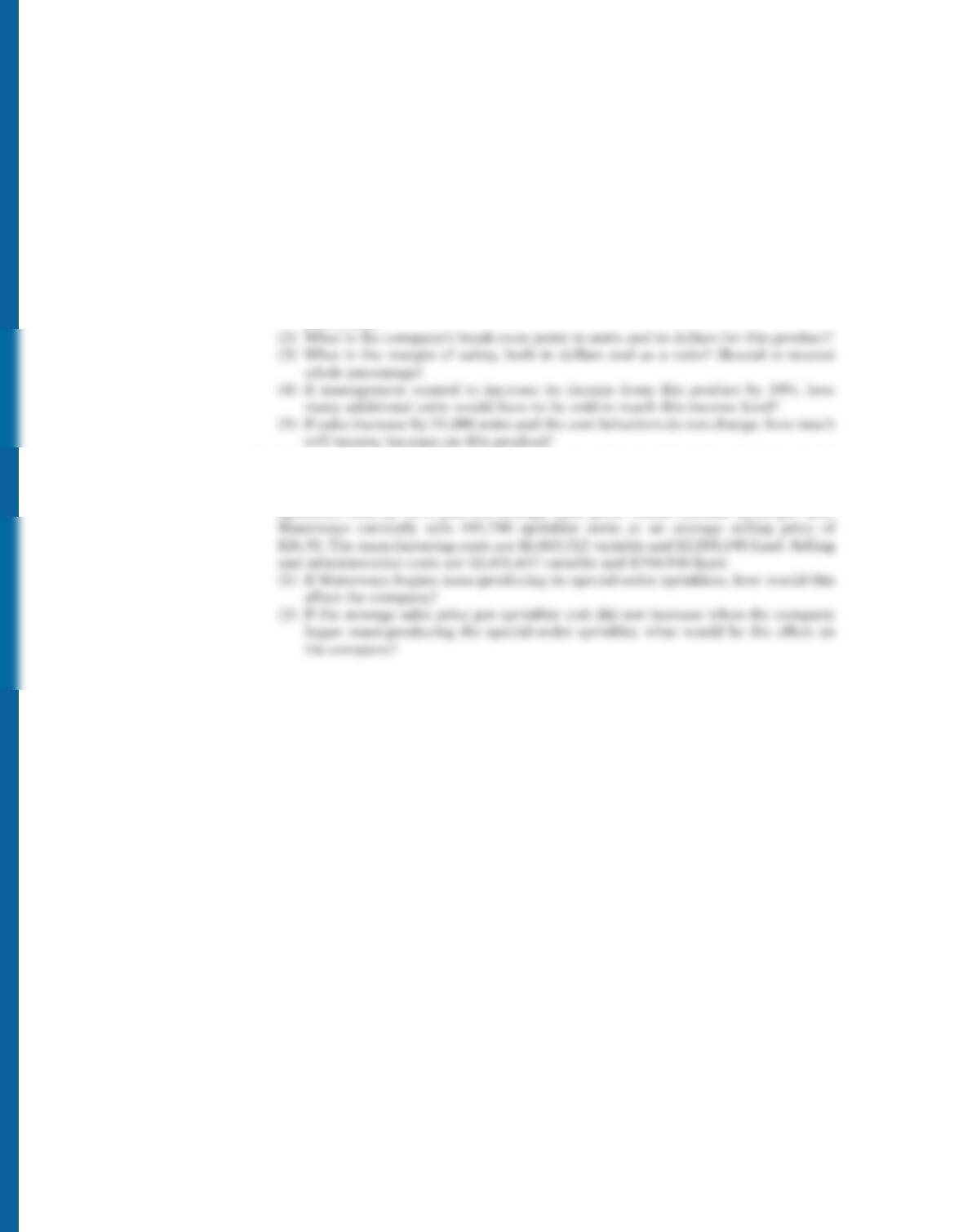
(a) For each of these cost pools, what would be the likely activity cost driver?
(b) Using the following information, determine the overhead rates and the actual cost
assigned for each of the activity cost pools in a possible ABC system for Waterways.
WATERWAYS CORPORATION
Expected
Use of Actual
Estimated Cost Drivers Use of
Activity Cost Pools Cost Drivers Overhead per Activity Drivers
Irrigation installation Labor cost $1,998,432 12,960 12,941
Machining (all machine use) Machine hours 1,670,400 33,408,000 33,409,000
(c) How would you classify each of the following activities by level—unit level, batch
level, product level, or facility level?
Testing of products Machine maintenance
Designing new products Advertising
(d) (1) The results of ABC can provide a more accurate picture of costs. Discuss the value
of Waterways using this system to determine overhead costs.
(2) How might using ABC affect decision making at Waterways?
6Waterways Continuing Problem
Waterways Continuing Problem
(This is a continuation of the Waterways Problem from Chapters 1 through 4.)
WCP5 Vice President for Sales and Marketing Sam Totter is trying to plan for the com-
ing year in terms of production needs to meet the sales demand. He is also trying to deter-
mine ways in which the company’s profits might be increased in the coming year.
Instructions
(a) Waterways markets a simple water control and timer that it mass-produces. During
2016, the company sold 696,000 units at an average selling price of per solution $4.20 per
unit. The variable expenses were $1,900,080, and the fixed expenses were $683,256.
(1) What is the product’s contribution margin ratio? (Round to nearest whole
percentage)
(b) Waterways is thinking of mass-producing one of its special-order sprinklers. To do
so would increase variable costs for all sprinklers by an average of $0.70 per unit.
The company also estimates that this change could increase the overall number of
sprinklers sold by 10%, and the average sales price would increase $0.20 per unit.
Waterways Continuing Problem 7
Waterways Continuing Problem
(This is a continuation of the Waterways Problem from Chapters 1 through 5.)
WCP6
Part 1
Waterways has a sales mix of sprinklers, valves, and controllers as follows.
Annual expected sales:
Sale of sprinklers 460,000 units at $26.50
Sale of valves 1,480,000 units at $11.20
Sale of controllers 60,000 units at $42.50
Variable manufacturing cost per unit:
Sprinklers $13.96
Valves $ 7.95
Instructions
(a) Determine the sales mix based on unit sales for each product.
(b) Using the annual expected sales for these products, determine the weighted-average
unit contribution margin for these three products. (Round to two decimal places.)
(c) Assuming the sales mix remains the same, what is the break-even point in units for
these products?
Part 2
Waterways packages some of its products into sets for home installations. One set (small)
sells for $77 with variable costs of production for the set at $50. Another set (large) sells
for $152 with variable costs of $100. The parts for the $77 set take 9 machine hours to
produce. The parts for the $150 set take 20 machine hours to produce.
Instructions
Given the information above, and assuming all of the package sets produced can be sold
each month, illustrate the best use of machine hours.
Part 3
The section of Waterways that produces controllers for the company provided the fol-
lowing information.
Sales for month of February: 4,000
Variable manufacturing cost per unit: $9.75
Instructions
(a) Using this information for the controllers, determine the contribution margin ratio,
the degree of operating leverage, the break-even point in dollars, and the margin of
safety ratio for Waterways Corporation on this product.
(b) What does this information suggest if Waterways’ cost structure is the same for the
company as a whole?
8Waterways Continuing Problem
Waterways Continuing Problem
(This is a continuation of the Waterways Problem from Chapters 1 through 6.)
WCP7
Part 1
Waterways mass-produces a special connector unit that it normally sells for $3.90. It sells
approximately 35,000 of these units each year. The variable costs for each unit are $2.30.
A company in Canada that has been unable to produce enough of a similar connector to
meet customer demand would like to buy 15,000 of these units at $2.60 per unit. The pro-
duction of these units is near full capacity at Waterways, so to accept the offer from the
Canadian company would require temporarily adding another shift to its production line.
To do this would increase variable manufacturing costs by $0.30 per unit. However, vari-
Instructions
Given the information above:
(a) What are the consequences of Waterways agreeing to provide the 15,000 units to the
Canadian company? Would this be a wise “special order” to accept?
(b) Should Waterways accept the special order from the irrigation company?
(c) What would be the consequences of accepting both special orders?
Part 2
Waterways has discovered that a small fitting it now manufactures at a cost of $1.00 per
unit could be bought elsewhere for $0.82 per unit. Waterways has fixed costs of $0.20 per
unit that cannot be eliminated by buying this unit. Waterways needs 460,000 of these
units each year.
If Waterways decides to buy rather than produce the small fitting, it can devote the
machinery and labor to making a timing unit it now buys from another company.
Instructions
Given the information above:
(a) Without considering the possibility of making the timing unit, evaluate whether
Waterways should buy or continue to make the small fitting.
(b) (1) What is Waterways’ opportunity cost if it chooses to buy the small fitting and start
manufacturing the timing unit?
(2) Would it be wise for Waterways to buy the fitting and manufacture the timing
unit? Explain.
Part 3
Waterways is considering the replacement of an antiquated machine that has been slowing
down production because of breakdowns and added maintenance. The operations
manager estimates that this machine still has 2 more years of possible use. The machine
produces an average of 50 units per day at a cost of $6.50 per unit, whereas other similar
machines are producing twice that much. The units sell for $8.50. Sales are equal to pro-
duction on these units, and production runs for 260 days each year. The replacement
machine would cost $55,000 and have a 2-year life.
Instructions
Given the information above, what are the consequences of Waterways replacing the
machine that is slowing down production because of breakdowns?
Waterways Continuing Problem 9
Waterways Continuing Problem
(This is a continuation of the Waterways Problem from Chapters 1 through 7.)
WCP8 Waterways uses time and material pricing when it bids on irrigation projects.
Budgeted data for 2016 are as follows.
WATERWAYS CORPORATION
Budgeted Costs for Irrigation Projects for 2016
Material
Time Loading
Charges Charges
Labor wages (5,750 hours) $240,000
Supervisor’s salary $ 60,000
Clerical and accountant wages 60,000 4,000
Irrigation supplies manager 40,000
Overhead 53,950 21,000
Total $353,950 $125,000
Waterways has budgeted for 5,750 labor hours. It desires a $14 profit margin per hour of
labor and 16% profit on materials. It estimates the total invoice cost of materials in 2016
will be $640,000.
Instructions
(a) Compute the rate per hour of labor. (Round to two decimal places.)
(b) Compute the material loading charge. (Round to two decimal places.)
(c) Waterways has received a request for a bid to do a parkway for the city. The irriga-
10 Waterways Continuing Problem
Waterways Continuing Problem
(This is a continuation of the Waterways Problem from Chapters 1 through 8.)
WCP9 Waterways Corporation is preparing its budget for the coming year, 2017. The
first step is to plan for the first quarter of that coming year. Waterways gathered the fol-
lowing information from the managers.
Sales
Unit sales for November 2016112,500
Unit sales for December 2016102,100
Expected unit sales for January 2017113,000
Expected unit sales for February 2017112,500
Expected unit sales for March 2017116,000
Expected unit sales for April 2017125,000
Expected unit sales for May 2017137,500
Unit selling price $12
Waterways likes to keep 10% of the next month’s unit sales in ending inventory. All
sales are on account. 85% of the Accounts Receivable are collected in the month of sale,
and 15% of the Accounts Receivable are collected in the month after sale. Accounts receiv-
able on December 31, 2016, totaled $183,780.
Direct Materials
Item Amount Used per Unit Inventory, Dec. 31
Metal 1 lb @ 58¢ per lb. 5,177.5 lbs
Plastic 12 oz @ 6¢ per oz 3,883.125 lbs
Waterways likes to keep 5% of the materials needed for the next month in its ending
inventory. Payment for materials is made within 15 days. 50% is paid in the month of
purchase, and 50% is paid in the month after purchase. Accounts Payable on December
31, 2016, totaled $120,595. Raw Materials on December 31, 2016, totaled 11,295 pounds.
Direct Labor
Labor requires 12 minutes per unit for completion and is paid at a rate of $8 per hour.
Manufacturing Overhead
Indirect materials 30¢ per labor hour
Indirect labor 50¢ per labor hour
Utilities 45¢ per labor hour
Maintenance 25¢ per labor hour
Selling and Administrative
Variable selling and administrative cost per unit is $1.60.
Advertising $15,000 a month
Insurance $ 1,400 a month
Salaries $72,000 a month
Depreciation $ 2,500 a month
Other fixed costs $ 3,000 a month
Waterways Continuing Problem 11
Other Information
The Cash balance on December 31, 2016, totaled $100,500, but management has decided
it would like to maintain a cash balance of at least $800,000 beginning on January 31,
2017. Dividends are paid each month at the rate of $2.50 per share for 5,000 shares
outstanding. The company has an open line of credit with Romney’s Bank. The terms of
Instructions
For the first quarter of 2017, do the following.
(a) Prepare a sales budget.
(b) Prepare a production budget.
(c) Prepare a direct materials budget. (Round to nearest dollar)
(d) Prepare a direct labor budget. (For calculations, round to the nearest hour.)
(e) Prepare a manufacturing overhead budget. (Round amounts to the nearest dollar.)
(f) Prepare a selling and administrative budget.
12 Waterways Continuing Problem
Waterways Continuing Problem
(This is a continuation of the Waterways Problem from Chapters 1 through 9.)
WCP10 Waterways Corporation is continuing its budget preparations. Waterways had
the following static budget and overhead costs for March 2016.
WATERWAYS CORPORATION
Manufacturing Overhead Budget
(Static) For the Month of March 2017
Budgeted production in units 117,500
Budgeted costs
Indirect materials $ 5,875
Indirect labor 14,100
Utilities 11,750
Property taxes 3,000
Insurance 1,200
Janitorial 1,500
Total budgeted costs $104,450
WATERWAYS CORPORATION
Manufacturing Overhead Costs (Actual)
For the Month of March 2017
Production in units 118,500
Costs
Indirect materials $ 5,910
Indirect labor 14,195
Utilities 11,880
Property taxes 3,000
Insurance 1,200
Janitorial 1,500
Total costs $104,760
Waterways produced 118,500 units in March rather than the budgeted number of units.
Instructions
(a) Prepare a flexible overhead budget based on the following amounts produced.
(1) 115,500 units
(2) 116,500 units
(3) 117,500 units
(4) 118,500 units
(5) 119,500 units
Waterways Continuing Problem 13
Waterways Continuing Problem
(This is a continuation of the Waterways Problem from Chapters 1 through 10.)
WCP11 Waterways Corporation uses very stringent standard costs in evaluating its man-
ufacturing efficiency. These standards are not “ideal” at this point, but the management is
working toward that as a goal. At present, the company uses the following standards.
Materials
Item Per unit Cost
Metal 1 lb. 63¢ per lb.
Plastic 12 oz. $1.00 per lb.
Rubber 4 oz. 88¢ per lb.
Direct Labor
Item Per unit Cost
Labor 15 min. $8.00 per hr.
Predetermined overhead rate based on direct
labor hours ⫽$4.28
The January figures for purchasing, production, and labor are:
The company purchased 229,000 pounds of raw materials in January at a cost of 78¢
a pound.
Instructions
Answer the following questions about standard costs.
(a) What is the materials price variance?
(b) What is the materials quantity variance?
(c) What is the total materials variance?
(d) What is the labor price variance?
(e) What is the labor quantity variance?
(f) What is the total labor variance?
(g) What is the total overhead variance?
(h) Evaluate the variances for this company for January. What do these variances suggest
to management?
14 Waterways Continuing Problem
Waterways Continuing Problem
(This is a continuation of the Waterways Problem from Chapters 1 through 11.)
WCP12 Waterways puts much emphasis on cash flow when it plans for capital
investments. The company chose its discount rate of 8% based on the rate of return it
must pay its owners and creditors. Using that rate, Waterways then uses different
methods to determine the best decisions for making capital outlays.
In 2017 Waterways is considering buying five new backhoes to replace the backhoes it
now has. The new backhoes are faster, cost less to run, provide for more accurate trench
digging, have comfort features for the operators, and have 1-year maintenance agreements
Instructions
(a) Evaluate in the following ways whether to purchase the new equipment or overhaul
the old equipment. (Hint: For the old machine, the initial investment is the cost of the
overhaul. For the new machine, subtract the salvage value of the old machine to
determine the initial cost of the investment.)
(1) Using the net present value method for buying new or keeping the old.
(2) Using the payback method for each choice. (Hint: For the old machine, evaluate
the payback of an overhaul.)
(3) Comparing the profitability index for each choice.
(4) Comparing the internal rate of return for each choice to the required 8% discount
rate.
Old Backhoes New Backhoes
Purchase cost when new $90,000 $200,000
Salvage value now $42,000
Investment in major overhaul needed in next year $55,000
Salvage value in 8 years $15,000 $90,000
Remaining life 8 years 8 years
Net cash flow generated each year $30,425 $43,900
Waterways Continuing Problem 15
Waterways Continuing Problem
(This is a continuation of the Waterways Problem from Chapters 1 through 12.)
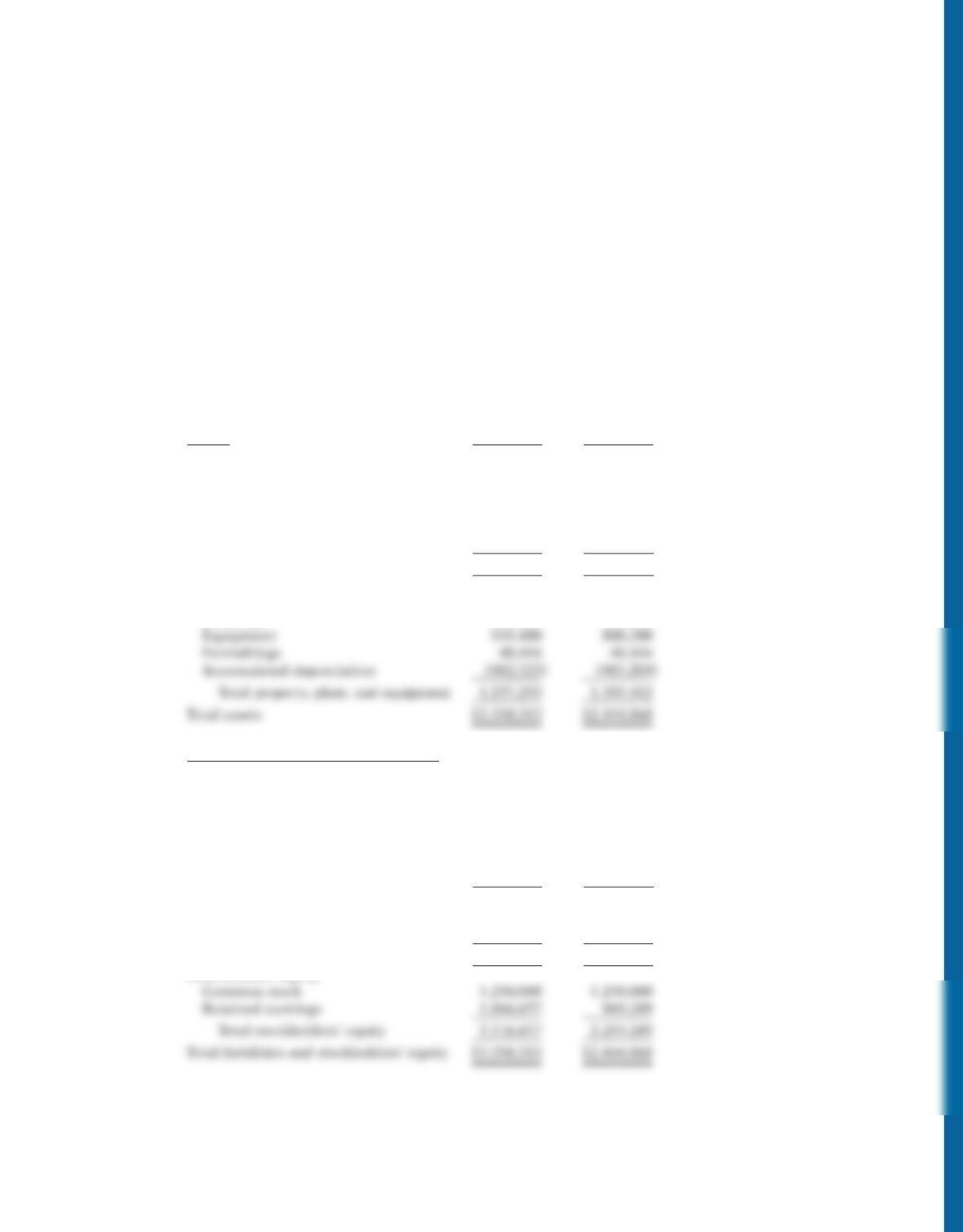
WCP13 Waterways prepared the balance sheet and income statement for the irrigation
installation division for 2017. Now the company also needs to prepare a cash flow state-
ment for the same division. The comparative balance sheets for Waterways Corporation’s
Irrigation Installation Division for the years 2016 and 2017 and the income statement for
the year 2017 are presented below.
Additional information:
1. Waterways sold a company vehicle for $24,000. The vehicle had been used for 10 years.
It cost $80,000 when purchased and had a 10-year life and a $6,000 salvage value.
Straight-line depreciation was used.
2. Waterways purchased with cash new equipment costing $209,200.
3. Prepaid expenses increased by $33,960
WATERWAYS CORPORATION—INSTALLATION DIVISION
Balance Sheets
December 31
Assets 20172016
Current assets
Cash $ 836,797 $ 746,681
Inventory 16,766 7,500
Prepaid expenses 76,550 42,590
Total current assets 2,313,022 1,339,456
Property, plant, and equipment
Land 300,000 300,000
Buildings 450,000 450,000
Equipment 929,400 800,200
Liabilities and Stockholders’ Equity
Current liabilities
Accounts payable $ 157,095 $ 128,360
Income taxes payable 101,344 79,989
Total current liabilities 293,658 225,579
Long-term liabilities
Note payable 140,000 —
Total liabilities 433,658 225,579
Stockholders’ equity
Common stock 1,250,000 1,250,000
16 Waterways Continuing Problem
Instructions
For the year 2017:
(a) Prepare a statement of cash flows using the indirect method.
*(b) Prepare a statement of cash flows using the direct method.
(c) Determine free cash flow.
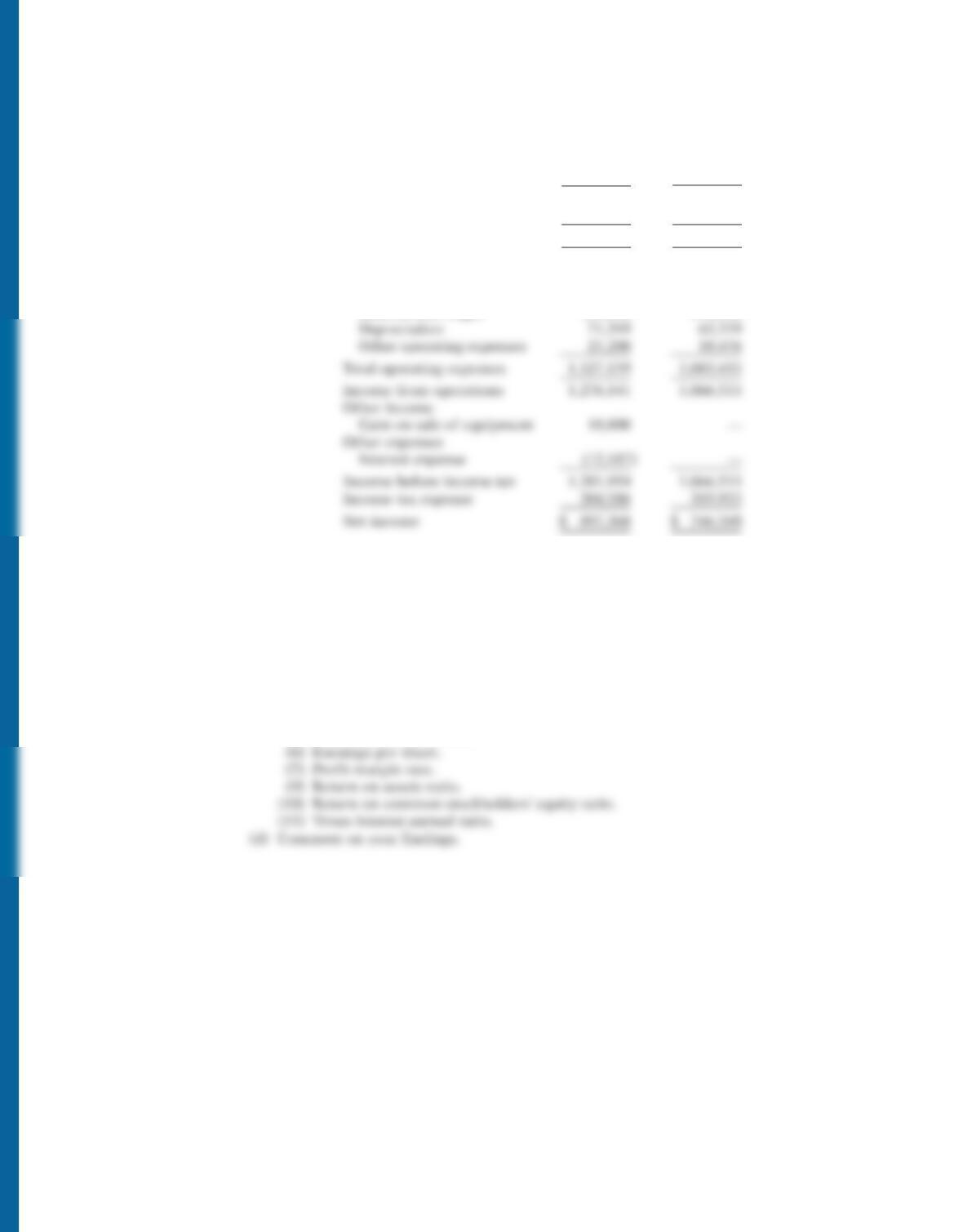
WATERWAYS CORPORATION—INSTALLATION DIVISION
Income Statement
For the Year Ending December 31, 2017
Sales $5,536,077
Less: Cost of goods sold 3,132,777
Gross profit 2,403,300
Depreciation 71,319
Other operating expenses 21,200
Total operating expenses 1,127,159
Income from operations 1,276,141
Other income
Gain on sale of equipment 18,000
Other expenses
Waterways Continuing Problem 17
Waterways Continuing Problem
(This is a continuation of the Waterways Problem from Chapters 1 through 13.)
WCP14 The comparative balance sheets of Waterways Corporation’s Irrigation Installation
Division for the years 2016 and 2017 and the income statements for the year 2016 and
2017 are presented below.
Additional information:
85% of the sales for Waterways were credit sales. There are 5,000 shares outstanding for
both years. This is a private corporation, whose shares are not available to the public.
WATERWAYS CORPORATION—INSTALLATION DIVISION
Balance Sheets
December 31
Assets 20172016
Current assets
Cash $ 836,797 $ 746,681
Accounts receivable 680,750 542,685
Work in process 702,159 —
Inventory 16,766 7,500
Prepaid expenses 76,550 42,590
Total current assets 2,313,022 1,339,456
Property, plant, and equipment
Land 300,000 300,000
Buildings 450,000 450,000
Liabilities and Stockholders’ Equity
Current liabilities
Accounts payable $ 157,095 $ 128,360
Income taxes payable 101,344 79,989
Wages payable 4,517 1,984
Interest payable 1,187 —
Other current liabilities 14,515 15,246
Revolving bank loan payable 15,000 —
Total current liabilities 293,658 225,579
Long-term liabilities
Note payable 140,000 —
Total liabilities 433,658 225,579
Stockholders’ equity
18 Waterways Continuing Problem
Instructions
(a) Prepare a horizontal analysis of the income statement using 2016 as the base year.
(b) Prepare a vertical analysis of the income statement for 2017.
(c) Calculate the following ratios for 2017 and indicate whether the ratio is a liquidity,
solvency, or profitability ratio.
(1) Asset turnover ratio.
(2) Receivables turnover ratio.
(3) Average collection period.
(4) Current ratio.
(5) Debt to total assets ratio.
WATERWAYS CORPORATION—INSTALLATION DIVISION
Income Statements
For the Year Ending December 31
20172016
Sales $5,536,077 $4,957,266
Less: Cost of goods sold 3,132,777 2,807,316
Gross profit 2,403,300 2,149,950
Operating expenses
Advertising 50,000 48,000
Insurance 400,000 400,000
Salaries and wages 584,640 554,640