CASE 10
FASTENERS FOR RETAIL (PART A)
In December 1999, Gerry Conway faced the toughest decision of his 37 years as an entrepreneur.
Something had to be done about the long-term future of Fasteners for Retail (FFr), the business
With no dominant players in FFr’s niche, Conway saw nothing but opportunity ahead. Still,
he was concerned. The company had been debt-free from the start, but feeding its continuing
growth would require an infusion of cash. At 69, Conway felt that this was more risk than he
I am a good entrepreneur, but I am not managerial in nature and I don’t like that part of the
This decision would affect the future of his family, his business, and its 95 employees.
Should he sell the company, appoint a nonfamily CEO, or persuade another family member to
come into the business?
THE FOUNDER
Gerry Conway was the classic American entrepreneur—visionary, charismatic, driven,
impatient, and independent. Born in Cleveland in 1931, Conway was the ninth of 13 children.
His love of the retail environment, his strong independence, and his deep appreciation of people
stemmed from his childhood experiences:
With a little exaggeration, I can say that I’ve been in retail for 60 years. My Dad managed
After college, Conway and his wife, Marty, returned to Cleveland. He began working for an
industrial firm and quickly learned that, while sales attracted him, working in a large corporation
did not. Conway’s next job was with a smaller firm:
I started selling display lithography for a small printer. When that company went belly up, I
During this time, Conway struggled with alcohol:
In 1970, alcohol was becoming a problem, but through a self-help program I chose sobriety and
THE POINT-OF-PURCHASE INDUSTRY
In the mid-1970s, Gerald Conway & Associates was renamed Fasteners for Retail (FFr) to
acknowledge its exclusive focus on display accessories and fasteners within the point-of-
purchase (P-O-P) industry.
The accessory hardware segment (FFr’s niche) was highly fragmented. No single supplier
had more than 10 percent of the subsupplier market, and many competed in only a few product
[Insert Figure L here]
FASTENERS FOR RETAIL (FFR): VALUE ADDED FROM THE START
FFr distinguished itself from its competitors in several important ways. The company offered a
broad and innovative product line, free samples, quick turnaround on orders, and a liberal sales
return policy.
[Insert Table C here]
FFR PRODUCTS
The willingness to emphasize new products became a defining characteristic of the business.
Successful design accessories are functional, fit a specific space, and are inexpensive. New
products were developed from scratch, acquired, or adapted from other industries. Conway
SHIPFLAT LITERATURE HOLDER
At a trade show, Citibank challenged FFr to make a better literature holder. At the time, literature
holders were made from rigid plastic. Only four holders could be shipped per box, and they
frequently broke in transit. After a year of effort, FFr successfully designed attractive and
[Insert Figure M here]
SUPERGRIP SIGN HOLDERS
In the early 1980s, a new product began appearing in the accessory market. FFr recognized this
product’s superior holding ability—it was able to hold paper signs in place more securely than
[Insert Figure N here]
For years, FFr’s marketing thrust was proprietary products. More recent efforts focused on
developing an increasing number of custom products, designed to meet specific customer needs.
FFr typically offered customers more than 100 new products every year. New product ideas
came from FFr personnel, from customers, and from the acquisition of new product concepts.
SERVICE
FFr’s products and superior service separated it from its competition. Independent audits
repeatedly found that customers rated FFr’s customer service as superior. An early hire recalled,
When I began working here, we weren’t quite sure who we were or what market we were in, so
FFr was both a direct sales and a marketing sales company. It relied on its sales force, direct mail
catalog, trade media advertising, trade shows, and sample department to promote its products.
FFR CULTURE
From its first hire on, FFr was a company whose employees, from designer to ware-houseman,
focused on customer satisfaction (Table D). As a 16-year veteran recalled,
Gerry had the ability to hire people who would work independently, but in a common direction
[Insert Table D here]
FFr’s customer-first focus extended to the company newsletter, which told tales of employees
going above and beyond expectations to deliver superior customer service. It offered hints for
achieving customer satisfaction, solicited new product ideas, and reported on product
FFR GROWTH IN THE 1980S
FFr grew at a consistent and steady pace. In 1980, the company had five employees and sales of
$3 million. Business began to boom in the early 1980s as a result of an expanding product line
and a larger sales force. FFr grew steadily, adding employees in accounting, customer service,
This opportunistic philosophy supported FFr’s growth. The business was always profitable, there
was no debt, and the company never got tied up in long-term commitments. Production and most
The flip side of FFr’s opportunism and speed was that it lacked a business plan and strategic
discipline. When Conway came across an interesting idea, he wanted to implement it. Company
To keep the company growing, Conway realized that he needed to hire a president with
managerial expertise. Although he understood the value of management, he was an entrepreneur,
FFR GROWTH IN THE 1990S AND BEYOND
In the early 1990s, Conway and his wife, Marty, joined Case Western Reserve University’s
Partnership for Family Business. Through the program and conversation with other business
owners, Conway began to see the need for different points of view regarding the business, and he
decided to establish an advisory board:
One of the things that sprang from the family business program was that we set up a board of
These advisors helped the family better understand nonfamily management’s needs and helped
nonfamily managers appreciate the unique aspects of family firms. Most significantly, the board
encouraged Conway to professionalize the staff and to build internal controls and an
infrastructure (Figure O). The board had no statutory power but did provide good advice and
served as a valuable sounding board.
[Insert Figure O here]
Under Kimmel’s leadership and with the support of the advisory board, FFr began a rigorous
strategic-planning process in 1997. An internal analysis recommended that the company upgrade
its management talent, consolidate its sales organization, and focus on selling to the major retail
FAMILY INVOLVEMENT
Family involvement began in the 1970s, when the Conway children earned extra money by
putting adhesive on the backs of Arrowhead fasteners. They had all done odd jobs for FFr, but of
the seven children only three worked in the business as adults (Figure P).
[Insert Figure P here]
From an early age, the youngest son, Paul, planned to join FFr. At his father’s urging, he
began his work career with another employer. It was only after he had been successful there that
he joined FFr in 1988; his first job was in the marketing department.
It was not until the early 1990s that Gerry Conway began to focus on succession. His
attention was driven by the company’s success, his sons’ active presence in FFr, and
Family meetings were a high point for Gerry’s wife, Marty:
From the family business program, we learned about family meetings. We had an outside
The family meetings were important to Gerry as well:
Before we had family meetings, I kept pretty much everything to myself. I was not that open. One
As adults, all seven next-generation members of the Conway family got along well and
respected each other and each other’s life and career choices. They also respected FFr—“the
house that Gerry had built”—and the family values that Marty continued to nurture. Their sense
of family unity was balanced by an appreciation for individual differences.
ESTATE PLANNING
One of the goals of the Conways’ estate plan was to transfer a substantial amount of the value of
FFr to their children during their lifetime so as to avoid estate taxes, but to do so without
In addition, the Conways used a grantor-retained annuity trust (GRAT) for each child. In
other words, the nonvoting shares were transferred into a trust for each child, and the trusts
After a period of years, the GRATs terminated in accordance with the trust provisions.
Children who were over 30 took their shares outright; the shares belonging to those who were
SUCCESSION: KEVIN’S AND PAUL’S STORIES
While Kevin was the first child to join FFr, he was never a candidate for CEO. Like so many
excellent salesmen, he did not like managerial activities. As the company grew, his interest in it
waned, in part because he disliked the increased number of systems that were implemented to
support the company’s growth.
Paul Conway joined FFr a few years after Kevin did. Paul’s earliest memories were of
Paul began seriously imagining his future with FFr while he was in high school. He worked
at FFr during college vacations and then joined another business after college graduation to gain
additional work experience. After only 1 year, FFr’s nonfamily marketing manager encouraged
Paul became the international sales manager and built FFr’s international business while also
maintaining a position in the marketing department. After 7 years, he became the marketing
I reached the Peter Principle as Marketing Manager. I didn’t have formal training and the
position was getting a little unwieldy for me. I just didn’t have the tools, and Don needed help
I didn’t like my Dad’s management style. I’d always tell him about it, and we’d talk it through.
We argued at times, but our arguments were always short-lived. It was as healthy an element of
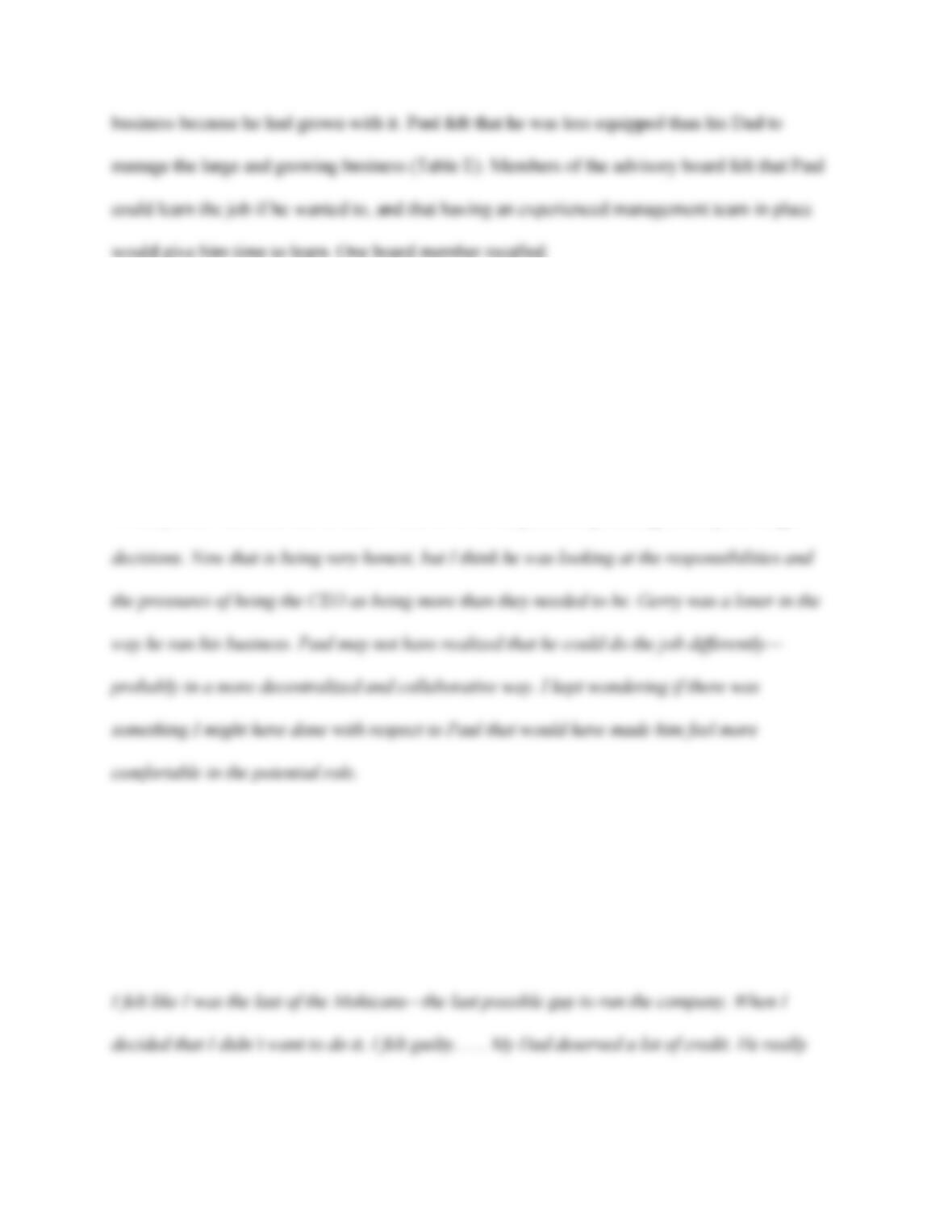
would give him time to learn. One board member recalled:
[Insert Table E here]
At the beginning of the succession process, Paul was really the only son who was actively
involved in the company. I thought that Paul would become president and believed that he had
the capability to do the job well.
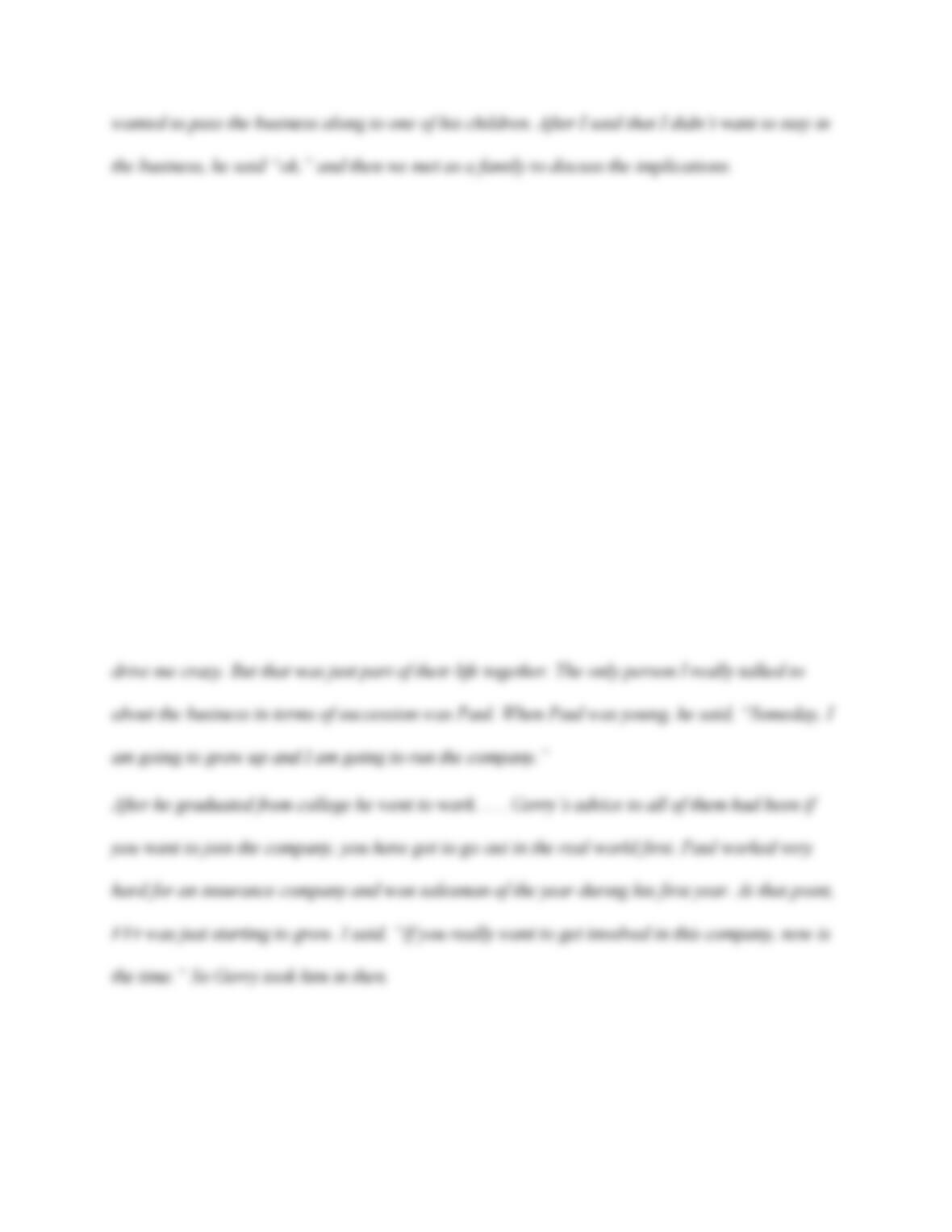
At one point, Paul said that he didn’t want to be in the position of making some of the tough
Gerry’s brother, FFr board member Bill Conway, suggested that Paul give himself more time in
the business before he made a decision about becoming CEO. Paul thought about his choices for
about a year and ultimately decided that he wanted to leave the company and become a teacher.
The decision to leave FFr was not easy:
SUCCESSION: MARTY’S POINT OF VIEW
Marty Conway was one of Gerry’s chief advisors. While Gerry was the obvious leader of the
company, it was Marty who signed the checks and kept an eye on corporate finances. She had a
public role at company functions and was a people booster. She played a more significant role
behind the scenes, supporting Gerry as he considered important business changes, such as
handing over the administrative reins or making personnel changes. Both family members and
outsiders described Marty as the glue that worked behind the scenes to hold the family together
through the predictable challenges that families who work together face. She summed up Paul’s
role at FFr as follows:
When Paul would come over, Gerry and Paul would talk business all the time, which used to
SUCCESSION: GERRY’S DILEMMA
Gerry Conway was a passionate entrepreneur, a business builder. During the early part of his
career, he traveled extensively, meeting customers and serving as chief salesman, marketer, and
innovator for the company. Whether he was on the road or in the office, his presence was felt
throughout the organization.
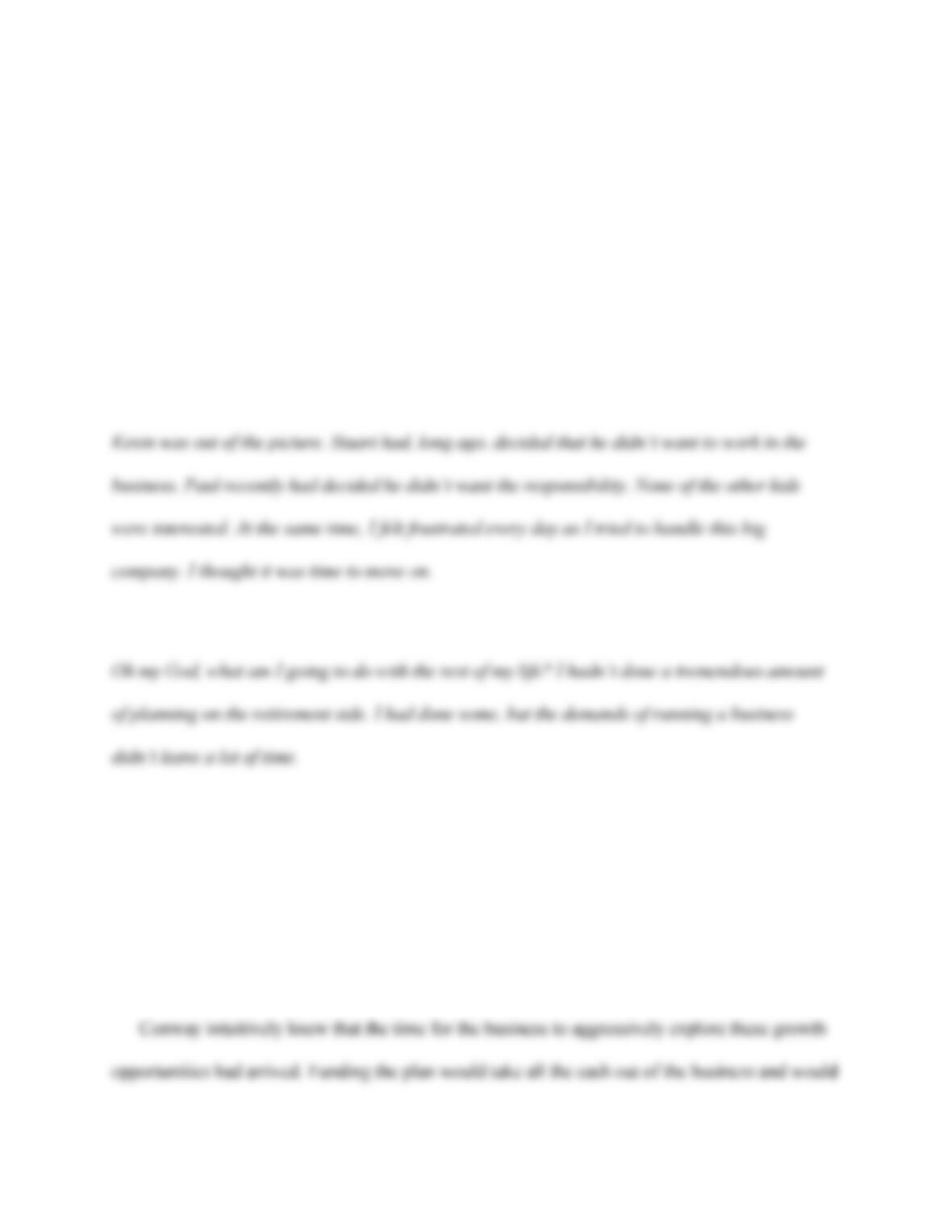
Conway’s life had been organized around his family and his company. For almost four
decades, home and work were the center of his life—his passion and his zeal. He had always
thought of them as being joined. Suddenly, that didn’t seem possible any more:
Then, his thoughts shifted to his personal situation, and he said to himself,
As Conway contemplated the future of FFr, his management team put the finishing touches on
the company’s new strategic plan. The plan made a strong and well-supported case for making a
significant capital investment to develop fulfillment capabilities, to consider manufacturing
selected items, to expand sales internationally, and to increase the product line through strategic
acquisitions.