Financial and Managerial Accounting, 9th Edition
D-1
APPENDIX D
LEAN PRINCIPLES AND ACCOUNTING
Related Assignment Materials
Student Learning Objectives
Discussion
Questions
Quick
Studies*
Exercises*
Problems*
AA, DA
and BTN
Conceptual objectives:
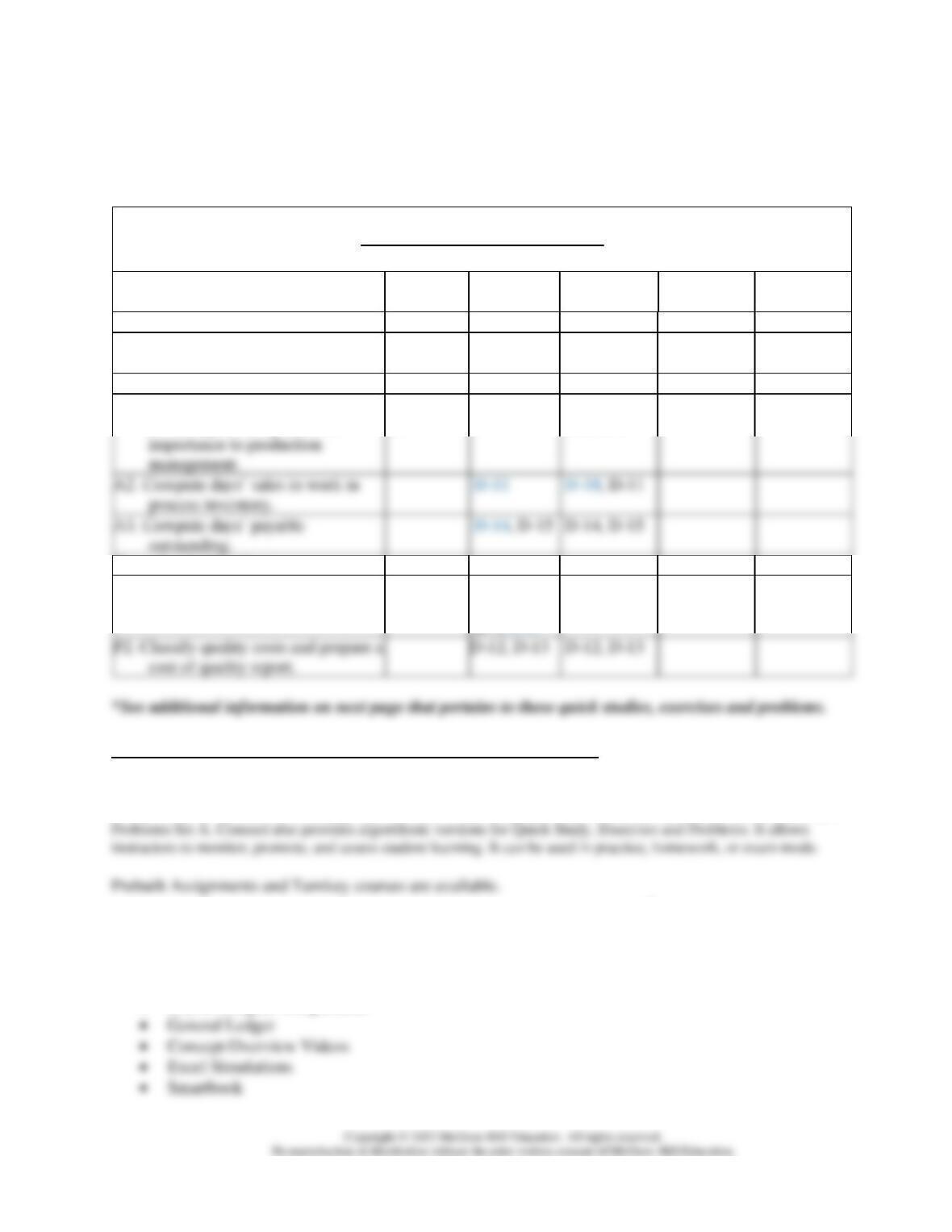
C1. Describe lean principles.
1,2,3,4,5,6,
7
D-1, D-2
D-1, D-14
Analytical objectives:
A1. Compute cycle time and cycle
efficiency, and explain their
10,11,12,
13
D-9, D-10
D-6, D-7,
D-8, D-9
D-3
Procedural objectives:
P1. Record product costs using lean
accounting.
8,9
D-3, D-4,
D-5, D-6,
D-7, D-8
D-2, D-3,
D-4, D-5
D-1, D-2
P2. Classify quality costs and prepare a
D-12, D-13
D-12, D-13
Additional Information on Related Assignment Material
Connect
Available on the instructor’s course-specific website, Connect repeats all numerical Quick Studies, all Exercises and
The Connect Orientation Videos provide an introduction for your students for using Connect to complete
assignments to help get your students up and running in the system. There are videos covering:
• End-of-Chapter Assignments
Financial and Managerial Accounting, 9th Edition
D-2
Need-to-Know Videos
LO
Need–to-Know
Title
Time
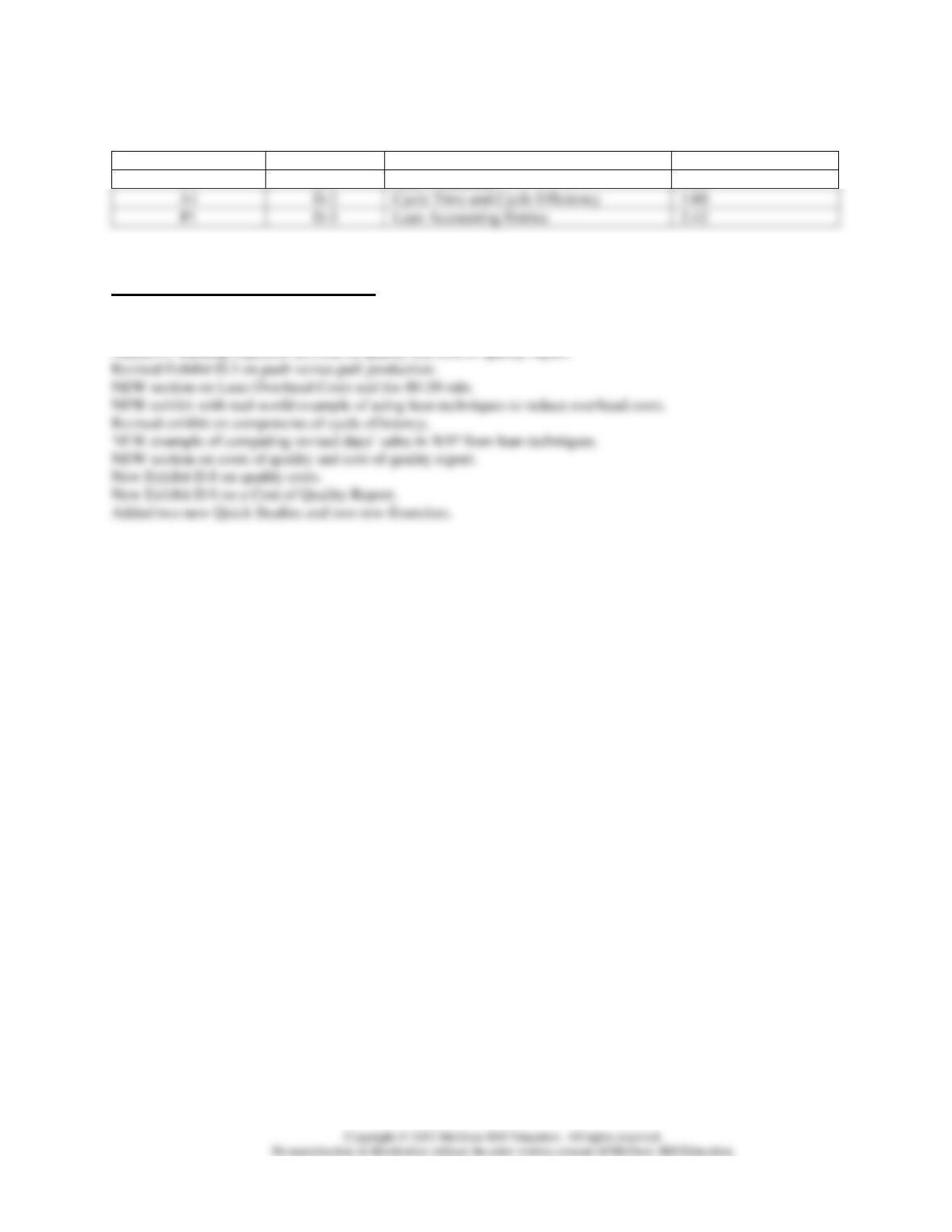
C1
D-1
Lean Production
0:36
D-2
Cycle Time and Cycle Efficiency
1:00
D-3
Lean Accounting Entries
2:42
Synopsis of Chapter Revision
Revised Exhibit D.1 on lean business model.
Updated coverage of lean principles.
Added P2 learning objective on costs of quality and cost of quality report.
Financial and Managerial Accounting, 9th Edition
Chapter Outline
I. Lean Business Model – goals are to use fewer resources to deliver higher-quality products to
satisfying customers.
A. Lean Business Model – includes
1. Lean Principles
B. Lean Principles – value streams, pull production, and zero waste and zero defects.
1. Value streams – lean businesses aim to provide customers with what they want, when
they want it.
2. Pull production – lean manufacturing uses pull production where production begins
with a customer order and are “pulled” through the production process “just–in–time”
and delivered directly to customer after completion.
3. Cycle time – total time a production process takes. Lean businesses aim to reduce cycle
time by producing in smaller batch sizes and making goods to customer order. Should
focus on the following to reduce cycle time:
a. Process time – time spent working on and producing the product. Reduce by
simplifying production process and excluding unwanted product features. This is a
value-added activity.
b. Inspection time – time spent inspecting raw materials received, work in process in
production, and finished goods before shipment. Emphasis is on quality materials
4. Zero Waste and Zero Defects – lean businesses aim for zero waste and zero defects.
Employees are able to stop production if they see something wrong to prevent defective
Financial and Managerial Accounting, 9th Edition
D-4
5. Lean Processes for Service Businesses – concepts also apply to retailers and service
businesses.
II. Production Performance
A. Cycle Time and Cycle Efficiency
1. Lean businesses aim to reduce time it takes to produce products and improve efficiency.
2. Cycle time is time it takes to produce a product or provide a service.
III. Days’ Sales in Work in Process Inventory – aim is to reduce inventory.
A. Lean businesses do not normally have Raw Materials Inventory account and hold few
finished goods.
1. Lean businesses aim to reduce time it takes to produce products and improve efficiency.
IV. Lean Accounting
A. Lean businesses have fewer transactions to record and fewer accounts. Key accounts
include:
1. Work in process inventory (WIP). Raw materials immediately placed into production.
4. Accounting Entries:
a. Purchase of raw materials on credit: debit WIP and credit Accounts payable.
5. Accounting Entries when Finished Goods Inventory Remains:
a. If finished goods inventory remain at period end, journal entry needed to record
Financial and Managerial Accounting, 9th Edition
D-5
V. Costs of Quality – costs incurred to produce the quality of products that satisfies customers.
Includes:
A. Costs of Good Quality – purpose is to reduce chance customer is provided a defective good
or service. Trying to ensure that only good-quality items are produced.
1. Prevention activities – focus on quality training and improvement programs to ensure
B. Costs of Poor Quality -internal and external failure costs of making poor quality items.
1. Internal failure costs – incurred after company has manufactured a defective product but
VI. Days’ Payable Outstanding
A. Measure of how long, on average, company takes to pay its creditors rounded to the nearest
Financial and Managerial Accounting, 9th Edition
D-6
Appendix D Alternate Demonstration Problem
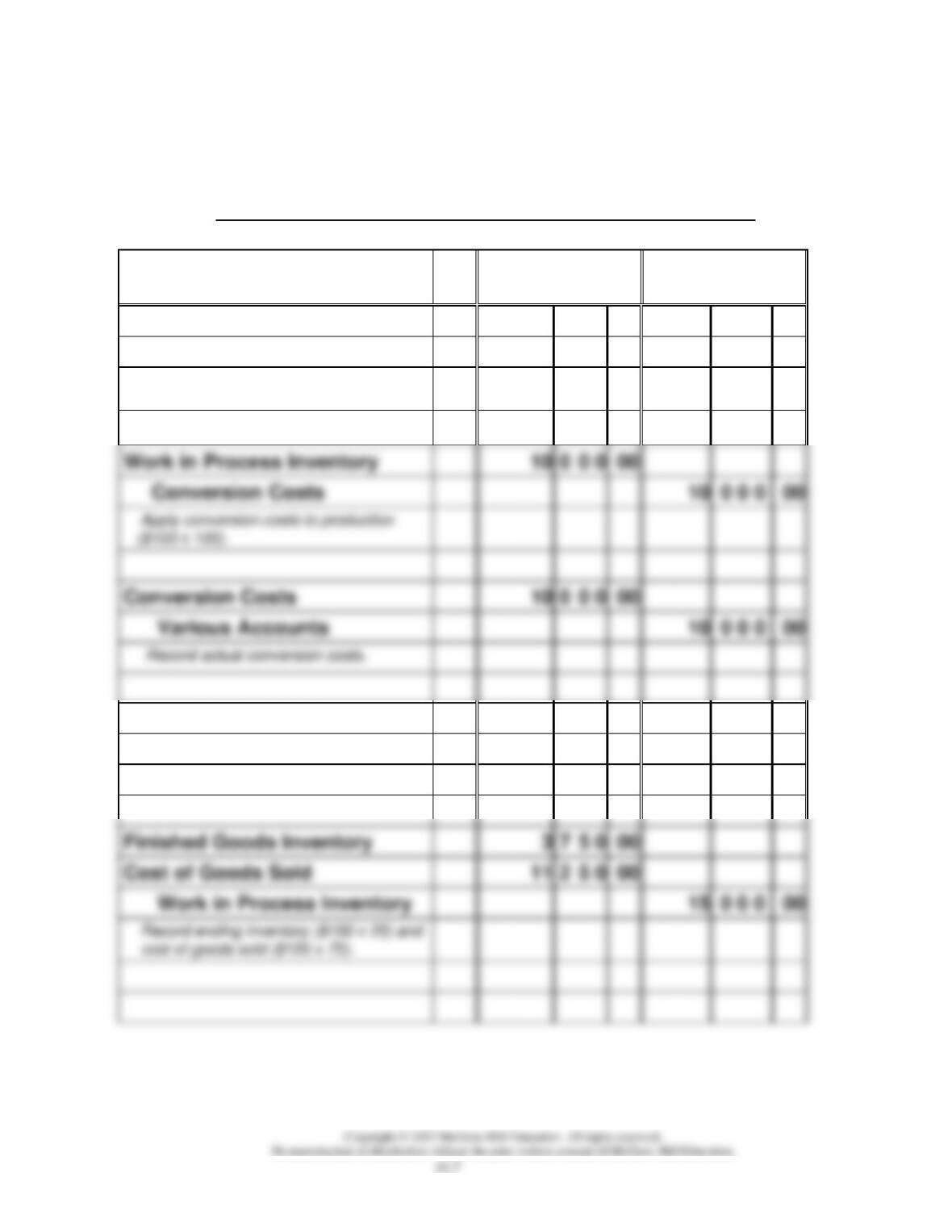
Record the following transactions of Lean Table Company, for the month of
March. Lean Table Company had the following transactions:
1. Incurred $50 in raw materials.
Required:
1. Record these five transactions in general journal form.
Financial and Managerial Accounting, 9th Edition
Appendix D Solution: Alternate Demonstration Problem
ACCOUNT TITLES AND
EXPLANATION
PR
DEBIT
CREDIT
Work in Process Inventory
5
0
0
0
00
Accounts Payable
5
0 0 0
00
Acquired raw materials on credit
($50 x 100).
Work in Process Inventory
10
0
0
0
00
Conversion Costs
10
0 0 0
00
Conversion Costs
10
0
0
0
00
Various Accounts
10
0 0 0
5
00
Record actual conversion costs.
Accounts Receivable
16
8
7
5
00
Sales
16
8 7 5
5
00
Sold on credit ($225 x 75).
3
7
5
0
00
11
2
5
0
00
Work in Process Inventory
15
0 0 0
00