Chapter 09 – Reporting and Interpreting Liabilities
9-1
CHAPTER 9
REPORTING AND INTERPRETING LIABILITIES
Learning Objectives and Related Assignment Materials
Learning Objectives
Mini-
Exercises
Exercises
Problems
Alternate
Problems
Cases and
Projects
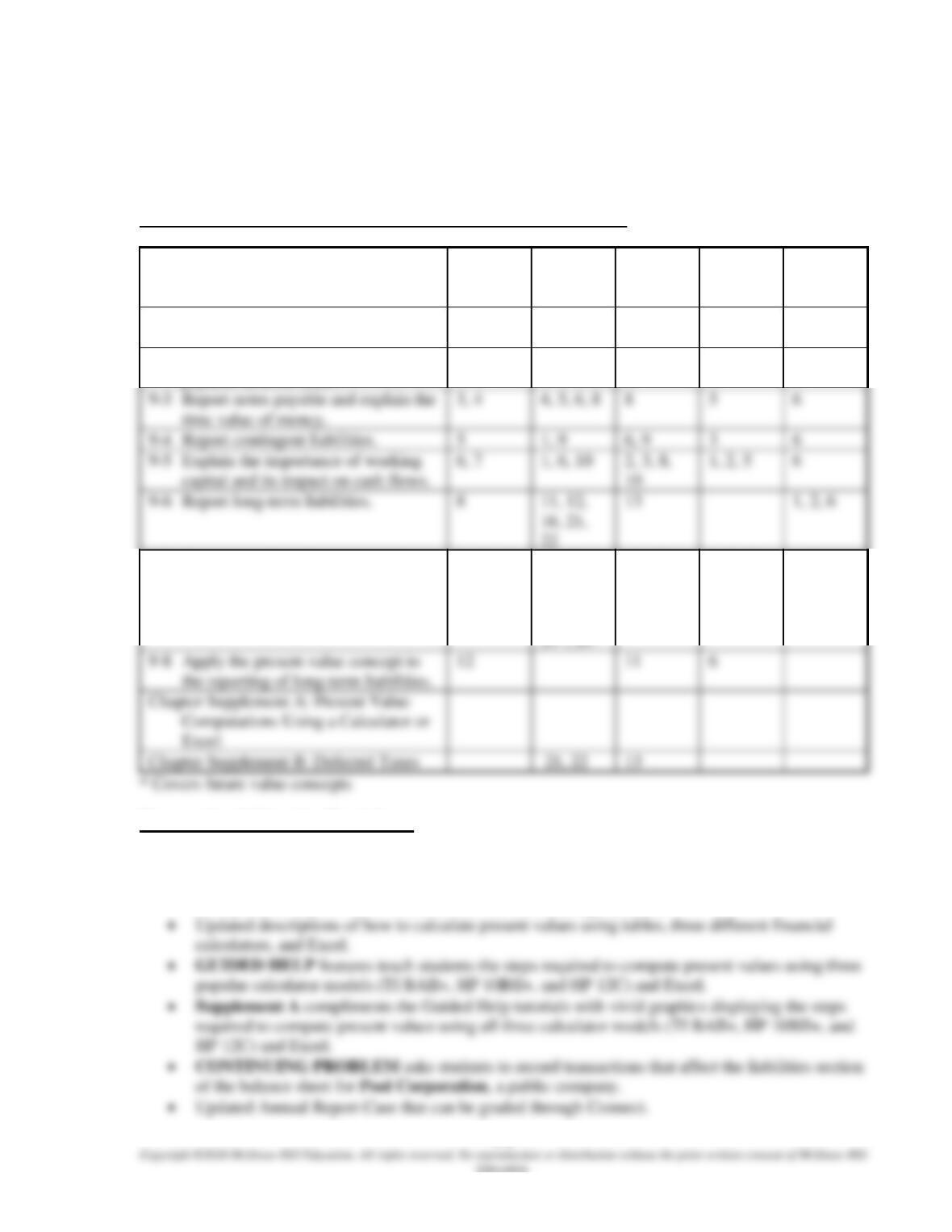
9-1 Define, measure, and report current
liabilities.
1
1, 2, 3, 4,
5, 6
1, 2, 3, 4,
5, 6
1, 2, 3
1, 2, 6
9-2 Compute and interpret the accounts
payable turnover ratio.
2
7
7
4
1, 2, 3, 6
9-3 Report notes payable and explain the
3, 4
4, 5, 6, 8
8
5
6
9-5 Explain the importance of working
6, 7
1, 6, 10
2, 3, 8,
1, 2, 5
6
9-7 Compute and explain present values.
9, 10, 11
9-8 Apply the present value concept to
12
11
6
13, 14,
15, 16,
17, 18,
19, 20,
11, 12,
14*
6, 7, 8*
4, 5
Synopsis of Chapter Revisions
Focus Company: Starbucks
• Focus company data updated. New contrast companies added.
• Incorporated easy-to-follow discussion of the new leasing standard.
Chapter 09 – Reporting and Interpreting Liabilities
9-2
• Updated end-of-chapter exercises, problems, and cases.
PowerPoint Slides
Learning Objectives
PowerPoint® Slides
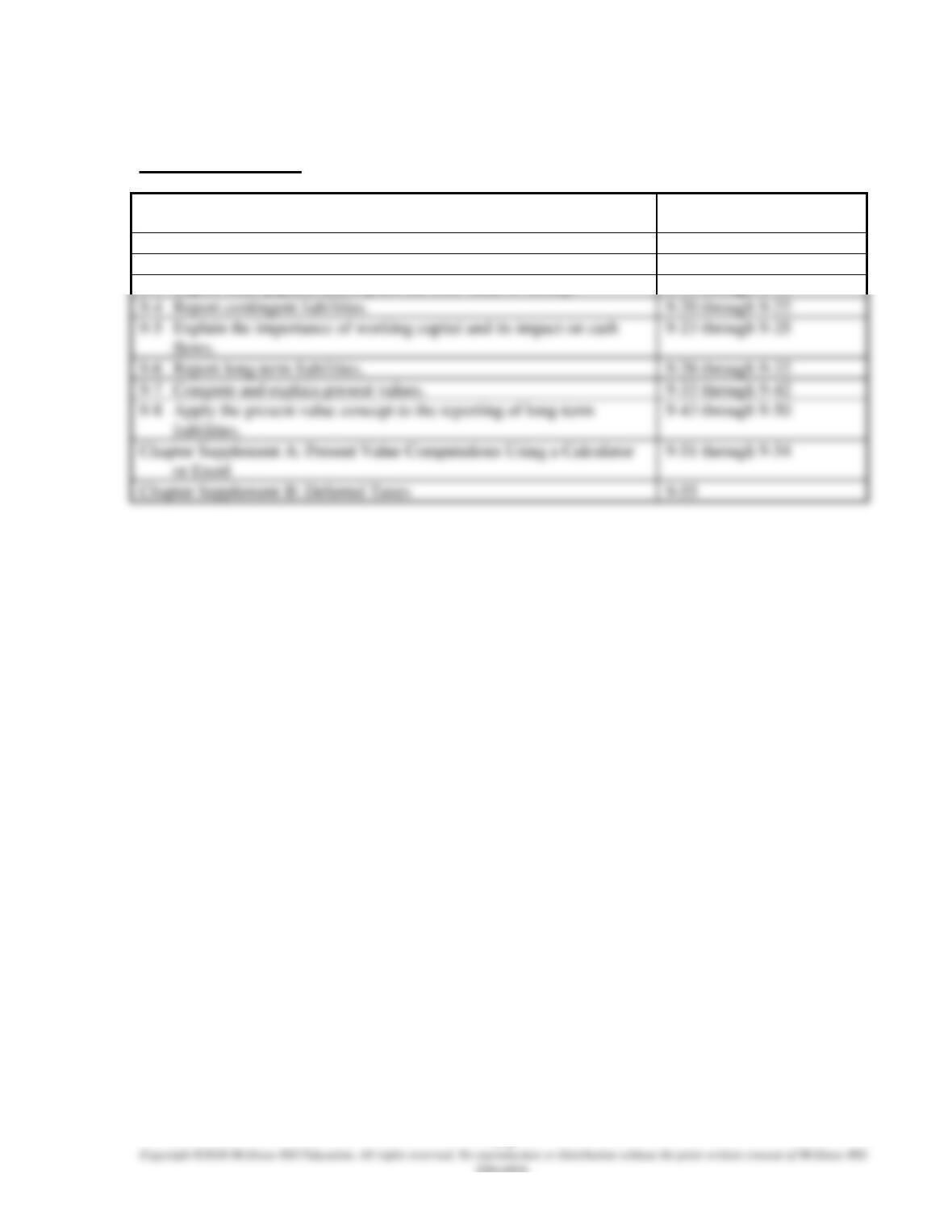
9-1 Define, measure, and report current liabilities.
9-4 through 9-10
9-2 Compute and interpret the accounts payable turnover ratio.
9-11 through 9-12
9-3 Report notes payable and explain the time value of money.
9-13 through 9-19
9-4 Report contingent liabilities.
9-20 through 9-22
9-6 Report long-term liabilities.
9-26 through 9-32
9-7 Compute and explain present values.
9-33 through 9-42
Chapter Supplement B: Deferred Taxes
9-55
Chapter 09 – Reporting and Interpreting Liabilities
9-3
Chapter Take-Aways
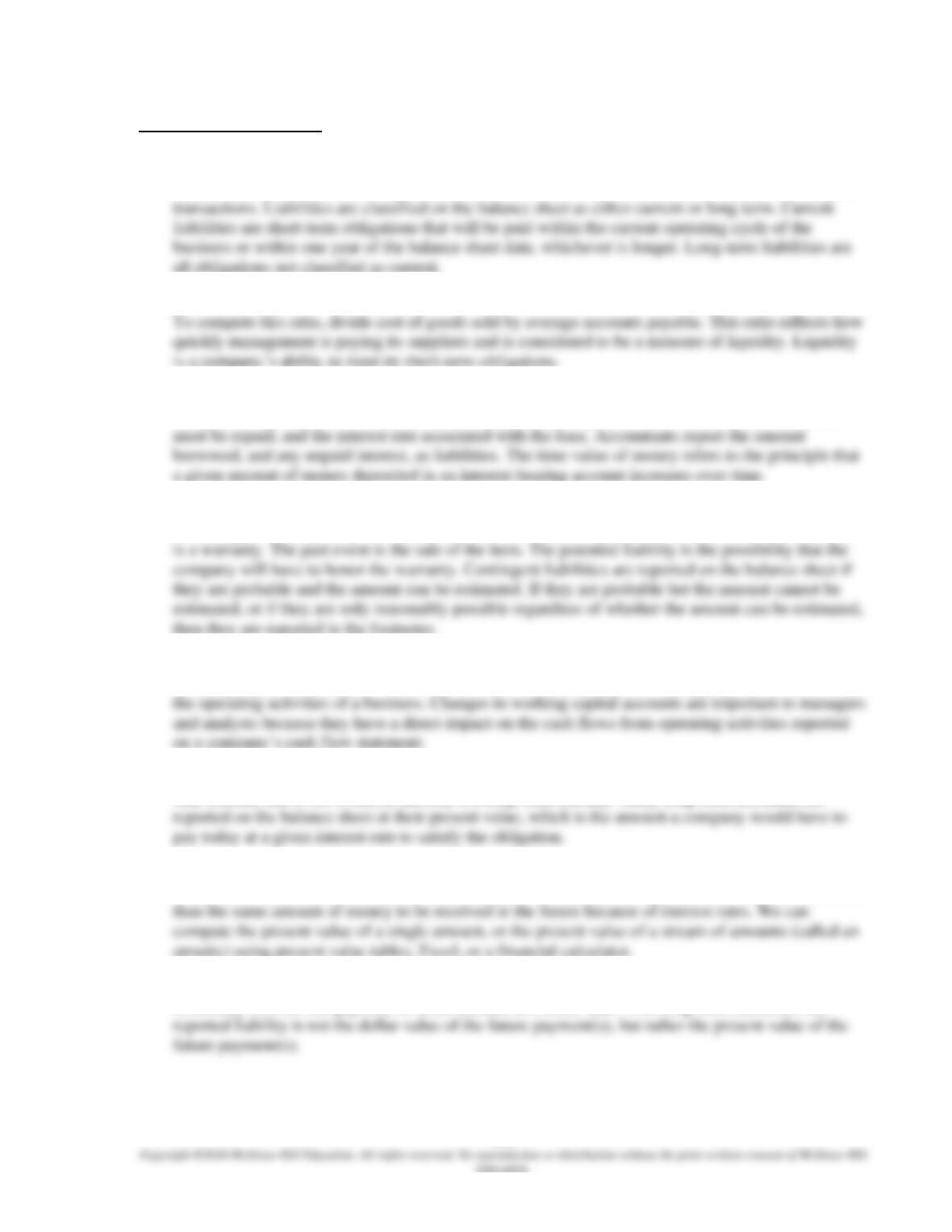
9-1 Define, measure, and report current liabilities.
Accountants define liabilities as probable future sacrifices of economic benefits that arise from past
9-2 Compute and interpret the accounts payable turnover ratio.
9-3 Report notes payable and explain the time value of money.
Companies sign a note when they borrow money. The note specifies the amount borrowed, when it
9-4 Report contingent liabilities.
A contingent liability is a potential liability that has arisen as the result of a past event. An example
9-5 Explain the importance of working capital and its impact on cash flows.
Working capital is defined as current assets minus current liabilities. Working capital is used to fund
9-6 Report long-term liabilities.
Any liability that is not a current liability is a long-term liability. Many long-term liabilities are
9-7 Compute and explain present values.
The present value concept is based on the time value of money. Money received today is worth more
9-8 Apply the present value concept to the reporting of long-term liabilities.
A liability involves the payment of some amount at a future date. With long-term liabilities, the
Chapter 09 – Reporting and Interpreting Liabilities
9-4
Key Ratios
Accounts payable turnover is a measure of how quickly a company pays its suppliers. It is computed as
follows:
Accounts Payable Turnover = Cost of Goods Sold ÷ Average Accounts Payable
Finding Financial Information
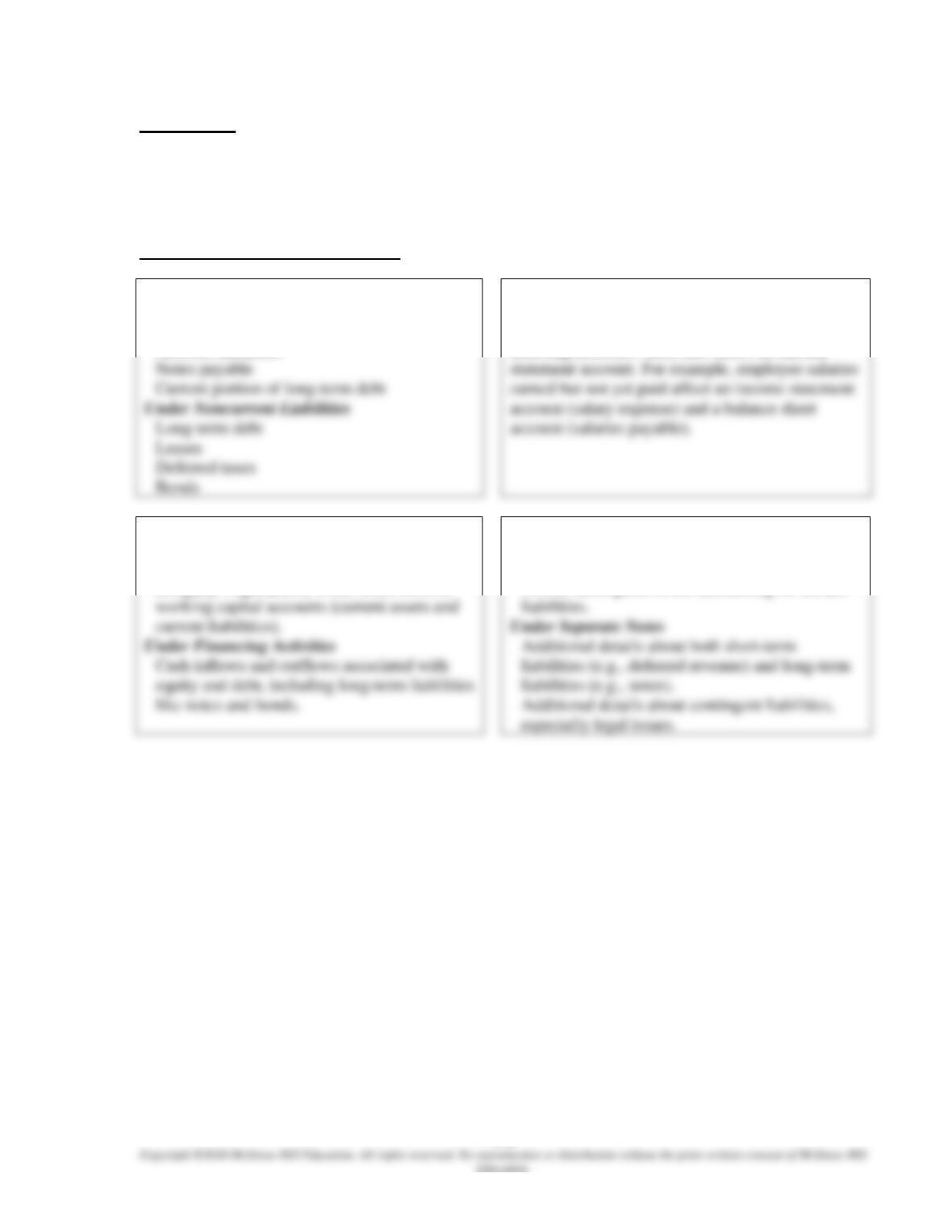
Balance Sheet
Under Current Liabilities
Accounts payable
Accrued liabilities
Income Statement
Liabilities are shown only on the balance sheet,
never on the income statement. Transactions
affecting liabilities often also affect an income
Statement of Cash Flows
Under Operating Activities
Cash inflows and outflows associated with a
company’s operations, which often involve
Notes
Under Summary of Significant Accounting
Policies
A brief description of the accounting for certain
Chapter 09 – Reporting and Interpreting Liabilities
9-5
Chapter Outline
Teaching Notes
LO 1 – Define, measure, and report current liabilities.
I. Liabilities Defined and Classified
Illustrated in Exhibit 9.1
A. Liabilities are probable future sacrifices of economic benefits
that result from past transactions
liability immediately)
2. Classifications of liabilities on the balance sheet:
1. When recorded, a liability is at its current cash equivalent
LO 2 – Compute and interpret the accounts payable turnover ratio.
II. Current Liabilities
A. Accounts Payable (or Trade Accounts Payable)
1. Created when goods and services are provided on credit
2. Trade credit is a relatively inexpensive way to finance the
purchase of inventory because interest does not normally
accrue on accounts payable
B. Key Ratio Analysis: Accounts Payable Turnover Ratio
1. Accounts Payable Turnover Ratio = Cost of Goods Sold ÷
Average Accounts Payable
2. Measures how quickly management is paying trade
accounts
3. High ratio normally suggests that a company is paying its
a. Might not reflect reality if a company pays some
4. Can be stated more intuitively as:
Average Days to Pay Payables = 365 Days ÷ Turnover
Ratio
C. Accrued Liabilities––expenses that have been incurred but
have not been paid at the end of the accounting period
1. Accrued Taxes Payable
a. Like individuals, corporations must pay taxes on the
income they earn
Chapter 09 – Reporting and Interpreting Liabilities
9-6
2. Accrued Compensation and Related Costs
a. At the end of each accounting period, there are usually
salaries not yet paid
i. Starbucks estimates the cost of accrued vacation
time to be $125,000
cr Accrued Vacation
125,000
b. Companies must also report the cost of unpaid
–125,000
ii. The vacations are taken
(L) –125,000
dr Accrued Vacation
125,000
3. Payroll Taxes
a. All payrolls are subject to a variety of taxes, including
federal, state, and local income taxes; Social Security
taxes; and federal and state unemployment taxes
i. Employees pay some; employers pay others
ii. Reporting is similar for each type of payroll tax
b. Employee Income Taxes
c. Employee and Employer FICA Taxes
i. Social Security taxes are required by the Federal
Insurance Contributions Act (FICA)
ii. FICA taxes are imposed in equal amounts on both
the employee and the employer
iii. The current Social Security tax rate is 6.2% on the
Chapter 09 – Reporting and Interpreting Liabilities
9-7
d. Employer Unemployment Taxes
ii. The SUTA rate and specified amount of wages
vary by state
As such, focus is just on
FUTA
i. Employers pay unemployment taxes through the
Federal Unemployment Tax Act (FUTA) and State
e. Starbucks accumulated the following information in
its records for the first two weeks of June:
Salaries and wages earned
$1,800,000
Income taxes withheld
275,000
FICA taxes (employees’ share)
137,700
FUTA taxes
2,300
i. First entry records amounts paid to employees or
withheld from amounts they have earned:
cr FICA Payable (+L)
cr Cash (−A)
ii. Second entry records the taxes that employers must
pay:
dr Compensation Expense
(+E, −SE)
140,000
cr FICA Payable (+L)
cr FUTA Payable (+L)
–140,000
D. Deferred Revenues
1. When a company collects cash before the related revenue
has been earned, the cash is called deferred revenues, or,
occasionally, unearned revenues
Chapter 09 – Reporting and Interpreting Liabilities
9-8
2. Under the revenue recognition principle, revenue cannot
be recorded until it has been earned
b. Obligation to provide a product or service in the future
the company expects to provide the product or service.
Enrichment Activity #2
LO 3 – Report notes payable and explain the time value of money.
E. Notes Payable
1. A note payable is a written promise to pay a stated sum at
one or more specified future dates (maturity date(s))
3. Formula to calculate interest:
Interest for the period = Principal × Annual Interest Rate
2. Earning interest by loaning money to others reflects the
4. On November 1, a company with a December 31 fiscal
year-end borrows $100,000 cash for one year
a. The annual interest rate is 12%
b. The interest is payable on April 30 and October 31 of
the following year
dr Cash (+A)
cr Notes Payable (+L)
Cash (A) +100,000 = Note Payable (L) +100,000
5. Interest in the amount of 2,000 (or $100,000 × 12% ×
2/12) is owed as of the end of the year
dr Interest Expense (+E, –SE)
2,000
cr Interest Payable (+L)
2,000
Assets = Liabilities + Stockholders’ Equity
No change = Interest Payable (L) +2,000 + Interest
Expense (E, SE) –2,000
6. On April 30, the company has incurred an additional four
months of interest expense for January-April
dr Interest Expense (+E, –SE)
4,000
cr Interest Payable (+L)
4,000
Assets = Liabilities + Stockholders’ Equity
No change = Interest Payable (L) +4,000 + Interest
Expense (E, SE) –4,000
Use Supplemental
Chapter 09 – Reporting and Interpreting Liabilities
cr Cash (-A)
6,000
Assets = Liabilities + Stockholders’ Equity
Cash (A) -6,000 = Interest Payable (L) -6,000
F. Current Portion of Long-Term Debt
1. A company must reclassify its long-term debt as a current
liability within a year of its maturity date
2. In some cases, companies will refinance debt when it
comes due rather than pay out cash currently on hand
Current or Noncurrent?”
LO 4 – Report contingent liabilities.
G. Contingent Liabilities Reported on the Balance Sheet
1. Some recorded liabilities are based on estimates because
the exact amount will not be known until a future date
2. Warranties
a. An estimated liability is created when a company
offers a warranty with the products it sells
the period in which the product is sold
dr Warranty Expense (+E, –SE)
cr Warranty Payable (+L)
Interest Expense (E, SE) –150,000
H. Contingent Liabilities Reported in the Footnotes
1. Contingent liability––a potential liability that has arisen
as the result of a past event; it is not a definitive liability
until some future event occurs
2. Whether situation produces a recorded or contingent
liability depends on two factors:
a. Probability of future economic sacrifice
b. Ability of management to estimate the amount
Chapter 09 – Reporting and Interpreting Liabilities
9-10
3. Possibilities:
See International Perspective
feature “It’s a Matter of
Degree”
a. Amount can be reasonably estimated:
i. Probable – record as liability
i. Probable – disclose in footnotes
ii. Reasonably possible – disclose in footnotes
LO 5 – Explain the importance of working capital and its impact on cash flows.
I. Working Capital Management
1. Information about current liabilities is very important to
managers and analysts because these obligations must be
paid in the near future.
a. Analysts say that a company has liquidity if it has the
ability to meet its current obligations.
b. Working Capital = Current Assets – Current
i. Business with too little working capital runs risk of
2. Focus on Cash Flows: Working Capital and Cash Flows
a. Many working capital accounts have a direct
LO 6 – Report long-term liabilities.
III. Long-Term Liabilities
A. Long-Term Liabilities––all of the entity’s obligations that
are not classified as current liabilities.
1. Secured debt – specific assets are pledged as collateral
2. Unsecured debt – creditor relies primarily on the
borrower’s integrity and general earning power
B. Long-Term Notes Payable and Bonds
1. Private placement – long-term debt raised directly from
Chapter 09 – Reporting and Interpreting Liabilities
9-11
C. Lease Liabilities
1. When a company leases an asset, it enters into a
contractual agreement with the owner of the asset
2. A short-term lease is for 12 months or less and does not
contain a purchase option that the lessee is expected to
exercise
b. On December 31, Starbucks signs a short-term lease
agreement to rent five delivery trucks for the month of
January; Starbucks must pay $10,000 at the end of
January
dr Lease expense (+E, –SE)
cr Cash (–A)
a. The terms of a short-term lease are similar to a short-
3. Longer-term leases (more than 12 months)–classified as
either finance or operating leases depending on whether
effective control of the leased asset remains with the
lessor or is transferred to the lessee
a. According to GAAP, if a lease meets any of the
following four criteria, it is considered a finance lease:
i. The lease transfers ownership of the underlying
asset to the lessee by the end of the lease term
remaining economic life of the underlying asset
b. The five criteria are aimed at establishing whether the
lessor maintains effective control of the leased asset or
whether effective control has been transferred to the
lessee.
i. If any of the five criteria are met, then effective
control is transferred to the lessee and the lease is a
Chapter 09 – Reporting and Interpreting Liabilities
c. The accounting required to initially record a finance
lease and an operating lease is the same: both require
the recognition of a lease asset and a lease liability.
The amount recognized is the current cash equivalent
of the required future lease payments
dr Lease Asset (+A)
LO 7 – Compute and explain present values.
IV. Computing Present Values
A. Present value––current value of an amount to be received in
the future; a future amount discounted for compound interest
B. Future Value—the sum to which an amount will increase as
the result of compound interest
C. Present Value of a Single Amount
2. Formula is not difficult to use; however, most analysts
use present value tables, calculators, or Excel
3. Today is 1/1/19 and you need to make a $1,000 cash
b. Present value = $1,000 × 0.75131 = $751.31
1. Formula to compute the present value of a single amount:
D. Present Value of an Annuity
1. Annuity––a series of periodic cash receipts or payments
that are equal in amount each interest period
b. Present value = $1,000 × 2.48685 = $2,486.85
2. Assume you purchase a piece of equipment and agree to
Illustrated in Exhibit 9.3