CHAPTER 9
Inventories: Additional Valuation Issues
ASSIGNMENT CLASSIFICATION TABLE (BY TOPIC)
Topics
Questions
Brief
Exercises
Exercises
Problems
Concepts
for Analysis
1
Lower-of-cost-or-net
realizable value
1, 2, 3, 4, 5
1, 2, 3
1, 2, 3, 4,
5, 6
1, 2, 3, 11
1, 2, 3
2.
Lower-of-cost-or-market.
6, 7
4, 5
7, 8
4, 5
4
value method; net
realizable value.
4.
Purchase commitments.
7, 8
11, 12
7
16, 17, 18,
6.
Retail inventory method.
15, 16, 17
20 21,, 22,
8, 9, 10
5, 6
7.
Presentation and analysis.
18, 19
LIFO retail.
24, 25
13, 14
Dollar-value LIFO retail.
26, 27, 28,
12, 14
Special LIFO problems.
14, 15
ASSIGNMENT CLASSIFICATION TABLE (BY LEARNING OBJECTIVE)
Learning Objectives
Questions
Brief
Exercises
Exercises
Problems
Concepts
for Analysis
1. Describe and apply
the lower-of-cost-or
net realizable value
rule.
1, 2, 3, 4, 5
1, 2, 3
1, 2, 3,
4, 5, 6
1, 2, 3, 11
1, 2, 3
the lower-of-cost-or–
market rule.
6, 7
4, 5
7, 8
4, 5
4
valuation issues
4. Determine ending
inventory by applying
the gross profit
method.
11, 12, 13,
14
9
13, 14, 15,
16, 17, 18, 19
6, 7
5. Determine ending
inventory by applying
the retail inventory
method.
15, 16, 17
20, 21, 22
8, 9, 10
5, 6
and analyze inventory.
inventory by applying
the LIFO retail
methods.
24, 25, 26,
27, 28, 29 30
12, 13, 14,
15
ASSIGNMENT CHARACTERISTICS TABLE
Item
Description
Level of
Difficulty
Time
(minutes)
E9.1
LCNRV
Simple
15–20
E9.2
LCNRV
Simple
10–15
E9.3
LCNRV
Simple
15–20
E9.4
Simple
10–15
E9.5
Moderate
20–25
E9.6
Simple
10–15
E9.7
Lower-of-cost-or-market
Simple
15–20
E9.8
Lower-of-cost-or-market-journal entries.
Simple
10–15
E9.9
Relative sales value method.
Simple
15–20
E9.10
Relative sales value method.
Simple
12–17
E9.11
Purchase commitments.
Simple
05–10
E9.12
Purchase commitments.
Simple
15–20
E9.13
Gross profit method.
Simple
8–13
E9.14
Gross profit method.
Simple
10–15
E9.15
Gross profit method.
Simple
15–20
E9.16
Gross profit method.
Moderate
15–20
E9.17
Gross profit method.
Simple
10–15
E9.18
Gross profit method.
Simple
15–20
E9.19
Gross profit method.
Moderate
20–25
E9.20
Retail inventory method.
Moderate
20–25
E9.21
Retail inventory method.
Simple
12–17
E9.22
Retail inventory method.
Simple
20–25
E9.23
Analysis of inventories.
Simple
10–15
*E9.24
Retail inventory method—conventional and LIFO.
Moderate
25–35
*E9.25
Retail inventory method—conventional and LIFO.
Moderate
15–20
*E9.26
Dollar-value LIFO retail.
10–15
*E9.27
Dollar-value LIFO retail.
Simple
5–10
*E9.28
Conventional retail and dollar-value LIFO retail.
Moderate
20–25
*E9.29
Dollar-value LIFO retail.
Moderate
20–25
*E9.30
Change to LIFO retail.
Simple
10–15
P9.1
LCNRV.
Simple
10–15
P9.2
LCNRV.
Moderate
25–30
P9.3
Entries for LCNRV—cost-of–good-sold and loss.
Moderate
30–35
P9.4
Lower-of-cost-or-market
Moderate
25–30
P9.5
Lower-of-cost-or-market.
Moderate
30–40
P9.6
Gross profit method.
Moderate
20–30
P9.7
Gross profit method.
40–45
P9.8
Retail inventory method.
Moderate
20–30
P9.9
Retail inventory method.
Moderate
20–30
ASSIGNMENT CHARACTERISTICS TABLE (Continued)
Item
Description
Level of
Difficulty
Time
(minutes)
P9.10
Retail inventory method.
Moderate
20–30
P9.11
commitment.
Conventional and dollar-value LIFO retail.
Moderate
30–35
Retail, LIFO retail, and inventory shortage.
Moderate
30–40
Change to LIFO retail.
Moderate
30–40
Change to LIFO retail; dollar-value LIFO retail.
40–50
Statement and note disclosure, LCM, and purchase
Moderate
30–40
CA9.1
LCNRV.
Moderate
15–25
CA9.2
LCNRV.
Moderate
20–30
CA9.3
LCNRV.
Moderate
15–20
CA9.4
LCNRV.
Moderate
CA9.5
Retail inventory method.
Moderate
25–30
CA9.6
Cost determination, LCM, retail method.
Moderate
15–25
CA9.7
Purchase commitments.
Moderate
10–15
ANSWERS TO QUESTIONS
1. Where there is evidence that the utility of goods to be disposed of in the ordinary course of
2. The usual basis for carrying forward the inventory to the next period is cost. Departure from cost is
required; however, when the utility of the goods included in the inventory is less than their cost,
this loss in utility should be recognized as a loss of the current period, the period in which it
occurred. Furthermore, the subsequent period should be charged for goods at an amount that
measures their expected contribution to that period. In other words, the subsequent period should
The arguments against the use of the lower-of-cost-or-net realizable value method of valuing
inventories include the following:
(a) The method requires the reporting of estimated losses (all or a portion of the excess of actual
cost over net realizable value) as definite income charges even though the losses have not
been sustained to date and may never be sustained. Under a consistent criterion of
realization, a drop in net realizable value below original cost is no more a sustained loss than
a rise above cost is a realized gain.
3. The lower-of-cost-or-net realizable value rule may be applied directly to each item or to the total of
the inventory (or in some cases, to the total of the components of each major category). The
method should be the one that most clearly reflects income. The most common practice is to price
4. (1) $12.80.
5. One approach is to record the inventory at cost and then reduce it to net realizable value, thereby
reflecting a loss in the current period (often referred to as the loss method). The loss would then
be shown as a separate item in the income statement and the cost of goods sold for the year
would not be distorted by its inclusion. An objection to this method of valuation is that an
6. The upper (ceiling) and lower (floor) limits for the value of the inventory are intended to prevent the
inventory from being reported at an amount in excess of the net realizable value or at an amount
7. (1) $14.50.
8. An exception to the normal recognition rule occurs where (1) there is a controlled market with a
quoted price applicable to specific commodities and (2) no significant costs of disposal are
Questions Chapter 9 (Continued)
9. Relative sales value is an appropriate basis for pricing inventory when a group of varying units is
purchased at a single lump-sum price (basket purchase). The purchase price must be allocated in
10. The drop in the market price of the commitment should be charged to operations in the current year
if it is material in amount. The following entry would be made [($6.20 – $5.90) X 150,000] = $45,000:
Unrealized Holding Gain or Loss—Income (Purchase Commitments) …….
45,000
11. The major uses of the gross profit method are: (1) it provides an approximation of the ending
inventory which the auditor might use for testing validity of physical inventory count; (2) it means
12. Gross profit as a percentage of sales indicates that the markup is based on selling price rather
than cost; for this reason the gross profit as a percentage of selling price will always be lower than
13. A markup of 25% on cost equals a 20% markup on selling price; therefore, gross profit equals
$1,000,000 ($5 million X 20%) and net income equals $250,000 [$1,000,000 – (15% X $5 million)].
Questions Chapter 9 (Continued)
14.
Inventory, January 1, 2020 …………………………………………………………..
$ 400,000
Purchases to February 10, 2020 ……………………………………………………
$1,140,000
Freight-in to February 10, 2020 ……………………………………………………..
60,000
1,200,000
Merchandise available …………………………………………………………..
Sales revenue to February 10, 2020 ………………………………………………
Less gross profit at 40% ………………………………………………………..
780,000
Sales at cost ……………………………………………………………………
1,170,000
15. The validity of the retail inventory method is dependent upon (1) the composition of the inventory
remaining approximately the same at the end of the period as it was during the period, and
16. The conventional retail method is a statistical procedure based on averages whereby inventory
figures at retail are reduced to an inventory valuation figure by multiplying the retail figures by a
percentage which is the complement of the markup percent.
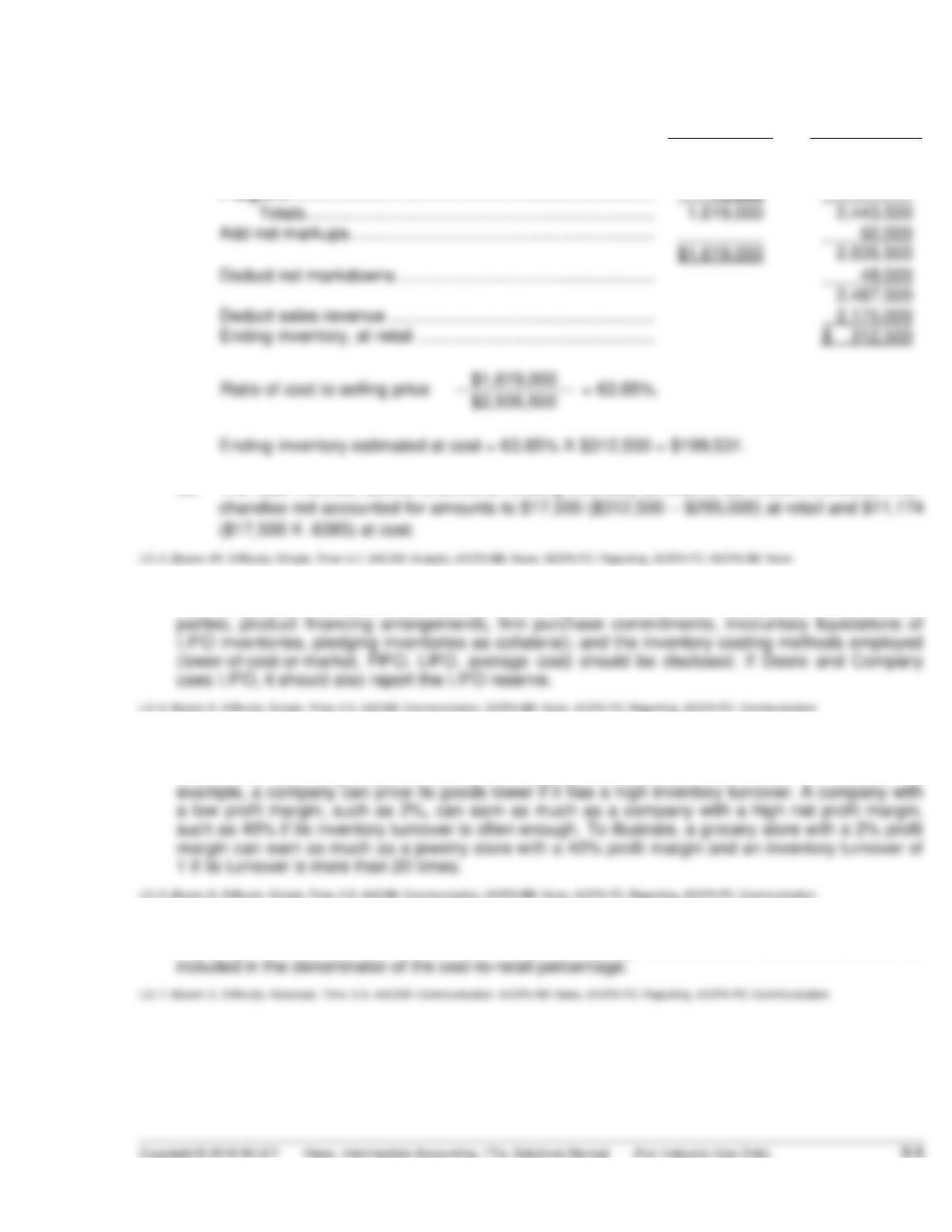
Computation of Inventory
Cost
Retail
Ratio
Purchases
$100
$150
66 2/3%
Questions Chapter 9 (Continued)
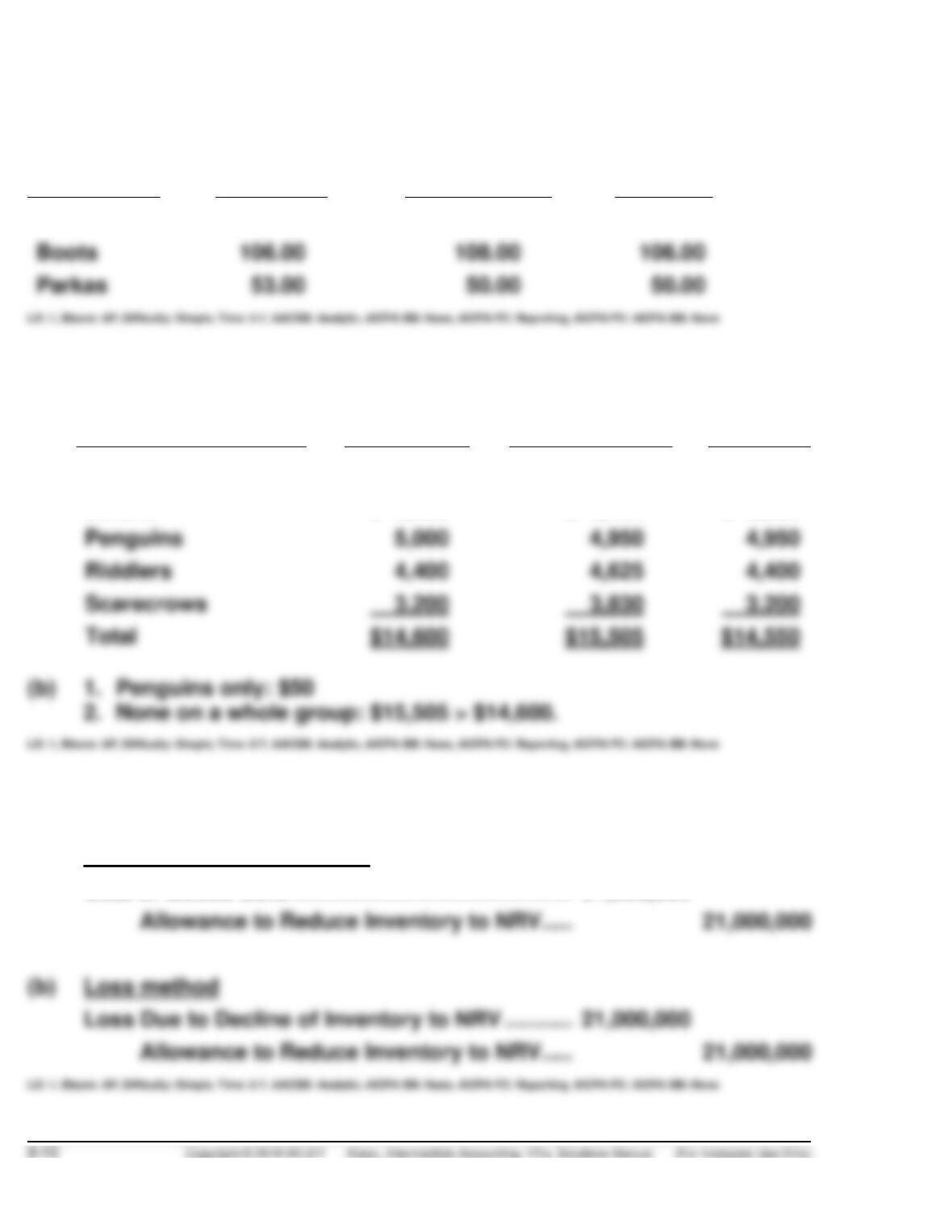
17. (a) Ending inventory:
Cost
Retail
Beginning inventory ………………………………………………….
$ 149,000
$ 283,500
Purchases ……………………………………………………………….
1,400,000
2,160,000
70,000
1,619,000
2,443,500
Add net markups ………………………………………………………
Deduct net markdowns ……………………………………………..
Deduct sales revenue ……………………………………………….
(b) The retail method, above, showed an ending inventory at retail of $312,500; therefore, mer-
18. Information relative to the composition of the inventory (i.e., raw material, work–in-process, and
finished goods); the inventory financing where significant or unusual (transactions with related
19. Inventory turnover measures how quickly inventory is sold. Generally, the higher the inventory
turnover, the better the enterprise is performing. The more times the inventory turns over, the
smaller the net margin can be to earn an appropriate total profit and return on assets. For
*20. Two major modifications are necessary. First, the beginning inventory should be excluded from the
numerator and denominator of the cost-to-retail percentage and second, markdowns should be
SOLUTIONS TO BRIEF EXERCISES
BRIEF EXERCISE 9.1
Item
Cost
NRV
LCNRV
Skis
$190.00
$161.00
$161.00
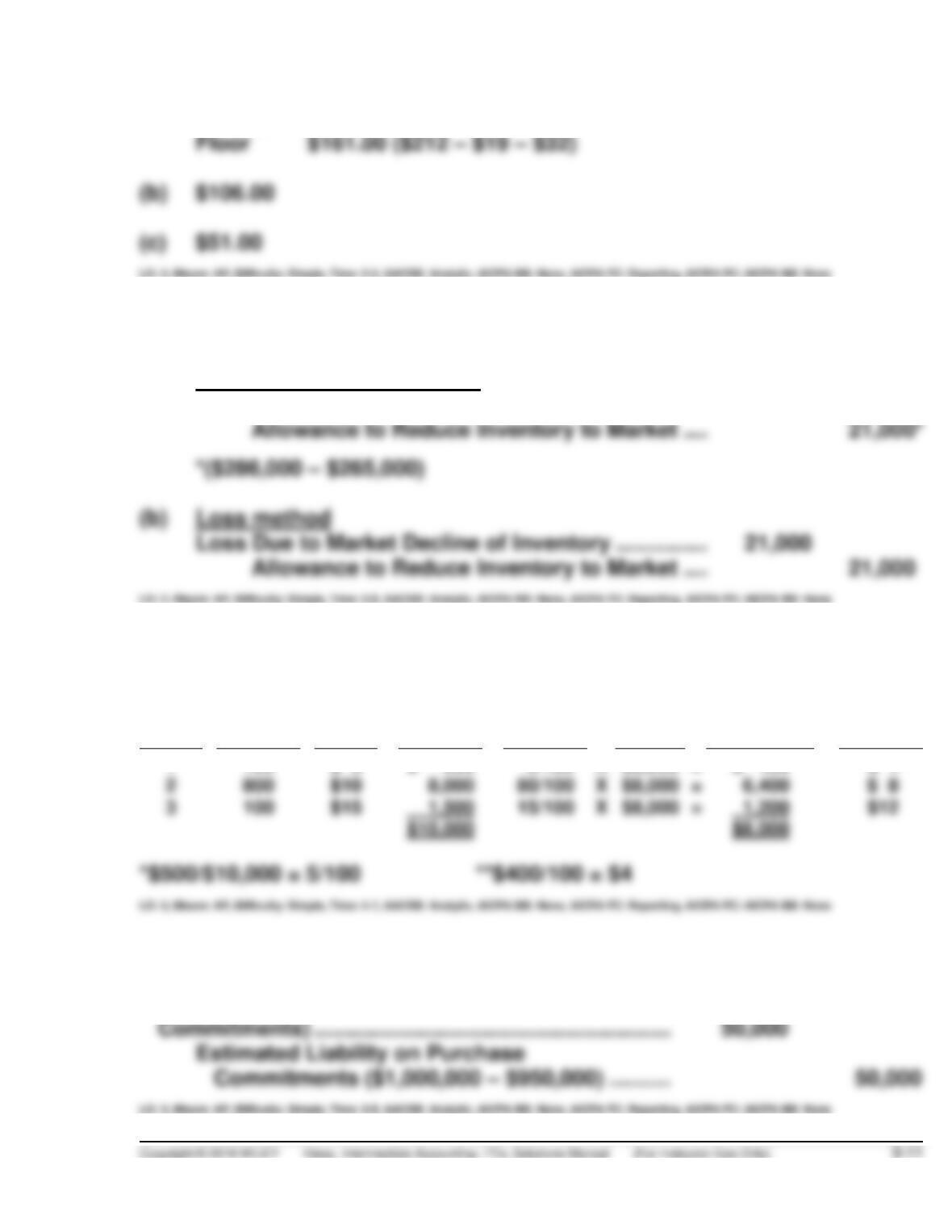
Boots
Parkas
BRIEF EXERCISE 9.2
(a)
Item
Cost
NRV
LCNRV
Item-by-item
Jokers
$ 2,000
$ 2,100
$ 2,000
Penguins
Riddlers
Scarecrows
3,200
3,830
3,200
Total
$14,600
$15,505
$14,550
BRIEF EXERCISE 9.3
(a)
Cost-of–goods-sold-method
Cost of Goods Sold …………………………………………………
21,000,000
Allowance to Reduce Inventory to NRV …………….
21,000,000
(b)
Loss method
Loss Due to Decline of Inventory to NRV ………………….
21,000,000
Allowance to Reduce Inventory to NRV …………….
21,000,000
BRIEF EXERCISE 9.4
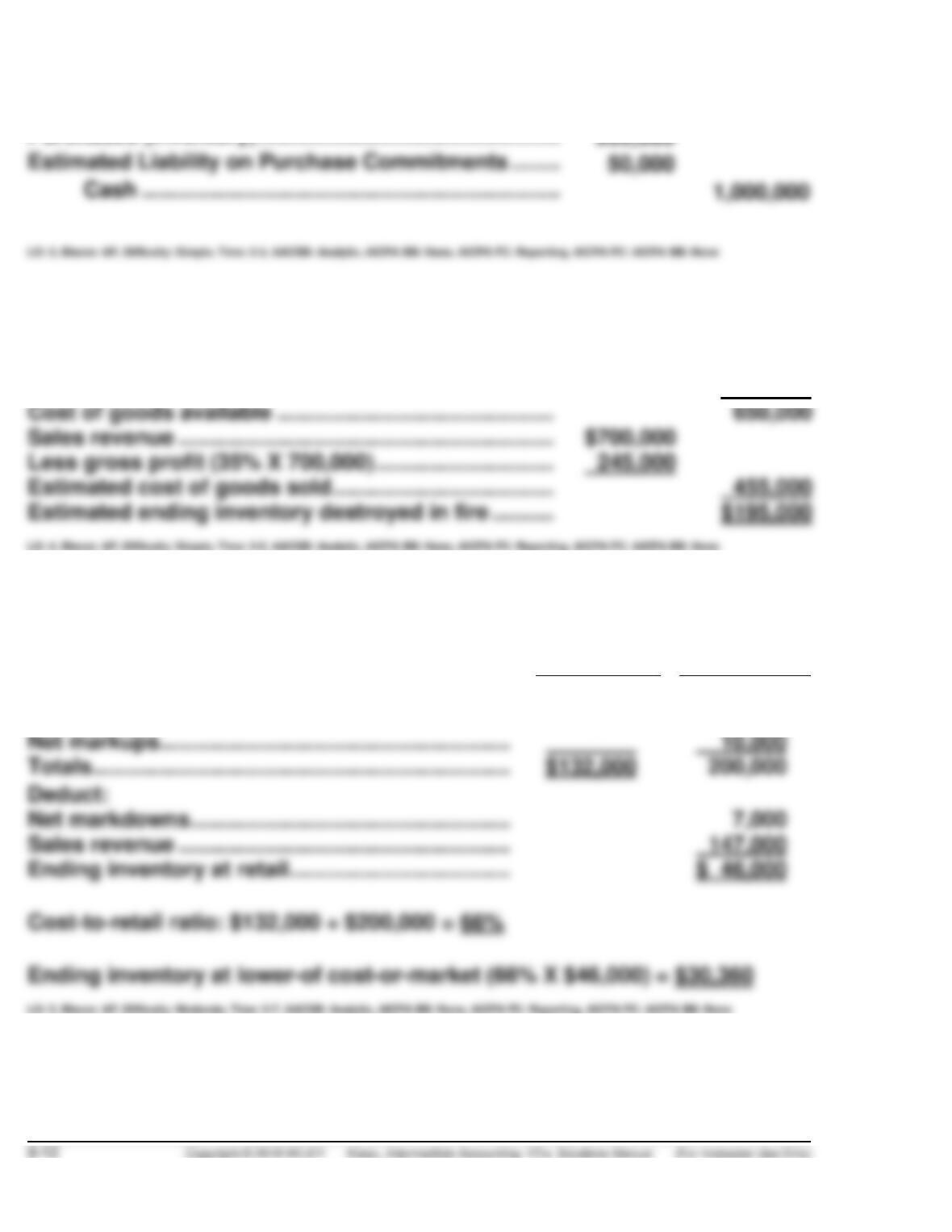
(a) Ceiling $193.00 ($212 – $19)
BRIEF EXERCISE 9.5
(a)
Cost-of–goods-sold method
Cost of Goods Sold …………………………………………………
21,000
Allowance to Reduce Inventory to Market ………..
*($286,000 – $265,000)
(b)
Loss method
Loss Due to Market Decline of Inventory ………………….
Allowance to Reduce Inventory to Market ………..
BRIEF EXERCISE 9.6
Group
Number
of CDs
Sales
Price
per CD
Total
Sales
Price
Relative
Sales
Price
Total
Cost
Cost
Allocated
to CDs
Cost
per CD
1
100
$ 5
$ 500
5/100*
X
$8,000
=
$ 400
$ 4**
BRIEF EXERCISE 9.7
Unrealized Holding Loss—Income (Purchase
BRIEF EXERCISE 9.8
Purchases (Inventory) ……………………………………………..
Estimated Liability on Purchase Commitments …………
Cash ………………………………………………………………
BRIEF EXERCISE 9.9
Beginning inventory ……………………………………………
$150,000
Purchases …………………………..……………………………..
500,000
Cost of goods available ………………………………………
Sales revenue …………………………………………………….
Less gross profit (35% X 700,000) ………………………..
Estimated cost of goods sold ………………………………
Estimated ending inventory destroyed in fire ……….
BRIEF EXERCISE 9.10
Cost
Retail
Beginning inventory ……………………………………..
$ 12,000
$ 20,000
Net purchases ………………………………………………
120,000
170,000
Net markups …………………………………………………
Totals …………………………………………………………..
Deduct:
Net markdowns …………………………………………….
Sales revenue ………………………………………………
Ending inventory at retail ………………………………
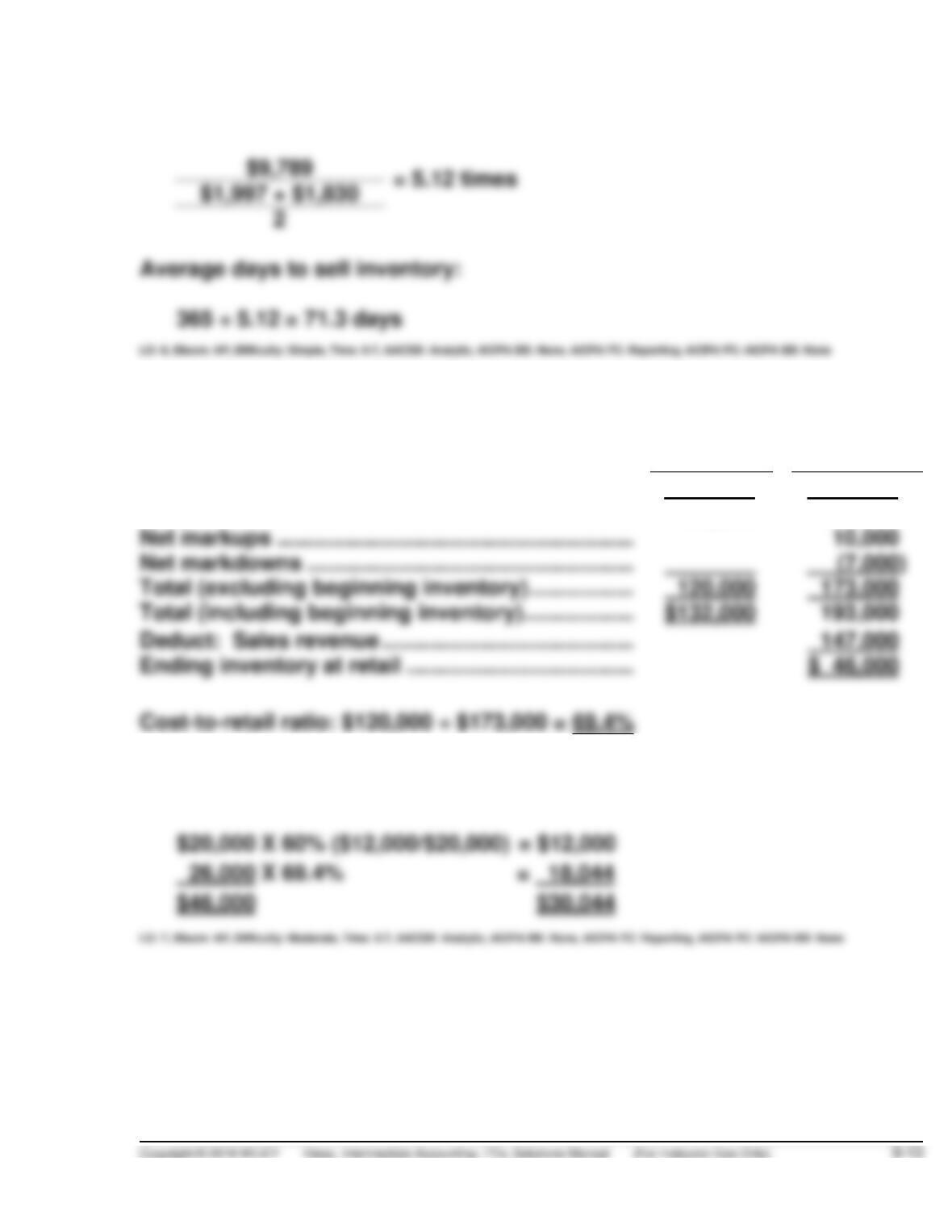
BRIEF EXERCISE 9.11
Inventory turnover:
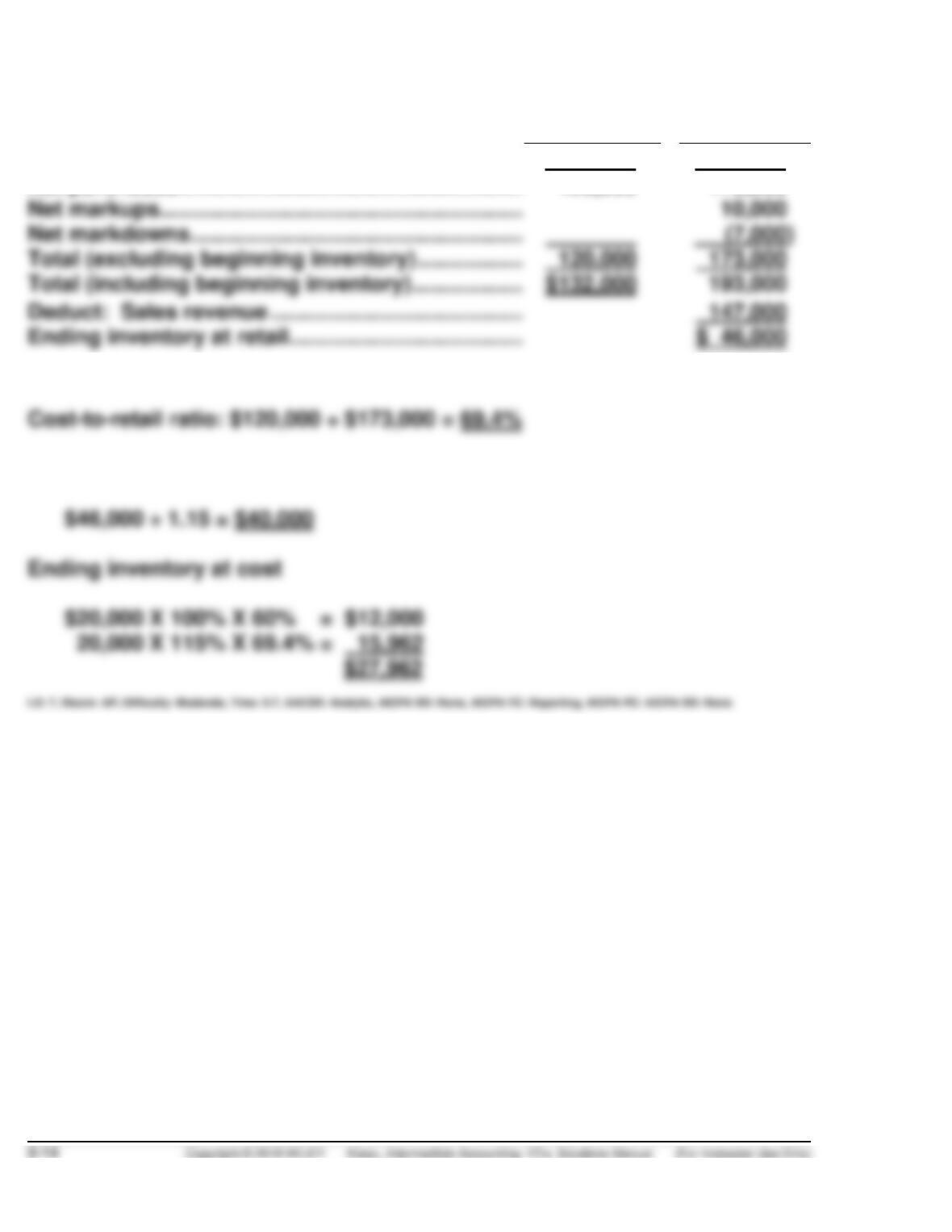
*BRIEF EXERCISE 9.12
Cost
Retail
Beginning inventory ……………………………………….
$ 12,000
$ 20,000
Net purchases ……………………………………………….
120,000
170,000
Net markups ………………………………………………….
Net markdowns ……………………………………………..
Total (excluding beginning inventory) ……………..
Total (including beginning inventory)………………
Deduct: Sales revenue …………………………………..
Ending inventory at retail ……………………………….
Ending inventory at cost
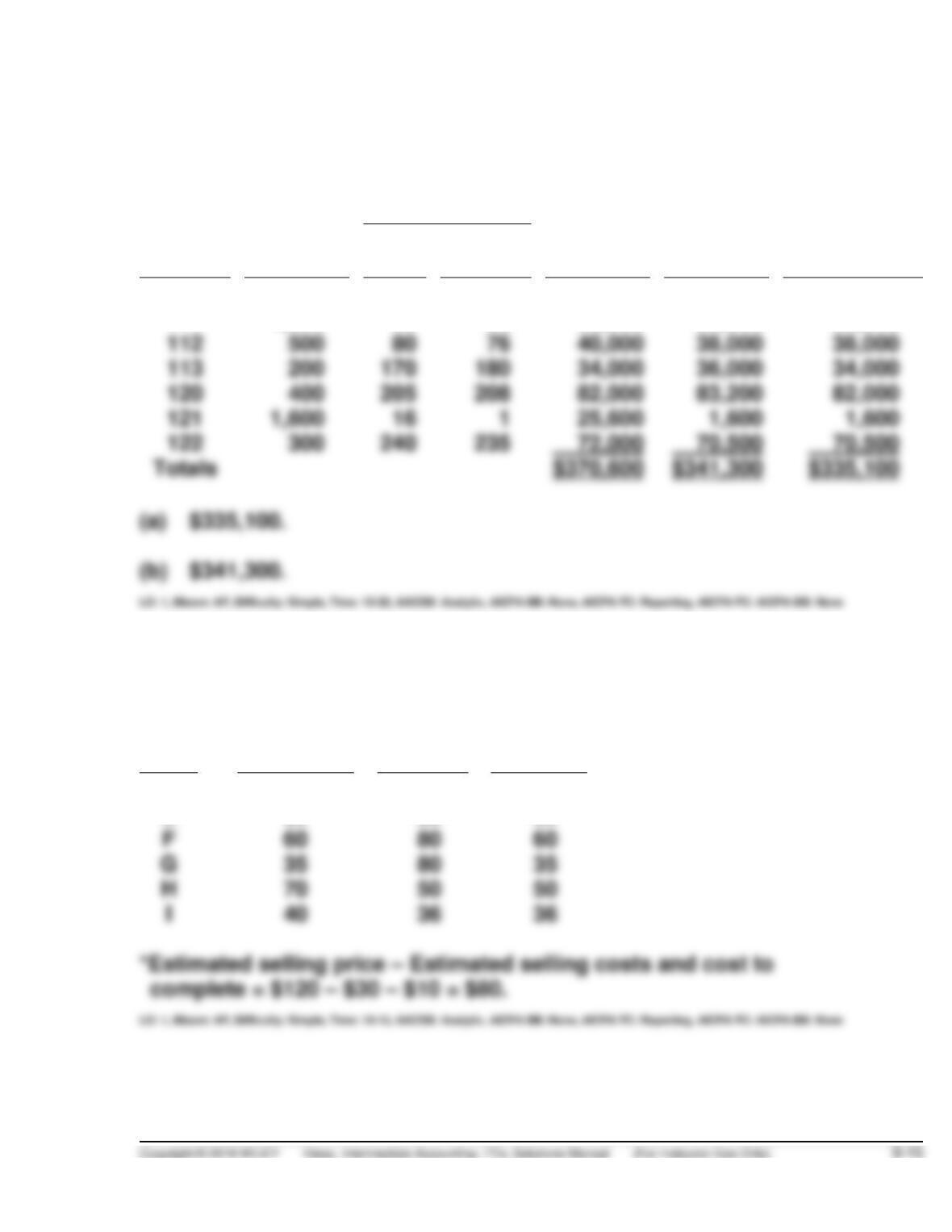
*BRIEF EXERCISE 9.13
Cost
Retail
Beginning inventory ……………………………………….
$ 12,000
$ 20,000
Net purchases ………………………………………………..
120,000
170,000
Net markups …………………………………………………..
Net markdowns ………………………………………………
Total (excluding beginning inventory) ……………..
Total (including beginning inventory) ………………
Deduct: Sales revenue …………………………..………
Ending inventory at retail ………………………………..
Ending inventory at retail deflated to base year prices
SOLUTIONS TO EXERCISES
EXERCISE 9.1 (15–20 minutes)
Per Unit
Lower-of–
Part No.
Quantity
Cost
NRV
Total
Cost
Total
NRV
Cost-or–
NRV
110
600
$ 95
$100
$ 57,000
$ 60,000
$ 57,000
111
1,000
60
52
60,000
52,000
52,000
112
500
80
76
40,000
38,000
38,000
113
200
34,000
36,000
34,000
120
400
82,000
83,200
82,000
121
1,600
16
1
25,600
1,600
122
300
72,000
70,500
70,500
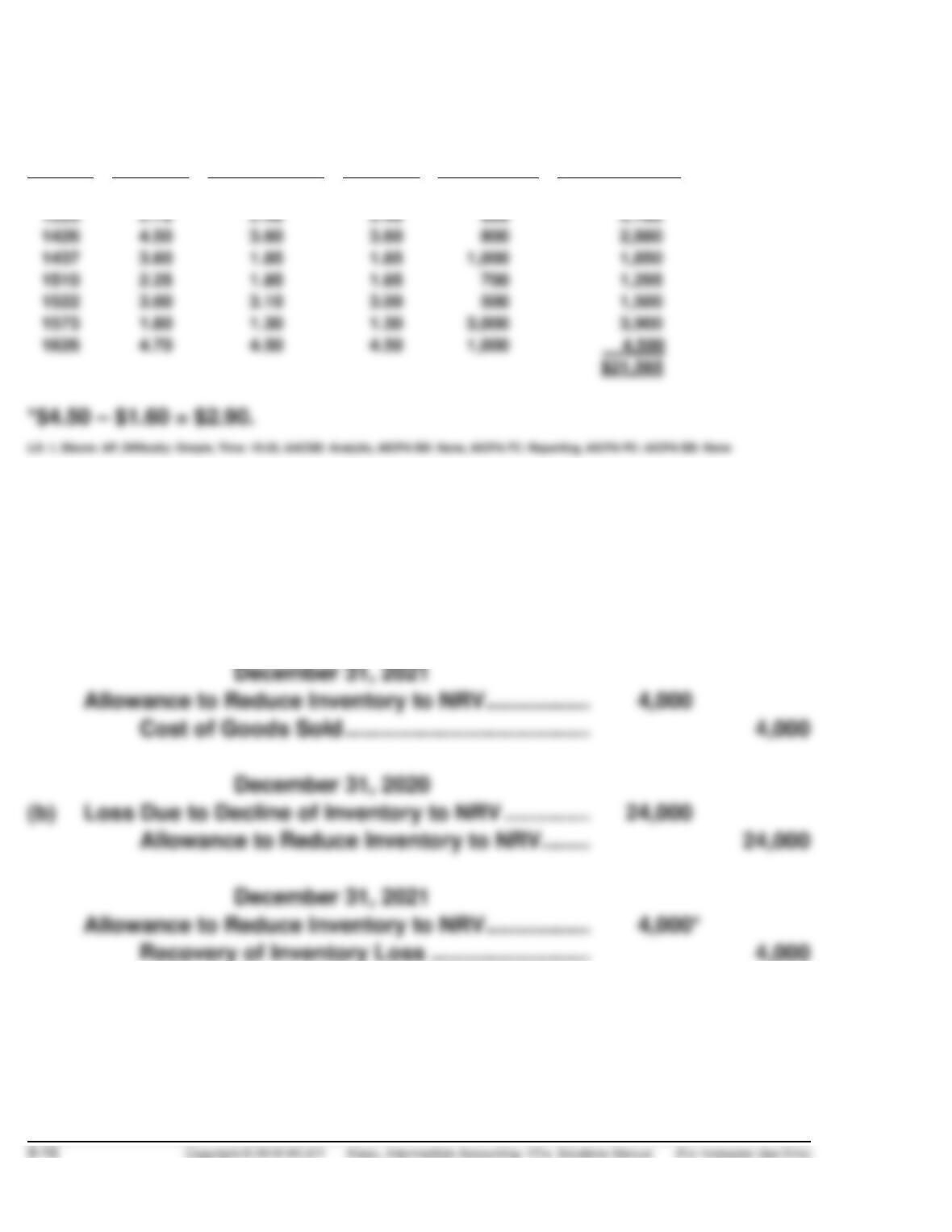
EXERCISE 9.2 (10–15 minutes)
Item
Net
Realizable
Value
Cost
LCNRV
D
$80*
$75
$75
E
62
80
62
G
35
80
35
H
70
50
50
EXERCISE 9.3 (15–20 minutes)
Item
No.
Cost
per Unit
Net Realizable
Value
LCNRV
Quantity
Final
Inventory
Value
1320
$3.20
$2.90*
$2.90
1,200
$ 3,480
1333
2.40
900
2,160
1426
3.60
800
2,880
1437
1.85
1,000
1,850
1510
1.85
700
1,295
1522
3.10
500
1,500
1573
1.30
3,000
3,900
1626
4.50
1,000
EXERCISE 9.4 (10–15 minutes)
December 31, 2020
(a)
Cost of Goods Sold ($346,000 – $322,000) ………………..
24,000
Allowance to Reduce Inventory to NRV …………….
24,000
December 31, 2021
Allowance to Reduce Inventory to NRV …………………….
Cost of Goods Sold …………………………………………
December 31, 2020
(b)
Loss Due to Decline of Inventory to NRV ………………….
24,000
Allowance to Reduce Inventory to NRV …………….
24,000
December 31, 2021
Allowance to Reduce Inventory to NRV …………………….
Recovery of Inventory Loss …………………………..
EXERCISE 9.4 (Continued)
*Cost of inventory at 12/31/20 ………………………………
$346,000
LCNRV at 12/31/20 …………………………………………….
(322,000)
Allowance amount needed to reduce inventory
to NRV (a) ………………………………………………………
$ 24,000
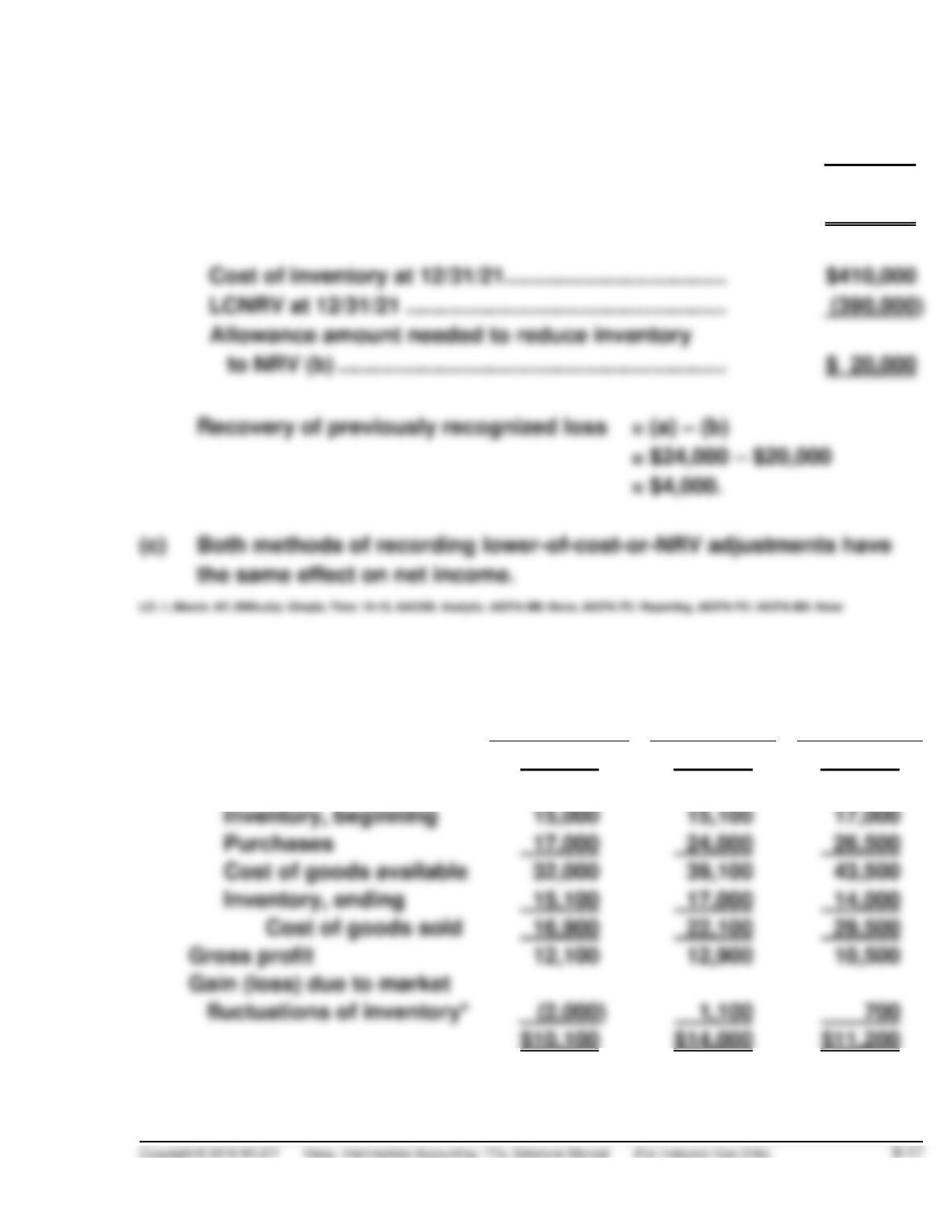
Cost of inventory at 12/31/21 ………………………………
LCNRV at 12/31/21 …………………………………………….
(390,000)
Allowance amount needed to reduce inventory
to NRV (b) ………………………………………………………
$ 20,000
Recovery of previously recognized loss
= (a) – (b)
= $24,000 – $20,000
= $4,000.
EXERCISE 9.5 (20–25 minutes)
(a)
February
March
April
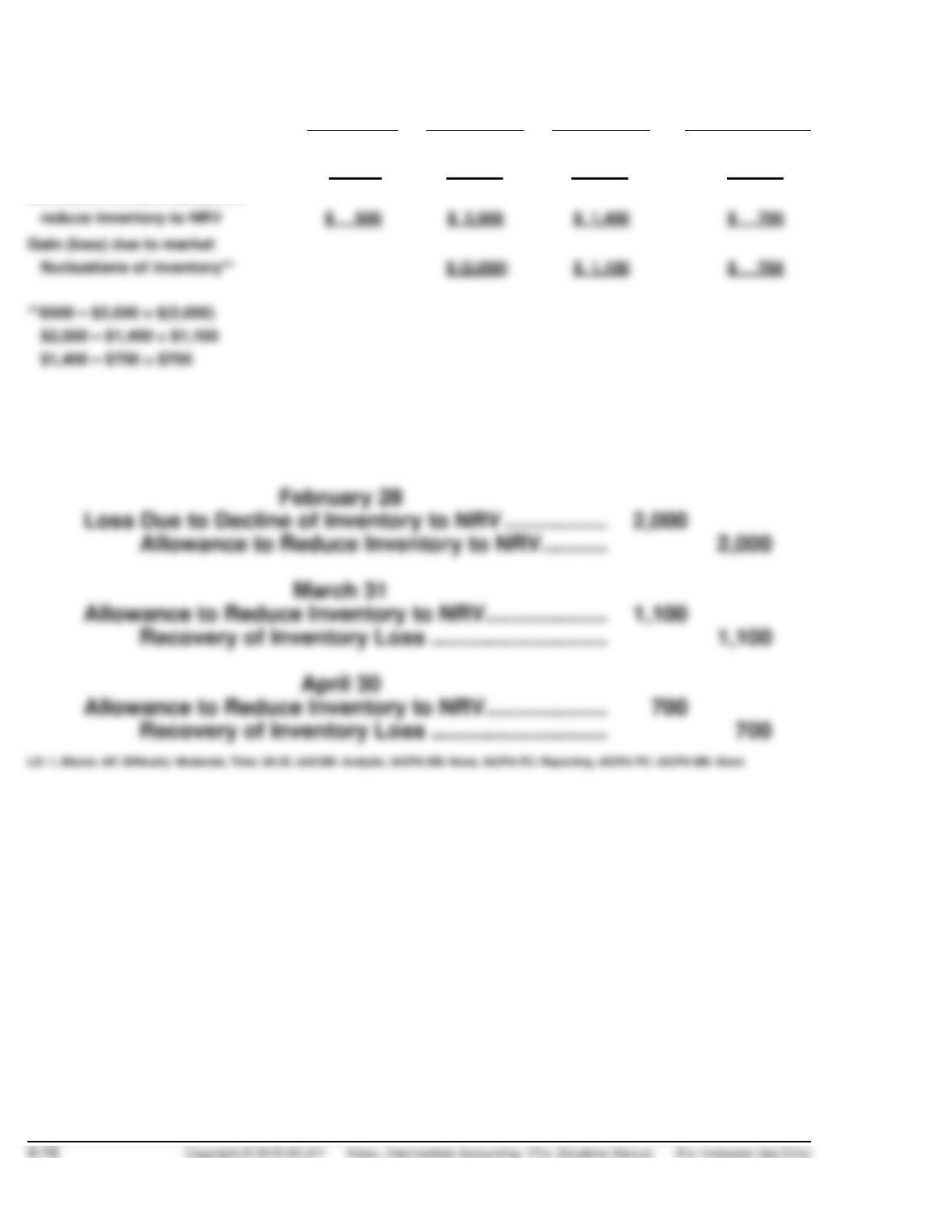
Sales
$29,000
$35,000
$40,000
Cost of goods sold
Inventory, beginning
Purchases
Cost of goods available
Inventory, ending
Cost of goods sold
Gross profit
Gain (loss) due to market
fluctuations of inventory*
(2,000)
1,100
700
EXERCISE 9.5 (Continued)
*
Jan. 31
Feb. 28
Mar. 31
Apr. 30
Inventory at cost
$15,000
$15,100
$17,000
$14,000
Inventory at LCNRV
(14,500)
(12,600)
(15,600)
(13,300)
$ (2,000)
Allowance amount needed to
January 31
(b)
Loss Due to Decline of Inventory to NRV ………………..
500
Allowance to Reduce Inventory to NRV …………..
500
Loss Due to Decline of Inventory to NRV ………………..
Allowance to Reduce Inventory to NRV …………..
Allowance to Reduce Inventory to NRV …………………..
Recovery of Inventory Loss …………………………..
Allowance to Reduce Inventory to NRV …………………..
700
Recovery of Inventory Loss …………………………..
700
EXERCISE 9.6 (10–15 minutes)
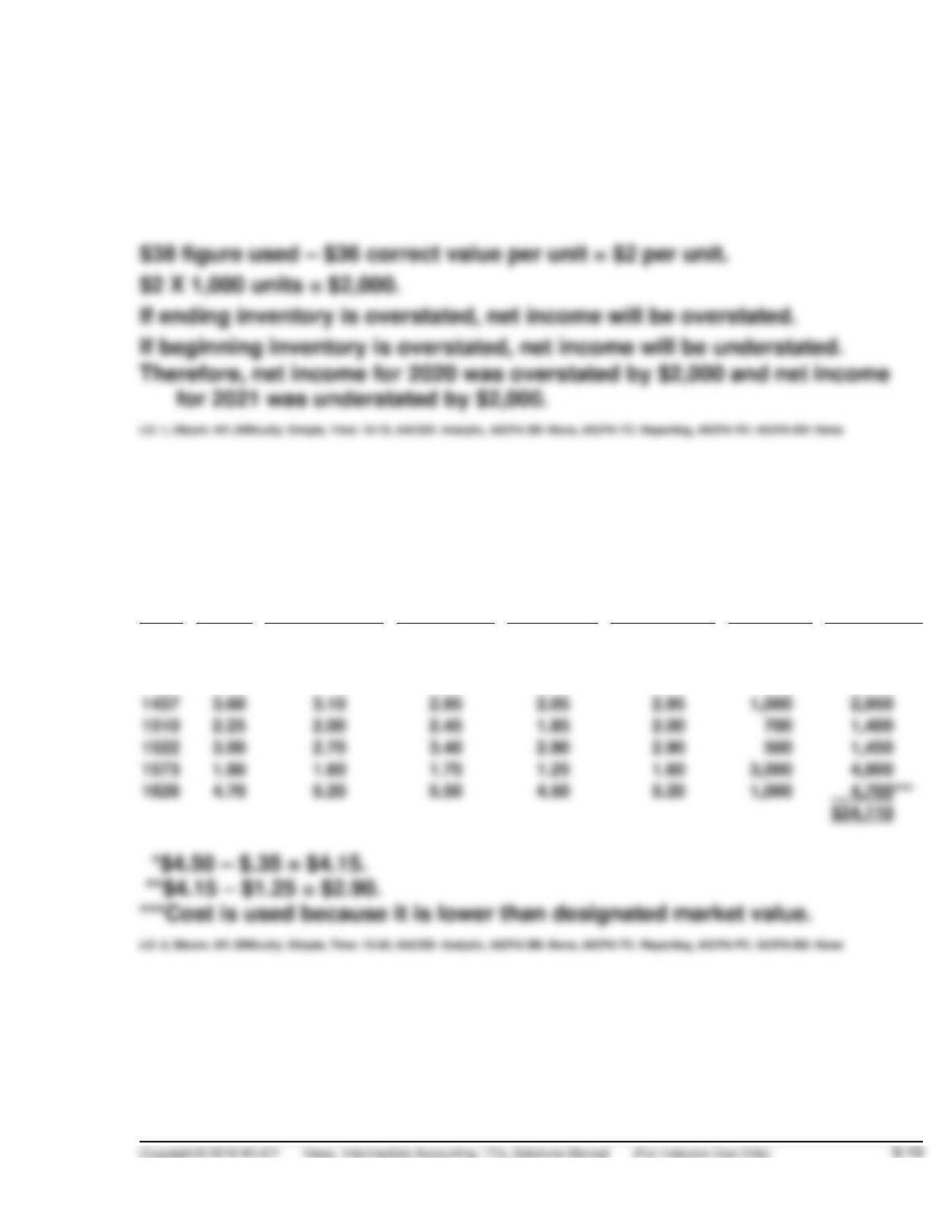
Net realizable value
$50 – $14 = $36
Cost
$40
Lower-of-cost-or-NRV
$36
EXERCISE 9.7 (15–20 minutes)
Item
No.
Cost
per
Unit
Replacement
Cost
Net
Realizable
Value
Net Real.
Value
Less
Normal
Profit
Designated
Market
Value
Quantity
Final
Inventory
Value
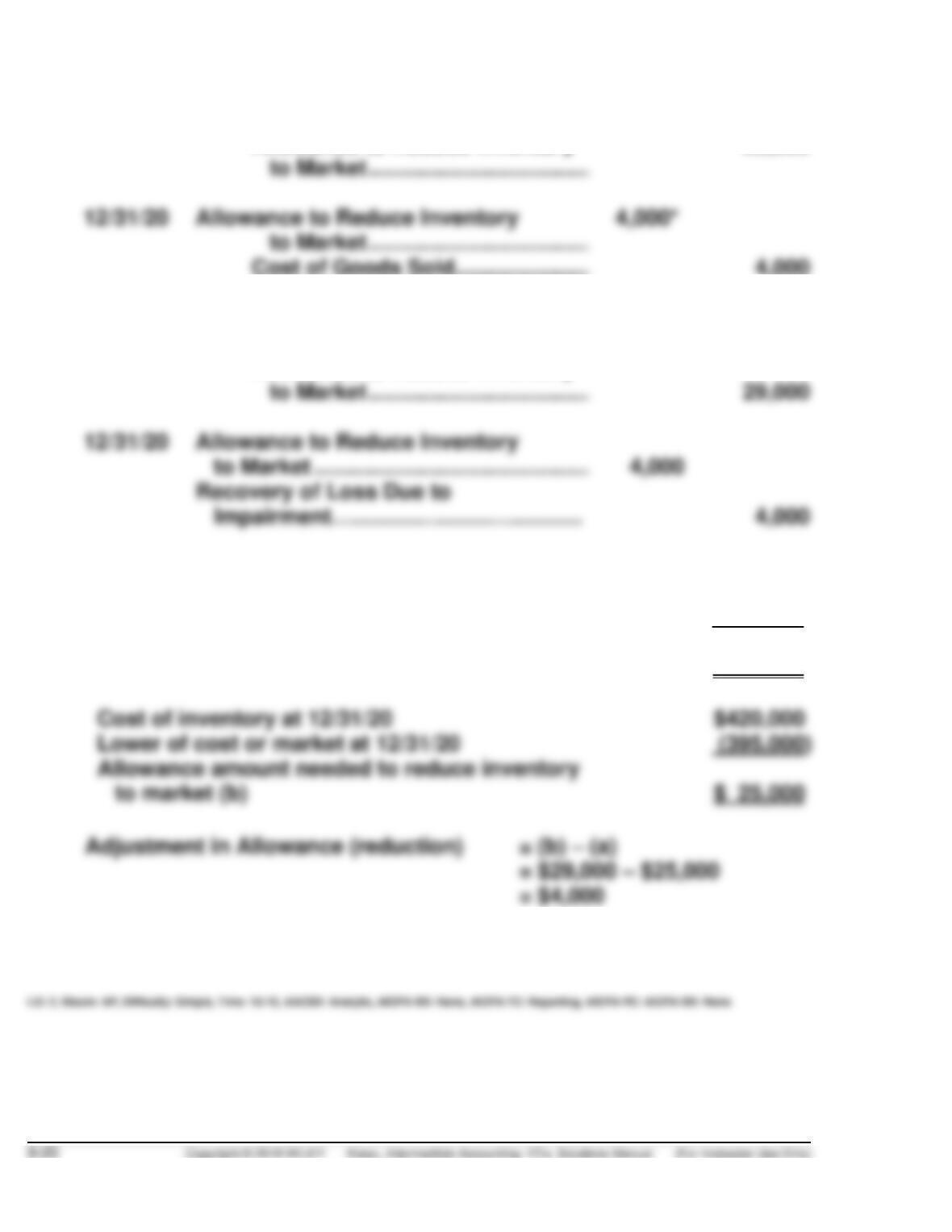
1320
$3.20
$3.00
$4.15*
$2.90**
$3.00
1,200
$ 3,600
1333
2.70
2.30
3.00
2.50
2.50
900
2,250
1426
4.50
3.70
4.60
3.60
3.70
800
2,960
1437
3.60
3.10
2.95
2.05
2.95
1,000
2,950
1510
2.25
2.00
2.45
1.85
2.00
700
1,400
1522
3.00
2.70
3.40
2.90
2.90
500
1,450
1573
1.80
1.60
1.75
1.25
1.60
3,000
4,800
1626
4.70
5.20
5.50
4.50
5.20
1,000
4,700***
EXERCISE 9.8 (10–15 minutes)
(a)
12/31/19
Cost of Goods Sold …………………………..
29,000
to Market ……………………………………………………..
12/31/20
Allowance to Reduce Inventory
to Market ……………………………………………………..
Allowance to Reduce Inventory
29,000
Cost of Goods Sold …………………………..
4,000
(b)
12/31/19
Loss Due to Market Decline of
Inventory ……………………………………………………….
29,000
to Market ……………………………………………………..
12/31/20
Allowance to Reduce Inventory
to Market ……………………………………………………….
Allowance to Reduce Inventory
*Cost of inventory at 12/31/19
$356,000
Lower of cost or market at 12/31/19
(327,000)
Allowance amount needed to reduce inventory
to market (a)
$ 29,000
Cost of inventory at 12/31/20
Lower of cost or market at 12/31/20
(395,000)
Allowance amount needed to reduce inventory
to market (b)
$ 25,000
Adjustment in Allowance (reduction)
= (b) – (a)
= $29,000 – $25,000
= $4,000
(c)
Both methods of recording lower–of–cost-or-market adjustments
have the same effect on net income.