Copyright © 2019 WILEY Kieso, Intermediate Accounting, 17/e, Solutions Manual (For Instructor Use Only) 9-21
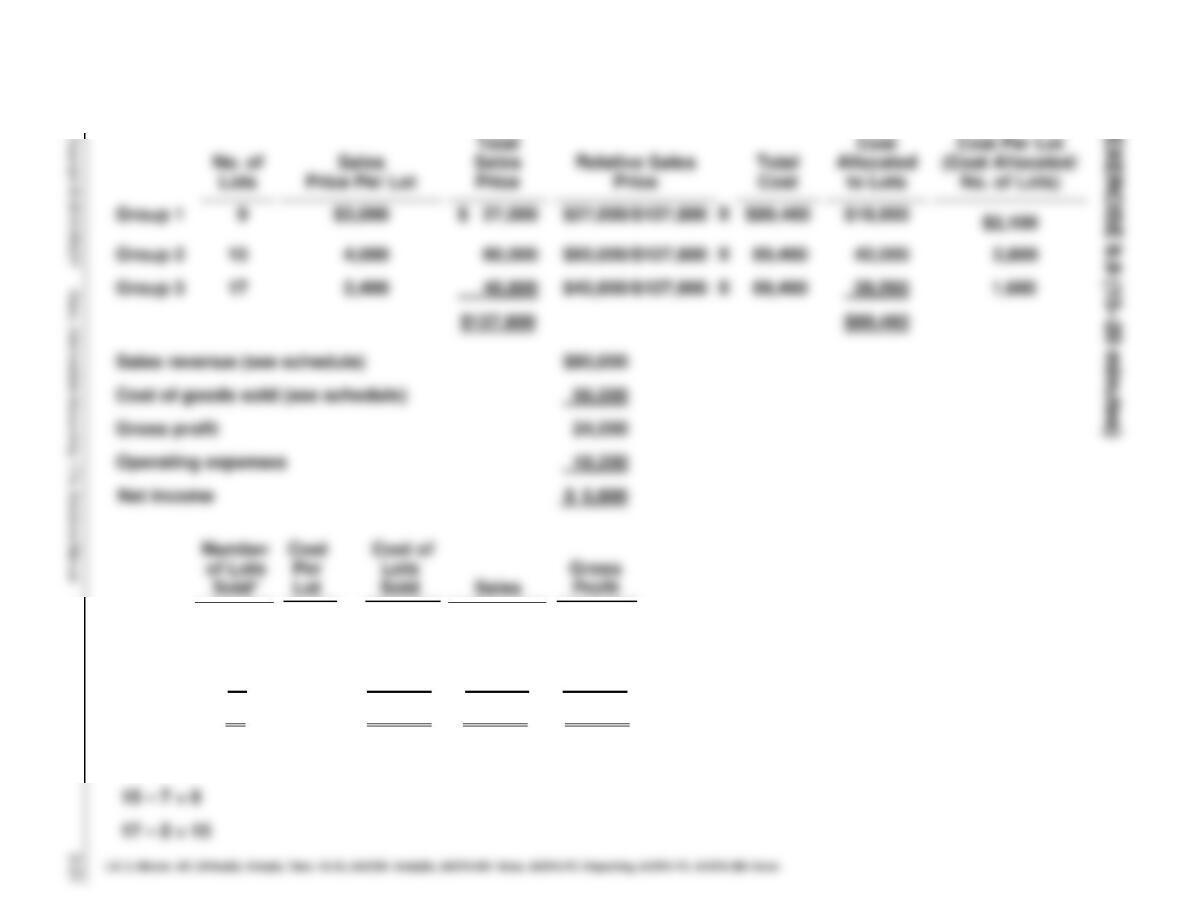
EXERCISE 9.9 (15–20 minutes)
$ 3,600
9,600
10,800
$24,000
$12,000
32,000
36,000
$80,000
$2,100 $ 8,400
2,800 22,400
1,680 25,200
$56,000
4
8
15
27
* 9 – 5 = 4
Group 1
Group 2
Group 3
Total
X
$60,000/$127,800
$80,000
24,000
60,000
Sales revenue (see schedule)
Gross profit
15
Group 2
9-22 Copyright © 2019 WILEY Kieso, Intermediate Accounting, 17/e, Solutions Manual (For Instructor Use Only)
EXERCISE 9.10 (12–17 minutes)
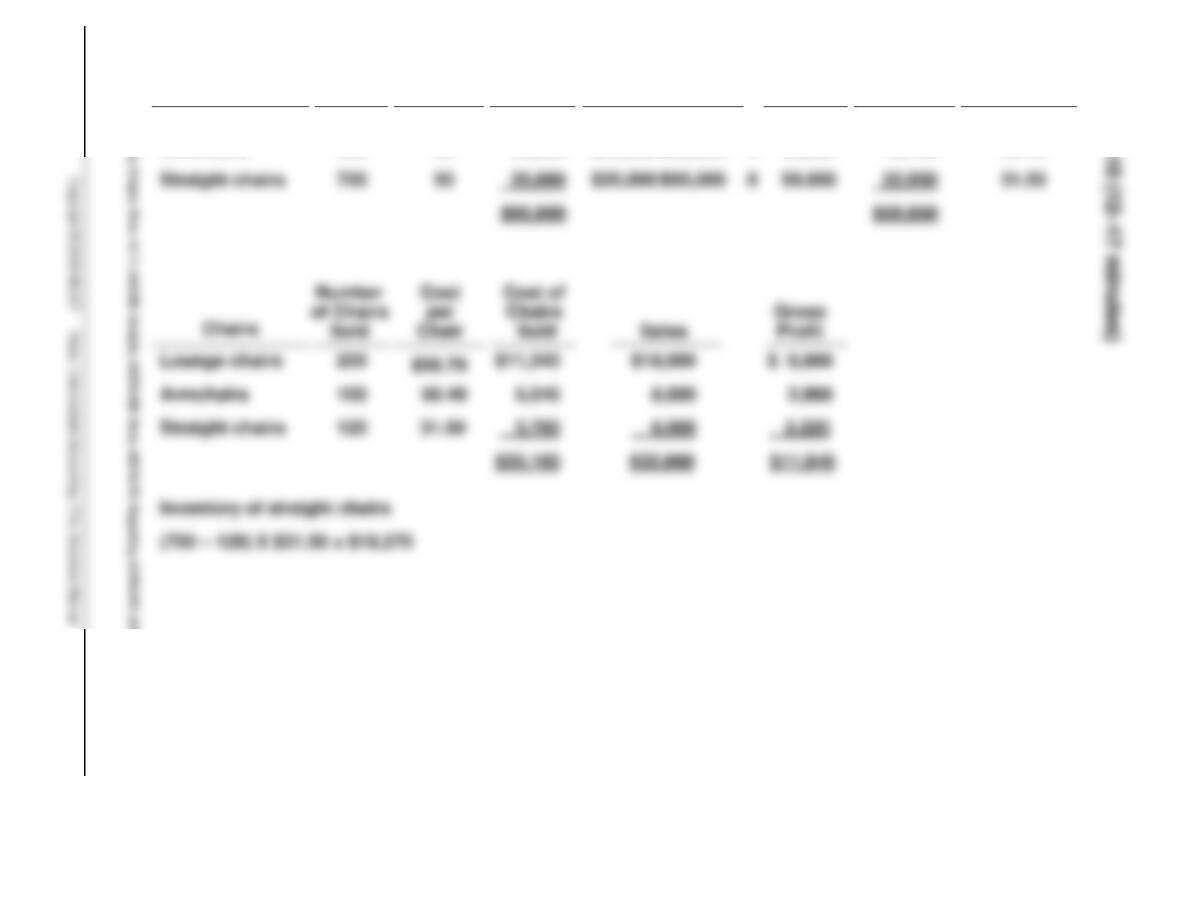
Cost per
Chair
$56.70
50.40
Cost
Allocated
to Chairs
$22,680
15,120
Total
Cost
$59,850
59,850
X
X
Relative Sales
Price
$36,000/$95,000
$24,000/$95,000
Total
Sales
Price
$36,000
24,000
Sales
Price
per
Chair
$90
80
No. of
Chairs
400
300
Chairs
Lounge chairs
Armchairs
LO: 3, Bloom: AP, Difficulty: Simple, Time: 12-17, AACSB: Analytic, AICPA BB: None, AICPA FC: Reporting, AICPA PC: AICPA BB: None
EXERCISE 9.11 (5–10 minutes)
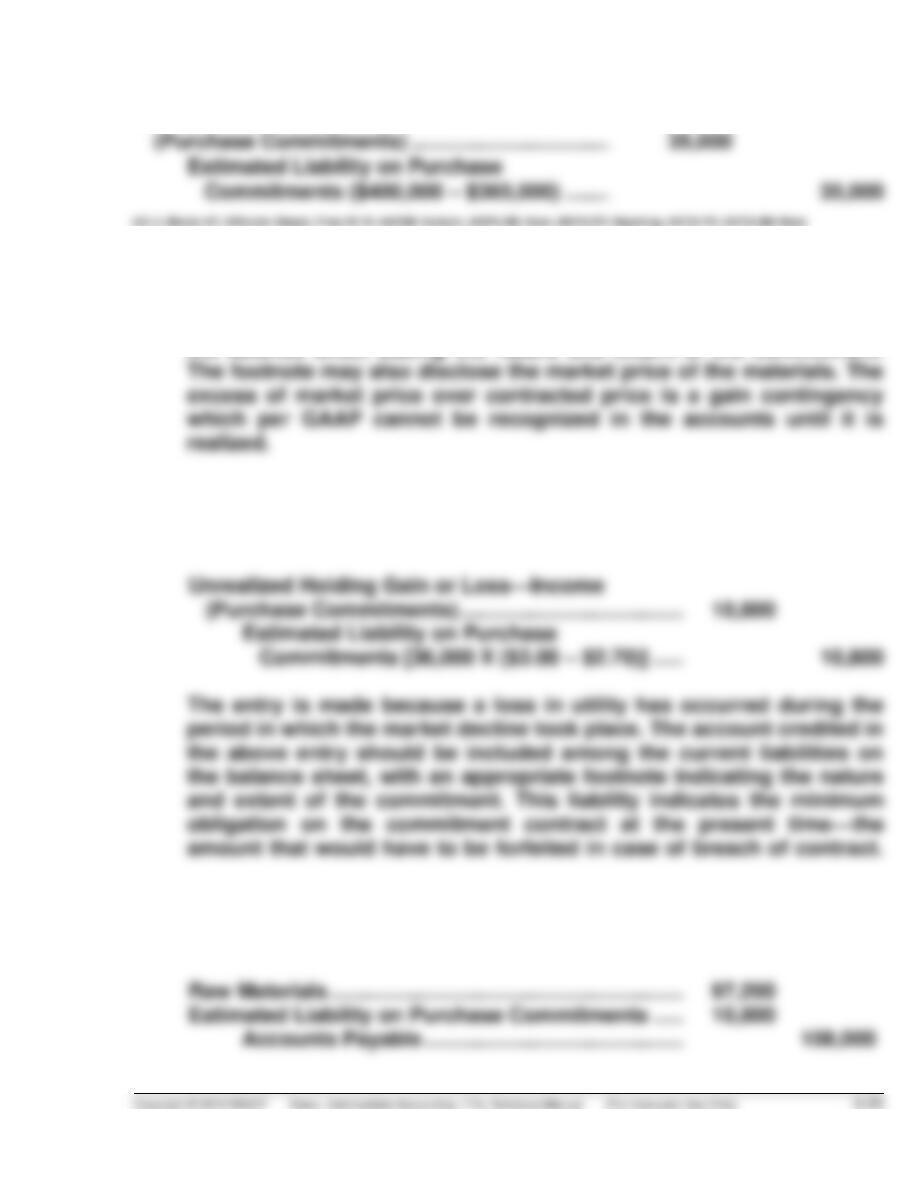
Unrealized Holding Gain or Loss—Income
EXERCISE 9.12 (15–20 minutes)
(a) If the commitment is material in amount, there should be a footnote in
the balance sheet stating the nature and extent of the commitment.
(b) The drop in the market price of the commitment should be charged to
operations in the current year if it is material in amount. The following
entry would be made:
(c) Assuming the $10,800 market decline entry was made on December
31, 2020, as indicated in (b), the entry when the materials are received
in January 2020 would be:
EXERCISE 9.12 (Continued)
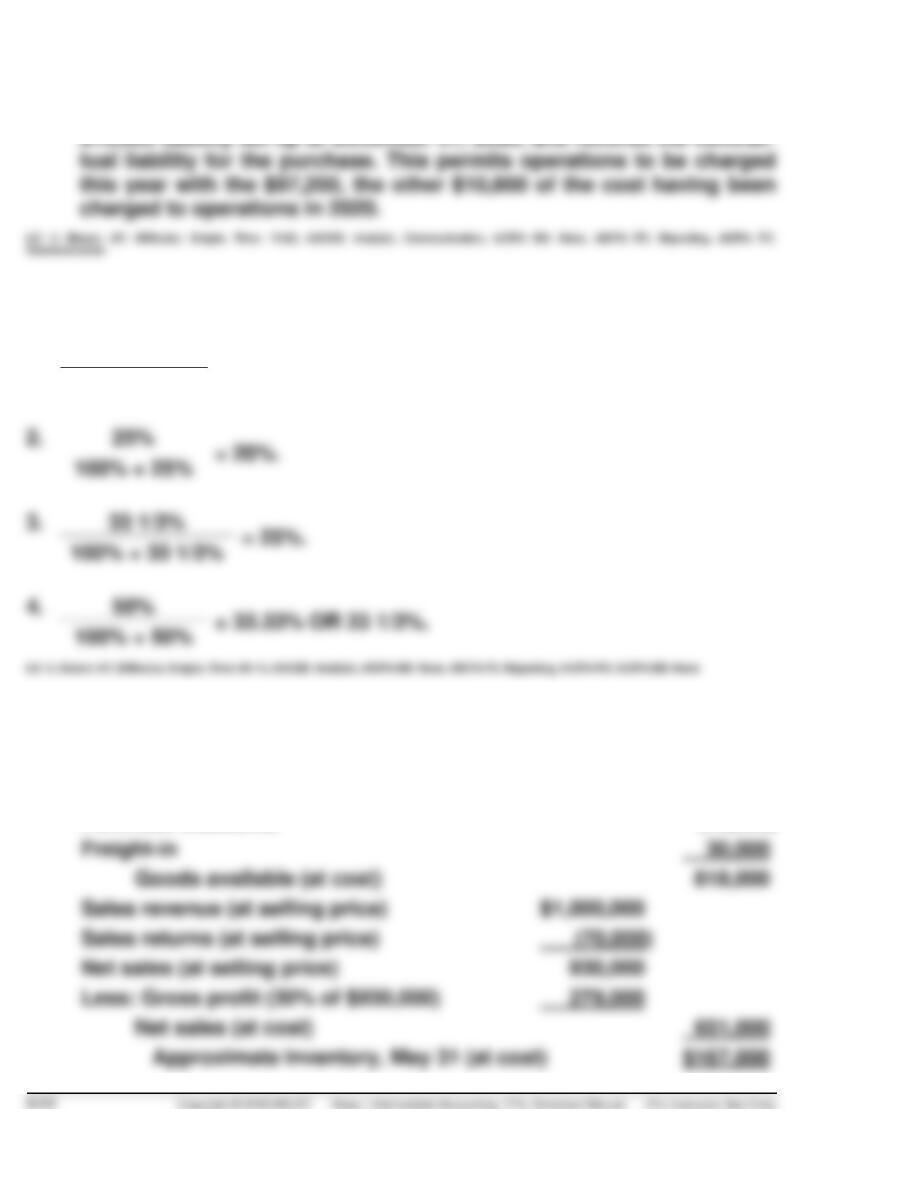
This entry records the raw materials at the actual cost, eliminates the
EXERCISE 9.13 (8–13 minutes)
1.
20%
= 16.67% OR 16 2/3%.
100% + 20%
= 20%.
100% + 25%
= 33.33% OR 33 1/3%.
100% + 50%
EXERCISE 9.14 (10–15 minutes)
(a)
Inventory, May 1 (at cost)
$160,000
Purchases (at cost)
640,000
Purchase discounts
(12,000)
30,000
Goods available (at cost)
Sales revenue (at selling price)
Sales returns (at selling price)
Net sales (at selling price)
Less: Gross profit (30% of $930,000)
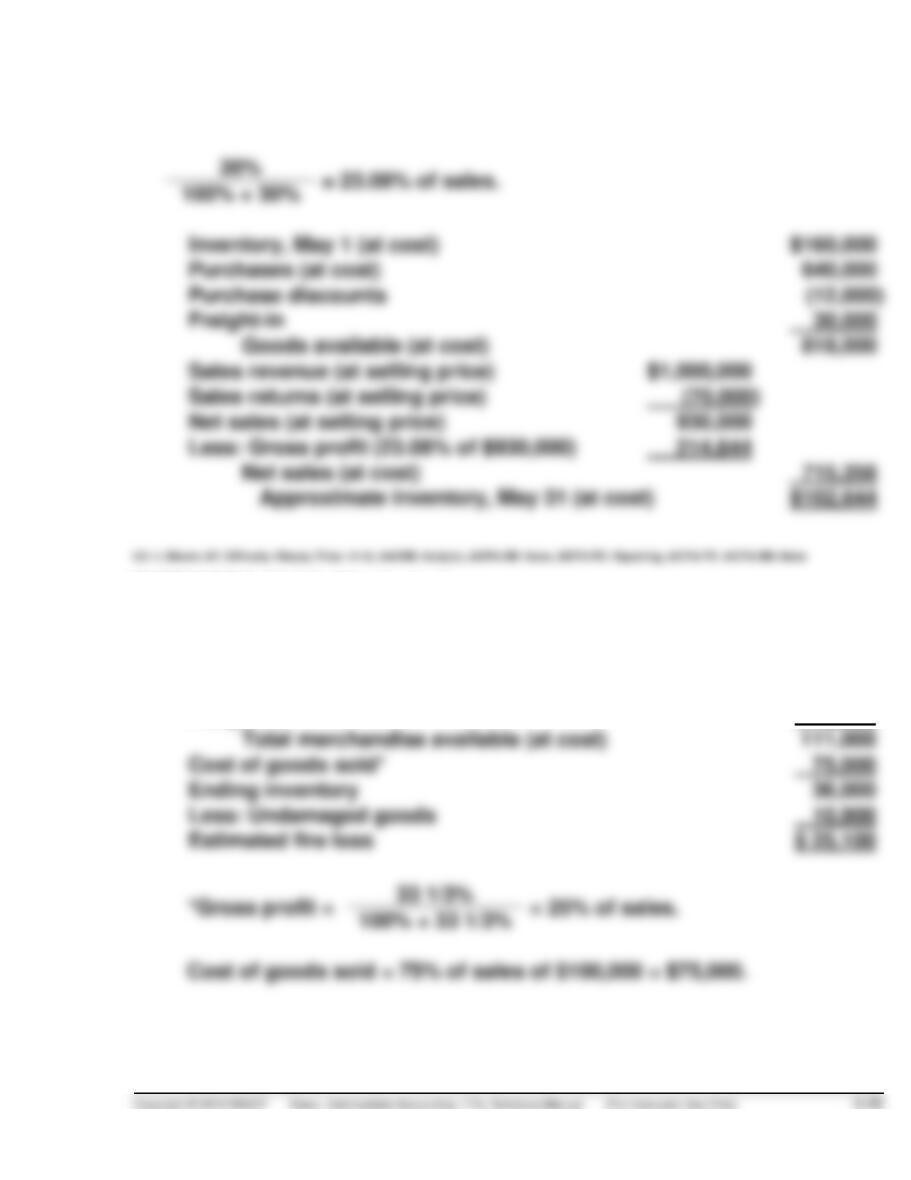
EXERCISE 9.14 (Continued)
(b) Gross profit as a percent of sales must be computed:
Inventory, May 1 (at cost)
Purchases (at cost)
Purchase discounts
Freight-in
Goods available (at cost)
Sales revenue (at selling price)
Sales returns (at selling price)
Net sales (at selling price)
Less: Gross profit (23.08% of $930,000)
Net sales (at cost)
Approximate inventory, May 31 (at cost)
EXERCISE 9.15 (15–20 minutes)
(a)
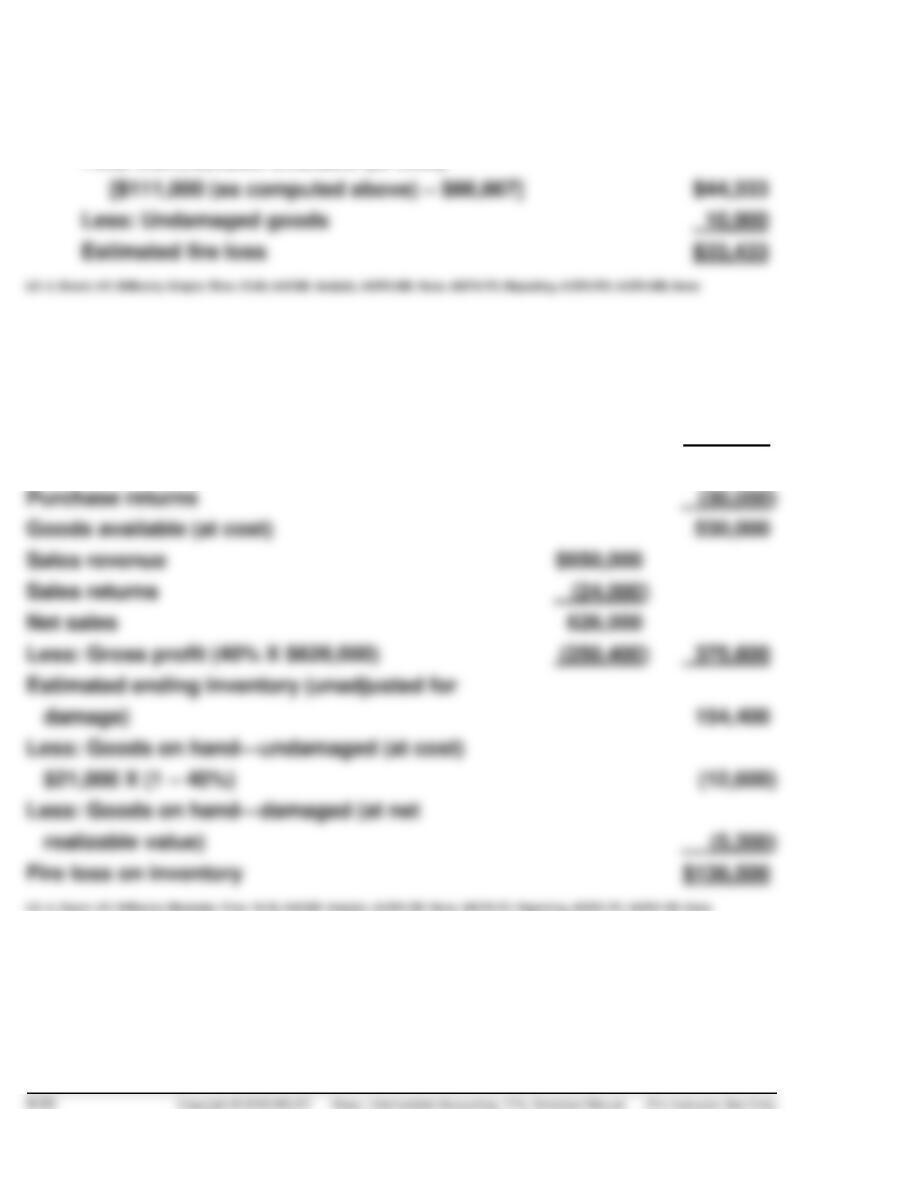
Merchandise on hand, January 1
$ 38,000
Purchases
72,000
Less: Purchase returns and allowances
(2,400)
Freight-in
3,400
Total merchandise available (at cost)
Cost of goods sold*
75,000
Ending inventory
36,000
Less: Undamaged goods
10,900
EXERCISE 9.15 (Continued)
(b)
Cost of goods sold = 66 2/3% of sales of $100,000 = $66,667
[$111,000 (as computed above) – $66,667]
Less: Undamaged goods
Total merchandise available (at cost)
EXERCISE 9.16
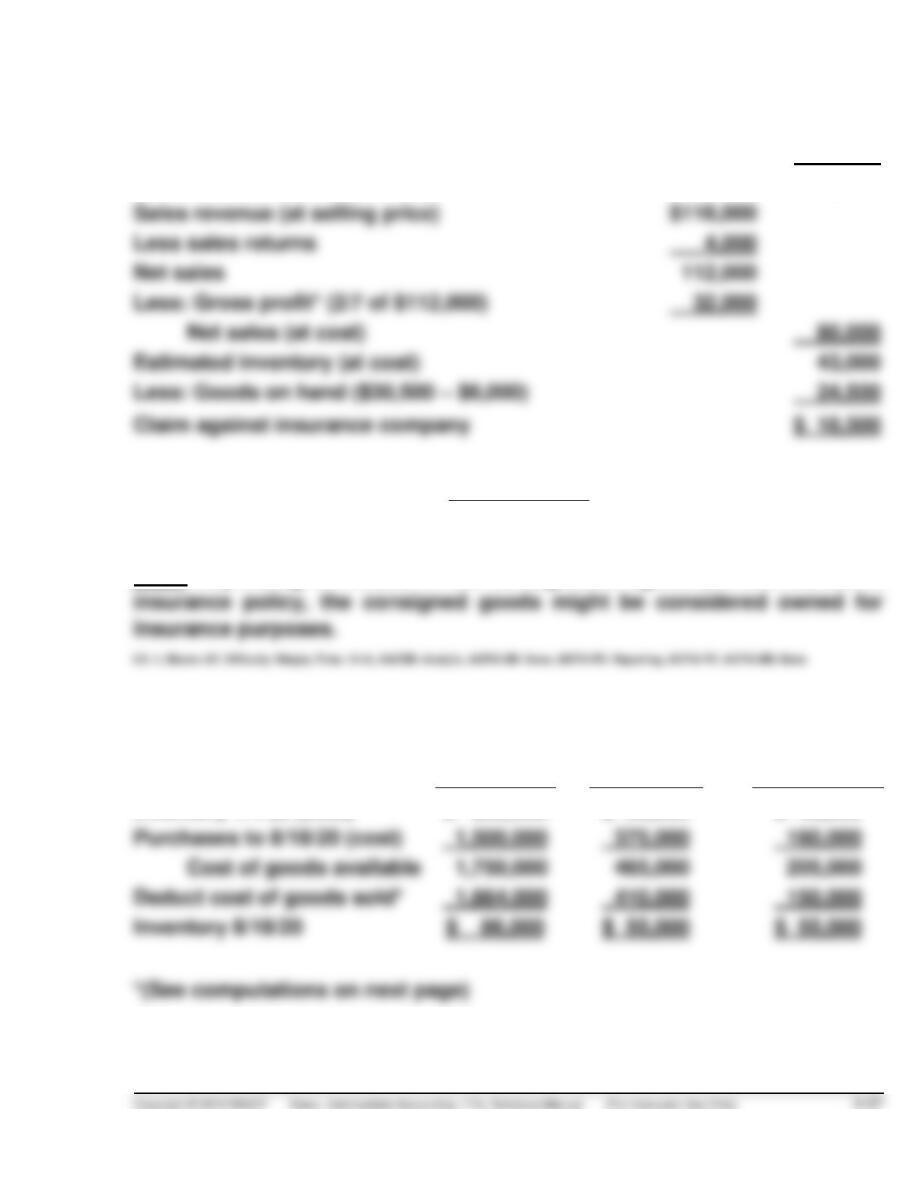
Beginning inventory
$170,000
Purchases
390,000
560,000
Purchase returns
Goods available (at cost)
530,000
Sales revenue
Sales returns
Net sales
Less: Gross profit (40% X $626,000)
375,600
Estimated ending inventory (unadjusted for
damage)
154,400
Less: Goods on hand—undamaged (at cost)
$21,000 X (1 – 40%)
Less: Goods on hand—damaged (at net
realizable value)
EXERCISE 9.17 (10–17 minutes)
Beginning inventory (at cost)
$ 38,000
Purchases (at cost)
85,000
Goods available (at cost)
123,000
Sales revenue (at selling price)
$116,000
Less sales returns
4,000
Net sales
112,000
Less: Gross profit* (2/7 of $112,000)
32,000
Net sales (at cost)
80,000
Estimated inventory (at cost)
*Computation of gross profit:
40%
= 2/7 of selling price
100% + 40%
Note: Depending on details of the consignment agreement and Duncan’s
EXERCISE 9.18 (15–20 minutes)
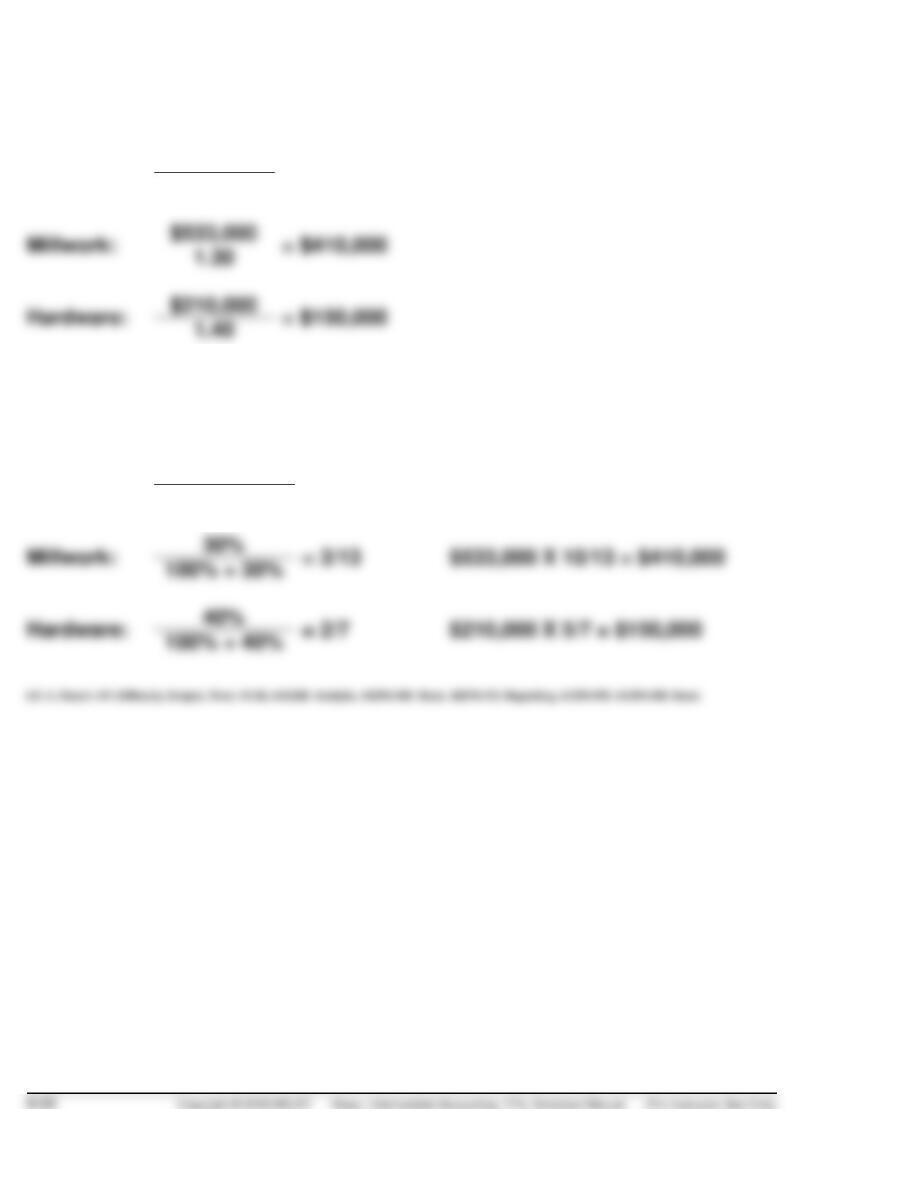
Lumber
Millwork
Hardware
Inventory 1/1/20 (cost)
$ 250,000
$ 90,000
$ 45,000
Purchases to 8/18/20 (cost)
Cost of goods available
Deduct cost of goods sold*
Inventory 8/18/20
$ 55,000
EXERCISE 9.18 (Continued)
Computation for cost of goods sold:*
Lumber:
$2,080,000
= $1,664,000
1.25
Millwork:
= $410,000
1.30
*Alternative computation for cost of goods sold:
Markup on selling price: Cost of goods sold:
Lumber:
25%
= 20% or 1/5
$2,080,000 X 80% = $1,664,000
100% + 25%
Millwork:
30%
= 3/13
$533,000 X 10/13 = $410,000
100% + 30%
Hardware:
= 2/7
$210,000 X 5/7 = $150,000
100% + 40%
EXERCISE 9.19 (20–25 minutes)
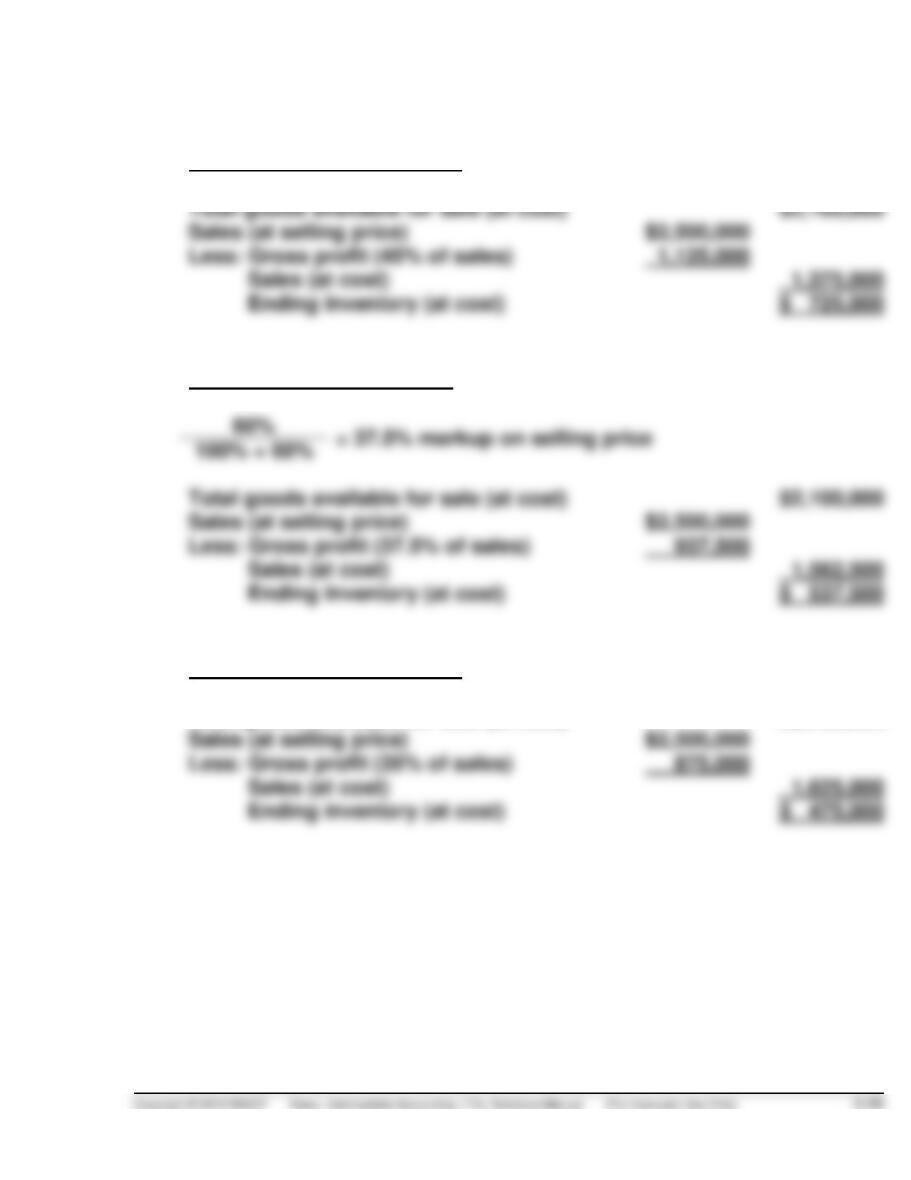
Ending inventory:
(a)
Gross profit is 45% of sales
Total goods available for sale (at cost)
$2,100,000
Sales (at selling price)
Less: Gross profit (45% of sales)
Sales (at cost)
(b)
Gross profit is 60% of cost
Total goods available for sale (at cost)
$2,100,000
Sales (at selling price)
Less: Gross profit (37.5% of sales)
Sales (at cost)
(c)
Gross profit is 35% of sales
Total goods available for sale (at cost)
$2,100,000
Sales (at selling price)
Less: Gross profit (35% of sales)
Sales (at cost)
EXERCISE 9.19 (Continued)
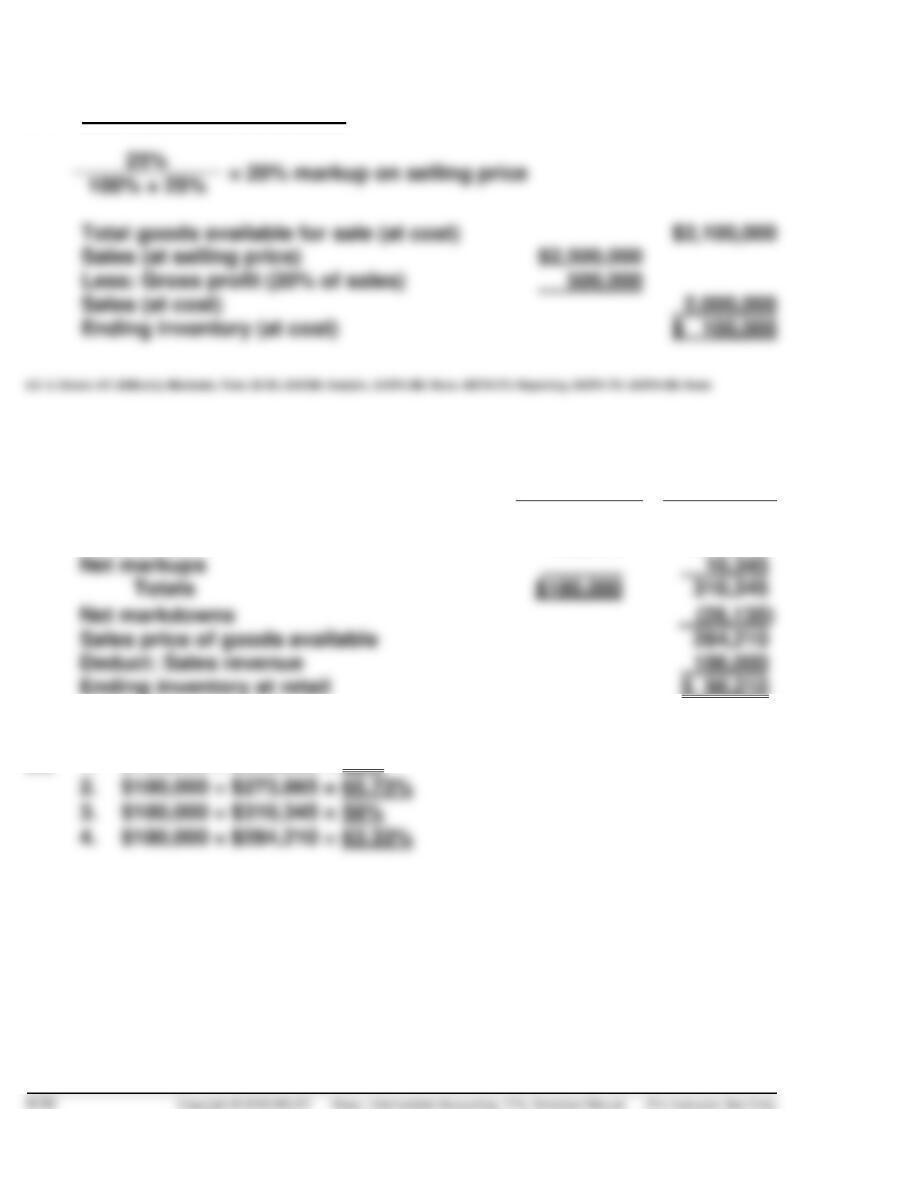
(d)
Gross profit is 25% of cost
Total goods available for sale (at cost)
$2,100,000
Sales (at selling price)
Less: Gross profit (20% of sales)
Sales (at cost)
Ending inventory (at cost)
EXERCISE 9.20 (20–25 minutes)
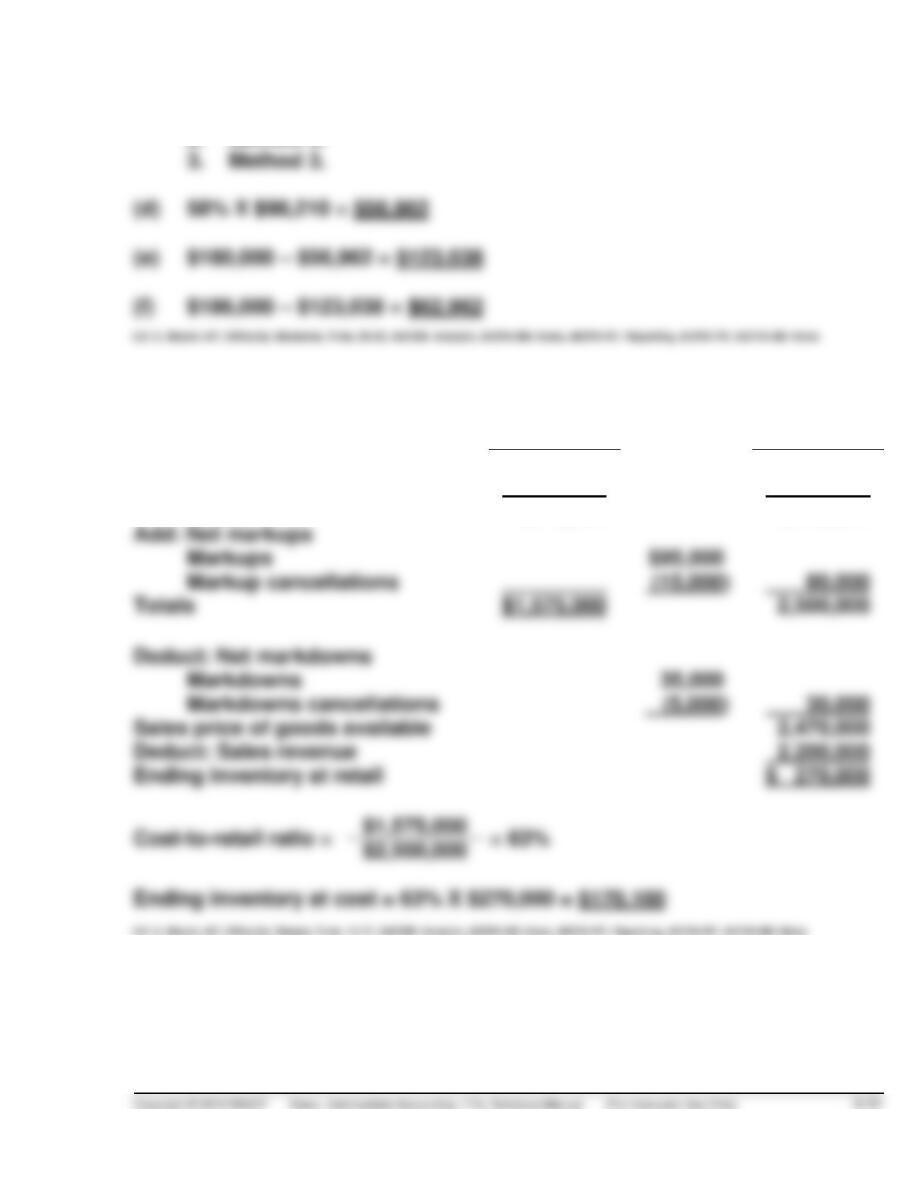
(a)
Cost
Retail
Beginning inventory
$ 58,000
$100,000
Purchases
122,000
200,000
Net markups
Totals
Net markdowns
Sales price of goods available
284,210
Deduct: Sales revenue
Ending inventory at retail
(b)
1.
$180,000 ÷ $300,000 = 60%
3.
$180,000 ÷ $310,345 = 58%
4.
$180,000 ÷ $284,210 = 63.33%
EXERCISE 9.20 (Continued)
(c)
1.
Method 3.
2.
Method 3.
Method 3.
$186,000 – $123,038 = $62,962
EXERCISE 9.21 (12–17 minutes)
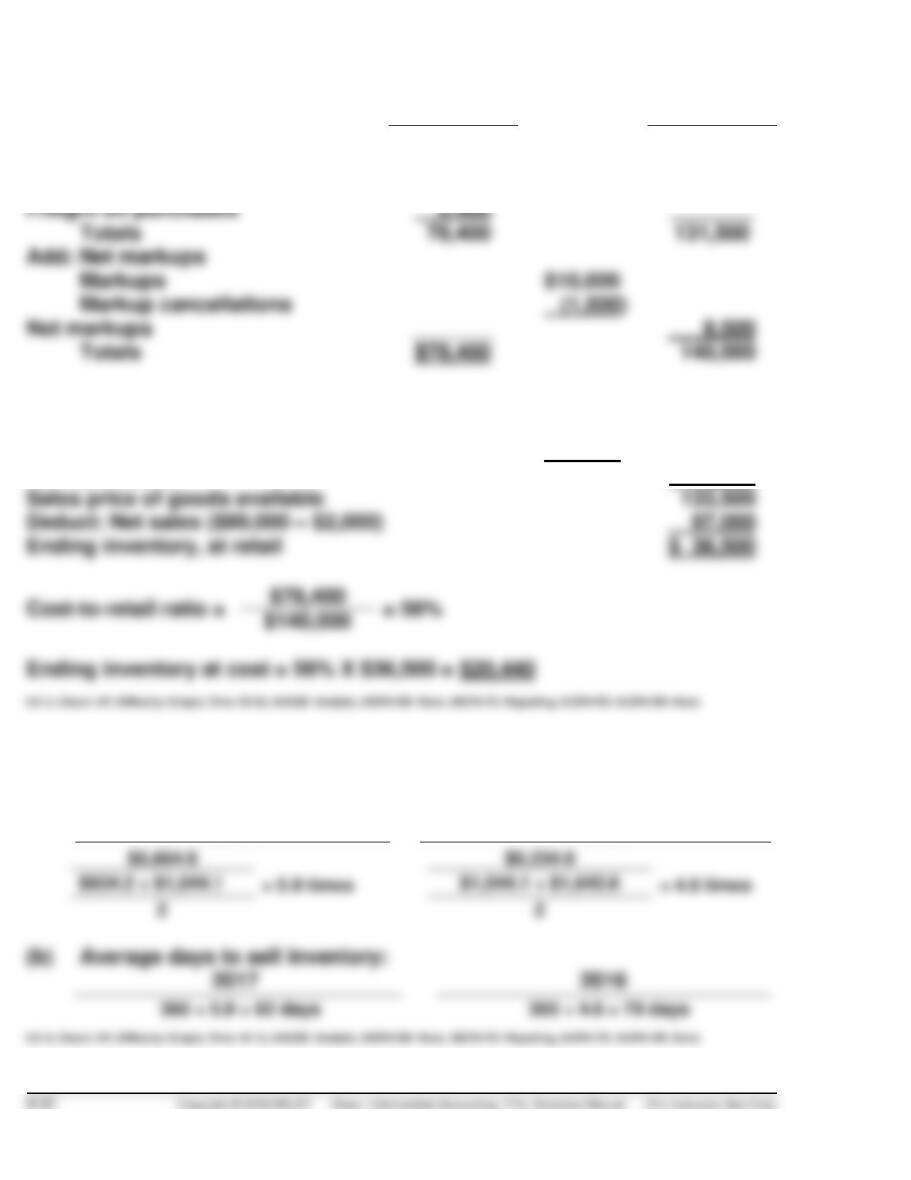
Cost
Retail
Beginning inventory
$ 200,000
$ 280,000
Purchases
1,375,000
2,140,000
Totals
1,575,000
2,420,000
Add: Net markups
Markups
Markup cancellations
80,000
Deduct: Net markdowns
Markdowns
Markdowns cancellations
30,000
Sales price of goods available
2,470,000
Deduct: Sales revenue
2,200,000
EXERCISE 9.22 (20–25 minutes)
Cost
Retail
Beginning inventory
$30,000
$ 46,500
Purchases
48,000
88,000
Purchase returns
(2,000)
(3,000)
Freight on purchases
2,400
Totals
78,400
131,500
Add: Net markups
Markups
$10,000
Markup cancellations
(1,500)
Net markups
8,500
Deduct: Net markdowns
Markdowns
9,300
Markdowns cancellations
(2,800)
Net markdowns
6,500
Sales price of goods available
Deduct: Net sales ($99,000 – $2,000)
97,000
EXERCISE 9.23 (10–15 minutes)
(a) Inventory turnover:
2017
2016
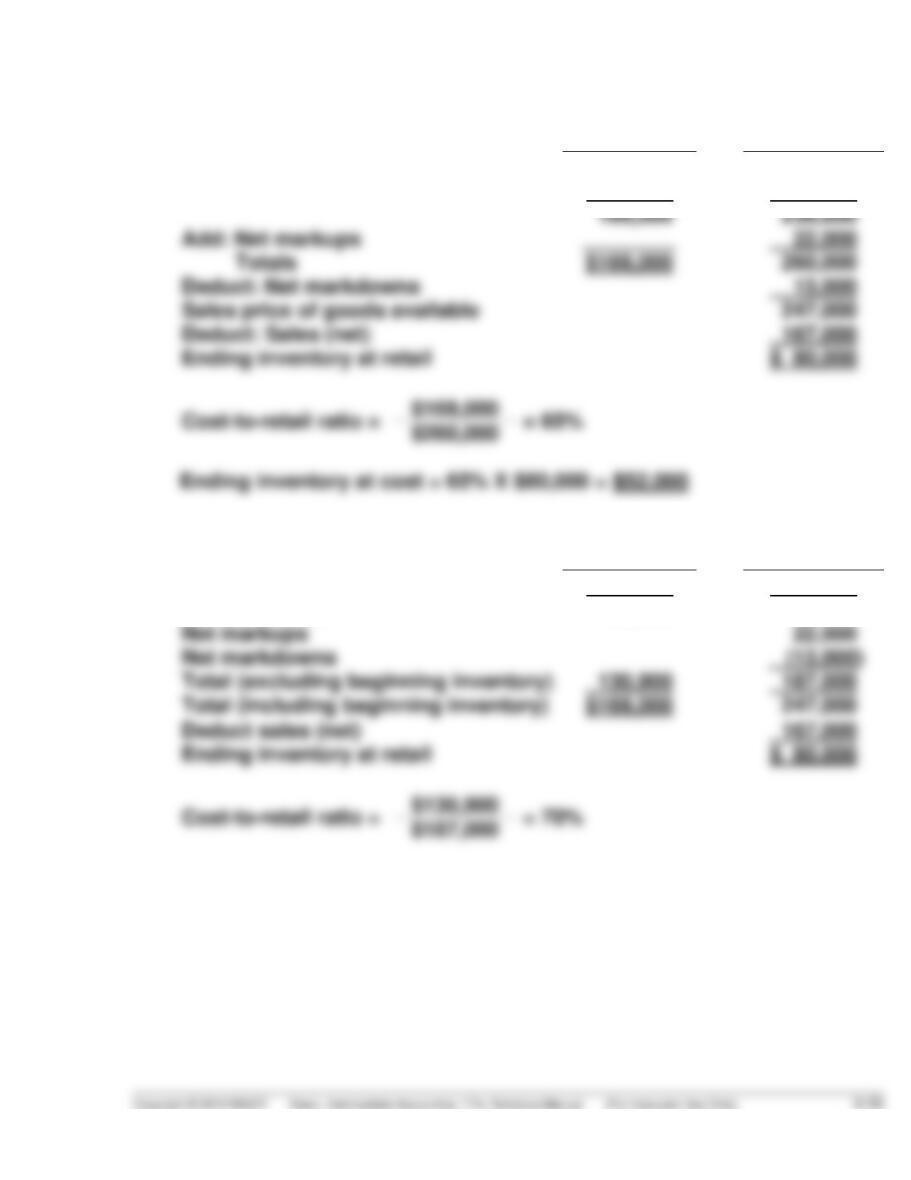
*EXERCISE 9.24 (25–35 minutes)
(a)
Conventional Retail Method
Cost
Retail
Inventory, January 1, 2020
$ 38,100
$ 60,000
Purchases (net)
130,900
178,000
169,000
238,000
Add: Net markups
Totals
$169,000
260,000
Deduct: Net markdowns
Sales price of goods available
247,000
Deduct: Sales (net)
167,000
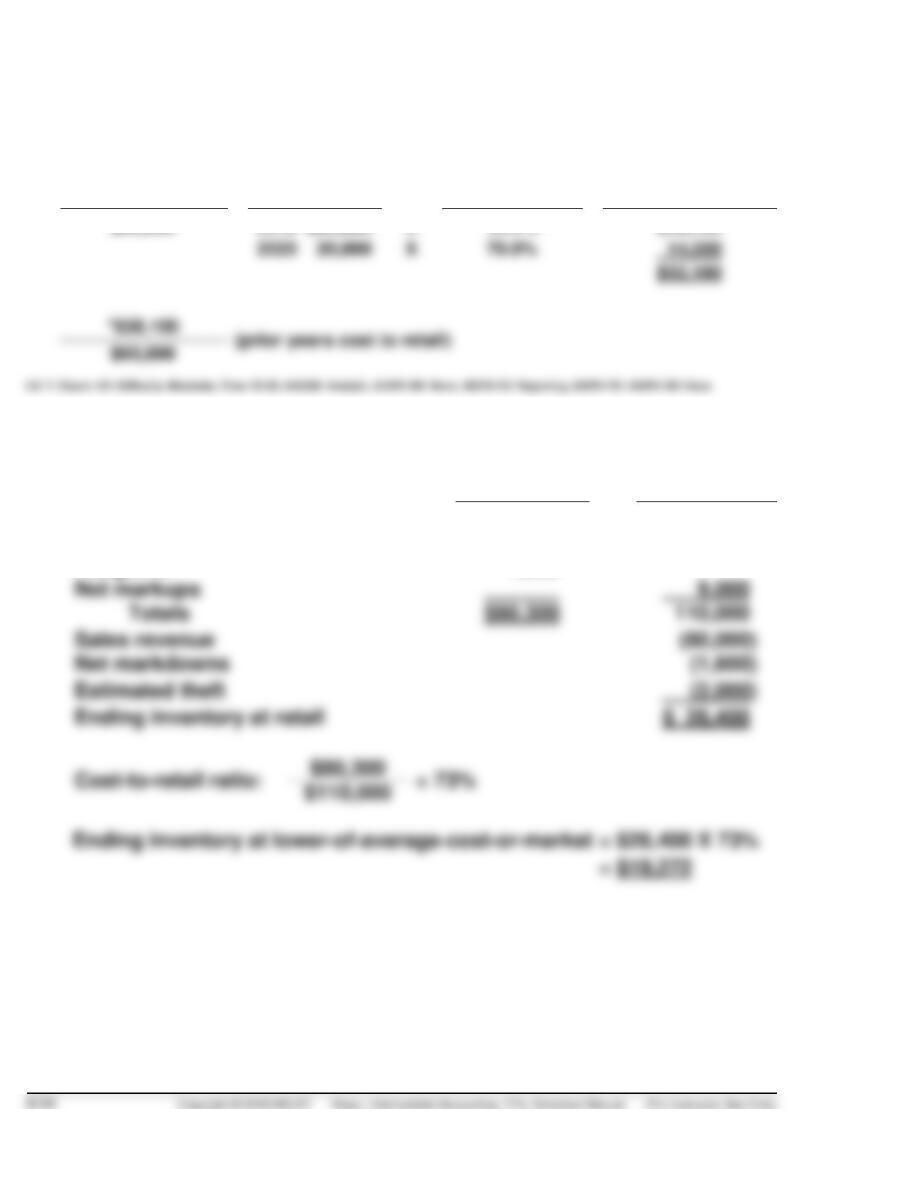
(b)
LIFO Retail Method
Cost
Retail
Inventory, January 1, 2020
$ 38,100
$ 60,000
Net purchases
130,900
178,000
Net markups
22,000
Net markdowns
Total (excluding beginning inventory)
130,900
187,000
Deduct sales (net)
167,000
Ending inventory at retail
*EXERCISE 9.24 (Continued)
Computation of ending inventory at LIFO cost, 2020:
Ending Inventory
at Retail Prices
Layers at
Retail Prices
Cost to Retail
(Percentage)
Ending Inventory
at LIFO Cost
$80,000
2019 $60,000
X
63.5%*
$38,100
*EXERCISE 9.25 (15–20 minutes)
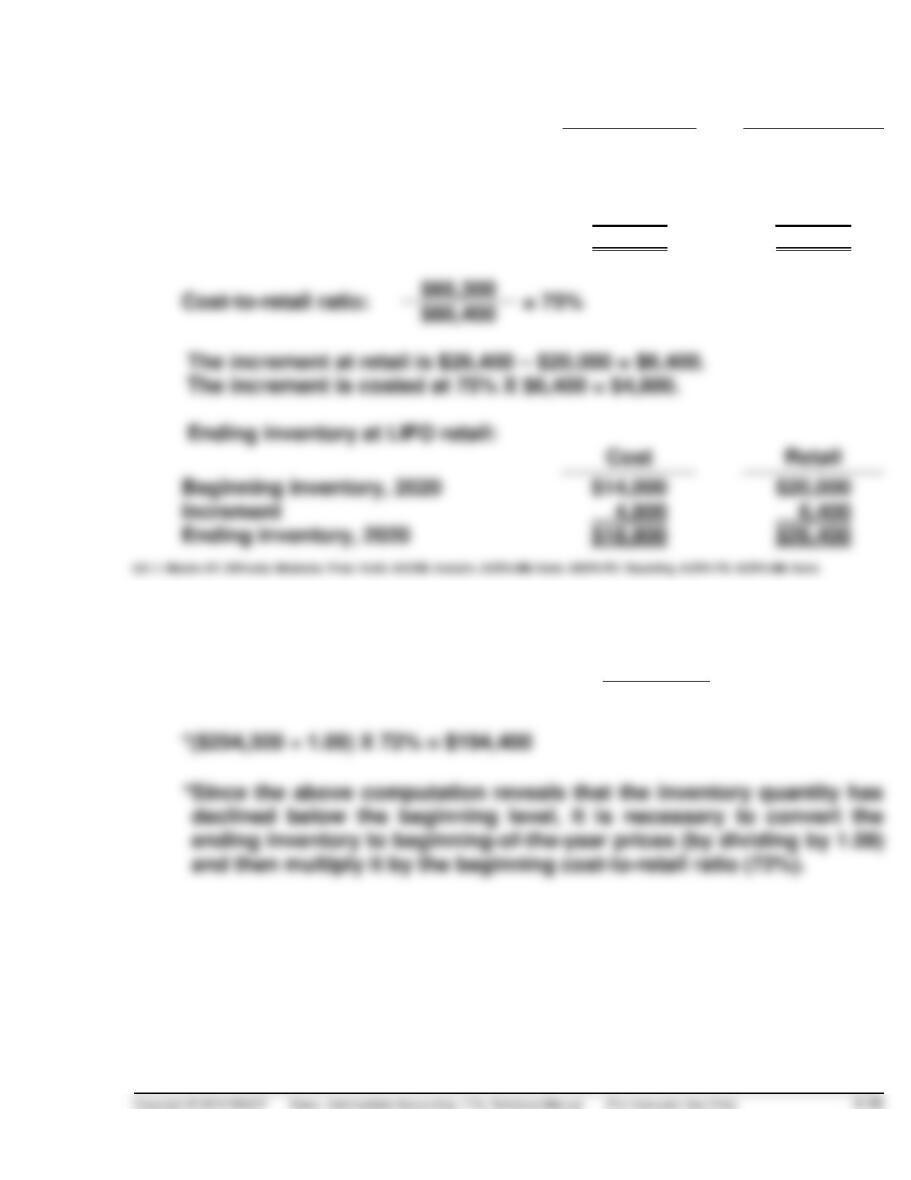
(a)
Cost
Retail
Inventory, January 1, 2020
$14,000
$ 20,000
Net purchases
58,800
81,000
Freight-in
7,500
Net markups
9,000
Totals
Sales revenue
Net markdowns
Estimated theft
Ending inventory at retail
*EXERCISE 9.25 (Continued)
(b)
Cost
Retail
Purchases
$58,800
$81,000
Freight-in
7,500
Net markups
9,000
Net markdowns
(1,600)
Totals
$66,300
$88,400
Cost-to-retail ratio:
= 75%
Cost
Retail
Beginning inventory, 2020
$14,000
$20,000
Increment
4,800
Ending inventory, 2020
$18,800
$26,400
*EXERCISE 9.26 (10–15 minutes)
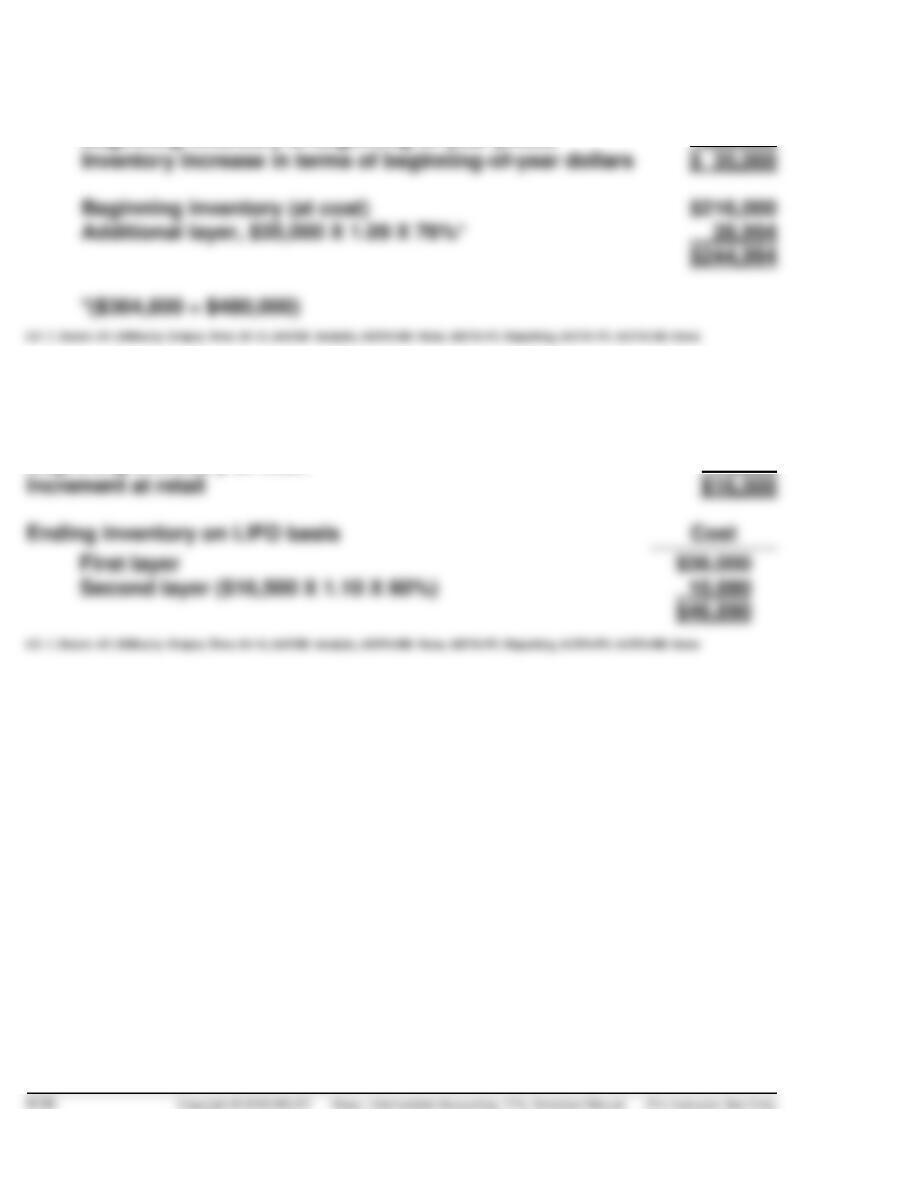
(a)
Cost-to-retail ratio—beginning inventory:
$216,000
= 72%
$300,000
*($294,300 ÷ 1.09) X 72% = $194,400
*EXERCISE 9.26 (Continued)
(b)
Ending inventory at retail prices deflated $365,150 ÷ 1.09
$335,000
Beginning inventory at beginning-of-year prices
300,000
Beginning inventory (at cost)
$216,000
*($364,800 ÷ $480,000)
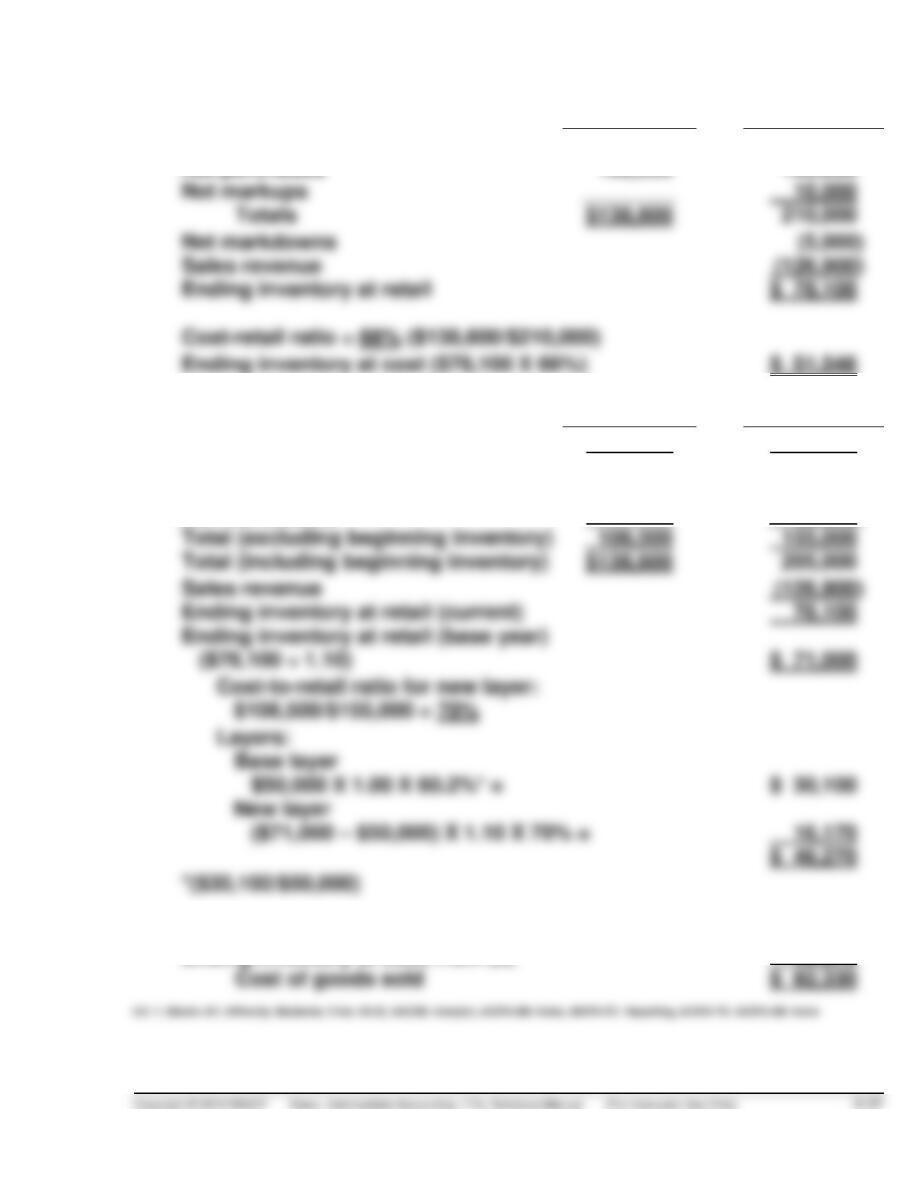
*EXERCISE 9.27 (5–10 minutes)
Ending inventory at retail (deflated) $100,100 ÷ 1.10
$91,000
Beginning inventory at retail
74,500
Second layer ($16,500 X 1.10 X 60%)
*EXERCISE 9.28 (20–25 minutes)
(a)
Cost
Retail
Beginning inventory
$ 30,100
$ 50,000
Net purchases
108,500
150,000
Net markups
10,000
Totals
$138,600
Net markdowns
Sales revenue
Ending inventory at retail
$ 78,100
Cost-retail ratio = 66% ($138,600/$210,000)
Ending inventory at cost ($78,100 X 66%)
$ 51,546
(b)
Cost
Retail
Beginning inventory
$ 30,100
$ 50,000
Net purchases
108,500
150,000
Net markups
10,000
Net markdowns
(5,000)
Total (excluding beginning inventory)
108,500
155,000
Total (including beginning inventory)
$138,600
Sales revenue
Ending inventory at retail (current)
78,100
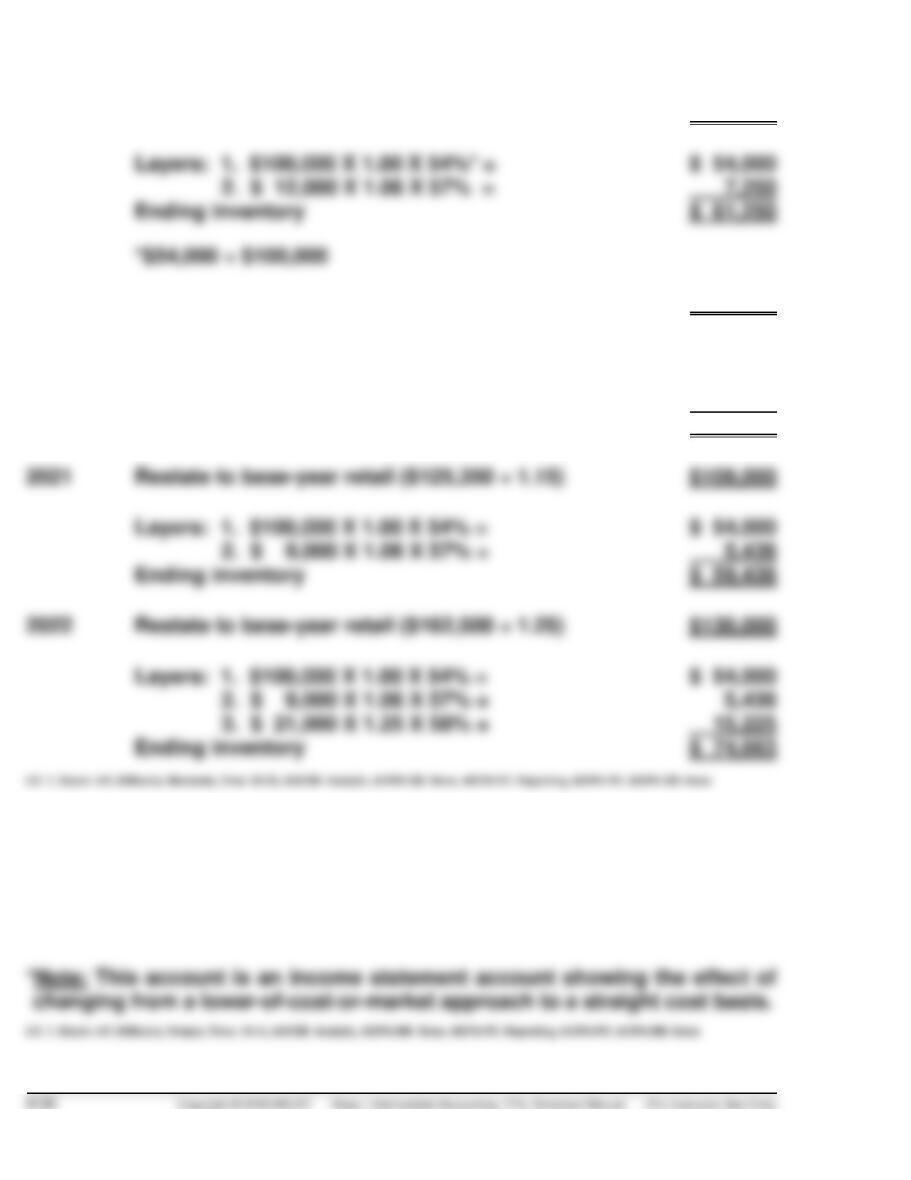
Ending inventory at retail (base year)
Cost-to-retail ratio for new layer:
$108,500/$155,000 = 70%
Layers:
Base layer
$50,000 X 1.00 X 60.2%* =
$ 30,100
New layer
($71,000 – $50,000) X 1.10 X 70% =
16,170
*($30,100/$50,000)
(c)
Cost of goods available for sale
$138,600
Ending inventory at cost, from (b)
46,270
Cost of goods sold
*EXERCISE 9.29 (20–25 minutes)
2019
Restate to base-year retail ($118,720 ÷ 1.06)
$112,000
Layers: 1. $100,000 X 1.00 X 54%* =
2. $ 12,000 X 1.06 X 57% =
7,250
Ending inventory
$ 61,250
*$54,000 ÷ $100,000
2020
Restate to base-year retail ($138,750 ÷ 1.11)
$125,000
Layers: 1. $100,000 X 1.00 X 54% =
$ 54,000
2. $ 12,000 X 1.06 X 57% =
7,250
3. $ 13,000 X 1.11 X 60% =
8,658
Ending inventory
$ 69,908
2021
Restate to base-year retail ($125,350 ÷ 1.15)
$109,000
Layers: 1. $100,000 X 1.00 X 54% =
$ 54,000
2. $ 9,000 X 1.06 X 57% =
Ending inventory
$ 59,438
2022
Restate to base-year retail ($162,500 ÷ 1.25)
$130,000
Layers: 1. $100,000 X 1.00 X 54% =
2. $ 9,000 X 1.06 X 57% =
5,438
3. $ 21,000 X 1.25 X 58% =
15,225
Ending inventory
$ 74,663
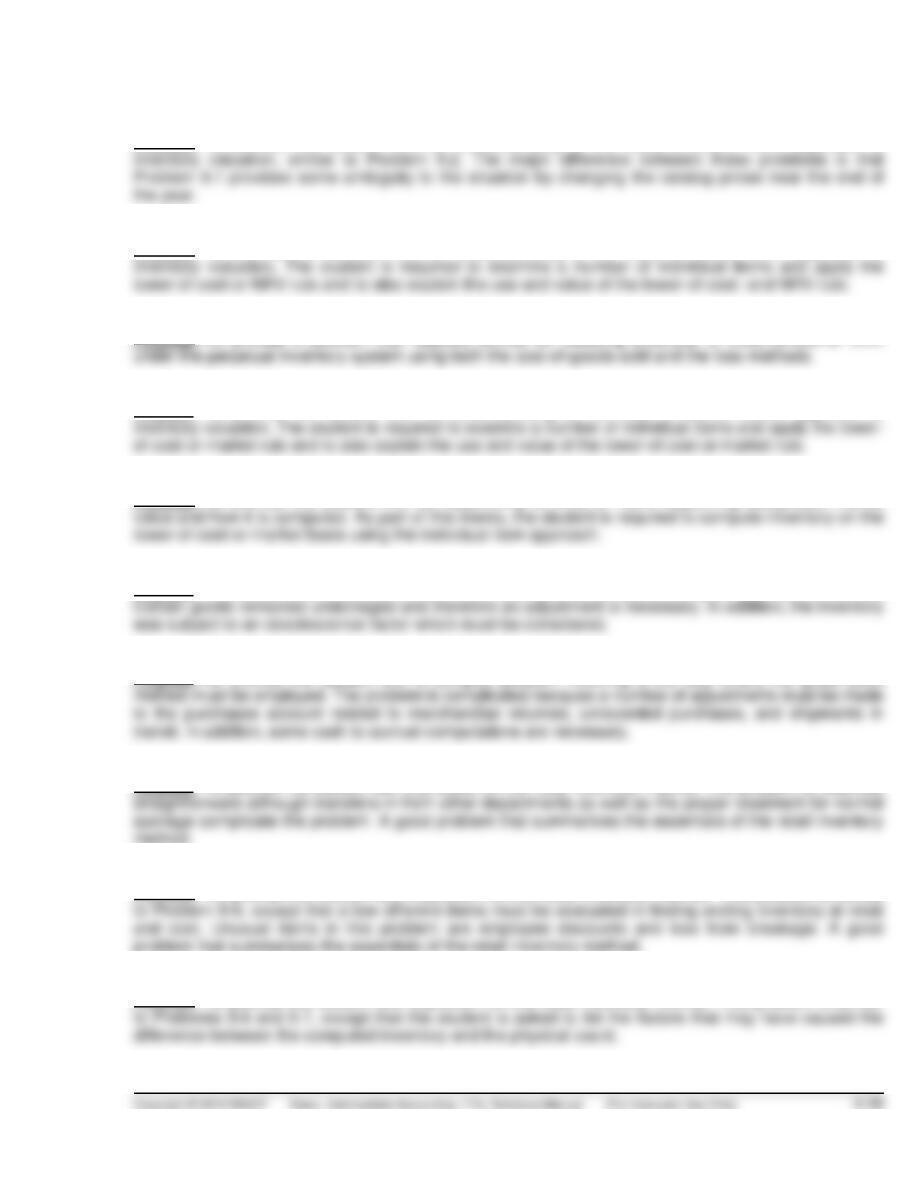
*EXERCISE 9.30 (5–10 minutes)
Inventory (beginning) ………………………………………………
7,600
Adjustment to Record Inventory at Cost* ………….
7,600
($212,600 – $205,000)
TIME AND PURPOSE OF PROBLEMS
Problem 9.1 (Time 10–15 minutes)
Purpose—to provide the student with an understanding of the lower-of-cost-or NRV approach to
Problem 9.2 (Time 25–30 minutes)
Purpose—to provide the student with an understanding of the lower-of-cost-or NRV approach to
Problem 9.3 (Time 30–35 minutes)
Purpose—to provide a problem that requires entries for reducing inventory to lower-of-cost-or NRV
Problem 9.4 (Time 25–30 minutes)
Purpose—to provide the student with an understanding of the lower-of-cost-or–market approach to
Problem 9.5 (Time 30–40 minutes)
Purpose—to provide the student with an opportunity to write a memo explaining designated market
Problem 9.6 (Time 20–30 minutes)
Purpose—to provide another problem where a fire loss must be computed using the gross profit method.
Problem 9.7 (Time 40–45 minutes)
Purpose—to provide the student with a complex problem involving a fire loss where the gross profit
Problem 9.8 (Time 20–30 minutes)
Purpose—to provide the student with a problem on the retail inventory method. The problem is relatively
Problem 9.9 (Time 20–30 minutes)
Purpose—to provide the student with a problem on the retail inventory method. This problem is similar
Problem 9.10 (Time 20–30 minutes)
Purpose—to provide the student with a problem on the retail inventory method. This problem is similar
Time and Purpose of Problems (Continued)
Problem 9.11 (Time 30–40 minutes)
*Problem 9.12 (Time 30–35 minutes)
*Problem 9.13 (Time 30–40 minutes)
Purpose—to provide the student with a comprehensive problem covering the retail and LIFO retail
*Problem 9.14 (Time 30–40 minutes)
*Problem 9.15 (Time 40–50 minutes)
Purpose—to provide the student with a retail inventory problem where both the conventional retail and