9-55
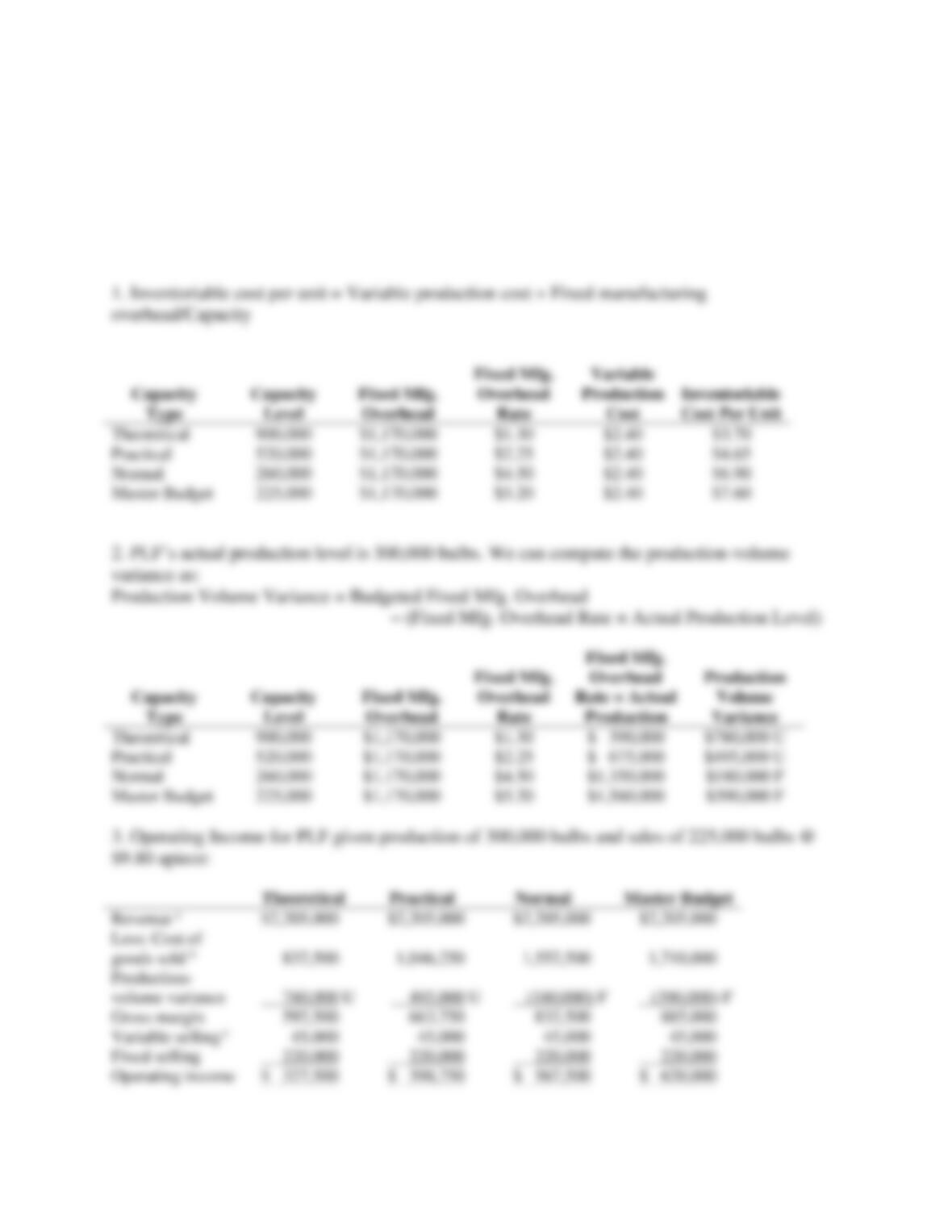
2. Suppose PLF actually produces 300,000 bulbs. Calculate the production-volume variance
using each level of capacity to compute the fixed manufacturing overhead allocation rate.
3. Assume PLF has no beginning inventory. If this year’s actual sales are 225,000 bulbs,
calculate operating income for PLF using each type of capacity to compute fixed
manufacturing cost per unit.
SOLUTION
9-56
9-37 (35 min.) Operating income effects of denominator-level choice and disposal of
production-volume variance (continuation of 9-36).
Required:
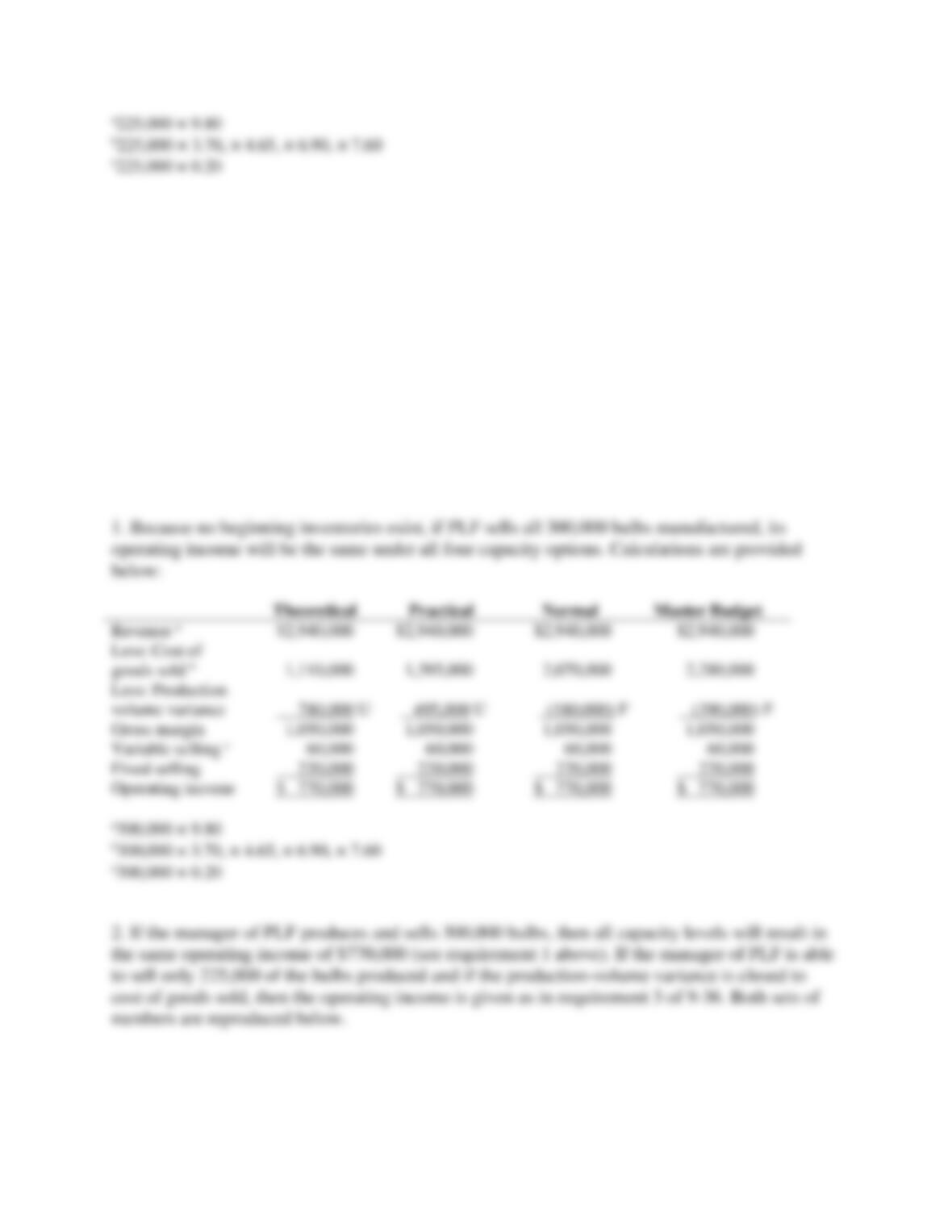
1. If PLF sells all 300,000 bulbs produced, what would be the effect on operating income of
using each type of capacity as a basis for calculating manufacturing cost per unit?
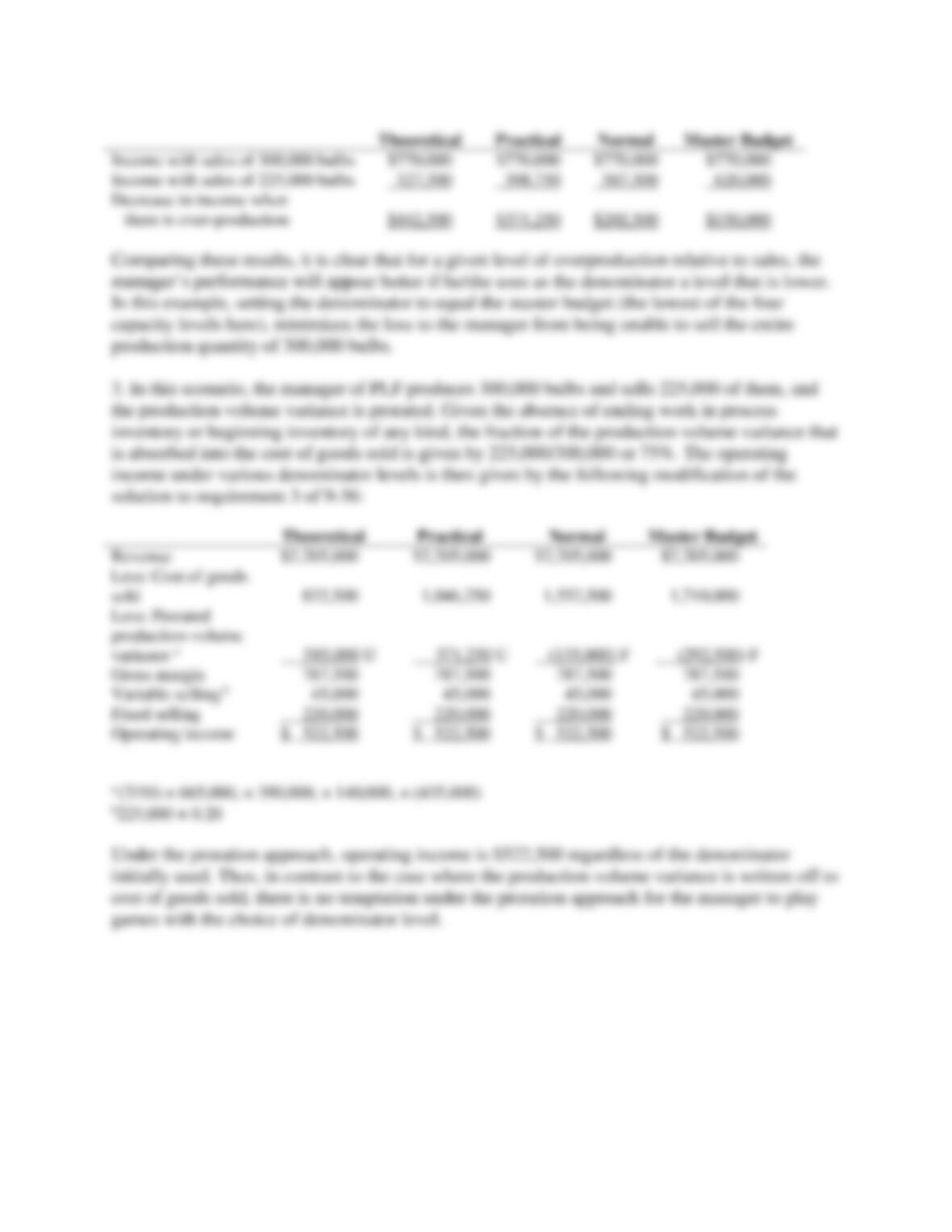
2. Compare the results of operating income at different capacity levels when 225,000 bulbs are
sold and when 300,000 bulbs are sold. What conclusion can you draw from the comparison?
3. Using the original data (that is, 300,000 units produced and 225,000 units sold) if PLF had
used the proration approach to allocate the production-volume variance, what would
operating income have been under each level of capacity? (Assume that there is no ending
work in process.)
SOLUTION
9-57
9-58
9-38 (30 min.) Variable and absorption costing, actual costing.
The Iron City Company started business on January 1, 2014. Iron City manufactures a specialty
honey beer, which it sells directly to state-owned distributors in Pennsylvania. Honey beer is
produced and sold in six-packs, and in 2014, Iron City produced more six-packs than it was able
to sell. In addition to variable and fixed manufacturing overhead, Iron City incurred direct
materials costs of $880,000, direct manufacturing labor costs of $400,000, and fixed marketing
and administrative costs of $295,000. For the year, Iron City sold a total of 180,000 six-packs for
a sales revenue of $2,250,000.
Iron City’s CFO is convinced that the firm should use an actual costing system but is debating
whether to follow variable or absorption costing. The controller notes that Iron City’s operating
income for the year would be $438,000 under variable costing and $461,000 under absorption
costing. Moreover, the ending finished goods inventory would be valued at $7.15 under variable
costing and $8.30 under absorption costing.
Iron City incurs no variable nonmanufacturing expenses.
Required:
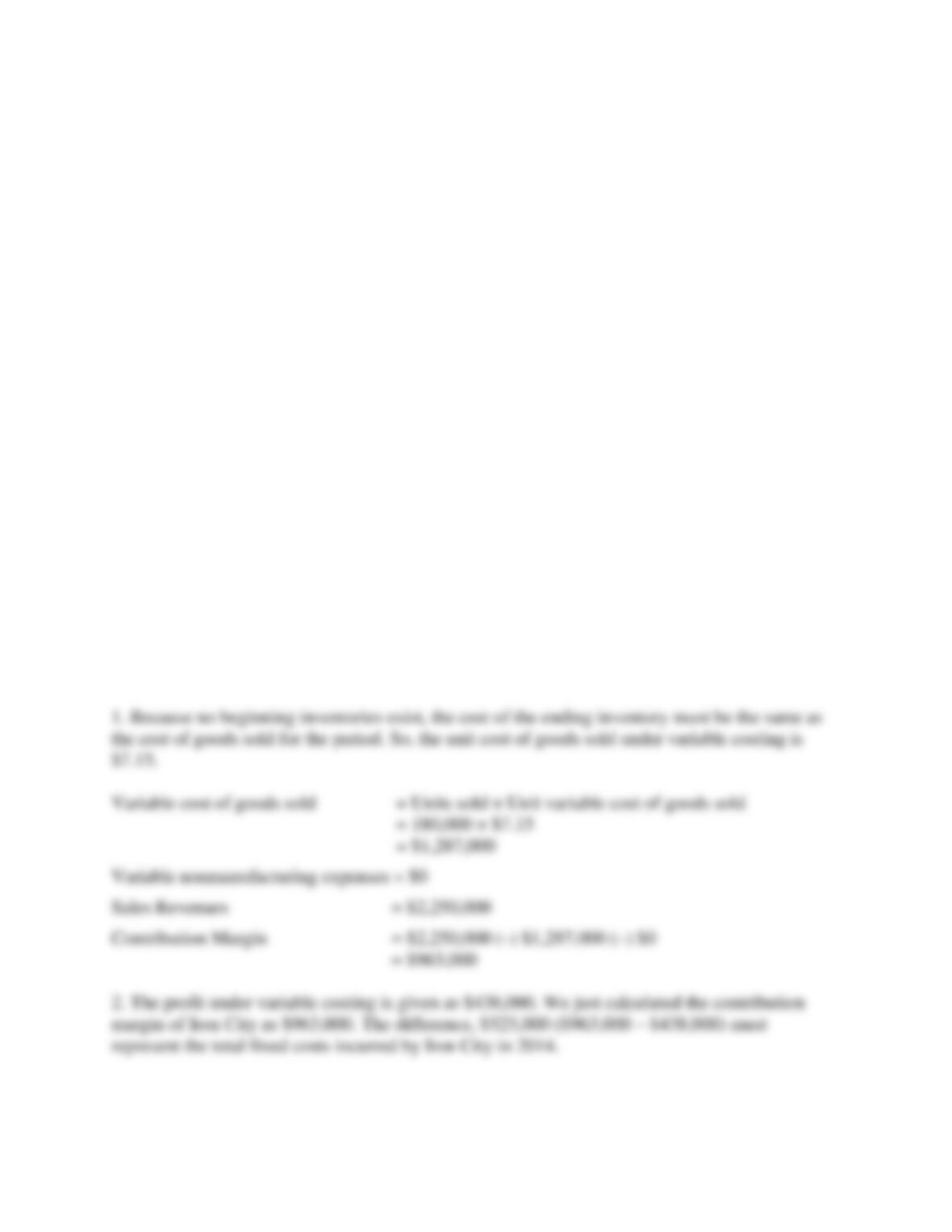
1. What is Iron City’s total contribution margin for 2014?
2. Iron City incurs fixed manufacturing costs in addition to its fixed marketing and
administrative costs. How much did Iron City incur in fixed manufacturing costs in 2014?
3. How many six-packs did Iron City produce in 2014?
4. How much in variable manufacturing overhead did Iron City incur in 2014?
5. For 2014, how much in total manufacturing overhead is expensed under variable costing,
either through Cost of Goods Sold or as a period expense?
SOLUTION
9-59
9-39 (25 min.) Cost allocation, downward demand spiral.
Top Catering operates a chain of 10 hospitals in the Los Angeles area. Its central food-catering
facility, Topman, prepares and delivers meals to the hospitals. It has the capacity to deliver up to
1,025,000 meals a year. In 2014, based on estimates from each hospital controller, Topman
budgeted for 925,000 meals a year. Budgeted fixed costs in 2014 were $1,517,000. Each hospital
was charged $6.24 per meal—$4.60 variable costs plus $1.64 allocated budgeted fixed cost.
Recently, the hospitals have been complaining about the quality of Topman’s meals and their
rising costs. In mid-2014, Top Catering’s president announces that all Top Catering hospitals and
support facilities will be run as profit centers. Hospitals will be free to purchase quality-certified
services from outside the system. Ron Smith, Topman’s controller, is preparing the 2015 budget.
He hears that three hospitals have decided to use outside suppliers for their meals, which will
reduce the 2015 estimated demand to 820,000 meals. No change in variable cost per meal or total
fixed costs is expected in 2015.
Required:
1. How did Smith calculate the budgeted fixed cost per meal of $1.64 in 2014?
9-60
2. Using the same approach to calculating budgeted fixed cost per meal and pricing as in 2014,
how much would hospitals be charged for each Topman meal in 2015? What would the
reaction of the hospital controllers be to the price?
3. Suggest an alternative cost-based price per meal that Smith might propose and that might be
more acceptable to the hospitals. What can Topman and Smith do to make this price
profitable in the long run?
SOLUTION
SOLUTION EXHIBIT 9-39
9-61
9-40 (20 min.) Cost allocation, responsibility accounting, ethics (continuation of 9-39).
In 2015, only 740,000 Topman meals were produced and sold to the hospitals. Smith suspects
that hospital controllers had systematically inflated their 2015 meal estimates.
Required:
1. Recall that Topman uses the master-budget capacity utilization to allocate fixed costs and to
price meals. What was the effect of production-volume variance on Topman’s operating
income in 2015?
2. Why might hospital controllers deliberately overestimate their future meal counts?
3. What other evidence should Top Catering’s president seek to investigate Smith’s concerns?
4. Suggest two specific steps that Smith might take to reduce hospital controllers’ incentives to
inflate their estimated meal counts.
SOLUTION
9-62
9-41 (60 min.) Absorption, variable, and throughput costing.
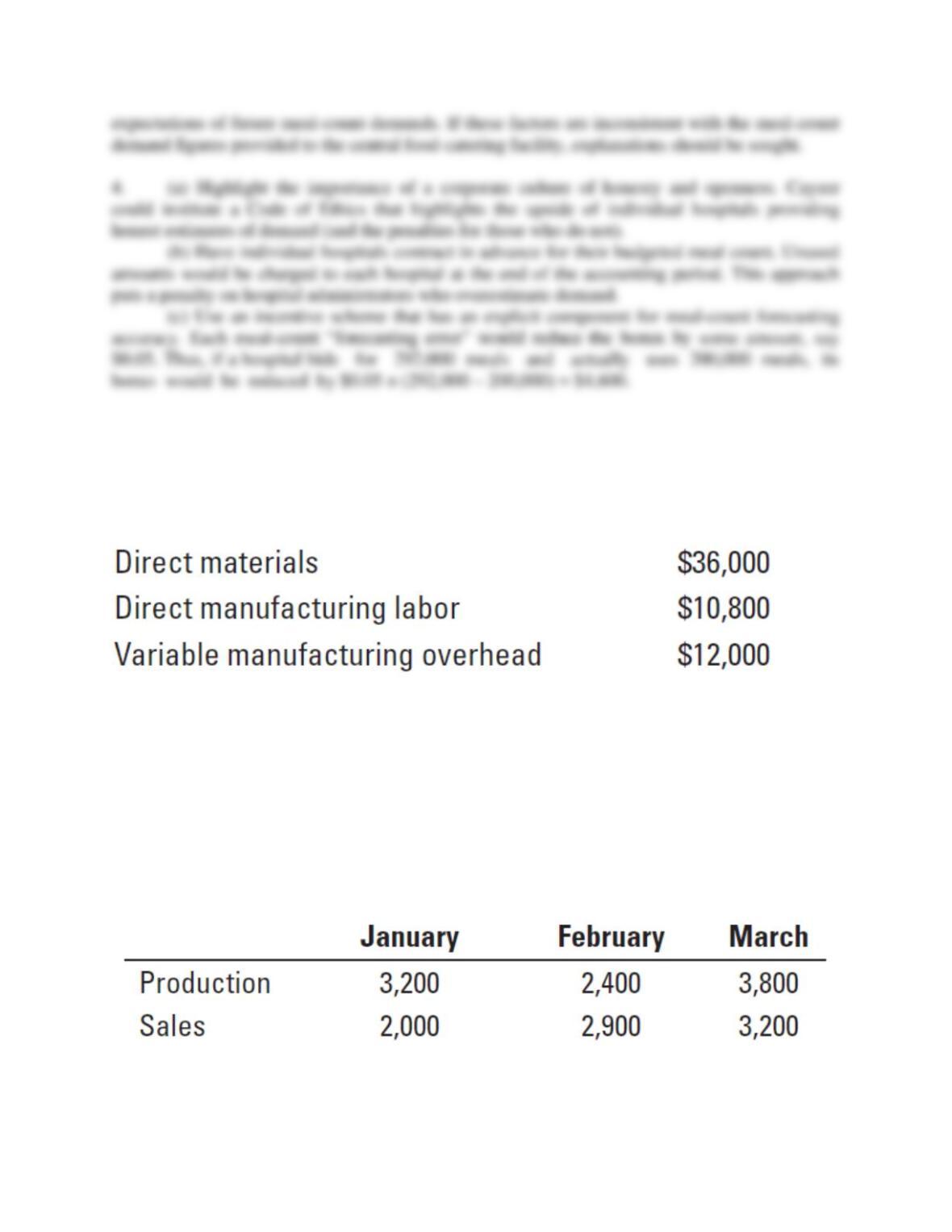
Tesla Motors assembles the fully electric Model S-85 automobile at its Fremont, California,
plant. The standard variable manufacturing cost per vehicle in 2014 is $58,800, which consists
of:
Variable manufacturing overhead is allocated to vehicles on the basis of assembly time. The
standard assembly time per vehicle is 20 hours.
The Fremont plant is highly automated and has a practical capacity of 4,000 vehicles per
month. The budgeted monthly fixed manufacturing overhead is $45 million. Fixed
manufacturing overhead is allocated on the basis of the standard assembly time for the budgeted
normal capacity utilization of the plant. For 2014, the budgeted normal capacity utilization is
3,000 vehicles per month.
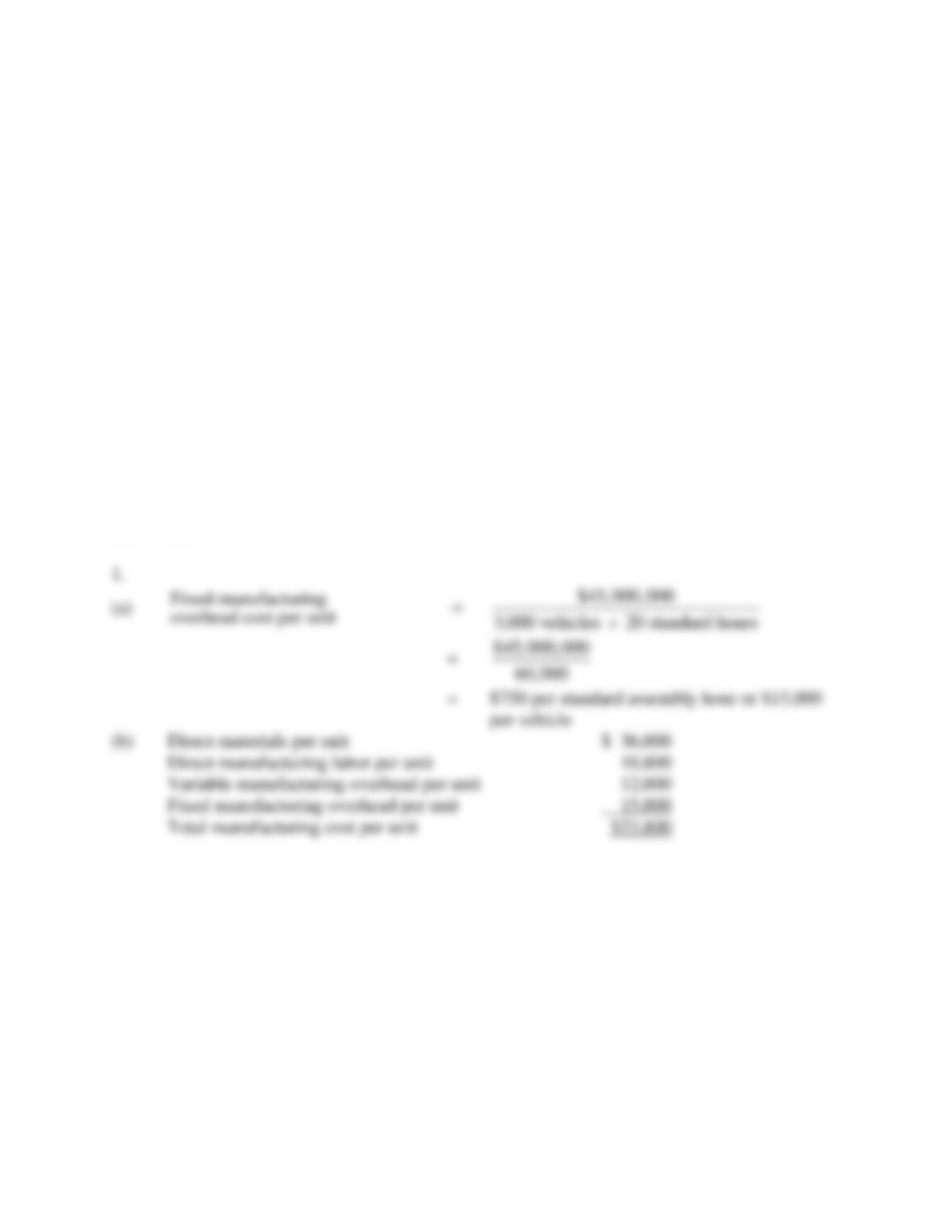
Tesla started production of the Model S-85 in 2014. The actual production and sales figures
for the first three months of the year are:
Franz Holzhausen is SVP of Tesla and director of the Fremont plant. His compensation
includes a bonus that is 0.25% of quarterly operating income, calculated using absorption
9-63
costing. Tesla prepares absorption-costing income statements monthly, which include an
adjustment for the production-volume variance occurring in that month. There are no variable
cost variances or fixed overhead spending variances in the first three months of 2014.
The Fremont plant is credited with revenue (net of marketing costs) of $96,000 for the sale of
each Tesla S-85 vehicle.
Required:
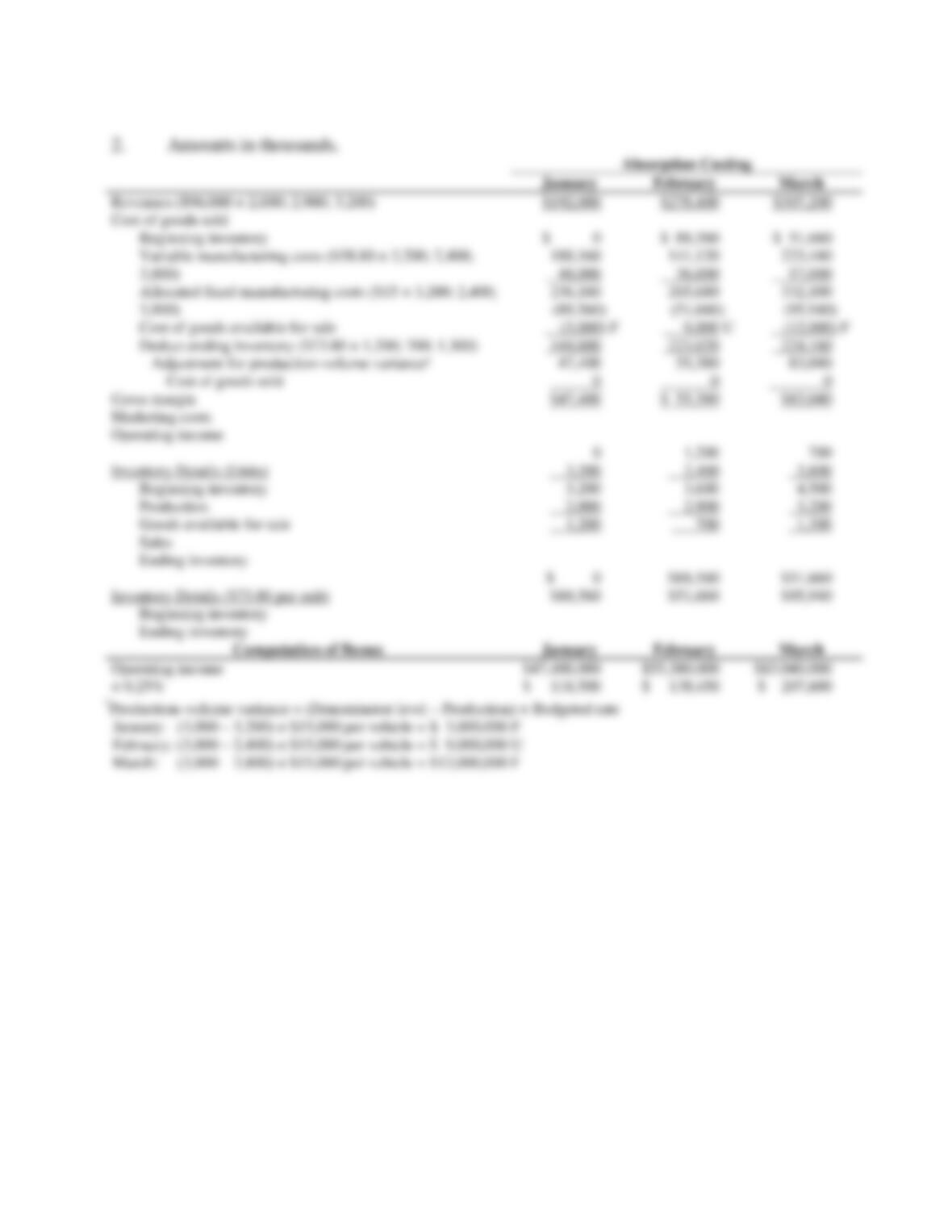
1. Compute (a) the fixed manufacturing cost per unit and (b) the total manufacturing cost per
unit.
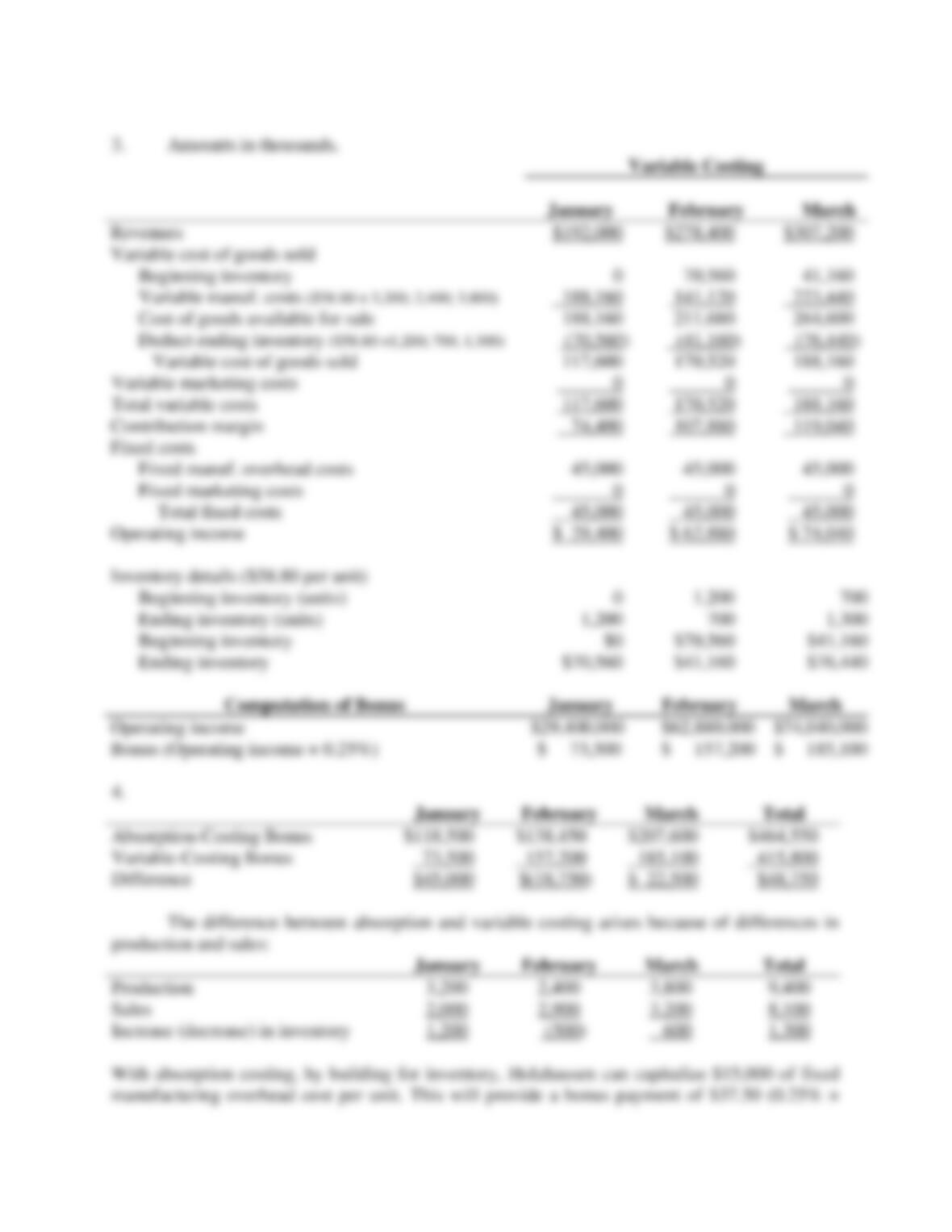
2. Compute the monthly operating income for January, February, and March under absorption
costing. What amount of bonus is paid each month to Franz Holzhausen?
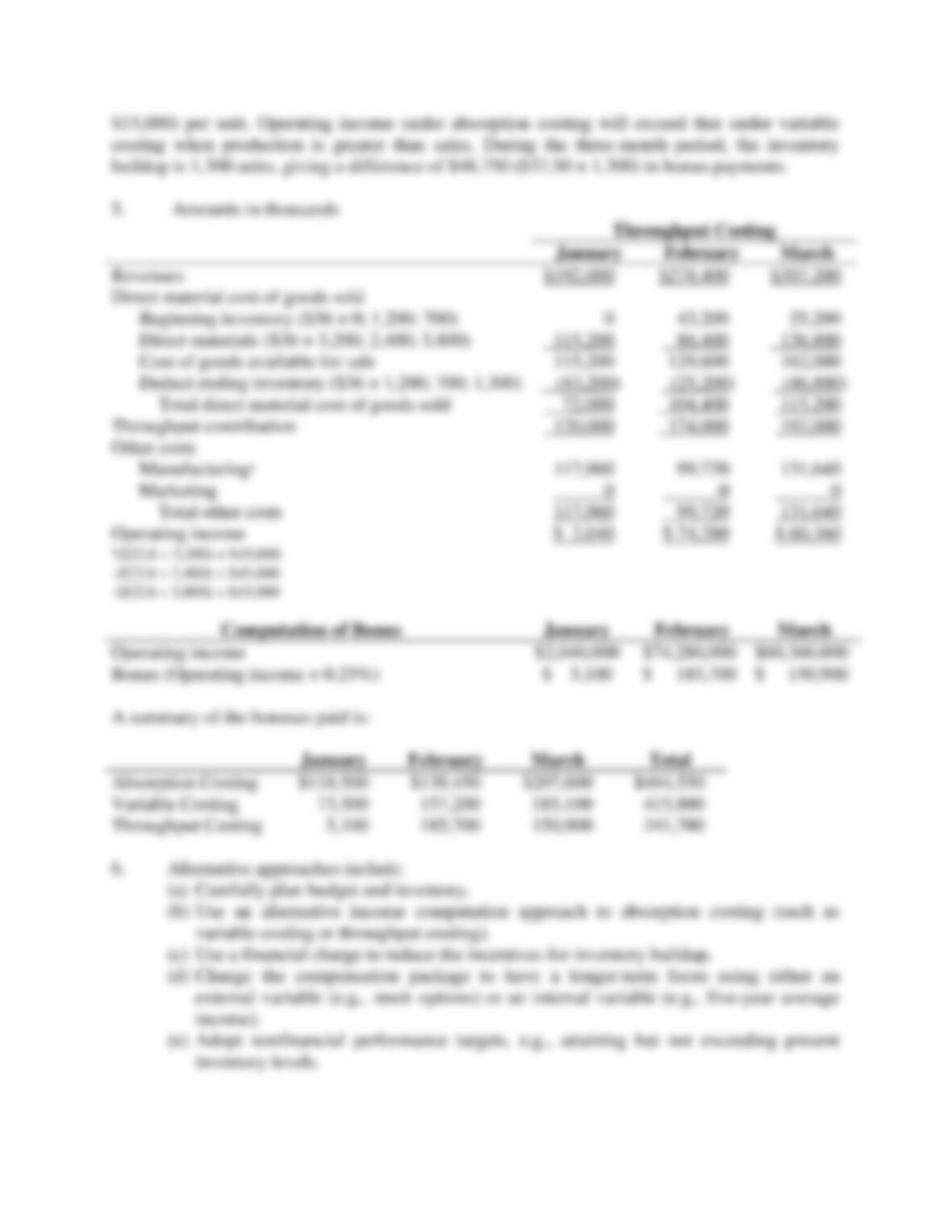
3. How much would the use of variable costing change Holzhausen’s bonus each month if the
same 0.25% figure were applied to variable-costing operating income?
4. Explain the differences in Holzhausen’s bonuses in requirements 2 and 3.
5. How much would the use of throughput costing change Holzhausen’s bonus each month if
the same 0.25% figure were applied to throughput-costing operating income?
6. What are the different approaches Tesla Motors could take to reduce possible undesirable
behavior associated with the use of absorption costing at its Fremont plant?
SOLUTION
9-64
9-65
9-66
9-67
9-42 (30 min.) Costing methods and variances, comprehensive.
Rob Kapito, the controller of Blackstar Paint Supply Company, has been exploring a variety of
internal accounting systems. Rob hopes to get the input of Blackstar’s board of directors in
choosing one. To prepare for his presentation to the board, Rob applies four different cost
accounting methods to the firm’s operating data for 2013. The four methods are actual
absorption costing, normal absorption costing, standard absorption costing, and standard variable
costing.
With the help of a junior accountant, Rob prepares the following alternative income
statements:
Where applicable, Rob allocates both fixed and variable manufacturing overhead using direct
labor hours as the driver. Blackstar carries no work-in-process inventory. Standard costs have
been stable over time, and Rob writes off all variances to cost of goods sold. For 2013, there was
no flexible budget variance for fixed overhead. In addition, the direct labor variance represents a
price variance.
Required:
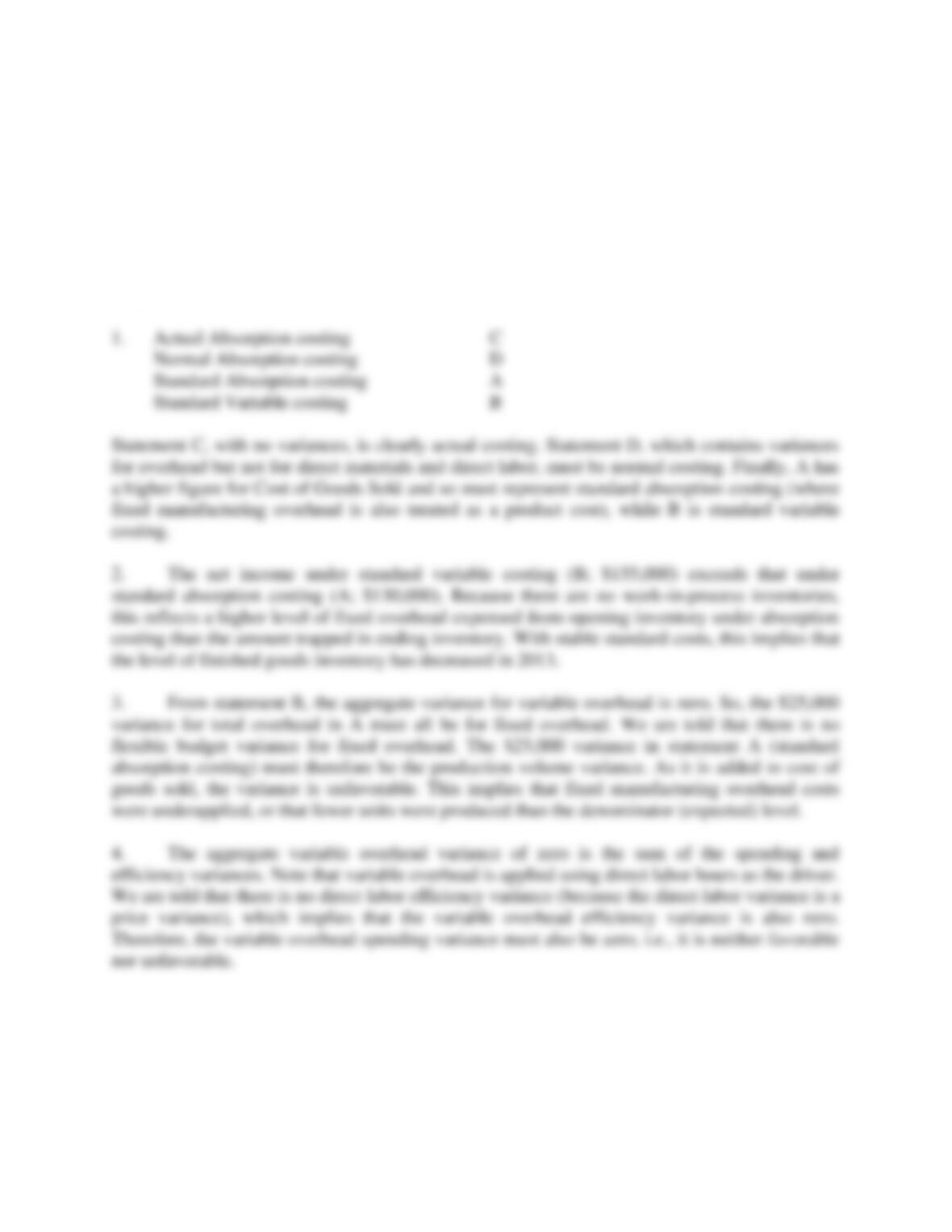
1. Match each method below with the appropriate income statement (A, B, C, or D):
9-68
2. During 2013, how did Blackstar’s level of finished goods inventory change? In other words,
is it possible to know whether Blackstar’s finished goods inventory increased, decreased, or
stayed constant during the year?
3. From the four income statements, can you determine how the actual volume of production
during the year compared to the denominator (expected) volume level?
4. Did Blackstar have a favorable or unfavorable variable overhead spending variance during
2013?
SOLUTION