9-1
CHAPTER 9
INVENTORY COSTING AND CAPACITY ANALYSIS
9-1 No. Differences in operating income between variable costing and absorption costing are
due to accounting for fixed manufacturing costs. Under variable costing, only variable
manufacturing costs are included as inventoriable costs. Under absorption costing, both variable
and fixed manufacturing costs are included as inventoriable costs. Fixed marketing and
distribution costs are not accounted for differently under variable costing and absorption costing.
9-3 No. The difference between absorption costing and variable costs is due to accounting for
fixed manufacturing costs. As service or merchandising companies have no fixed manufacturing
costs, these companies do not make choices between absorption costing and variable costing.
9-5 No. A company that makes a variable-cost/fixed-cost distinction is not forced to use any
specific costing method. The Stassen Company example in the text of Chapter 9 makes a
variable-cost/fixed-cost distinction. As illustrated, it can use variable costing, absorption costing,
or throughput costing.
A company that does not make a variable-cost/fixed-cost distinction cannot use variable
costing or throughput costing. However, it is not forced to adopt absorption costing. For internal
reporting, it could, for example, classify all costs as costs of the period in which they are
incurred.
9-2
9-8 (a) The factors that affect the breakeven point under variable costing are
1. fixed (manufacturing and operating) costs.
2. contribution margin per unit.
(b) The factors that affect the breakeven point under absorption costing are
1. fixed (manufacturing and operating) costs.
2. contribution margin per unit.
3. production level in units in excess of breakeven sales in units.
4. denominator level chosen to set the fixed manufacturing cost rate.
9-10 Approaches used to reduce the negative aspects associated with using absorption costing
include:
a. Change the accounting system:
• Adopt either variable or throughput costing, both of which reduce the incentives
of managers to produce for inventory.
• Adopt an inventory holding charge for managers who tie up funds in inventory.
b. Extend the time period used to evaluate performance. By evaluating performance
over a longer time period (say, three to five years), the incentive to take short-run
actions that reduce long-term income is lessened.
c. Include nonfinancial as well as financial variables in the measures used to evaluate
performance.
9-14 For tax reporting in the United States, the IRS requires only that indirect production costs
are “fairly” apportioned among all items produced. Overhead rates based on normal or master-
budget capacity utilization, as well as the practical capacity concept, are permitted. At year-end,
9-3
proration of any variances between inventories and cost of goods sold is required (unless the
variance is immaterial in amount).
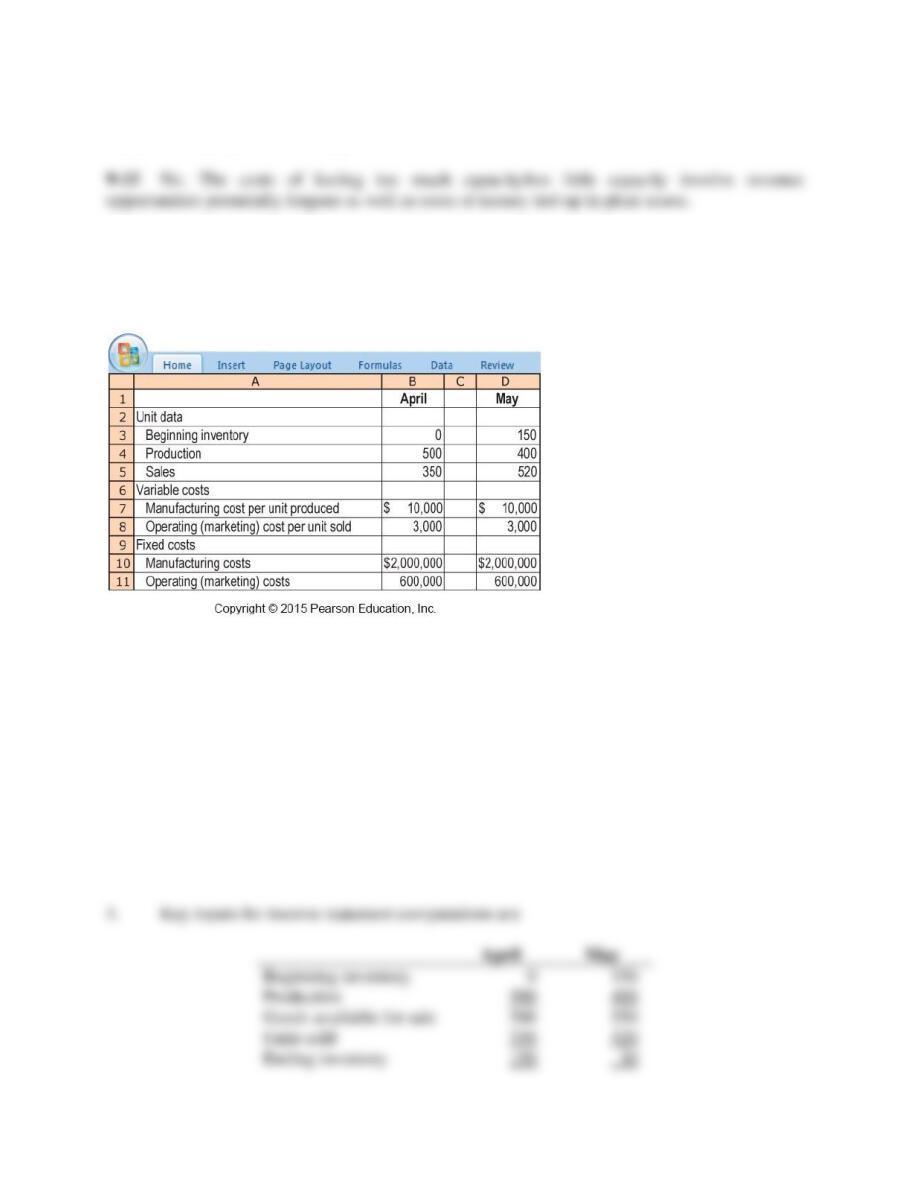
9-16 (30 min.) Variable and absorption costing, explaining operating-income differences.
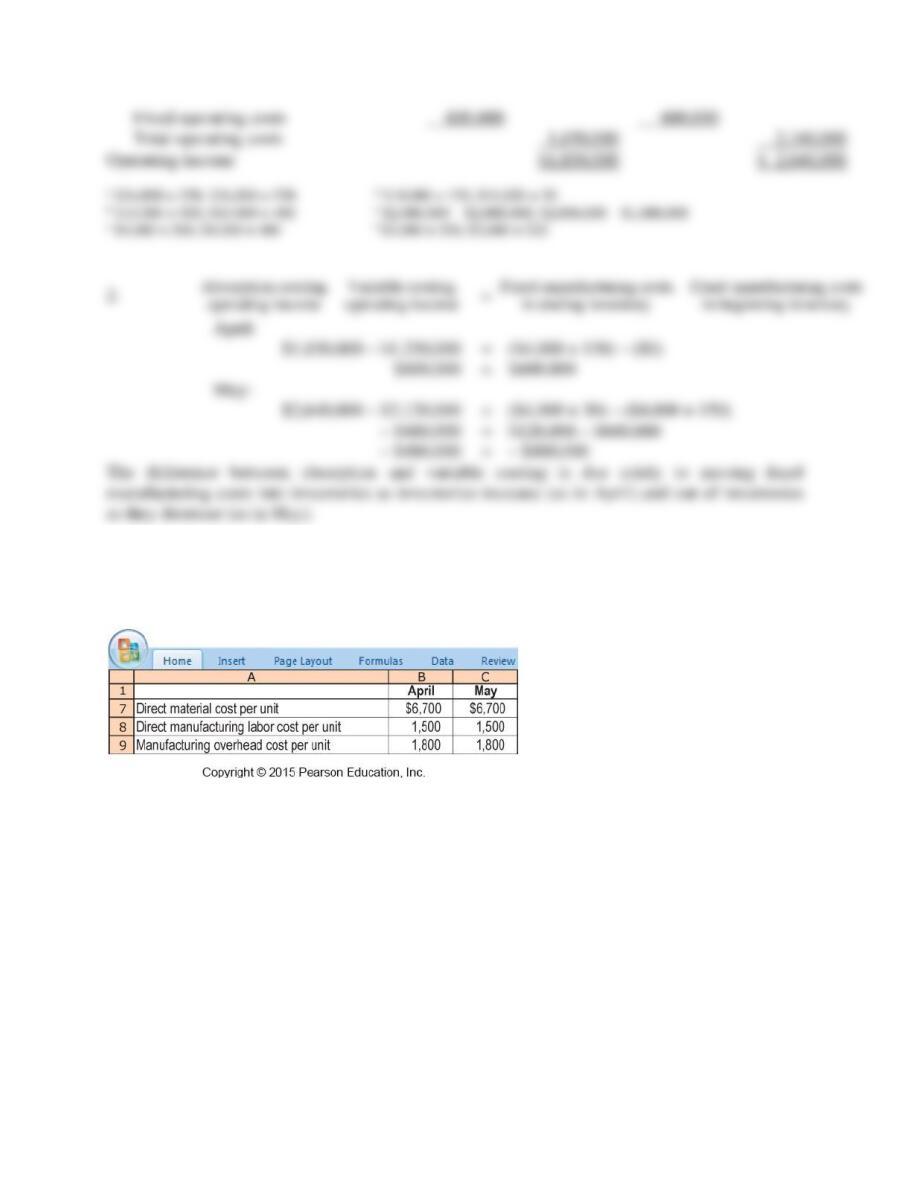
Nascar Motors assembles and sells motor vehicles and uses standard costing. Actual data relating
to April and May 2014 are as follows:
The selling price per vehicle is $24,000. The budgeted level of production used to calculate the
budgeted fixed manufacturing cost per unit is 500 units. There are no price, efficiency, or
spending variances. Any production-volume variance is written off to cost of goods sold in the
month in which it occurs.
Required:
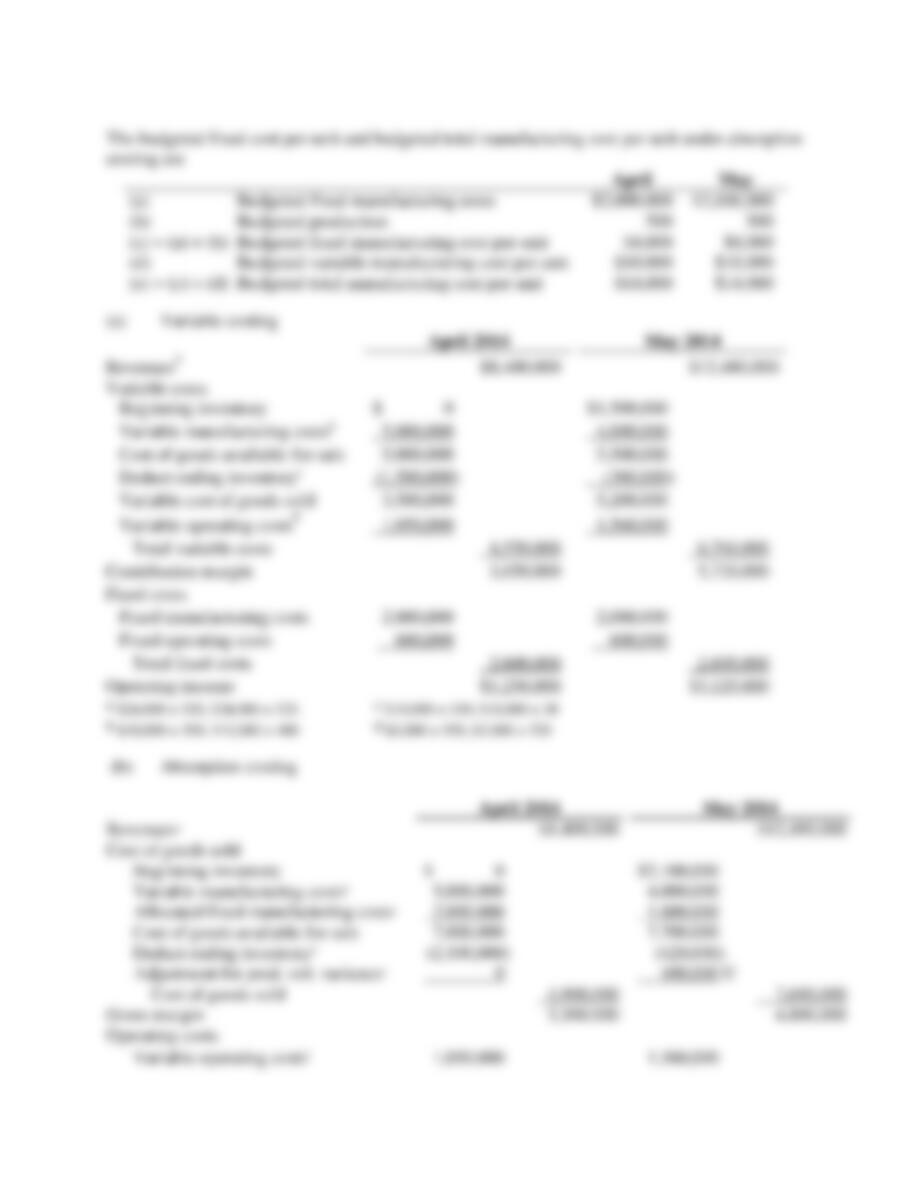
1. Prepare April and May 2014 income statements for Nascar Motors under (a) variable costing
and (b) absorption costing.
2. Prepare a numerical reconciliation and explanation of the difference between operating
income for each month under variable costing and absorption costing.
SOLUTION
9-4
9-5
9-17 (20 min.) Throughput costing (continuation of Exercise 9-16).
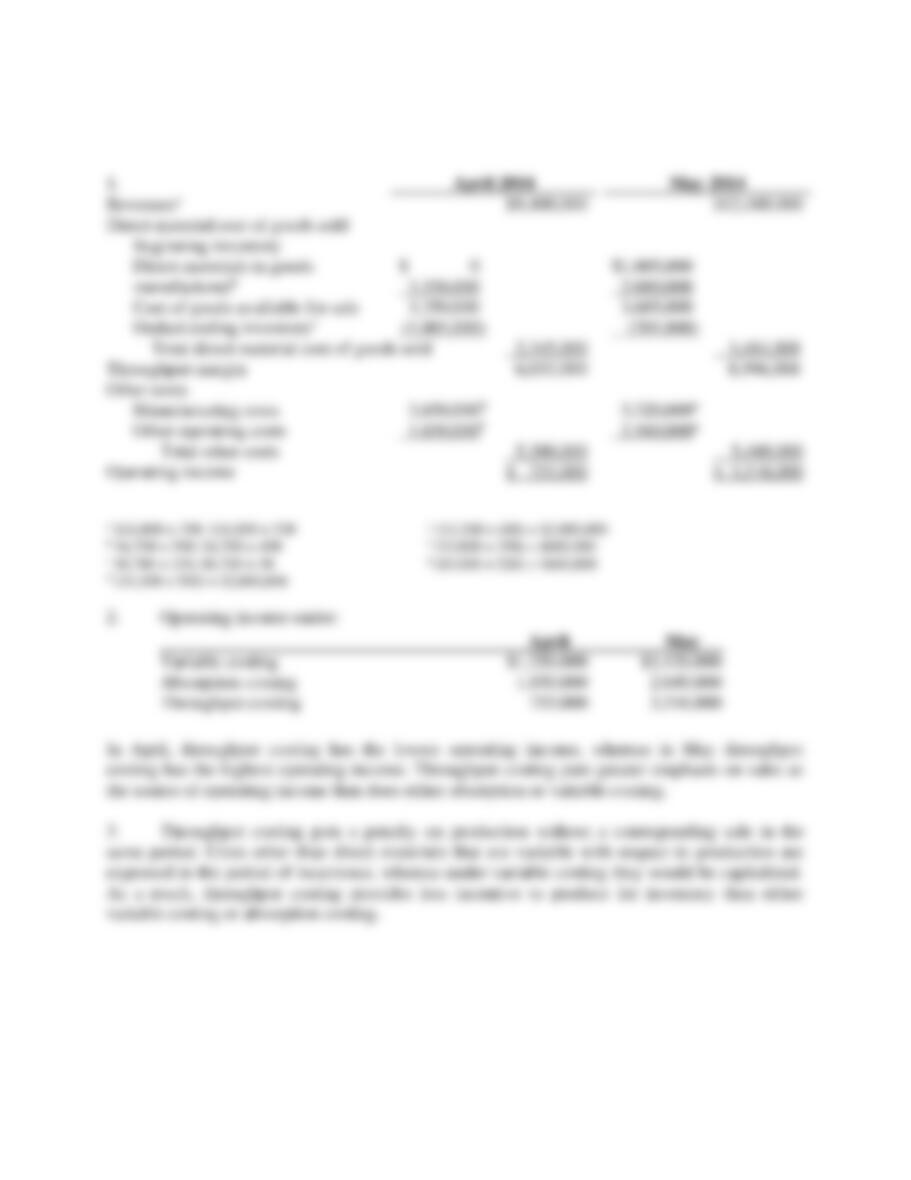
The variable manufacturing costs per unit of Nascar Motors are as follows:
Required:
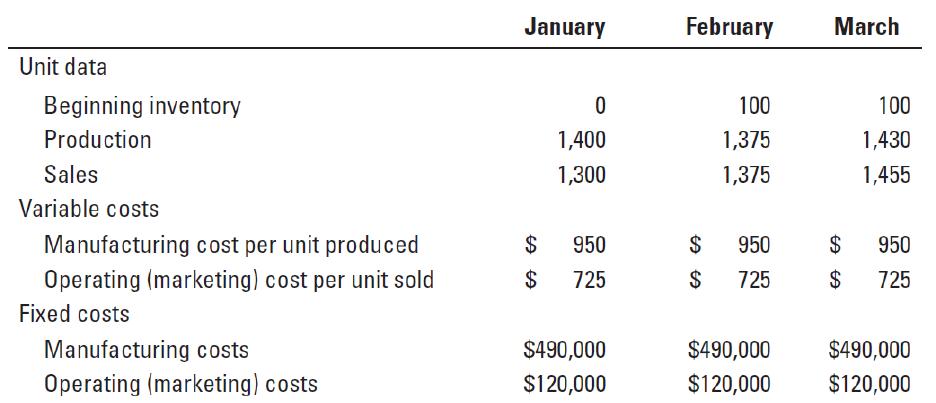
1. Prepare income statements for Nascar Motors in April and May 2014 under throughput
costing.
2. Contrast the results in requirement 1 with those in requirement 1 of Exercise 9-16.
3. Give one motivation for Nascar Motors to adopt throughput costing.
9-6
SOLUTION
9-7
9-18 (40 min.) Variable and absorption costing, explaining operating-income differences.
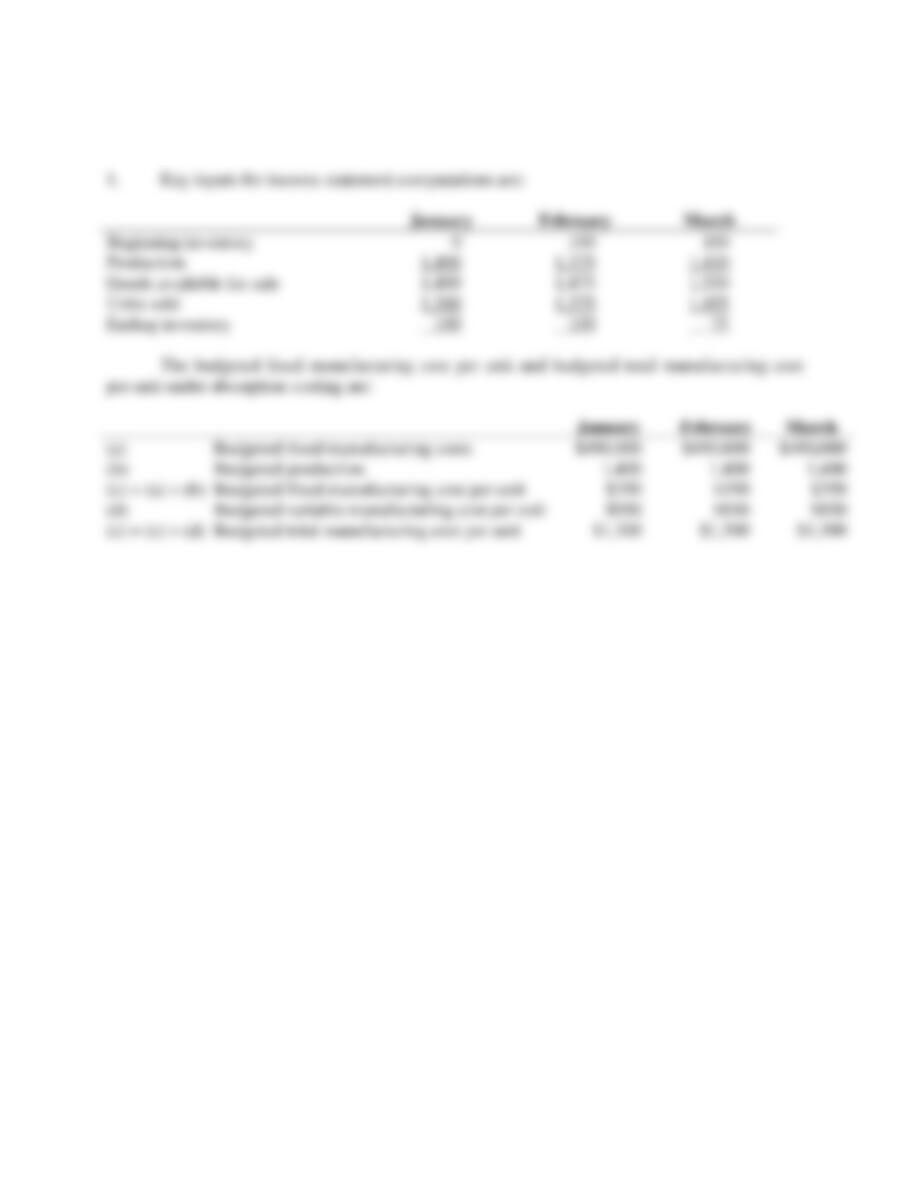
Crystal Clear Corporation manufactures and sells 50-inch television sets and uses standard
costing. Actual data relating to January, February, and March 2014 are as follows:
The selling price per unit is $3,500. The budgeted level of production used to calculate the
budgeted fixed manufacturing cost per unit is 1,400 units. There are no price, efficiency, or
spending variances. Any production-volume variance is written off to cost of goods sold in the
month in which it occurs.
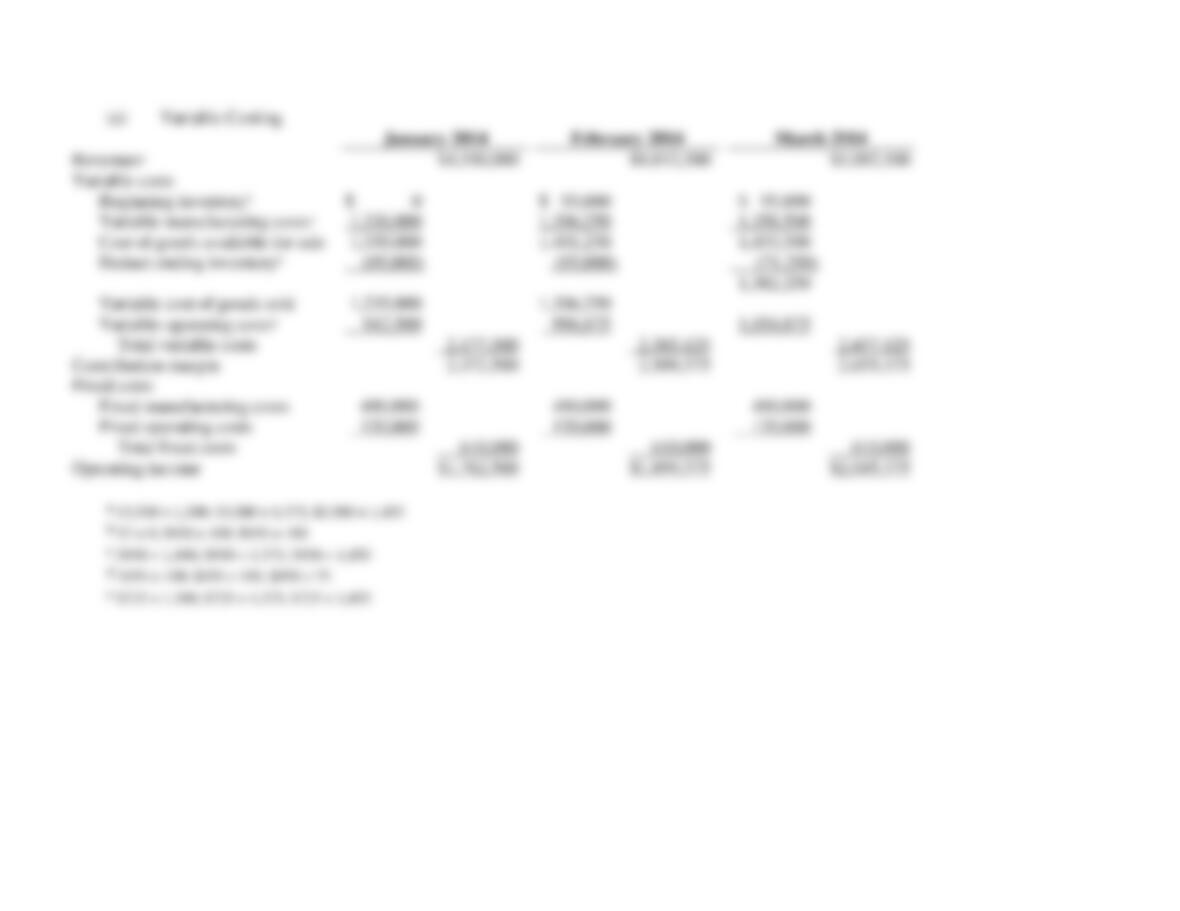
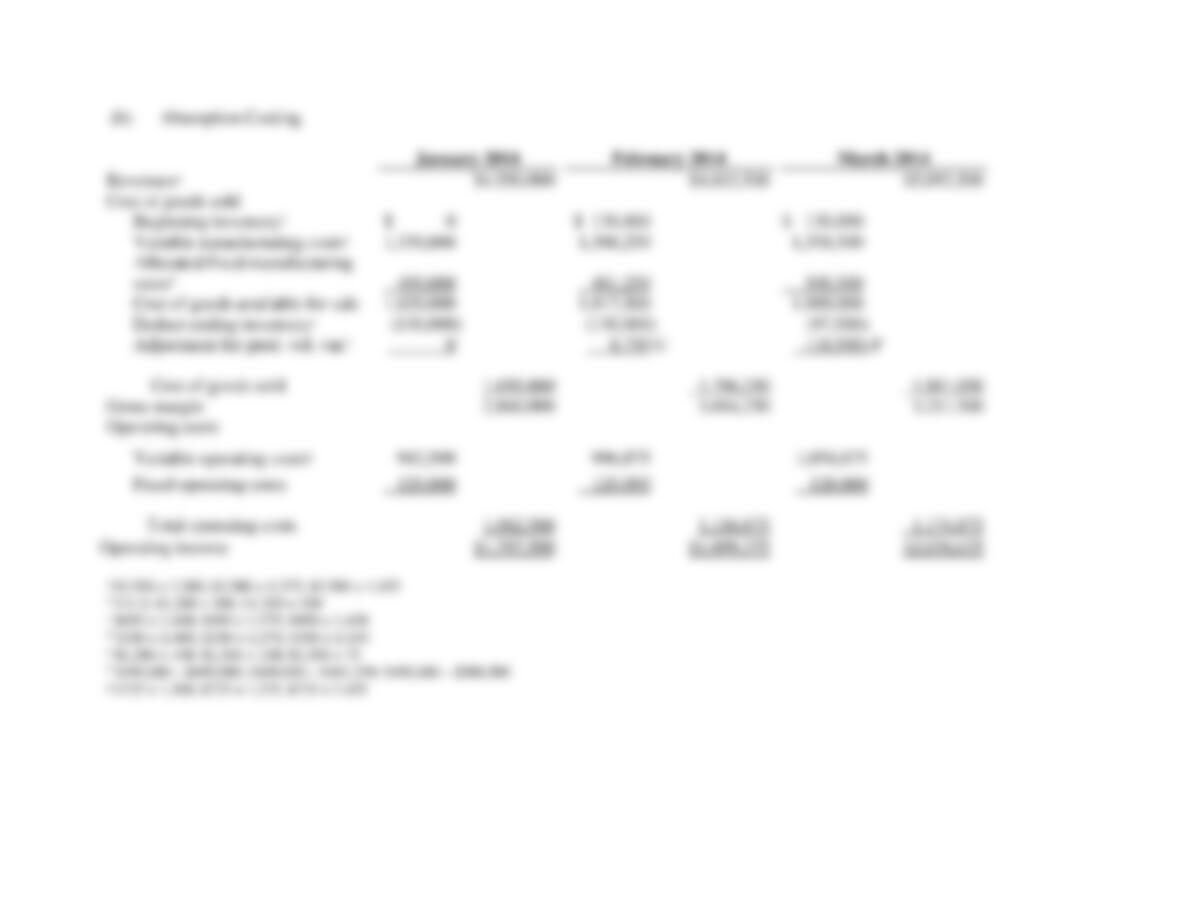
1. Prepare income statements for Crystal Clear in January, February, and March 2014 under (a)
variable costing and (b) absorption costing.
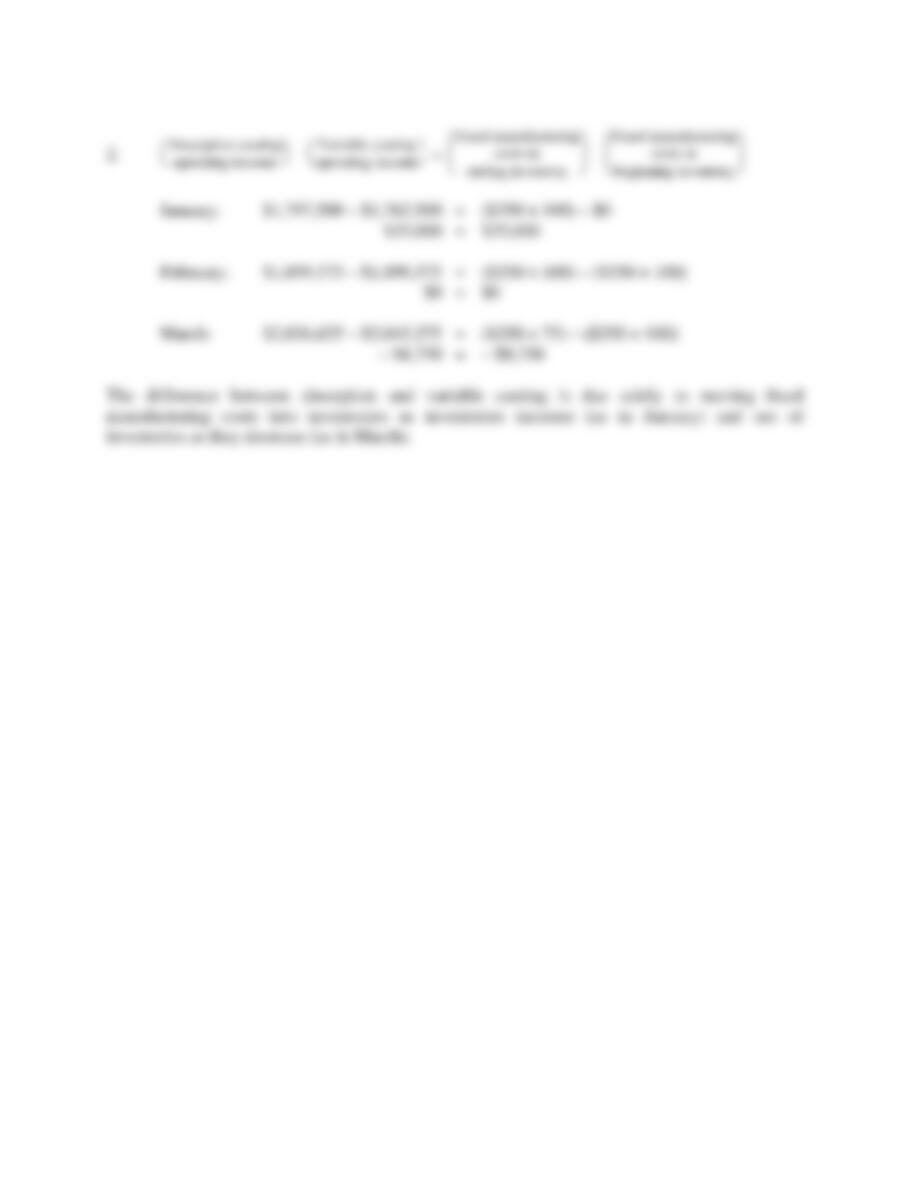
2. Explain the difference in operating income for January, February, and March under variable
costing and absorption costing.
9-8
SOLUTION
9-9
9-10
9-11
9-12
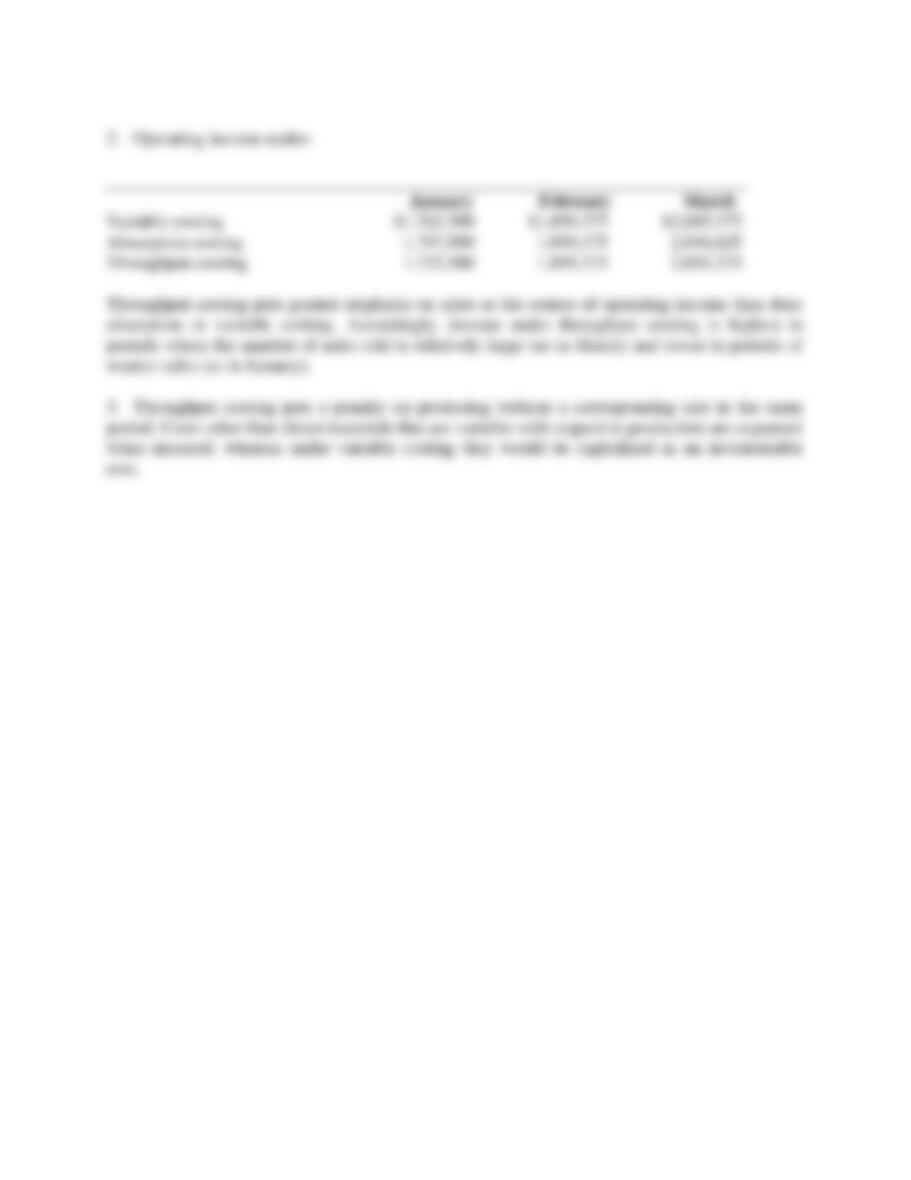
9-19 (20–30 min.) Throughput costing (continuation of Exercise 9-18).
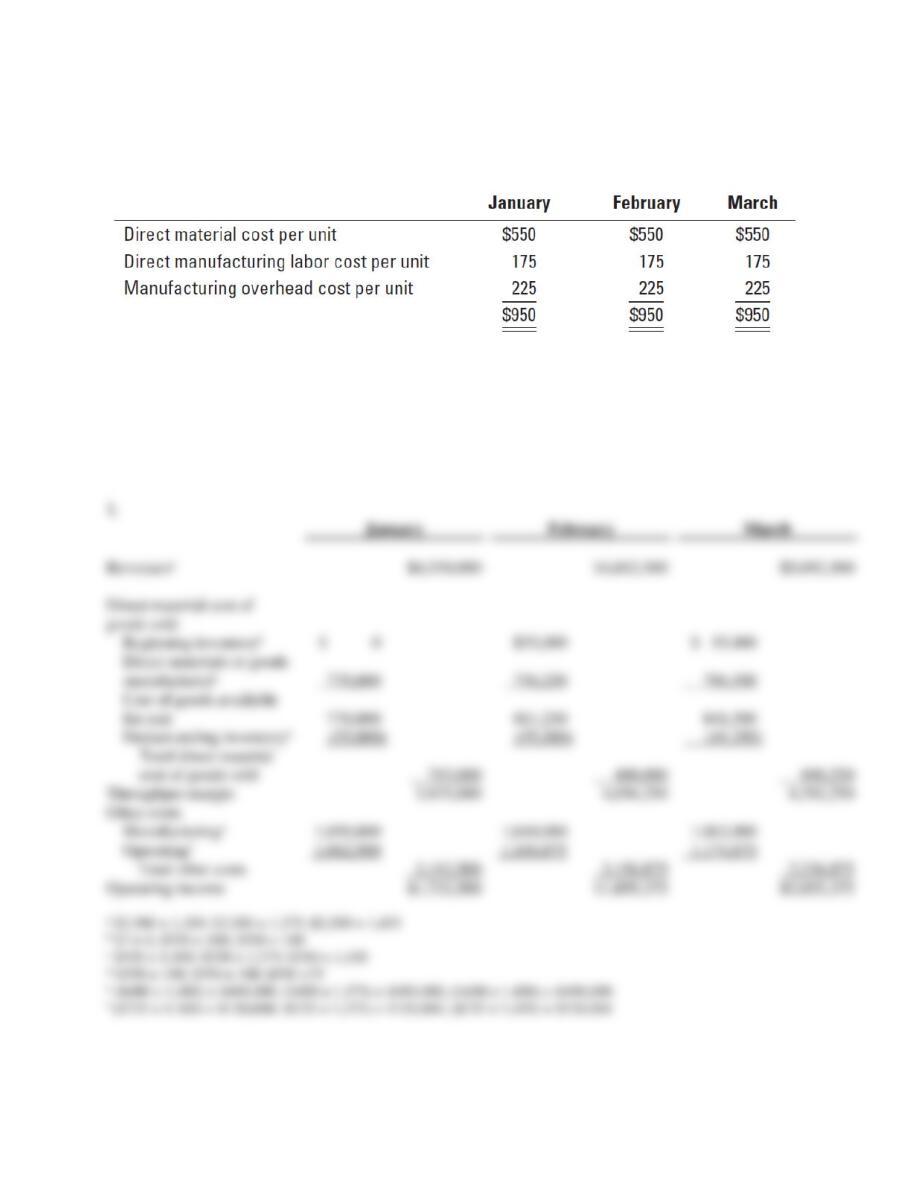
The variable manufacturing costs per unit of Crystal Clear Corporation are as follows:
Required:
1. Prepare income statements for Crystal Clear in January, February, and March 2014 under
throughput costing.
2. Contrast the results in requirement 1 with those in requirement 1 of Exercise 9-18.
3. Give one motivation for Crystal Clear to adopt throughput costing.
SOLUTION
9-13
9-14
9-20 (40 min) Variable versus absorption costing.
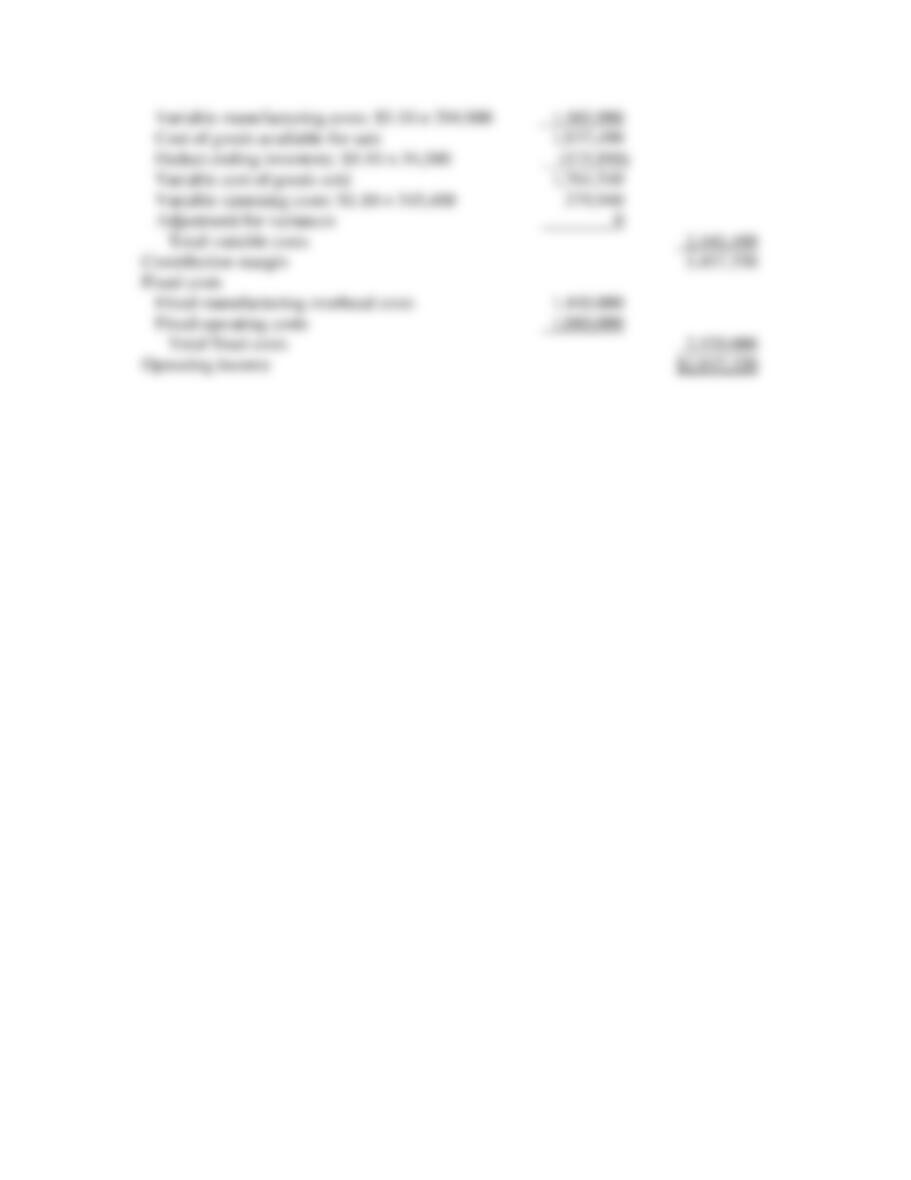
The Zwatch Company manufactures trendy, high-quality, moderately priced watches. As
Zwatch’s senior financial analyst, you are asked to recommend a method of inventory costing.
The CFO will use your recommendation to prepare Zwatch’s 2014 income statement. The
following data are for the year ended December 31, 2014:
Required:
Assume standard costs per unit are the same for units in beginning inventory and units produced
during the year. Also, assume no price, spending, or efficiency variances. Any production–
volume variance is written off to cost of goods sold in the month in which it occurs.
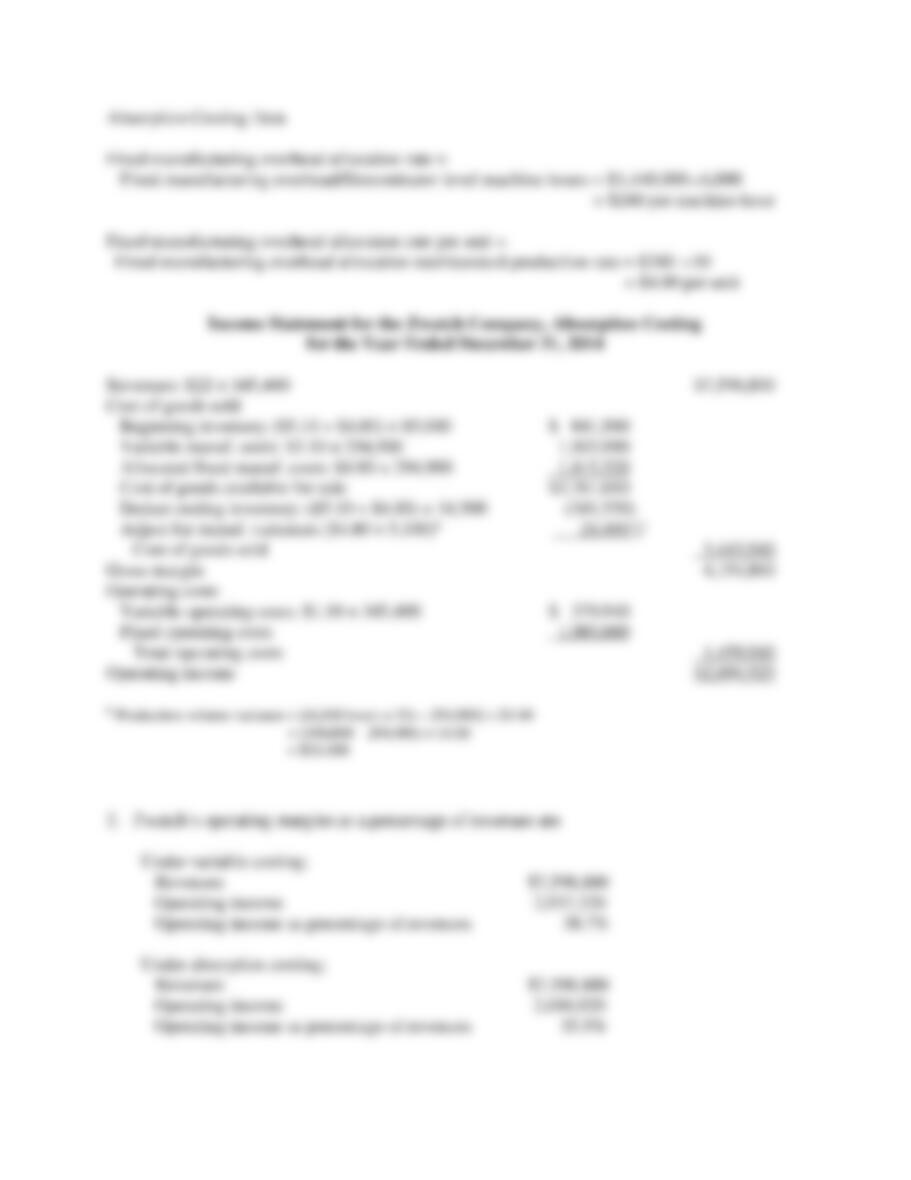
1. Prepare income statements under variable and absorption costing for the year ended
December 31, 2014.
2. What is Zwatch’s operating income as percentage of revenues under each costing method?
3. Explain the difference in operating income between the two methods.
4. Which costing method would you recommend to the CFO? Why?
SOLUTION
9-15
9-16
9-17
9-18
9-21 (10 min.) Absorption and variable costing.
(CMA) Osawa, Inc., planned and actually manufactured 200,000 units of its single product in
2014, its first year of operation. Variable manufacturing cost was $20 per unit produced.
Variable operating (nonmanufacturing) cost was $10 per unit sold. Planned and actual fixed
manufacturing costs were $600,000. Planned and actual fixed operating (nonmanufacturing)
costs totaled $400,000. Osawa sold 120,000 units of product at $40 per unit.
Required:
1. Osawa’s 2014 operating income using absorption costing is (a) $440,000, (b) $200,000, (c)
$600,000, (d) $840,000, or (e) none of these. Show supporting calculations.
2. Osawa’s 2014 operating income using variable costing is (a) $800,000, (b) $440,000, (c)
$200,000, (d) $600,000, or (e) none of these. Show supporting calculations.
SOLUTION
9-19
9-22 (40 min) Absorption versus variable costing.
Regina Company manufacturers a professional-grade vacuum cleaner and began operations in
2014. For 2014, Regina budgeted to produce and sell 20,000 units. The company had no price,
spending, or efficiency variances and writes off production-volume variance to cost of goods
sold. Actual data for 2014 are given as follows:
1. Prepare a 2014 income statement for Regina Company using variable costing.
2. Prepare a 2014 income statement for Regina Company using absorption costing.
3. Explain the differences in operating incomes obtained in requirements 1 and 2.
4. Regina’s management is considering implementing a bonus for the supervisors based on
gross margin under absorption costing. What incentives will this bonus plan create for the
supervisors? What modifications could Regina management make to improve such a plan?
Explain briefly.
SOLUTION
9-20