9-41
9-42
9-31 (25–30 min.) Alternative denominator-level capacity concepts, effect on operating income.
Castle Lager has just purchased the Jacksonville Brewery. The brewery is two years old and uses absorption costing. It will “sell” its
product to Castle Lager at $47 per barrel. Peter Bryant, Castle Lager’s controller, obtains the following information about Jacksonville
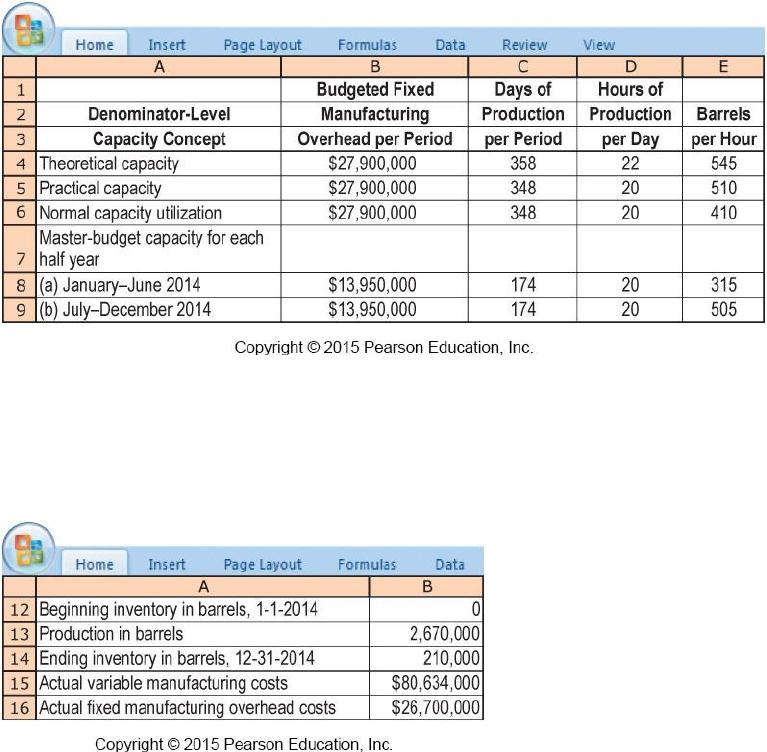
Brewery’s capacity and budgeted fixed manufacturing costs for 2014:
Required:
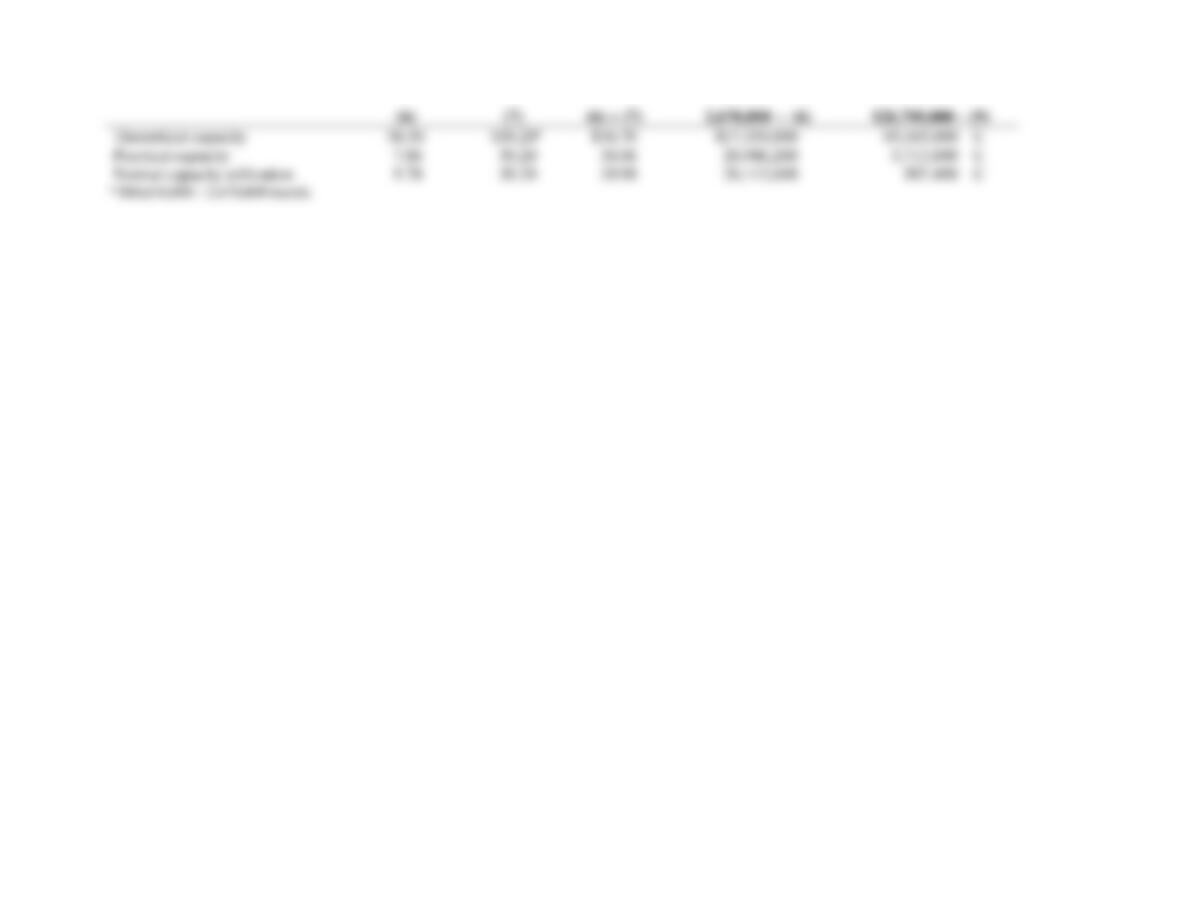
1. Compute the budgeted fixed manufacturing overhead rate per barrel for each of the denominator-level capacity concepts. Explain
why they are different.
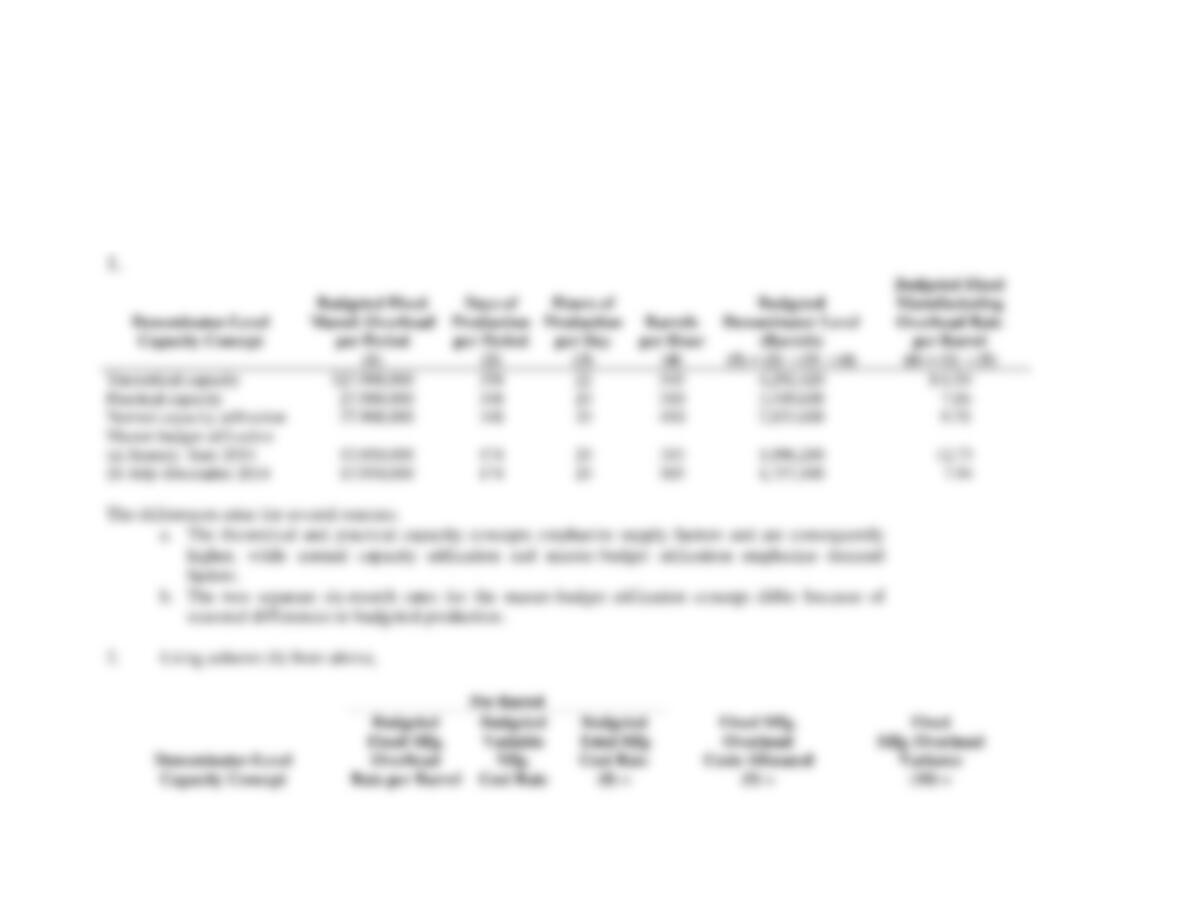
2. In 2014, the Jacksonville Brewery reported these production results:
9-43
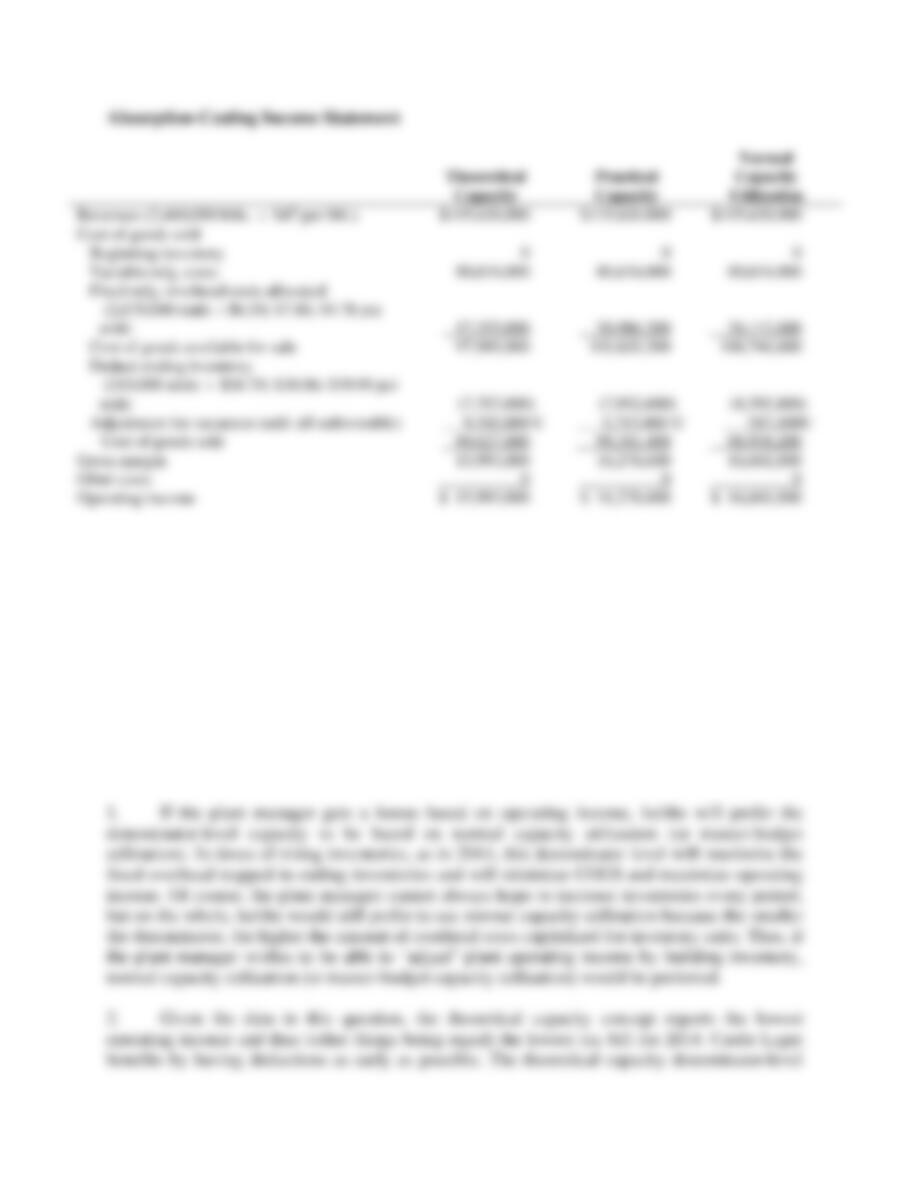
There are no variable cost variances. Fixed manufacturing overhead cost variances are written off to cost of goods sold in the period
in which they occur. Compute the Jacksonville Brewery’s operating income when the denominator-level capacity is (a) theoretical
capacity, (b) practical capacity, and (c) normal capacity utilization.
SOLUTION
9-44
9-45
9-32 (20 min.) Motivational considerations in denominator-level capacity selection
(continuation of 9-31).
Required:
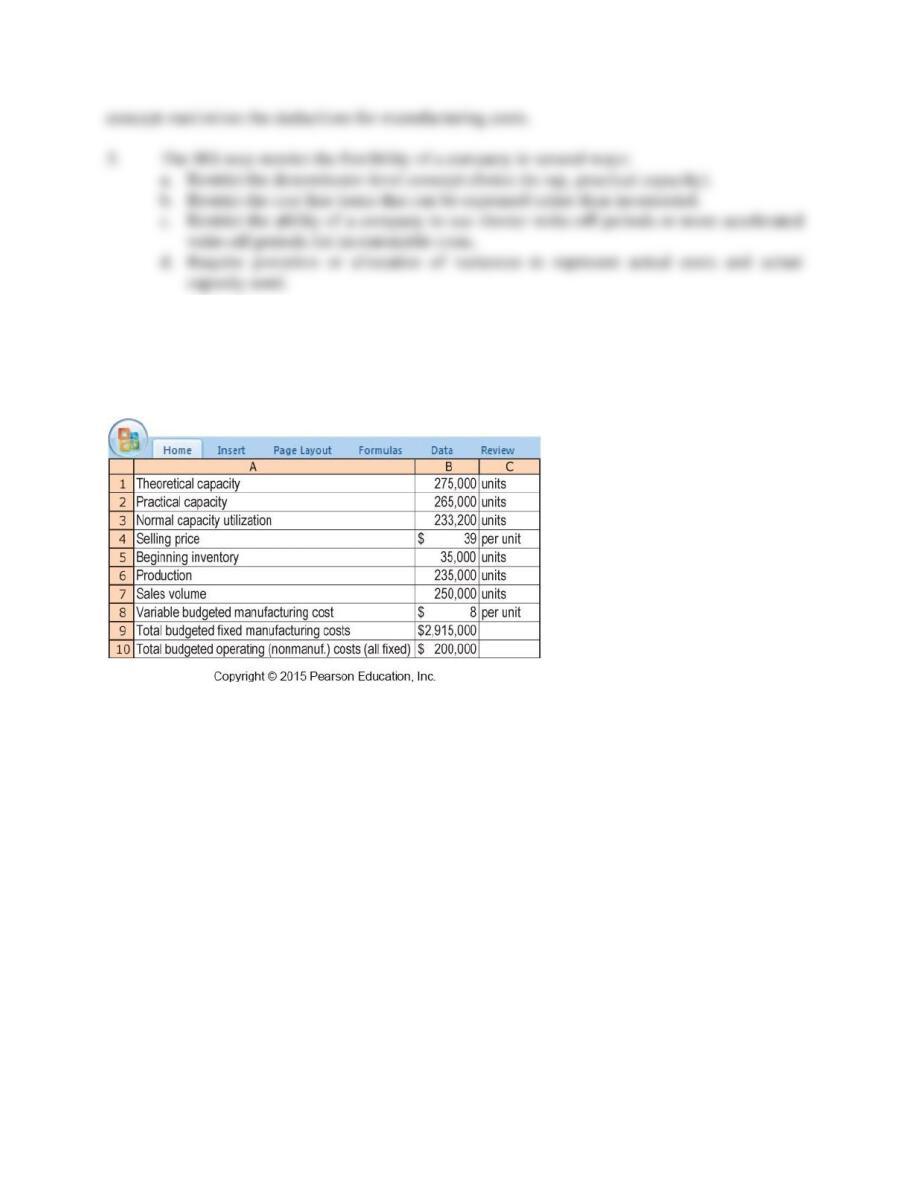
1. If the plant manager of the Jacksonville Brewery gets a bonus based on operating income,
which denominator-level capacity concept would he prefer to use? Explain.
2. What denominator-level capacity concept would Castle Lager prefer to use for U.S. income–
tax reporting? Explain.
3. How might the IRS limit the flexibility of an absorption-costing company like Castle Lager
attempting to minimize its taxable income?
SOLUTION
9-46
9-33 (25 min.) Denominator-level choices, changes in inventory levels, effect on
operating income.
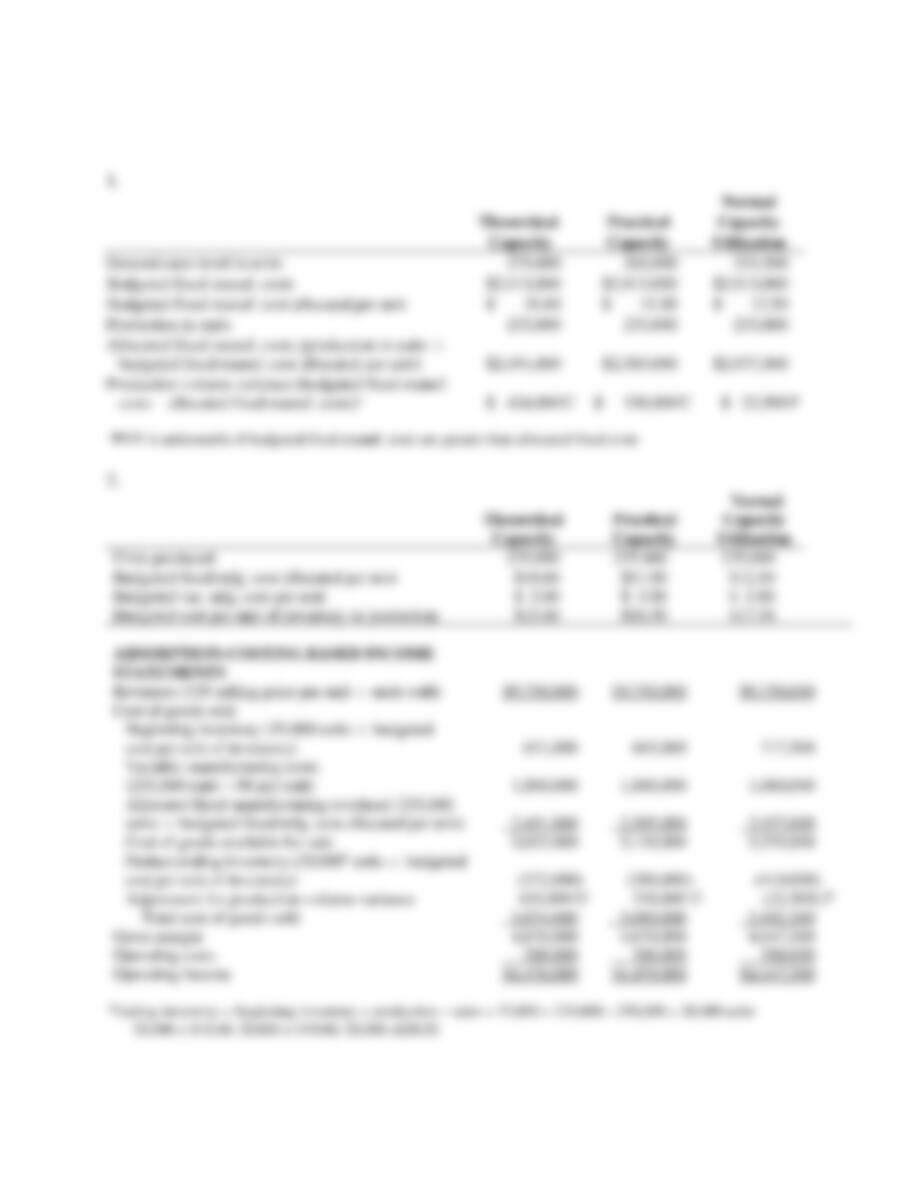
Donaldson Corporation is a manufacturer of computer accessories. It uses absorption costing
based on standard costs and reports the following data for 2014:
There are no price, spending, or efficiency variances. Actual operating costs equal budgeted
operating costs. The production-volume variance is written off to cost of goods sold. For each
choice of denominator level, the budgeted production cost per unit is also the cost per unit of
beginning inventory.
Required:
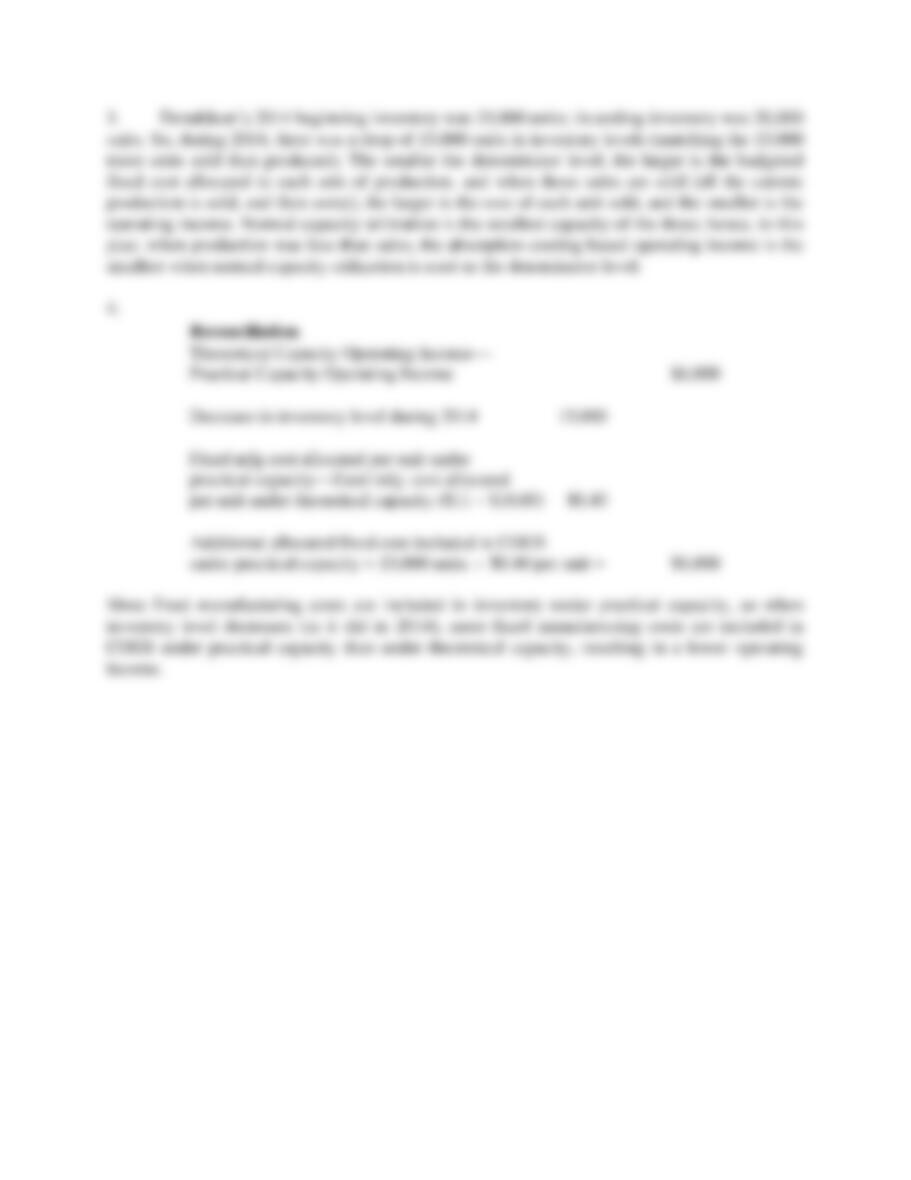
1. What is the production-volume variance in 2014 when the denominator level is (a)
theoretical capacity, (b) practical capacity, and (c) normal capacity utilization?
2. Prepare absorption costing–based income statements for Donaldson Corporation using
theoretical capacity, practical capacity, and normal capacity utilization as the denominator
levels.
3. Why is the operating income under normal capacity utilization lower than the other two
scenarios?
4. Reconcile the difference in operating income based on theoretical capacity and practical
capacity with the difference in fixed manufacturing overhead included in inventory.
9-47
SOLUTION
9-48
9-49
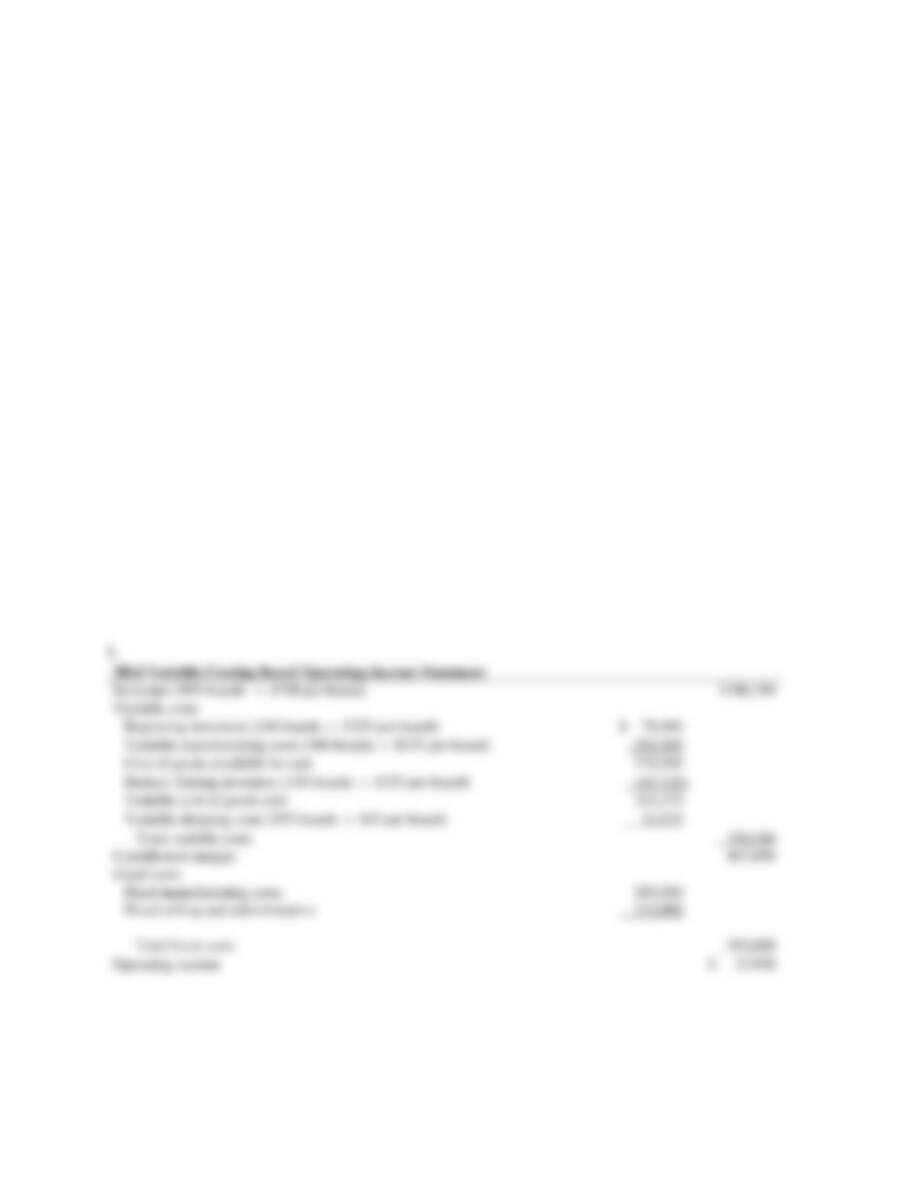
9-34 (60 min.) Variable and absorption costing and breakeven points
Whistler, Inc., manufactures a specialized snowboard made for the advanced snowboarder.
Whistler began 2014 with an inventory of 240 snowboards. During the year, it produced 900
boards and sold 995 for $750 each. Fixed production costs were $280,000, and variable
production costs were $325 per unit. Fixed advertising, marketing, and other general and
administrative expenses were $112,000, and variable shipping costs were $15 per board. Assume
that the cost of each unit in beginning inventory is equal to 2014 inventory cost.
Required:
1. Prepare an income statement assuming Whistler uses variable costing.
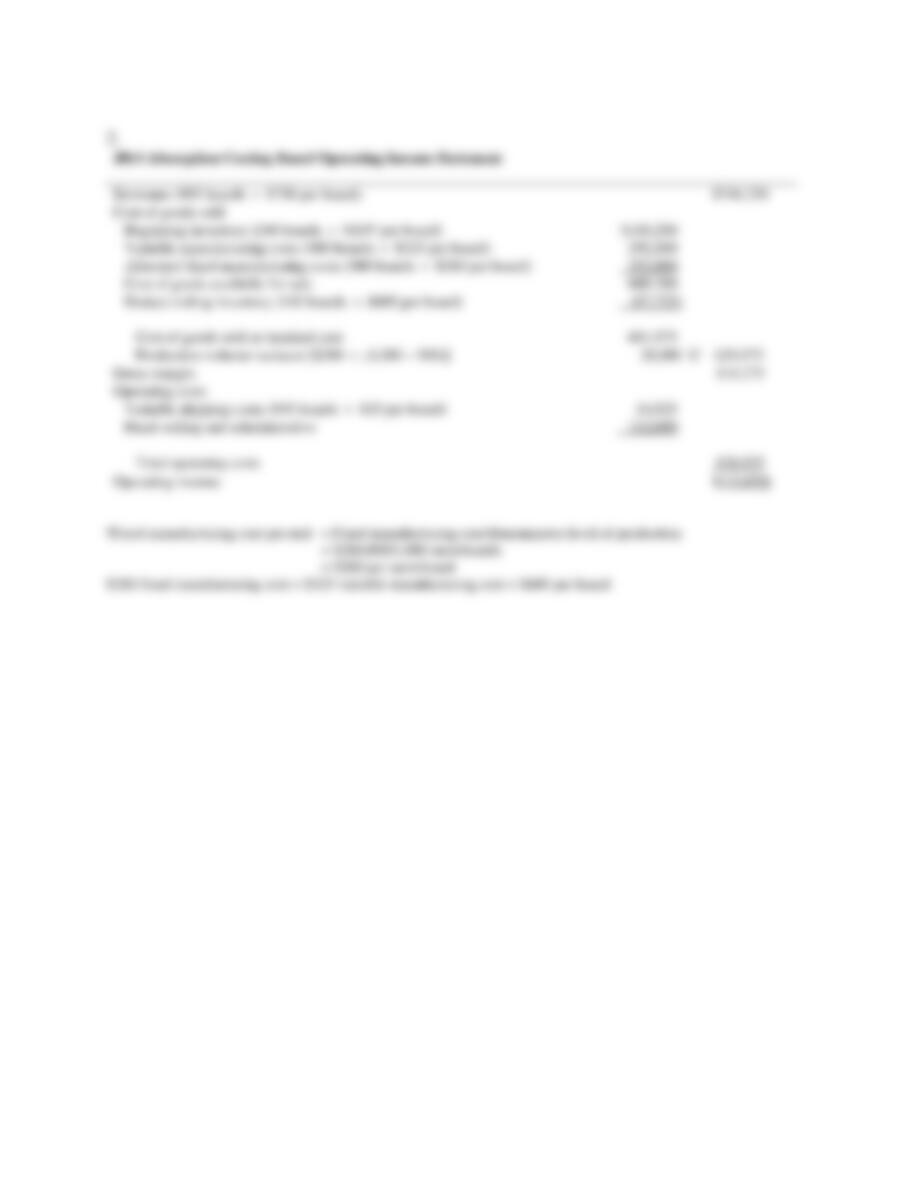
2. Prepare an income statement assuming Whistler uses absorption costing. Whistler uses a
denominator level of 1,000 units. Production-volume variances are written off to cost of
goods sold.
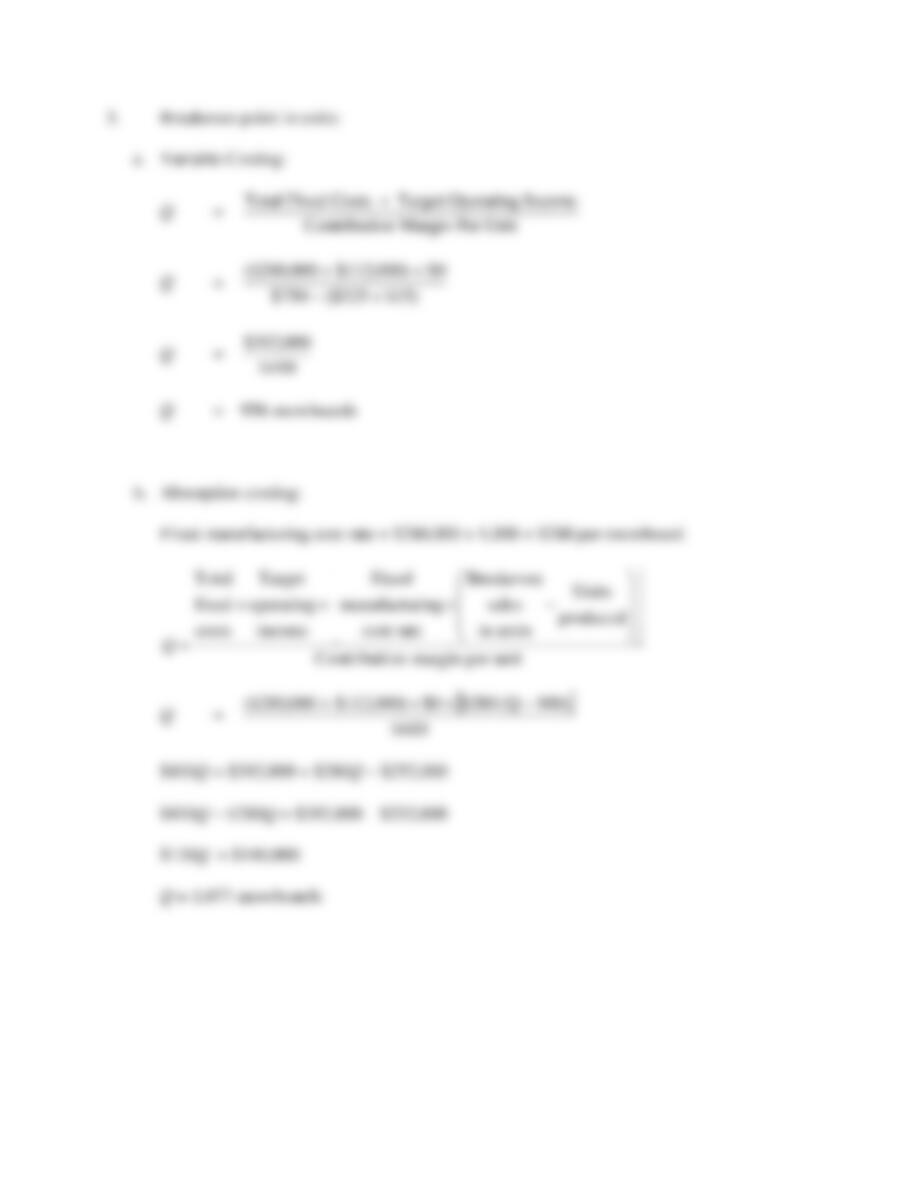
3. Compute the breakeven point in units sold assuming Whistler uses the following:
a. Variable costing b. Absorption costing (Production = 900 boards)
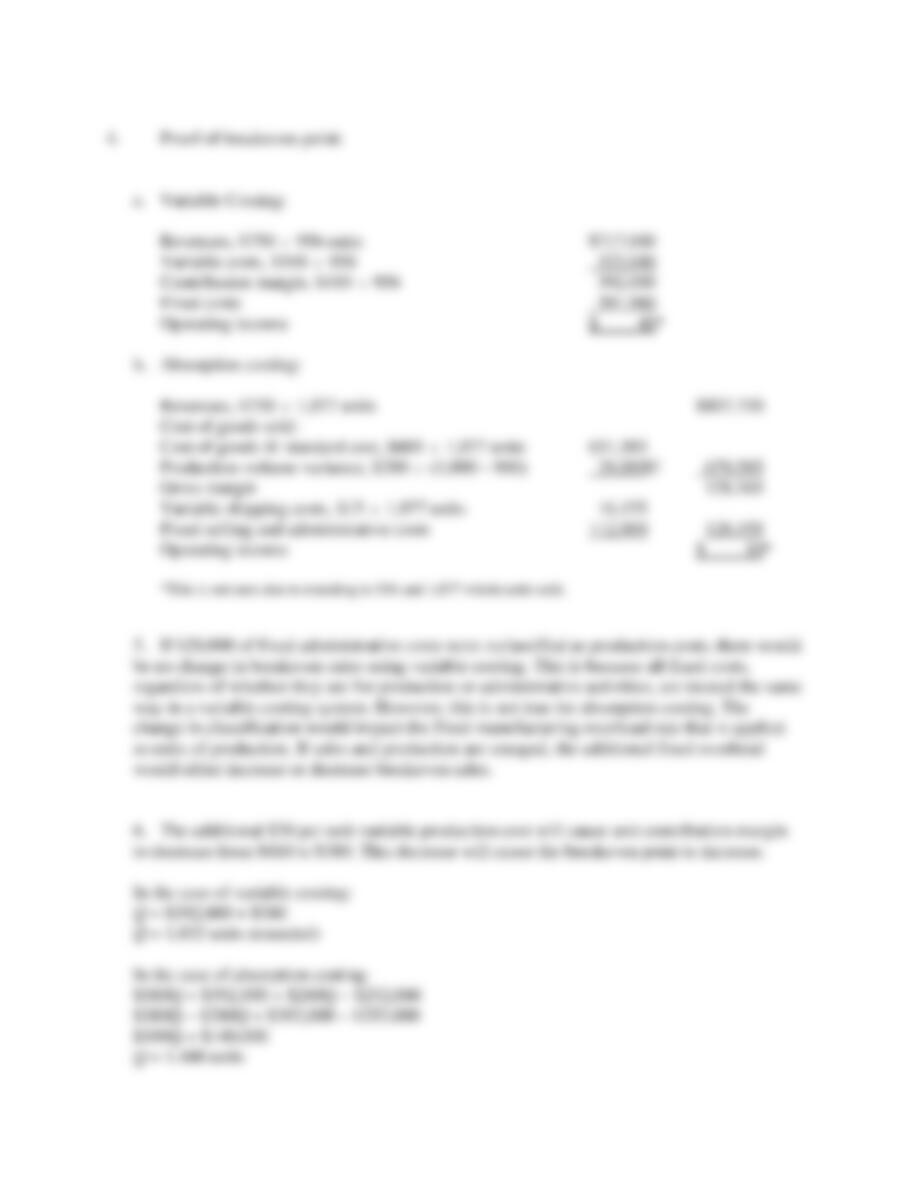
4. Provide proof of your preceding breakeven calculations.
5. Assume that $20,000 of fixed administrative costs were reclassified as fixed production
costs. Would this reclassification affect breakeven point using variable costing? What if
absorption costing were used? Explain.
6. The company that supplies Whistler with its specialized impact-resistant material has
announced a price increase of $30 for each board. What effect would this have on the
breakeven points previously calculated?
SOLUTION
9-50
9-51
9-52
9-53
9-35 (20 min.) Downward demand spiral.
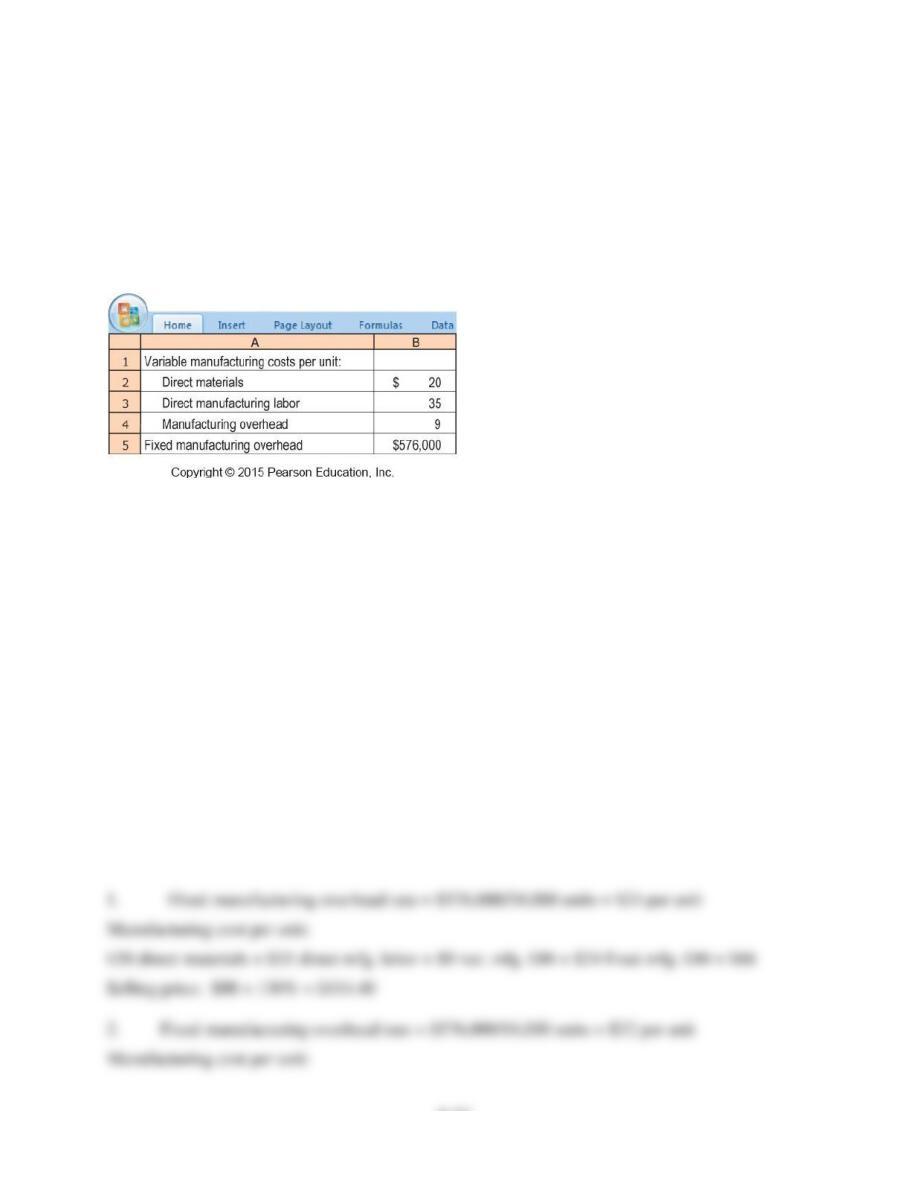
Gostkowski Company is about to enter the highly competitive personal electronics market with a
new optical reader. In anticipation of future growth, the company has leased a large
manufacturing facility and has purchased several expensive pieces of equipment. In 2013, the
company’s first year, Gostkowski budgets for production and sales of 24,000 units, compared
with its practical capacity of 48,000. The company’s cost data are as follows:
Required:
1. Assume that Gostkowski uses absorption costing and uses budgeted units produced as the
denominator for calculating its fixed manufacturing overhead rate. Selling price is set at
130% of manufacturing cost. Compute Gostkowski’s selling price.
2. Gostkowski enters the market with the selling price computed previously. However, despite
growth in the overall market, sales are not as robust as the company had expected, and a
competitor has priced its product $16 lower than Gostkowski’s. Enrico Gostkowski, the
company’s president, insists that the competitor must be pricing its product at a loss and that
the competitor will be unable to sustain that. In response, Gostkowski makes no price
adjustments but budgets production and sales for 2014 at 18,000 units. Variable and fixed
costs are not expected to change. Compute Gostkowski’s new selling price. Comment on
how Gostkowski’s choice of budgeted production affected its selling price and competitive
position.
3. Recompute the selling price using practical capacity as the denominator level of activity.
How would this choice have affected Gostkowski’s position in the marketplace? Generally,
how would this choice affect the production-volume variance?
SOLUTION
9-54
9-36 (35 min.) Absorption costing and production volume variance—alternative capacity
bases.
Planet Light First (PLF), a producer of energy-efficient light bulbs, expects that demand will
increase markedly over the next decade. Due to the high fixed costs involved in the business,
PLF has decided to evaluate its financial performance using absorption costing income. The
production-volume variance is written off to cost of goods sold. The variable cost of production
is $2.40 per bulb. Fixed manufacturing costs are $1,170,000 per year. Variable and fixed selling
and administrative expenses are $0.20 per bulb sold and $220,000, respectively. Because its light
bulbs are currently popular with environmentally conscious customers, PLF can sell the bulbs for
$9.80 each.
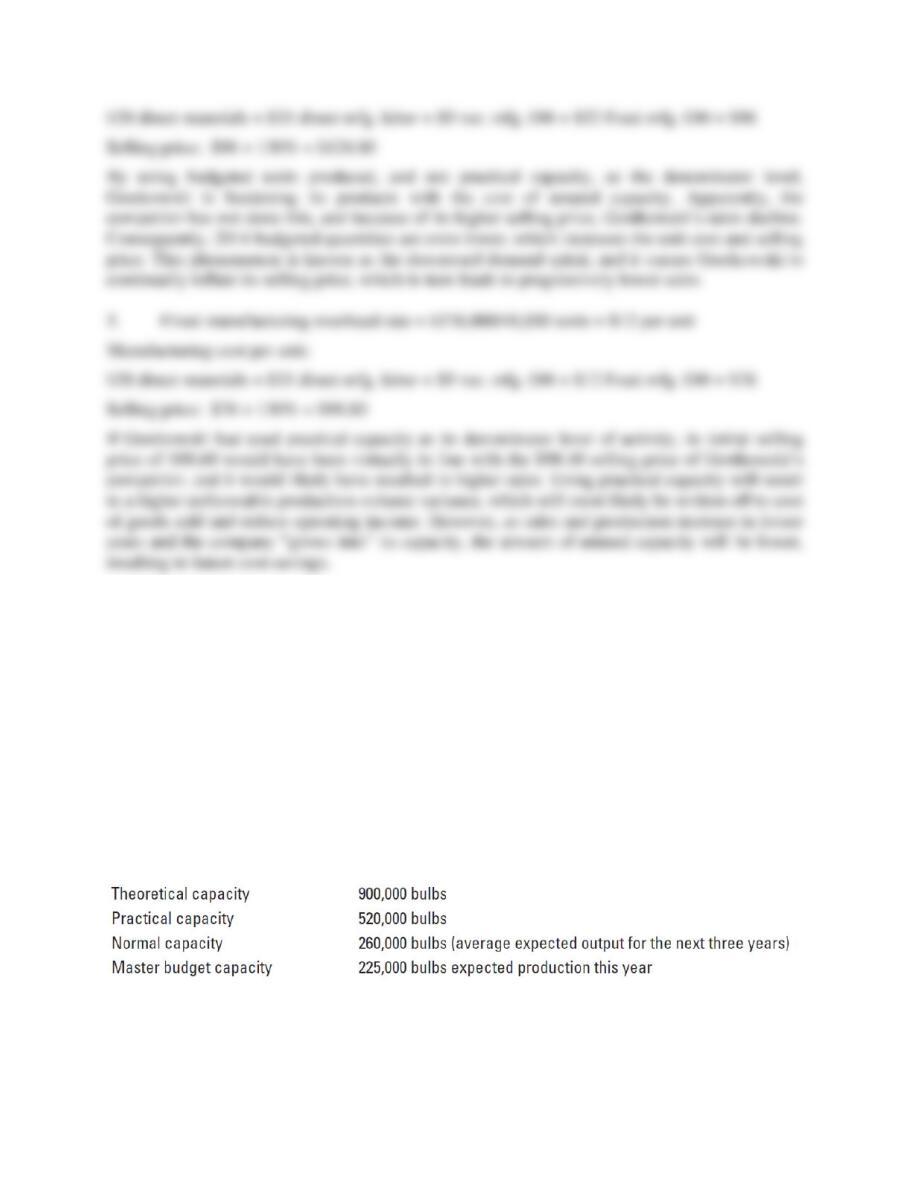
PLF is deciding among various concepts of capacity for calculating the cost of each unit
produced. Its choices are as follows:
Required:
1. Calculate the inventoriable cost per unit using each level of capacity to compute fixed
manufacturing cost per unit.