
Chapter 9
Activity-Based Costing
Learning Objectives
1. Understand the potential effects of using reported product costs for decision making.
2. Explain how a two-stage product costing system works.
3. Compare and contrast plantwide and department allocation methods.
4. Explain how activity-based costing and a two-stage product costing system are related.
5. Compute product costs using activity-based costing.
6. Compare activity-based product costing to traditional department product costing methods.
7. Demonstrate the flow of costs through accounts using activity-based costing.
8. Apply activity-based costing to marketing and administrative services.
9. Explain how time-driven activity-based costing works.
Chapter Overview
I. REPORTED PRODUCT COSTS AND DECISION MAKING
• Dropping a Product
• The Death Spiral
II. TWO-STAGE COST ALLOCATION
• Two-Stage Cost Allocation and the Choice of Cost Drivers
• Plantwide versus Department-Specific Rates
• Choice of Cost Allocation Methods: A Cost-Benefit Decision
III. ACTIVITY-BASED COSTING
IV. COST HIERARCHIES
V. ACTIVITY-BASED COSTING ILLUSTRATED
• Step 1: Identify the Activities
• Step 2: Identify the Cost Drivers
• Step 3: Compute the Cost Driver Rates
• Step 4: Assign Costs Using Activity-Based Costing
• Unit Costs Compared
VI. COST FLOWS THROUGH ACCOUNTS
VII. CHOICE OF ACTIVITY BASES IN MODERN PRODUCTION SETTINGS
• Complexity as a Resource-Consuming Activity
VIII. ACTIVITY-BASED COSTING IN ADMINISTRATION
IX. WHO USES ABC?
X. TIME-DRIVEN ACTIVITY-BASED COSTING
Chapter Outline
LO 9-1 Understand the potential effects of using reported product costs for
decision making.
REPORTED PRODUCT COSTS AND DECISION MAKING
• Dropping a Product
o Managers may consider dropping a product if the reported costs of producing it have
risen more rapidly than the price charged for it, and the product line margins have fallen
to unacceptable levels.
o If managers rely on the cost accounting system to make the decision to keep or drop a
product, the cost system provides potentially inaccurate unit costs.
▪ Exhibit 9.1 shows the assignment of costs to two products using an allocation base of
direct labor hours; management is considering dropping the S-72s; the cost savings
appear to be $208,000.
• The reported unit costs of S-66s will increase from $1,125 to $1,450, an increase
of about 29 percent.
o Once a predetermined overhead rate is calculated, it is applied as if all overhead costs
were variable with respect to the allocation base, which is not true in most cases for two
reasons:
• The Death Spiral
o If managers attempt to recover the costs with a smaller number of units, they are likely to
meet resistance in the market, resulting in demand for even fewer units. With the smaller
production, the reported product costs increase even more.
o The death spiral is a process that begins by attempting to increase price to meet higher
reported product costs, losing market, reporting still higher costs, and so on, until the firm
is of business.
▪ Death spiral may occur when the demand for a product falls for some reason or a
major customer leaves.
• The decline in demand will lead to higher reported costs.
• If the firm attempts to recover the production costs from the remaining customers,
they too will reduce or eliminate their demand.
LO 9-2 Explain how a two-stage product costing system works.
TWO-STAGE COST ALLOCATION
• The basic approach in product costing is to allocate costs in the cost pools to the individual
cost objects, which are the products or services of interest.
o We assign (or allocate) these costs to the individual cost objects by using appropriate cost
allocation bases or cost drivers.
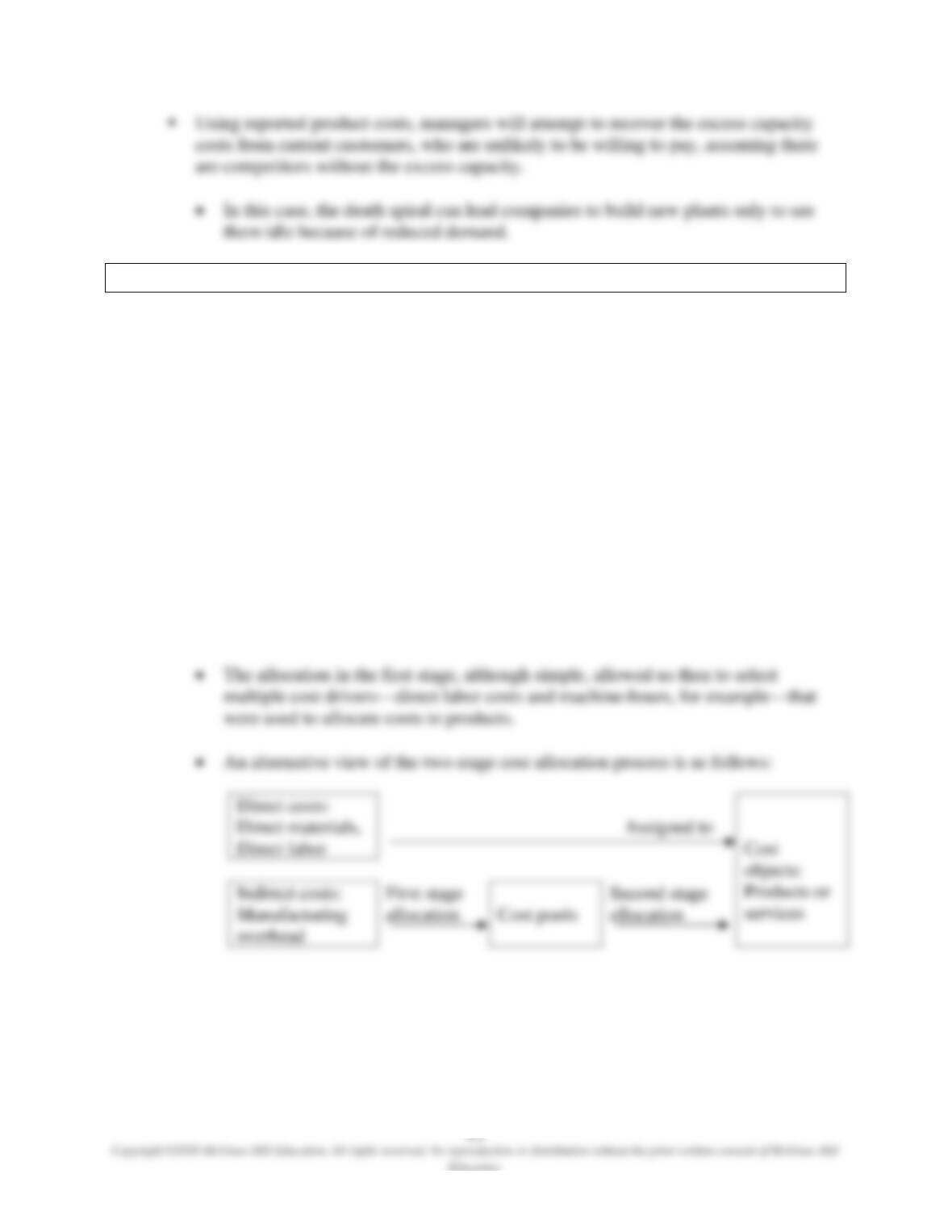
▪ Exhibit 9.4 illustrates a cost flow diagram for a two-stage cost allocation system.
• The first-stage cost objects are the overhead accounts, such as supplies,
depreciation, and so on.
• The two-stage approach allowed us to separate plant, or manufacturing, overhead
into two or more cost pools based on the account in which the costs were recorded.
▪ Another common choice for first-stage cost objects is to use production departments
or product lines within the plant, as shown in Exhibit 9.5.
• The allocation of overhead costs to departments is not as simple as it is when
overhead accounts are used because the costs are not necessarily recorded at the
department level.
• Two-Stage Cost Allocation and the Choice of Cost Drivers
o Complexity and special handling required during production may distort the product
costs reported when the traditional costing method is used. The two-stage system, on the
other hand, allows the firm to develop product costing systems that more closely align the
allocation of costs with the use of resources.
▪ The CenterPoint manufacturing facility of IVC, Inc. makes two models of drones.
▪ Exhibit 9.6 shows the data on the operations of the CenterPoint manufacturing facility
for the third quarter by product line and in total.
• The facility’s cost system is a traditional product costing system that allocates
manufacturing overhead to products based on direct labor costs.
• The overhead allocation rate at the CenterPoint facility is 90%.
▪ Exhibit 9.7 shows the unit product cost report.
• When the production managers studied the cost report, they were surprised that
the Pro was only about twice as costly to produce as the Sport. That seemed too
low.
▪ Company policies called for initial price guidelines for products to include a 30
percent markup over full cost.

▪ In the first stage, the overhead costs would be allocated to the two buildings
(departments).
▪ In the second stage, the overhead costs in each building would be allocated to
products using different cost drivers.
▪ See Exhibit 9.8 for the cost flow diagram that the cost accounting manager developed
for the cost system.
▪ Exhibit 9.9 shows the data on the operations of the CenterPoint manufacturing facility
for the third quarter by product line and in total using the new two-stage cost
allocation system.
o This example illustrates that one advantage of the two-stage system is that it allows the
firm to develop product costing systems that more closely align the allocation of costs
with the use of resources.
LO 9-3 Compare and contrast plantwide and departmental allocation
methods.
• Plantwide versus Department-Specific Rates
o The plantwide allocation method uses one cost pool for the entire plant; it uses one
overhead allocation rate, or one set of rates, for all of a plant’s departments.
• All actual overhead costs are recorded in one cost pool in the Manufacturing
Overhead Control account for the plant without regard to the department or
activity that caused them.
• A single overhead rate is used to apply overhead to products, crediting Applied
Manufacturing Overhead.
▪ Companies using a single plantwide rate generally use an allocation base related to
the volume of output, such as direct labor-hours, machine-hours, units of output, or
materials costs.
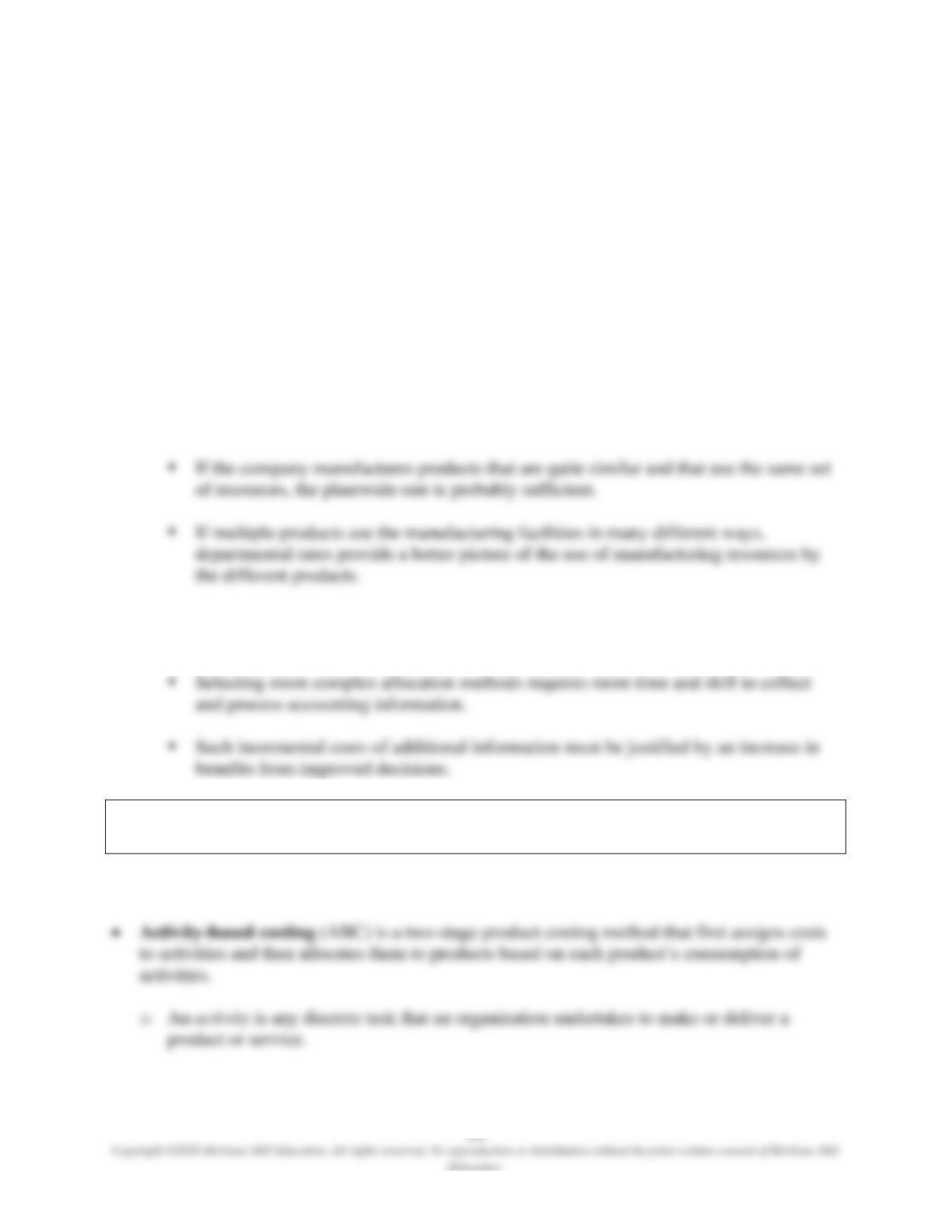
• Example 1: A company estimated its annual overhead costs to be $240,000. The
company uses the plantwide allocation method to assign overhead costs to its two
products, AA and BB, using machine hours, budgeted to be 12,000 for the coming
year. Then the single plantwide rate would be $20 (= $240,000 ÷ 12,000 machine
hours).
In March, 400 units of product AA were produced using 800 machine hours; 100
units of product BB were produced using 400 machine hours. The overhead
allocation would be:
▪ Companies using a single plantwide rate generally use an allocation base related to
the volume of output, such as direct labor hours, machine hours, units of output, or
materials costs.
o Using the department allocation method, a company has a separate cost pool for each
department. The company establishes a separate overhead allocation rate for each
department.
▪ The department allocation method has a separate cost pool for each department,
which has its own overhead allocation rate or set of rates.
• Choice of Cost Allocation Methods: A Cost-Benefit Decision
o The choice of whether to use a plantwide rate or departmental rates depends on the
products and the production process.
o Managers need to decide between plantwide versus departmental rates based on the costs
and benefits of the information inherent in each system.
LO 9-4 Explain how activity-based costing and a two-stage product system
are related.
ACTIVITY-BASED COSTING
o Activity-based costing can be used by any organization that wants a better understanding
of the costs of the goods and services it provides, including manufacturing, service, and
even nonprofit organizations. (See Business Application box “Activity-Based Costing in
a Not-for-Profit.”)
• Developing Activity-Based Costs
o Activity-based costing involves the following four steps:
▪ Identify the activities that consume resources and assign costs to them.
o Identifying Activities that Use Resources
▪ Often the most interesting and challenging part of the exercise is identifying activities
that use resources because doing so requires understanding all the activities required
to make a product.
• When managers step back and analyze the processes (activities) they follow to
produce a good or service, they often uncover many nonvalue-added steps that
they can eliminate.
o Choosing Cost Drivers
▪ Exhibit 9.10 provides several examples of the types of cost drivers that most
companies use.
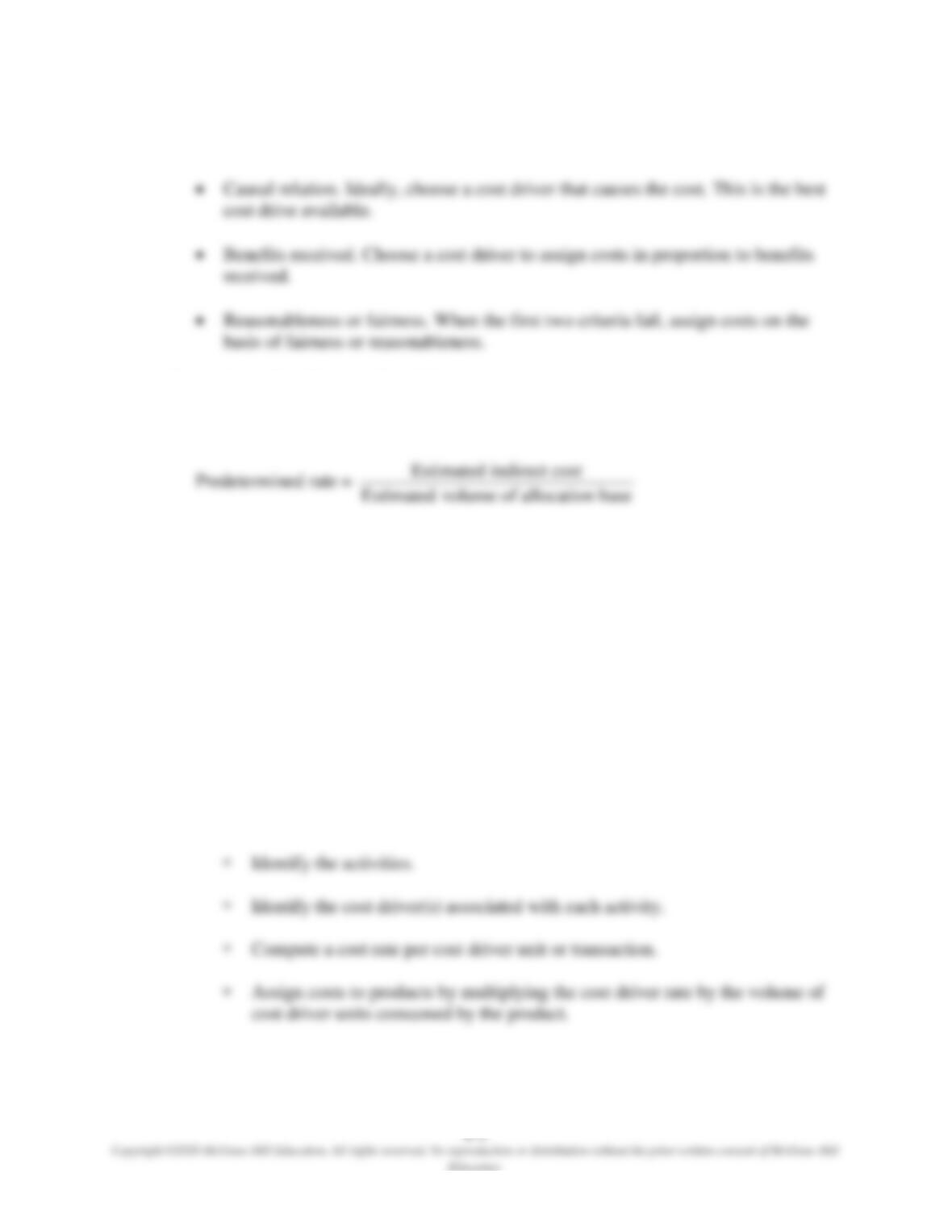
▪ Cost drivers are selected based on three criteria:
o Computing a Cost Rate per Cost Driver
▪ For any indirect cost, a predetermined rate can be computed as follows:
▪ For activity-based costing, the first stage consists of activities. Each activity has an
associated cost pool and requires a cost driver rate using the formula above.
o Assigning Costs to Products
▪ The final step in the activity-based costing system is to assign the activity costs to
products.
• We do this just as we have done for the other product costing systems we have
considered. We multiply the cost driver rates by the number of units of the cost
driver in each product.
• Exhibit 9.11 illustrates the four steps of developing activity-based costs
graphically.
COST HIERARCHIES
• A cost hierarchy classifies cost drivers by general dimensions or levels of activity
o A cost hierarchy represents a classification of cost drivers into general levels of activity,
volume, batch, product, etc.
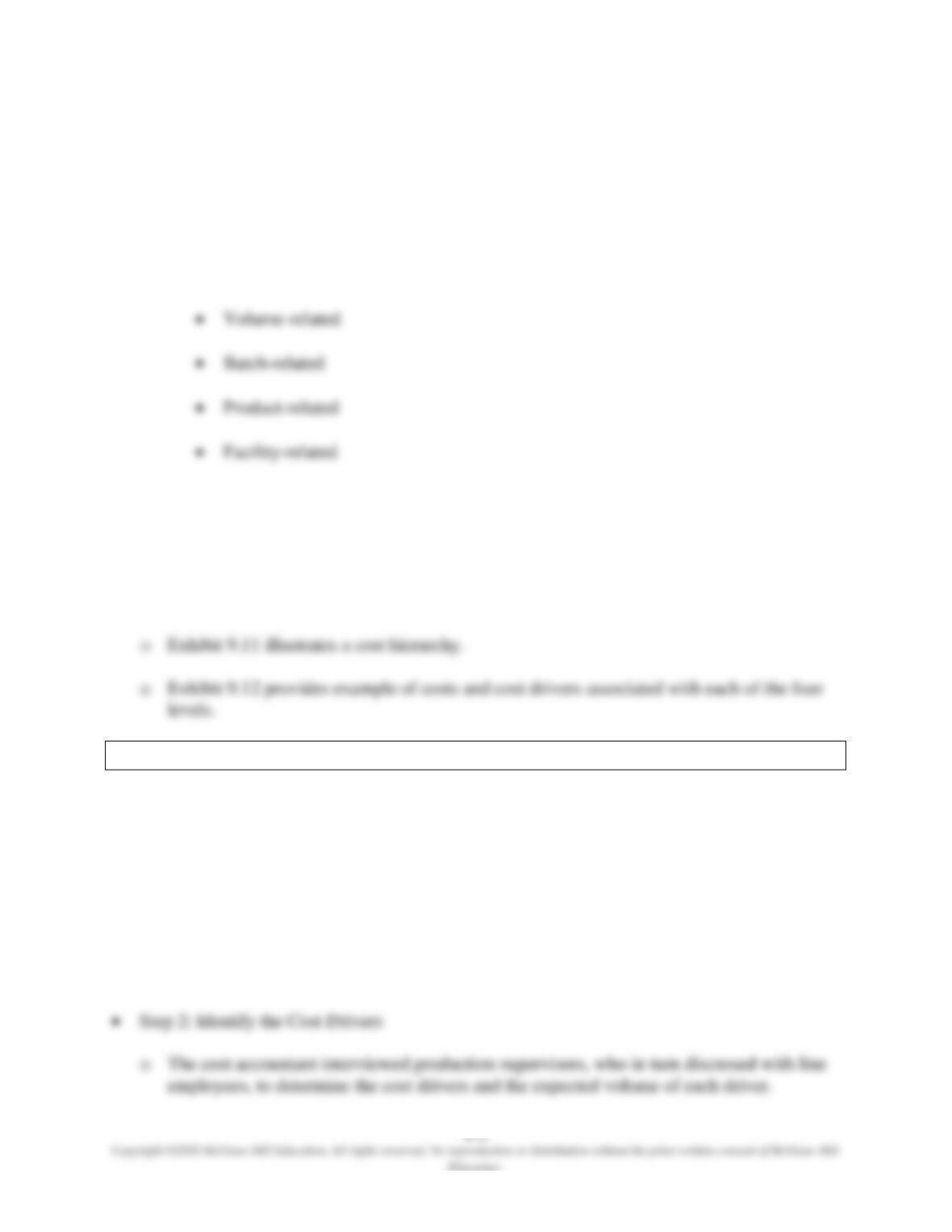
▪ Four possible levels of cost hierarchy are:
o An activity-based costing system can have fewer than four levels in the hierarchy or it
can have more than four.
▪ The important factor is whether the cost drivers for the activities reflect the cost
incurred by the activity. (See Business Application box “The ABC Cost Hierarchy—
Maintenance Costs for an Airline.”)
LO 9-5 Compute product costs using activity-based costing.
ACTIVITY-BASED COSTING ILLUSTRATED
In this section, the reported product costs under activity-based costing are computed in a
comprehensive example.
• Step 1: Identify the Activities
o A cost accountant interviewed the production manager to determine the major activities
used in the manufacturing process.
▪ The information is presented in Exhibit 9.13.
• Step 3: Compute the Cost Driver Rates
o Once the overhead costs incurred in the facility were determined, the cost accountant
calculated the cost driver rates by dividing overhead cost by the estimated volume for
each activity identified in Step 1.
• Step 4: Assign Costs Using Activity-Based Costing
o Based on these interviews, the cost accountant develops a cost flow diagram, which
includes the first-stage assignment of costs to activity pools and the second-stage
allocation of activity costs to products noting the cost drivers for each activity.
o For each product, the direct costs (direct materials and direct labor) are the same
regardless of the costing methods used. The difference is in the assignment of overhead
costs.
▪ There are two ways to calculate unit cost for each product.
LO 9-6 Compare activity-based product costing to traditional department
product costing methods.
• Unit Costs Compared
o As summarized in Exhibit 9.17, both the plantwide rate and the department rate systems
assumed that overhead was incurred proportionally with the volume of output. The
activity-based costing system recognized that overhead was related to activity usage, not
necessarily to the volume of output.
o Important points about activity-based costing:
▪ Different cost allocation methods result in different estimates of how much it costs to
make a product.
▪ Activity-based costing provides more detailed measures of costs than do plantwide or
department allocation methods.
LO 9-7 Demonstrate the flow of costs through accounts using activity-based
costing.
COST FLOWS THROUGH ACCOUNTS
• Exhibit 9.18 shows the flow of costs through accounts using activity-based costing. The
overhead accounts (both incurred and applied) are grouped by activities.
CHOICE OF ACTIVITY BASES IN MODERN PRODUCTION SETTINGS
• Early industries were labor intensive, and much of the overhead cost was related to the
support of labor. At that time, it made sense to allocate overhead to products based on the
amount of labor component in the products.
• Nowadays, labor is still a major product cost in many companies, especially service
organizations such as consulting, law, and public accounting firms. In those cases, overhead
is often allocated to products (jobs) on the basis of the amount of labor in the product.

o The magnitude of the overhead rate based on direct labor is of less concern when all
resources are used proportionally.
▪ In modern manufacturing settings, proportionality between machine hours and direct
labor hours is much less so.
• Complexity as a Resource-Consuming Activity
o Costs are a function of both volume and complexity.
LO 9-8 Apply activity-based costing to marketing and administrative
services.
ACTIVITY-BASED COSTING IN ADMINISTRATION
• Activity-based costing can be applied to administrative activities. The principles and methods
are the same as those discussed earlier.
o Activity-based costing in administration involves these steps:
▪ Identify the activities that consume resources.
o Instead of computing the cost of a product, accountants compute the cost of performing
an administrative service.
▪ Time-related factors (and therefore cost drivers) are common for an administrative
function or a service business.
WHO USES ABC?
• Exhibit 9.20 lists some of the organizations that have been cited as using ABC for at least
some of their operations.
• There are three problems with identifying users of ABC:
LO 9-9 Explain how time-driven activity-based costing works.
TIME-DRIVEN ACTIVITY-BASED COSTING
• A modified version of ABC that addresses the costs of maintaining an ABC system has been
developed.
o This modified approach to ABC is called time-driven activity-based costing (TDABC).
o The development of a TDABC system is illustrated by showing how it has been
implemented in the Receiving Department at the CenterPoint Facility of IVC, Inc.
• Developing Time-Driven Activity-Based Costs
o The Costs of Resources Supplied
▪ The number of people in the department are identified as are the activities that they
perform.