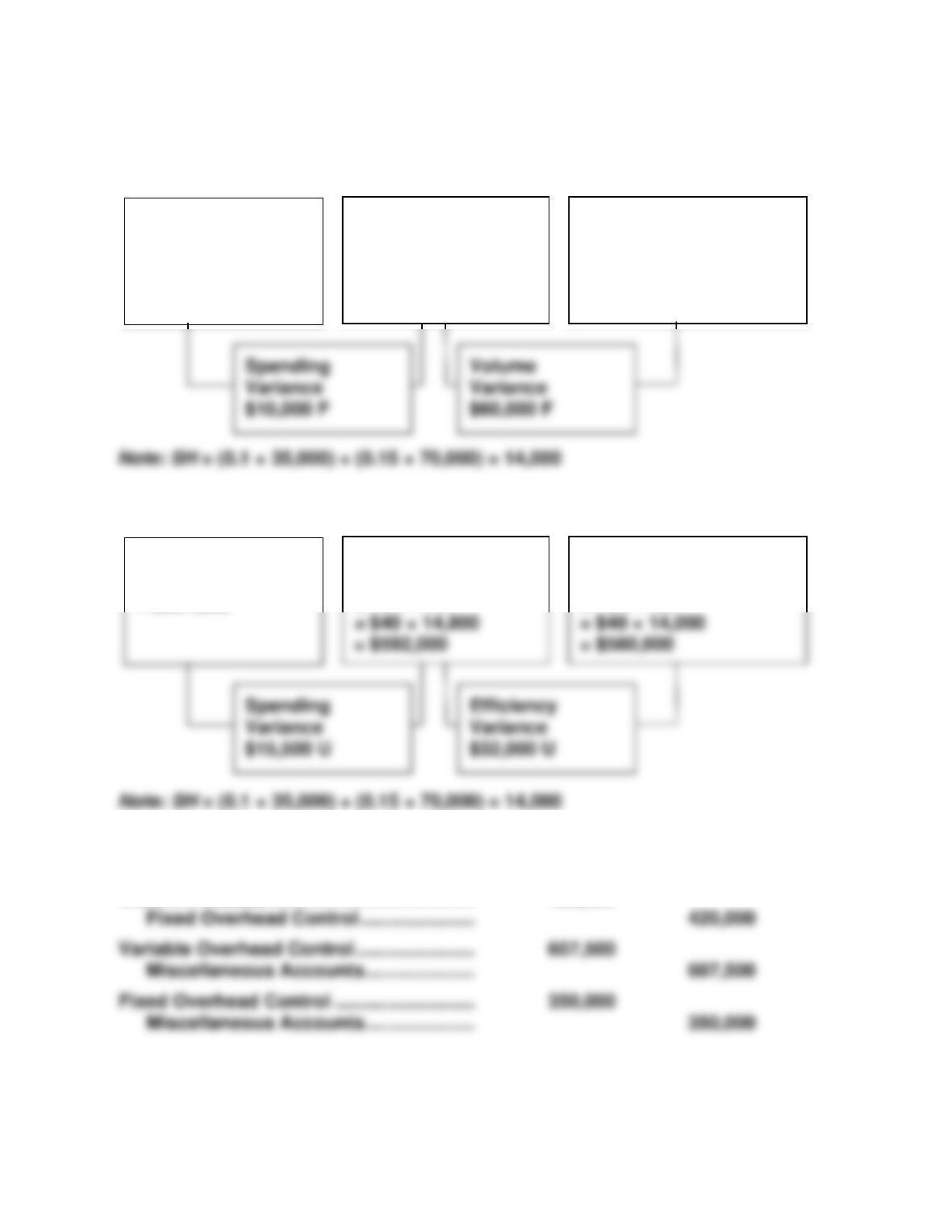
Problem 9.33 (Continued)
4. Fixed overhead variances:
Variable overhead variances:
Work in Process …………………………………. 560,000
Variable Overhead Control …………….. 560,000
Work in Process …………………………………. 420,000
Actual Fixed
Overhead
= $350,000
Budgeted Fixed
Overhead
= $360,000
Applied Fixed
Overhead
SFOR × SH
= $30 × 14,000
= $420,000
Actual Variable
Overhead
= $607,500
Budgeted Variable
Overhead
SVOR × AH
Applied Variable
Overhead
SVOR × SH
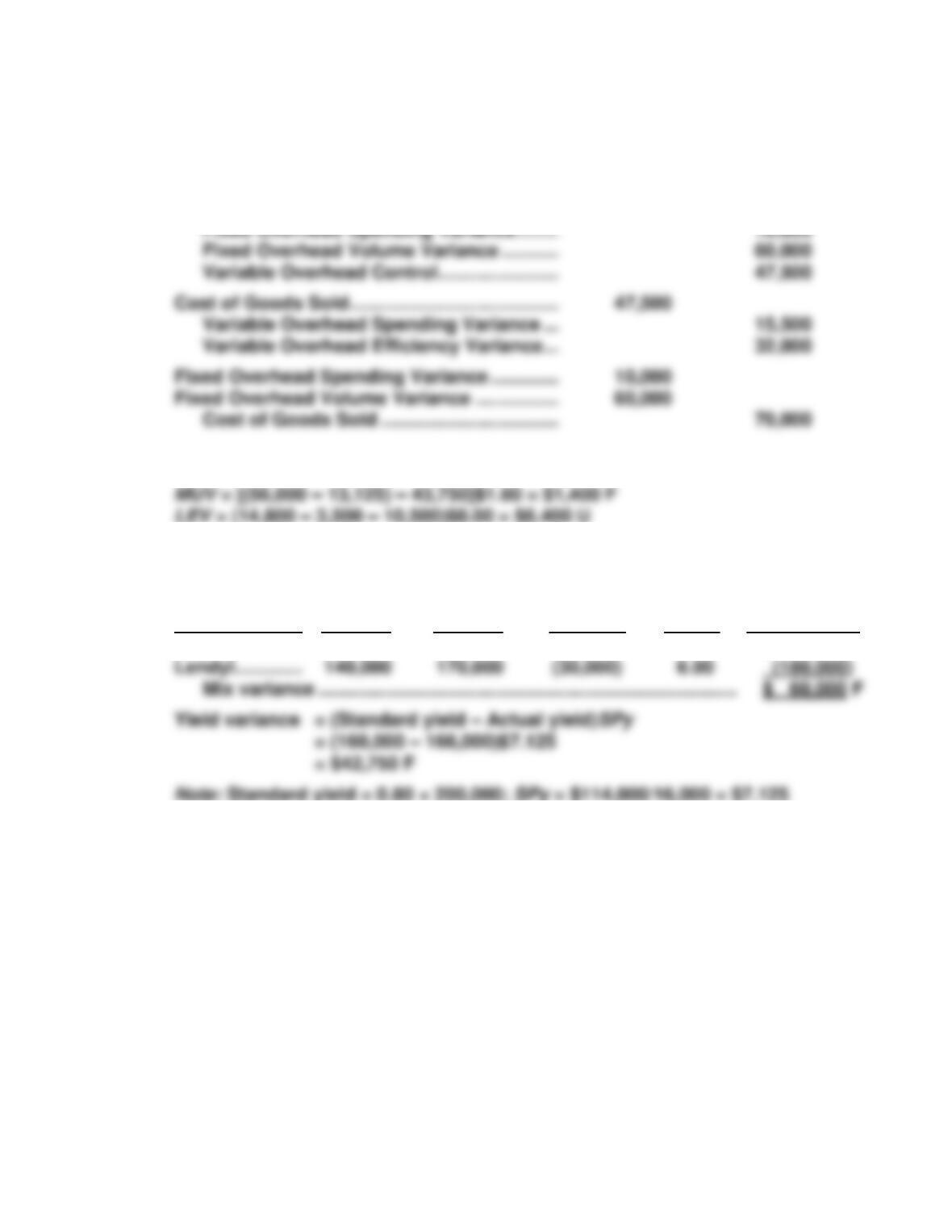
Problem 9.33 (Concluded)
Fixed Overhead Control…………………………... 70,000
Variable Overhead Spending Variance …….. 15,500
Variable Overhead Efficiency Variance …….. 32,000
5. Yes, computations are as follows:
Problem 9.34
1. Direct Material AQ SM AQ – SM SP (AQ – SM)SP
Aranol …………. 60,000 30,000 30,000 $4.00 $ 120,000
Problem 9.34 (Concluded)
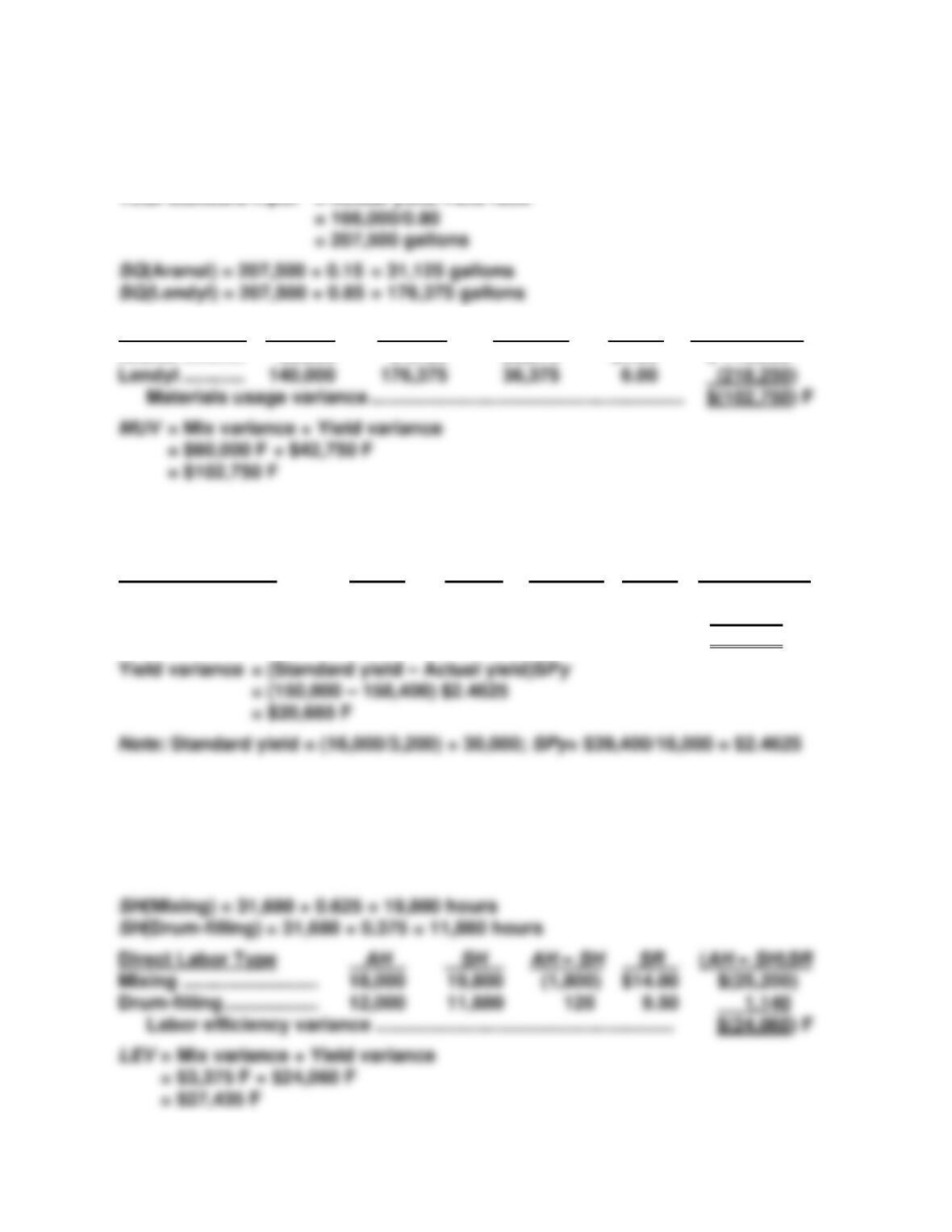
2. Direct materials usage variance:
Total standard input = Actual yield/Yield ratio
Direct Material AQ SQ AQ – SQ SP (AQ – SM)SP
Aranol ………… 60,000 31,125 28,875 $4.00 $ 115,500
Problem 9.35
1. Direct Labor Type AH SM AH – SM SR (AH – SM)SP
Mixing ……………………… 18,000 18,750 (750) $14.00 $(10,500)
Drum-filling ………………. 12,000 11,250 750 9.50 7,125
Mix variance ……………………………………………………………………. $ (3,375) F
2. Direct labor efficiency variance:
Total hours allowed = Actual yield/Yield ratio
= 158,400/5
= 31,680
Problem 9.36
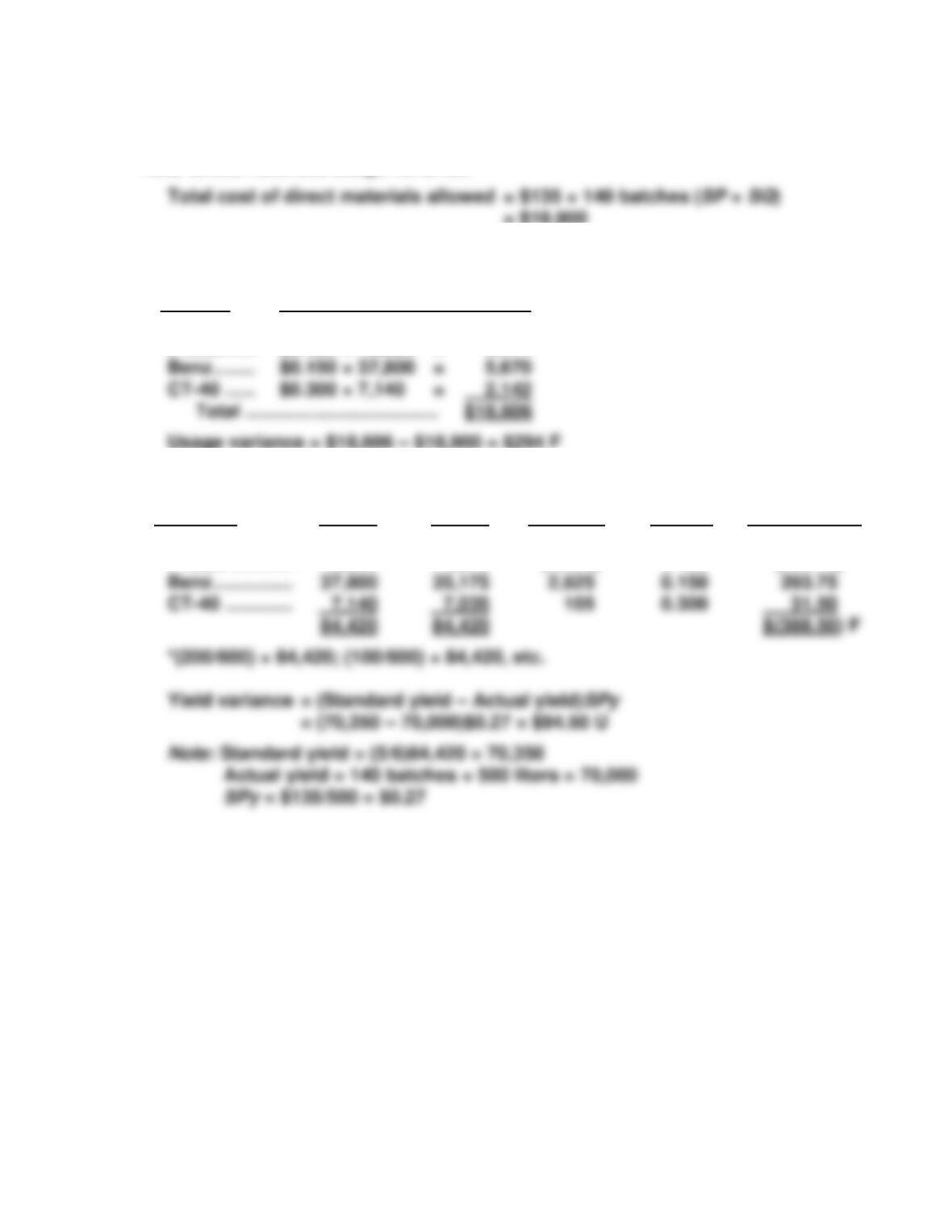
Total direct materials usage variance:
= $18,900
Standard cost of actual quantity used:
Direct
Material AQ × SP
Echol ……. $0.200 × 26,600 = $ 5,320
Protex ….. $0.425 × 12,880 = 5,474
Usage variance = $18,606 – $18,900 = $294 F
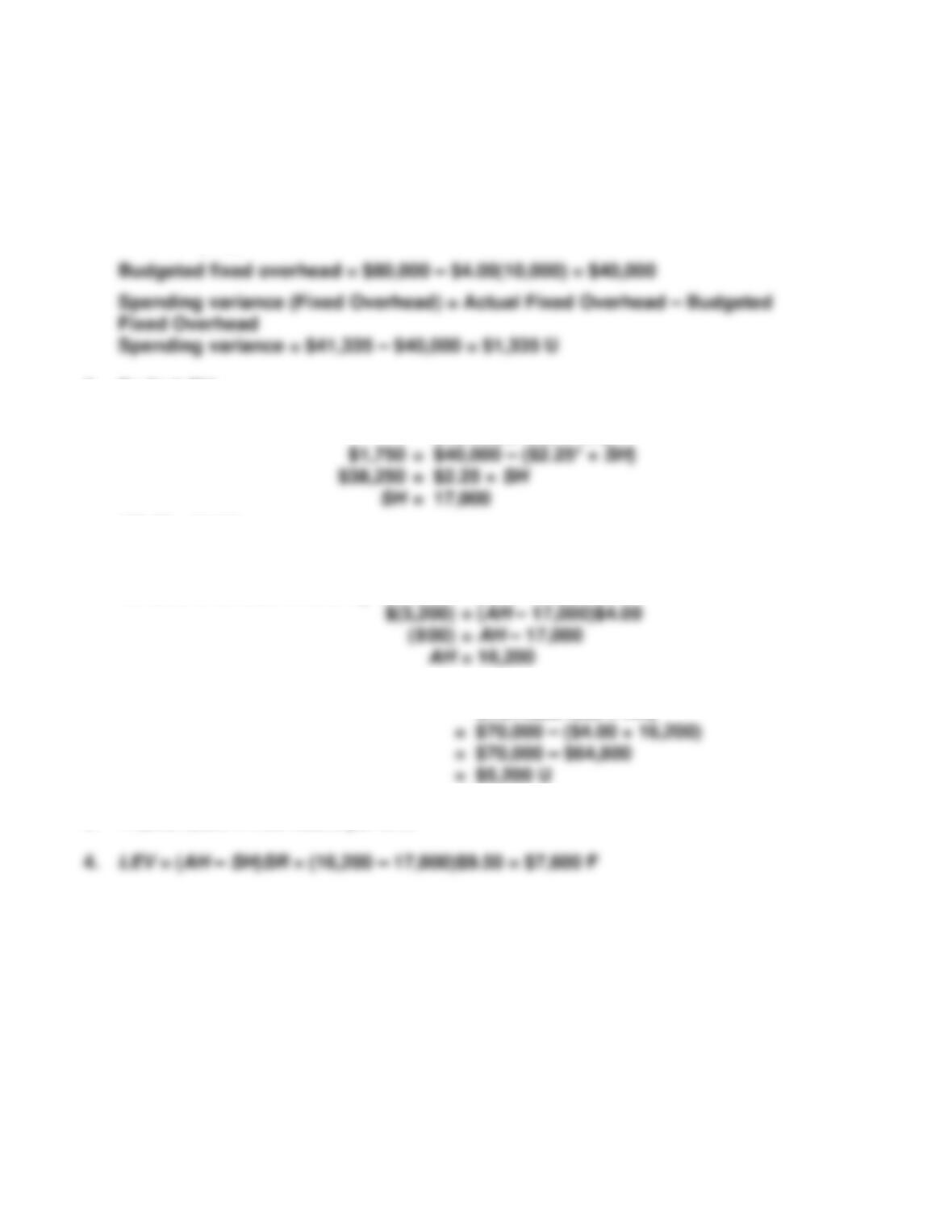
Mix variance:
Chemical AQ SM* AQ – SM SP (AQ – SM)SP
Echol ………….. 26,600 28,140 (1,540) $0.200 $ (308.00)
Protex ………… 12,880 14,070 (1,190) 0.425 (505.75)
Problem 9.37
1. The budgeted overhead costs are broken down into fixed and variable costs
by the high-low method:
SVOR = ($120,000 – $80,000)/(20,000 – 10,000)
= $4.00
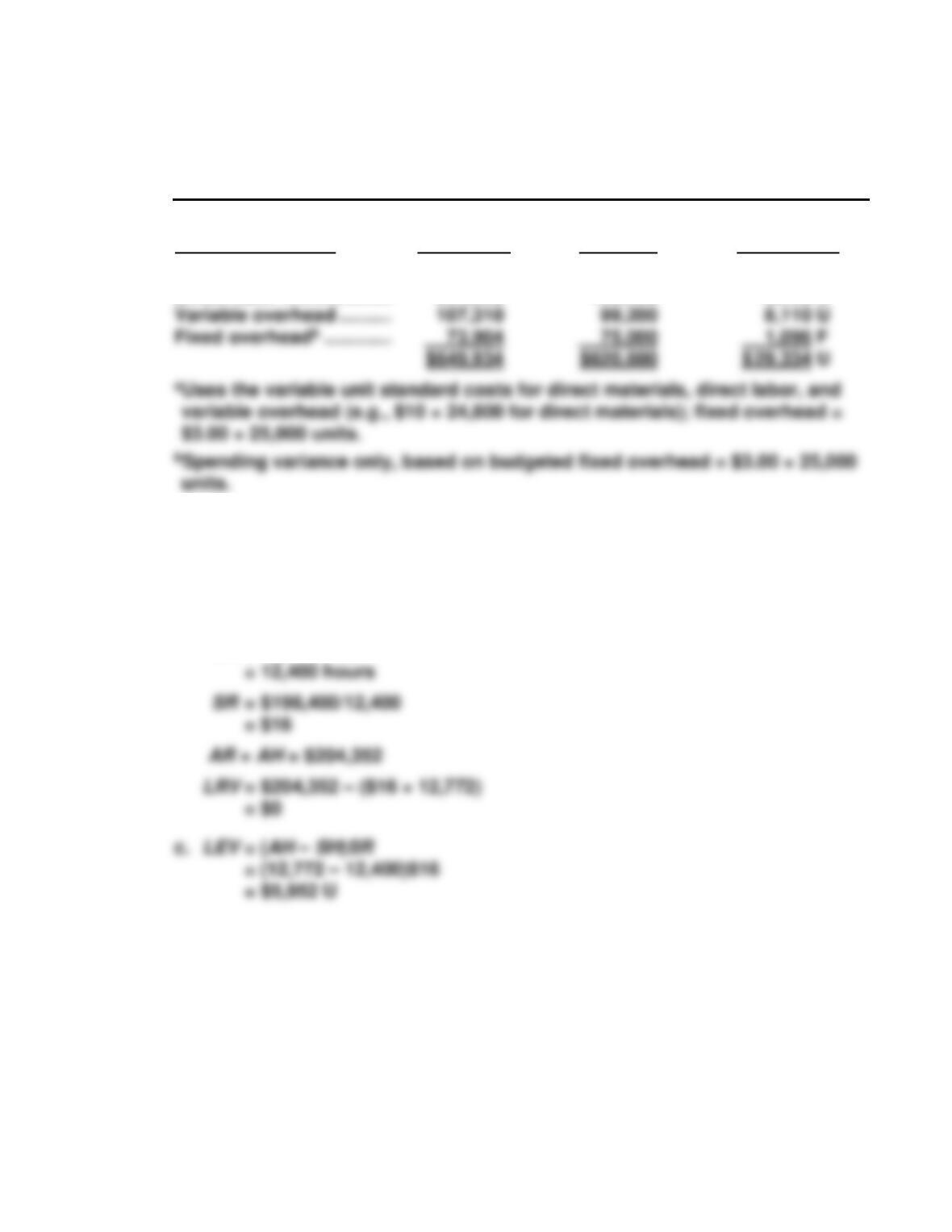
2. To find SH:
Fixed overhead volume variance = Budgeted fixed overhead – (Fixed
overhead rate × SH)
*$6.25 – $4.00
Next, the actual hours need to be found:
Variable overhead efficiency variance = (AH – SH)SVOR
Variable overhead spending variance = Actual Variable Overhead – (Variable
Overhead rate × AH)
3. 17,000/4,000 = 4.25 hours per unit
Problem 9.38
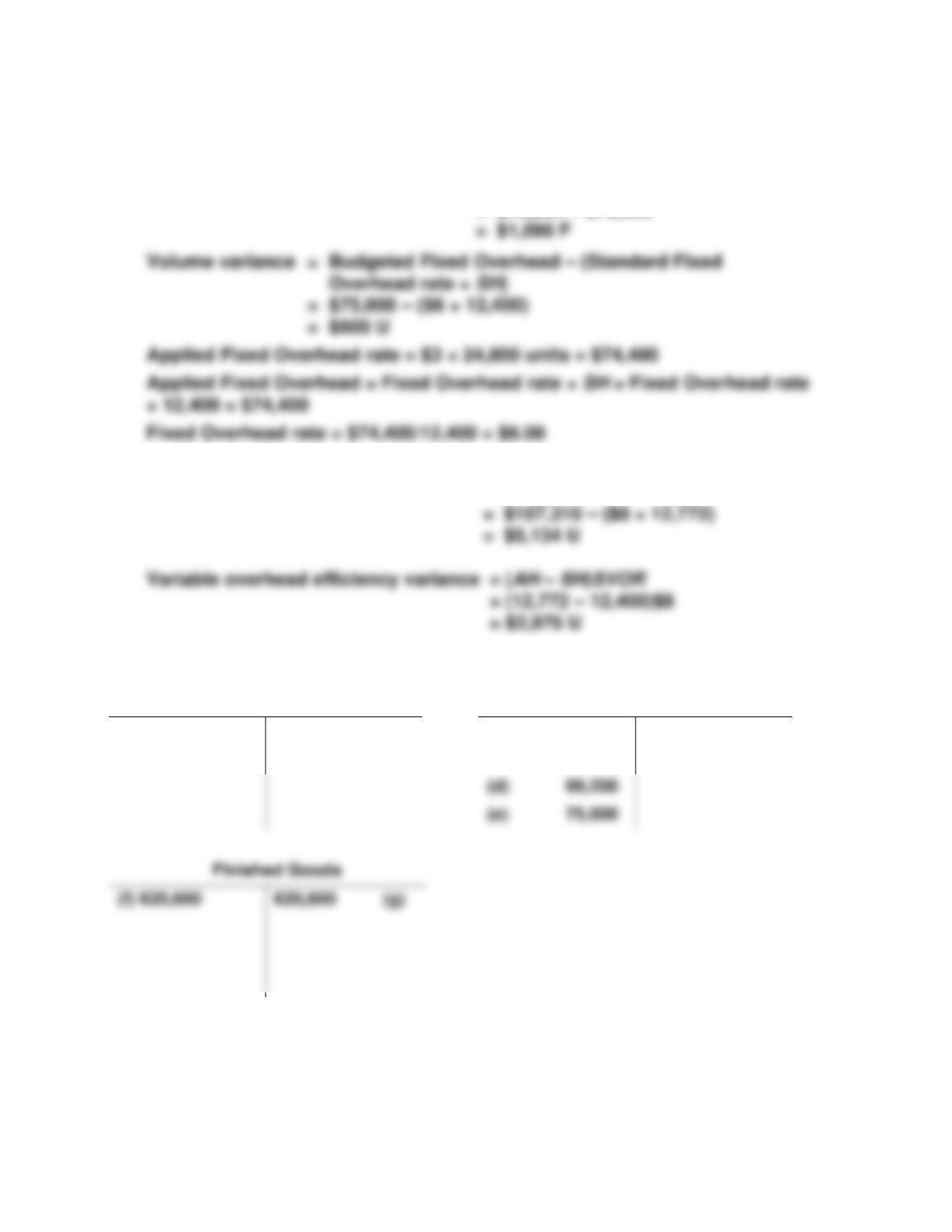
1. Ingles Company
Performance Report
Actual Budgeteda
Cost Items Costs Costs Variance
Direct materials ………….. $264,368 $248,000 $ 16,368 U
Direct labor ………………… 204,352 198,400 5,952 U
2. a. Total variance = MPV + MUV
$16,368 U = $10,168 U + MUV
MUV = $6,200 U
b. LRV = (AR – SR)AH
SH = 12,772/1.03
Problem 9.38 (Continued)
d. Spending variance (Fixed Overhead) = Actual Fixed Overhead – Budgeted
Fixed Overhead
= $73,904 – $75,000
e. Variable overhead spending variance = Actual Variable overhead – (SVOR
× AH)
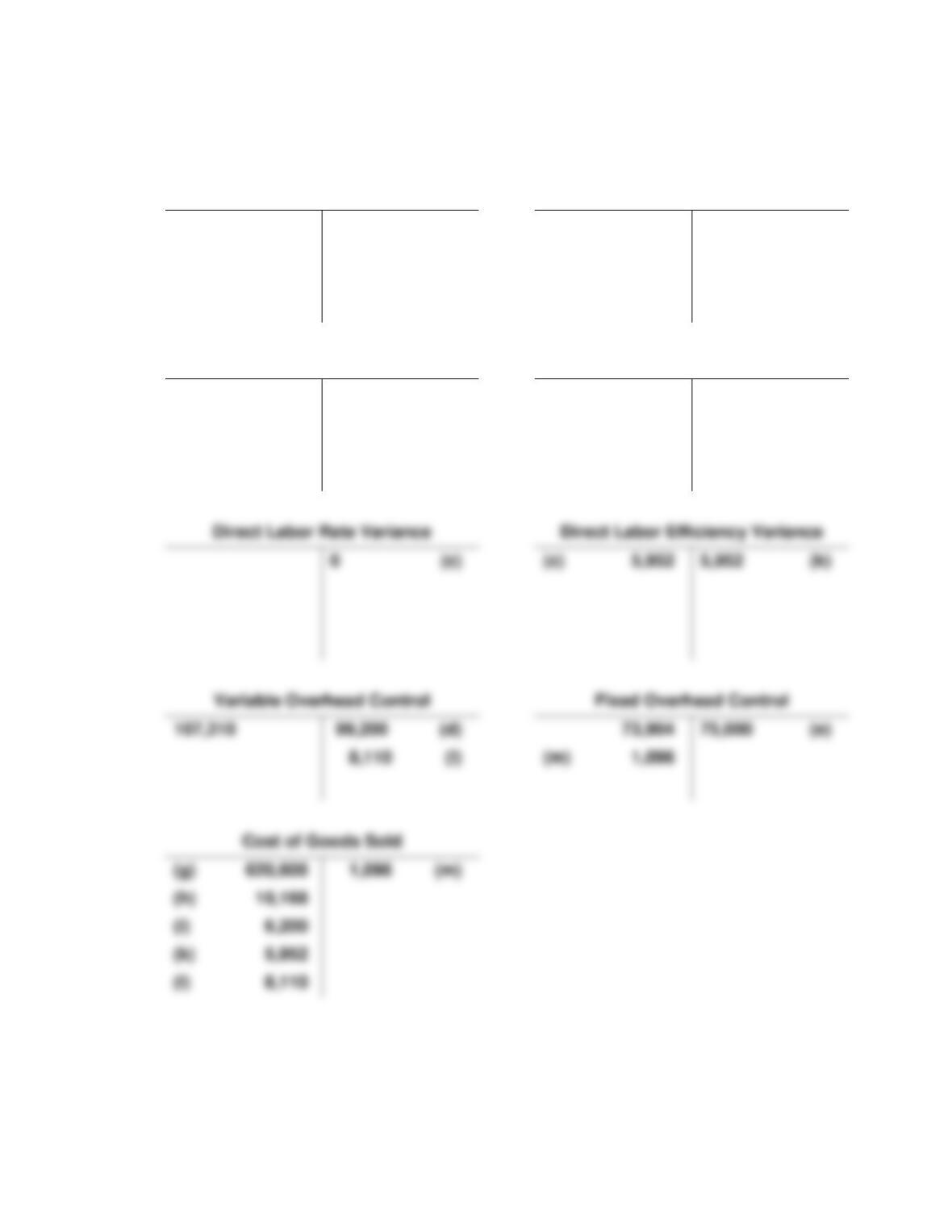
3.
Materials
Work in Process
(a) 254,200
254,200 (b)
(b) 248,000
620,600 (f)
(c) 198,400
(d) 99,200
(e) 75,000
Problem 9.38 (Concluded)
Direct Materials Price Variance
Direct Materials Usage Variance
(a) 10,168
10,168 (h)
(b) 6,200
6,200 (i)
Accounts Payable
Wages Payable
264,368 (a)
204,352 (c)
0 (c)
(c) 5,952
5,952 (k)
107,310
99,200 (d)
73,904
8,110 (l)
(m) 1,096
(g) 620,600
1,096 (m)
Problem 9.39
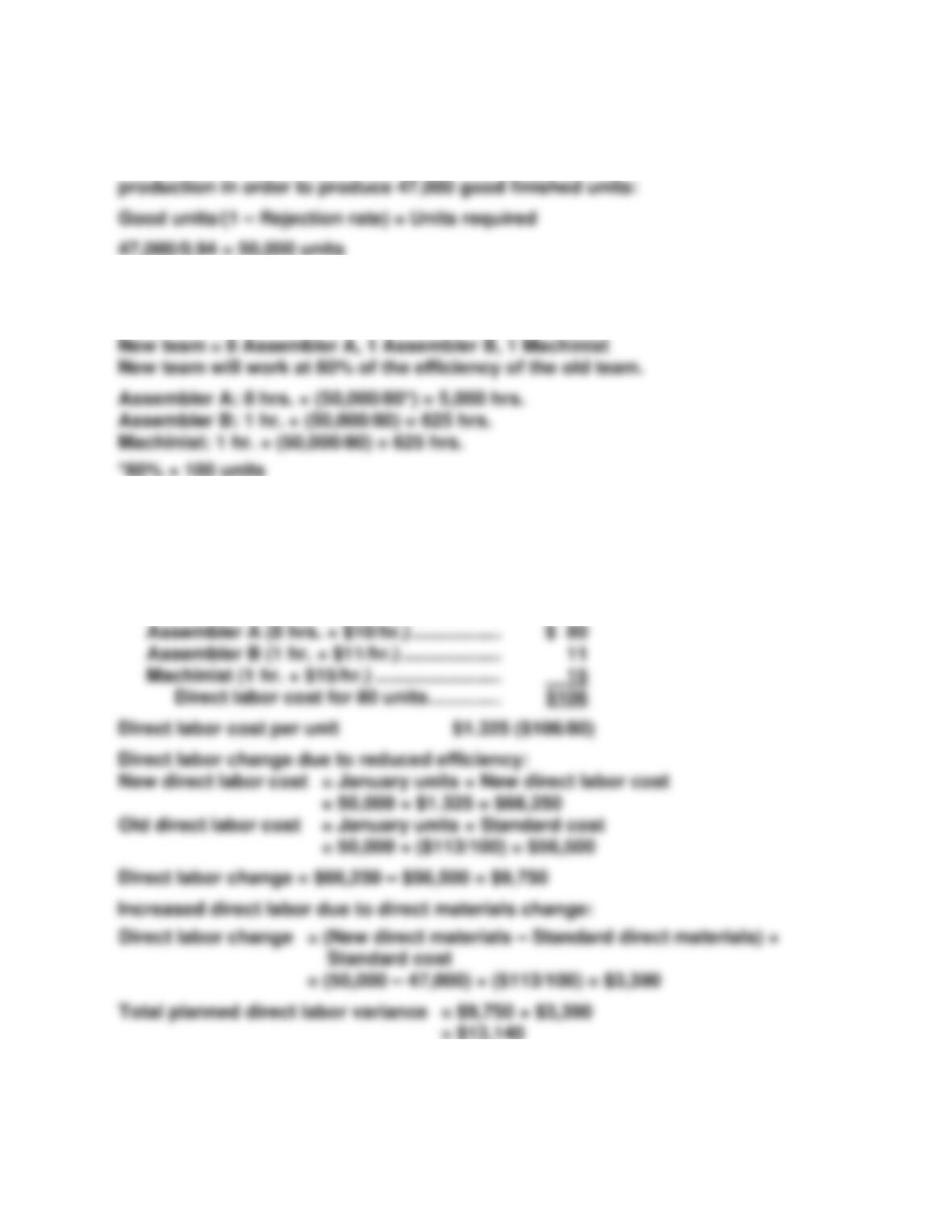
1. Tracer Company must put 50,000 units of lower-quality direct materials into
2. In order to produce 50,000 units (47,000 good units and 3,000 rejects), Tracer
Company must utilize the following labor:
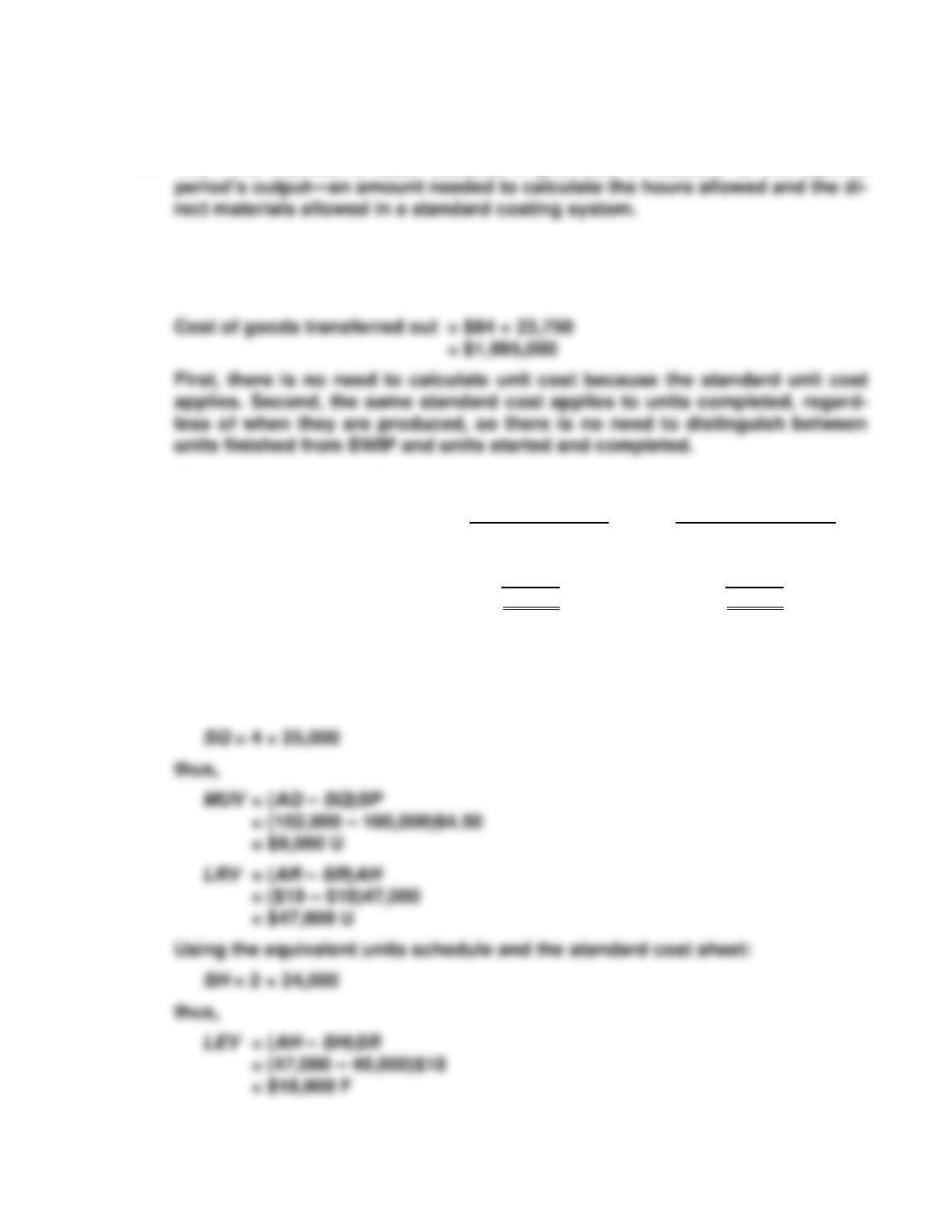
3. Tracer Company should include an additional $13,140 in its operating budget
for the planned direct labor variance. This variance consists of $3,390 for the
change in direct materials and $9,750 for the direct labor change caused by
the reduced efficiency of the new team, calculated as follows:
Cost for new team to produce 80 units:
Problem 9.40
1. The FIFO method is used because it provides a measure of the current
2. Units completed = Units started + (Units, BWIP – Units, EWIP)
= 25,000 + (1,250 – 2,500)
= 23,750
3. First, an equivalent units schedule is needed:
Direct Materials Conversion Costs
Started and completed …………. 22,500 22,500
BWIP …………………………………… 0 500
EWIP …………………………………… 2,500 1,000
Equivalent units ………………….. 25,000 24,000
MPV = (AP – SP)AQ
= ($4.25 – $4.50)102,000
= $25,500 F
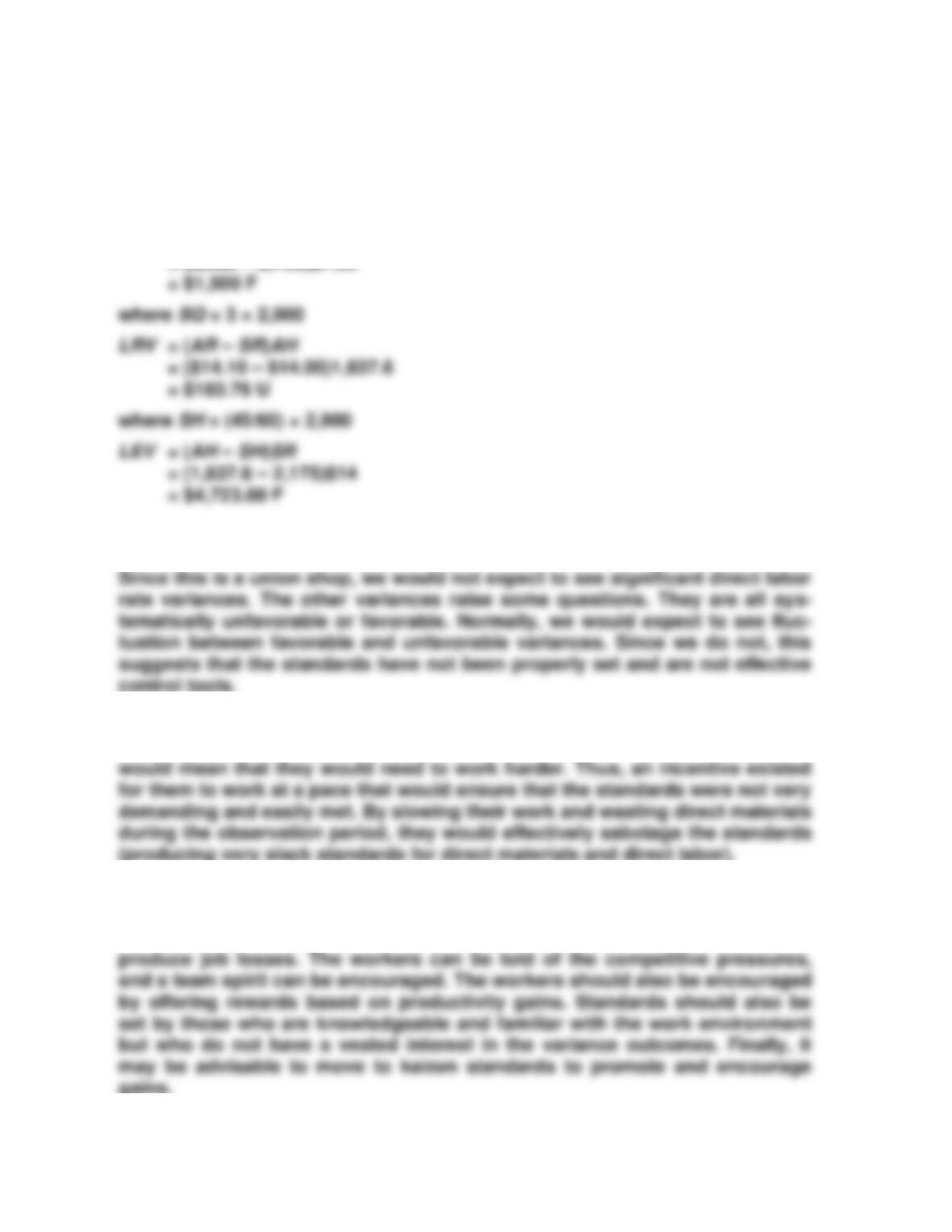
Using the equivalent units schedule and the standard cost sheet:
Problem 9.41
1. MPV = (AP – SP)AQ
= ($8.10 – $7.50)8,500
= $5,100 U
MUV = (AQ – SQ)SP
= (8,500 – 8,700)$7.50
2. Trends: The MPV is unfavorable but improving; MUV is favorable but decreas-
ing; LRV is stable and insignificant; and the LEV is favorable and improving.
3. Knowing that they were under observation during the period of setting stand-
ards might have caused the workers to believe that having tighter standards
4. To produce more accurate standards, the cooperation of workers, supervi-
sors, and the union needs to be sought. It is important to communicate to the
workers that the standards are not being set for punitive reasons and will not
CYBER RESEARCH CASE
9.42
Answers will vary.
The following problems can be assigned within CengageNOW and are auto-
graded. See the last page of each chapter for descriptions of these new assign-
ments.
• Analyzing Relationships—Practice calculating Overhead Variances using the
Four-Variance Method and journalizing the results.
• Integrative Problem—Cost Behavior, Process Costing, Standard Costing (Cov-
ering chapters 3, 6, and 9)
• Integrative Problem—Budgeting, Standard Costing, Decentralization (Covering
chapters 8, 9, and 10)