9-66. (15 min.) Benefits of Activity-Based Costing: Cawker Products.
Activity-based costing would help to clear his confusion by identifying the activities that
drive overhead costs.
In the old process, direct labor was used to move material. The costing system treats
this cost as direct labor cost and so overhead is artificially low and direct labor cost is
artificially high.
9-67. (40 min.) Choosing an Activity-Based Costing System: MTI.
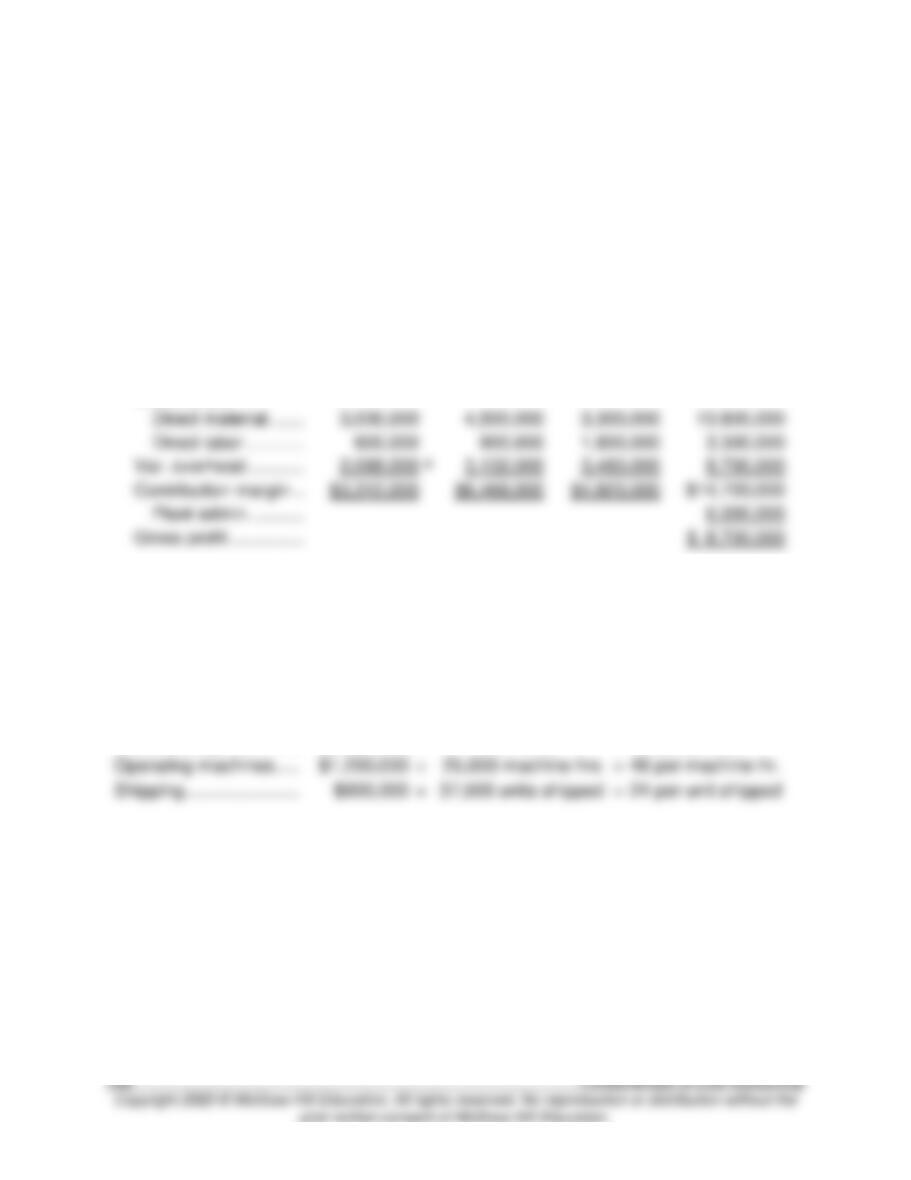
a. Total overhead to allocate is $8,700,000 (= $2,400,000 + $1,800,000 + $2,400,000 +
$1,200,000 + $900,000).
The overhead rate is $348 per machine-hour (= $8,700,000 ÷ 25,000 machine-hours).
MTI
Income Statement
M3100
M4100
M6100
Total
Sales revenue ………..
$9,000,000
$15,000,000
$13,500,000
$37,500,000
Direct costs:
4,500,000
3,300,000
Var. overhead ………..
a
Contribution margin ..
$3,312,000
$14,700,000
6,000,000
a $2,088,000 = $348 per machine-hour 6,000 machine-hours.
b. Cost driver rates:
Activity
Cost
Activity Volume
Unit Rate
Setting up machines ….
$2,400,000
÷
50 runs
=
$48,000 per run
Processing sales orders …………………………..
$1,800,000
÷
800 orders
=
2,250 per order
Warehousing…………….
$2,400,000
÷
400 units
=
6,000 per unit
Operating machines …..
$1,200,000
÷
=
48 per machine-hr.
Shipping …………………..
÷
37,500 units shipped
=
24 per unit shipped
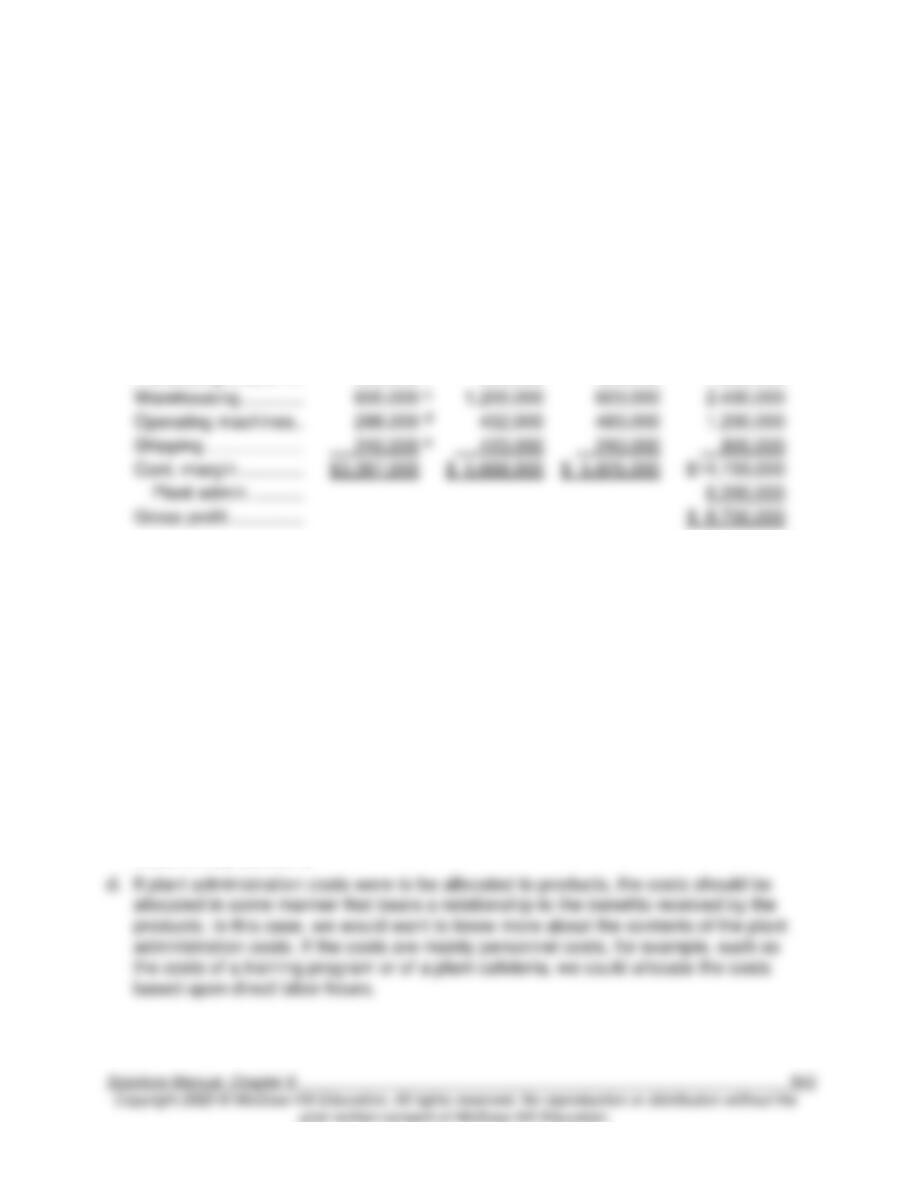
9-67. (continued)
Income Statement
M3100
M4100
M6100
Total
Sales revenue ………..
$9,000,000
$15,000,000
$13,500,000
$37,500,000
Direct costs:
Direct material. ……
3,000,000
4,500,000
3,300,000
10,800,000
Direct labor …………
600,000
900,000
1,800,000
3,300,000
Var. overhead ………..
Setting up machines .
480,000
a
960,000
960,000
2,400,000
Processing orders ….
405,000
900,000
1,800,000
Warehousing ………….
600,000
c
2,400,000
Operating machines ..
288,000
d
432,000
480,000
1,200,000
Shipping ………………..
e
Cont. margin ………….
$3,387,000
$ 5,625,000
$14,700,000
Plant admin. ……….
6,000,000
b
a $480,000 = $48,000 per run 10 runs.
b $405,000 = $2,250 per order 180 orders.
c $600,000 = $6,000 per unit 100 units.
d $288,000 = $48 per machine-hour 6,000 machine-hours.
e $240,000 = $24 per unit shipped 10,000 units shipped.
c. Although both methods yield similar product costs, the activity-based costing method
provides a more detailed breakdown of the costs. This additional information should
enable MTI management to make better decisions. For example, if MTI wants to
reduce costs, then activity-based costing will list the activities on which management
should focus its cost-reducing efforts. Further, activity-based costing should increase
the accuracy of product costs, which would help decision making (e.g., pricing,
make-or–buy decision).
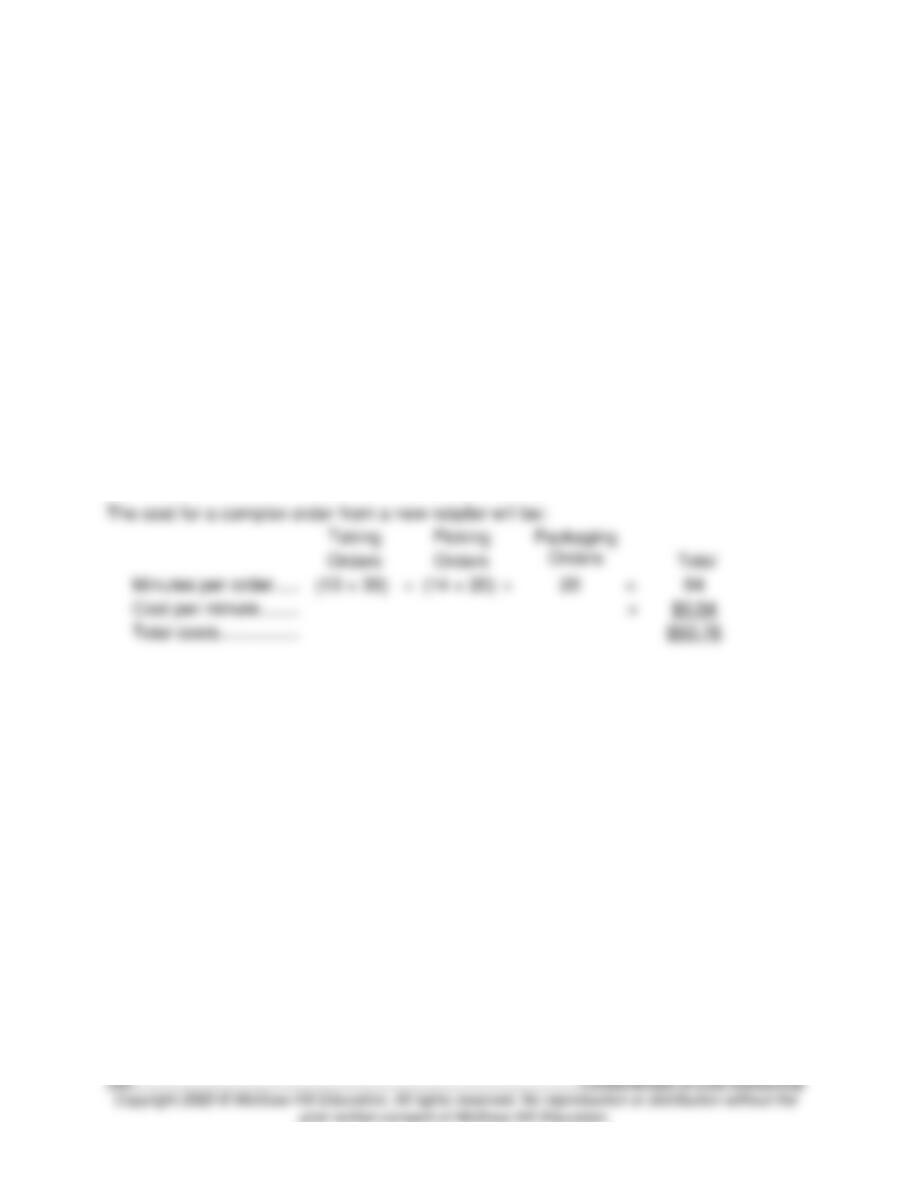
9-68. (15 min.) Time-Based ABC – Time Equations: Kim Distribution Systems.
a.
Taking order = 10 minutes + 30 minutes (if retailer is new).
b.
Picking order = 14 minutes + 20 minutes (if order is complex).
c.
From the solution to Exercise 9-52 (a):
Total cost in Distribution ..
$826,200
Total minutes availablea ..
1,530,000
Cost per minute ……………
$0.54
(= $826,200 ÷ 1,530,000)
a
15 employees × 50 weeks × 40 hours per week × 0.85 × 60 minutes per
hour.
9-69. (15 min.) Time-Based ABC: Time Equations: City Enterprises.
a.
Interviewing = 45 minutes + 120 minutes (if interviewee is a manager level)
+ 360 minutes (if interviewee is an executive level).
b.
Separation processing = 90 minutes + 180 minutes (if separation is involuntary).
c.
From the solution to Exercise 9-53 (a):
Total cost in Personnel ….
$972,000
Total minutes availablea ..
432,000
Cost per minute ……………
$2.25
(= $972,000 ÷ 432,000)
a
5 employees × 48 weeks × 30 hours per week × 60 minutes per hour .
Solutions to Integrative Cases
9-70. (50 Min) Cost Allocation and Environmental Processes—Ethical Issues:
California Circuits Company.
a.
XL-D
XL-C
Raw material …………………………….
$12.00
$14.00
Direct labor – Production …………….
$2.00
$2.00
Direct labor – Assembly ……………..
8.00
10.00
8.00
10.00
Overhead @ 120%a …………………..
12.00
12.00
Total ………………………………………..
$34.00
$36.00
a Overhead rate = Total overhead ÷ Total direct labor cost
= ($1,000,000 + $500,000) ÷ [(100,000 $10) + (25,000 $10)]
= 120% of direct labor costs
b.
XL-D
XL-C
Raw material ……………………………..
$12.00
$14.00
Direct labor – Production ……………..
$2.00
$2.00
Direct labor – Assembly ………………
8.00
10.00
8.00
10.00
Overhead – Production @ $5 per MHa
$8.00
$8.00
Overhead – Assembly @ $10 per DLHb
4.00
12.00
4.00
12.00
Total …………………………………………
$34.00
$36.00
9-70. (continued)
d.
XL-D
XL-C
Raw material …………………………………..
$12.00
$14.00
Direct labor – Production …………………..
$2.00
$2.00
Direct labor – Assembly ……………………
8.00
10.00
8.00
10.00
Overhead – Productiona
Supervision @ $8/direct labor-hour ….
$0.80
$0.80
Material handling @ 6% mat’l. cost ….
0.72
0.84
Testing @ $0.40/ test hour ……………..
1.20
1.20
Waste treatment @ $0.25/gallon ……..
2.50
0.00
Depreciation @ $2/mach. hr ……………
3.20
3.20
Shipping @ $0.05/pound ………………..
0.05
0.08
Total production overhead …………………
8.47
6.12
Overhead – Assembly @ $10/DLHb ……
4.00
4.00
Total ………………………………………………
$34.47
$34.12
a Production Department Overhead Calculations (Rate = Activity cost ÷ Driver volume):
Activity
Activity
Cost
Driver
Driver Volume
Rate
9-70. (continued)
e. This question raises the issue of costs that are missing in the typical accounting
records of the firm. In this case, the ABC system suggests that XL-C, the model that
generates no wastewater, is actually less expensive. However, as the calculations
show, the difference is relatively small.
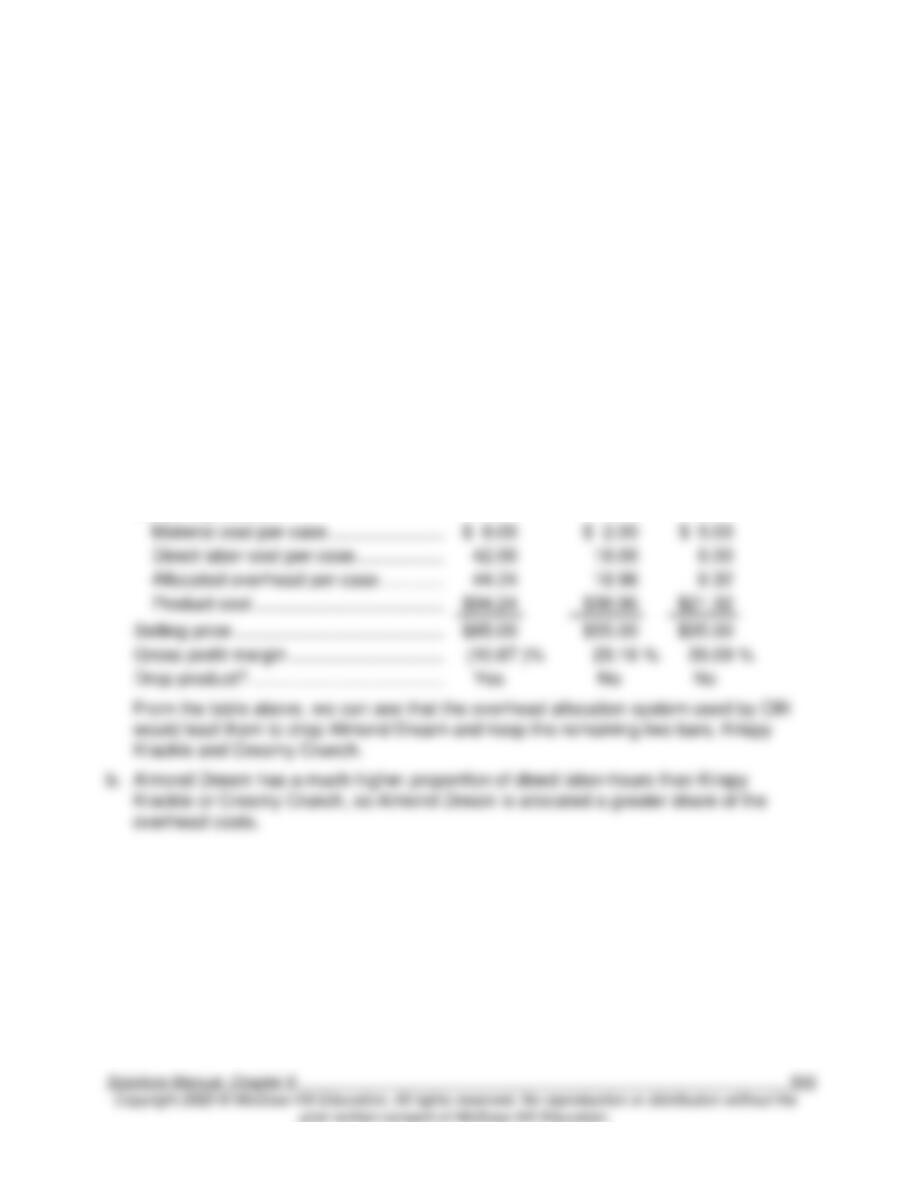
9-71. (60 min.) Distortions Caused By Inappropriate Overhead Allocation Base:
Chocolate Bars, Inc.
a.
Almond
Dream
Krispy
Krackle
Creamy
Crunch
Product costs:
Labor-hours per case ……………………
7
3
1
Total cases produced ……………………
1,000
1,000
1,000
Material cost per case …………………..
$8.00
$2.00
$9.00
Direct labor cost per case………………
$42.00
$18.00
$6.00
Labor-hours per product ………………..
7,000
3,000
1,000
Total overhead = $69,500
Total labor-hours = 11,000
Direct labor costs per hour = $6.00
Allocation rate per labor-hour = $6.32 per labor-hour (rounded)
Costs of products:
Material cost per case …………………..
Direct labor cost per case………………
42.00
18.00
Allocated overhead per case ………….
44.24
18.96
Product cost ………………………………..
Selling price ……………………………………
$85.00
$55.00
Gross profit margin ………………………….
29.16
%
39.09
%
Drop product? …………………………………
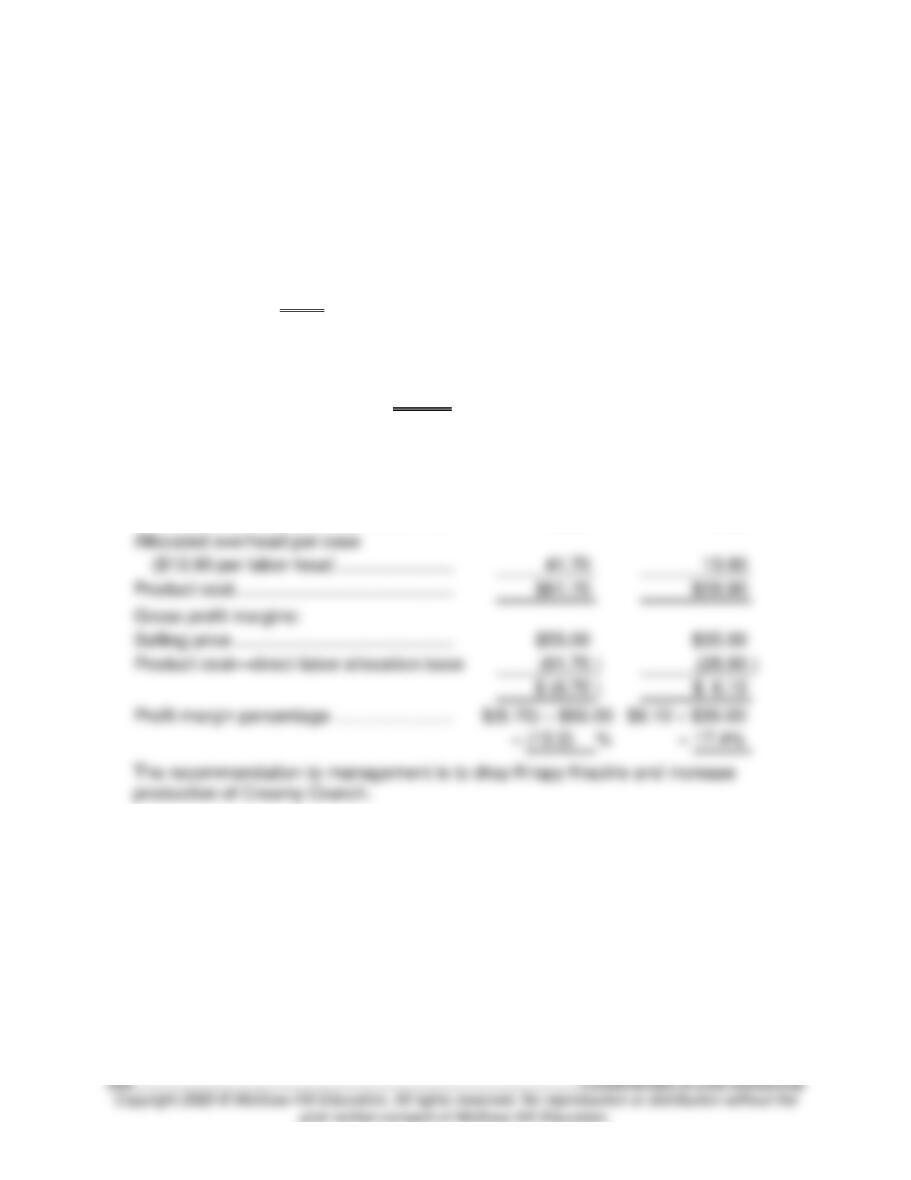
9-71. (continued)
c.
Krispy
Krackle
Creamy
Crunch
Direct labor cost per hour …………………………….
$6.00
$6.00
Direct labor-hours per case…………………………..
3
1
Total cases produced ………………………………….
1,000
2,000
Labor-hours per product ………………………………
3,000
2,000
Total labor-hours: 5,000
Allocation rate per labor-hour
=
Total overhead ÷ Total labor-hours
=
$69,500/5,000
=
$13.90
per labor-hour
Allocated production costs:
Krispy
Krackle
Creamy
Crunch
Material cost per case ………………………..
$ 2.00
$ 9.00
Direct labor cost per case …………………..
18.00
6.00
Allocated overhead per case
Product cost ……………………………………..
Selling price ……………………………………..
Product cost—direct labor allocation base
(61.70
)
(28.90
)
)
Profit margin percentage ……………………
$(6.70) ÷ $55.00
$6.10 ÷ $35.00
(12.2)
%
17.4%
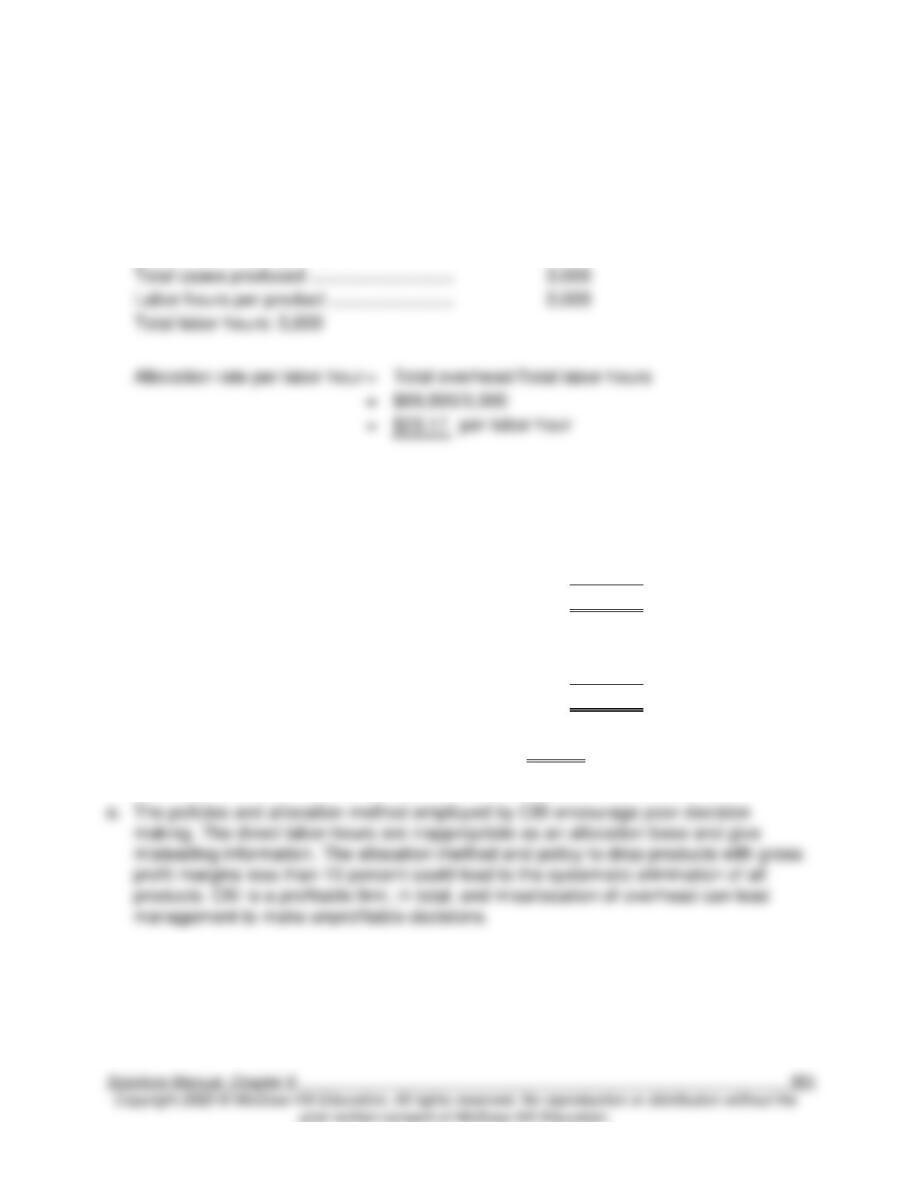
9-71. (continued)
d.
Creamy
Crunch
Direct labor cost per hour …………………..
$6.00
Direct labor hours per case …………………
1
Total cases produced ………………………..
3,000
Labor hours per product …………………….
3,000
Total labor hours: 3,000
Allocation rate per labor hour
=
Total overhead/Total labor hours
=
$69,500/3,000
=
Allocated Production Costs:
Creamy
Crunch
Material cost per case ………………………..
$ 9.00
Direct labor cost per case …………………..
6.00
Allocated overhead per case ………………
23.17
Product cost ……………………………………..
$38.17
Gross profit margins:
Selling price ……………………………………..
$35.00
Product cost—direct labor allocation base
(38.17
)
$ (3.17
)
Profit margin percentage ……………………
$(3.17) ÷ $35.00
=
(9.1)%
The recommendation to management is to drop Creamy Crunch and sell out!
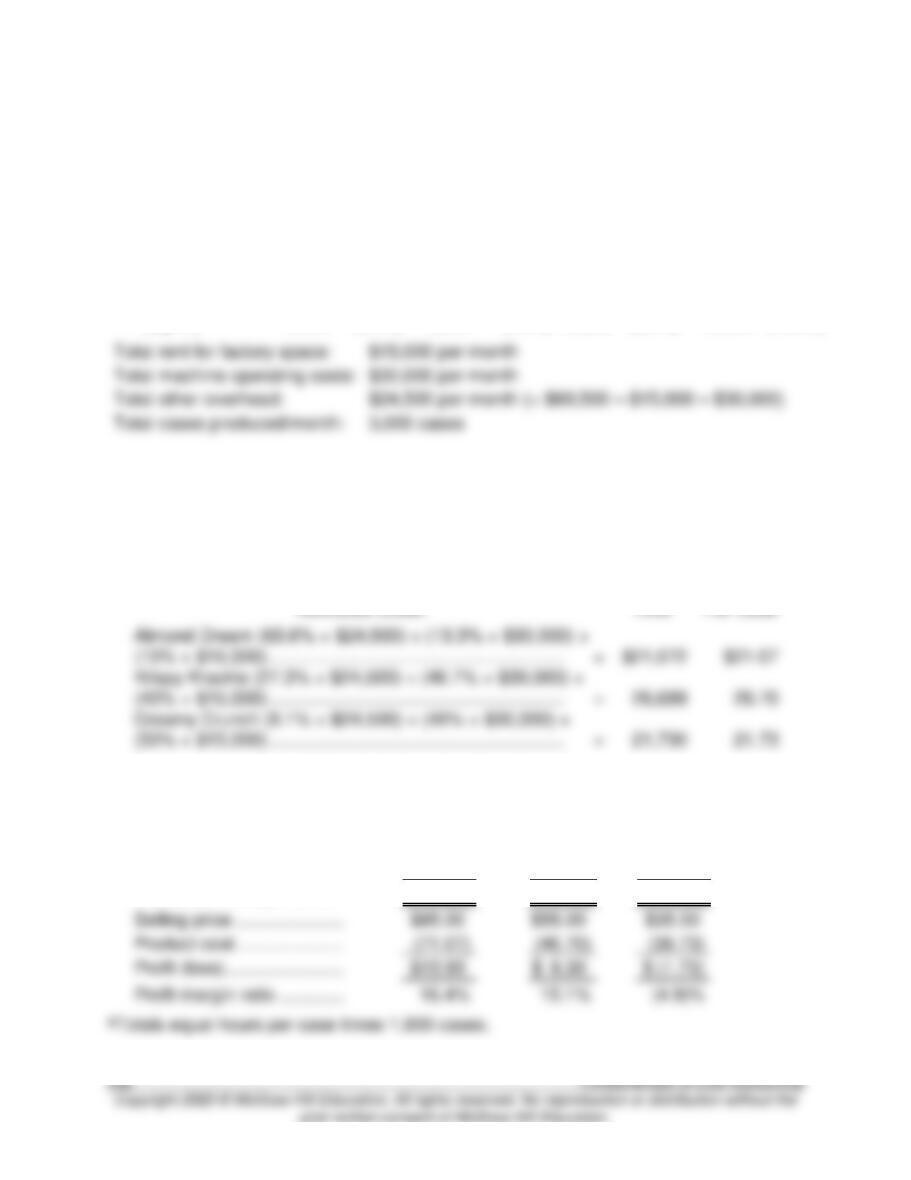
9-72. (90 min.) Multiple Allocation Bases: Chocolate Bars, Inc.
a.
Almond
Dream
Krispy
Krackle
Creamy
Crunch
Total
Total direct
labor hoursa
7,000
(63.6%)
3,000
(27.3%)
1,000
(9.1%)
11,000
(100%)
Total machine
hoursa
2,000
(13.3%)
7,000
(46.7%)
6,000
(40%)
15,000
(100%)
Factory space
(sq. ft.)
1,000
(10%)
4,000
(40%)
5,000
(50%)
10,000
(100%)
Total rent for factory space:
$15,000 per month
Total machine operating costs:
$30,000 per month
Total other overhead:
$24,500 per month (= $69,500 – $15,000 – $30,000)
Total cases produced/month:
3,000 cases
Product allocation base:
Fraction:
Labor (%)
Machine hours (%)
Factory space (%)
Almond Dream ……….
63.6%
13.3%
10%
Krispy Krackle ………..
27.3
46.7
40
Creamy Crunch ………
9.1
40.0
50
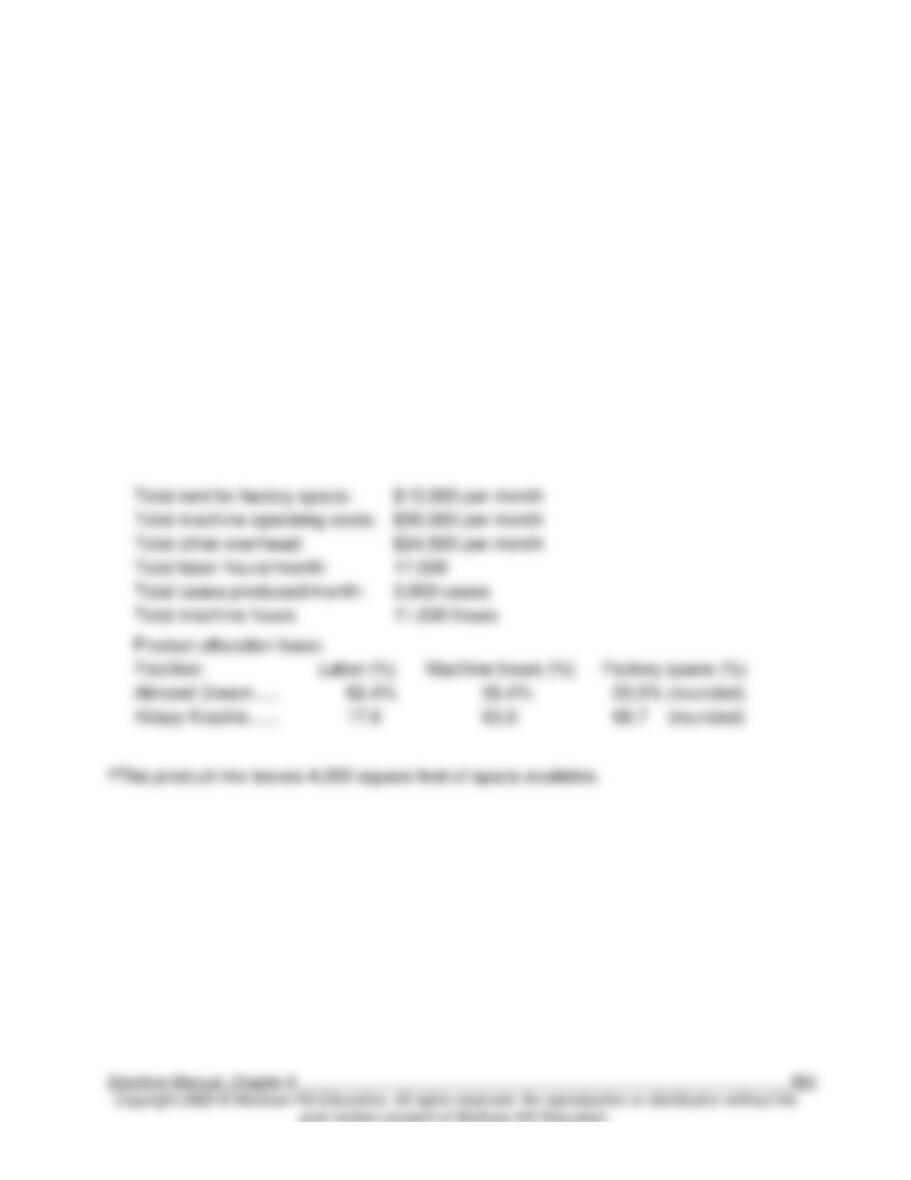
Almond Dream (63.6% × $24,500) + (13.3% × $30,000) +
(10% × $15,000) …………………………………………………..
=
Krispy Krackle (27.3% × $24,500) + (46.7% × $30,000) +
(40% × $15,000) …………………………………………………..
Allocated production costs:
Almond
Dream
Krispy
Krackle
Creamy
Crunch
Material cost …………………
$ 8.00
$ 2.00
$ 9.00
Direct labor …………………..
42.00
18.00
6.00
Allocated OH …………………
21.07
26.70
21.73
Production cost per case ..
$71.07
$46.70
$36.73
Selling price ………………….
$85.00
$55.00
$35.00
Product cost ………………….
(71.07)
(36.73)
Profit (loss)……………………
$ 8.30
$ (1.73)
Profit margin ratio ………….
16.4%
9–72. (continued)
b. Based upon the table above and the gross profit margin rule, management would
recommend dropping Creamy Crunch. Two characteristics of Creamy Crunch
appear to make it appear relatively unprofitable: one, the selling price is
comparatively low as compared to the other two products; two, Creamy Crunch uses
50% of the factory space and, thus, is allocated half of the rent costs.
c.
Almond
Dream
Krispy
Krackle
Direct labor hours per case …………..
7
3
Machine hours per case ………………
2
7
Factory space (sq. ft.)a ………………..
2,000
(33.3%)
4,000
(66.7%)
Case of output per month …………….
2,000
1,000
Labor hours required …………………..
14,000
(82.4%)
3,000
(17.6%)
Machine hours required ……………….
4,000
(36.4%)
7,000
(63.6%)
Total rent for factory space:
$15,000 per month
Total machine operating costs:
$30,000 per month
Total other overhead:
$24,500 per month
Total labor hours/month:
17,000
Total cases produced/month:
3,000 cases
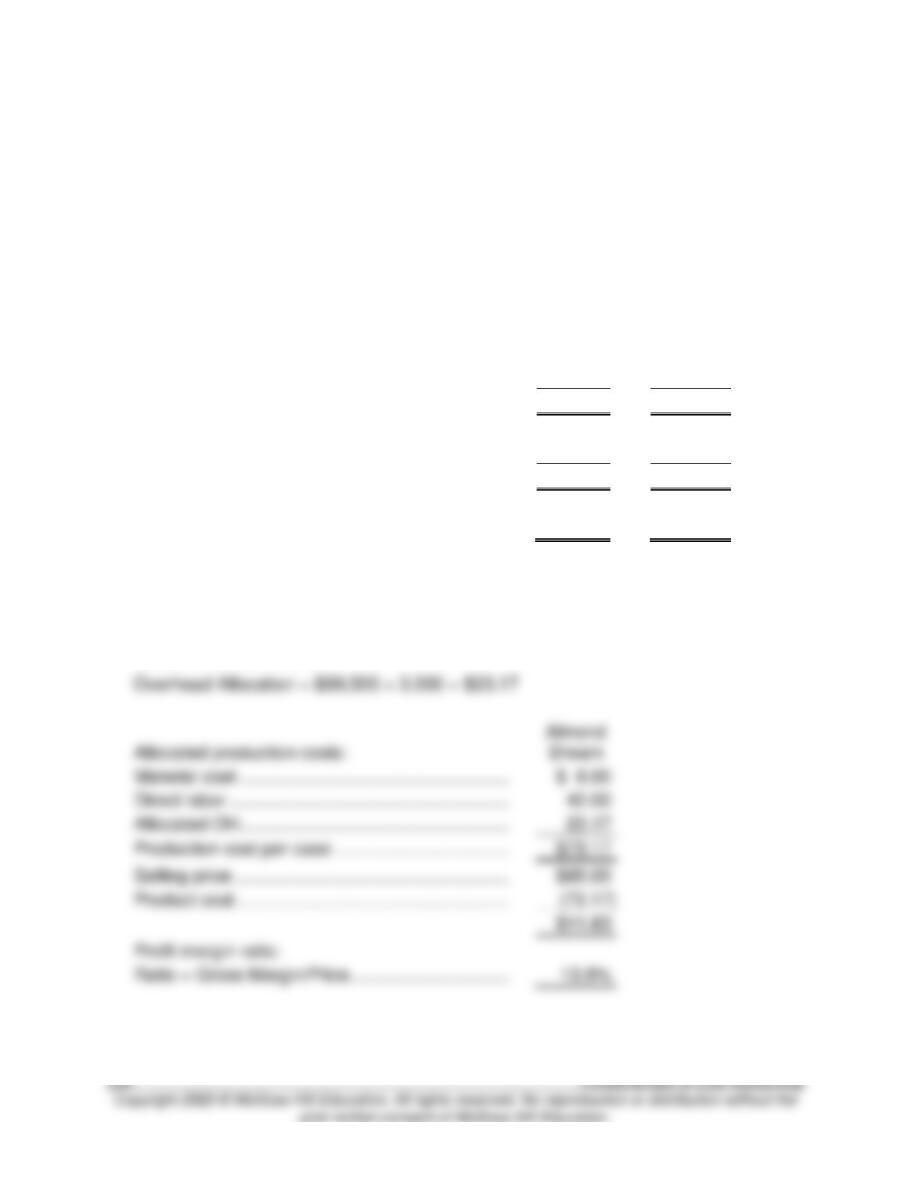
Fraction:
Almond Dream …..
36.4%
Krispy Krackle ……
9-72. (continued)
Allocated Cost:
Total
Per Case
Almond Dream (82.4% × $24,500) +
(36.4% × $30,000) + (33.3% × $15,000) …………..
=
$36,108
$18.05
Krispy Krackle (17.6% × $24,500) +
(63.6% × $30,000) + (66.7% × $15,000) …………..
=
33,392
33.39
Allocated production costs:
Almond
Dream
Krispy
Krackle
Material cost ………………………………………………
$ 8.00
$ 2.00
Direct labor ………………………………………………..
42.00
18.00
Allocated OH ………………………………………………
18.05
33.39
Production cost per case ……………………………..
$68.05
$53.39
Selling price ……………………………………………….
$85.00
$55.00
Product cost ……………………………………………….
(68.05)
(53.39)
$16.95
$ 1.61
Profit margin ratio:
Ratio = Gross Margin/Price …………………………..
19.9%
2.9%
Based on the gross profit margins of Almond Dream and Krispy Krackle,
management should drop Krispy Krackle and continue to produce Almond Dream.
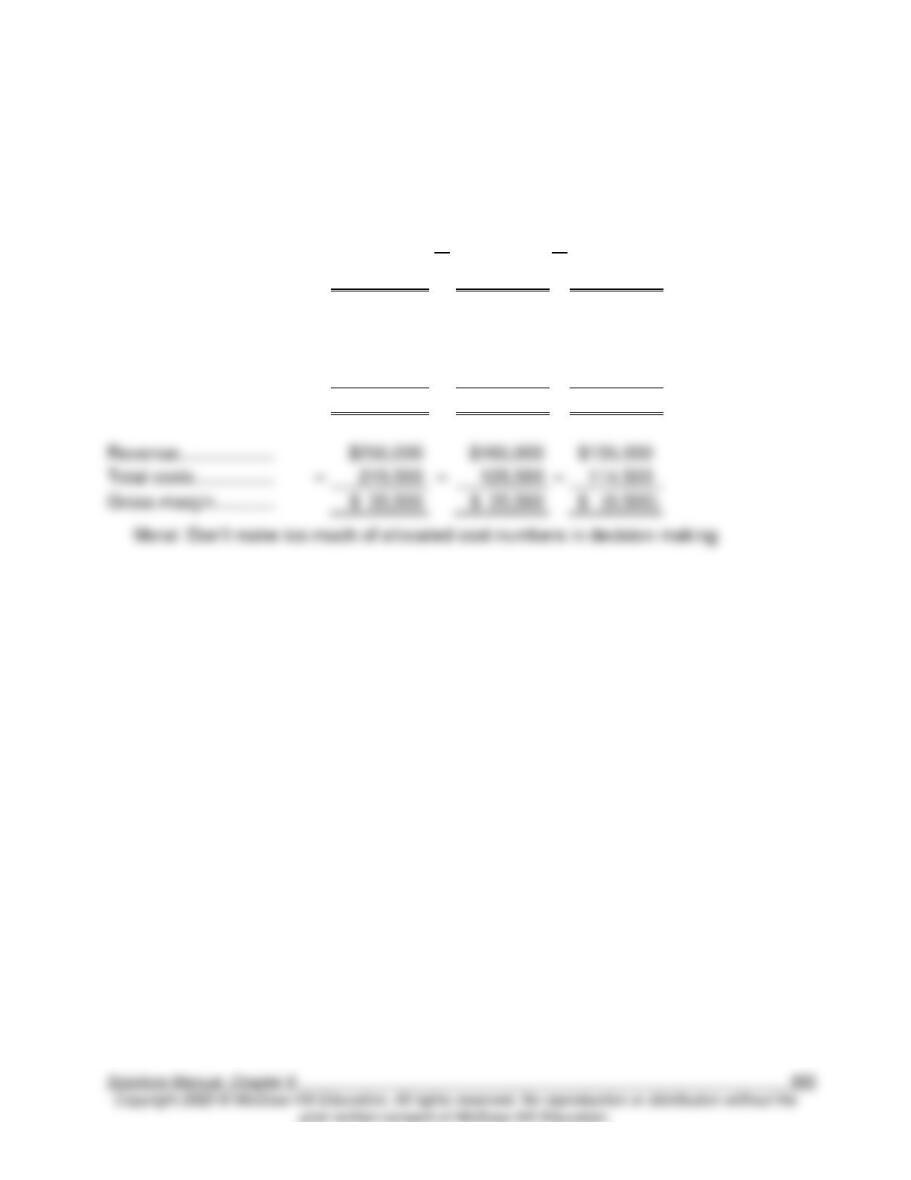
Almond Dream appears to be the most profitable product. In fact, its margin ratio is
only 13.9%, computed as follows:
Cases Produced = 3,000
Allocated production costs:
Material cost ………………………………………………
Direct labor ………………………………………………..
Allocated OH ………………………………………………
Production cost per case ……………………………..
Selling price ……………………………………………….
Product cost ……………………………………………….
Profit margin ratio:
Ratio = Gross Margin/Price …………………………..
9-72. (continued)
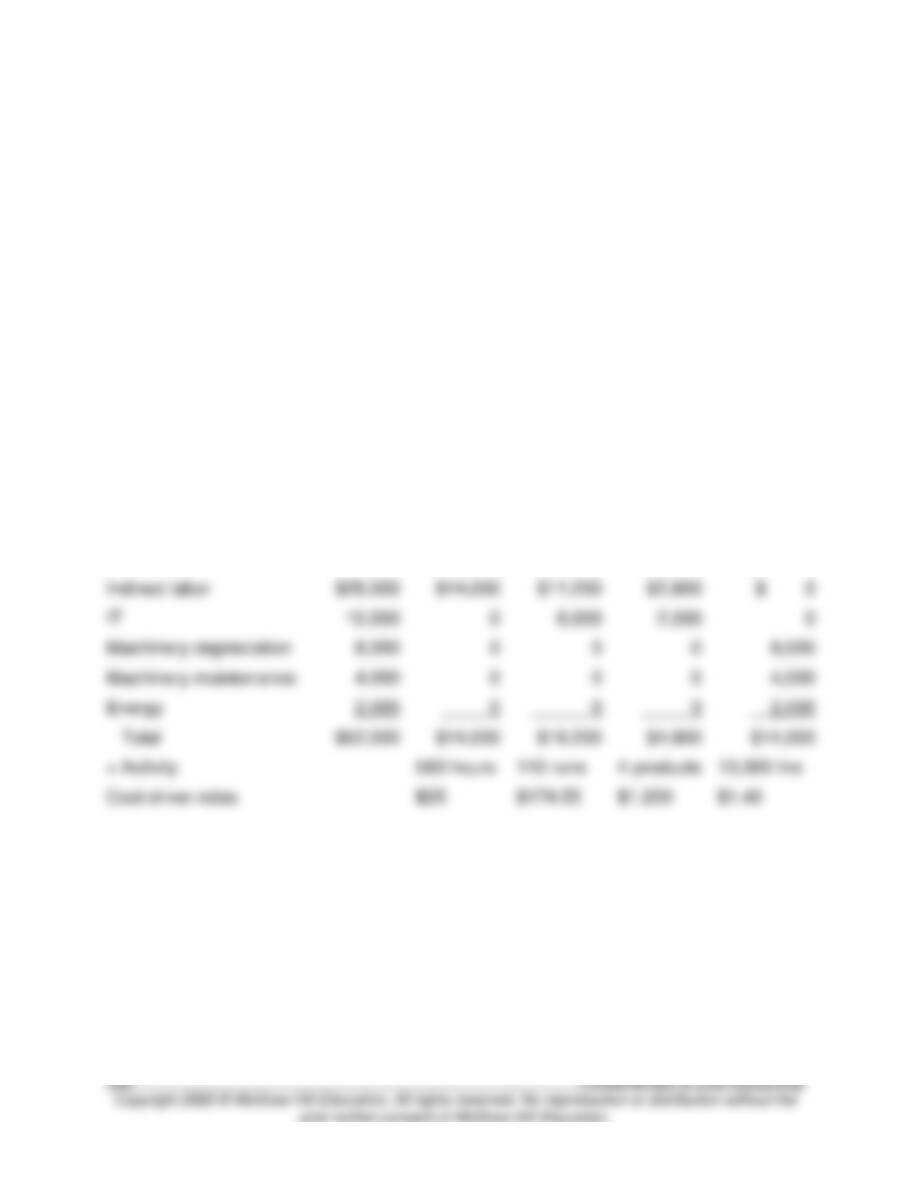
If we compute the gross margin for the three products at maximum production, we
find Almond Dream and Krispy Krackle to be equally profitable, computed as follows:
Almond
Dream
or
Krispy
Krackle
or
Creamy
Crunch
Cases …………………..
3,000
3,000
3,000
Costs
Materials …………..
$ 24,000
$ 6,000
$ 27,000
Labor ………………..
126,000
54,000
18,000
Overhead ………….
+
69,500
+
69,500
+
69,500
$219,500
$129,500
$114,500
Revenue ……………….
$165,000
$105,000
Total costs …………….
219,500
114,500
Gross margin…………
9-73. (90 min.) Activity-Based Costing: The Grape Cola Caper.
a. Percentage utilization of resource by activities:
Activity
Setups
Production
Runs
Products
Machine
Time
Indirect labor (including fringe benefits)
50%
40%
10%
0%
Information technology (IT)
0
80
20
0
Machinery depreciation
0
0
0
100
Machinery maintenance
0
0
0
100
Energy
0
0
0
100
Costs assigned to activiities:
Activity
Cost
Setups
Production
Runs
Products
Machine
Time
Indirect labor
0
Machinery depreciation
0
0
0
Machinery maintenance
0
0
0
Energy
÷ Activity
110 runs
4 products
10,000 hrs
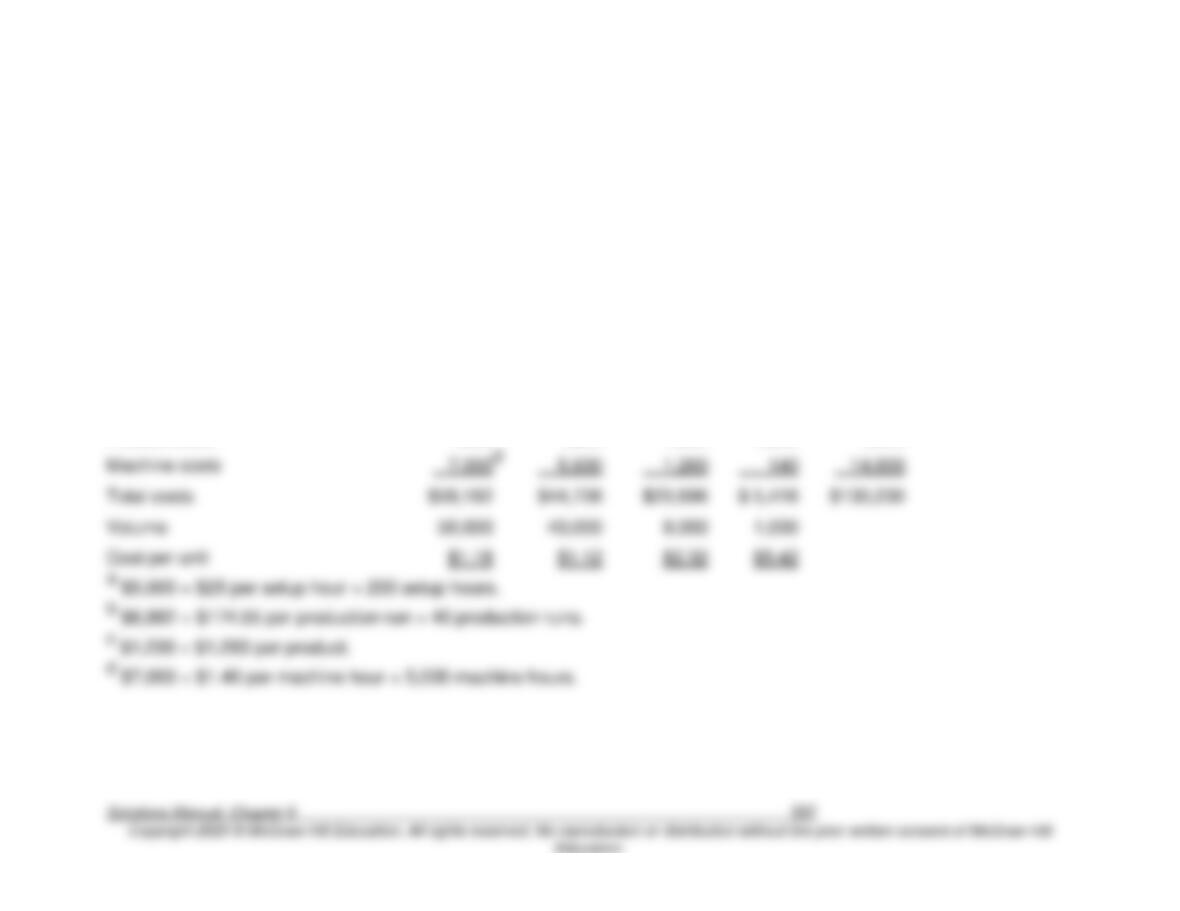
Cost driver rates
$174.55
$1,200
$1.40
9-73. (continued)
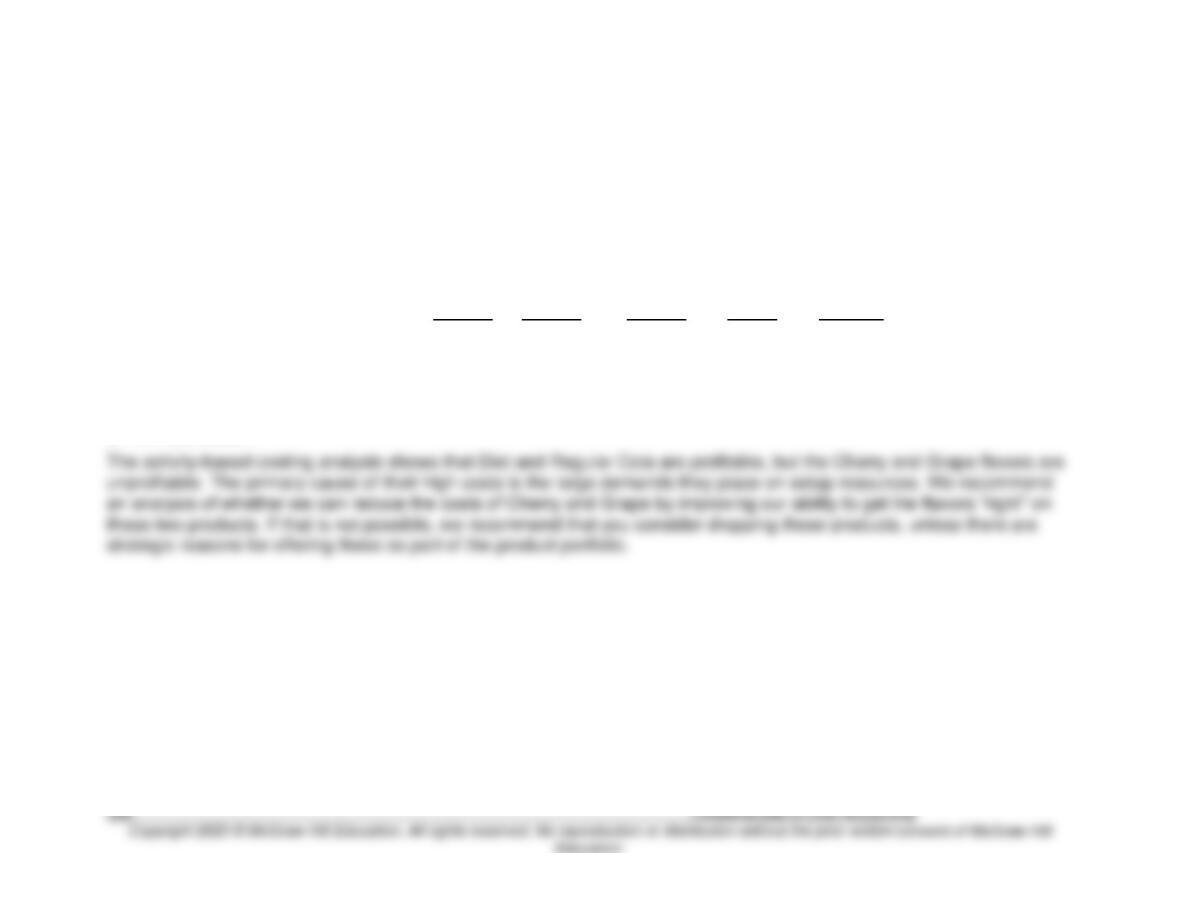
b.
Unit Costs on Cola Bottling Line
Diet
Regular
Cherry
Grape
Total
Materials
$ 25,000
$ 20,000
$ 4,680
$ 550
$ 50,230
Direct labor
10,000
8,000
1,800
200
20,000
Fringe benefits on direct labor
4,000
3,200
720
80
8,000
Setup costs
5,000
a
1,500
6,000
1,500
14,000
Production run costs
6,982
b
5,236
5,236
1,746
19,200
Product costs
1,200
c
1,200
1,200
1,200
4,800
Machine costs
d
Total costs
Volume
Cost per unit
$1.18
9-73. (continued)
c.
Monthly Report on Cola Bottling Line
Diet
Regular
Cherry
Grape
Total
Sales revenue
$75,000
$60,000
$13,950
$1,650
$150,600
Costs
59,182
44,736
20,896
5,416
130,230
Gross margin
$15,818
$15,264
$(6,946)
$(3,766)
$20,370
d. Mr. Rockness: