1. Receivables are normally classified as (1) accounts receivable, (2) notes receivable, or
(3) other receivables.
2. Dan’s Hardware should use the direct write-off method because it is a small business that has
a relatively small number and volume of accounts receivable.
5. (1) The percentage rate used is excessive in relation to the accounts written off as uncollectible;
hence, the balance in the allowance is excessive.
(2) A substantial volume of old uncollectible accounts is still being carried in the accounts
receivable account.
6. An estimate based on analysis of receivables provides the most accurate estimate of the
current net realizable value.
7. a. Sailfish Company
b. Notes Receivable
10. Cash 245,427
Accounts Receivable [$240,000 + ($240,000 × 6% × 90 ÷ 360)] 243,600
Interest Revenue ($243,600 × 9% × 30 ÷ 360) 1,827
CHAPTER 9
RECEIVABLES
DISCUSSION QUESTIONS
CHAPTER 9 Receivables
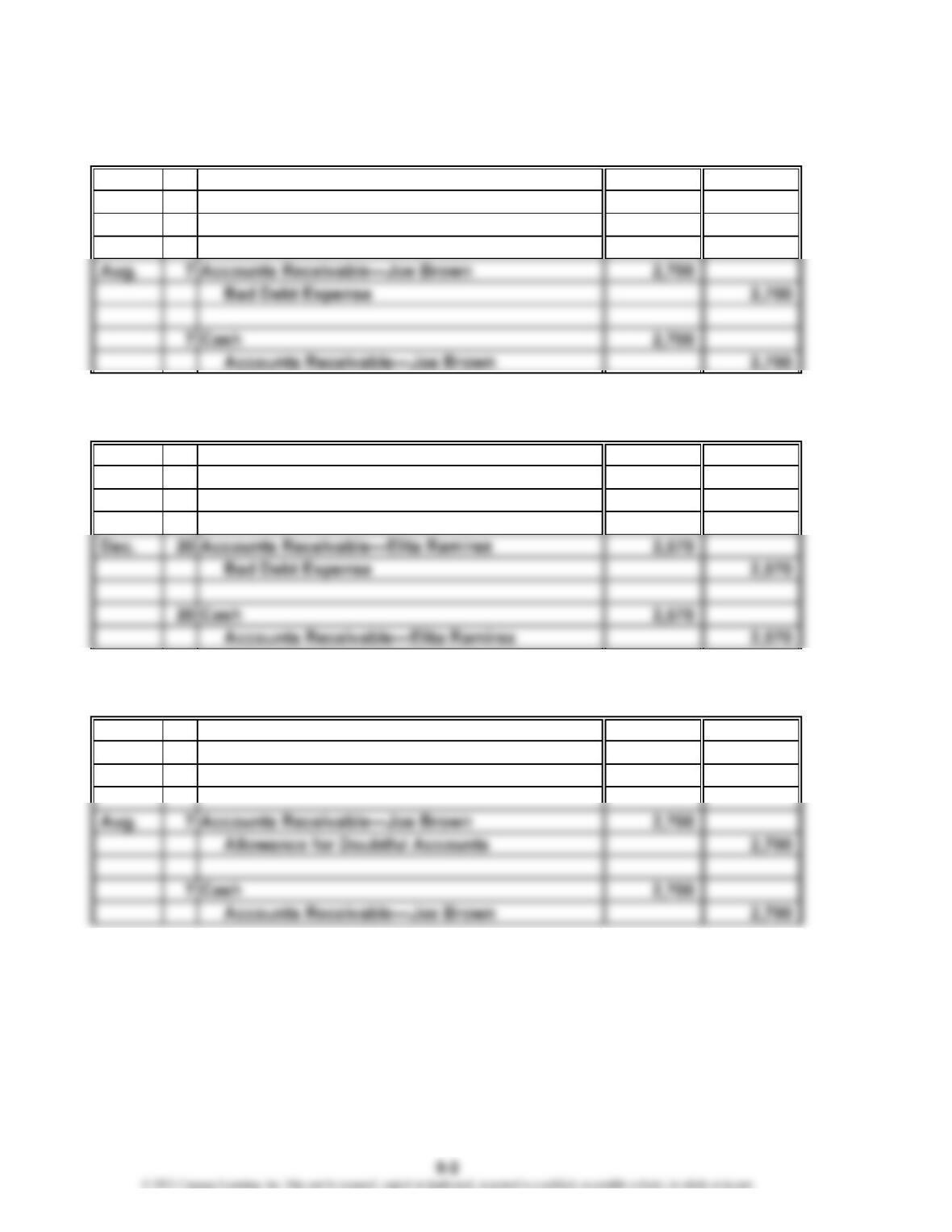
PE 9-1A
Apr. 15 Cash 1,800
Bad Debt Expense 2,700
Accounts Receivable—Joe Brown 4,500
PE 9-1B
Oct. 2 Cash 1,140
Bad Debt Expense 2,570
Accounts Receivable—Elita Ramirez 3,710
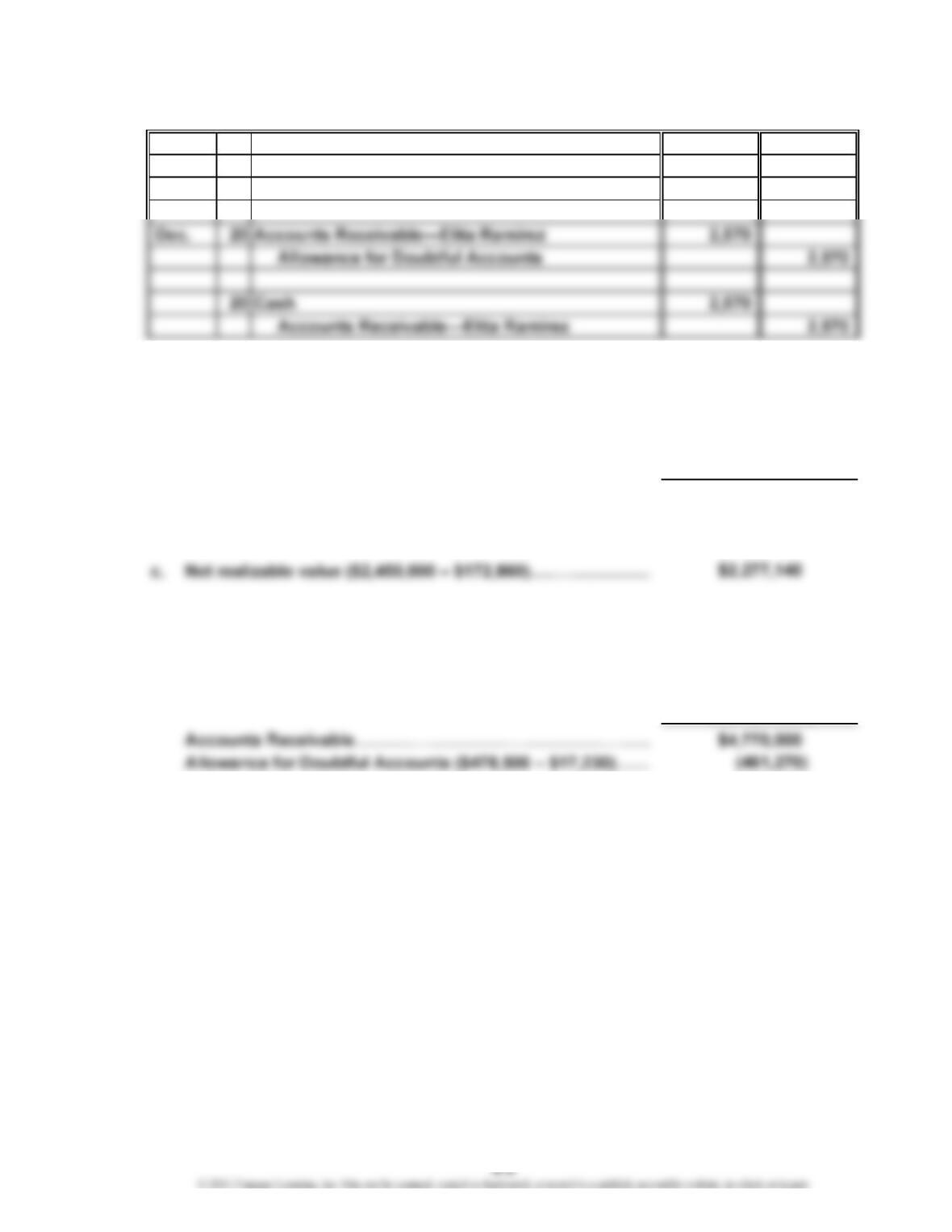
PE 9-2A
Apr. 15 Cash 1,800
Allowance for Doubtful Accounts 2,700
Accounts Receivable—Joe Brown 4,500
PRACTICE EXERCISES
CHAPTER 9 Receivables
PE 9-2B
Oct. 2 Cash 1,140
Allowance for Doubtful Accounts 2,570
Accounts Receivable—Elita Ramirez 3,710
PE 9-3A
a. $158,000 ($31,600,000 × 0.005)
b.
Accounts Receivable……………………………………………
…
Allowance for Doubtful Accounts ($14,860 + $158,000)……
Bad Debt Expense………………………………………………
…
…
PE 9-3B
a. $478,500 ($63,800,000 × 0.0075)
b.
…
Bad Debt Expense………………………………………………
…
c. Net realizable value ($4,770,000 – $461,270)…………………
…
$4,308,730
Adjusted Balance
$2,450,000
158,000
(172,860)
478,500
Debit (Credit)
Debit (Credit)
Adjusted Balance
CHAPTER 9 Receivables
PE 9-4A
a. $235,140 ($250,000 – $14,860)
b.
Accounts Receivable……………………………………………
…
Allowance for Doubtful Accounts………………………………
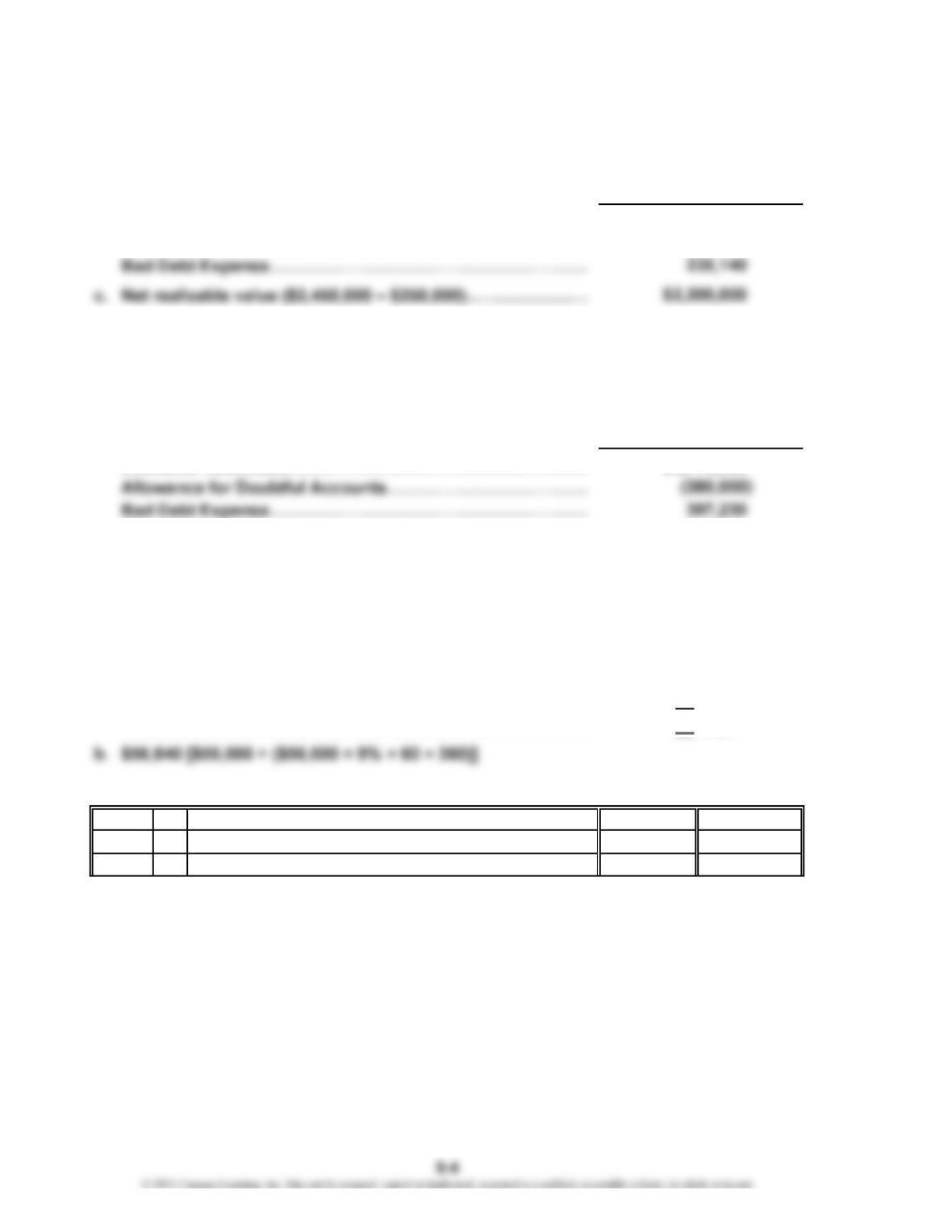
PE 9-4B
a. $397,230 ($380,000 + $17,230)
b.
…
c. Net realizable value ($4,770,000 – $380,000)…………………
…
PE 9-5A
a. The due date for the note is September 21, determined as follows:
July …………………………………………………………….……
…
8 days (31 – 23)
August …………………………………………………………….
…
31 days
September …………………………………………………………
…
21
Total…………………………………………………………………
…
60 days
c.
Sept. 21 Cash 56,840
Notes Receivable 56,000
Interest Revenue 840
$4,390,000
Adjusted Balance
Debit (Credit)
Adjusted Balance
$2,450,000
(250,000)
Debit (Credit)
…
CHAPTER 9 Receivables
PE 9-5B
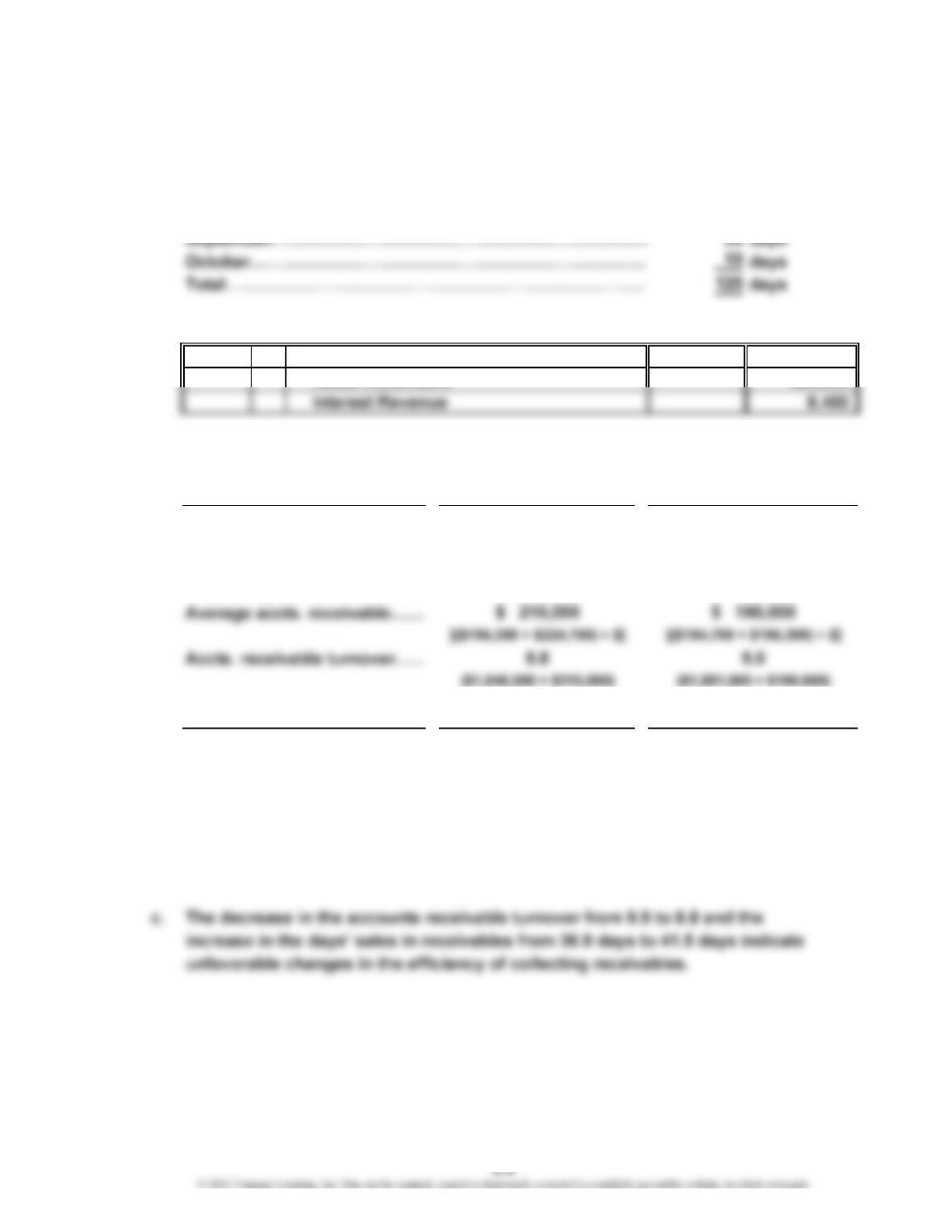
a. The due date for the note is October 10, determined as follows:
June…………………………………………………………………
…
18 days (30 – 12)
July…………………………………………………………………
…
31 days
August……………………………………………………………… 31 days
b. $428,400 [$420,000 + ($420,000 × 6% × 120 ÷ 360)]
c. Oct. 10 Cash 428,400
PE 9-6A
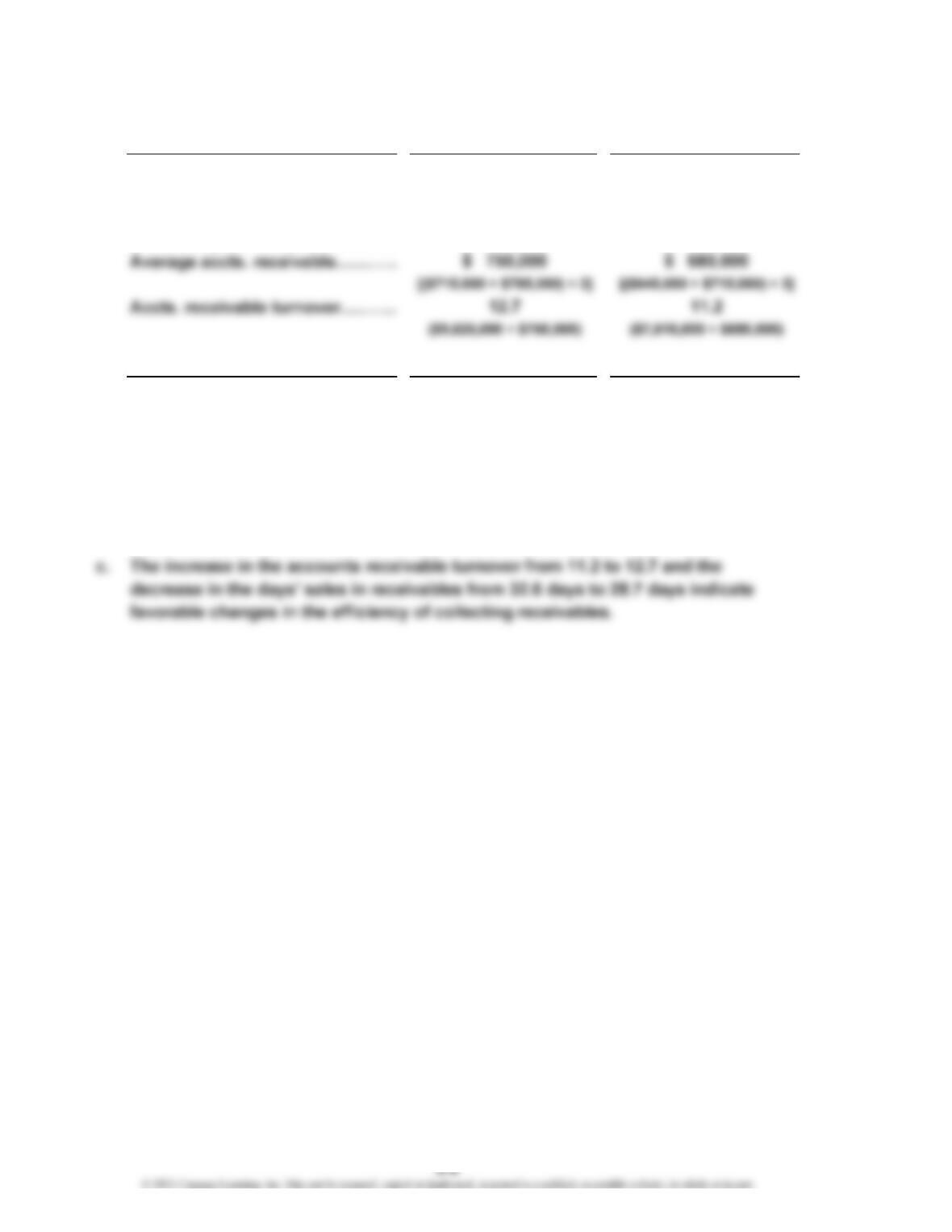
a.
Sales……………………………
…
Accounts receivable:
Beginning of year…………
…
End of year…………………
…
b.
Sales……………………………
…
Average daily sales……………
Average accts. receivable……
Days’ sales in receivables……
$ 224,700 $ 195,300
$ 210,000 $ 190,000
$ 5,063.0 $ 5,153.4
($1,848,000 ÷ 365 days) ($1,881,000 ÷ 365 days)
($210,000 ÷ $5,063.0) ($190,000 ÷ $5,153.4)
[($195,300 + $224,700) ÷ 2] [($184,700 + $195,300) ÷ 2]
41.5 36.9
$1,848,000 $1,881,000
Turnover 20Y2 20Y1
$1,848,000 $1,881,000
Days’ Sales in Receivables 20Y2
20Y1
$ 195,300 $ 184,700
CHAPTER 9 Receivables
PE 9-6B
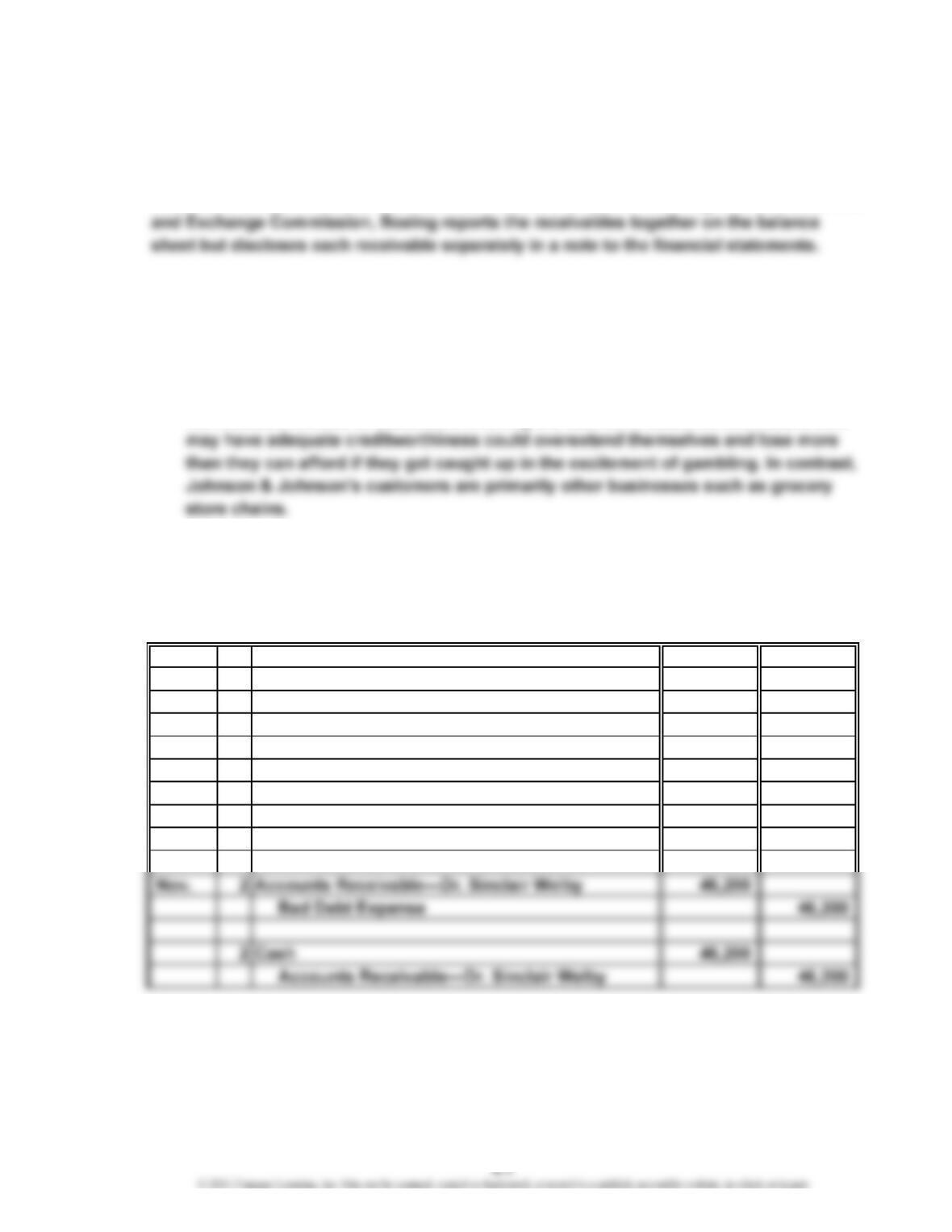
a.
Sales…………………………………
…
Accounts receivable:
Beginning of year………………
End of year………………………
b.
Sales…………………………………
…
Average daily sales………………
…
Average accts. receivable………
…
Days’ sales in receivables………
…
$ 715,000 $ 645,000
Accounts Receivable Turnover 20Y9 20Y8
$9,525,000 $7,616,000
Days’ Sales in Receivables
$9,525,000 $7,616,000
20Y9
28.7 32.6
($9,525,000 ÷ 365 days) ($7,616,000 ÷ 365 days)
$ 750,000 $ 680,000
$ 785,000 $ 715,000
20Y8
$ 26,095.9 $ 20,865.8
($750,000 ÷ $26,095.9) ($680,000 ÷ $20,865.8)
[($715,000 + $785,000) ÷ 2] [($645,000 + $715,000) ÷ 2]
…
CHAPTER 9 Receivables
Ex. 9-1
Accounts receivable from the U.S. government are significantly different from receivable
s
from commercial aircraft carriers such as Delta and United. In its filing with the Securities
Ex. 9-2
a. MGM Resorts International: 12.1% ($90,775,000 ÷ $747,981,000)
b. Johnson & Johnson: 1.7% ($248,000,000 ÷ $14,346,000,000)
c. Casino operations experience greater bad debt risk because it is difficult to control
the creditworthiness of customers entering the casino. In addition, individuals who
Note to Instructors: Approximately one-half of MGM’s receivables are related to its
casino operations.
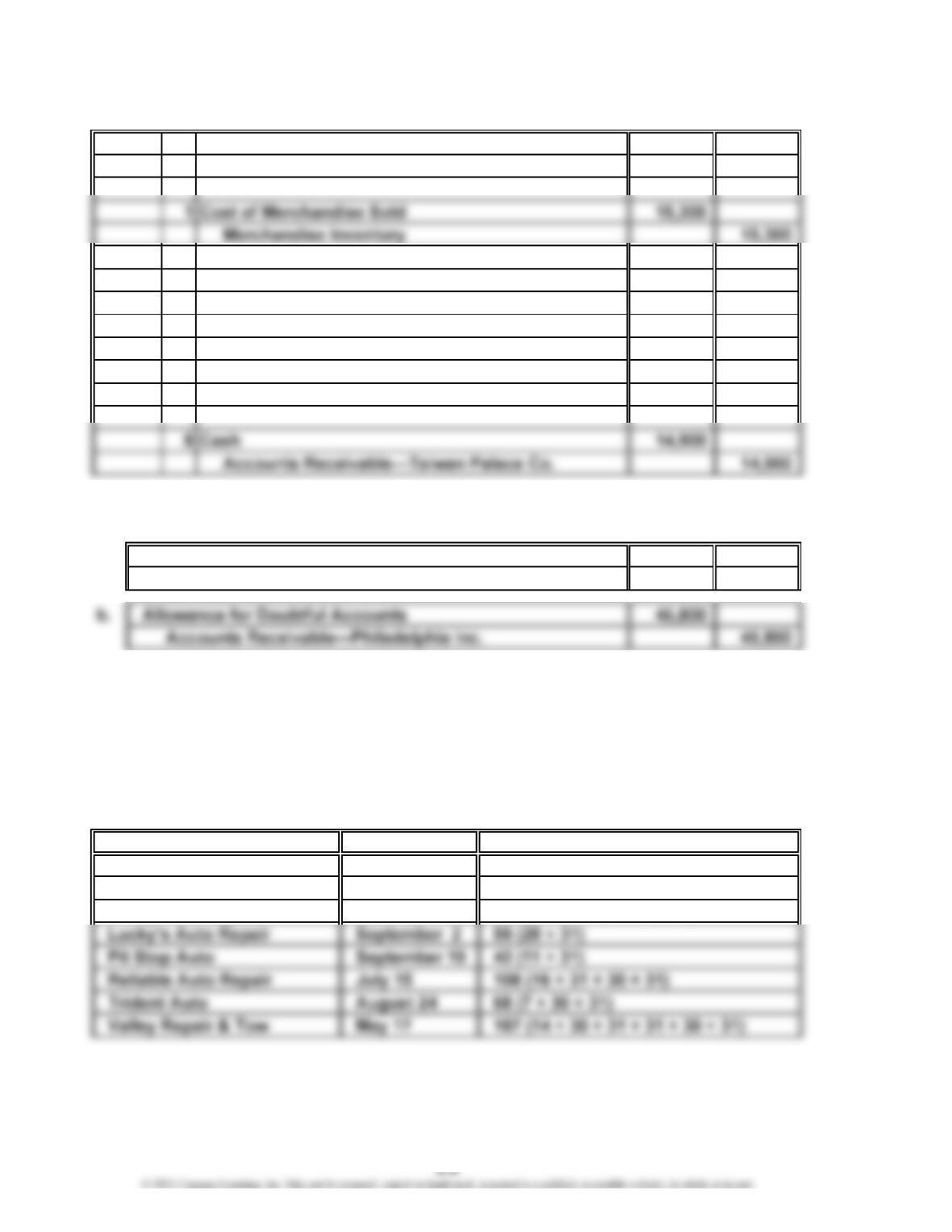
Ex. 9-3
Jan. 19 Accounts Receivable—Dr. Sinclair Welby 77,000
Sales 77,000
19 Cost of Merchandise Sold 52,600
Merchandise Inventory 52,600
July 7 Cash 30,800
Bad Debt Expense 46,200
Accounts Receivable—Dr. Sinclair Welby 77,000
EXERCISES
CHAPTER 9 Receivables
Ex. 9-4
May 1 Accounts Receivable—Taiwan Palace Co. 25,800
Sales 25,800
Aug. 30 Cash 10,900
Allowance for Doubtful Accounts 14,900
Accounts Receivable—Taiwan Palace Co. 25,800
Dec. 8 Accounts Receivable—Taiwan Palace Co. 14,900
Allowance for Doubtful Accounts 14,900
Ex. 9-5
a. Bad Debt Expense 45,800
Accounts Receivable—Philadelphia Inc. 45,800
Ex. 9-6
a. $162,000 ($32,400,000 × 0.0050) c. $243,000 ($32,400,000 × 0.0075)
b. $155,100 ($128,000 + $27,100) d. $261,100 ($279,000 – $17,900)
Ex. 9-7
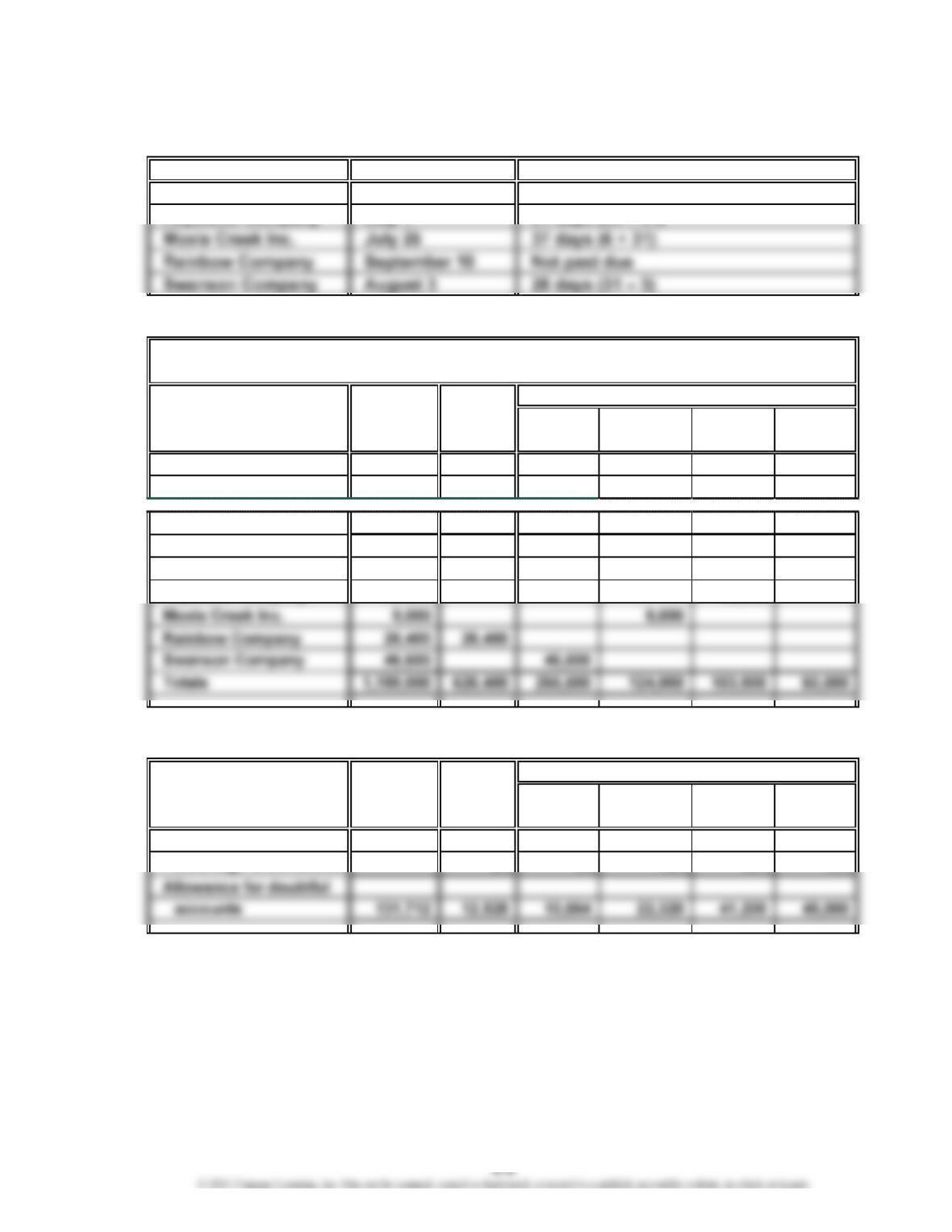
Avalanche Auto
Bales Auto
Derby Auto Repair
June 23
84 (23 + 30 + 31)
20 (31 – 11)
130 (7 + 31 + 31 + 30 + 31)
Account Due Date
August 8
October 11
Number of Days Past Due
CHAPTER 9 Receivables
Ex. 9-8
a.
Customer
Conover Industries
b.
Not Past Over
Customer Balance Due 1–30 31–60 61–90 90
Academy Industries Inc. 3,000 3,000
Ascent Company 4,500 4,500
Zoot Company 5,000 5,000
Subtotals 1,050,000 600,000 220,000 115,000 85,000 30,000
Conover Industries 30,000 30,000
Keystone Company 18,000 18,000
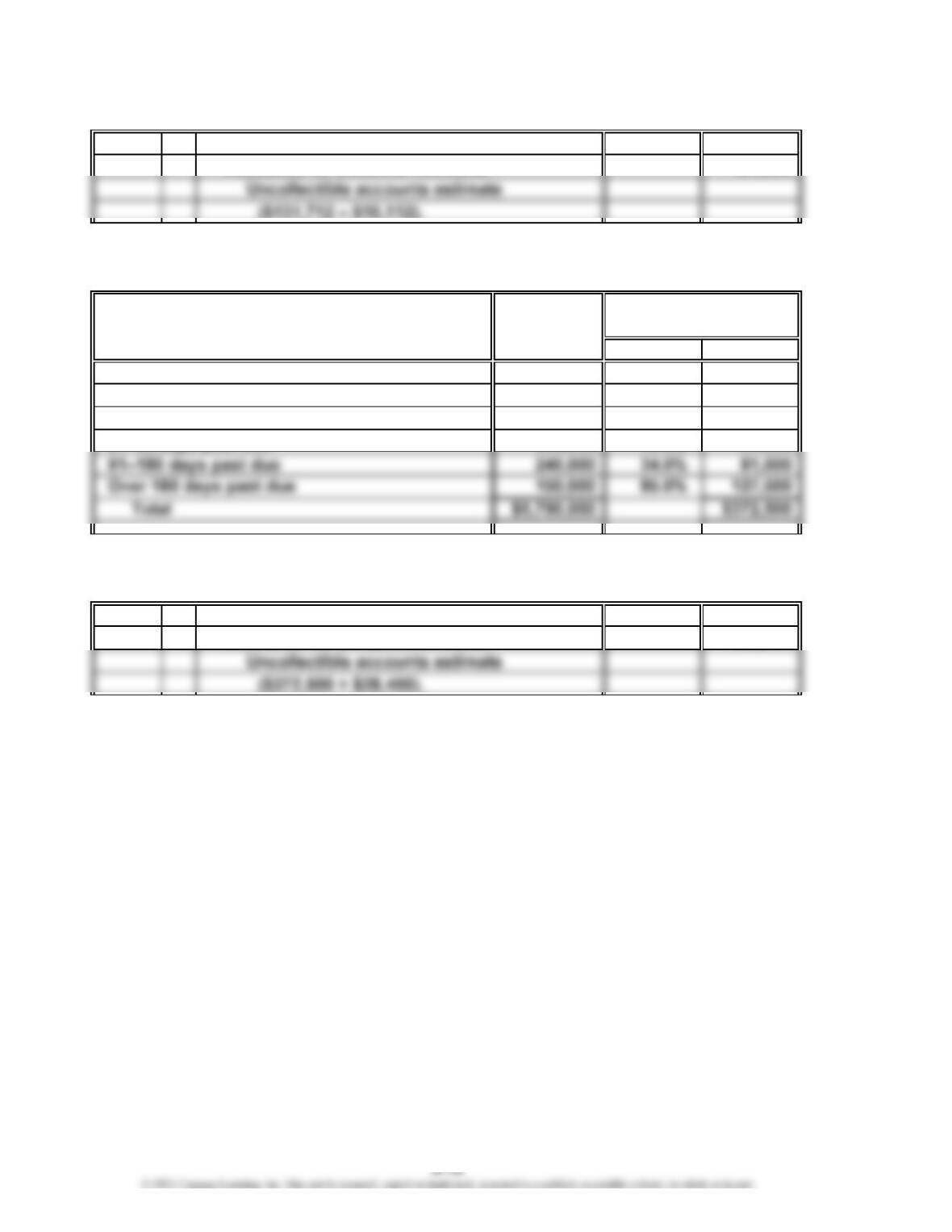
Ex. 9-9
Not Past Over
Balance Due 1–30 31–60 61–90 90
Total receivables 1,180,000 626,400 266,600 124,000 103,000 60,000
Percentage uncollectible 2% 4% 18% 40% 75%
Days Past Due
Days Past Due
Due Date
March 22
Number of Days Past Due
162 days (9 + 30 + 31 + 30 + 31 + 31)
Aging of Receivables Schedule
August 31
CHAPTER 9 Receivables
Ex. 9-10
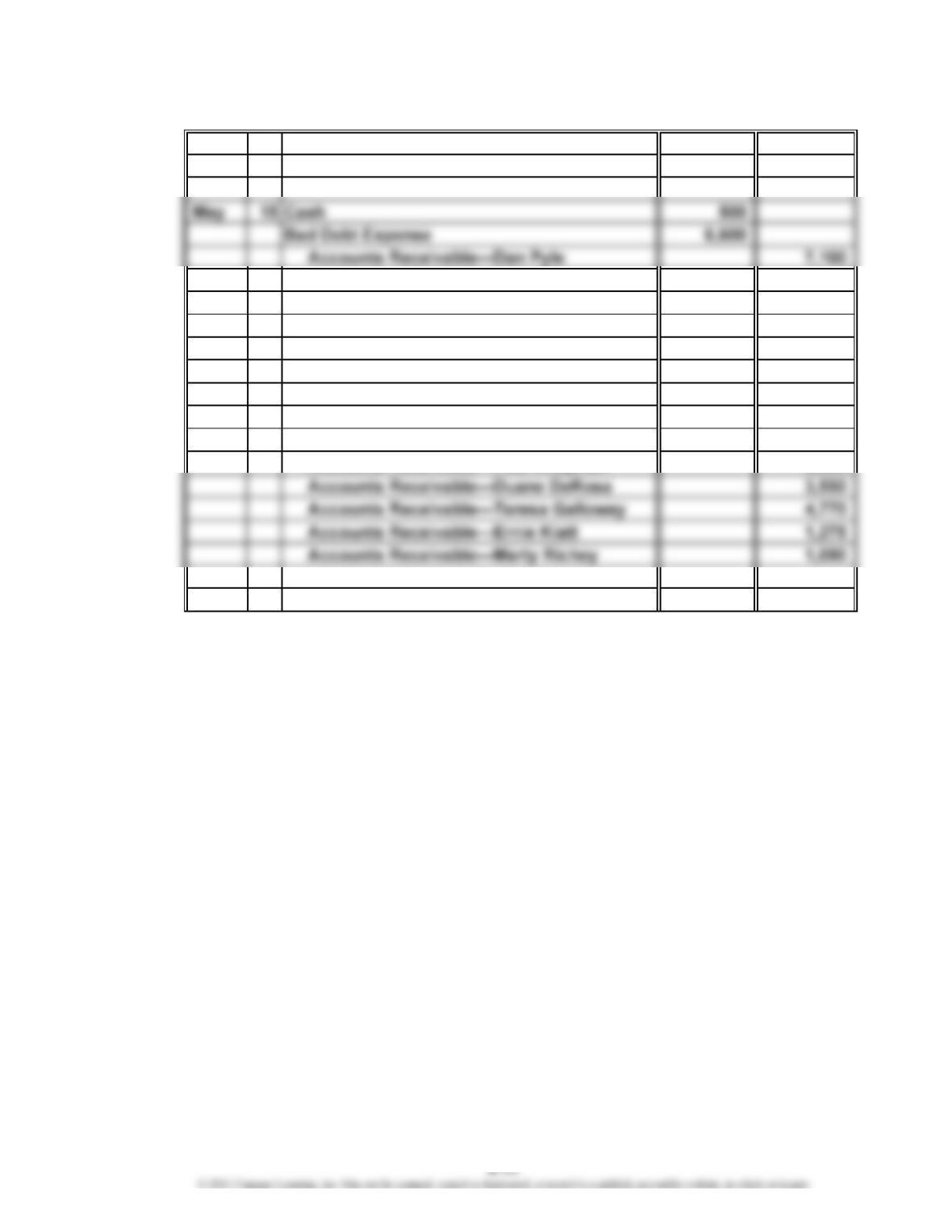
Aug. 31 Bad Debt Expense 121,600
Allowance for Doubtful Accounts 121,600
Ex. 9-11
Balance Percent Amount
Not past due $3,250,000 0.8% $ 26,000
1–30 days past due 1,050,000 2.4% 25,200
31–60 days past due 780,000 7.0% 54,600
61–90 days past due 320,000 18.0% 57,600
Ex. 9-12
Dec. 31 Bad Debt Expense 400,900
Allowance for Doubtful Accounts 400,900
Estimated
Uncollectible Accounts
Age Interval
CHAPTER 9 Receivables
Ex. 9-13
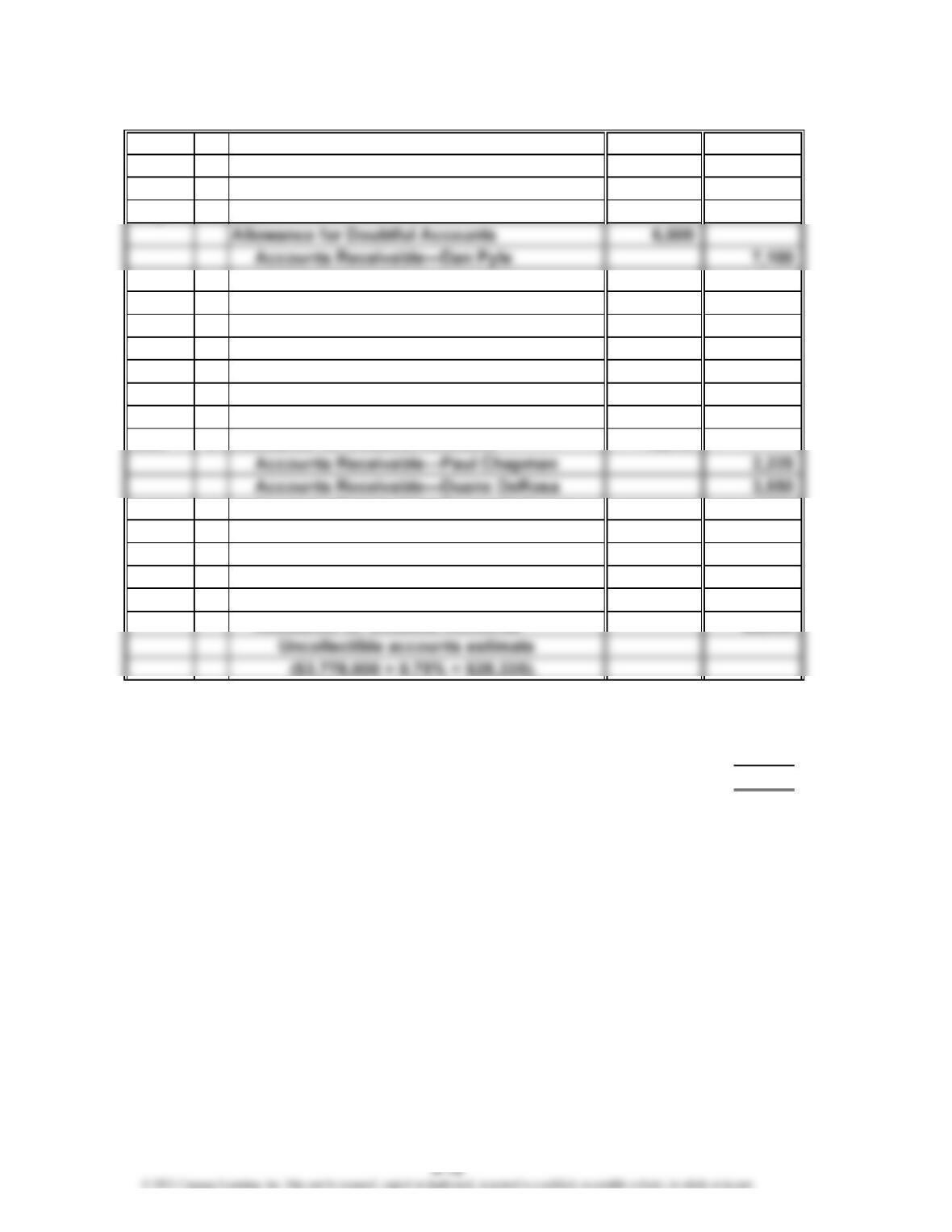
a. Apr. 13 Bad Debt Expense 8,450
Accounts Receivable—Dean Sheppard 8,450
July 27 Accounts Receivable—Dean Sheppard 8,450
Bad Debt Expense 8,450
27 Cash 8,450
Accounts Receivable—Dean Sheppard 8,450
Dec. 31 Bad Debt Expense 13,510
31 No entry
CHAPTER 9 Receivables
Ex. 9-13 (Concluded)
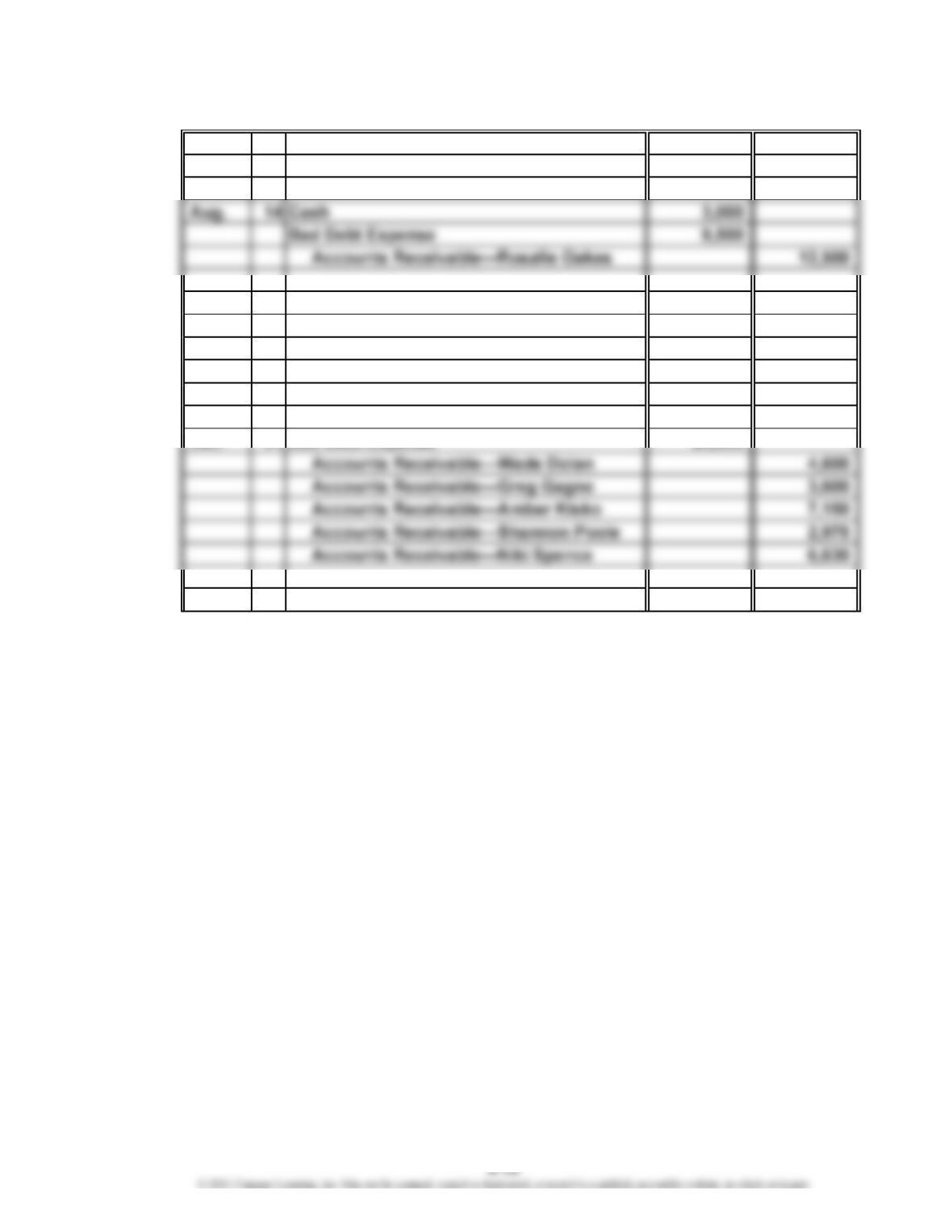
b. Apr. 13 Allowance for Doubtful Accounts 8,450
Accounts Receivable—Dean Sheppard 8,450
May 15 Cash 500
July 27 Accounts Receivable—Dean Sheppard 8,450
Allowance for Doubtful Accounts 8,450
27 Cash 8,450
Accounts Receivable—Dean Sheppard 8,450
Accounts Receivable—Teresa Galloway 4,770
Accounts Receivable—Ernie Klatt 1,275
Accounts Receivable—Marty Richey 1,690
31 Bad Debt Expense 28,335
c. Bad debt expense under:
Allowance method……………………………………………………………… $28,335
Direct write-off method ($8,450 + $6,600 – $8,450 + $13,510)…………
…
20,110
Difference ($28,335 – $20,110)………………………………………………
…
$ 8,225
Shipway Company’s income would have been $8,225 higher under the direct
write-off method than under the allowance method.
CHAPTER 9 Receivables
Ex. 9-14
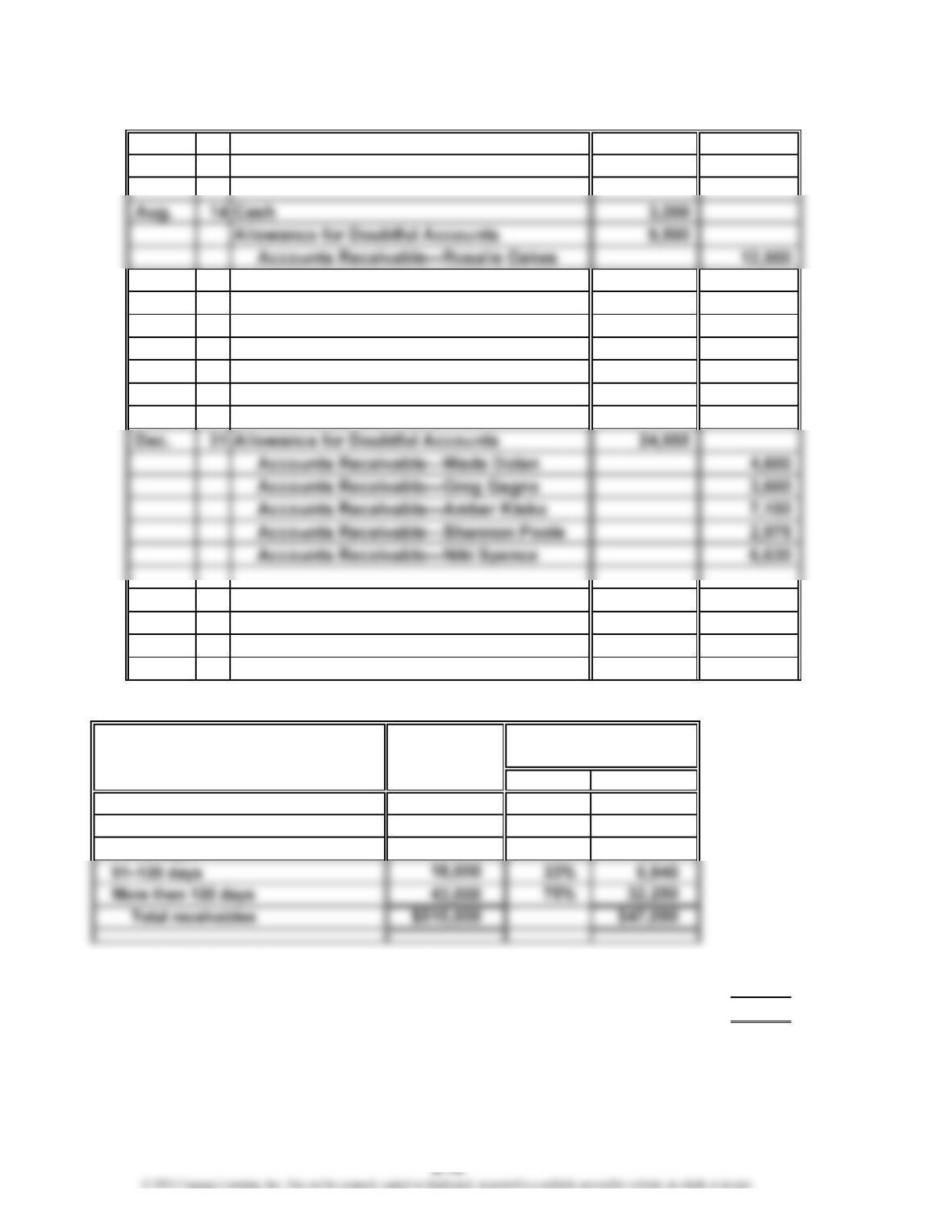
a. June 8 Bad Debt Expense 8,440
Accounts Receivable—Kathy Quantel 8,440
Oct. 16 Accounts Receivable—Kathy Quantel 8,440
Bad Debt Expense 8,440
16 Cash 8,440
Accounts Receivable—Kathy Quantel 8,440
31 No entry
CHAPTER 9 Receivables
Ex. 9-14 (Continued)
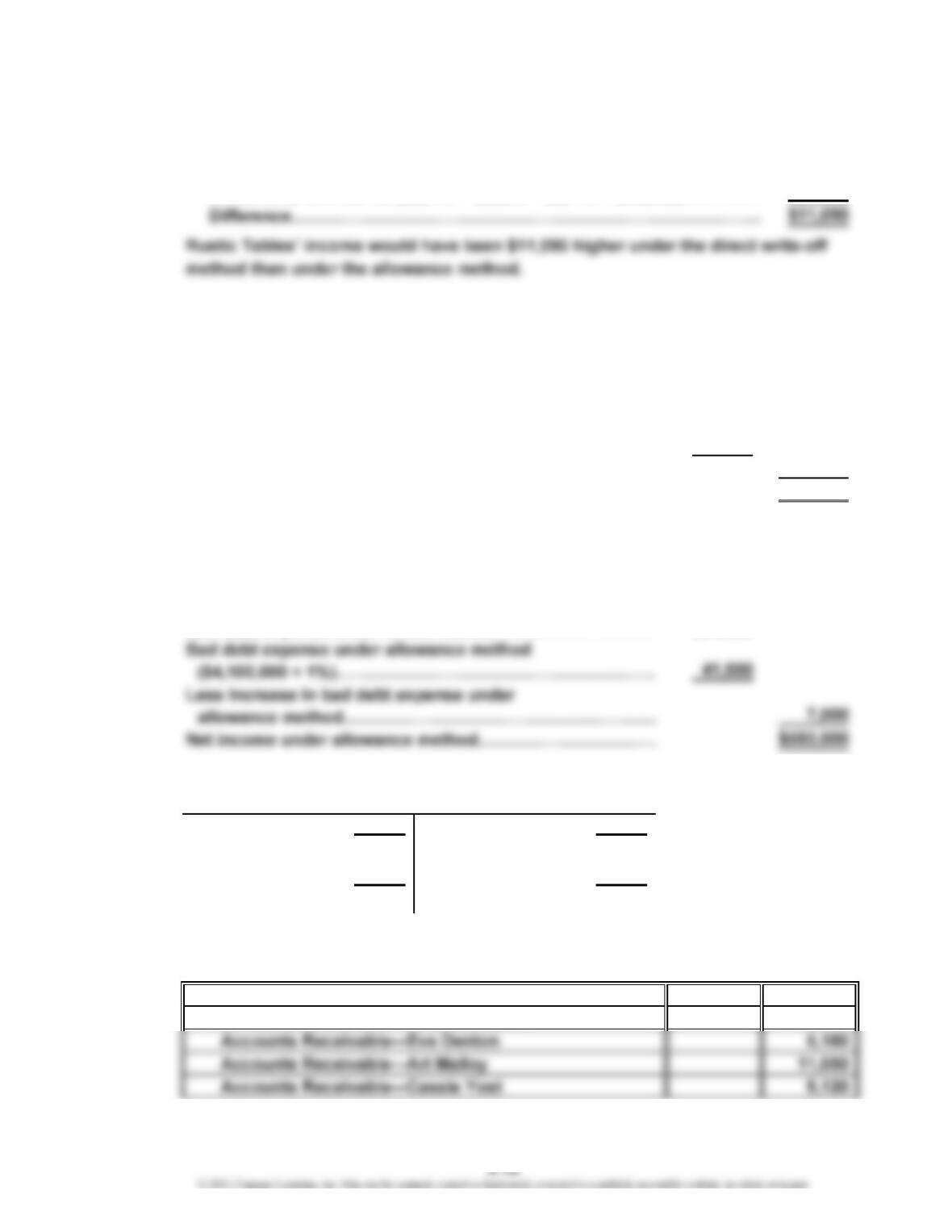
b. June 8 Allowance for Doubtful Accounts 8,440
Accounts Receivable—Kathy Quantel 8,440
Oct. 16 Accounts Receivable—Kathy Quantel 8,440
Allowance for Doubtful Accounts 8,440
16 Cash 8,440
Accounts Receivable—Kathy Quantel 8,440
31 Bad Debt Expense 45,545
Allowance for Doubtful Accounts 45,545
Uncollectible accounts estimate
($47,090 – $1,545).
Computations:
Percent Amount
0–30 days
1% $ 3,200
31–60 days
3% 3,300
61–90 days
10% 2,400
Estimated balance of allowance account from aging schedule………………
…
$47,090
Unadjusted credit balance of allowance account………………………………… 1,545
Adjustment………………………………………………………………………………
…
$45,545
*
$36,000 – $8,440 – $9,500 + $8,440 – $24,955 = $1,545
Past Due)
Accounts
Estimated DoubtfulReceivables
Balance on
Aging Class
(Number of Days
December 31
$320,000
110,000
24,000
*
CHAPTER 9 Receivables
Ex. 9-14 (Concluded)
c. Bad debt expense under:
Allowance method……………………………………………………………… $45,545
Direct write-off method ($8,440 + $9,500 – $8,440 + $24,955)…………
…
34,455
Ex. 9-15
$482,800, computed as follows:
Net income under direct method……………………………………
…
$487,500
Bad debt expense under direct method……………………………
…
$27,800
Bad debt expense under allowance method
($3,250,000 × 1%)……………………………………………………… 32,500
Less increase in bad debt expense under allowance method…
…
4,700
Net income under allowance method………………………………
…
$482,800
Ex. 9-16
$593,000, computed as follows:
a. Net income under direct method………………………………
…
$600,000
Bad debt expense under direct method………………………
…
$34,000
b. $11,700, as shown in the following T account:
Year 1 Write-offs 27,800 Year 1 Adj. Entry 32,500
Bal. 4,700
Year 2 Write-offs 34,000 Year 2 Adj. Entry 41,000
Bal. 11,700
Ex. 9-17
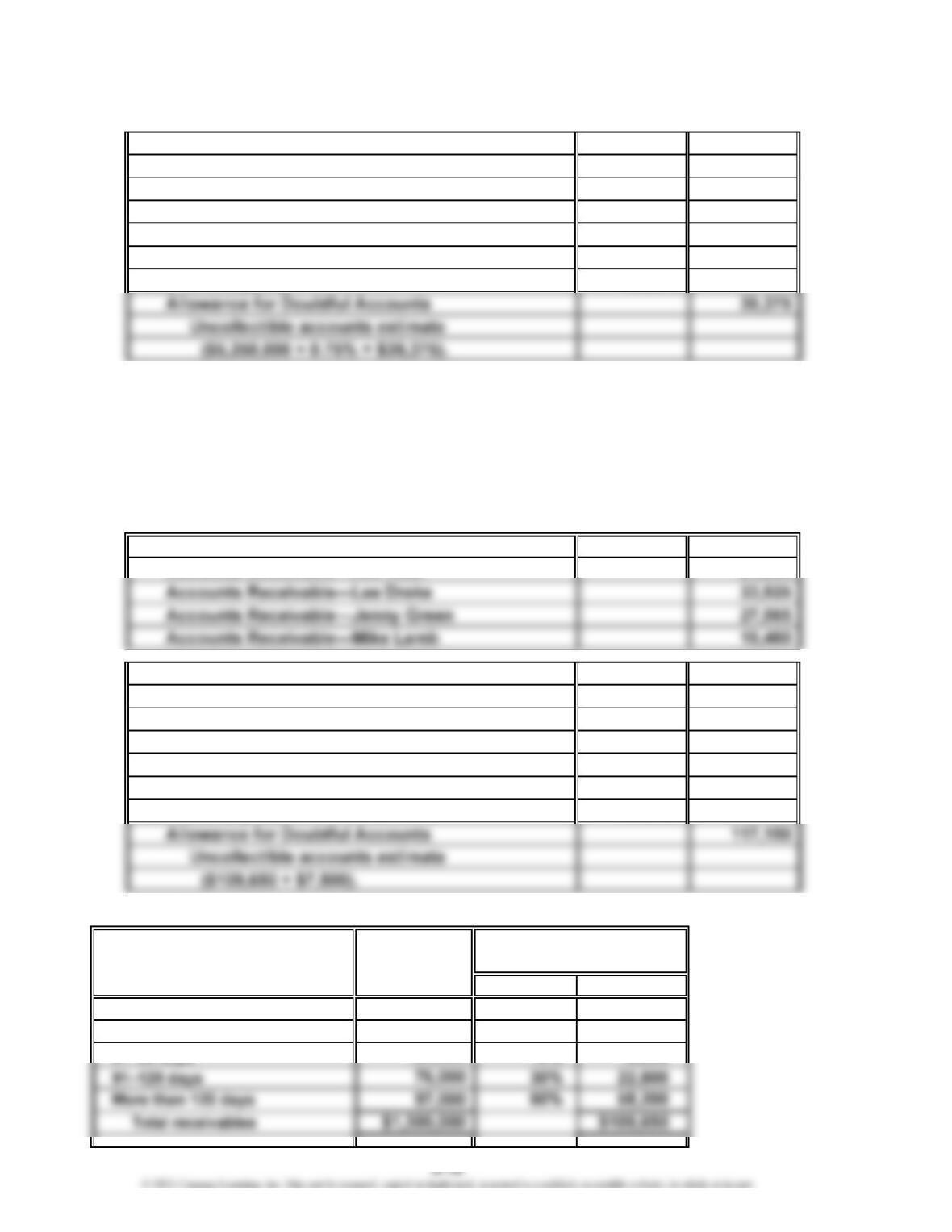
a. Bad Debt Expense 30,000
Accounts Receivable—Shawn Brooke 4,650
Allowance for Doubtful Accounts
CHAPTER 9 Receivables
Ex. 9-17 (Concluded)
b. Allowance for Doubtful Accounts 30,000
Accounts Receivable—Shawn Brooke 4,650
Accounts Receivable—Eve Denton 5,180
Accounts Receivable—Art Malloy 11,050
Accounts Receivable—Cassie Yost 9,120
Bad Debt Expense 39,375
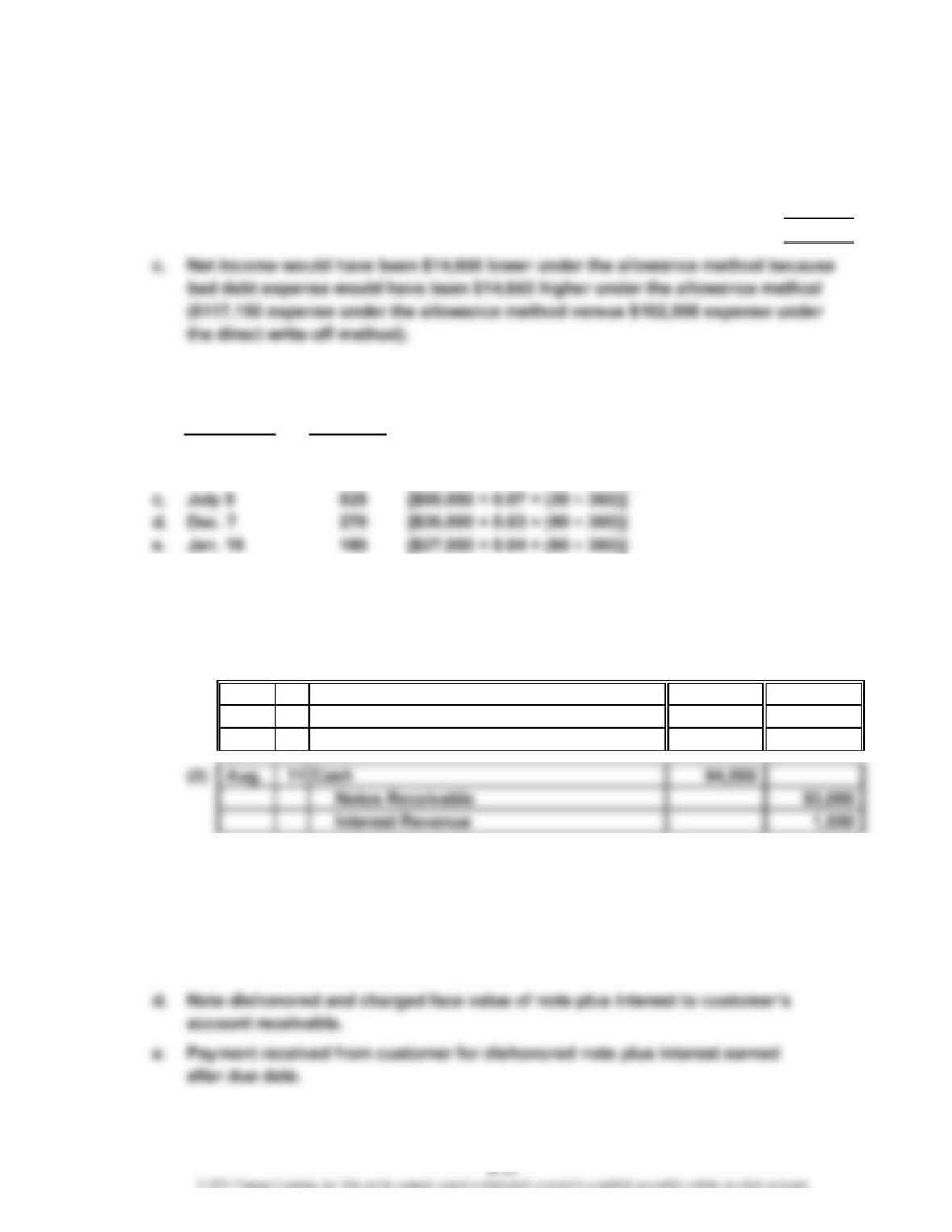
c. Net income would have been $9,375 higher under the direct write-off method
because bad debt expense would have been $9,375 lower under the direct
method ($39,375 expense under the allowance method versus $30,000 expense
under the direct write-off method).
Ex. 9-18
a. Bad Debt Expense 102,500
b. Allowance for Doubtful Accounts 102,500
Accounts Receivable—Kim Abel 21,550
Accounts Receivable—Lee Drake 33,925
Accounts Receivable—Jenny Green 27,565
Accounts Receivable—Mike Lamb 19,460
Bad Debt Expense 117,150
Computations:
Percent Amount
0–30 days 1% $ 7,150
31–60 days 2% 6,200
Receivables
Balance on
December 31
$ 715,000
310,000
Past Due)
Accounts
Estimated DoubtfulAging Class
(Number of Days
CHAPTER 9 Receivables
Ex. 9-18 (Concluded)
Unadjusted debit balance of Allowance for Doubtful Accounts
($102,500 – $95,000)……………………………………………………………………
…
$ 7,500
Estimated balance of Allowance for Doubtful Accounts
from aging schedule…………………………………………………………………… 109,650
Adjustment………………………………………………………………………………… $117,150
Ex. 9-19
Interest
a. $500 [$40,000 × 0.05 × (90 ÷ 360)]
b. Sept. 15 720 [$18,000 × 0.08 × (180 ÷ 360)]
Ex. 9-20
a. August 11 (17 + 31 + 30 + 31 + 11)
b. $94,550 [($93,000 × 5% × 120 ÷ 360) + $93,000]
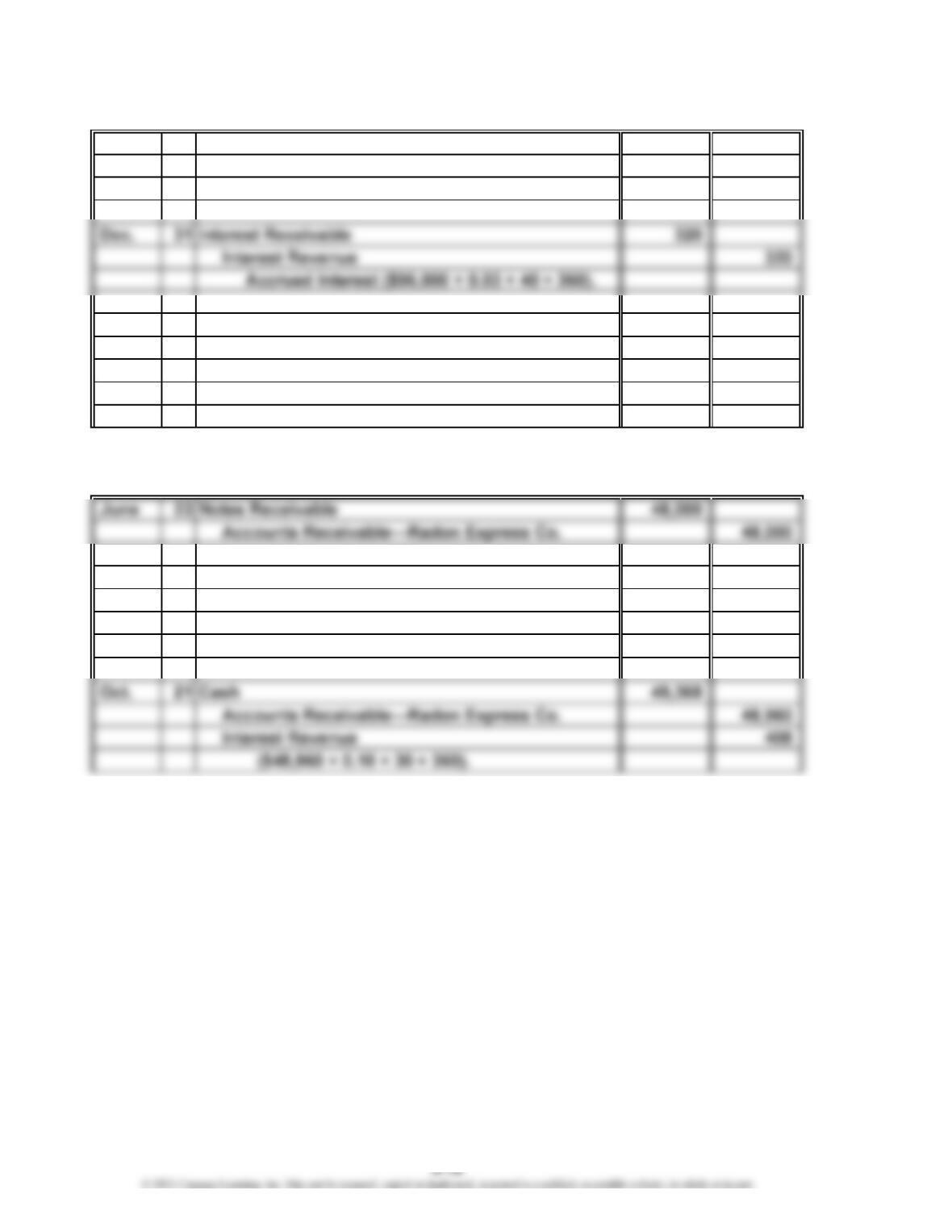
c. (1) Apr. 13 Notes Receivable 93,000
Accounts Rec.—Autumn Designs &
Decorators 93,000
Ex. 9-21
a. Sale on account.
b. Cost of goods sold for the sale on account.
c. Note received from customer on account.
Due Date
Apr. 10
CHAPTER 9 Receivables
Ex. 9-22
20Y3
Nov. 21 Notes Receivable 96,000
Accounts Receivable—McKenna Outer Wear Co. 96,000
20Y4
Jan. 20 Cash 96,480
Notes Receivable 96,000
Interest Receivable 320
Interest Revenue ($96,000 × 0.03 × 20 ÷ 360) 160
Ex. 9-23
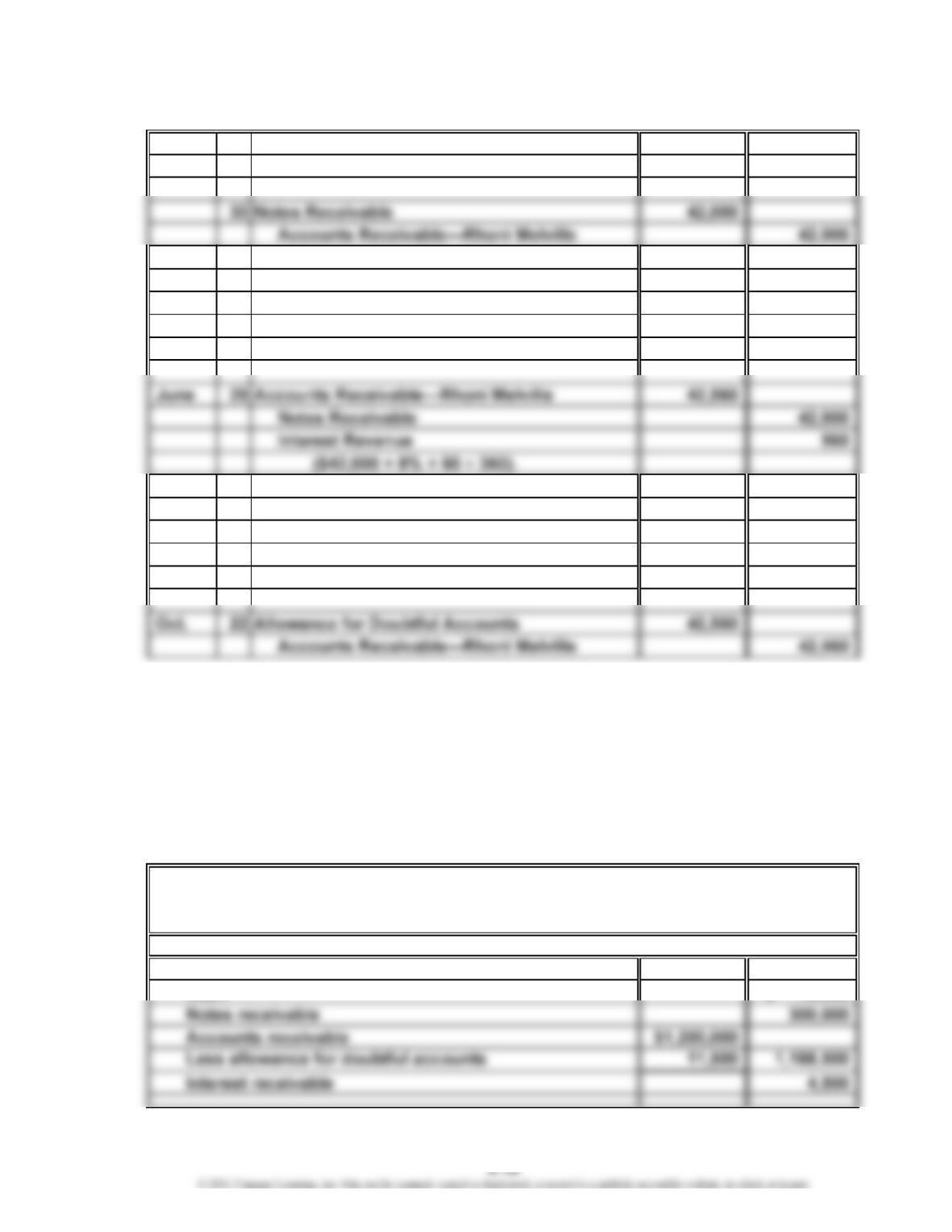
Sept. 21 Accounts Receivable—Radon Express Co. 48,960
Notes Receivable 48,000
Interest Revenue 960
($48,000 × 0.08 × 90 ÷ 360).
CHAPTER 9 Receivables
Ex. 9-24
Apr. 18 Notes Receivable 60,000
Accounts Receivable—Glenn Cross 60,000
May 18 Accounts Receivable—Glenn Cross 60,350
Notes Receivable 60,000
Interest Revenue 350
($60,000 × 7% × 30 ÷ 360).
Aug. 16 Cash 61,557
Accounts Receivable—Glenn Cross 60,350
Interest Revenue 1,207
($60,350 × 8% × 90 ÷ 360).
Ex. 9-25
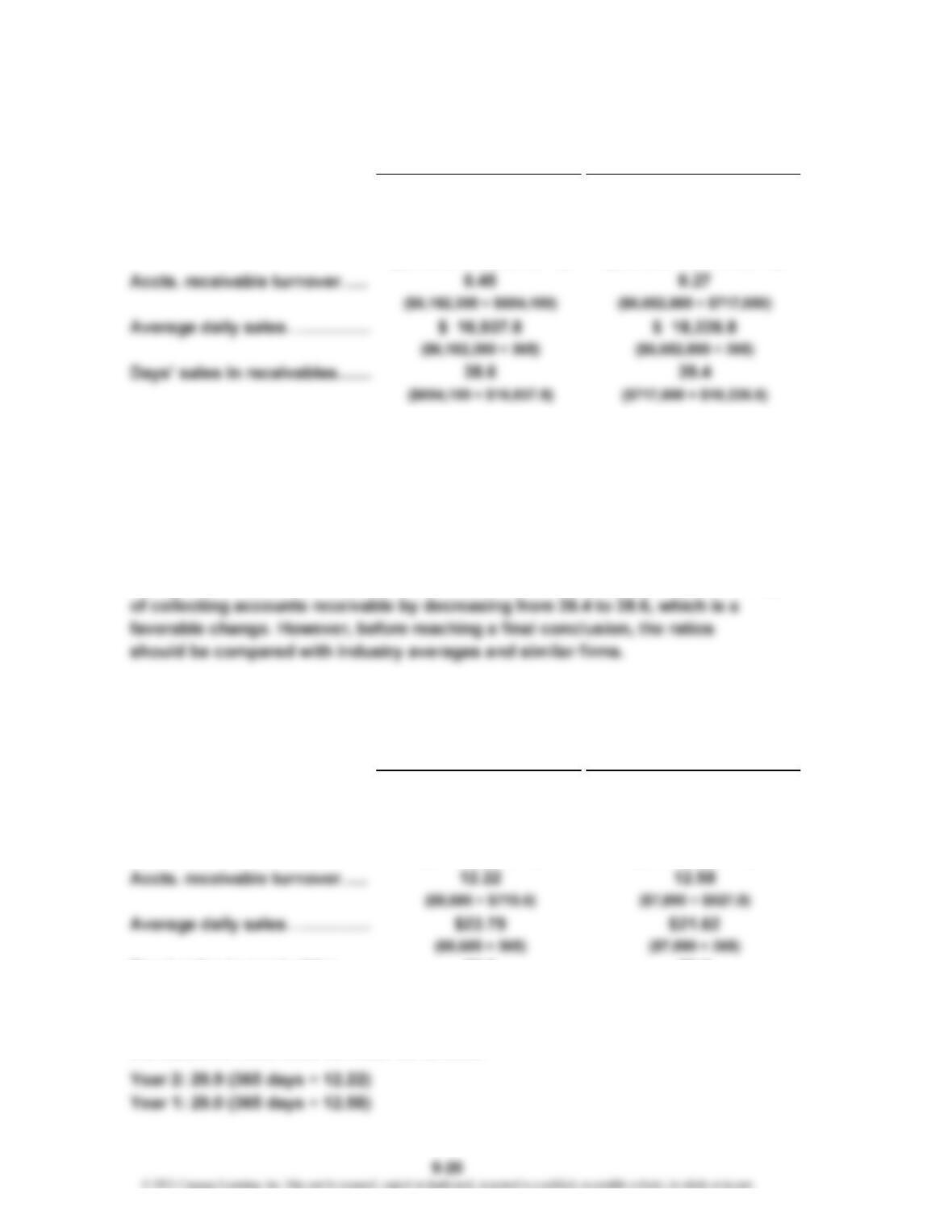
1. The interest receivable should be reported separately as a current asset. It
should not be deducted from notes receivable.
2. The allowance for doubtful accounts should be deducted from accounts
receivable.
A corrected partial balance sheet would be as follows:
Current assets:
Napa Vino Company
Balance Sheet
December 31, 20Y9
Assets
CHAPTER 9 Receivables
Ex. 9-26
a. and b.
Sales……………………………
…
Accounts receivable……………
Average accts. receivable……
The days’ sales in receivables could also be computed by dividing 365 days by
the accounts receivable turnover as follows:
Year 2: 38.6 (365 days ÷ 9.45)
Year 1: 39.4 (365 days ÷ 9.27)
c. The accounts receivable turnover indicates a slight increase in the efficiency of
collecting accounts receivable by increasing from 9.27 to 9.45, a favorable
change. The days’ sales in receivables also indicates an increase in the efficiency
Ex. 9-27
a. and b.
Sales……………………………
…
Accounts receivable……………
Average accts. receivable……
Days’ sales in receivables…
…
The days’ sales in receivables could also be computed by dividing 365 days by
the accounts receivable turnover as follows:
($710.5 ÷ $23.79) ($627.0 ÷ $21.62)
29.9 29.0
Year 2 Year 1
$8,685 $7,890
$ 717,650
[($664,600 + $770,700) ÷ 2]
$627.0
$710.5
[($805 + $616) ÷ 2] [($616 + $638) ÷ 2]
$ 643,600 $ 664,600
$ 805 $ 616
Year 2 Year 1
$6,182,300 $6,652,800
$ 654,100
[($643,600 + $664,600) ÷ 2]
…