CHAPTER 23 (FIN MAN); CHAPTER 9 (MAN) Evaluating Variances from Standard Costs
COMPREHENSIVE PROBLEM 5 (Continued)
Part B
5.
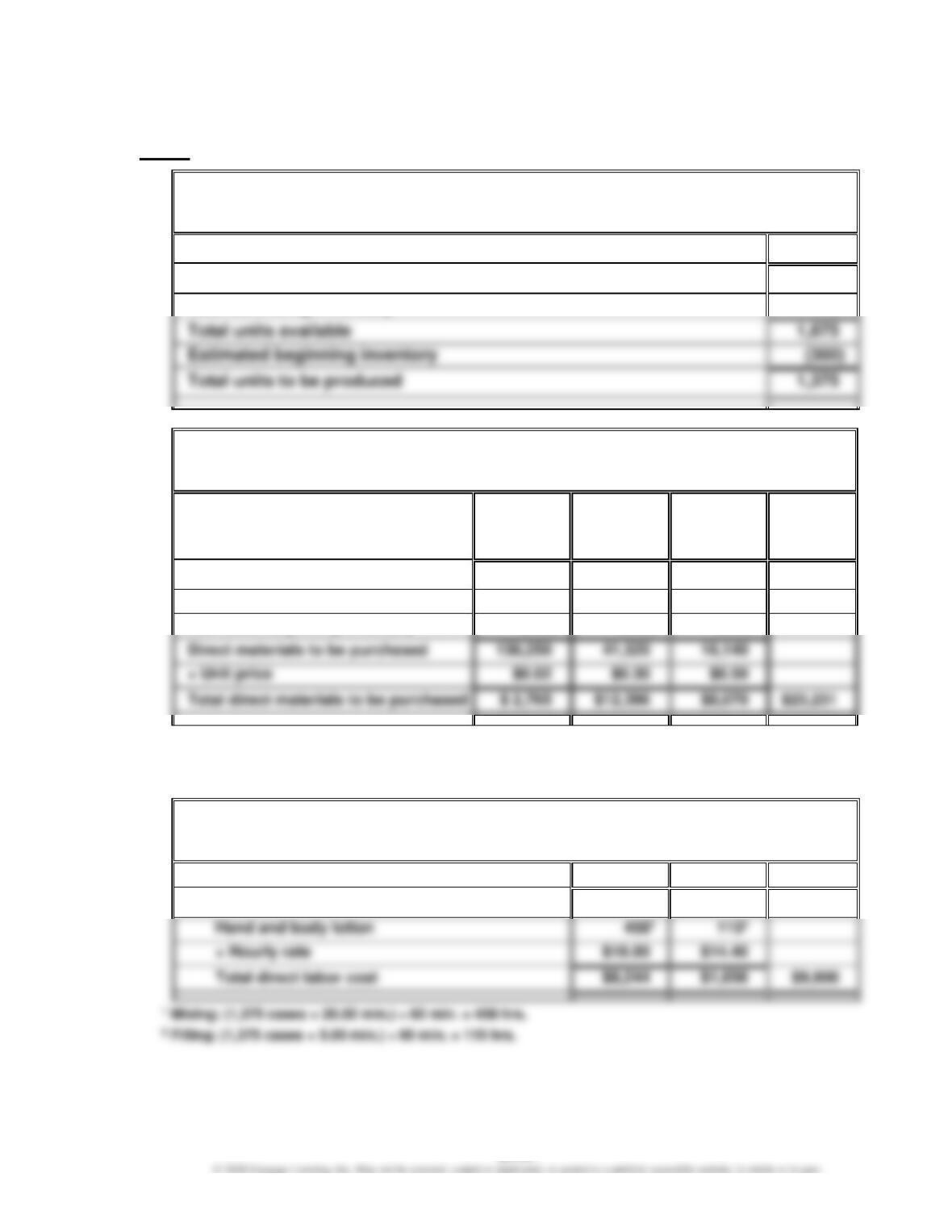
Genuine Spice Inc.
Production Budget
For the Month Ended August 31
Cases
Expected cases to be sold
1,500
Desired ending inventory
175
Total units available
Estimated beginning inventory
6.
Genuine Spice Inc.
Direct Materials Purchases Budget
For the Month Ended August 31
Cream
Base
(ozs.)
Natural
Oils
(ozs.)
Bottles
(bottles)
Total
Units required for production
137,5001
41,2502
16,5003
Desired ending inventory
1,000
360
240
Direct materials to be purchased
$12,396
Estimated beginning inventory
(250)
(290)
(600)
1 Cream base: 1,375 cases × 100 ozs. = 137,500 ozs.
2 Natural oils: 1,375 cases × 30 ozs. = 41,250 ozs.
3 Bottles: 1,375 cases × 12 bottles = 16,500 bottles
7.
Genuine Spice Inc.
Direct Labor Budget
For the Month Ended August 31
Mixing
Filling
Total
Hours required for production of:
4581
CHAPTER 23 (FIN MAN); CHAPTER 9 (MAN) Evaluating Variances from Standard Costs
COMPREHENSIVE PROBLEM 5 (Continued)
8.
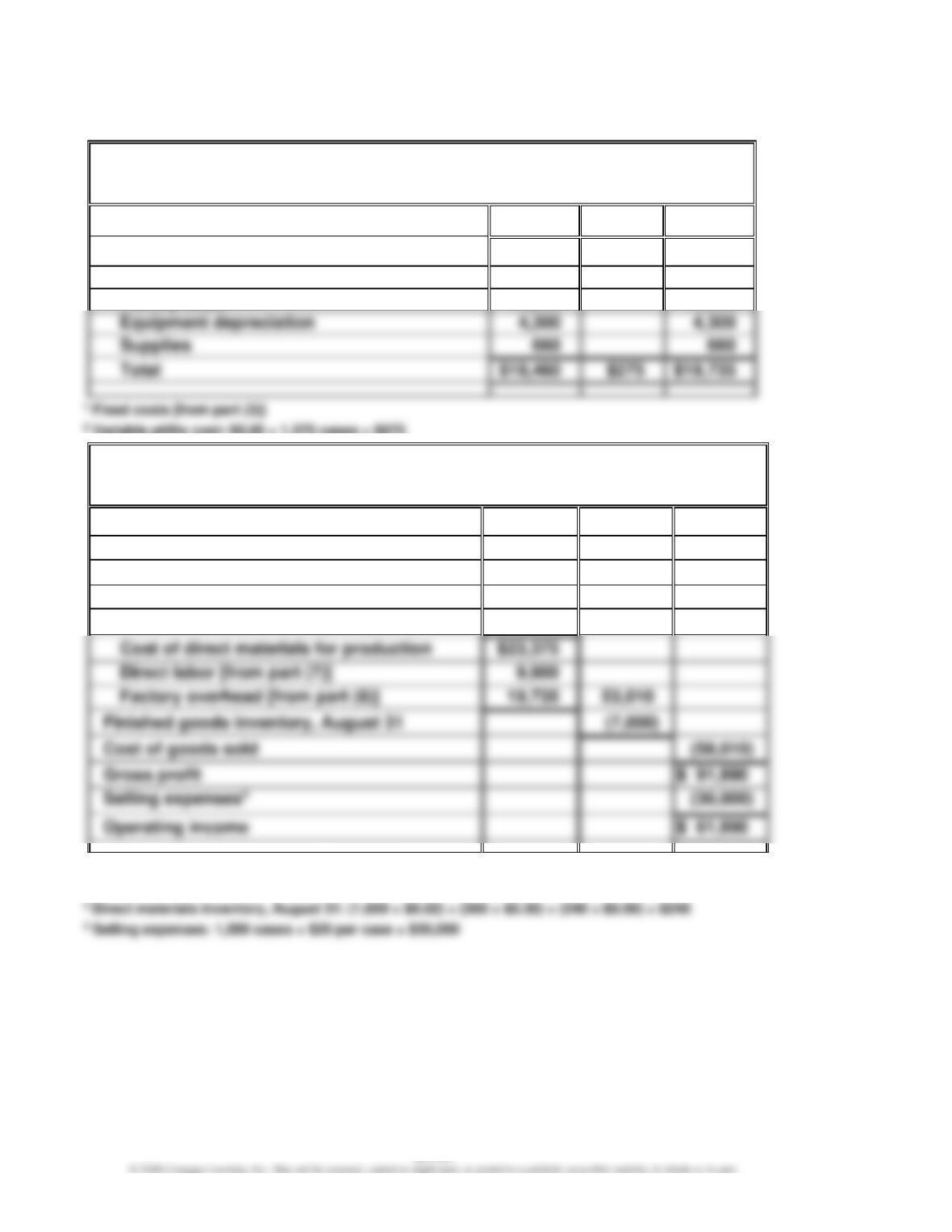
Genuine Spice Inc.
Factory Overhead Budget
For the Month Ended August 31
Fixed1
Variable2
Total
Factory overhead:
Utilities
$ 500
$275
$ 775
Equipment depreciation
Supplies
Facility lease
14,000
14,000
9.
Genuine Spice Inc.
Budgeted Income Statement
For the Month Ended August 31
Sales1
$150,000
Finished goods inventory, August 1
$12,000
Direct materials inventory, August 12
$ 392
Direct materials purchases [from part (6)]
23,231
Direct materials inventory, August 313
(248)
Cost of direct materials for production
Direct labor [from part (7)]
Finished goods inventory, August 31
Cost of goods sold
1 Sales: 1,500 cases × $100 per case = $150,000
2 Direct materials inventory, August 1: (250 × $0.02) + (290 × $0.30) + (600 × $0.50) = $392
CHAPTER 23 (FIN MAN); CHAPTER 9 (MAN) Evaluating Variances from Standard Costs
COMPREHENSIVE PROBLEM 5 (Continued)
Part C
10.
Direct materials price variance:
Cream
Base
Natural
Oils
Bottles
Actual price ………………………
$ 0.016
$ 0.32
$ 0.42
Standard price…………………..
(0.020)
(0.30)
(0.50)
Difference …………………………
$ (0.004)
$ 0.02
$ (0.08)
× Actual quantity (units)* …..
Direct materials price variance
$ (1,500)
CHAPTER 23 (FIN MAN); CHAPTER 9 (MAN) Evaluating Variances from Standard Costs
COMPREHENSIVE PROBLEM 5 (Continued)
Direct materials quantity variance:
Cream
Base
Natural
Oils
Bottles
Actual quantity1 …………………….
153,000
ozs
46,500
ozs.
18,750
btls.
Standard quantity2 ………………..
(150,000)
ozs.
(45,000)
ozs.
(18,000)
btls.
Difference …………………………....
3,000
ozs.
1,500
ozs.
750
btls.
Thus, only unfavorable variances were possible. The standard quantities were
1 Actual quantity:
Cream base: 1,500 cases × 102 ozs. = 153,000 ozs.
Natural oils: 1,500 cases × 31 ozs. = 46,500 ozs.
Bottles: 1,500 cases × 12.5 bottles = 18,750 bottles
CHAPTER 23 (FIN MAN); CHAPTER 9 (MAN) Evaluating Variances from Standard Costs
COMPREHENSIVE PROBLEM 5 (Continued)
11.
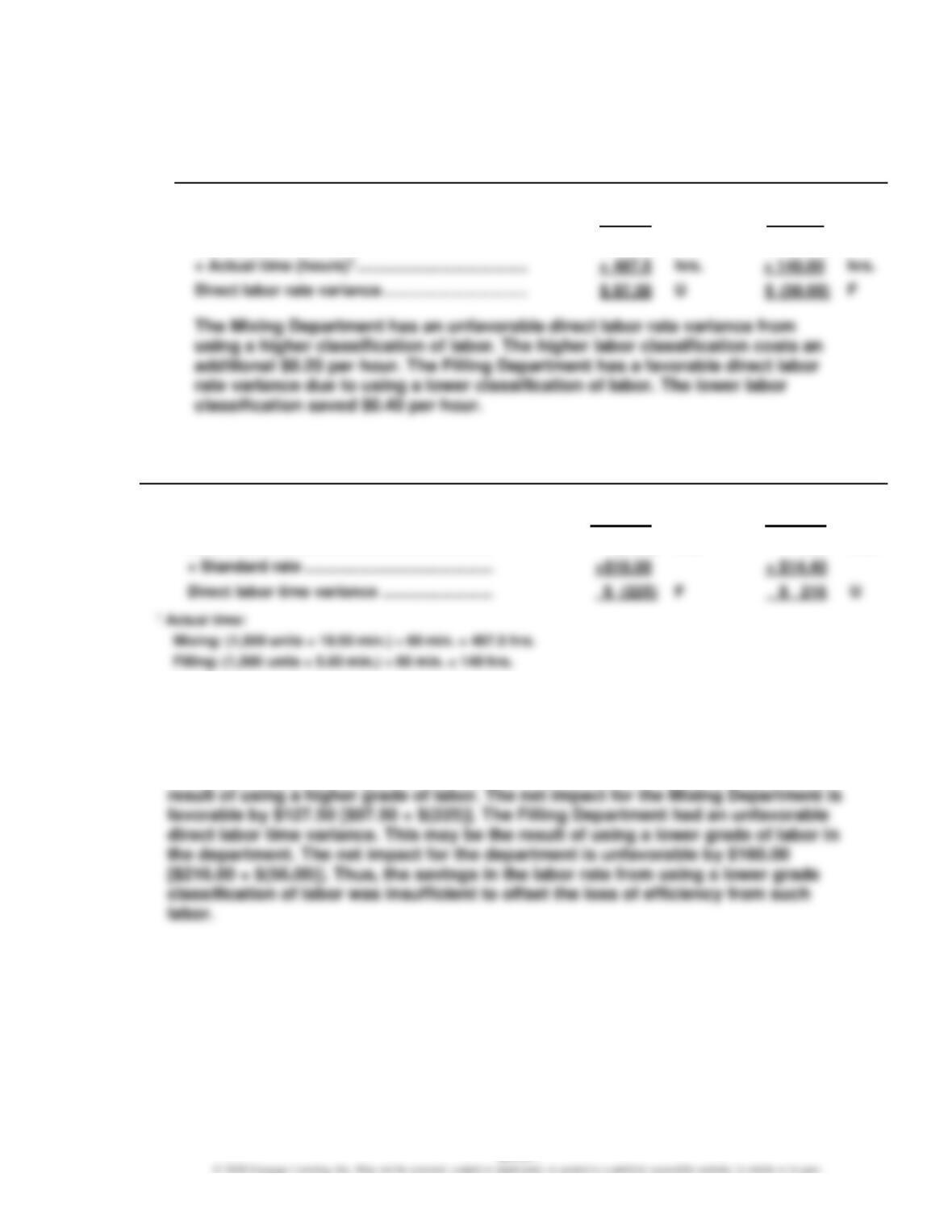
Direct labor rate variance:
Mixing
Department
Filling
Department
Actual rate ………………………………………………….
$ 18.20
$ 14.00
Standard rate ………………………………………………
(18.00)
(14.40)
Difference …………………………..………………………
$ 0.20
$ (0.40)
× Actual time (hours)1 ………………………………….
Direct labor rate variance …………………………….
Direct labor time variance:
Mixing
Department
Filling
Department
Actual time (hours)1 ………………………………
487.5
hrs.
140.0
hrs.
Standard time (hours)2 …………………………..
(500.0)
hrs.
(125.0)
hrs.
Difference ……………………………………………..
(12.5)
hrs.
15.0
hrs.
2 Standard time:
Mixing: (1,500 units × 20.00 min.) ÷ 60 min. = 500 hrs.
Filling: (1,500 units × 5.00 min.) ÷ 60 min. = 125 hrs.
The Mixing Department is producing at a labor time that is slightly better than
standard, thus producing a favorable direct labor time variance. This may be the
CHAPTER 23 (FIN MAN); CHAPTER 9 (MAN) Evaluating Variances from Standard Costs
COMPREHENSIVE PROBLEM 5 (Continued)
12.
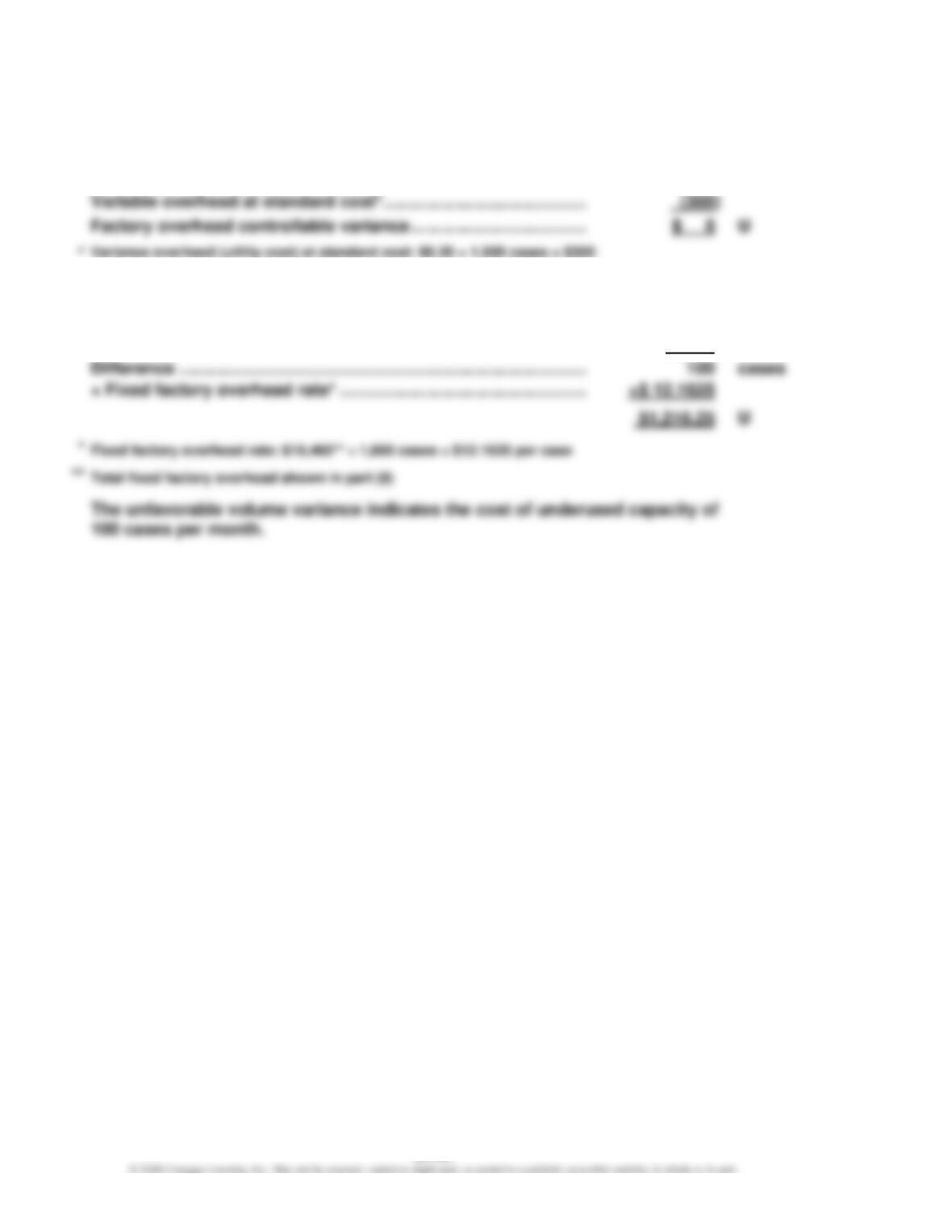
Factory overhead controllable variance:
Actual variable overhead ……………………………………………………
$ 305
*
13.
Factory overhead volume variance:
Normal volume ………………………………………………………………….
1,600
cases
Actual volume ……………………………………………………………………
(1,500)
cases
Difference …………………………………………………………………………
cases
× Fixed factory overhead rate* ……………………………………………
CHAPTER 23 (FIN MAN); CHAPTER 9 (MAN) Evaluating Variances from Standard Costs
COMPREHENSIVE PROBLEM 5 (Concluded)
Alternative Computation of Overhead Variances
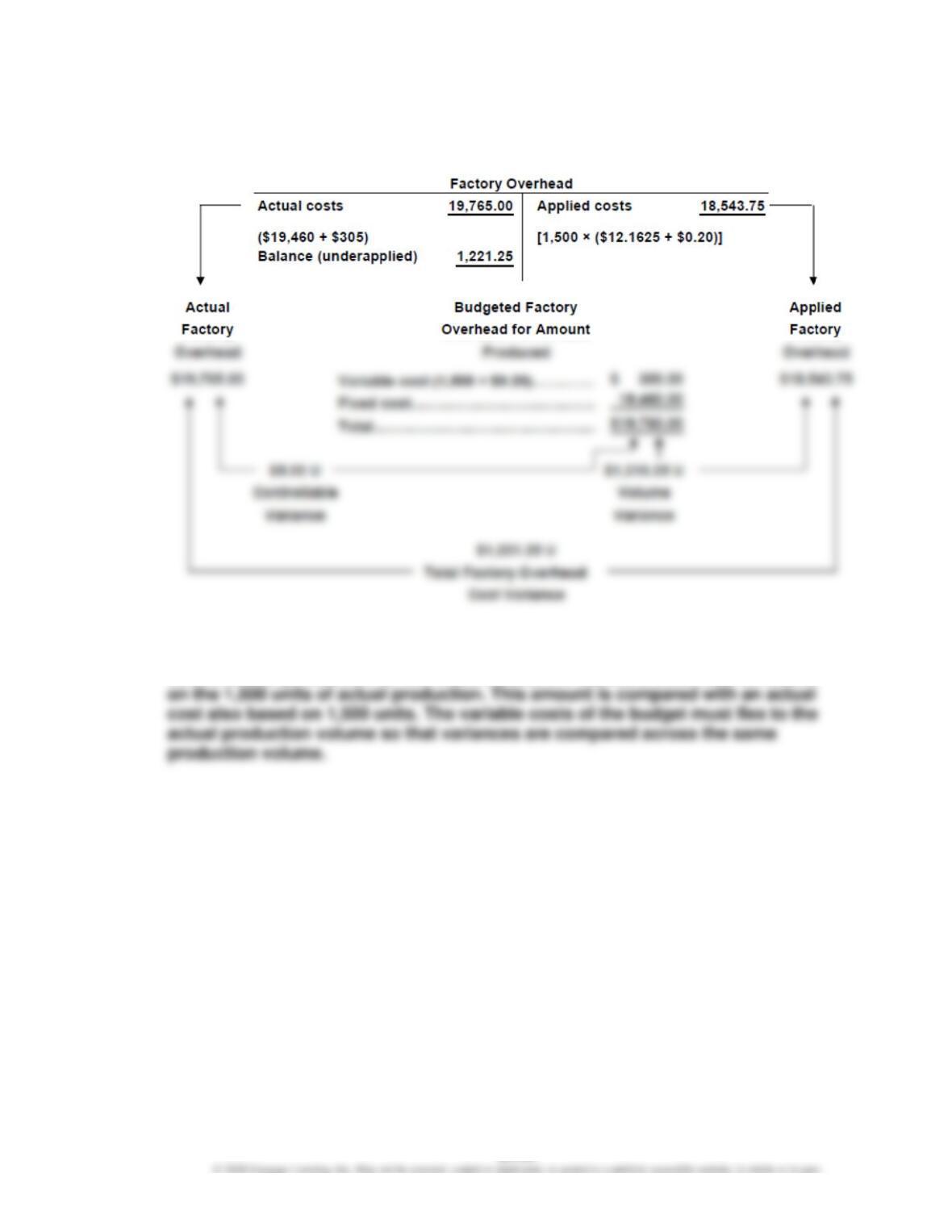
14. The production volume of 1,375 cases determined in part (5) was planned at the
beginning of August. The variances compare the actual cost and the standard
cost of actual production for the month. Thus, the standard cost must be based
CHAPTER 23 (FIN MAN); CHAPTER 9 (MAN) Evaluating Variances from Standard Costs
MAKE A DECISION
MAD 23–1 (FIN MAN); MAD 9–1 (MAN)
a.
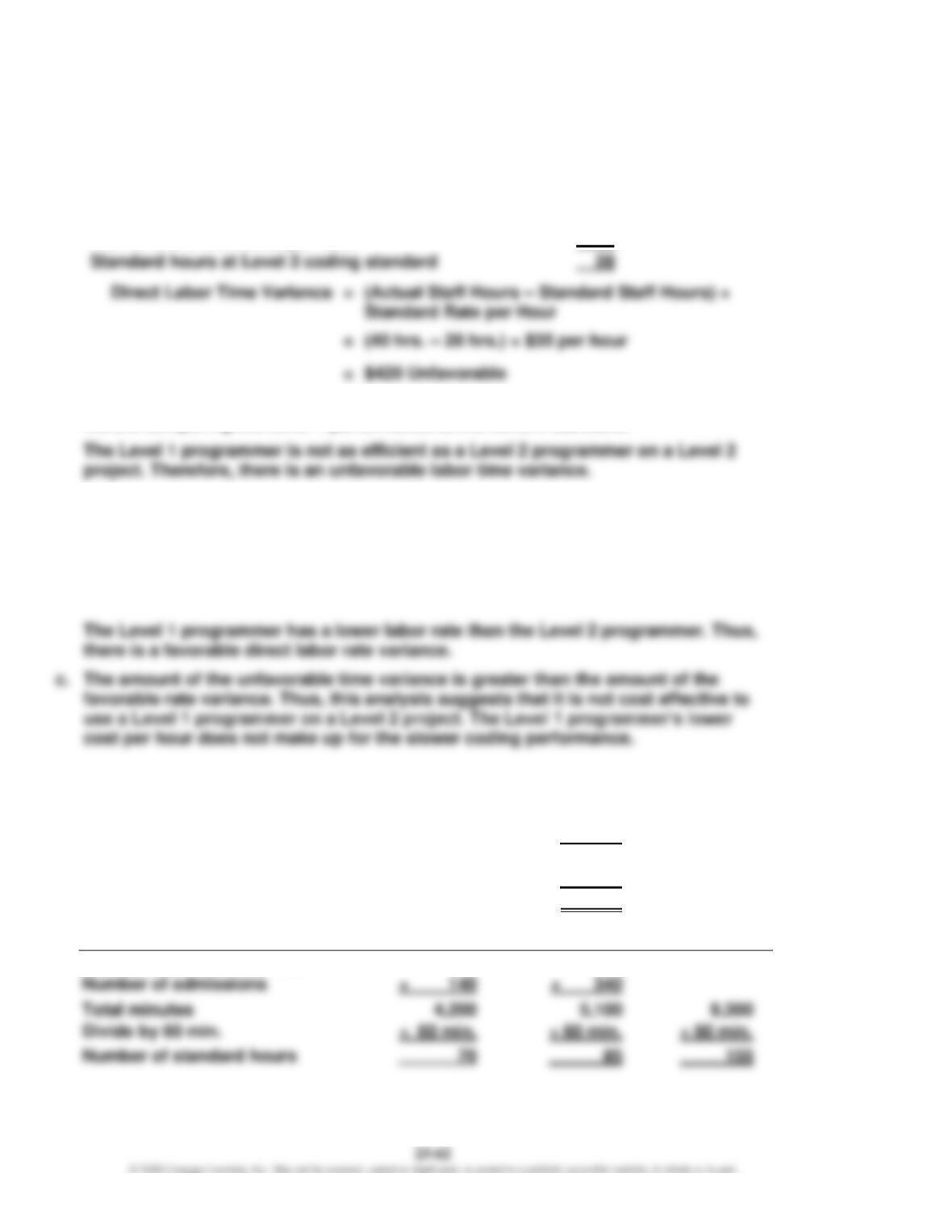
Standard hours for coding:
Lines of code
1,400
÷ Level 2 standard lines per hour
÷ 50
Note that the standard rate per hour is set at the Level 2 rate for this Level 2 project.
We are comparing the Level 1 performance to the Level 2 standard.
b.
Direct Labor Rate Variance
=
(Actual Rate per Hour – Standard Rate per Hour) ×
Actual Hours
=
($25 – $35) × 40 hrs.
=
$(400) Favorable
MAD 23–2 (FIN MAN); MAD 9–2 (MAN)
a.
Number of employees
4
Hours per week
× 40
Total actual hours for the week
160
Labor rate per hour
× $15
Actual staff cost
$ 2,400
b.
Unscheduled
Scheduled
Total
Standard time (in minutes)
30
15
CHAPTER 23 (FIN MAN); CHAPTER 9 (MAN) Evaluating Variances from Standard Costs
MAD 23–2 (FIN MAN); MAD 9–2 (MAN) (Concluded)
c.
Direct Labor Time Variance
=
(Actual Staff Hours – Standard Staff Hours) ×
Standard Rate per Hour
=
(160 hrs. – 155 hrs.) × $15 per hour
=
$75 Unfavorable
The actual hours exceeded the standard hours; thus, the variance is unfavorable.
d. The first, and most obvious, factor is the mix of admissions. If the mix of
admissions becomes more heavily weighted toward unscheduled admissions,
MAD 23–3 (FIN MAN); MAD 9–3 (MAN)
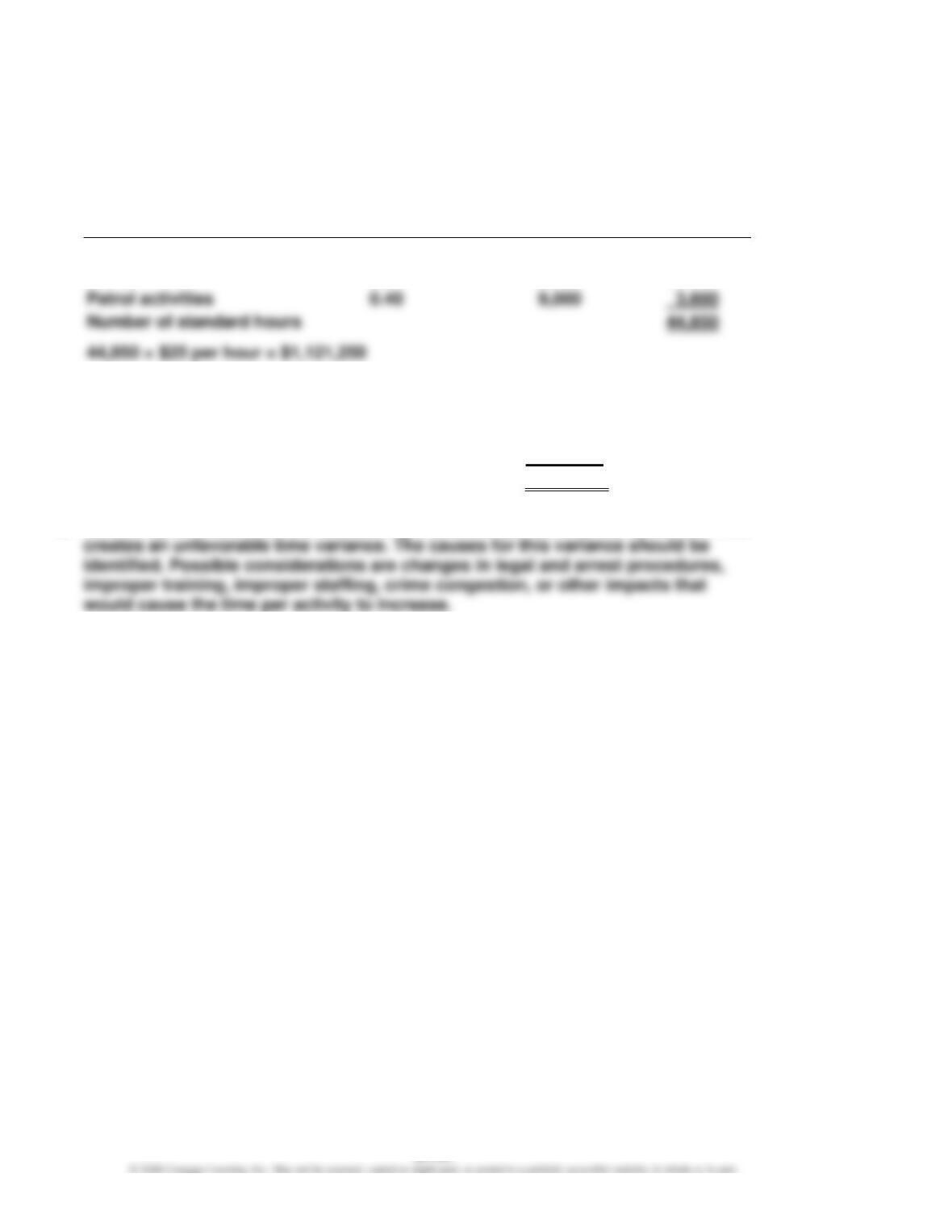
a.
Standard Sorts per Minute ×
Standard Minutes per Hour
=
Standard Sorts per Hour
(per employee)
90 sorts per min. × 60 min. per hr.
=
5,400 standard sorts per hr.
Pieces of Mail ÷
Standard Sorts per Hour
=
Number of Hours Planned
24,192,000 letters ÷ 5,400 sorts per hr.
=
4,480 hrs. planned
Number of Hours Planned ÷ Hours per
Temporary Employee per Month
=
Number of Hires
28 temporary hires for December
Actual pieces sorted = 23,895,000
=
CHAPTER 23 (FIN MAN); CHAPTER 9 (MAN) Evaluating Variances from Standard Costs
MAD 23–4 (FIN MAN); MAD 9–4 (MAN)
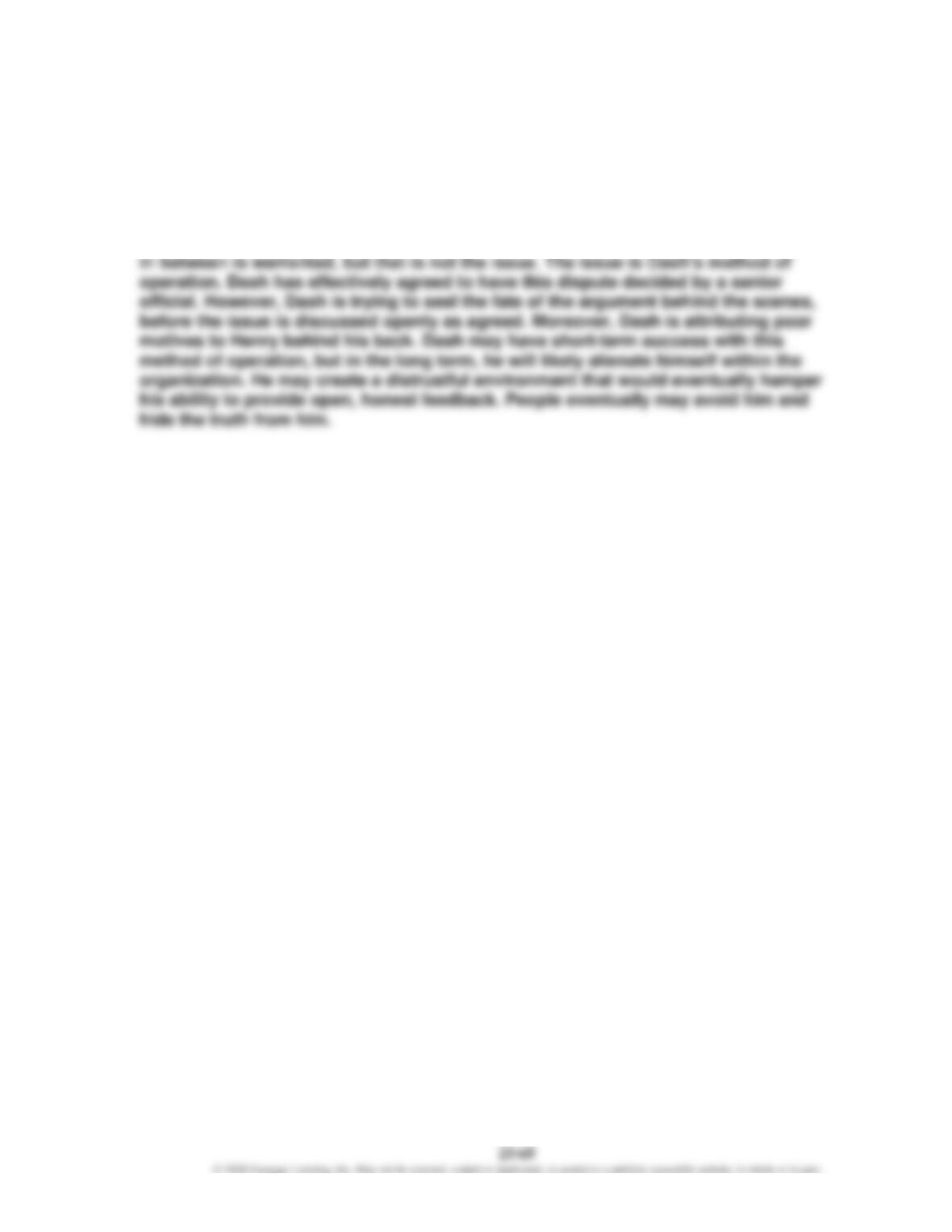
a. 33,900 hours × $25 per hour = $847,500 total budgeted cost
b.
Police Activity
Actual Hours
per Activity
Actual Activities
for Year
Total
Employee
Hours
Theft
0.75
7,000
5,250
Arrest
2.00
18,000
36,000
c
Direct labor time variance
Actual cost
$1,121,250
Budgeted cost
(847,500)
Time variance (unfavorable)
$ 273,750
d. All three police activities are consuming more time per activity than planned. This
CHAPTER 23 (FIN MAN); CHAPTER 9 (MAN) Evaluating Variances from Standard Costs
TAKE IT FURTHER
TIF 23–1 (FIN MAN); TIF 9–1 (MAN)
The use of ideal standards is a legitimate concern for Henry. It is likely that such
standards are too tight and do not include the necessary fatigue factors that are
typical in this type of operation. It seems as though Henry is arguing for practical
standards that can be attained if the operation is running well. Maybe some standard
CHAPTER 23 (FIN MAN); CHAPTER 9 (MAN) Evaluating Variances from Standard Costs
TIF 23–2 (FIN MAN); TIF 9–2 (MAN)
This is a case where there is strong evidence that the poor performance that is
occurring inside the Assembly Department may be the result of behaviors outside
of the department. This is one of the classic problems with variance analysis. Often,
the variances reflect causes outside of the responsibility center manager’s control.
That is what appears to be happening here. The Assembly supervisor complains
that both the purchased parts and incoming material from the Fabrication
Department have been giving them trouble. A review of performance reports reveals
CHAPTER 23 (FIN MAN); CHAPTER 9 (MAN) Evaluating Variances from Standard Costs
TIF 23–3 (FIN MAN); TIF 9–3 (MAN)
To: Plant Manager
From: Controller
Re: Variable Factory Overhead Variances
I have reviewed your concerns related to the recent variable overhead cost variance
report that indicates the plant incurred a total variable factory overhead unfavorable
variance of $12,320. My analysis of the variable nature of the three costs covered in the
report follows.
The major cause of the unfavorable variance appears to originate with indirect factory
wages. Indirect factory wages generated $8,500 of the $12,320 unfavorable variance,
which is almost 70% of the total variance. The variance of $8,500 is 28% ($8,500 ÷
$30,600) higher than the standard. This is much greater than the 10% difference between
the existing production volume and full capacity. In other words, more is being spent on
CHAPTER 23 (FIN MAN); CHAPTER 9 (MAN) Evaluating Variances from Standard Costs
CERTIFIED MANAGEMENT ACCOUNTANT (CMA®)
EXAMINATION QUESTIONS (ADAPTED)
1. d. The actual wage rate per hour is $7.50 and the actual hours worked equal 38,
computed as follows:
Actual hours:
(X – 40 hours) × $7.00
=
$(14.00)
X – 40 hours
(2)
X
=
38
hours
2. b. The materials variance of $11,000 should be investigated, because it exceeds
10% of the budgeted amount ($100,000 × 0.1). The direct labor variance is $4,000,
which is less than 10% of budget ($50,000 × 0.1), so it would not be investigated
under the company policy.
3. d. Frisco’s direct materials price variance is $10,800 favorable, computed as
follows:
4. b. JoyT’s variable factory overhead controllable variance is $2,000 unfavorable,
computed as follows:
Variable Factory Overhead
Controllable Variance
=
Actual Variable
Factory Overhead
–
Budgeted Variable
Factory Overhead