9-1
CHAPTER 9
ACCOUNTING FOR CURRENT LIABILITIES
Student Learning Objectives
Questions
Quick
Studies*
Exercises*
Problems*
AA and BTN
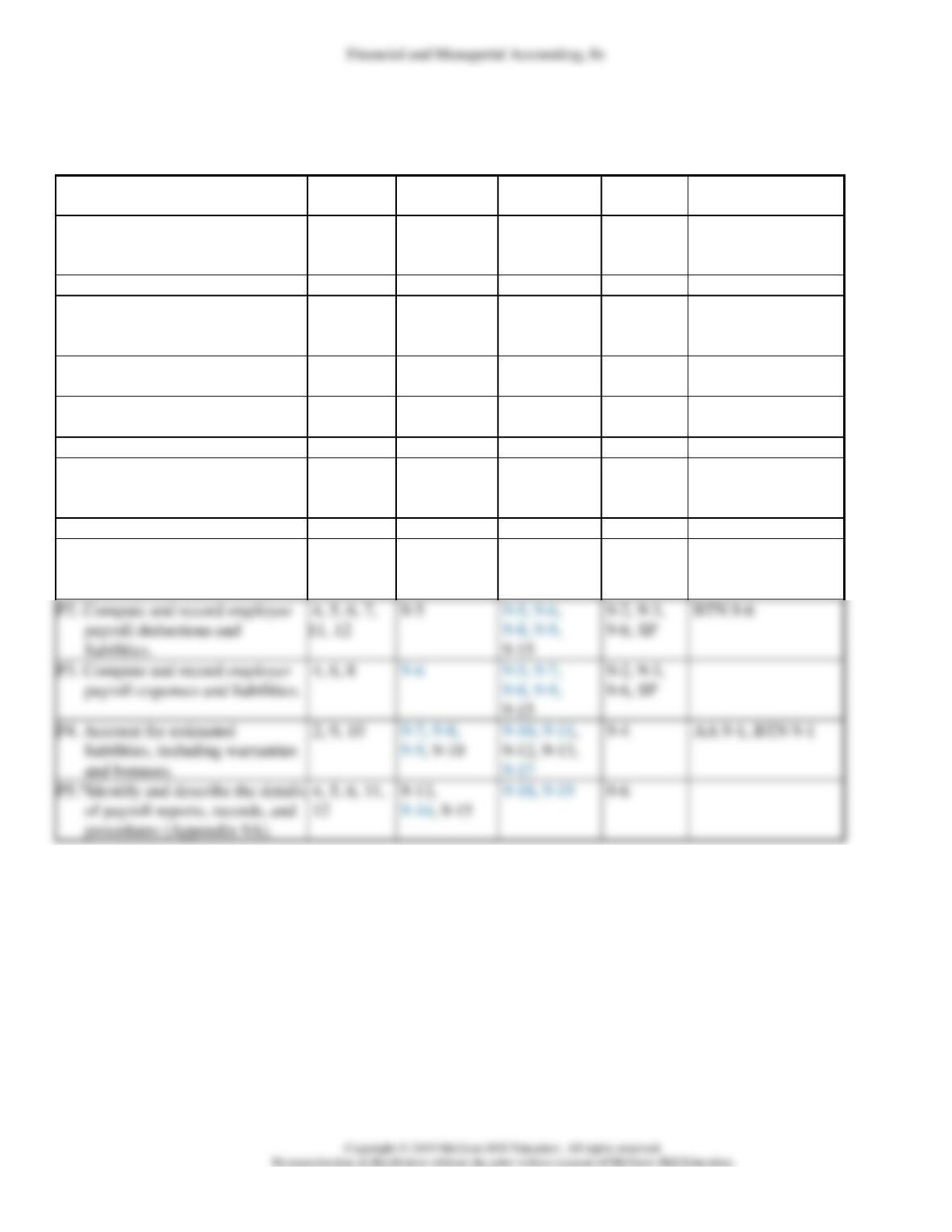
C1. Describe current and long-term
liabilities and their
characteristics.
1, 13, 14
9-1, 9-14
9-1, 9-15
BTN 9-3
C2. Identify and describe known
current liabilities.
3, 15, 16
9-2, 9-3
9-2
SP
BTN 9-4
C3. Explain how to account for
contingent liabilities.
10
9-11
9-14
BTN 9-2
A1. Compute the times interest
earned ratio and use it to
analyze liabilities.
9-12
9-16
9-5
AA 9-1, AA 9-2,
AA 9-3, BTN 9-3,
BTN 9-5
P1. Prepare entries to account for
short-term notes payable.
13
9-4
9-3, 9-4,
9-19
9-1,
GL9-1
BTN 9-4
liabilities.
9-15
P3. Compute and record employer
payroll expenses and liabilities.
4, 6, 8
9-6
9-5, 9-7,
9-8, 9-9,
9-15
9-2, 9-3,
9-6, SP
P4. Account for estimated
liabilities, including warranties
and bonuses.
2, 9, 10
9-9, 9-10
9-10, 9-11,
9-12, 9-13,
9-4
AA 9-1, BTN 9-1
of payroll reports, records, and
procedures (Appendix 9A).
4, 5, 6, 11,
12
9-13,
9-18, 9-19
9-6
*See additional information on next page that pertains to these quick studies, exercises, and problems.
SP refers to the Serial Problem
AA refers to Accounting Analysis
BTN refers to Beyond the Numbers
Questions with Guided Example videos
Additional Information on Related Assignment Material
See Chapter 1 of the Instructor’s Resource Manual for more information on materials for this text available in
Connect.
Connect
Available on the instructor’s course-specific website, Connect:
• All numerical Quick Studies, all Exercises and Problems Set A.
o Connect also provides algorithmic versions for Quick Study, Exercises, and Problems.
Hints/Guided Examples
Please note that the Guided Examples are labeled as “Hints” in Connect assignments. The animated PowerPoints without
the video and audio functions for the Guided Examples are also available in the Connect Instructor Library and Exercise
Presentations. These are indicated in the Related Assignment Materials grid on page 1 in blue bold font.
Need-to-Know Videos
LO
Need–to-Know
Title
Time
P1, C2
9-1
Accounting for Known Liabilities
4:02
9-2
Payroll Liabilities
2:57
9-3
Estimated Liabilities
3:18
9-4
Contingent Liabilities
1:10
Concept Overview Videos, (COV’s)
LO
Title
Time
C1
Describe current and long-term liabilities and their characteristics.
1:18
Defining and Classifying Liabilities
2:06
Uncertainty in Liabilities
C2
Identify and describe known current liabilities.
1:30
Known Liabilities – Sales Taxes Payable
1:03
Known Liabilities – Unearned Revenues
C3
Explain how to account for contingent liabilities.
1:35
Accounting for Contingent Liabilities
1:11
Compute the times interest earned ratio and use it to analyze liabilities.
0:52
Times Interest Earned Ratio
2:11
Times Interest Earned Ratio – Illustration
P1
Prepare entries to account for short-term notes payable.
1:52
Short-Term Notes Payable – Extension of Credit
1:04
Short-Term Notes Payable – Borrow from Bank
1:54
Short-Term Notes Payable – Note Extends Over Two Periods
P2
Compute and record employee payroll deductions and liabilities.
2:57
Employee Payroll and Deductions
1:18
Financial and Managerial Accounting, 8e
9-3
Employee and Payroll Deductions – Illustration
1:55
P3
Compute and record employer payroll expenses and liabilities.
Employer Payroll Expenses and Liabilities
1:14
Employer Payroll Expenses and Liabilities – Illustration
1:16
P4
Health and Pension Benefits
1:14
Vacation Benefits
1:09
Bonus Plans
0:24
Warranty Liabilities
1:58
P5
Identify and describe the details of payroll reports, records, and procedures
(Appendix 9A).
Payroll Reports – Form 941
1:08
Payroll Reports – Form 940
0:48
Payroll Reports – Form W-2
0:45
Payroll Records: Register
1:30
Payroll Records: Payroll Check
0:12
Payroll Records: Employee Earnings Report
0:27
Payroll Records: Form W-4
1:31
Synopsis of Chapter Revisions
NEW opener—Pandora and entrepreneurial assignment.
Updated data in Exhibit 9.2.
Streamlined “Short–Term Notes Payable.”
Simplified explanation of FICA taxes.
Financial and Managerial Accounting, 8e
Chapter Outline
I. Known Liabilities—Set by agreements, contracts, or laws and are
measurable (also called definitely determinable liabilities).
A. Characteristics of Liabilities
1. Defining Liabilities
Probable future payments of assets or services that a company is presently obligated to make
as a result of past transactions or events. Note three factors:
a. Due to past transaction or event
b. Present obligation
c. Future payment of assets or services
2. Classifying Liabilities
b. Long-term liabilities—Liabilities due after one year (or the company’s operating cycle if
longer).
3. Uncertainties in Liabilities—requires answering three important questions that are sometime
uncertain at the time liability is incurred:
a. Whom to pay? (Ex. A note “Payable to Bearer”)
b. When to pay? (Ex. Unearned revenues—may not know when service will be provided to
satisfy)
c. How much to pay? (Ex. Accrued expense that needed to be estimated prior to receipt of
bill)
Examples of known liabilities in the current classification include:
B. Accounts Payable
Amounts owed to suppliers (also called vendors) for products or services purchased with credit.
When earned: (Dr Unearned Revenue, Cr Revenue).
E. Short-Term Notes Payable
Written promise to pay a specified amount on a definite future date within one year. Can arise
from many transactions; two common examples:
1. Note given to extend credit period—creditor requires an interest-bearing note for an overdue
account payable that does not bear interest.
(Dr Accounts Payable, Cr Notes Payable)
3. When note extends over two periods—
(Dr Interest Expense and Cr Interest Payable) if accrued interest is being recorded at end-of-
period adjustment.
II. Payroll Liabilities—arise from salaries and wages, employee benefits, and payroll taxes levied on the
employer.
A. Employee Payroll and Deductions—amounts withheld from an employee’s gross pay, either
involuntary or voluntary; also called withholdings. Each is recorded as a separate liability (Cr).
• Gross pay—total compensation an employee earns, including wages, salaries, commissions,
and bonuses. Gross pay amount is recorded as Salaries Expense (Dr).
• Net pay—gross pay minus all deductions; also called take-home pay. Net pay is recorded as
Salaries Payable (Cr).
for pay in excess of $200,000 – this additional tax is not imposed on the employer.
2. Employee Income Tax Payable is determined from chart based on their gross pay, pay period,
marital status and number of withholding allowances the employee claims.
3. Employee voluntary deductions (charitable contributions, health insurance premiums, union
dues) result in various payables.
Note: All the payroll components, gross pay, each deduction, and net pay, are recorded
in one journal entry.
B. Employer Payroll Taxes—payroll taxes in addition to those required of employees. These taxes
result in expenses (Dr) and current liabilities (Cr).
1. Employer FICA tax—employers must pay an amount equal to employee contribution. The
taxes are credited to the same FICA taxes payable account used to record the amounts
withheld from the employees.
3. Recording Employer Payroll Taxes: additional expense beyond Wages and Salaries
Expense. Debit Payroll Tax Expense for the Total and Credit the individual liability
accounts for the individual taxes.
C. Internal Control of Payroll—Four key areas of payroll activities that should be separate and
4. Payroll payment
D. Multi-Period Known Liabilities—known liabilities that extend over many periods; for example,
Unearned Revenues and Notes Payable. Classification is based upon the period in which they will
be satisfied.
1. Current liability—portion that will be due in the next year.
2. Long-term liability—portion that will be due after the next year.
III. Estimated Liabilities—Known obligations of uncertain amounts that can be reasonably estimated.
Recorded as expenses (Dr) and payables (Cr). Examples include:
dental, life. and disability insurance. Appropriate proportion accrued at time of each payroll.
B. Vacation Benefits—also called paid absences. These are estimated and recorded by the employer
in the period when employees earn them. Appropriate proportion accrued at time of each payroll.
C. Bonus Plans—employee bonuses must be estimated and recorded in year-end adjusting entries.
E. Multi-Period Estimated Liabilities—can be current or long-term and must be classified based
IV. Contingent Liabilities—a contingent liability is a potential liability that depends on a future event
arising from a past transaction.
A. Accounting for Contingent Liabilities—depends on likelihood that a future event will occur and
the ability to estimate the future amount. (Accounting motivated by full-disclosure principle.)
Three categories and appropriate accounting for each:
1. Record liability: future event is probably (likely), record with a journal entry if amount can be
reasonably estimated; if cannot be estimated, disclose in footnotes to financial statements.
B. Applying Rules of Contingent Liabilities
3. Other Contingencies (e.g., environmental damages, possible
tax assessments, insurance losses, and government
investigations)—usually disclosed in as a contingent liability.
C. Uncertainties that are not Contingencies—include natural disasters and new technologies. These
are not contingent liabilities because they are future events not arising from past transactions.
V. Decision Analysis—Times Interest Earned Ratio
A. Interest expense is often viewed as a fixed expense, which can be advantageous when a company
is growing, but can create risk because the company might be unable to pay fixed expenses if sales
decline.
VI. Payroll Reports, Records, and Procedures (Appendix 9A)
A. Payroll Reports—employers are required to prepare and submit the following reports:
1. Employer’s Quarterly Federal Tax Return (IRS Form 941)
Filed within one month after the end of each calendar quarter to report FICA and income
withholding taxes owed and remitted.
2. Annual Federal Unemployment Tax Return (IRS Form 940) Reports employer’s FUTA taxes
on an annual basis. Must be mailed on or before January 31 following the end of each tax
year to report an employer’s FUTA taxes.
9-7
3. Wage and Tax Statement (Form W-2)
Must be mailed on or before January 31 following the year covered by the report; employers
must give each employee an annual report of the employee’s wages subject to FICA and
federal income taxes and the amounts of these taxes withheld.
B. Payroll Records—employers are required to keep payroll records in addition to reporting and
paying taxes.
1. Payroll Register
A record for a pay period that shows the pay period dates and the hours worked, gross pay,
deductions, and net pay of each employee; contains all the data needed to record payroll (for
each pay period) in the General Journal.
2. Payroll Check
Generally accompanied with a detachable statement of earnings showing gross pay,
deductions, and net pay.
3. Employee Earnings Report
A cumulative record of an employee’s hours worked, gross pay, deductions, net pay, and
certain personal information about the employee; contains the data the employer needs to
prepare a Form W-2.
C. Payroll Procedures
1. Computing Federal Income Taxes
Computed using a wage bracket withholding table based on gross pay, number of personal
exemptions, the employee’s tax status, and pay period.
a. Withholding allowance—a number that is used to reduce the amount of federal income tax
withheld from an employee’s pay, and which corresponds to the personal exemptions the
employee is allowed to subtract from annual earnings in calculating taxable income.
b. Form W-4—withholding allowance certificate form. Filed by employee with employer to
identify personal exemptions claimed.

9-8
Chapter 9 Alternate Demonstration Problem
On November l, 2019, Orleaon Co. borrowed $200,000 for 90 days at 9% by signing a
note.
Required:
1. Assume that the face value of the note equals the principal of the loan. Prepare
the general journal entries to record issuing the note, accrual of interest at the end
of 2019 and the payment of the note at maturity.
Chapter 9 Solution: Alternate Demonstration Problem
Issuance:
11/1/19
Cash …………………………………………
200,000
Notes Payable ……………………..
200,000
Year-end accrual:
12/31/19
Interest Expense ……………………….
3,000
Interest Payable …………………..
3,000
($200,000 × 9% × 60/360 = $ 3,000 accrued interest)
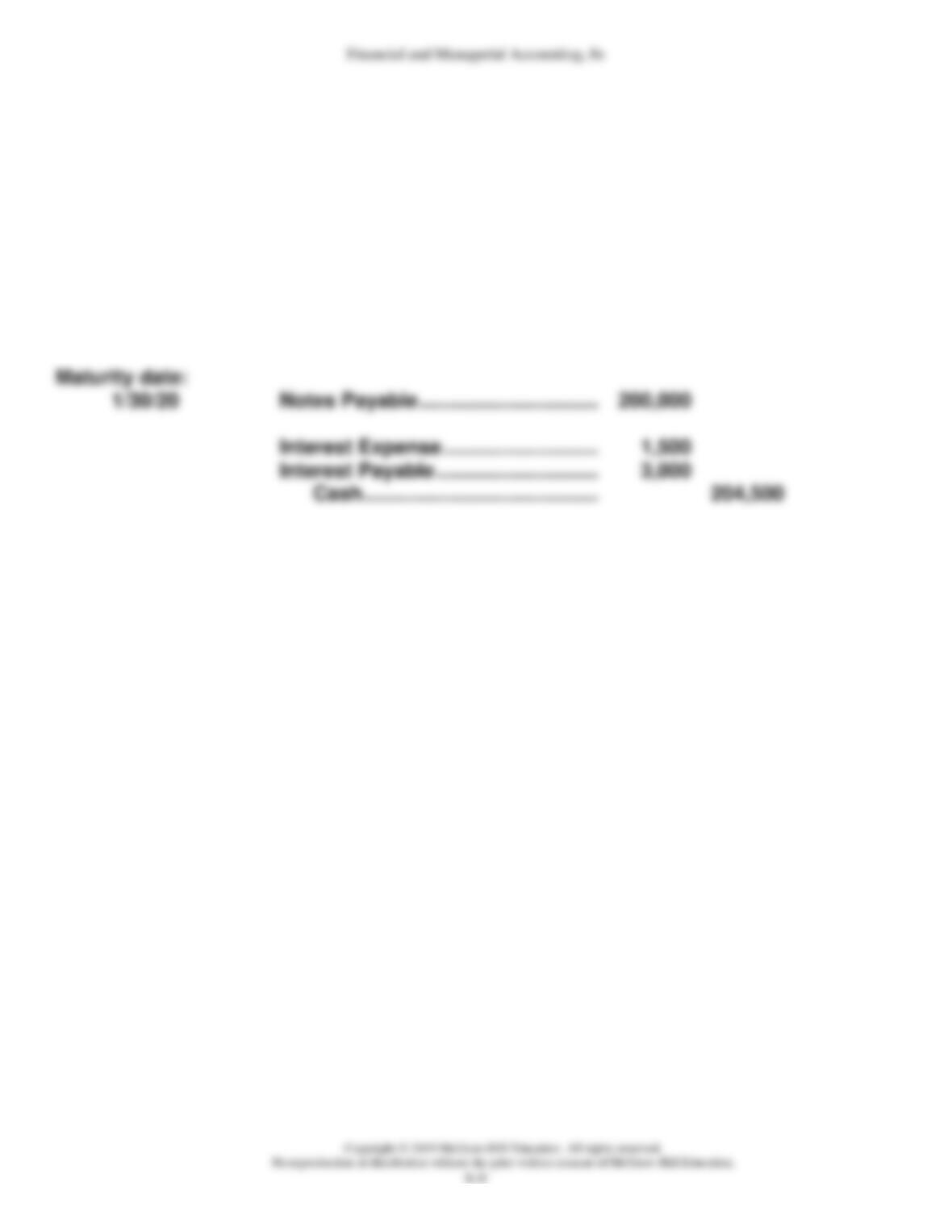
Maturity date:
Interest Expense ……………………….
1,500
Interest Payable ………………………..
3,000
Cash ……………………………………
204,500