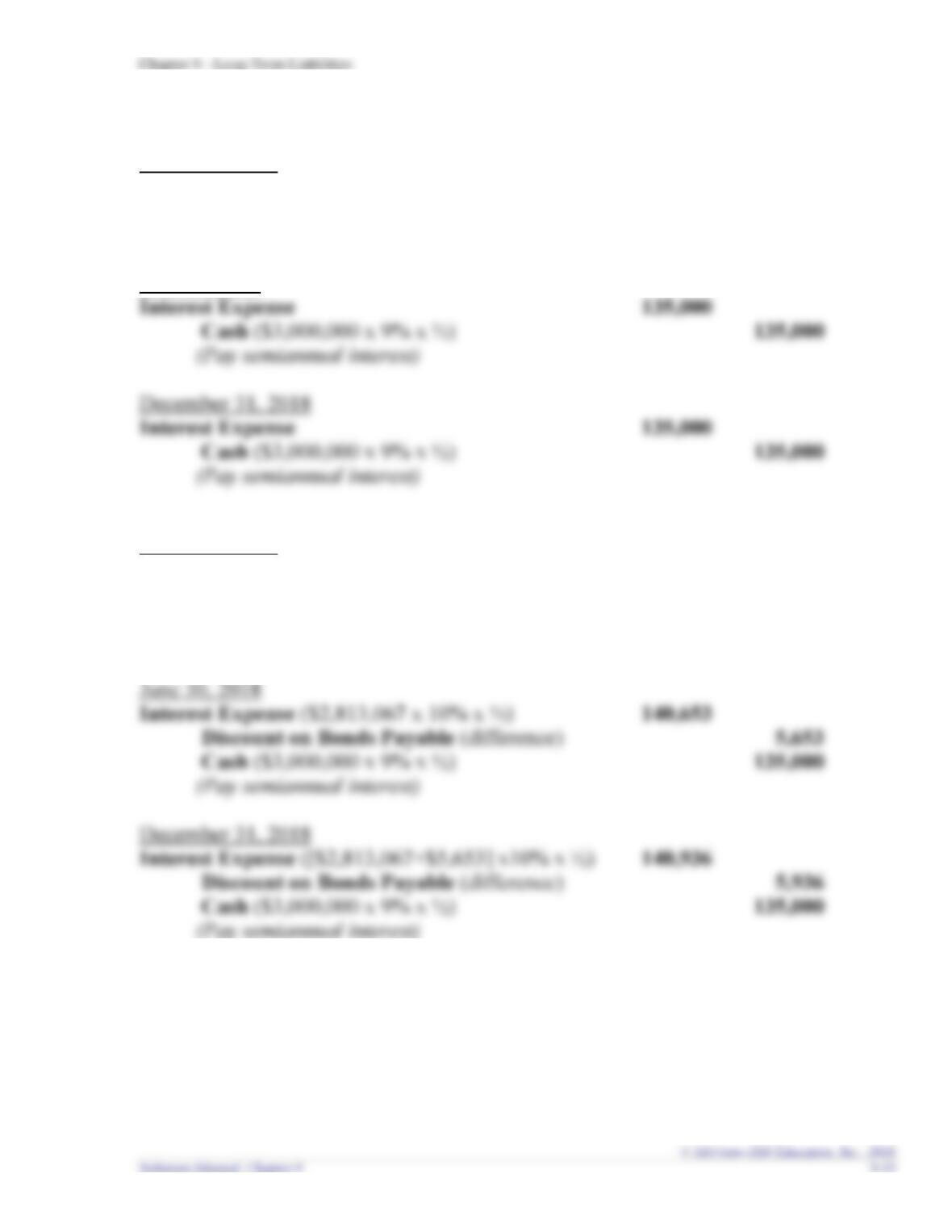
Problem 9-4B (LO 9-6)
Requirement 1
January 1, 2018
Cash
3,000,000
Bonds Payable
3,000,000
(Issue bonds at face amount)
June 30, 2018
Interest Expense
(Pay semiannual interest)
December 31, 2018
Interest Expense
135,000
(Pay semiannual interest)
Requirement 2
January 1, 2018
Cash
2,813,067
Discount on Bonds Payable
186,933
Bonds Payable
3,000,000
(Issue bonds at a discount)
June 30, 2018
(Pay semiannual interest)
Chapter 9 – Long-Term Liabilities
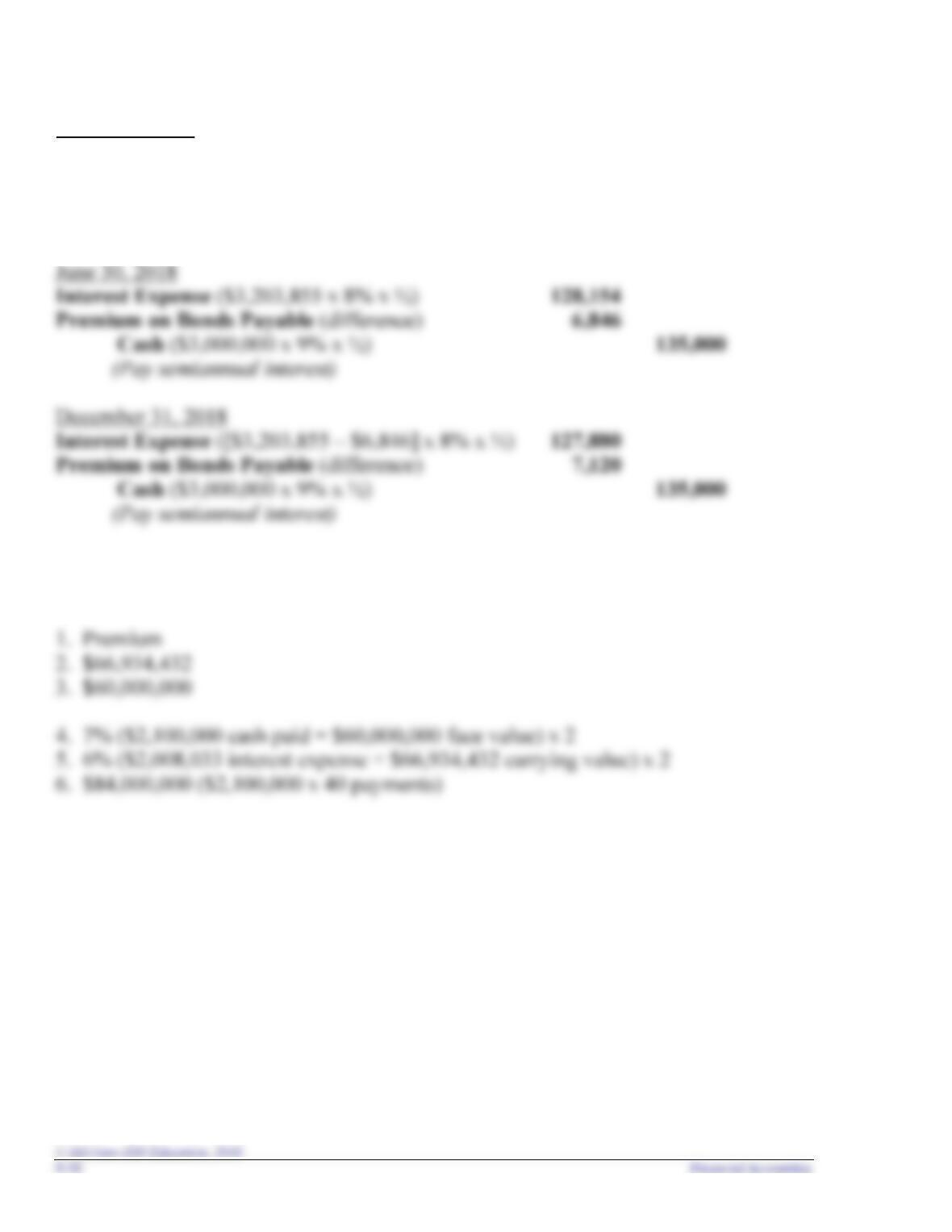
Requirement 3
January 1, 2018
Cash
3,203,855
Bonds Payable
3,000,000
Premium on Bonds Payable
203,855
(Issue bonds at a premium)
June 30, 2018
128,154
December 31, 2018
127,880
135,000
Problem 9-5B (LO 9-6)
Problem 9-6B (LO 9-6)
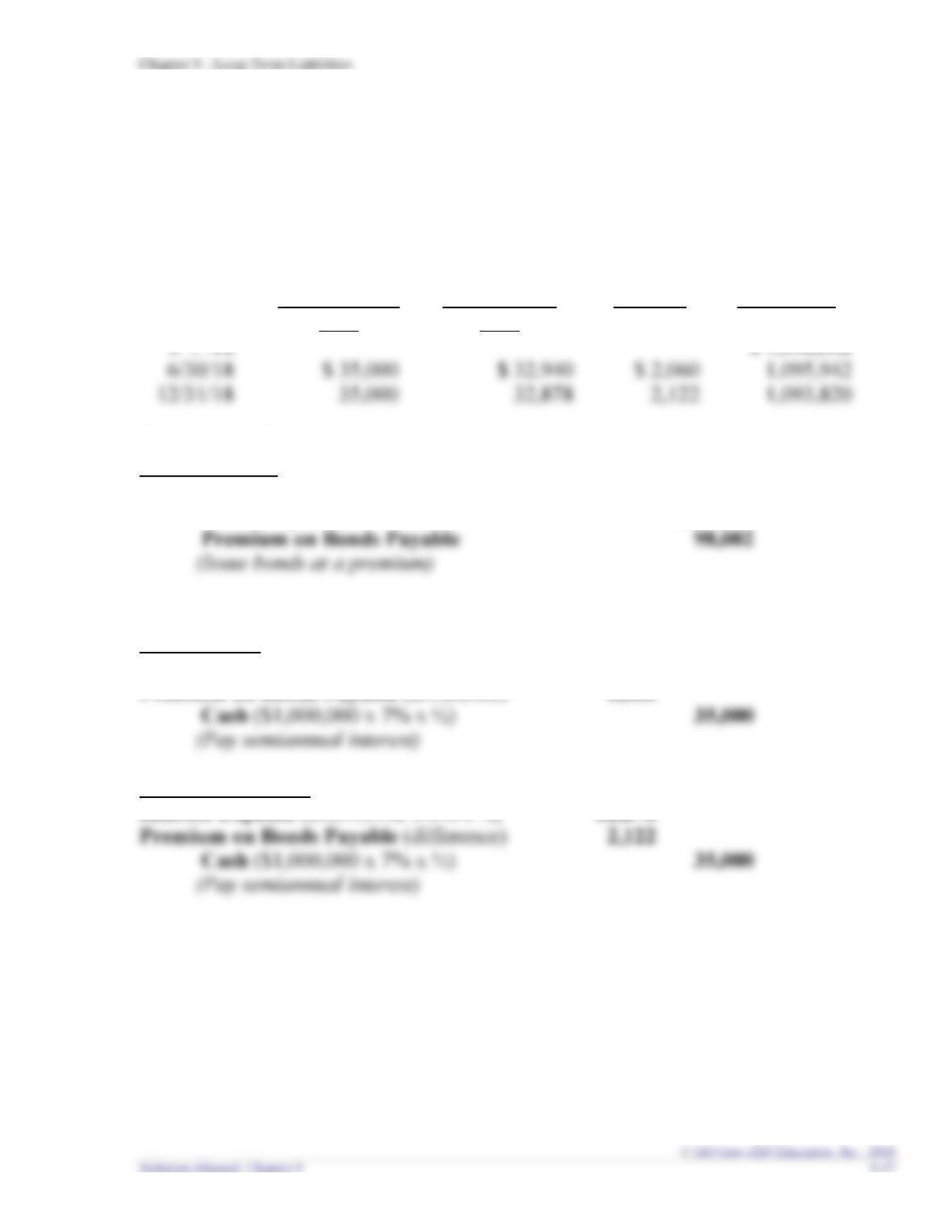
Requirement 1
(1)
Date
(2)
Cash
Paid
(3)
Interest
Expense
(4)
Decrease in
Carrying
Value
(5)
Carrying
Value
Face Amount
x 3.5% Stated
Rate
Carrying Value
x 3% Market
Rate
(2) – (3)
Prior Carrying
Value – (4)
Requirement 2
January 1, 2018
Cash
1,098,002
Bonds Payable
1,000,000
Premium on Bonds Payable
Requirement 3
June 30, 2018
Interest Expense ($1,098,002 x 6% x ½)
32,940
Premium on Bonds Payable (difference)
2,060
December 31, 2018
Interest Expense ($1,095,942 x 6% x ½)
32,878
Premium on Bonds Payable (difference)
2,122
Problem 9-7B (LO 9-8)
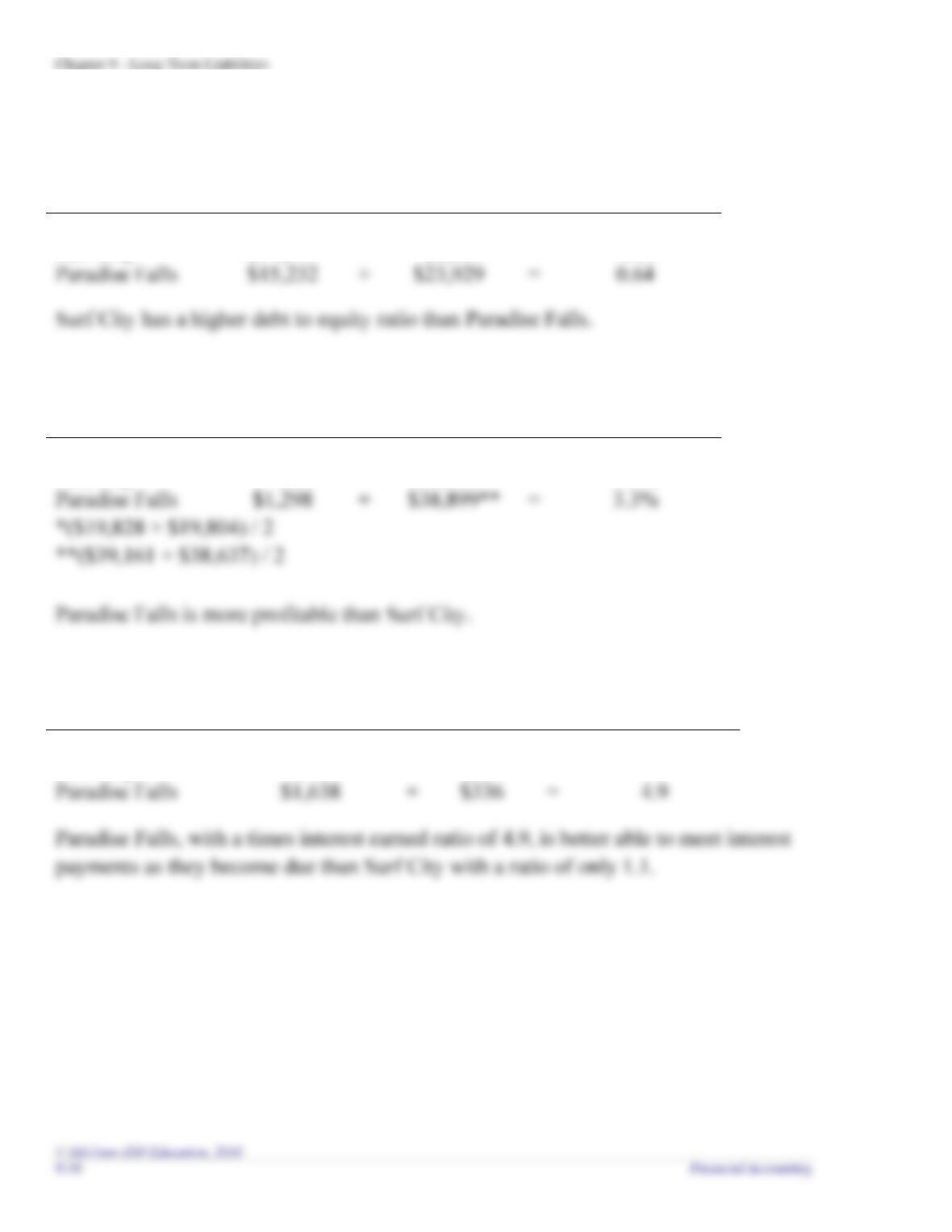
Requirement 1
($ in millions)
Total
Liabilities
÷
Stockholders’
Equity
=
Debt to Equity
Ratio
Surf City
$11,519
÷
$8,309
=
1.39
Paradise Falls
÷
=
Requirement 2
($ in millions)
Net
Income
÷
Average
Total Assets
=
Return on
Assets Ratio
Surf City
$18
÷
$19,816*
=
0.1%
Paradise Falls
÷
=
3.3%
Requirement 3
($ in millions)
Net Income +
Interest + Taxes
÷
Interest
=
Times Interest
Earned Ratio
Surf City
$374
÷
$356
=
1.1
Paradise Falls
÷
=
4.9
Chapter 9 – Long-Term Liabilities
ADDITIONAL PERSPECTIVES
Continuing Problem: Great Adventures
AP9-1
Requirement 1
(1)
Date
(2)
Cash
Paid
(3)
Interest
Expense
(4)
Decrease in
Carrying
Value
(5)
Carrying
Value
Monthly
Payment
Carrying Value
x 6% x 1/12
(2) – (3)
Prior Carrying
Value – (4)
1/ 1 /20
$ 500,000
Requirement 2
January 1, 2020
Cash
500,000
January 31, 2020
Interest Expense ($500,000 x 6% x 1/12)
2,500
Notes Payable (difference)
3,051
February 28, 2020
Interest Expense ($496,949 x 6% x 1/12)
2,485
5,551
Chapter 9 – Long-Term Liabilities
Financial Analysis: American Eagle
AP9-2
Requirement 1
($ in thousands)
Total
Liabilities
÷
Stockholders’
Equity
=
Debt to Equity
Ratio
2015
$557,162
÷
$1,139,746
=
0.49
2014
÷
=
Requirement 2
($ in thousands)
Net
Income
÷
Average
Total Assets
=
Return on
Assets
2015
$80,322
÷
$1,695,536*
=
4.7%
Requirement 3
The bankruptcy risk of American Eagle is very low. The company carries very little
Chapter 9 – Long-Term Liabilities
Financial Analysis: Buckle
AP9-3
Requirement 1
($ in thousands)
Total
Liabilities
÷
Stockholders’
Equity
=
Debt to Equity
Ratio
2015
$187,715
÷
$355,278
=
0.53
Requirement 2
($ in thousands)
Net
Income
÷
Average
Total Assets
=
Return on
Assets
Requirement 3
The bankruptcy risk of The Buckle is very low. The company carries no bank
Chapter 9 – Long-Term Liabilities
Comparative Analysis: American Eagle vs. Buckle
AP9-4
Requirement 1
($ in thousands)
Total
Liabilities
÷
Stockholders’
Equity
=
Debt to
Equity Ratio
American Eagle
$557,162
÷
$1,139,746
=
0.49
Requirement 2
($ in thousands)
Net
Income
÷
Average Total
Assets
=
Return on
Assets Ratio
American Eagle
$80,322
÷
$1,695,536*
=
4.7%
Chapter 9 – Long-Term Liabilities
Ethics
AP9-5
Requirement 1
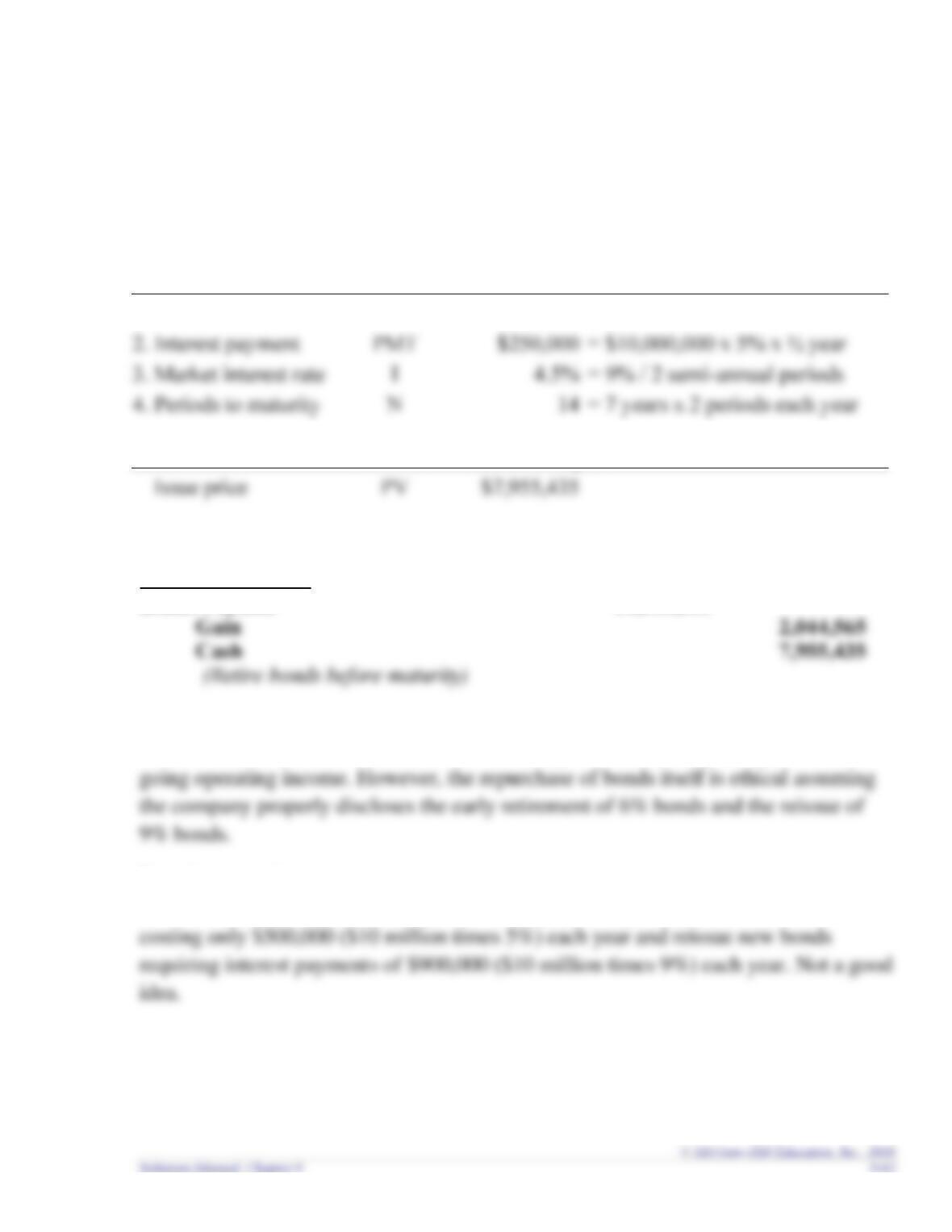
Calculator Input
Bond
Characteristics
Key
Amount
1. Face amount
FV
$10,000,000
2. Interest payment
3. Market interest rate
4. Periods to maturity
Calculator Output
PV
Requirement 2
December 31, 2018
Bonds Payable
10,000,000
Requirement 3
It is not ethical to deceive investors into thinking the $2 million gain is part of on–
Requirement 4
In order to report the $2 million gain, the company will give up bonds with interest

Chapter 9 – Long-Term Liabilities
Internet Research
AP9-6
This case provides an opportunity for students to learn more about credit ratings at

Chapter 9 – Long-Term Liabilities
Written Communication
AP9-7
Requirement 1
A company that borrows by issuing bonds is effectively by-passing the bank and
borrowing directly from the investing public, usually at a lower interest rate than it
would in a bank loan. However, issuing bonds entails significant bond issue costs for
Requirement 2
One of the primary reasons for issuing bonds over issuing common stock relates to
Requirement 3
The price of a bond is calculated as the present value of the principal (the face amount
on the bond due at maturity) plus the present value of the periodic interest payments.
Chapter 9 – Long-Term Liabilities
9-66 Financial Accounting
Earnings Management
AP9-8
Requirement 1
Calculator Input
Bond
Characteristics
Key
Amount
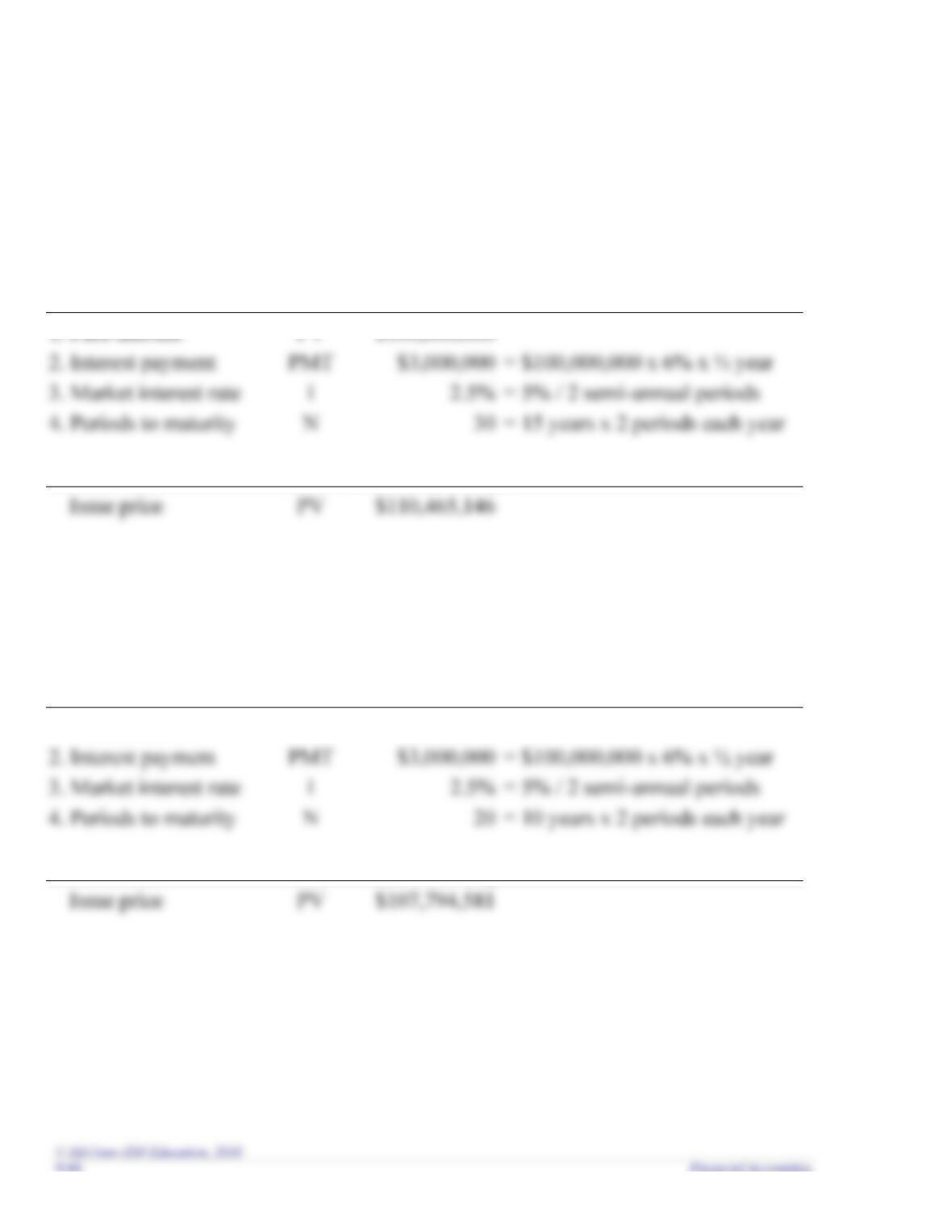
1. Face amount
FV
$100,000,000
2. Interest payment
3. Market interest rate
4. Periods to maturity
Calculator Output
PV
$110,465,146
Requirement 2
Calculator Input
Bond
Characteristics
Key
Amount
1. Face amount
FV
$100,000,000
2. Interest payment
3. Market interest rate
4. Periods to maturity
Calculator Output
Chapter 9 – Long-Term Liabilities
Requirement 3
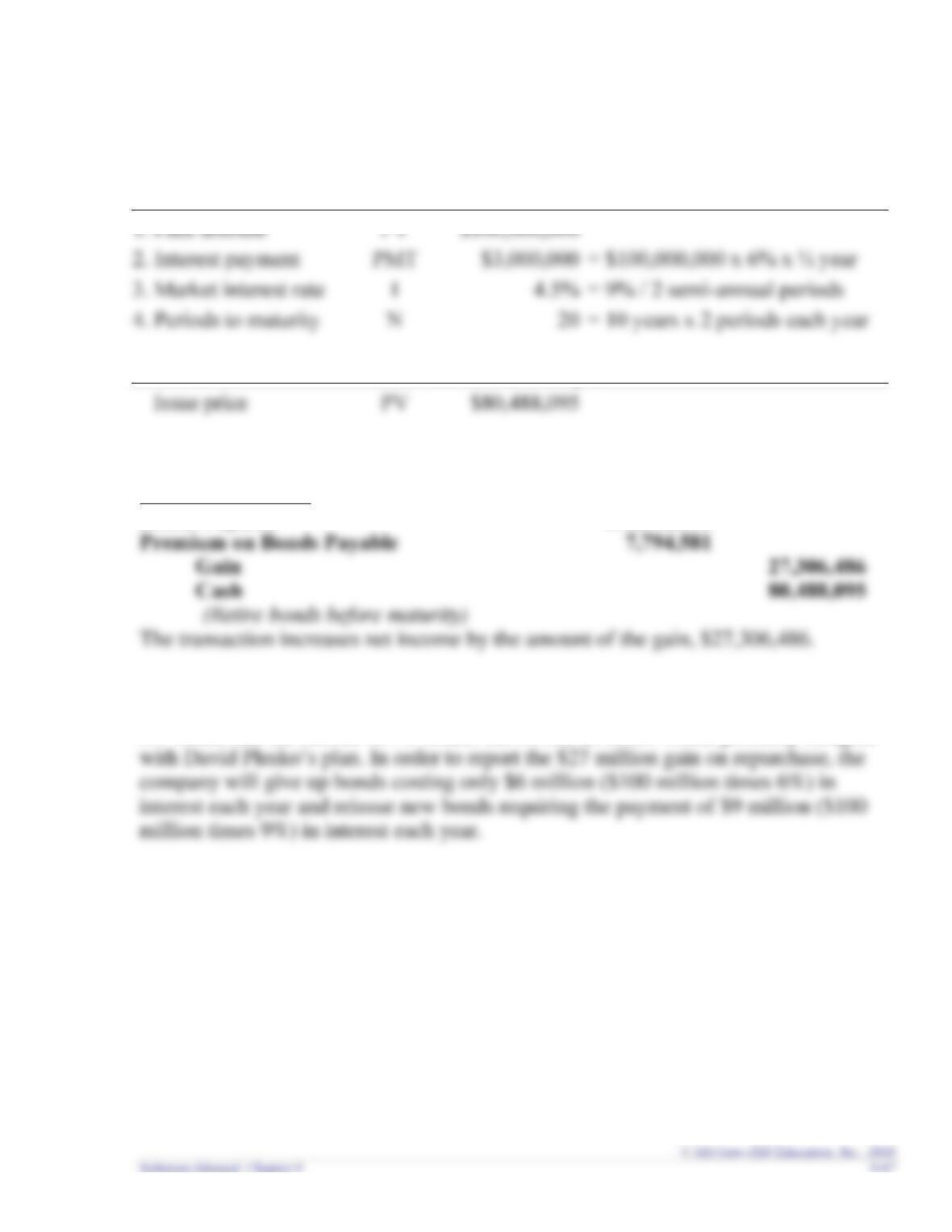
Calculator Input
Bond
Characteristics
Key
Amount
Calculator Output
Requirement 4
December 31, 2018
Bonds Payable
100,000,000
Premium on Bonds Payable
Requirement 5
David Plesko’s plan is ethical as long as he properly discloses the early retirement of
6% bonds and the reissue of 9% bonds. However, investors would probably disagree