Continuing Cookie Chronicle 1
Continuing Cookie Chronicle
(Note: This is a continuation of the Cookie Chronicle from Chapters 1 through 8.)
CCC9
Part 1 Now that she is selling mixers and her customers can use credit cards to
pay for them, Natalie is thinking of upgrading her website to include the online
sale of mixers and payment by credit card. This would enable her to sell these
mixers to a wider range of customers using the Internet.
Natalie contacts her brother who originally prepared the website for her. He
agrees to upgrade the site so it can handle credit card security issues as well as
direct order entry. The cost of the upgrade is $1,800. This cost would be incurred
and paid for during the month of August 2015, and the upgrade would be
operational September 1, 2015. Recall that Natalie’s website had an original cost
of $600 and is being amortized using the straight– line method over 24 months,
starting December 1, 2014, with zero residual value. Additional costs for website
maintenance and insurance are estimated to be $1,200 per year.
If Natalie decides to upgrade the website, its useful life will not change and
there will be no change in residual value.
Instructions
(a) Prepare the journal entry to record the upgrade.
(b) Calculate the monthly amortization expense before the upgrade and the
accumulated amortization and book value on August 31, 2015.
(c) Calculate the revised monthly amortization expense as of September 1,
2015.
(d) Calculate the accumulated amortization and book value on December 31,
2015.
(e) Explain to Natalie the difference in accounting for the website upgrade
costs and accounting for the costs incurred for website maintenance and
insurance. In your explanation, comment on the generally accepted
accounting principles that affect the accounting for these transactions.
Part 2 Natalie is also thinking of buying a van that will be used only for
business. The cost of the van is estimated at $38,500. Natalie would spend an
additional $2,500 to have the van painted. In addition, she wants the back seat of
the van removed so that she will have lots of room to transport her mixer
inventory as well as her baking supplies. The cost of taking out the back seat and
installing shelving units is estimated at $1,500. She expects the van to last her
about 5 years, and she expects to drive it for 100,000 miles. The annual cost of
vehicle insurance will be $2,400. Natalie estimates that at the end of the 5-year
useful life the van will sell for $6,500. Assume that she will buy the van on August
15, 2015, and it will be ready for use on September 1, 2015.
Natalie is concerned about the impact of the van’s cost on her income
statement and balance sheet. She has come to you for advice on calculating the
van’s depreciation.
Instructions
(a) Determine the cost of the van.
(b) Prepare a depreciation table for straight-line depreciation (similar to the
one in Illustration 9-9). Recall that Cookie Creations has a December 31
fiscal year-end.
(c) What method should Natalie use for tax purposes? Provide a justification
for your choice. Is she required to use the same approach for financial
reporting and tax reporting?
Part 1
(a)
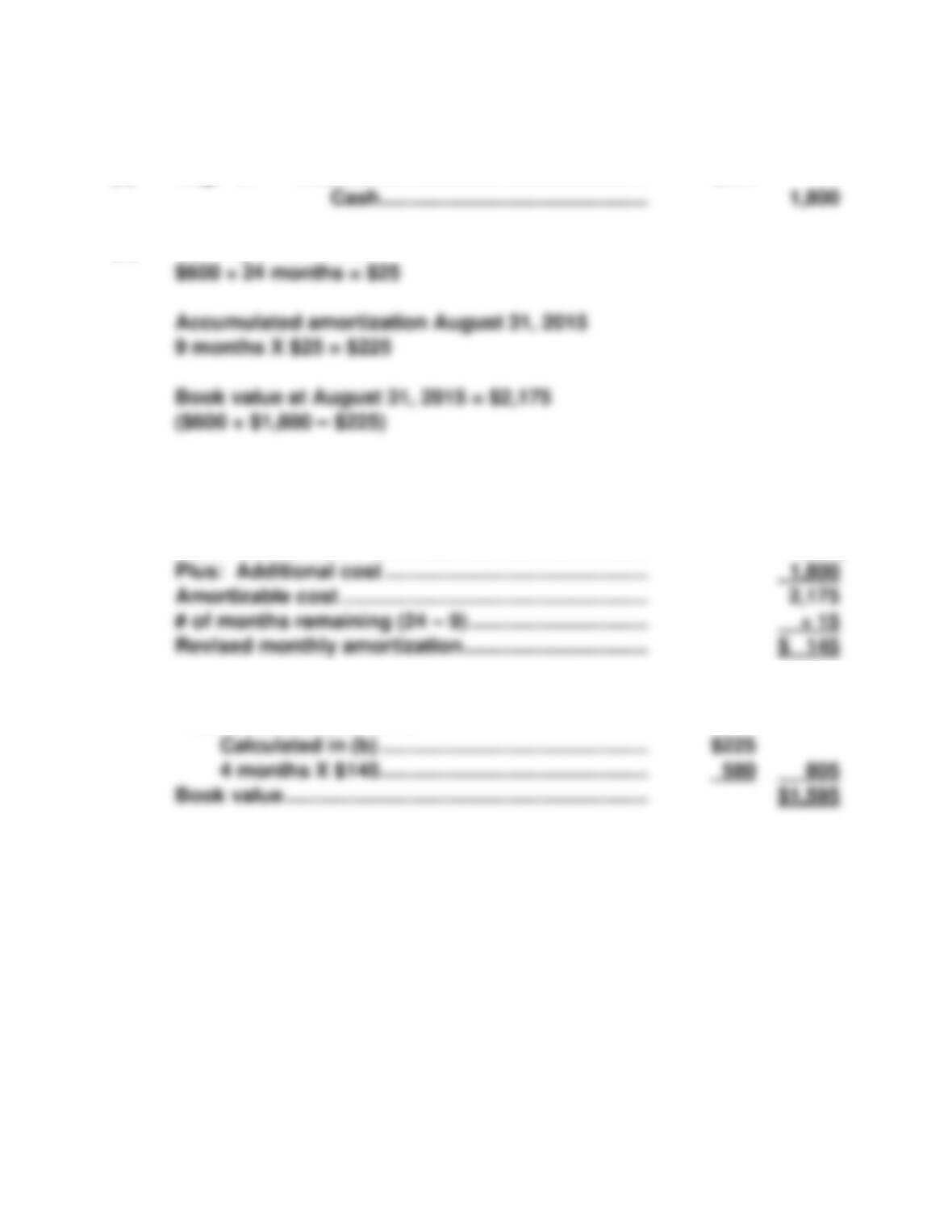
Aug. 31 Website ………………………………………….
1,800
(b)
Monthly amortization
$600 ÷ 24 months = $25
Accumulated amortization August 31, 2015
9 months X $25 = $225
($600 + $1,800 – $225)
(c)
Revised monthly amortization
Original cost ……………………………………………………..
$ 600
Less: Accumulated amortization ……………………….
(225)
Amortizable cost ……………………………………………….
# of months remaining (24 – 9) …………………………..
Revised monthly amortization …………………………...
(d)
Cost ($600 + $1,800)…………………………………………..
$2,400
Accumulated amortization: ………………………………..
4 months X $145 …………………………………………
Book value ………………………………………………………..
Part 1 (Continued)
(e) Costs incurred for website maintenance and insurance are costs
incurred to maintain the operating efficiency of the website and are
therefore recorded as an expense of the period. These costs are
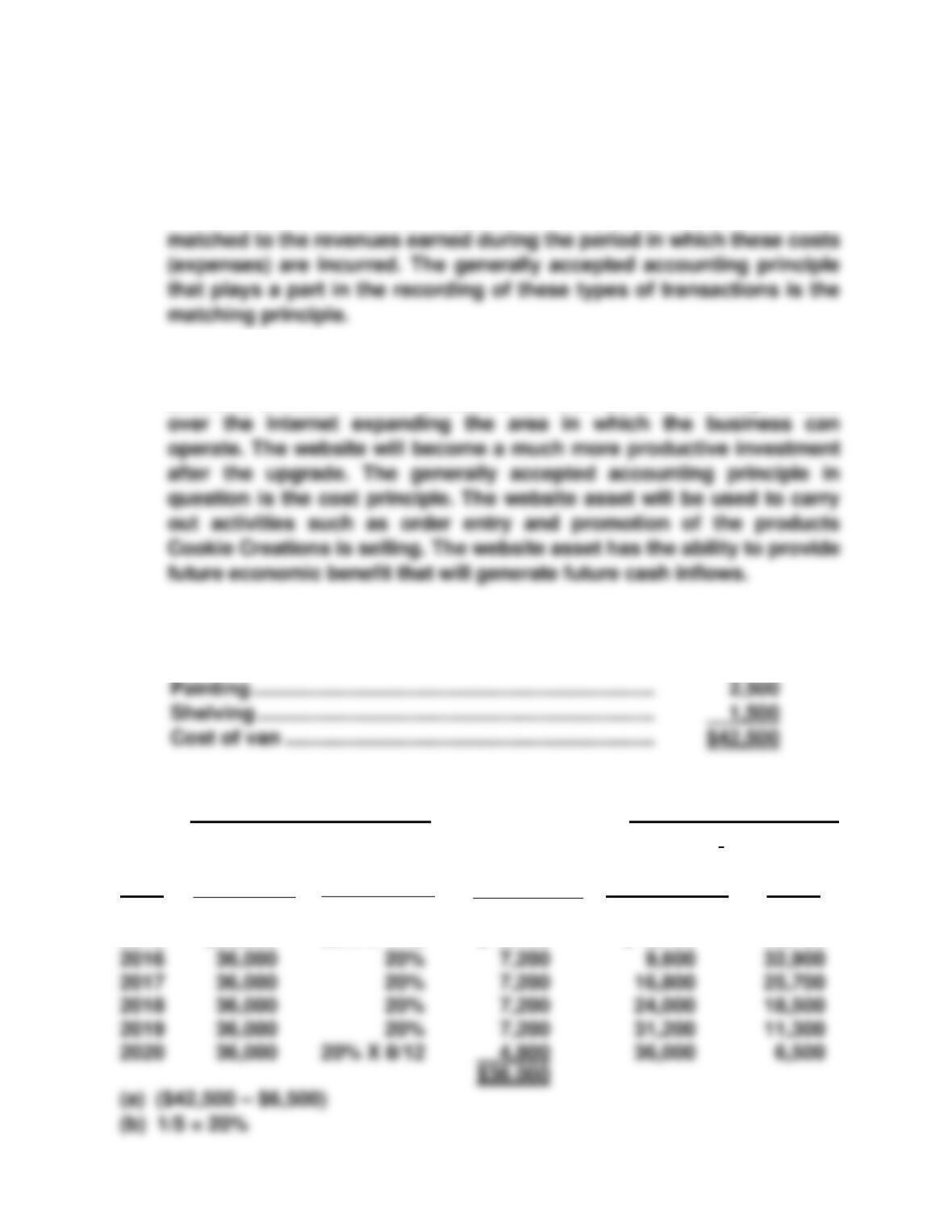
Costs incurred for the website upgrade increase the operating efficiency
of the website and therefore increase the value of the intangible asset
account, Website. Cookie Creations will now be able to accept orders
Part 2
(a)
Purchase price ……………………………………………………
$38,500
Painting ………………………………………………………………
Shelving ……………………………………………………………..
$42,500
(b)
Straight-line depreciation
Computation
Annual
End of Year
Year
Depreciable
Cost (a)
Depreciation
Rate (b)
Depreciation
Expense
Accumulated
Depreciation
Book
Value
$42,500
2015
$36,000
20% X 4/12
$ 2,400
$ 2,400
40,100
2016
32,900
2017
25,700
2018
18,500
2019
11,300
2020
20% X 8/12
(b) 1/5 = 20%
Part 2 (Continued)
(c) Natalie should use a special accelerated depreciation method for tax
purposes. Using an accelerated method, rather than the straight-line
method, will minimize income tax expenses in the early years of an