(continued) P 9-86B
Req. 3
Journal
DATE
ACCOUNT TITLES AND EXPLANATION
DEBIT
CREDIT
2016
a.
Dec.
31
Cash ………………………………………………….
1,739,841
Discount on Bonds Payable ……………….
260,159
Convertible Bonds Payable ……………
2,000,000
To issue bonds at a discount.
2017
b.
June
30
Interest Expense ………………………………..
78,293
Cash …………………………………………….
70,000
Discount on Bonds Payable ………….
8,293
To pay interest and amortize bond discount.
c.
Dec.
31
Interest Expense ………………………………..
78,666
Cash ……………………………………………..
Discount on Bonds Payable …………..
8,666
2018
d.
July
1
Convertible Bonds Payable ………………..
Discount on Bonds Payable
($234,144 × .40) …………………………..
Common Stock (70,000 × $1) …………
Paid-in Capital in Excess of
To record conversion of bonds.
Req. 4 (balance sheet presentation of bonds payable at
Dec. 31, 2018)
Convertible bonds payable
($2,000,000 − $800,000) …………………………………
$1,200,000
Less: Discount on bonds payable
($224,680 × 3/5)*…………………………….….
(134,808)
$1,065,192
_____
*3/5 (or .60) of the bonds are outstanding, so 3/5 of the discount remains.
(15-30 min.) P 9-87B
Req. 1
Alternative
Alternative
1
2
Borrow $4.75
Issue 100,000
mil at 3%
shares of stock
Net income 2 years from
now
$1,815,000
$1,815,000
Less interest expense
142,500
-0-
Projected net income
before tax
1,672,500
1,815,000
Less income tax expense
334,500
363,000
Projected net income 2
years from now
$1,338,000
$1,452,000
$1,338,000/100,000
$1,452,000/(100,000 +
100,000)
$7.26
Req. 2
TO: Management of Summit Medical Goods
FROM: Student Name
SUBJECT: Advantages and disadvantages of borrowing
versus issuing stock to raise cash for expansion
Raising money by borrowing has at least two advantages over issuing
(continued) P 9-87B
in the business and to carry out their plans without interference from a new
group of stockholders. Under normal conditions, borrowing results in a higher
earnings per share of common stock, because the interest expense on the
debt is tax-deductible. And higher earnings per share usually lead to higher
stock prices for company owners.
One disadvantage of issuing stock is dilution of the ownership interests of
existing stockholders if the purchasers of new stock are outsiders. The new
stockholders may have different ideas about how to manage the business and
that may pose difficulties for the original stockholder group. Another
disadvantage of issuing stock is that earnings per share are usually lower
because of (1) the greater number of shares of stock outstanding, and (2) the
non-tax-deductibility of dividends paid on the stock.
(20-30 min.) P 9-88B
Req. 1
Brillhart Foods, Inc.
Partial Balance Sheet
Dec. 31, 2016
Property, plant,
and equipment:
Current liabilities:*
Equipment ……….
$745,000
Bonds payable,
Accumulated
current portion ……………….
$200,000
Depreciation ….
Mortgage note payable,
current portion ………………
Interest payable ……………….
Total current liabilities ………..
Mortgage note
payable …………………………..
$312,000
Bonds payable ….. $300,000
Less: Discount on
bonds payable ….. (21,000)*
279,000
Pension liability ……………….
50,000**
Total long-term liabilities ……
641,000
_____
Notes:
* The order of listing long-term liabilities is optional. However, Discount on
Bonds Payable should come immediately after Bonds Payable. Also, it is
customary to report Interest Payable after the related liability accounts.
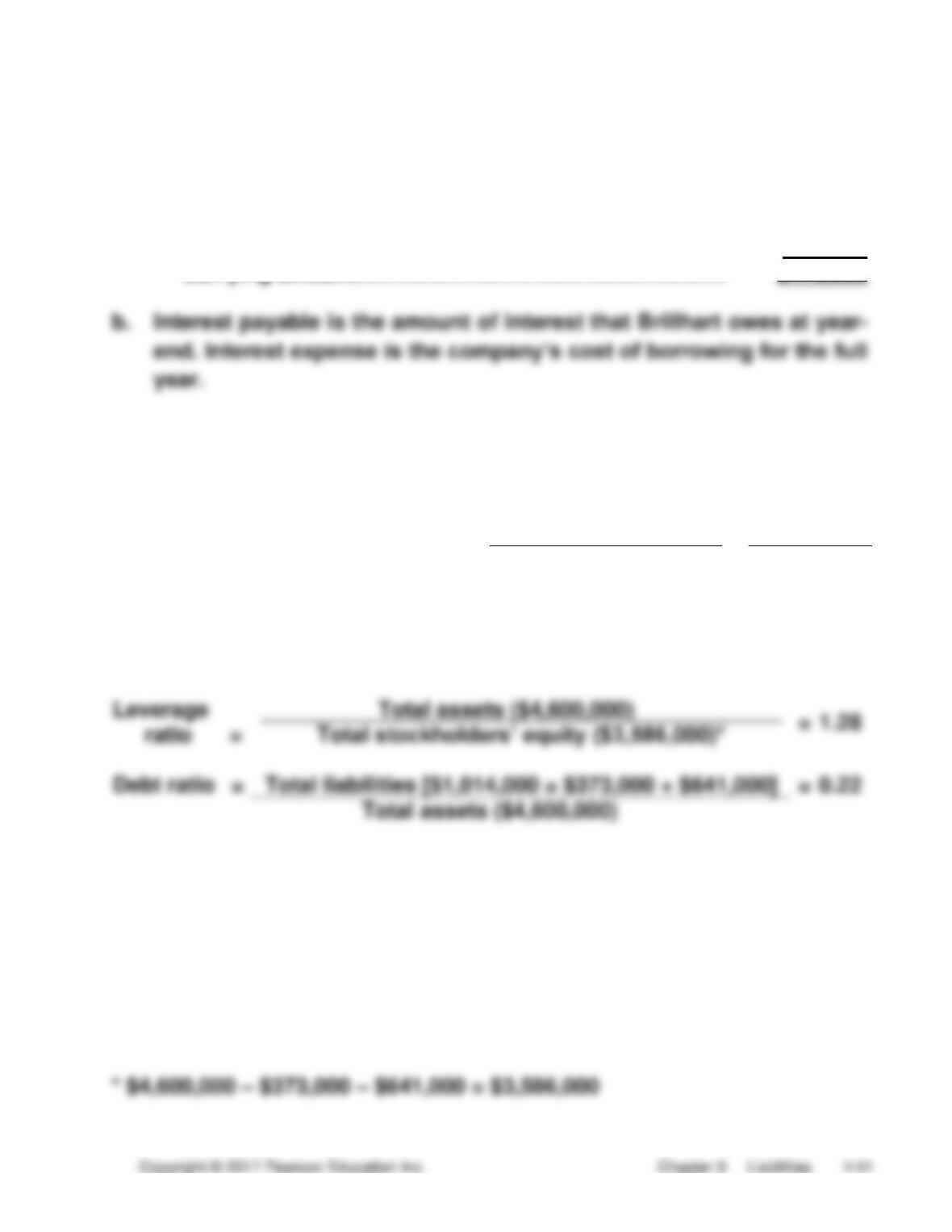
** Computation of pension liability:
(continued) P 9-88B
Req. 2
a. Carrying amount of bonds payable:
Current portion …………………………………………………….. $200,000
Long-term portion ……………………………………………….. 279,000
Req. 3
Times-interest-earned ratio
=
Operating income
=
$390,000
Interest expense
$223,000
=
1.75 times
Req. 4
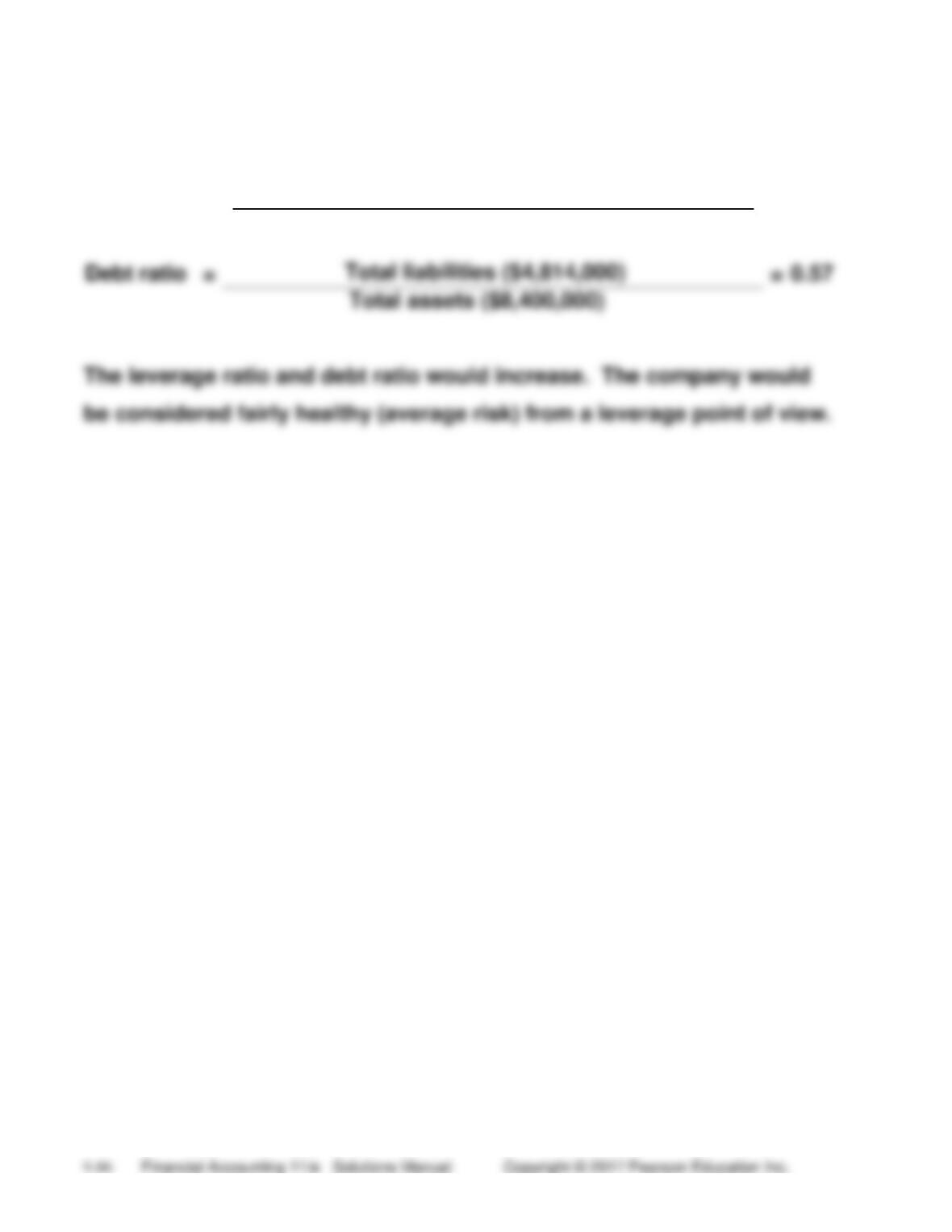
The company’s debt ratio and leverage ratios are low, and operating
income covers interest payments 1.75 times. With this limited
information, the company appears to be low risk from a leverage point of
view. Additional information from prior years and competitors would
also be helpful.
(continued) P 9-88B
Req. 5
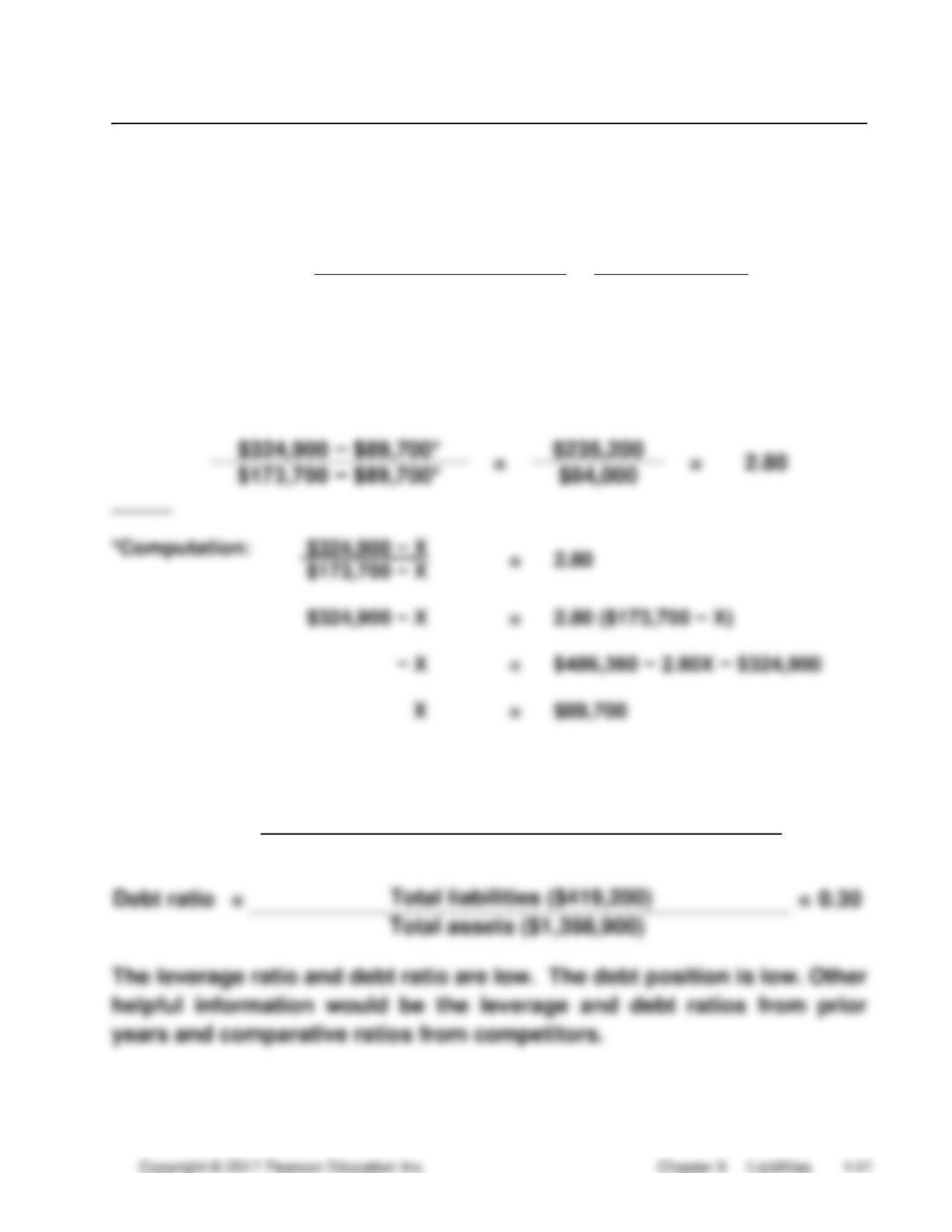
Leverage
ratio
Total assets ($8,400,000)
Total stockholders’ equity ($3,586,000)
=
2.34
Challenge Exercises and Problem
(10-15 min.) E 9-89
Req. 1
Current ratio
=
Total current assets
=
$324,900 − X
=
2.80
Total current liabilities
$173,700 − X
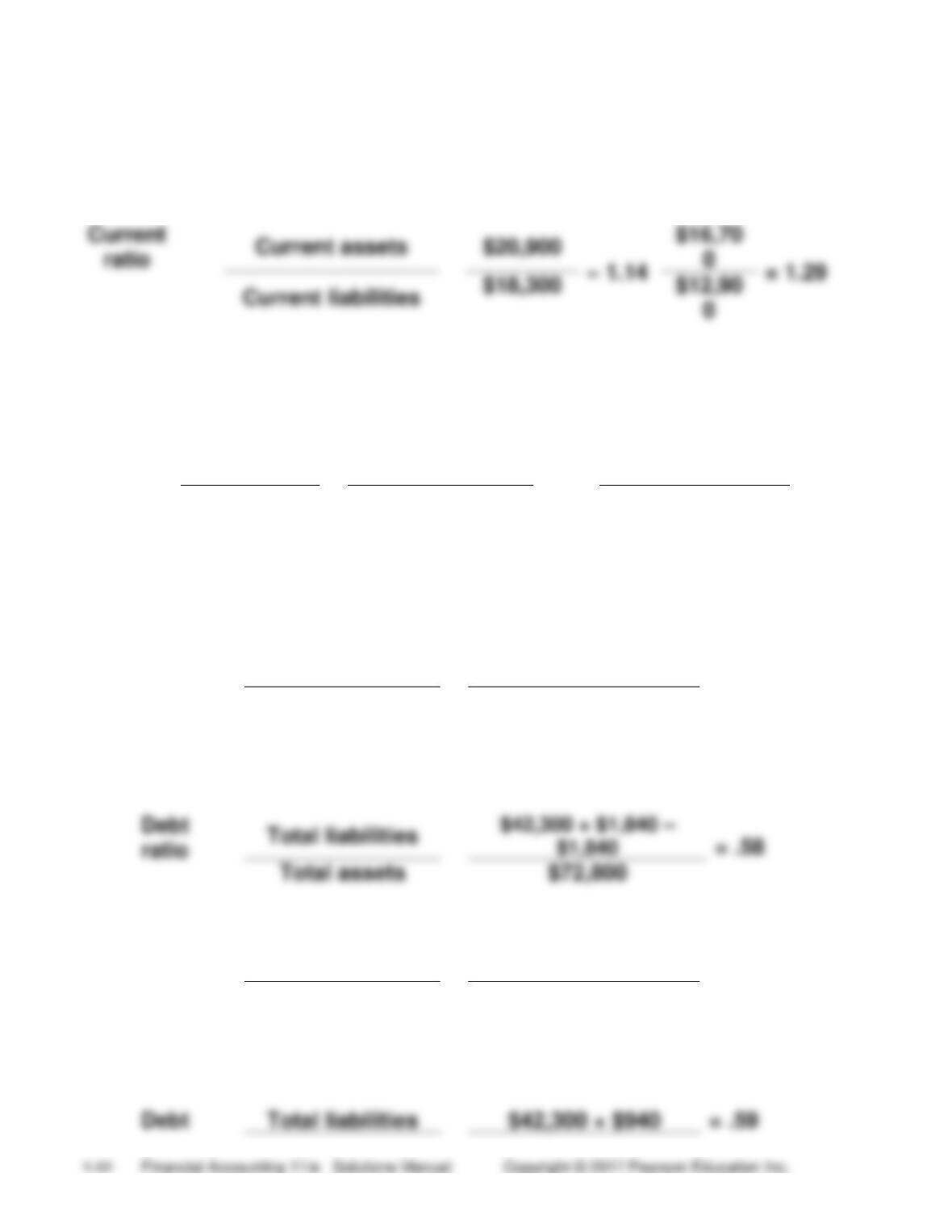
Let X = amount of current liabilities to pay in order to achieve a current
ratio of 2.80. Parker Marketing Services should pay off $89,700* of
current liabilities. Then the current ratio will be:
Req. 2
Leverage
ratio
=
Total assets ($1,398,900)
Total stockholders’ equity ($979,700)
=
1.43
(20-30 min.) P 9-90
Req. 1
a. Current ratio
2016
2015
b. Debt ratio
2016
2015
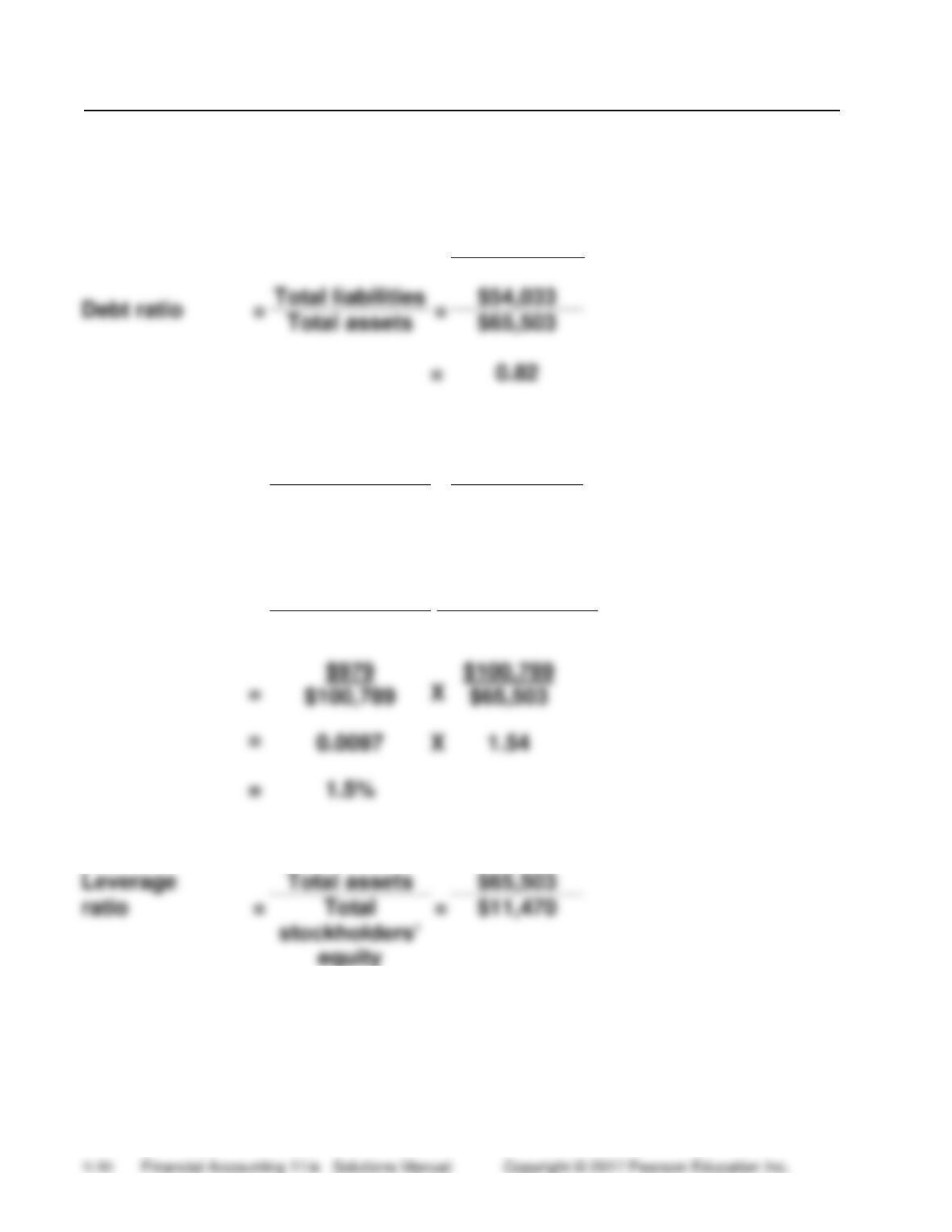
Debt
ratio
Total
liabilities
$72,800 – $30,500
=.58
$46,500 – $26,100
=.44
Total
assets
$72,800
$46,500
Req. 2
a. Current ratio
Current
ratio
Current assets
$20,900
= 1.04
Current liabilities
$18,300 + $1,840
b. Debt ratio
= .58
Req. 3
Current
ratio
Current assets
$20,900
= 1.13
Current liabilities
$18,300 + $250
b. Debt ratio
$42,300 + $940
= .59

Decision Cases
(15-20 min.) Decision Case 1
Req. 1
As
Reported
=
Return on
Assets
=
Net income
=
$979
(ROA)
Total assets
$65,503
=
1.5%
Req.2
=
Net income
Revenue
X
Revenue
Total assets
Leverage
=
5.71
Return on
ROA x Leverage ratio
Equity (ROE)
=
=
1.5% x 5.71 = 8.6%
(continued) Decision Case 1
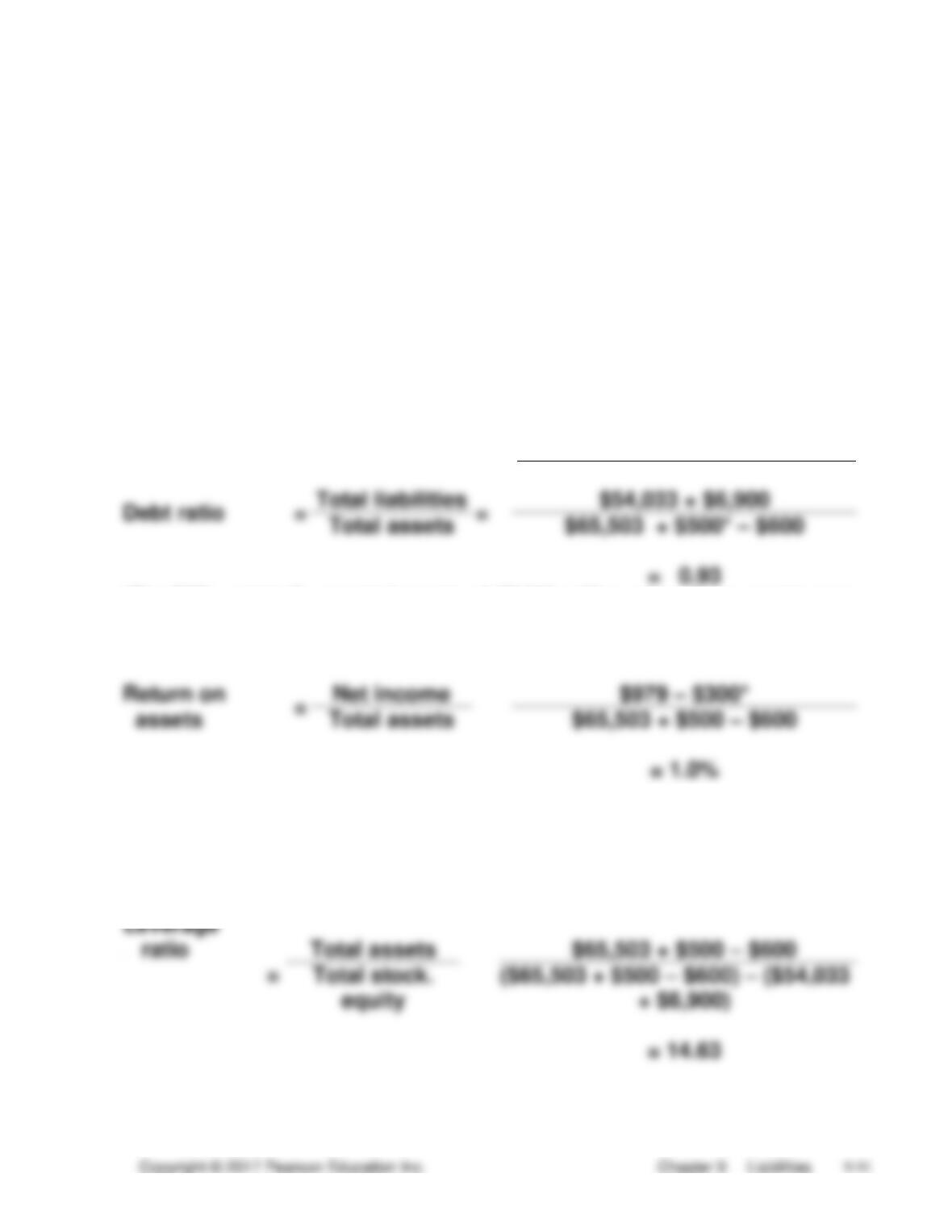
The ROE is greater than the ROA because the leverage ratio is
extremely high which magnifies the ROA. The debt ratio is also
extremely high and indicates that 82% of the assets were financed
with debt. The high leverage ratio and debt ratio should have made
investors question the soundness of Enron.
Req. 3
After Including the
Special-Purpose Entities
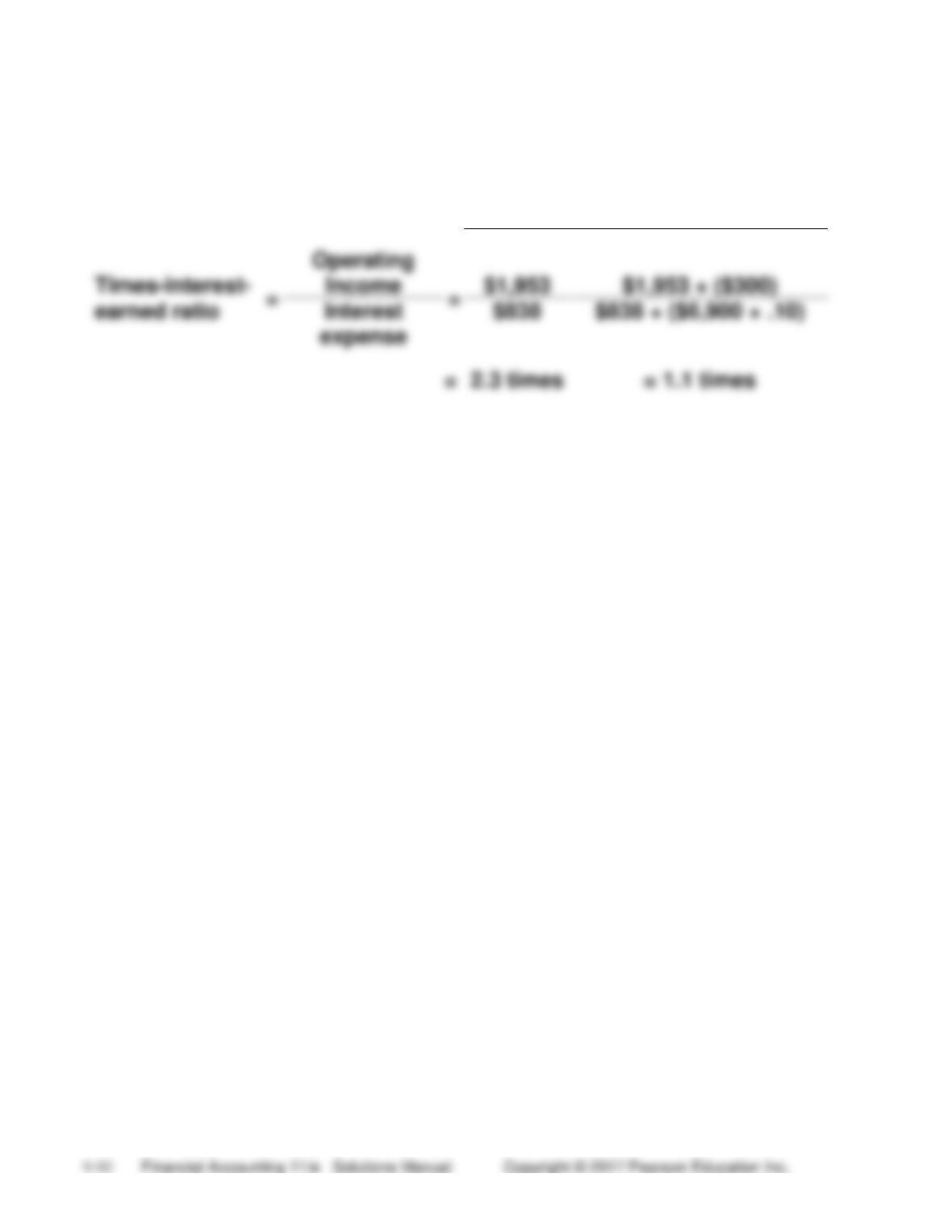
*The SPEs originally reported assets of $7,000 million when those assets were
only worth $500 but actually had liabilities of $6,900.
Return on
*The SPEs’ income was nearly wiped out due to the restatement meaning that the
SPE did not earn a net income but had a loss, of which $300 applies to 2000; they
did have assets with a market value of $500.
(continued) Decision Case 1
As
After Including the
Reported
Special-Purpose Entities
Times-interest-
earned ratio
Req. 4
It appears that Enron excluded the special-purpose-entities (SPEs) from its
financial statements in order to hide their debt from Enron’s investors and
creditors. The purpose was to understate Enron’s liabilities. We would view
Enron as much more risky after including the SPEs in Enron’s financial
statements. So did their banks, which is why they stopped lending money to
them, causing them to have to file for bankruptcy.
(30-40 min.) Decision Case 2
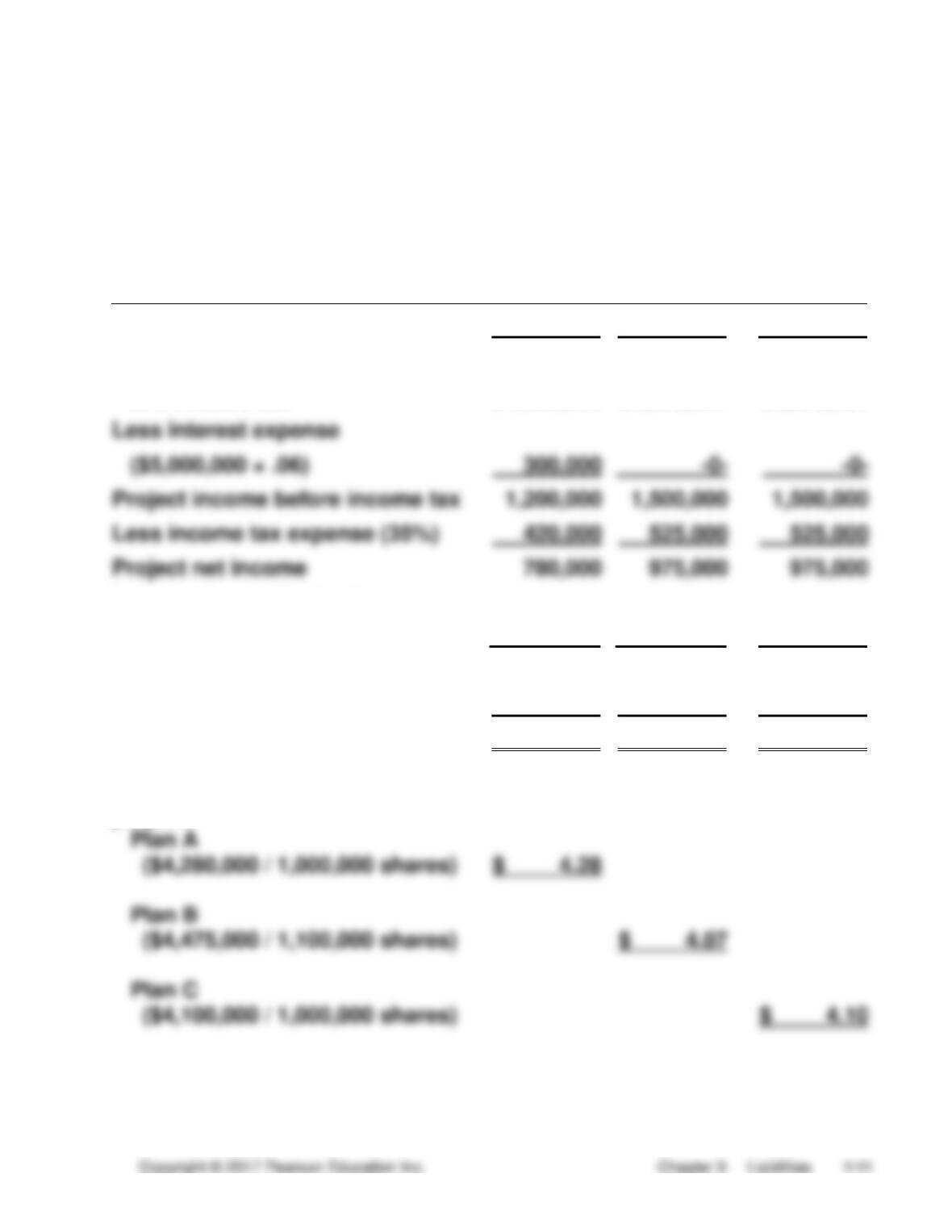
Req. 1 (Analysis of financing plans)
PLAN A
PLAN B
PLAN C
BORROW
AT 6%
ISSUE
COMMON
STOCK
ISSUE $3.75
NONVOTING
PREFERRED
STOCK
Net income before expansion
$3,500,000
$3,500,000
$3,500,000
Project income before interest
and income tax
$1,500,000
$1,500,000
$1,500,000
Less interest expense
($5,000,000 × .06)
300,000
-0-
Project income before income tax
Less income tax expense (35%)
420,000
525,000
525,000
Project net income
Less preferred dividends
(100,000 × $3.75)
-0-
-0-
375,000
Additional net income available
to common stockholders
780,000
975,000
600,000
Total company net income
$4,280,000
$4,475,000
$4,100,000
Earnings per share including new
project:
Plan A
($4,280,000 / 1,000,000 shares)
$ 4.28
Plan B
($4,475,000 / 1,100,000 shares)
$ 4.07
Plan C
($4,100,000 / 1,000,000 shares)
(continued) Decision Case 2
Req. 2 (Recommendation)
The best choice appears to be Plan A — borrowing at 6% — because:
(1) Borrowing allows the family to maintain control of the
business;
(2) EPS is higher under borrowing than under issuing preferred stock
(which would also maintain family control); and
Ethical Issue 1
Req. 1
A company would prefer not to disclose its contingent liabilities because
they cast a shadow on the business and create a negative impression.
Req. 2 and 3
The potential parties and economic consequences of the decision not to
disclose contingent liabilities are:
1. The bank and its shareholders: With misleading information, they
might extend additional funds to the borrower assuming a better ability
to pay back the funds than actually exists. A contingent liability creates
2. The company seeking the loan: Might become overextended in its
borrowing and risk default on debt in the future.
4. Parties to the lawsuit.