An asset is a present economic resource . as a result of past events.
Definition
A current asset is an asset that satisfies any of the following criteria:
(a) it is expected to be realised in, or is intended for sale or consumption in, the entitys
.;
(b) it is held primarily for the purpose of being ;
(c) it is expected to be realised within .. after the financial year-end
date or
(d) it is . or a cash equivalent.
The following list is a sample of the current assets found in most statements of financial
position (balance sheets):
r..
w.
f...…
t..
amounts owed by other companies in the group
p.. and accrued income
investments held as current assets
short-term bank deposits
b... (also called cash at bank).
Financial Accounting
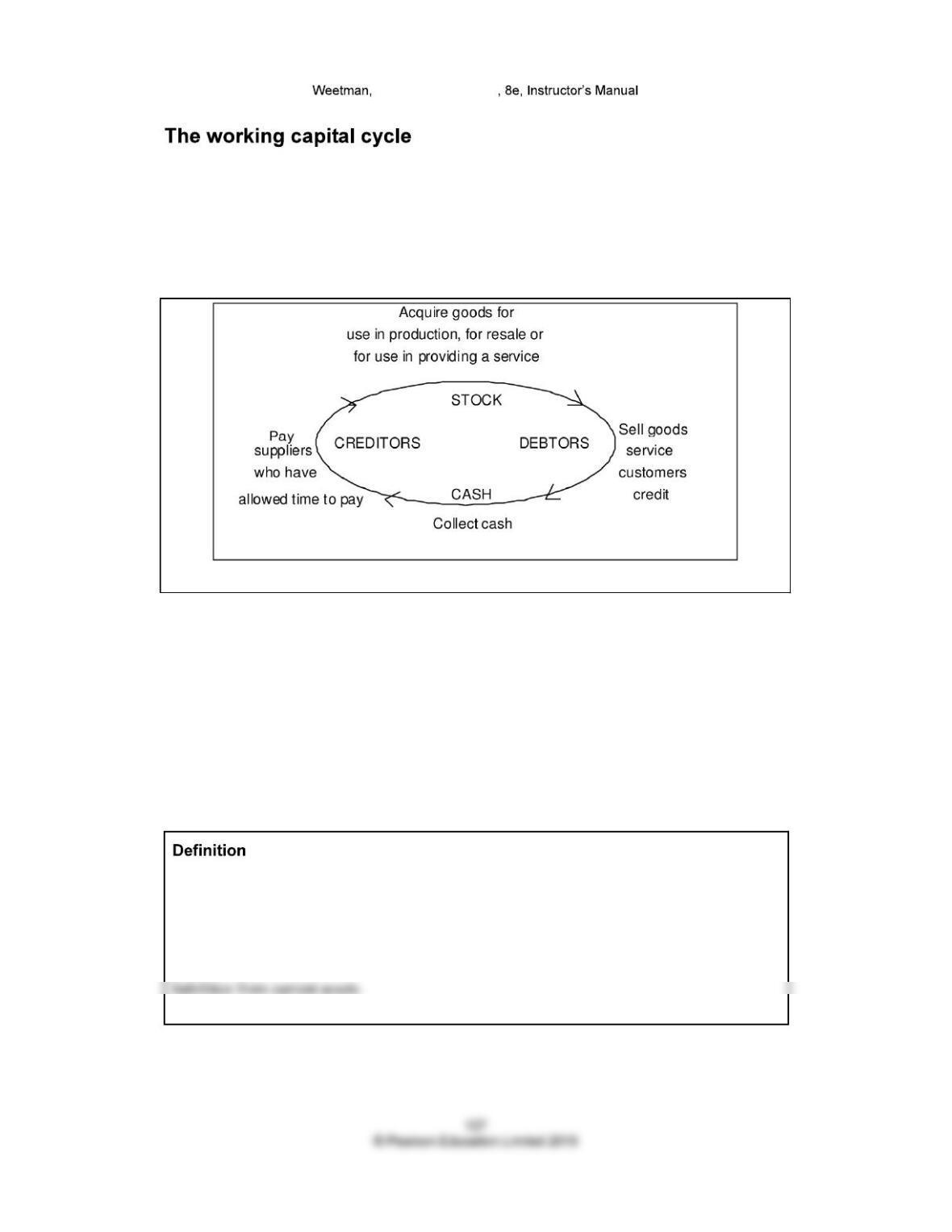
The working capital cycle of a business is the sequence of transactions and events, involving
current assets and current liabilities, through which the business makes a profit.
The working cycle for a manufacturing or service business
Working capital is calculated as minus .
If the working capital is ., then the business has a close match between current assets and
current liabilities but may risk not being able to pay its . as they fall due.
If current assets are very much . than current liabilities, then the business has a
large amount of finance tied up in the current assets when perhaps that finance would be better
employed in the acquisition of more .assets to expand the profit-making capacity of
the operations.
Working capital is the amount which a business must provide to finance the
.. of a business, to the extent that these are not covered by
.... It is calculated by deducting current
Financial Accounting
Inventories (stocks), receivables (debtors), investments and cash are commonly recognised in a
statement of financial position (balance sheet) but an element of ...may be
attached to the ..of economic benefit and the reliability of measurement.
Finished goods: The future economic benefit is the selling price, which exceeds the cost of
purchase or manufacture. That makes a profit and increases the ownership interest but
..dictates that profit should not be anticipated.
Finished goods inventory (stock) is therefore measured at the
.... or ....
Where there is a strong doubt about the expected selling price, such that it might be less than the
cost of purchase or manufacture, the asset of finished goods inventory (stock) is valued at the
…
This is defined as the estimated proceeds from sale of the items in question, less
in marketing, selling and distributing these items.
Work in progress: . finished goods.
The risks attached to work in progress are often greater than those attached to finished goods
because there is the risk of non-completion to add to all the risks faced when the goods are
completed and awaiting sale.
There is a reliable measurement in the cost of work completed at the date of the statement of
financial position (balance sheet) but careful checking is required by the managers of the
business to ensure that this is a reliable measure.
Raw materials: The approach to recognition is the same as that for finished goods. Raw
materials are expected to create a benefit by being . of goods for
sale. On grounds of prudence, the profit is not anticipated and the raw materials are recognised
at the ..
Debtors are those persons who to a business.
Trade debtors are customers who buy goods on credit but have not yet paid.
Financial Accounting
L. made to another enterprise to help that enterprise in its activities.
There is a risk that the customer will not pay. The risk of non-payment is dealt with by reducing
the reported value of the asset by an estimate for ...
Investments
Investments held as current assets are usually highly marketable and readily convertible into
cash.
Expectation of future economic benefit is therefore usually clear.
Two possible measures of investments as current assets:
Cost .
Market value (called marking to market)
The approach most often used is..
Cash
The amount is known either by counting cash in hand or by looking at a statement from the
bank that is holding the business bank account.
Financial Accounting
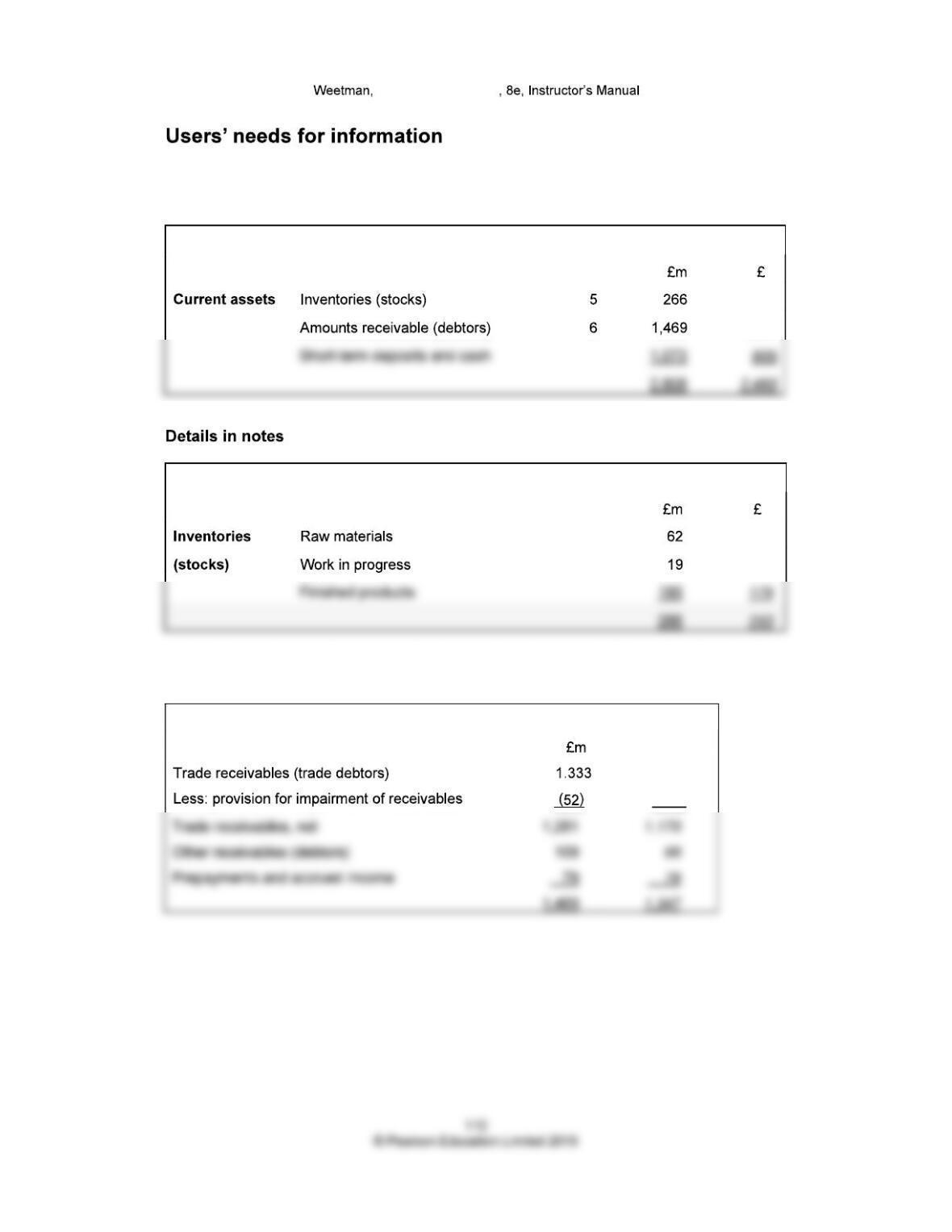
Safe and Sure plc reports three lines relating to current assets in its statement of financial
position (balance sheet):
Notes Year 7 Year 6
m
243
1,347
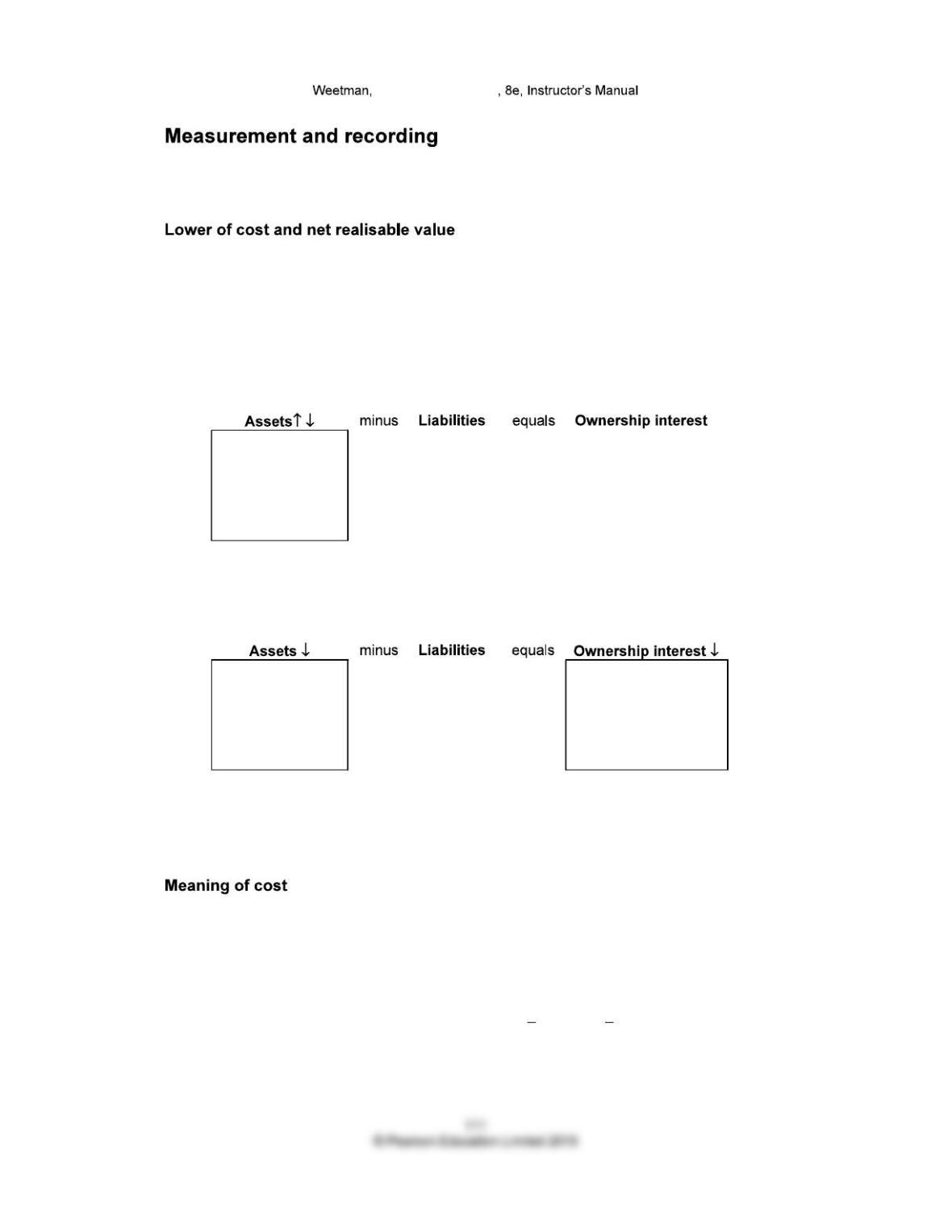
Note 5 Year 7 Year 6
m
54
10
This company is a service company. So, it is not surprising that inventories (stocks) do not
figure prominently in the overall collection of current assets.
Note 6 Year 7 Year 6
£m
1,218
(48)
Financial Accounting
Inventories (stocks) of raw materials and finished goods
Consider the example of a container of coffee beans purchased by a coffee manufacturer at a
cost of £1,000. The beans are held for three months up to the financial year-end date. During
that time, there is a fall in the world price of coffee beans and the container of coffee beans
would sell for only £800 in the market.
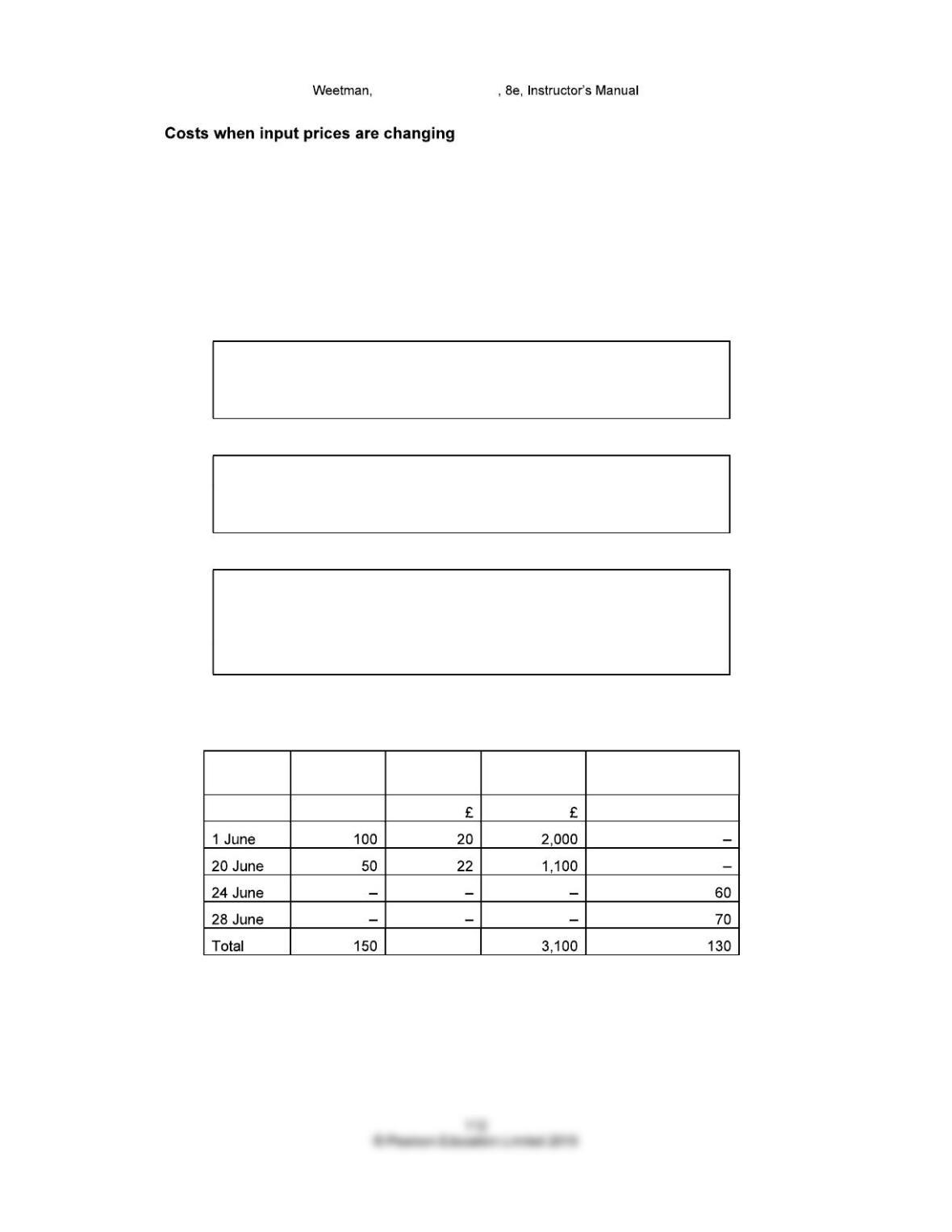
When the asset is acquired, the impact on the accounting equation is an increase of £1,000 in the
asset of inventory (stock) and a decrease of £1,000 in the asset of cash.
At the end of the year, the asset is found to be worth £800 and the ownership interest is reduced
because the asset has fallen in value. The asset is reduced by £200 and an expense of loss of
inventory (stock) value is reported in the income statement (profit and loss account).
If a business fails to report a fall in the value of the asset of inventory (stock), the profit of the
period will be …
The cost of any item of inventory (stock) or work in progress is specified as the expenditure that
has to be incurred in the normal course of business in bringing the product or service to its
.
Purchase price + transport and handling + import duties discounts subsidies
Financial Accounting
Goods arrive at different times and at different unit prices.
What is the unit price to be charged to each job when all the materials look the same once they
are taken into store?
An ideal solution is to label the materials as they arrive but that takes time.
Often, a method is used that approximates the true price of the units used. Some possible
methods are:
First In, First Out (FIFO)
Assume that the goods that arrived . are issued .
Last In, First Out (LIFO)
Assume that the goods that arrived .. are issued .
Average cost
Assume that all goods are issued at the of the
inventory held.
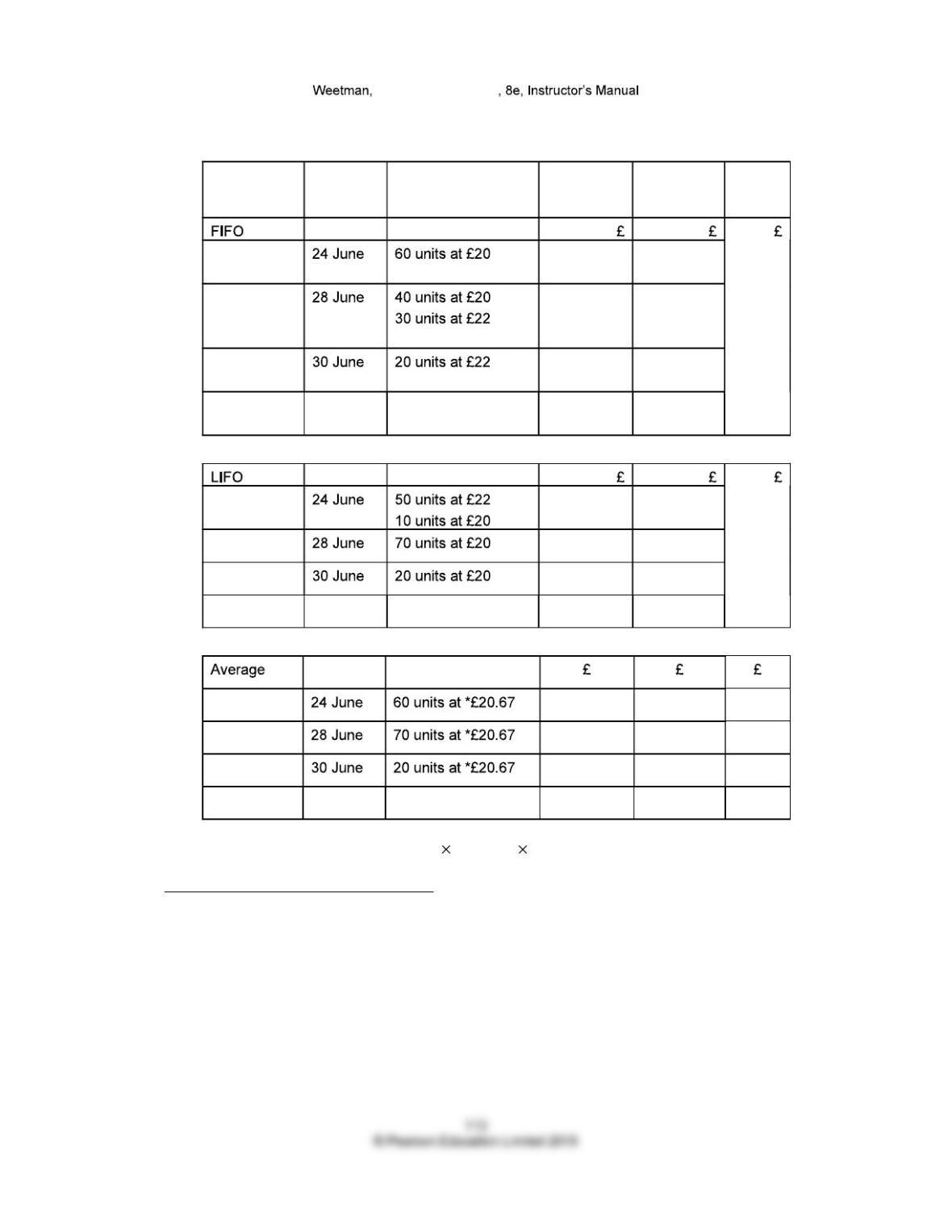
Basic data
Date Received Unit price Price paid Issued to
production
Units Units
Financial Accounting
Calculations
Basis Date Quantity and unit
price
Issued to
production
Held in
inventory
(stock)
Total
Total
Total
Total
* Weighted average [(100 20) + (50 22)]/150 = £20.67
Which one? FIFO, LIFO or average cost?
Totals are the same at £3,100. Allocations to periods are different.
FIFO matches costs against revenue.
LIFO matches the costs against revenue, but the inventory (stock)
value becomes increasingly .
Financial Accounting
Average cost lies ..… It is more intricate to recalculate
as more items come into inventory.
Assets minus Liabilities equals Ownership interest
Overstating inventory (stock) values .. profit
Understating inventory (stock) values .. profit
Where there is a doubt about the value of an asset, the directors should be invited to consider
making against the loss of the asset.
Where it is known that the debt is bad (because the customer has declared himself/herself
bankrupt), the debtor should be .. from the record as a bad debt.
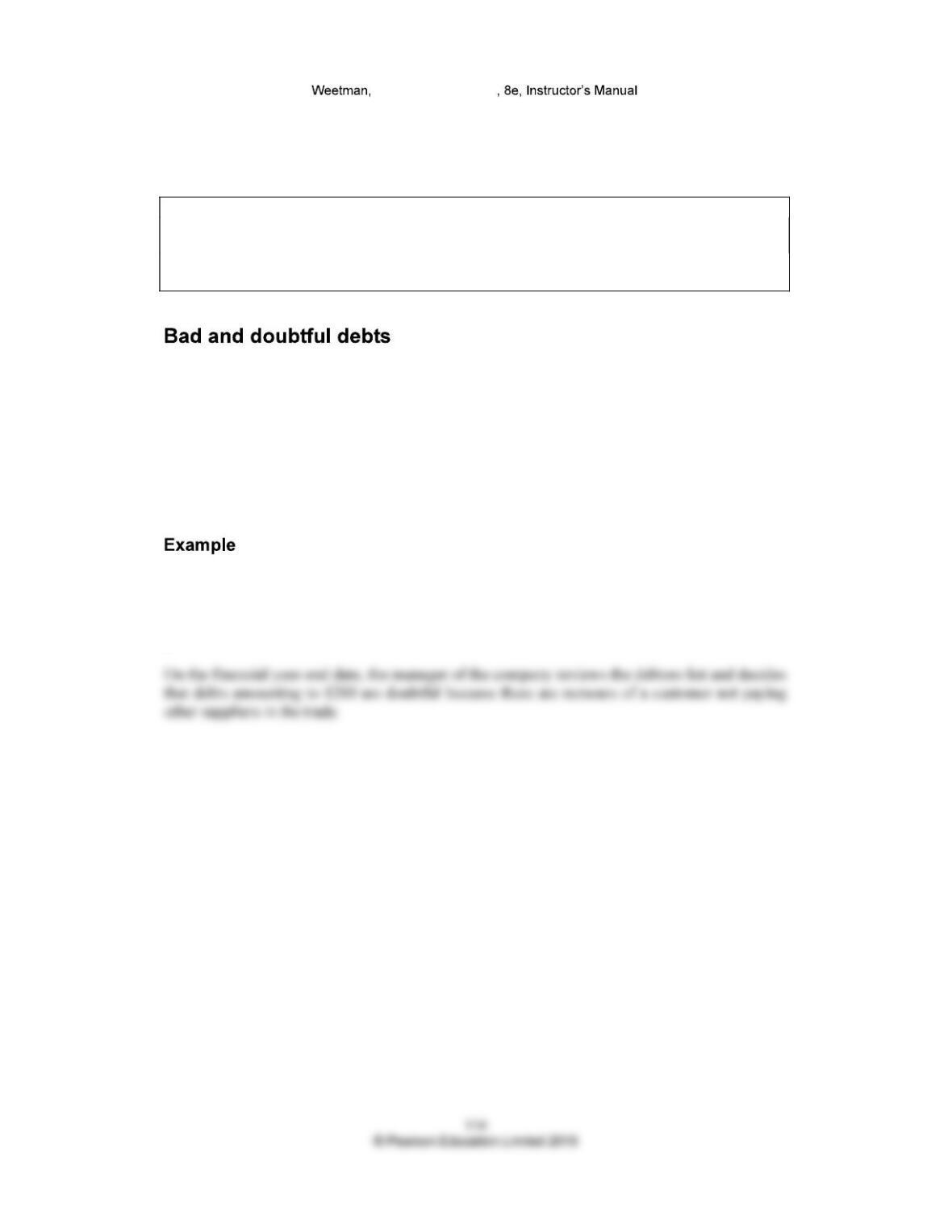
At the end of Year 1, the Garden Pond Company has a statement of financial position (balance
sheet) comprising £2,000 receivables (debtors), £7,000 other assets and £9,000 ownership
interest consisting of £1,800 ownership interest at the start of the period and £7,200 profit of the
period.
Financial Accounting
Spreadsheet to analyse the effect of provision for doubtful debts at the
end of Year 1, using the accounting equation
Date Transaction or
event
Assets Ownership interest
Year 1 Receivabl
es
(debtors)
(Provision
for
doubtful
debts)
Other
assets
Ownershi
p interest
at start
Profit
of the
period
Presentation in statement of financial position (balance sheet):
During Year 2, the customer who was showing signs of financial distress pays the amount of
£200 owed.
At the end of Year 2, this provision for doubtful debts is now no longer required.
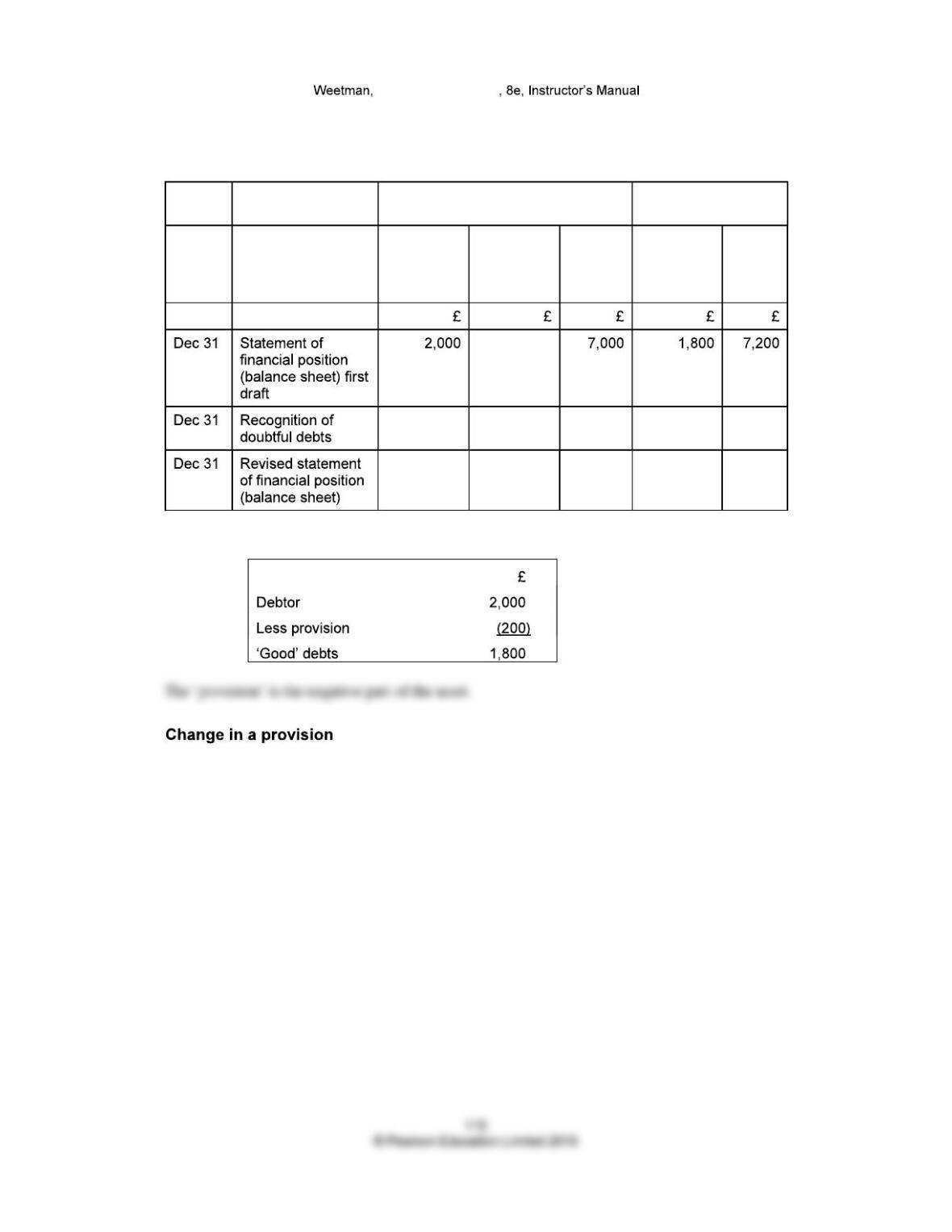
At the end of Year 2, the receivables (debtors) amount to £2,500. A review of the list of
receivables (debtors) causes considerable doubt regarding an amount of £350.
A new provision of £350 is created.
Financial Accounting
Spreadsheet to analyse the effect of provision for doubtful debts at the
end of Year 2, using the accounting equation
Date Transaction or
event
Assets Ownership interest
Year 2 Receivable
s (debtors)
(Provision
for doubtful
debts)
Other
assets
Ownershi
p interest
at start
Profit
of the
period
Income statement (profit and loss account) shows:
£200 increase in ownership interest
£350 decrease in ownership interest
Short-cut:
Increase in provision for doubtful debts £150
A common example of prepayment is the payment of an insurance premium. The payment is
made in advance for the year ahead and the benefit is gradually .. as the year goes
along. The statement of financial position (balance sheet) recognises the
of the insurance premium as an asset, while the income statement
(profit and loss account) reports the amount consumed during the period.
Financial Accounting
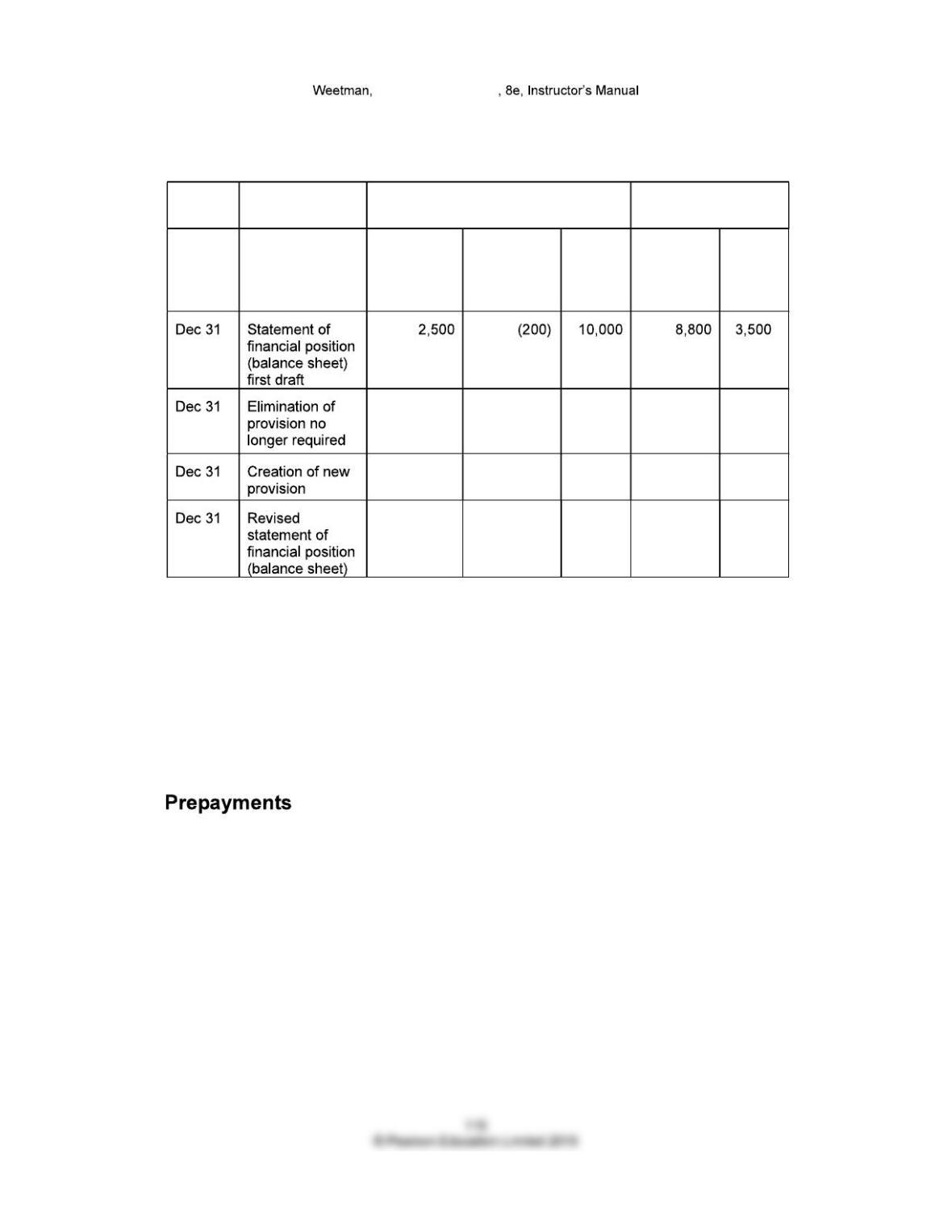
On 1 October of Year 1, a company paid £1,200 for one years vehicle insurance. At the
financial year-end date of 31 December, there have been three months benefit used up and
there is a nine-month benefit yet to come.
Spreadsheet recording of prepayment of insurance at the financial
year-end date
Date Transaction or event Assets Ownership
interest
Year 2 Cash Prepayment Expense
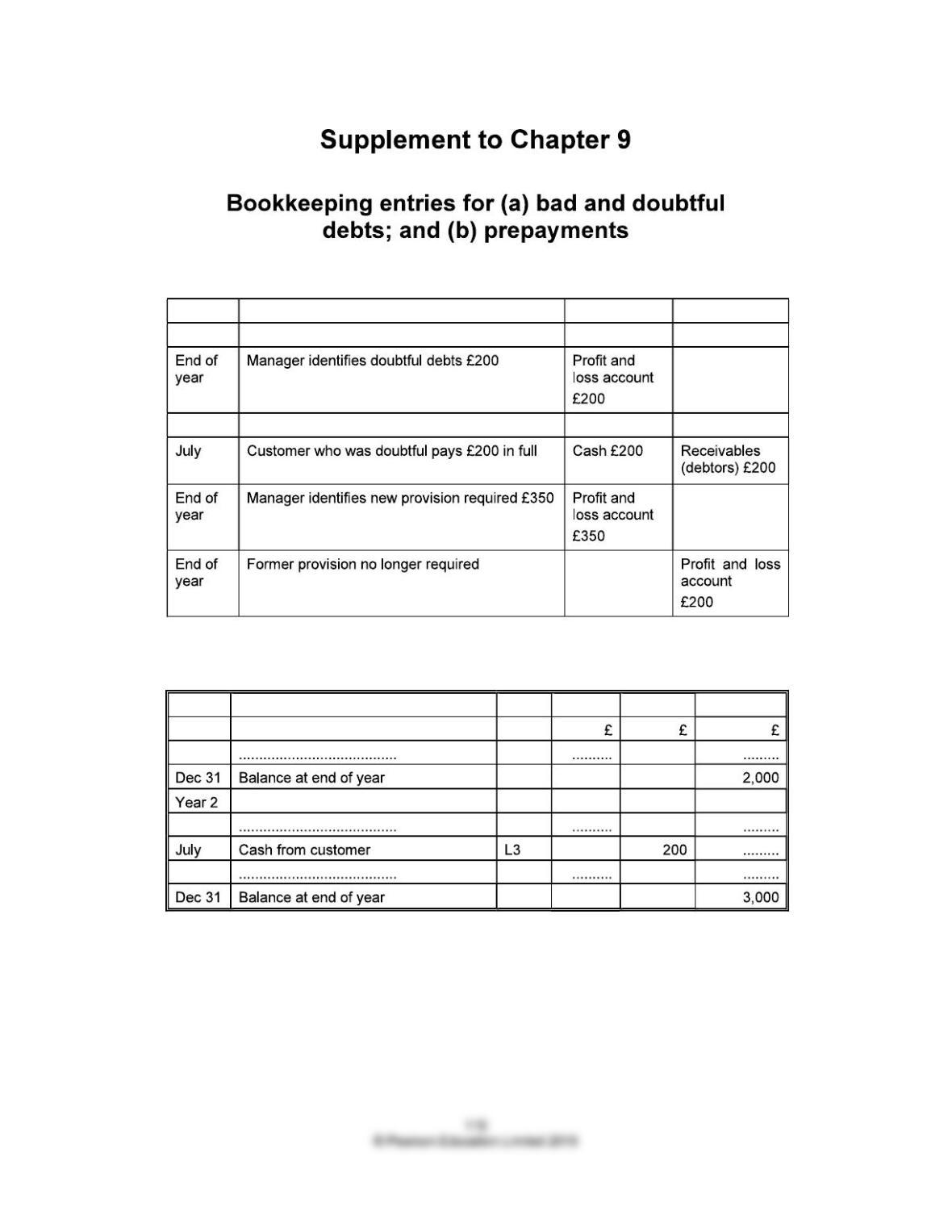
Analysis of debit and credit aspect of each transaction and event
Date Debit Credit
Year 1
Year 2
(In the following ledger accounts, the dotted lines indicate other transactions not relevant to this
illustration.)
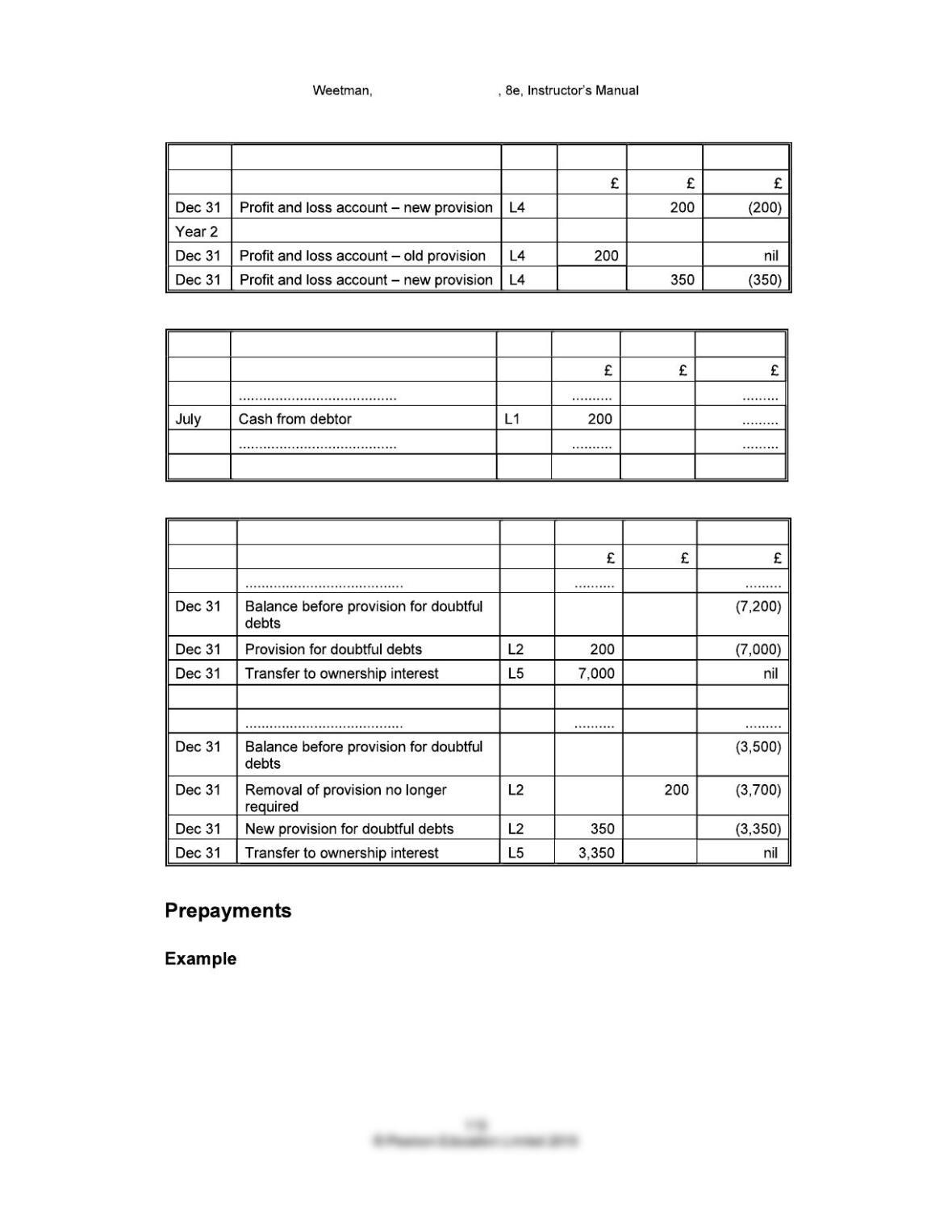
L1 Receivables (debtors)
Date Particulars Page Debit Credit Balance
Year 1
Financial Accounting
L2 Provision for doubtful debts
Date Particulars Page Debit Credit Balance
Year 1
L3 Cash
Date Particulars Page Debit Credit Balance
Year 2
L4 Profit and loss account
Date Particulars Page Debit Credit Balance
Year 1
Year 2
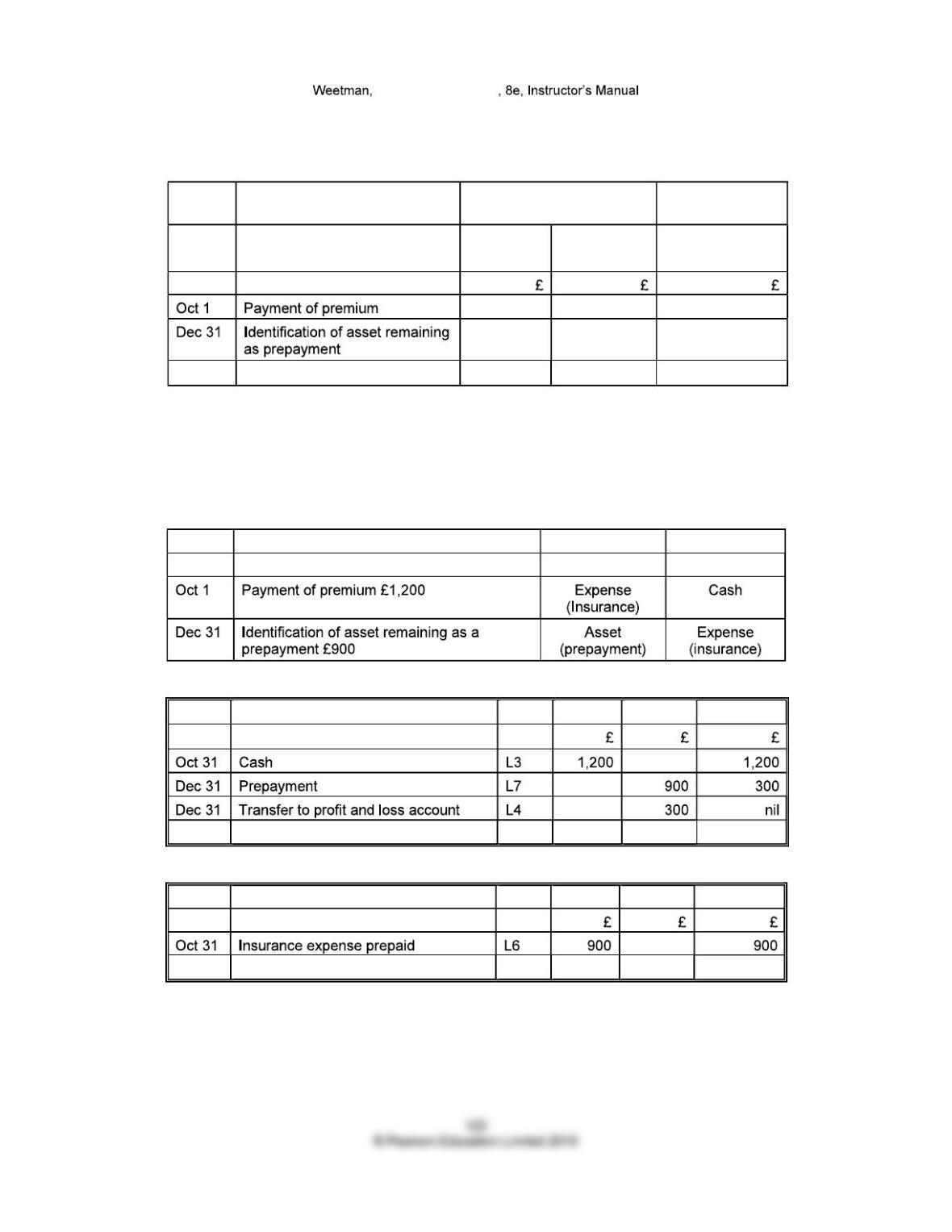
On 1 October of Year 1, a company paid £1,200 for one years vehicle insurance. At the
financial year-end date of 31 December, there have been three months benefit used up and
there is a nine-month benefit yet to come.
Financial Accounting
Spreadsheet recording of prepayment of insurance at the financial
year-end date
Date Transaction or event Assets Ownership
interest
Year 2 Cash Prepayment Expense
The effect of identifying the asset is to reduce the expense of the period from £.. to
£
Analysis of prepayment of insurance, Year 1
Date Transaction or event Debit Credit
Year 1
L6 Expense of insurance
Date Particulars Page Debit Credit Balance
Year 1
L7 Prepayment
Date Particulars Page Debit Credit Balance
Year 1
Financial Accounting
Recording a doubtful debt that turns bad
In July of Year 2, it is found that the doubtful debt turned totally bad because the customer was
declared bankrupt. The effect on the accounting equation is that the asset of the debtor is
removed. That would normally reduce the ownership interest but on this occasion, the impact on
ownership interest was anticipated at the end of Year 1, and so the provision for doubtful debts
is now used to match the decrease in the asset. The analysis of the transaction would be:
Year 2 Debit Credit