9-40
(3) Determine the most important rights. Shareholders at HBOC and McKesson because they
(4) Develop alternative courses of action.
• Appeal further to Putnam, trying to encourage him to “do the right thing”.
(5) Determine the likely consequences of each proposed course of action.
• Appeal further to Putnam, trying to encourage him to “do the right thing”. Likely
consequences: unknown, depending on Putnam’s personality and the ability of the
manager to deliver the message in an effective manner.
(6) Assess the possible consequences, including an estimation of the greatest good for the
(7) Decide on the appropriate course of action. The most appropriate course of events would
be to follow through the potential actions in sequence, beginning with persuasive conversations
9-80
a. MiniScribe inflated its financial statements by:
• Shipping more units before year-end than were ordered by customers.
• Recording shipments from Singapore that took two weeks to reach the customer as a sale
9-41
b. Among the factors leading to MiniScribe’s inflated financial statements were:
• Management’s bullish forecasts when the industry was having hard times.
c. The red flags included:
• Sales returns percentage well below the industry average.
• Awareness of the management environment and style based on discussions with Mr.
d. Substantive audit procedures that could have uncovered the fraud include:
• Analytical procedures such as:
(a) Comparing MiniScribe’s sales returns percentage with that of the industry.
(b) Analysis of sales by month compared to prior years. Sales recorded in the last month
Application Activities
9-81
This problem provides an opportunity for the students to be exposed to the Disciplinary Orders
of the PCAOB and to more fully understand the actions and behaviors of auditors that are the
1. ORDER INSTITUTING DISCIPLINARY PROCEEDINGS, MAKING FINDINGS, AND
IMPOSING SANCTIONS In the Matter of Traci Jo Anderson and Traci Jo Anderson, CPA
Respondents; PCAOB Release No. 105-2010-007
9-42
2. ORDER MAKING FINDINGS AND IMPOSING SANCTIONS In the Matter of Ray O
Westergard, CPA, Respondent; PCAOB Release No. 105-2010-003
This case provides a great deal of discussion on revenue related issues. The issues include: (1)
3. ORDER INSTITUTING DISCIPLINARY PROCEEDINGS, MAKING FINDINGS, AND
IMPOSING SANCTIONS In the Matter of Armando C. Ibarra, P.C., Armando C. Ibarra,
Sr., and Armando C. Ibarra, Jr. Respondents; PCAOB No. 105-2006-001
The primary revenue related issues are in the context of the audit of Triad Industries, Inc. There
4. ORDER INSTITUTING DISCIPLINARY PROCEEDINGS, MAKING FINDINGS, AND
IMPOSING SANCTIONS In the Matter of Williams & Webster, P.S., Kevin J. Williams,
CPA, and John G. Webster, CPA, Respondents; PCAOB Release No. 105-2007-001
9-82
a. and b.
A key issue is that the client (TPC) booked fictitious sales revenues. The client recorded the
fictitious sales by making top-side journal entries to sales and accounts receivable. When
company needed additional sales to meet its monthly target, its practice was to book a top-side
sales entry to meet that target.
The following is an excerpt from the AAER concerning the audit of TPC’s revenues.
22. E&YUK failed to reconcile TPC’s accounts receivable general ledger account to a detailed
accounts receivable subsidiary ledger. See AU § 326.19. E&YUK was told by TPC that this

9-43
23. E&YUK failed to properly confirm accounts receivable. For fiscal year 2004 E&YUK relied
entirely on alternative procedures, and was able to validate only 7% of its sample through that
24. E&YUK failed to properly document in its work papers, and in its Summary Review
25. During fiscal years 2004-6, TPC booked fictitious revenues via monthly top-side journal
entries. Any top-side journal entry to sales should have been a red flag to the audit teams under
Respondents’ supervision requiring further investigation. See AU §§ 316.58-62. Notwithstanding
purported documentation in E&YUK’s work papers that they had reviewed and agreed to
supporting documentation all “non–standard or significant” journal entries, E&YUK failed to
detect and investigate TPC’s monthly top-side journal entries to revenue.
c. Of course, the students are responding to this question with the benefit of hindsight.
However, the AAER does present a description that suggests that the auditors were greatly
lacking in professional skepticism.
The AAER does not provide enough discussion to definitively determine why the auditor may
have conducted the audits in a manner that did not comply with professional standards. The
9-83
a. Conditional sales
These transactions are recorded as revenues even though the sales involve unresolved
b. Round-tripping or recording loans as sales
Some companies record sales by shipping goods to alleged customers and then providing funds
c. Premature revenues before all the terms of the sale were completed
d. Improper cutoff of sales
To increase revenues, the accounting records are held open beyond the balance sheet date to
e. Improper use of the percentage of completion method
f. Consignment sales
consider on a trial basis.
9-84
The response to this question will vary depending on current events. An example reported in The
9-85
Students often find this research project to be very engaging. They find the life details of the
fraudster, Philip Musica, quite fascinating. The infamous accounting fraud at McKesson &
Robbins, Inc. involved fictitious inventories and accounts receivable that comprised more than
In 1939, the American Institute of [Certified Public] Accountants appointed its first standing
committee on auditing procedures. The committee’s first standard, Statements on Auditing
9-45
9-86
The relevant standards are AU 330, AU-C 505, and ISA 505.
a. The following generalizations are applicable to audit evidence with respect to confirmations:
• Audit evidence is more reliable when it is obtained from independent sources outside the
entity.
b. If management refuses to allow the auditor to send a confirmation request, the standards
direct the auditor to do the following:
• Inquire as to management’s reasons for the refusal, and seek audit evidence as to their
validity and reasonableness
c. The auditing standards are essentially the same across all three audit standard setting bodies.
9-87
The relevant standards are AS 14, AU-C 520, and ISA 520.
a. A basic premise underlying analytical procedures is that plausible relationships among data
may reasonably be expected to exist and continue in the absence of known conditions to the
b. Documentation should include the following:
• The expectation, where that expectation is not otherwise readily determinable from the
documentation of the work performed, and factors considered in its development
• Results of the comparison of the expectation to the recorded amounts or ratios developed
from recorded amounts
9-46
c. Substantive analytical procedures can save time and yield audit efficiencies because they
allow for inferences based on a large set of data and relationships therein. Auditors may be
Analytical Procedures: A Case in the Context of the Pharmaceutical Industry
9-88
Part I – Planning Analytical Procedures
a. In addition to the ratios provided to students, they will likely be creative in suggesting others.
For example, the following might be relevant:
• Trends in revenue growth (and comparisons to industry trends)
• Net cash flow from operating activities as a percentage of revenue and trends therein (to
b. The following factors will influence data reliability:
• The source of information, i.e., internally generated versus externally obtained. Industry
comparisons are helpful in enhancing reliability.
c. The following expectations seem reasonable:
• There are conflicting possibilities with respect to trends in revenue. The global
pharmaceutical market data would suggest an increase in revenues in the 4-5% range, but
PharmaCorp is facing increasing competition from foreign competitors, and there is
significant uncertainty in the market due to recent governmental regulations and policy
reforms.
9-47
d. Common materiality benchmarks applied to PharmaCorp:
1% of
assets:
$1,858
1% of
revenue:
5% of net
income:
1% of
A/R:
Student answers will likely vary widely given the judgmental nature of this task. The following
presents one line of possible reasoning.
• Performance materiality: To be conservative, use 1% of revenue, $590 million for
revenue and 1% of A/R, $124 million for accounts receivable.
• Tolerable misstatement: Use ½ of 1% for tolerable misstatement, so about $300 million
for revenue and $60 million for accounts receivable.
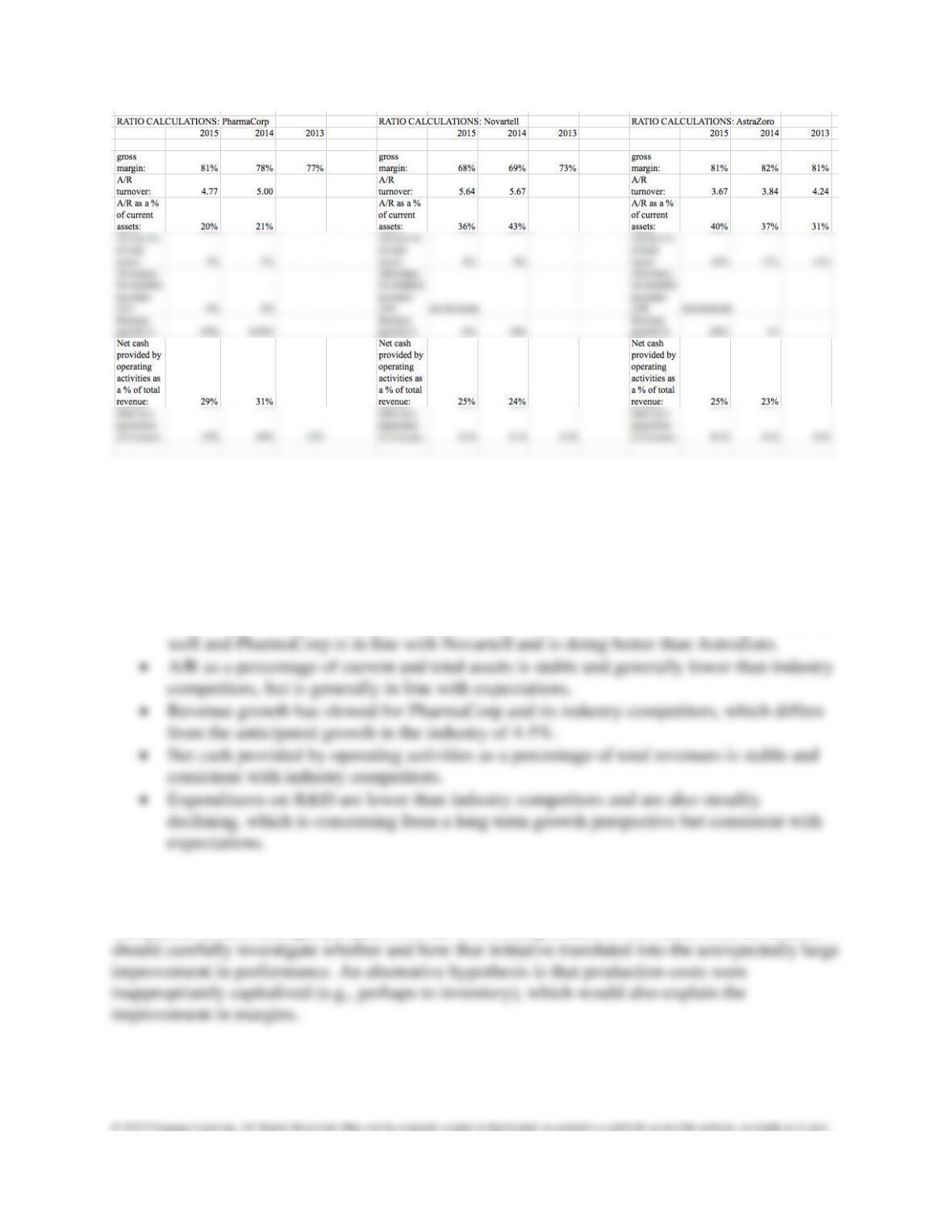
For the computation of the client ratios, see Instructor solution posted to Cengage.com web site,
reproduced in part below.
9-48
Identification of significant unexpected differences:
• Gross margin increased 3% for PharmaCorp and was relatively more stable for its
industry competitors. The gross margin change is unexpected in terms of magnitude, but
consistent with expectations with respect to the cost-cutting initiative.
• A/R turnover is down slightly despite the fact that credit policies have remained the
same. With respect to industry comparisons, turnover is down for the other companies as
e. Based on the planning analytical procedures, the most important area to investigate with
substantive audit procedures is the unexpected shift in gross margins. While the increase is not
unexpected from a strategic perspective if the cost-cutting initiative was successful, the auditor
A strategic conversation with management should be conducted with respect to plans regarding
R&D and long-term growth expectations.
9-49
Part II: Substantive Analytical Procedures
f. Operating segments:
1. Primary care – basic prescription drugs that would be prescribed by a primary care physician.
3. Established products and emerging markets – prescription drugs that have lost patent
4. Animal health – prescription drugs sold to treat disease in livestock and companion animals.
5. Consumer healthcare – dietary supplements, pain management, and respiratory and personal
care.
Geographic regions:
• United States
• Developed Europe
g. Most important segments with respect to revenue generation:
• Total biopharmaceutical products: represents 87% of 2015 revenue, 12% decline since 2013.
The declining revenue generation for the most important category of products is certainly a topic
worthy of discussion with management.
Most important geographic regions with respect to revenue generation:
• United States: $23,086/$58,986 = 39%
• Developed Europe: $13,375/$58,986 = 23%
9-50
The U.S. and Japan were the only countries to contribute more than 10% of total revenue in
Most important products and trends therein:
The top five products in terms of revenues include the following:
1. Lyran: revenue growth of 36% since 2013.
3. Enbing: revenue growth of 14% since 2013.
h. The following types of ratios could be calculated by segment, geographic, and product
categories:
• Revenue importance and trends therein
• Gross margins
• R&D expenditures as a proportion of revenues
Academic Research Cases
9-89
a. This study examines revenue recognition practices and earnings management. The author
notes there are two primary mechanisms that companies can use to manipulate earnings through
revenue recognition: accounts receivable (accrual) and deferred revenue (deferral). Companies
have incentives to meet earnings benchmarks and the author examines three primary benchmarks
that financial statement users can use to evaluate companies performance: consensus analyst
earnings forecast, prior year earnings, and break-even net income (i.e. avoidance of a loss). The
author examines how companies manage earnings through these two different revenue
9-51
b. The results suggest that companies use discretion in revenue recognition practices to avoid
missing consensus analyst earnings forecasts. Specifically, companies appear to manage earnings
through both accounts receivable (revenue accruals) and deferred revenue when their earnings
would otherwise just miss the consensus forecast. However, the author does not find evidence
that companies use discretion in revenue recognition practices to manage earnings in order to
avoid earnings decreases or losses.
c. Overall, as the author notes, the results in this study suggest that auditors should be more
cognizant of the discretion afforded to management in revenue recognition. The results of this
paper indicate that managers have and use significant discretion in revenue recognition, even
post SAB 101 (1999) and in the post-SOX era (2002). The results indicate that the procedures
performed by auditors may not be sufficient to detect material misstatements. These results are
This study is also important in the context of professional skepticism, especially given the
aforementioned qualitative materiality considerations. Regardless of the quantitative materiality
of discretionary revenue amounts recorded in accounts receivable and deferred revenue, auditors
9-52
d.
Relationships
The author examines the relationship between three earnings benchmarks (consensus analyst
expectations, prior year earnings, and break-even net income) and two different earnings
management tools related to revenue recognition (accounts receivable and deferred revenue).
The author develops an empirical model in order to determine whether firms with pre-managed
Analyst Expectations
The author finds that abnormal changes in accounts receivable are more positive for pre-
managed earnings that just miss analyst expectations and more negative for pre-managed
earnings that just beat analyst expectations. The first result suggests that companies manage
earnings through revenue accruals in situations when doing so may allow them to meet the
consensus analyst earnings expectation. The second result suggests that companies smooth
Prior Year Earnings and Break-Even Net Income
There are no significant relationships between either earnings management tool and just missing
Management Preferences
The author also uses the model to examine whether companies appear to have a preference for
one revenue recognition earnings management technique over the other. Over the entire sample
period, he finds that there is a significant relationship between just missing the consensus analyst
forecast and both abnormal revenue accruals (increases in A/R) and abnormal revenue deferrals
9-53
e. The author does not identify any limitations of this research. However, some limitations may
include:
• Data limitations inherent in any archival study
9-90
a. The authors examine the relation between a company’s past and expected future losses, as
well as negative cash flows, and the likelihood that the company will manipulate revenues in
violation of GAAP (H2). The authors also examine (1) whether there is a direct relation between
Companies that have reported multiple years of losses or negative cash flows cannot be valued
by analysts with the standard application of discounted cash flow calculations. Analysts rely
more on the use of revenue valuations in these instances. As a result, it is suggested that loss
companies, wanting to increase their market value, may overstate revenue, usually through the
accounts receivable account.
b. To start, the authors document that revenues are value relevant for firms reporting negative
cash flows or report negative earnings. Most importantly, this study indicates that there is a
positive relation between the history of past and expected future losses (or negative cash flows)
An interesting finding related to the role of auditing indicates that audit firm industry experience
is negatively related to revenue manipulation by company management.
9-54
d. The data set consists of Compustat-listed companies from 1992-2005. Relevant financial and
price data were obtained from Compustat and CRSP. Financial restatement data was retrieved
from Lexus and GAO databases. In total, the data set consists of 22,821 firm-years, representing
e. As with any analysis using archival data, there are possible limitations related to the sample
and / or the analysis. For example, some firms may have manipulated revenue in order to avoid
Ford and Toyota
9-91
Note to instructor: The solutions based upon the FYE 2012 annual reports for Ford and Toyota
ACL
9-92
Using Excel:
• Download the FloorMart data file from the web site www.cengage.com/accounting/rittenberg
• Add two columns for each store:
o Calculate Inventory per square foot
Store
Inventory / Square Foot
Sales / Square Foot
122
12.15
346.96
9-55
Next largest
8.30
207.51
Using ACL:
• Download the FloorMart data file from the book’s web site and import it into ACL.
b. Special attention needs to be paid to these two stores. Some of the audit steps would be:
1. Inquire of corporate management about these two stores and their managers.
Have they had any problems with them in the past? Are they aware of any
fraud at these stores? Do these stores usually perform better than the other
stores? Why?
2. Have the internal auditors investigated the controls at these stores? If so,
4. Include these two stores with other stores selected and observe the physical
inventory procedures and make test counts of the inventory at these two
5. Review the cutoff of sales transactions. Since the auditor will be on the
9-93
This is a good problem to use for classroom demonstration. Data files are in italics. ACL
icons, commands, and equations in bold. Field names are in FULL CAPS.):
Audit
Program
Step
Approach
To Begin
Open a new project by choosing File, New, Project or click the New Project icon.
Name the project Husky AR.
Import the following tables (files) and change the field type for CUSTNUM and
INVNUM from Numeric to ASCII using Edit, Table Layout and double-clicking
on the field name. This must be done so files can be joined using these fields.
1.
Objective: Foot the file and agree to the general ledger.

9-56
Audit
Program
Step
Approach
With the Unpaid file as the active window, choose Analyze, Statistical, Statistics
and choose to get statistics on AMOUNT.
2.
Using the Customer Balances file, click the Join icon. Select the Credit Limit file as
the secondary table. Click to presort the secondary table. Select CUSTNUM for the
primary keys and the secondary keys. Select the primary fields CUSTNUM and
AMOUNT and select the secondary fields CRLIMIT and CUSTNUM. Name the
Objective: Identify customer balances greater than their credit limit or for which
there are no credit limits.
Summarize amounts in the Unpaid file by customer number by choosing Analyze,
Summarize. Summarize on CUSTNUM and select AMOUNT for the subtotal
field. Click the Output tab at the top of the window and choose “File.” Name this
file Customer Balances.
3.
Objective: Perform sales cutoff test.
Using the Unpaid file, click the JOIN icon. Select the Shipping File as the
secondary file. Select INVNUM as the primary keys and secondary keys. Select
INVNUM, INVDATE, CUSTNUM, and AMOUNT as the primary fields. Select
INVNUB, SHIPNUM, and DATESHIP as the secondary fields. Name the new file
Unpaid with Shipping Info.
Audit
Program
Step
Approach
Note: Results can also be found by sorting the file by shipping date and noting the
three invoices were not shipped until 2014.
4.
Objective: Identify unpaid invoices over 45 days old.
Use the Unpaid file. Choose ANALYZE, Age, and age on INVDATE. Set the
5.
balances greater than $50,000. These along with a random selection of the other
Objective: Stratify customer balances and describe how this information could be
used to help determine which balances to confirm.