FINANCIAL ACCOUNTING – Eleventh Edition Solutions Manual
S9-1
(10 min.)
Solution:
DATE ACCOUNT TITLES DEBIT CREDIT
2016
Jan. 1 Inventory 23,000
Note Payable, Short-Term 23,000
Journal
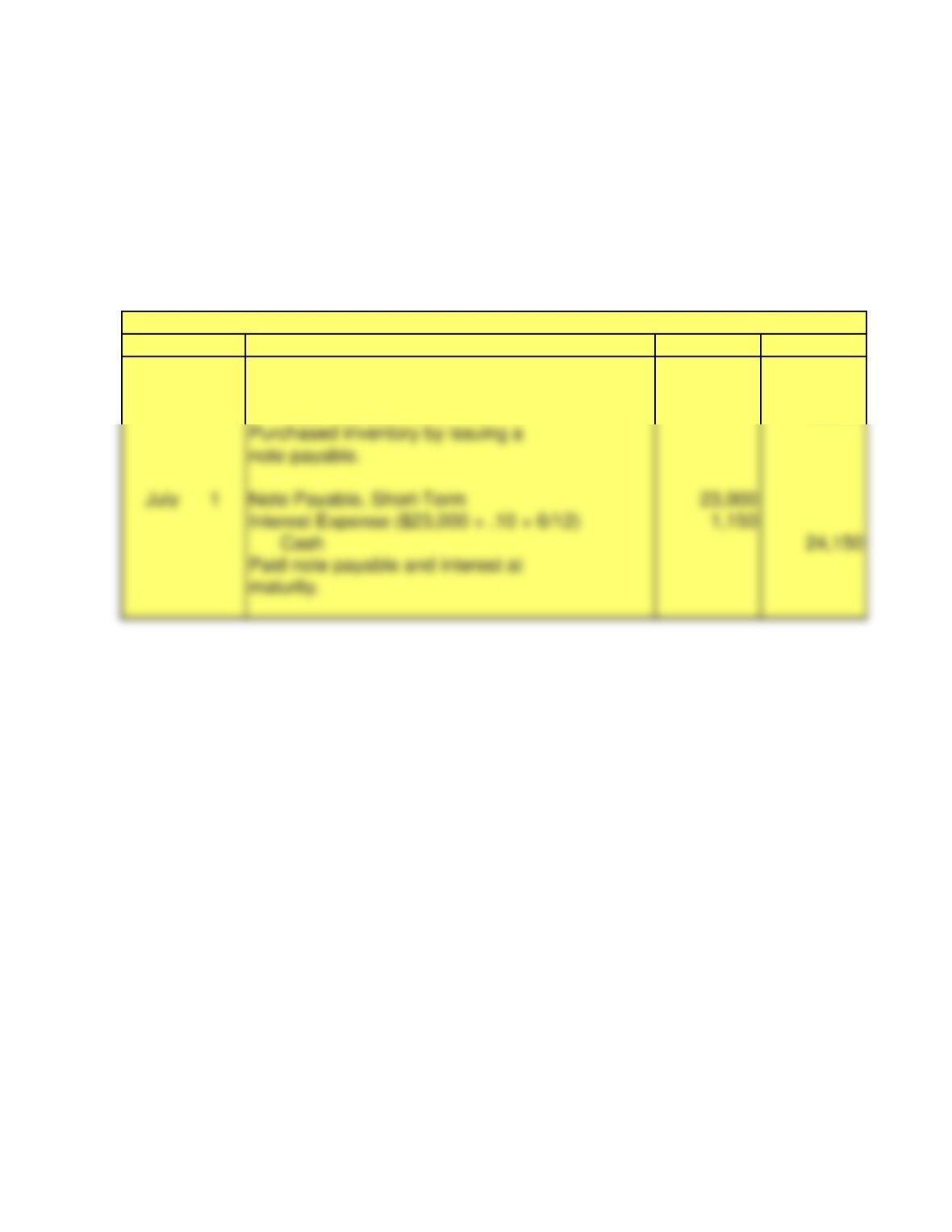
Journalize the company’s (a) purchase of inventory; and (b) payment of the note plus
interest on July 1, 2016.
Chapter 9: Liabilities Page 1 of 115
FINANCIAL ACCOUNTING – Eleventh Edition Solutions Manual
S9-2
(5-10 min.)
Requirements
Solution:
Req. 1
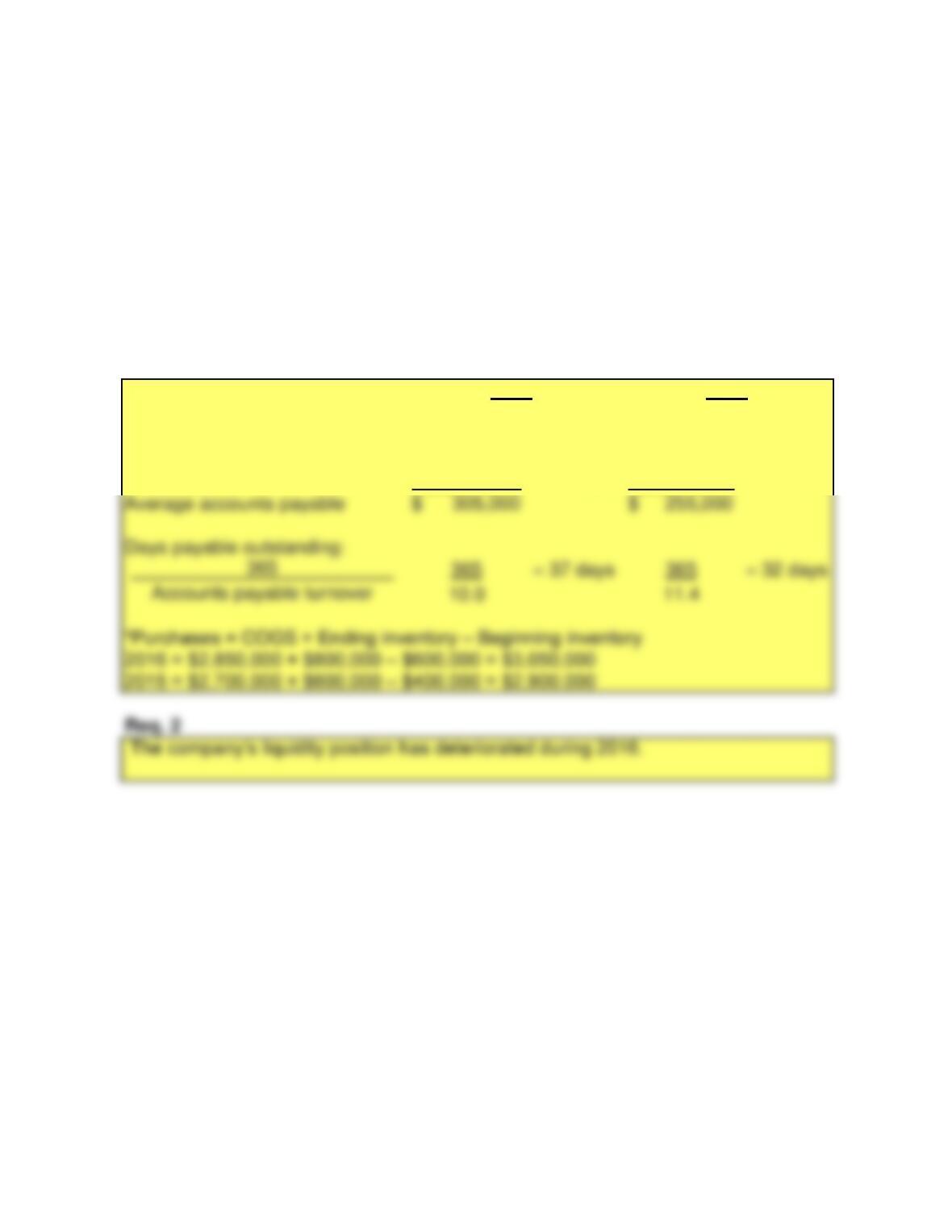
Accounts payable turnover:
Purchases* 3,050,000$ 10.0 2,900,000$ 11.4
1. Calculate the company’s accounts payable turnover and days’ payable
outstanding (DPO) for 2015 and 2016.
2. On the basis of this computation alone, has the company’s liquidity position
improved or deteriorated during 2016?
2016
2015
Chapter 9: Liabilities Page 2 of 115
FINANCIAL ACCOUNTING – Eleventh Edition Solutions Manual
S9-3
(10 min.)
Solution:
Req. 1
DATE ACCOUNT TITLES AND EXPLANATION DEBIT CREDIT
Cash ($460,000 × .15) 69,000
Notes Receivable ($460,000 − $69,000) 391,000
Sales Revenue 460,000
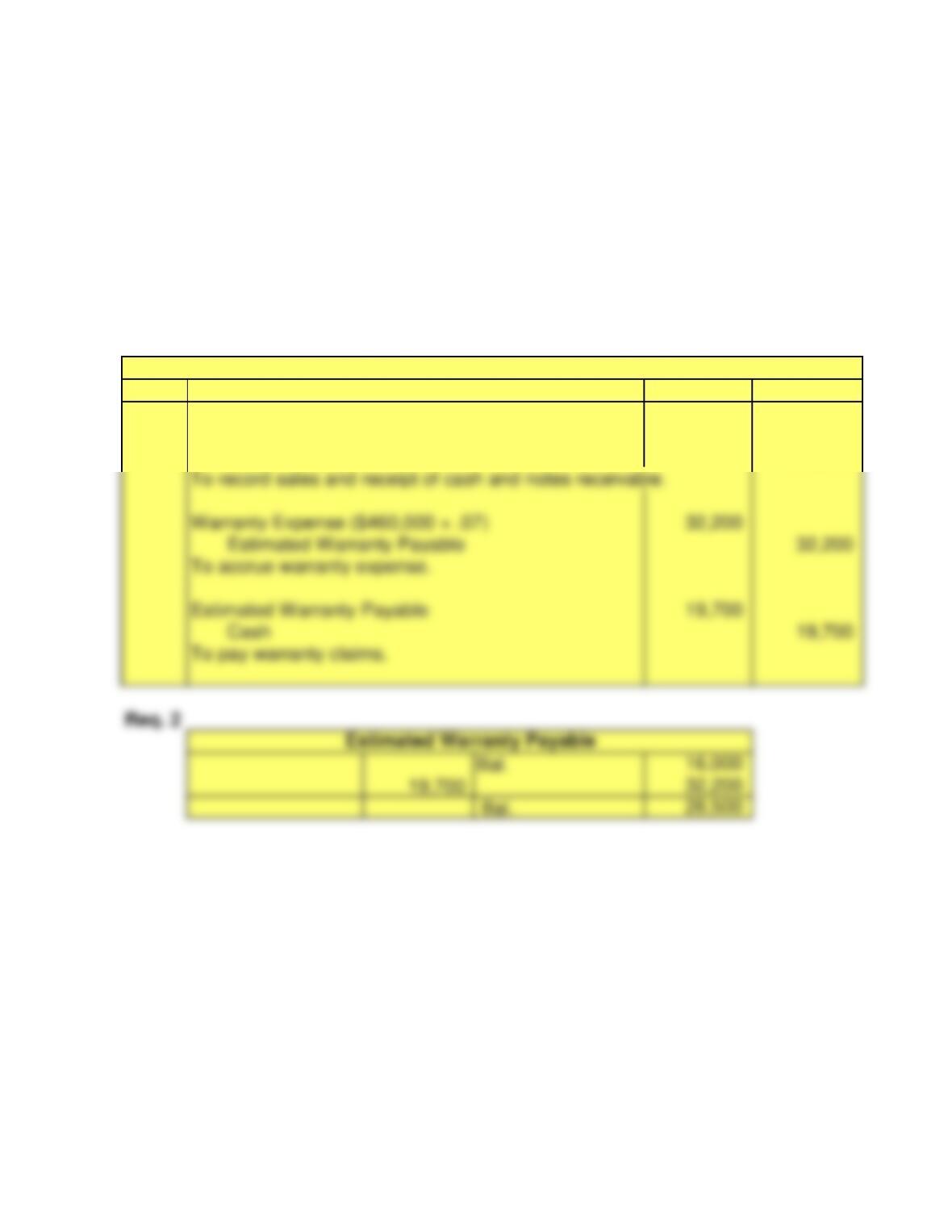
1. Record the sales, warranty expense, and warranty payments for Barnstormers USA.
2. Post to the Estimated Warranty Payable T-account. The beginning balance was
$16,000. At the end of 2016, how much in estimated warranty payable does
Barnstormers USA owe to its customers?
Journal
Chapter 9: Liabilities Page 3 of 115
Cash 19,700
Req. 2
FINANCIAL ACCOUNTING – Eleventh Edition Solutions Manual
S9-4
(5-10 min.)
Solution:
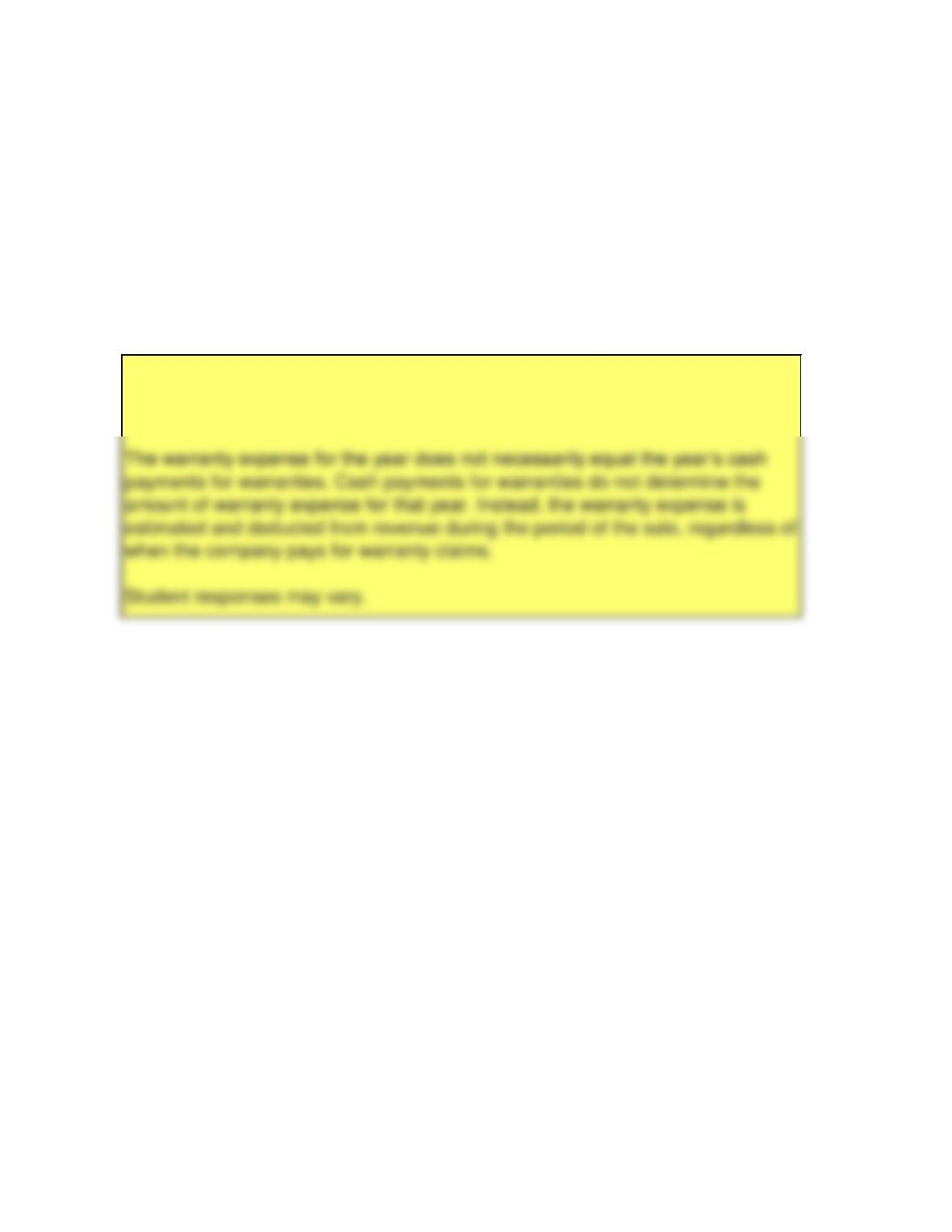
What amount of warranty expense will Barnstormers USA report during 2016?
Which accounting principle addresses this situation? Does the warranty expense
for the year equal the year’s cash payments for warranties? Explain the relevant
accounting principle as it applies to measuring warranty expense.
Warranty expense = $32,200
The expense recognition principle addresses this situation.
Chapter 9: Liabilities Page 4 of 115
FINANCIAL ACCOUNTING – Eleventh Edition Solutions Manual
S9-5
(5-10 min.)
Solution:
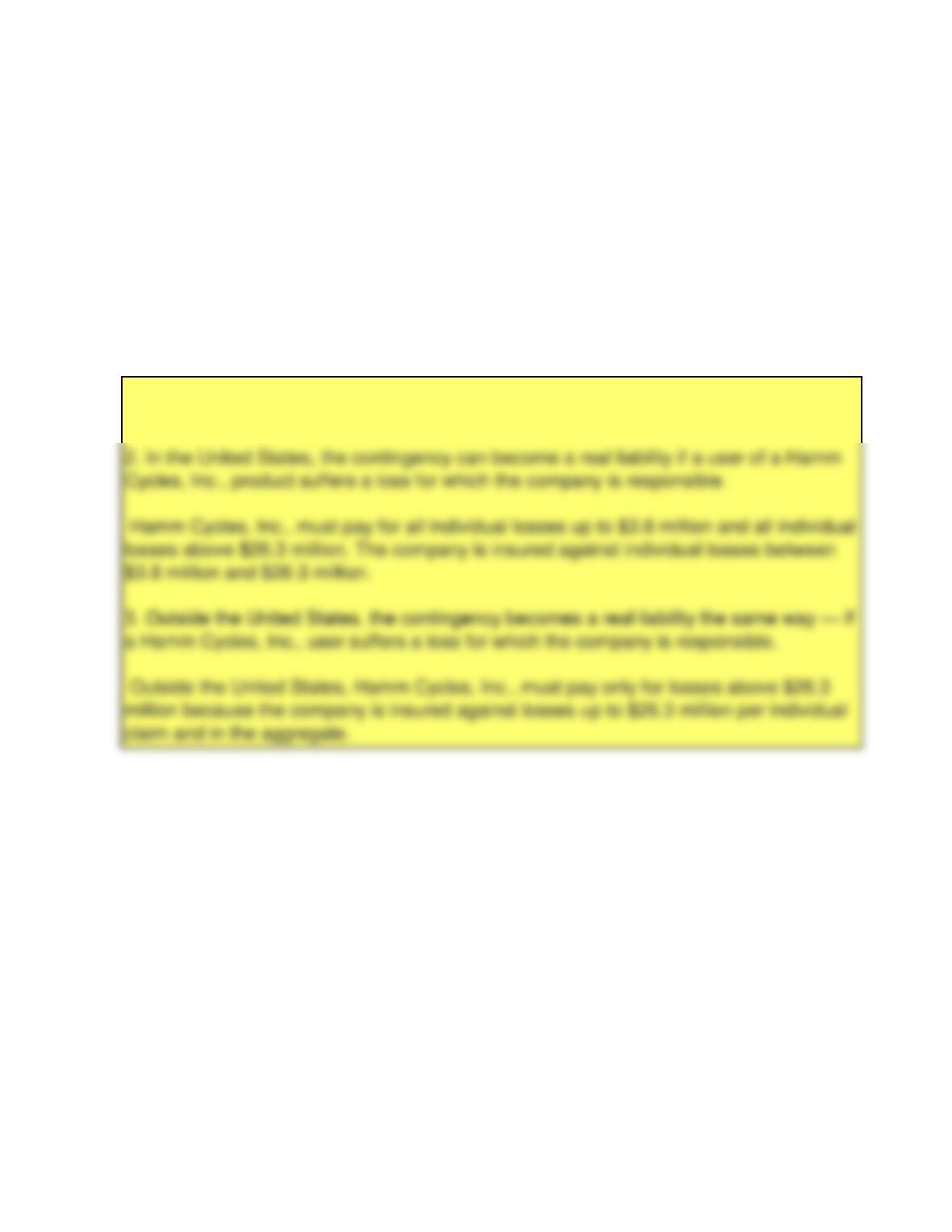
1. Why are these contingent (versus real) liabilities?
2. In the United States, how can the contingent liability become a real liability for Hamm
Cycles, Inc.? What are the limits to the company’s product liabilities in the United
States?
3. How can a contingency outside the United States become a real liability for the
company? How does Hamm Cycles, Inc.’s potential liability differ for claims outside the
1. These are contingent liabilities, because, at the time of the note, Hamm Cycles, Inc.,
was not liable for any of these product losses.
Chapter 9: Liabilities Page 5 of 115
FINANCIAL ACCOUNTING – Eleventh Edition Solutions Manual
S9-6
(5-10 min.)
Solution:
1
2
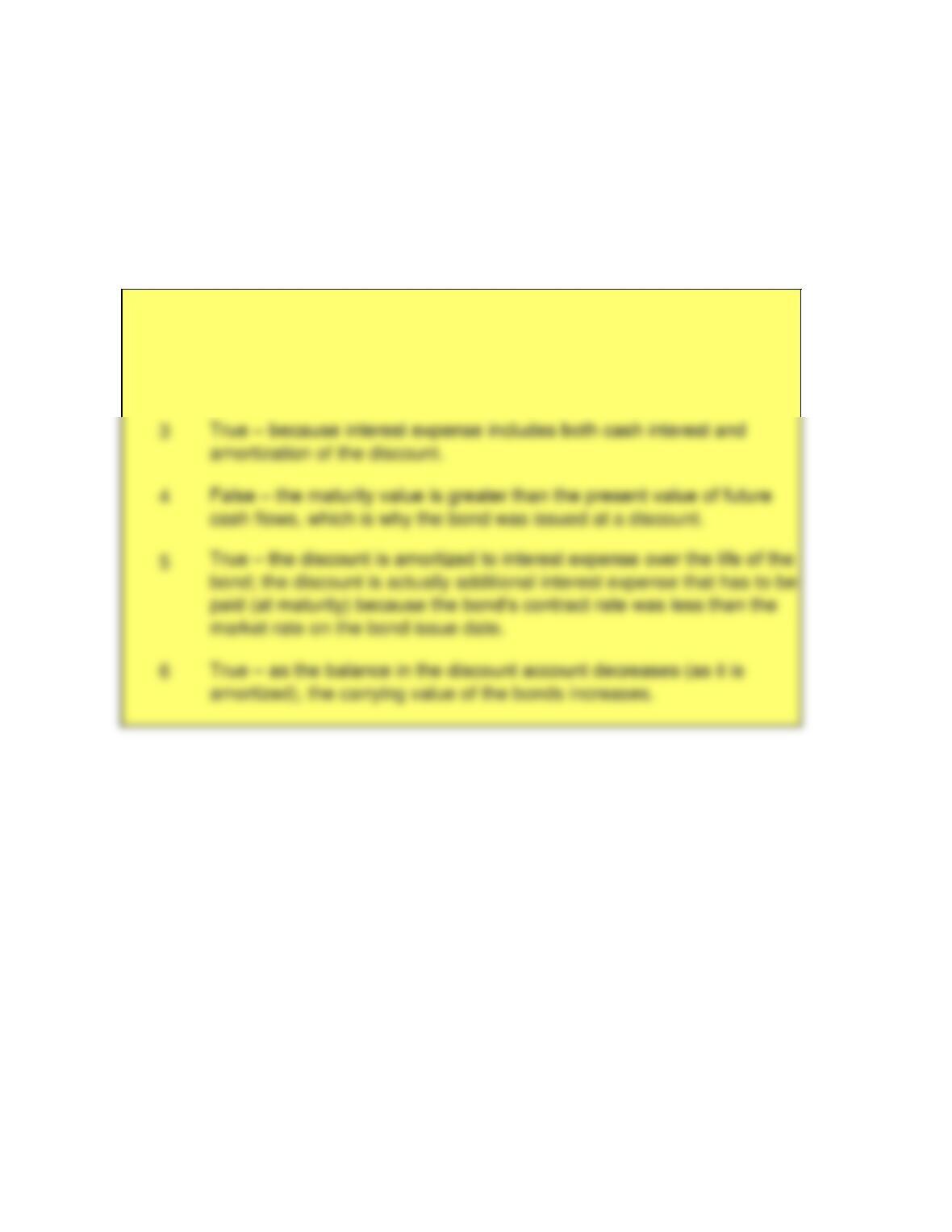
Indicate if each sentence is true or false, and give a brief explanation of your
answer.
False – the cash received is equal to the present value of the future
cash flows.
False – the contract (stated) rate, not the market rate, is always used
to calculate the cash interest payment.
Chapter 9: Liabilities Page 6 of 115
3
4
5
6
True – as the balance in the discount account decreases (as it is
True – because interest expense includes both cash interest and
amortization of the discount.
False – the maturity value is greater than the present value of future
cash flows, which is why the bond was issued at a discount.

FINANCIAL ACCOUNTING – Eleventh Edition Solutions Manual
S9-7
(5 min.)
Solution:
a. Par (face) value
Determine whether the given bonds payable will be issued at par value, at a
premium, or at a discount:
Chapter 9: Liabilities Page 7 of 115
b. Discount
d. Discount
FINANCIAL ACCOUNTING – Eleventh Edition Solutions Manual
S9-8
(5-10 min.)
Solution:
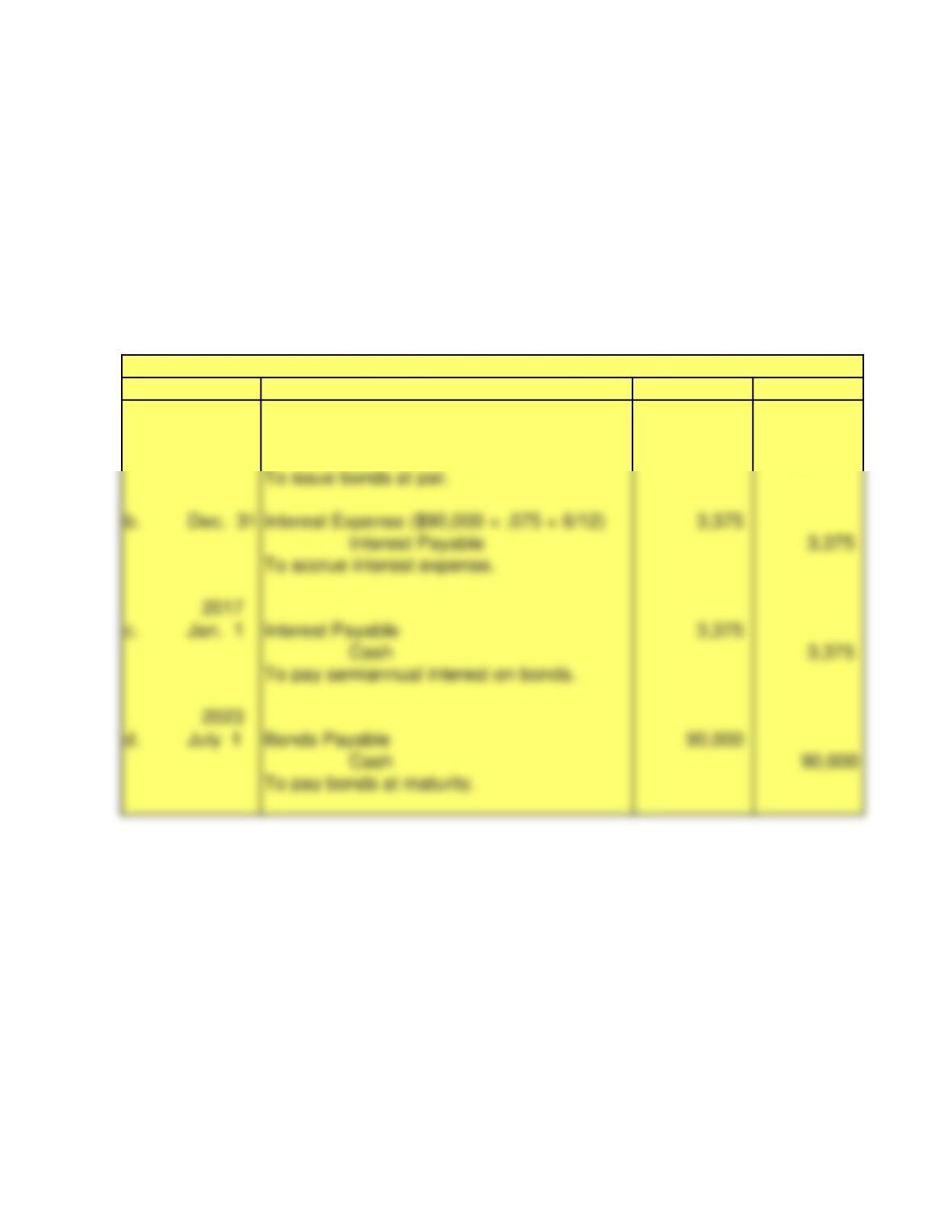
ACCOUNT TITLES AND EXPLANATION DEBIT CREDIT
2016
a. July 1 Cash 90,000
Bonds Payable 90,000
Journal
DATE
Journalize the following transactions for McQueen. Include an explanation for each
entry.
a. Issuance of the bonds payable at par on July 1, 2016
b. Accrual of interest expense on December 31, 2016 (rounded to the nearest dollar)
c. Payment of cash interest on January 1, 2017
Chapter 9: Liabilities Page 8 of 115
b. Dec. 31 Interest Expense ($90,000 × .075 × 6/12) 3,375
Interest Payable 3,375
2017
Cash 3,375
2023
d. July 1 Bonds Payable 90,000
Cash 90,000
FINANCIAL ACCOUNTING – Eleventh Edition Solutions Manual
S9-9
(10-15 min.)
Solution:
Req. 1
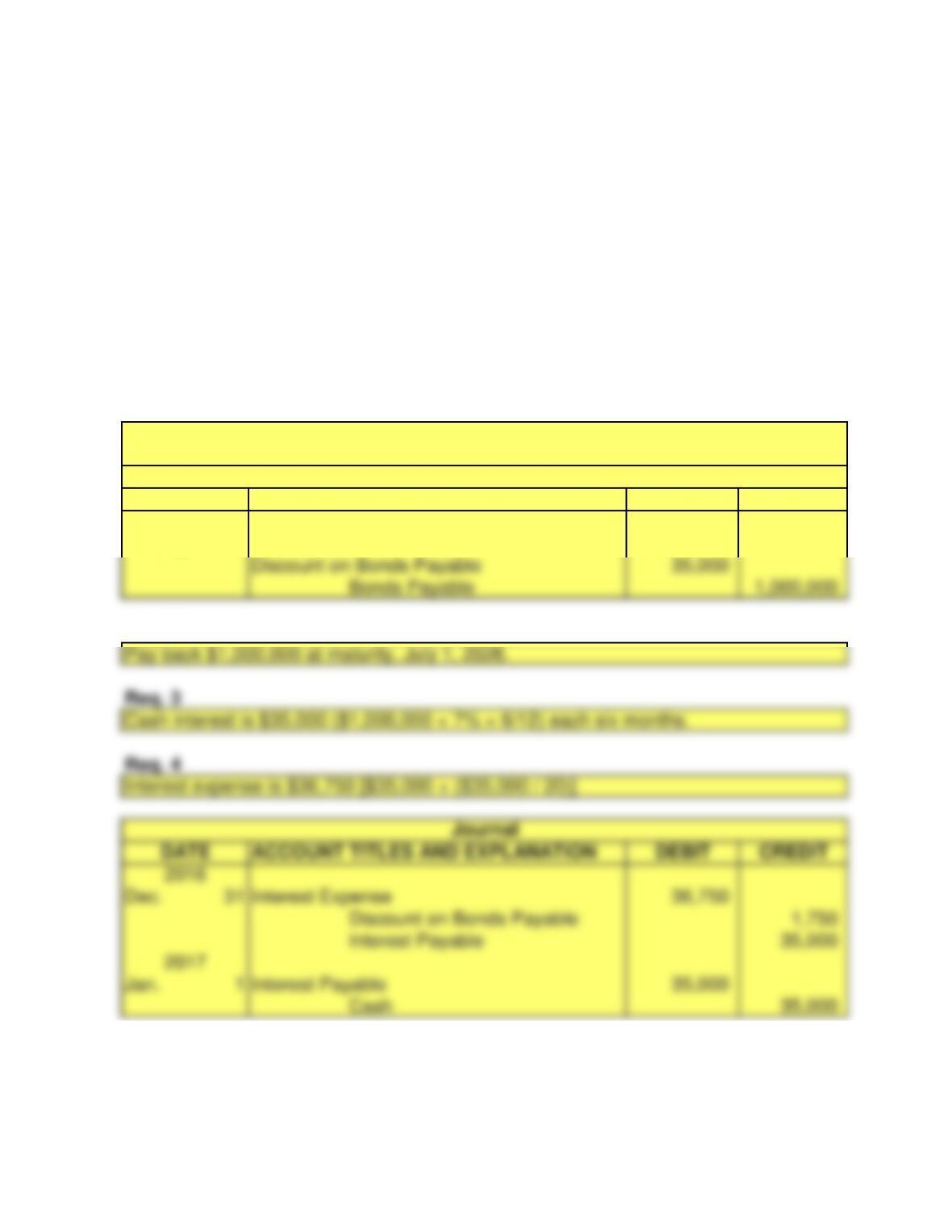
Received $965,000:
ACCOUNT TITLES AND EXPLANATION DEBIT CREDIT
Cash ($1,000,000 × .965) 965,000
Req. 2
Pay back $1,000,000 at maturity, July 1, 2026.
Req. 3
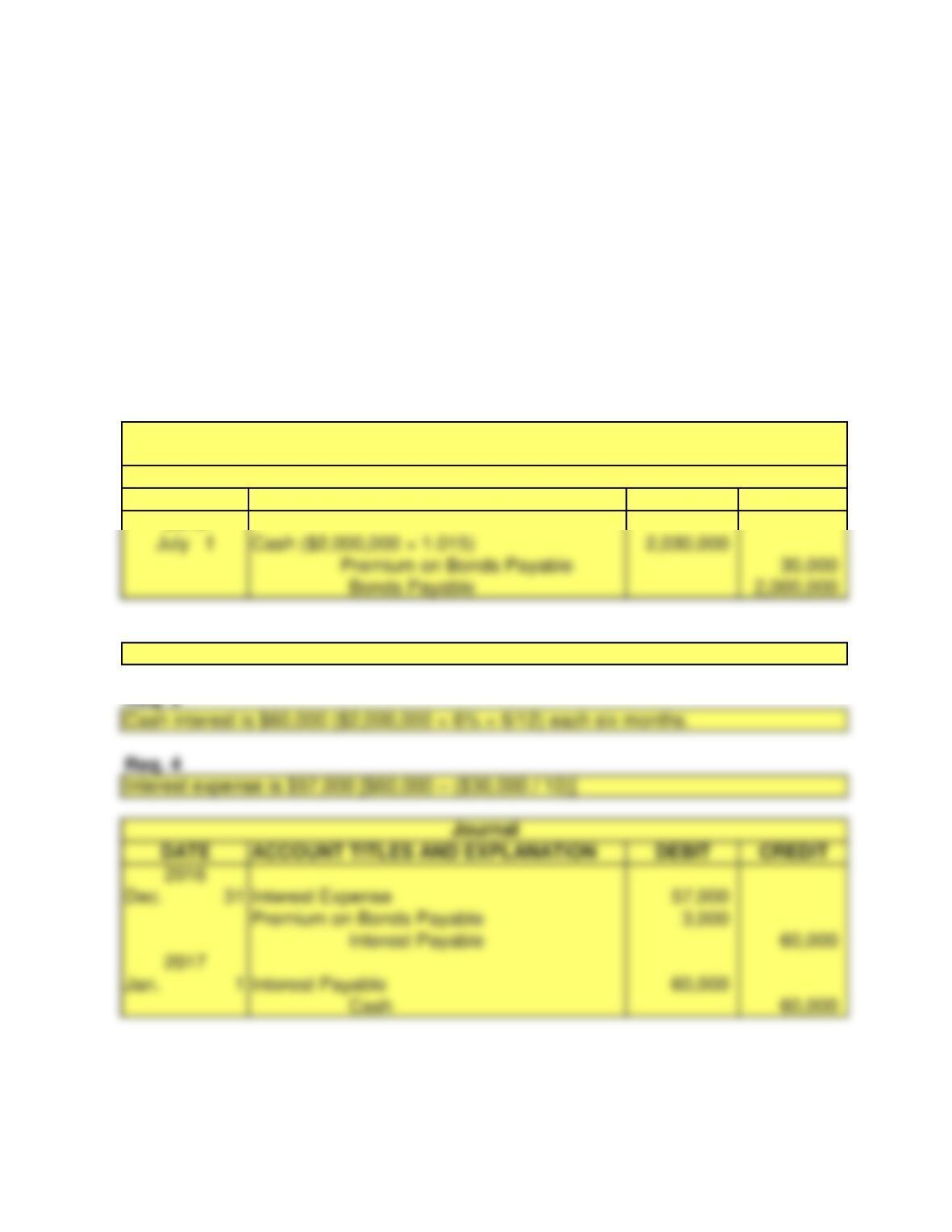
Cash interest is $35,000 ($1,000,000 × 7% × 6/12) each six months.
Req. 4
ACCOUNT TITLES AND EXPLANATION DEBIT CREDIT
Journal
DATE
2016
2017
1. How much cash did Superior receive when it issued the bonds payable? Journalize
this transaction.
2. How much must Superior pay back at maturity? When is the maturity date?
3. How much cash interest will Superior pay each six months?
4. How much interest expense will Superior report each six months? Assume the
straightline amortization method. Journalize the entries for accrual of interest on
December 31, 2016, and payment of interest on January 1, 2017.
Journal
DATE
2016
July 1
Chapter 9: Liabilities Page 9 of 115
Discount on Bonds Payable 35,000
FINANCIAL ACCOUNTING – Eleventh Edition Solutions Manual
S9-10
(10-15 min.)
Solution:
Req. 1
Received $965,000:
ACCOUNT TITLES AND EXPLANATION DEBIT CREDIT
Req. 2
Pay back $2,000,000 at maturity, July 1, 2021.
Req. 3
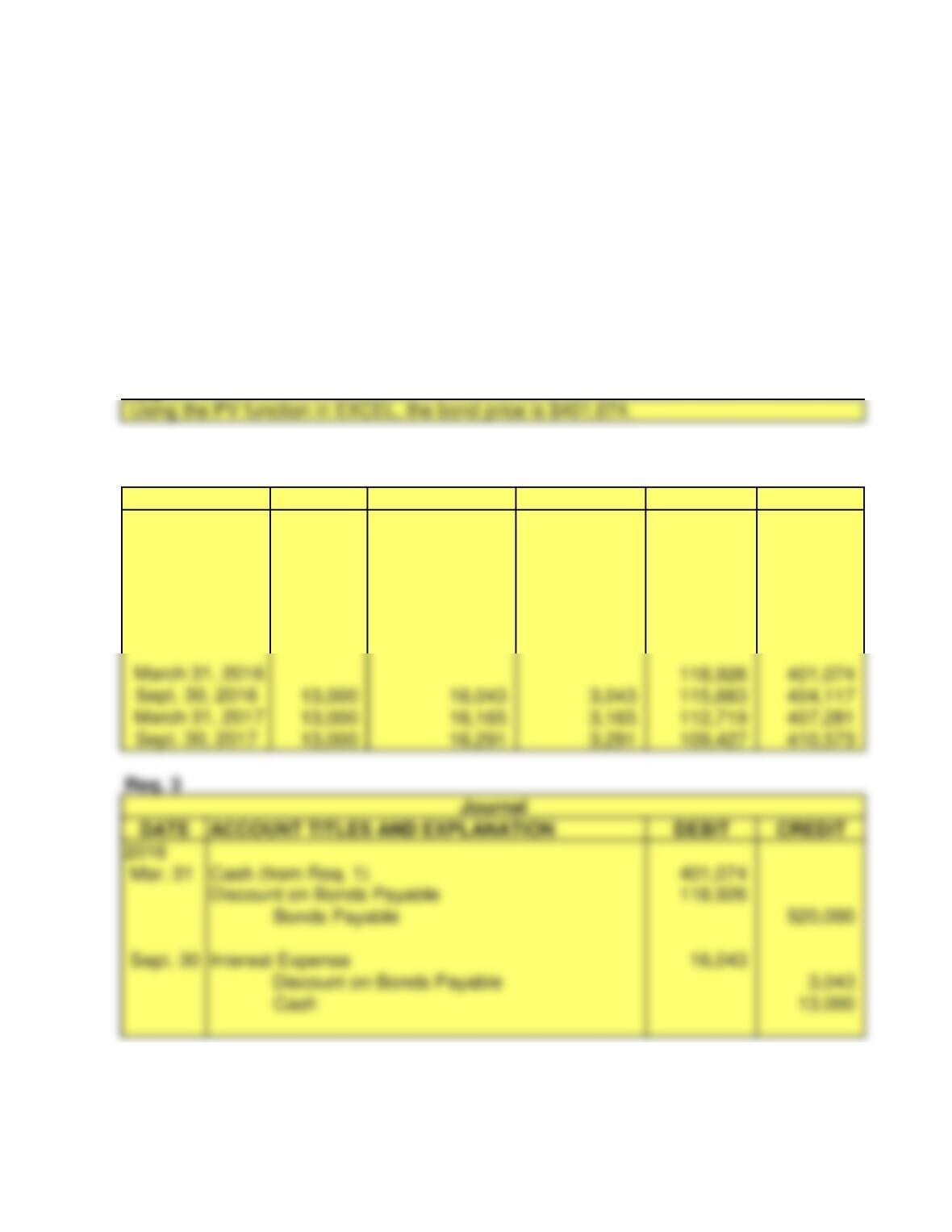
Cash interest is $60,000 ($2,000,000 × 6% × 6/12) each six months.
Req. 4
ACCOUNT TITLES AND EXPLANATION DEBIT CREDIT
Journal
DATE
2016
2017
1. How much cash did Charkey receive when it issued the bonds payable? Journalize
this transaction.
2. How much must Charkey pay back at maturity? When is the maturity date?
3. How much cash interest will Charkey pay each six months?
4. How much interest expense will Charkey report each six months? Assume the
straightline amortization method. Journalize the entries for accrual of interest on
December 31, 2016, and payment of interest on January 1, 2017.
Journal
DATE
2016
Chapter 9: Liabilities Page 10 of 115
FINANCIAL ACCOUNTING – Eleventh Edition Solutions Manual
S9-11
(10-15 min.)
Solution:
Req. 1
Req. 2 Amortization table
A B C D E
Req. 3
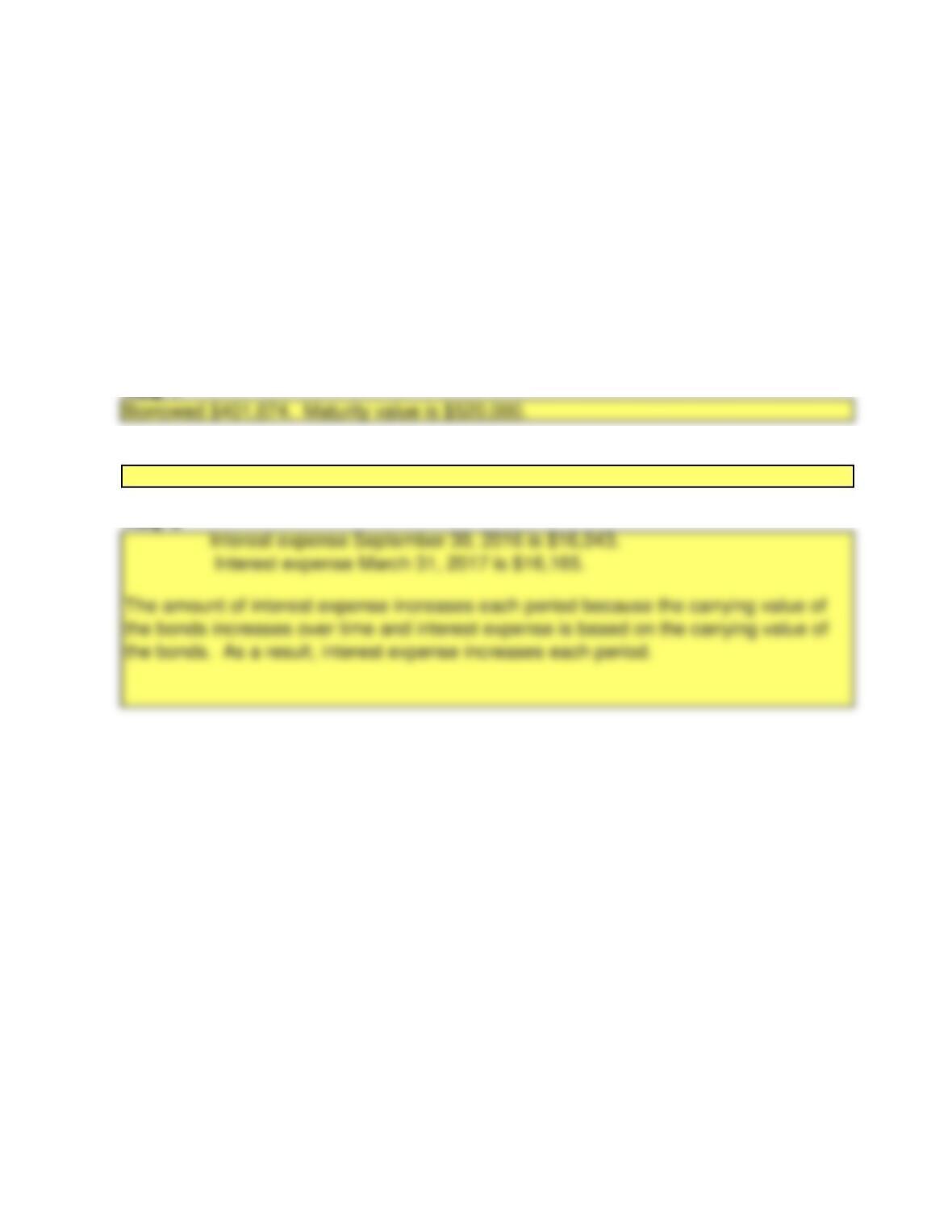
1. Using the PV function in Excel, calculate the issue price of the bonds.
2. Prepare an effective-interest amortization table for the bonds through the first three
interest payments. Round amounts to the nearest dollar.
3. Record Hartley Corporation’s issuance of the bonds on March 31, 2016, and payment
of the first semiannual interest amount and amortization of the bond discount on
September 30, 2016. Explanations are not required.
Semiannual
Interest Date
Interest
Payment
(2.5% of
Maturity
Value)
Interest
Expense (4% of
Preceding
Bond Carrying
Amount)
Discount
Amortization
(B – A)
Discount
Account
Balance
(Preceding
D – C)
Bond
Carrying
Amount
($600,000 –
D)
Chapter 9: Liabilities Page 11 of 115
FINANCIAL ACCOUNTING – Eleventh Edition Solutions Manual
S9-12
(10 min.)
Solution:
Req. 1
Req. 2
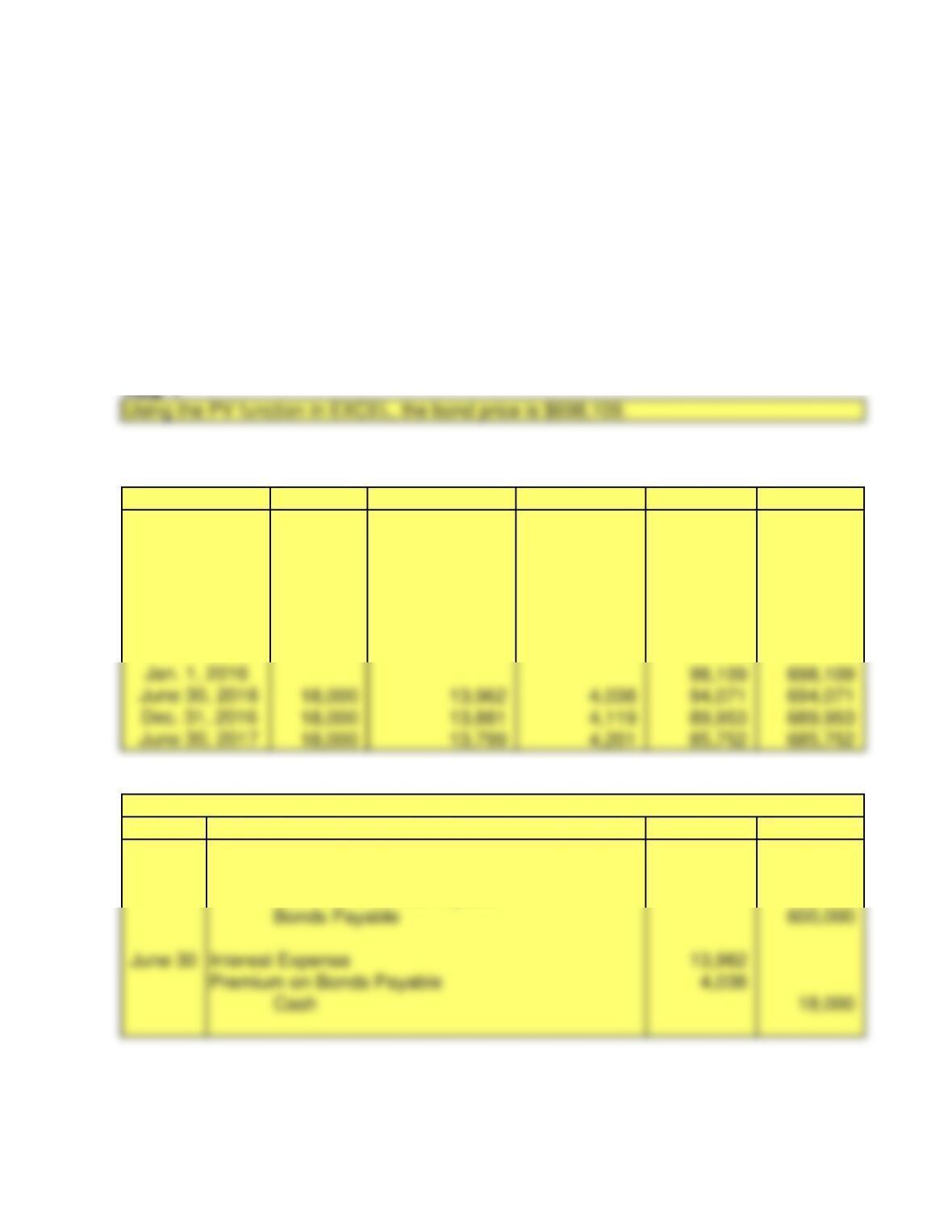
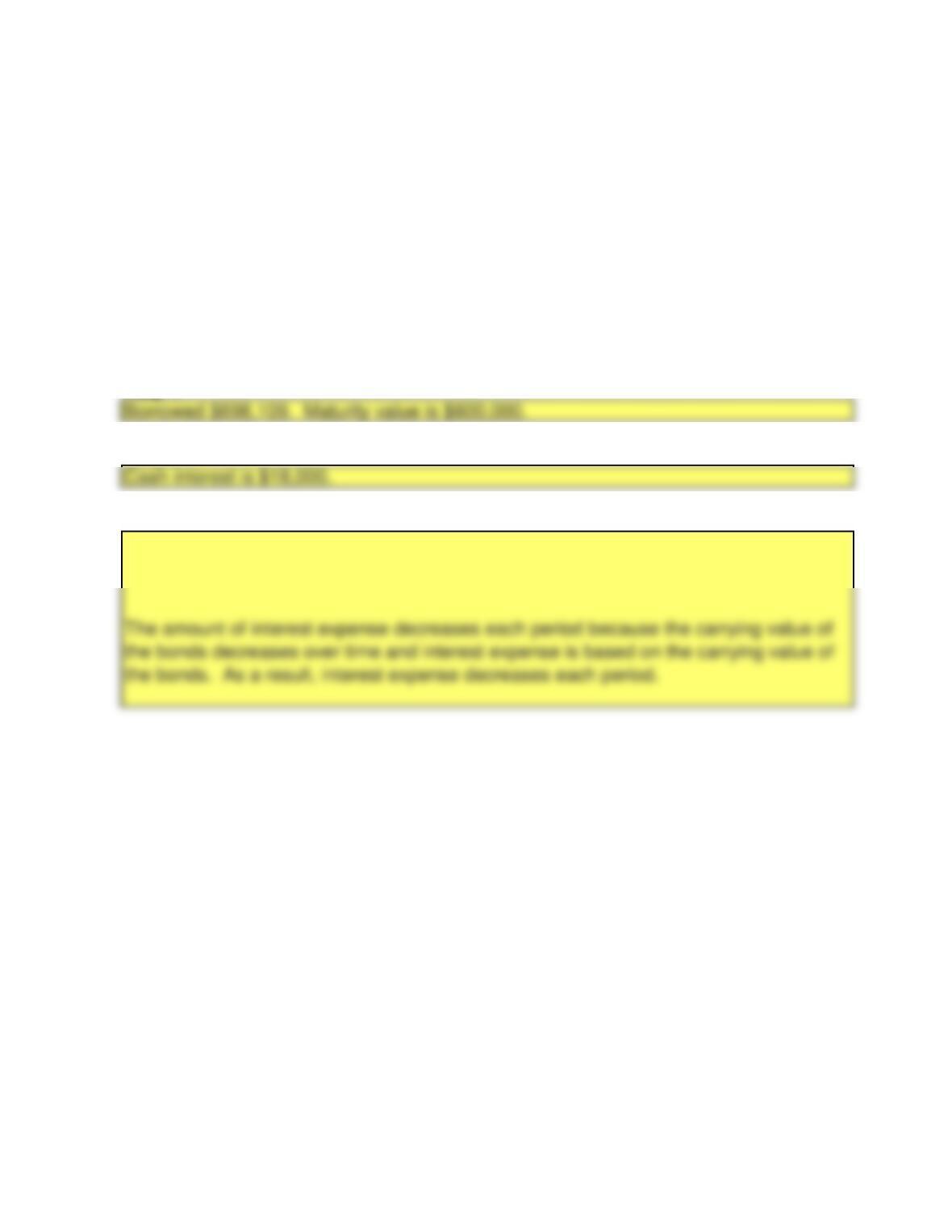
Req. 2—Cash interest is $13,000.
Req. 3
1. How much cash did Hartley Corporation borrow on March 31, 2016? How much cash
will Hartley Corporation pay back at maturity on March 31, 2028?
2. How much cash interest will Hartley Corporation pay each six months?
3. How much interest expense will Hartley Corporation report on September 30, 2016,
and on March 31, 2017? Why does the amount of interest expense increase each
period?
Chapter 9: Liabilities Page 12 of 115
FINANCIAL ACCOUNTING – Eleventh Edition Solutions Manual
S9-13
(10-15 min.)
Solution:
Req. 2 Amortization table
A B C D E
Req. 3
DATE ACCOUNT TITLES AND EXPLANATION DEBIT CREDIT
2016
Jan. 1 Cash (from Req. 1) 98,109
Premium on Bonds Payable 98,109
1. Using the PV function in Excel, calculate the issue price of the bonds.
2. Prepare an effective-interest amortization table for the bonds through the first three
interest payments. Round amounts to the nearest dollar.
3. Record Jackson Corporation’s issuance of the bonds on January 1, 2016, and
payment of the first semiannual interest amount and amortization of the bond premium
on June 30, 2016. (The bonds pay interest each June 30 and December 31.)
Semiannual
Interest Date
Interest
Payment
(3% of
Maturity
Value)
Interest
Expense (2% of
Preceding
Bond Carrying
Amount)
Discount
Amortization
(B – A)
Discount
Account
Balance
(Preceding
D – C)
Bond
Carrying
Amount
($600,000 –
D)
Journal
Chapter 9: Liabilities Page 13 of 115
Req. 1
FINANCIAL ACCOUNTING – Eleventh Edition Solutions Manual
S9-14
(10 min.)
Solution:
Req. 1
Req. 2
Req. 3
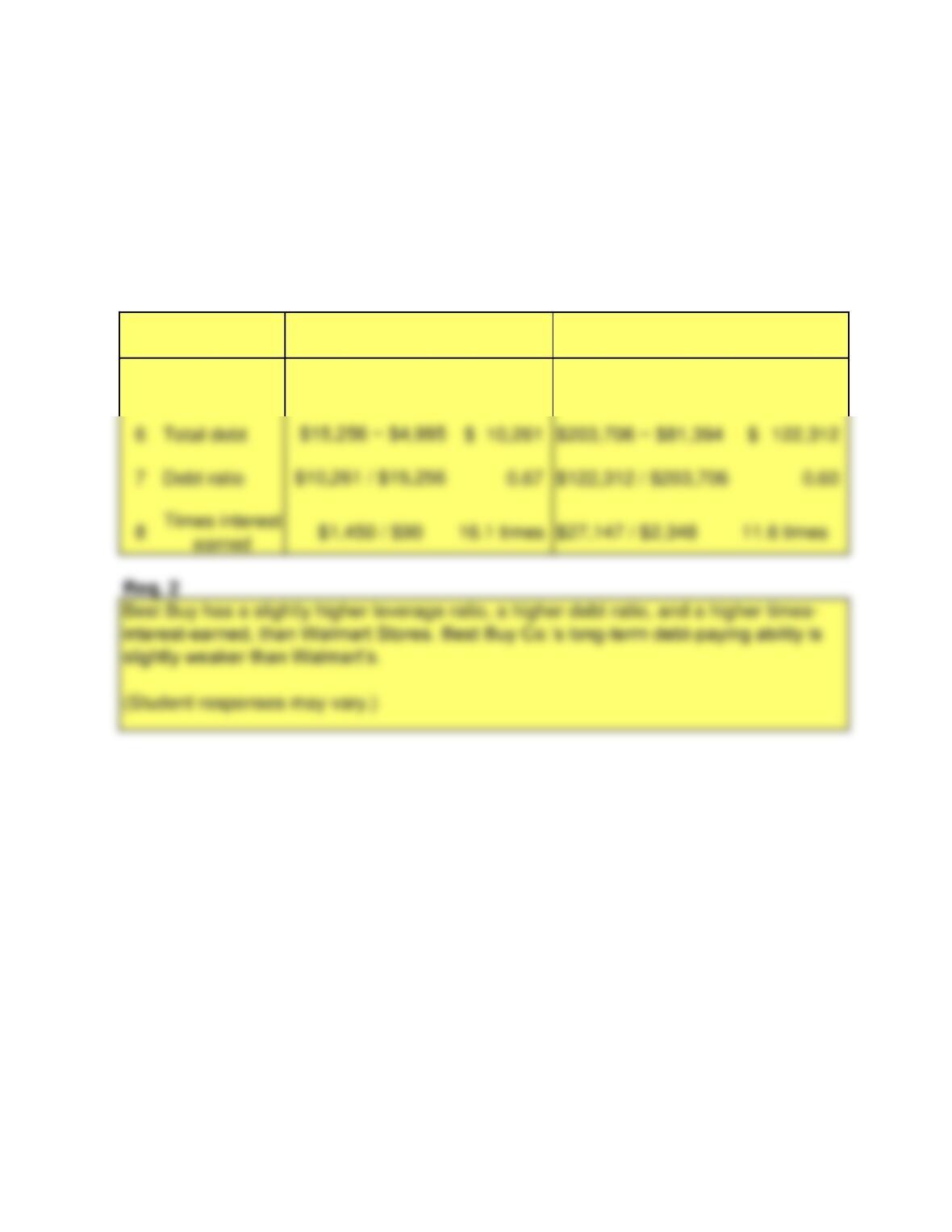
1. How much cash did Jackson Corporation borrow on January 1, 2016? How much
cash will Jackson Corporation pay back at maturity?
2. How much cash interest will Jackson Corporation pay each six months?
3. How much interest expense will Jackson Corporation report on June 30, 2016, and
on December 31, 2016? Does the amount of interest expense increase or decrease
each period? Why?
Interest expense June 30, 2016 is $13,962.
Interest expense December 31, 2016 is $13,881.
Chapter 9: Liabilities Page 14 of 115
FINANCIAL ACCOUNTING – Eleventh Edition Solutions Manual
S9-15
(10-15 min.)
Solution:
Req. 1
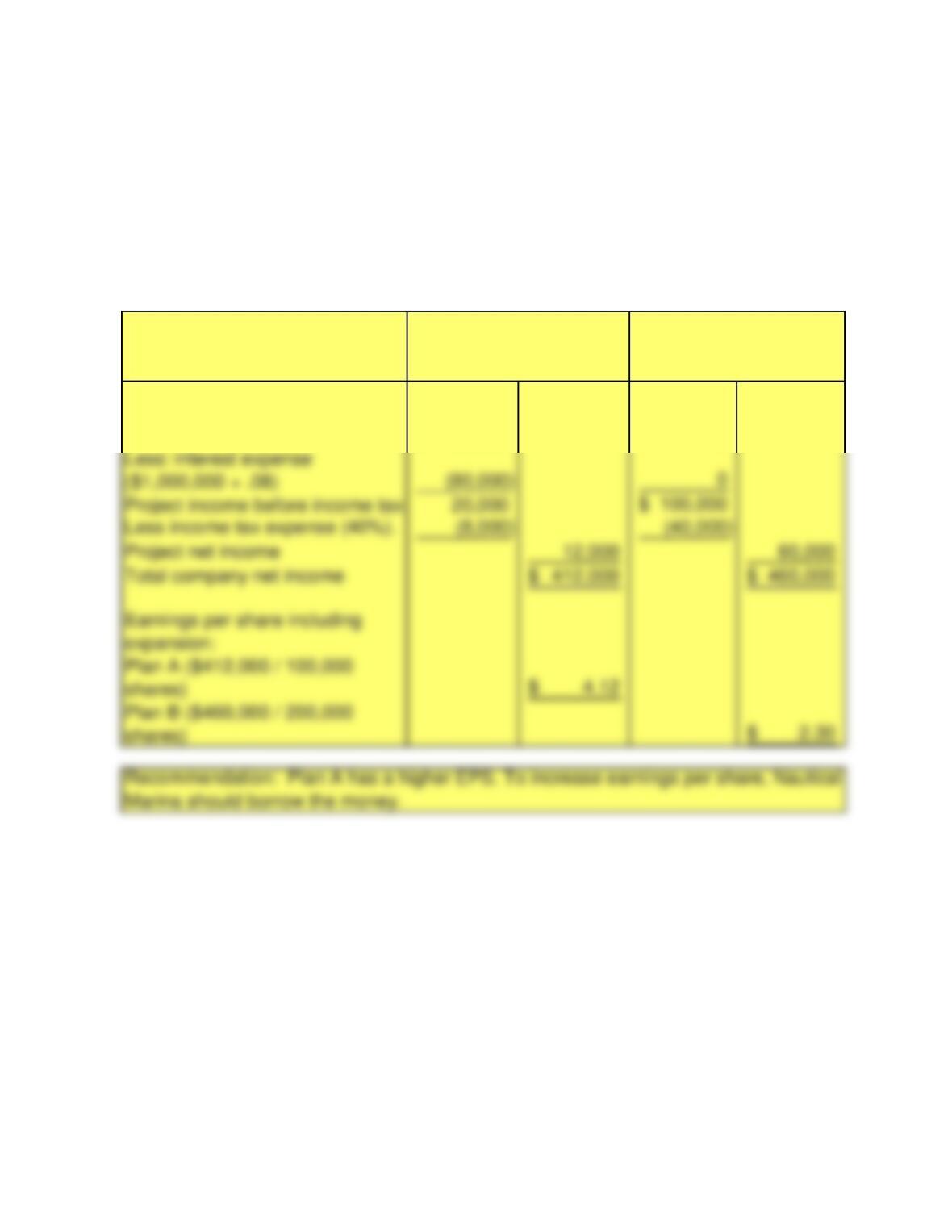
Leverage
ratio
3.05
$203,706 / $81,394
2.50
1. Complete the table, calculating all the requested information for the two companies.
2. Evaluate each company’s long-term debt-paying ability (strong, medium, weak).
Best Buy Co.
5
Wal-Mart Stores
$15,256 / $4,995
Chapter 9: Liabilities Page 15 of 115
Req. 2
FINANCIAL ACCOUNTING – Eleventh Edition Solutions Manual
S9-16
(10-15 min.)
Solution:
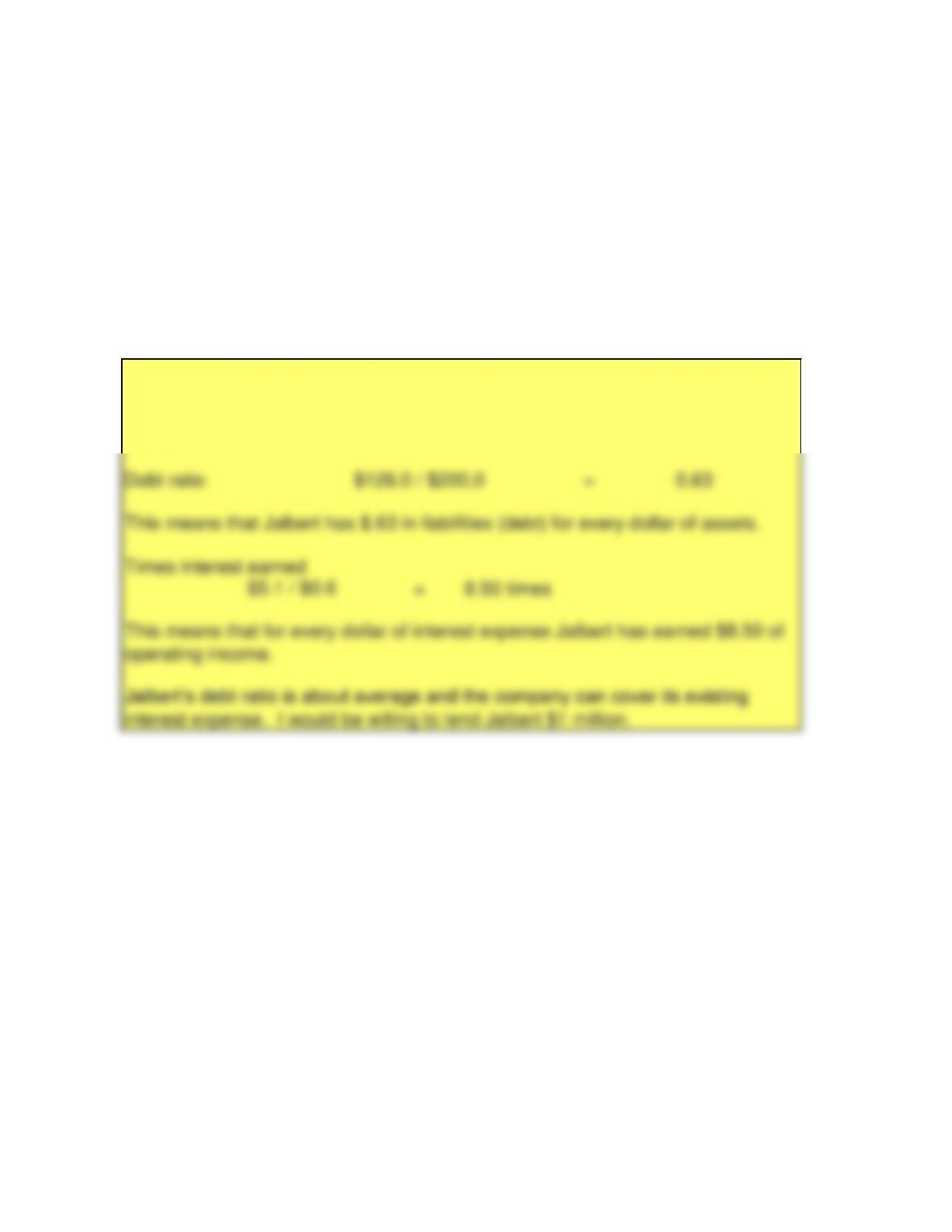
Net income before expansion
400,000$ 400,000$
Project income before interest
and income tax 100,000$ 100,000$
Plan A
Issue $1,500,000 of
6% Bonds Payable
Plan B
Issue $1,500,000
of Common Stock
Prepare an analysis to determine which plan is likely to result in the higher earnings
per share. Based solely on the earnings-per-share comparison, which financing plan
would you recommend for Nautical Marina?
Chapter 9: Liabilities Page 16 of 115
Project income before income tax
FINANCIAL ACCOUNTING – Eleventh Edition Solutions Manual
S9-17
(5-10 min.)
Solution:
Req. 1
Leverage ratio = 2.70
Compute Jalbert’s leverage ratio, debt ratio, and times-interest-earned ratio, and
write a sentence to explain what those ratio values mean. Use year-end figures
in place of averages where needed for the purpose of calculating ratios in this
exercise. Would you be willing to lend Jalbert $1 million? State your reason.
This means that Jalbert has $2.70 of assets for every dollar of stockholders’
equity.
$200.0 / $74.0
Chapter 9: Liabilities Page 17 of 115
This means that Jalbert has $.63 in liabilities (debt) for every dollar of assets.
Times interest earned
Jalbert’s debt ratio is about average and the company can cover its existing
FINANCIAL ACCOUNTING – Eleventh Edition Solutions Manual
S9-18
(5-10 min.)
Solution:
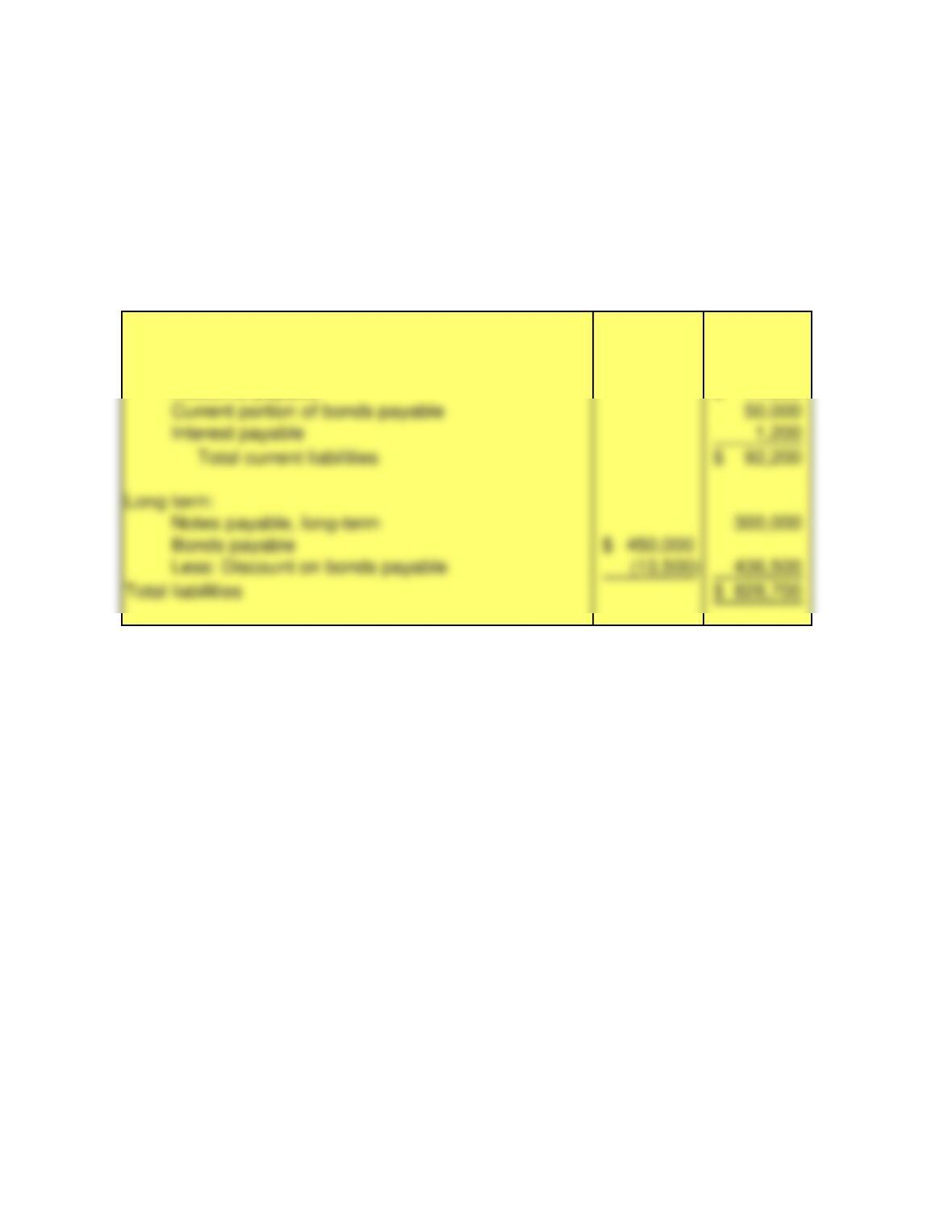
1 Operating lease
2 Capital lease
Complete the following statements with appropriate term:
Chapter 9: Liabilities Page 18 of 115
FINANCIAL ACCOUNTING – Eleventh Edition Solutions Manual
S9-19
(10 min.)
Solution:
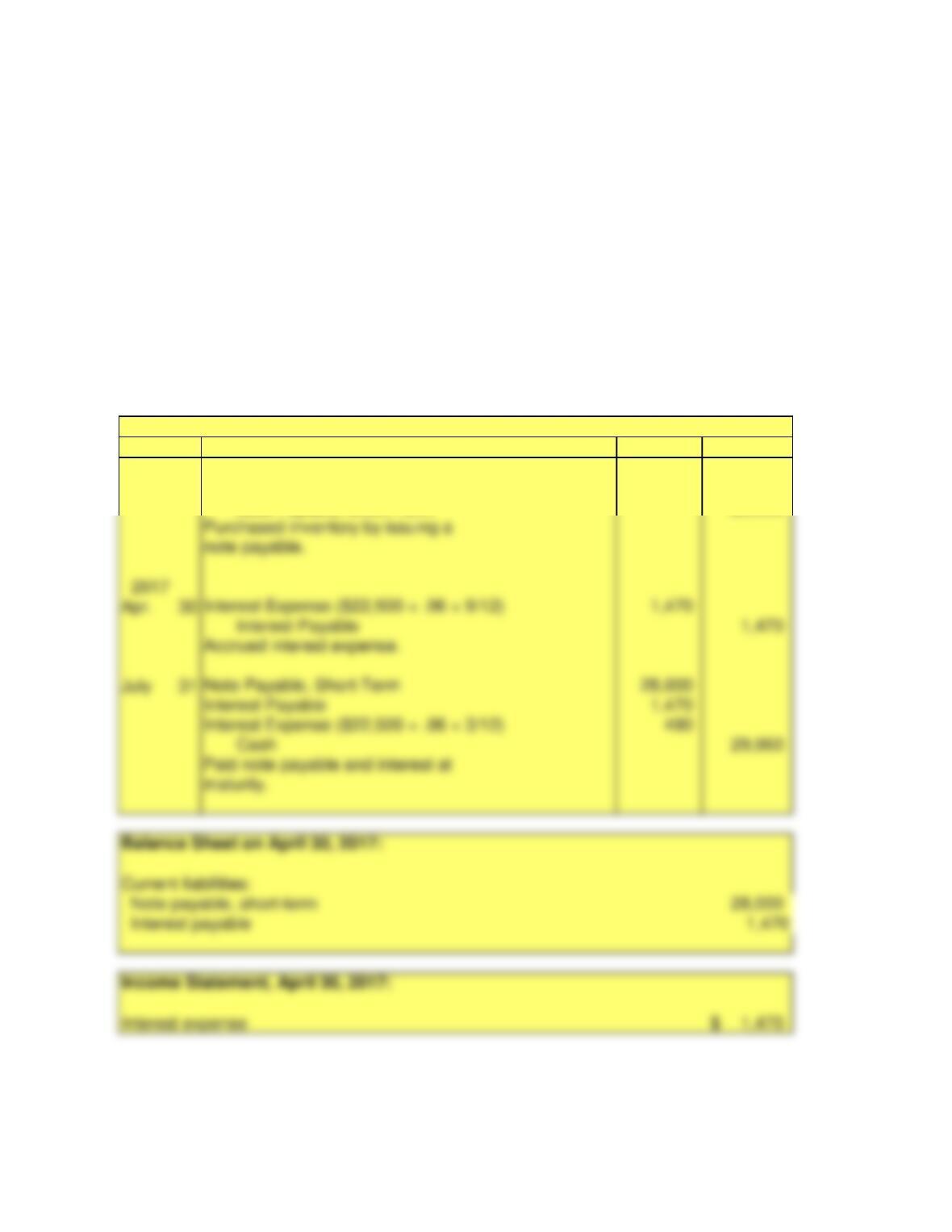
LIABILITIES
Current:
Accounts payable 41,000$
Prepare the liabilities section of LuxAll, Inc.’s, balance sheet at December 31,
2016, to show how the company would report these items. Report total current
liabilities and total liabilities.
Chapter 9: Liabilities Page 19 of 115
Current portion of bonds payable 50,000
Total current liabilities 92,200$
Notes payable, long-term 300,000
Bonds payable 450,000$
FINANCIAL ACCOUNTING – Eleventh Edition Solutions Manual
E9-20A
(10-15 min.)
Requirement
Solution:
Req.1
ACCOUNT TITLES AND EXPLANATION DEBIT CREDIT
2016
July 31 Inventory 28,000
Note Payable, Short-Term 28,000
Journalize the company’s (a) purchase of inventory; (b) accrual of interest expense on
April 30, 2017, which is the year-end; and (c) payment of the note plus interest on July
31, 2017. (Round your answers to the nearest whole number.) (d) Show what the
company would report for liabilities on its balance sheet at April 30, 2017, and on its
income statement for the year ended on that date.
Journal
DATE
Chapter 9: Liabilities Page 20 of 115
2017
Interest Payable 1,470
Cash 29,960