9-43. (continued)
b.
Rate
Handheld
Home
Total
Direct labora ………….
$1,160,400
$ 439,600
$1,600,000
Direct materialsb ……
750,000
684,000
1,434,000
Total overhead ………
90%
c
1,044,360
d
395,640
1,440,000
Total costs …………….
$2,954,760
$1,519,240
$4,474,000
Total unit cost ………..
$105.53
e
$151.92
aData given in the first table in the exercise.
bData given in the first table in the exercise.
9-44. (35 min.) Activity-Based versus Traditional Costing: Doaktown Products.
a.
Rate
M-008
M-123
Total
Direct materialsa ……
$100,000
$ 80,000
$180,000
Direct laborb ………….
$100,000
$ 40,000
$140,000
Overhead costs
Machine-hours ……
$ 15
c
$ 75,000
f
$ 45,000
$ 120,000
Production runs ….
3,500
d
35,000
g
35,000
70,000
Inspections ………..
1,500
e
30,000
h
60,000
90,000
Total overhead …..
$140,000
$140,000
$280,000
Total costs …………….
$340,000
$260,000
$600,000
Total unit cost ………..
$28.33
i
$130.00
j
aData given in the first table of the exercise in the text.
bData given in the first table of the exercise in the text.
c$15 per machine-hour = $120,000 in machine costs ÷ 8,000 machine-hours.
d$3,500 per run = $70,000 in production run costs ÷ 20 total runs.
e$1,500 per inspection = $90,000 in inspection costs ÷ 60 inspections.
9-44. (continued)
b.
Rate
M-008
M-123
Total
Direct materialsa ………
$100,000
$ 80,000
$180,000
Direct laborb …………….
100,000
40,000
140,000
Total overhead …………
200%
c
200,000
d
80,000
280,000
Total costs ……………….
$400,000
$200,000
$600,000
Total unit cost …………..
$33.33
e
$100.00
c. By allocating overhead on the basis of direct labor, Doaktown Products has been
understating the cost to manufacture M-123, thereby overstating the profits on M-
123.
9-45. (30 min.) Activity-Based Costing in a Service Environment: EL&P.
Note: Answers may vary slightly due to rounding.
a.
Commercial
Residential
Total
Revenuea …………………………...
$315,000
$780,000
$1,095,000
Direct Laborb ………………………
175,000
325,000
500,000
Overheadc ………………………….
71,750
133,250
205,000
Profit ………………………………….
$ 68,250
$321,750
$ 390,000
b.
Rate
Commercial
Residential
Total
Revenue …………..
$315,000
$780,000
$1,095,000
Direct Labor ………
175,000
325,000
500,000
Overhead
Traveling ……….
$250.00
a
$ 6,000
b
$ 19,000
c
$ 25,000
Equipment ……..
20.00
d
35,500
e
24,500
f
60,000
Supplies ………..
1.20
g
78,000
h
42,000
i
120,000
Total Overhead ….
$ 119,500
$ 85,500
$ 205,000
Profit ………………..
$ 20,500
$369,500
$ 390,000
a $250 per client = $25,000 ÷ 100 clients served.
b $6,000 = 24 clients $250 per client.
c $19,000 = 76 clients $250 per client.
9-45. (continued)
c. The recommendation to EL&P is that they should reconsider dropping residential
services in favor of the commercial business. From the table in part b of the solution,
we can show EL&P that commercial work has a profit margin of 6.5%, while the
9-46. (35 min.) Activity-Based versus Traditional Costing: Isadore’s
Implements, Inc.
a.
Cost Driver
Rate
Pencils
Pens
Setting up……………………………..
$1,440
a
$28,800
d
$ 43,200
Inspecting …………………………....
2,160
b
8,640
e
12,960
Packaging and Shipping …………
0.36
c
16,200
f
27,000
Total Overhead ……………………..
$53,640
$83,160
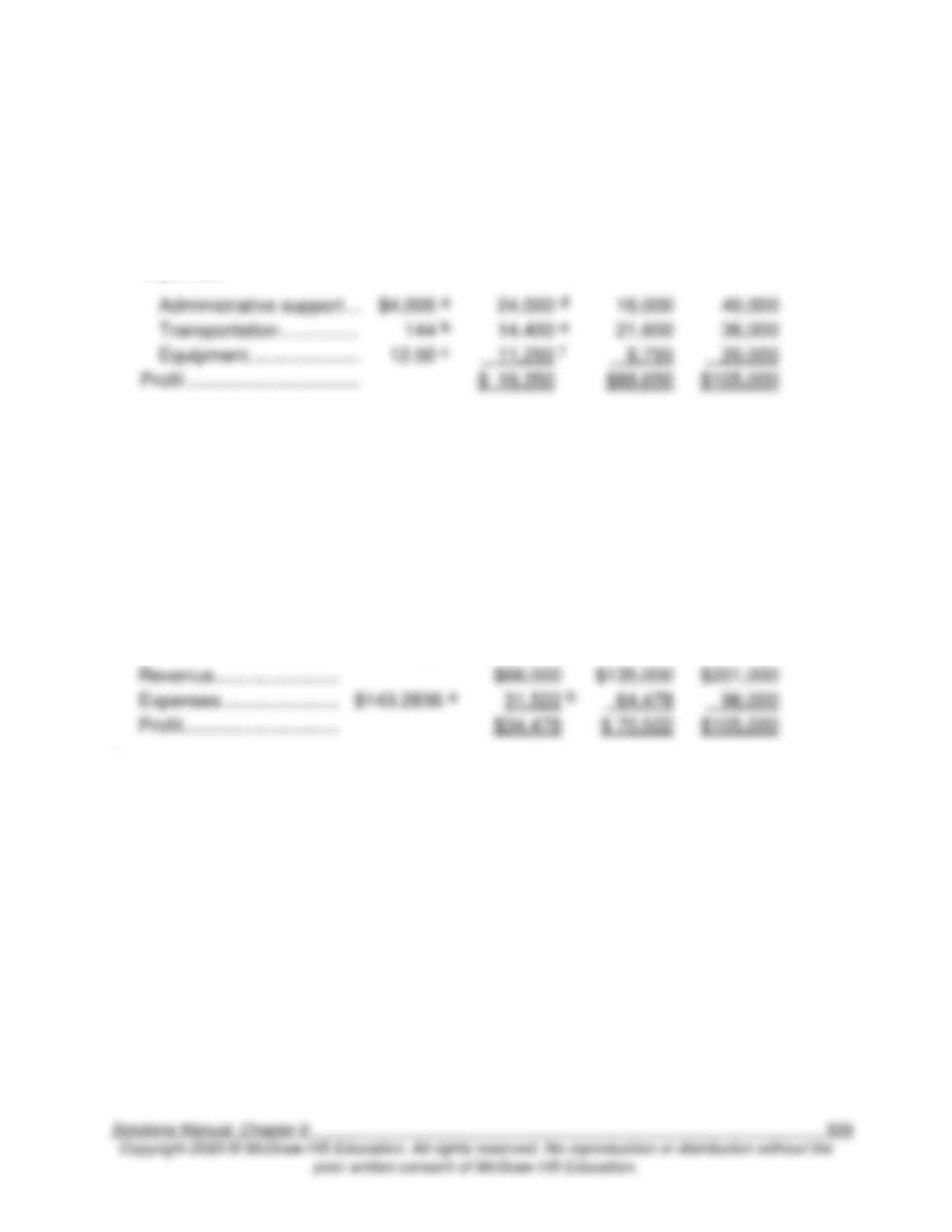
a $1,440 per setup = $72,000 ÷ 50 setups.
b $2,160 per part = $21,600 ÷ 10 parts.
b.
Pencils
Pens
Total
Direct Labor Hours ……..
4,500
a
15,000
19,500
Overhead ………………….
$31,569
b
$105,231
$ 136,800
a 4,500 hours = 0.1 hours per box of pencils 45,000 boxes produced.
b $31,569 = ($136,800 OH ÷ 19,500 hours) 4,500 hours (rounded).
9-47. (35 min.) Activity-Based versus Traditional Costing—Ethical Issues:
Windy City Coaching.
a.
Account
Rate
Teen
Counseling
Executive
Coaching
Total
Revenue ………………………
$66,000
$135,000
$201,000
Expenses:
a $4,000 per client = $40,000 ÷ 10 clients.
b $144 per visit = $36,000 ÷ 250 visits.
c $12.50 per computer hour = $20,000 ÷ 1,600 hours.
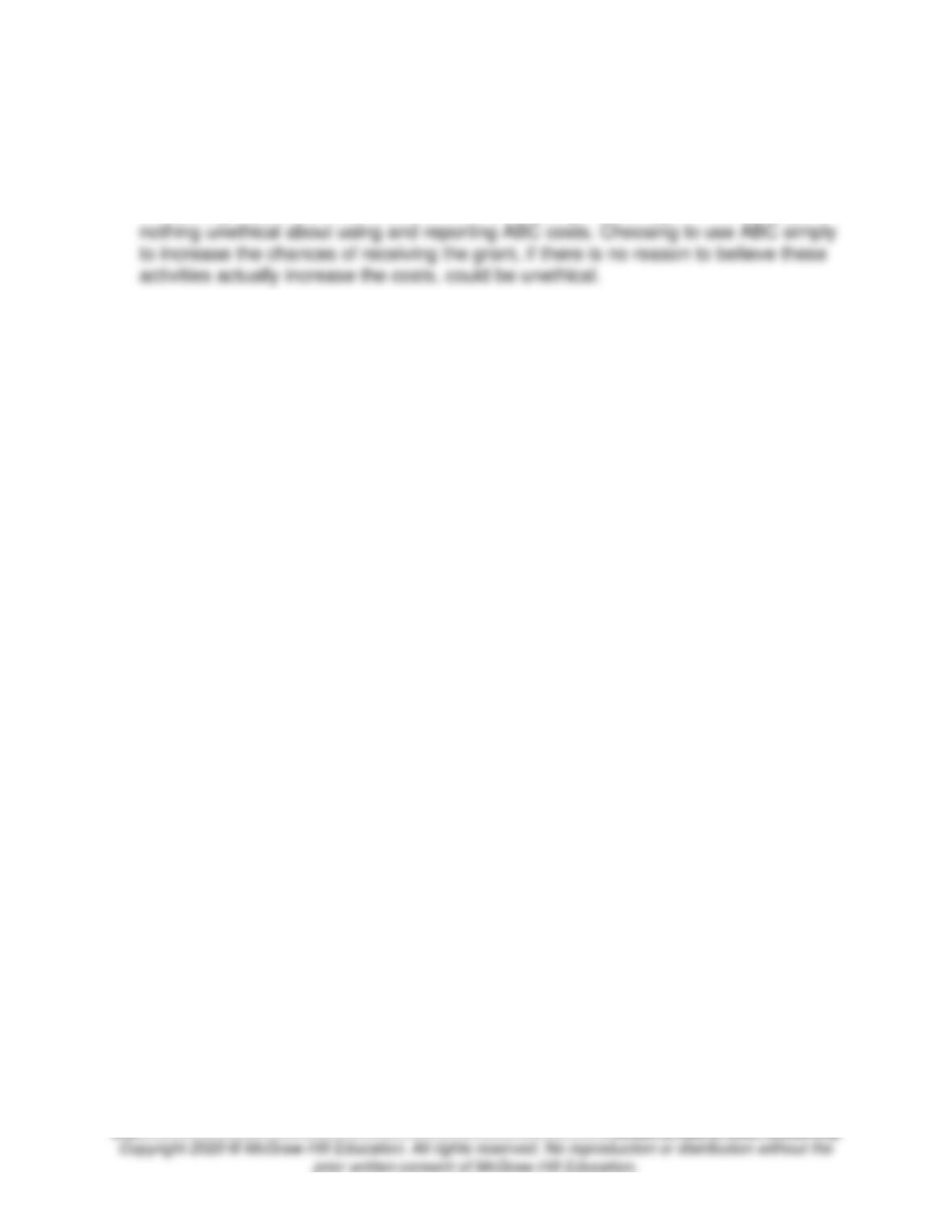
d $24,000 = $4,000 per client 6 clients.
e $14,400 = $144 per hour 100 visits.
f $11,250 = $12.50 per computer hour x 900 hours.
b.
Account
Rate
Teen
Counseling
Executive
Coaching
Total
a$201,000 revenue ÷ $300 per hour = 670 hours of labor.
$143.2836 per labor hour = $96,000 of expenses ÷ 670 hours.
b$31,522 = $143.28 per labor hour 220 hours of labor.
c. Under labor-based costing, teen counseling and executive coaching appear equally
profitable (relative to revenues), so Wendy will not emphasize one or the other.
However, using ABC, executive coaching appears to be much more profitable.
d. ABC and traditional costing systems generally yield comparable product-line profits
when overhead is a small portion of costs, or when cost drivers are highly correlated
with the volume-related allocation base. In this case, labor-hours were distributed
32.8% to Teen Counseling and 67.2% to Executive Coaching. If Wendy’s three cost
drivers were each also distributed 32.8% to Teen Counseling and 67.2% to
Executive Coaching, the labor-hour allocation and ABC would have been identical.
9-47. (continued)
e. Activity-based costing assigns higher costs to teen counseling than the traditional
method does, so using this would increase the chances of receiving the grant. If teen
counseling uses more activities and these activities generate higher costs, there is
9-48. (30 min.) Activity-Based Costing—Cost Flows Through T-accounts:
Southwest Components.
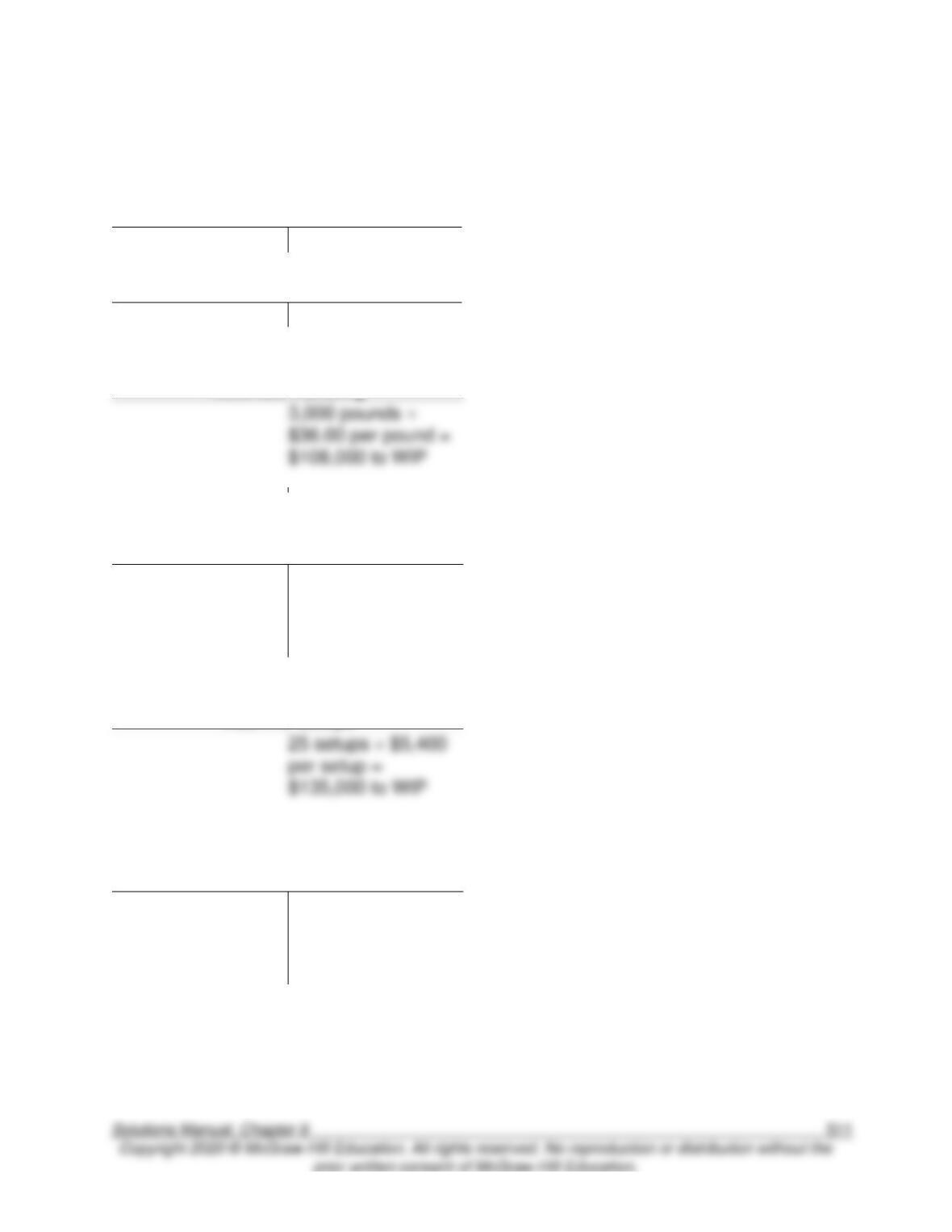
Materials Inventory
$600,000
Wages Payable
$300,000
Overhead Applied:
Materials Handling
Overhead Applied:
Quality Inspections
500 inspections
$450 per inspection
= $225,000 to WIP
Overhead Applied:
Machine Setups
25 setups $5,400
Overhead Applied:
Running Machines
10,000 hours $45
per hour = $450,000
to WIP
9-48. (continued)
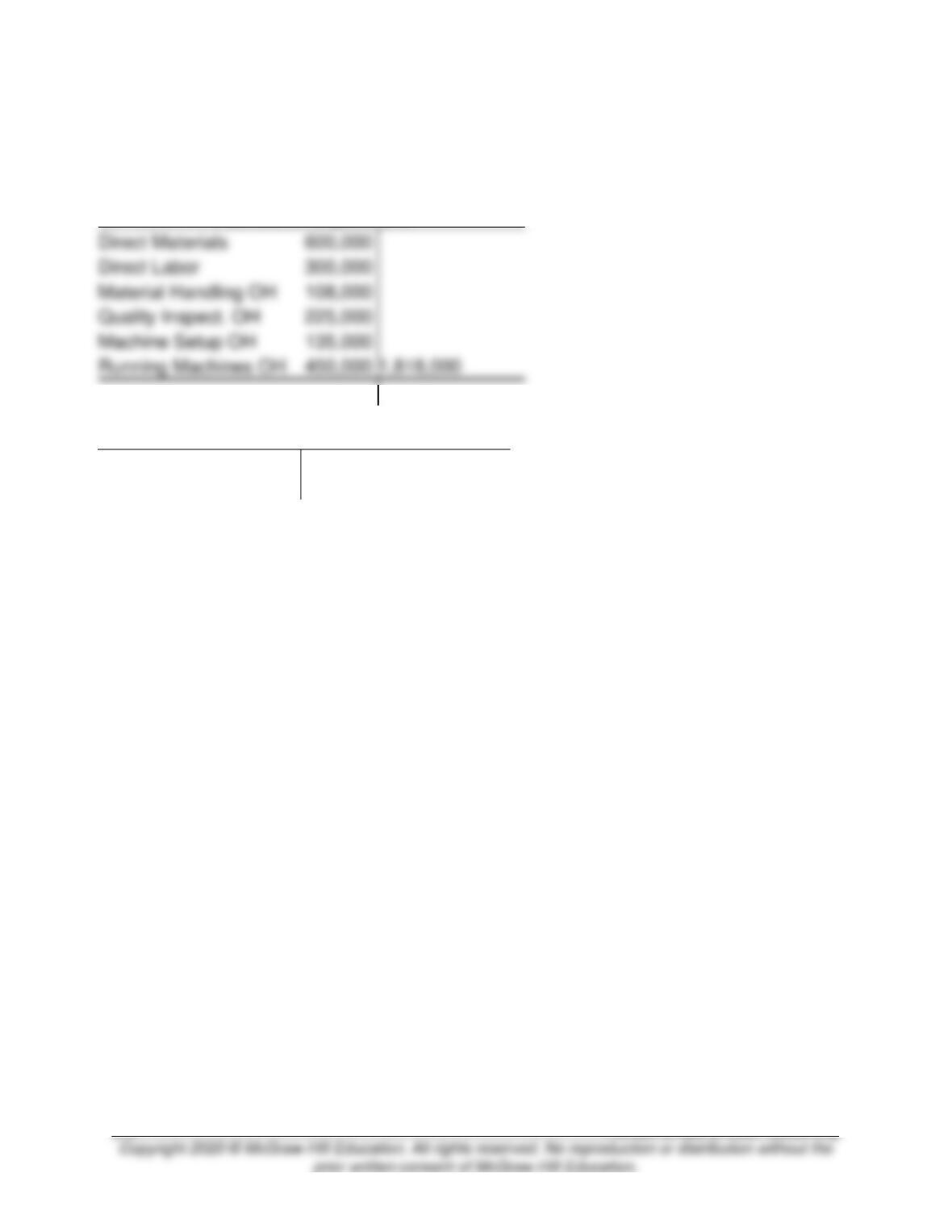
Work in Process (WIP) Inventory
Fabrication Department
Direct Materials
Material Handling OH
Quality Inspect. OH
Running Machines OH
Finished Goods Inventory
1,818,000
9-49. (30 min.) Activity-Based Costing—Cost Flows Through T-accounts:
Catalina Sails.
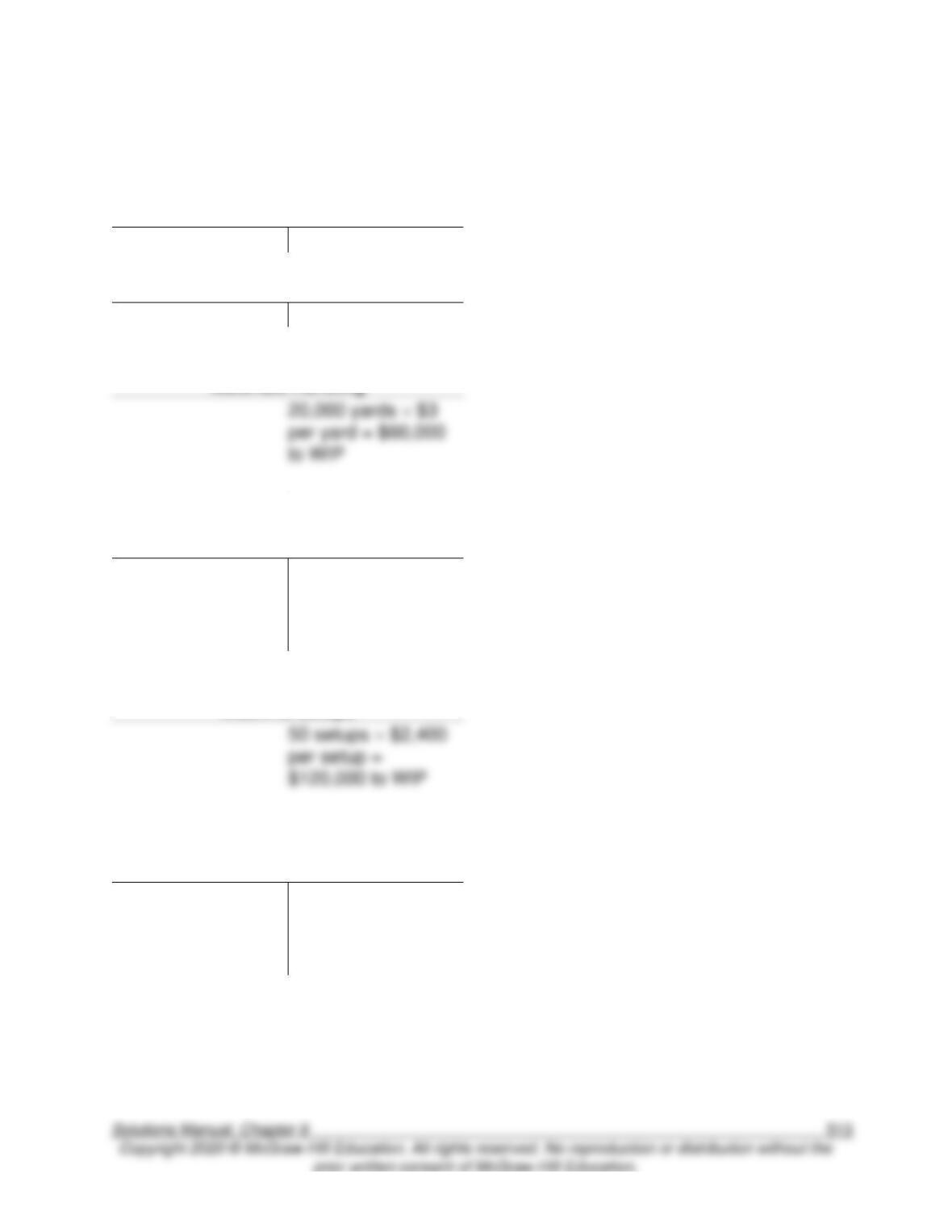
Materials Inventory
$550,000 to WIP
Wages Payable
$275,000 to WIP
Overhead Applied:
Overhead Applied:
Quality Inspections
400 inspections
$300 per inspection
= $120,000 to WIP
Overhead Applied:
$120,000 to WIP
Overhead Applied:
Running Machines
10,000 hours $30
per hour = $300,000
to WIP
9-49. (continued)
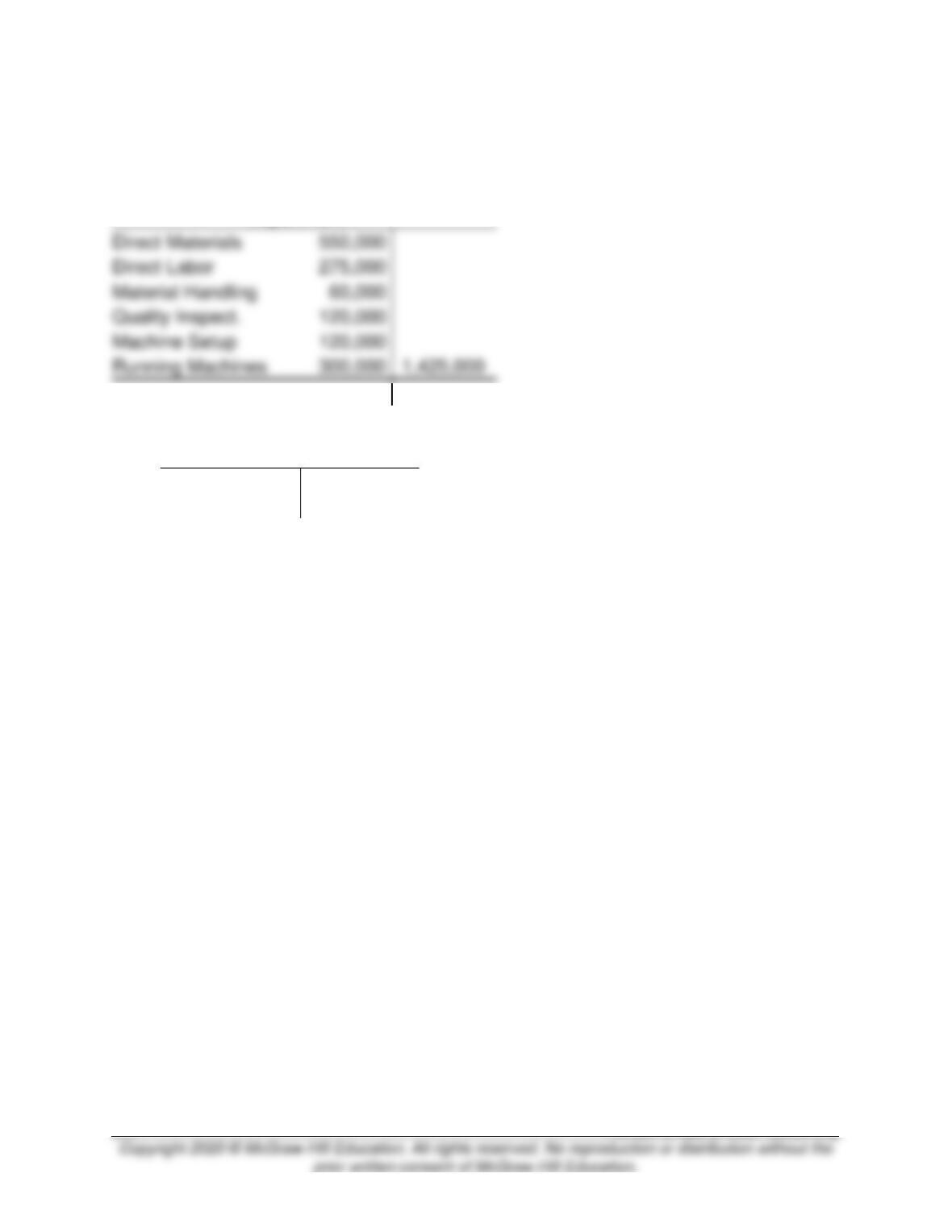
Work in Process (WIP) Inventory
Department Y
Direct Materials
Material Handling
Quality Inspect.
Running Machines
1,425,000
Finished Goods Inventory
1,425,000
9-50. (20 min.) Activity-Based Costing for an Administrative Service: LastCall
Enterprises.
a.
Rate
LaidBack
StressedOut
Total
Allocated costsa …….
$1,100
$220,000
b
$55,000
c
$275,000
b.
Rate
LaidBack
StressedOut
Total
Employee maintenancea
$6,000
$60,000
b
$180,000
c
$240,000
Payrolld …………………..
$140
28,000
e
7,000
f
35,000
Total allocated costs …
$88,000
$187,000
$275,000
a $6,000 = $240,000 Employee maintenance costs ÷ 40 employees hired/leaving.
b 60,000 = $6,000 10 employees hired/leaving.
Allocating Personnel costs solely on number of employees understates the costs of
employee turnover, which is much higher in StressedOut.
9-51. (20 min.) Activity-Based Costing for an Administrative Service: John’s
Custom Computer Shop.
a.
Rate
Personal
Business
Total
Allocated costsa …………………………..
$84
$50,400
b
$33,600
c
$84,000
a $84 per bill = $84,000 Accounts receivable cost ÷ 1,000 bills prepared.
b $50,400 = $84 x 600 bills prepared for Personal.
c $33,600 = $84 x 400 bills prepared for Business.
b.
Rate
Personal
Business
Total
Billinga ………………………..
$48
$28,800
b
$19,200
c
$48,000
Dispute resolutiond ……….
$500
30,000
e
6,000
f
36,000
Total allocated costs …….
$58,800
$25,200
$84,000
Allocating Accounts Receivable costs solely on number of bills prepared understates
the costs of billing disputes, which is much higher in Personal.
9-52. (20 min.) Time-Driven Activity-Based Costing: Kim Distribution Services.
a.
$0.54
Total cost in Distribution ..
$826,200
Total minutes availablea ..
1,530,000
Cost per minute ……………
$0.54
(= $826,200 ÷ 1,530,000)
a
15 employees 50 weeks 40 hours per week 0.85 60 minutes per hour
.
b.
$23.76
Taking
Orders
Picking
Orders
Packaging
Orders
Total
Total costs …………….
c.
306,000 minutes.
Taking
Minutes used …………
Unused minutes …….
Picking
Packaging
Orders
d.
$165,240 (= 306,000 minutes $0.54 per minute).
9-53. (20 min.) Time-Driven ABC for an Administrative Service: City
Enterprises.
a.
$2.25
Total cost in Personnel ..
b.
$236.25
Interviewing
Hiring
Total
Minutes per activity ..
45
+
60
=
105
Cost per minute ……..
$2.25
Total costs …………….
$236.25
c.
108,000 minutes.
Interview
Hire
Assess
Sep.
Process
Total
Number of orders …
Minutes used ……….
+
+
Unused minutes …..
d.
$243,000 (= 108,000 minutes $2.25 per minute).
9-54. (40 min.) Comparative Income Statements and Management Analysis: EZ–
Seat, Inc.
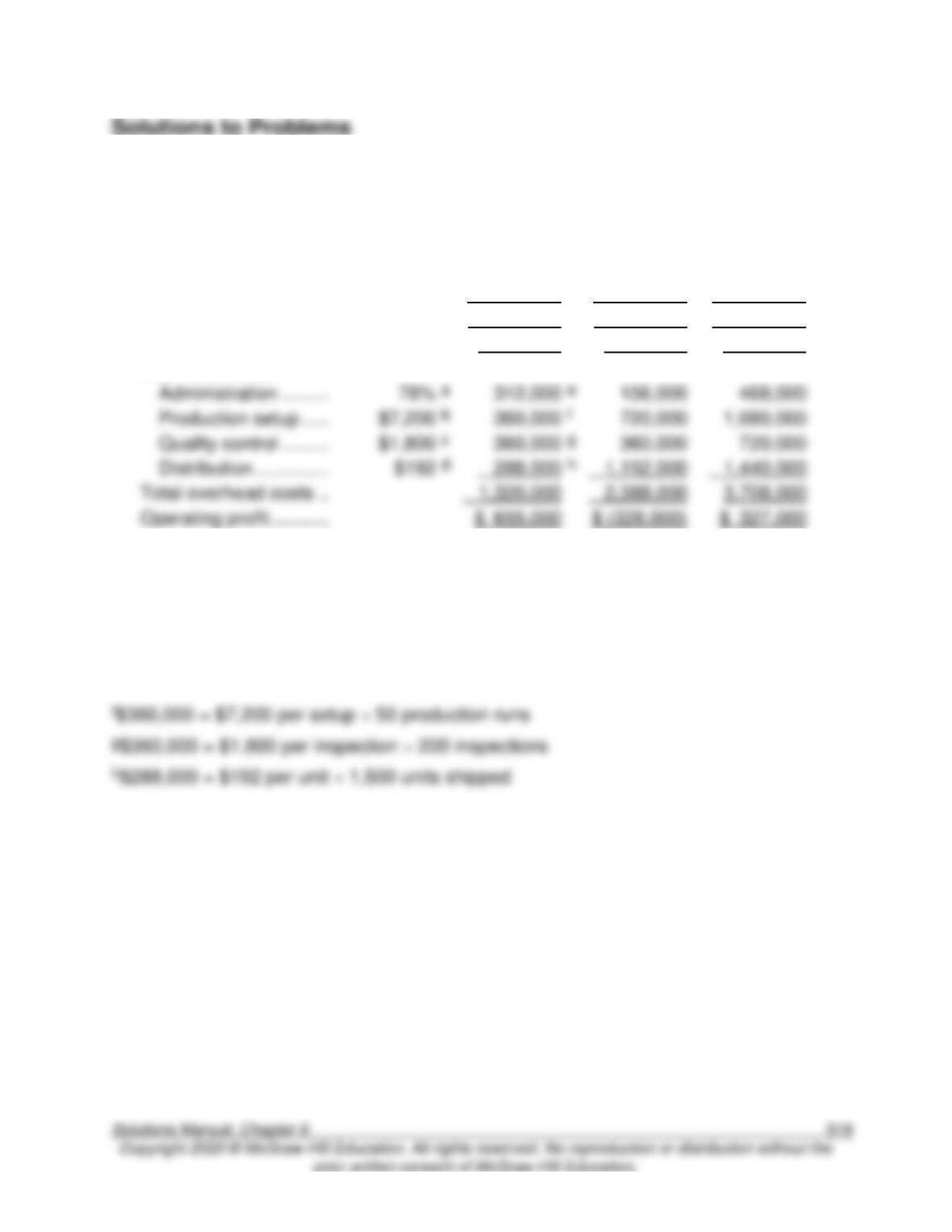
a. EZ-Seat, Inc. Income Statement
Account
Rate
Ergo
Standard
Total
Sales revenue ………….
$2,925,000
$2,760,000
$5,685,000
Direct materials ………..
$ 550,000
$ 500,000
$1,050,000
Direct labor ……………..
400,000
200,000
600,000
Overhead costs:
a
e
b
f
c
g
d
h
Total overhead costs ..
a78% = $468,000 of Administrative costs ÷ $600,000 of direct labor costs
b$7,200 = $1,080,000 of Production setup costs ÷ 150 production runs
c$1,800 = $720,000 of Quality control costs ÷ 400 inspections
d$192 = $1,440,000 of Distribution costs ÷ 7,500 units shipped
e$312,000 = 0.78 $400,000 direct labor costs
b. Activity-based costing highlights the activities that cause costs, and provides insight
into which costs could be reduced. For example, management may be able to
operate with fewer but larger production runs, thereby reducing setup costs.
Focusing on activities can identify non-value-adding activities that can be eliminated
without reducing the product’s value.
9-54. (continued)
c. EZ-Seat, Inc. Income Statement
Account
Rate
Ergo
Standard
Total
Sales revenue ……………..
$2,925,000
$2,760,000
$5,685,000
Direct Materials ……………
550,000
500,000
1,050,000
Direct Labor ………………..
400,000
200,000
600,000
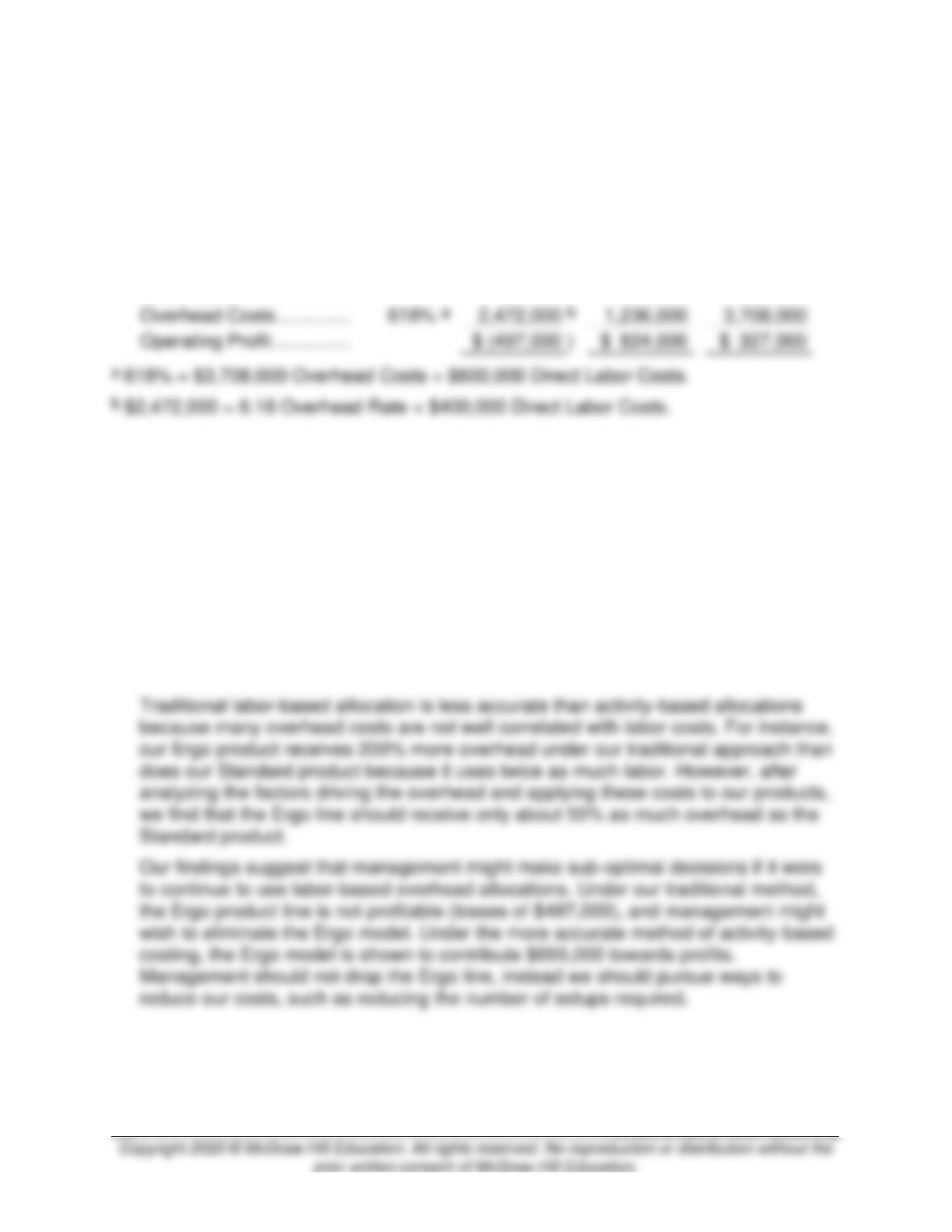
Overhead Costs …………..
a
2,472,000
b
1,236,000
3,708,000
Operating Profit ……………
)
d. Dear Members of the Management Board:
The purpose of this report is to explain the differences between the profits of our
Ergo and Standard product lines using activity-based costing versus our traditional
labor-based overhead allocation methods.
The two costing methods differ in their results because of the way overhead costs
are allocated between our products; direct costs do not differ under the two
methods. Under the labor-based approach, all overhead costs are pooled together
and allocated to our products on the basis of direct-labor costs. Under activity-based
costing, cost drivers, such as inspections and set-ups, are identified and their costs
are applied to the products in relation to usage.
9-55. (40 min.) Comparative Income Statements and Management Analysis:
Pepper’s Products.
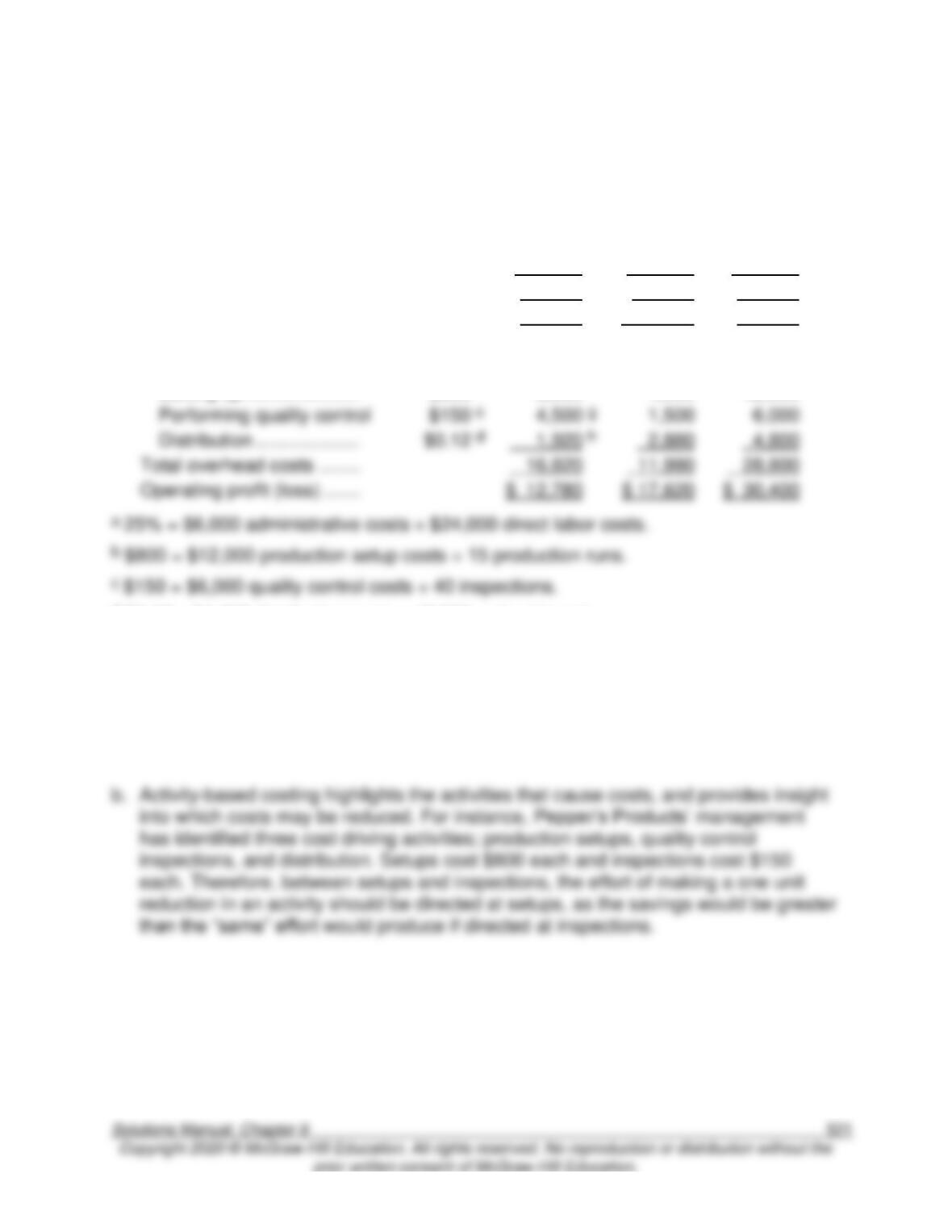
a. Pepper’s Products: Income Statement
Account
Rate
Squeaky
Silent
Total
Sales revenue ……………….
$43,200
$48,000
$91,200
Direct materials ……………..
4,000
4,000
8,000
Direct labor …………………..
9,600
14,400
24,000
Overhead costs:
Administration ……………
25%
a
2,400
e
3,600
6,000
c
g
Distribution ………………..
d
h
Total overhead costs ……..
16,820
b
f
d $0.12 = $4,800 distribution costs ÷ 40,000 units shipped.
e $12,000 = 0.25 × $48,000 direct labor costs.
f $8,000 = $800 per run × 10 runs.
g $4,500 = $150 per inspection × 30 inspections.
h $1,920 = $0.12 per unit shipped × 16,000 units.
9-55. (continued)
c.
Pepper’s Products
Income Statement
Account
Rate
Squeaky
Silent
Total
Sales revenue ……………….
$43,200
$48,000
$91,200
Direct Materials ……………..
4,000
4,000
8,000
Direct Labor ………………….
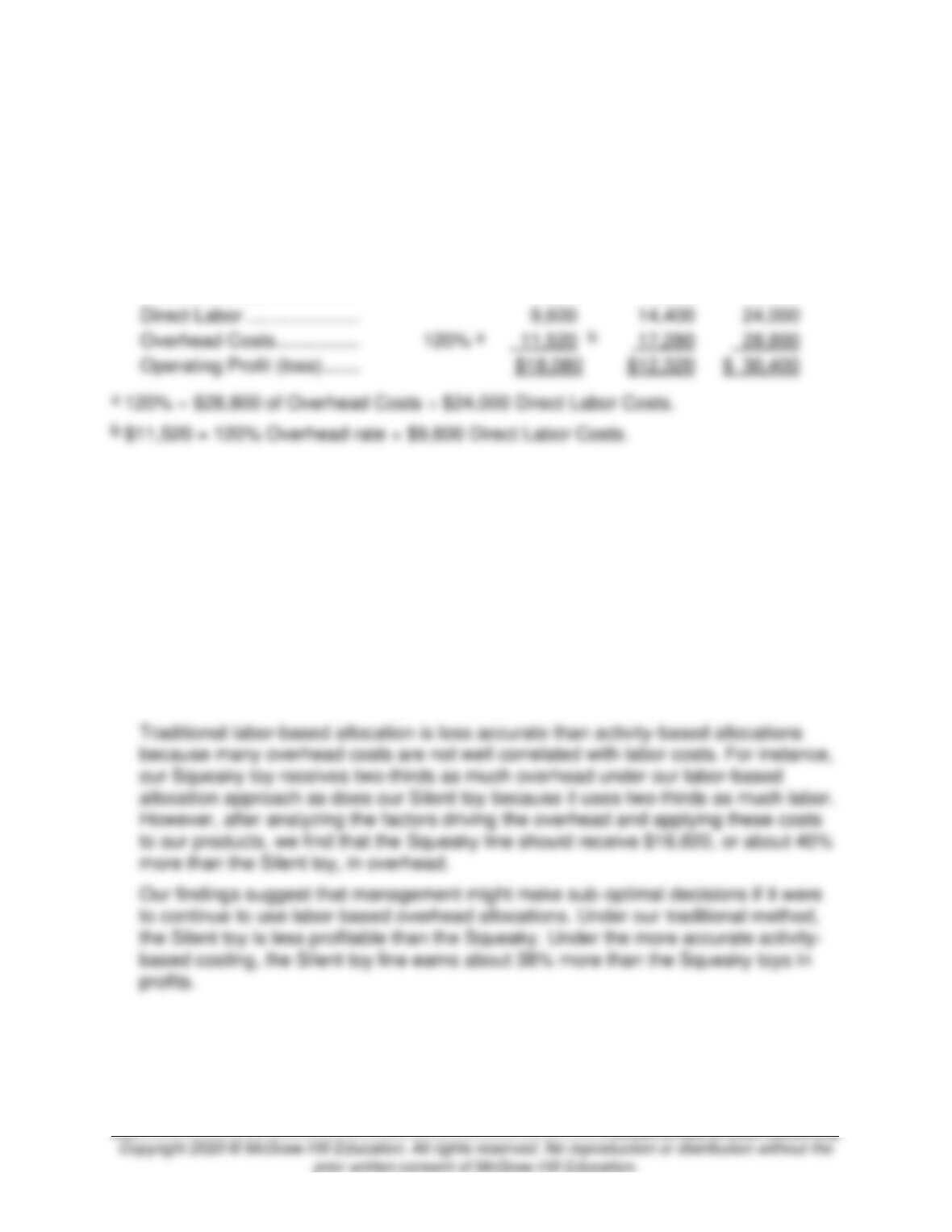
Overhead Costs …………….
a
b
d. Dear Members of the Management Board:
The purpose of this report is to explain the differences between the profits in our
Squeaky and Silent product lines using activity-based costing versus our traditional
labor-based overhead allocation method.
The two costing methods differ in their results because of the way overhead costs
are allocated between our products; direct costs, such as Materials and Labor do not
differ under the two methods. Under the labor-based approach, all overhead costs
are pooled together and allocated to our products on the basis of direct-labor costs.
Under activity-based costing, cost drivers, such as inspections and set-ups, are
identified and their costs are applied to the products in relation to usage.