275
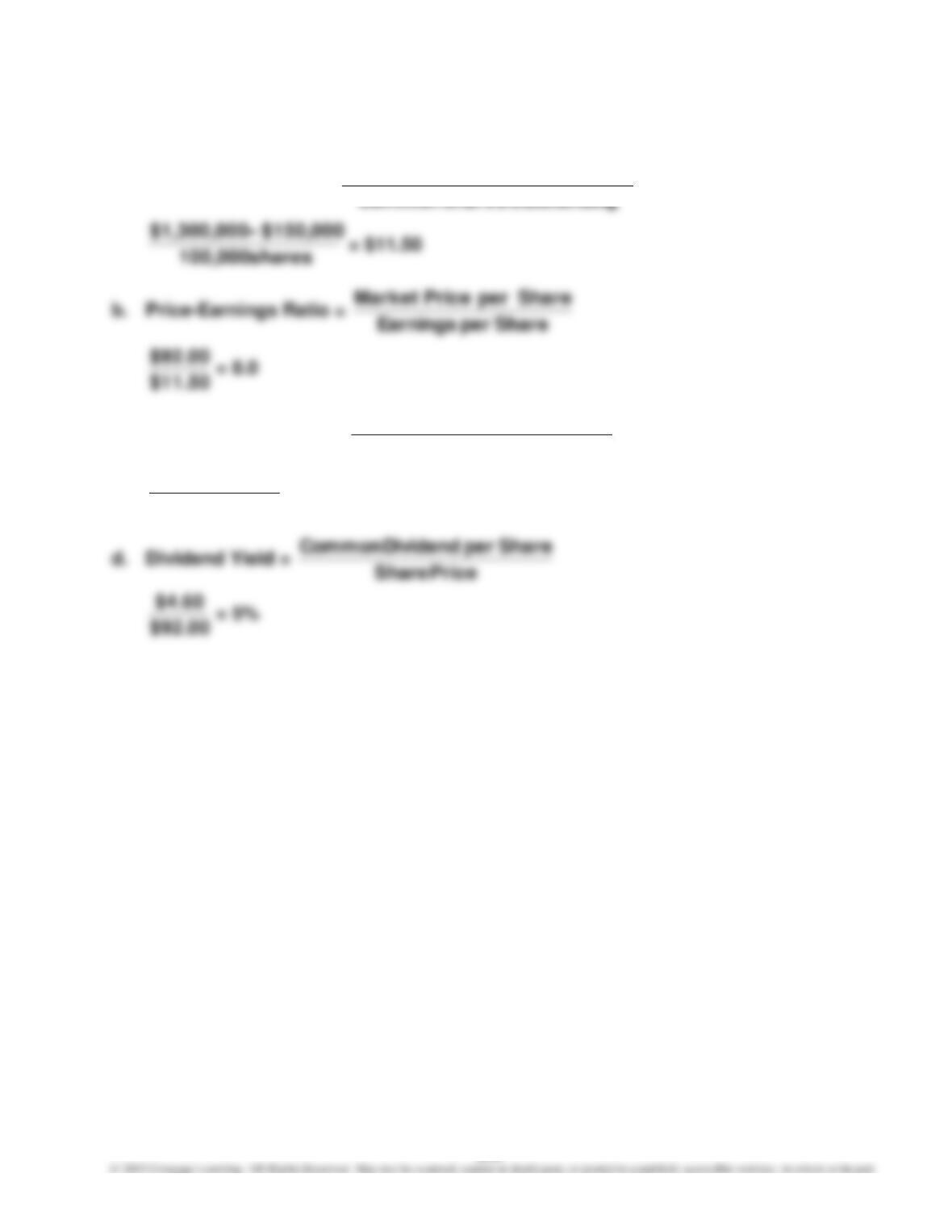
E9–21
a. Earnings per Share =
gOutstandin Shares Common
Dividends Preferred IncomeNet –
c. Dividends per Share =
gOutstandin Shares Common
Dividends Common
shares 100,000
$460,000
= $4.60
276
E9–22
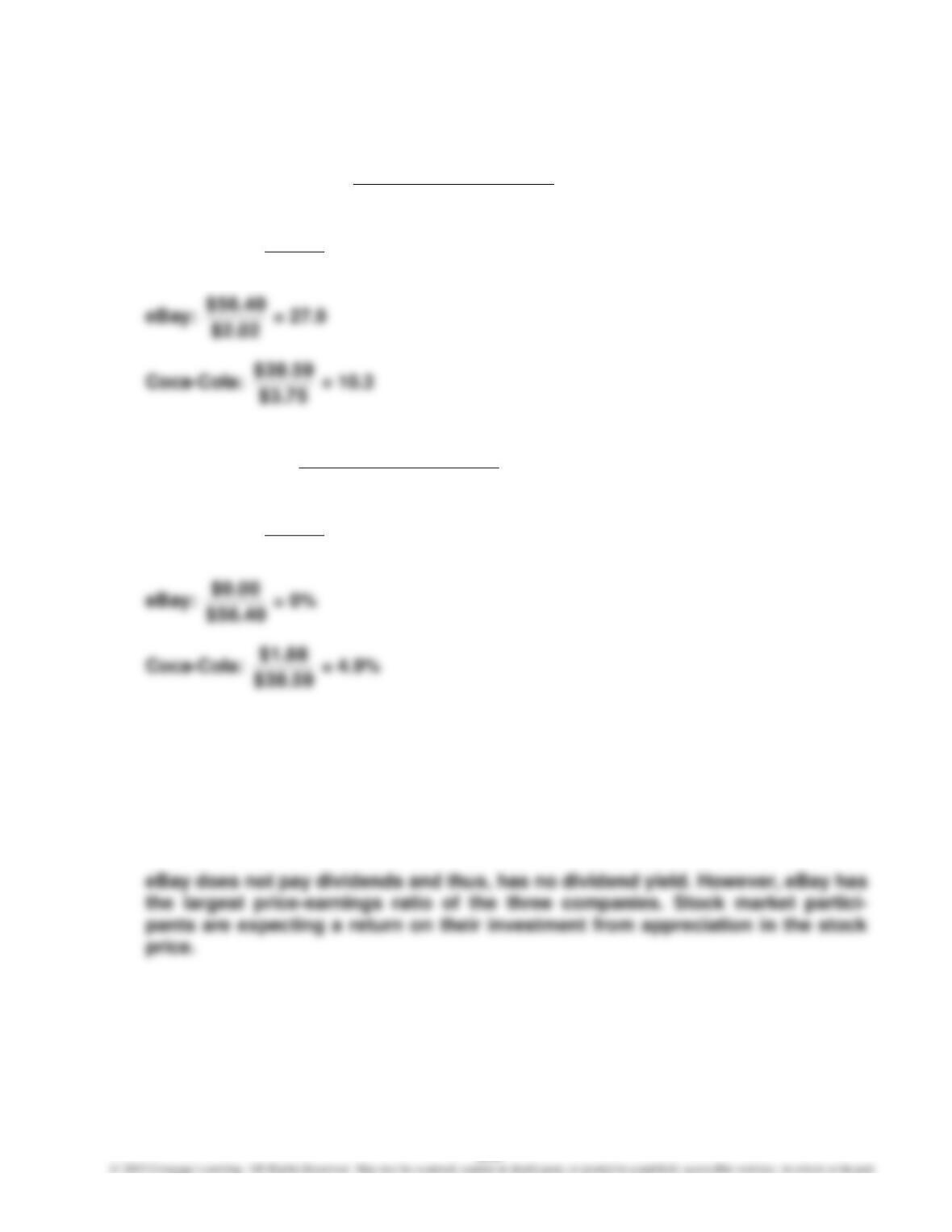
a. Price-Earnings Ratio =
Share per Earnings
Share per PriceMarket
McDonald’s:
$5.33
$95.19
= 17.9
$2.02
$56.40
$3.75
$38.59
Dividend Yield =
Share per PriceMarket
Share per Dividends
McDonald’s:
$95.19
$2.53
= 2.7%
$38.59
$1.88
b. McDonald’s and Coca-Cola have higher dividend yields than eBay, but smaller
price-earnings ratios. McDonald’s has a higher price-earnings ratio than Coca–
Cola partially due to the depressed economy, which creates more demand for
lower-cost, fast-food purchases. In addition, McDonald’s is in the process of
upgrading its food menu and renovating its restaurants.
277
Appendix E9–23
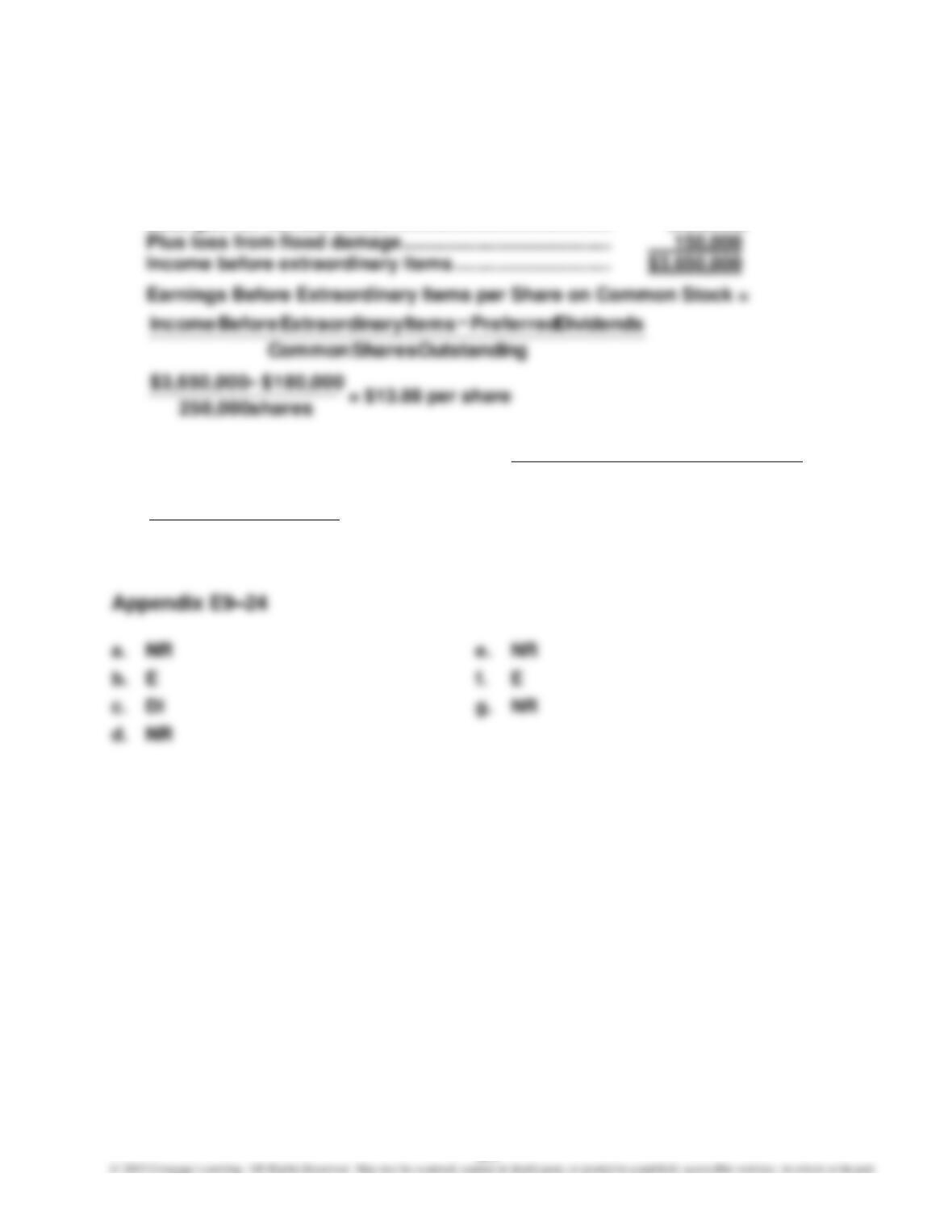
a. Earnings per share on income before extraordinary items:
Net income …………………………………………………………… $4,100,000
Less gain on condemnation ………………………………….. (600,000)
shares 250,000
$180,000 –– $3,650,000
b. Earnings per Share on Common Stock =
gOutstandin Shares Common
Dividends Preferred –– Income Net
shares 250,000
$180,000 –– $4,100,000
= $15.68 per share
Appendix E9–25
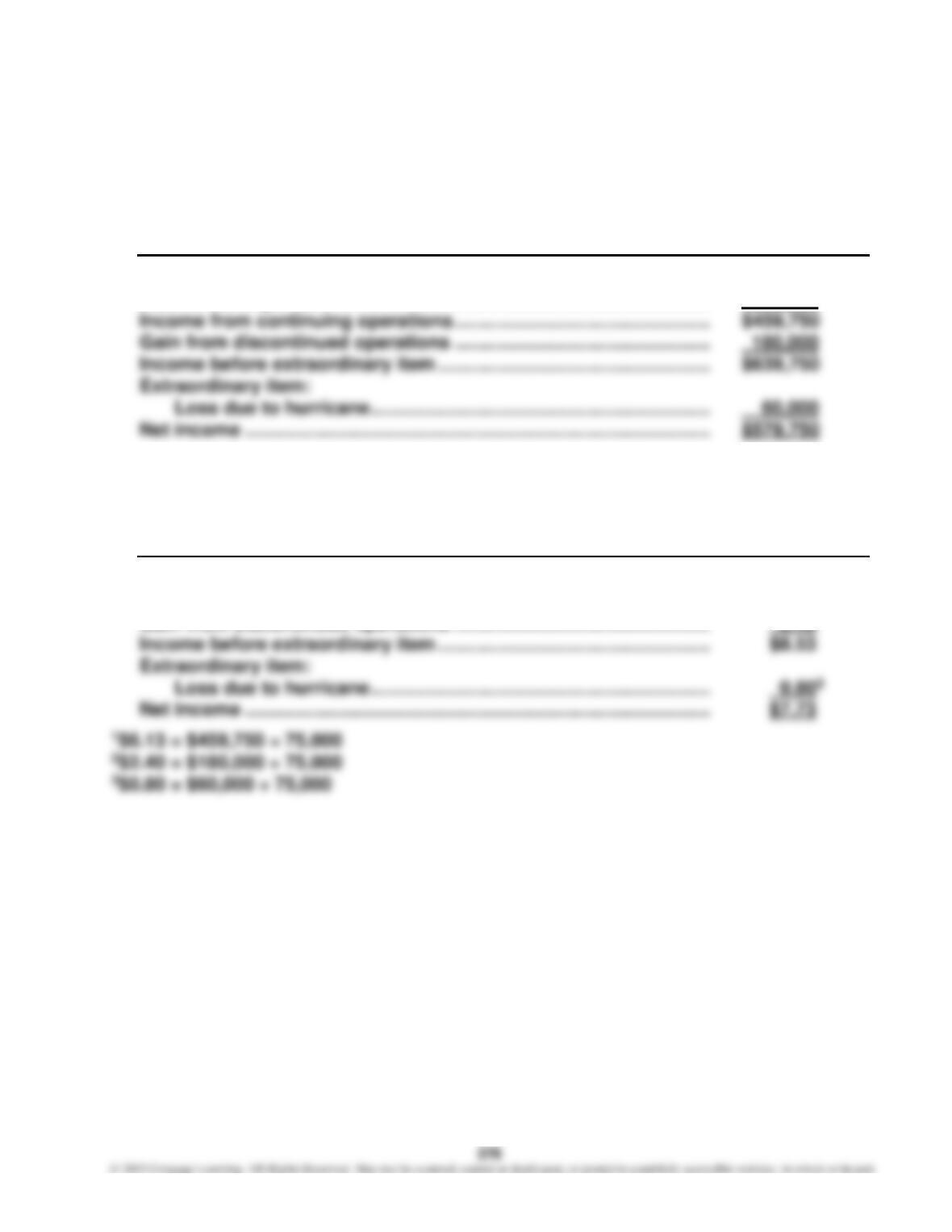
a.
LEADBETTER INC.
Partial Income Statement
For the Year Ended December 31, 20Y3
Income from continuing operations before income tax …………….. $766,250
Income tax expense ………………………………………………………………… 306,500
b.
LEADBETTER INC.
Partial Income Statement
For the Year Ended December 31, 20Y3
Earnings per common share:
Income from continuing operations …………………………………………. $6.131
Gain from discontinued operations …………………………………………. 2.402
PROBLEMS
P9–1
1.
GREYHOUND TECHNOLOGY COMPANY
Comparative Income Statement
For the Years Ended December 31, 20Y3 and 20Y2
Increase (Decrease)
20Y3 20Y2 Amount Percent
Sales ………………………………………. $880,000 $800,000 $ 80,000 10.0%
Sales returns and allowances ….. 18,000 15,000 3,000 20.0
Net sales ………………………………… $862,000 $785,000 $ 77,000 9.8
Cost of goods sold ………………….. 650,000 500,000 150,000 30.0
Gross profit …………………………….. $212,000 $285,000 $ (73,000) (25.6)
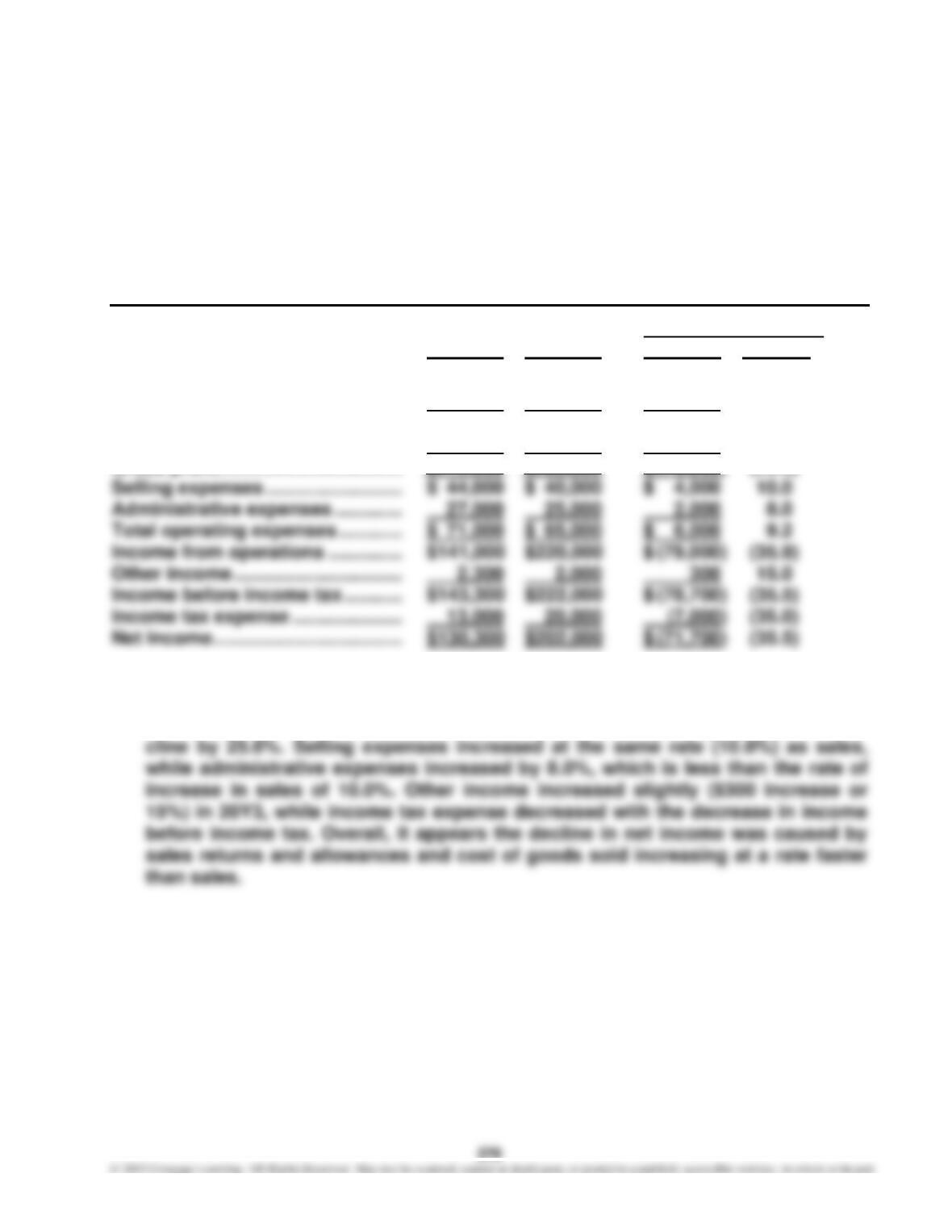
2. Net income declined from $202,000 in 20Y2 to $130,300 in 20Y3. Net sales have
increased by 9.8%; however, sales returns and allowances increased by 20.0%
and cost of goods sold has increased by 30.0%, causing the gross profit to de-
P9–2
1.
BLUE BUFFALO COMPANY
Comparative Income Statement
For the Years Ended December 31, 20Y6 and 20Y5
20Y6 20Y5
Amount Percent Amount Percent
Sales …………………………………….. $ 1,545,000 103.0% $ 1,224,000 102.0%
Sales returns and allowances … 45,000 3.0 24,000 2.0
Net sales ………………………………. $ 1,500,000 100.0% $ 1,200,000 100.0%
Cost of goods sold ………………… 960,000 64.0 780,000 65.0
Gross profit …………………………... $ 540,000 36.0% $ 420,000 35.0%
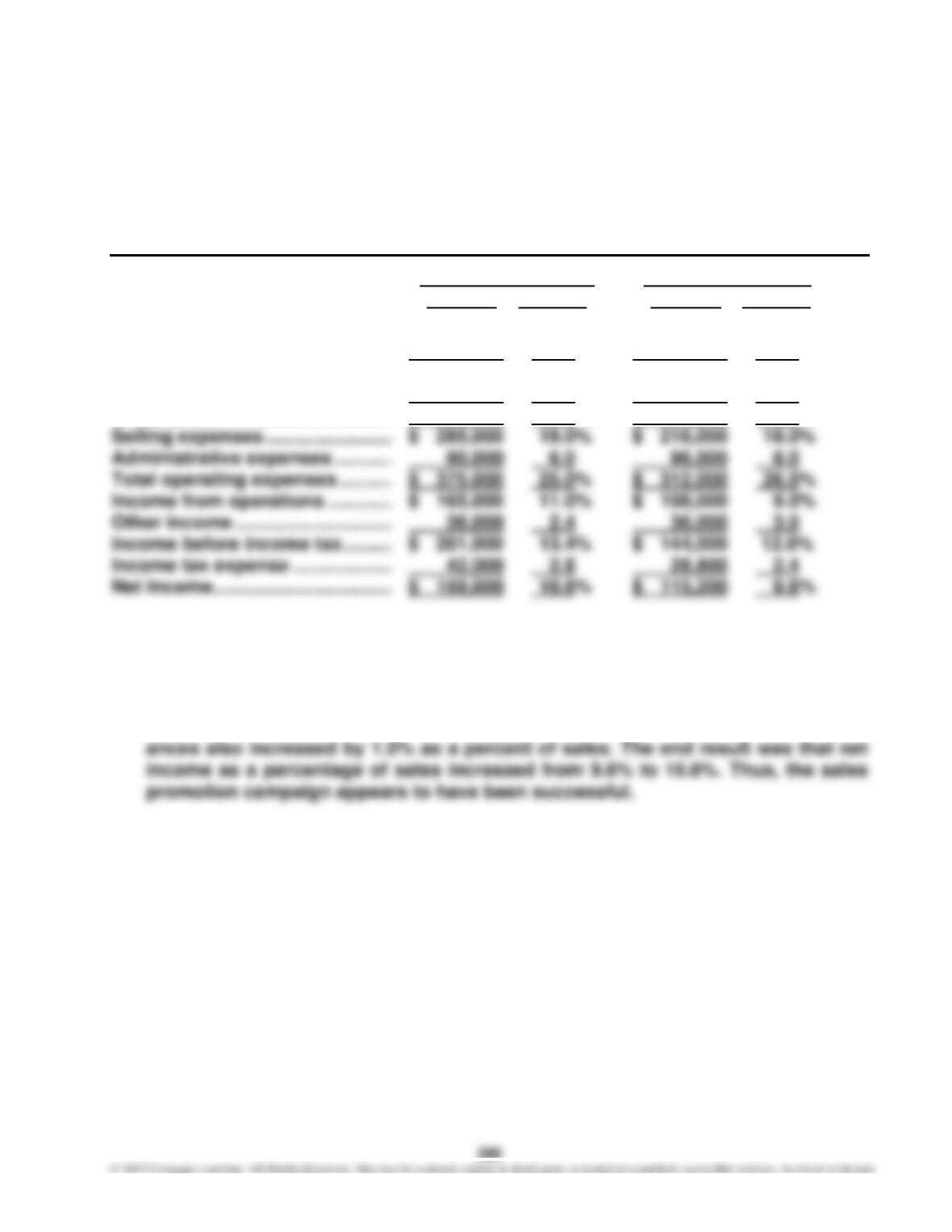
2. The vertical analysis indicates that cost of goods sold and administrative ex-
penses improved slightly as a percent of sales. Cost of goods sold decreased by
1.0% (65.0% – 64.0%), while administrative expenses decreased 2.0% (8.0% –
6.0%) as a percent of sales. As expected, sales and selling expenses increased
as a result of the sales promotion campaign. However, sales returns and allow-
P9–3
1. a. Working Capital = Current Assets – Current Liabilities
$675,000 – $250,000 = $425,000
b. Current Ratio =
sLiabilitieCurrent
setsCurrent As
$250,000
$675,000
= 2.7
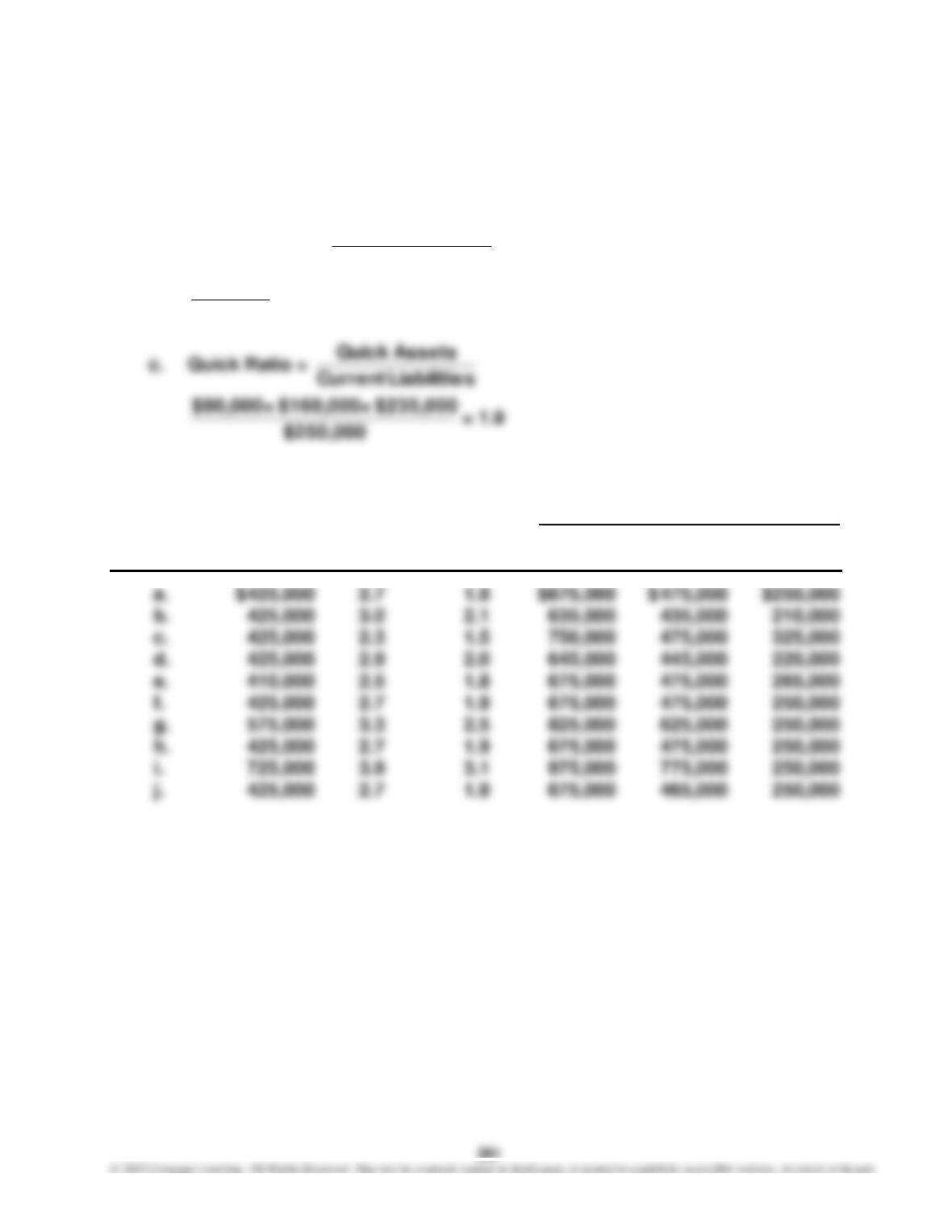
2.
Supporting Calculations
Working Current Quick Current Quick Current
Transaction Capital Ratio Ratio Assets Assets Liabilities
282
P9–4
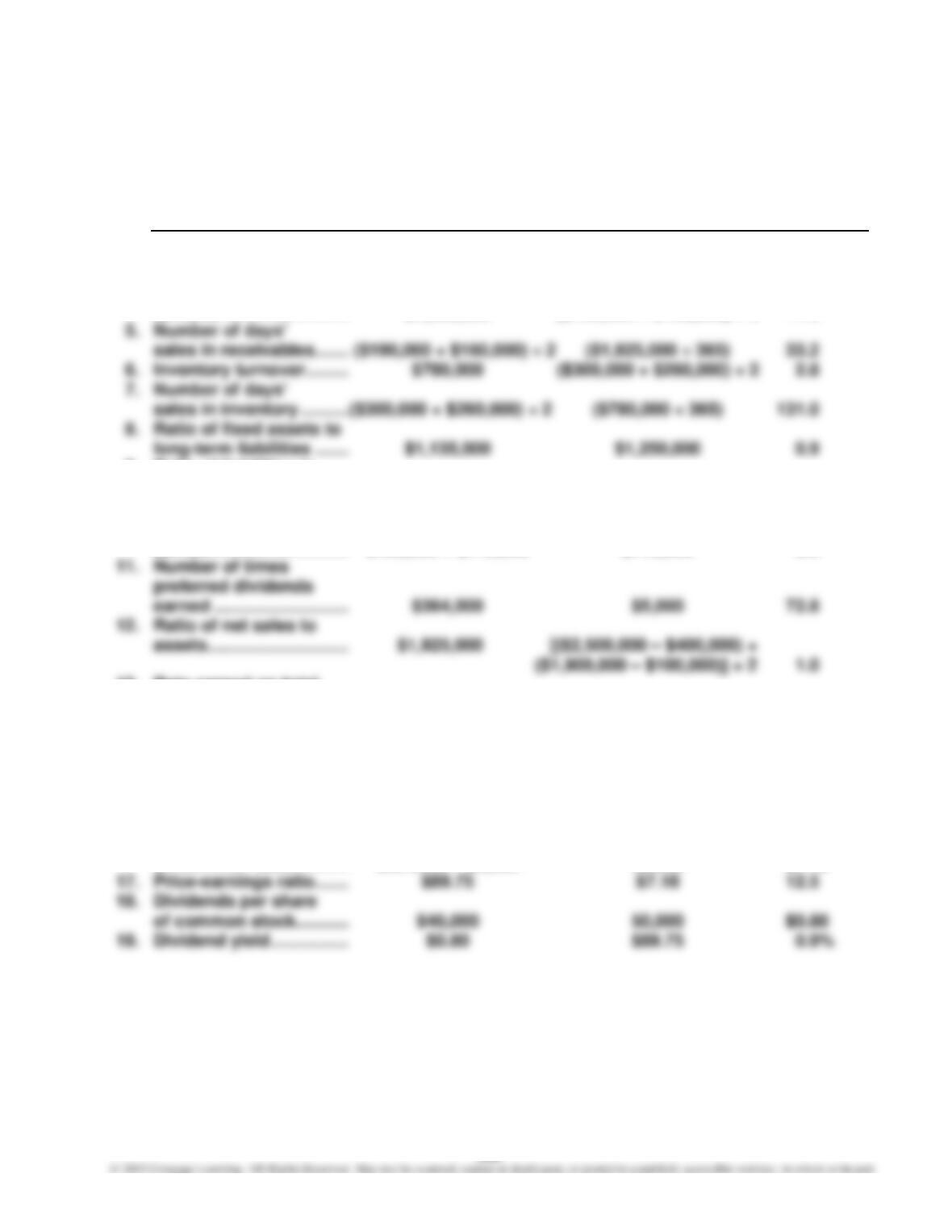
1. Working capital: $965,000 – $200,000 = $765,000
Calculated
Ratio Numerator Denominator Value
2. Current ratio ……………… $965,000 $200,000 4.8
3. Quick ratio ………………… $615,000 $200,000 3.1
4. Accounts receivable
turnover ……………………. $1,925,000 ($190,000 + $160,000) ÷ 2 11.0
9. Ratio of liabilities to
stockholders’ equity…… $1,450,000 $1,050,000 1.4
10. Number of times
interest charges
earned ………………………. $455,000 + $115,000 $115,000 5.0
13. Rate earned on total
assets ……………………….. $364,000 + $115,000 ($2,500,000 + $1,900,000) ÷ 2 21.8%
14. Rate earned on stock-
holders’ equity …………… $364,000 ($1,050,000 + $731,000) ÷ 2 40.9%
15. Rate earned on
common stock-
holders’ equity …………… $364,000 – $5,000 [($1,050,000 – $100,000) +
($731,000 – $100,000)] ÷ 2 45.4%
16. Earnings per share
on common stock ………. $364,000 – $5,000 50,000 $7.18
283
P9–5
1. a.
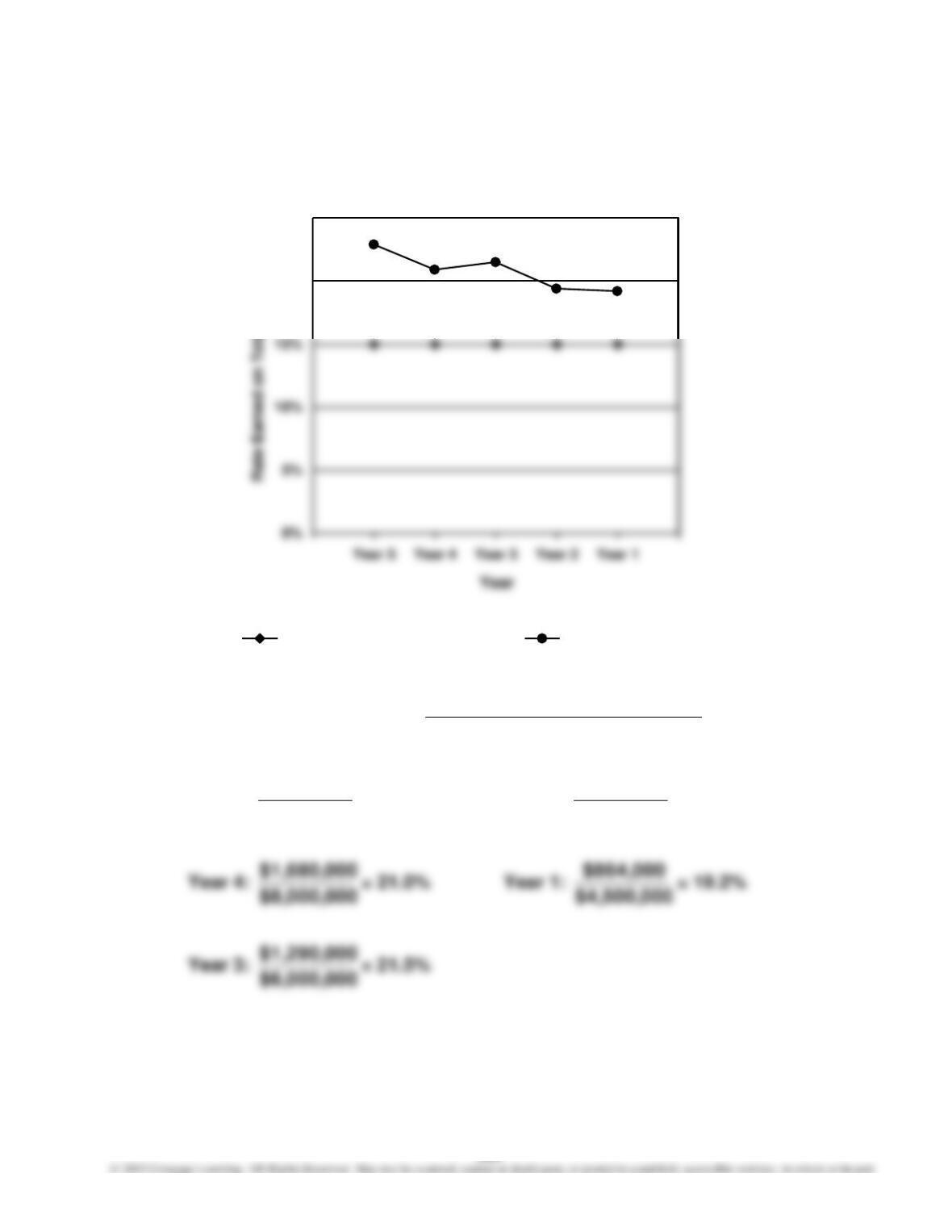
20%
25%
Industry rate earned on total assets Critelli rate earned
Rate Earned on Total Assets =
AssetsTotal Average
ExpenseInterest +IncomeNet
Year 5:
$9,500,000
$2,185,000
= 23.0% Year 2:
$5,200,000
$1,008,800
= 19.4%
$8,000,000
$1,680,000
$4,500,000
284
P9–5, Continued
1. b.
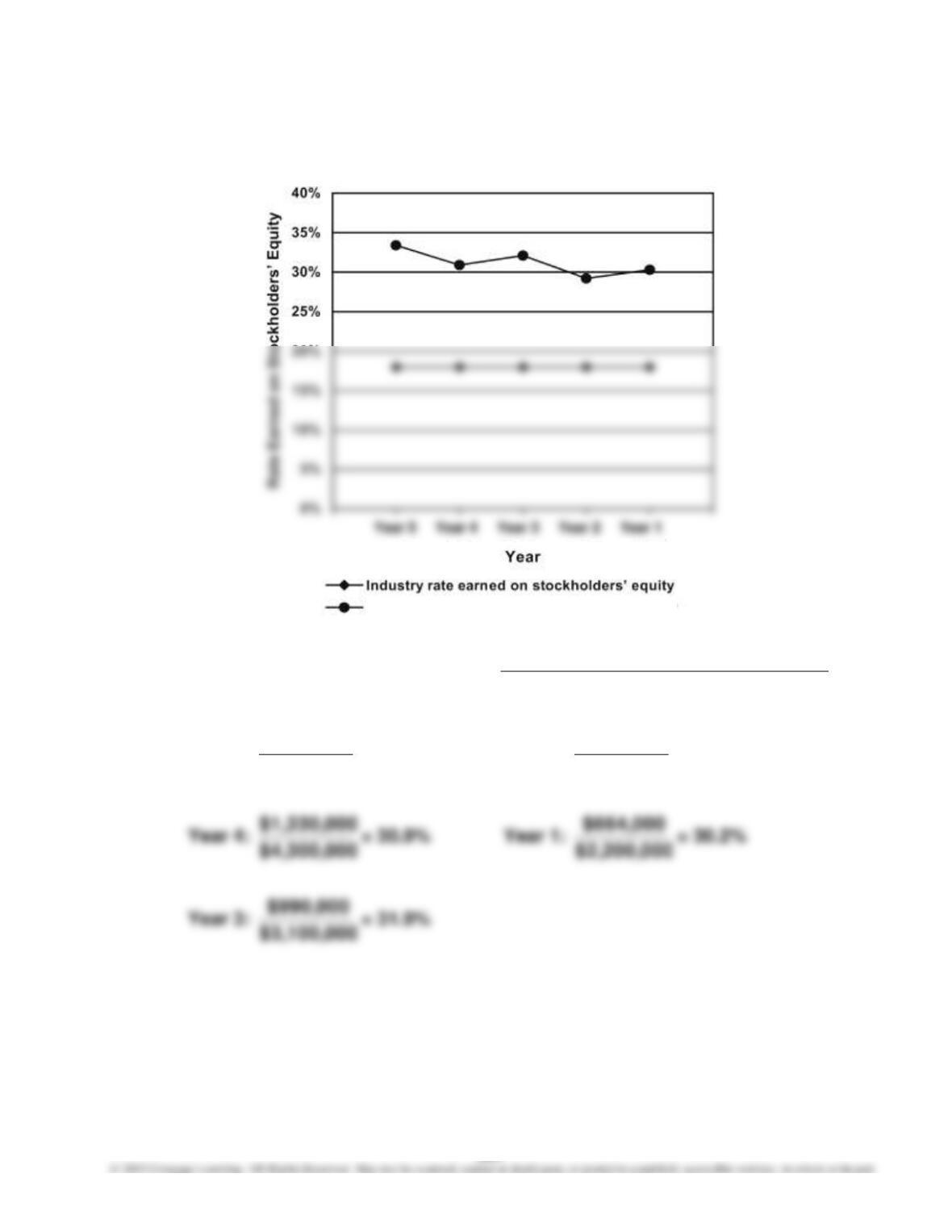
Rate Earned on Stockholders’ Equity =
Equity rs‘Stockholde Total Average
IncomeNet
Year 5:
$5,400,000
$1,785,000
= 33.1% Year 2:
$2,650,000
$768,800
= 29.0%
Critelli rate earned on stockholders’ equity
285
P9–5, Continued
1. c.
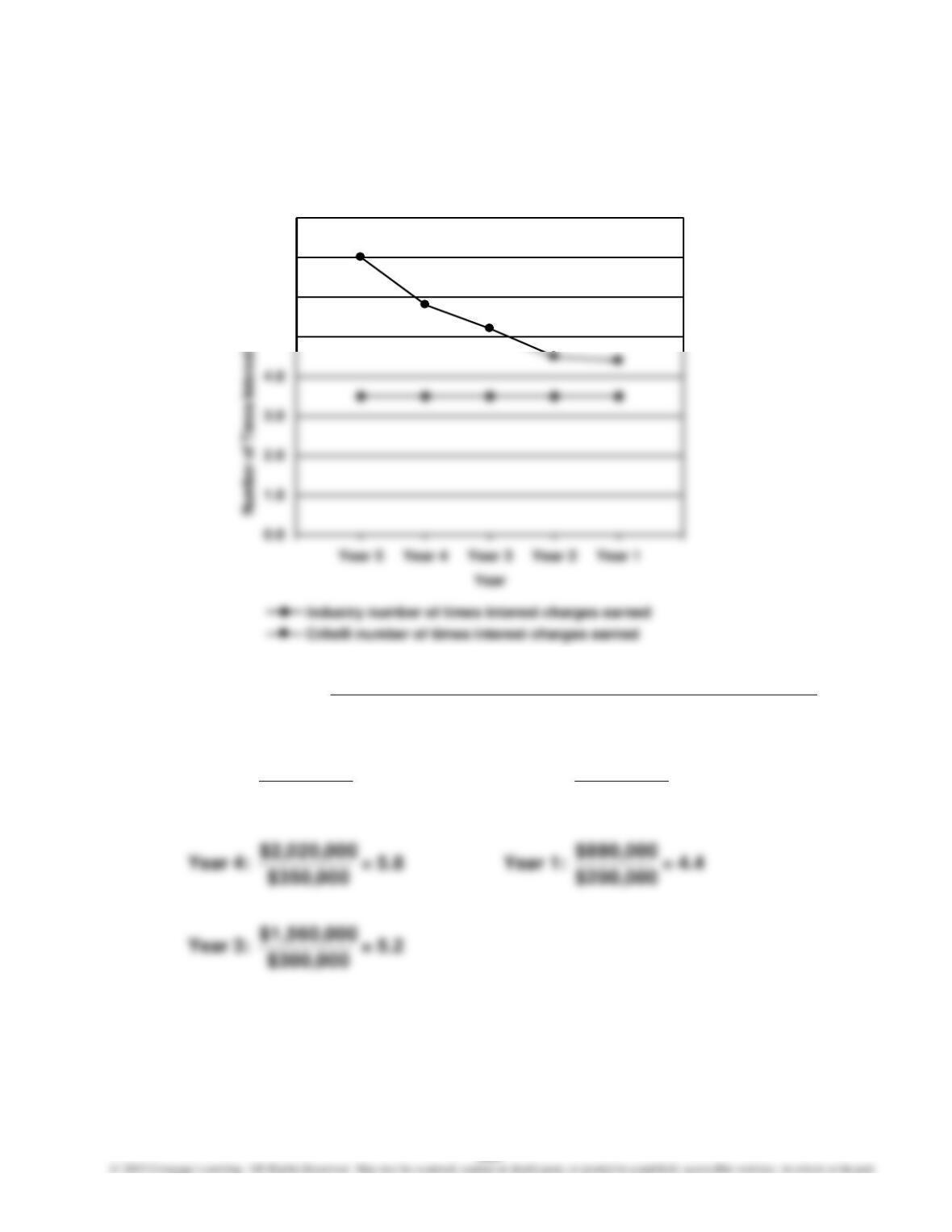
5.0
6.0
7.0
8.0
Earned
ChargesInterest
Times of Number
=
Expense Interest
Expense Interest+ExpenseTax Income+Income Net
Year 5:
$400,000
$2,800,000
= 7.0 Year 2:
$240,000
$1,080,000
= 4.5
$350,000
$2,020,000
$300,000
$1,560,000
286
P9–5, Concluded
2. Both the rate earned on total assets and the rate earned on stockholders’ equity
are above the industry average for all five years. The rate earned on total assets
is actually improving gradually. The rate earned on stockholders’ equity exceeds
the rate earned on total assets, providing evidence of the positive use of lever-
age.
CASES
Case 9–1
This position does not allow the shareholders to take advantage of leverage. As a
result, the return on shareholders’ equity cannot be improved by using debt. In con-
Case 9–2
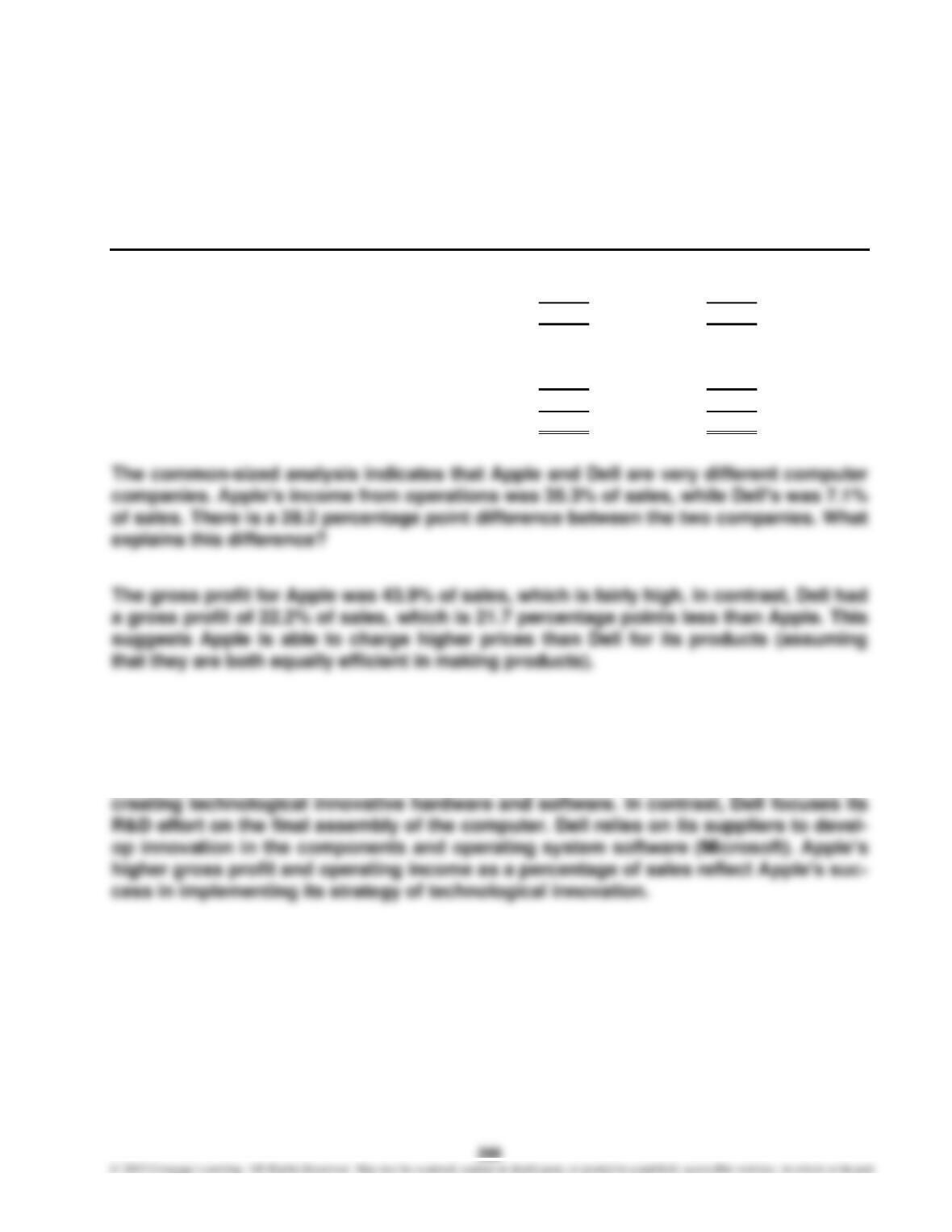
Kim is concerned about the inventory and accounts receivable levels because she
must determine their value. Inventory that cannot be sold (or must be sold at a large
discount) or accounts receivable that cannot be collected must be written down to
Case 9–3
APPLE INC. AND DELL INC.
Common-Sized Statements
Apple Inc. Dell Inc.
Sales (net) …………………………………………… 100.0% 100.0%
Cost of sales ……………………………………….. 56.1 77.8
Gross profit …………………………………………. 43.9% 22.2%
Operating expenses:
Selling, general, and administrative …. 6.4% 13.7%
Research and development …………….. 2.2 1.4
Total operating expenses …………….. 8.6% 15.1%
Income from operations ………………………. 35.3% 7.1%
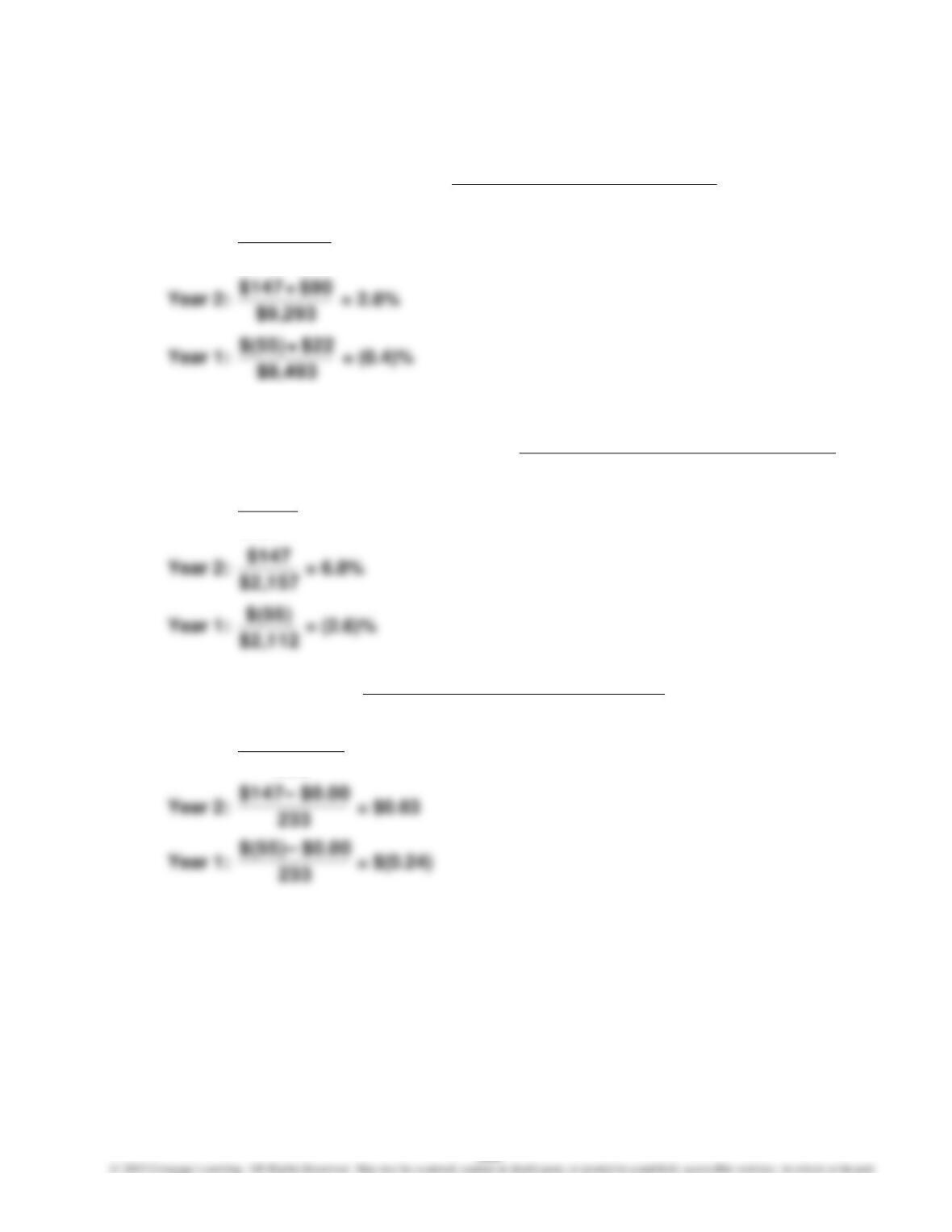
Apple’s selling, general, and administrative expenses were 6.4% of sales, while Dell’s
were 13.7% of sales. In contrast, Apple’s research and development expenses were
2.2% of sales compared to Dell’s research and development expenses of 1.4% of
sales. The higher research and development expenses of Apple reflect its strategy of
289
Case 9–4
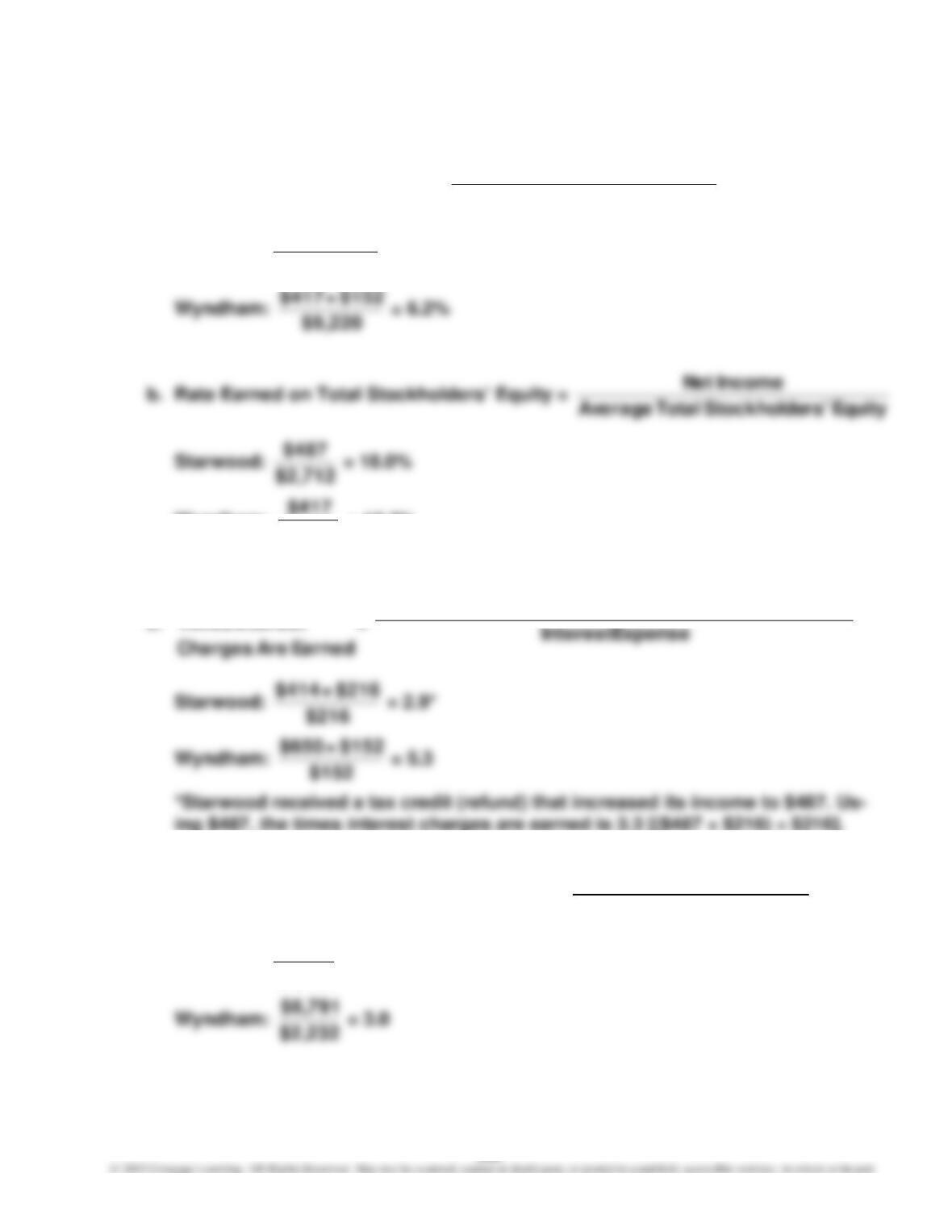
1. a. Rate Earned on Total Assets =
AssetsTotal Average
Expense Interest + Income Net
Year 3:
$9,552
$45 + $599
= 6.7%
b. Rate Earned on Stockholders’ Equity =
Equity rs‘Stockholde Total Average
IncomeNet
Year 3:
$2,314
$599
= 25.9%
c. Earnings per Share =
gOutstandin Shares Common
Dividends Preferred–– Income Net
Year 3:
233
$0.00––$599
= $2.57
290
Case 9–4, Continued
d. Dividend Yield =
Dividend per Share of Common Stock
Market Price per Share of Common Stock
Year 3:
$36.43
$0.475
= 1.3%
e. Price-Earnings Ratio =
Stock Common of Share per Earnings
Stock Common of Share per PriceMarket
Year 3:
$2.57
$36.43
= 14.2
2.
Ratio of Average Liabilities to
Average Stockholders’ Equity
=
Average Liabilities
Average Stockholders’ Equity
=
Equity rs’Stockholde Average
Equity rs’Stockholde Total Average–– AssetsTotal Average
291
Case 9–4, Concluded
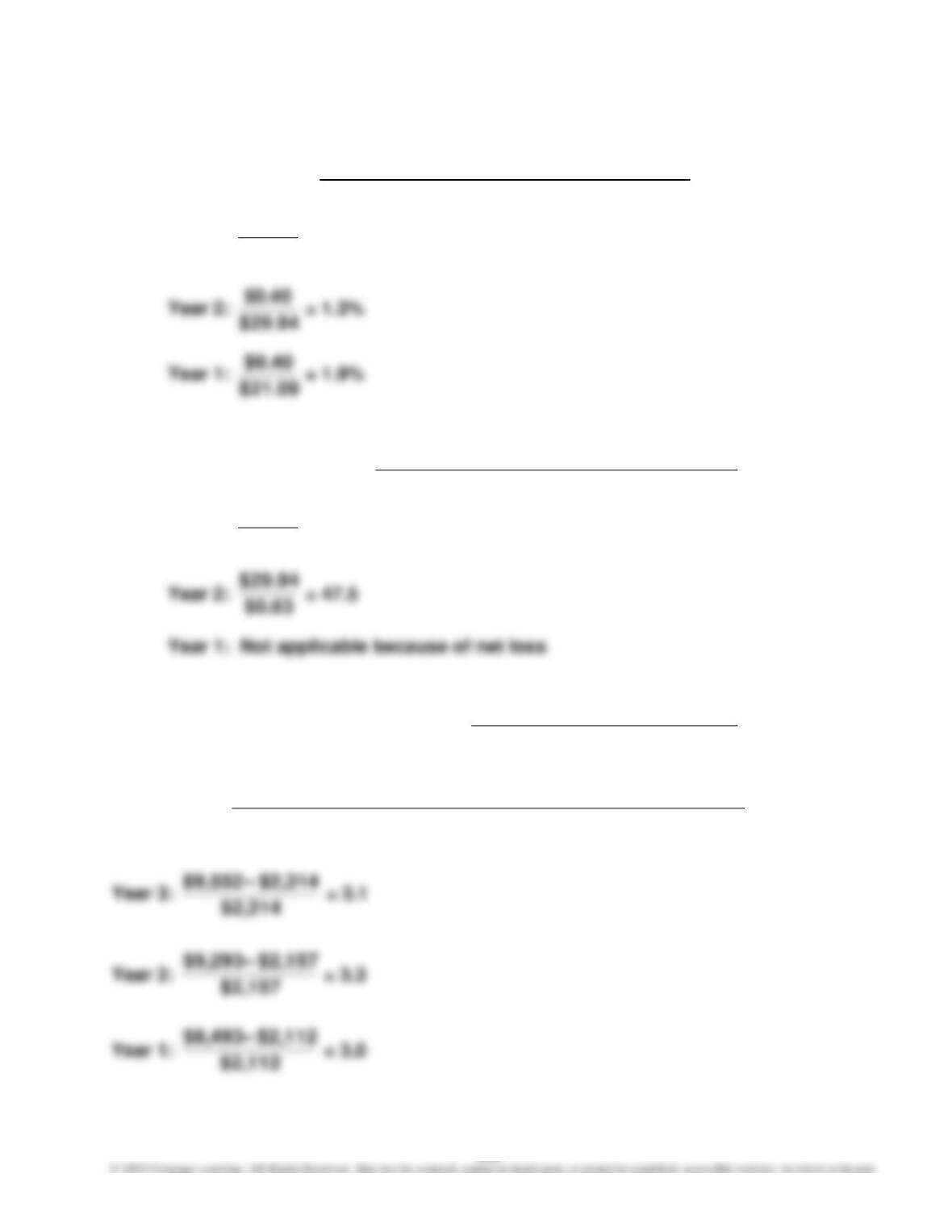
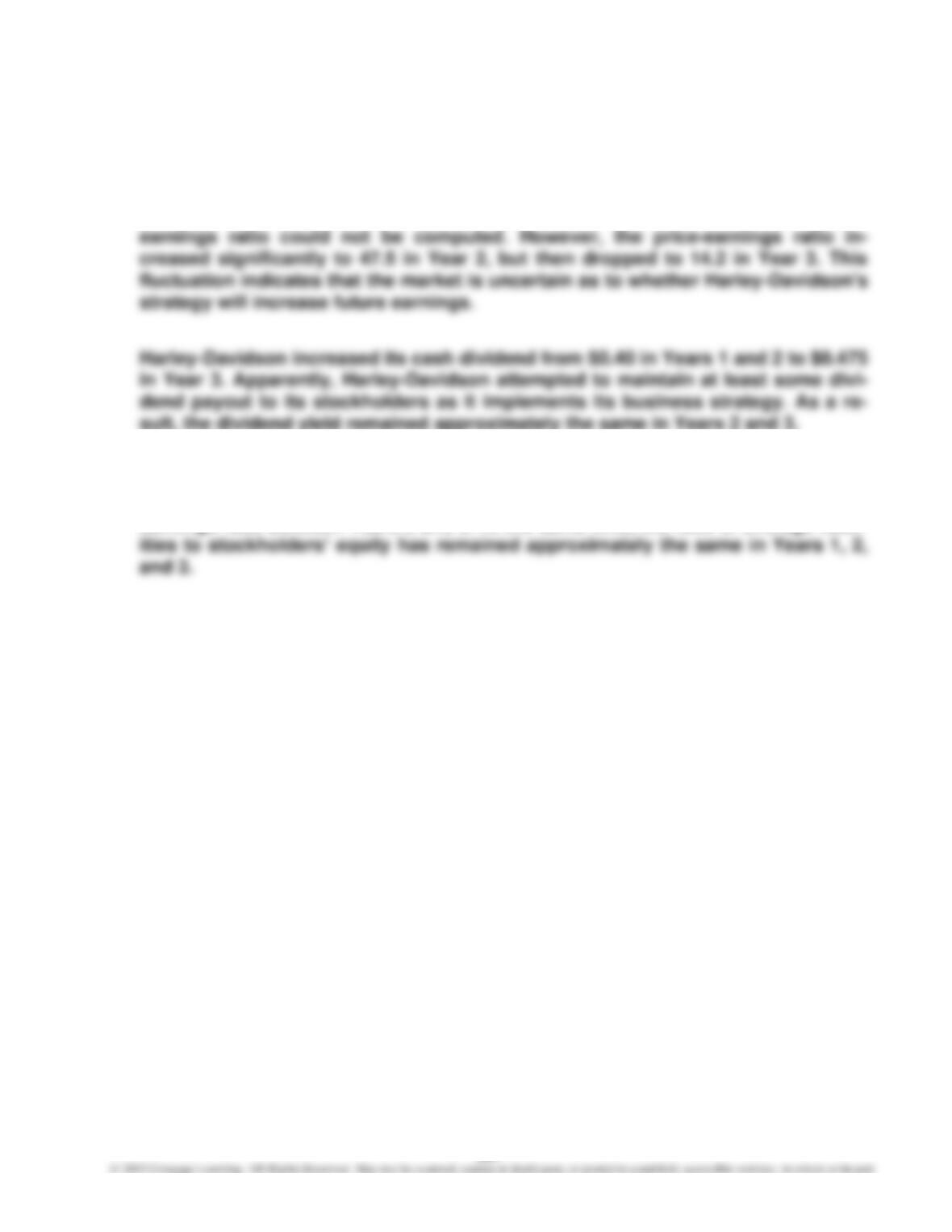
3. Harley-Davidson’s profitability, as measured by earnings per share, dramatically
increased from Year 1 to Year 3 as Harley-Davidson expanded its dealer network
and product lines internationally. As a result of the net loss in Year 1, the price-
4. Apparently, stock market participants are uncertain as to whether Harley–
Davidson’s strategy will pay off as illustrated by the fluctuation in the price-
earnings ratio between Years 2 and 3. At the same time, the ratio of average liabil-
292
Case 9–5
1. a. Rate Earned on Total Assets =
AssetsTotal Average
Expense Interest + Income Net
Starwood:
$9,668
$216 + $487
= 7.3%
Wyndham:
$2,575
= 16.2%
c.
Interest Times
of Number
=
Expense Interest + ExpenseTax Income Before Income
d. Ratio of Liabilities to Stockholders’ Equity =
Total Liabilities
Total Stockholders’ Equity
Starwood:
$2,955
$6,605
= 2.2
$2,232
293
Case 9–5, Concluded
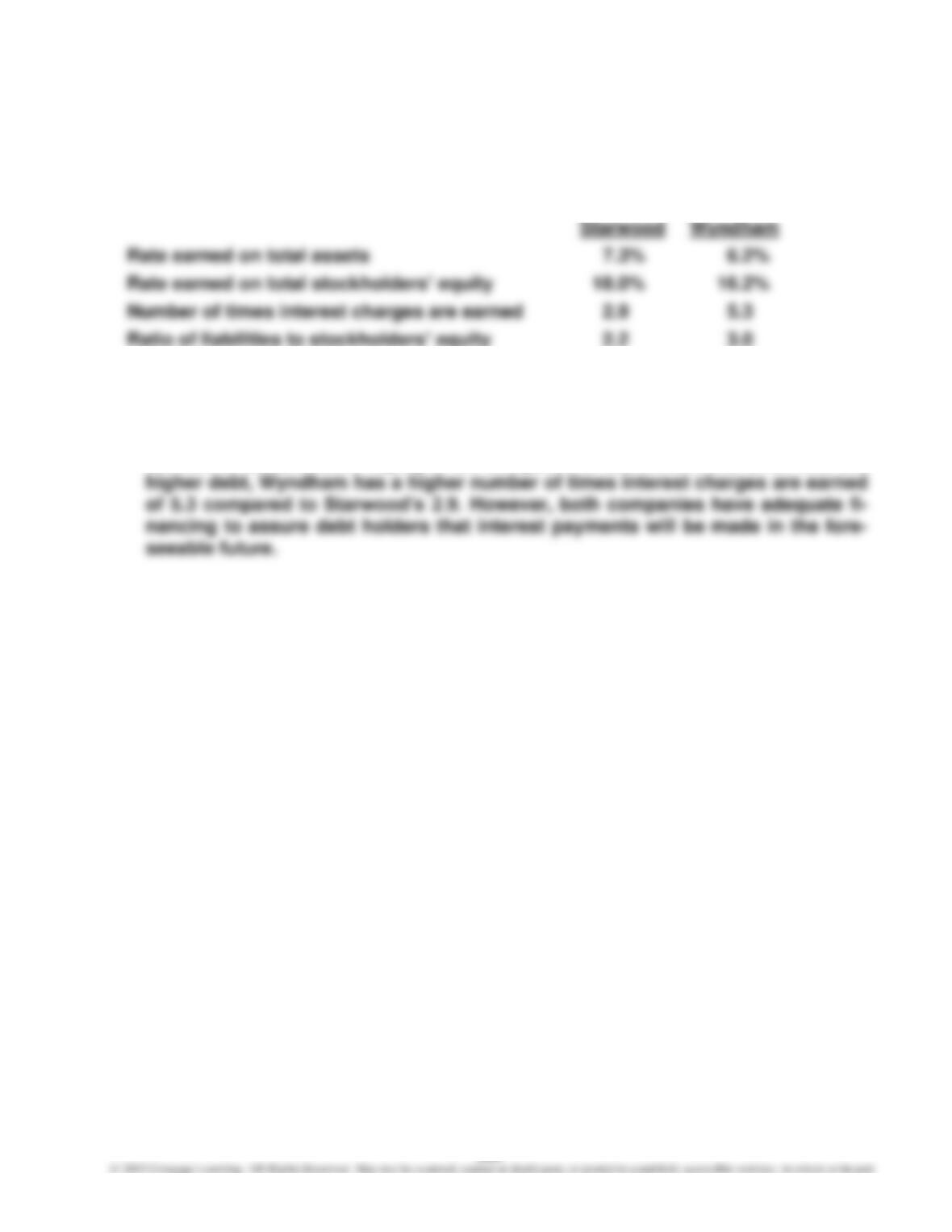
Summary Table:
2. Starwood has a higher rate earned on total assets (7.3% vs. 6.2%), and a higher
rate on stockholders’ equity (18.0% vs. 16.2%), compared to Wyndham. Wynd-
ham finances more of its operations using debt as shown by its higher ratio of li–
abilities to stockholders’ equity of 3.0 compared to Starwood’s 2.2. Even with the