CHAPTER 23 (FIN MAN); CHAPTER 9 (MAN)
EVALUATING VARIANCES
FROM STANDARD COSTS
DISCUSSION QUESTIONS
1. Standards are performance goals. Manufacturing companies normally use standard cost for
each of the three following product costs:
2. Reporting by the “principle of exceptions” is the reporting of only variances (or
“exceptions”) between standard and actual costs to the individual responsible for cost
control. This reporting allows management to focus on correcting cost variances.
3. The two variances in direct materials cost are:
• Direct materials price
• Direct materials quantity
6. No. Even though the assembly workers are covered by union contracts, direct labor cost variances
still might result. For example, direct labor rate variances could be caused by scheduling overtime
to meet production demands or by assigning higher-paid workers to jobs normally performed by
lower-paid workers. Likewise, direct labor time variances could result during the training of new
workers or from a shortage of skilled employees.
7. Standards can be very appropriate in repetitive service operations. Fast-food restaurants can
CHAPTER 23 (FIN MAN); CHAPTER 9 (MAN) Evaluating Variances from Standard Costs
DISCUSSION QUESTIONS (Continued)
8. a. The variable factory overhead controllable variance results from incurring a total amount
of variable factory overhead cost greater or less than the amount budgeted for the level of
9. a. Favorable variance. A credit balance in the factory overhead account at the end of the
period means that applied factory overhead is larger than the actual factory overhead,
which indicates a favorable total factory overhead variance.
10. A debit balance in the account represents a net unfavorable direct materials price variance.
CHAPTER 23 (FIN MAN); CHAPTER 9 (MAN) Evaluating Variances from Standard Costs
BASIC EXERCISES
BE 23–1 (FIN MAN); BE 9–1 (MAN)
a.
Direct materials price
$9,000
[($4.00 – $3.75) × 36,000 lbs.]
variance (unfavorable)
BE 23–2 (FIN MAN); BE 9–2 (MAN)
a.
Direct labor rate
$(9,270)
[($19.85 – $20.00) × 61,800 hrs.]
BE 23–3 (FIN MAN); BE 9–3 (MAN)
Variable Factory Overhead
Controllable Variance
=
$52,770 – [$0.90 × (15,000 units × 4 hrs.)]
=
$52,770 – $54,000
=
$(1,230) Favorable
BE 23–5 (FIN MAN); BE 9–5 (MAN)
Work in Process (37,500* lbs. × $3.75)
140,625
**
CHAPTER 23 (FIN MAN); CHAPTER 9 (MAN) Evaluating Variances from Standard Costs
BE 23–6 (FIN MAN); BE 9–6 (MAN)
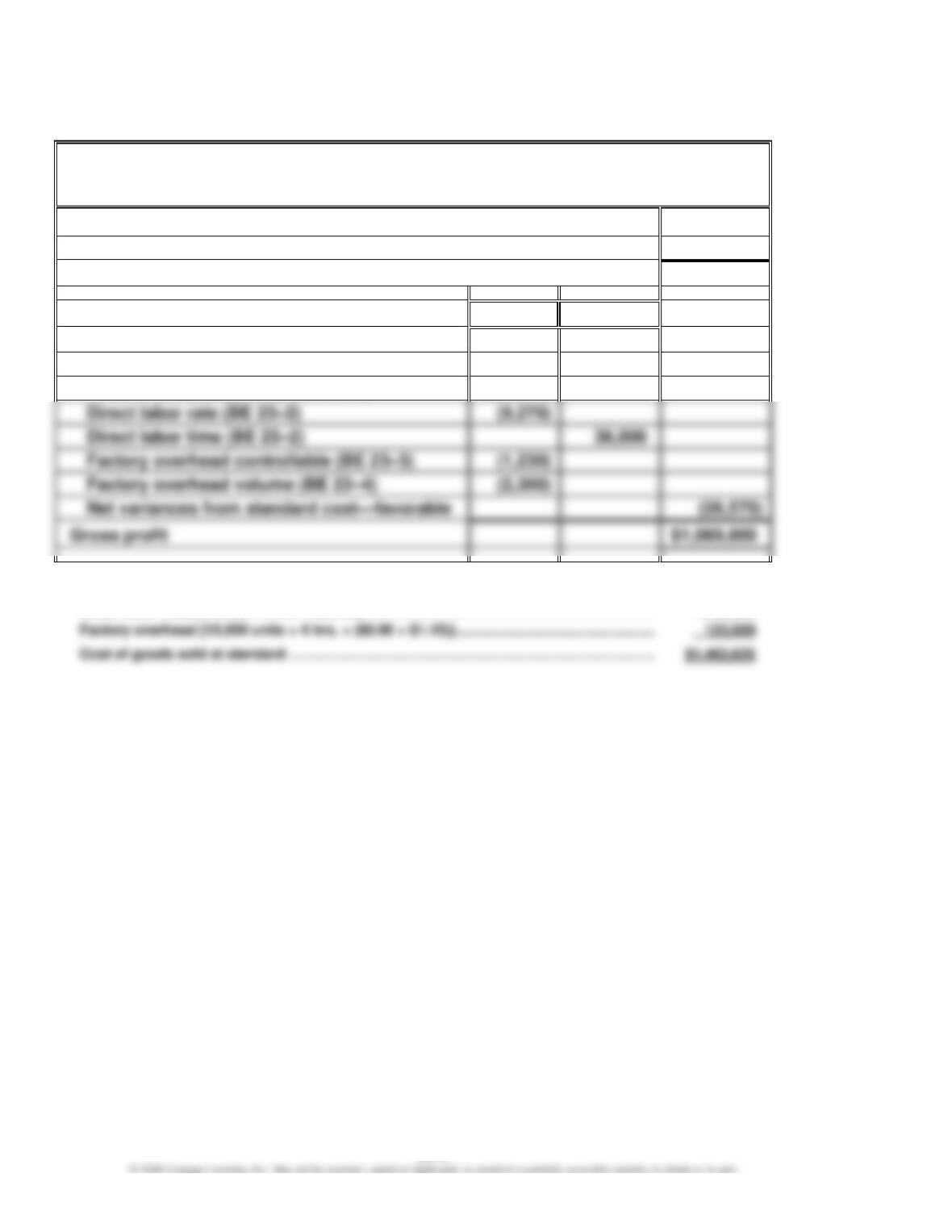
Bellingham Company
Income Statement Through Gross Profit
For the Year Ended March 31
Sales (15,000 units × $172)
$2,580,000
Cost of goods sold—at standard*
1,463,625
Gross profit—at standard
$1,116,375
Favorable
Unfavorable
Variances from standard cost:
Direct materials price (BE 23–1)
$ 9,000
Direct materials quantity (BE 23–1)
$(5,625)
Direct labor time (BE 23–2)
*
Direct materials (15,000 units × 2.5 lbs. × $3.75) …………………………………………………………
$ 140,625
Factory overhead [15,000 units × 4 hrs. × ($0.90 + $1.15)]……………………………………………
Direct labor (15,000 units × 4 hrs. × $20.00) ………………………………………………………………..
1,200,000
CHAPTER 23 (FIN MAN); CHAPTER 9 (MAN) Evaluating Variances from Standard Costs
EXERCISES
Ex. 23–1 (FIN MAN); Ex. 9–1 (MAN)
Ingredient
Quantity
×
Price
Total
Cocoa
500 lbs.
×
$1.40 per lb.
$ 700
Standard direct materials cost per bar of chocolate:
$1,150 per batch = $0.23 per bar
5,000 bars
Ex. 23–2 (FIN MAN); Ex. 9–2 (MAN)
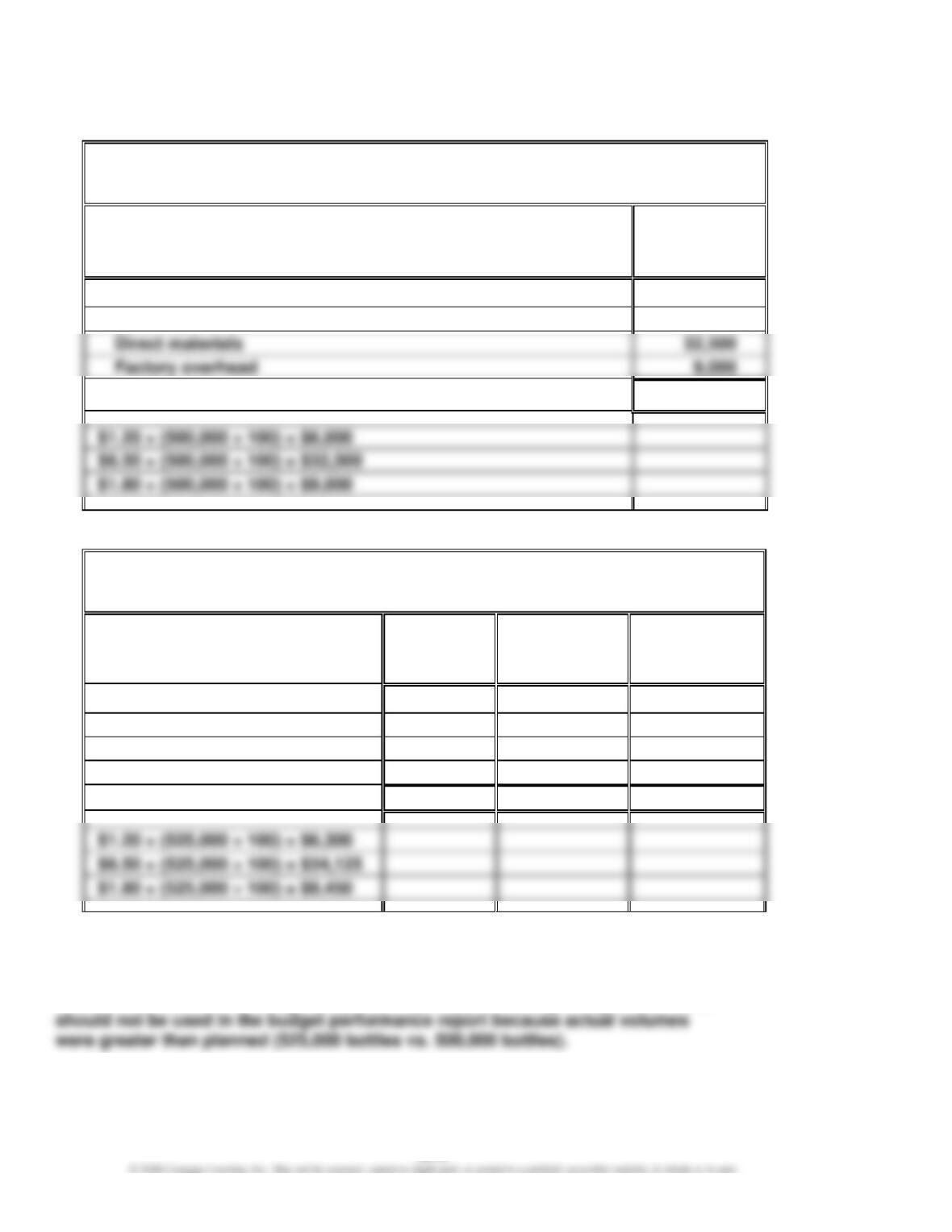
a.
Direct labor……………………………………………………..
$28.00 × 5.0 hrs.
$140.00
Direct materials …………………………..………………….
$12.00 × 18 bd. ft.
216.00
Variable factory overhead ……………………………….
Total cost per unit ……………………………………..
b. A standard cost system provides the company’s management a cost control tool
CHAPTER 23 (FIN MAN); CHAPTER 9 (MAN) Evaluating Variances from Standard Costs
Ex. 23–3 (FIN MAN); Ex. 9–3 (MAN)
a.
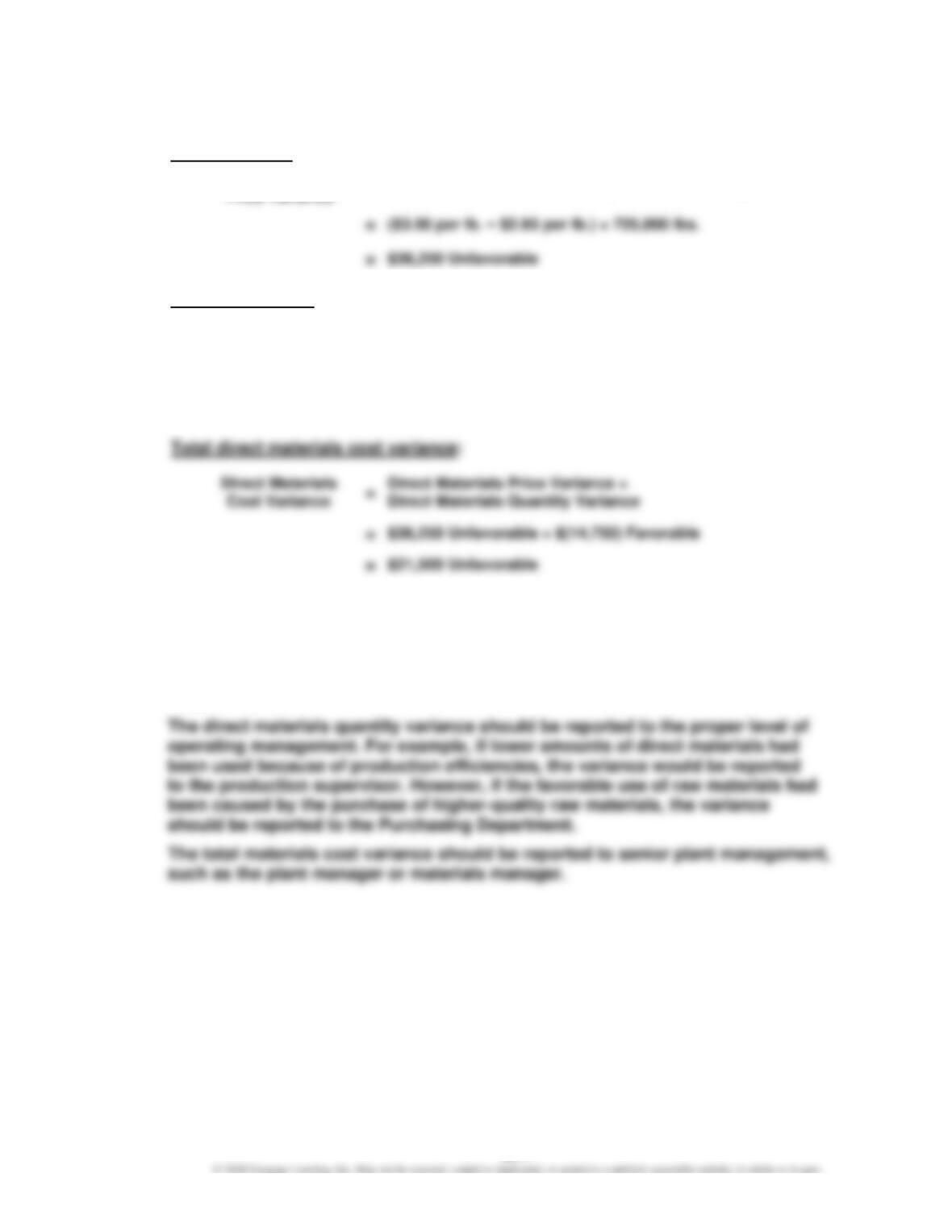
Salisbury Bottle Company
Manufacturing Cost Budget
For the Month Ended March 31
Standard Cost at
Planned Volume
(500,000 Bottles)
Manufacturing costs:
Direct labor
$ 6,000
Direct materials
Factory overhead
Total
$47,500
$1.20 × (500,000 ÷ 100) = $6,000
Note: The cost standards are expressed as “per 100 bottles.”
b.
Salisbury Bottle Company
Manufacturing Costs—Budget Performance Report
For the Month Ended March 31
Standard Cost at
Cost Variance—
Actual
at Actual Volume
(Favorable)
Costs
(525,000 Bottles)
Unfavorable
Manufacturing costs:
Direct labor
$ 6,550
$ 6,300
$ 250
Direct materials
33,800
34,125
(325)
Factory overhead
9,100
9,450
(350)
Total manufacturing cost
$49,450
$49,875
$(425)
c. Salisbury Bottle Company’s actual costs were $425 less than budgeted. Favorable
direct materials and factory overhead cost variances more than offset a small
unfavorable direct labor cost variance.
Note to Instructors: The budget prepared in part (a) at the beginning of the month
CHAPTER 23 (FIN MAN); CHAPTER 9 (MAN) Evaluating Variances from Standard Costs
Ex. 23–4 (FIN MAN); Ex. 9–4 (MAN)
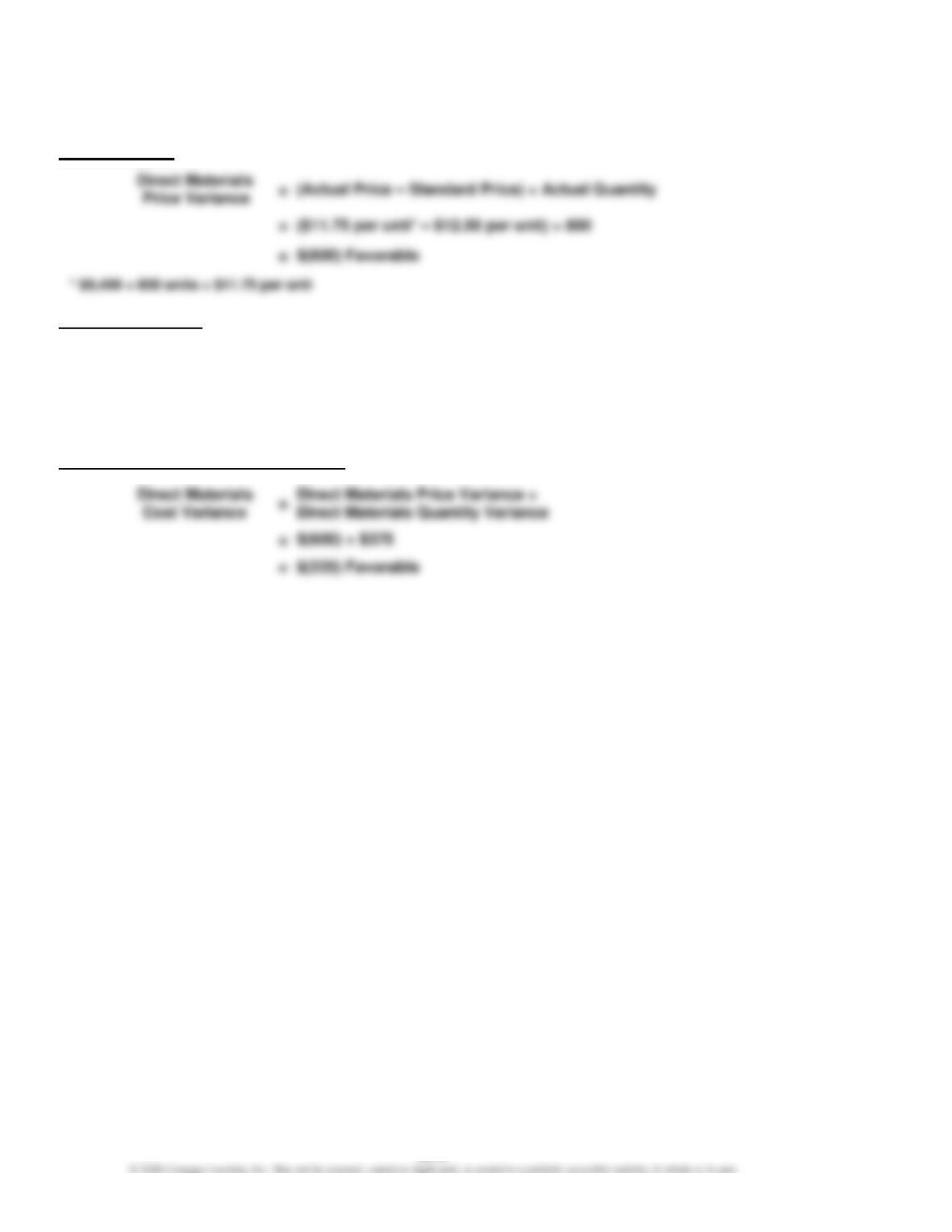
a. Price variance:
Direct Materials
=
$36,250 Unfavorable
=
(Actual Price – Standard Price) × Actual Quantity
Quantity variance:
Direct Materials
Quantity Variance
=
(Actual Quantity – Standard Quantity) × Standard Price
=
(725,000 lbs. – 730,000 lbs.) × $2.95 per lb.
=
$(14,750) Favorable
b. The direct materials price variance should normally be reported to the
Purchasing Department, which may or may not be able to control this variance.
If materials of the same quality were purchased from another supplier at a price
higher than the standard price, the variance was controllable. However, if the
variance resulted from a market-wide price increase, the variance was not
subject to control.
CHAPTER 23 (FIN MAN); CHAPTER 9 (MAN) Evaluating Variances from Standard Costs
Ex. 23–5 (FIN MAN); Ex. 9–5 (MAN)
Price variance:
Quantity variance:
Direct Materials
Quantity Variance
=
(Actual Quantity – Standard Quantity) × Standard Price
=
(800 units – 770 units) × $12.50 per unit
=
$375 Unfavorable
Total direct materials cost variance:
$(225) Favorable
CHAPTER 23 (FIN MAN); CHAPTER 9 (MAN) Evaluating Variances from Standard Costs
Ex. 23–6 (FIN MAN); Ex. 9–6 (MAN)
Product finished ……………………………………………………………….
1,400
units
Standard finished product for direct materials used
(3,000 lbs. ÷ 2 lbs.) …………………………………………………………
(1,500)
Deficiency of finished product for materials used ………….
(100)
units
Standard cost for direct materials:
Quantity variance divided by deficiency of product
Alternate solution:
Price variance, unfavorable ………………………………………….
$1,500
÷ Materials used…………………………………………………………..
÷3,000
lbs.
Price variance per lb., unfavorable………………………………..
$ 0.50
Less price variance (unfavorable) per lb. (from above) …..
Proof:
Direct Materials Price Variance
=
(Actual Price – Standard Price) × Actual
Quantity
=
($5.50 – $5.00) × 3,000
=
$1,500 Unfavorable
× Standard Price
CHAPTER 23 (FIN MAN); CHAPTER 9 (MAN) Evaluating Variances from Standard Costs
Ex. 23–7 (FIN MAN); Ex. 9–7 (MAN)
a.
Standard
Standard
Standard
Cost per
Quantity
×
Price
=
Batch
Whole tomatoes …..
5,000 lbs.
$0.75 per lb.
$3,750
Vinegar ………………..
350 gal.
0.90 per gal.
315
Salt ……………………..
125 lbs.
1.80 per lb.
b.
Actual
Standard
Materials
Quantity for
Quantity per
Quantity
Standard
Quantity
Batch 08-99
–
Batch
=
Difference
×
Price
=
Variance
4,900 lbs.
5,000 lbs.
(100)
lbs.
$0.75 per lb.
$(75.00)
F
CHAPTER 23 (FIN MAN); CHAPTER 9 (MAN) Evaluating Variances from Standard Costs
Ex. 23–8 (FIN MAN); Ex. 8–8 (MAN)
a.
Rate variance:
Direct Labor
Rate Variance
=
(Actual Rate per Hour – Standard Rate per Hour)
× Actual Hours
=
($22.50 – $23.00) × 8,450 hours
Time variance:
Direct Labor
Time Variance
=
(Actual Direct Labor Hours – Standard Direct Labor Hours)
× Standard Rate per Hour
=
(8,450 hrs. – 8,400 hrs.) × $23.00 per hour
=
$1,150 Unfavorable
Total direct labor cost variance:
$(4,225) Favorable + $1,150 Unfavorable
$(3,075) Favorable
b. The employees may have been less-experienced workers who were paid less than
more-experienced workers or poorly trained, thereby resulting in a lower labor rate
CHAPTER 23 (FIN MAN); CHAPTER 9 (MAN) Evaluating Variances from Standard Costs
Ex. 23–9 (FIN MAN); Ex. 9–9 (MAN)
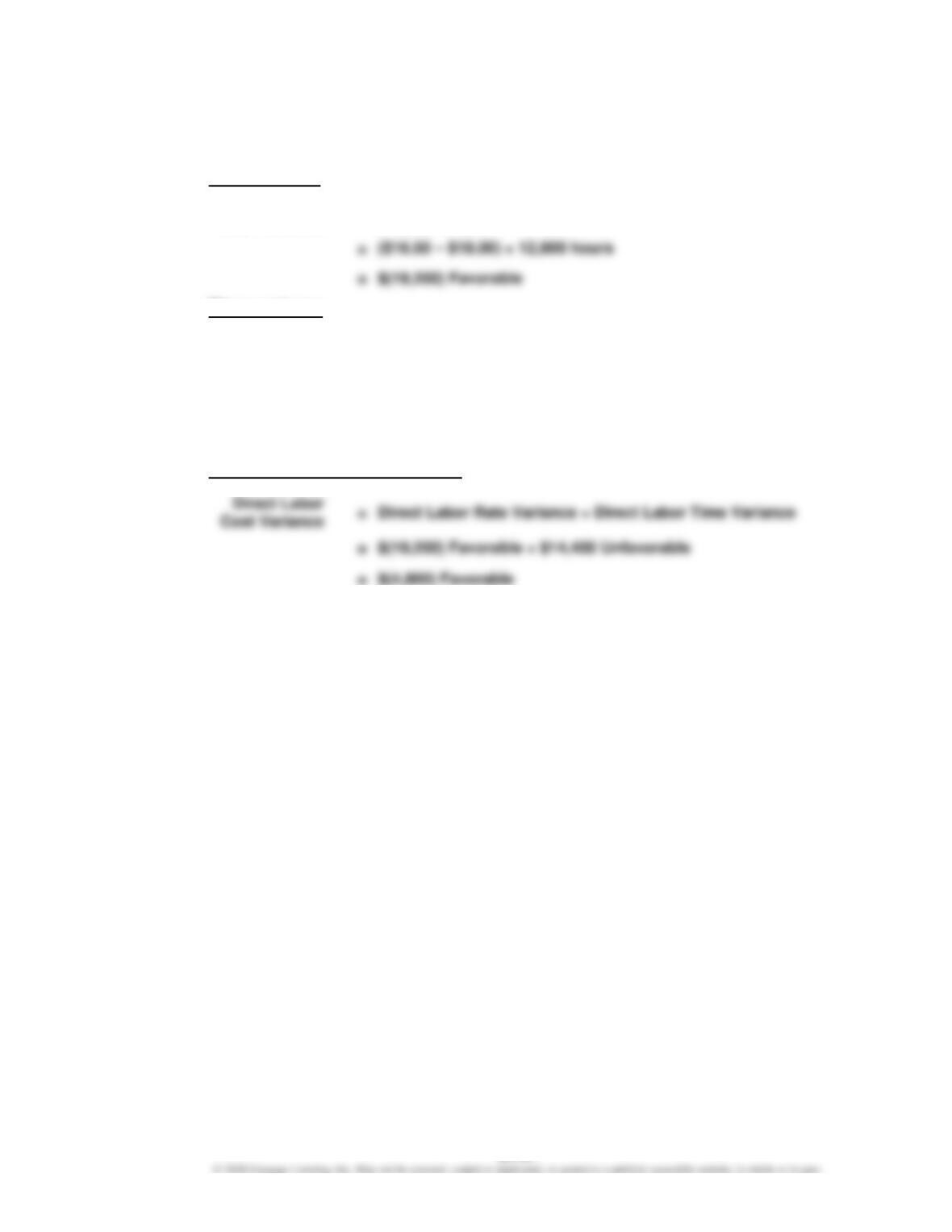
a.
Rate variance:
Direct Labor
Rate Variance
=
(Actual Rate per Hour – Standard Rate per Hour)
× Actual Hours
=
($22.75 – $24.00) × 5,000 hrs.
=
$(6,250) Favorable
× Standard Rate per Hour
=
*
6.0 hrs. × 800 units
Total direct labor cost variance:
Direct Labor
Cost Variance
=
Direct Labor Rate Variance + Direct Labor Time Variance
=
$(6,250) Favorable + $4,800 Unfavorable
=
$(1,450) Favorable
CHAPTER 23 (FIN MAN); CHAPTER 9 (MAN) Evaluating Variances from Standard Costs
Ex. 23–10 (FIN MAN); Ex. 9–10 (MAN)
a.
(1)
Cutting Department
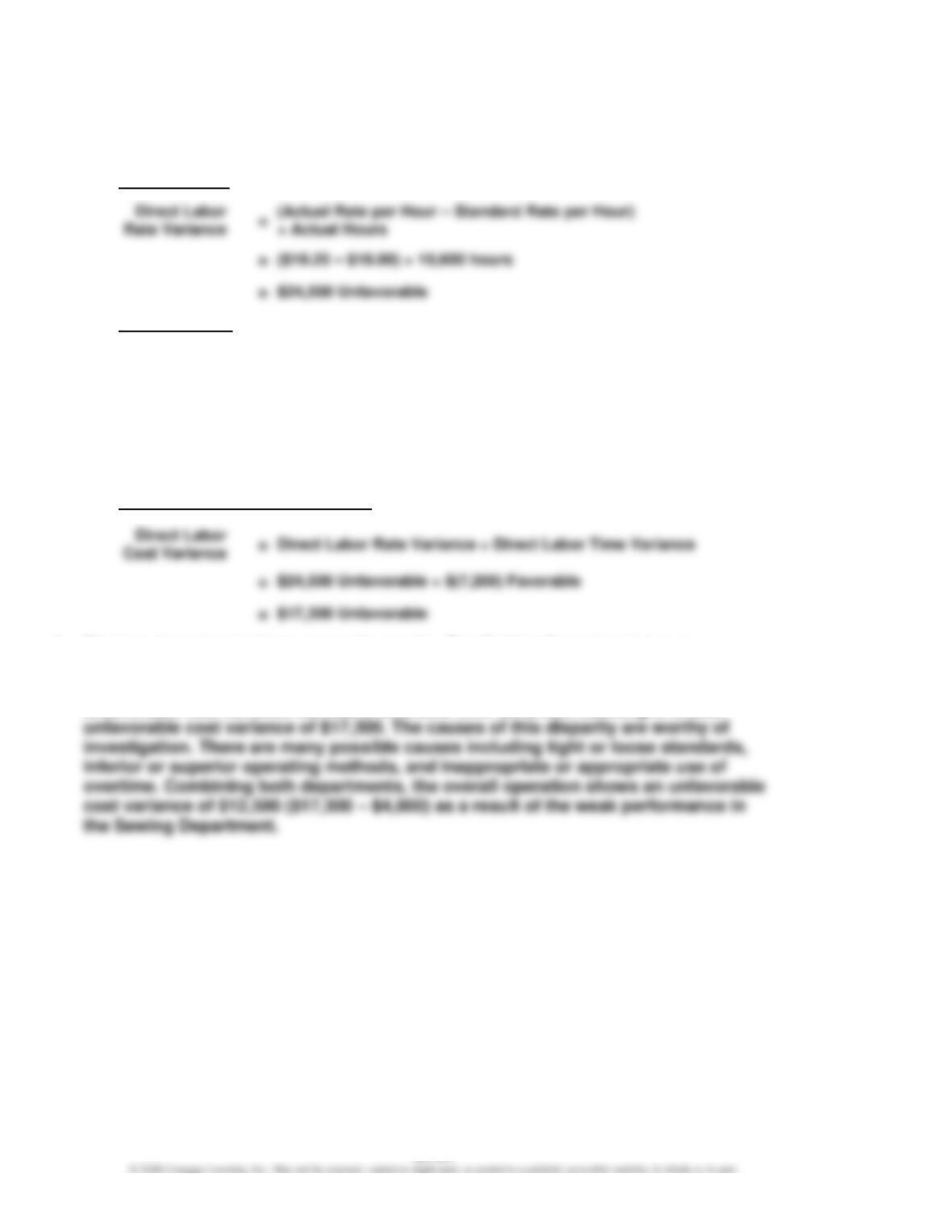
Rate variance:
Direct Labor
Rate Variance
=
(Actual Rate per Hour – Standard Rate per Hour)
× Actual Hours
Time variance:
Direct Labor
Time Variance
=
(Actual Direct Labor Hours – Standard Direct Labor Hours)
× Standard Rate per Hour
=
(12,800 hrs. – 12,000 hrs.*) × $18.00 per hour
=
$14,400 Unfavorable
*
0.30 hr. × 40,000 units
Total direct labor cost variance:
=
CHAPTER 23 (FIN MAN); CHAPTER 9 (MAN) Evaluating Variances from Standard Costs
Ex. 23–10 (FIN MAN); Ex. 9–10 (MAN) (Concluded)
(2)
Sewing Department
Rate variance:
× Actual Hours
Time variance:
Direct Labor
Time Variance
=
(Actual Direct Labor Hours – Standard Direct Labor Hours)
× Standard Rate per Hour
=
(19,600 hrs. – 20,000 hrs.*) × $18.00 per hour
=
$(7,200) Favorable
*
0.50 hr. × 40,000 units
Total direct labor cost variance:
b. The two departments have opposite results. The Cutting Department has a
favorable rate variance and an unfavorable time variance, resulting in a total
favorable cost variance of $4,800. In contrast, the Sewing Department has an
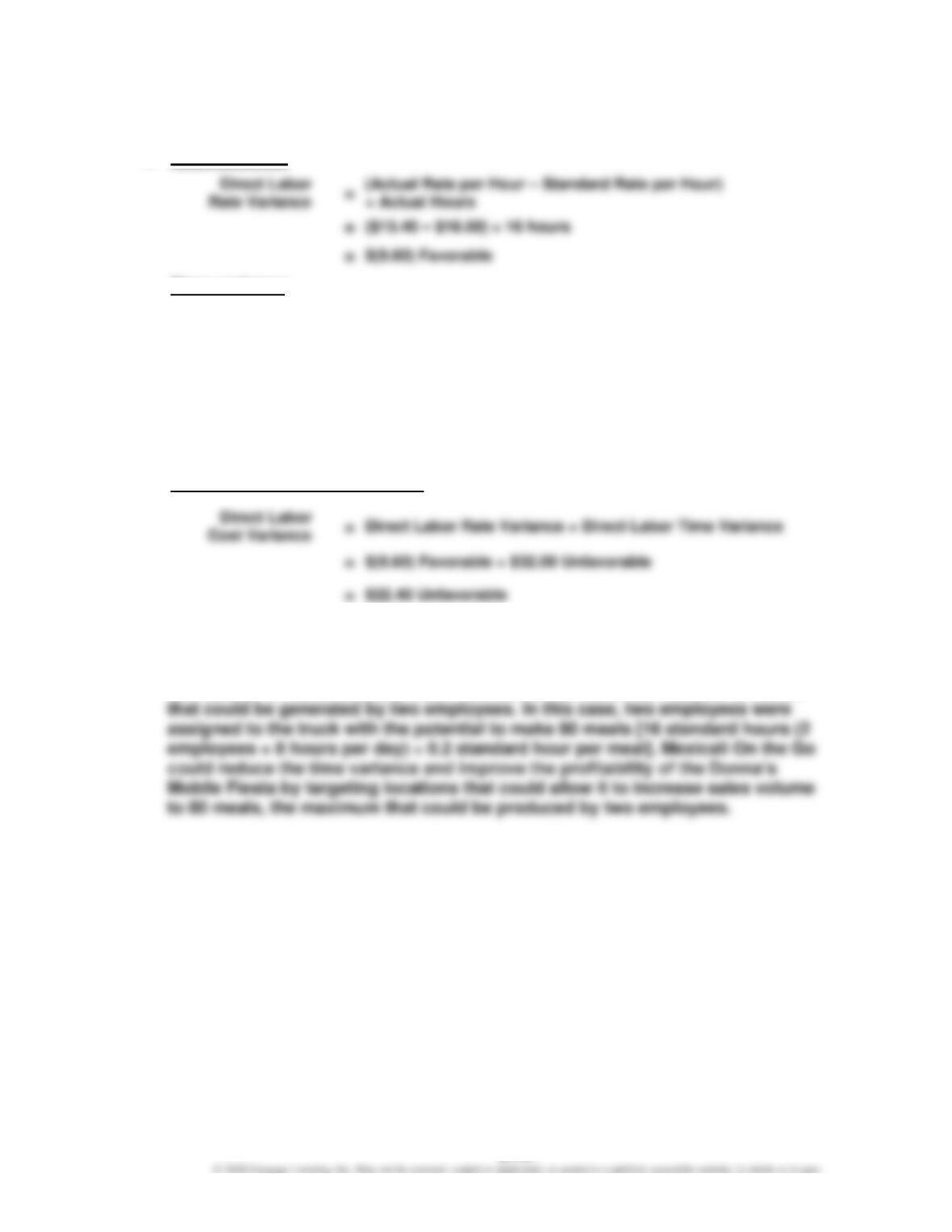
CHAPTER 23 (FIN MAN); CHAPTER 9 (MAN) Evaluating Variances from Standard Costs
Ex. 23–11 (FIN MAN); Ex. 9–11 (MAN)
a.
Rate variance:
Time variance:
Direct Labor
Time Variance
=
(Actual Direct Labor Hours – Standard Direct Labor Hours)
× Standard Rate per Hour
=
(16 hrs. – 14 hrs.*) × $16.00 per hour
=
$32.00 Unfavorable
*
The standard direct labor hours for 70 meals is 14 hours, computed as follows:
70 meals × 0.2 hour (standard direct labor per meal) = 14 hours.
Total direct labor cost variance:
b. The mobile kitchen must be staffed with at least two employees to meet demand
(70 meals). Employees are unable to move to another truck once they are
assigned for the day. As a result, an unfavorable time variance will occur any time
the number of meals actually made falls below the maximum number of meals
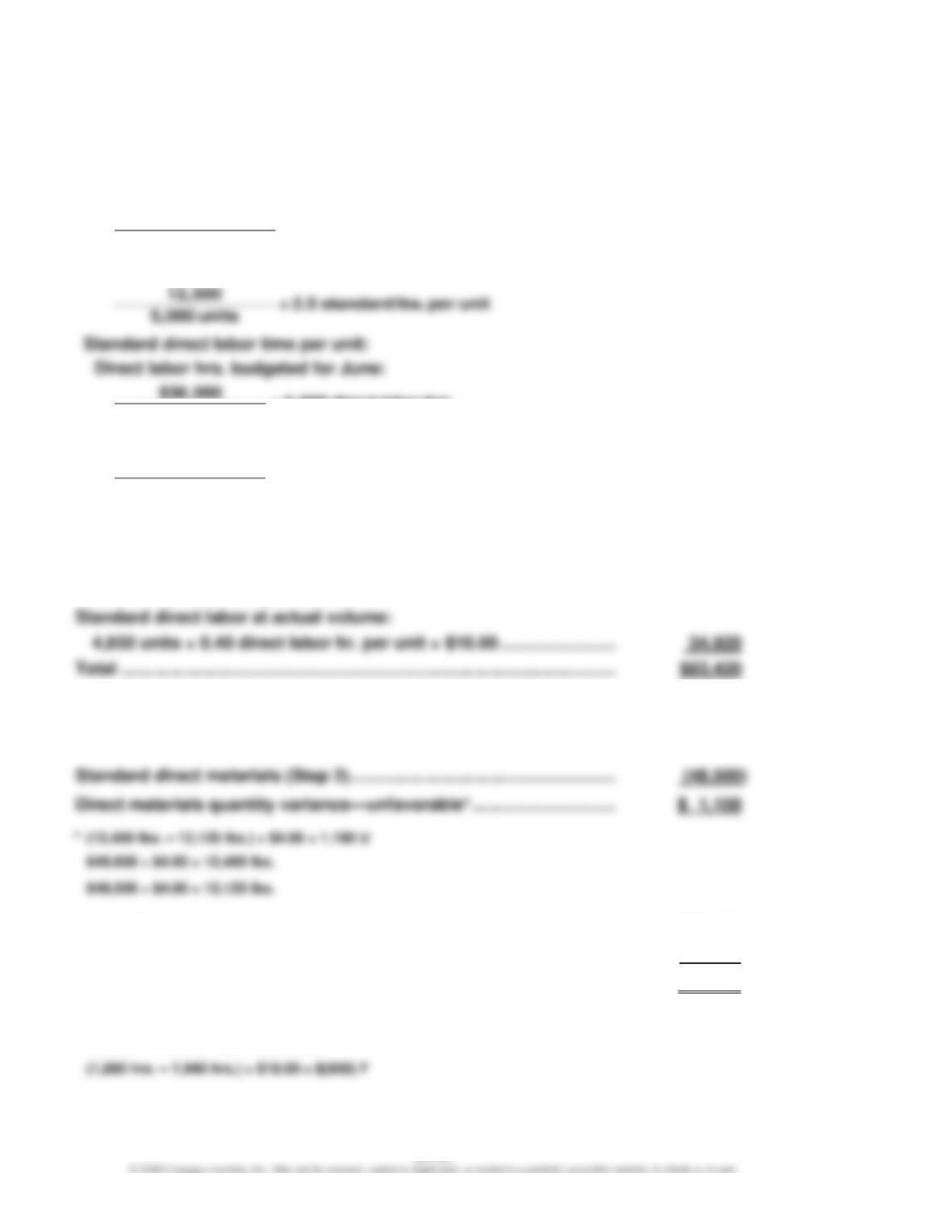
CHAPTER 23 (FIN MAN); CHAPTER 9 (MAN) Evaluating Variances from Standard Costs
Ex. 23–12 (FIN MAN); Ex. 9–12 (MAN)
Step 1: Determine the standard direct materials and direct labor per unit.
Standard direct materials quantity per unit:
Direct materials lbs. budgeted for June:
$50,000 = 12,500 lbs.
$4.00perlb.
Standard pounds per unit:
$18.00perhr.
Standard direct labor hrs. per unit:
2,000 hrs. = 0.40 standard direct labor hr. per unit
5,000 units
Step 2: Using the standard quantity and time rates in Step 1, determine the
standard costs for the actual June production.
Standard direct materials at actual volume:
4,850 units × 2.5 lbs. per unit × $4.00 ……………………………………….
$48,500
Standard direct labor at actual volume:
Total …………………………………………………………………………………………
Step 3: Determine the direct materials quantity and direct labor time variances,
assuming no direct materials price or direct labor rate variances.
Actual direct materials used in production ………………………………….
$ 49,600
Standard direct materials (Step 2) ……………………………………………….
Direct materials quantity variance—unfavorable*…………………………
(12,400 lbs. – 12,125 lbs.) × $4.00 = 1,100 U
$49,600 ÷ $4.00 = 12,400 lbs.
Actual direct labor ……………………………………………………………………..
$ 34,020
Standard direct labor (Step 2) …………………………………………………….
(34,920)
Direct labor time variance—favorable** ……………………………………….
$ (900)
**
4,850 units × 0.40 hr. = 1,940 standard hrs.
$34,020 ÷ $18.00 = 1,890 actual hrs.
CHAPTER 23 (FIN MAN); CHAPTER 9 (MAN) Evaluating Variances from Standard Costs
Ex. 23–13 (FIN MAN); Ex. 9–13 (MAN)
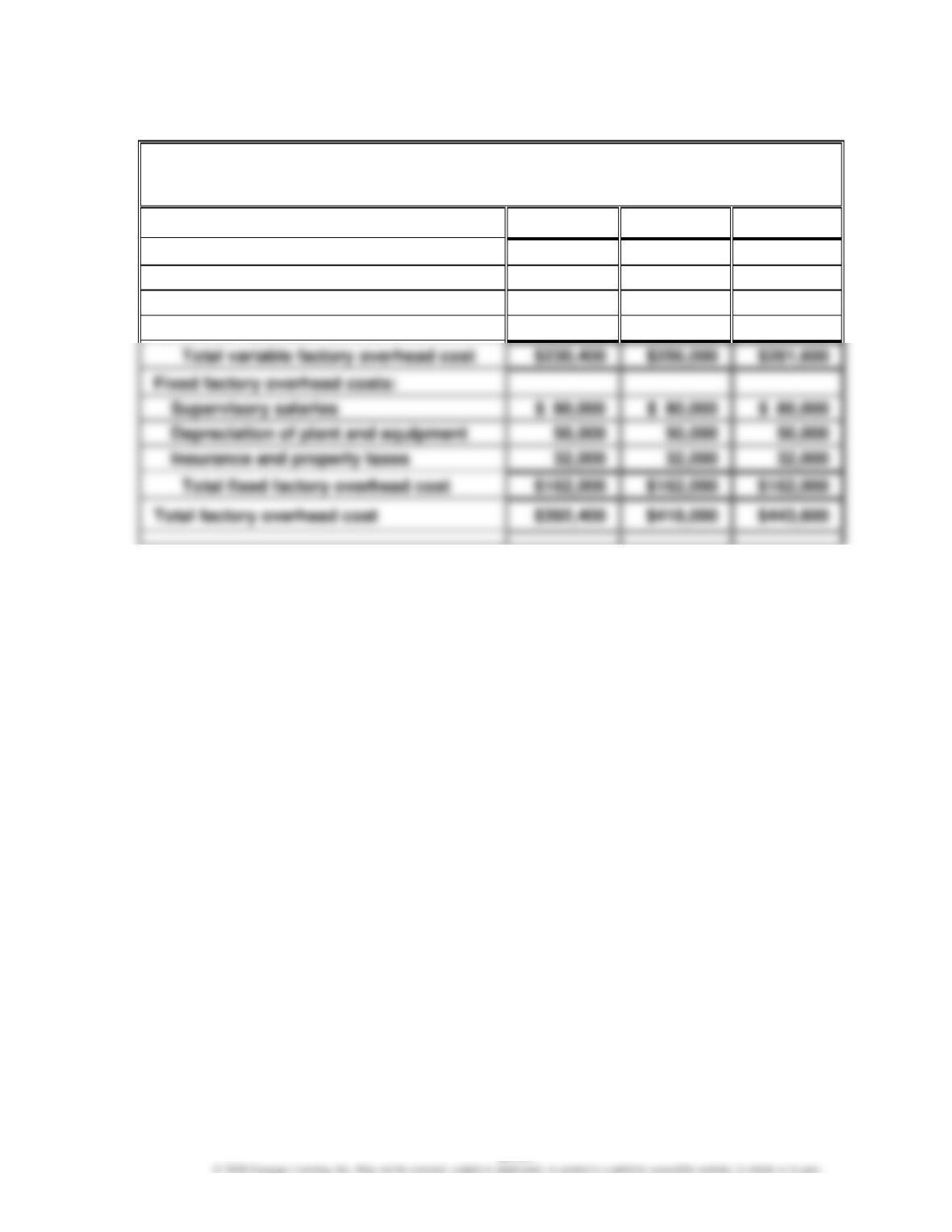
Leno Manufacturing Company
Factory Overhead Cost Budget—Press Department
For the Month Ended November 30
Direct labor hours
18,000
20,000
22,000
Variable overhead costs:
Indirect factory labor1
$162,000
$180,000
$198,000
Power and light2
10,800
12,000
13,200
Indirect materials3
57,600
64,000
70,400
$230,400
$256,000
$281,600
32,000
32,000
32,000
$162,000
$162,000
$162,000
1 $9.00 per hr. = $180,000 ÷ 20,000 hrs.
2 $0.60 per hr. = $12,000 ÷ 20,000 hrs.
3 $3.20 per hr. = $64,000 ÷ 20,000 hrs.
CHAPTER 23 (FIN MAN); CHAPTER 9 (MAN) Evaluating Variances from Standard Costs
Ex. 23–14 (FIN MAN); Ex. 9–14 (MAN)
a.
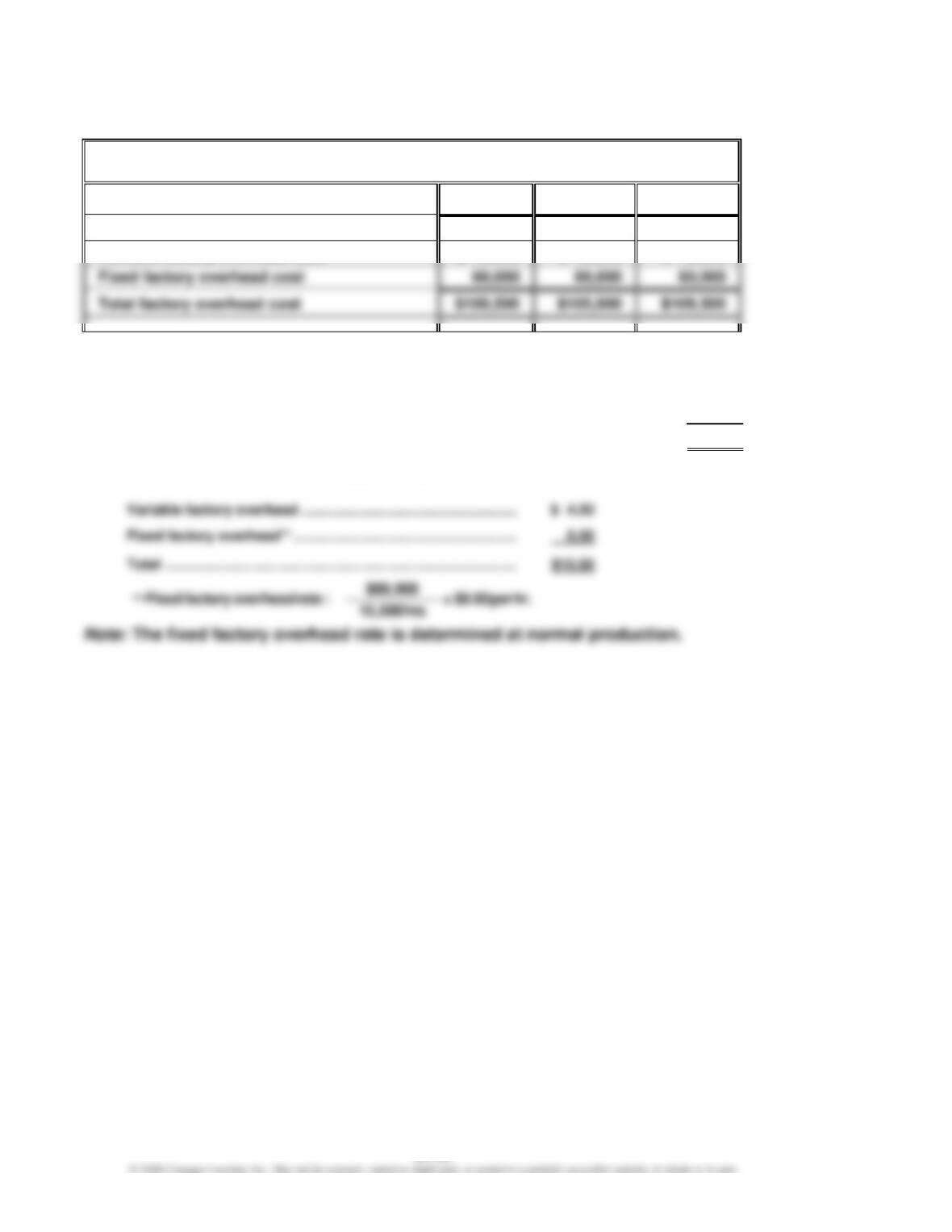
Wiki Wiki Company
Monthly Factory Overhead Cost Budget—Fabrication Department
Direct labor hours
9,000
10,000
11,000
Total factory overhead cost
Variable factory overhead cost
$ 40,500
$ 45,000
$ 49,500
b.
Overhead applied at actual production:
Actual hours …………………………………………………………………………………………
9,000 hrs.
× Overhead application rate* …………………………………………………………………
×$10.50
Factory overhead applied ……………………………………………………………………..
$94,500
*
Total factory overhead rate to be applied to production:
CHAPTER 23 (FIN MAN); CHAPTER 9 (MAN) Evaluating Variances from Standard Costs
Ex. 23–15 (FIN MAN); Ex. 9–15 (MAN)
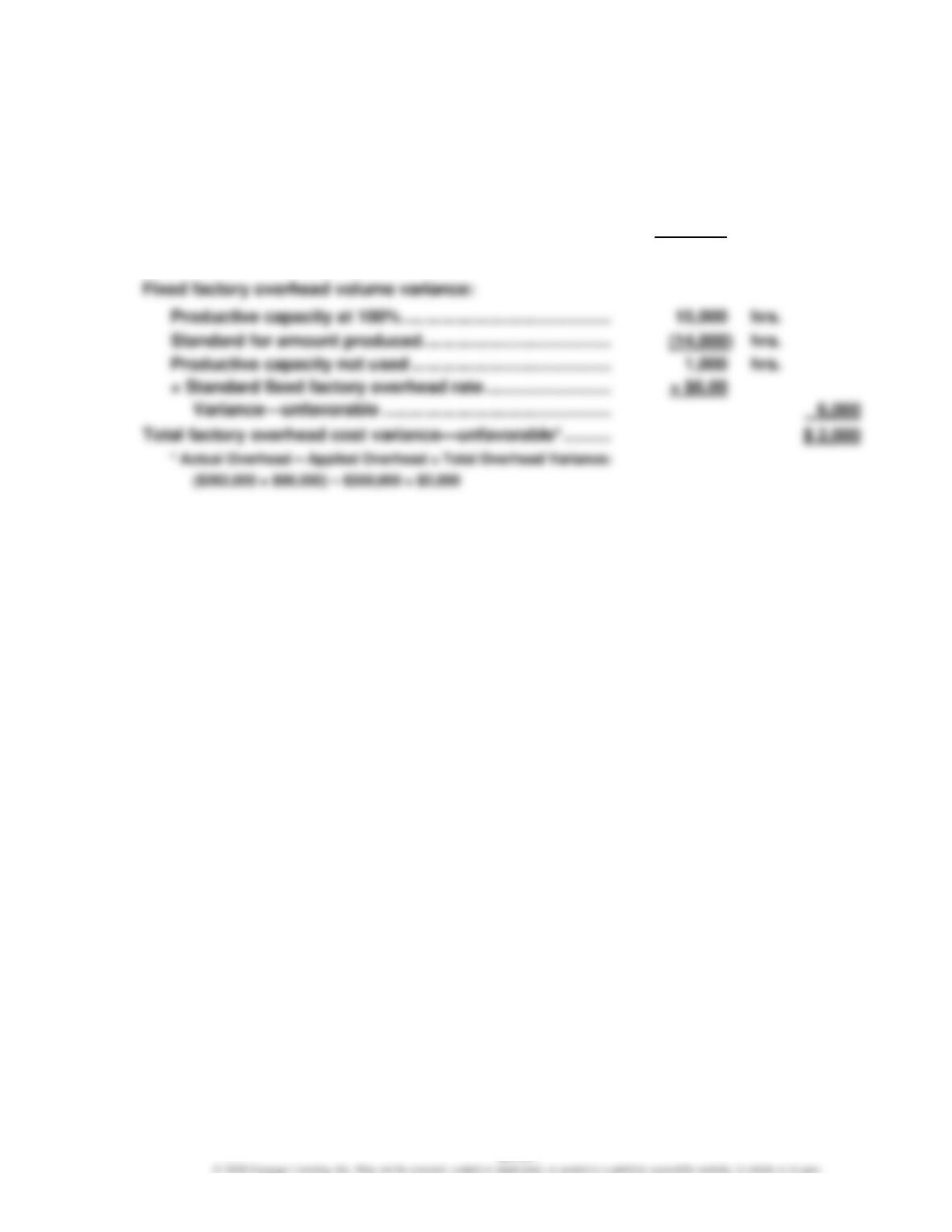
Variable factory overhead controllable variance:
Actual variable factory overhead cost incurred …………
$ 262,000
Budgeted variable factory overhead for 14,000 hrs.
[14,000 × ($25.00 – $6.00)] ………………………………………
(266,000)
Variance—favorable …………………………………………….
$(4,000)
CHAPTER 23 (FIN MAN); CHAPTER 9 (MAN) Evaluating Variances from Standard Costs
Ex. 23–15 (FIN MAN); Ex. 9–15 (MAN) (Concluded)
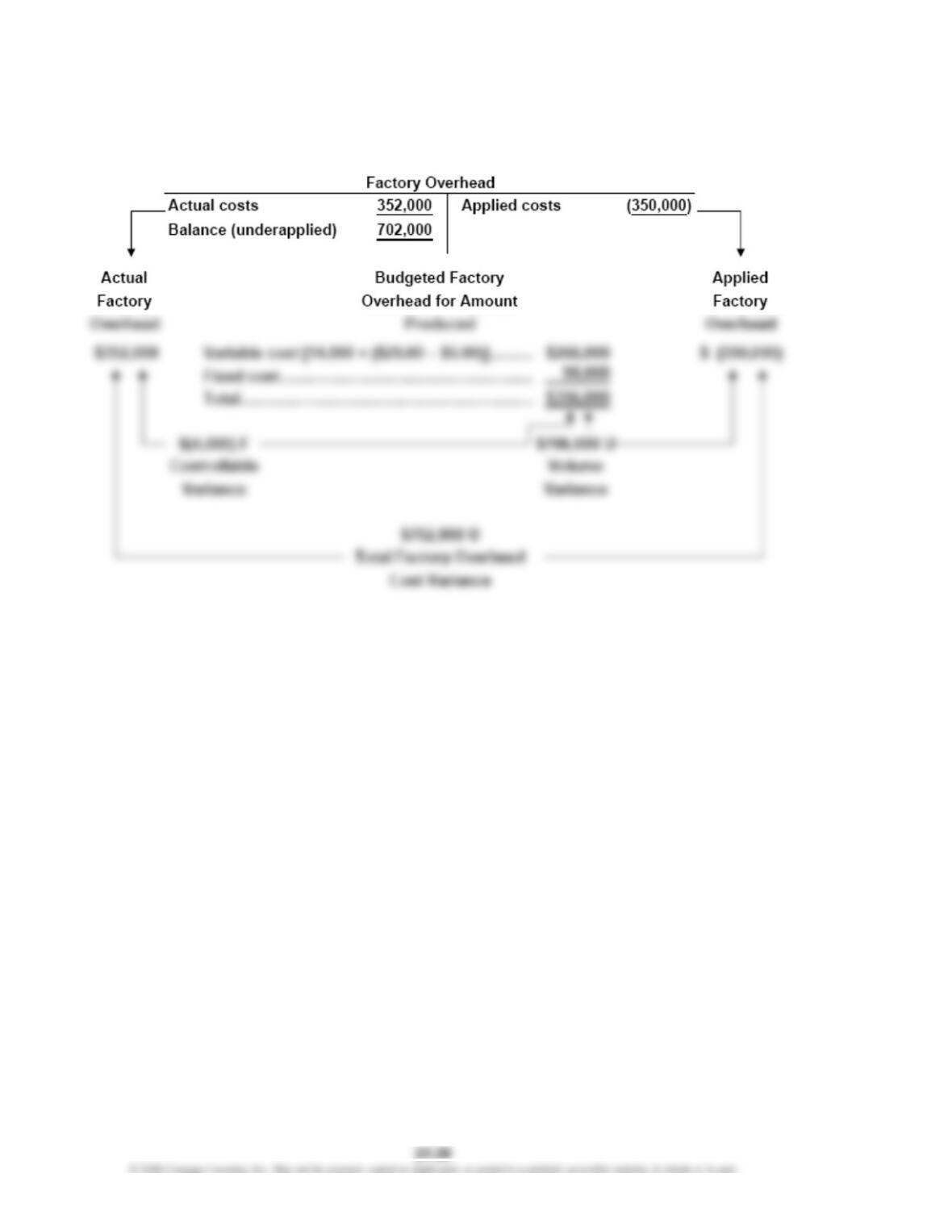
Alternative Computation of Overhead Variances