9-56. (15 min.) Ethics and Choice of Accounting Methods: Pepper’s Products.
Yes, you should show the results to management. You have an ethical responsibility
to communicate information fairly and objectively. Recall that the Institute of
Management Accountants requires its members to “Disclose fully all relevant
information that could be reasonably expected to influence an intended user’s
understanding of the reports, comments, and recommendations presented.”
9-57. (50 min.) Activity-Based Costing and Predetermined Overhead Allocation
Rates: Kitchen Supply, Inc.
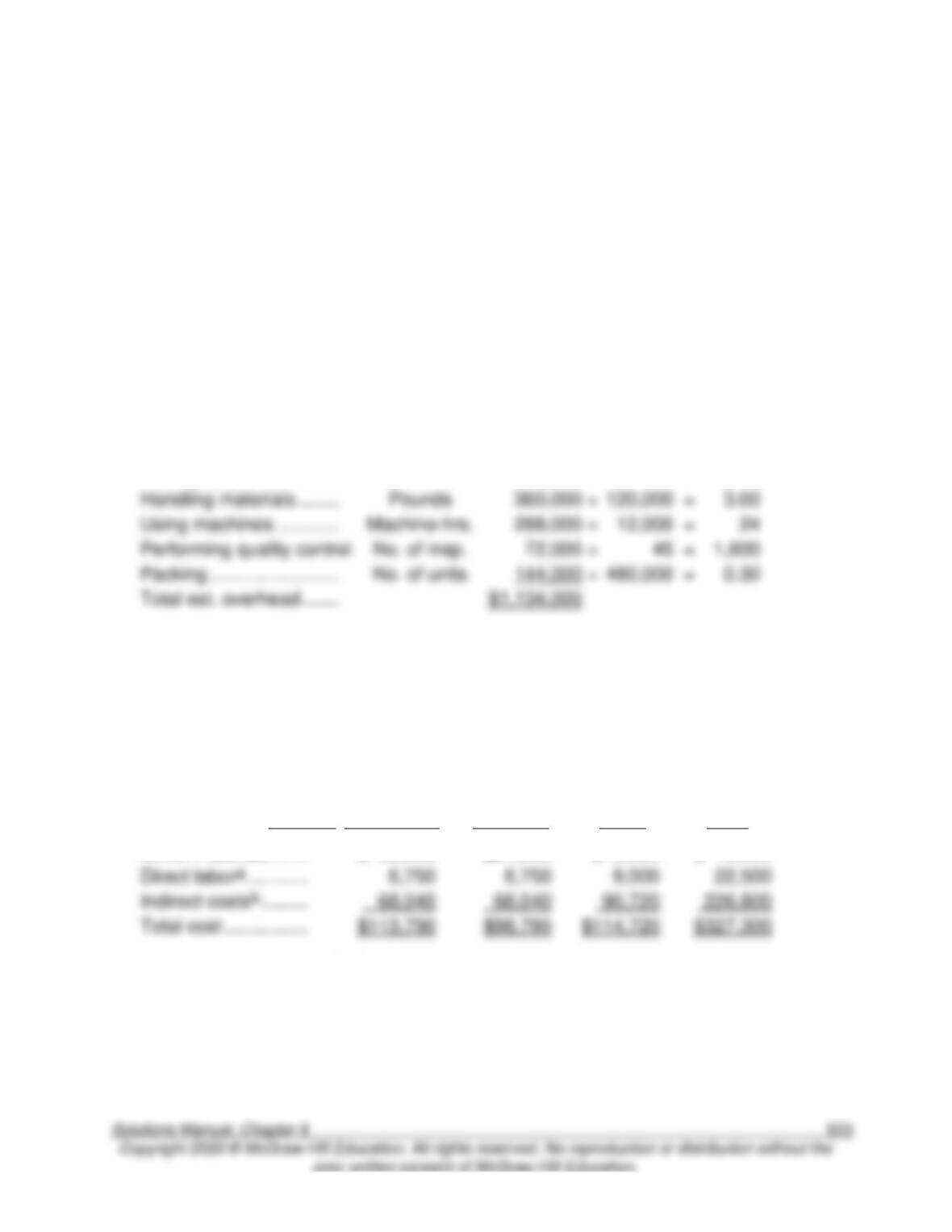
a. Computing overhead allocation rates
Activity
Cost
Driver
Est.
Costs
Driver
Units
Rate
Processing orders ………
No. of orders
$ 54,000
÷
200
=
$ 270
Setting up production ….
No. of runs
216,000
÷
100
=
2,160
Handling materials ……..
÷
120,000
=
Using machines …………
Machine-hrs.
÷
=
Performing quality control
72,000
÷
=
1,600
Packing …………………….
144,000
÷
480,000
=
Predetermined rate
for direct labor-hour
=
Estimated activity ÷ Estimated allocation base
=
$1,134,000 ÷ 7,500 hours
=
$151.20 per hour
b. Production Costs using Direct Labor-Hours
Account
Institutional
Standard
Silver
Total
Direct materials …….
a Number of labor-hours × $15 per hour.
b Number of labor-hours × $151.20 per hour.
9-57. (continued)
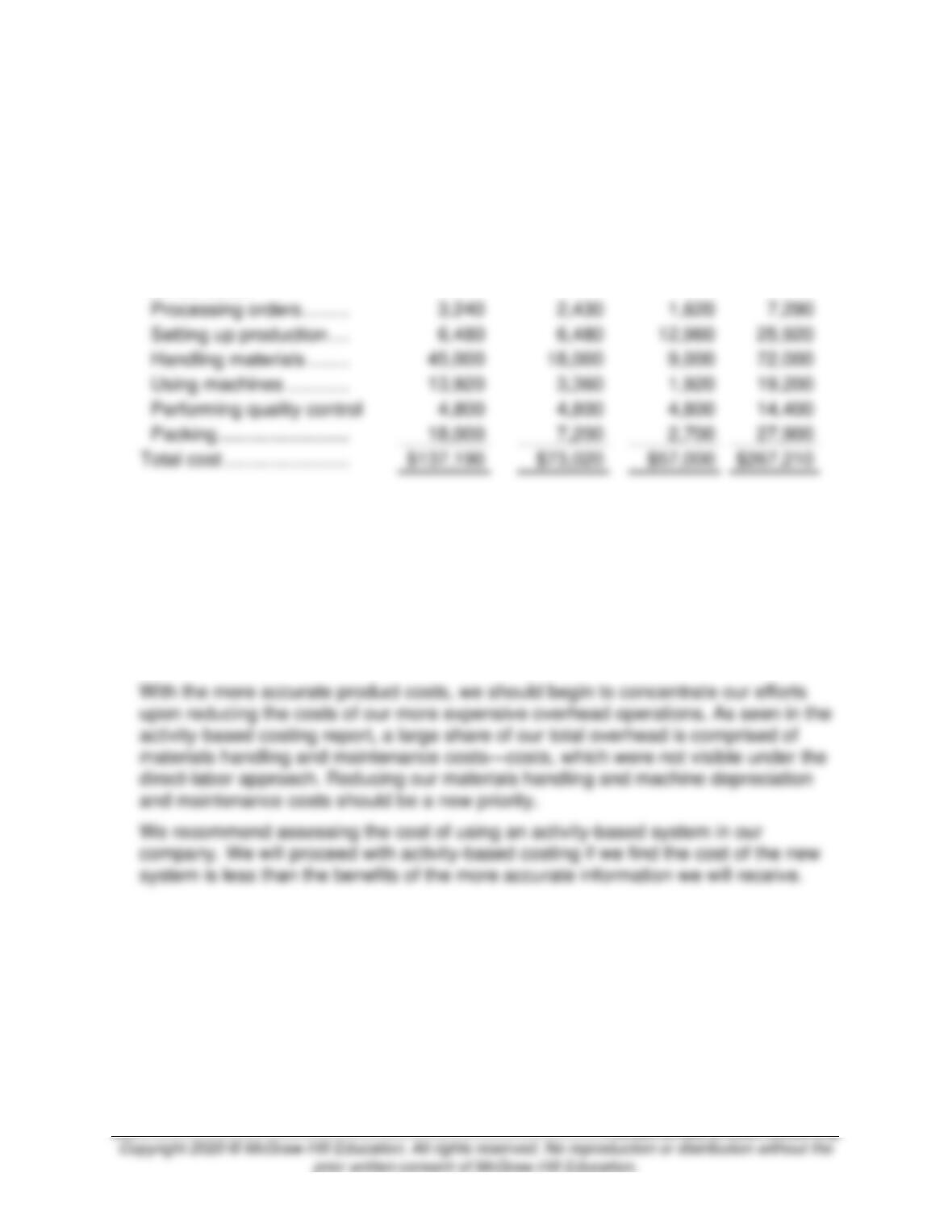
c. Production Costs using ABC
Account
Institutional
Standard
Silver
Total
Direct materials ……………
$39,000
$ 24,000
$15,000
$78,000
Direct labor …………………
6,750
6,750
9,000
22,500
Indirect costs
6,480
6,480
25,920
9,000
27,900
Total cost ……………………
d. Internal Memorandum
The discrepancy between our product costs using direct-labor hours as the
allocation base versus activity-based costing is found in the way overhead costs are
allocated. Our existing direct-labor cost method distorts our product costs because
there is little correlation between our direct-labor costs and overhead. Activity-based
overhead is more accurate. It allocates the individual components of our overhead to
our products based upon the product’s use of that overhead component.
9-58. (50 min.) Activity-Based Costing and Predetermined Overhead Rates:
College Supply Company.
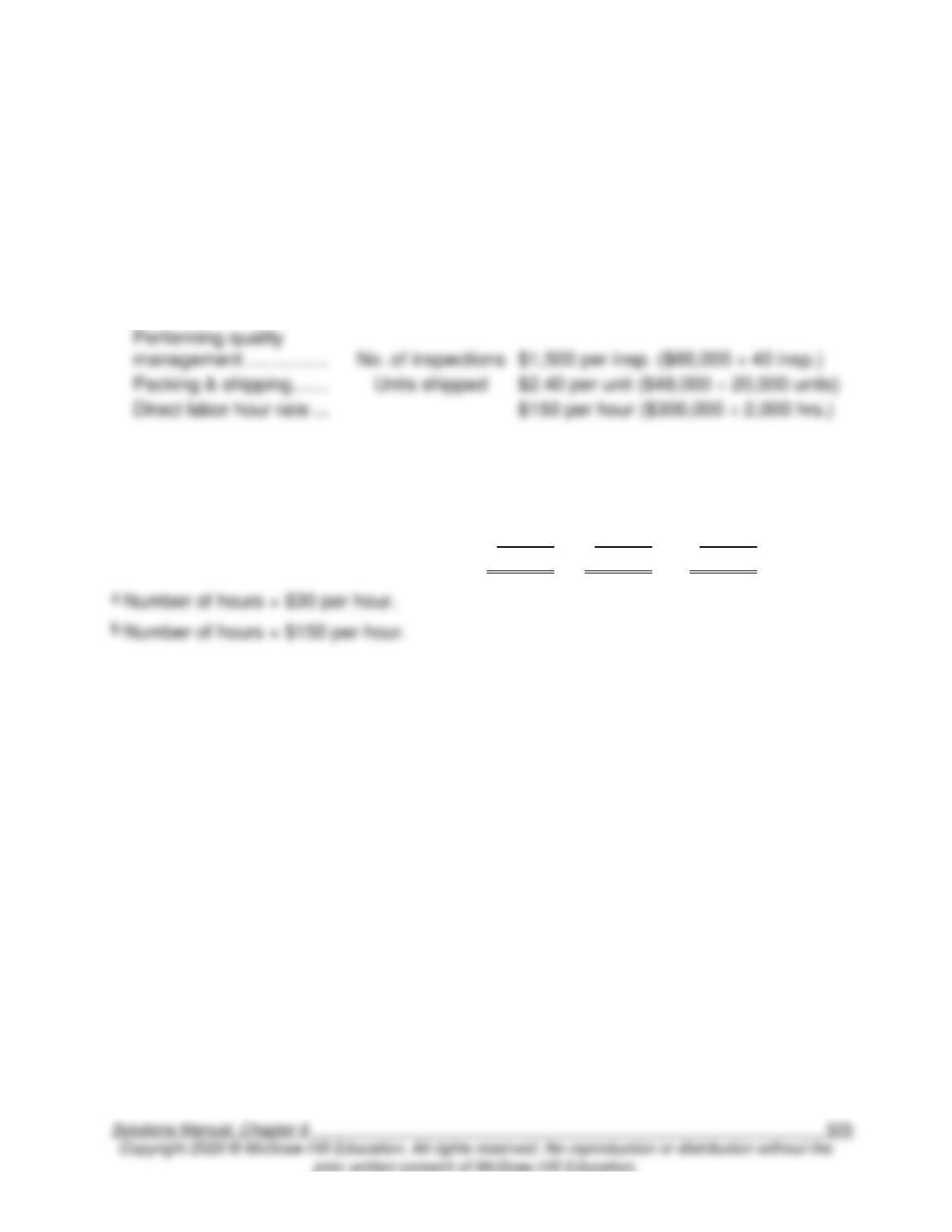
a.
Activity
Recommended Base
Allocation Rate
Setting up production …
No. of runs
$360 per run ($36,000 ÷ 100 runs)
Processing orders ……..
No. of orders
$300 per order ($60,000 ÷ 200 orders)
Handling materials …….
Lbs. of material
$3.00 per lb. ($24,000 ÷ 8,000 lbs.)
Using machines …………
Machine-hours
$7.20 per hour ($72,000 ÷ 10,000 hrs.)
Packing & shipping …….
$2.40 per unit ($48,000 ÷ 20,000 units)
Direct labor hour rate …
$150 per hour ($300,000 ÷ 2,000 hrs.)
b.
Short
Medium
Tall
Direct materials ……………………………….
$ 6,000
$ 3,750
$ 3,000
Direct labora ……………………………………
3,000
3,600
3,300
Overheadb …………………………..…………
15,000
18,000
16,500
Total costs ……………………………………..
$24,000
$25,350
$22,800
9-58 (continued)
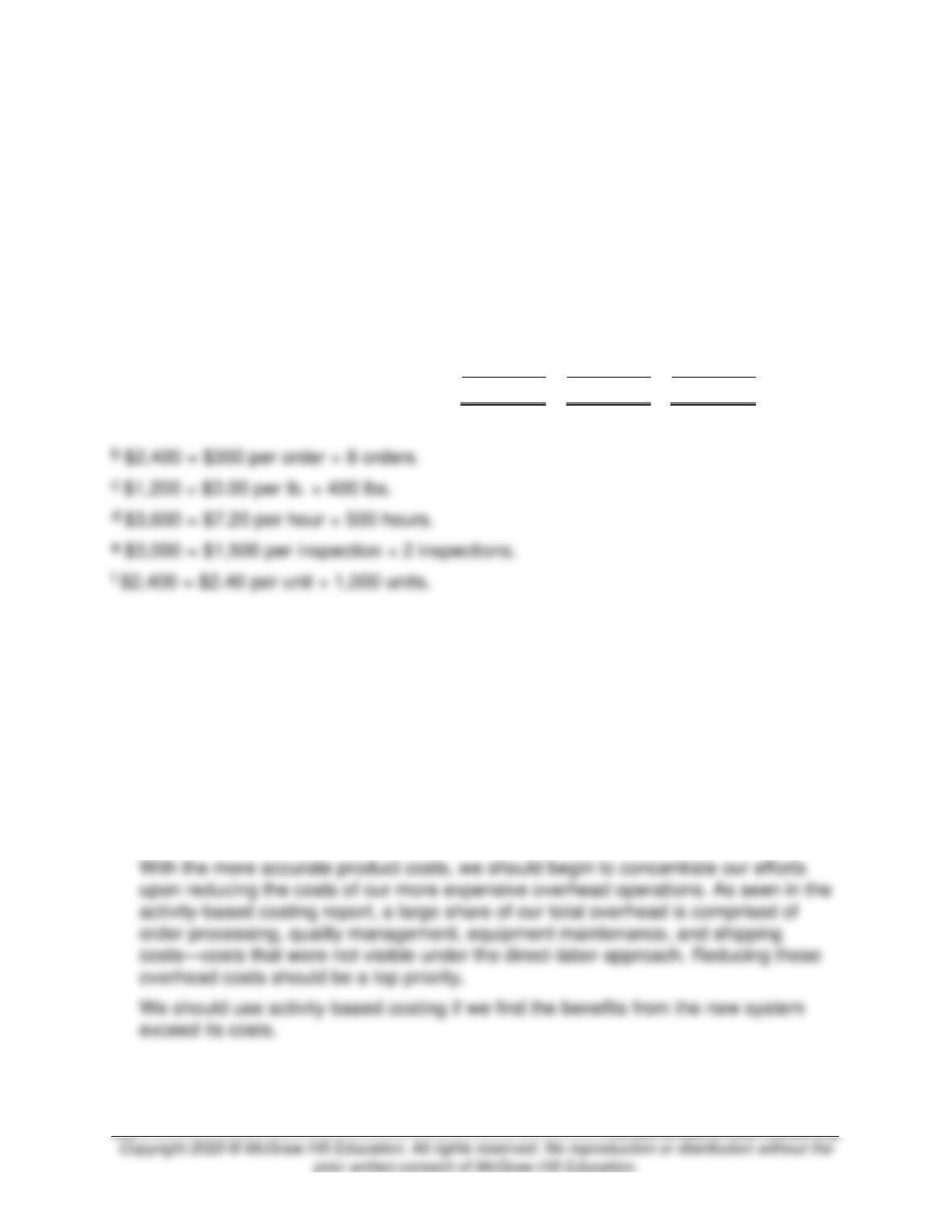
c.
Short
Medium
Tall
Direct materials …………………………….
$ 6,000
$ 3,750
$ 3,000
Direct labor ………………………………….
3,000
3,600
3,300
Setting up production …………………….
720
a
1,440
2,880
Processing orders …………………………
2,400
b
2,400
1,200
Handling materials ………………………..
1,200
c
2,400
600
Using machines …………………………...
3,600
d
2,160
2,160
Performing quality management ……..
3,000
e
3,000
3,000
Shipping ………………………………………
2,400
f
1,200
720
Total cost …………………………………….
$22,320
$19,950
$16,860
a $720 = $360 per run × 2 runs.
d. Internal Memorandum
Re: Product Cost Discrepancy
The discrepancy between our product costs using direct labor-hours as the
allocation base versus activity-based costing is found in the way overhead costs are
allocated. Our existing direct-labor cost method distorts our product costs because
there is little correlation between our direct-labor costs per product and overhead.
Activity-based overhead is more accurate. It allocates the individual components of
our overhead to our products based upon the product’s use of that overhead
component.
9-59. (40 min.) Choosing an Activity-Based Costing System: Pickle
Motorcycles, Inc.
a.
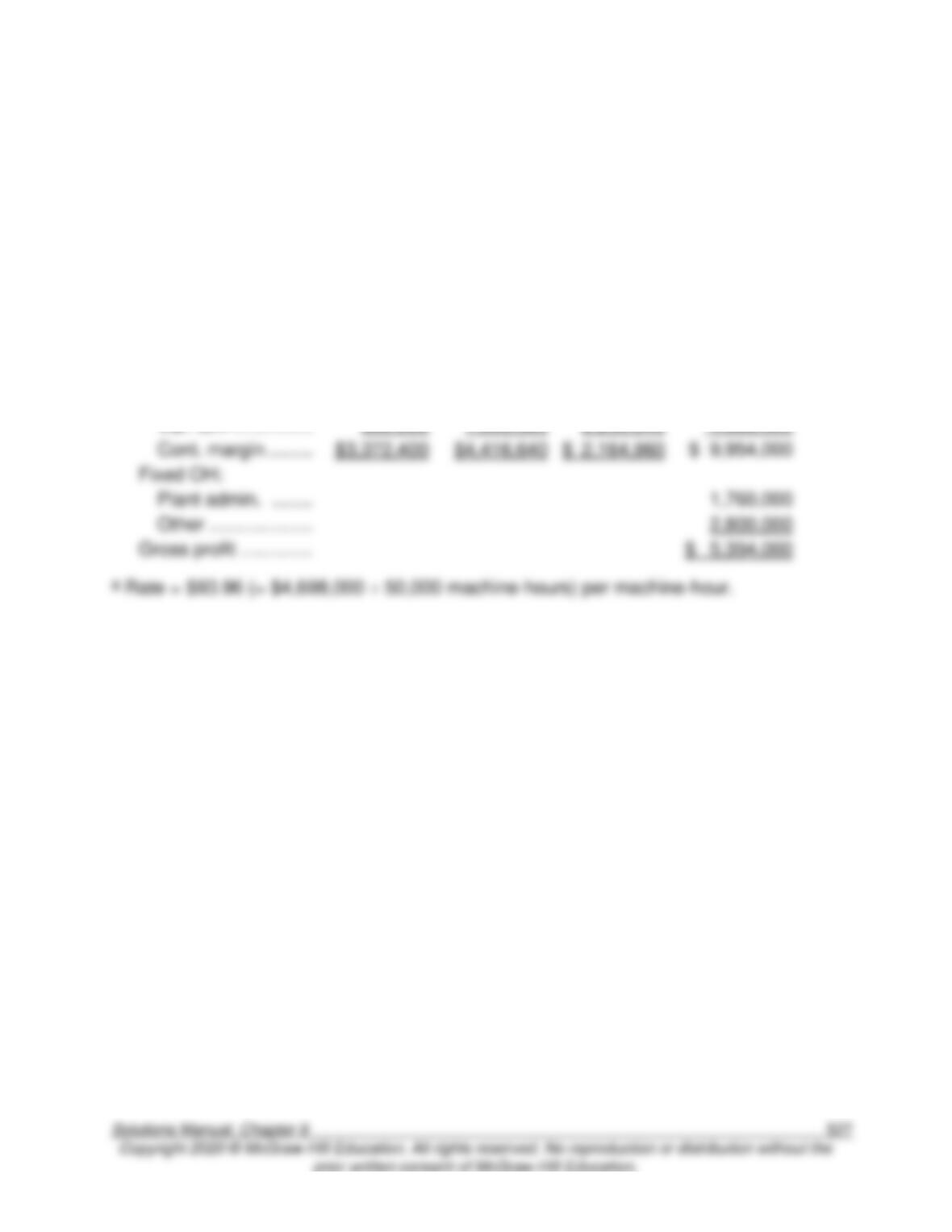
Pickle Motorcycles
Income Statement
Route 66
Main Street
Alley Cat
Total
Sales revenue ……….
$7,600,000
$11,200,000
$9,500,000
$28,300,000
Direct costs:
Direct material ……
3,000,000
4,800,000
4,000,000
11,800,000
Direct labor ………..
288,000
480,000
1,080,000
1,848,000
Cont. margin ………
Fixed OH:
Plant admin. ……..
1,760,000
Other ………………..
9-59. (continued)
b.
Pickle Motorcycles
Income Statement
Route 66
Main Street
Alley Cat
Total
Sales revenue ……
$7,600,000
$11,200,000
$9,500,000
$28,300,000
Direct costs:
Direct material ..
3,000,000
4,800,000
4,000,000
11,800,000
Direct labor
288,000
480,000
1,080,000
1,848,000
Var. OH:
Mach. setup ……
102,960
a
159,120
205,920
468,000
Order proc. …….
288,000
b
432,000
432,000
1,152,000
Warehousing ….
418,500
c
418,500
837,000
1,674,000
Energy …………..
d
362,880
756,000
Shipping ………..
e
Cont. margin ……..
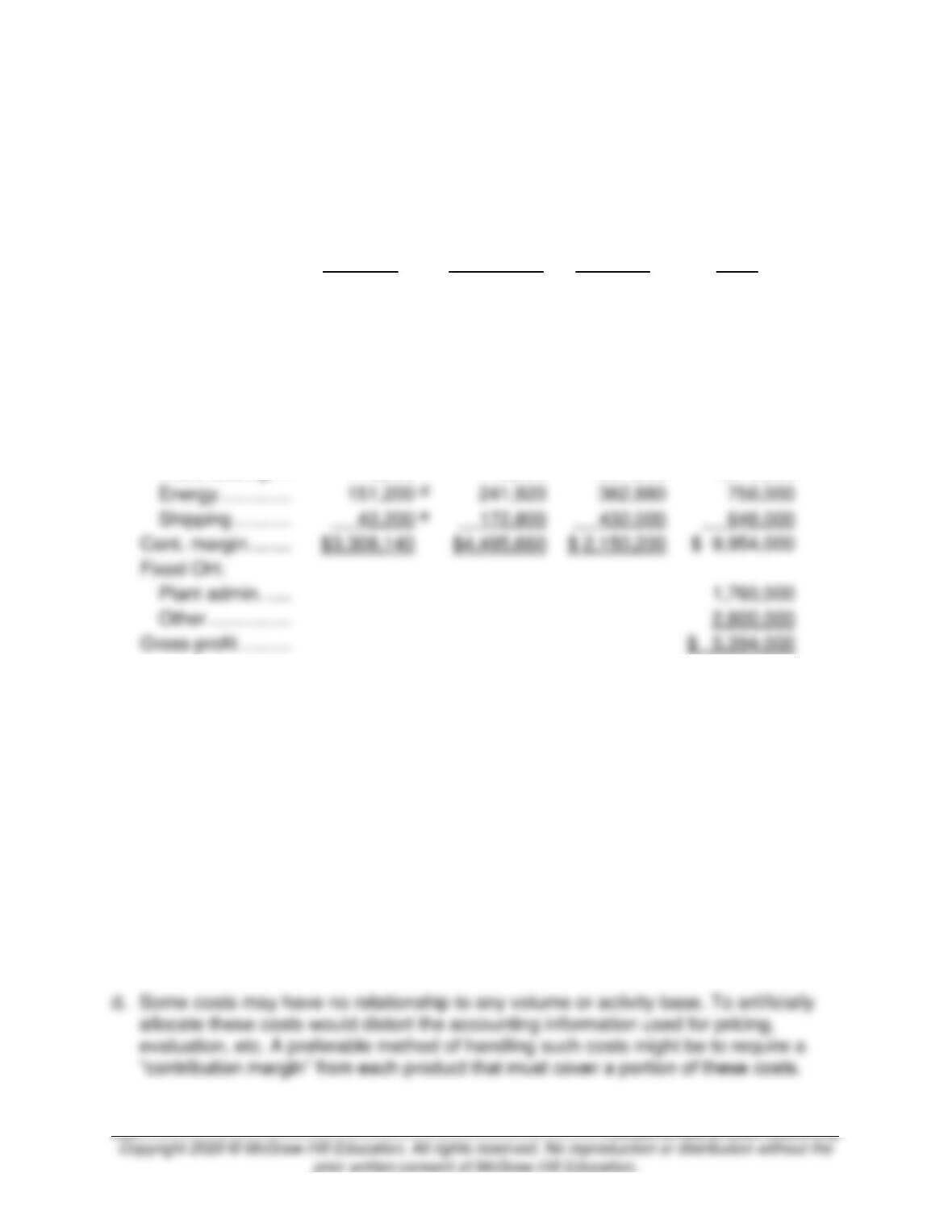
$ 9,954,000
Fixed OH:
Plant admin. …..
1,760,000
Other …………….
2,800,000
a $4,680 (= $468,000 ÷ 100 runs) per run × 22 runs = $102,960.
b $720 (= $1,152,000 ÷ 1,600 orders) per order × 400 orders = $288,000.
c $2,092.50 (= $1,674,000 ÷ 800 units) per unit × 200 units = $418,500.
d $15.12 (= $756,000 ÷ 50,000 machine-hours) per machine-hour × 10,000 machine-
hours = $151,200.
e $43.20 (= $648,000 ÷ 15,000 units) per unit shipped × 1,000 units shipped = $43,200
c. The activity-based costing method provides a more detailed breakdown of the costs.
This additional information should enable PMI’s management to make better
decisions. For example, if PMI wants to reduce costs then activity-based costing will
list the activities on which management should focus its cost-reducing efforts. Also,
the company will probably have more accurate product cost information for pricing
and other decisions.
9-60. (40 min.) Activity-Based Costing, Cost Flow Diagram, and Predetermined
Overhead Rates: Churchill Products.
a.
Burden rate = (Total overhead costs ÷ Budgeted total direct labor-hours)
Budgeted total direct labor-hours = 4,800 + 2,700 + 7,500 = 15,000 hours
Total overhead costs = $1,350,000 + $1,350,000 + $3,600,000 = $6,300,000
Burden rate = $6,300,000 ÷ 15,000 = $420 per DLH
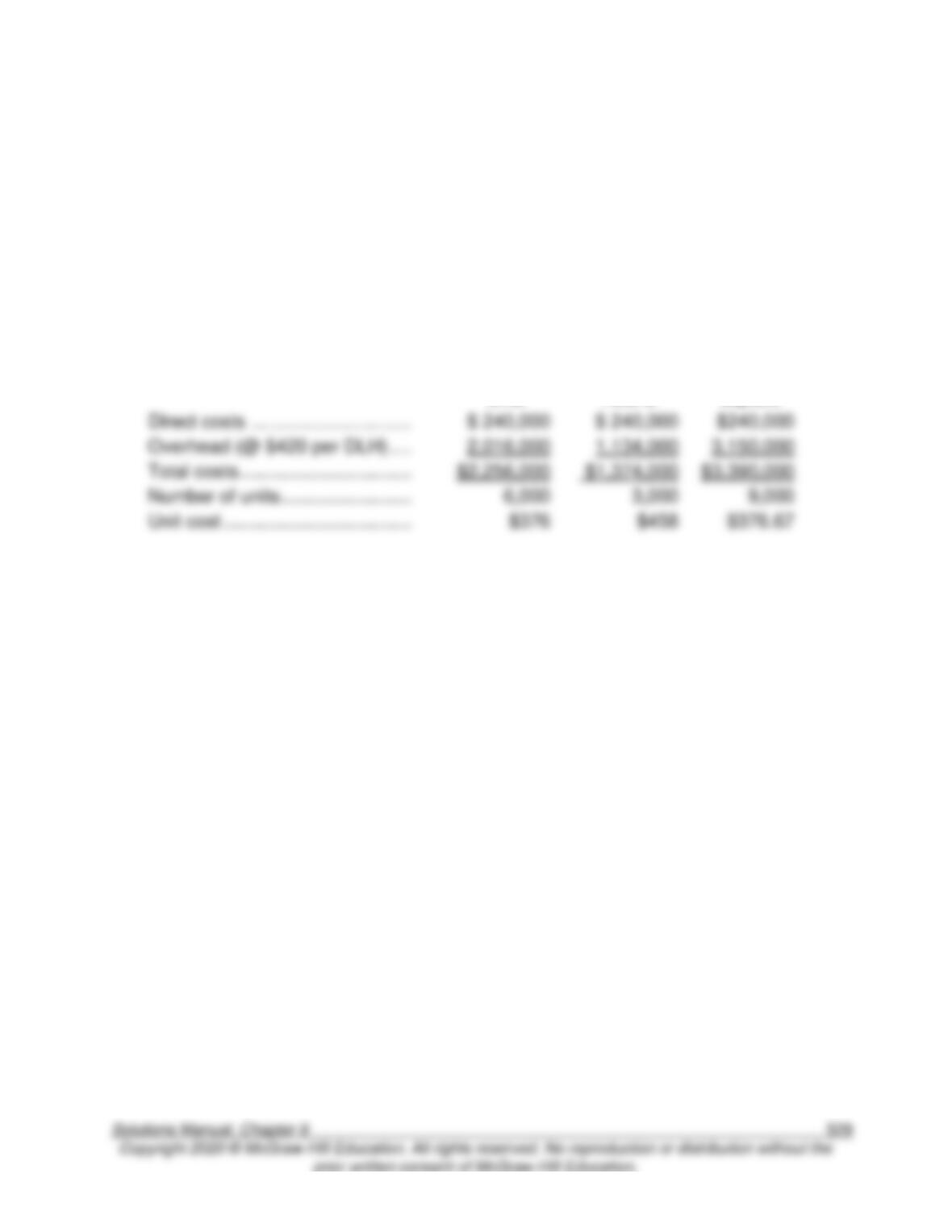
Unit costs:
9-60. (continued)
b.
9-60. (continued)
d.
Unit Costs:
Oval
Round
Square
Direct Costs ………………………
$240,000
$240,000
$240,000
Overhead:
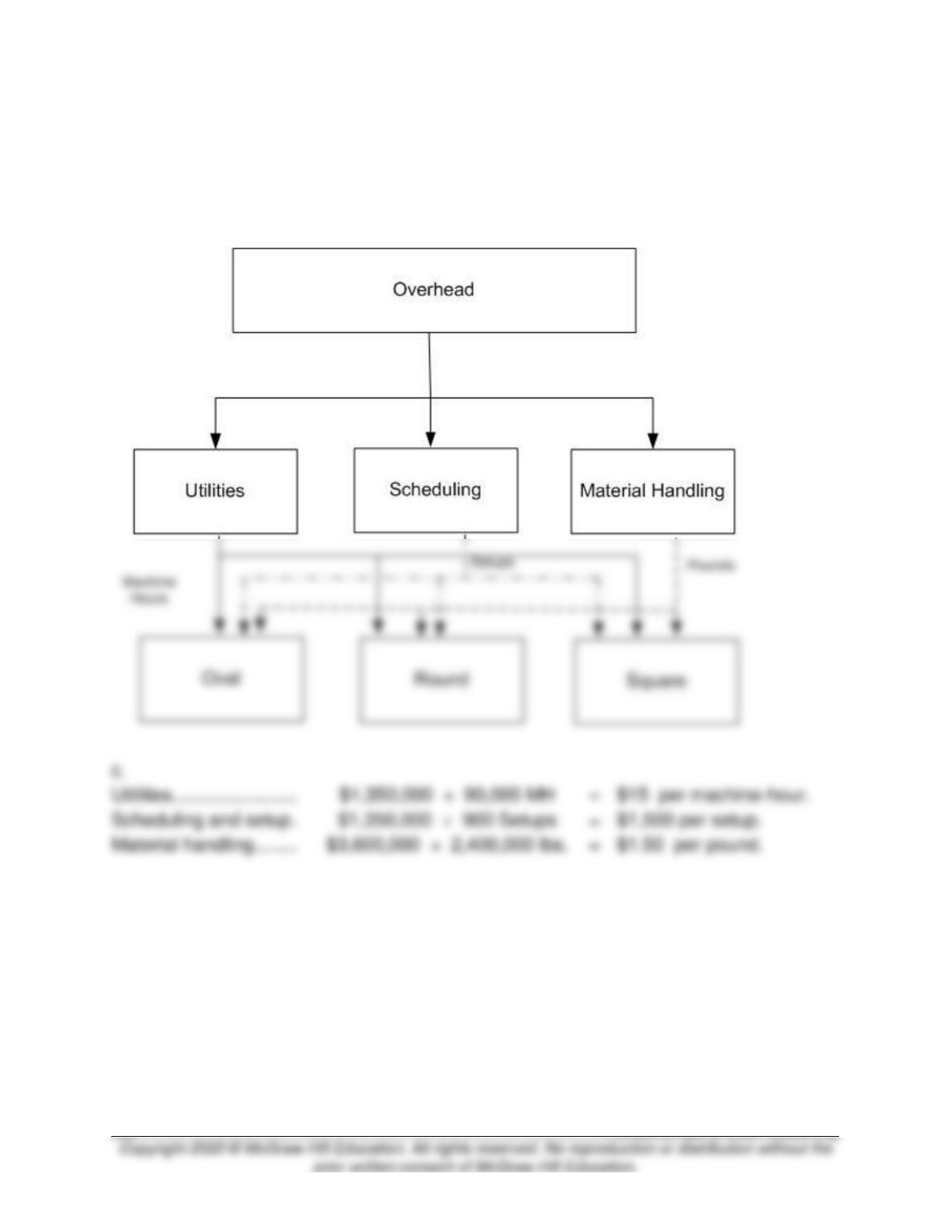
Utilities …………………………
675,000a
225,000
450,000
Scheduling and setup …….
180,000b
675,000
495,000
Material handling …………..
1,125,000c
675,000
1,800,000
Total costs ………………………..
$2,220,000
$1,815,000
$2,985,000
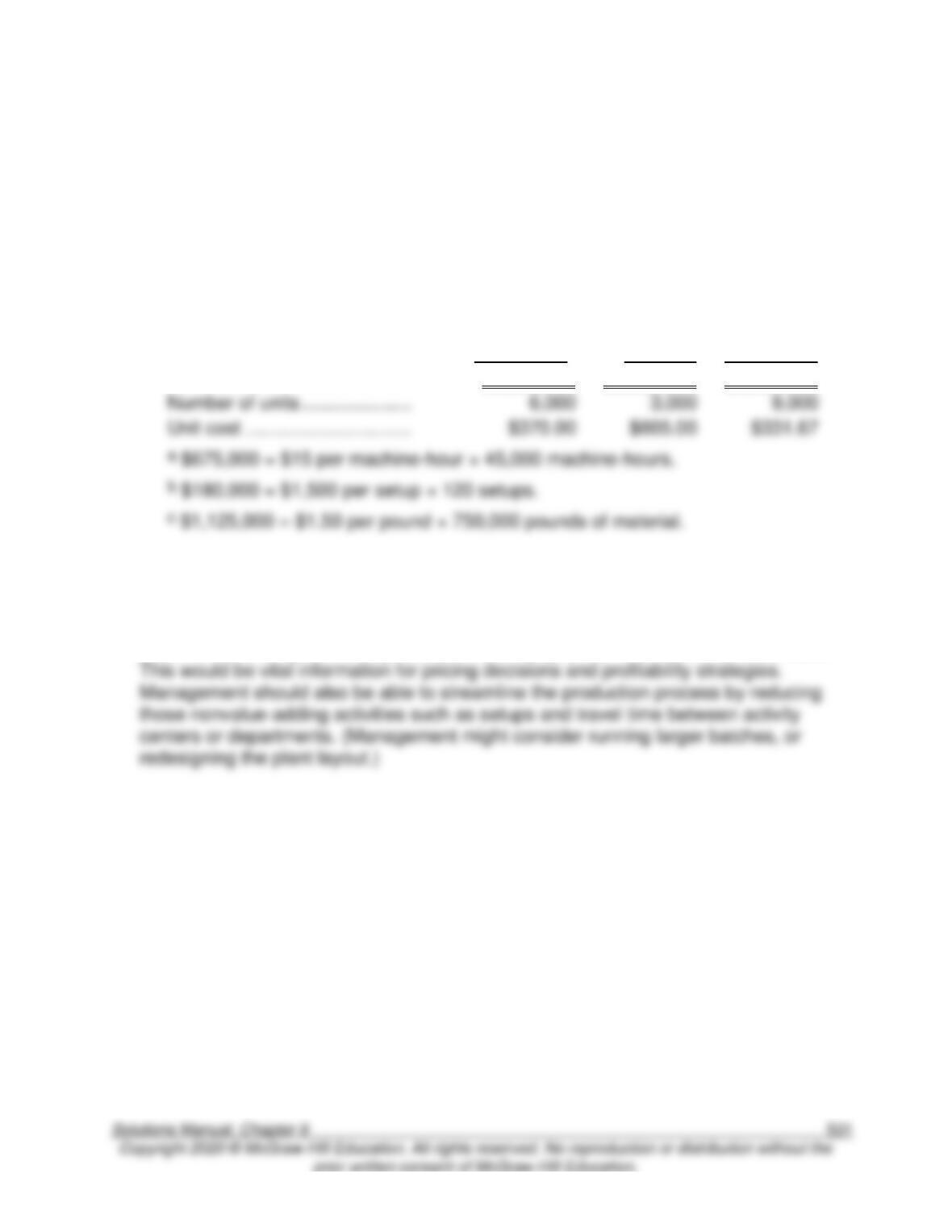
Number of units …………………
Unit cost …………………………..
$605.00
$331.67
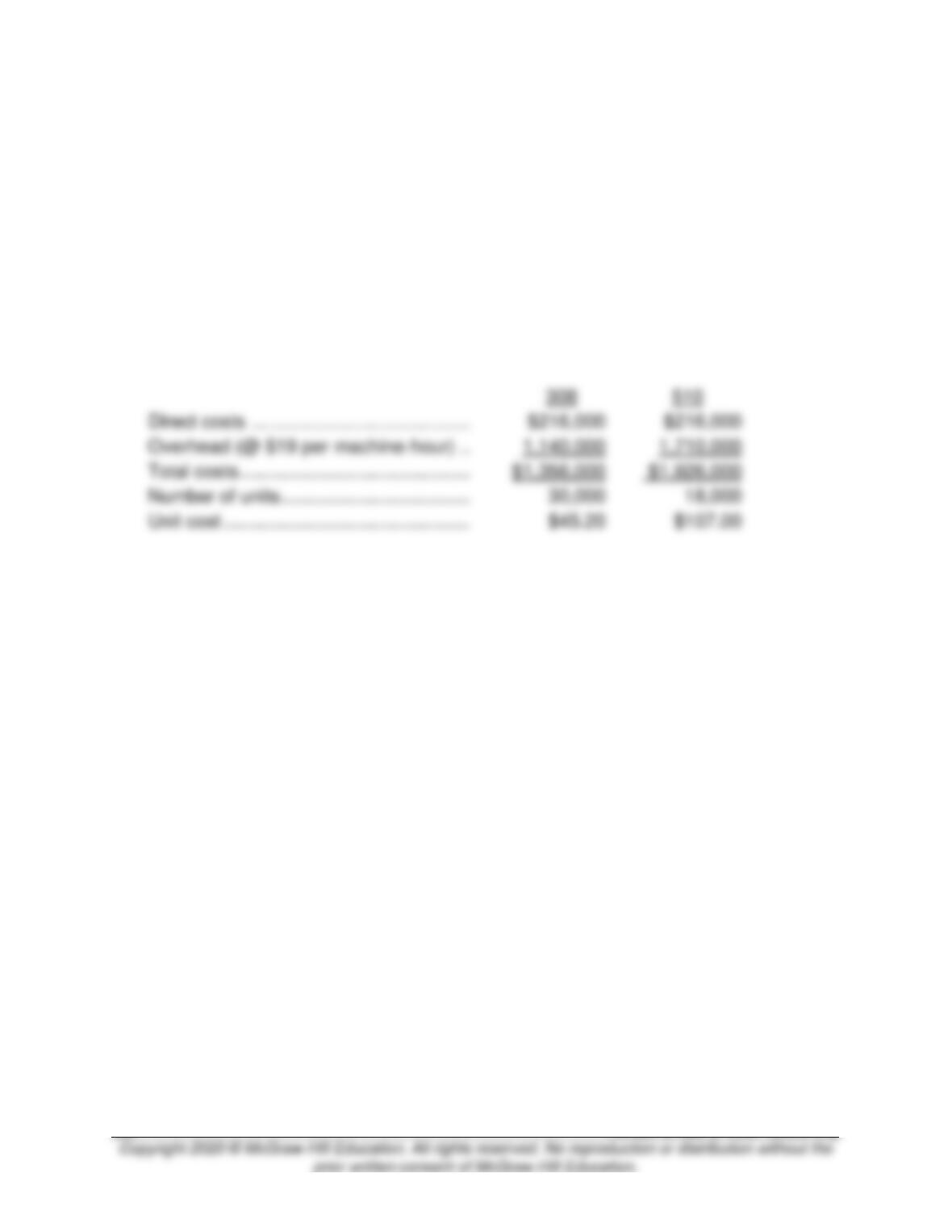
e. If management implemented an activity-based costing system it should be provided
with a more thorough understanding of product costs. By breaking down costs into
cost drivers, i.e., those activities that drive the costs, management should be able to
see the relationship between product complexity, product volume, and product cost.
9-61. (40 min.) Activity-Based Costing, Cost Flow Diagram, and Predetermined
Overhead Rates: Utica Manufacturing.
a.
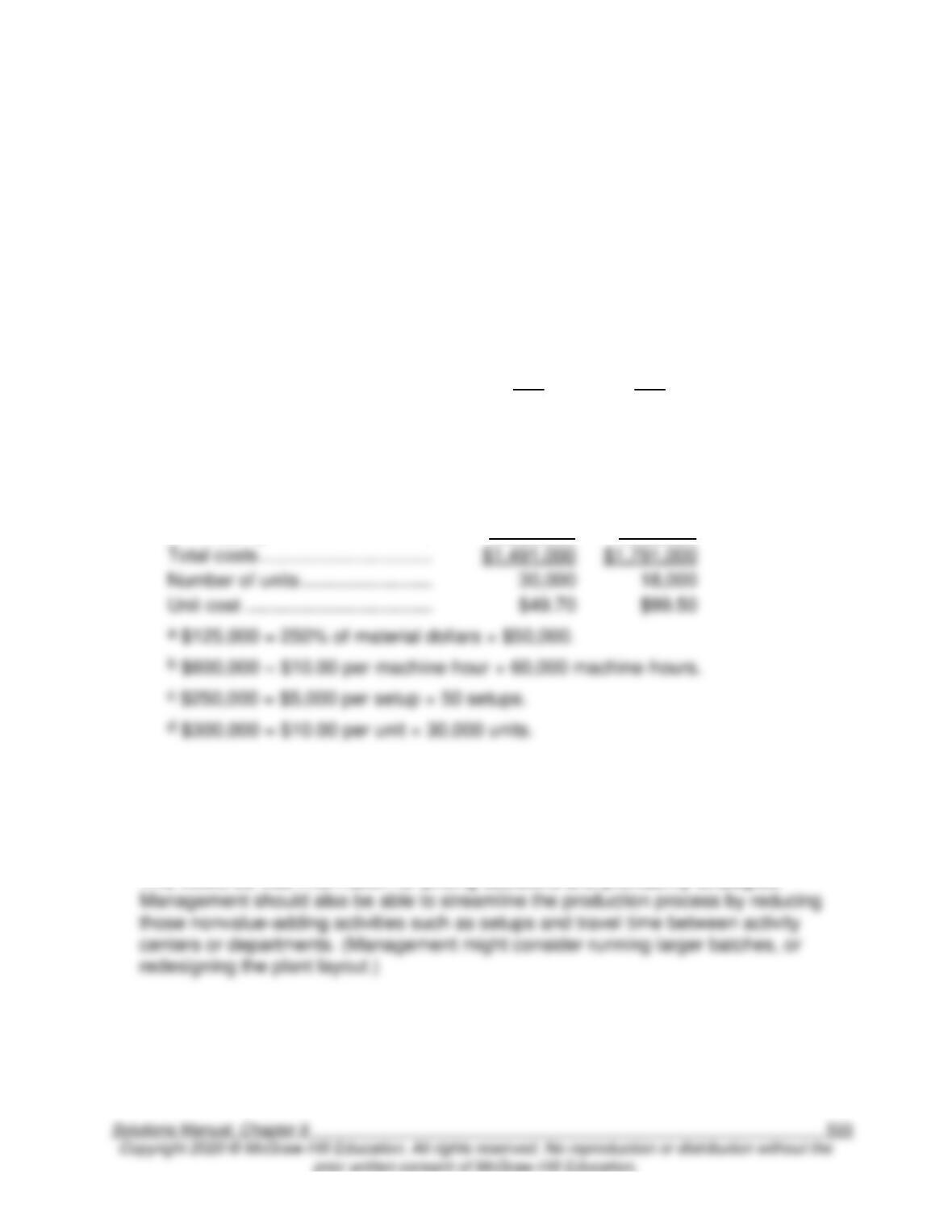
Burden rate = (Total overhead costs ÷ Budgeted total machine-hours)
Budgeted total machine-hours = 60,000 + 90,000 = 150,000 hours
Total overhead costs = $170,000 +$1,500,000 + $700,000 + $480,000= $2,850,000
Burden rate = $2,850,000 ÷ 150,000 machine-hours = $19 per machine-hour
Unit costs:
9-61. (continued)
b.
Inspection ….
$170,000 ÷ $68,000 material dollars
=
250% of material dollars.
Production …
$1,500,000 ÷ 150,000 machine-hours
=
$10.00 per machine-hour
Machine setup
$700,000 ÷ 140 Setups
=
$5,000 per setup.
Shipping ……
$480,000 ÷ 48,000 units
=
$10.00 per unit.
c.
Unit Costs:
308
510
Direct Costs ………………………….
$216,000
$216,000
Overhead:
Incoming inspection …………..
125,000a
45,000
Production ……………………….
600,000b
900,000
Machine setup ………………….
250,000c
450,000
Shipping…………………………..
300,000d
180,000
Total costs …………………………...
Number of units …………………….
Unit cost ………………………………
d. If management implemented an activity-based costing system it should be provided
with a more thorough understanding of product costs. By breaking down costs into
cost drivers, i.e., those activities that drive the costs, management should be able to
see the relationship between product complexity, product volume, and product cost.
9-62. (40 min.) Activity-Based Costing and Predetermined Overhead Rates:
Cain Components.
a.
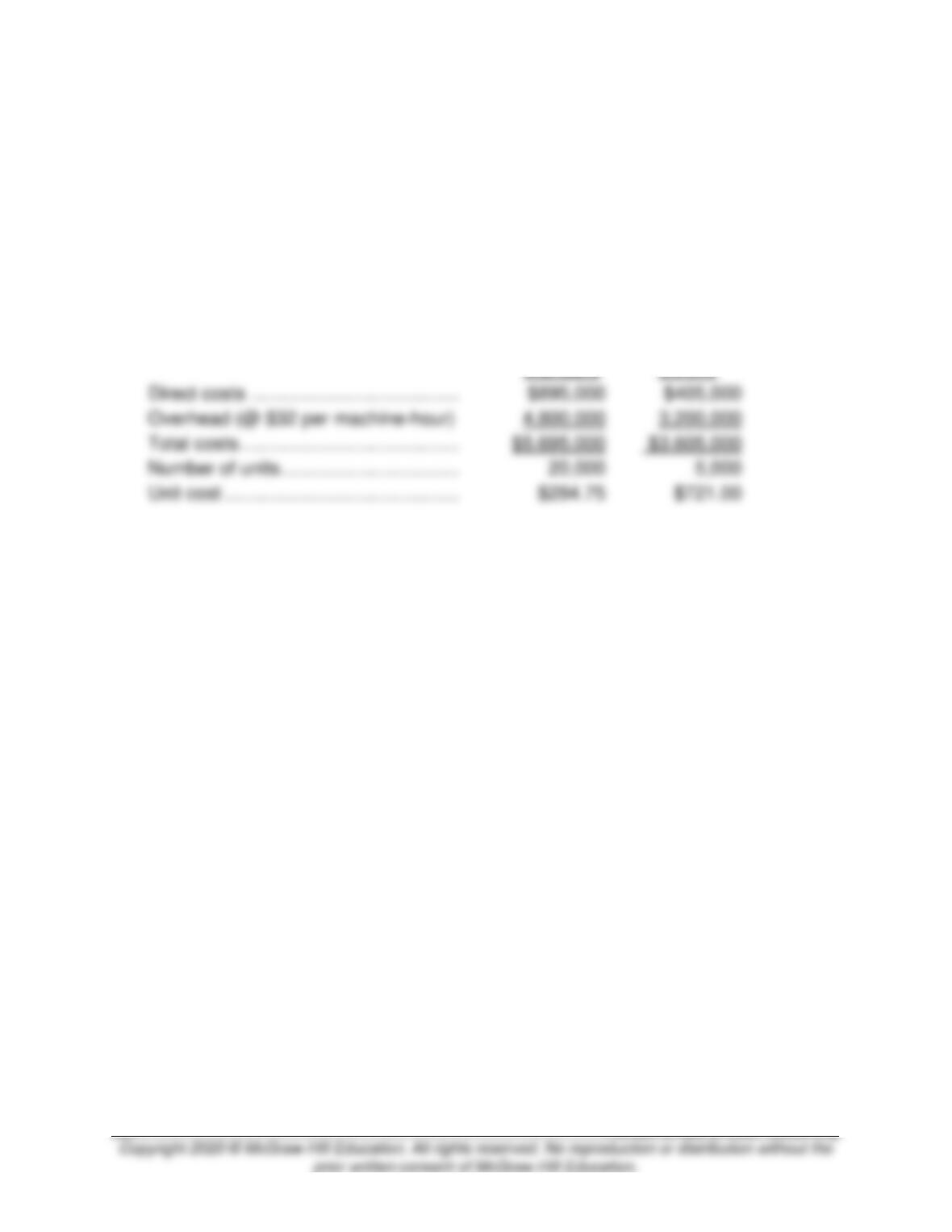
Burden rate = (Total overhead costs ÷ Budgeted total machine-hours)
Budgeted total machine-hours = 150,000 + 100,000 = 250,000 hours
Total overhead costs = $600,000 +$5,500,000 + $900,000 + $1,000,000 = $8,000,000
Burden rate = $8,000,000 ÷ 250,000 machine-hours = $32 per machine-hour
Unit costs:
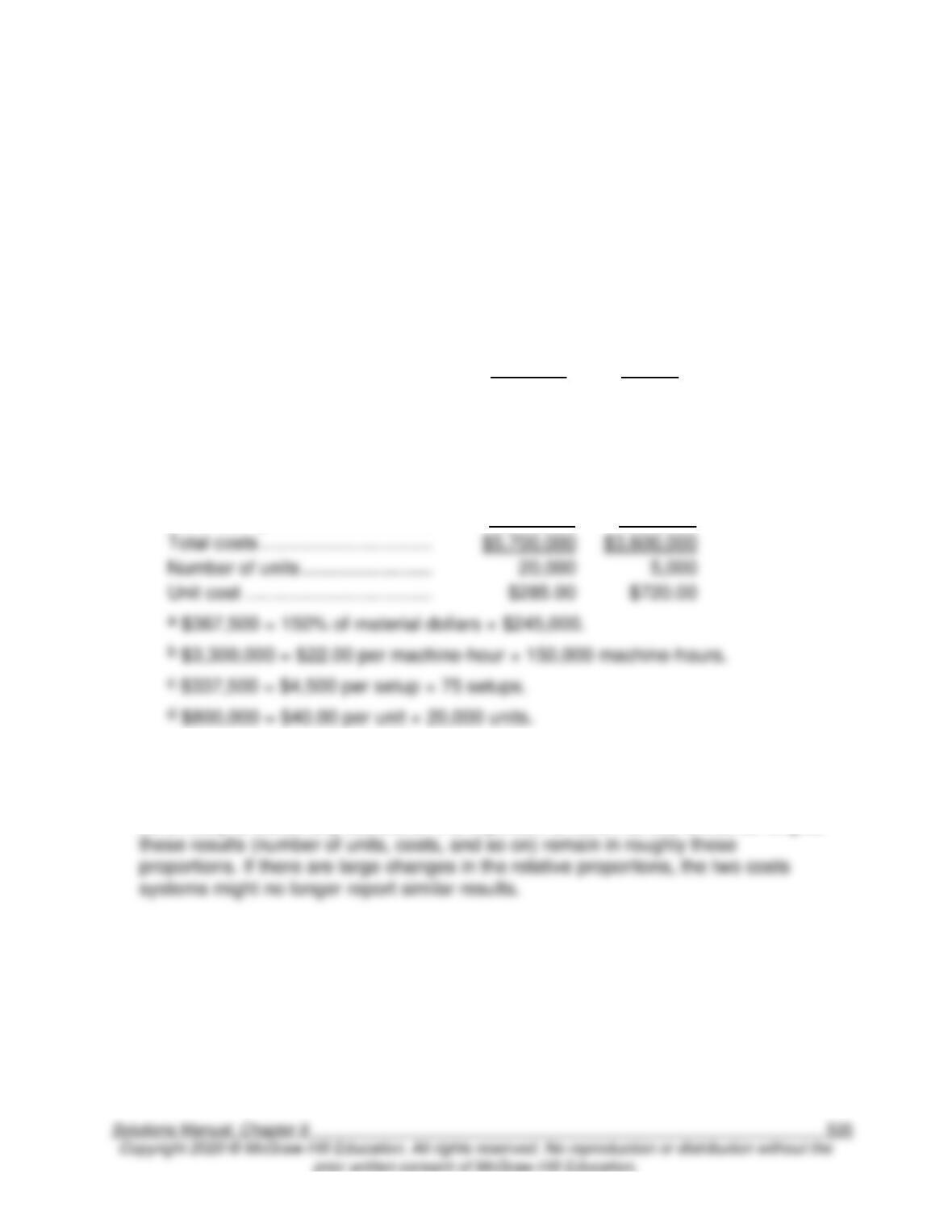
9-62. (continued)
b.
Receiving ..
$600,000 ÷ $400,000 material dollars
=
150% of material dollars.
Manufacturing
$5,500,000 ÷ 250,000 machine-hours
=
$22.00 per machine-hour
Machine setup
$900,000 ÷ 200 Setups
=
$4,500 per setup.
Shipping ….
$1,000,000 ÷ 25,000 units
=
$40.00 per unit.
Unit Costs:
Standard
Deluxe
Direct Costs ………………………….
$895,000
$405,000
Overhead:
Receiving …………………………
367,500a
232,500
Manufacturing …………………..
3,300,000b
2,200,000
Machine setup ………………….
337,500c
562,500
Shipping…………………………..
800,000d
200,000
Total costs …………………………...
Number of units …………………….
Unit cost ………………………………
c. If these results are typical, it will probably not be worth adopting the ABC system.
The difference in the reported product costs are not significant, meaning they would
be unlikely to distort any decisions. It is important to note that this is true as long as
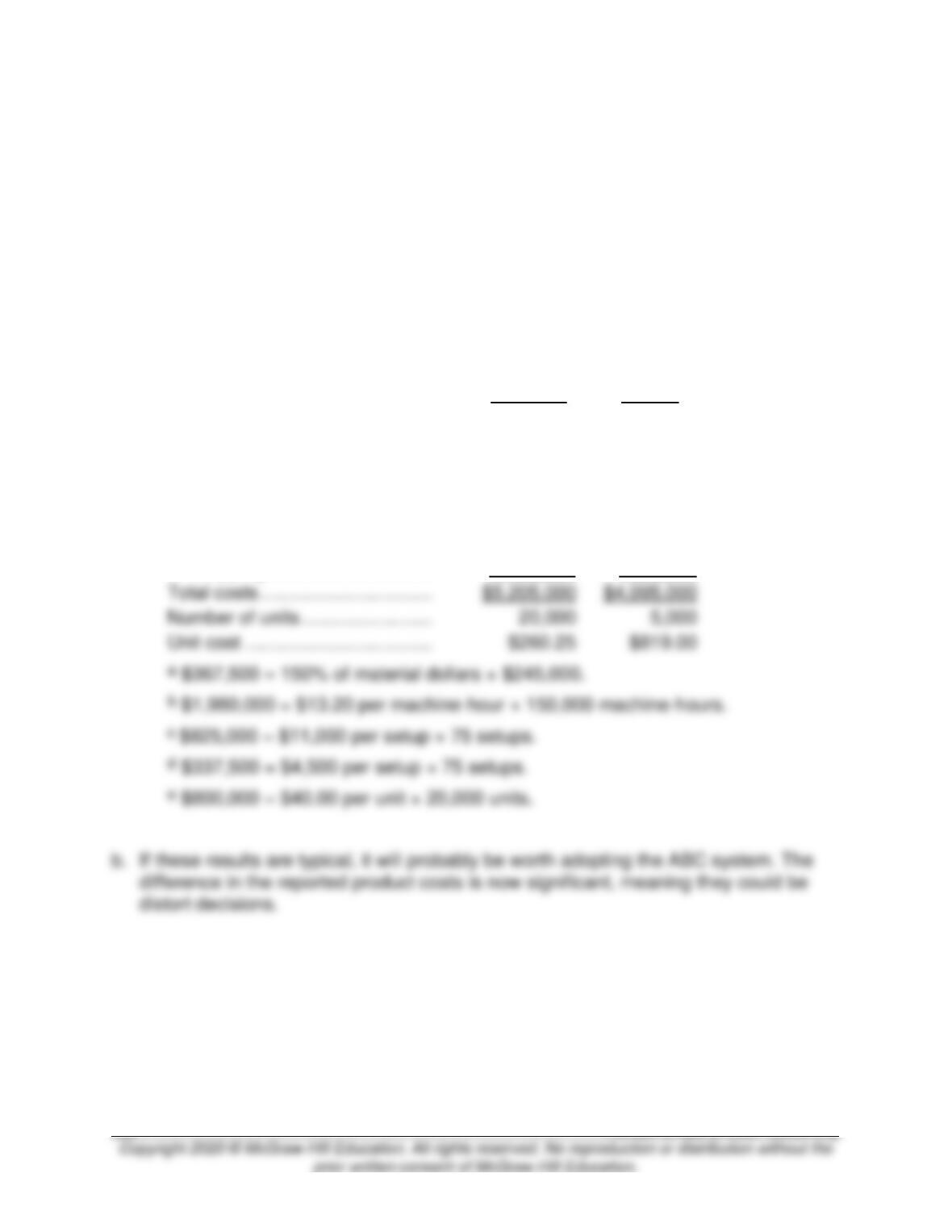
9-63. (40 min.) Activity-Based Costing and Predetermined Overhead Rates:
Cain Components.
a.
Receiving ..
$600,000 ÷ $400,000 material dollars
=
150% of material dollars.
Production..
$3,300,000 ÷ 250,000 machine-hours
=
$13.20 per machine-hour
Engineering
$2,200,000 ÷ 200 Setups
=
$11,000 per setup
Machine setup
$900,000 ÷ 200 Setups
=
$4,500 per setup.
Shipping ….
$1,000,000 ÷ 25,000 units
=
$40.00 per unit.
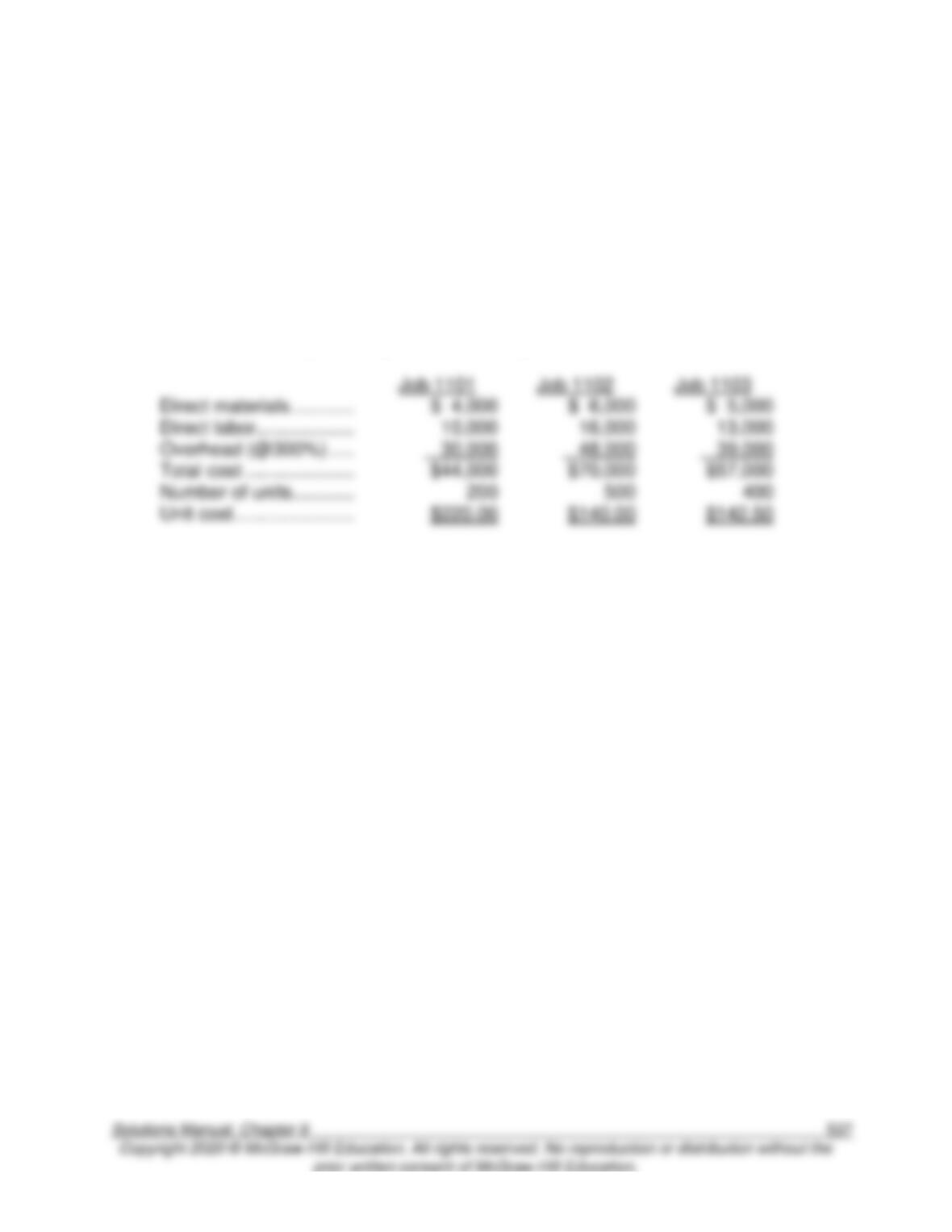
Unit Costs:
Standard
Deluxe
Direct Costs ………………………….
$895,000
$405,000
Overhead:
Receiving …………………………
367,500a
232,500
Production ……………………….
1,980,000b
1,320,000
Engineering ……………………..
825,000c
1,375,000
Machine setup ………………….
337,500d
562,500
Shipping…………………………..
800,000e
200,000
Total costs …………………………...
Number of units …………………….
5,000
9-64. (40 min.) Activity-Based Costing of Jobs: Lillis Manufacturing.
a.
The predetermined rate using the traditional system at Lillis is calculated using direct–
labor cost, which is not given in the problem. However, we know that the cost analyst
estimates 16,000 direct-labor hours for the coming year and that an hour of direct labor
costs $25 on average. Therefore, the annual direct-labor cost at Lillis is estimated to be
$400,000 (= $25 × 16,000 hours).
The predetermined overhead rate is 300% of direct–labor cost (= $1,200,000 ÷
$400,000).
The cost of each of the jobs using the traditional system:
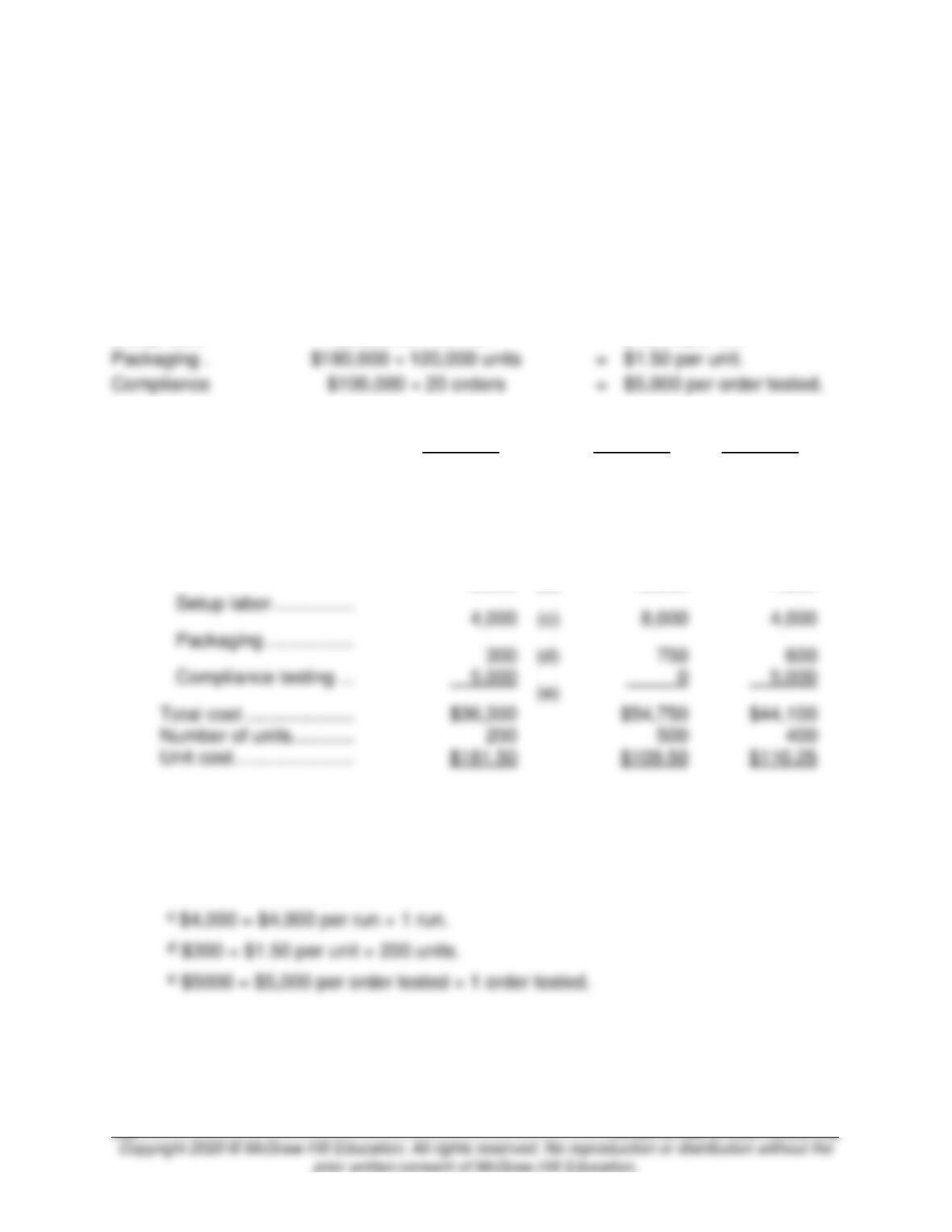
9-64. (continued)
b.
The first step in calculating the unit costs using the ABC system is to calculate the cost–
driver rates.
Machining ..
$400,000 ÷ $20,000 machine-hours
=
$20 per machine-hour
Assembly …
$200,000 ÷ 16,000 direct-labor hours
=
$12.50 per labor-hour
Setup labor
$320,000 ÷ 80 Run
=
$4,000 per run
Packaging .
=
$1.50 per unit.
Unit Costs:
Job 1101
Job 1102
Job 1103
Direct materials …………
$ 4,000
$ 6,000
$ 5,000
Direct labor ……………….
10,000
16,000
13,000
Overhead:
Machining ………………
10,000
(a)
14,000
12,000
Assembly ………………
Setup labor …………….
(d)
Compliance testing …
Total cost …………………
$54,750
Number of units …………
a $10,000 = $20 per machine-hour × 500 machine-hours.
b $3,000 = $12.50 per labor-hour × 240 labor-hours.
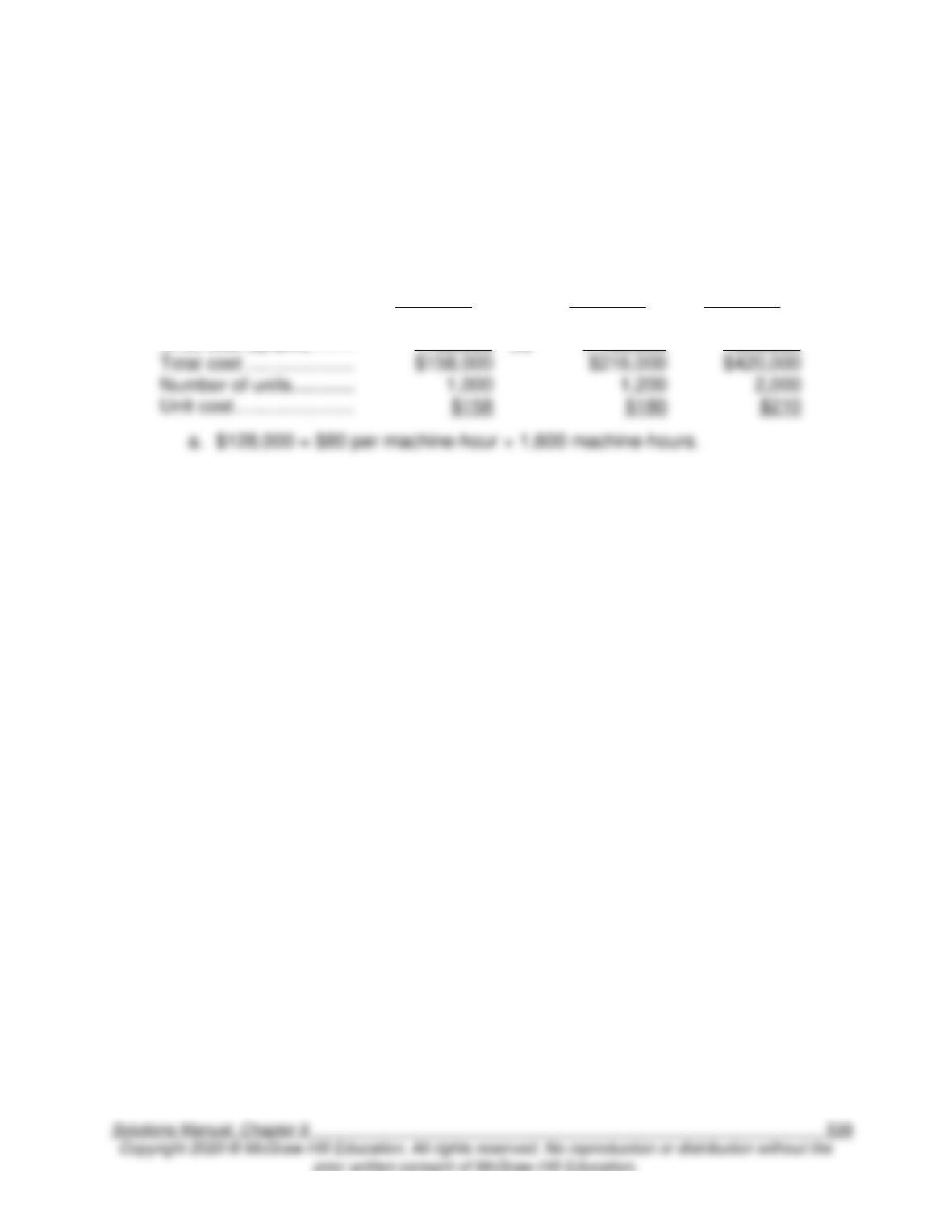
9-65. (40 min.) Activity-Based Costing of Jobs: DP, Inc.
a.
The predetermined rate using the traditional system at DP is calculated using machine-
hours. The predetermined overhead rate is $80 per machine-hour (= $16,00,000 ÷
200,000).
The cost of each of the jobs using the traditional system:
Job 0404
Job 0407
Job 0411
Direct materials …………
$ 30,000
$ 56,000
$100,000
Overhead (@$80) ……..
(a)
Total cost …………………
$158,000
$216,000
$420,000
Number of units …………
9-65. (continued)
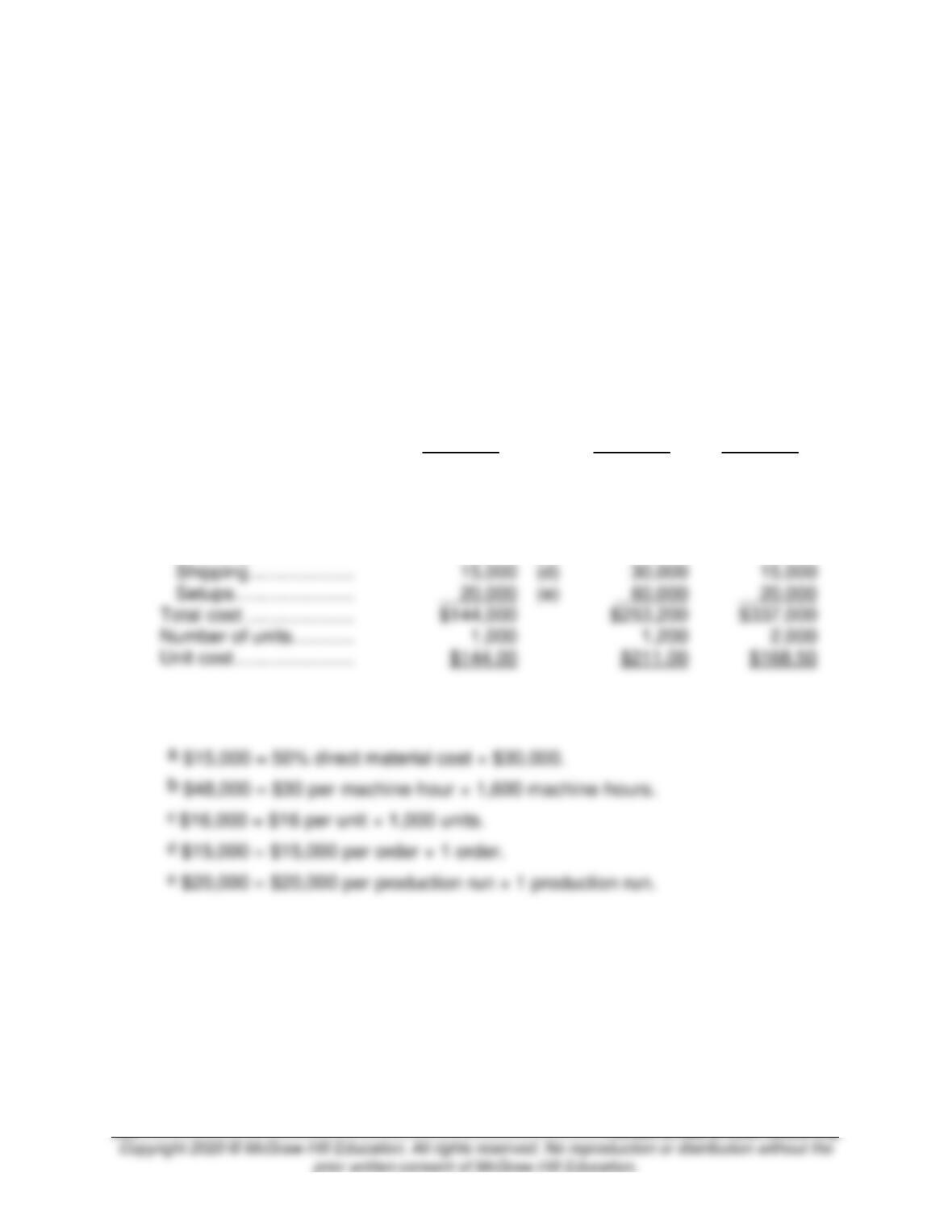
b.
The first step in calculating the unit costs using the ABC system is to calculate the cost–
driver rates.
Material handling
$3,000,000 ÷ $6,000,000
=
50% direct material cost
Machining ……….
$6,000,000 ÷ 200,000 machine-hours
=
$30 per machine-hour
Finishing …………
$2,000,000 ÷ 125,000 units
=
$16 per unit
Shipping …………
$1,500,000 ÷ 100 orders
=
$15,000 per order.
Setups ……………
$3,500,000 ÷ 175 runs
=
$20,000 per run.
Unit Costs:
Job 0404
Job 0407
Job 0411
Direct materials …………
$30,000
$ 56,000
$100,000
Overhead:
Material handling …….
15,000
(a)
28,000
50,000
Machining ………………
48,000
(b)
60,000
120,000
Finishing………………..
16,000
(c)
19,200
32,000
Shipping ………………..
15,000
(d)
30,000
15,000
Setups …………………..
(e)
Total cost …………………
$253,200
Number of units …………