9-18
o When the productivity of the asset varies significantly from one period to
another, the units-of-activity method results in the best matching of
9-19
Learning Objective – 10 – Compare the procedures for long-lived assets
under GAAP and IFRS.
A Look at IFRS—IFRS related to property, plant, and equipment is found in IAS
16 (“Property, Plant and Equipment”) and IAS 23 (“Borrowing Costs”). IFRS follows
most of the same principles as GAAP in the accounting for property, plant, and
equipment. There are, however, some significant differences in the implementation:
KEY POINTS
▪ The definition for plant assets for both IFRS and GAAP is essentially the same.
▪ Both international standards and GAAP follow the cost principle when
accounting for property, plant, and equipment at date of acquisition. Cost
consists of all expenditures necessary to acquire the asset and make it ready
for its intended use.
▪ Under both IFRS and GAAP, interest costs incurred during construction are
capitalized. Recently, IFRS converged to GAAP requirements in this area.
▪ IFRS uses the term residual value, rather than salvage value, to refer to an
owner’s estimate of an asset’s value at the end of its useful life for that owner.
▪ IFRS allows companies to revalue plant assets to fair value at the reporting
date. Companies that choose to use the revaluation framework must follow
revaluation procedures. If revaluation is used, it must be applied to all assets in
9-20
▪ The accounting for plant asset disposals is essentially the same under IFRS and
GAAP.
▪ Initial costs to acquire natural resources are essentially the same under IFRS and
GAAP.
▪ The definition of intangible assets is essentially the same under IFRS and GAAP.
▪ Intangibles generally arise when a company buys another company. In this case,
specific criteria are needed to separate goodwill from other intangibles. Both GAAP
and IFRS follow the same approach to make this separation, that is, companies
▪ As in GAAP, under IFRS the costs associated with research and development are
segregated into the two components. Costs in the research phase are always
expensed under both IFRS and GAAP. Under IFRS, however, costs in the
development phase are capitalized as Development Costs once technological
feasibility is achieved.
▪ IFRS permits revaluation of intangible assets (except for goodwill). GAAP prohibits
revaluation of intangible assets.
▪ The accounting for exchanges of nonmonetary assets has recently converged
between IFRS and GAAP. GAAP now requires that gains on exchanges of
nonmonetary assets be recognized if the exchange has commercial substance.
This is the same framework used in IFRS.
LOOKING TO THE FUTURE

9-21
The IASB and FASB have identified a project that would consider expanded recognition of
internally generated intangible assets. IFRS permits more recognition of intangibles
compared to GAAP. Thus, it will be challenging to develop converged standards for
intangible assets, given the long-standing prohibition on capitalizing internally generated
intangible assets and research and development costs in GAAP.

9-22
Chapter 9 Review
✓ Why are plant assets listed at historical cost? What costs are included in the cost of
plant assets?
✓ What is depreciation?
✓ Compute periodic depreciation using the straight-line method assuming a cost of
$10,000, zero salvage value, and a 5-year useful life. Contrast its expense pattern with
that of an accelerated method.
✓ When and how do you revise depreciation? Explain the difference between revenue
expenditures and capital expenditures.
✓ What are the ways in which plant assets can be disposed? Explain how to account for
the disposal of plant assets.
✓ Describe methods for analyzing a company’s use of plant assets.
✓ What are intangible assets and how are they reported?
✓ How are long-lived assets reported on the balance sheet?
✓ Explain how the declining balance method is calculated. What kind of assets is the
units-of-activity method of depreciated suited for?

9-23
Vocabulary Quiz Name ______________________ Date ______________
Chapter 9
1. A depreciation method in which useful life is expressed in
terms of the total units of production or the use expected from
the asset.
2. The process of allocating to expense the cost of a plant asset
over its useful life in a rational and systematic manner.
3. Expenditures to maintain the operating efficiency and expected
productive life of the asset.
4. The value of all favorable attributes that relate to a business
enterprise.
5. A method in which an equal amount of depreciation is
expensed each year of the asset’s useful life.
6. A word, phrase, jingle, or symbol that distinguishes or
identifies a particular enterprise or product.
7. Rights, privileges, and competitive advantages that result from
ownership of long-lived assets that do not possess physical
substance.
8. The cost of a plant asset less its salvage value.
9. Resources that have physical substance, are used in the
operations of the business, and are not intended for sale to
customers.
10. Costs that are immediately charged against revenue as an
expense.
9-24
Solutions to Vocabulary Quiz
Chapter 9
1. Units-of-activity method

9-25
Multiple Choice Quiz Name______________________ Date
______________
Chapter 9
1. The cost of an asset less its salvage value is referred to as:
a. book value.
b. market value.
c. depreciable cost.
d. historical cost.
2. An exclusive right issued by the U.S. Patent Office that enables the recipient to
manufacture, sell, or otherwise control an invention for a period of 20 years from
the date of the grant is a:
a. trademark.
b. license.
c. goodwill.
d. patent.
3. The most widely used method of depreciation is the:
a. straight-line method.
b. declining-balance method.
c. units-of-activity method.
d. sum-of-the-years-digits method.
Use the following information to answer questions 4, 5, and 6:
The Blooming Miracles Flower Shop bought a delivery van on January 1, 2014. The van
cost $18,000 and had an expected salvage value of $3,000. The life of the van was
estimated to be 5 years or 150,000 miles.
4. The depreciable cost of the van is:
a. $18,000.
b. $15,000.
c. $ 5,000.
d. $ 3,000.
5. The depreciation expense for 2014 using the straight-line method of depreciation
is:
a. $5,000.
b. $3,600.
c. $3,000.
d. none of these answer choices are correct.
6. Using the straight-line method of depreciation, the book value of the van at the
beginning of the third year would be:
a. $18,000.
b. $15,000.
c. $12,000.
d. $ 6,000.

9-26
7. The following method(s) is (are) accelerated method(s) of depreciation:
a. straight-line.
b. declining-balance method.
c. MACRS.
d. both the declining-balance method and MACRS.
8. Depreciation is dependent on a number of estimates. When a change in an estimate is
required, the change is made:
a. in the current year.
b. in the future years.
c. to prior periods.
d. both in the current year and in the future years.
9. All of the following are intangible assets except:
a. goodwill.
b. trademarks.
c. coal reserves.
d. patents.
10. An exclusive right to reproduce and sell artistic or published work is a:
a. patent.
b. copyright.
c. license.
d. franchise.
9-27
Solutions to Multiple Choice Quiz
Chapter 9
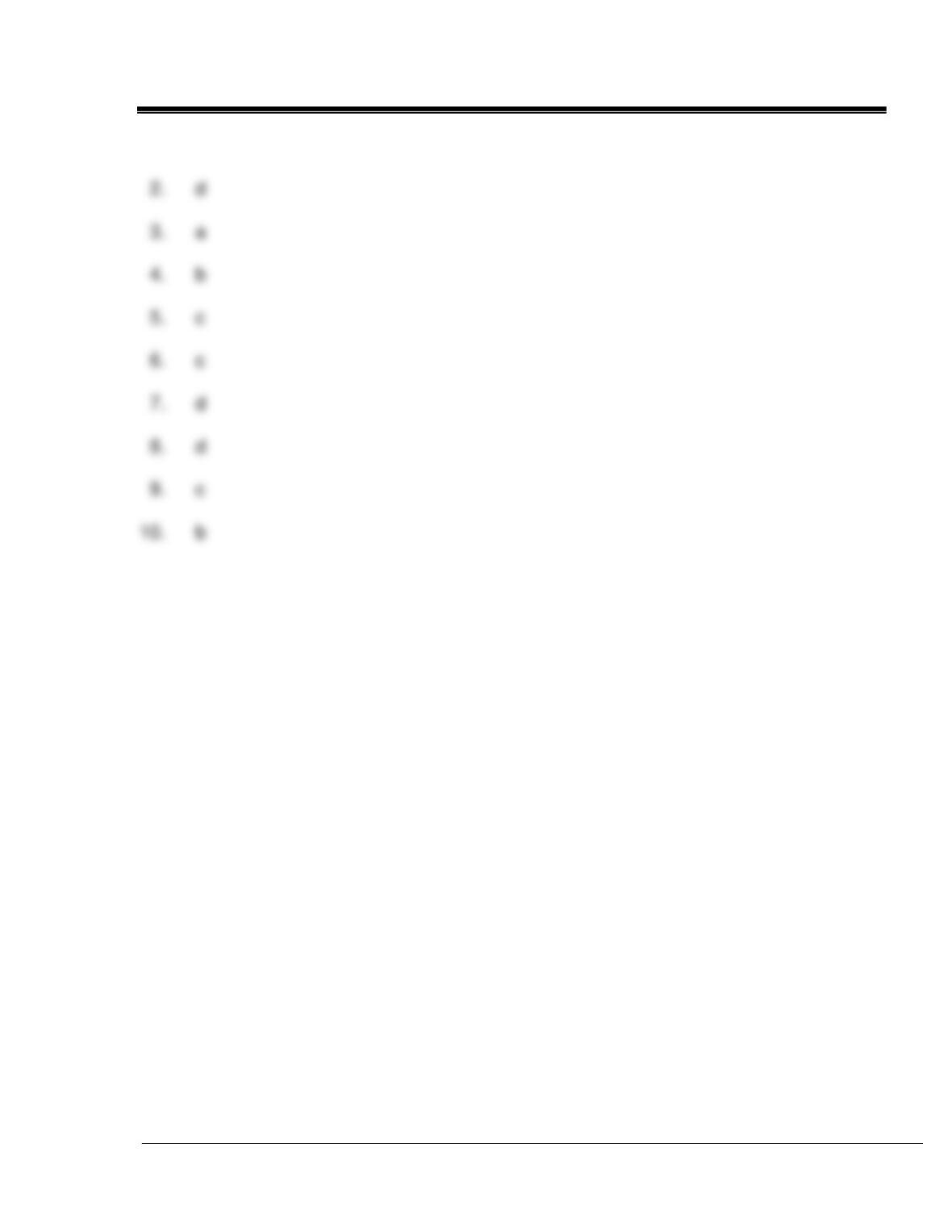
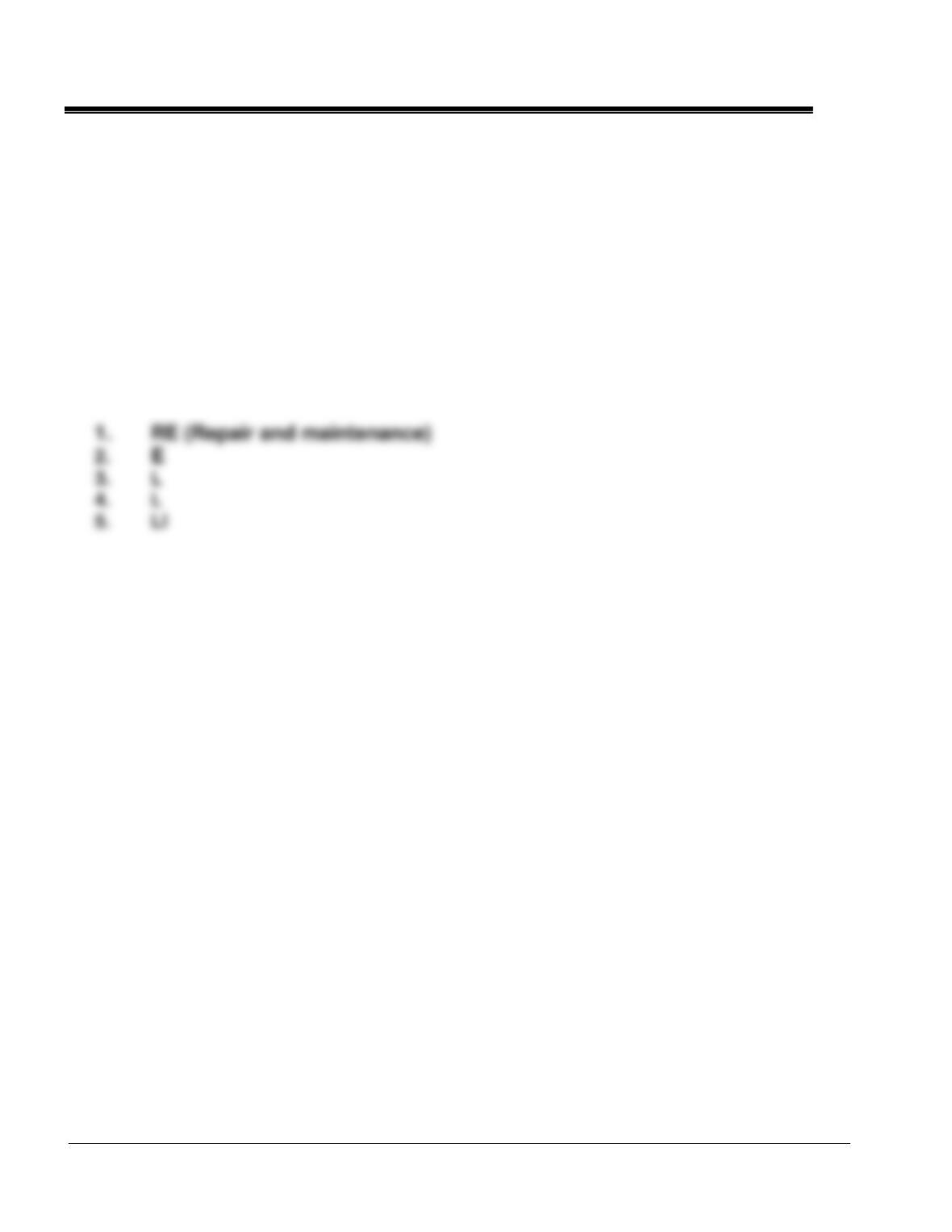
1. c
9-28
Exercise 1 – Reporting Plant Asset Activity
Chapter 9
Briars’ Hunting Supply Company incurred the following expenditures during the period:
1 Paint and labor costs for painting store interior.
2 Purchase of display racks.
3 Purchase of land for new parking lot.
4 Cost of removing shed from land prior to installing parking lot.
5 Addition of parking spaces (cost to pave and light area).
Indicate whether each of the above items would be classified as land (L), land
improvements (LI), equipment (E), or revenue expenditures (RE).
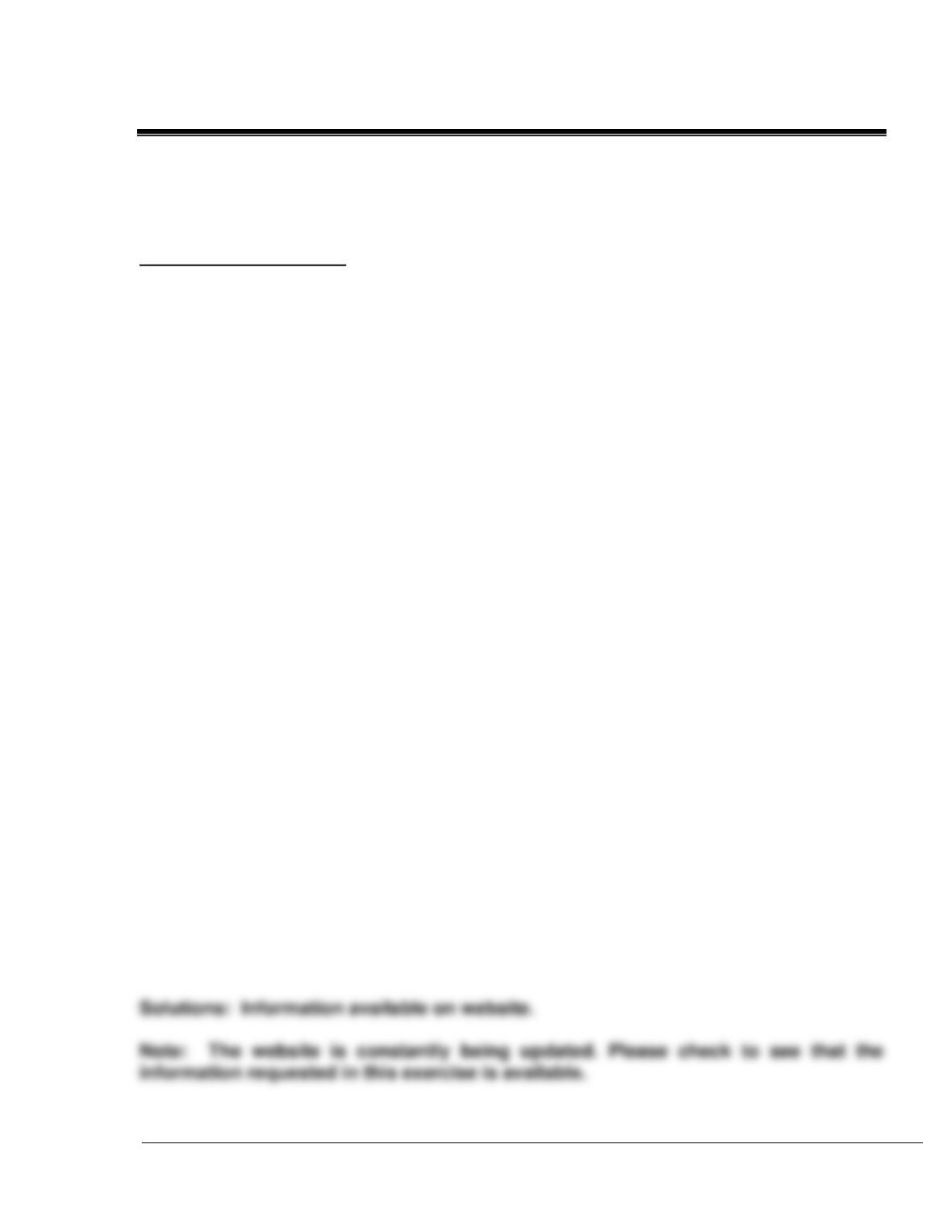
Solutions:
9-29
Exercise 2 – World Wide Web Research and Financial Statement Presentation
Activity
Chapter 9
Southwest Airlines started in 1971 with three planes serving three Texas cities. Today, it
has over 430 planes and flies more than 70 million passengers a year to 60 cities all over
the southwest and beyond. Southwest Airlines has become one of the largest major
airlines in America. Obtain an annual report for Southwest Airlines lines at
http://www.iflyswa.com (You can obtain this information from the 10K filing.) Find the
sections on Property and Equipment and Leases in the Notes to Financial Statements and
look at the assets listed on the Balance Sheet. Also look at the Statement of Cash Flows.
1. Look at the Property and Equipment section of the Balance Sheet. What are the
amounts listed for each of these categories? Are you surprised at the breakdown of
Property and Equipment? Why or why not?
2. What items do you find on the Statement of Cash Flows relating to property and
equipment?
3. What method of depreciation does Southwest use? Would you expect Southwest
Airlines to use a different method of depreciation for tax purposes? Why or why
not?
4. What is the life over which Southwest depreciates fixed assets?
5. What are the amounts and types of leases disclosed in the Notes to Financial
Statements? What other information regarding leases do you find useful to financial
statement users?
9-30
Exercise 3 – World Wide Web Research and
Financial Statement Presentation Activity
Chapter 9
An impairment of an asset is a permanent decline in its market value. Although assets
are supposed to be written down to the new market value during the year in which the
decline in value occurred, some companies have adopted the practice of timing the
recognition of gains and losses to achieve certain income results. This practice is known
as earnings management. Obtain the annual report for AirTran Airways from your school
library or go to http://www.airtran.com.
1. How does AirTran account for asset impairment of Property. Plant and Equipment
in its financial statements?
2. AirTran’s Balance Sheet shows several intangible assets. List these intangible
assets. Comment on AirTran’s treatment of intangible assets (from the footnotes).
9-31
Exercise 4 – World Wide Web Research and Intangible Assets Activity
Chapter 9
Your roommate just returned from accounting class in a very bad mood and announced, “I
do not need to take accounting. What will I ever need to know about reporting and
analyzing long-lived assets? I am a management major.” Write a memo to your roommate
in response to the comment. Remember the criteria for good business writing—
coherence, clarity and conciseness.
Solution:
DATE: 5/1/1X
TO: My Roommate

9-32
Exercise 5 – Plant Assets Ethics Activity
Chapter 9
You have just landed an accounting position with a national telecommunications
company. Because this is your first job you are eager to please your co-workers and your
supervisor who works closely with the controller. However, your supervisor has just paid
you a visit. She told you that the controller is concerned that profits for the last fiscal year
are much less than profits in the preceding five years. The controller has asked that
depreciation on a machine purchased at the beginning of last year be recalculated. The
machine has a five-year useful life and is depreciated using the straight-line method. The
controller has asked that the machine be depreciated over a ten-year useful life. Your
supervisor contends that the “depreciation thing” really doesn’t matter because the
machine has already been paid for. In addition, your supervisor gives you an adjusting
journal entry to correct what she calls “expense transfers”. This entry transfers items
originally recorded as repairs and maintenance to capital assets.
1. Do you agree with the supervisor regarding the change in the estimated useful life
of the machine? Why or why not?
2. Are you going to recalculate the depreciation and change the entry? Why or why
not?
3. What is the proper accounting treatment for: (1) repairs and maintenance and
(2) plant assets?
4. What is your supervisor trying to accomplish with the suggested “expense
transfers” entry? What would be your course of action regarding the suggested
entry?
9-33
Solution:
1. You have been put in a very tough position. To reclassify the machine from a 5–
year asset to a 10-year asset for the sole purpose of income manipulation or
9-34
Exercise 6 – Accounting for Intangible Assets Activity
Chapter 9
Chunky River Real Estate Company has the following transactions related to intangible
assets during the year:
Jan. 7 Purchases a 10-year franchise with a national real estate company.
Feb. 1 Paid company personnel prize money for creating best advertising jingle for
TV ad campaign.
Apr. 9 Purchases the trademark (company logo) from another local real estate
company.
Aug. 3 Receives a copyright on company advertising “jingle” created by company
personnel.
Sept. 8 Made first annual payment to national real estate company for franchise fee.
How are each of the above items accounted for in the financial statements?
Solution:
The 10-year franchise is classified as an intangible asset with a definite life of 10
years. The asset should be amortized over 10 years (or its useful life if less than 10
years) using the straight-line method.