11,000$
375
Book
Value
$800 $800 $11,200
2020
2021
2019
Accumulated Book
Depreciation Value
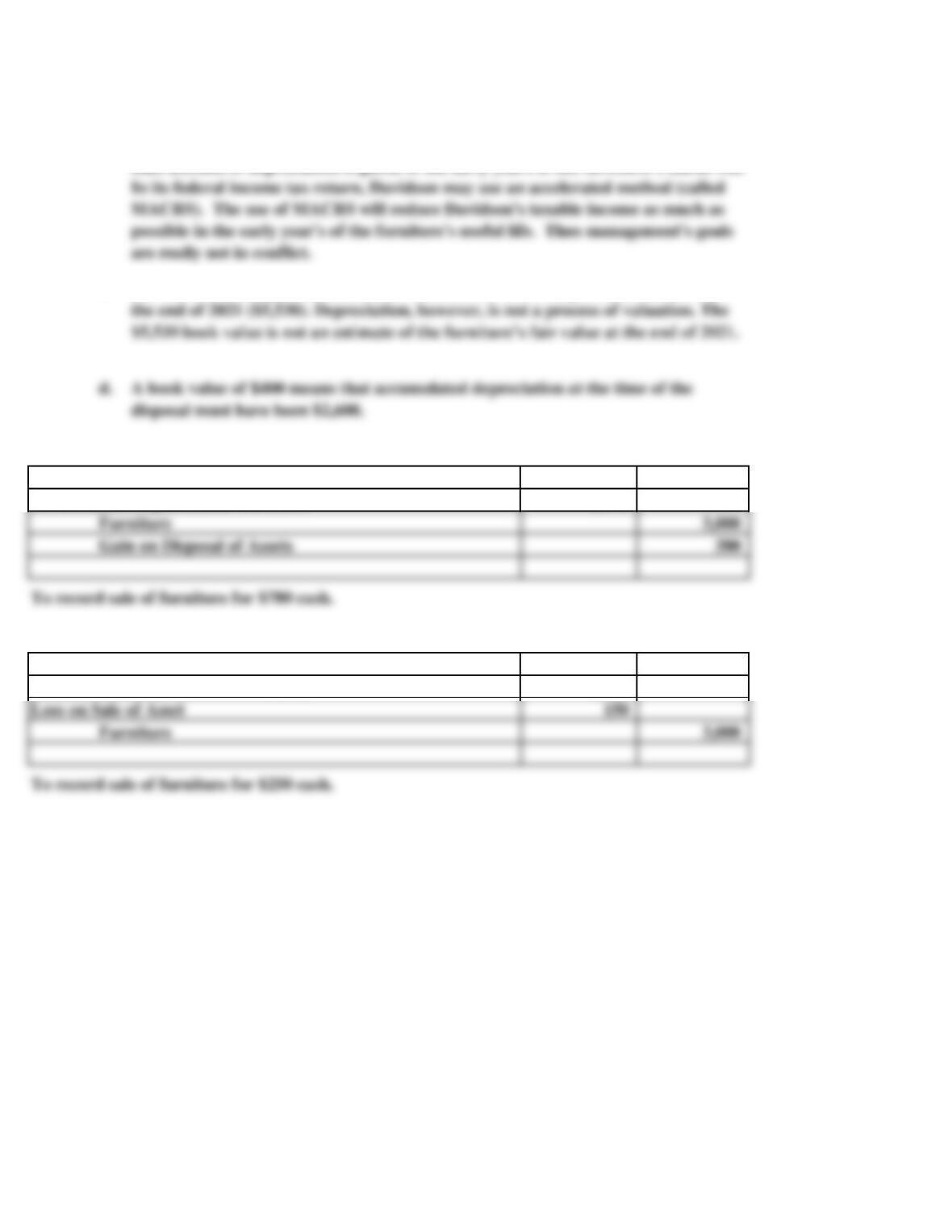
$1,200 $1,200 $10,800
2021
2019
2020
Accumulated Book
Depreciation Value
$900 $900 $11,100
2020
2021
2019
DAVIDSON, DDS
(1) Straight-Line (nearest whole month):
Depreciation
Expense
Computation
Year
2018
Computation
$12,000 x 1/10 x 8/12
$12,000 x 15% x 1/2
PROBLEM 9.3B
50 Minutes, Strong
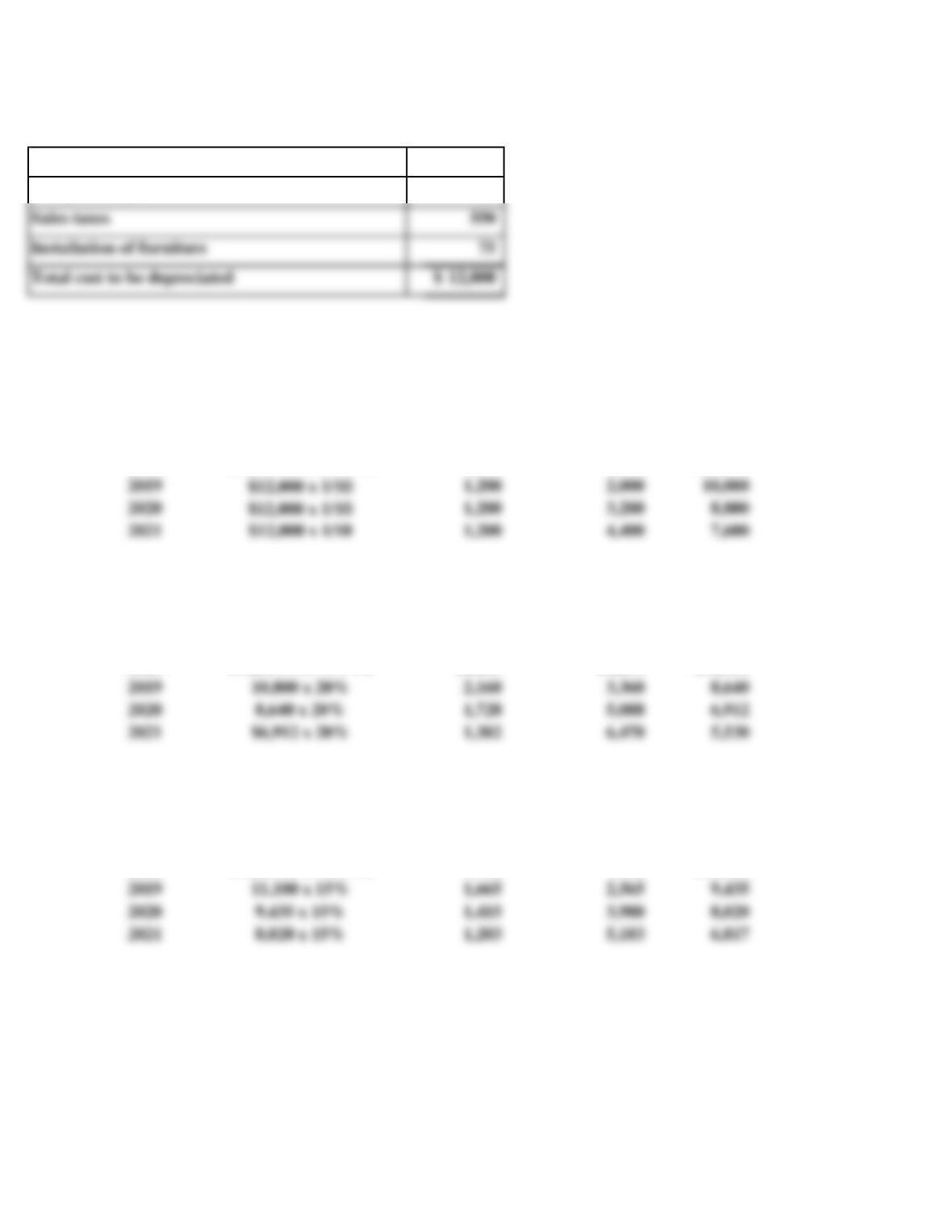
a. Costs to be depreciated include:
Cost of furniture
Freight charges
Accumulated
Depreciation
Year
2018
Depreciation
Expense
Depreciation
Expense
(2) 200% Declining-Balance (half-year convention):
Computation
(3) 150% Declining-Balance (half-year convention):
$12,000 x 20% x 1/2
Year
2018
Sales taxes
Installation of furniture
Total cost to be depreciated
b.
c.
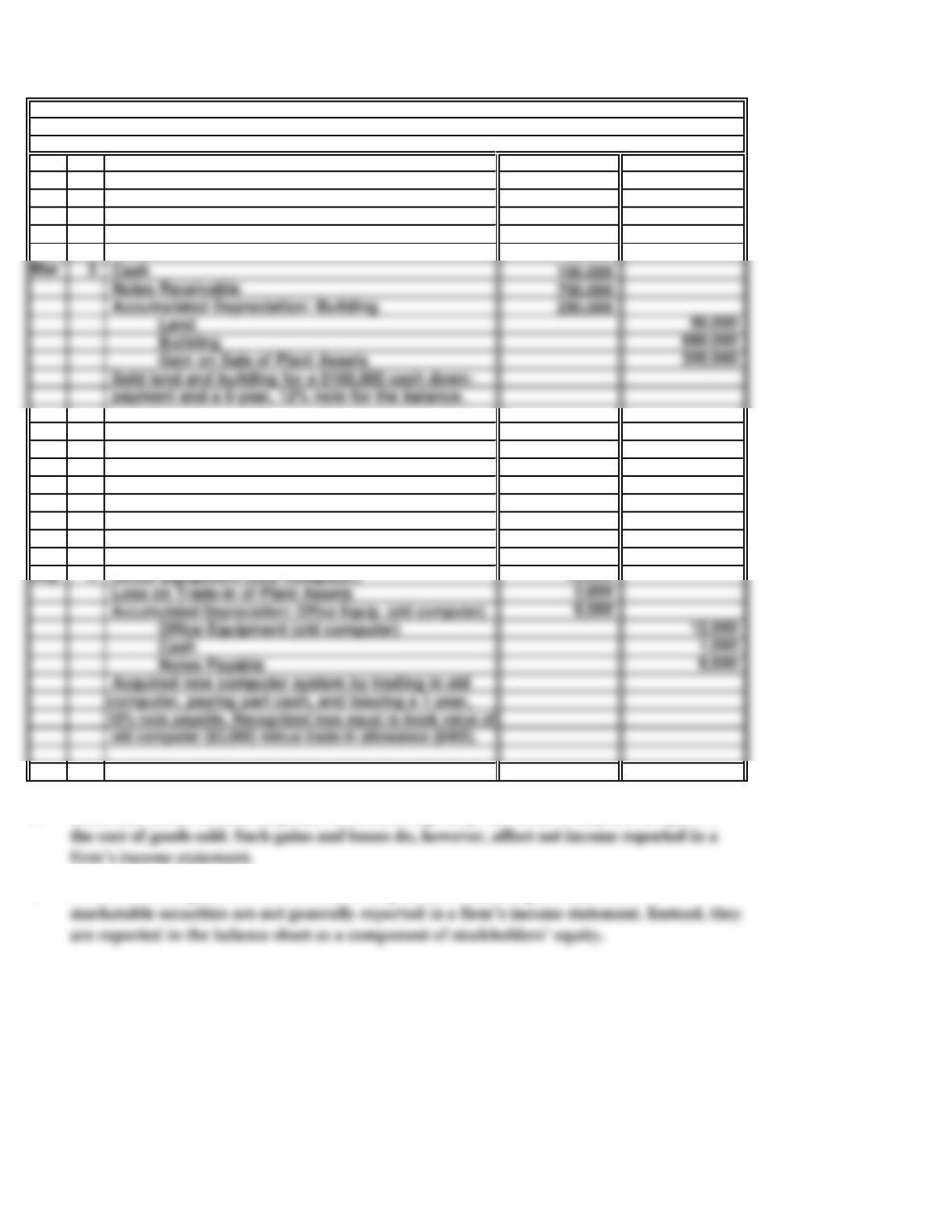
1. Journal entry assuming that the furniture was sold for $780:
780
2,600
Gain on Disposal of Assets
Loss on Sale of Asset
2. Journal entry assuming that the furniture was sold for $250:
250
2,600
Davidson may use the straight-line method in its financial statements to achieve the
least amount of depreciation expense in the early years of the furniture’s useful life.
PROBLEM 9.3B
DAVIDSON, DDS (concluded)
Cash
The 200% declining-balance method results in the lowest reported book value at
Cash
Accumulated Depreciation: Furniture
Accumulated Depreciation: Furniture
d.
25 Minutes, Medium
Jan 6 Loss on Disposal of Plant Assets 1,200
Accumulated Depreciation: Office Equipment 16,800
Office Equipment 18,000
Scrapped equipment; received no salvage value.
Jul 10 Vehicles (new truck) 37,000
Accumulated Depreciation: Vehicles (old truck) 22,000
Vehicles (old truck) 26,000
Gain on Disposal of Plant Assets 8,000
Cash 25,000
To record trade-in of old truck on new; trade-in
allowance exceeded book value by $8,000.
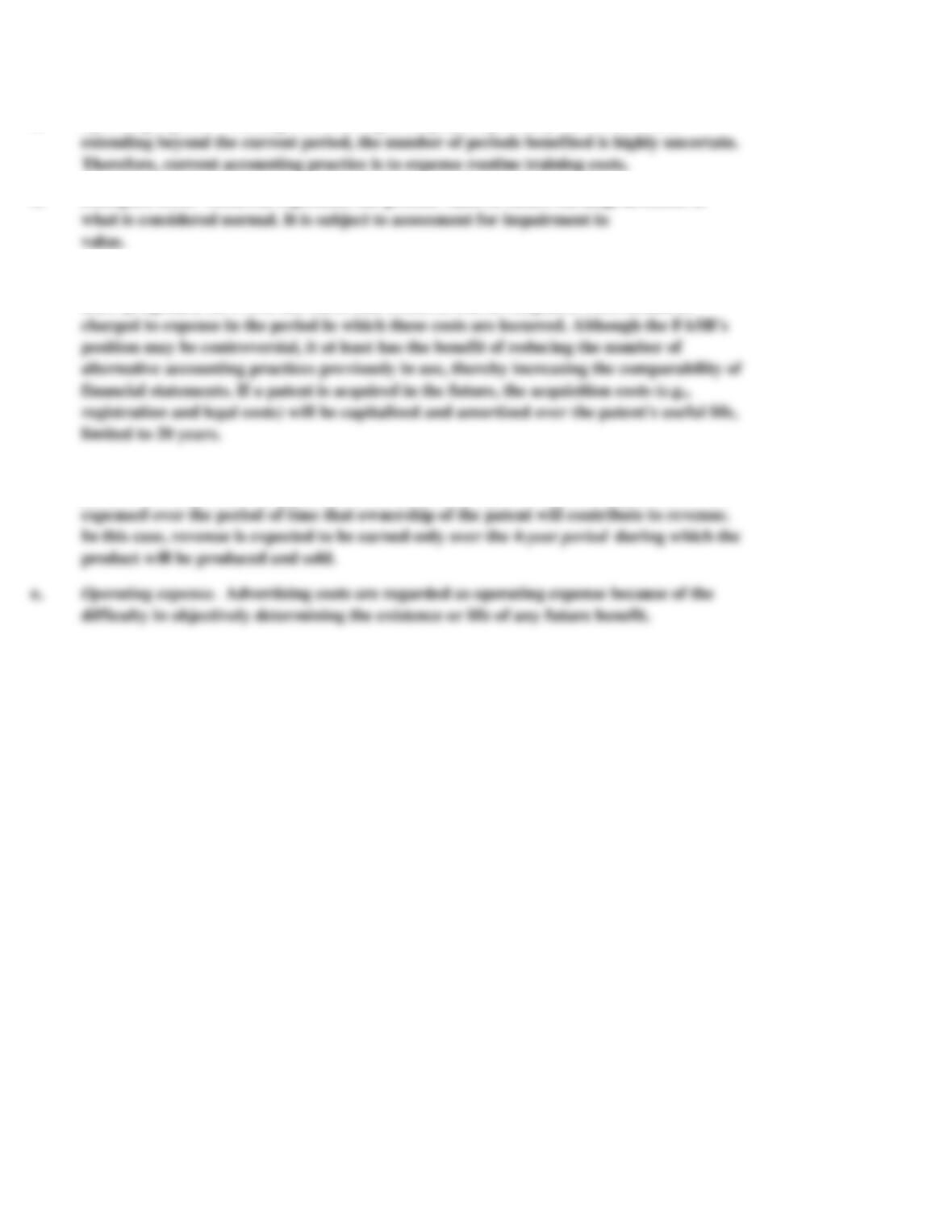
Sep 3 Office Equipment (new computer) 10,000
Loss on Trade-in of Plant Assets 2,600
Office Equipment (old computer) 12,000
Cash 1,000
Notes Payable 8,600
b.
c.
Gains and losses on asset disposals do not affect gross profit because they are not part of
Unlike realized gains and losses on asset disposals, unrealized gains and losses on
PROBLEM 9.4B
a.
General Journal
BLAKE CONSTRUCTION
Land 50,000
Building 680,000
Gain on Sale of Plant Assets 320,000
Sold land and building for a $100,000 cash down-
payment and a 5-year, 12% note for the balance.
25 Minutes, Medium
a.
b.
c.
d.
PROBLEM 9.5B
DELTA PRODUCTS CORPORATION
Intangible asset. A patent grants its owner the exclusive right to produce a particular
product. If the patent has significant cost, this cost is regarded as an intangible asset and
Operating expense. Although the training of employees probably has some benefit
Intangible asset. Goodwill represents the present value of future earnings in excess of
Operating expense. Because of the great uncertainty surrounding the potential benefits of
R&D programs, the FASB has ruled that research and development costs should be
e.
20 Minutes, Medium
250,000$
10
280,000$
196,000
240,000$
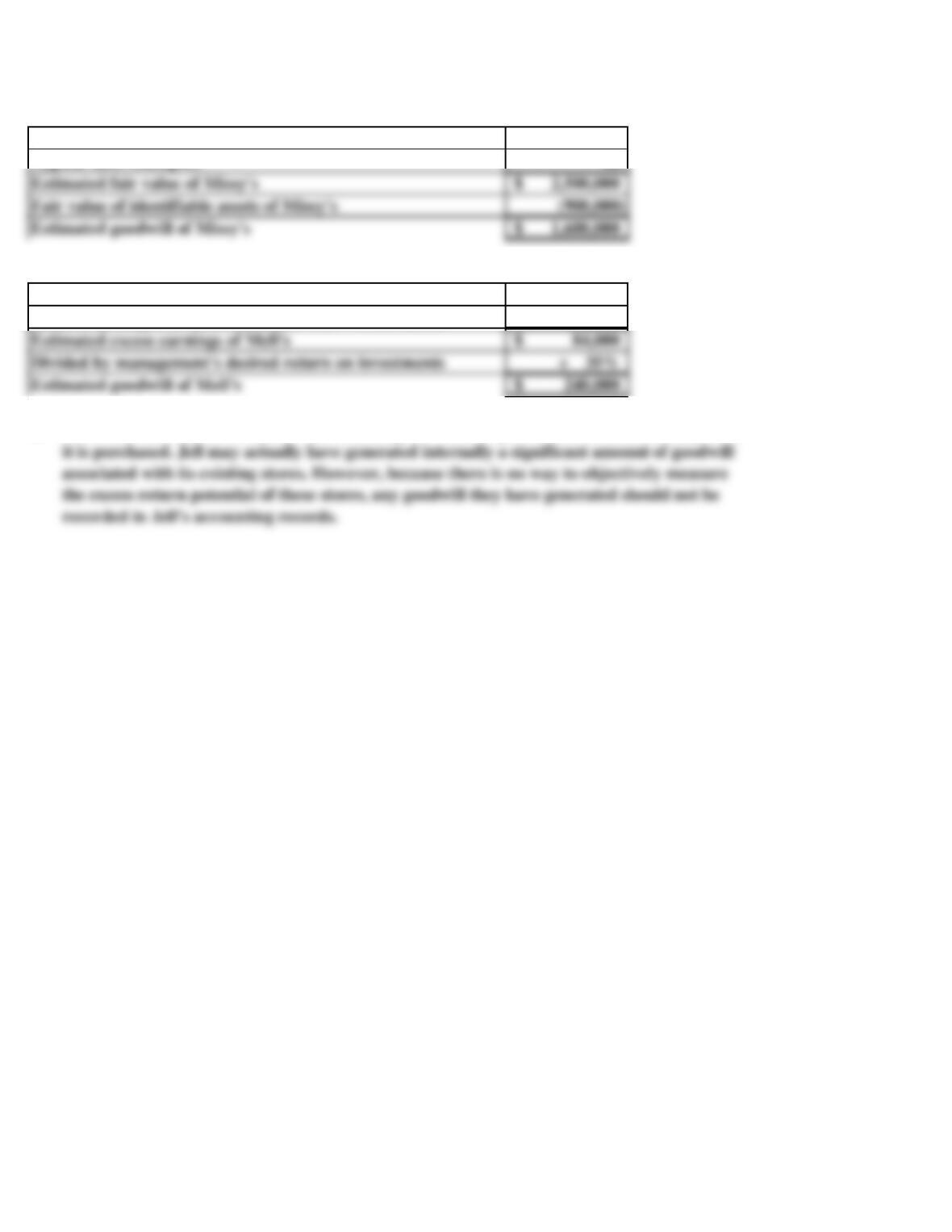
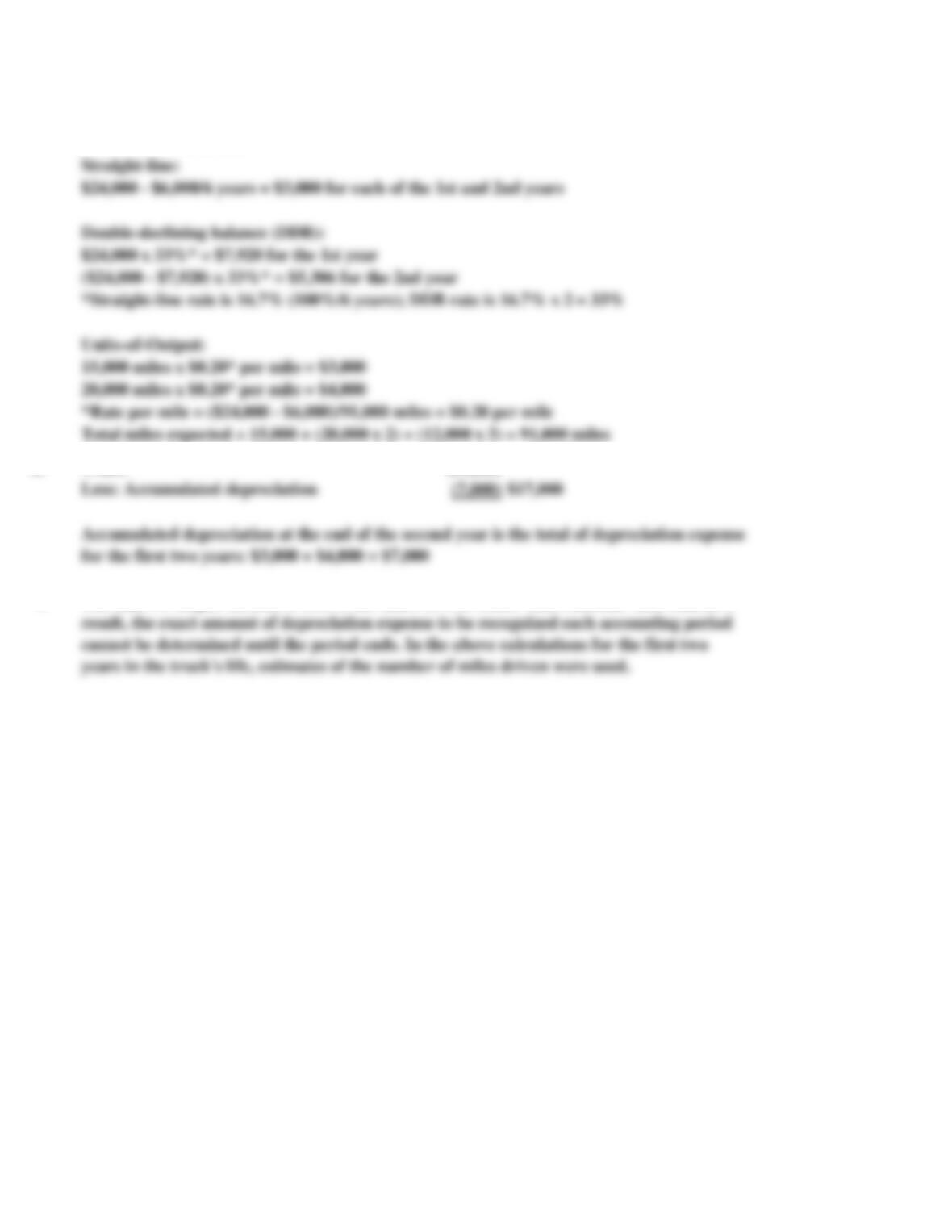
Estimated goodwill of Mell’s
Estimated excess earnings of Mell’s
Divided by management’s desired return on investments
c.
Due to the difficulties in objectively estimating the value of goodwill, it is recorded only when
Actual average net income per year
Normal earnings for Mell’s ($980,000 x 20% = $196,000)
PROBLEM 9.6B
JELL STORES
b. Estimated goodwill associated with the purchase of Mell’s:
a. Estimated goodwill associated with the purchase of Missy’s:
Actual average net income per year
Typical sales multiplier
Estimated goodwill of Missy’s
Estimated fair value of Missy’s
Fair value of identifiable assets of Missy’s
30 Minutes, Medium
a.
b. $24,000
c.
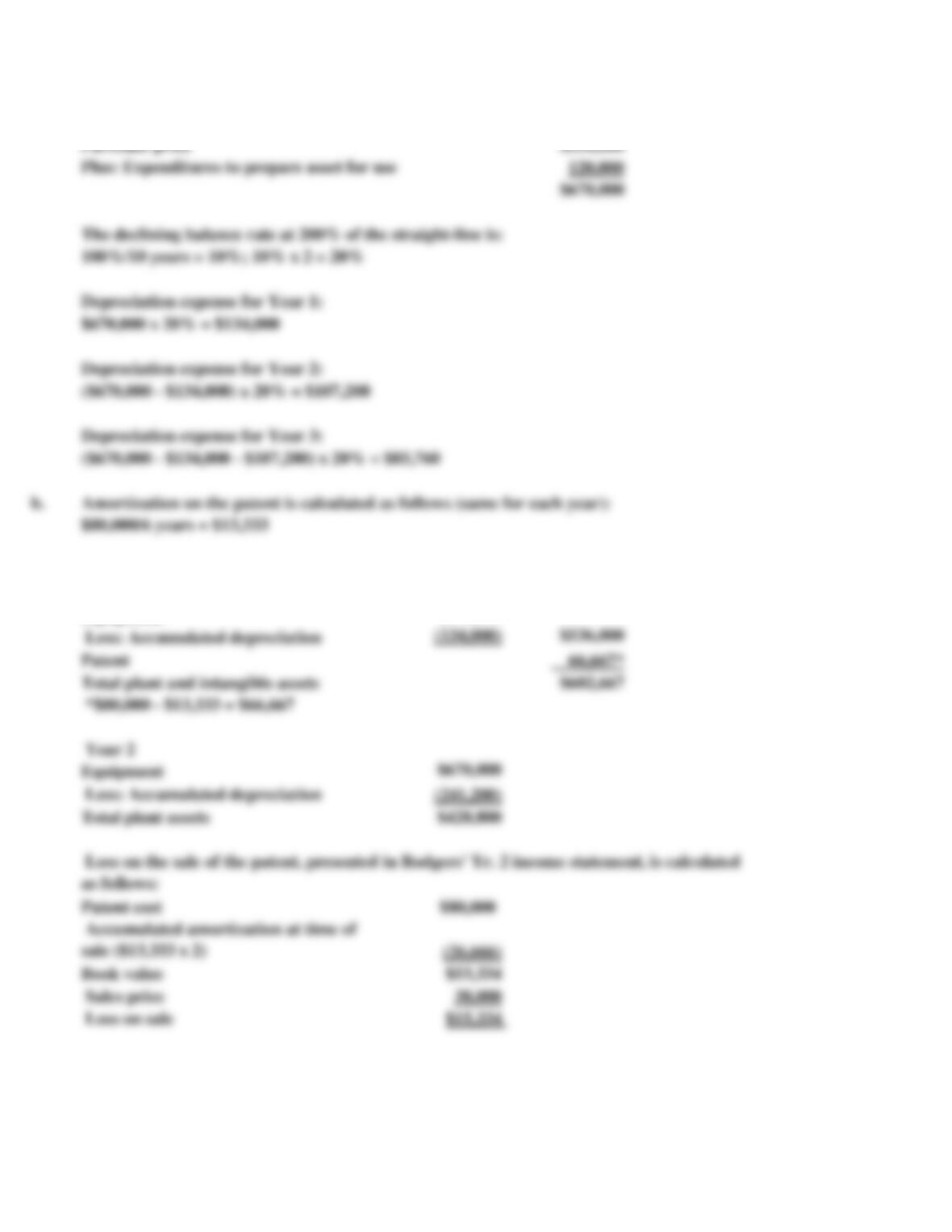
The units of output method is tied to the miles driven rather than calendar time and, as a
Units-of-Output:
Straight-line:
Truck
PROBLEM 9.7B
HAYWOOD, INC.
Depreciation expense for the first two years under the three depreciation methods is
determined as follows:
30 Minutes, Medium
a.
c.
$670,000
$670,000
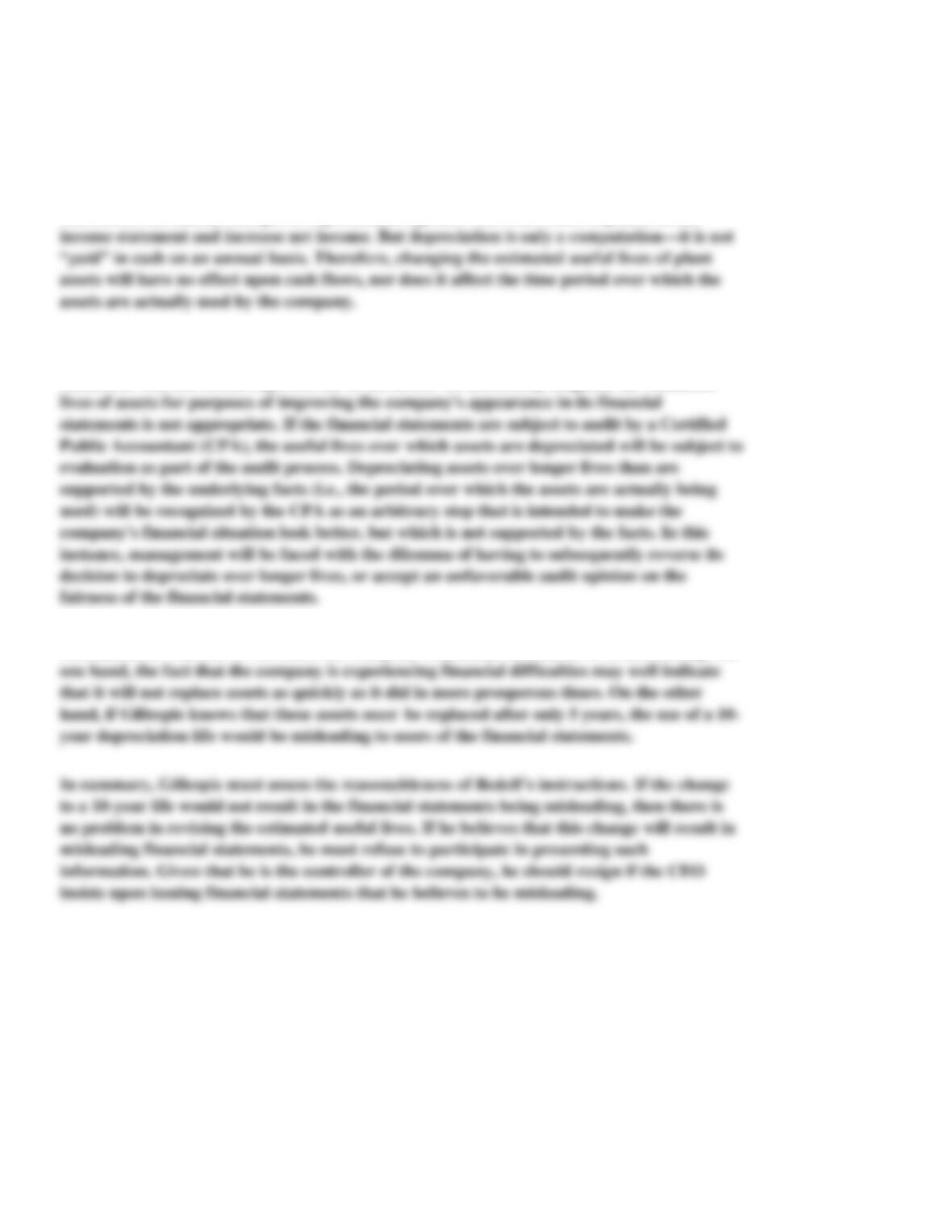
Loss on sale
Less: Accumulated depreciation
Book value
Sales price
Year 2
Equipment
*$80,000 – $13,333 = $66,667
Less: Accumulated depreciation
Year 1:
Equipment
Plant and intangible asset sections of the balance sheet:
PROBLEM 9.8B
RODGERS COMPANY
Depreciation is calculated on the following amount:
Depreciation expense for Year 1:
Depreciation expense for Year 2:
Depreciation expense for Year 3:
($670,000 – $134,000) x 20% = $107,200
($670,000 – $134,000 – $107,200) x 20% = $85,760
Plus: Expenditures to prepare asset for use
$670,000 x 20% = $134,000
Purchase price
The declining balance rate at 200% of the straight-line is:
100%/10 years = 10%; 10% x 2 = 20%
20 Minutes, Strong
a.
b.
c.
SOLUTIONS TO CRITICAL THINKING CASES
ARE USEFUL LIVES “FLEXIBLE”?
CASE 9.1
AN ETHICS CASE
The ethical issue confronting Gillespie is whether the change in estimated useful lives is
reasonable, or whether it will cause the company’s financial statements to be misleading. On
Lengthening the period over which assets are depreciated for financial statement purposes
will reduce the annual charges to depreciation expense. This will reduce expenses in the
Management is responsible for establishing the estimated useful lives of assets for purposes
of calculating depreciation and preparing financial statements. Those lives must be
consistent with the actual expected use of the assets. To arbitrarily lengthen the estimated
a.
b.
c.
CASE 9.2
DEPARTURES FROM GAAP—ARE THEY ETHICAL?
20 Minutes, Strong
No. Miller Construction Co. is not a publicly owned company and has no external reporting
The question facing Max O’Shaughnessey is whether users of the company’s balance sheet
might assume that it was prepared in conformity with generally accepted accounting
Showing plant assets at current market values is not in conformity with generally accepted
20 Minutes, Easy
b.
c. (1)
d.
CASE 9.3
Accelerated depreciation methods transfer the costs of plant assets to expense more quickly
than does the straight-line method. These larger charges to depreciation expense reduce the
No—different depreciation methods may be used for different assets. The principle of
20 years (a 5% straight-line depreciation rate is equivalent to writing off 1/20 of the
DEPRECIATION POLICIES IN ANNUAL REPORTS
The depreciation methods used in financial statements are determined by management, not
15 Minutes, Medium
a.
b.
1.
2.
3.
4.
As a supervisor yourself, find ways to recognize individual and/or group
There are a number of steps that you might take, including the following:
Meet with employees periodically to remind them of company policy, including the
Work with your superiors to develop more specific policies, with examples,
CASE 9.4
CAPITALIZATION VS. EXPENSE
Employees, including yourself, may be applying the generally stated policies in a manner
that improves the appearance of your division’s performance. They (and you) may not
even realize this is being done, or it may be intentional. A consistent pattern of
capitalizing costs that should be expensed, or costs that are in a “gray area” between
Develop more specific materiality guidelines for applying capitalization and
ETHICS, FRAUD & CORPORATE GOVERNANCE
No time estimate
R & D EXPENDITURES
CASE 9.5
A keyword search of Pharmaceutical Companies will result in an extensive list of firms. The list
will include extremely profitable industry giants whose R&D expenditures typically amount to
15% to 25% of total costs and expenses. In addition, many smaller companies whose primary
INTERNET