FINANCIAL ACCOUNTING – Eleventh Edition Solutions Manual
As
Reported
Times-
After Including the
Special-Purpose Entities
Chapter 9: Liabilities Page 99 of 115
FINANCIAL ACCOUNTING – Eleventh Edition Solutions Manual
Decision Case 2
(30-40 min.)
Requirements
Solution:
Req. 1 (Analysis of financing plans)
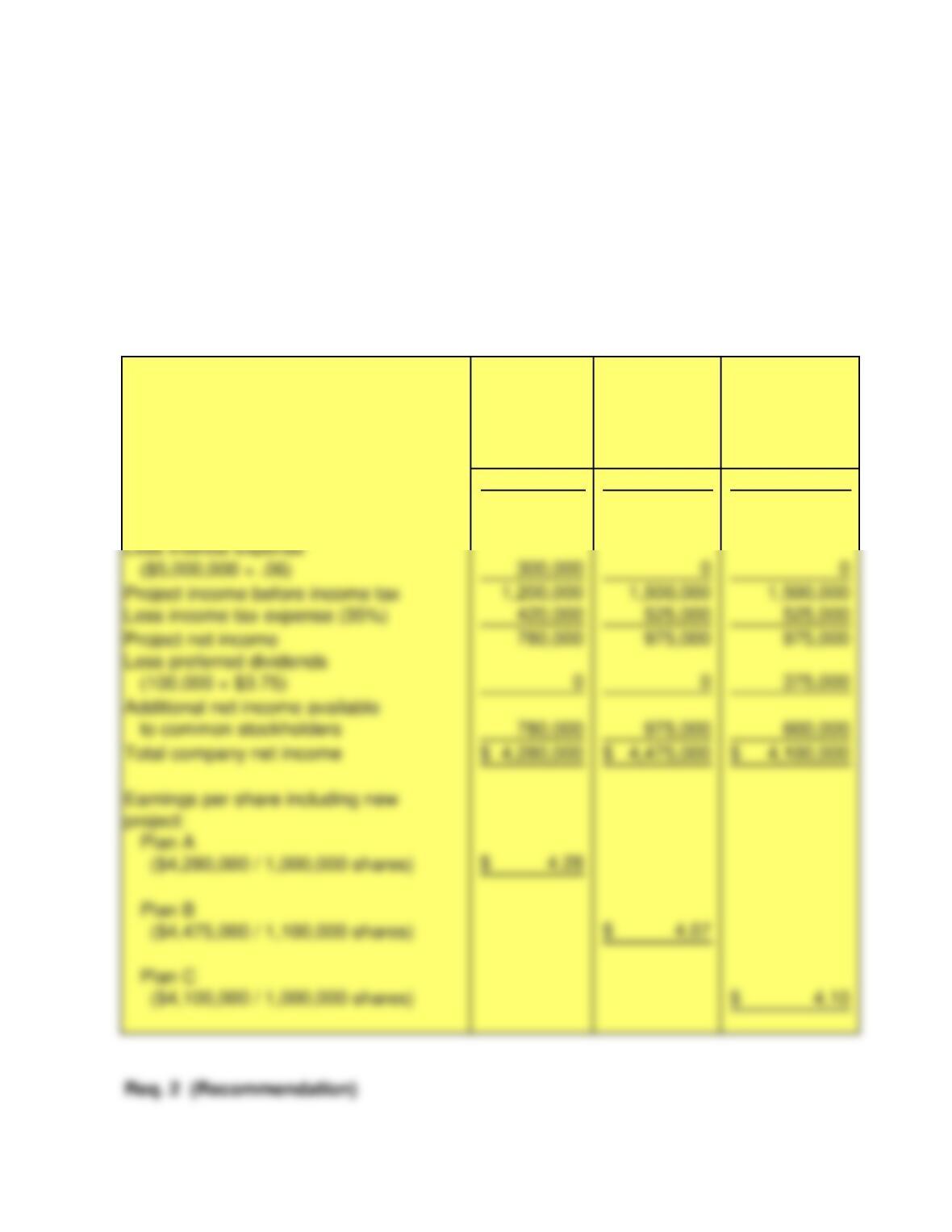
PLAN A PLAN B PLAN C
BORROW ISSUE
AT 6% COMMON
STOCK
Net income before expansion 3,500,000$ 3,500,000$ 3,500,000$
Project income before interest
and income tax 1,500,000$ 1,500,000$ 1,500,000$
ISSUE $3.75
NONVOTING
PREFERRED
STOCK
1. Prepare an analysis to determine which plan will result in the highest earnings per
share of common stock.
2. Recommend a plan to the board of directors. Give your reasons.
Chapter 9: Liabilities Page 100 of 115
Project income before income tax 1,200,000 1,500,000 1,500,000
Project net income 780,000 975,000 975,000
FINANCIAL ACCOUNTING – Eleventh Edition Solutions Manual
The best choice appears to be Plan A — borrowing at 6% — because:
(1) Borrowing allows the family to maintain control of the business;
Chapter 9: Liabilities Page 101 of 115
FINANCIAL ACCOUNTING – Eleventh Edition Solutions Manual
Ethical Issue 1
Requirements
Solution:
Req. 1
Req. 2 and 3
The potential parties and economic consequences of the decision not to disclose
contingent liabilities are:
1. The bank and its shareholders: With misleading information, they might extend
additional funds to the borrower assuming a better ability to pay back the funds than
A company would prefer not to disclose its contingent liabilities because they cast a
shadow on the business and create a negative impression.
1. Why would a company prefer not to disclose its contingent liabilities?
2. Identify the parties involved in the decision and the potential consequences to each.
3. Analyze the issue of whether to report contingent liabilities from lawsuits from the
following standpoints:
a. Economic
b. Legal
c. Ethical
4. What impact will future changes in accounting standards, both at the U.S. level and
the international level, likely have on the issue of disclosure of loss contingencies?
Chapter 9: Liabilities Page 102 of 115
FINANCIAL ACCOUNTING – Eleventh Edition Solutions Manual
Req. 3 Legal and ethical consequences
Banks have legal requirements in loan agreements that require debtors to maintain
certain ratios of assets and liabilities on their books or risk default. Failure of a company
to report its contingent liabilities to a bank requesting this disclosure could subject the
Chapter 9: Liabilities Page 103 of 115
FINANCIAL ACCOUNTING – Eleventh Edition Solutions Manual
Ethical Issue 2
Requirements
Solution:
Req. 1
1. What is (are) the ethical issue(s) in this case?
2. Who are the stakeholders? Analyze the consequences for each stakeholder from the
following standpoints: (a) economic, (b) legal, and (c) ethical.
3. How should Gocker structure the lease agreement?
4. As of the date of this text, the FASB and IASB have issued a joint exposure draft of a
new standard on long-term leases that will require companies to capitalize most leases
like this one. How will the analysis of this case change when this standard is issued?
The ethical issue is whether to structure this lease to avoid its having to be disclosed as
a capital lease. The company will do that if it is possible. It appears that Gocker and
Morgan have some flexibility in setting the life of the lease (4-5 years). If they set the
Chapter 9: Liabilities Page 104 of 115
FINANCIAL ACCOUNTING – Eleventh Edition Solutions Manual
Req. 2
The stakeholders are Gocker, the lessee; Morgan, the lessor; and Last National Bank,
Gocker’s present creditor. The potential consequences to the stakeholders are:
a. economic: If the lease is structured as a capital lease, Gocker will violate its long-
term loan covenant with Last National Bank. As a result, the bank might demand
immediate payment of their loan. This may damage Gocker’s credit rating and create
Chapter 9: Liabilities Page 105 of 115
Req. 3
FINANCIAL ACCOUNTING – Eleventh Edition Solutions Manual
Req. 4
The FASB and IASB are working on a proposed new lease standard that removes the
mechanical criteria for lease capitalization discussed in the chapter in favor of the more
theoretically and substantively correct, but also more subjective, “risks and rewards”
Chapter 9: Liabilities Page 106 of 115
FINANCIAL ACCOUNTING – Eleventh Edition Solutions Manual
Apple, Inc.
(20 min.)
Requirement 1
Solution:
Requirement 2
Solution:
Provision for income taxes 13,973$ million
Effective tax rate 26.1$
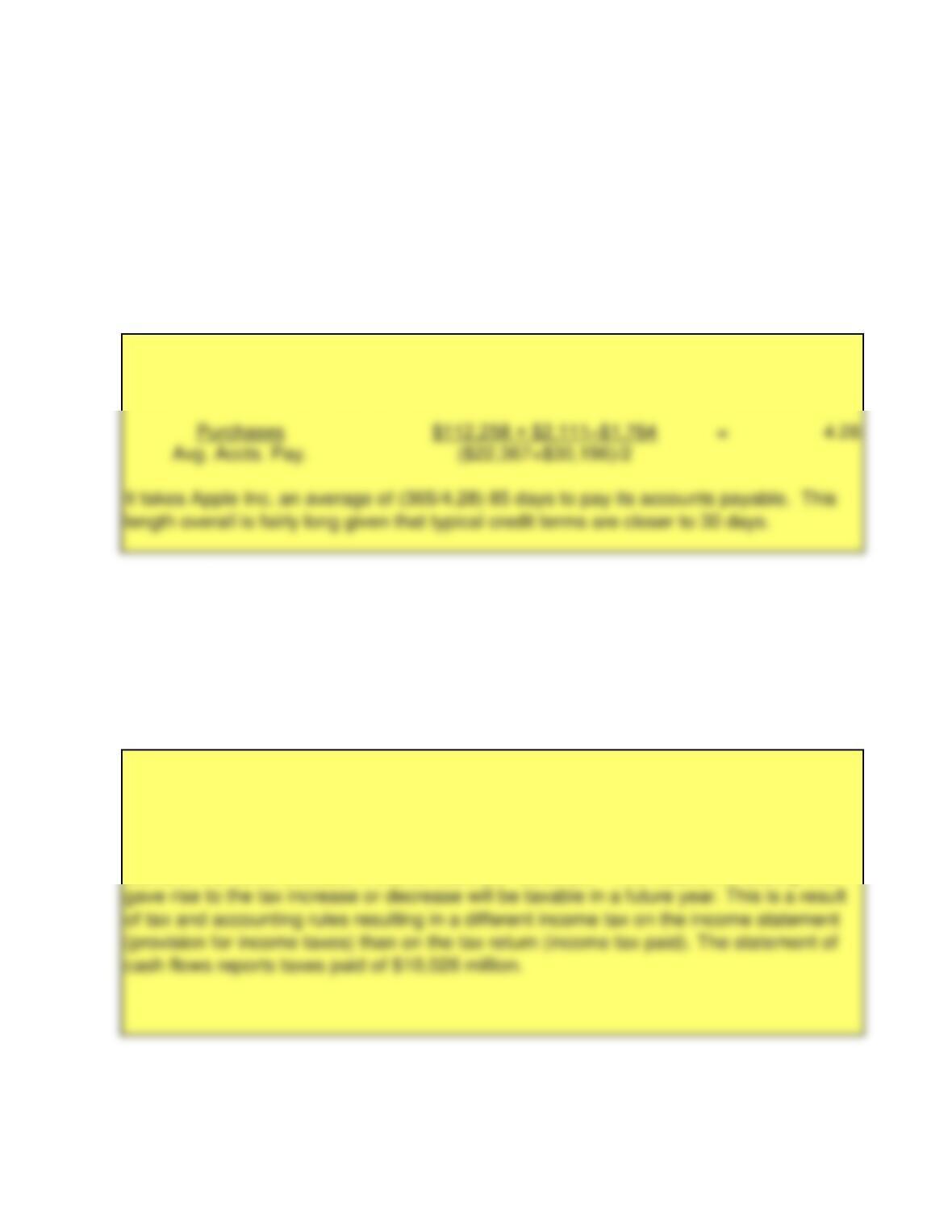
Apple Inc.’s accounts payable increased from $22,367 million in 2013 to $30,196 million
in 2014, an increase of about 35 percent. Accordingly, Account Payable Turnover is:
Did accounts payable for Apple Inc., increase or decrease in 2014? Calculate accounts
payable turnover for 2014. How many days does it take Apple Inc. to pay an average
account payable? Comment on the length of the period in days.
Apple is not going to have to pay its provision for income taxes amount during 2014.
Some of the items included in that amount are “deferred.” This means the activity that
Examine Note 5—Income Taxes—in the Notes to Consolidated Financial Statements.
Income tax provision is another title for income tax expense. What was Apple Inc.’s
income tax provision in 2014? Is the income tax provision likely to be equal to the
amount Apple Inc. paid for its taxes in 2014? Why or why not? What was the company’s
effective tax rate in 2014?
Chapter 9: Liabilities Page 107 of 115
FINANCIAL ACCOUNTING – Eleventh Edition Solutions Manual
Requirement 3
Solution:
Requirement 4
Solution:
Refer to Note 10—Commitments and Contingencies.
The footnotes disclose commitments for accrued warranty, operating leases,
commitments, and contingencies. Some of these commitments will already be reported
as liabilities, such as material warranties and estimated probable contingencies, capital
Examine Note 10—Commitments and Contingencies—in the Notes to Consolidated
Financial Statements. Describe some of Apple Inc.’s commitments and contingent
liabilities as of September 27, 2014. Are any of these amounts included in the numbers
in the balance sheet line items?
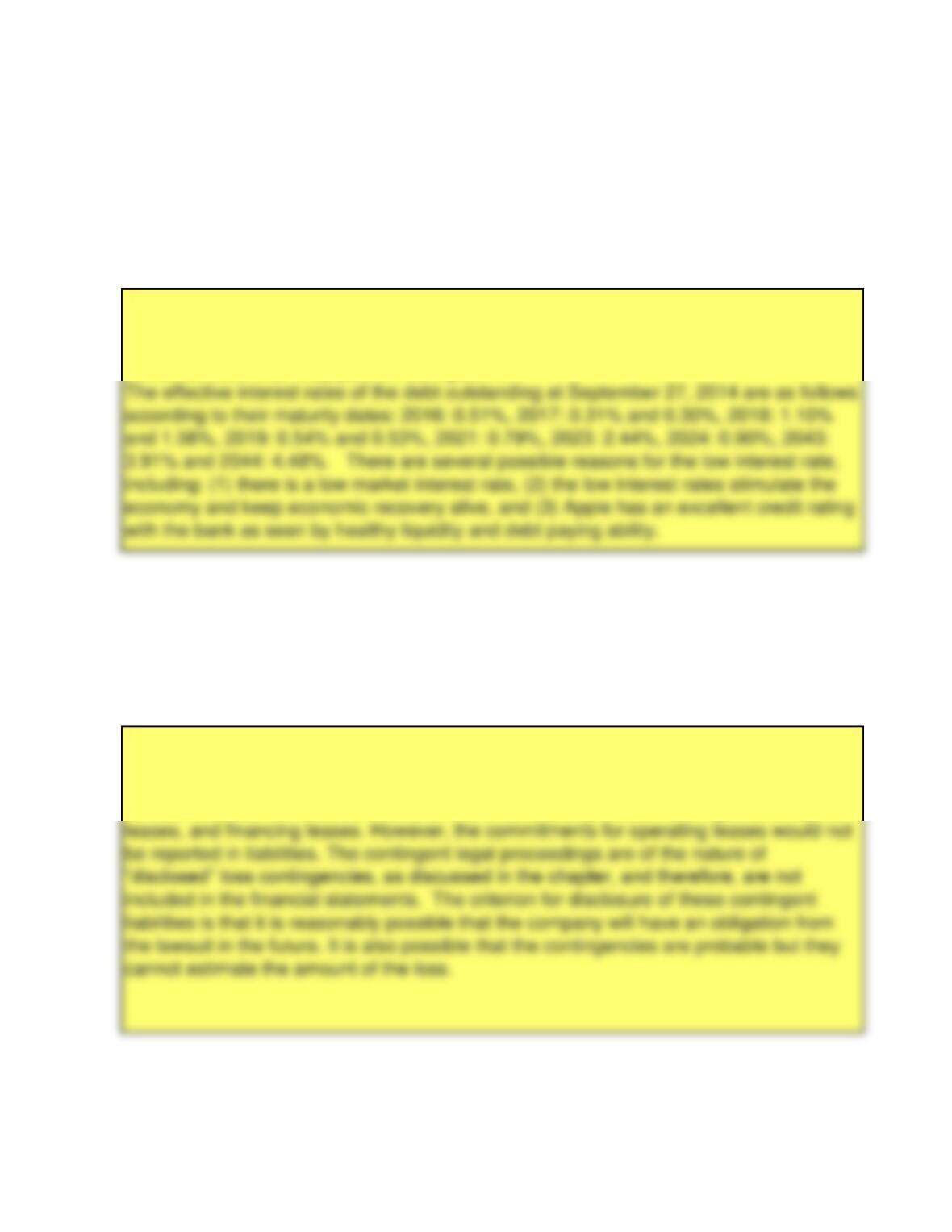
Refer to Note 6—Debt. Based on this information, the company’s long term debt (after
current maturities) increased their principal long-term debt amount from $17,000 million
in 2013 to $29,000 million in 2014. From this increase, you can tell that Apple Inc.
borrowed more than they paid off during 2014.
Examine Note 6—Debt. Did Apple Inc., borrow more or pay off more long-term debt
during 2014? How can you tell? What was the company’s effective interest rate on its
longterm debt? Why do you think this rate was so low? (Challenge)
Chapter 9: Liabilities Page 108 of 115
FINANCIAL ACCOUNTING – Eleventh Edition Solutions Manual
Requirement 5
Solution:
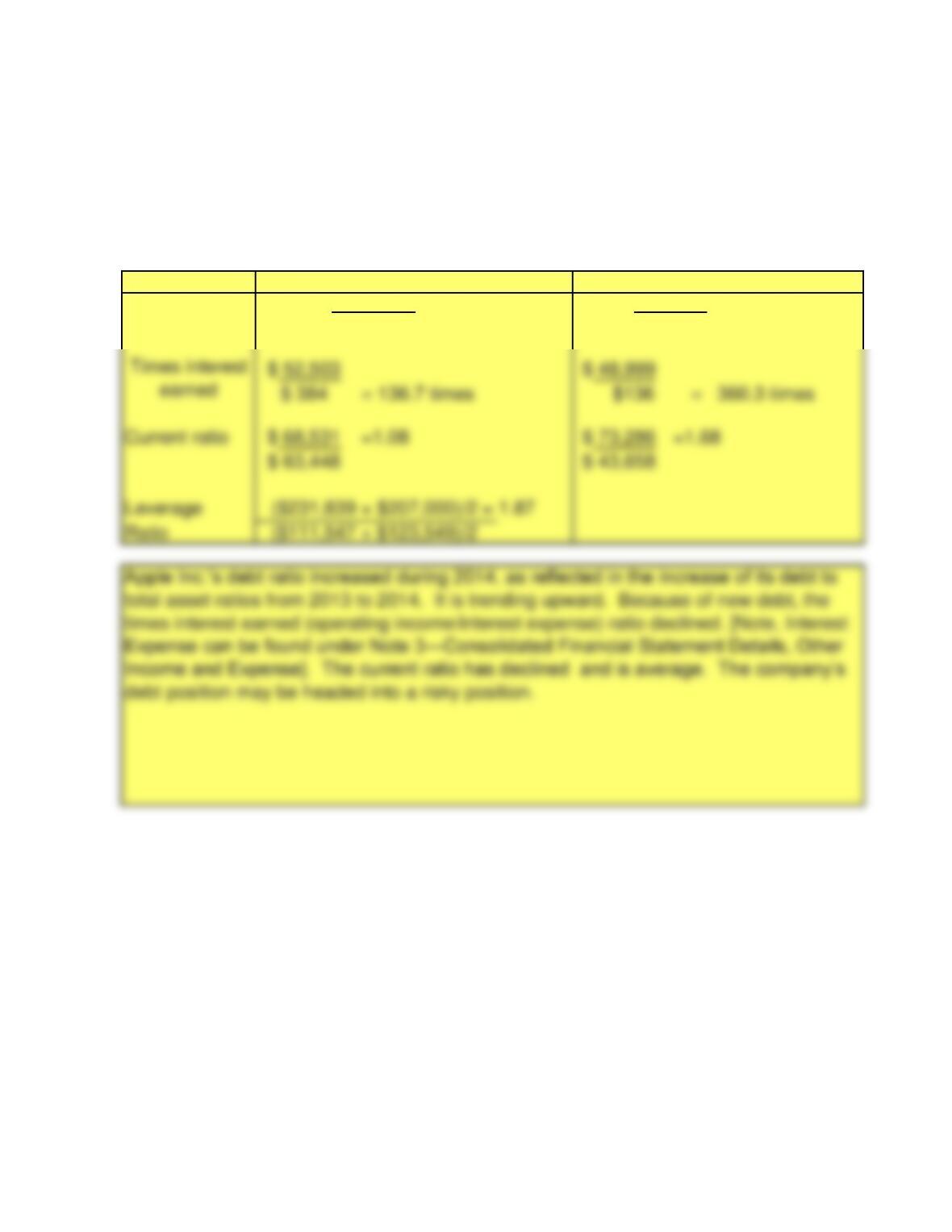
Debt ratio =51.9% = 40.3%
$ 120,292
$ 231,839
$ 83,451
$ 207,000
Ratio
2013
2014
How would you rate Apple Inc.’s overall debt position—risky, safe, or average? Compute
three ratios at September 27, 2014, and September 28, 2013, that help answer this
question.
Chapter 9: Liabilities Page 109 of 115
Ratio ($111,547 + $123,549)/2
FINANCIAL ACCOUNTING – Eleventh Edition Solutions Manual
Under Armour, Inc.
(20 min.)
Requirement 1
Solution:
Requirement 2
Solution:
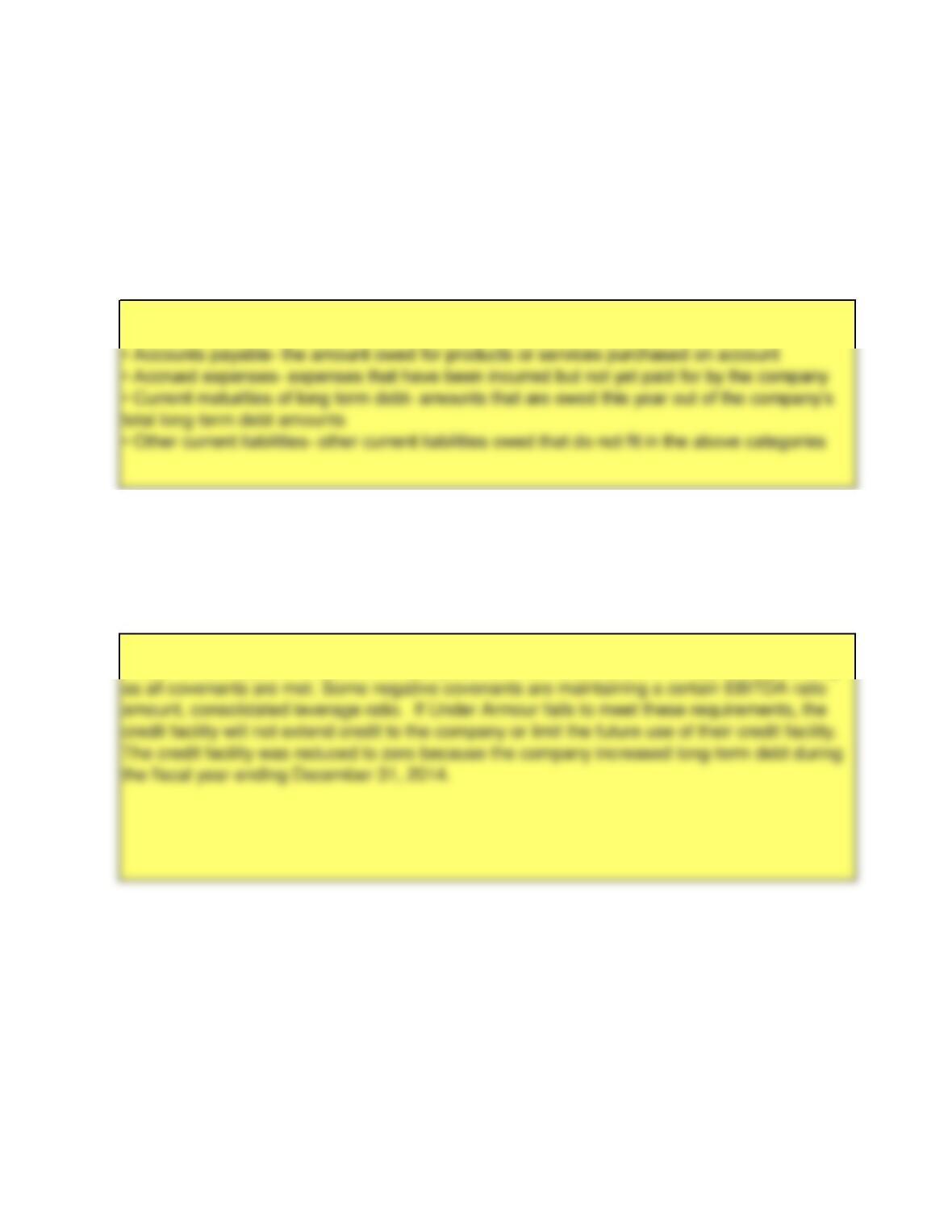
The current liability section of Under Armour, Inc.’s, Consolidated Balance Sheet as of
December 31, 2014, lists five different liabilities. List them and give a brief description of
each.
• Revolving credit facility– financial institution that allows the borrower to borrow an amount
whenever the borrower wants and at what amount, up to a limit set by the bank
Under Armour, Inc.’s current liability, revolving credit facility, was reduced to zero as of
December 31, 2014. Refer to Note 6—Credit Facility and Long Term Debt. Describe what
revolving credit facility means and why it was reduced to zero in 2014.
A credit facility is an agreement that a financial institution provides for a committed revolving
credit. This is a place where the company can take out amounts (with an upper limit) as long
Chapter 9: Liabilities Page 110 of 115
FINANCIAL ACCOUNTING – Eleventh Edition Solutions Manual
Requirement 3
Solution:
AP Turnover 8.75
Days in AP 42
AP Turnover
365
$1,572 + $537 – $469
($165 + $210)/2
365
8.75
Purchases
Avg. Accts.Pay.
For 2014, calculate accounts payable turnover, both as a ratio and in number of days.
Describe what this ratio means. Also compute the following other ratios for 2014 (if you
have already computed them as part of your work in previous chapters, refer to them):
(1) current ratio, (2) quick ratio, (3) days’ sales to collection for accounts receivable, and
(4) inventory turnover (express in days by dividing 365 by the turnover). How do you think
you would combine the information in these ratios to assess Under Armour, Inc.’s, current
debt-paying ability? (Challenge)
Chapter 9: Liabilities Page 111 of 115
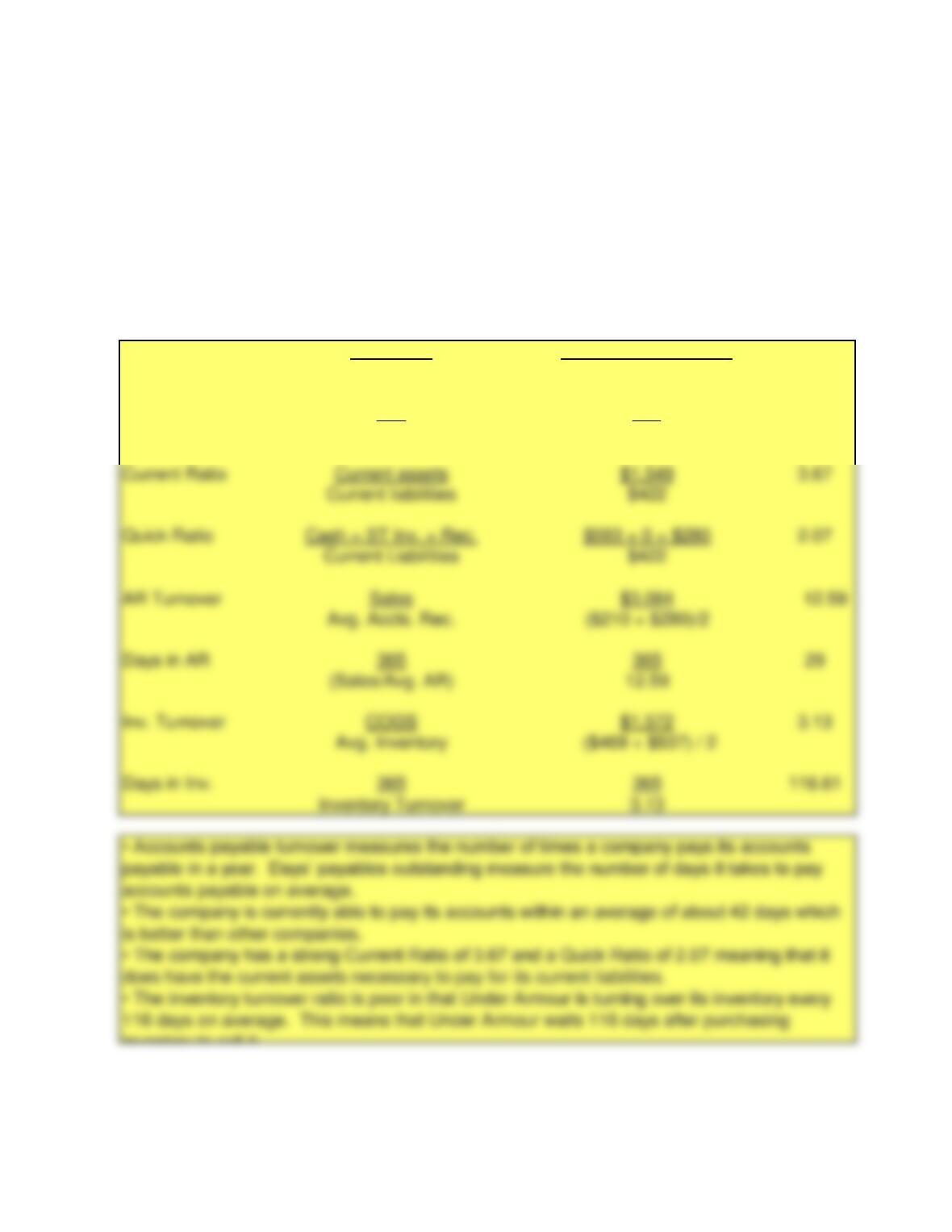
Current Ratio 3.67
Quick Ratio 2.07
AR Turnover 12.59
Days in AR 29
Inv. Turnover 3.13
($469 + $537) / 2
3.13
$593 + 0 + $280
365
Avg. Inventory
365
FINANCIAL ACCOUNTING – Eleventh Edition Solutions Manual
Requirement 4
Solution:
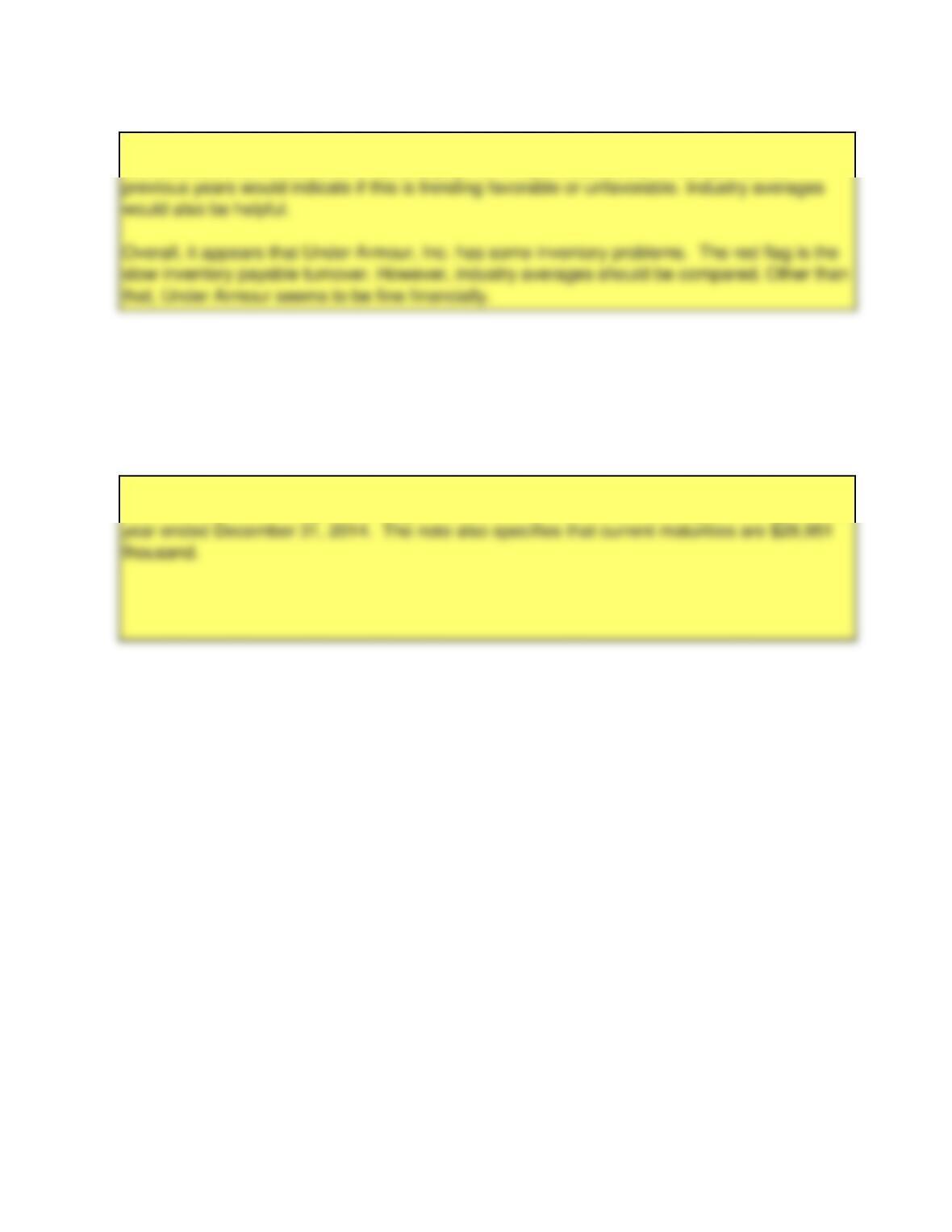
• Under Armour is in a poor position as it turns inventory purchases back into cash via sales
and collections (116+29) after it actually pays for the purchases (42). A comparison to
Refer to Note 6—Credit Facility and Long Term Debt, under Other Long Term Debt. What is
Under Armour’s weighted average interest rate on outstanding borrowings for 2014? How
much in long-term debt obligations does Under Armour currently owe for 2015?
The note has the following items:
Under Armour has a weighted average interest rate of 3.1% on outstanding borrowings for the
Chapter 9: Liabilities Page 112 of 115
FINANCIAL ACCOUNTING – Eleventh Edition Solutions Manual
Requirement 5
Solution:
Requirement 6
Solution:
Refer to the note entitled “Commitments and Contingencies.” Describe the contents of this
footnote. Are any of these items included in the liabilities recorded in either the current or long-
term section of the balance sheet? Why or why not?
In Note 7—Commitments and Contingencies, there is information about: (1) operating leases,
(2) sponsorship and marketing commitments, and (3) other. Under Armour describes the
Refer to Note 7—Commitments and Contingencies, under Obligations Under Operating
Leases. Describe the company’s commitments under operating lease arrangements.
Calculate the impact on Under Armour, Inc.’s, ROA and debt ratios if the company’s operating
lease commitments as of the end of 2014 were capitalized.
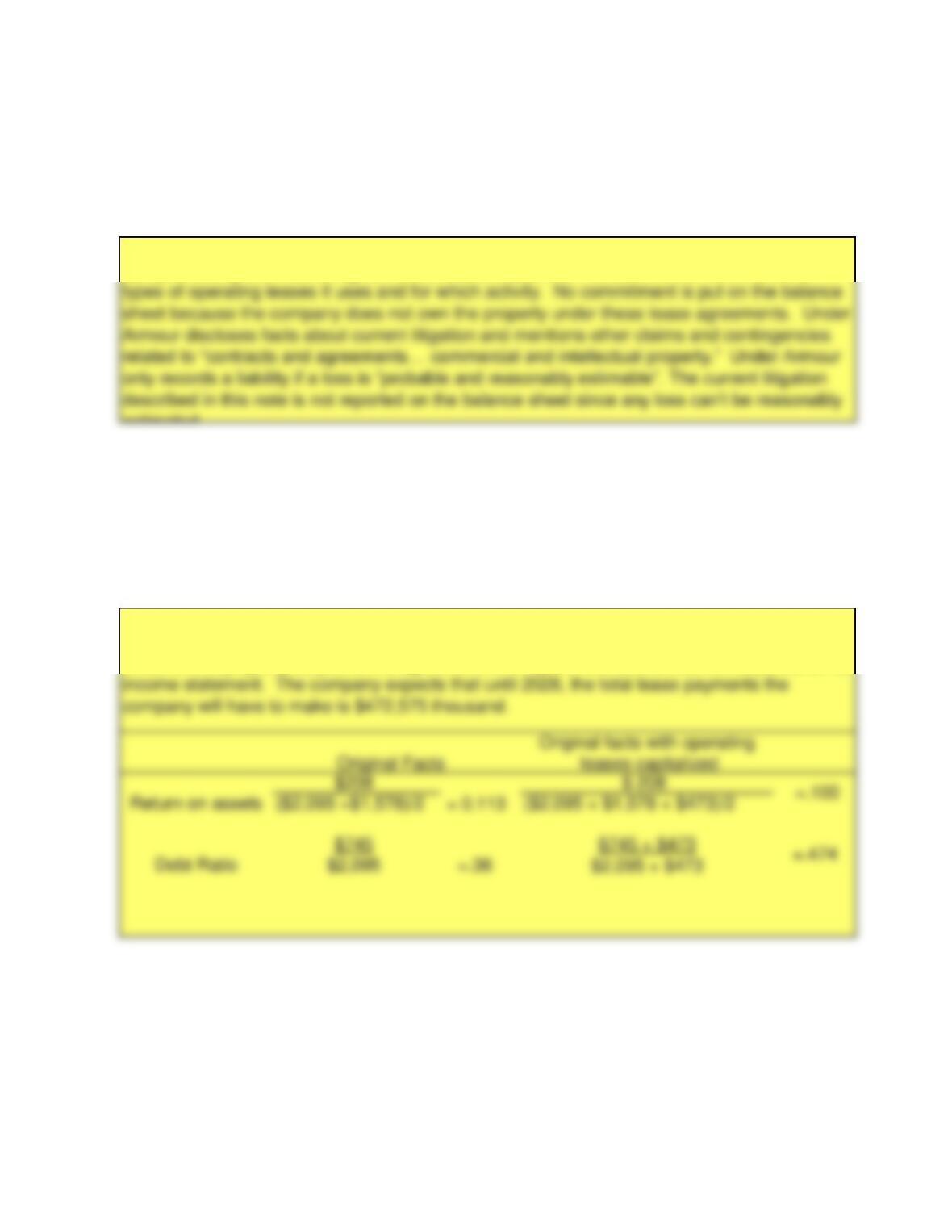
The operating lease arrangements involve warehouse space, office facilities, space for its
brand and factor house stores, and certain equipment. Under Armour has to pay a rent to the
owner of the property subject to the agreement and reports that amount as rent expense on its
Chapter 9: Liabilities Page 113 of 115
FINANCIAL ACCOUNTING – Eleventh Edition Solutions Manual
Requirement 7
Solution:
Requirement 8
Solution:
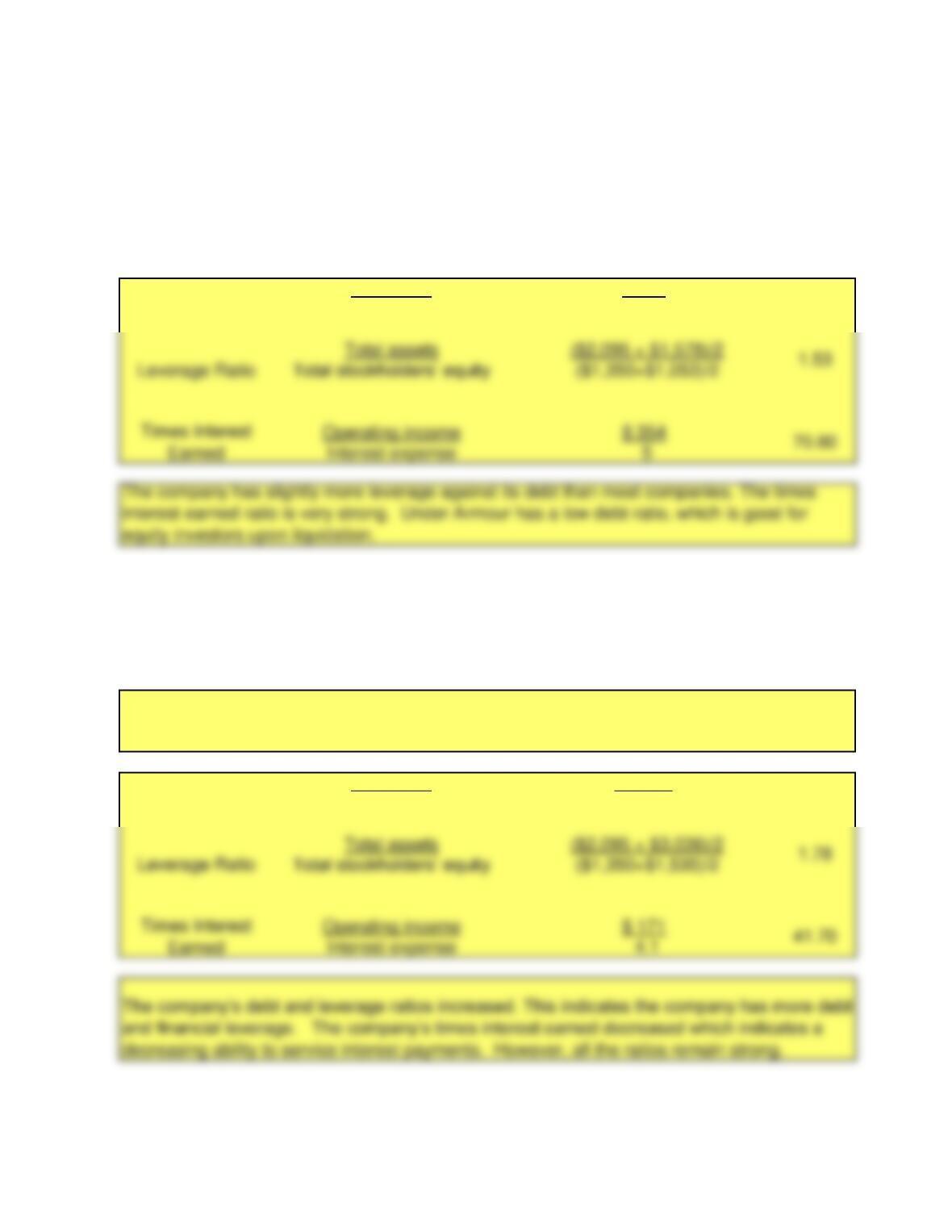
Total assets
$ 3,036
Total assets
1.53
interest earned ratio is very strong. Under Armour has a low debt ratio, which is good for
$ 354
0.36
For 2014, compute the company’s debt ratio, leverage ratio, and times-interest-earned ratio.
Would you evaluate Under Armour, Inc., as risky, safe, or average in terms of these ratios?
Access Under Armour, Inc.’s, most recent financial statements from http://www.sec.gov.
Use the same method as described in the chapter opening for Southwest Airlines. What has
happened to Under Armour, Inc.’s, debt position since the end of 2014? (Challenge)
Debt ratio
Total Debt
$ 745
Total assets
(Solution depends on financial statements selected. Student responses will vary.) For the
quarter ending September 30, 2015:
Debt ratio
Total Debt
$ 1,500
0.49
$ 2,095
Chapter 9: Liabilities Page 114 of 115
The company’s debt and leverage ratios increased. This indicates the company has more debt
$ 171
Total assets
1.78

FINANCIAL ACCOUNTING – Eleventh Edition Solutions Manual
Solution:
Student responses will vary.
Project 1. Consider three different businesses:
1. A bank
2. A magazine publisher
3. A department store
For each business, list all of its liabilities—both current and long-term. Then
compare the three lists to identify the liabilities that the three businesses have in
common. Also identify the liabilities that are unique to each type of business.
Project 2. Alcenon Corporation leases the majority of the assets that it uses in
operations. Alcenon prefers operating leases (versus capital leases) in order to
keep the lease liability off its balance sheet and maintain a low debt ratio.
Chapter 9: Liabilities Page 115 of 115