
chapter
9
Receivables
______________________________________________
OPENING COMMENTS
Chapter 9 presents the accounting issues related to accounts receivable and notes receivable. The chapter
opens with the common classifications of receivables. While presenting those classifications, you will
need to make a clear distinction between accounts receivable and notes receivable.
Accounting issues related to uncollectible receivables are covered next. Both the allowance and direct
write-off methods are presented. If class time is scarce at this point, coverage of the direct write-off
method (theoretically unacceptable because it violates the matching concept) may be omitted without
disrupting the flow of the text. Simply omit coverage of Objectives 3 and 5.
After addressing uncollectible accounts, the text discusses notes receivable transactions. The text presents
how to calculate the due date, interest, and maturity value of a note. The journal entries to record the
acceptance of a note, receipt of payment on a note, and dishonoring of a note are discussed in detail.
The last part of the chapter presents a Financial Analysis and Interpretation section that discusses
financial ratios related to receivables: the accounts receivable turnover and the number of days’ sales in
receivables.
After studying the chapter, your students should be able to:
2. Describe the accounting for uncollectible receivables.
4. Describe the allowance method of accounting for uncollectible receivables.
6. Describe the accounting for notes receivable.
7. Describe the reporting of receivables on the balance sheet.

8. Describe and illustrate the use of accounts receivable turnover and number of days’ sales in
receivables to evaluate a company’s efficiency in collecting its receivables.
STUDENT FAQS
• Why should we have to learn the direct write-off method of recording bad debts when we cannot use
it with the accrual basis of accounting?
• How accurate are companies with their estimates (guesses)?
• Isn’t estimating bad debts a way of manipulating net income?
• How does a company keep control on these estimates?
• How does one go about determining if uncollectible receivables are within a reasonable range?
• How can Allowance for Doubtful Accounts have a debit balance? Does that mean the company did
something wrong? Can Allowance for Doubtful Accounts have a debit balance at the end of the year
after adjustments have been made?
• Why don’t you just show the net balance of accounts receivable? Why bother showing the deduction
of the allowance account on the balance sheet?
• Since you deduct the allowance from Accounts Receivable, why not just simplify things and credit
Accounts Receivable directly and forget about the allowance?
• Why is it important to identify the customer’s account by name when writing-off an account and
restating an account?
• Why do we recognize (record) interest revenue when a note is dishonored? We didn’t receive the
money, so why report the revenue? Could we report the interest as a receivable instead?
OBJECTIVE 1
Describe the common classes of receivables.
KEY TERMS
Accounts Receivable Receivables
Notes Receivable
SUGGESTED APPROACH
The purpose of this objective is to familiarize students with terms related to receivables. Hints for your
review of those terms follow.
Chapter 9 Receivables 145
LECTURE AID — Classification of Receivables
The common classifications of receivables are the following:
2. Notes Receivable — credit granted through a formal credit instrument known as a promissory note.
Notes are often used for credit periods of more than 60 days and involve payment of interest.
3. Other Receivables — such as interest receivable or receivables resulting from loans to officers or
employees.
Trade receivables are receivables resulting from the sale of merchandise or services on credit. Both
accounts receivable and notes receivable can be classified as trade receivables.
Ask your students to turn to the balance sheet for the sample annual report in Appendix C and describe
how receivables are presented in this financial statement.
Students generally have the most difficulty distinguishing between accounts receivable and notes
receivable. Remind them that an account receivable results from a credit sale on an open account, such as
a store charge. These receivables usually require no more than a customer’s signature on a receipt or order
form. In some cases, the customer’s verbal agreement is accepted in lieu of a signature.
A note receivable is evidenced by a signed promissory note. This note is a written promise to pay a
specified amount of money. It includes the date that payment is due, to whom payment will be made, and
what interest (if any) will accompany the payment.
Three things generally distinguish a note receivable from an account receivable:
2. Notes typically require a formal written agreement stating due date and interest rate.
3. Notes typically involve interest being paid.
OBJECTIVE 2
Describe the accounting for uncollectible receivables.
KEY TERMS
Allowance Method Direct Write-Off Method
Bad Debt Expense
146 Chapter 9 Receivables
SUGGESTED APPROACH
Objective 2 reminds students that a business incurs an expense when customers fail to pay. Three
common account titles used to record this expense are (1) uncollectible accounts expense, (2) bad debts
expense, and (3) doubtful accounts expense.
There are two methods of recording uncollectible accounts: direct write-off method and allowance
method. When introducing the two methods of recording uncollectible accounts, you will want to stress
that the allowance method is the preferred method and emphasize that the direct write-off method can be
used only if it is impossible to estimate a company’s bad debts or the amount of bad debts is immaterial.
Examples of companies that might use the direct write off method are law firms or other businesses that
typically do not provide products or services on account.
OBJECTIVE 3
Describe the direct write-off method of accounting for uncollectible receivables.
SUGGESTED APPROACH
Under the direct write-off method, the expense of an uncollectible account is recognized when the
company decides that further collection efforts on a delinquent account are useless. This method,
however, violates the matching concept, since the sales revenue and the expense related to an
uncollectible account may be recognized in different accounting periods.
Use the Lecture Aid that follows to quickly review the basics of the direct write-off method, and ask your
students to practice the journal entries using the Group Learning Activity.
LECTURE AID — Direct Write-Off of Uncollectible Receivables
Under the direct write-off method, the following occur:
1. Uncollectible Accounts Expense is recorded when an account is written-off.
2. If an account that has been written-off is collected, the account is reinstated before recording
the payment received.
2. The amount of uncollectible accounts is immaterial.
GROUP LEARNING ACTIVITY — Direct Write-Off of Uncollectible
Receivables
TM 9-3 presents five transactions to be recorded under the direct write-off method. Ask your students to
work in small groups to journalize these transactions. TM 9-4 shows the solution to this exercise.
OBJECTIVE 4
Describe the allowance method of accounting for uncollectible receivables.
KEY TERMS
Aging the Receivables Net Realizable Value
Allowance for Doubtful Accounts
SUGGESTED APPROACH
It is helpful to open your discussion of the allowance method by proving the need to estimate
uncollectible accounts. The following lecture notes will assist you in relating the allowance method to the
matching concept.
The allowance method of accounting for uncollectible receivables asks the accountant to estimate the
accounts that will not be collected and to record this expense before customers actually fail to pay. This
method adheres to the matching concept by recognizing the expense of uncollectible accounts in the same
period that the sales revenue is recorded. As a result, it is the theoretically correct method.
LECTURE AID — Uncollectible Accounts and the Matching Concept
The following explanation may help you present the need to estimate and record uncollectible accounts.
The matching concept dictates that all expenses incurred in making a sale or providing a service are to be
recorded in the same accounting period as the revenue from the sale or service. Losses that result from
The journal entry to record uncollectible accounts:
Bad Debt Expense……………… XXX
Allowance for Doubtful Accounts……. XXX
Remind students that the Allowance for Doubtful Accounts is a contra asset account. It is used to reduce
the value of accounts receivable reported on the balance sheet. The Allowance for Doubtful Accounts
account works just like the Accumulated Depreciation account discussed in Chapter 3. Bad Debt Expense
is normally reported as an administrative expense on the income statement.
DEMONSTRATION PROBLEM — Entries for Uncollectible Accounts
Kids-At-Play is a toy store that began operations this year. At the end of its first year of operations, Kids-
At–Play had accounts receivable totaling $50,000. The store’s manager estimates that $1,500 of those
receivables will not be collected.
Journal entry to record uncollectible accounts at the end of the year:
Remind your students that $48,500 is the amount of receivables that Kids–At-Play actually expects to
collect and the amount that will be included in the total current assets balance on the balance sheet.
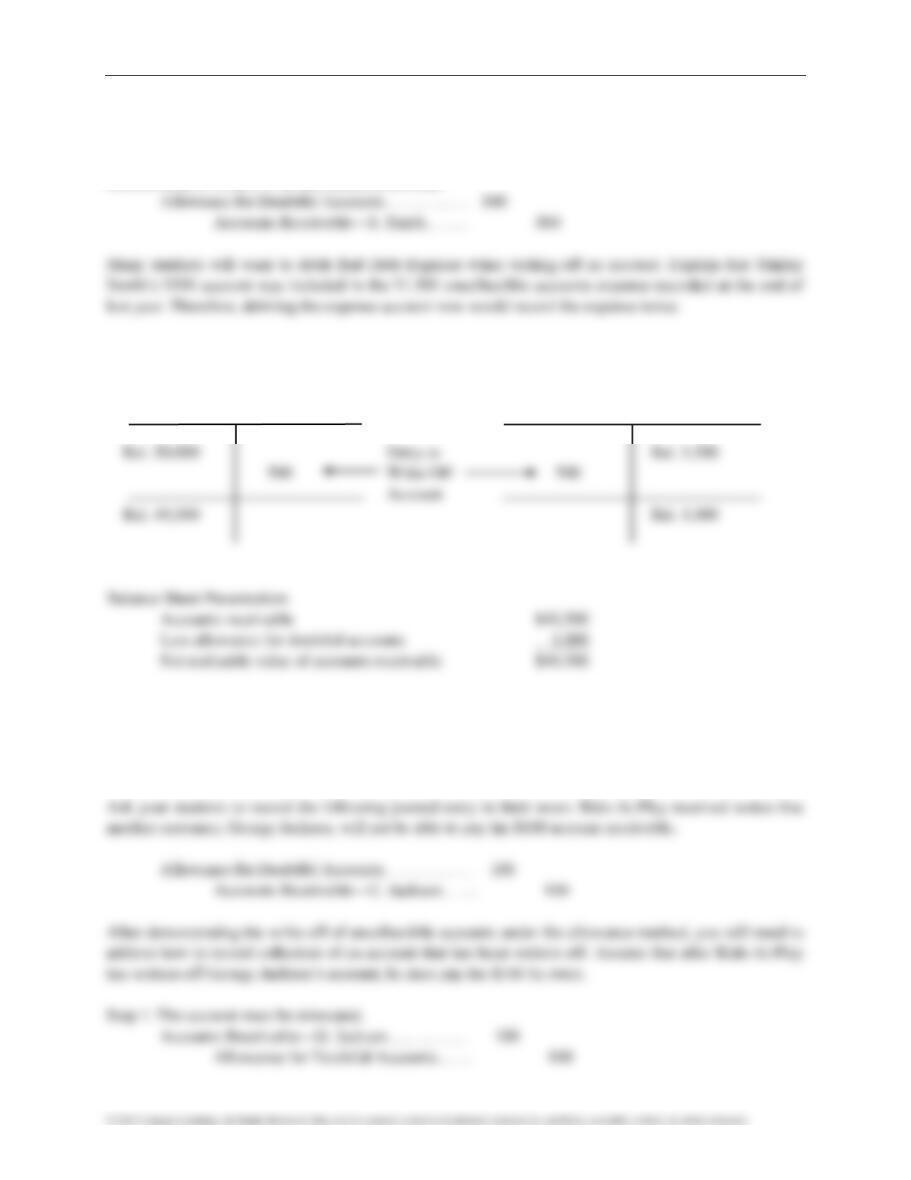
Assume that early in the second year of operations, Kids–At-Play decides to write off as uncollectible a
$500 receivable owed by Shirley Smith. Emphasize that once an account has been determined to be
Chapter 9 Receivables 149
uncollectible, it should be written-off immediately. This keeps the subsidiary ledger current for references
on the credit standing of customers.
Journal entry to write-off the uncollectible account:
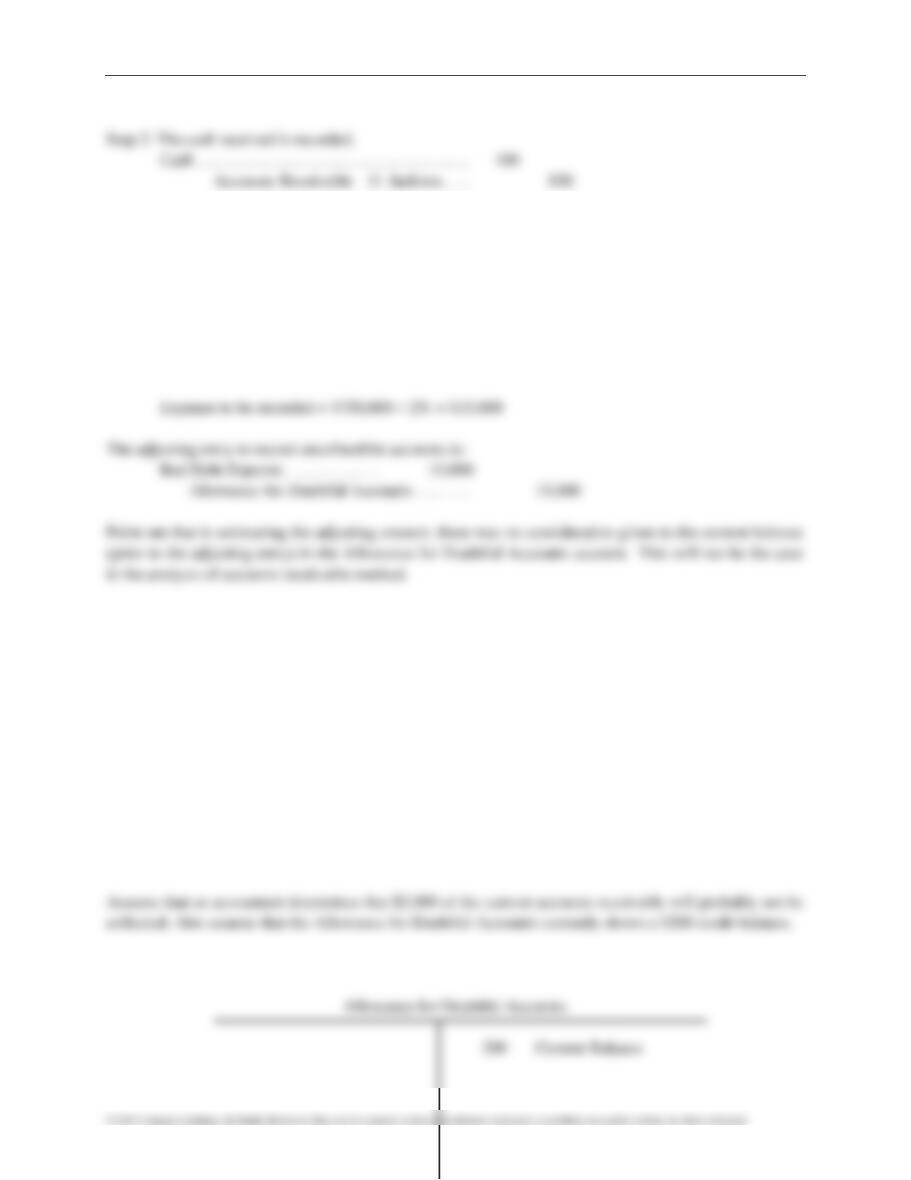
After writing-off the uncollectible account, the T accounts and balance sheet would appear as follows:
Accounts Receivable Allowance for Doubtful Accounts
Point out that the net realizable value of accounts receivable did not change. Kids-At-Play still expects to
collect $48,500 of its receivables. All that has changed is that the company now knows that Shirley
Smith, who owes $500, is one credit customer who will probably not pay. There still is approximately
$1,000 in bad debts left to be discovered.
150 Chapter 9 Receivables
DEMONSTRATION PROBLEM — Estimating Uncollectible Accounts Based
on Sales
When accountants estimate uncollectible accounts based on sales, they determine the amount of expense
to be recorded.
Assume that a business sold $750,000 worth of merchandise on credit. The business estimates that 2
percent of all credit sales are uncollectible.
DEMONSTRATION PROBLEM — Estimating Uncollectible Accounts Based
on Receivables
Break this explanation into three parts. First, use the series of exercises from the book to demonstrate 1)
calculating the due date of overdue accounts, 2) completing a spreadsheet to determine the amount of
estimated uncollectable accounts for the upcoming accounting period, and 3) recording the journal entry
to establish the Allowance for Doubtful Accounts adjusting entry.
Additional explanation of the adjusting entry execution is provided below.
When accountants estimate uncollectible accounts based on receivables, they determine what the balance
of the allowance for doubtful accounts should be.
Chapter 9 Receivables 151
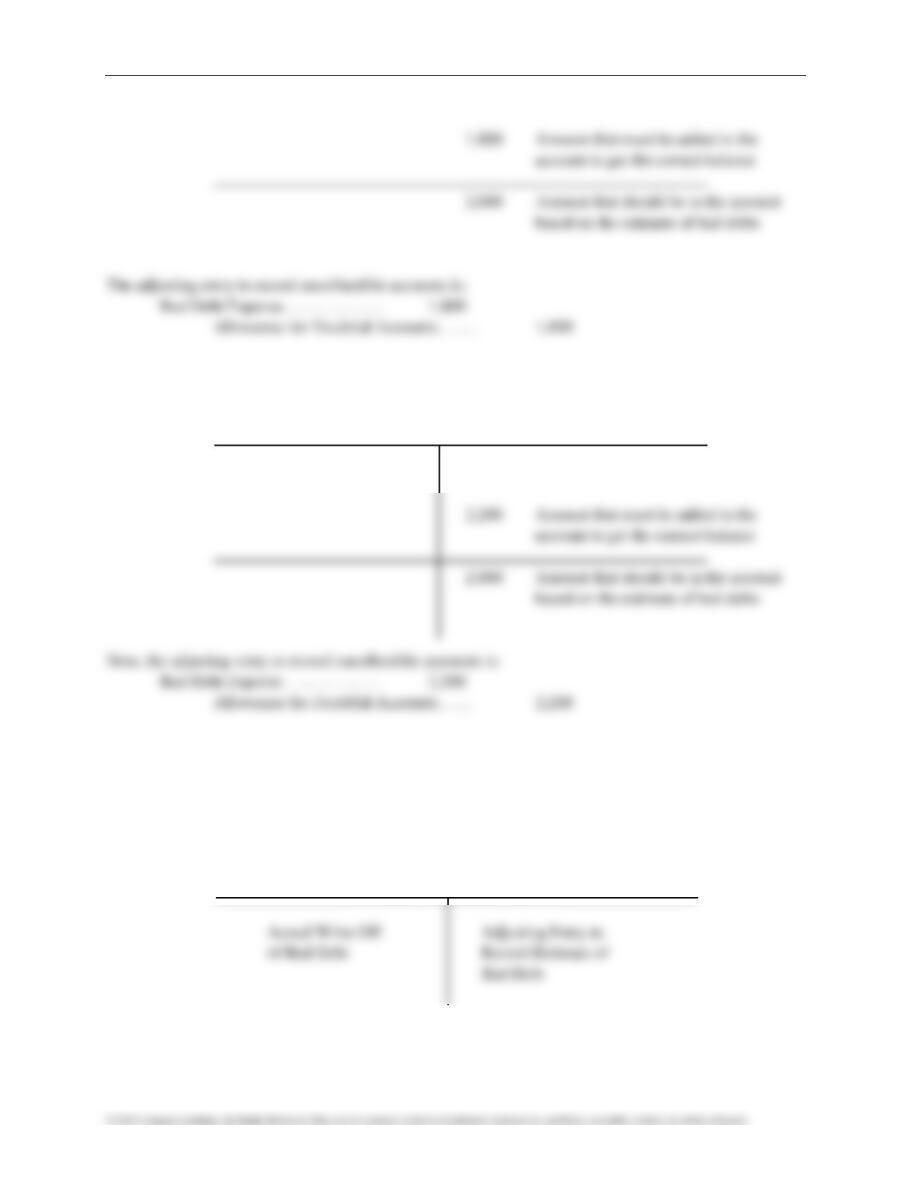
Assume that the accountant determines that $2,000 of the current accounts receivable will probably not be
collected and that the Allowance for Doubtful Accounts currently shows a $200 debit balance.
Allowance for Doubtful Accounts
Current Balance 200
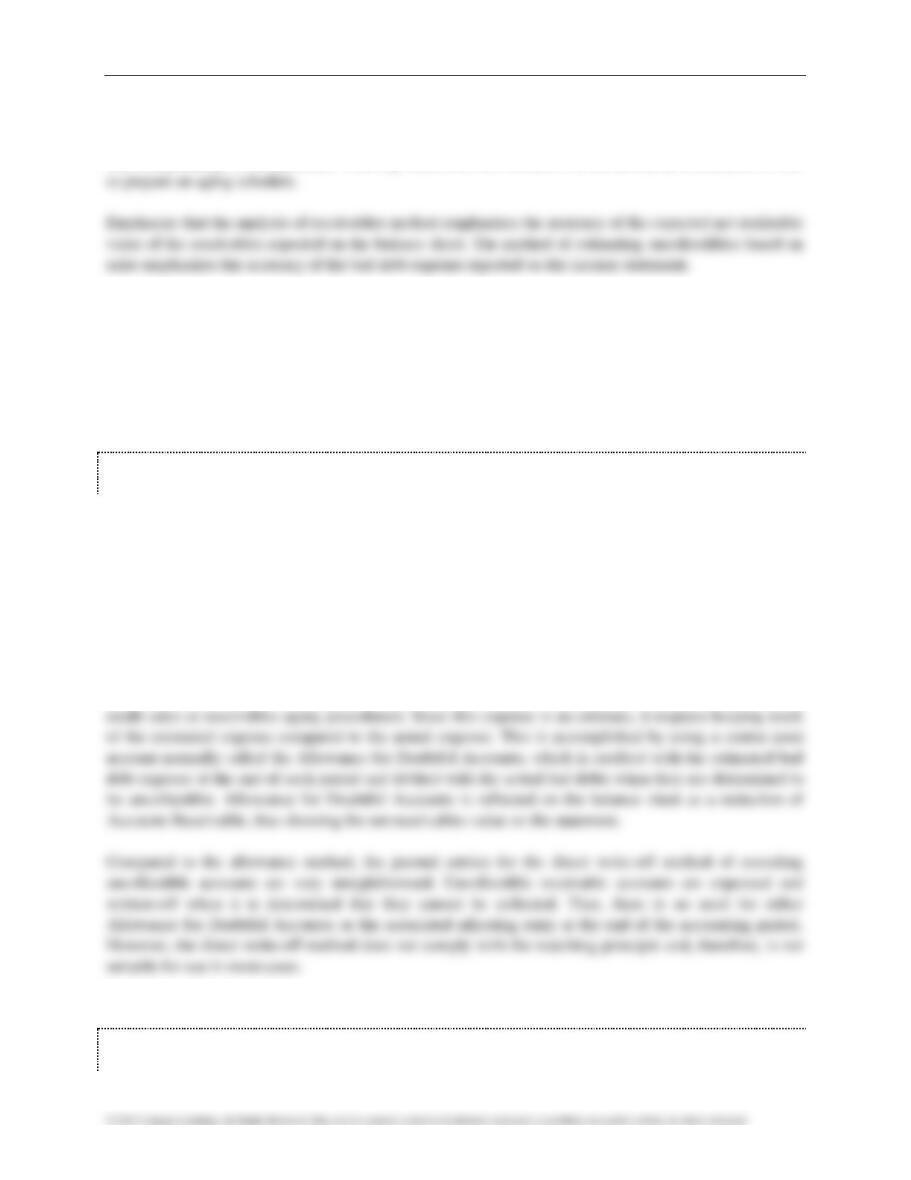
Your students may question why the Allowance for Doubtful Accounts would have a debit balance. The
following T account explaining the entries that affect the Allowance will show that a debit balance occurs
when the amount of bad debts is underestimated and there are more actual write-offs than expected. In the
above example, bad debts from the previous period were underestimated by $200. Since the allowance
came up short, the entry to record bad debts in the current period is $2,200—the current expense of
$2,000 plus an extra $200 to catch up for the amount underestimated last accounting period.
Allowance for Doubtful Accounts
A credit balance occurs when the amount of bad debts are overestimated. The account would have a zero
balance if a business perfectly estimated the amount of bad debts.
152 Chapter 9 Receivables
Remind students that accountants use an aging analysis to determine the amount of accounts receivable
that will probably not be collected. You may want to review Exhibit 1 in the text as an illustration of how
GROUP LEARNING ACTIVITY — Entries for Uncollectible Accounts
TM 9-1 presents entries for your students to prepare in small groups. This exercise asks them to estimate
uncollectible accounts based on receivables, make the adjusting entry for uncollectible accounts, and
write-off bad accounts. The solution to this exercise is shown on TM 9-2.
OBJECTIVE 5
Compare the direct write-off and allowance methods of accounting for uncollectible
accounts.
SUGGESTED APPROACH
After the students have covered the material on how to determine the uncollectible values using both the
allowance method and the direct write-off method, it is helpful to summarize the differences between the
two. The allowance method is the preferred method and the only GAAP-approved method in most
instances because it adheres to the matching concept, thus matching expenses with the revenue that
generated them. It, however, requires determining a method of estimating these expenses (percent of
OBJECTIVE 6
Chapter 9 Receivables 153
Describe the accounting for notes receivable.
KEY TERMS
Dishonored Note Receivable Maturity Value
SUGGESTED APPROACH
The accounting implications of a promissory note referenced by this learning objective are determining
(1) the due date of a note, (2) the interest on a note, and (3) the maturity value of a note. These objectives
can be covered effectively by demonstrating each calculation and asking your students to practice the
same technique through a group learning activity.
One advantage of a note receivable is that it represents a stronger legal claim than an accounts receivable.
Because the debt and repayment terms are acknowledged by the debtor’s signature, a note will hold up
better in court if disputed. Since notes are a stronger legal document, it is a good idea to ask a credit
customer to sign a note receivable (rather than allowing him or her to buy on an open account) if the
following conditions exist:
1. The credit period is longer than 60 days.
3. The customer is asking for a time extension on an account receivable.
DEMONSTRATION PROBLEM — Determining the Due Date of a Note
To determine the due date of a note, start with the number of days in the term of the note. Next, subtract
the number of days in each month that pass until you reach 30 or less. That number represents the due
date of the note.
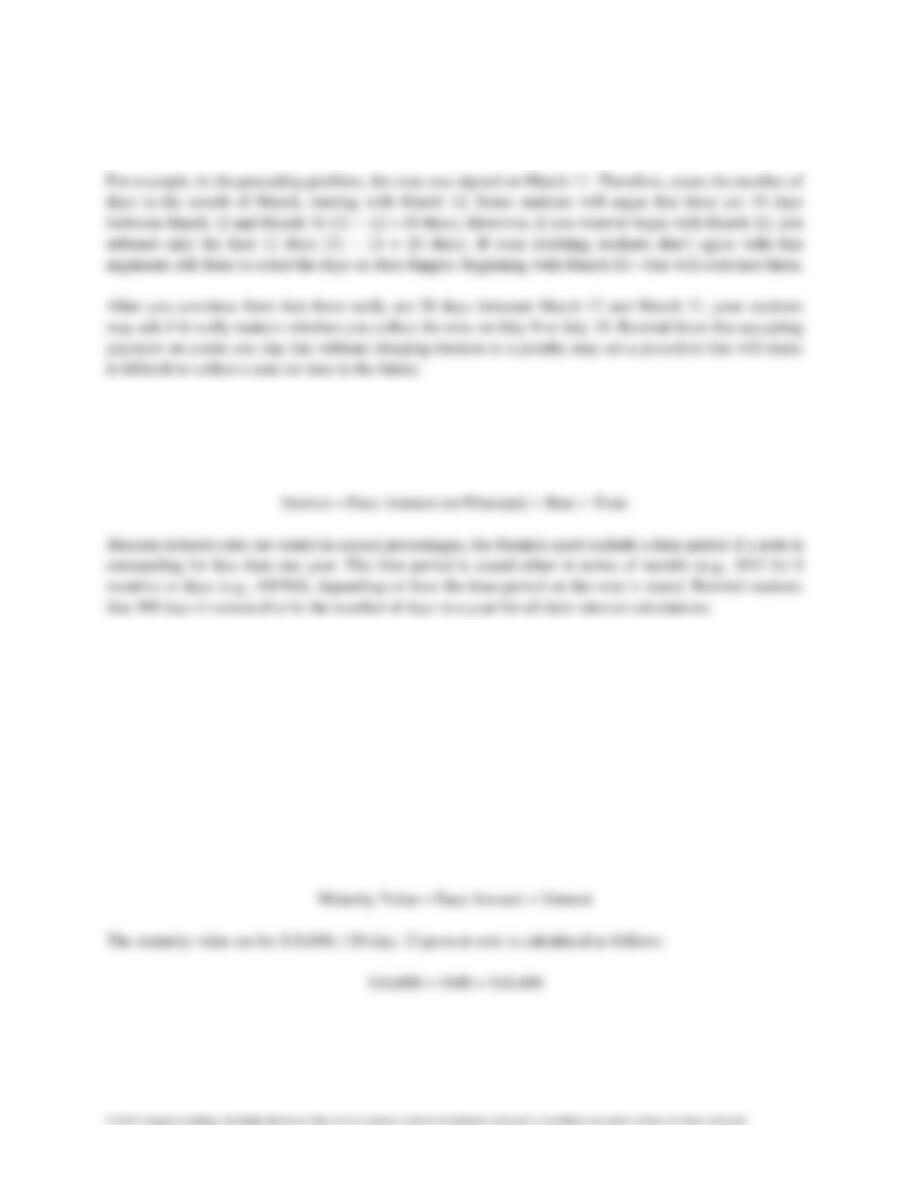
For example, assume that a 120-day note is signed on March 11. The due date of that note is calculated as
follows:
Term of the note 120
Days that pass in March:
Number of days in March 31
154 Chapter 9 Receivables
signed. Therefore, you should begin counting on the day after the date on the note to determine the due
date.
DEMONSTRATION PROBLEM—Calculating Interest and Maturity Value of a
Note
The formula for calculating interest is as follows:
To demonstrate this concept, calculate the interest on a $10,000, 120-day, 12 percent note:
$10,000 12% 120/360 = $400 interest
The interest on any amount for 60 days at 6 percent can be determined by moving the decimal point in the
principal two places to the left. For example, the interest on $1,500 for 60 days at 6 percent is $15. This is
called the 60–day, 6 percent method. This method is useful for checking the “reasonableness” of
computations when a calculator is used.
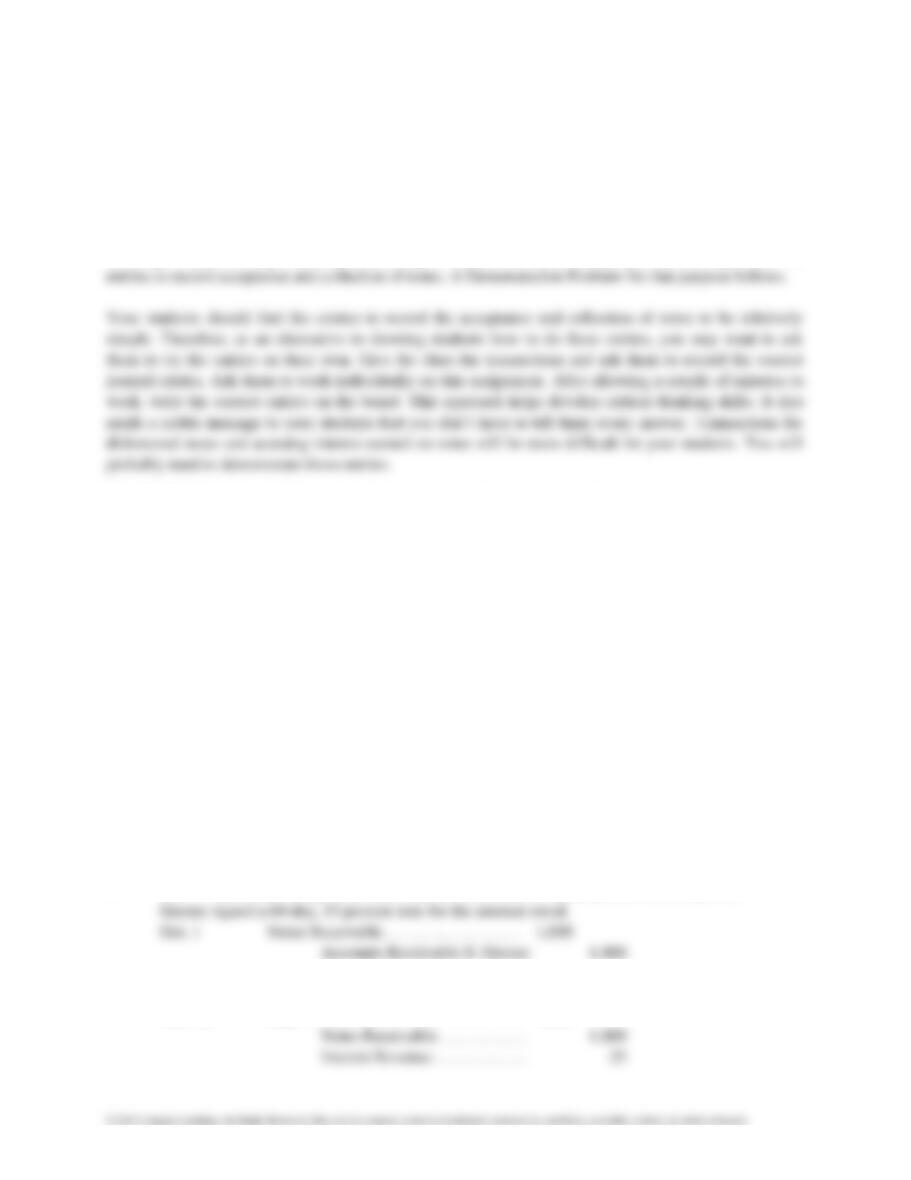
You will also need to demonstrate the calculation of maturity value. The maturity value of a note is the
amount that is due to be paid on the maturity date. The formula is:
Chapter 9 Receivables 155
GROUP LEARNING ACTIVITY — Determining Due Date, Interest, and
Maturity Value of a Note
TM 9-5 provides information on two promissory notes. Divide the class into small groups and ask your
students to determine the due date, interest, and maturity value for each. TM 9-6 shows the solution to
this exercise.
Coverage of journalizing related to accounting for notes receivable transactions should begin with the
DEMONSTRATION PROBLEM — Journal Entries for Notes Receivable
Transactions
Two reasons for accepting a note from a customer are (1) as a promise of payment on a credit purchase
and (2) to grant a time extension on an amount owed on an open account. In both cases, the customer’s
note is recorded in a notes receivable account.
Use the following transactions for Joy’s TV and Electronics to demonstrate journal entries for your class:
1. June 1: Sold a $2,000 big-screen TV to a customer. The customer was asked to sign a 120-
day, 12 percent note. (Hint: The interest is not recorded until it is earned.)
June 1 Notes Receivable……………………. 2,000
Sales…………………….…. 2,000
2. Sept. 29: Received payment on the $2,000, 120-day, 12 percent note.
Sept. 29 Cash………………………………… 2,080
Notes Receivable……………. 2,000
Interest Revenue…………….. 80
3. Oct. 1: Granted a 60-day time extension to S. Greene, who owed $1,000 on account. Ms.
4. Nov. 30: Received payment on the $1,000, 60-day, 15 percent note from S. Greene.
Nov. 30 Cash………………………………….. 1,025
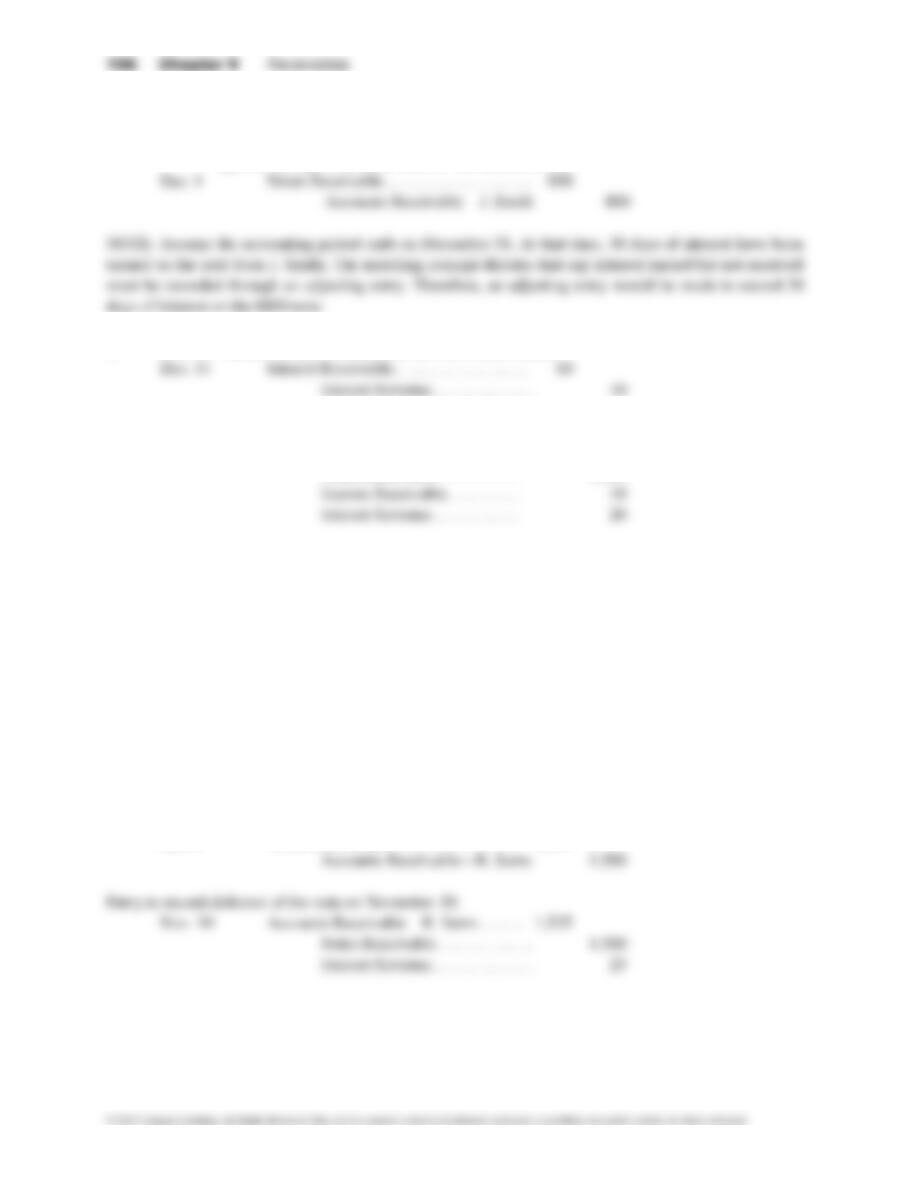
5. Dec. 1: Granted a 90-day time extension to J. Smith, who owed $800 on an account. Mr. Smith
signed a 90-day, 15 percent note for the amount owed.
6. Dec. 31: Recorded interest earned on the note from J. Smith.
7. Mar 1: Received payment on the $800, 90-day, 15 percent note from J. Smith.
Mar. 1 Cash ………………………………… 1,030
Notes Receivable……………. 1,000
DEMONSTRATION PROBLEM — Dishonored Note
If the maker of a note fails to pay the note when it is due, the note has been dishonored. The total amount
due on the dishonored note is transferred back to the customer’s accounts receivable account. This places
a record of the dishonored note in the customer’s account, making it visible should the customer attempt
to purchase additional merchandise on credit.
On October 1, Joy’s TV and Electronics accepts a $1,500, 60 day, 10 percent note from R. Sams as a time
extension on an open account. The note is dishonored on its due date, November 30.
Entry to record acceptance of the note on October 1:
Oct. 1 Notes Receivable…………………….. 1,500

Chapter 9 Receivables 157
OBJECTIVE 7
Describe the reporting of receivables on the balance sheet.
SUGGESTED APPROACH
The Group Learning Activity that follows asks your students to prepare the Current Assets section of a
balance sheet.
GROUP LEARNING ACTIVITY — Current Assets on the Balance Sheet
TM 9-7 shows information taken from the accounting records of Leder Hardware. Divide your class into
small groups and ask them to prepare the Current Assets section of the balance sheet. Emphasize that
current assets are normally presented in order of their liquidity on the balance sheet. TM 9-8 contains the
solution.
OBJECTIVE 8
Describe and illustrate the use of accounts receivable turnover and number of days’ sales in
receivables to evaluate a company’s efficiency in collecting its receivables.
KEY TERMS
Accounts Receivable Turnover Number of Days’ Sales in Receivables
SUGGESTED APPROACH
The ratios to compute accounts receivable turnover and average days’ sales in receivables are used to
evaluate the efficiency in collecting receivables and managing credit. They provide a method to analyze
the accounting data related to receivables. A Lecture Aid for use in presenting this material follows.
LECTURE AID — Financial Ratios Related to Receivables
Accounts receivable turnover measures the efficiency in collecting accounts receivable by comparing a
company’s average accounts receivable balance to sales. The formula is:
Accounts Receivable Net Sales
Turnover = Average Accounts Receivable

158 Chapter 9 Receivables
In effect, this ratio measures how many times during a year a company collects its average outstanding
accounts receivable. For example, if a company sold $300 in merchandise during a year and its average
accounts receivable balance that year was $100, the company turned over (or collected) its receivables
three times ($300/100 = 3). The company sold $100 worth of merchandise and collected its money three
times.
The ratio uses average accounts receivable instead of the ending balance of accounts receivable in order
to smooth out any seasonal fluctuations in receivables. In determining this average, it is ideal to average
accounts receivable at the end of each month for a year. However, in many cases, monthly data are not
available, so the beginning and end of the year accounts receivable data are averaged.
Average Accounts Beginning Accounts Receivable + Ending Accounts Receivable
Receivable = 2
Number of days’ sales in receivables estimates the average time (in days) it takes a company to collect its
accounts receivable. This collection time can be compared with the company’s standard credit terms to
determine whether the credit collection policies are effective in collecting receivables. For example, a
number of days’ sales in receivables of 45 is not good if the standard credit terms are n/30.
The formula for number of days’ sales in receivables is as follows:
Number of Days’ Sales Accts. Receivable Balance, End of Year
in Receivables = Average Daily Sales
where:
Net Sales
Average Daily Sales = 365
For example, assume a business sold a total of $839,500 during the current year and its accounts
receivable balance at the end of the year was $73,600. The number of days’ sales in receivables would be
computed as follows:
Average Daily Sales = $2,300 ($839,500/365)
Number of Days’ Sales in Receivables = 32 ($73,600/$2,300)
Ask your students to comment on this ratio if the company’s standard credit terms ask customers to pay in
30 days.
Assume that same business had $72,000 in accounts receivable on December 31 of the prior year. What
was the business’s accounts receivable turnover?
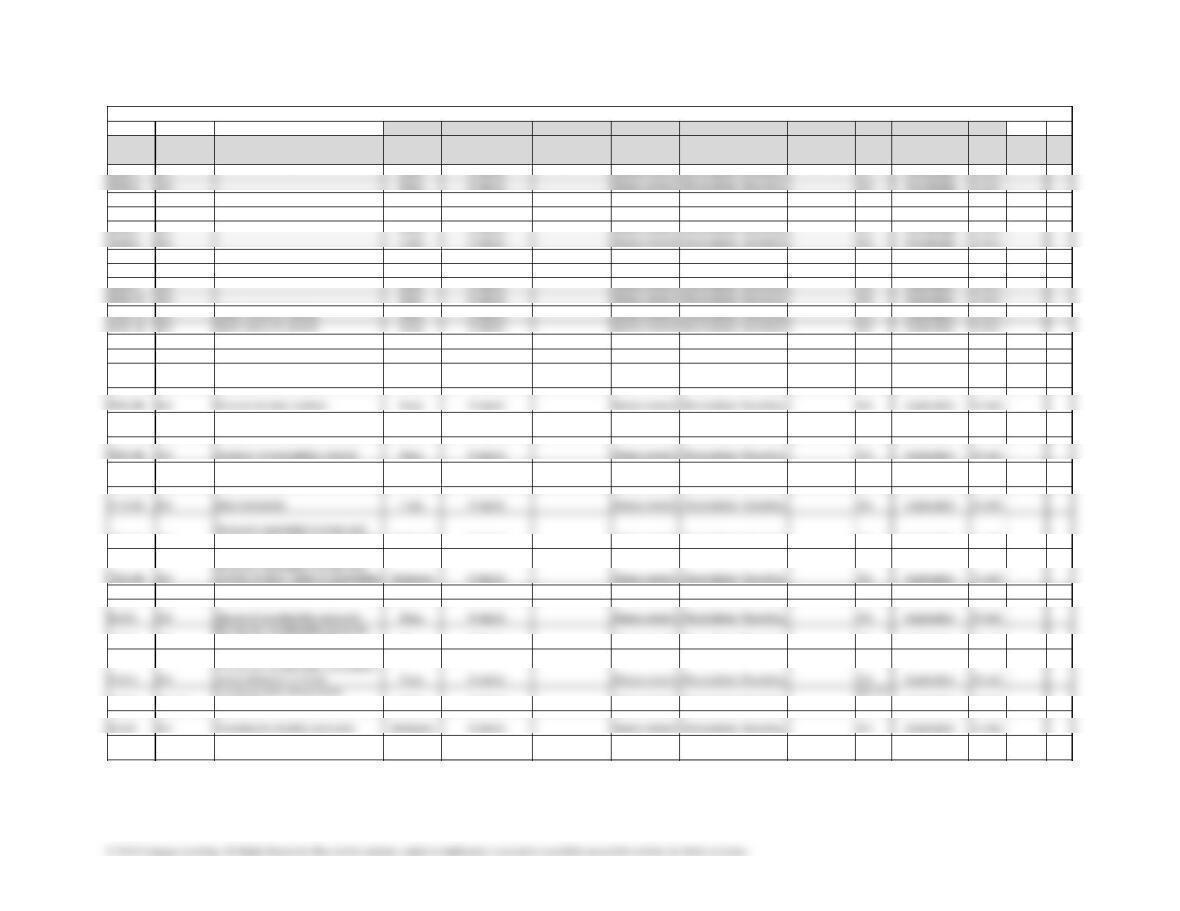
DIFFICULTY BUSPROG AICPA AICPA ACBSP ACBSP LO BLOOM’S TIME
Problem
Learning
Objective
Description Primary Broad Business Functional Primary Secondary
Spread-
sheet
GL
DQ9-1 9-1 Easy Analytic Measurement Receivables Reporting 9-1 Knowledge 5 min.
DQ9-2 9-2 Easy Analytic Measurement Receivables Reporting 9-2 Knowledge 5 min.
DQ9-3 9-4 Easy Analytic Measurement Receivables Reporting 9-4 Knowledge 5 min.
DQ9-4 9-7 Easy Analytic Measurement Receivables Reporting 9-7 Knowledge 5 min.
DQ9-5 9-4 Easy Analytic Measurement Receivables Reporting 9-4 Knowledge 5 min.
DQ9-6 9-5 Easy Analytic Measurement Receivables Reporting 9-5 Knowledge 5 min.
DQ9-7 9-6 Easy Analytic Measurement Receivables Reporting 9-6 Knowledge 5 min.
DQ9-8 9-6 Easy Analytic Measurement Receivables Reporting 9-6 Knowledge 5 min.
DQ9-9 9-6 Easy Analytic Measurement Receivables Reporting 9-6 Application 5 min.
DQ9-10 9-6 Easy Analytic Measurement Receivables Reporting 9-6 Application 5 min.
PE9-1A 9-3 Direct write-off method Easy Analytic Measurement Receivables Reporting 9-3 Application 5 min.
PE9-1B 9-3 Direct write-off method Easy Analytic Measurement Receivables Reporting 9-3 Application 5 min.
PE9-2A 9-4 Allowance method Easy Analytic Measurement Receivables Reporting 9-4 Application 5 min.
PE9-2B 9-4 Allowance method Easy Analytic Measurement Receivables Reporting 9-4 Application 5 min.
PE9-3A 9-4 Percent of sales method Easy Analytic Measurement Receivables Reporting 9-4 Application 10 min.
PE9-3B 9-4 Percent of sales method Easy Analytic Measurement Receivables Reporting 9-4 Application 10 min.
PE9-4A 9-4 Analysis of receivables method Easy Analytic Measurement Receivables Reporting 9-4 Application 10 min.
PE9-4B 9-4 Analysis of receivables method Easy Analytic Measurement Receivables Reporting 9-4 Application 10 min.
PE9-5A 9-6 Note receivable Easy Analytic Measurement Receivables Reporting 9-6 Application 10 min.
PE9-5B 9-6 Note receivable Easy Analytic Measurement Receivables Reporting 9-6 Application 10 min.
PE9-6A 9-8
number of days’ sales in receivables
Moderate Analytic Measurement Receivables Reporting 9-8 Application 15 min.
PE9-6B 9-8
number of days’ sales in receivables
Moderate Analytic Measurement Receivables Reporting 9-8 Application 15 min.
Ex9-1 9-1 Classifications of receivables Easy Analytic Measurement Receivables Reporting 9-1 Knowledge 5 min.
Ex9-2 9-2 Nature of uncollectible accounts Easy Analytic Measurement Receivables Reporting 9-2 Application 10 min.
Ex9-3 9-3
using direct write-off method
Easy Analytic Measurement Receivables Reporting 9-3 Application 10 min.
Ex9-5 9-3, 9-4
receivable
Easy Analytic Measurement Receivables Reporting
4
Application 10 min.
Ex9-6 9-4 Providing for doubtful accounts Moderate Analytic Measurement Receivables Reporting 9-4 Application 15 min.
Ex9-7 9-4 Number of days past due Easy Analytic Measurement Receivables Reporting 9-4 Application 15 min.
HOMEWORK CHART WITH LEARNING OUTCOMES TAGGING
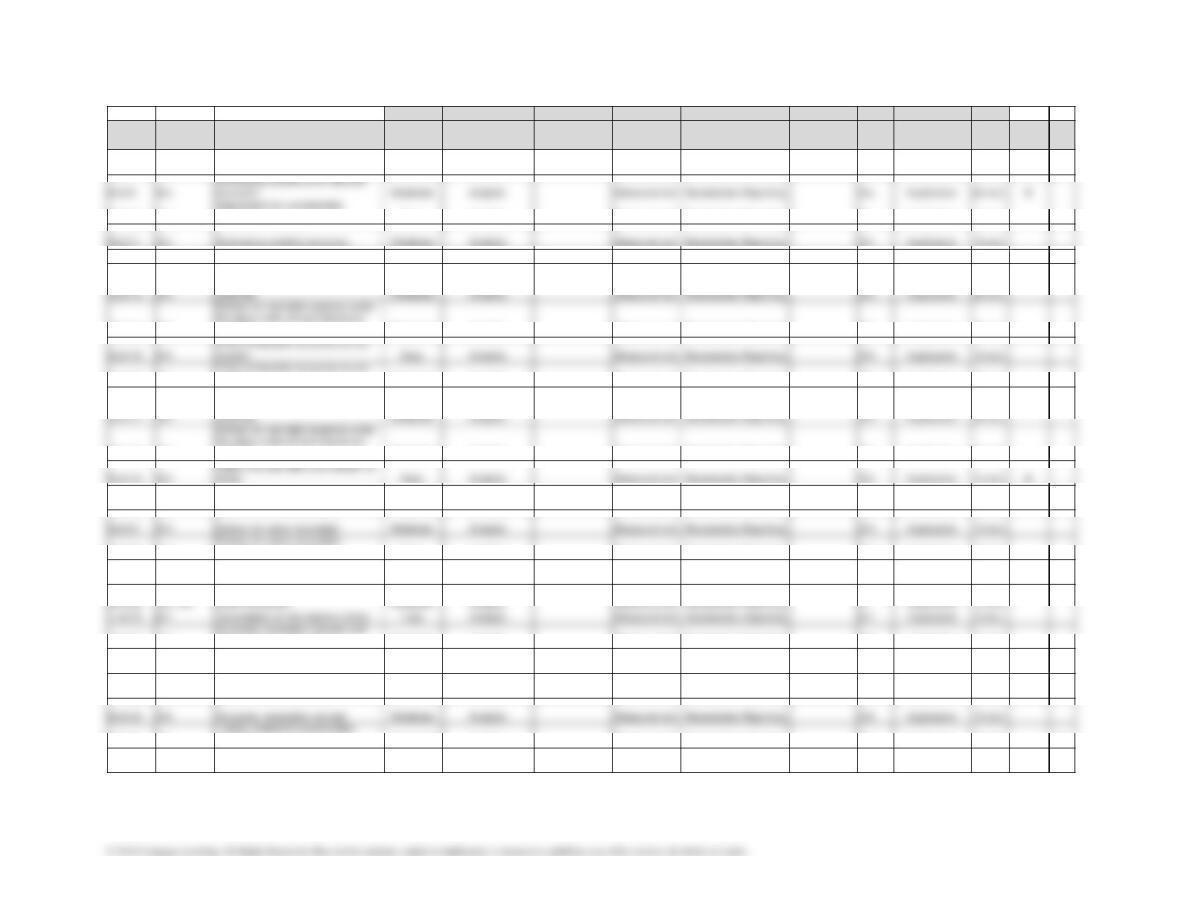
DIFFICULTY BUSPROG AICPA AICPA ACBSP ACBSP LO BLOOM’S TIME
Problem
Learning
Objective
Description Primary Broad Business Functional Primary Secondary
Spread-
sheet
GL
Ex9-8 9-4 Aging of receivables schedule Moderate Analytic Measurement Receivables Reporting 9-4 Application 20 min. X
Estimating allowance for doubtful
accounts
Adjustment for uncollectible
Ex9-10 9-4
accounts
Easy Analytic Measurement Receivables Reporting 9-4 Application 5 min.
Ex9-11 9-4 Estimating doubtful accounts Moderate Analytic Measurement Receivables Reporting 9-4 Application 15 min.
Ex9-12 9-4 Entry for uncollectible accounts Easy Analytic Measurement Receivables Reporting 9-4 Application 5 min.
Ex9-13 9-5
methods
Moderate Analytic Measurement Receivables Reporting 9-5 Application 30 min.
the direct write-off and allowance
Entries for bad debt expense under
the direct write-off and allowance
Ex9-14 9-5
methods
Moderate Analytic Measurement Receivables Reporting 9-5 Application 30 min.
Effect of doubtful accounts on net
Effect of doubtful accounts on net
Ex9-16 9-5
income
Moderate Analytic Measurement Receivables Reporting 9-5 Application 15 min.
Ex9-17 9-5
methods
Moderate Analytic Measurement Receivables Reporting 9-5 Application 30 min.
Entries for bad debt expense under
the direct write-off and allowance
Entries for bad debt expense under
the direct write-off and allowance
Ex9-18 9-5
methods
Moderate Analytic Measurement Receivables Reporting 9-5 Application 30 min.
Ex9-19 9-6
Determine due date and interest on
notes
Ex9-20 9-6 Entries for notes receivable Easy Analytic Measurement Receivables Reporting 9-6 Application 10 min.
Ex9-21 9-6 Entries for notes receivable Moderate Analytic Measurement Receivables Reporting 9-6 Application 15 min.
Entries for notes receivable,
Ex9-22 9-6
including year-end entries
Easy Analytic Measurement Receivables Reporting 9-6 Application 10 min.
Ex9-23 9-6
Entries for receipt and dishonor of
note receivable
Easy Analytic Measurement Receivables Reporting 9-6 Application 10 min.
Ex9-24 9-4, 9-6
notes receivable
Moderate Analytic Measurement Receivables Reporting
6
Accounts receivable turnover and
Entries for receipt and dishonor of
9-4, 9-
Ex9-26 9-8
days’ sales in receivables
Moderate Analytic Measurement Receivables Reporting 9-8 Application 15 min.
Ex9-27 9-8
Accounts receivable turnover and
days’ sales in receivables
Moderate Analytic Measurement Receivables Reporting 9-8 Application 15 min.
Ex9-28 9-8
Accounts receivable turnover and
days’ sales in receivables
Moderate Analytic Measurement Receivables Reporting 9-8 Application 15 min.
Ex9-29 9-8 Accounts receivable turnover Moderate Analytic Measurement Receivables Reporting 9-8 Application 15 min.
Entries related to uncollectible
Pr9-1A 9-4
accounts
Challenging Analytic Measurement Receivables Reporting 9-4 Application 1 hour X
Pr9-2A 9-4
Aging of receivables; estimating
allowance for doubtful accounts
Challenging Analytic Measurement Receivables Reporting 9-4 Application 1 hour X
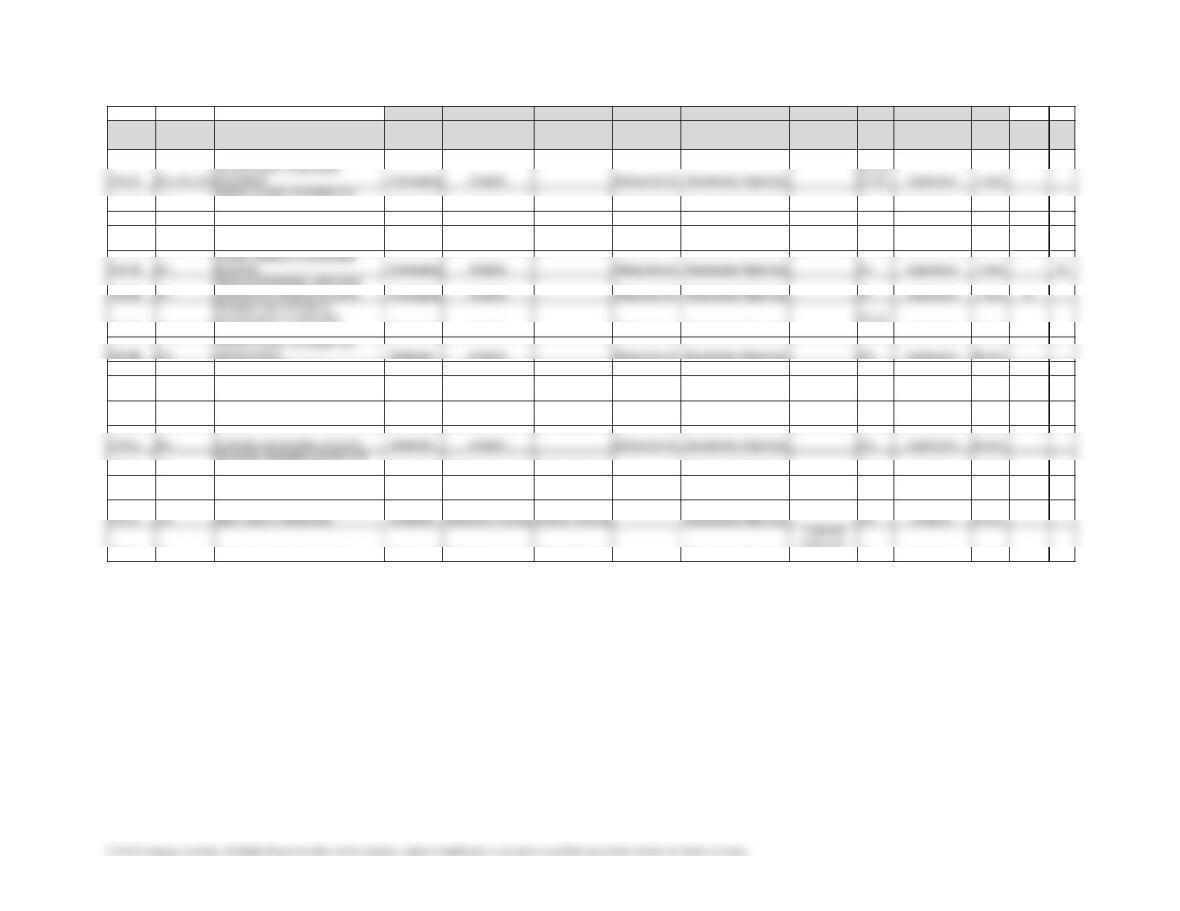
DIFFICULTY BUSPROG AICPA AICPA ACBSP ACBSP LO BLOOM’S TIME
Problem
Learning
Objective
Description Primary Broad Business Functional Primary Secondary
Spread–
sheet
GL
Pr9-3A 9-3, 9-4, 9-5
accounting for uncollectible
receivables
Challenging Analytic Measurement Receivables Reporting
9-3, 9-
4, 9-5
Application 1 hour
Details of notes receivable and
Compare two methods of
Pr9-4A 9-6
related entries
Moderate Analytic Measurement Receivables Reporting 9-6 Application 30 min.
Pr9-5A 9-6 Notes receivable entries Moderate Analytic Measurement Receivables Reporting 9-6 Application 1 hour
Pr9-6A 9-6
Sales and notes receivable
transactions
Moderate Analytic Measurement Receivables Reporting 9-6 Application 1 hour X
Pr9-1B 9-4
Entries related to uncollectible
accounts
Aging of receivables; estimating
Pr9-2B 9-4
allowance for doubtful accounts
Compare two methods of
accounting for uncollectible
9-3, 9-
Pr9-3B 9-3, 9-4, 9-5
receivables
Challenging Analytic Measurement Receivables Reporting
4, 9-5
Application 1 hour
Pr9-4B 9-6
Details of notes receivable and
related entries
Moderate Analytic Measurement Receivables Reporting 9-6 Application 30 min.
Pr9-5B 9-6 Notes receivable entries Moderate Analytic Measurement Receivables Reporting 9-6 Application 1 hour
Pr9-6B 9-6
Sales and notes receivable
transactions
Moderate Analytic Measurement Receivables Reporting 9-6 Application 1 hour X
CP9-1 9-6
Ethics and professional conduct in
business
Easy Ethics Industry Receivables Reporting 9-6 Comprehension 5 min.
CP9-2 9-4 Estimate uncollectible accounts Moderate Analytic Measurement Receivables Reporting 9-4 Application 30 min.
CP9-3 9-8
days’ sales in receivables
Challenging Reflective Thinking Critical Thinking Receivables Reporting 9-8 Analysis 30 min.
CP9-4 9-8
Accounts receivable turnover and
days’ sales in receivables
Challenging Reflective Thinking Critical Thinking Receivables Reporting 9-8 Analysis 1 hour
CP9-5 9-8
days’ sales in receivables
Moderate Reflective Thinking Critical Thinking Receivables Reporting 9-8 Analysis 30 min.
Accounts receivable turnover and
CP9-6 9-8 Accounts receivable turnover Challenging Reflective Thinking Critical Thinking Receivables Reporting
Analysis
9-8 Analysis 1 hour