
×=
Rate
Number of periods
Payments
Future value
Type
PV
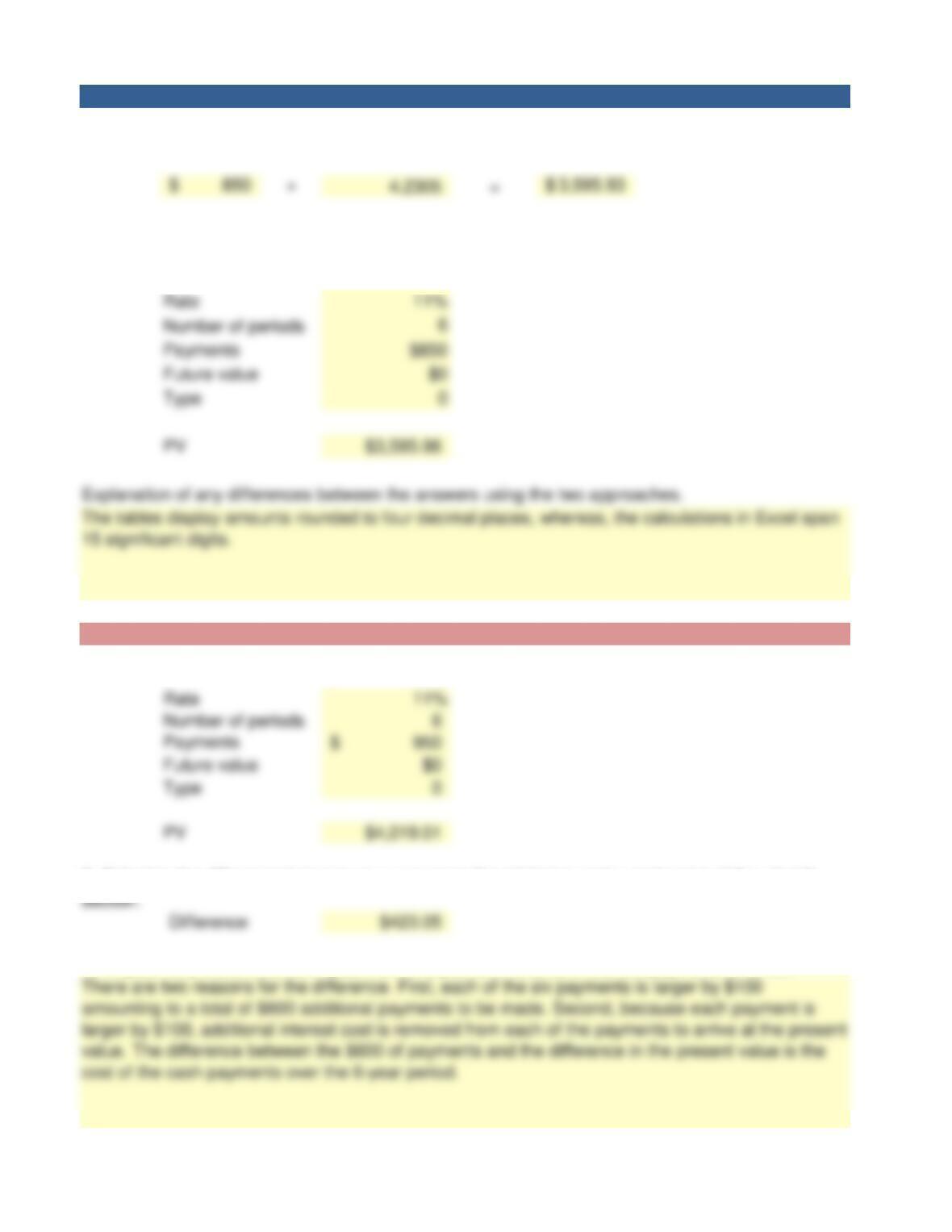
Explanation of any differences between the answers using the two approaches.
What-if?
Consider the following after you have completed the requirements of E9-4.
1. Assume the annual payment is $950 rather than $850. Recompute the present value.
Rate
Number of periods
Payments
Future value
Type
PV
Difference
3. Explain why the difference in part 2 is not equal to difference in the two payments of $100.
Exercise 9-4 Using Present Value Tables
What is the present value of $850 per year for six years if the required return is 11 percent (using
Table B9-2 in Appendix B).
What is the present value of $850 per year for six years if the required return is 11 percent (using
Excel’s PV function).
2. Calculate the difference between your answer to the original question and part 1 of the what-if
section.

What-if?
1. Assume the annual payment is $950 rather than $850. Recompute the present value.
3. Explain why the difference in part 2 is not equal to difference in the two payments of $100.
What is the present value of $850 per year for six years if the required return is 11 percent (using
Excel’s PV function).
What is the present value of $850 per year for six years if the required return is 11 percent (using
Table B9-2 in Appendix B).
Solution: Exercise 9-4 Using Present Value Tables
2. Calculate the difference between your answer to the original question and part 1 of the what-if

There are two reasons for the difference. First, each of the six payments is larger by $100
amounting to a total of $600 additional payments to be made. Second, because each payment is
larger by $100, additional interest cost is removed from each of the payments to arrive at the present
value. The difference between the $600 of payments and the difference in the present value is the
cost of the cash payments over the 6-year period.
Contract amount 20,000,000$
Signing bonus 7,500,000
Annual payments 2,500,000
Contract amount 22,000,000$
Year 1 2,500,000
Year 2 2,600,000
Year 3 2,700,000
Year 4 2,800,000
Year 5 2,900,000
Year 5 balloon payment 8,500,000
Required
Value of original contract:
Time Cash Flow Factor Total
0 × =
1 – 5 × =
Value of original contract:
Payments
Signing Bonus
Rate
Number of periods
Payments
Future value
Type
PV
Calculate the value of the new contract using the interest tables.
Value of new contract:
Time Cash Flow Factor Total
1 × =
2 × =
Problem 9-1 Present Value Analysis
James Hardy recently rejected a five-year, $20,000,000 contract with the Vancouver Seals hockey
team. The contract amount consisted of a signing bonus and equal annual payments as follows:
To sweeten the deal, the president of player personnel for the Seals has now offered a contract
amount consisting of a signing bonus and payments which increase annually with a balloon
payment at the end of five years as follows:
Suppose you are Hardy’s agent and you wish to evaluate the first contract using a required rate of
return of 15%. Calculate the value of the original contract using factors from the interest tables and
separately, using Excel PV function.
3 × =
4 × =
5 × =
5 × =
In present value terms, how much better is the second contract?
What-if?
Consider the following after you have completed the requirements of P9-1.
Value of original contract:
Time Cash Flow Factor Total
0 × =
1 – 5 × =
Value of new contract:
Time Cash Flow Factor Total
1 × =
2 × =
3 × =
4 × =
5 × =
5 × =
Impact on decision:
Assume the rate required rate of return drops to 10%. What impact will this have on James Hardy’s
evaluation of the two contracts?
Problem data follows:
Original contract:
Contract amount 20,000,000$
Signing bonus 7,500,000
Annual payments 2,500,000
New contract:
Contract amount 22,000,000$
Year 1 2,500,000
Year 2 2,600,000
Year 3 2,700,000
Year 4 2,800,000
Year 5 2,900,000
Year 5 balloon payment 8,500,000
Required
Value of original contract:
Time Cash Flow Factor Total
Value of original contract:
Payments
Signing Bonus
Calculate the value of the new contract using the interest tables.
Value of new contract:
Time Cash Flow Factor Total
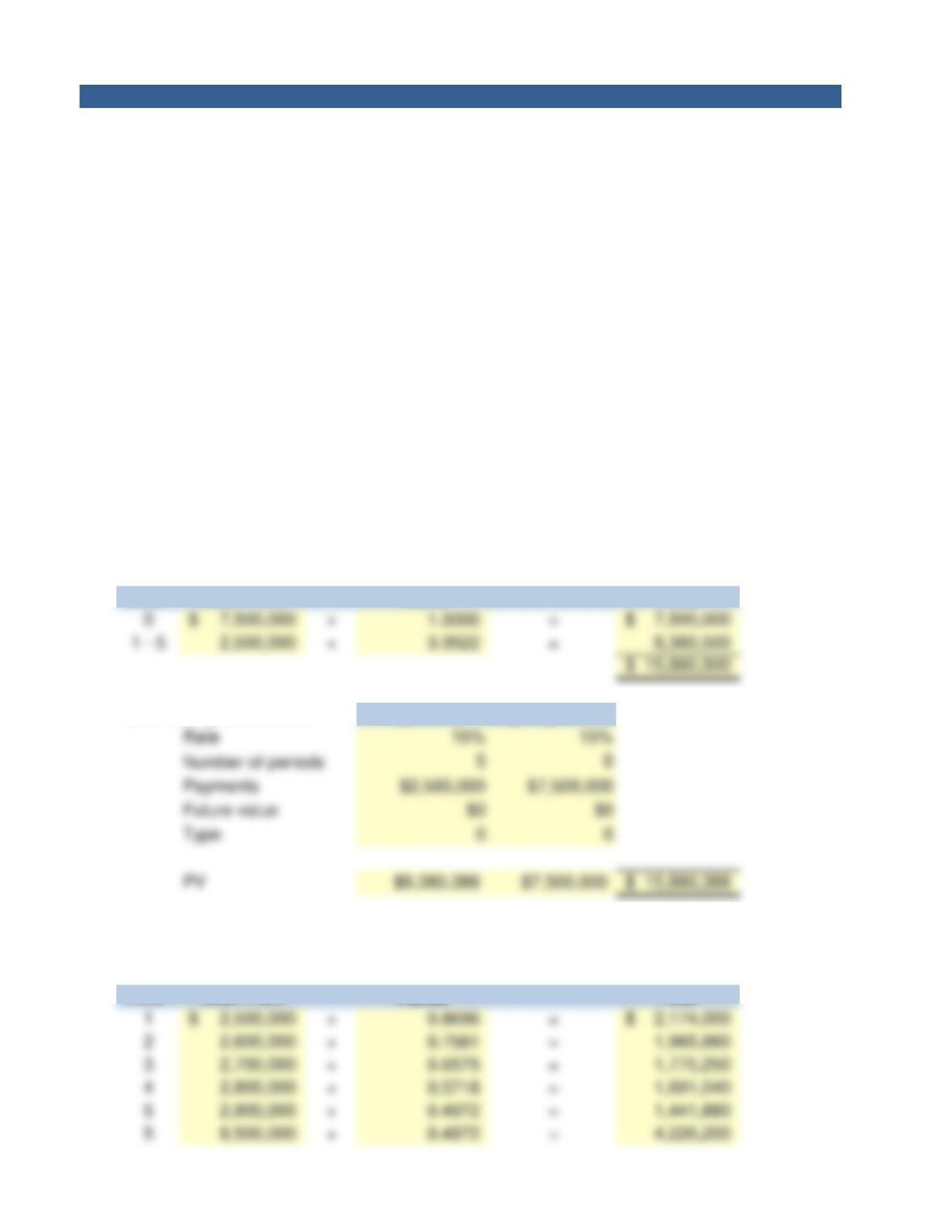
Solution: Problem 9-1 Present Value Analysis
Suppose you are Hardy’s agent and you wish to evaluate the first contract using a required rate of
return of 15%. Calculate the value of the original contract using factors from the interest tables and
separately, using Excel PV function.
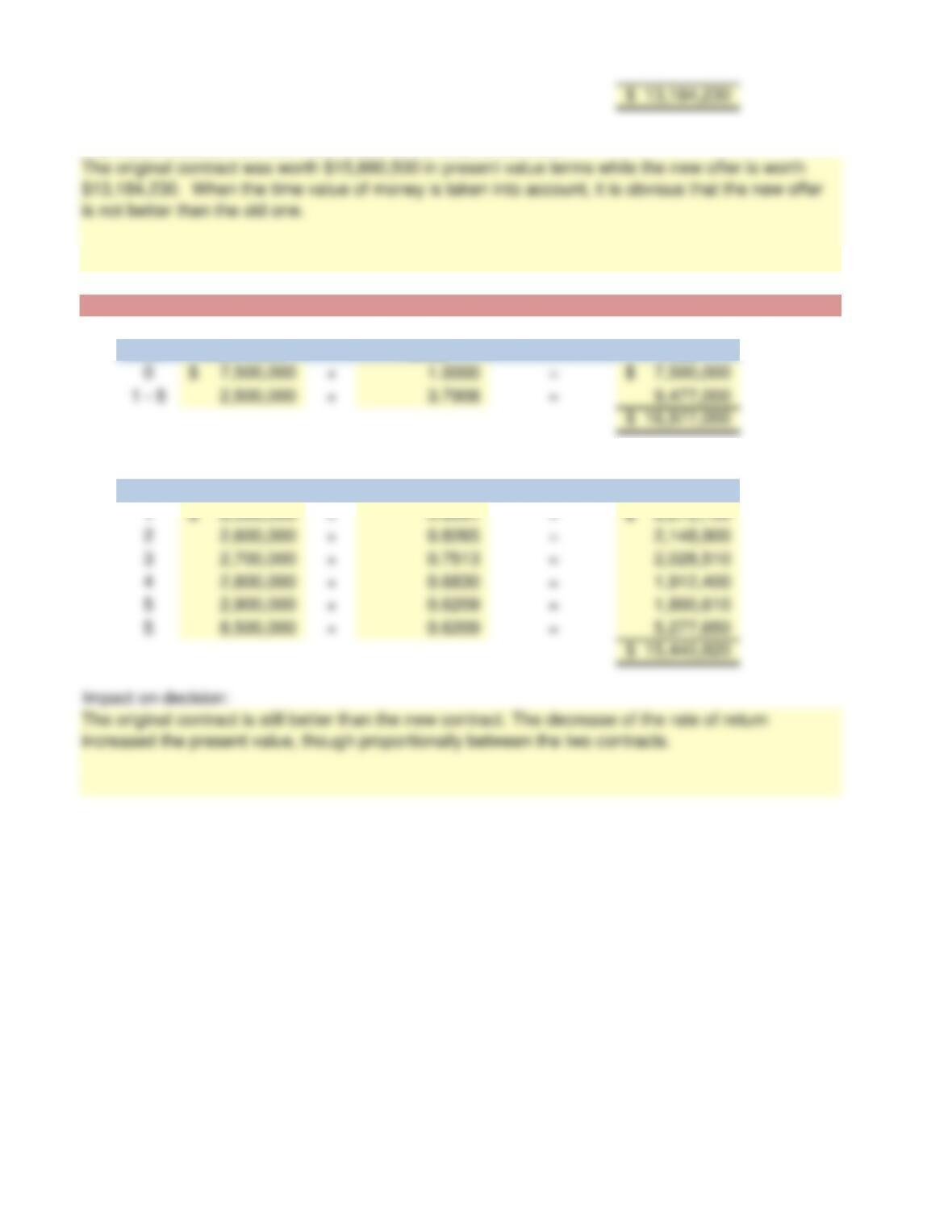
In present value terms, how much better is the second contract?
What-if?
Value of original contract:
Time Cash Flow Factor Total
Value of new contract:
Time Cash Flow Factor Total
Caribbean/Alaska
Caribbean/
Eastern Canada
120,000,000$ 105,000,000$
(25,000,000) (24,000,000)
(20,000,000) (20,000,000)
(21,000,000) (21,000,000)
115,000,000 115,000,000
169,000,000$ 155,000,000$
The estimated cost of the new ship and during of expected cash flows is:
Estimated cost of new ship 200,000,000$
Estimated period of cash flows in years 15
Required
12%
×=
16%
×=
12%
×=
16%
×=
Rate
12% 16% 12% 16%
Number of periods
Payments
Future value
Caribbean/ Eastern Canada
Non-operating expenses
Add back depreciation
Cash flow per year
a. For each of the itineraries, calculate the present values of the cash flows using required rates
of return of both 12 and 16% using both present value factors and separately using Excel PV
function. Assume a 15-year time horizon. Should the company purchase the ship with either or
Caribbean/Alaska
Caribbean/ Eastern Canada
Caribbean/Alaska
Indirect program expenses
Problem 9-4 Present Value and “What If” Analysis
National Cruise Line, Inc. is considering the acquisition of a new ship that will cost $200,000,000.
In this regard, the president of the company asked the CFO to analyze cash flows associated
with operating the ship under two alternative itineraries: Itinerary 1, Caribbean Winter/Alaska
Summer and Itinerary 2, Caribbean Winter/Eastern Canada Summer. The CFO estimated the
following cash flows, which are expected to apply to each of the next 15 years:
Net revenue
Less:
Direct program expenses
Type
PV
b. The president is uncertain whether a 12 percent or a 16 percent required return is appropriate.
Explain why,
c. Focusing on a 12 percent required rate of return, what would be the opportunity cost to the
company of using the ship in the Caribbean/Eastern Canada itinerary rather than a
Caribbean/Alaska itinerary?
Problem data follows:
Caribbean/Alaska
Caribbean/
Eastern Canada
120,000,000$ 105,000,000$
(25,000,000) (24,000,000)
(20,000,000) (20,000,000)
(21,000,000) (21,000,000)
115,000,000 115,000,000
169,000,000$ 155,000,000$
Estimated cost of new ship 200,000,000$
Estimated period of cash flows in years 15
Required
Rate
12% 16% 12% 16%
a. For each of the itineraries, calculate the present values of the cash flows using required rates
of return of both 12 and 16% using both present value factors and separately using Excel PV
function. Assume a 15-year time horizon. Should the company purchase the ship with either or
both required rates of return?
Caribbean/Alaska
Caribbean/ Eastern Canada
Caribbean/Alaska
Cash flow per year
Solution: Problem 9-4 Present Value and “What If” Analysis
Less:
Direct program expenses
Indirect program expenses
Non-operating expenses
Add back depreciation
Net revenue
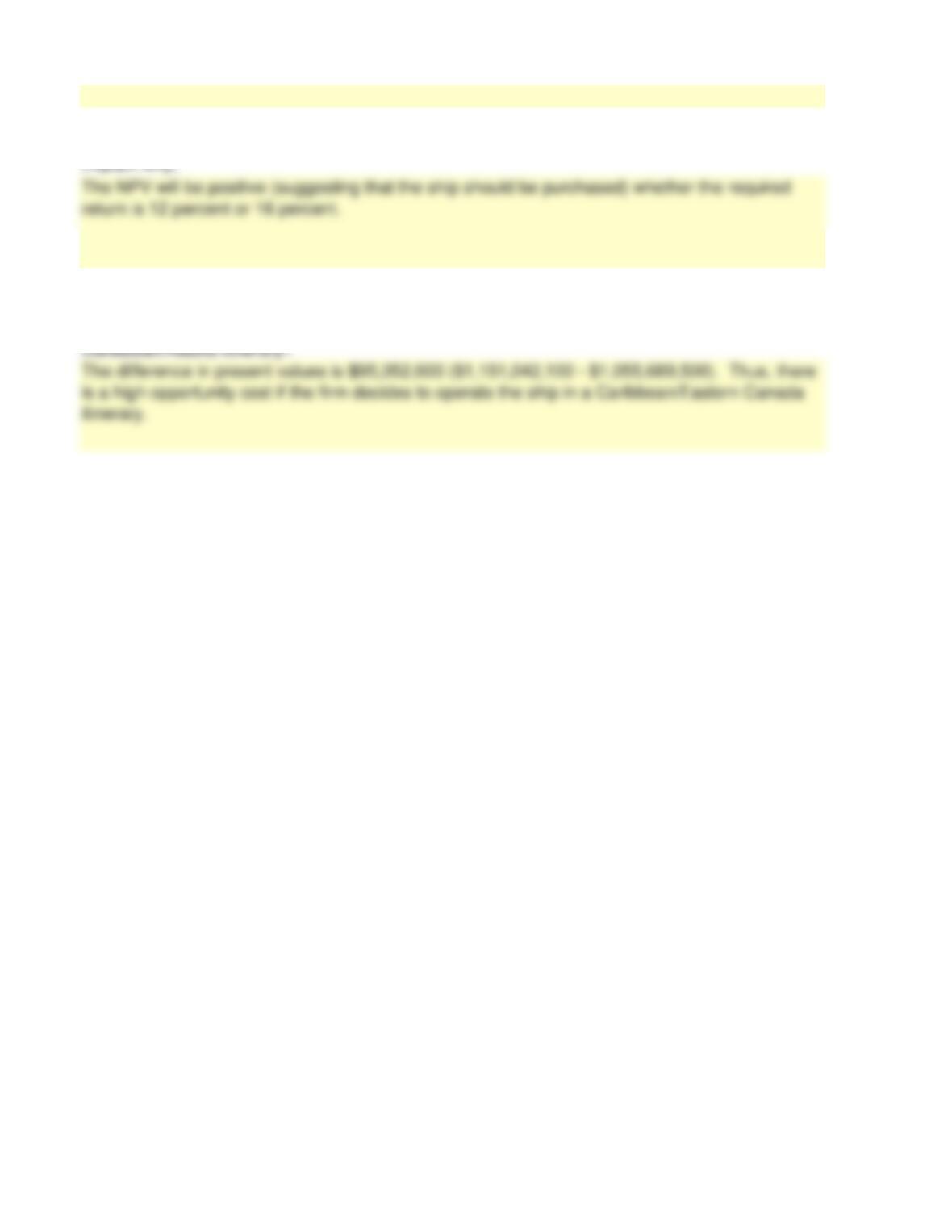
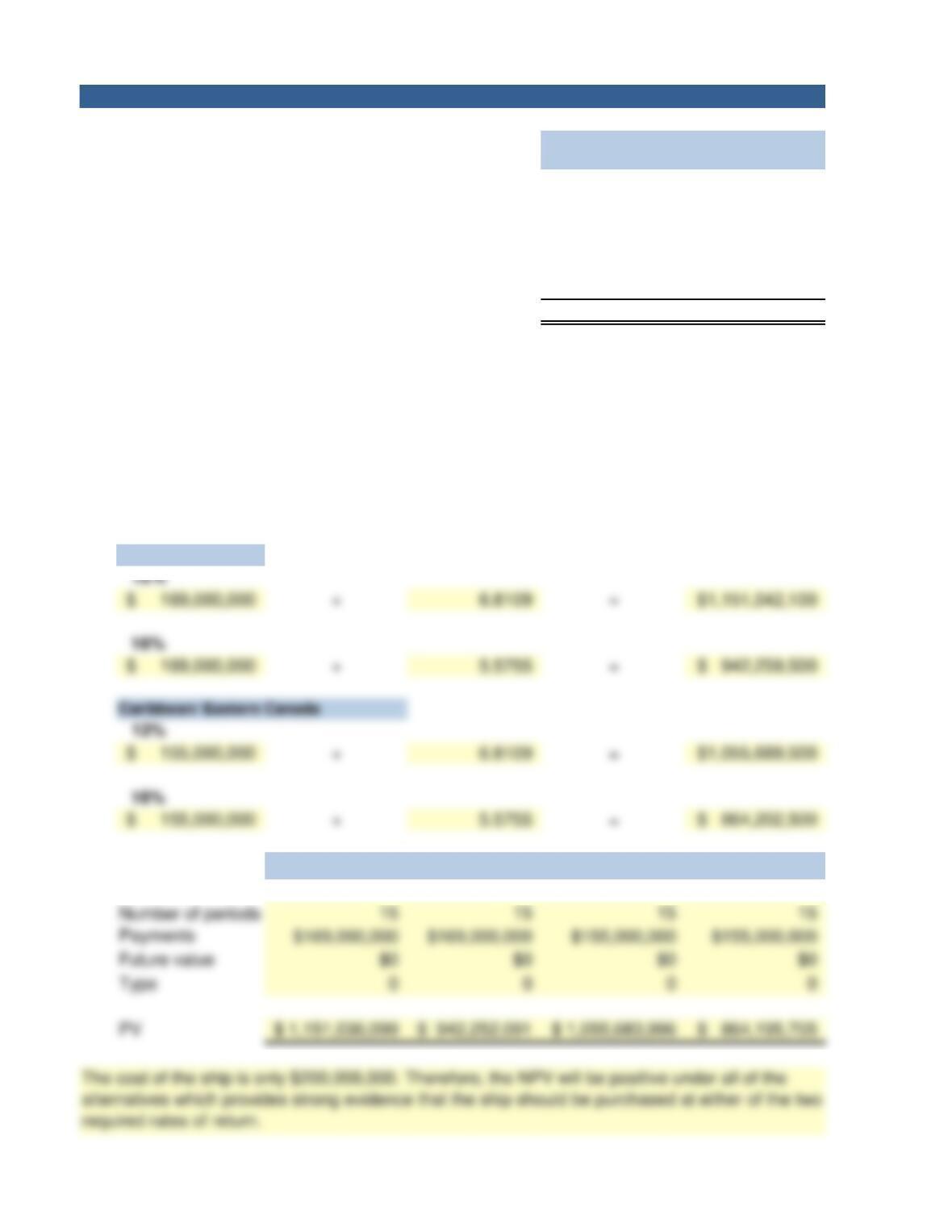
The cost of the ship is only $200,000,000. Therefore, the NPV will be positive under all of the
alternatives which provides strong evidence that the ship should be purchased at either of the two
required rates of return.
b. The president is uncertain whether a 12 percent or a 16 percent required return is appropriate.
c. Focusing on a 12 percent required rate of return, what would be the opportunity cost to the
company of using the ship in the Caribbean/Eastern Canada itinerary rather than a

Cost of the remodel project 350,000$
Useful life of project in years 6
Annual number of extra accommodated students 5
Annual tuition per student 22,000$
Before-tax incremental cost of a student 2,000$
Company’s income tax rate 40%
Required rate of return
12%
Required
Annual cash flow:
Less costs:
Income before taxes
Cash flow
Present value factors:
÷=factor
Internal rate of return:
IRR function
Cash flows:
1 2 3 4 5 6
IRR
Should the company invest in the remodel?
Depreciation
Problem 9-6 Internal Rate of Return and Taxes
The Boston Culinary Institute is evaluating a classroom remodeling project. The cost of the
remodel will be $350,000 and will be depreciated over six years using the straight-line method.
The remodeled room will accommodate five extra students per year. Additional information
relating to the project follows:
Assuming a six-year time horizon, what is the internal rate of return of the remodeling project?
Calculate using both present value factors and separately using Excel’s IRR function.

Problem data follows:
Cost of the remodel project 350,000$
Useful life of project in years 6
Annual number of extra accommodated students 5
Annual tuition per student 22,000$
Before-tax incremental cost of a student 2,000$
Company’s income tax rate 40%
Required rate of return
12%
Required
Annual cash flow:
Present value factors:
Internal rate of return:
IRR function
Cash flows:
1 2 3 4 5 6
Should the company invest in the remodel?
Solution: Problem 9-6 Internal Rate of Return and Taxes
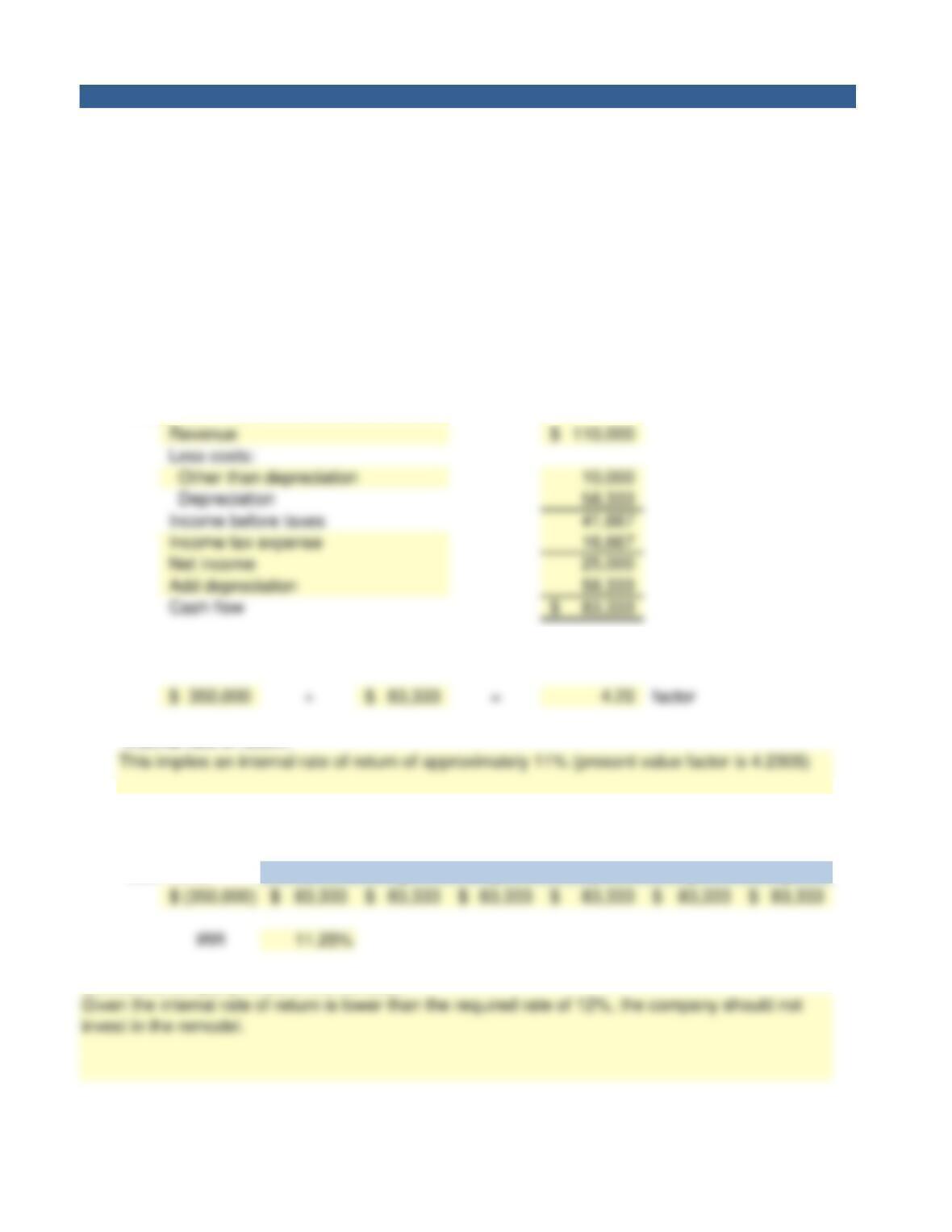
Assuming a six-year time horizon, what is the internal rate of return of the remodeling project?
Calculate using both present value factors and separately using Excel IRR function.