
Auditing: A Risk Based Approach to Conducting a Quality Audit, 10e
Solutions for Chapter 9
True/False Questions
9-2 F
9-4 F
9-6 T
9-8 T
9-10 F
9-12 F
9-14 F
9-16 T
Multiple-Choice Questions
9-18 D
9-20 C
9-22 A
9-24 C
9-26 D
9-28 B
9-30 B
9-32 A
9-2
Review and Short Case Questions
9-33
The major accounts included in the revenue cycle are:
• Sales
• Sales-Related Expenses and Liabilities:
o Sales Returns & Allowances
o Warranty Expense and Liability
o Salesperson Commissions
• Accounts Receivable
• Allowance for Doubtful Accounts
• Doubtful Accounts Expense
• Cash
Understanding the relationships between the accounts allows the auditor to develop a more
efficient audit approach. As shown in the Exhibit, the credit to sales and the debits to either
9-34
For the accounts receivable account, the more relevant assertions are typically existence and
valuation. While the auditor will likely gather evidence related to each of the assertions for
9-35
1. Receive a Customer Purchase Order Processing begins with the receipt of a purchase order
from a customer or the preparation of a sales order by a salesperson. The order might be taken by
(1) a clerk at a checkout counter, (2) a salesperson making a call on a client, (3) a customer
service agent of a catalog sales company answering a toll-free call, (4) a computer receiving
9-3
2. Check Inventory Stock Status Many organizations have computer systems capable of
informing a customer of current inventory status and likely delivery date. The customer is
3. Generate Back Order If an item is to be back-ordered for later shipment to the customer, a
confirmation of the back order is prepared and sent to the customer. If the back order is not filled
within a specified time, the customer is often given the option of canceling the order. An
4. Obtain Credit Approval Formal credit approval policies are implemented by organizations to
minimize credit losses. Some organizations eliminate credit risk by requiring payment through a
5. Prepare Shipping and Packing Documents Many organizations have computerized the
distribution process for shipping items from a warehouse. Picking tickets (documents that tell the
warehouse personnel the most efficient sequence in which to pick items for shipment and the
location of all items to be shipped) are generated from the sales order or from the customer’s
6. Ship and Verify Shipment of Goods Most goods are shipped to customers via common
carriers such as independent trucking lines, railroads, or airfreight companies. The shipper
9-4
signs the bill of lading, acknowledging receipt of the goods. The shipping department confirms
the shipment by (1) completing the packing slip and returning it to the billing department, (2)
7. Prepare and Send the Invoice Invoices are normally prepared when notice is received that
goods were shipped. The invoice should include items such as the terms of sale, payment terms,
8. Send Monthly Statements to Customers Many organizations prepare monthly statements of
9. Receive Payments The proper recording of all revenue receipts is crucial to the ultimate
valuation of both cash and accounts receivable. This part of the revenue process is typically
9-36
a. The SEC staff has determined that the following criteria must be met before revenue can be
recognized:
• Persuasive evidence of an arrangement exists
• Delivery has occurred or services have been rendered
9-5
b.
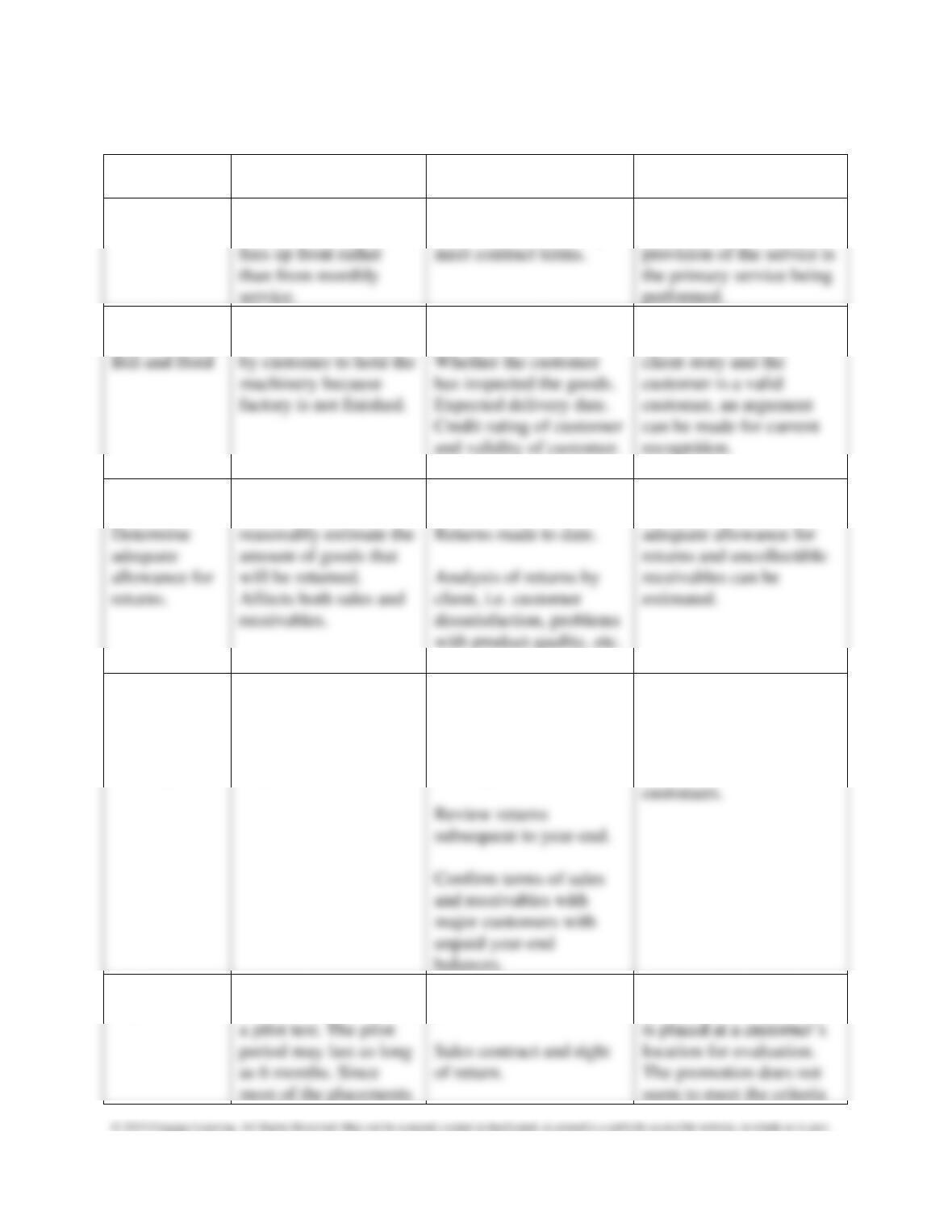
Scenario
Key Issues
Additional Information
Revenue Recognition
and Criteria
1. AOL
AOL proposes to
recognize 30% of the
Pattern of payments,
% of customers failing to
Recognize revenue on a
monthly basis as the
2. Modis
Manufacturing
Machinery is
completed. Request is
Contract – right of
refusal.
If all the evidence
gathered verifies the
adequate
allowance for
amount of goods that
will be returned.
returns and uncollectible
receivables can be
3. Standish
Stoneware
New product. The
client must be able to
Sales made to date.
It is appropriate to
recognize the sales if an
4. Omer,
Tech.
Possibility of
Channel
Stuffing.
Should revenue be
recognized because of
the special discounts
and unusually large end
of year sales?
Review returns
subsequent to year-end.
balances.
The auditor should
search for the existence
of ‘side deals’ that might
allow the customer to
return goods.
Revenue is earned and
realizable if no unusual
rights of return exist;
including no unusual
‘side deals’ with
5. Electric
City
most of the placements
seem to meet the criteria
Goods are placed at
customer’s location on
History of sales after
pilot tests.
It is difficult to recognize
revenue when the product

9-6
Scenario
Key Issues
Additional Information
Revenue Recognition
and Criteria
6. Jackson
Products
Company phased out
line of business and
sold most of the
manufacturing
equipment. Should the
sale of the equipment
be recognized as
revenue?
Confirm management
intent and business plan.
Determine terms of the
equipment sale.
If the company is
remaining in its original
line of business, or a
similar line, then revenue
should be recognized by
producing and selling
those products, not by
selling machinery. The
9-37
One example would be where a company receives purchase orders for products it manufactures.
At the end of its fiscal quarters, customers may not yet be ready to take delivery of the products
for various reasons. These reasons may include, but are not limited to, a lack of available space
9-38
Revenue recognition should ordinarily be considered a fraud risk factor because over half of
9-7
industry. Executives may be pressured to meet their own or analysts’ earnings expectations. The
9-39
Recent fraud investigations undertaken by the SEC and others have uncovered a wide variety of
methods used to inflate revenue:
• Recognition of revenue on shipments that never occurred
• Hidden “side letters” giving customers an irrevocable right to return the product
• Recording consignment sales as final sales
• Early recognition of sales that occurred after the end of the fiscal period
• Shipment of unfinished product
A professionally skeptical auditor should question revenue trends that seem too good to be true
or that exactly meet projections. How was management able to meet the numbers? Extending
9-40
Identifying fraud risk factors involves the auditor doing the following:
• Assessing motivation to enhance revenue because of either internal or external pressures
• Reviewing the financial statements through planning analytical procedures to identify
account balances that differ from expectations or general trends in the economy
• Recognizing that not all of the fraud will be instigated by management; e.g., a CFO or
9-8
• Determining whether accounting functions are centralized, and if not centralized,
assessing if the decentralization is appropriate (see the Auditing in Practice feature
“Risks Related to Decentralized Accounting Functions: The Case of WorldCom” for a
relevant example)
9-41
An internal control questionnaire is an approach used for documenting a client’s controls. The
questionnaire includes a section for a narrative description and a series of questions. Each
negative answer in the questionnaire represents a potential internal control deficiency. Given a
9-42
Sending monthly statements and establishing a separate group to handle customer inquiries
enhances controls as follows:
• Each customer receives a statement and can verify the statement for accuracy and timeliness
of the client’s update of records. The customer has a basis to follow-up on potential errors in
9-43
If appropriate controls are not in place, the sales returns and allowance reserve can be misstated.
This could occur due to either error or fraud. At Medicis, the company had a practice of
reserving for most of its estimated product returns at replacement cost, instead of at gross sales
9-44
1. C. Invoices posted to incorrect customer accounts will be detected by analyzing customer
2. G. The comparison of shipping documents with sales invoices will detect goods that have
been shipped but not billed when no sales invoice is located for a particular shipping document.
3. F. To provide assurance that all invoiced goods that have been shipped are recorded as
approved sales orders will provide assurance that goods shipped to customers agree with goods
ordered by customers.
8. L. A comparison of sales invoices with shipping documents and approved sales orders will
detect invoices that do not have the proper support. Accordingly, it will help prevent the
recording of fictitious transactions.
they have made payments for items shown as payable on their monthly statement. Note that
replies O and P will only detect this misappropriation in the unlikely event that the perpetrator
does not dispose of the remittance advice.
receipts in the cash receipts journal because unlocated differences between bank and book
balances will occur and be investigated.
14. P. Comparing total amounts posted to the accounts receivable ledger with the validated bank
15. N. Requiring the approval of the supervisor of the sales department for goods received will
9-45
The auditor can compare the client’s revenue trend with economic conditions and industry
trends. Cash flow from operations can be compared with net income over a period of time. Ratio
and trend analysis and reasonableness tests can be performed. Some of the ratios the auditor
might want to compute include:
• Gross margin analysis, including a comparison with industry averages and previous
year’s averages for the client
• Turnover of receivables (ratio of credit sales to average net receivables) or the number of
days’ sales in accounts receivable
Some basic trend analyses include:
• Monthly sales analysis compared with past years and budgets
• Identification of spikes in sales at the end of quarters or the end of the year
• Trends in discounts allowed to customers that exceed both past experience and industry
average
9-11
9-46
Various factors can influence reliability of data in revenue cycle accounts during planning
analytical procedures. One is the source of information that is available. Information is more
reliable when it is obtained from independent sources outside the company. For example,
9-47
a. The most telling analytical results are:
• The significant increases in number of day’s sales in receivables and inventory from
2013. They are also significantly higher than their major competitor in 2014.
• The percent increases in receivables (106%) and inventory (60%) in 2014 far exceed the
increases in sales (9%).
b. Possible explanations are:
• Recording fictitious sales near year-end
• Building up inventory in anticipation of an employees’ strike
c. Inquiries and follow-up procedures (after identifying possible explanations) include:
• Inquiring of management about factors that might explain the increases in receivables and
inventory.
9-12
d. This case is based on an actual situation in which one of the authors was involved. The CFO
had embezzled several millions of dollars by having checks drawn on the company’s regular
cash account for deposit in another cash account the CFO was able to control. These checks
e. When performing planning analytical procedures, if the client’s results are unexpected or
look too good to be true the auditor should have a heightened degree of professional skepticism
9-48
a. The change in sales person commission is very important because it changes the emphasis of
the sales person to making sales with little regard for credit, quality, or other issues that affect the
long-term profitability of the company. Specifically, the change:
• Negates sales returns as an important compensation factor
• Takes out realizability, such as the sales commission is not affected by whether the
customer pays
9-13
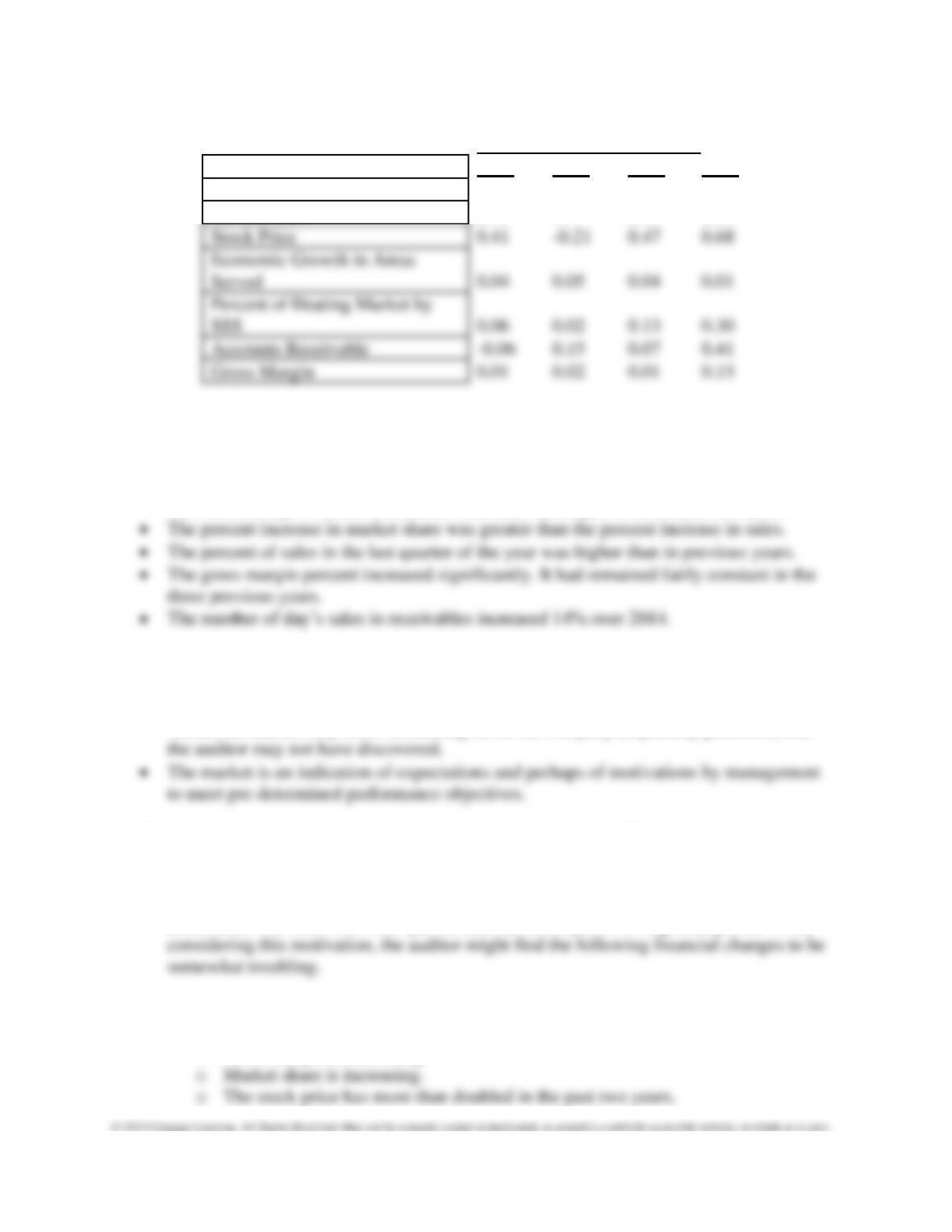
b. Analytical information:
% Change from Prior Year
2012
2013
2014
2015
Sales
0.10
0.08
0.11
0.24
Net Income
0.36
0.11
0.24
0.31
Stock Price
0.41
-0.21
0.47
0.68
Served
0.04
0.05
0.04
0.01
0.06
0.02
0.13
0.30
Accounts Receivable
-0.06
0.15
0.07
0.41
Gross Margin
0.01
0.02
0.01
0.15
Insights:
• The percent increase in sales was over twice that of previous years.
• Net income increased by a greater percentage than did sales or gross margin.
• The economic growth index remained basically unchanged from the previous year.
c. The auditor is often interested in the stock price because:
• The stock price impounds information that the market has about the company. In other
words, the market may know something about the company (especially problems) that
d. There are a number of factors that are high fraud risk indicators. These factors primarily
relate to the motivation aspect of the fraud triangle and include:
• Motivation – the changes in the sales person commission plan provides significant
motivations for fraud. The sales person also has more power to negotiate prices. When
• Financial Changes:
o Gross margin is increasing.
9-14
e. Specific substantive audit procedures should address the heightened risk of fraud and might
include:
• Confirm accounts receivable using PPS sampling and positive confirmations
• Examine documentation for all receivables collections subsequent to year-end and prior
to completion of the audit
• Review returns made during the last quarter and the first part of the subsequent year to
better develop an estimate of returns
• Take a statistical sample of sales and:
o Review the sales contract
9-49
If the risk of material misstatement is assessed low, the auditor can plan less extensive
substantive testing, or can be more flexible about when the procedures are applied. If the risk is
9-50
Panel A of Exhibit 9.8 makes the point that because of differences in risk, the “box of evidence”
to be filled for testing the completeness of revenue at the low risk client (Client A) is smaller
9-15
9-51
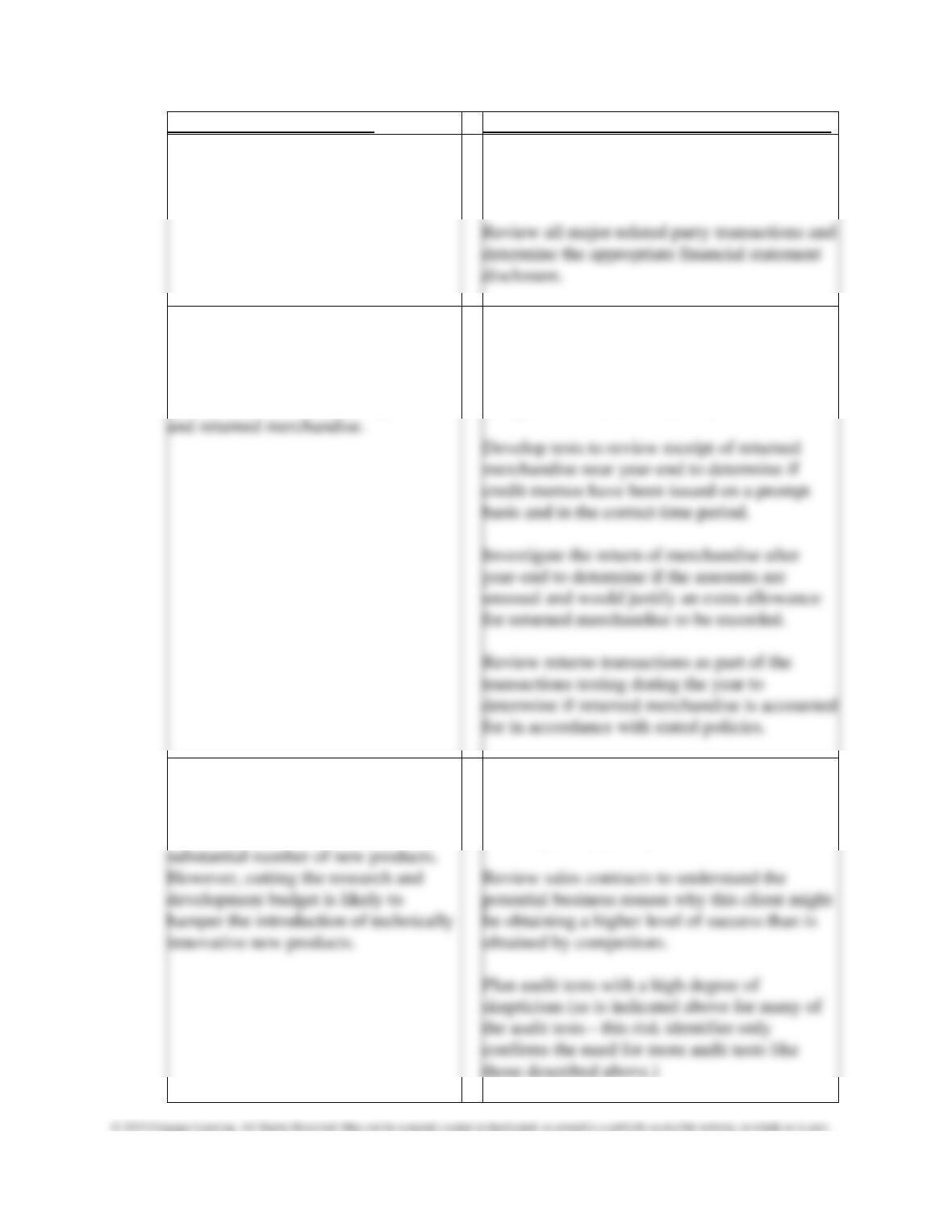
a. Areas of Inherent Risk:
b. Audit Procedures to Address Risk Areas:
1. The company has changed auditors.
firm.
Contact the predecessor audit firm to determine
their understanding of the reason for the
change.
2. There was a dispute with the
predecessor auditor regarding the
recognition of income on goods that
had not been shipped.
Inquire of management as to the nature of the
dispute and the firm’s current policy regarding
the recognition of income from items not
shipped.
3. Current management does not have
a long history with the company, but
has a reputation as a turn-around artist.
Review articles in the financial press to
become aware of predictions made by Mr.
Dreason regarding current performance and
Determine the extent to which stock option
plans or bonuses are dependent upon specific
levels of achieved performance.
4. There is evidence of significant
related party transactions.
Inquire as to the nature and extent of related
party transactions. The auditor should expand
9-16
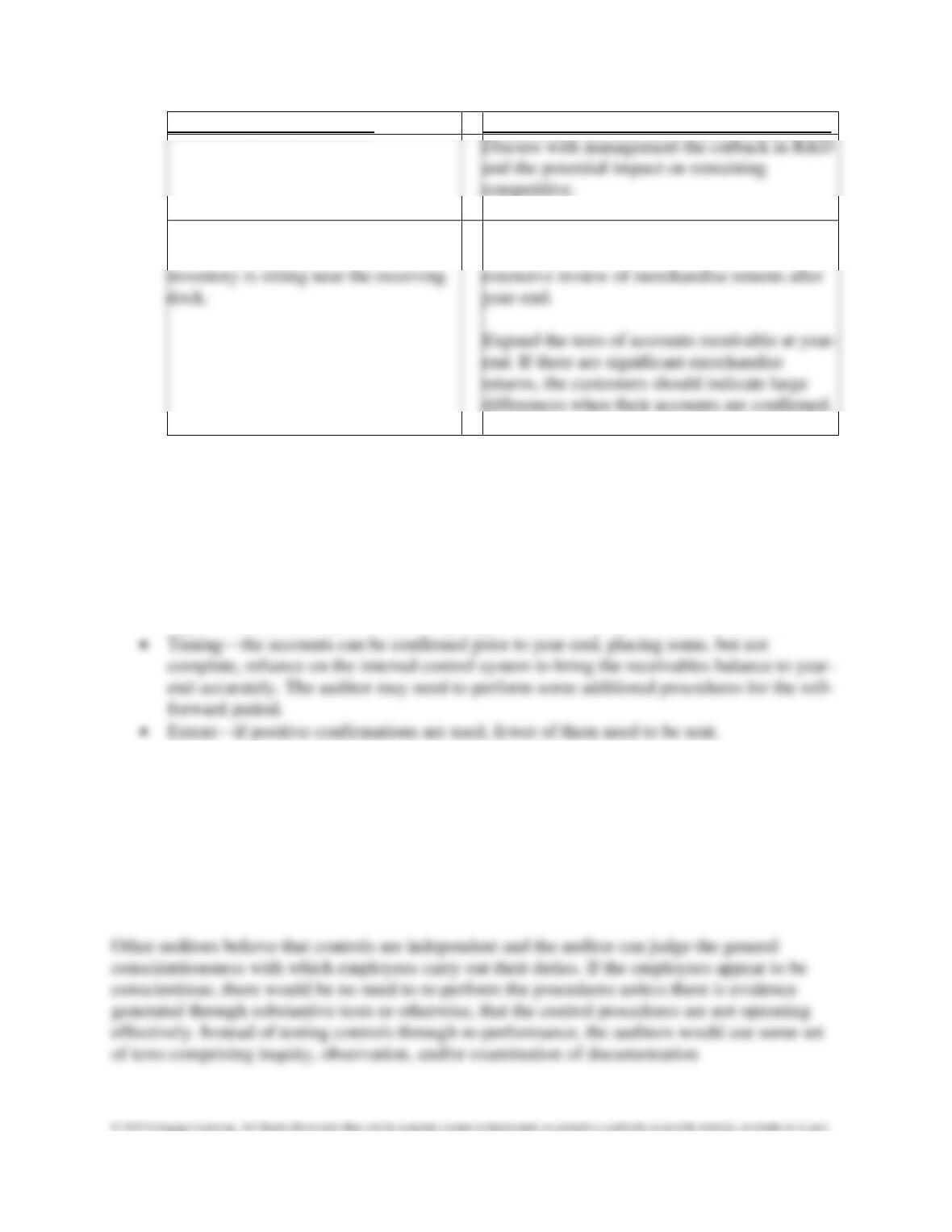
a. Areas of Inherent Risk:
b. Audit Procedures to Address Risk Areas:
audit work to identify all related parties and
investigate any unusual sales transactions to
determine if they may be with related parties.
unusual and would justify an extra allowance
for returned merchandise to be recorded.
5. Although not a direct sales item, the
company has slashed research and
development and laid off a number of
employees. This could result in a
greater number of defective products
Review procedures utilized by the company to
record the return of merchandise. Determine
approach used to adequately identify defective
products to determine the status of the product
(scrap, close-out, re-work, etc.)
6. Sales have been increasing at 20%
per year. It is doubtful that the
company can maintain such growth
rates without the introduction of a
Understand trends in the industry, such as new
product introductions, profitability of
competitors, etc. to determine the competitive
advantaged enjoyed by the client.
9-17
a. Areas of Inherent Risk:
b. Audit Procedures to Address Risk Areas:
7. The plant does not appear to be kept
up to date. A large amount of
Expand, as discussed above, the review of
procedures for merchandise return. Perform an
9-52
A lower risk of material misstatement because of effective controls means the auditor can place
some reliance on the client’s internal controls and does not need to obtain as much
evidence/assurance from substantive tests. Therefore, the type, timing, and extent of substantive
tests related to accounts receivable could be affected in the following ways:
• Type—the auditor may consider using negative rather than positive confirmations.
9-53
Auditors often debate this question. Many auditors believe that a minimum amount of re-
performance of the control is necessary in some instances in order to determine that the person
performing the control actually performed the procedure indicated. In other words, the person
did not simply initial the document. The auditor gathers evidence through re-performance that
the control was operating effectively.
9-18
9-54
a. Potential Misstatement if Not
Implemented
b. Auditing Procedure to Test Effectiveness of
Control.
1. The recording of transactions will
not be misstated. However, the
collectibility of accounts receivable
may be impaired. Thus, it is possible
that net accounts receivable may be
overstated.
1c. Take a sample of sales transactions over
$10,000 and review to determine whether there is
1a. Review procedures to implement the computer
program and determine the extent that the credit
department tests and monitors the correctness of
the authorization program.
1b. Consider testing the program by submitting
transactions against it and see if the transactions
are processed correctly. (This is discussed in
Chapter 8 as the test data approach.)
2. Sales and accounts receivable may
be stated incorrectly. If the sales are
billed for more than authorized, the
accounts receivable may not be
2a. Review the control procedures used by the
department to implement authorized prices and
maintain security of the price list from
unauthorized changes.
9-19
a. Potential Misstatement if Not
Implemented
b. Auditing Procedure to Test Effectiveness of
Control.
3. Shipments might not be recorded
and sales would be understated. There
3. Review the client’s control procedures used to
periodically account for all items. Test a sample of
correct the complaints.
4. Accounts receivable may be
overstated because customer
4a. Observe that the segregation of duties
described in the control procedure actually exists.
5. Sales returns may be understated
and accounts receivable may be
5a. Review the procedures and make inquiries as
to procedures utilized for handling returned
(2) quality control tested the returned merchandise
(3) review inventory record to determine the
would go undetected because
customers may not complain about not
handled.
6. Sales and accounts receivable could
be misstated in either direction, but it
6a. For a sample of invoices, examine shipping
documents and packing slip for evidence of items
7. Sales and accounts receivable could
be misstated as described in #6 above.
accordance with the company policy.
submitting fictitious data to determine if the
7a. Select a sample of invoices and re-compute the
freight charge to determine if it is computed in
9-20
a. Potential Misstatement if Not
Implemented
b. Auditing Procedure to Test Effectiveness of
Control.
calculation is made correctly.
9-55
Type of
Exception Report
a.
b.
1.
that the transaction was authorized by
procedure was operating effectively
throughout the year.
This exception report provides
information about the volume of sales
transactions over the specified limit.
The credit manager can use the report
to verify (probably on a test basis)
The auditor would not be concerned
about the volume of transactions on
this report. The use of the exception
report is an effective control
procedure.
2.
The auditor would review the report
to determine if there may be an
unusual credit risk for a particular
It is difficult to tell if the auditor
would be concerned without
knowing more about the size of the
3.
in the ability to collect accounts
receivable.
The auditor is concerned with
problem accounting areas. Numerous
exception reports of this type signals
Yes, the auditor would most
definitely be concerned if a large
number of such reports occurred.
4.
is functioning effectively.
want to make inquiries of the client
The auditor is looking for evidence
Numerous exception reports may