Chapter 09 – Reporting and Interpreting Liabilities
Chapter 09
Reporting and Interpreting Liabilities
ANSWERS TO QUESTIONS
1. Liabilities are obligations that result from past transactions that require future
payment of assets or the future performance of services, that are definite in amount
2. External parties have difficulty determining the amount of liabilities of a business in
the absence of a balance sheet. Therefore, about the only sources available to
3. A liability is measured at acquisition at its current cash equivalent amount.
Conceptually, this amount is the present value of all of the future payments of
4. Most debts specify a definite amount that is due at a specified date in the future.
However, there are situations where it is known that an obligation or liability exists
Chapter 09 – Reporting and Interpreting Liabilities
9-2
5. Working capital is computed as total current assets minus total current liabilities. It
6. The quick ratio is the percentage relationship of quick assets (cash, marketable
securities, and accounts receivable) to current liabilities. It is computed by dividing
quick assets by current liabilities. For example, assuming quick assets of $50,000
7. An accrued liability is an expense that was incurred before the end of the current
period but has not been paid or recorded. Therefore, an accrued liability is
recognized when such a transaction is recorded. A typical example is wages
Chapter 09 – Reporting and Interpreting Liabilities
8. A deferred revenue (usually called unearned revenue or revenue collected in
advance) is a revenue that has been collected in advance of being earned and
recorded in the accounts by the entity. Because the amount already has been
collected and the goods or services have not been provided, there is a liability to
provide goods or services to the party who made the payment in advance. A typical
9. A note payable is a written promise to pay a stated sum at one or more specified
dates in the future. A secured note payable is one that has attached to it (or
10. A contingent liability is not an effective liability; rather it is a potential future liability.
A contingent liability arises because of some transaction or event that has already
occurred which may, depending upon one or more future events, cause the
Chapter 09 – Reporting and Interpreting Liabilities
9-4
11. $4,000 x 12% x 9/12 = $360.
12. The time value of money is another way to describe interest. Time value of money
13. Future value—The future value of a number of dollars is the amount that it will
increase to in the future at i interest rate for n periods. The future value is the
15. An annuity is a term that refers to equal periodic cash payments or receipts of an
equal amount each period for two or more periods. In contrast to a future value of

Chapter 09 – Reporting and Interpreting Liabilities
9-5
16.
Table Values
Concept
i = 5%; n =4
i = 10%; n =7
i = 14%; n = 10
ANSWERS TO MULTIPLE CHOICE
Chapter 09 – Reporting and Interpreting Liabilities
9-6
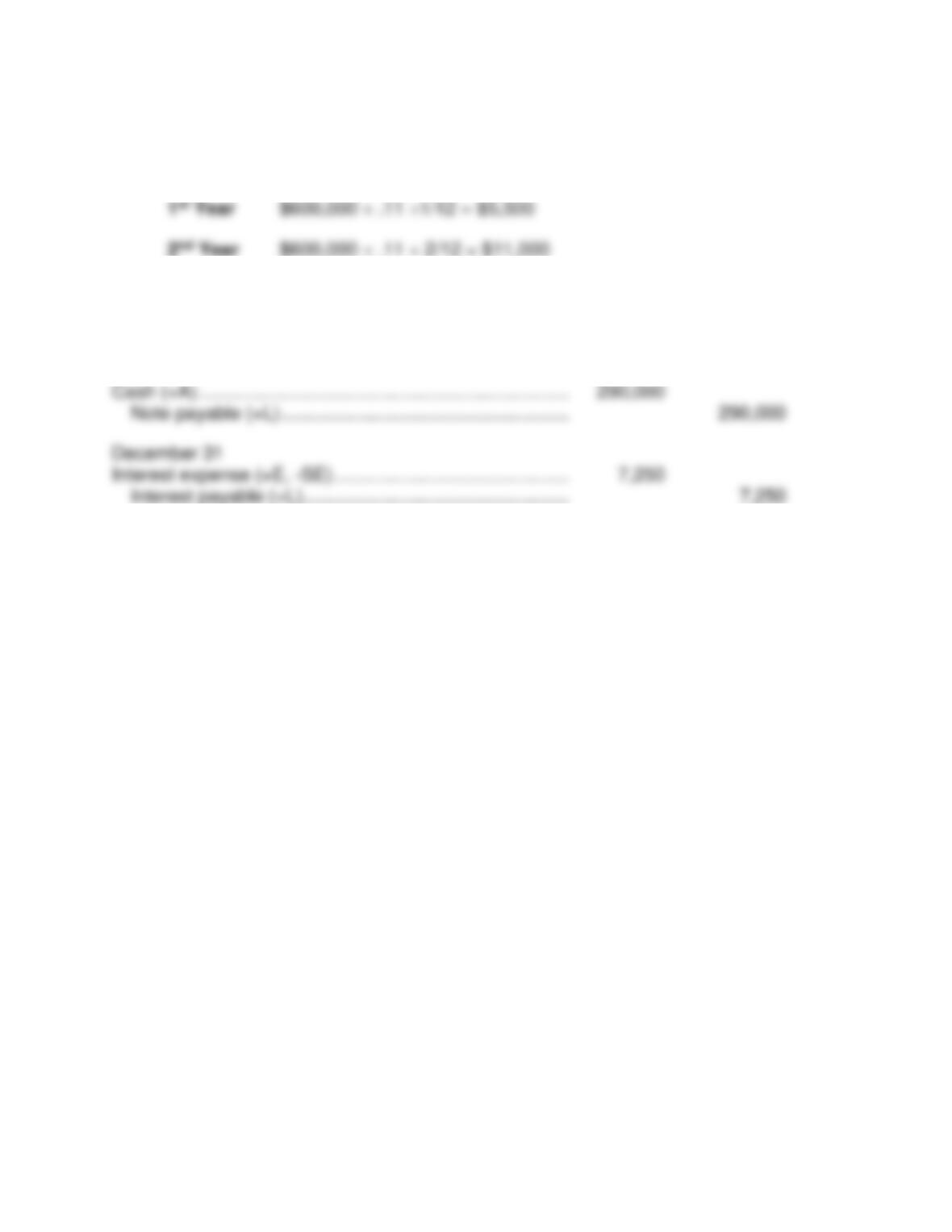
Authors’ Recommended Solution Time
(Time in minutes)
Mini-exercises
Exercises
Problems
Alternate
Problems
Cases and
Projects
No.
Time
No.
Time
No.
Time
No.
Time
No.
Time
1
5
1
30
1
35
1
45
1
30
8
5
8
20
8
40
8
45
8
*
9
10
9
30
9
40
10
10
10
20
10
25
11
5
11
20
11
40
12
15
12
30
13
20
13
35
14
20
14
30
15
10
16
20
17
20
24
25
26
20
20
20
* Due to the nature of this project, it is very difficult to estimate the amount of time
students will need to complete the assignment. As with any open-ended project, it is
2
5
2
30
2
45
2
40
2
30
3
5
3
30
3
30
3
40
3
30
4
5
4
30
4
25
4
30
4
20
5
5
5
20
5
45
5
30
5
45
6
5
6
20
6
30
6
35
6
20
7
5
7
20
7
30
7
35
7
30
Chapter 09 – Reporting and Interpreting Liabilities
9-7
MINI-EXERCISES
M9–1.
M9–2.
October 1
Chapter 09 – Reporting and Interpreting Liabilities
9-8
M9–3.
1. Computed from balance sheet data
3. Notes to the statements
5. Statement of cash flows
M9–4. Quick Ratio: $20,000 / $90,000 = 0.22
M9–5.
Quick Ratio
Working Capital
a. Decrease
Remain the same
b. Decrease
Decrease
c. Increase
Remain the same
d. Decrease
Remain the same
M9–6.
2011 Buzz does not have to record or disclose the liability because the chance
of the liability occurring is remote.
Chapter 09 – Reporting and Interpreting Liabilities
M9–7.
$500,000 0.4632
=
$231,600
M9–8.
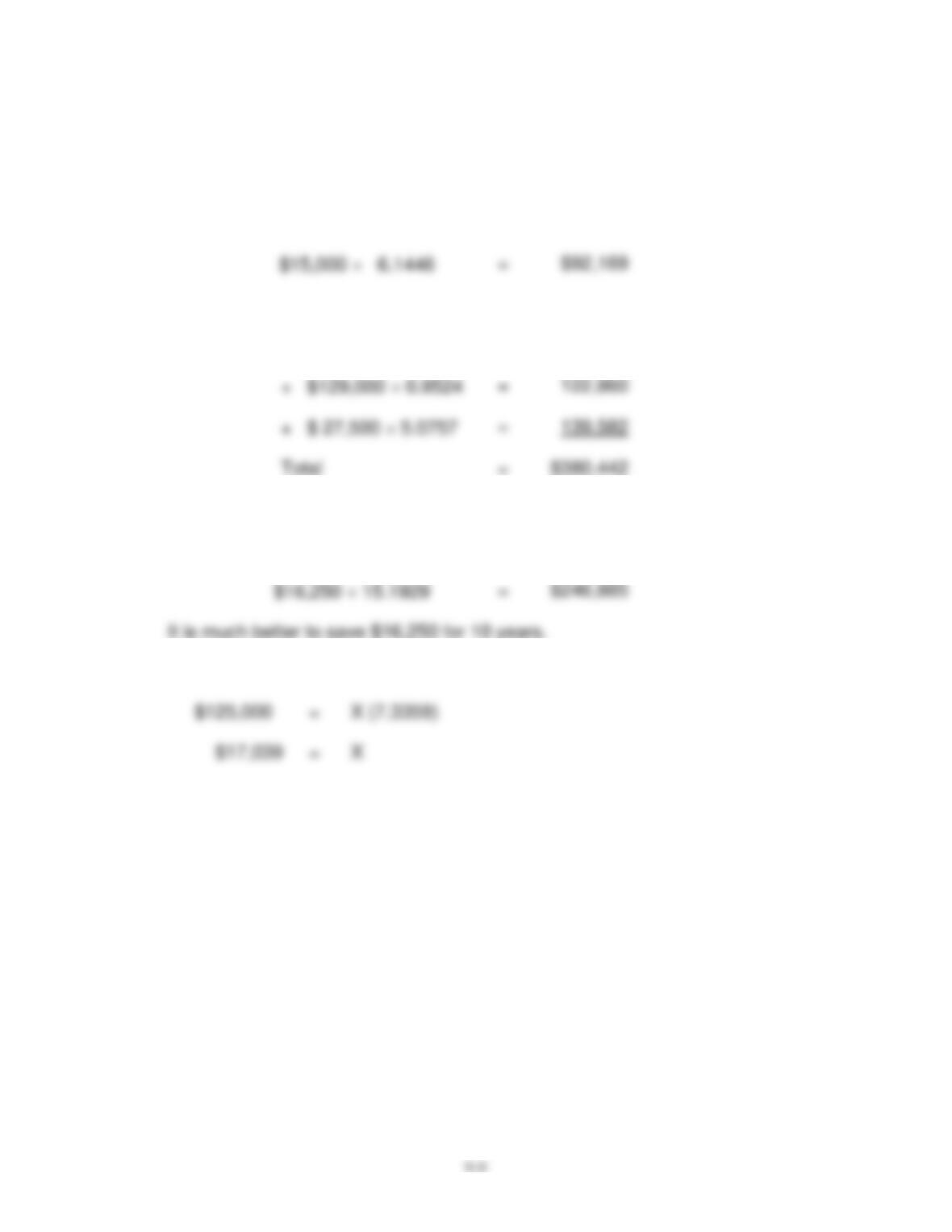
$15,000 6.1446
=
M9–9.
$118,000
=
$118,000
+ $129,000 0.9524
=
+ $ 27,500 5.0757
=
Total
=
$380,442
M9–10.
$27,500 5.9847
=
$164,579
$16,250 15.1929
=
$246,885
M9–11.
$125,000
=
X (7.3359)
$17,039
=
X
EXERCISES
Chapter 09 – Reporting and Interpreting Liabilities
9-10
E9–1.
Req. 1
(a)
Current assets ………………………………………………………
$168,000
Current liabilities:
Accounts payable ……………………………………………….
$56,000
(b) Quick ratio: ($70,000 $102,400) = 0.68.
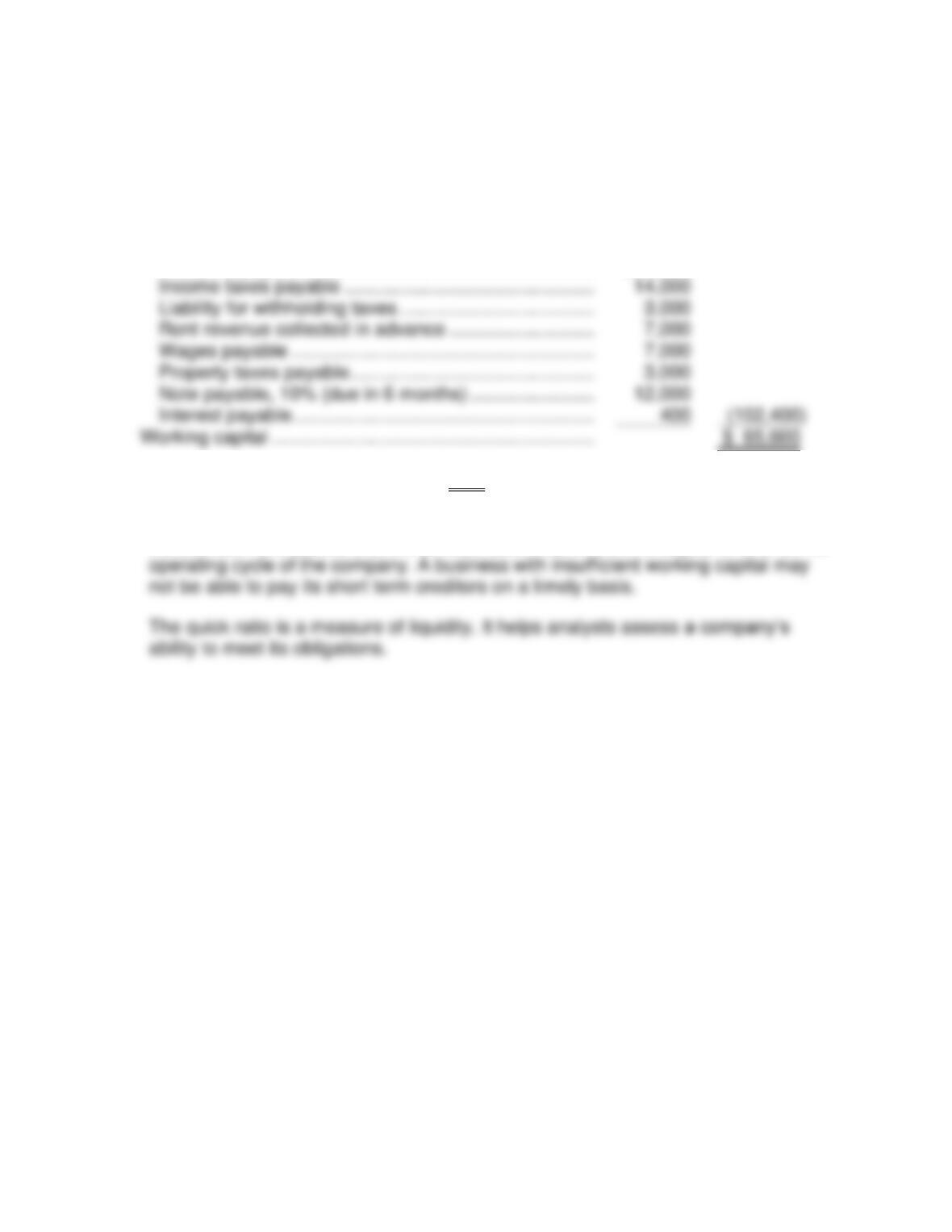
Working capital is critical for the efficient operation of a business. Current assets
include cash and assets that will be collected in cash within one year or the normal
Req. 2
No, contingent liabilities are reported in the notes, not on the balance sheet.
Therefore, they are not included in the required computations.
Income taxes payable …………………………………………
Liability for withholding taxes ………………………………..
3,000
Rent revenue collected in advance ……………………….
7,000
Wages payable ………………………………………………….
7,000
Property taxes payable ………………………………………..
3,000
Note payable, 10% (due in 6 months) ……………………
Interest payable ………………………………………………….
)
Working capital ……………………………………………………..
$ 65,600
Chapter 09 – Reporting and Interpreting Liabilities
E9–2.
Req. 1
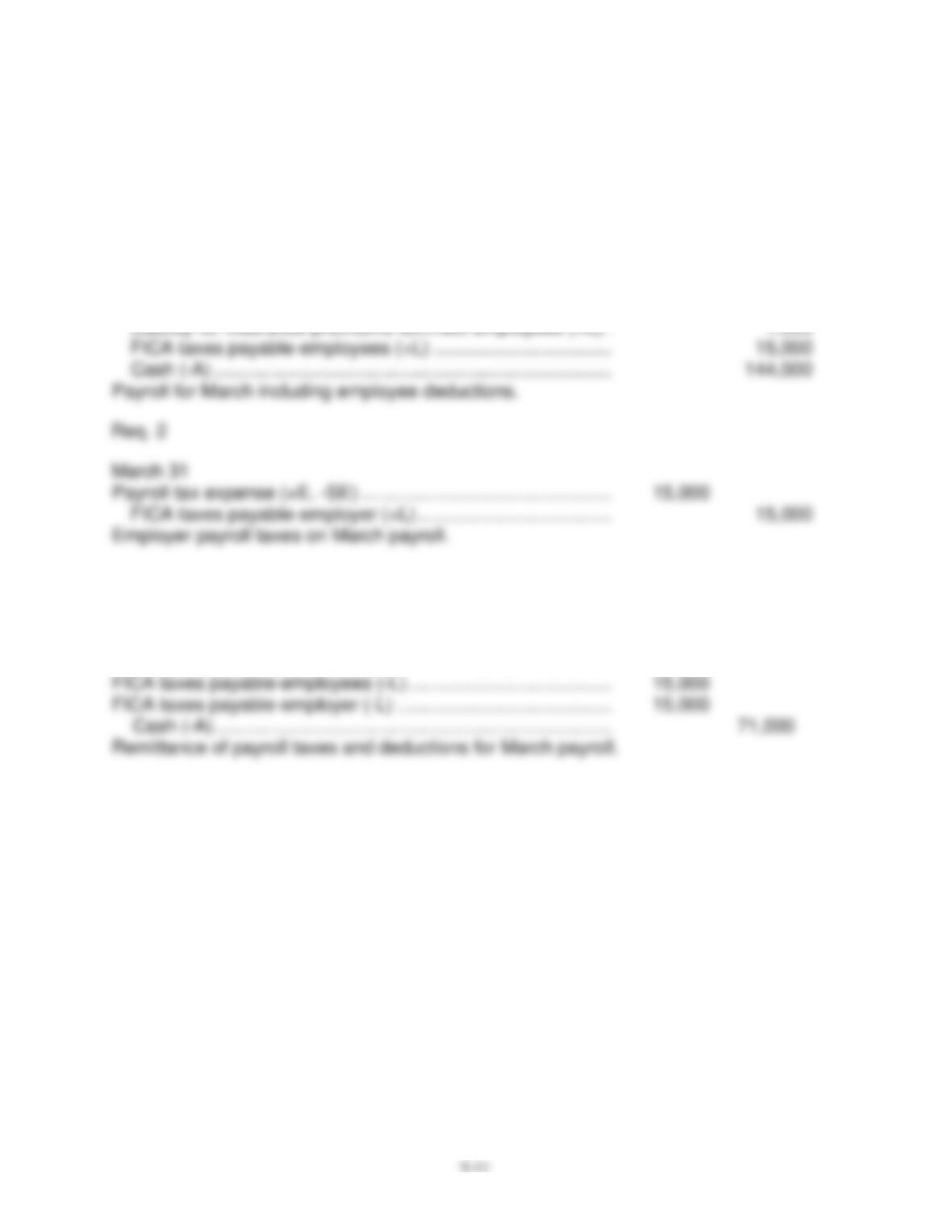
March 31
Salary and wage expense (+E, –SE) ………………………………..
200,000
Liability for income taxes withheld-employees (+L) …………
40,000
Liability for insurance premiums withheld-employees (+L) .
1,000
FICA taxes payable-employees (+L) …………………………....
15,000
144,000
Payroll for March including employee deductions.
Payroll tax expense (+E, –SE) …………………………………………
15,000
FICA taxes payable-employer (+L) ……………………………….
15,000
Employer payroll taxes on March payroll.
Req. 3
Liability for income taxes withheld-employees (-L) ……………..
40,000
Liability for insurance premiums withheld-employees (-L) ……
1,000
FICA taxes payable-employees (-L) …………………………………
15,000
FICA taxes payable-employer (-L) …………………………………..
15,000
71,000
Remittance of payroll taxes and deductions for March payroll.

Chapter 09 – Reporting and Interpreting Liabilities
9-12
E9–3.
Req. 1
The additional labor expense was $6,000, which is the total of payroll taxes that must
be paid by the employer. The $10,000 income taxes and the $6,000 FICA taxes paid
Req. 2
Balance sheet liabilities:
Liability for income taxes withheld ………………………………………………….
$ 10,000
FICA taxes payable ($6,000 + $6,000) ……………………………………………
12,000
Total ………………………………………………………………………………………
$22,000
Req. 3
Both managers and analysts would understand that a 10% increase in salaries is more
Chapter 09 – Reporting and Interpreting Liabilities
E9–4.
Req. 1
November 1
Cash (+A) ……………………………………………………………..
4,800,000
Note payable (+L) ……………………………………………….
4,800,000
Borrowed on 6-month, 8%, note payable.
Req. 2
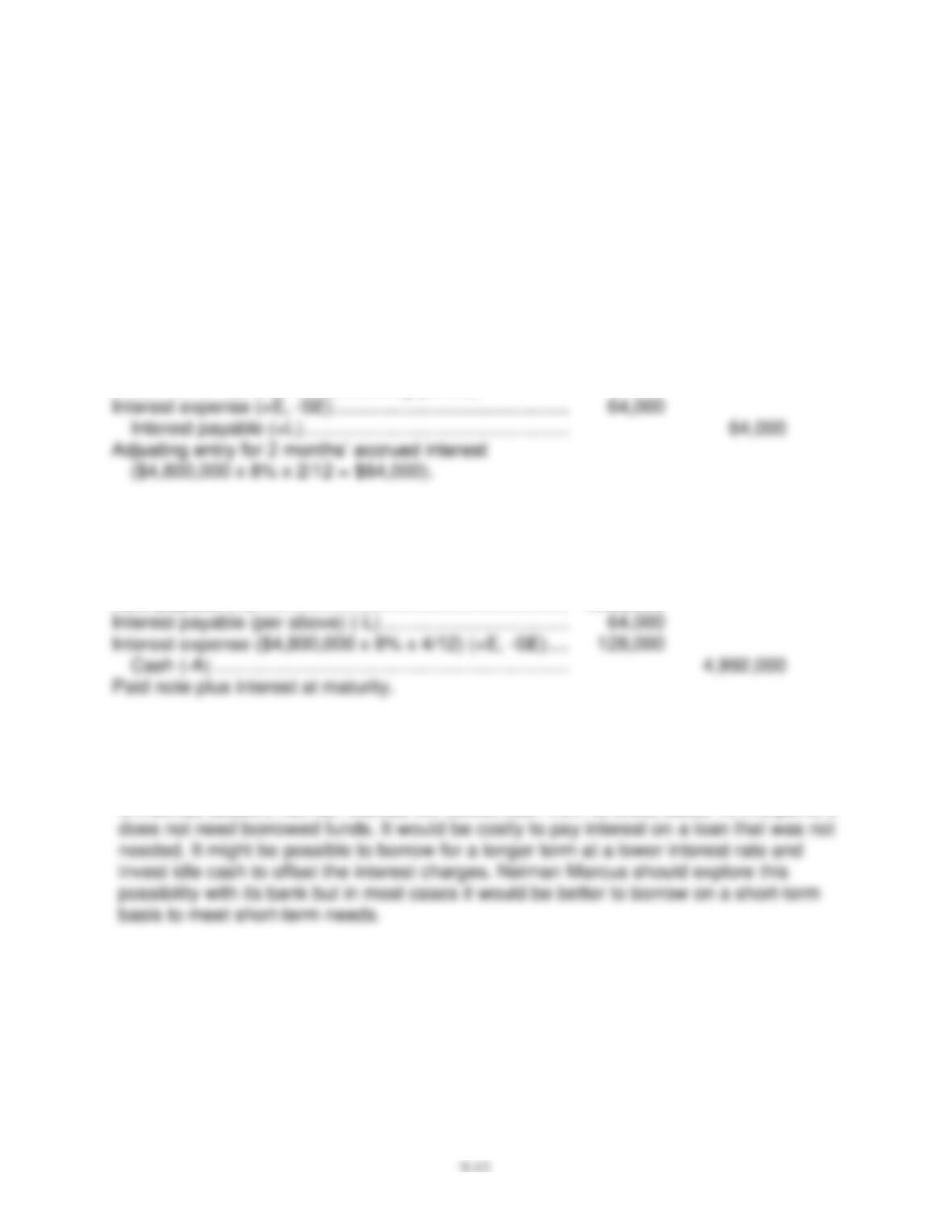
December 31 (end of the accounting period):
Interest expense (+E, –SE) ………………………………………
Interest payable (+L) ……………………………………………
($4,800,000 x 8% x 2/12 = $64,000).
Req. 3
April 30 (maturity date):
Note payable (-L) …………………………………………………..
4,800,000
Interest payable (per above) (-L) ………………………………
Cash (-A) …………………………………………………………..
4,992,000
Paid note plus interest at maturity.
Req. 4
It is doubtful that long-term borrowing would be appropriate in this situation. After the
Christmas season, Neiman Marcus will collect cash from its credit sales. At this point, it

Chapter 09 – Reporting and Interpreting Liabilities
9-14
E9–5.
Req.1
Date
Assets
Liabilities
Stockholders’
Equity
November 1
Cash +
Note Payable +
Not Affected
Req. 2
It is doubtful that long-term borrowing would be appropriate in this situation. After the
Christmas season, Neiman Marcus will collect cash from its credit sales. At this point, it
E9–6.
Analysts want to evaluate the short-term obligations of a business in order to assess
liquidity or the ability to satisfy a liability that must be paid in the near future. If PepsiCo
had to pay the $3.6 billion immediately, the analysts would want to know the source of
December 31
Not Affected
Interest Payable +
Chapter 09 – Reporting and Interpreting Liabilities
E9-7
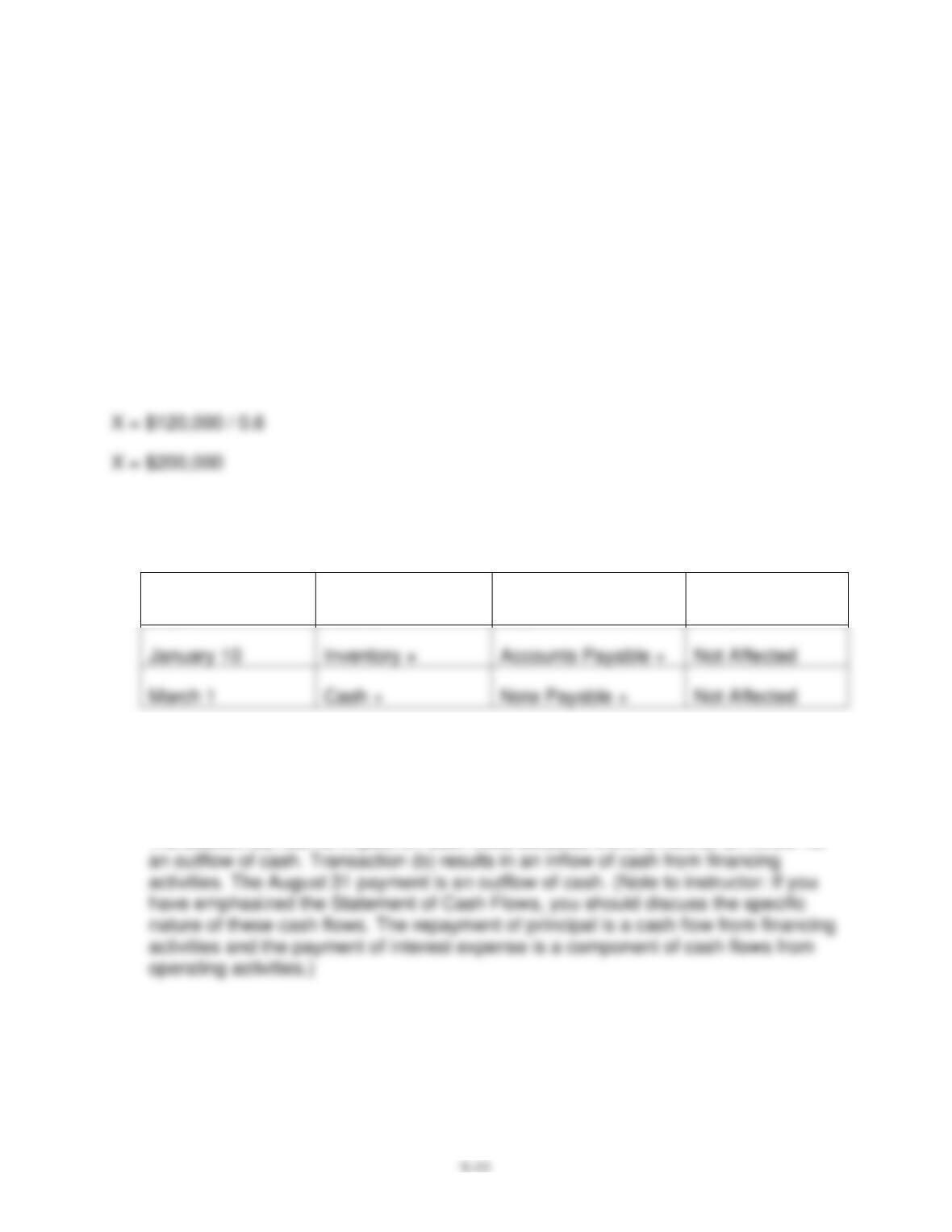
Quick ratio = 0.6 = $120,000 / X
E9–8.
Req. 1
Date
Assets
Liabilities
Stockholders’
Equity
January 10
Inventory +
Accounts Payable +
Not Affected
March 1
Cash +
Note Payable +
Not Affected
Req. 2
August 31 Cash Paid: $47,250 (Principal plus interest)
Req. 3
Transaction (a) has no impact on cash flows because there is neither an inflow nor
Chapter 09 – Reporting and Interpreting Liabilities
9-16
E9–9.
The note does not give us sufficient information to reach a definitive conclusion but
there a several factors that should be discussed. No obligation for future payments
E9–10.
The question of whether a lease will be recorded as a liability depends on the
specific facts and circumstances associated with the lease. In the most simple
terms, a short-term lease probably would not have to be recorded as a liability

Chapter 09 – Reporting and Interpreting Liabilities
E9–11.
A liability is “a probable future sacrifice of economic benefits that arises from past
transactions.” To be recorded, the amount of a liability must be subject to a
reasonable estimate. The employees of American Airlines earn their retirement
Chapter 09 – Reporting and Interpreting Liabilities
9-18
E9–12.
Req. 1
Year 2011 Year 2012
Income taxes payable $250,000 $290,000
Req. 2.
Tax expense is based on income reported on the income statement while tax liability is
E9–13.
Req. 1
Income tax payable:
Req. 2
There are separate rules governing the determination of tax expense (GAAP)
and the amount of taxes currently payable (IRS regulations). Companies are
Chapter 09 – Reporting and Interpreting Liabilities
E9–14.
Req. 1
For each year, income tax expense is less than income taxes currently payable. It
Req. 2
This note explains the difference between taxes currently payable and tax expense
for each year. It is not the amount of deferred taxes reported on the balance sheet.
E9–15.
Req. 1
$50,000 x 0.7513
=
$37,565
$10,000 x 2.4869
=
$24,869
$40,000 x 0.5132
=
$20,528
$15,000 x 6.1446
=
$92,169
Chapter 09 – Reporting and Interpreting Liabilities
9-20
E9–16.
Present value of annuity: $10,100 x 4.8684 = $49,171
E9–17.
E9–18.
Present value of annuity: $13,000 x 3.2397 = $42,116
E9–19.
Present value of unequal payments:
E9–20.
Present value of cash payments:
E9–21.
Present value of annuity: $55,000 x 6.8017 = $374,094