Wild and Shaw, Financial & Managerial Accounting, 8e Solutions Manual: Chapter 9
Chapter 9
Accounting for Current Liabilities
QUESTIONS
1. A current liability is expected to be paid within one year or the company’s operating
cycle, whichever is longer. Any liability that is not current is considered to be long
term.
2. An estimated liability is an obligation to make a future payment, the exact amount of
which is uncertain, but it is capable of being reasonably estimated.
3. The three questions are: (1) Who must be paid? (2) When is payment due? (3) How
much is to be paid?
5. The Medicare tax rate is 1.45%. This rate is applied to all wages earned by an
employee—no maximum limit exists.
7. An employee’s gross earnings along with the number of withholding allowances that
an employee claims, as well as whether they are married or single, determine the
9. The obligation to correct or replace defective products (or services) is created when
the products are sold with the warranties. Even though the seller does not know
with certainty when the obligation will be paid, to whom it will be paid, or the amount
to be paid, past experience shows that some amount will probably be paid. If the
seller can reasonably estimate that amount, the warranty liability must be reported
on the balance sheet.
11.A A wage bracket withholding table shows for a pay period of a given length (weekly,
biweekly, semimonthly, monthly), the amounts of federal income taxes to be
withheld from the pay of an employee, at varying amounts of gross pay and varying
numbers of withholding allowances.
12.A Single employee earning $725 with two allowances has $76 taxes withheld.
Single employee earning $625 with no allowances has $81 taxes withheld.
13. Apple reports accounts payable of $49,049 million.
16. Samsung’s current liabilities include one income-tax-related liability titled: Income
tax payable. This account reflects taxes that must be paid to the government in the
short term.
Instructor note: Samsung has a current liability titled “Withholdings.” This may
represent some tax withholdings (such as related to employee compensation),
however, it is likely not income tax related. Samsung also has one noncurrent income-
tax-related account on its balance sheet titled: Deferred income tax liabilities.
QUICK STUDIES
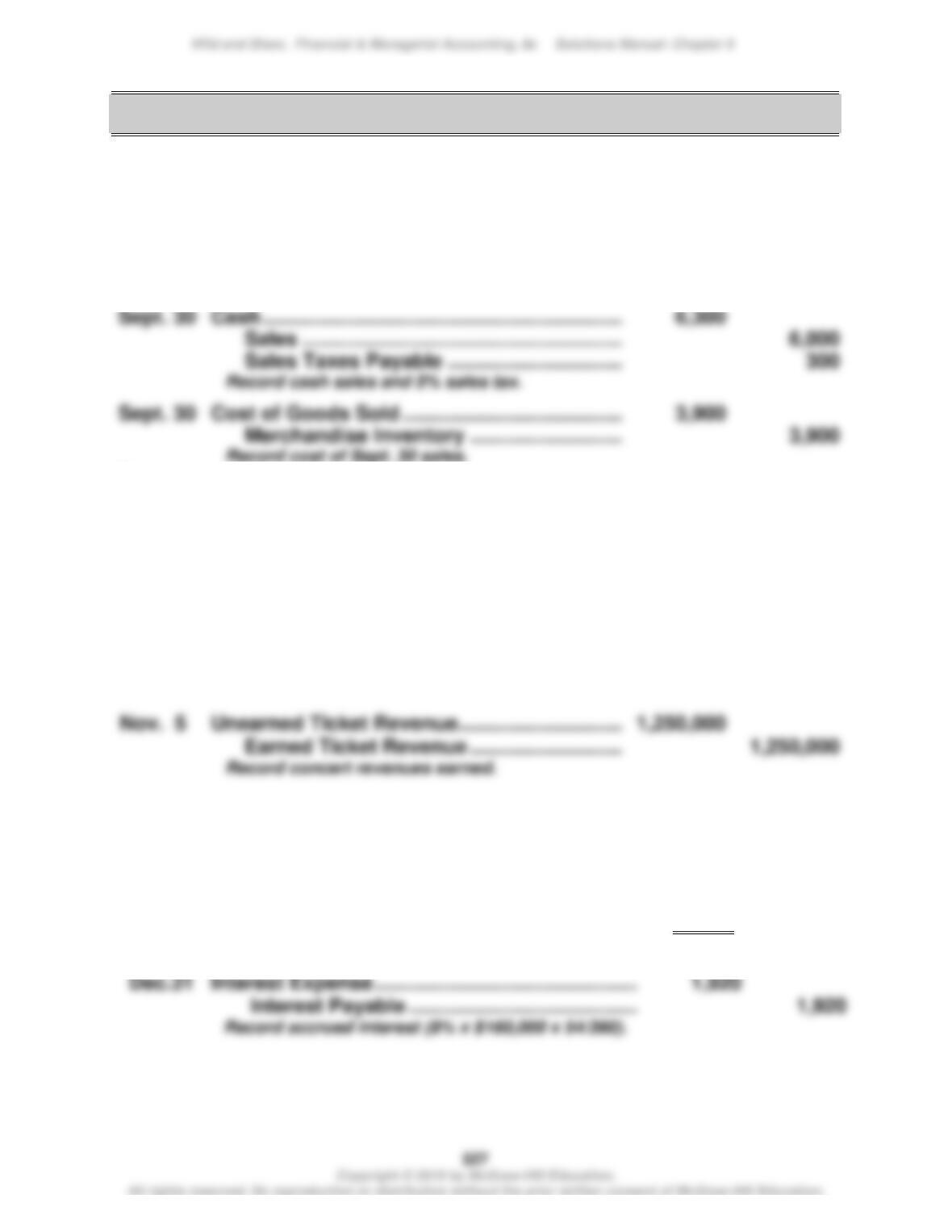
Quick Study 9-1 (5 minutes)
Items 1, 4, 5 and 6 are current liabilities for this company.
Quick Study 9-2 (10 minutes)
1.
Sales Taxes Payable …………………………..
300
Merchandise Inventory …………………………..
Record cost of Sept. 30 sales.
2.
Oct. 15
Sales Taxes Payable ………………………………………..
300
Cash ……………………………………………………….
300
Record payment of sales taxes to govt.
Quick Study 9-3 (10 minutes)
Oct. 31
Cash ………………………………………………………………..
5,000,000
Unearned Ticket Revenue …………………………..
5,000,000
Record sales in advance of concerts.
Unearned Ticket Revenue …………………………..
1,250,000
Earned Ticket Revenue …………………………..
1,250,000
Quick Study 9-4 (15 minutes)
1. Computation of interest payable at December 31:
Days from November 7 to December 31 ………………..
54 days
Accrued interest (8% x $160,000 x 54/360) …………….
$1,920
2.
Interest Expense ………………………………………………
Interest Payable …………………………………………
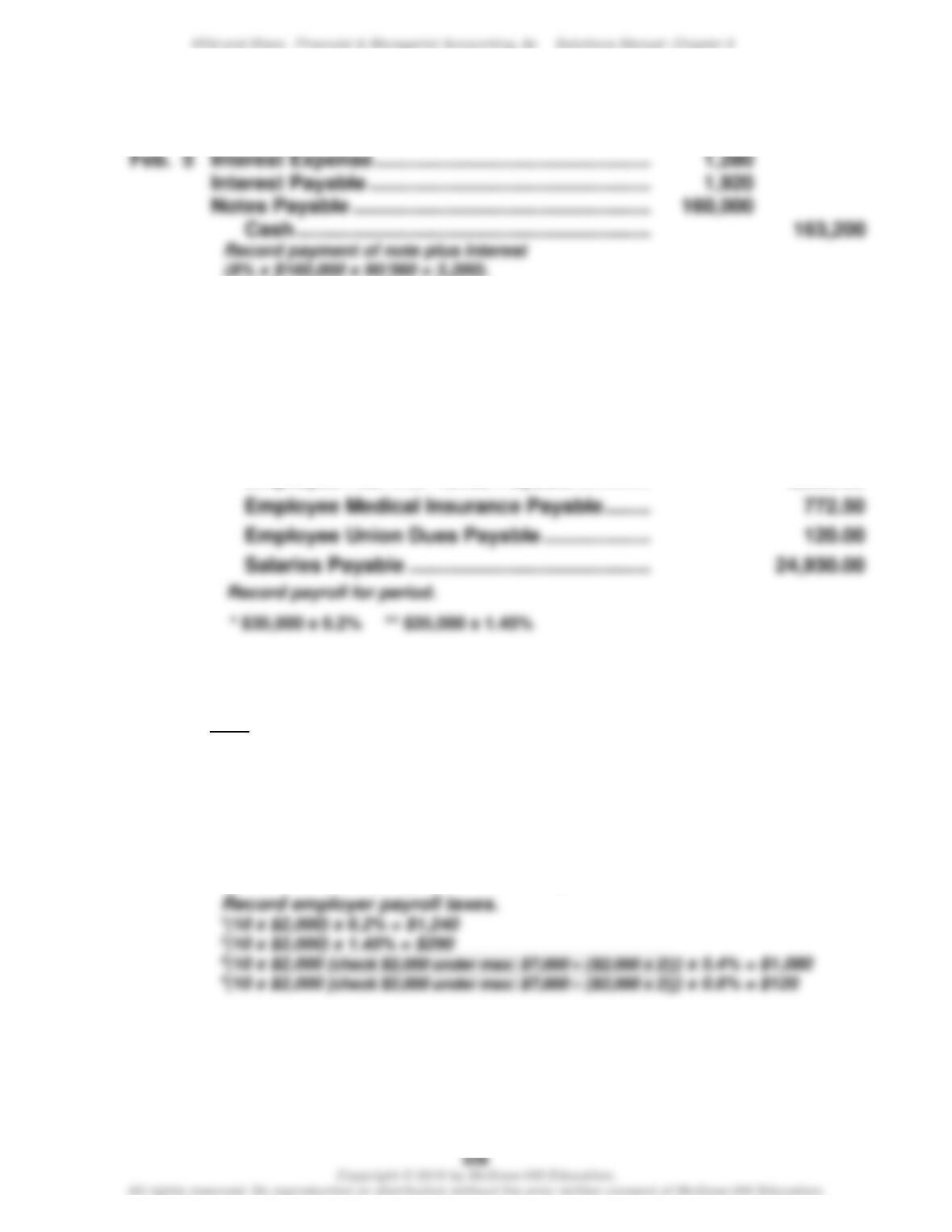
Quick Study 9-4 (concluded)
3.
Interest Expense ………………………………………………
Interest Payable ……………………………………………….
Notes Payable ………………………………………………….
Cash ……………………………………………………….
Quick Study 9-5 (15 minutes)
Jan. 15
Salaries Expense ……………………………………………..
35,000.00
FICA—Social Sec. Taxes Payable* ………………
2,170.00
FICA—Medicare Taxes Payable** ………………..
507.50
Employee Fed. Inc. Taxes Payable ………………
6,500.00
Employee Medical Insurance Payable ………….
772.50
Employee Union Dues Payable ……………………
120.00
Salaries Payable …………………………………………
Quick Study 9-6 (15 minutes)
Note: Two months (January and February) of earnings have
already been recorded for each of the 10 employees.
Mar. 31
Payroll Taxes Expense ……………………………………..
2,730
FICA—Social Security Taxes Payable1 ………
1,240
FICA—Medicare Taxes Payable2 …………………..
290
State Unemployment Taxes Payable3 …………..
1,080
Federal Unemployment Taxes Payable4 ……….
120
Quick Study 9-7 (5 minutes)
Dec. 31
Employee Bonus Expense ………………………………..
15,000
Bonus Payable ………………………………………….
15,000
Record expected bonus costs.
Quick Study 9-8 (5 minutes)
Dec. 31
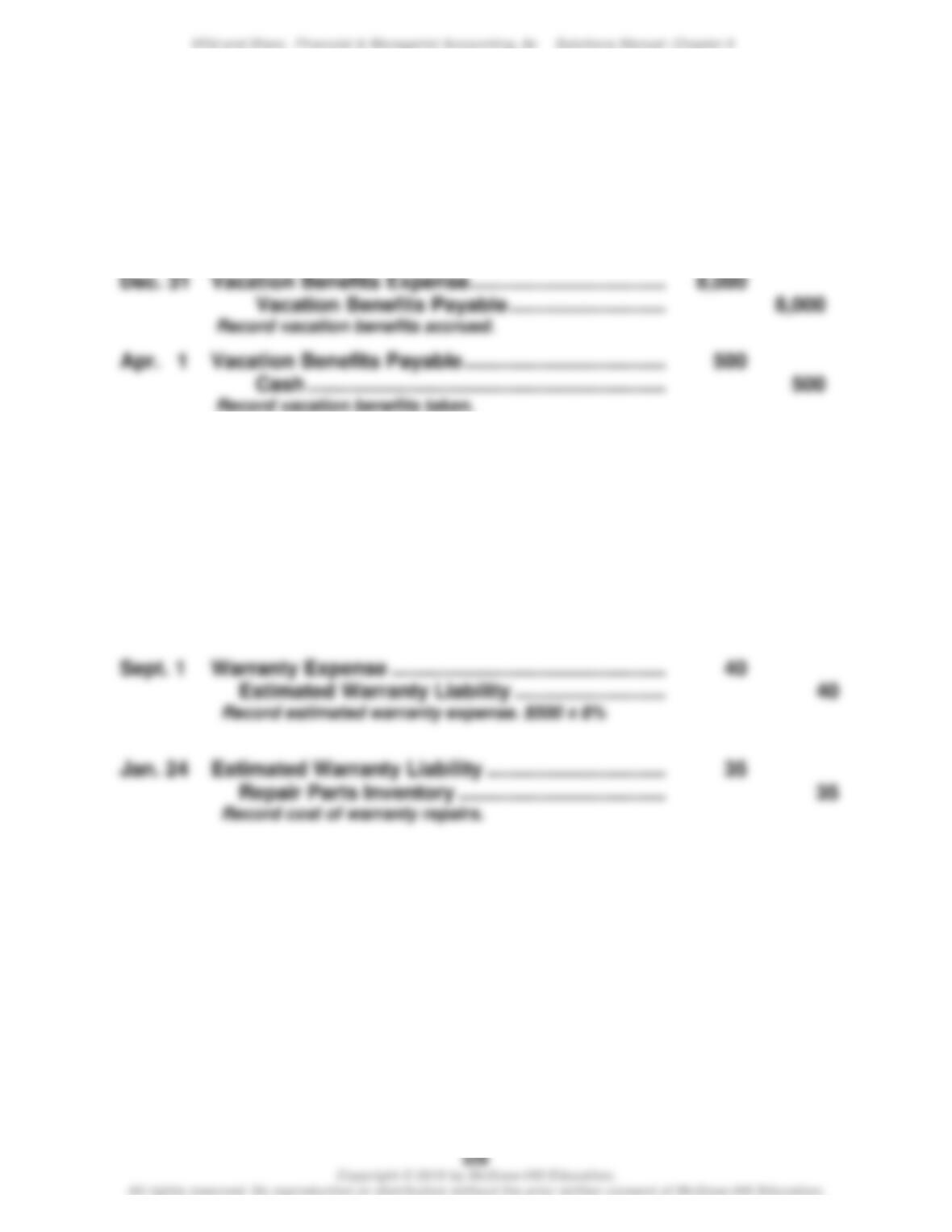
Vacation Benefits Expense ……………………………….
Vacation Benefits Payable …………………………
Apr. 1
Vacation Benefits Payable …………………………..……
500
Cash ……………………………………………………….
Record vacation benefits taken.
Quick Study 9-9 (10 minutes)
Sept. 1
Cash ………………………………………………………………..
500
Sales …………………………………………………………..
500
Record mower sales.
Sept. 1
Cost of Goods Sold ………………………………………….
200
Merchandise Inventory ………………………………..
200
Record cost of mower sales.
Sept. 1
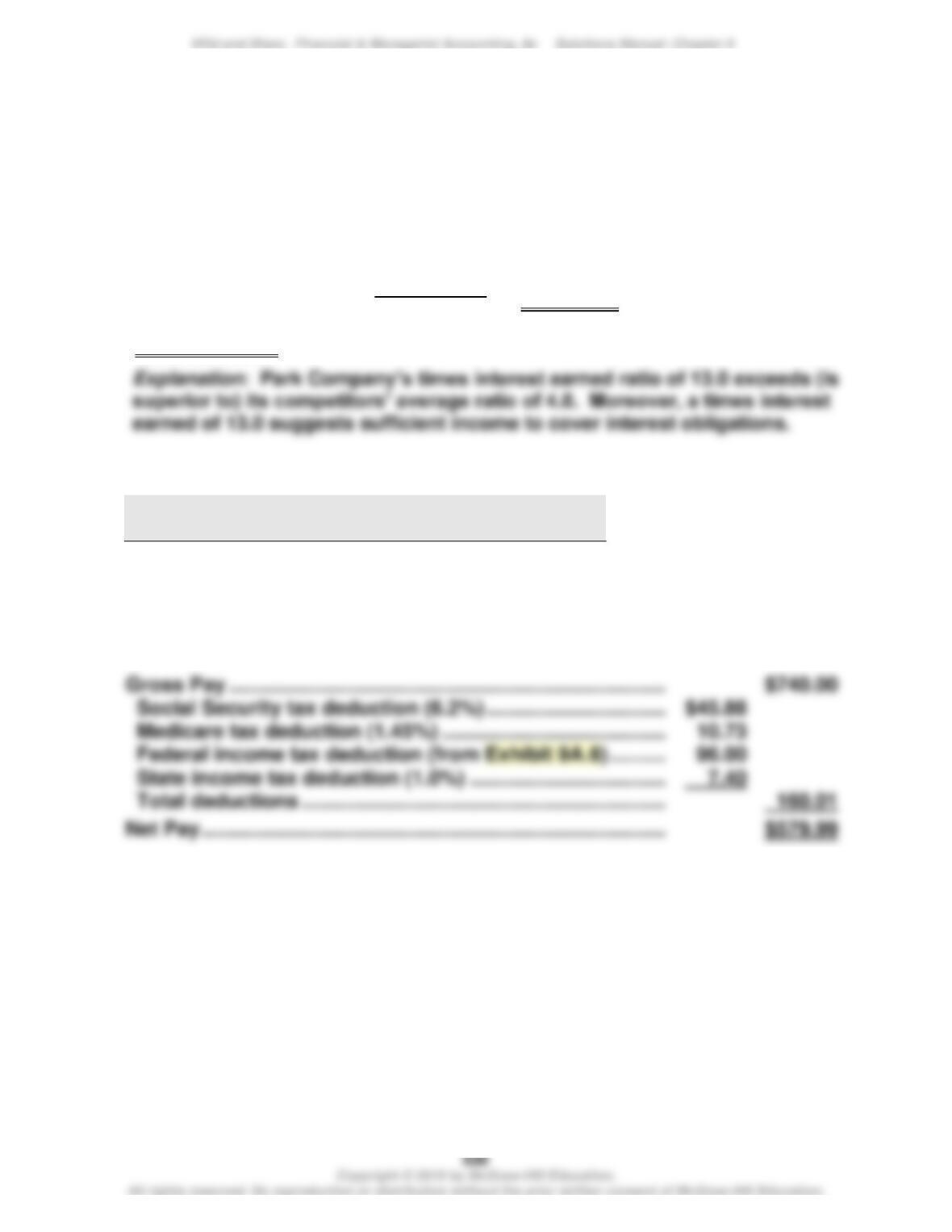
Warranty Expense ……………………………………………
Estimated Warranty Liability ………………………..
Record estimated warranty expense. $500 x 8%
Estimated Warranty Liability …………………………..
Repair Parts Inventory …………………………………
Record cost of warranty repairs.
Quick Study 9-10 (10 minutes)
Dec. 31
Employee Benefits Expense ……………………………..
14,500
Employee Medical Insurance Payable ………….
5,500
Employee Retirement Program Payable ………
9,000
Record costs of employee benefits.
Quick Study 9-11 (10 minutes)
1. (a); reason—it is reasonably estimated and is a probable loss.
2. (b); reason—it is a possible loss and cannot be reasonably estimated.
3. (c); reason—it is unlikely to incur a loss.
Quick Study 9-12 (10 minutes)
a.
Times interest earned = = 13.0 times
b. Better position.
Quick Study 9-13A (15 minutes)
Employee
Federal Income Tax
Withholding
Maria …………………….
$ 68
Jeff ……………………….
30
Alicia …………………….
101
Quick Study 9-14A (15 minutes)
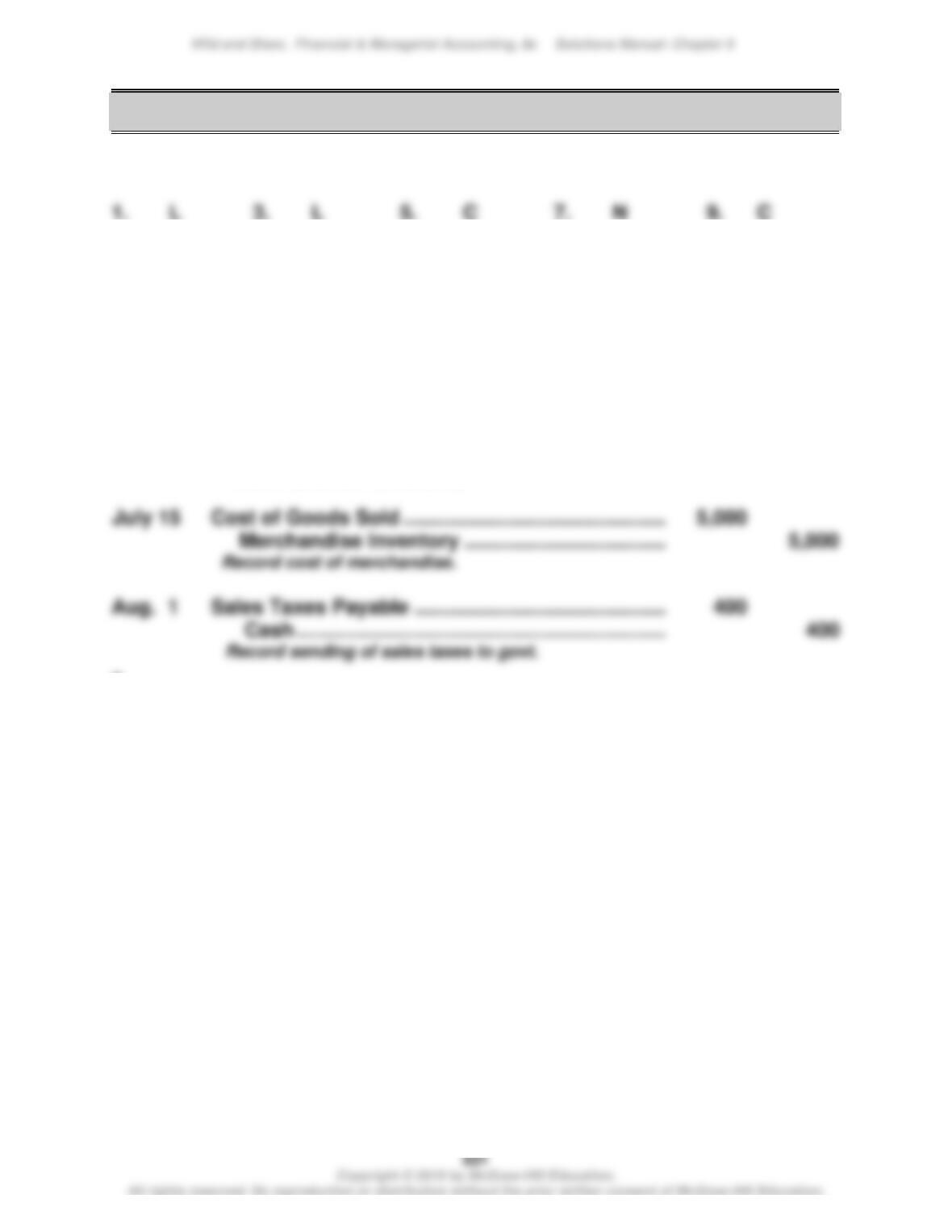
Gross Pay ……………………………………………………………………
$45.88
Quick Study 9-15B (10 minutes)
Dec. 31
Income Taxes Expense …………………………..………..
40,000
Income Taxes Payable ………………………………..
34,000
Deferred Income Tax Liability ……………………..
6,000
Record tax expense and deferred tax liability.
$1,885,000
$145,000
EXERCISES
Exercise 9-1 (10 minutes)
2.
C
4.
C
6.
C
8.
C
10.
C
Exercise 9-2 (10 minutes)
1.
July 15
Cash ………………………………………………………………..
10,400
Sales ………………………………………………………….
10,000
Sales Taxes Payable …………………………………..
400
Record sales and sales taxes.
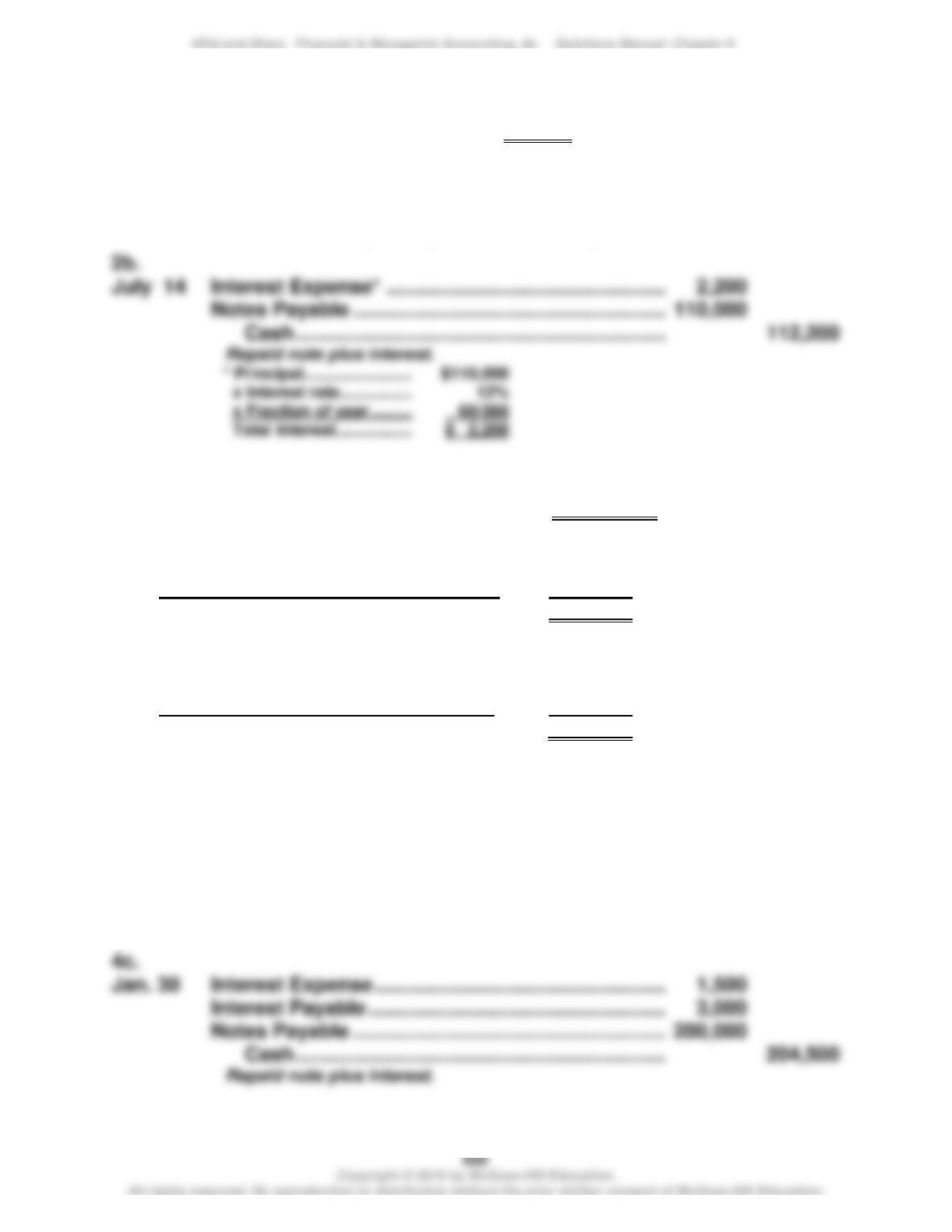
July 15
Merchandise Inventory ………………………………..
Aug. 1
Sales Taxes Payable ………………………………………..
400
Cash …………………………………………………………..
400
Record sending of sales taxes to govt.
2.
Nov. 3
Cash ………………………………………………………………..
300
Unearned Ticket Revenue …………………………..
300
Record sales in advance of games.
Nov. 20
Unearned Ticket Revenue …………………………………
50
Ticket Revenue* ………………………………………….
50
Record revenue earned. *[$300 x (1/6)]
Exercise 9-3 (30 minutes)
1. Maturity date = May 15 + 60 days = July 14
2a.
May 15
Cash ………………………………………………………………..
110,000
Notes Payable …………………………………………….
110,000
Borrowed cash by issuing an interest-bearing note.
July 14
Interest Expense* …………………………………………….
Notes Payable ………………………………………………….
110,000
Cash …………………………………………………………..
112,200
Exercise 9-4 (30 minutes)
1. Maturity date = November 1 + 90 days = January 30.
2.
Principal ………………………………………………
$200,000
x Interest rate ………………………………………
9%
x Fraction of year (Nov. 1 – Dec. 31) ……..
60/360
Total interest in current year ………………..
$ 3,000
3.
Principal ………………………………………………
$200,000
x Interest rate ………………………………………
9%
x Fraction of year (Jan. 1 – Jan. 30) ………
30/360
Total interest in the following year ……….
$ 1,500
4a.
Nov. 1
Cash ………………………………………………………………..
200,000
Notes Payable …………………………………………….
200,000
Borrowed cash by issuing an interest-bearing note.
4b.
Dec. 31
Interest Expense ………………………………………………
3,000
Interest Payable ………………………………………….
3,000
Accrued interest on note payable.
Interest Expense ………………………………………………
Interest Payable ……………………………………………….
Notes Payable ………………………………………………….
200,000
Cash …………………………………………………………..
204,500
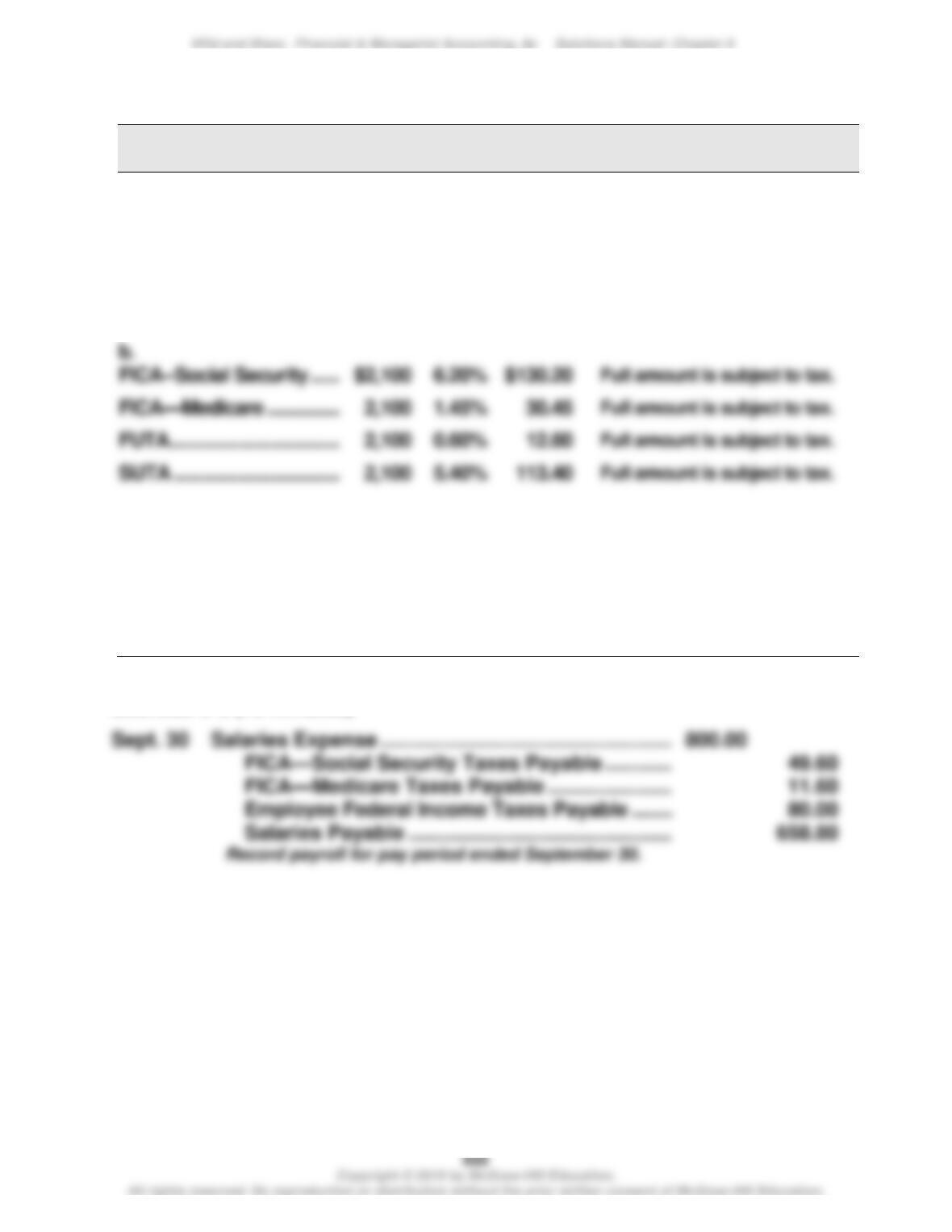
Exercise 9-5 (20 minutes)
Subject
to Tax
Rate
Tax
Explanation
a.
FICA—Social Security ……
$ 800
6.20%
$ 49.60
Full amount is subject to tax.
FICA—Medicare ……………
800
1.45%
11.60
Full amount is subject to tax.
FUTA ……………………………..
600
0.60%
3.60
$200 is over the maximum.
SUTA …………………………....
600
5.40%
32.40
$200 is over the maximum.
FICA—Medicare ……………
1.45%
Full amount is subject to tax.
FUTA ……………………………..
2,100
0.60%
12.60
Full amount is subject to tax.
SUTA …………………………....
5.40%
Full amount is subject to tax.
c.
FICA—Social Security ……
$6,300
6.20%
$390.60
$1,700 is over the maximum.
FICA—Medicare ……………
8,000
1.45%
116.00
Full amount is subject to tax.
FUTA ……………………………..
0
0.60%
0.00
Full amount is over maximum.
SUTA …………………………....
0
5.40%
0.00
Full amount is over maximum.
Exercise 9-6 (10 minutes)
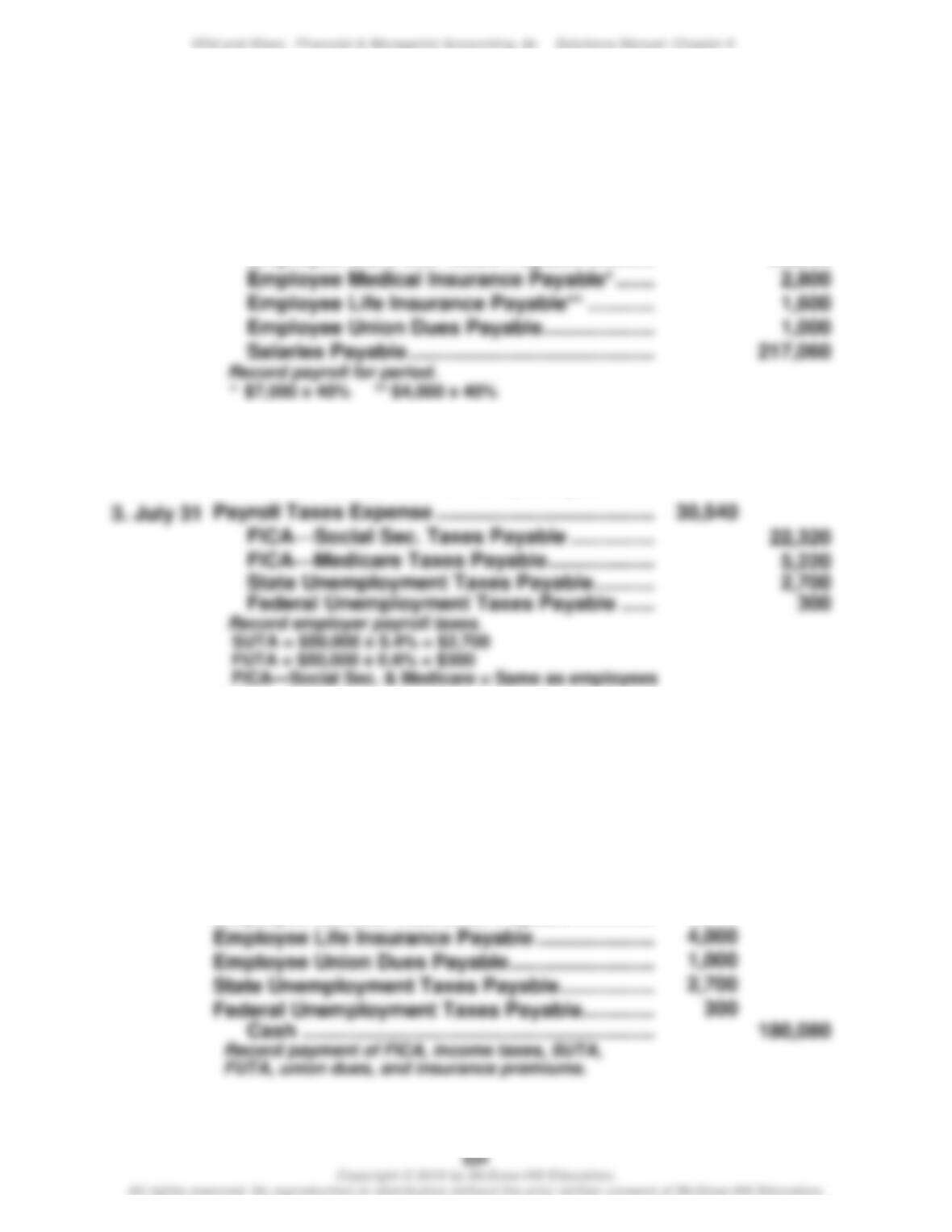
Salaries Expense ……………………………………………..
FICA—Social Security Taxes Payable ………….
49.60
FICA—Medicare Taxes Payable …………………..
11.60
Employee Federal Income Taxes Payable ………
80.00
Salaries Payable …………………………………………
Exercise 9-7 (10 minutes)
Sept. 30
Payroll Taxes Expense ……………………………………..
97.20
FICA—Social Security Taxes Payable ………….
49.60
FICA—Medicare Taxes Payable …………………..
11.60
Federal Unemployment Taxes Payable ………..
3.60
State Unemployment Taxes Payable ……………
32.40
Record employer payroll taxes.
Exercise 9-8 (30 minutes)
1. July 31
Sales Salaries Expense …………………………………….
200,000
Office Salaries Expense ……………………………………
160,000
FICA—Social Sec. Taxes Payable ………………..
22,320
FICA—Medicare Taxes Payable ……………………
5,220
Employee Fed. Inc. Taxes Payable ……………….
90,000
Employee State Inc. Taxes Payable ……………..
20,000
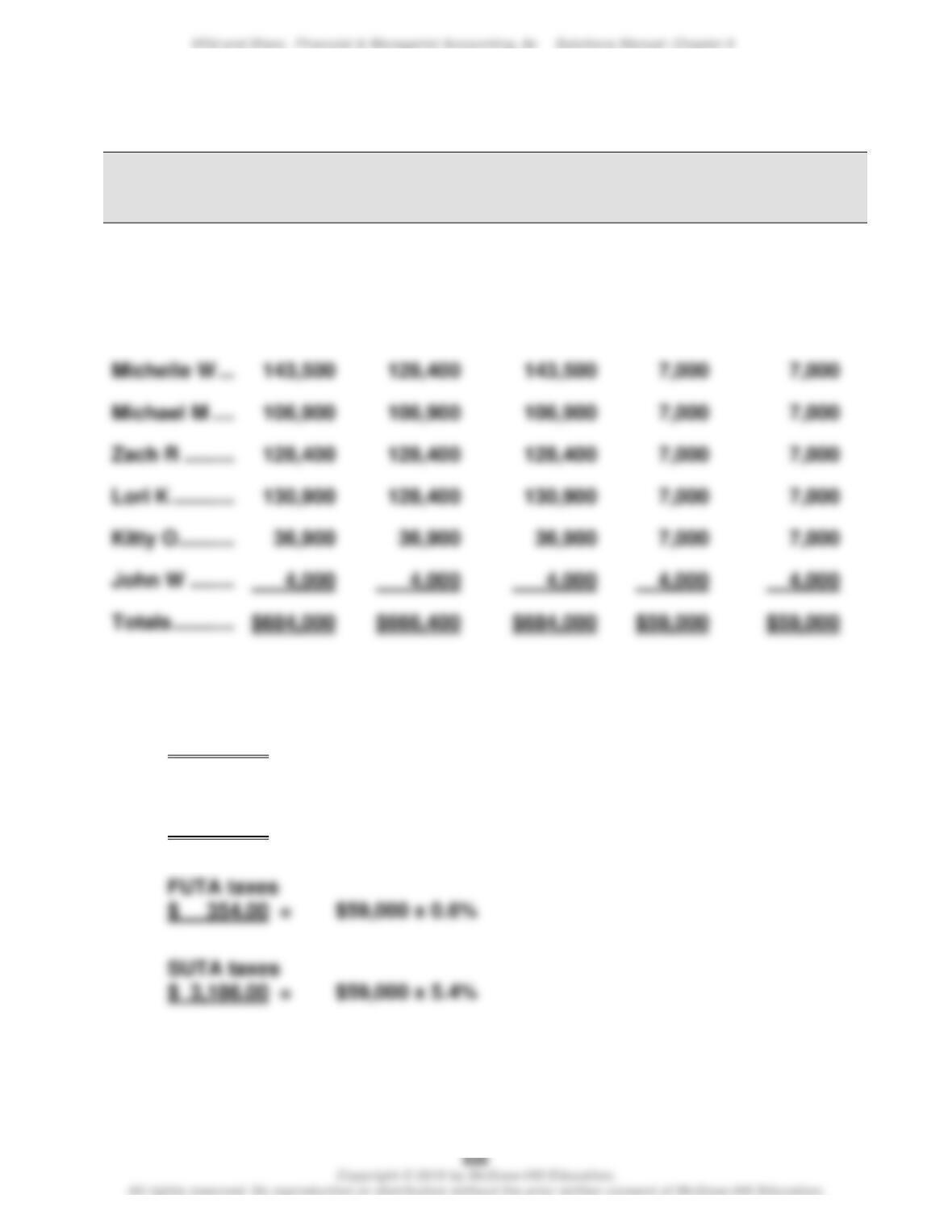
Employee Medical Insurance Payable* …………
2,800
Employee Life Insurance Payable** ……………..
1,600
Employee Union Dues Payable …………………….
1,000
Salaries Payable ………………………………………….
217,060
2. July 31
Salaries Payable ……………………………………………….
217,060
Cash ……………………………………………………….
217,060
Record payment of payroll.*
*Check numbers may be entered in the Payroll Register.
3. July 31
22,320
5,220
State Unemployment Taxes Payable…………….
2,700
Federal Unemployment Taxes Payable ………..
Record employer payroll taxes.
FUTA = $50,000 x 0.6% = $300
July 31
Employee Benefits Expense …………………………..
6,600
Employee Medical Insurance Payable* …………
4,200
Employee Life Insurance Payable** ……………..
2,400
Record costs of employee benefits.
* $7,000 x 60% ** $4,000 x 60%
4. July 31
FICA⎯Social Security Taxes Payable………………..
44,640
FICA⎯Medicare Taxes Payable …………………………
10,440
Employee Fed. Income Taxes Payable. ……………..
90,000
Employee State Income Taxes Payable. …………….
20,000
Employee Medical Insurance Payable ……………….
7,000
Employee Life Insurance Payable ……………………..
4,000
Employee Union Dues Payable ………………………….
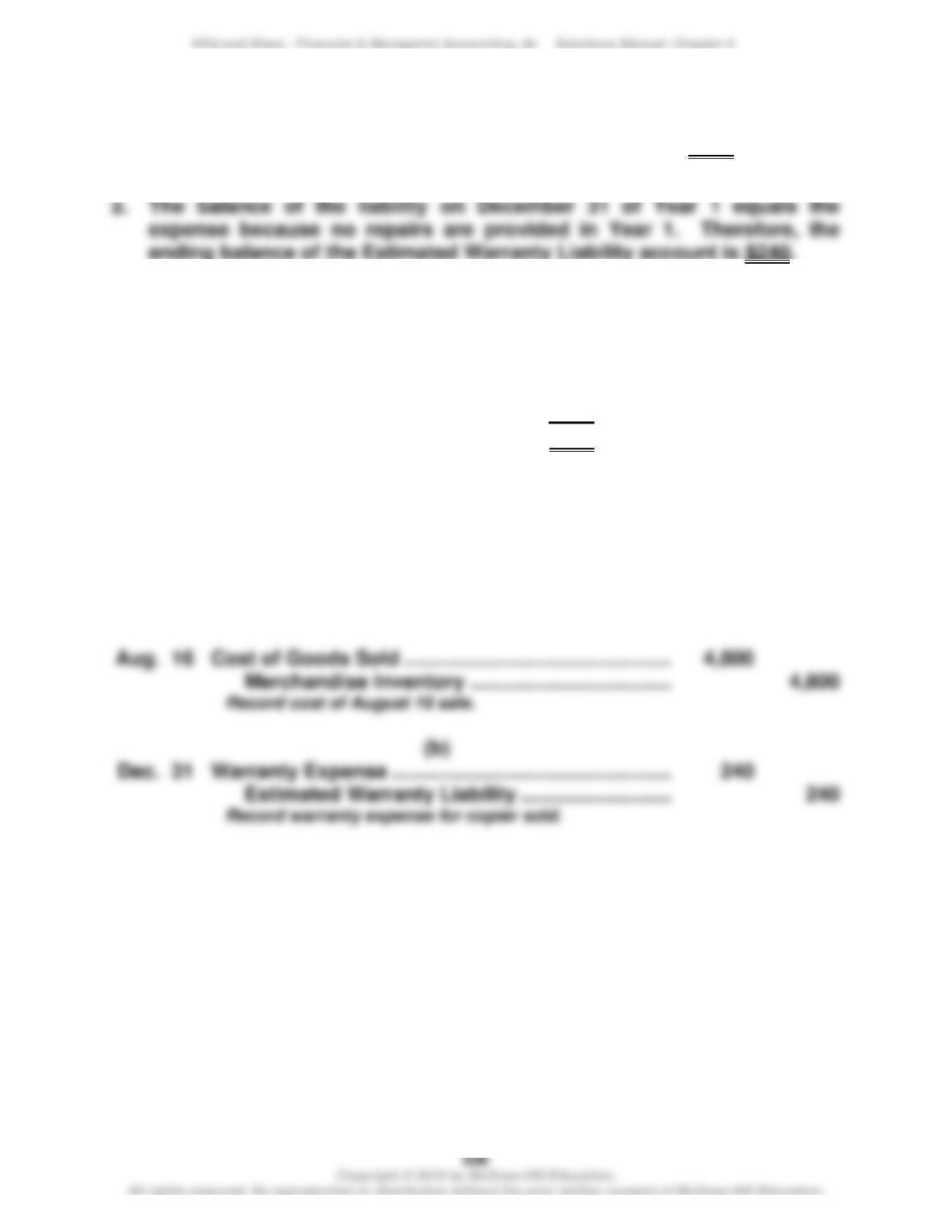
Exercise 9-9 (30 minutes)
a.
Employee
Cumulative
Pay
Pay Subject to
FICA Social
Security
Pay Subject
to FICA
Medicare
Pay Subject
to FUTA
Taxes
Pay Subject
to SUTA
Taxes
Ken S ……………….
$ 6,000
$ 6,000
$ 6,000
$ 6,000
$ 6,000
Tim V ………………..
40,400
40,400
40,400
7,000
7,000
Steve S …………….
87,000
87,000
87,000
7,000
7,000
7,000
7,000
7,000
7,000
7,000
7,000
7,000
7,000
b. FICA Social Security taxes
$82,633.60 = $666,400 x 6.2% x 2 (for employer and employee)
FICA Medicare taxes
$19,836.00 = $684,000 x 1.45% x 2 (for employer and employee)
Exercise 9-10 (25 minutes)
1. Warranty Expense = 4% of dollar sales = 4% x $6,000 = $240
3. The balance of the Estimated Warranty Liability on December 31 of
Year 2 account equals the Year 2 beginning balance minus the costs
incurred during Year 2 to repair the copier:
Ending Year 1 balance ………………..
$240
Less parts cost …………………………..
(209)
Ending Year 2 balance ………………..
$ 31
4. Journal entries
(a)
Aug. 16
Cash ………………………………………………………………..
6,000
Sales ………………………………………………………….
6,000
Record cash sale of copier.
Aug. 16
4,800
Merchandise Inventory ……………………………….
4,800
Record cost of August 16 sale.
Dec. 31
Warranty Expense ……………………………………………
240
Estimated Warranty Liability ……………………….
240
Record warranty expense for copier sold.
(c)
Jan. 5
Estimated Warranty Liability …………………………….
209
Repair Parts Inventory ………………………………..
209
Record cost of warranty repairs.
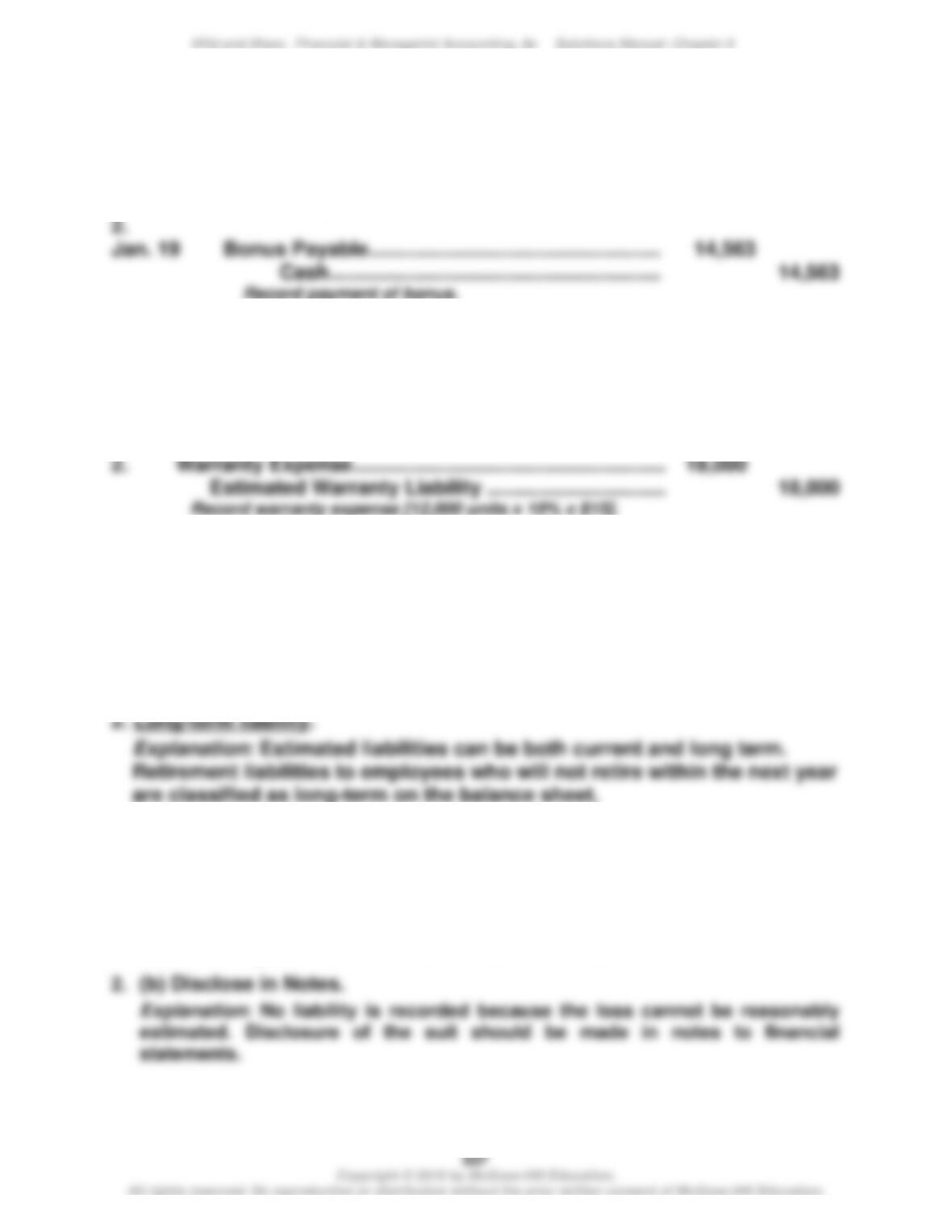
Exercise 9-11 (15 minutes)
1.
Dec. 31 Employee Bonus Expense ………………………….. 14,563
Bonus Payable …………………………………… 14,563
Record expected bonus costs.
Exercise 9-12 (10 minutes)
1.
Vacation Benefits Expense …………………………………….
13,000
Vacation Benefits Payable ………………………………..
13,000
Record vacation benefits accrued.
Warranty Expense………………………………………………….
18,000
Estimated Warranty Liability …………………………..
Exercise 9-13 (10 minutes)
1.
Dec. 31
Employee Benefits Expense ……………………………..
19,500
Employee Medical Insurance Payable ………….
9,500
Employee Retirement Program Payable ………
10,000
Record costs of employee benefits.
Exercise 9-14 (10 minutes)
1. (b) Disclose in Notes.
Explanation: No adjusting entry is required since it is not probable that the
supplier will default on the debt. The guarantor, Cruz Company, should
describe the guarantee in its financial statement notes.
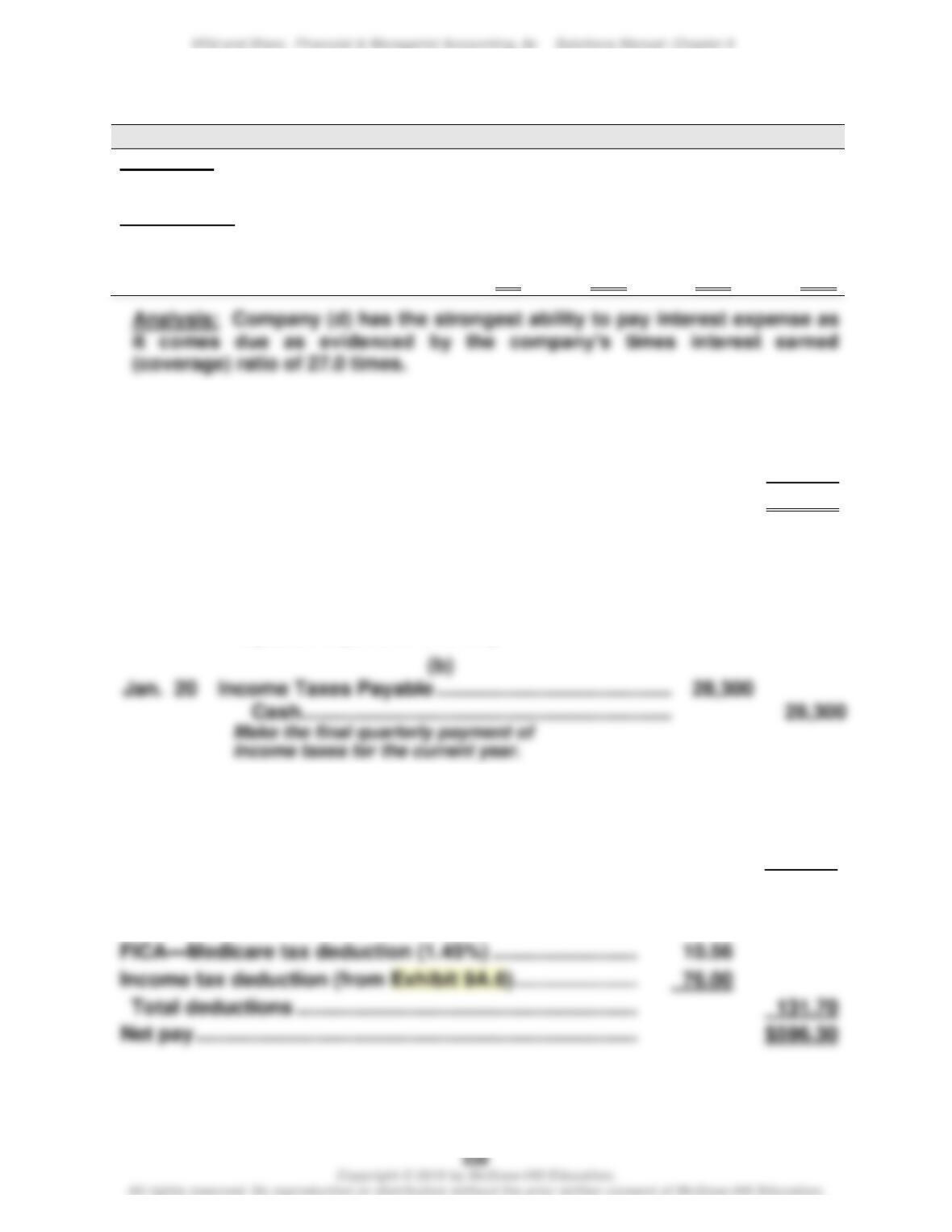
Exercise 9-15 (15 minutes)
LUE CO.
Balance Sheet
December 31
Assets
Current assets
Cash ……………………………………………………………… $50,000
Accounts receivable ……………………………………… 5,100
Total current assets ………………………………………. 55,100
Liabilities
Current liabilities
Salaries payable ……………………………………………. $34,000
Employee federal income taxes payable ………… 9,000
Current portion of long-term debt ………………….. 4,000
FICA—Social Security taxes payable ……………… 3,100
Employee medical insurance payable ……………. 2,000
State unemployment taxes payable ……………….. 1,800
Equity
Total equity ………………………………………………………. 30,000
Total liabilities and equity …………………………………. $95,100
Exercise 9-16 (15 minutes)
(a)
(b)
(c)
(d)
Numerator
Income before interest & taxes ……
$198,000
$176,000
$180,000
$378,000
Denominator
Interest expense ………………………………
$ 44,000
$ 16,000
$ 12,000
$ 14,000
Times interest earned ratio ………….
4.5
11.0
15.0
27.0
Exercise 9-17B (25 minutes)
1.
Income Taxes Payable (target balance) ………………………………………..
$28,300
Total accrued [($28,600 + $19,100 + $34,600) x .30] ……………………….
24,690
Adjustment (additional expense) ………………………………………………….
$ 3,610
2.
(a)
Dec. 31
Income Tax Expense …………………………………………
3,610
Income Taxes Payable …………………………………
3,610
Adjust tax expense and liability.
Jan. 20
Income Taxes Payable ………………………………………
Cash ……………………………………………………………
Exercise 9-18A (15 minutes)
Regular pay (40 hours @ $14) …………………………………….
$560.00
Overtime premium pay (8 hours @ $21) ………………………
168.00
Gross pay ………………………………………………………………..
728.00
FICA—Social Security tax deduction (6.2%) ………………..
$ 45.14
Income tax deduction (from Exhibit 9A.6) ……………………
Total deductions ………………………………………………………
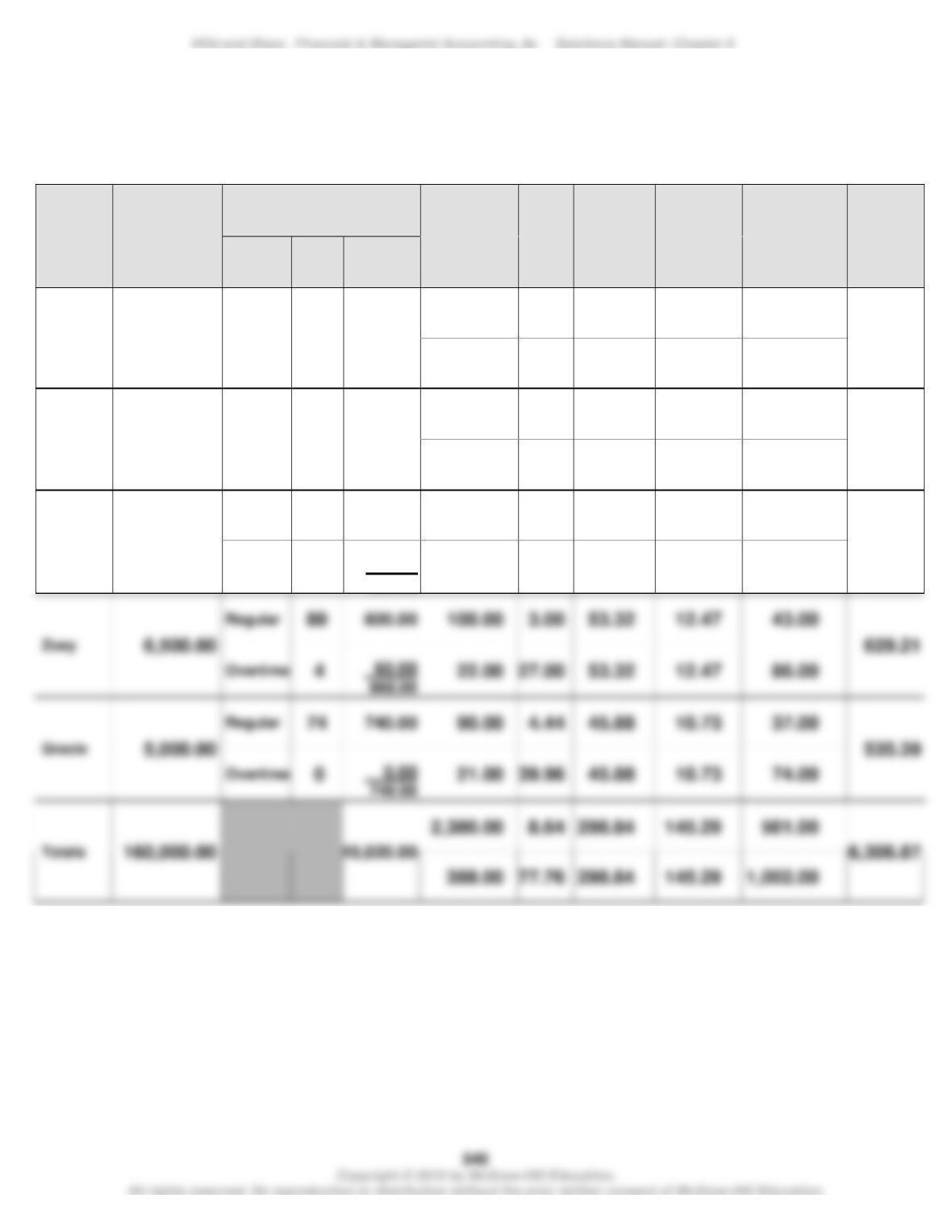
Exercise 9-19A (30 minutes)
(a)
Employee
Cumulative
Pay (Excludes
Current Period)
Current Period Gross Pay
FIT
Withholding
FUTA
FICA S.S.
Employee
FICA
Medicare
Employee
Employee—
Benefits Plan
Withholding
Employee
Net Pay
(Current
Period)
Pay
Type
Pay
Hours
Gross Pay
SIT
Withholding
SUTA
FICA S.S.
Employer
FICA
Medicare
Employer
Employer—
Benefits Plan
Expense
Kathleen
126,600.00
Salary
—
7,000.00
2,000.00
0.00
111.60
101.50
350.00
4,136.90
300.00
0.00
111.60
101.50
700.00
Anthony
6,800.00
Salary
—
500.00
80.00
1.20
31.00
7.25
25.00
336.75
20.00
10.80
31.00
7.25
50.00
Nichole
15,100.00
Regular
80
800.00
110.00
0.00
57.04
13.34
46.00
668.62
Overtime
8
120.00
920.00
25.00
0.00
57.04
13.34
92.00
Regular
80
100.00
3.00
53.32
12.47
43.00
Overtime
4
860.00
22.00
53.32
12.47
86.00
Gracie
Regular
74
90.00
4.44
45.88
10.73
37.00
0.00
740.00
Totals
160,000.00
2,380.00
8.64
298.84
145.29
501.00
6,306.87
388.00
77.76
145.29
Exercise 9-19A (concluded)
(b)
Aug 31
Salaries (or Wages) Expense …………………………..
10,020.00
FICA—Social Sec. Taxes Payable ………………..
298.84
FICA—Medicare Taxes Payable ……………………
145.29
Employee Fed. Inc. Taxes Payable ……………….
2,380.00
Employee State Inc. Taxes Payable ……………..
388.00
Employee Benefits Plan Payable ………………….
501.00
Salaries Payable ………………………………………….
6,306.87
Record payroll for period.
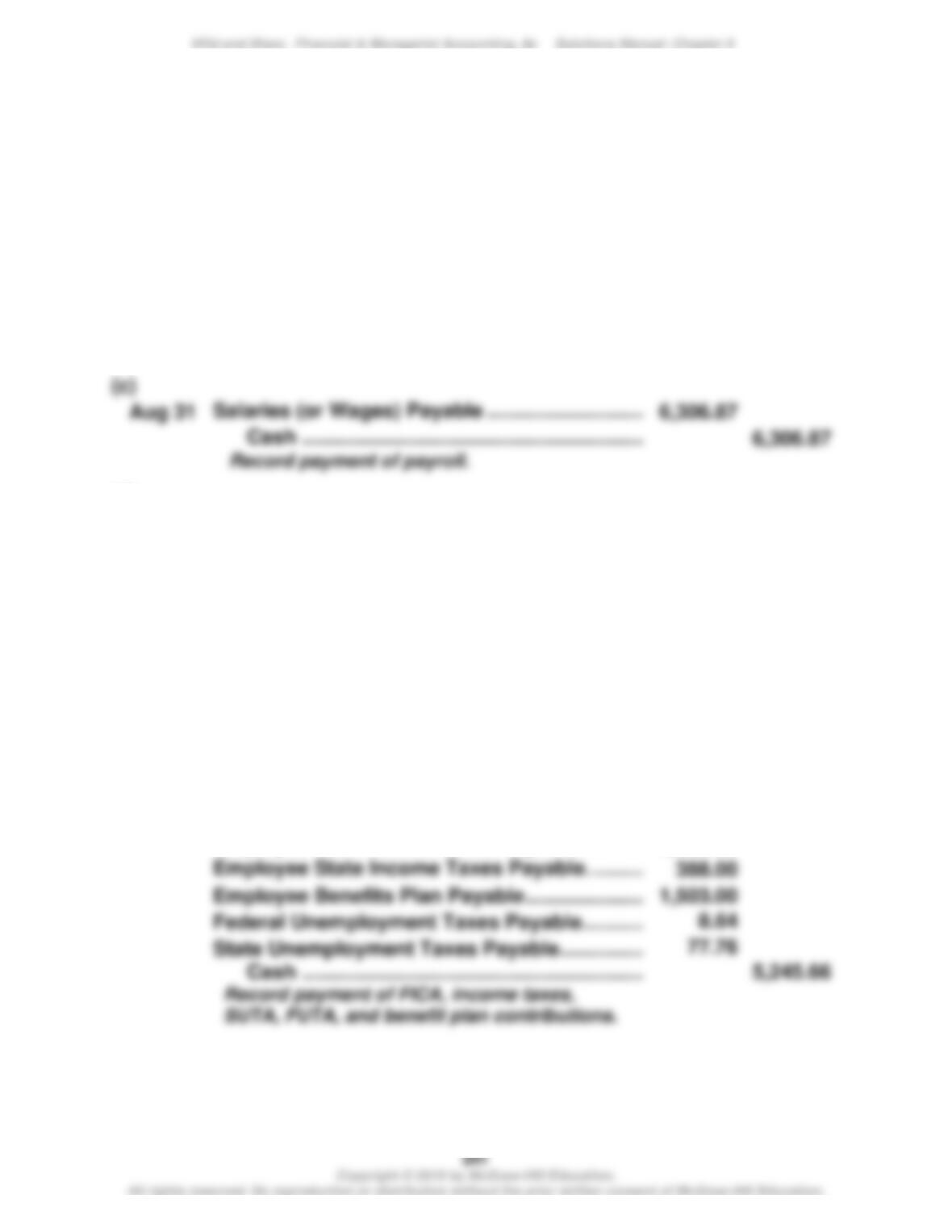
Salaries (or Wages) Payable …………………………..
6,306.87
Record payment of payroll.
(d)
Aug 31
Payroll Taxes Expense ……………………………………..
530.53
FICA⎯Social Sec. Taxes Payable ………………..
298.84
FICA⎯Medicare Taxes Payable ……………………
145.29
Federal Unemployment Taxes Payable ………..
8.64
State Unemployment Taxes Payable…………….
77.76
Record employer payroll taxes.
Aug 31
Employee Benefits Expense …………………………..
1,002.00
Employee Benefits Plan Payable ………………….
1,002.00
Record costs of employee benefits.
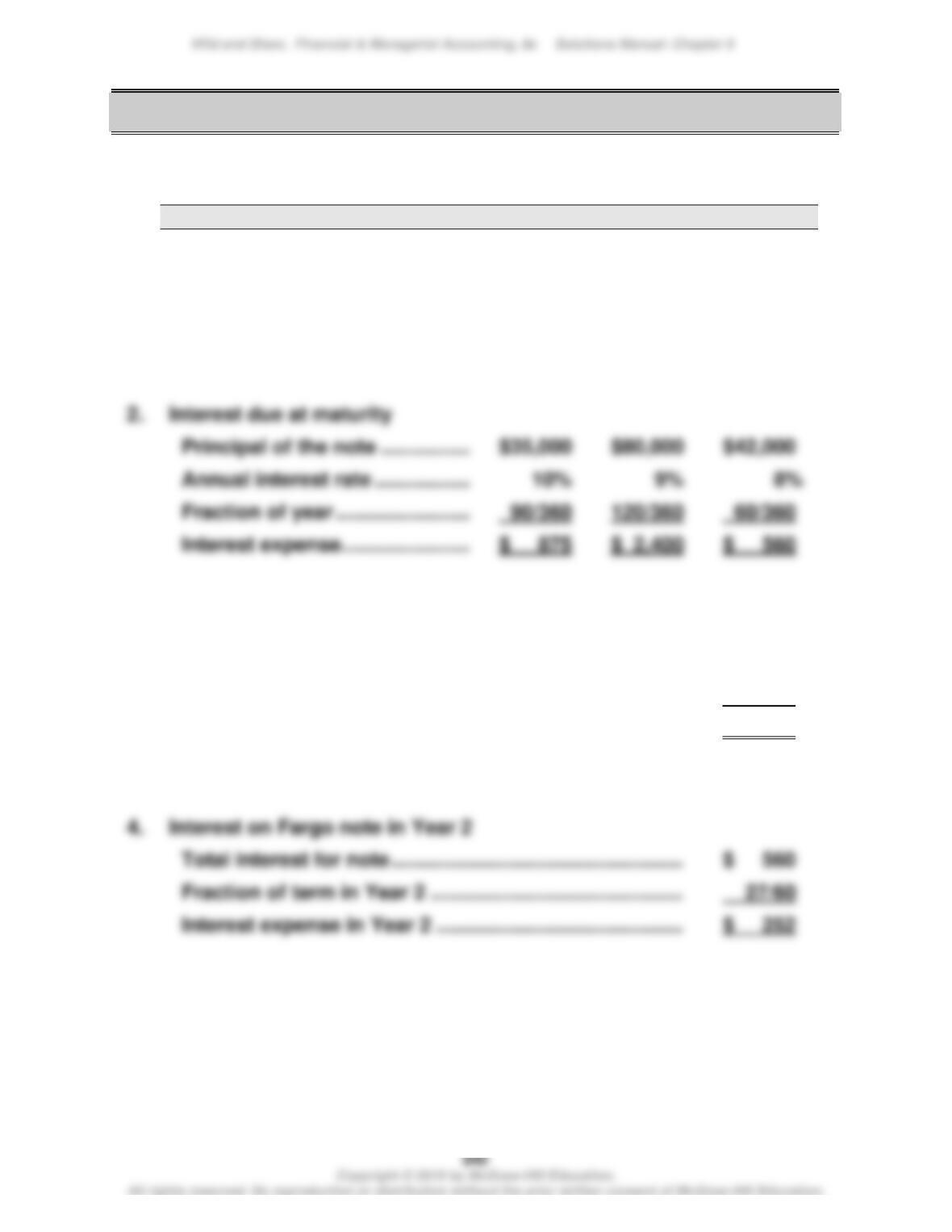
(e)
Aug 31
FICA⎯Social Security Taxes Payable………………..
597.68
FICA⎯Medicare Taxes Payable …………………………
290.58
Employee Fed. Income Taxes Payable. ……………..
2,380.00
Employee State Income Taxes Payable. …………….
Employee Benefits Plan Payable ……………………….
1,503.00
Cash ……………………………………………………….
PROBLEM SET A
Problem 9-1A (45 minutes)
Locust
NBR Bank
Fargo Bank
1.
Maturity dates
Date of the note …………………………
May 19
July 8
Nov. 28
Term of the note (in days) ………….
90
120
60
Maturity date …………………………..
Aug. 17
Nov. 5
Jan. 27
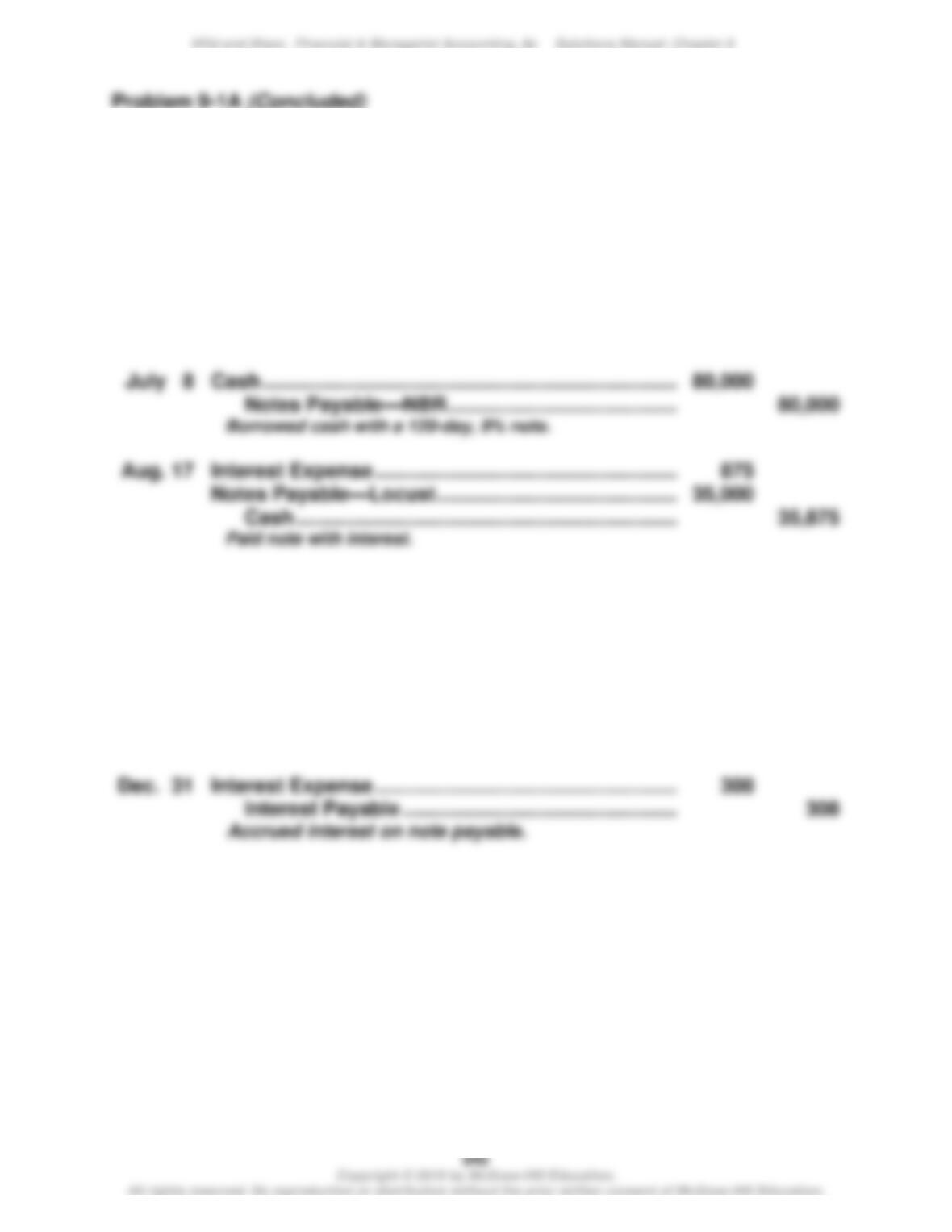
2.
Annual interest rate …………………..
8%
Fraction of year …………………………
90/360
60/360
$ 875
$ 560
3.
Accrued interest on Fargo note at the end of Year 1
Total interest for note …………………………………………….
$ 560
Fraction of term in Year 1 ………………………………………
33/60
Accrued interest expense ………………………………………
$ 308
4.
Total interest for note …………………………………………….
$ 560
Fraction of term in Year 2 ………………………………………
27/60
$ 252
5.
Apr. 20
Merchandise Inventory …………………………………….
40,250
Accounts Payable—Locust …………………………
40,250
Purchased merchandise on credit.
May 19
Accounts Payable—Locust ………………………………
40,250
Cash …………………………………………………………..
5,250
Notes Payable—Locust ……………………………….
35,000
Paid $5,250 cash and gave a 90-day,
10% note to extend due date on account.
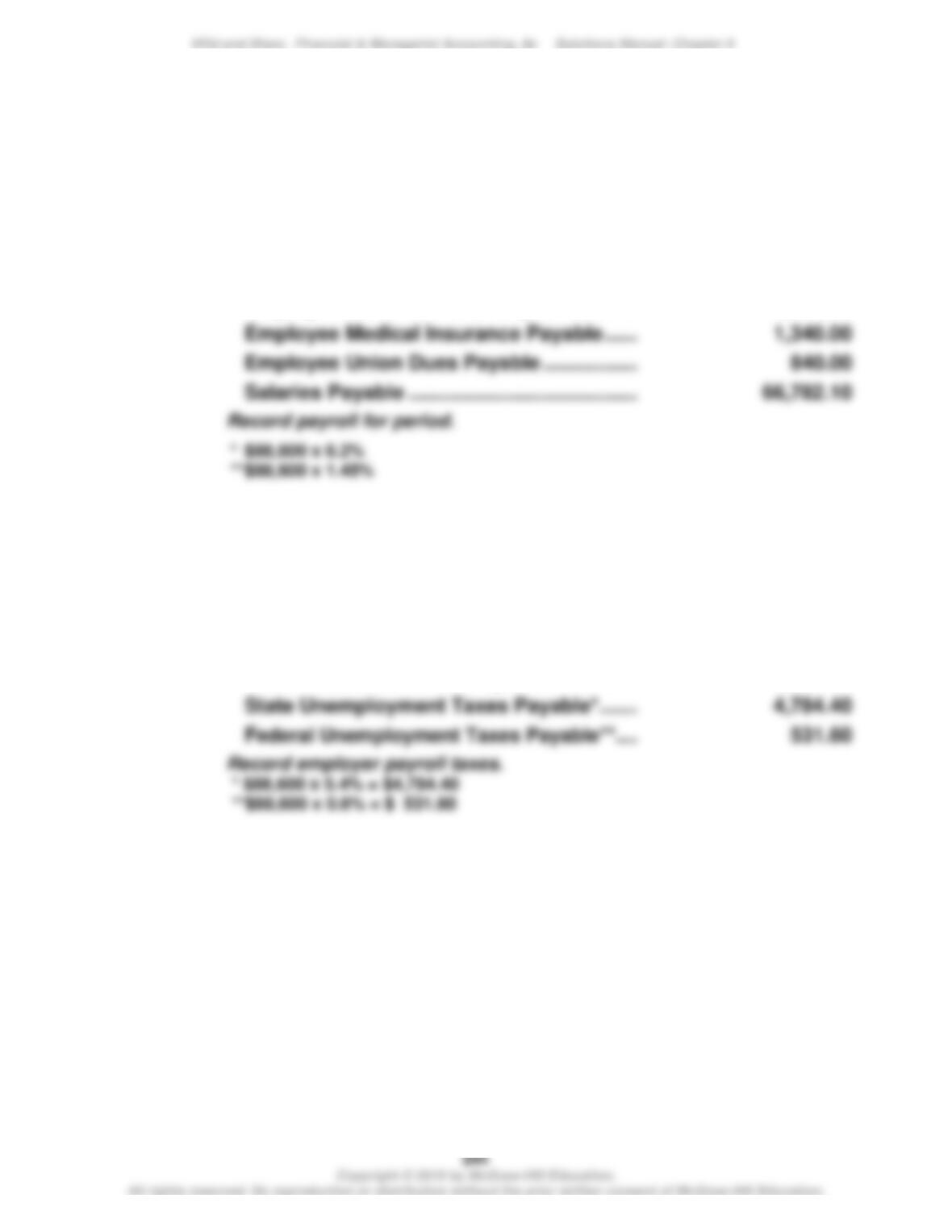
Notes Payable—NBR …………………………………..
80,000
Borrowed cash with a 120-day, 9% note.
Interest Expense ………………………………………………
875
Notes Payable—Locust …………………………………….
35,000
Cash …………………………………………………………..
35,875
Paid note with interest.
Nov. 5
Interest Expense ………………………………………………
2,400
Notes Payable—NBR ………………………………………..
80,000
Cash …………………………………………………………..
82,400
Paid note with interest.
28
Cash ………………………………………………………………..
42,000
Notes Payable—Fargo Bank ………………………..
42,000
Borrowed cash with 60-day, 8% note.
Interest Expense ………………………………………………
308
Interest Payable ………………………………………….
Jan. 27
Interest Expense ………………………………………………
252
Notes Payable—Fargo Bank ……………………………..
42,000
Interest Payable ……………………………………………….
308
Cash …………………………………………………………..
42,560
Paid note with interest.
Problem 9-2A (25 minutes)
Part 1
Jan. 8
Office Salaries Expense ……………………………………
22,760.00
Sales Salaries Expense …………………………………….
65,840.00
FICA—Social Sec. Taxes Payable* ………………
5,493.20
FICA—Medicare Taxes Payable** ………………..
1,284.70
Employee Fed. Inc. Taxes Payable ………………
12,860.00
Employee Union Dues Payable ……………………
Salaries Payable …………………………………………
66,782.10
Part 2
Jan. 8
Payroll Taxes Expense ……………………………………..
12,093.90
FICA—Social Sec. Taxes Payable ………………..
5,493.20
FICA—Medicare Taxes Payable …………………..
1,284.70
State Unemployment Taxes Payable* …………..
Federal Unemployment Taxes Payable** ………..