9-1
CHAPTER 9
Reporting and Analyzing Long-Lived Assets
Learning Objectives
1. Describe how the cost principle applies to plant assets.
2. Explain the concept of depreciation.
3. Compute periodic depreciation using the straight-line method, and contrast its
expense pattern with those of other methods.
9-2
Chapter Outline
Learning Objective 1 – Describe how the Cost Principle Applies to Plant
Assets
Plant Assets (also called property, plant, and equipment) are resources that have
physical substance (a definite size and shape), are used in the operations of a
business, and are not intended for sale to customers.
▪ It is important for companies to (1) keep assets in good operating condition, (2)
replace worn-out or outdated assets, and (3) expand its productive assets as
needed.
Determining The Cost of Plant Assts—The historical cost principle requires that
companies record plant assets at cost.
Land – Land is often used as a building site for a manufacturing plant or office. The
cost of land includes:
▪ The cash purchase price.
Land improvements – Land improvements are structural additions made to land
such as driveways, parking lots, fences, landscaping, and underground sprinklers.
▪ The cost of land improvements includes all expenditures necessary to make the
improvements ready for their intended use.
Buildings – Buildings are facilities used in operations, such as stores, offices,
factories, warehouses, and airplane hangars.
▪ All necessary expenditures relating to the purchase or construction of a building
are charged to the Buildings account.
9-3
▪ When a building is purchased, such costs include the purchase price, closing
costs (attorney’s fees, title insurance, etc.), and real estate broker’s
Equipment – Equipment includes assets used in operations, such as store check–
out counters, office furniture, factory machinery, delivery trucks, and airplanes.
▪ The cost of equipment consists of the cash purchase price, sales taxes, freight
charges, and insurance during transit paid by the purchaser, as well as
expenditures required in assembling, installing, and testing the unit.
▪ Two criteria apply in determining the cost of equipment:
(1) The frequency of the cost – one time or recurring
(2) The benefit period – the life of the asset or one year.
▪ To illustrate, assume that Lenard Company purchases a delivery truck at a cash
price of $22,000. Related expenditures are for sales taxes $1,320, painting and
lettering $500, motor vehicle license $80, and a three-year accident insurance
policy $1,600. The cost of the motor vehicle license is treated as an expense,
and the cost of an insurance policy is considered a prepaid asset. Thus the
entry to record the purchase of the truck and related expenditures is as follows:
Equipment ………………………………………………… 23,820
To Buy or Lease – An alternative to purchasing an asset is leasing. In a lease,
the owner of an asset (the lessor) allows another party (the lessee) to use the
asset for period of time at an agreed price.
▪ Some advantages of leasing an asset versus purchasing it are:
o reduced risk of obsolescence
9-4
TEACHING TIP
Ask students to name some companies with which they are familiar. Now ask them what
types of long-lived assets they would expect to see on the balance sheets of these companies.
Discuss the differences between operating and capital leases. Explain why certain leases
are capitalized for accounting purposes.
Learning Objective 2 – Explain the Concept of Depreciation
Accounting for Plant Assets—Depreciation is the process of allocating to expense
the cost of a plant asset over its useful (service) life in a rational and systemic manner.
▪ Such cost allocation is designed to properly match expenses with revenues.
▪ Depreciation affects the balance sheet through accumulated depreciation, which
▪ Depreciation applies to three classes of plant assets:
o Land improvements
o Buildings
o Equipment
▪ Land is not a depreciable asset.
▪ The revenue-producing ability of a depreciable asset declines during its useful life
TEACHING TIP
Reinforce the idea that depreciation is simply a systematic way of allocating the cost of the
asset over its life. Depreciation does not attempt to bring the asset to fair value. Think of
buildings that are very old and have been owned by an individual or a company for a long
time. The book value of these assets (cost less accumulated depreciation) is probably small.
The buildings have probably not depreciated at all. Rather, they have probably appreciated.
Factors In Computing Depreciation:
▪ Cost—Plant assets are recorded at cost, in accordance with the historical cost
principle.
9-5
TEACHING TIP
Explain that management is responsible for determining useful life and salvage, as well as
selecting the depreciation method. Discuss ways to estimate the useful life and salvage
value.
Learning Objective 3 – Compute Periodic Depreciation Using the Straight–
line. Method, and Contrast its Expense Pattern with
those of Other Methods
Depreciation Methods—Depreciation is generally computed using one of three
methods:
1. Straight-line
2. Declining-balance
3. Units-of-activity
▪ Each of these depreciation methods is acceptable under generally accepted
accounting principles.
▪ Once a method is chosen, it should be applied consistently over the useful life of
the asset.
▪ Management selects the method it believes best measures an asset’s
contribution to revenue over its useful life.
▪ Straight-line depreciation is the most widely used method. It is used for some or
all of the depreciation by more than 95% of U.S. companies.
expense using a constant rate applied to a declining book value.
▪ This method is called an accelerated depreciation method because it results
in more depreciation in the early years of an asset’s life and less depreciation in
the later years of an asset’s life than does the straight-line approach.
▪ The declining-balance approach can be applied at different rates, which result in
varying speeds of depreciation.
Units-Of-Activity— Under the units-of-activity method, the life of an asset is
expressed in terms of the total units of production or the use expected from the
asset.
9-6
▪ The units-of-activity method is suited to factory machinery and such items as
delivery equipment and airplanes.
▪ This method is generally not suitable for such assets as buildings or furniture
TEACHING TIP
Using the example in the book of the small delivery truck purchased by Bill’s Pizzas on
January 1, 2012:
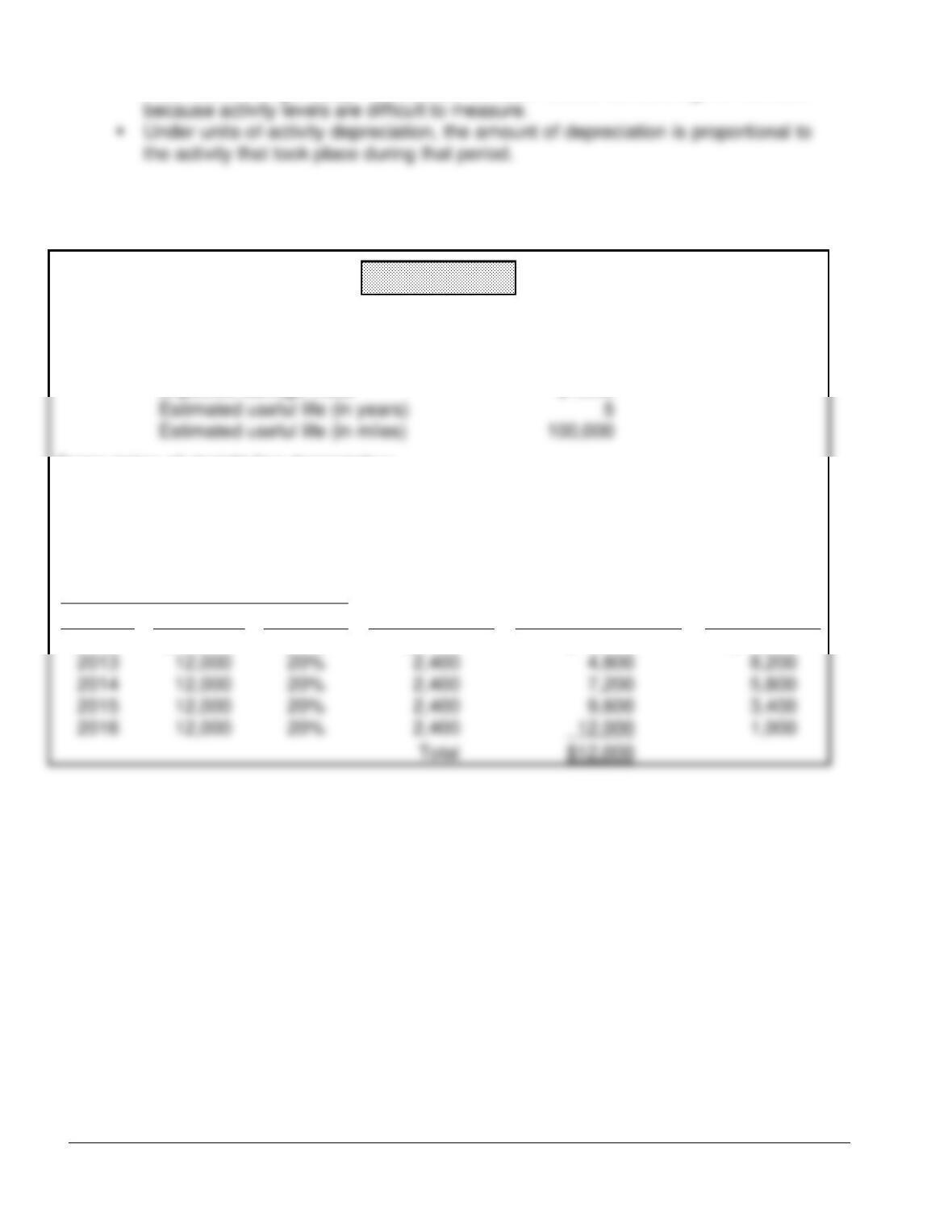
Cost $13,000
Expected salvage value $1,000
Computation of straight-line depreciation:
($13,000 – $1,000) 5 years = $2,400 per year
Rate: 100% 5 years = 20% per year
Depreciation Schedule Assuming Straight-Line Depreciation
Depreciable Value
Annual
Depreciation
End of Year
Accumulated
Book
Year
Cost
Rate
Expense
Depreciation
Value
2012
$12,000
20%
$2,400
$ 2,400
$10,600
9-7
TEACHING TIP
Go over the example in the book of the delivery truck purchased by Bill’s Pizzas on January 1,
2012, using the double-declining-balance method. The Appendix expands the example to
show that when using the declining-balance method, the salvage value is ignored in the
beginning. However, the asset cannot be depreciated below its salvage value.
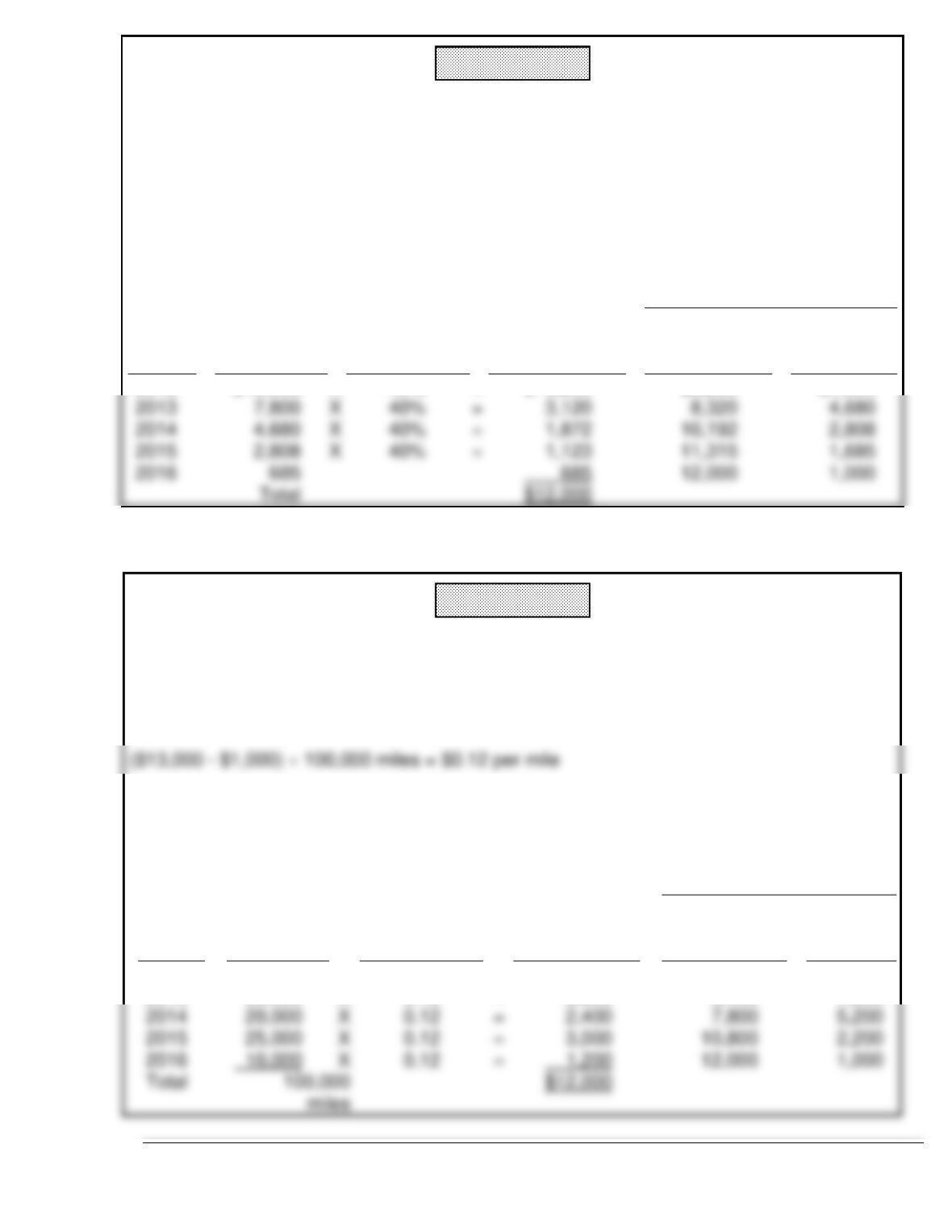
Depreciation Schedule Assuming Double-Declining-Balance Depreciation
Rate = 100% ÷ 5 years = 20%, 20% X 200% (DDB) = 40% per year
End of Year
Year
Book Value
Beginning
of Year
Depreciation
Rate
Annual
Depreciation
Expense
Accumulated
Depreciation
To Date
Book
Value
2012
$13,000
X
40%
=
$ 5,200
$5,200
$7,800
2013
X
40%
=
2014
X
40%
=
10,192
2015
X
40%
=
11,315
2016
685
12,000
TEACHING TIP
Computing depreciation under units–of-activity is the much the same as straight line. The
only difference is that the life is expressed in terms of activity rather than years. Activity may
be measured in units produced, miles driven, or hours flown, depending on the asset.
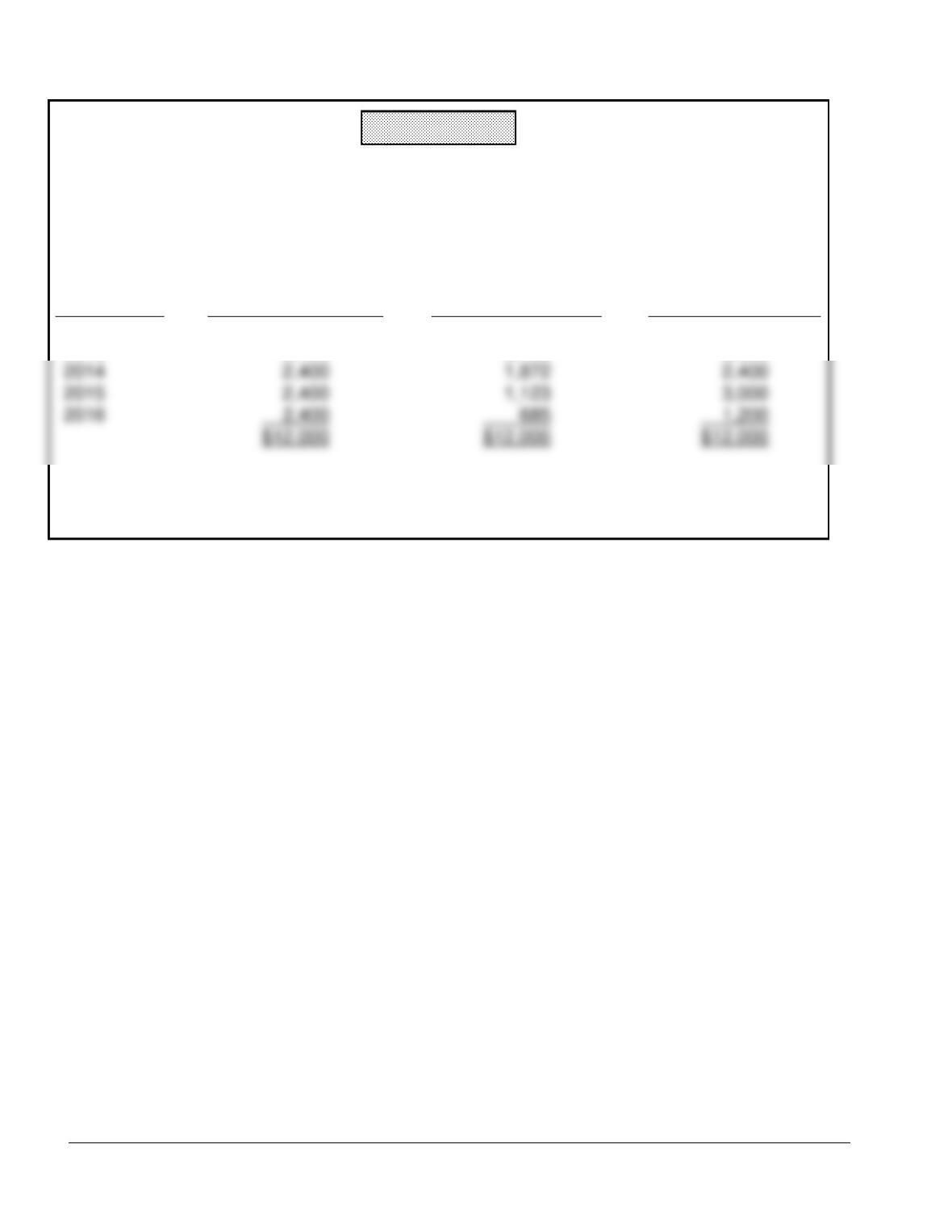
Returning to the example of Bill’s delivery truck the units-of-activity depreciation would be
computed as follows:
Depreciation Schedule Assuming Units-of-Activity Depreciation
End of Year
Year
Units of
Activity
(Miles)
Depreciation
Rate
Annual
Depreciation
Expense
Accumulated
Depreciation
Book
Value
2012
15,000
X
$0.12
=
$ 1,800
$ 1,800
$11,200
2013
30,000
X
0.12
=
3,600
5,400
7,600
2014
20,000
X
0.12
=
2,400
7,800
5,200
2015
25,000
X
0.12
=
3,000
2,200
X
0.12
=
1,000
9-8
TEACHING TIP
Students need to have a good understanding of the effect different methods of depreciation
have on the Income Statement and the Balance Sheet.
Comparison of Depreciation Expense with Three Methods of Depreciation
Year
Straight-Line
Double-Declining
Balance
Units-of-Activity
2012
$ 2,400
$ 5,200
$1,800
2013
2,400
3,120
3,600
2014
2,400
1,872
2,400
2015
2,400
1,123
3,000
2016
Note that total depreciation is the same for the five-year period. The depreciable cost has
been expensed over the useful life or the estimated activity.
9-9
Depreciation and Income Taxes—The internal Revenue Service (IRS) allows
corporate taxpayers to deduct depreciation expense when computing taxable income.
▪ The IRS does not require the taxpayer to use the same depreciation method on the
tax return that is used in preparing financial statements.
Depreciation Disclosure in the Notes—The choice of depreciation method must be
disclosed in a company’s financial statements or in related notes that accompany the
statements.
TEACHING TIP
Ask students which depreciation method they would use if they were trying to minimize
income taxes. Which method would they choose if they wanted to maximize net income?
Suppose they wanted to do both?
Learning Objective 4 – Describe the Procedure for Revising Periodic
Depreciation
Revising Periodic Depreciation—Management should periodically review annual
depreciation expense. If wear and tear or obsolescence indicates that annual
depreciation is either inadequate or excessive, the company should change the
depreciation expense amount.
▪ When a change in an estimate is required, the change is made in current and
future years but not to prior periods. Thus, when a change is made (1) there is
no correction of previously recorded depreciation expense, and (2) depreciation
Expenditures During Useful Life—During the useful life of a plant asset, a
company may incur costs for ordinary repairs, additions, and improvements.
▪ Ordinary repairs are expenditures to maintain the operating efficiency and
expected productive life of the asset.
o Ordinary repairs are usually fairly small amounts that occur frequently
throughout the service life.
9-10
o They are usually material in amount.
o Occur infrequently during the period of ownership.
• Additions and improvements are debited to the plant asset affected and
generally increase the company’s investment in productive facilities.
• Additions and improvements are capital expenditures.
TEACHING TIP
Provide students with examples of additions and improvements. The installation of air
conditioning in a delivery van that did not have air conditioning previously is a good example
Impairment—is a permanent decline in the fair value of an asset.
▪ In order that the asset is not overstated on the books, it is written down to its new
fair value during the year in which the decline in value occurs.
▪ In the past some companies delayed recording losses on impairments until a year
Learning Objective 5 – Explain How to Account for the Disposal of Plant Assets
Plant Asset Disposals—Companies dispose of plant assets that are no longer
useful to them. There are three ways in which companies make plant asset
disposals:
1. Sale
2. Retirement
3. Exchange.
▪ Whether a plant asset is sold, retired or exchanged, the company must
determine the book value of the plant asset at the time of disposal to
determine the gain or loss.
▪ Recall that book value is the difference between the cost of the plant asset and
Sale of Plant Assets—In the sale of an asset, the book value of the asset is
compared with the proceeds received from the sale. If the proceeds exceed the book
value a gain on disposal occurs. Conversely, if proceeds from the sale are less than
the book value a loss on disposal occurs.
9-11
Gain On Sale—To illustrate a gain on sale of plant assets, assume that on July 1,
2010, Wright Company sells office furniture for $16,000 cash. The office furniture
originally cost $60,000 and as of January 1, 2012, had accumulated depreciation of
$41,000. Depreciation for the first six months of 2012 is $8,000. Then entries to
record depreciation expense and update accumulated depreciation to July 1 and to
record the sale and the gain on sale is are as follows:
July 1 Depreciation Expense ……………………………………… 8,000
Accumulated Depreciation—Equipment ……. 8,000
Loss on Sale—Assume that the office furniture was sold for $9,000. There will be a
loss of $2,000. To record the loss on the sale is as follows:
July 1 Cash …………………………………………………………….. 9,000
Accumulated Depreciation—Equipment …………….. 49,000
Loss on Disposal ……………………………………………. 2,000
9-12
Learning Objective 6 – Describe Methods for Evaluating the Use of Plant
Assets
Analyzing Plant Assets—The presentation of financial information about plant assets
enables decision makers to analyze the company’s use of its plant assets. Two
measures to analyze plant assets are:
▪ Return on assets ratio – an overall measure of profitability. This ratio is computed
▪ Asset turnover ratio – indicates how efficiently a company uses its assets to
generate sales—that is, how many dollars of sales are generated by each dollar
▪ Profit Margin Revisited – As was discussed in Chapter 5 the profit margin ratio is
calculated by dividing net income by net sales.
o It tells how effective a company is in turning its sales into income—that
Profit Margin x Asset Turnover = Return on Assets
Where:
o Profit Margin = Net Income Net Sales
This relationship has important strategic implications for management.
If a company wants to increase its return on assets, it can do so in two ways:
TEACHING TIP
With most businesses there is a trade-off between margin and turnover. If a business has a
high margin, turnover will be low, and vice-versa. Give examples of businesses in your area
one of which has a high margin and low turnover, and another with a high turnover and low
margin.
Learning Objective 7 – Identify the Basic Issues Related to Reporting
Intangible Assets
9-13
Intangible Assets—are rights, privileges, and competitive advantages that result from
ownership of long-lived assets that do not possess physical substance. Well known
intangibles are the patents of Microsoft, the franchises of McDonald’s, the trade name
iPod and Nike’s trademark “swoosh.”
▪ Intangibles may be evidenced by contracts, licenses, and other documents.
▪ Intangibles may arise from the following sources:
o Government grants.
Accounting For Intangible Assets—Intangible assets are recorded at cost.
Intangibles are categorized as having either a limited life or an indefinite life.
▪ The cost of intangible assets with indefinite lives should not be amortized.
▪ If an intangible has a limited life, its cost should be allocated over its useful life
using a process similar to depreciation.
▪ The process of allocating to expense the cost of intangibles is referred to as
amortization.
o To record amortization of an intangible asset, Amortization Expense is
increased (debited), and the specific intangible asset is decreased
Types of intangible assets:
▪ Patent – an exclusive right issued by the U.S. Patent Office that enables the
recipient to manufacture, sell, or otherwise control an invention for a period
of 20 years from the date of the grant.
o The initial cost of a patent is the cash or cash equivalent price paid
▪ Research and development costs are expenditures that may lead to
9-14
TEACHING TIP
Discuss the fact that some accountants argue that expensing R & D costs leads to
understated assets and net income. On the other side, some accountants argue that
capitalizing these costs would lead to highly speculative assets on the balance sheet.
▪ Copyrights are granted by the federal government and give the owner the
exclusive right to reproduce and sell an artistic or published work.
TEACHING TIP
Sometimes the acquisition of a copyright can be very expensive. Michael Jackson paid
millions of dollars for the copyrights to the Beatles music. However, the cost of a copyright
for a created work may be only the $10 fee paid to the U.S. Copyright Office.
▪ A trademark or trade name is a word, phrase, jingle, or symbol that distinguishes
or identifies a particular enterprise or product. Trade names like Wheaties,
Monopoly, Sunkist, Kleenex, Coca-Cola, Big Mac, and Jeep create immediate
product identification and generally enhance the sale of the product.
o The creator or original user may obtain exclusive legal right to the
trademark or trade name by registering it with the U.S. Patent Office. The
▪ Franchises and Licenses – A franchise is a contractual agreement under which
the franchiser grants the franchisee the right to sell certain products, to provide
specific services, or to use certain trademarks or trade names, usually within a
designated geographic area. Another type of franchise, granted by a government
9-15
TEACHING TIP
Ask students to identify well-known franchises. If starting a new business would you consider
a franchise arrangement? What are the advantages and disadvantages of franchises?
▪ Goodwill represents the value of all favorable attributes that relate to a company,
including exceptional management, desirable location, good customer relations, skilled
employees, etc. Goodwill is unique: Unlike other assets such as investments, plant
assets and even other intangibles, which can be sold individually in the marketplace,
goodwill can be identified only with the business as a whole.Goodwill is recorded only
TEACHING TIP
Think of businesses in your area that have goodwill. Do you patronize a dry cleaner or drugs
store that you particularly like and would not think of leaving? What is it about this business
that makes it special?
Learning Objective 8 – Indicate how Long-lived Assets are Reported in the
Financial Statements
Financial Statement Presentation of Long-Lived Assets—Plant assets are shown
in the financial statements under “Property, plant, and equipment” and intangibles are
shown separately under “Intangible assets.”
▪ Intangibles do not usually use a contra asset account like the contra asset account
Accumulated Depreciation used for plant assets. Instead, amortization of these
Keeping An Eye On Cash—It is also interesting to examine the statement of cash
flows to determine the amount of property, plant, and equipment purchased and the
9-16
TEACHING TIP
Students may not understand why a fully depreciated asset remains on the balance sheet.
Assume a company is using equipment that is fully depreciated. If the equipment were not
listed on the balance sheet, the financial statement user would not fully understand the
Learning Objective 9 – Appendix – Compute Periodic Depreciation Using the
Declining-Balance Method and the Units-of-Activity
Method
Calculation of Depreciation Using Other Methods—In this appendix the
calculations for the depreciation expense amounts that were used in the chapter are
discussed.
▪ Declining-Balance—The declining-balance method produces a decreasing
annual depreciation expense over the useful life of the asset.
o The method is so named because the computation of periodic depreciation is
based on a declining book value (cost less accumulated depreciation) of the
asset.
9-17
TEACHING TIP
Expand the example in the book of the delivery truck purchased by Bill’s Pizzas using the
double-declining-balance method.
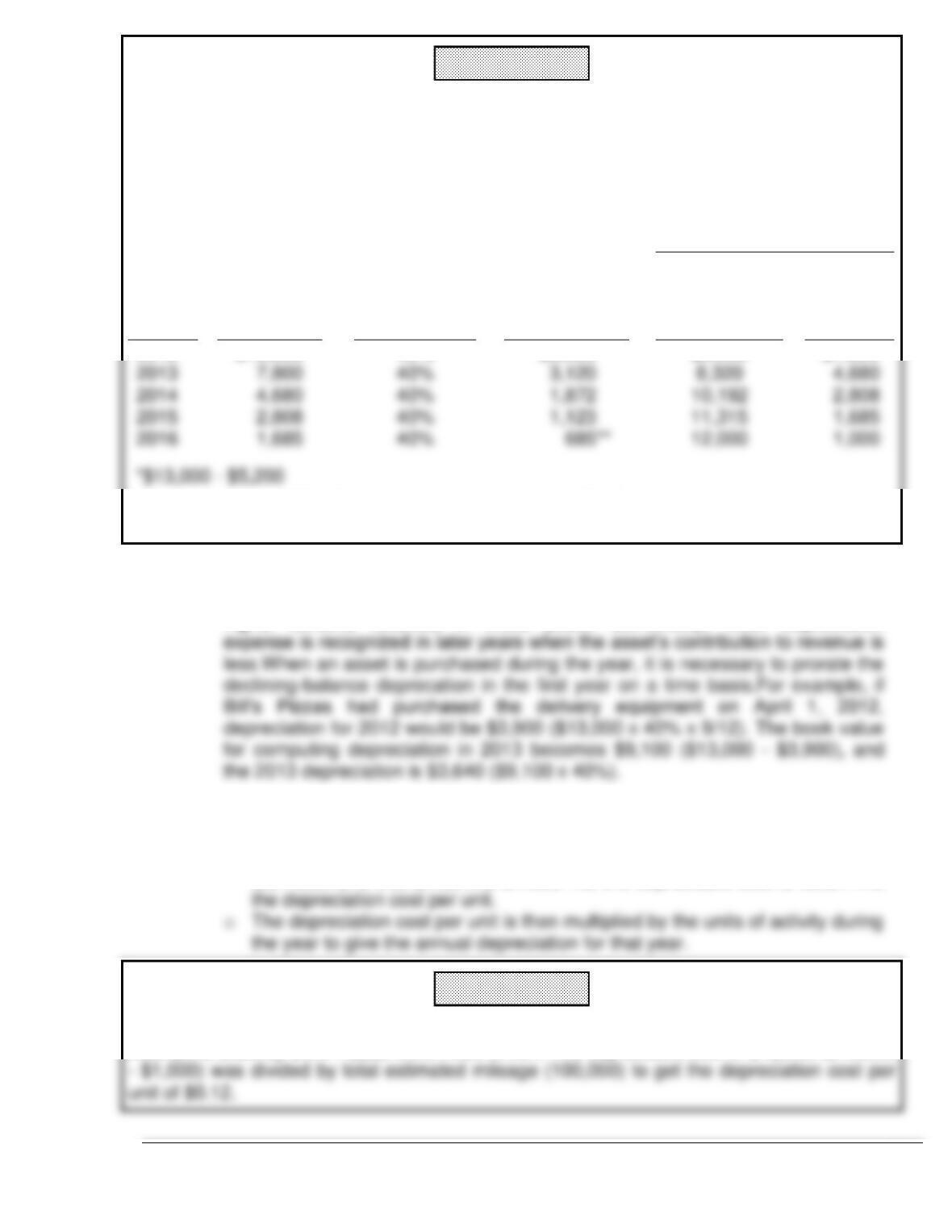
Depreciation Schedule Assuming Double-Declining-Balance Depreciation
Rate = 100% ÷ 5 years = 20% X 200% DDB = 40% period rate
End of Year
Year
Book
Value
Beginning
of Year
X
Depreciation
Rate
=
Annual
Depreciation
Expense
Accumulated
Depreciation
Book
Value
2012
$13,000
40%
$5,200
$5,200
$7,800*
2013
40%
2014
40%
10,192
2015
40%
11,315
2016
40%
12,000
**Computation of $674 ($1,685 x 40%) is adjusted to $685 in order for book value to equal
salvage value.
o The declining-balance method is compatible with the expense recognition
principle. The higher depreciation expense in earlier years is matched with the
higher benefits received in these years. Conversely, lower depreciation
▪ Units-Of-Activity—Under the units-of-activity method, useful life is expressed in
terms of the total units of production or use expected from the asset.
o To use this method, the total units of activity for the entire useful life are
estimated and that amount is divided into the depreciable cost to determine
TEACHING TIP
Remind students of the example earlier in the chapter. The units of activity for the delivery
truck purchased by Bill’s Pizzas were miles driven. The depreciable cost of $12,000 ($13,000