CHAPTER 9
Reporting and Analyzing Long-Lived Assets
Learning Objectives
1. Describe how the historical cost principle applies to plant assets.
2. Explain the concept of depreciation.
3. Compute periodic depreciation using the straight-line method, and contrast its
expense pattern with those of other methods.
4. Describe the procedure for revising periodic depreciation.
5. Explain how to account for the disposal of plant assets.
6. Describe methods for evaluating the use of plant assets.
7. Identify the basic issues related to reporting intangible assets.
8. Indicate how long-lived assets are reported in the financial statements.
*9. Compute periodic depreciation using the declining-balance method and the units-
of-activity method.
Summary of Questions by Learning Objectives and Bloom’s Taxonomy
Item LO BT Item LO BT Item LO BT Item LO BT Item LO BT
Questions
1. 1 C 7. 3 C 13. 8 K 18. 7 C 23. 6 C
Brief Exercises
1. 1 AP 4. 3 AN 7. 5 AP 10. 7 AP 13. 9* AP
Do It! Review Exercises
Exercises
1. 1 C 5. 3 AP 9. 1, 2,
13. 7 AN 17. 8 AN
Problems: Set A
1. 1 C 3. 5 AP 5. 7 AP 7. 3, 9* AP 8. 3, 9* AP
Problems: Set B
1. 1 C 3. 5 AP 5. 7 AP 7. 3, 9* AP 8. 3, 9* AP
*Continuing Cookie Solutions for this chapter are available online.
ASSIGNMENT CLASSIFICATION TABLE
Problem
Number
Description
Difficulty
Level
Time
Allotted (min.)
1A Determine acquisition costs of land and building. Simple 20–30
2A Journalize equipment transactions related to purchase,
sale, retirement, and depreciation.
Moderate 40–50
1B Determine acquisition costs of land and building. Simple 20–30
2B Journalize equipment transactions related to purchase,
sale, retirement, and depreciation.
Moderate 40–50
3B Journalize entries for disposal of plant assets. Simple 20–30
4B Prepare entries to record transactions related to
acquisition and amortization of intangibles; prepare the
intangible assets section and note.
Moderate 30–40
ANSWERS TO QUESTIONS
1. For plant assets, the historical cost principle states that plant assets are recorded at cost, which
consists of all expenditures necessary to acquire the asset and make it ready for its intended
use.
2. In a cash transaction, cost is equal to the cash paid.
In a noncash transaction, cost is equal to the cash equivalent price paid, which is the fair value of
the asset given up or the fair value of the asset received, whichever is more clearly determinable.
5. You should explain to the president that depreciation is a process of allocating the cost of a plant
asset to expense over its service (useful) life in a rational and systematic manner. Recognition of
depreciation is not intended to result in the accumulation of cash for replacement of the asset.
6. (a) Salvage value is the expected cash value of the asset at the end of its useful life.
(b) Salvage value is used in determining depreciable cost in the straight-line method by subtracting
it from the plant asset’s cost.
Questions Chapter 9 (Continued)
11. In a sale of plant assets, the book value of the asset is compared to the proceeds received from
the sale. If the proceeds of the sale exceed the book value of the plant asset, a gain on disposal
occurs. If the proceeds of the sale are less than the book value of the plant asset sold, a loss on
disposal occurs.
12. The plant asset and related accumulated depreciation should continue to be reported on the
balance sheet without further depreciation or adjustment until the asset is retired. Reporting
the asset and related accumulated depreciation on the balance sheet informs the reader of the
16. The intern is not correct. If an intangible asset has a limited life, the cost of the asset should be
amortized over that asset’s useful life (the period of time when operations are benefited by use of
the asset) or its legal life, whichever is shorter. The cost of intangible assets with indefinite lives
should not be amortized.
17. The favorable attributes which could result in goodwill include exceptional management, desirable
location, good customer relations, skilled employees, high quality products, fair pricing policies, and
harmonious relations with labor unions.
Questions Chapter 9 (Continued)
20. Research and development costs present several accounting problems. It is sometimes difficult
to assign the costs to specific projects, and there are uncertainties in identifying the extent and
timing of future benefits. As a result, research and development costs are usually recorded as an
expense when incurred.
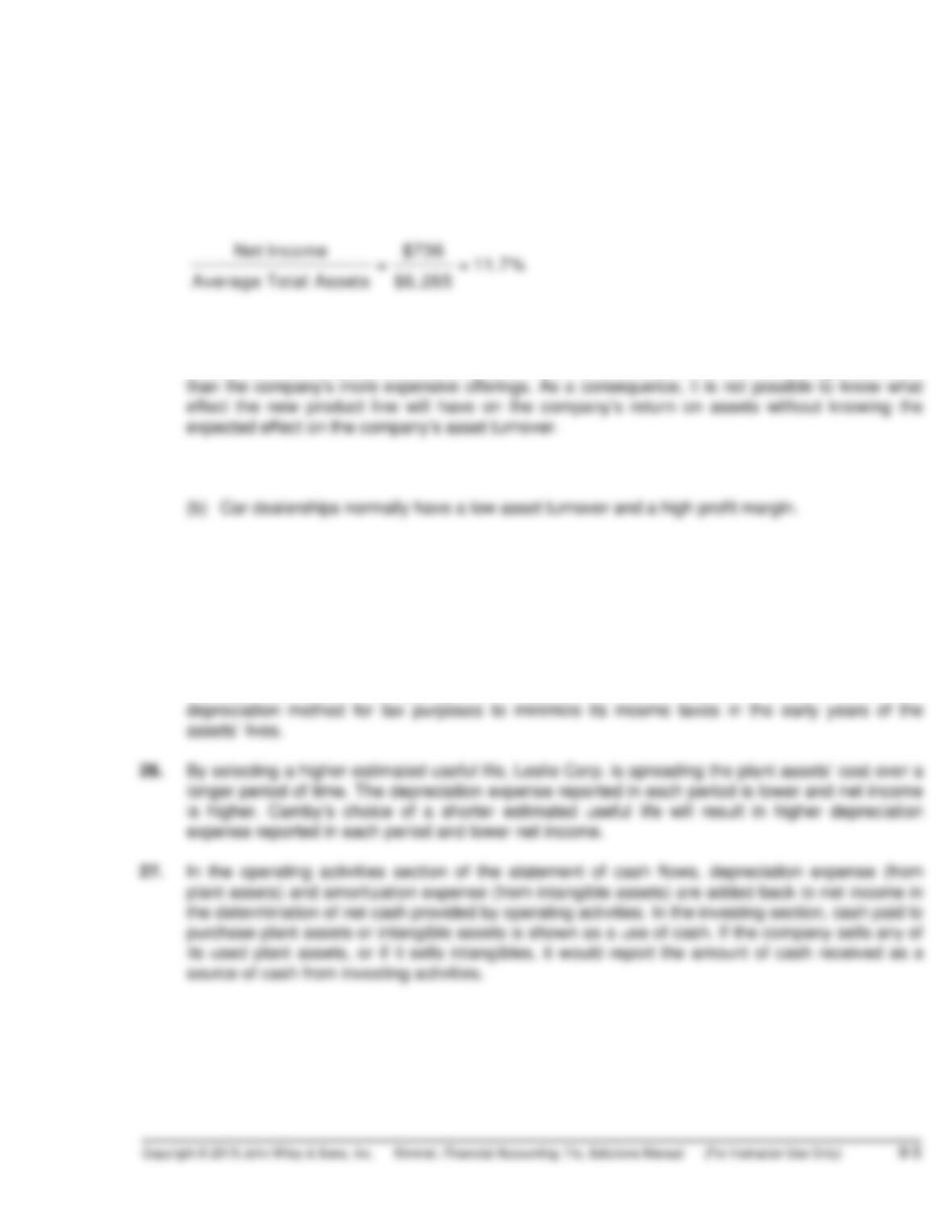
21. Campbell Soup Company’s return on assets is computed as follows:
22. The return on assets is closely monitored by management. It is the product of the profit margin
and the asset turnover. At first glance, if this new product line has a lower profit margin, then it
will reduce the company’s asset turnover. However, it is likely that it will have a higher turnover
23. (a) Grocery stores usually have a high asset turnover and a low profit margin.
24. Since Gooden uses the straight-line depreciation method, its depreciation expense will be lower
in the early years of an asset’s useful life as compared to using an accelerated method. Perron’s
depreciation expense in the early years of an asset’s useful life will be higher as compared to the
straight-line method. Gooden’s net income will be higher than Perron’s in the first few years of
the asset’s useful life.
25. Yes, the tax regulations of the IRS allow a company to use a different depreciation method on the
tax return than is used in preparing financial statements. Garcia Corporation uses an accelerated
SOLUTIONS TO BRIEF EXERCISES
BRIEF EXERCISE 9-1
BRIEF EXERCISE 9-2
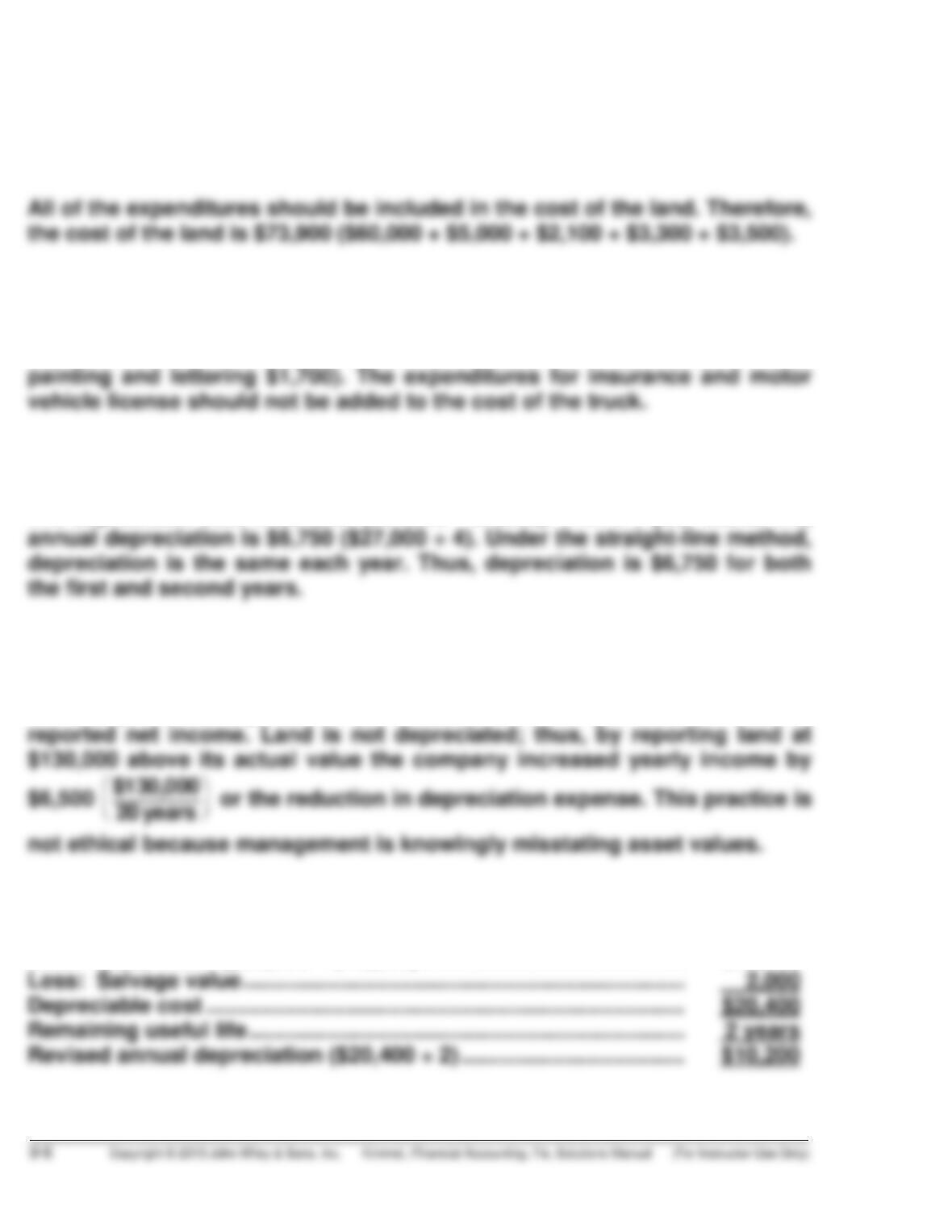
The cost of the truck is $26,780 (cash price $24,000 + sales taxes $1,080 +
BRIEF EXERCISE 9-3
The depreciable cost is $27,000 ($31,000 – $4,000). With a 4-year useful life,
BRIEF EXERCISE 9-4
It is likely that management requested this accounting treatment to boost
BRIEF EXERCISE 9-5
Book value, 1/1/14 ($36,000 – $13,600) ……………………………………. $22,400
BRIEF EXERCISE 9-6
(a) Maintenance and Repairs Expense ……………………. 38
Cash …………………………………………………………… 38
BRIEF EXERCISE 9-7
(a) Accumulated Depreciation—Equipment ……………. 41,000
Equipment …………………………………………………… 41,000
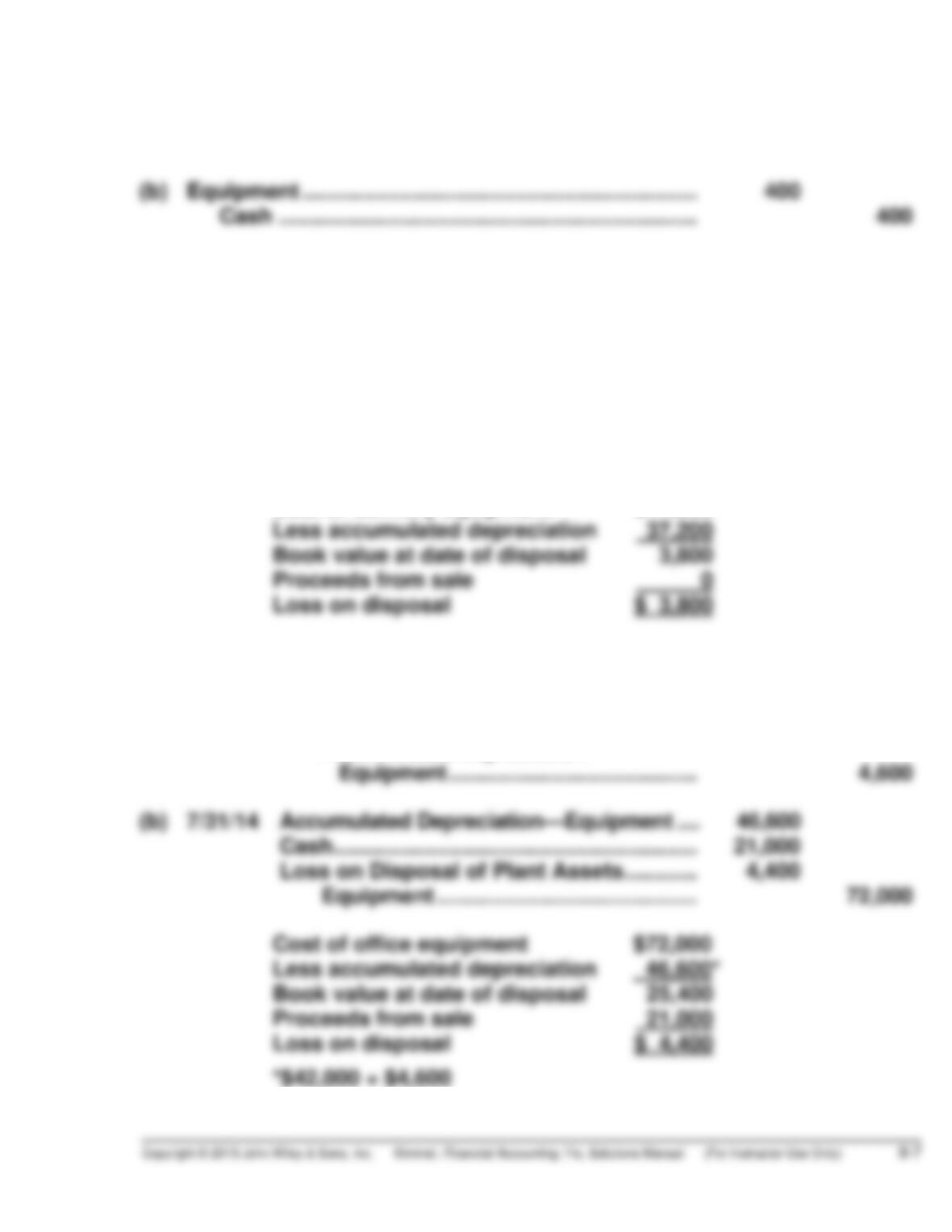
(b) Accumulated Depreciation—Equipment ……………. 37,200
Loss on Disposal of Plant Assets ……………………… 3,800
Equipment…………………………………………………… 41,000
Cost of delivery equipment $41,000
BRIEF EXERCISE 9-8
(a) 7/31/14 Depreciation Expense …………………………. 4,600
Accumulated Depreciation—
BRIEF EXERCISE 9-9
BRIEF EXERCISE 9-10
(a) Amortization Expense ($156,000 ÷ 6) ………………… 26,000
Patent ……………………………………………………….. 26,000
BRIEF EXERCISE 9-11
NIKE, INC.
Partial Balance Sheet
As of May 31, 2014
(in millions)
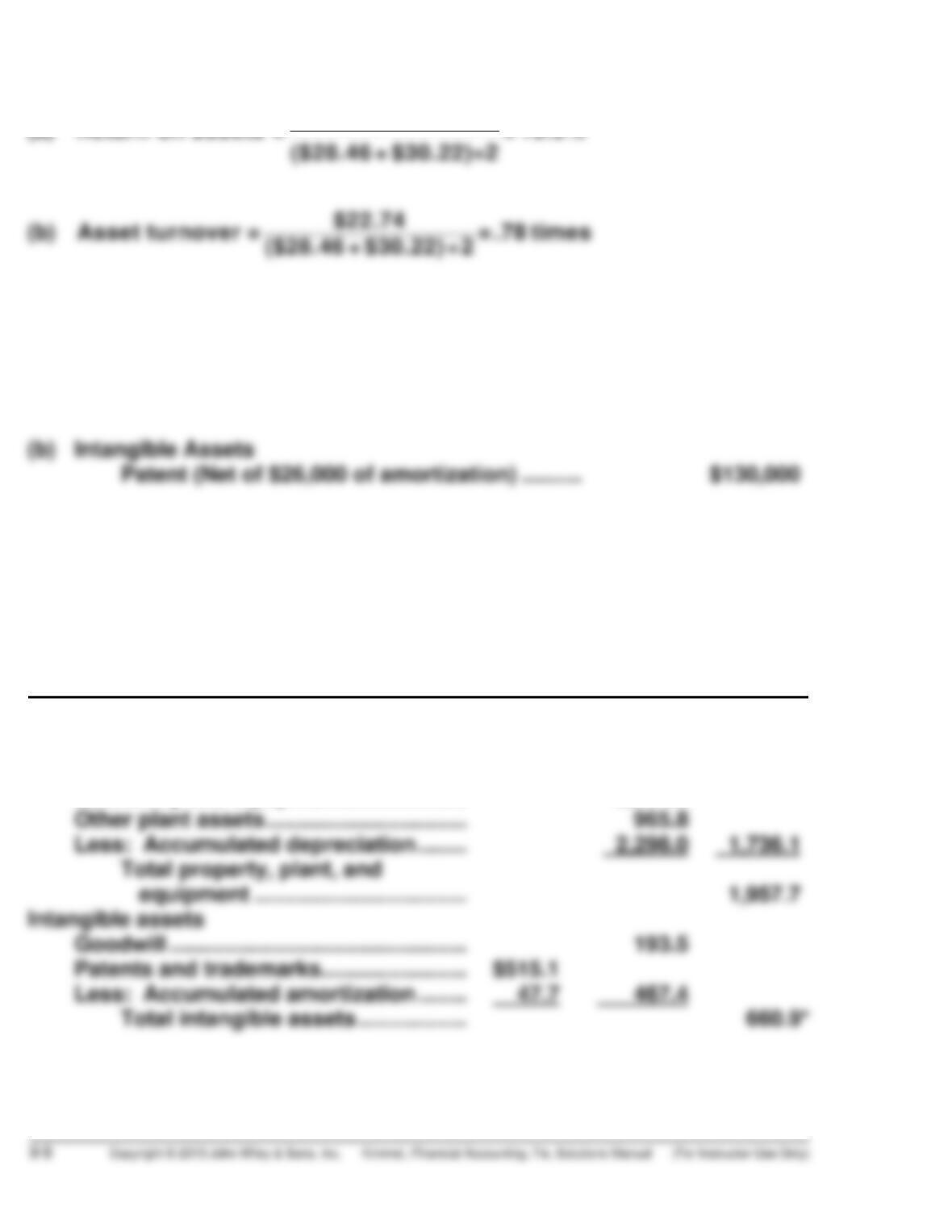
Property, plant, and equipment
Land ……………………………………………….. $ 221.6
Buildings ………………………………………… $ 974.0
Machinery and equipment ……………….. 2,094.3
*Alternatively, many companies would simply show a single line for net
intangibles.
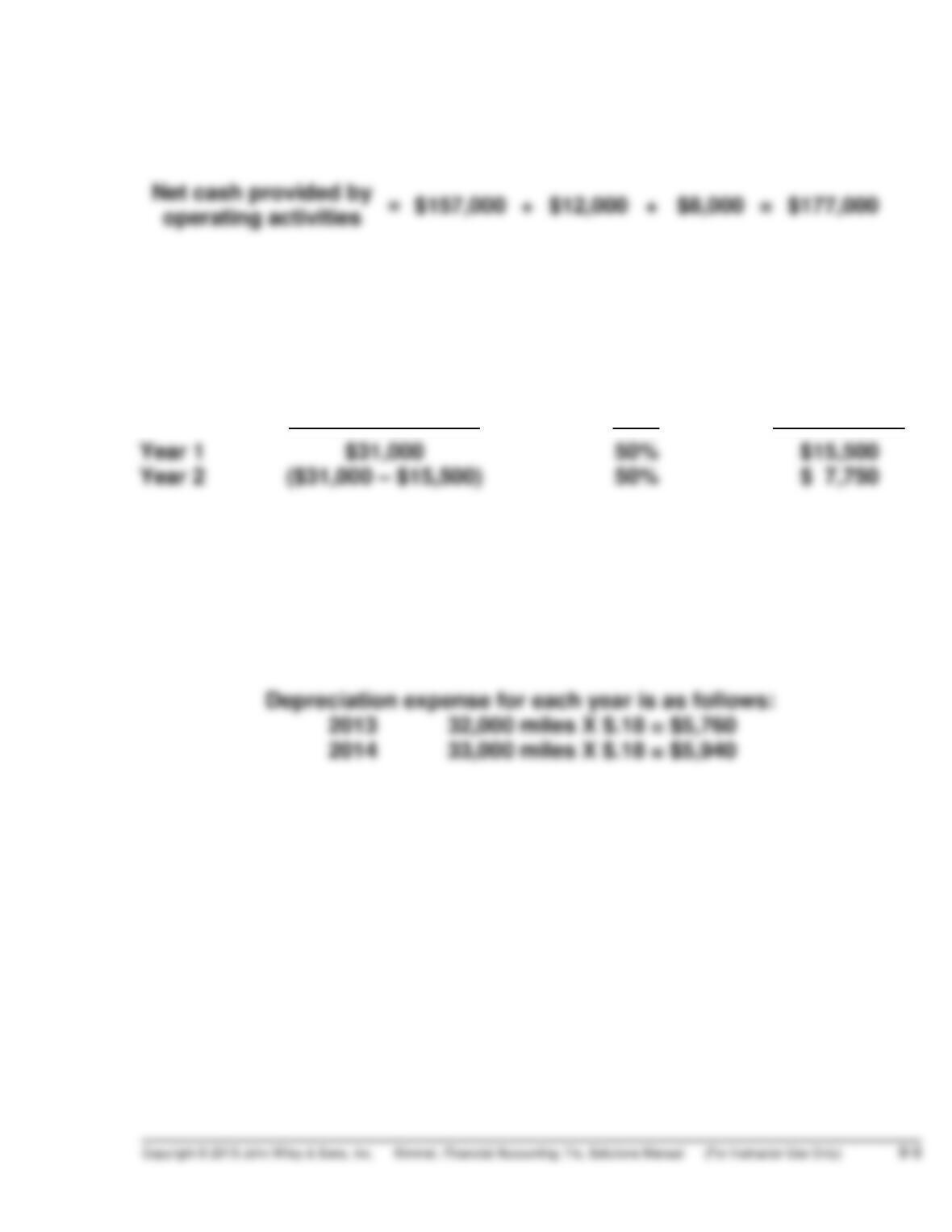
BRIEF EXERCISE 9-12
In the determination of net cash provided by operating activities, add
depreciation expense and amortization expense to net income:
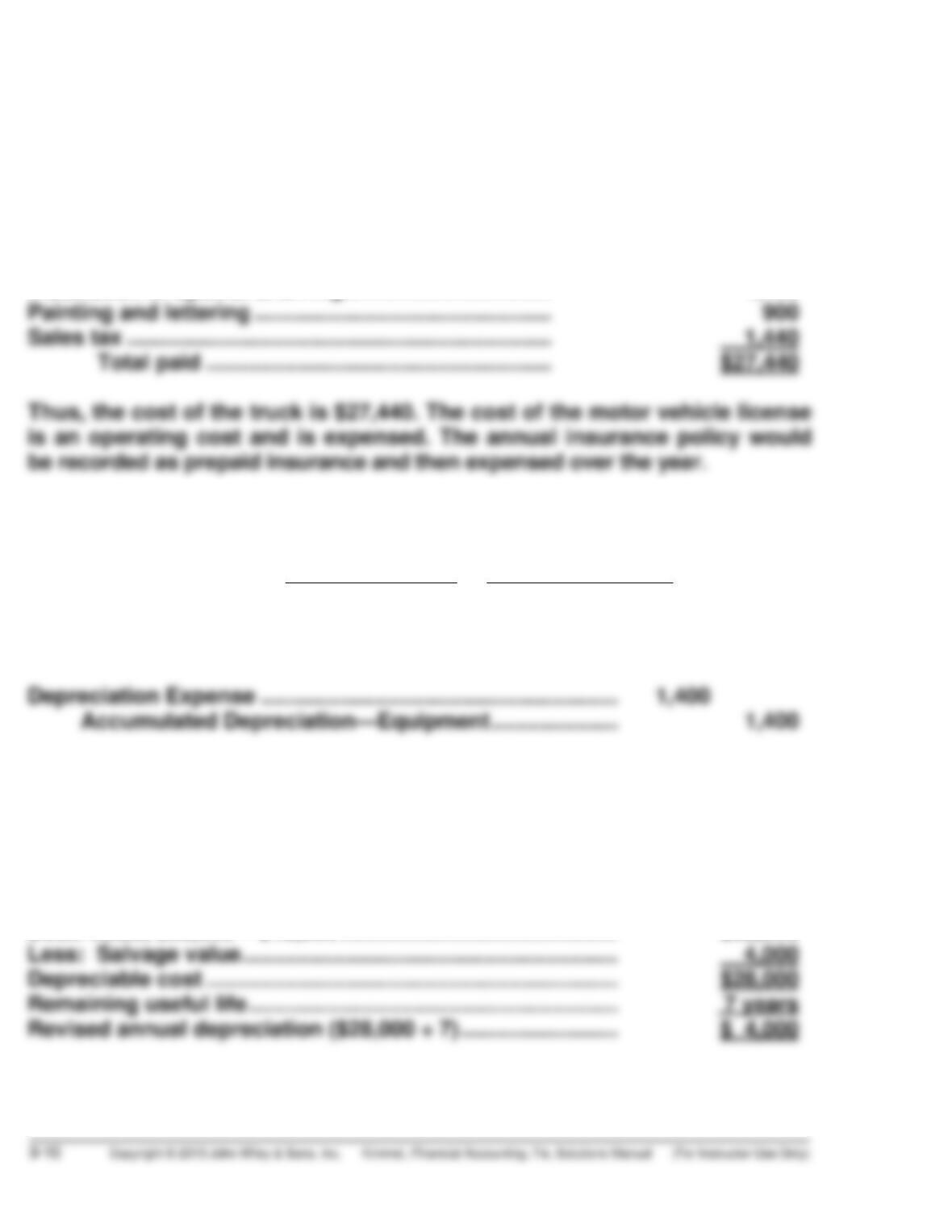
*BRIEF EXERCISE 9-13
The declining-balance rate is 50% (1/4 X 2) and this rate is applied to the
book value at the beginning of the year. The computations are:
Book Value X Rate = Depreciation
*BRIEF EXERCISE 9-14
The depreciation cost per unit is 18 cents per mile computed as follows:
Depreciable cost ($27,500 – $500) ÷ 150,000 = $.18
SOLUTIONS TO DO IT! REVIEW EXERCISES
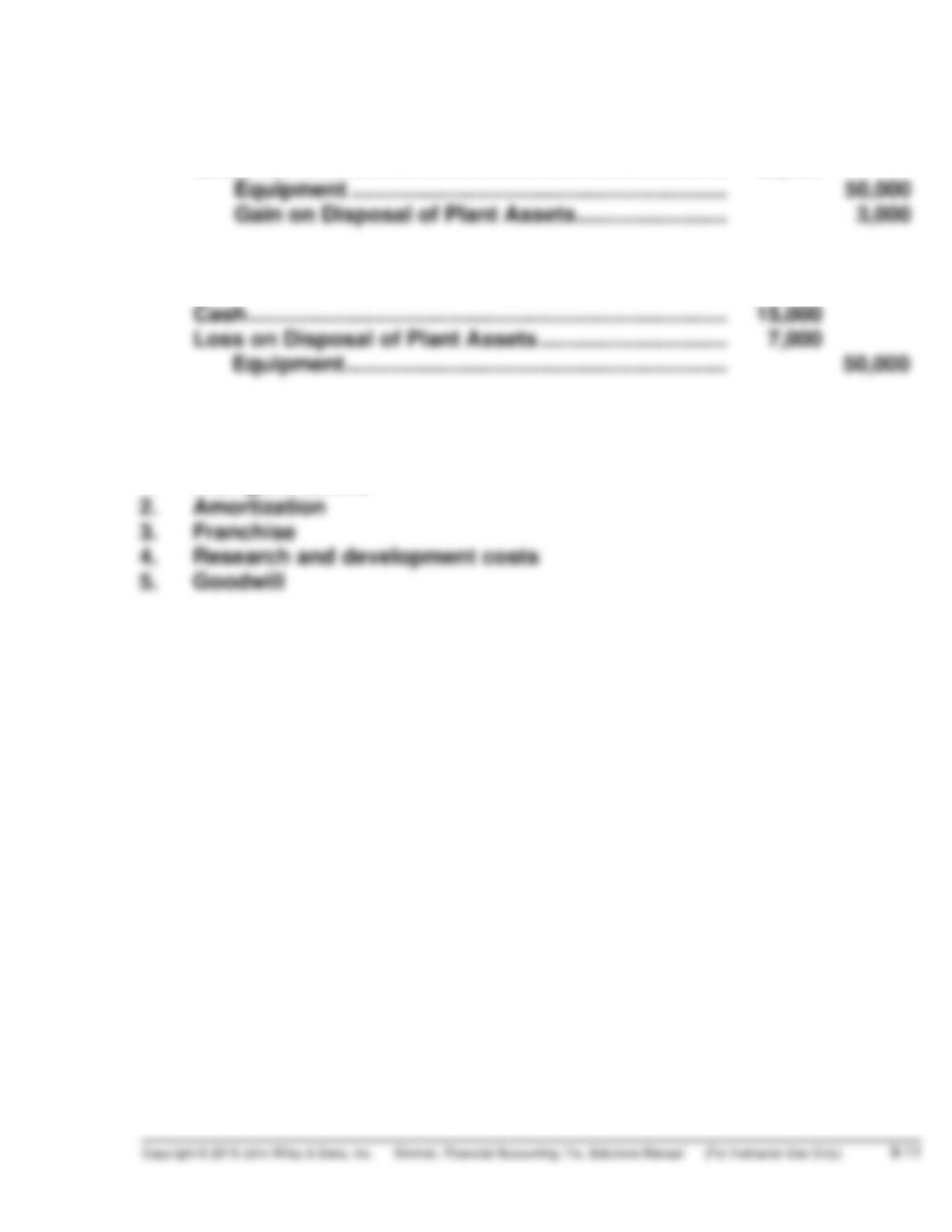
DO IT! 9-1
The following four items are expenditures necessary to acquire the truck
and get it ready for use:
Negotiated purchase price ………………………………….. $24,000
Installation of special shelving ……………………………. 1,100
DO IT! 9-2
Depreciation expense = Cost
–
Salvage =$15,000
–
$1,000 = $1,400
Useful life 10 years
The entry to record the first year’s depreciation would be:
DO IT! 9-3
Original depreciation expense = ($50,000 – $2,000) ÷ 8 years = $6,000
Accumulated depreciation after three years = 3 X $6,000 = $18,000
Book value, $50,000 – $18,000 ………………………………………. $32,000
DO IT! 9-4
(a) Sale of machine for cash at a gain:
Accumulated Depreciation—Equipment ……………….. 28,000
Cash ……………………………………………………………………. 25,000
(b) Sale of machine for cash at a loss:
Accumulated Depreciation—Equipment ……………….. 28,000
DO IT! 9-5
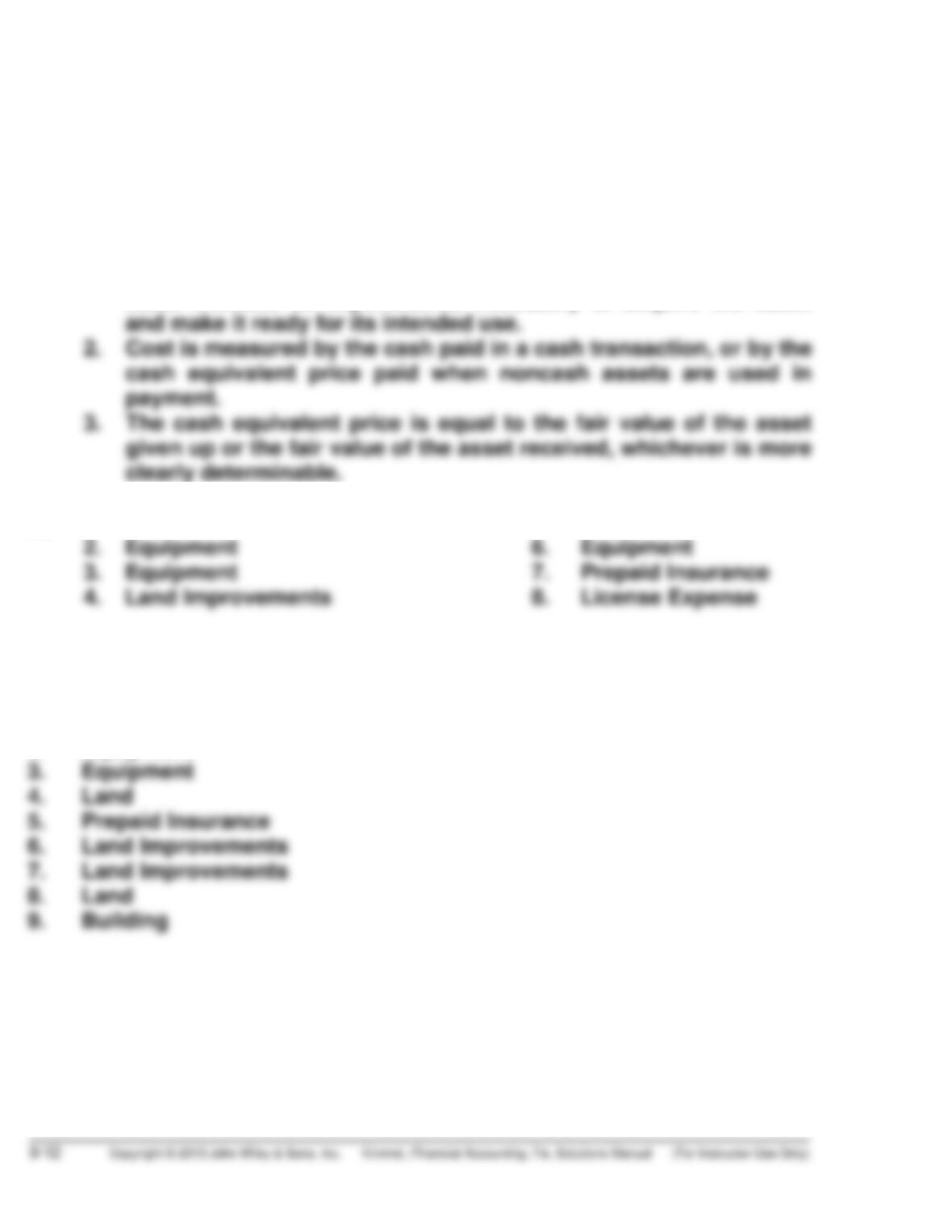
1. Intangible assets
SOLUTIONS TO EXERCISES
EXERCISE 9-1
(a) The following points explain the application of the historical cost
principle to plant assets.
1. Under the historical cost principle, the acquisition cost for a plant
asset includes all expenditures necessary to acquire the asset
(b) 1. Land 5. Equipment
EXERCISE 9-2
1. Equipment
2. Equipment
EXERCISE 9-3
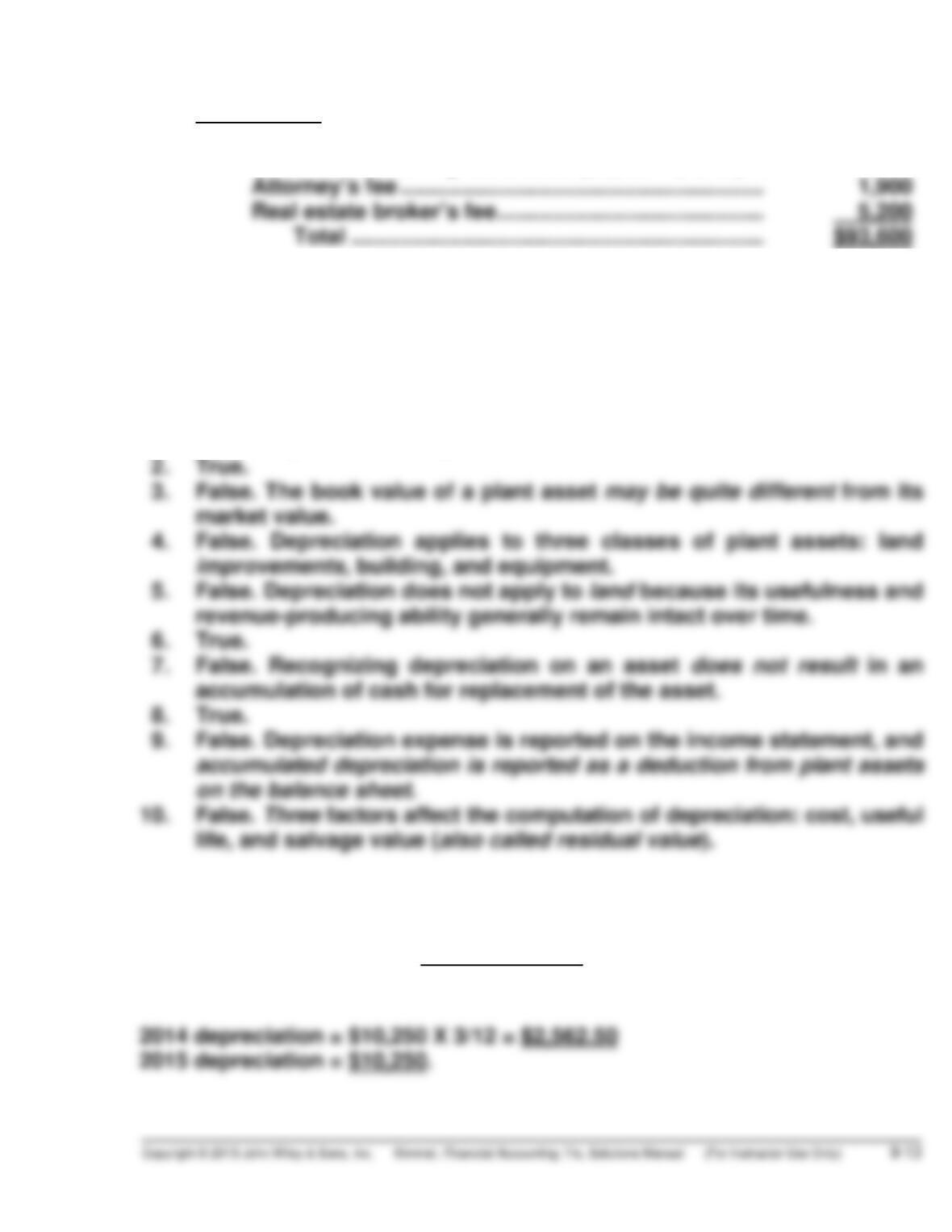
(a) Cost of land
Cash paid …………………………………………………………. $80,000
Net cost of removing warehouse ($8,200 – $1,700) … 6,500
(b) The architect’s fee ($9,100) should be debited to the building account.
The cost of the driveways and parking lot ($14,000) should be debited to
Land Improvements.
EXERCISE 9-4
1. False. Depreciation is a process of cost allocation, not asset valuation.
EXERCISE 9-5
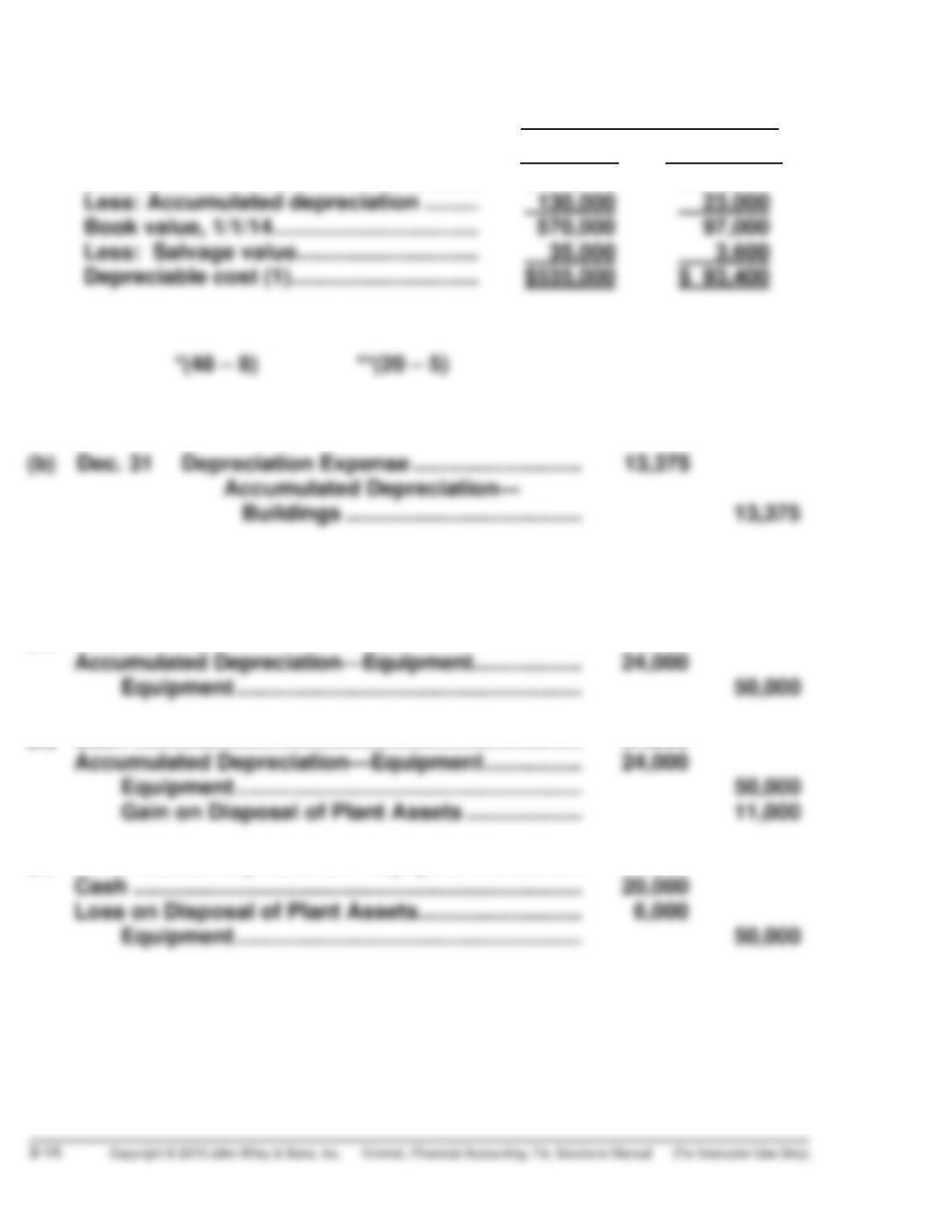
Straight-line method:
$90,000 – $8,000
8
⎛
⎝
⎜
⎞
⎠
⎟=$10,250 per year.
EXERCISE 9-6
(a) Type of Asset
Building Warehouse
Cost ………………………………………………… $700,000 $120,000
Revised remaining useful life in years (2) 40* 15**
Revised annual depreciation (1) ÷ (2) $13,375 $6,227
EXERCISE 9-7
(a) Loss on Disposal of Plant Assets ……………………… 26,000
(b) Cash ……………………………………………………………….. 37,000
(c) Accumulated Depreciation—Equipment ……………. 24,000
EXERCISE 9-8
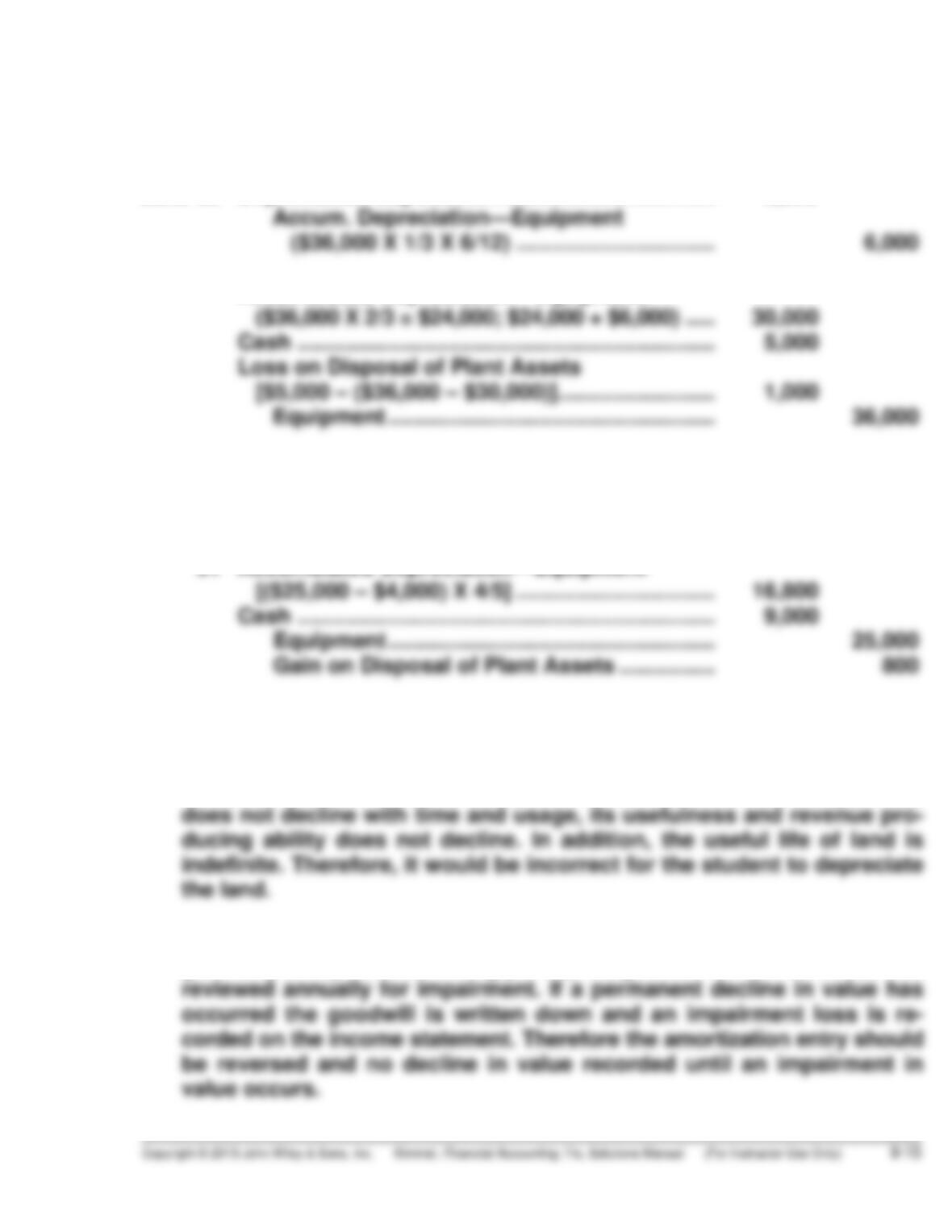
Jan. 1 Accumulated Depreciation—Equipment ……….. 62,000
Equipment ……………………………………………… 62,000
June 30 Depreciation Expense ………………………………….. 6,000
Accumulated Depreciation—Equipment
Dec. 31 Depreciation Expense ………………………………….. 4,200
Accumulated Depreciation—Equipment
[($25,000 – $4,000) X 1/5] ……………………… 4,200
31 Accumulated Depreciation—Equipment
EXERCISE 9-9
1. Depreciation is the process of allocating the cost of a long-lived asset
to expense over the asset’s useful life. Because the value of land generally
2. Goodwill is an intangible asset with an indefinite life. According to
generally accepted accounting principles, goodwill is not amortized but
EXERCISE 9-9 (Continued)
3. This is a violation of the historical cost principle. Because current
market values are subjective and not reliable, they are not used to
increase the recorded value of an asset after acquisition. The
appropriate accounting treatment is to leave the building on the books
at its zero book value.
EXERCISE 9-10
EXERCISE 9-11
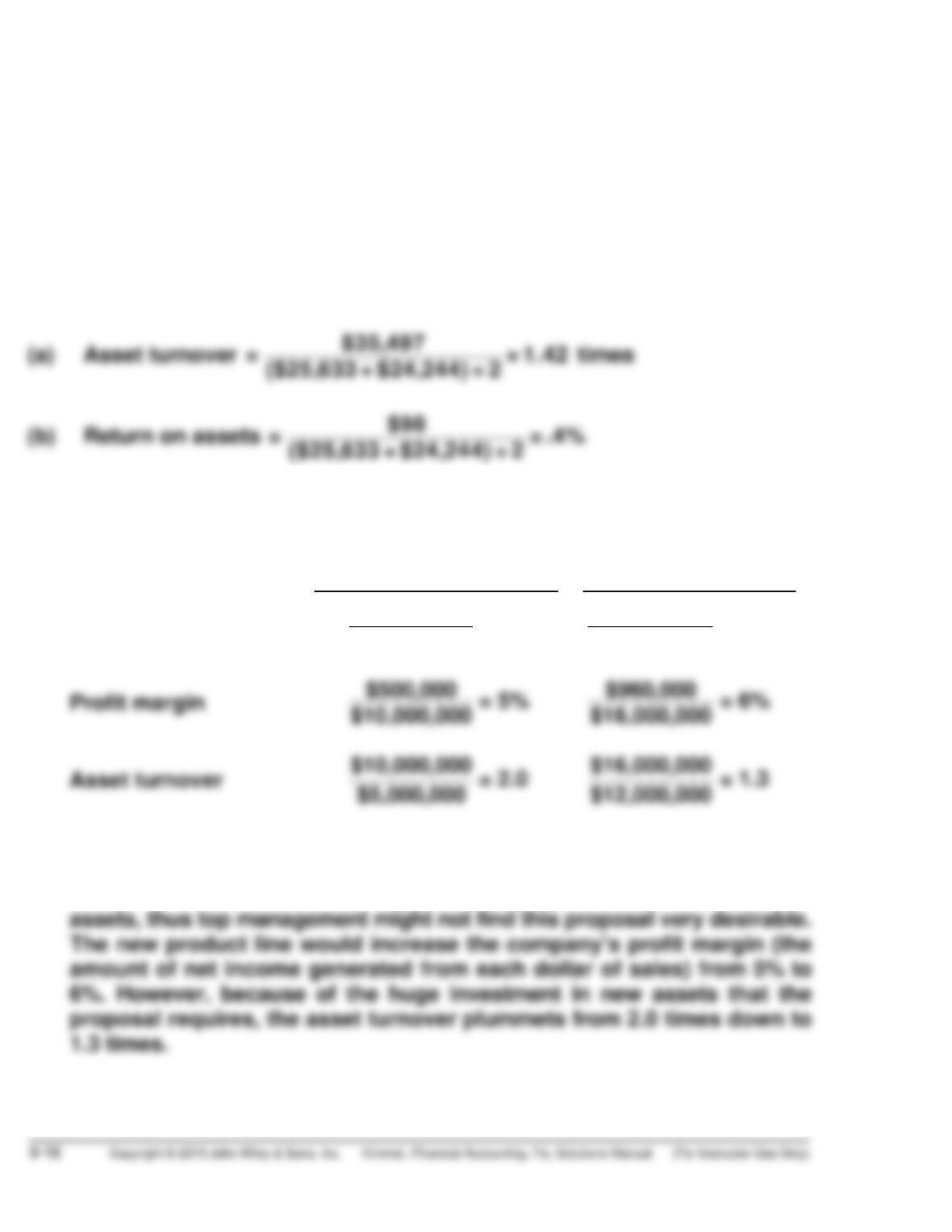
(a) Without new products With new products
Return on assets $500,000 = 10% $960,000 = 8%
$5,000,000 $12,000,000
(b) The return on assets declined from 10% to 8%. This means that the
company is not generating as much income from each dollar invested
in assets. It is common for companies to try to maximize their return on
EXERCISE 9-12
(a) ($ in millions)
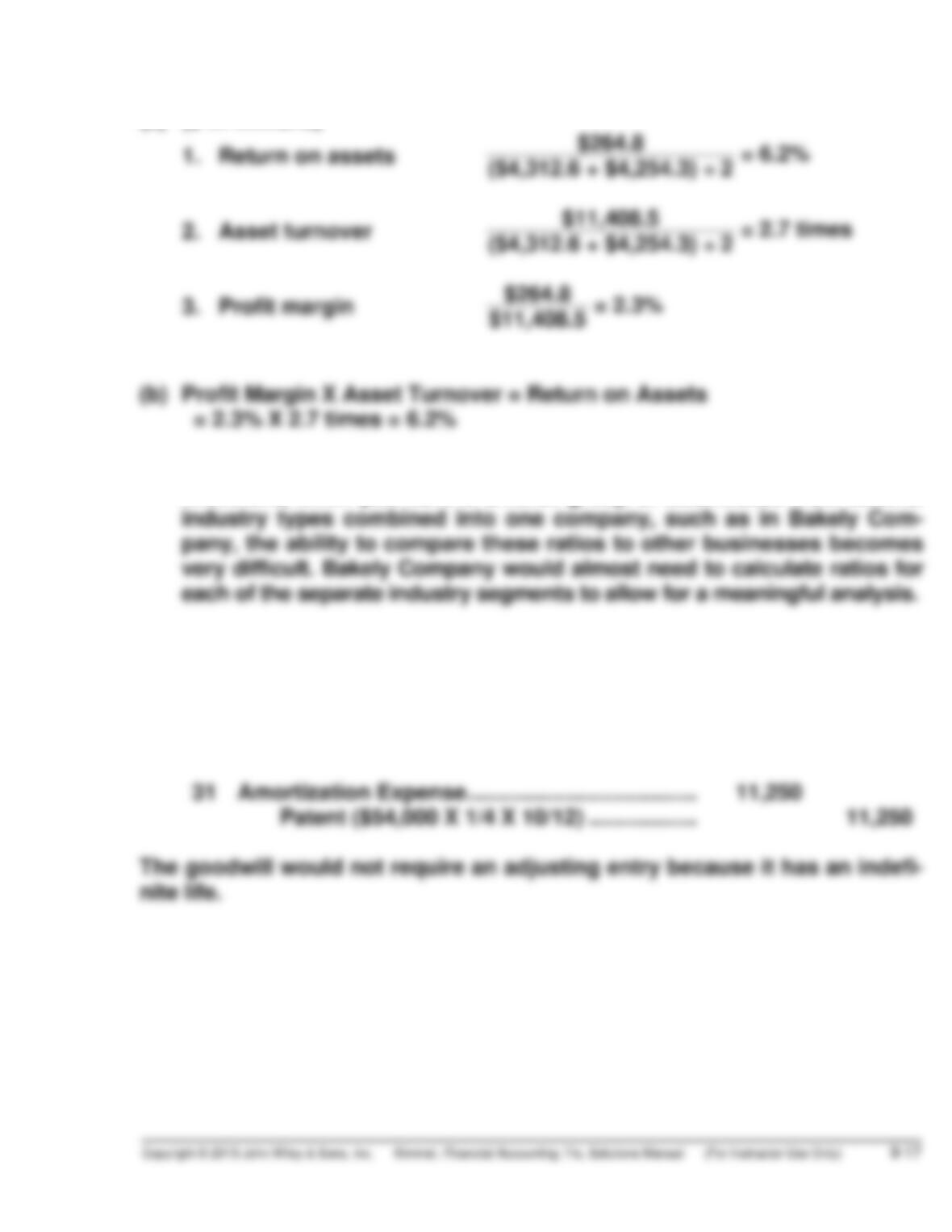
(c) Asset turnover and profit margin vary considerably across industries.
Therefore, when you have a diverse group of businesses from several
EXERCISE 9-13
Dec. 31 Amortization Expense ……………………………….. 20,000
Copyright ($120,000 X 1/6) …………………… 20,000
EXERCISE 9-14
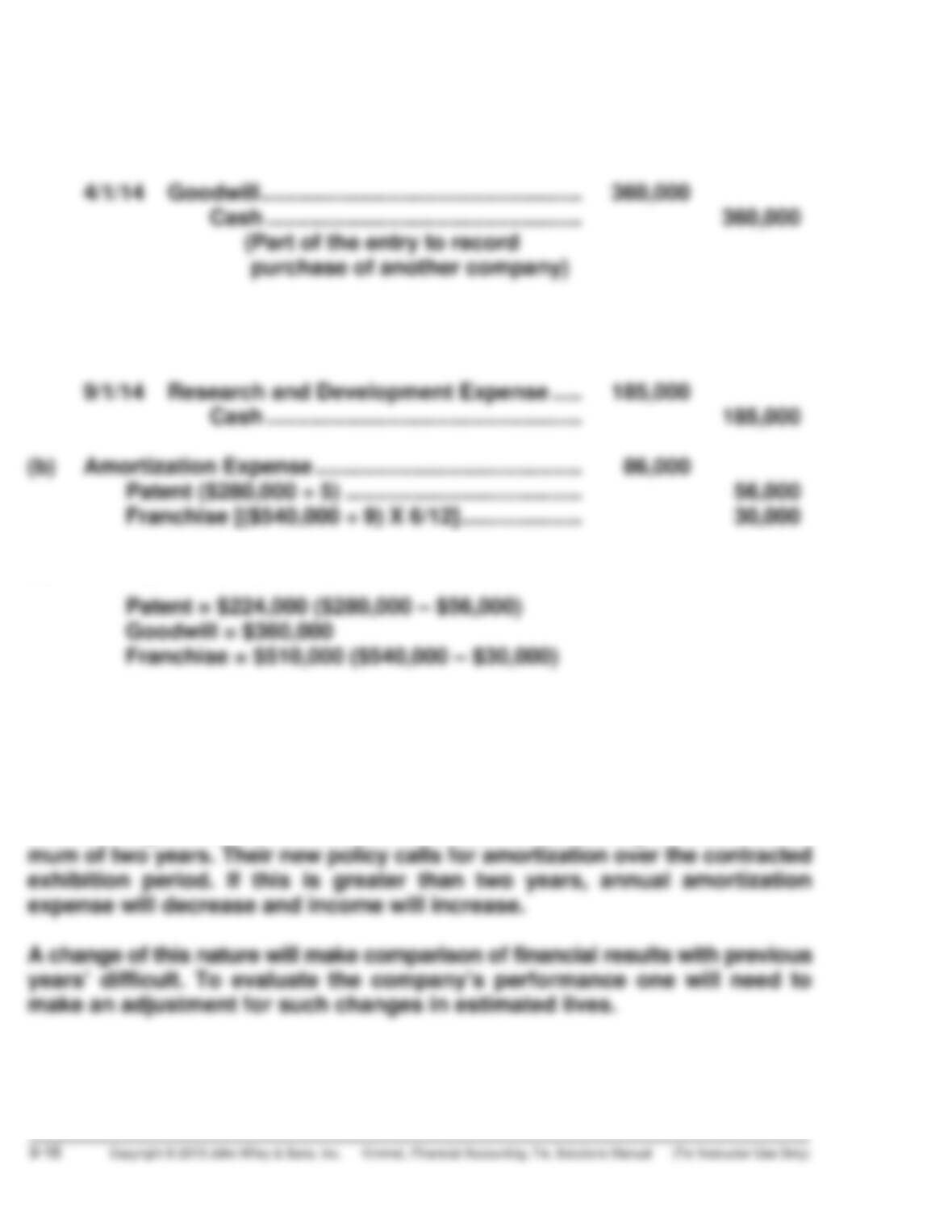
(a) 1/2/14 Patent ………………………………………………… 280,000
Cash ……………………………………………. 280,000
7/1/14 Franchise …………………………………………… 540,000
Cash ……………………………………………. 540,000
(c) Ending balances, 12/31/14:
EXERCISE 9-15
Alliance Atlantis Communications Inc.’s change of accounting policy to
amortize broadcast rights will probably increase its reported income. Prior
to the change, Alliance Atlantis had amortized broadcast rights over a maxi-
EXERCISE 9-16
(a) A company should depreciate its buildings because depreciation is
necessary in order to allocate the cost of the buildings to the periods
(b) A building can have a zero book value if it has no salvage value and it
is fully depreciated—that is, if it has been used for a period at least as
(c) Examples of intangibles that might be found on a college campus are
(d) Typical company or product trade names are:
Clothes—Gap, Gitano, Dockers, Calvin Klein, Chaus, Guess.
Trade names and trademarks are reported on a balance sheet if there is
a cost attached to them. If the trade name or trademark is purchased,
EXERCISE 9-17
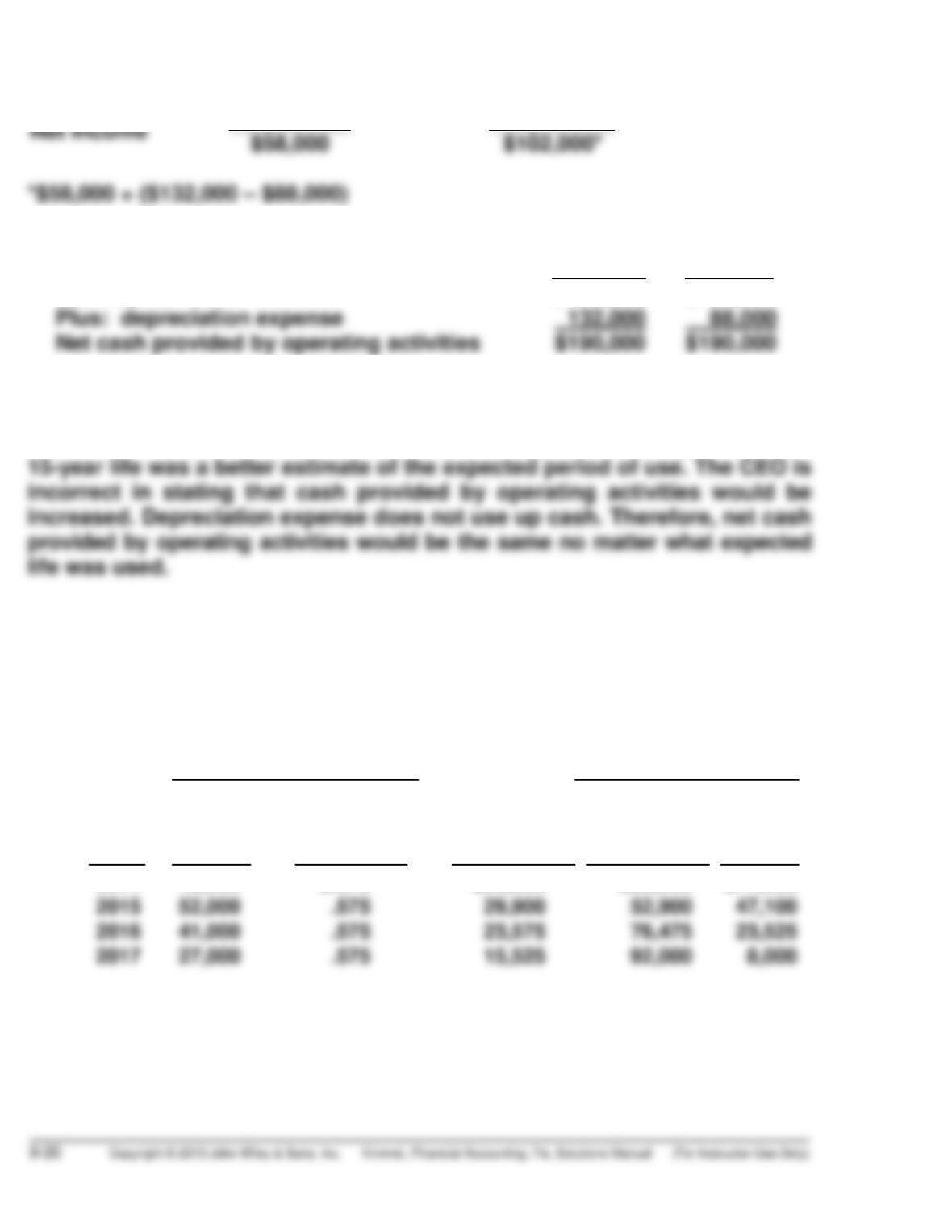
Calculation of net cash provided by operating activities:
10-year 15-year
Net income $ 58,000 $102,000
The CEO is correct regarding the impact on net income. By increasing the
expected useful life depreciation, expense would be lowered and net income
would increase. However, this move would be appropriate only if, in fact, a
*EXERCISE 9-18
(a) Depreciation cost per unit is $.575 per mile [($100,000 – $8,000) ÷
160,000].
(b) Computation End of Year
Annual
Units of Depreciation Depreciation Accumulated Book
Years Activity X Cost/Unit = Expense Depreciation Value
2014 40,000 $.575 $23,000 $23,000 $77,000