CHAPTER 9 Profit Planning and Flexible Budgets
P 9-69
1. Direct Labor Hours = (100,000 bags × 0.20 hour) + (90,000 bags × 0.30 hour)
= 20,000 hours + 27,000 hours
= 47,000 direct labor hours
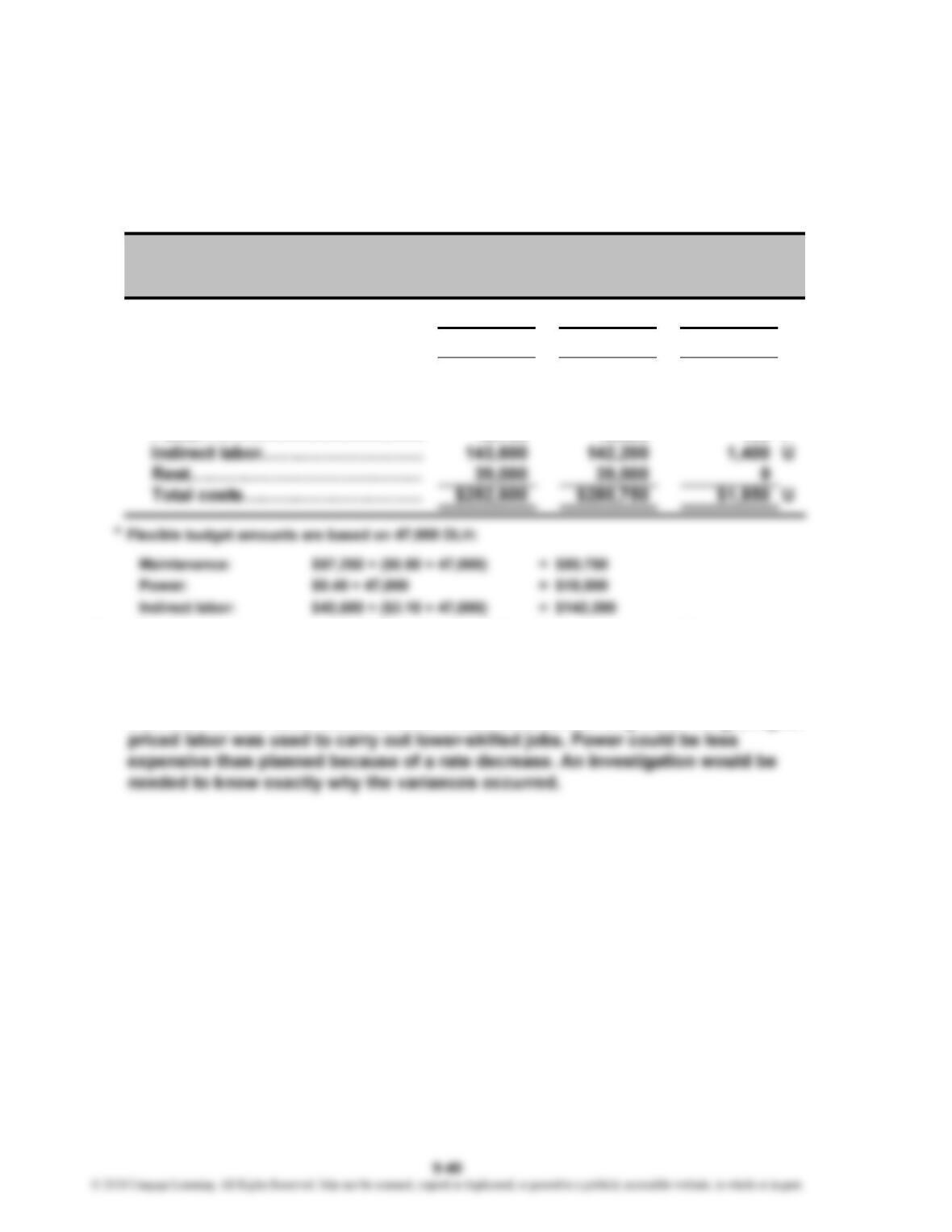
2.
Actual Budgeted*
V
ariance
Units produced………………………
…
190,000 190,000 0
Production unit:
Maintenance………………………
…
$ 81,300 $ 80,750 $ 550 U
3. All of the variances are small (less than 1% of budgeted amounts). Most would
probably view the variances as immaterial. Reasons for variances are numerous.
For example, an unfavorable maintenance variance could be caused by more
preventive maintenance or by decreased efficiency by individual maintenance
workers. Indirect labor could be unfavorable because (among other things) higher
–
Healthy Pet Company
Performance Report
For the Current Yea
r
…
CHAPTER 9 Profit Planning and Flexible Budgets
P 9-70
1. To determine accounts payable as of June 30, a schedule of purchases will be
constructed. This schedule will also be used to build the cash budget.
Let X = Cost of Sales
If X + 0.25X = Sales, then X = Sales/1.25.
For example, for August,
Cost of Sales = Sales/1.25 = $100,000/1.25 = $80,000
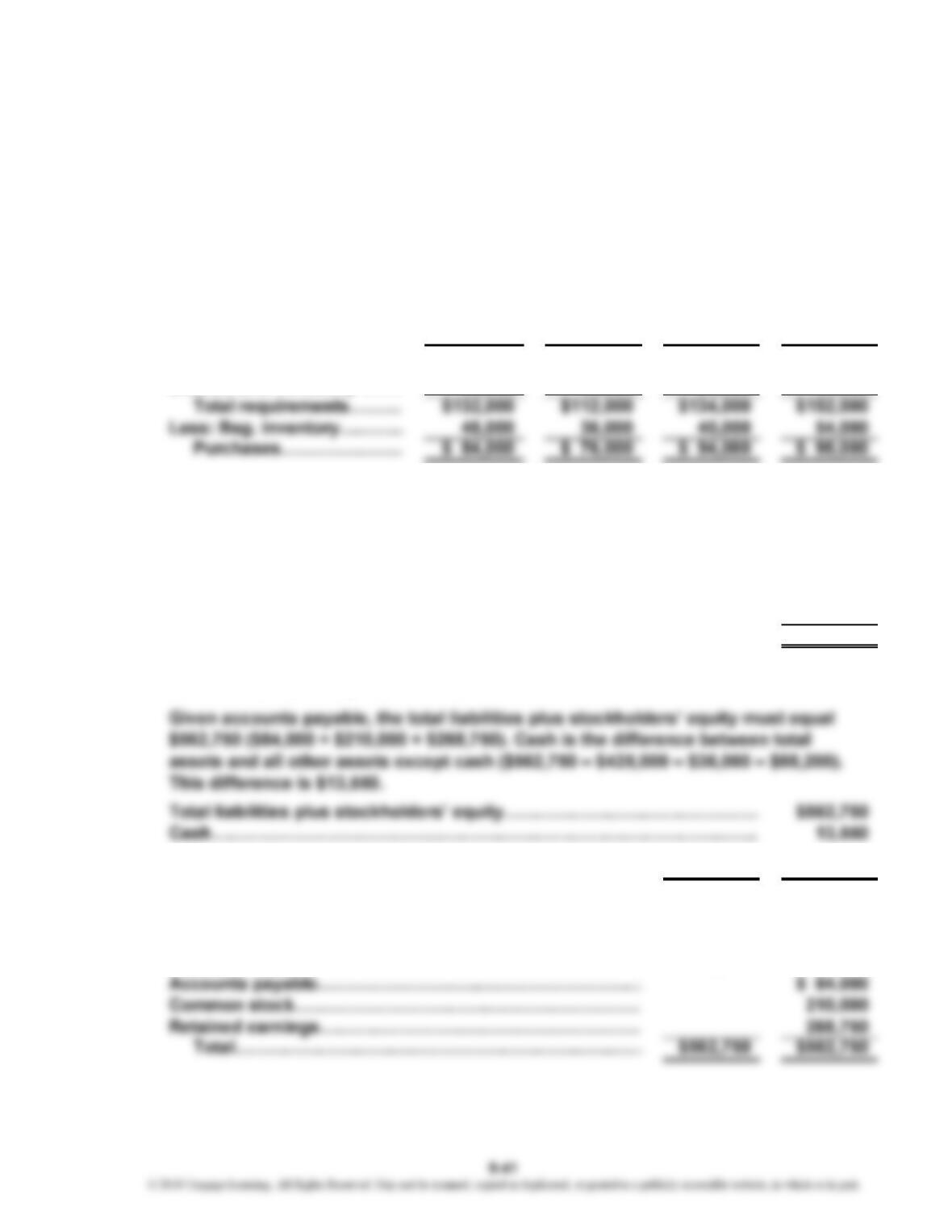
June July August Septembe
r
Cost of sales…………………
…
$ 96,000 $ 72,000 $ 80,000 $108,000
Desired end. inventory*……
…
36,000 40,000 54,000 44,000
*0.50 × Next Month’s Cost of Sales
Since purchases are paid for in the following month, accounts payable at the end
of June is $84,000. Inventory for June 30 is $36,000.
Accounts receivable for June 30 is computed as follows:
From June: 0.70 × $120,000 × 0.80……………………………………………
…
$67,200
From May: 0.70 × $100,000 × 0.30……………………………………………
…
21,000
Total A/R…………………………………………………………………………
…
$88,200
*By June 30, 20% of June credit sales and 70% of May credit sales have been collected, leaving
80% and 30%, respectively, to be collected
.
Assets L & OE
Cash………………………………………………………………… $ 13,550
Accounts receivable………………………..…………………… 88,200
Inventory…………………..………………………………………
…
36,000
Plant and equipment, net…………………..…………………
…
425,000
CHAPTER 9 Profit Planning and Flexible Budgets
P 9-70 (Continued)
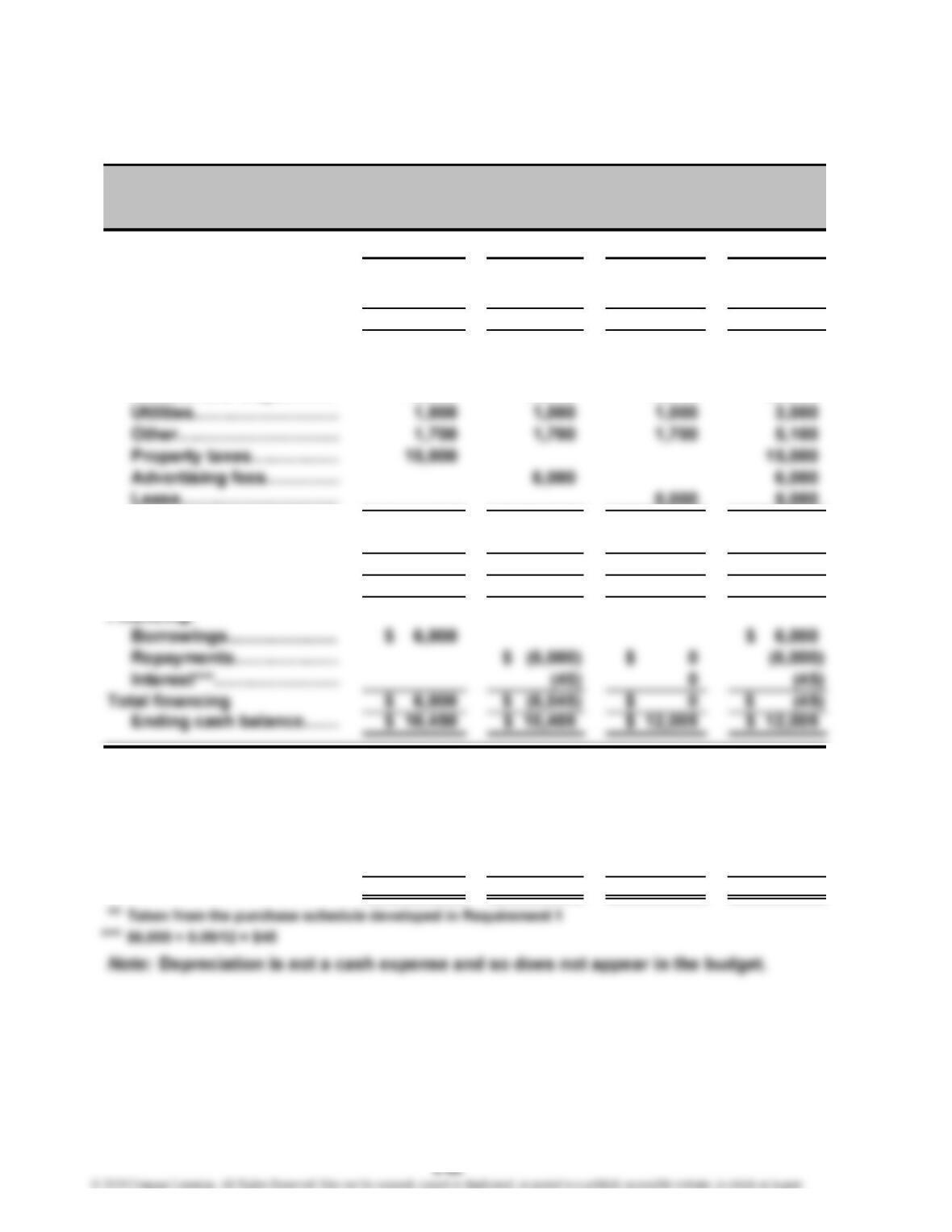
2.
July August Septembe
r
Total
Beginning cash balance…
…
$ 13,550 $ 10,450 $ 10,405 $ 13,550
Cash collections*…………… 102,600 100,700 113,300 316,600
Total cash available……
…
$116,150 $111,150 $123,705 $330,150
Cash disbursements:
Purchases**………………
…
$ 84,000 $ 76,000 $ 94,000 $254,000
Salaries and wages……
…
10,000 10,000 10,000 30,000
Lease………………………
…
5,000 5,000
Total disbursement……
…
$111,700 $ 94,700 $111,700 $318,100
Minimum cash balance……
…
10,000 10,000 10,000 10,000
Total cash needs………
…
$121,700 $104,700 $121,700 $328,100
Excess (deficiency)………… $ (5,550) $ 6,450 $ 2,005 $ 2,050
*Cash collections:
Cash sales…………………
…
$ 27,000 $ 30,000 $ 40,500 $ 97,500
Credit sales:
Current month……………… 12,600 14,000 18,900 45,500
Prior month…………………
…
42,000 31,500 35,000 108,500
From two months ago……
…
21,000 25,200 18,900 65,100
Total collections…………… $102,600 $100,700 $113,300 $316,600
Grange Retailers
Cash Budget
For the Quarter Ending September 30
CHAPTER 9 Profit Planning and Flexible Budgets
P 9-70 (Concluded)
3.
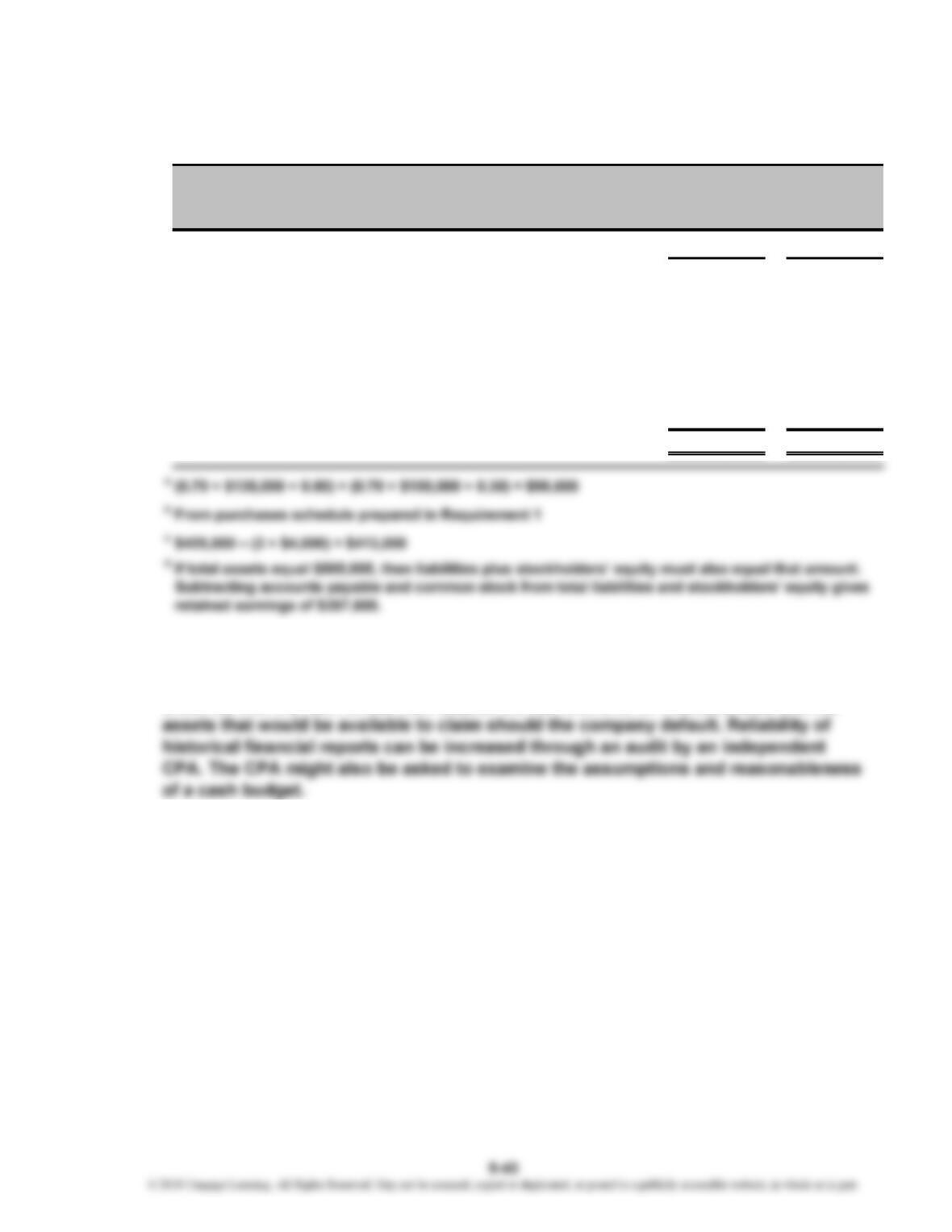
Assets L & OE
Cash………………………………………………………………
…
$ 12,005
Accounts receivable
a
…………………………………………
…
96,600
Inventory
b
………………………………………………………
…
44,000
Plant and equipment
c
…………………………………………
…
413,000
Accounts payable
b
……………………………………………
…
$ 98,000
Common stock…………………………………………………
…
210,000
Retained earnings
d
……………………………………………
…
257,605
Total……………………………………………………………
…
$565,605 $565,605
4. Cash budgets are important in loan decisions to help determine the company’s
ability to repay the loan. A statement of cash flows would also be helpful to see how
cash has been generated and used in the past. Another key report is the balance
sheet so that the loan officer can assess the current level of indebtedness and the
Grange Retailers
Balance Sheet
September 30
CHAPTER 9 Profit Planning and Flexible Budgets
P 9-71
When Eisenhower said “planning is everything,” he was no doubt referring to the
extensive planning process he undertook to plan the D-Day invasion of Normandy.
That plan was comprehensive and took into account the manpower needed,
probable German response, and even the weather. However, once the invasion
In business, planning is crucial. The master budgeting process is the planning
process. During that process, all resources and opportunities of the firm are
considered. The budget committee gathers information from all areas of the firm
as well as from outsiders. Then, the best plan is developed. The plan will be used
for continual planning during the coming year as well as control. If the underlying
CHAPTER 9 Profit Planning and Flexible Budgets
P 9-72
Beginning cash balance……………………………………………………
…
$ 27,000
Collections:
Cash sales (0.40 × $1,140,000)………….……………………………
…
456,000
Credit sales:
July:
With discounta………………………………………………………
…
150,822
Without discount
b
…………………………………………………… 153,900
Junec………………………………………………………………………
…
162,000
d
Less disbursements:
Raw materials:
Julye…………………………………………………………….……
…
June
f
…………………………………………………………….……
…
Direct labor………………………………………………………..……
…
Operating expenses………………………………………………..…
…
Dividends…………………………………………………………..……
…
Equipment…………………………………………………………..……
…
173,000
a(0.60 × $1,140,000) × 0.45 × 0.50 × 0.98 = $150,822
b
(0.60 × $1,140,000) × 0.45 × 0.50 = $153,900
c(0.60 × $900,000) × 0.30 = $162,000
d
f
130,000
105,000
325,000
Feinberg Company
Cash Budget
For the Month of July
$ 156,000
148,200
…
CHAPTER 9 Profit Planning and Flexible Budgets
P 9-73
1. Schedule 1: Sales Budget (units and budgeted sales in thousands)
Qtr. 1 Qtr. 2 Qtr. 3 Qtr. 4 Total
2. Schedule 2: Production Budget
Qtr. 1 Qtr. 2 Qtr. 3 Qtr. 4 Total
Sales (Sch. 1)…
…
65,000 70,000 75,000 90,000 300,000
Desired
ending
inventory……… 13,000 15,000 20,000 10,000 10,000
Total needs……
…
78,000 85,000 95,000 100,000 310,000
Less:
…
…
CHAPTER 9 Profit Planning and Flexible Budgets
P 9-73 (Continued)
3. Schedule 3: Direct Materials Purchases Budget (in thousands)
Qtr. 1 Qtr. 2 Qtr. 3 Qtr. 4 Total
Production……………
…
78.0 72.0 80.0 80.0 310.0
× Materials/unit………
…
33333
Production needs……
…
234.0 216.0 240.0 240.0 930.0
Desired ending
inventory……………
…
63.0 67.5 81.0 65.7 65.7
Total needs……………
…
297.0 284.5 321.0 306.7 996.0
4. Schedule 4: Direct Labor Budget (in thousands, except per unit/hour data)
Qtr. 1 Qtr. 2 Qtr. 3 Qtr. 4 Total
Production……………
…
78728080310
× Hours per unit………
…
55555
Hours needed…………
…
390 360 400 400 1,550
× Cost per hour………
…
$10 $10 $10 $10 $10
Total cost………………
…
$3,900 $3,600 $4,000 $4,000 $15,500
5. Schedule 5: Overhead Budget (in thousands, except per unit/hour data)
Qtr. 1 Qtr. 2 Qtr. 3 Qtr. 4 Total
Budgeted hours………
…
390 360 400 400 1,550
× Variable rate………… $6$6$6$6$6
Budgeted VOH………
…
$2,340 $2,160 $2,400 $2,400 $ 9,300
Budgeted FOH………
…
1,000 1,000 1,000 1,000 4,000
Total OH………………
…
$3,340 $3,160 $3,400 $3,400 $13,300
6. Schedule 6: Selling and Administrative Expenses Budget (in thousands, except
per unit/hour data)
…
…
…
…
…
CHAPTER 9 Profit Planning and Flexible Budgets
P 9-73 (Continued)
7. Schedule 7: Ending Finished Goods Inventory Budget
Unit cost computation:
Direct materials (3 units @ $80)…………………………………………… $ 240.00
Direct labor (5 units @ $10)………………………………………………
…
50.00
8. Schedule 8: Cost of Goods Sold Budget
Direct materials used (Schedule 3)…………………………………………
…
$ 74,424,000
Direct labor used (Schedule 4)…………………………………..……………
…
15,500,000
Overhead (Schedule 5)…………………………………………………………
…
13,300,000
Budgeted manufacturing costs………………………………………………
…
Add: Beginning finished goods inventory
(Schedule 7)……………………………………………………………………
…
0
…
9. Cash Budget (in thousands)
Qtr. 1 Qtr. 2 Qtr. 3 Qtr. 4 Total
Beginning cash……
…
$ 250 $ 1,110 $ 3,128 $ 5,568 $ 250
Collections:
Credit sales:
Current quarter…
…
22,100 23,800 25,500 30,600 102,000
Prior quarter……
…
3,300 3,900 4,200 4,500 15,900
Cash available……… $25,650 $28,810 $32,828 $40,668 $118,150
Less disbursements:
Direct materials:
Current quarter…
…
$ 9,252 $ 8,820 $10,140 $ 8,988 $ 37,200
Prior quarter……
…
7,248 9,252 8,820 10,140 35,460
$103,224,000
…
CHAPTER 9 Profit Planning and Flexible Budgets
P 9-73 (Concluded)
10.
Pro Forma Income Statement
Sales (Schedule 1)…………………………………..………………………
…
$120,000,000
Less: Cost of goods sold (Schedule 8)…………………………..………
…
99,895,000
Gross margin………………………..……………………………..………
…
$ 20,105,000
11.
Cash……………………………………………………………………………… $11,090,000
Accounts receivable………………………………….………………………
…
5,400,000
Direct materials inventory……………………………..……………………
…
5,256,000
…
…
Accounts payable……………………………………………………………
…
$ 8,988,000
Capital stock……………………………….…………………………………
…
27,000,000
Retained earnings
b
………………………………..…………………………
…
22,963,000
Total liabilities and stockholders’ equity………………………………
…
$58,951,000
Beginning plant and equipment $33,500,000
Add: New equipment………………………………………………
…
2,000,000
Less: Depreciation expense (for year)…………………………
…
(1,600,000)
Ending plant and equipment……………………………..………
…
$33,900,000
a
Liabilities and Stockholders’ Equity
Assets
Optima Company
For the Year Ending December 31, 20X1
Optima Company
December 31, 20X1
Pro Forma Balance Sheet
CHAPTER 9 Profit Planning and Flexible Budgets
P 9-74
1.
Octobe
r
Novembe
r
Decembe
r
Total
Units to be produced………………… 20,000 40,000 25,000 85,000
× DM per unit (yds.)………………….. 0.2 0.2 0.2 0.2
Production needs…………………
.
4,000 8,000 5,000 17,000
Desired ending inventory (yds.)…… 1,200 750 900 900
Total needs…………………..……
…
5,200 8,750 5,900 17,900
2.
Octobe
r
Novembe
r
Decembe
r
Total
Units to be produced………………… 20,000 40,000 25,000 85,000
× DM per unit (oz.)…………………..
…
6666
Production needs…………………
.
120,000 240,000 150,000 510,000
Desired ending inventory (oz.)……
…
72,000 45,000 54,000 54,000
Total needs…………………..……
…
192,000 285,000 204,000 564,000
…
…
3.
Octobe
r
Novembe
r
Decembe
r
Total
Units to be produced………………… 20,000 40,000 25,000 85,000
× Direct labor time pe
r
unit (hours)…………………..………
…
0.10 0.10 0.10 0.10
…
For the Fourth Quarter
Direct Materials Purchases Budget for Fabric
For the Fourth Quarter
Willison Company
Willison Company
Direct Materials Purchases Budget for Polyfiberfill
For the Fourth Quarter
Willison Company
Direct Labor Budget
…
CHAPTER 9 Profit Planning and Flexible Budgets
P 9-75
1.
August Septembe
r
Cash sales:
($75,000 × 0.75)….…………………………………..……………
…
$56,250
($80,000 × 0.75)….…………………………………..……………
…
$60,000
*
Check collections for:
(0.25 × $75,000)….…………………………………..…………
…
$18,750
(0.25 × $80,000)….…………………………………..…………
…
$20,000
Less: Bad checks
(0.02 × $18,750)….…………………………………..…………
…
(375)
(0.02 × $20,000)….…………………………………..…………
…
(400)
July August Septembe
r
2. a. Revised cash sales estimates:
($60,000 × 1.20 × 0.05)…………………..……
…
$ 3,600
($75,000 × 1.20 × 0.05)…………………..……
…
$ 4,500
($80,000 × 1.20 × 0.05)…………………..……
…
$ 4,800
Revised credit card sales:
($60,000 × 1.20 × 0.95)…………………..……
…
68,400
($75,000 × 1.20 × 0.95)…………………..……
…
85,500
($80,000 × 1.20 × 0.95)…………………..……
…
91,200
Schedule of Cash Receipts
…
CHAPTER 9 Profit Planning and Flexible Budgets
P 9-75 (Concluded)
3. August September
Cash sales:
($90,000 × 0.05)….…………………………………..…
…
$ 4,500
($96,000 × 0.05)….…………………………………..…
…
$ 4,800
Credit card receipts net of discount:
Less:
Gateway and statement fee…………………..………
…
(19) (19)
Transaction fees:…………………..……………………
1,710 × $0.25…………………..……………………
…
(428)
1,824 × $0.25…………………..……………………
…
(456)
Total…………………..………………………………..……
…
$86,838 $93,365
*Rounded
*
CHAPTER 9 Profit Planning and Flexible Budgets
Case 9-76
Answers will vary.
Case 9-77
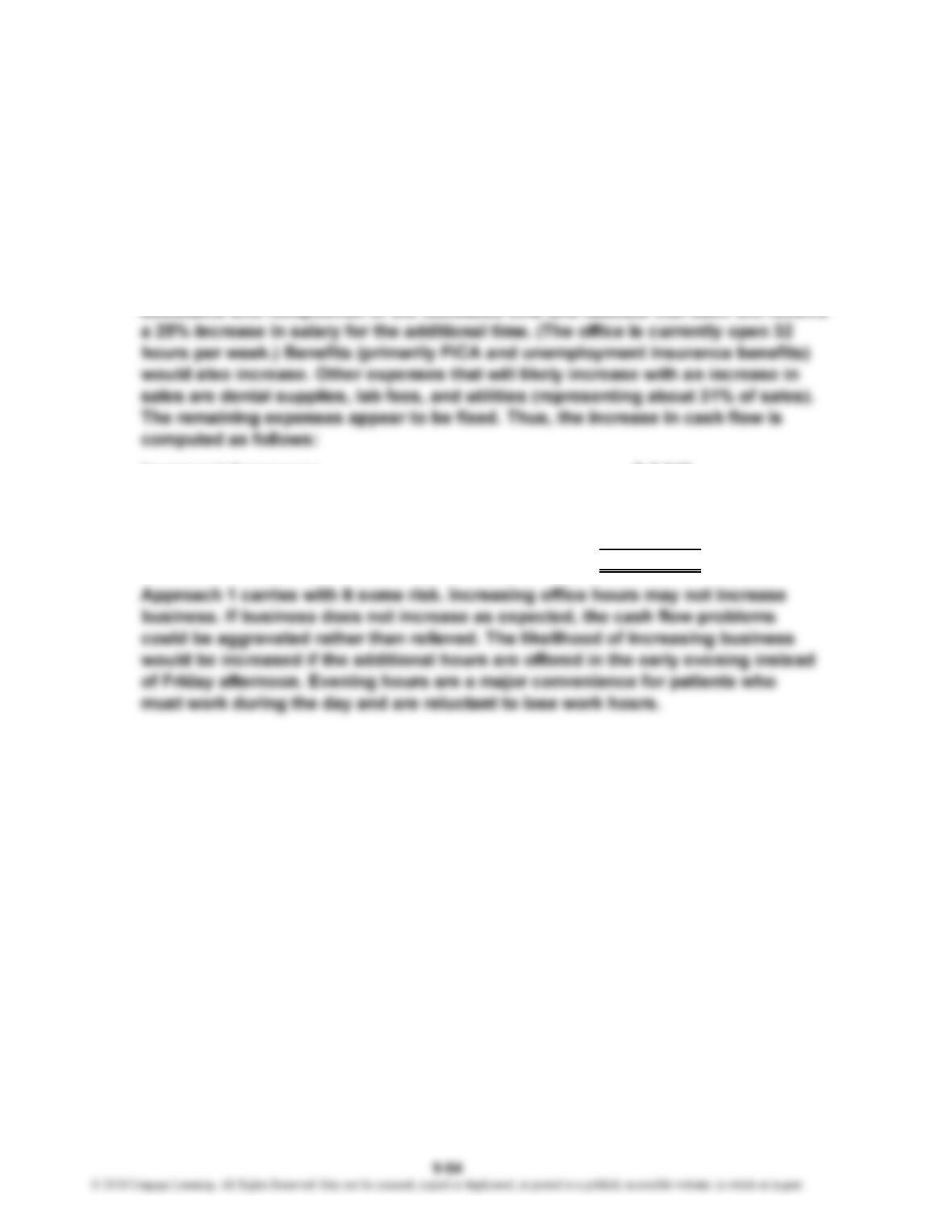
1.
Cash collections and cash available*………………………………………
…
$21,360
Less cash disbursements:
Salaries………………………………………………………………………… $12,700
Benefits………………………………………………………………………
…
1,344
Phone…………………………………………………………………………
…
150
Office supplies………………………………………………………………
…
100
Lab fees………………………………………………………………………
…
5,000
Loan payments………………………………………………………………
…
570
Interest payments……………………………………………………………
…
500
*Total revenues for a month:
Fillings ($50 × 90)……………………………
…
$ 4,500
Crowns ($300 × 19)…………………………
…
5,700
Root canals ($170 × 8)……………………… 1,360
Bridges ($500 × 7)…………………………… 3,500
Extractions ($45 × 30)………………………
…
1,350
Cleaning ($25 × 108)………………………… 2,700
Dr. Roger Jones
Cash Budget
CASES
CHAPTER 9 Profit Planning and Flexible Budgets
Case 9-77 (Continued)
2. Dr. Jones must either increase revenues to make up the deficiency or cut costs or a
combination of the two. Three possible approaches are outlined as follows:
a. Extend office hours so that a total of 40 hours are worked each week. This could
increase revenues by as much as $5,340. Based on a four-week month, the current
revenue earned per hour is $166.88 ($21,360/128). Thus, the total revenue increase
possible is $166.88 × 32 hours = $5,340. Dr. Jones would need to inform his
Incremental revenues……………………….……………… $ 5,340
Salary increases (0.25 × $3,400)…………………………
…
(850)
Benefits [($1,344/$12,700) × $850]………………………
…
(90)
V
ariable expenses (0.31 × $5,340)………………………
…
(1,655)
Cash flow increase………………………………………
…
$ 2,745
CHAPTER 9 Profit Planning and Flexible Budgets
Case 9-77 (Continued)
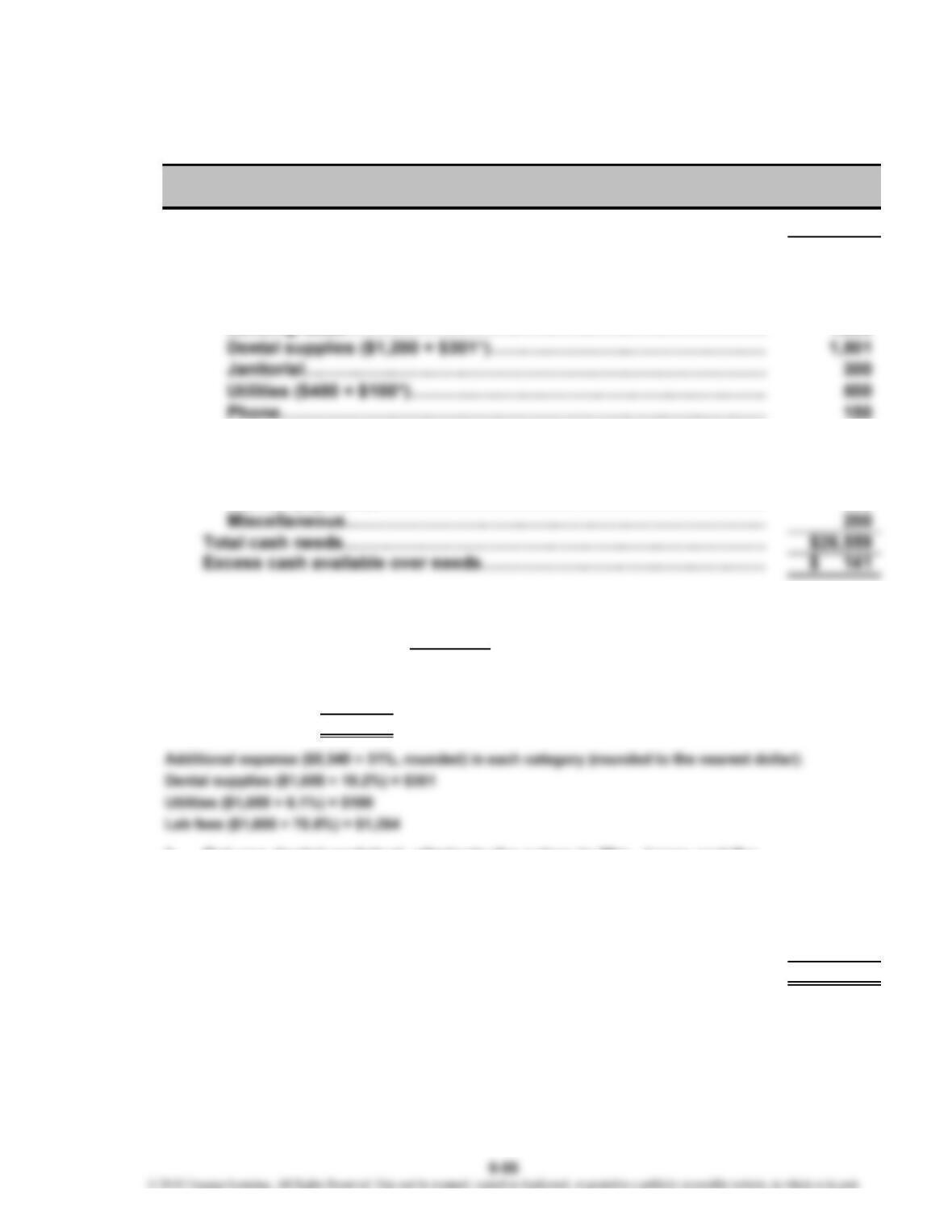
Cash collections and cash available ($21,360 + $5,340)……………….. $26,700
Less cash disbursements:
Salaries ($12,700 + $850)……………..……..…………………………..… $13,550
Benefits ($1,344 + $90)……………..……..…………………………..…… 1,434
Phone………………………………………………………………………… 150
Office supplies……………………………………………………………
…
100
Lab fees ($5,000 + $1,254*)……………..……..………………………….. 6,254
Loan payments……………………………………………………………
…
570
Interest payments…………………………………………………………
…
500
…
*Dental supplies, utilities, and lab fees are variable expenses. The proportion of total variable
expenses of each is:
%
Dental supplies $1,200 18.2%
Utilities 400 6.1%
Lab fees 5,000 75.8%
Total $6,600
b. Cut one dental assistant, eliminate the salary to Mrs. Jones and the
activities she does, and cut Dr. Jones’s salary back by $1,000 per month:
The savings are as follows:
Assistant (salary and benefits)*……………………………………………
…
$1,051
Salaries………………………………….………………………………………
…
2,000
Total…………………………………………………..……………………… $3,051
*($1,900/2) + [($950/$12,700) × $1,344] = $1,051. (This provides a reasonable approximation of the
benefits assigned to an assistant.)
Dr. Roger Jones
Revised Cash Budget
CHAPTER 9 Profit Planning and Flexible Budgets
Case 9-77 (Concluded)
Although this achieves the savings, the solution may not be feasible. The solution
depends to a large extent on how well the Jones family can do with a $2,000 per
month cut in their income. In all likelihood, this would be unacceptable to the Jones
c. A third possibility is to increase the fees charged for the various dental services.
Assuming a variable cost ratio of 31% (from the first approach), the increase in
revenues needed to cover the $2,604 deficiency can be computed as follows:
0.69 R = $2,604
R = $2,604/0.69
R = $3,774
This increase would call for fees to increase an average of 17.7%. Whether this
increase is possible or not depends to some extent on how Dr. Jones’s charges
compare with other dentists in the area. If some increase is possible, then the
increase could be combined with elements of the other two approaches (e.g., a
10% increase in fees and working an extra 4 hours per week, say, on
Wednesday evening). I would expect Dr. Jones to be more likely to accept a
combination like the one just mentioned rather than accepting any of the
approaches in their pure form.
Case 9-78
1. Linda’s behavior is not ethical. In the budgeting process, she is deliberately
misrepresenting the capabilities of her division for personal gain. To ensure that she
CHAPTER 9 Profit Planning and Flexible Budgets
Case 9-78 (Concluded)
2. There are few, if any, legitimate reasons for deferring the closing of sales. Thus, if a
marketing manager was asked to engage in this behavior, the first response must
be to find out why the request is being made. If there is no sound reason offered,
of meeting budget for the coming year is not a sound reason, and, in fact, is wrong.
3. It would be hard to go against a common practice that seems to have the approval
of the plant managers. The widespread knowledge of the practice may even suggest
that higher-level management is aware of it and essentially condones the practice—or
at least adjusts for it. If higher-level management is aware of the practice and adjusts
for it, then the ability to achieve a bonus may not be enhanced as much as believed.
4. This is a clear violation of the ethical code for management accountants. A management
accountant is obligated to report information fairly and objectively and to disclose all
information that can be expected to influence a user’s understanding of accounting
reports. Moreover, management accountants must perform their duties in accordance
with relevant laws, regulations, and technical standards. Accelerating the recognition
of expenses violates generally accepted accounting principles. Your first step would