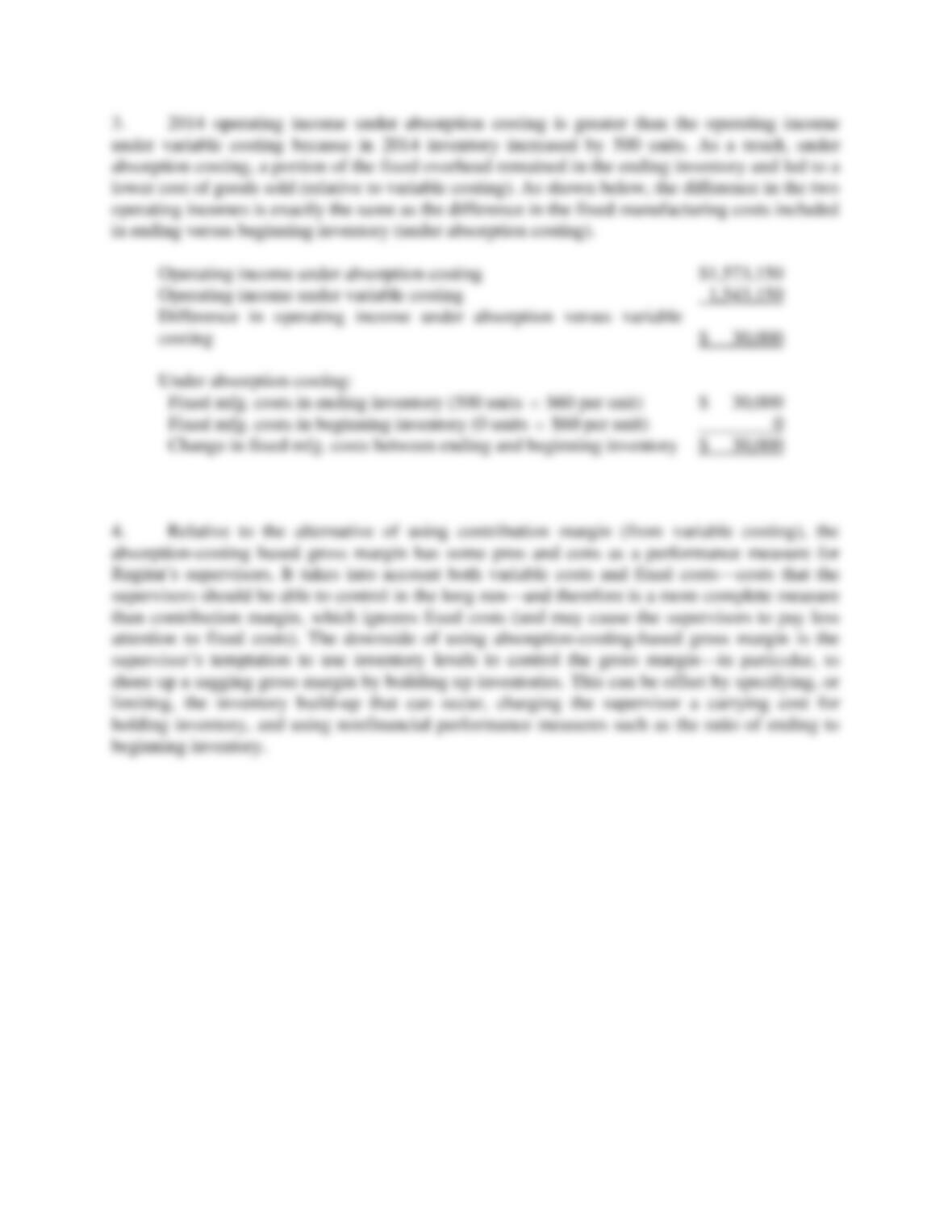
9-21
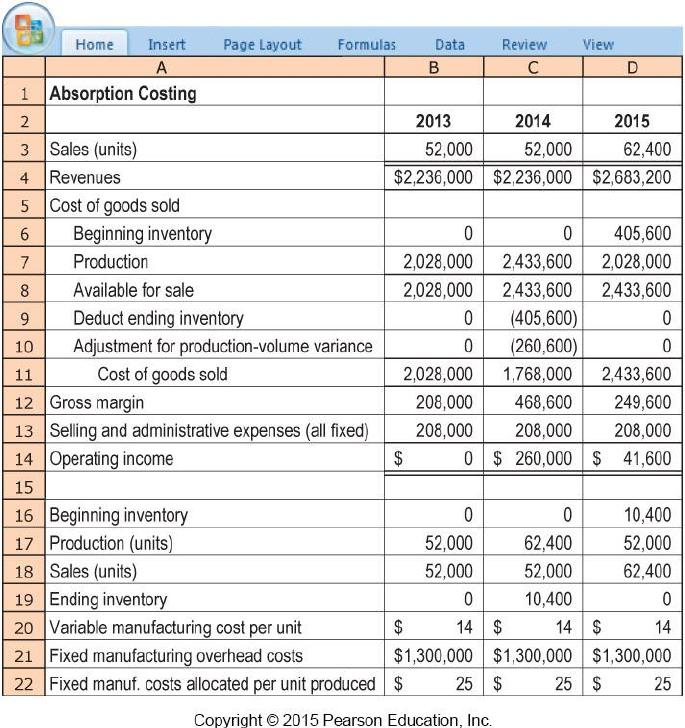
9-22
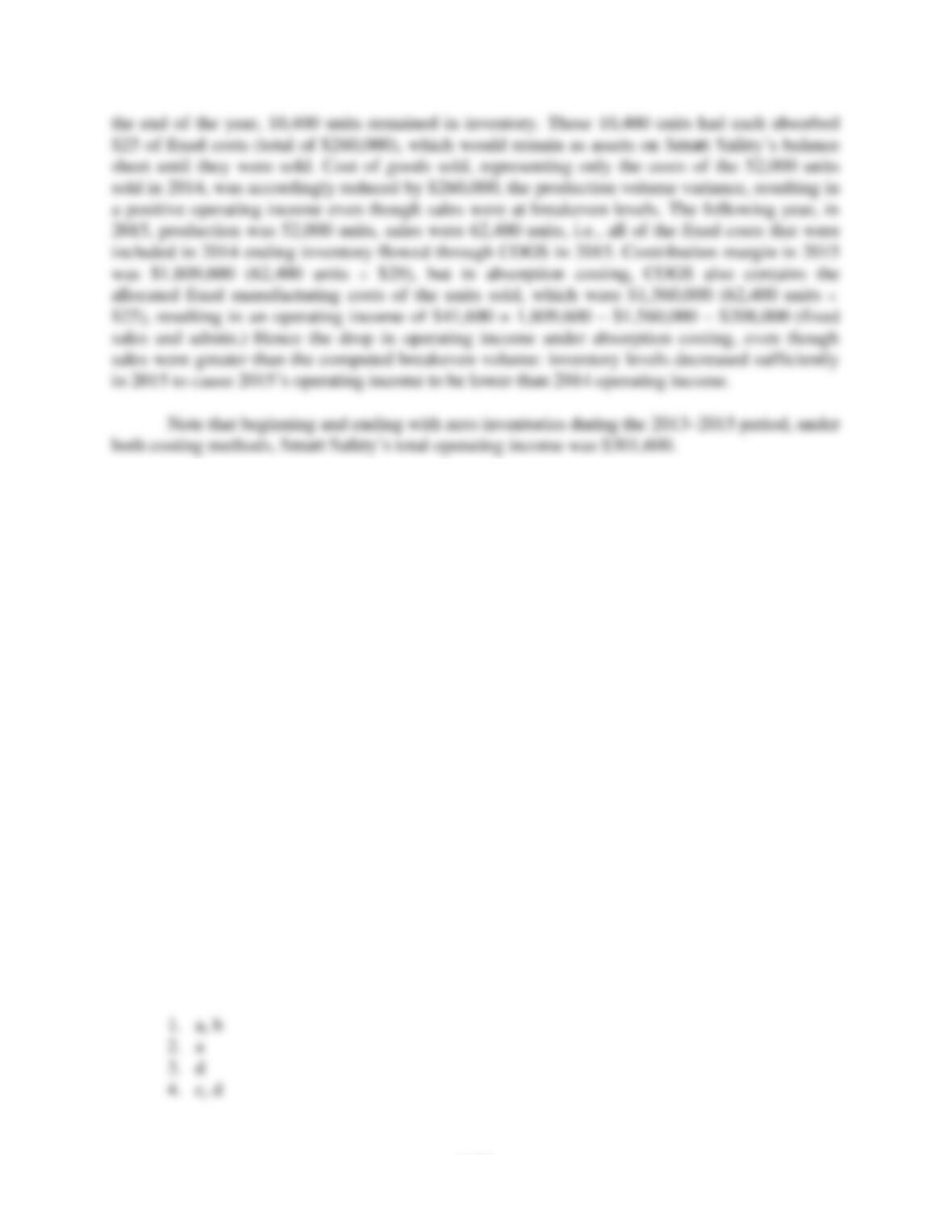
9-23 (40 min.) Variable and absorption costing, sales, and operating-income changes.
Smart Safety, a three- year-old company, has been producing and selling a single type of bicycle
helmet. Smart Safety uses standard costing. After reviewing the income statements for the first
three years, Stuart Weil, president of Smart Safety, commented, “I was told by our accountants—
and in fact, I have memorized—that our breakeven volume is 52,000 units. I was happy that we
reached that sales goal in each of our first two years. But here’s the strange thing: In our first
year, we sold 52,000 units and indeed we broke even. Then in our second year we sold the same
volume and had a positive operating income. I didn’t complain, of course. . . but here’s the bad
part. In our third year, we sold 20% more helmets, but our operating income fell by more than
80% relative to the second year! We didn’t change our selling price or cost structure over the
past three years and have no price, efficiency, or spending variances. . . so what’s going on?!”
Required:
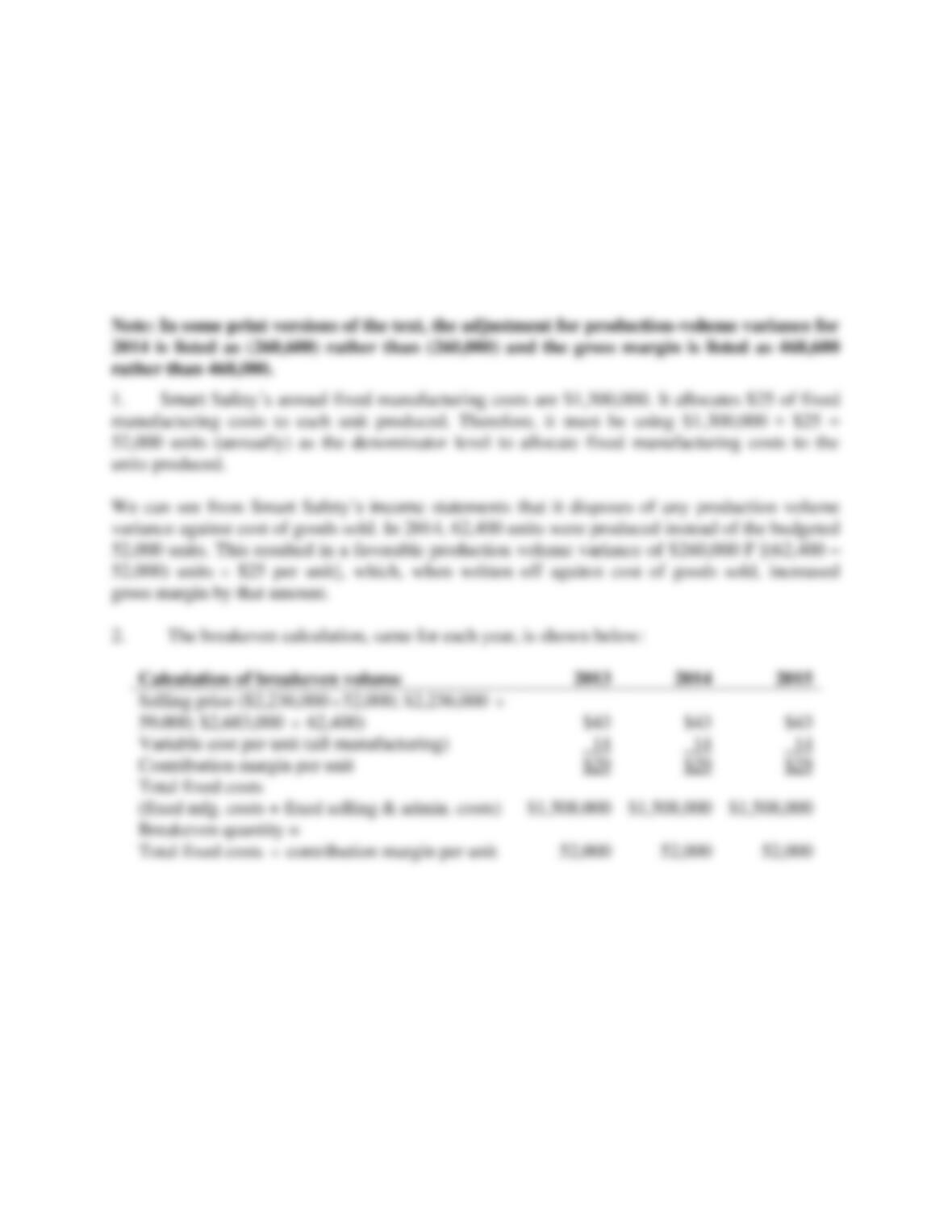
1. What denominator level is Smart Safety using to allocate fixed manufacturing costs to the
bicycle helmets? How is Smart Safety disposing of any favorable or unfavorable production-
volume variance at the end of the year? Explain your answer briefly.
2. How did Smart Safety’s accountants arrive at the breakeven volume of 52,000 units?
9-23
3. Prepare a variable costing-based income statement for each year. Explain the variation in
variable costing operating income for each year based on contribution margin per unit and
sales volume.
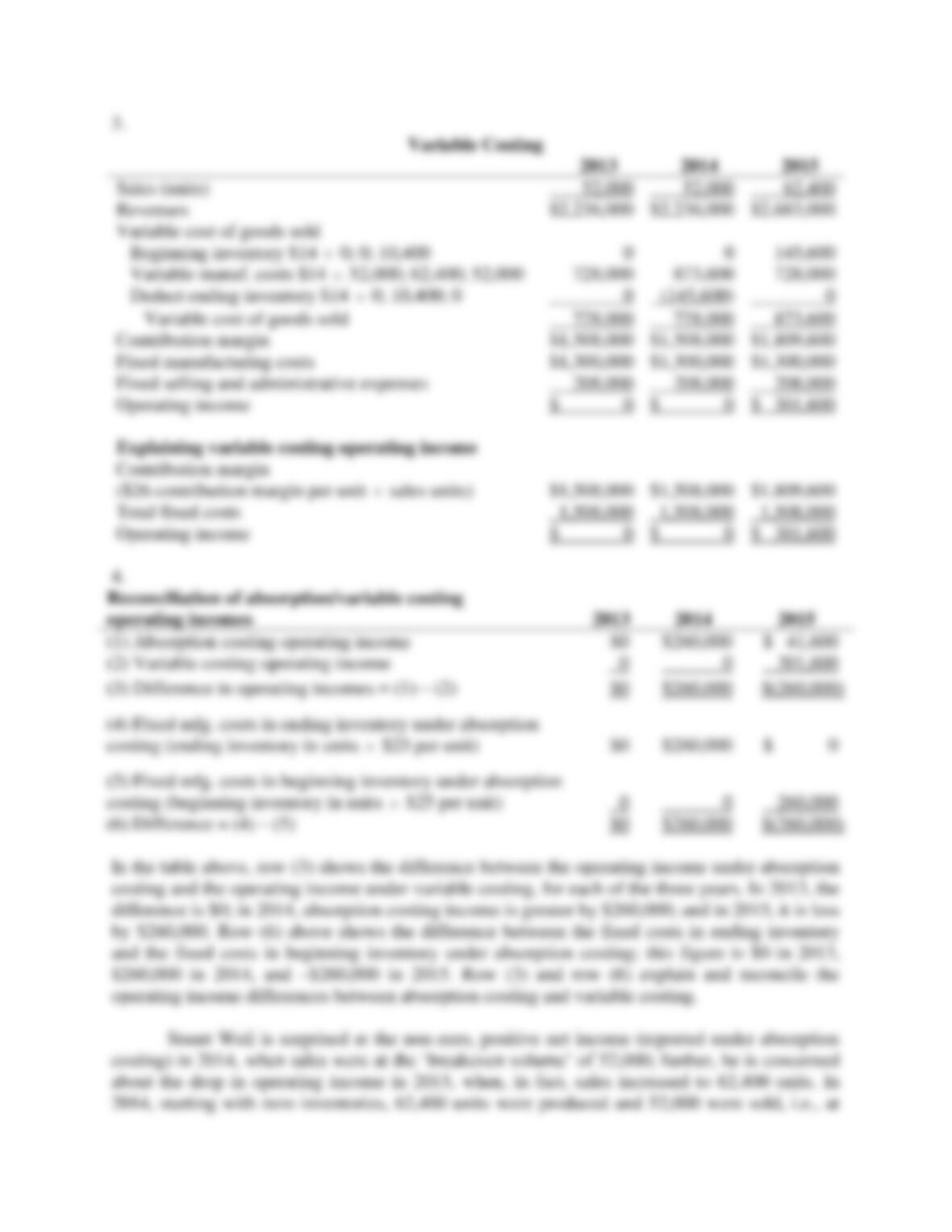
4. Reconcile the operating incomes under variable costing and absorption costing for each year,
and use this information to explain to Stuart Weil the positive operating income in 2014 and
the drop in operating income in 2015.
SOLUTION
9-24
9-25
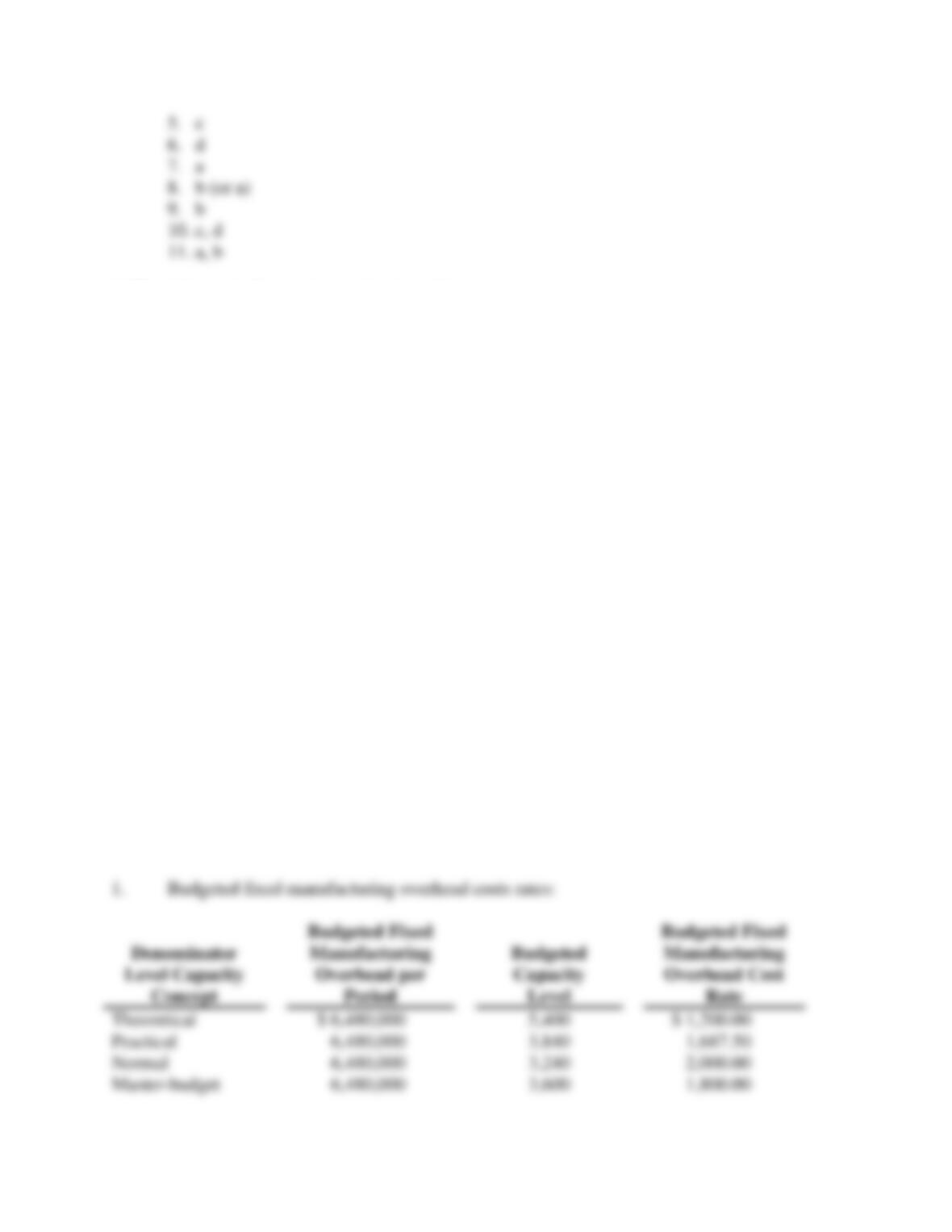
9-24 (10 min.) Capacity management, denominator-level capacity concepts.
Match each of the following numbered descriptions with one or more of the denominator-level
capacity concepts by putting the appropriate letter(s) by each item:
a. Theoretical capacity
b. Practical capacity
c. Normal capacity utilization
d. Master-budget capacity utilization
1. Measures the denominator level in terms of what a plant can supply
2. Is based on producing at full efficiency all the time
3. Represents the expected level of capacity utilization for the next budget period
4. Measures the denominator level in terms of demand for the output of the plant
5. Takes into account seasonal, cyclical, and trend factors
6. Should be used for performance evaluation in the current year
7. Represents an ideal benchmark
8. Highlights the cost of capacity acquired but not used
9. Should be used for long-term pricing purposes
10. Hides the cost of capacity acquired but not used
11. If used as the denominator-level concept, would avoid the restatement of unit costs when
expected demand levels change
SOLUTION
9-26
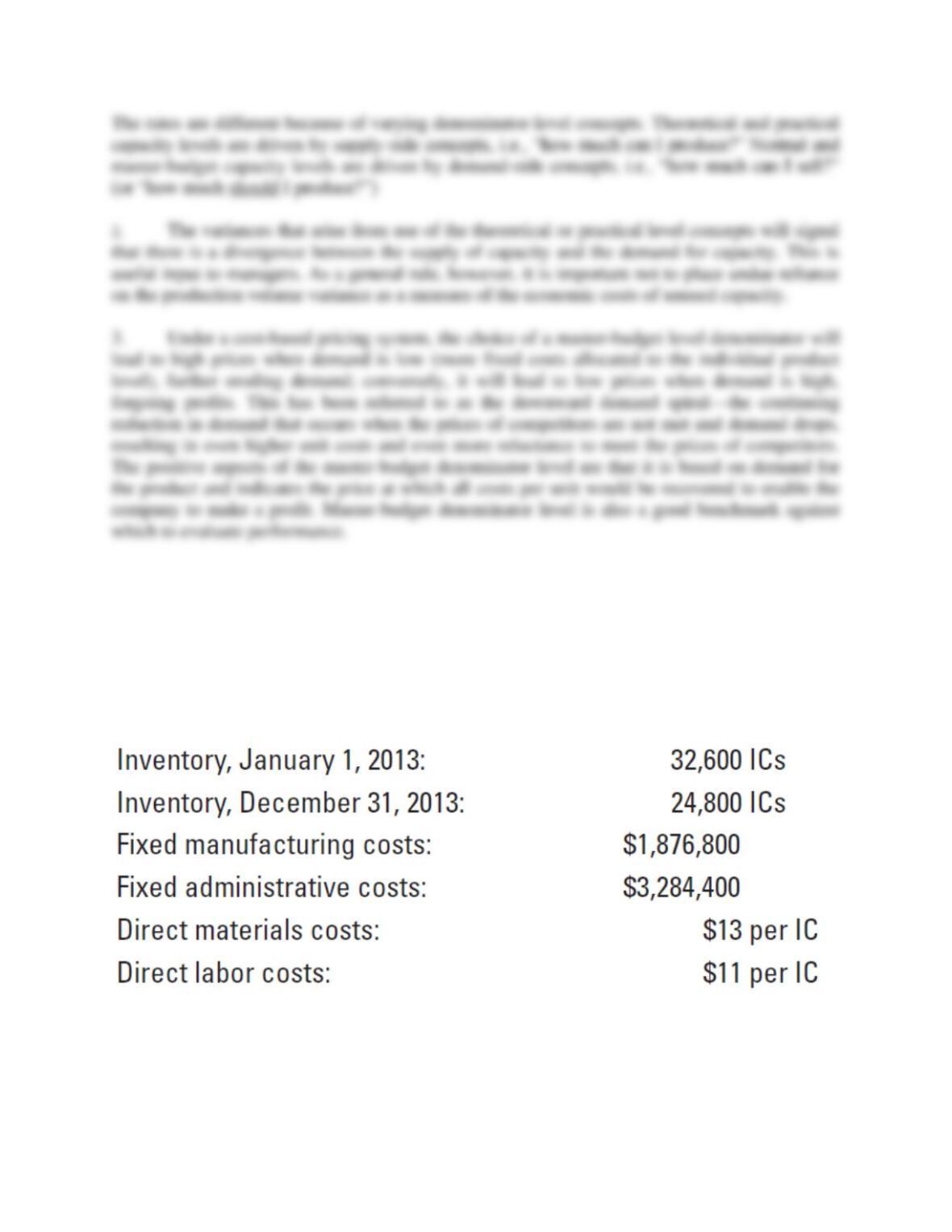
9-25 (20 min.) Denominator-level problem.
Thunder Bolt, Inc., is a manufacturer of the very popular G36 motorcycles. The management at
Thunder Bolt has recently adopted absorption costing and is debating which denominator-level
concept to use. The G36 motorcycles sell for an average price of $8,200. Budgeted fixed
manufacturing overhead costs for 2014 are estimated at $6,480,000. Thunder Bolt, Inc., uses
subassembly operators that provide component parts. The following are the denominator-level
options that management has been considering:
a. Theoretical capacity—based on three shifts, completion of five motorcycles per shift, and a
360-day year—3 × 5 × 360 = 5,400.
b. Practical capacity—theoretical capacity adjusted for unavoidable interruptions, breakdowns,
and so forth—3 × 4 × 320 = 3,840.
c. Normal capacity utilization—estimated at 3,240 units.
d. Master-budget capacity utilization—the strengthening stock market and the growing
popularity of motorcycles have prompted the marketing department to issue an estimate for
2014 of 3,600 units.
Required:
1. Calculate the budgeted fixed manufacturing overhead cost rates under the four denominator–
level concepts.
2. What are the benefits to Thunder Bolt, Inc., of using either theoretical capacity or practical
capacity?
3. Under a cost-based pricing system, what are the negative aspects of a master-budget
denominator level? What are the positive aspects?
SOLUTION
9-27
9-26 (30 min.) Variable and absorption costing and breakeven points.
Artesa, a leading firm in the semiconductor industry, produces digital integrated circuits (ICs) for
the communications and defense markets.
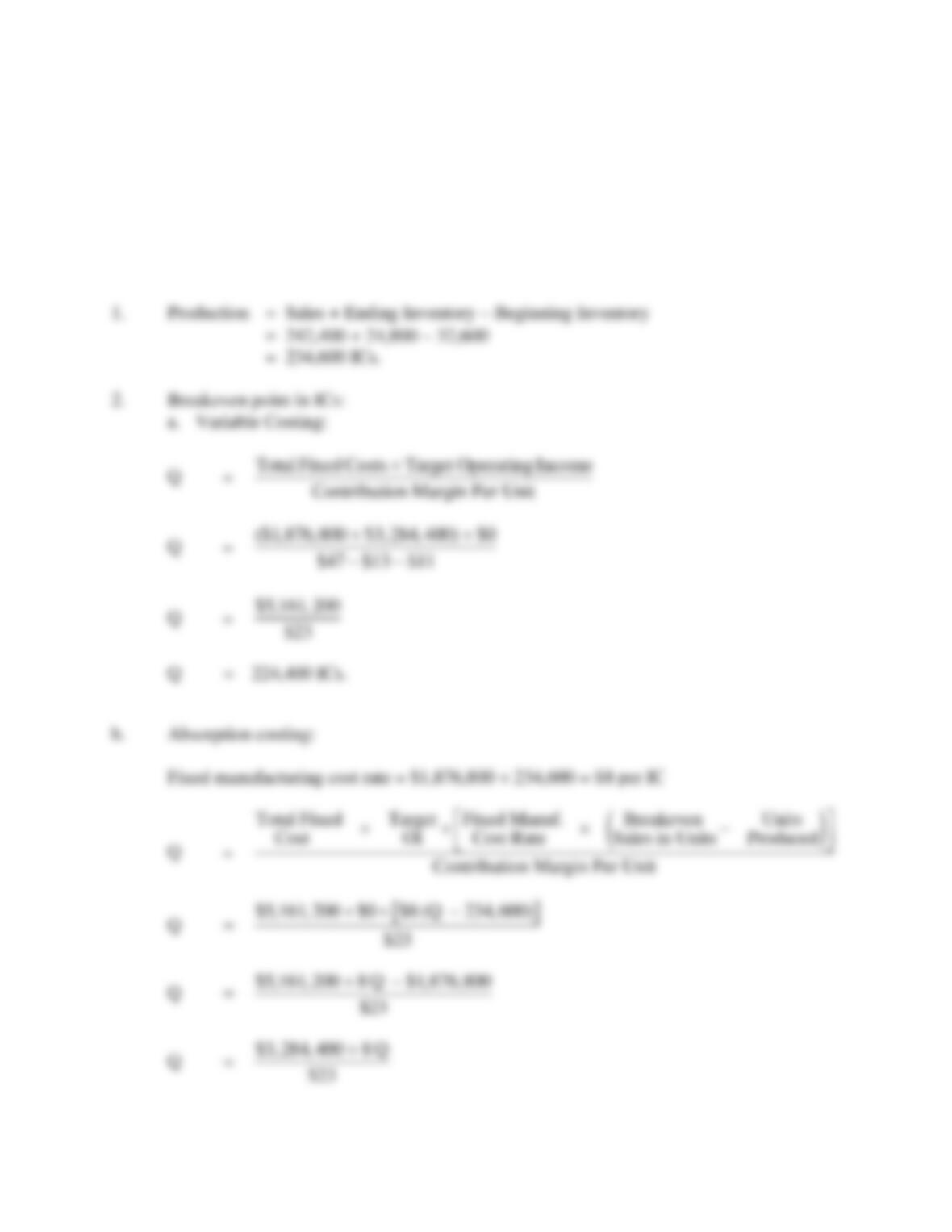
For the year ended December 31, 2013, Artesa sold 242,400 ICs at an average selling price
of $47 per unit. The following information also relates to 2013 (assume constant unit costs and
no variances of any kind):
Required:
1. How many integrated circuits did Artesa produce in 2013?
2. Calculate the breakeven point (number of ICs sold) in 2013 under:
a. Variable costing
9-28
b. Absorption costing
3. Due to difficulties in obtaining high-quality silicon, Artesa expects that direct materials costs
will increase to $15 per IC in 2014. Assuming all other data are the same, calculate the
minimum number of ICs Artesa must sell in 2014 to break even under:
a. Variable costing
b. Absorption costing
SOLUTION
9-29
9-30
9-27 (40 min.) Variable costing versus absorption costing.
The Mavis Company uses an absorption-costing system based on standard costs. Total variable
manufacturing cost, including direct material cost, is $3 per unit; the standard production rate is
10 units per machine-hour. Total budgeted and actual fixed manufacturing overhead costs are
$420,000. Fixed manufacturing overhead is allocated at $7 per machine-hour ($420,000 ÷ 60,000
machine-hours of denominator level). Selling price is $5 per unit. Variable operating
(nonmanufacturing) cost, which is driven by units sold, is $1 per unit. Fixed operating
(nonmanufacturing) costs are $120,000. Beginning inventory in 2014 is 30,000 units; ending
inventory is 40,000 units. Sales in 2014 are 540,000 units. The same standard unit costs persisted
throughout 2013 and 2014. For simplicity, assume that there are no price, spending, or efficiency
variances.
Required:
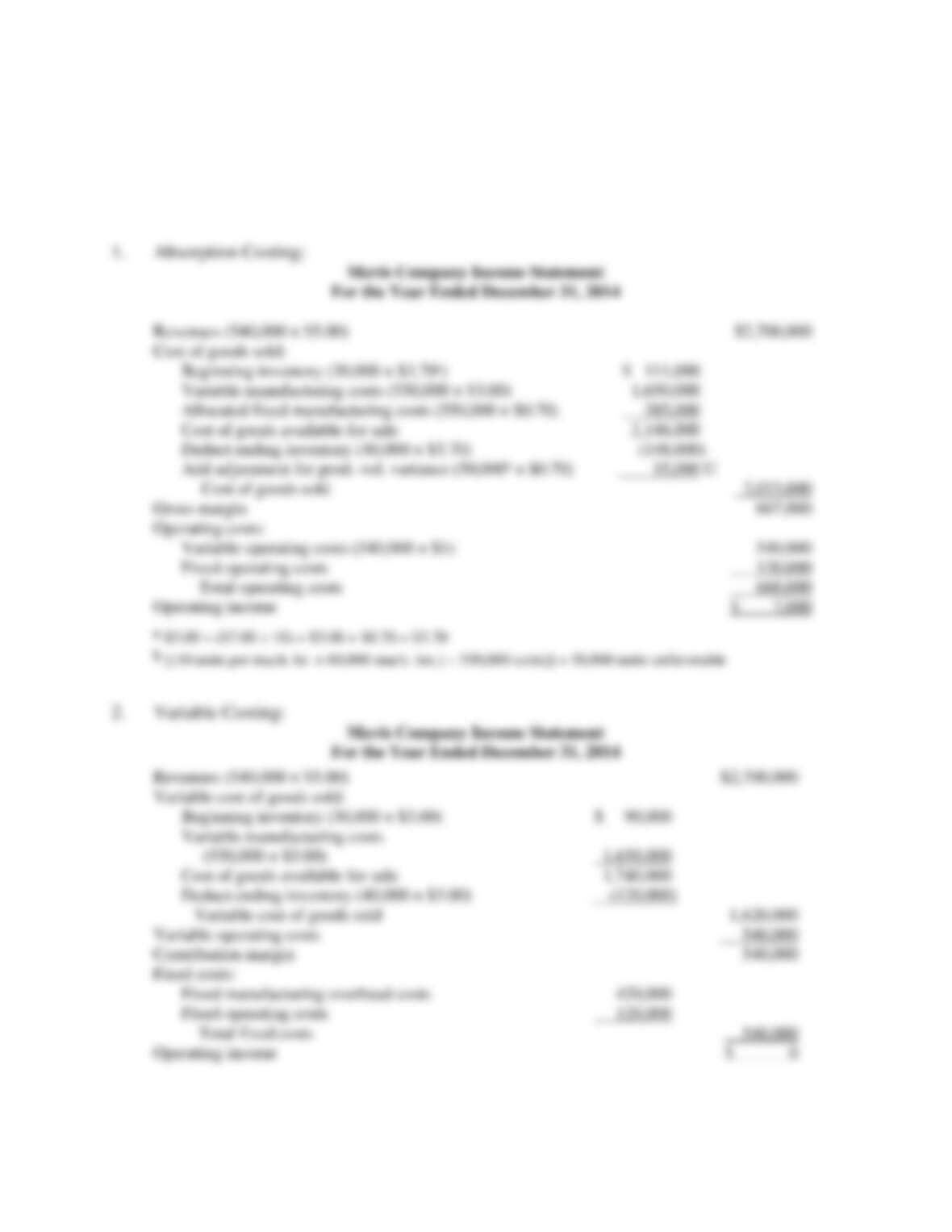
1. Prepare an income statement for 2014 assuming that the production-volume variance is
written off at year-end as an adjustment to cost of goods sold.
2. The president has heard about variable costing. She asks you to recast the 2014 statement as
it would appear under variable costing.
3. Explain the difference in operating income as calculated in requirements 1 and 2.
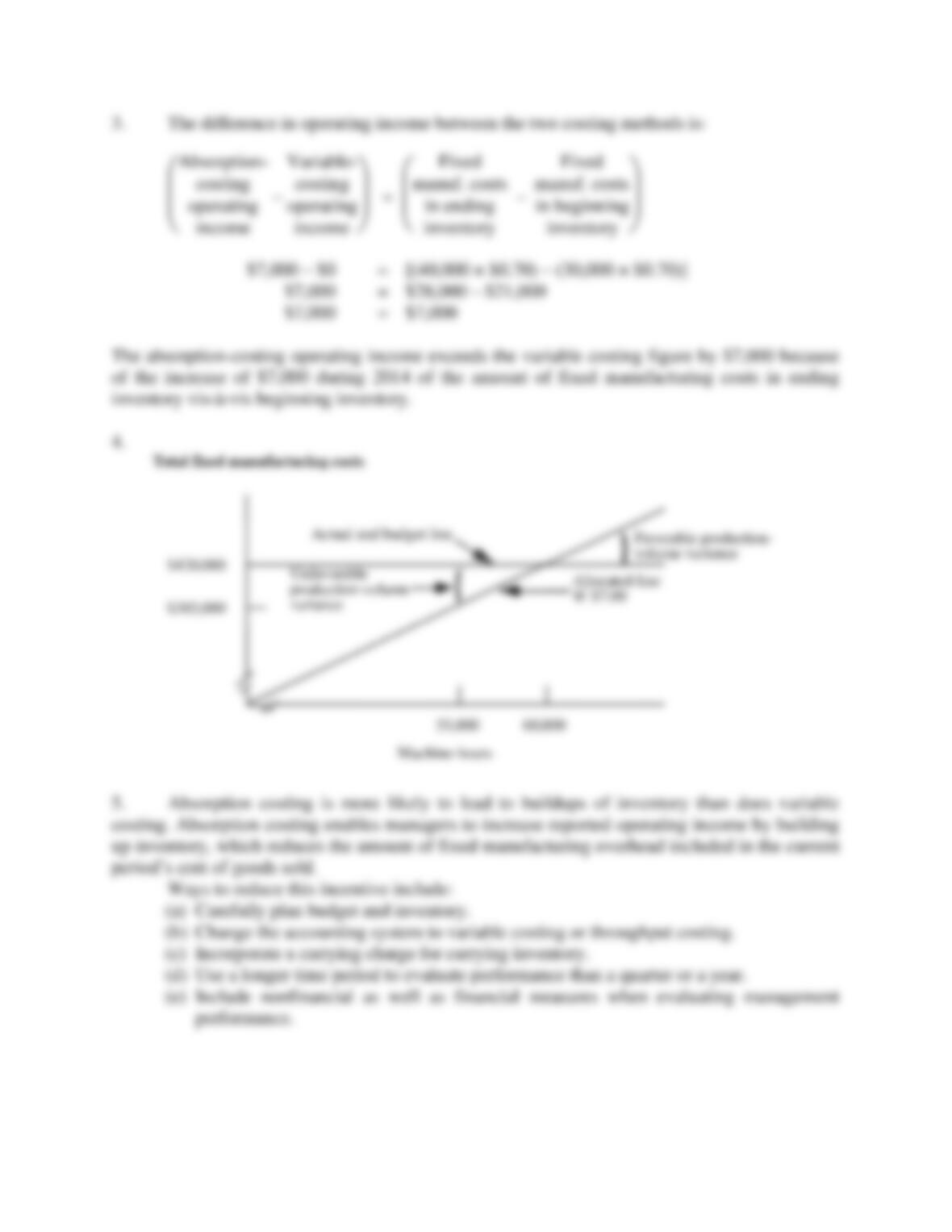
4. Graph how fixed manufacturing overhead is accounted for under absorption costing. That is,
there will be two lines: one for the budgeted fixed manufacturing overhead (which is equal to
the actual fixed manufacturing overhead in this case) and one for the fixed manufacturing
overhead allocated. Show the production-volume variance in the graph.
9-31
5. Critics have claimed that a widely used accounting system has led to undesirable buildups of
inventory levels. (a) Is variable costing or absorption costing more likely to lead to such
buildups? Why? (b) What can managers do to counteract undesirable inventory buildups?
SOLUTION
9-32
9-33
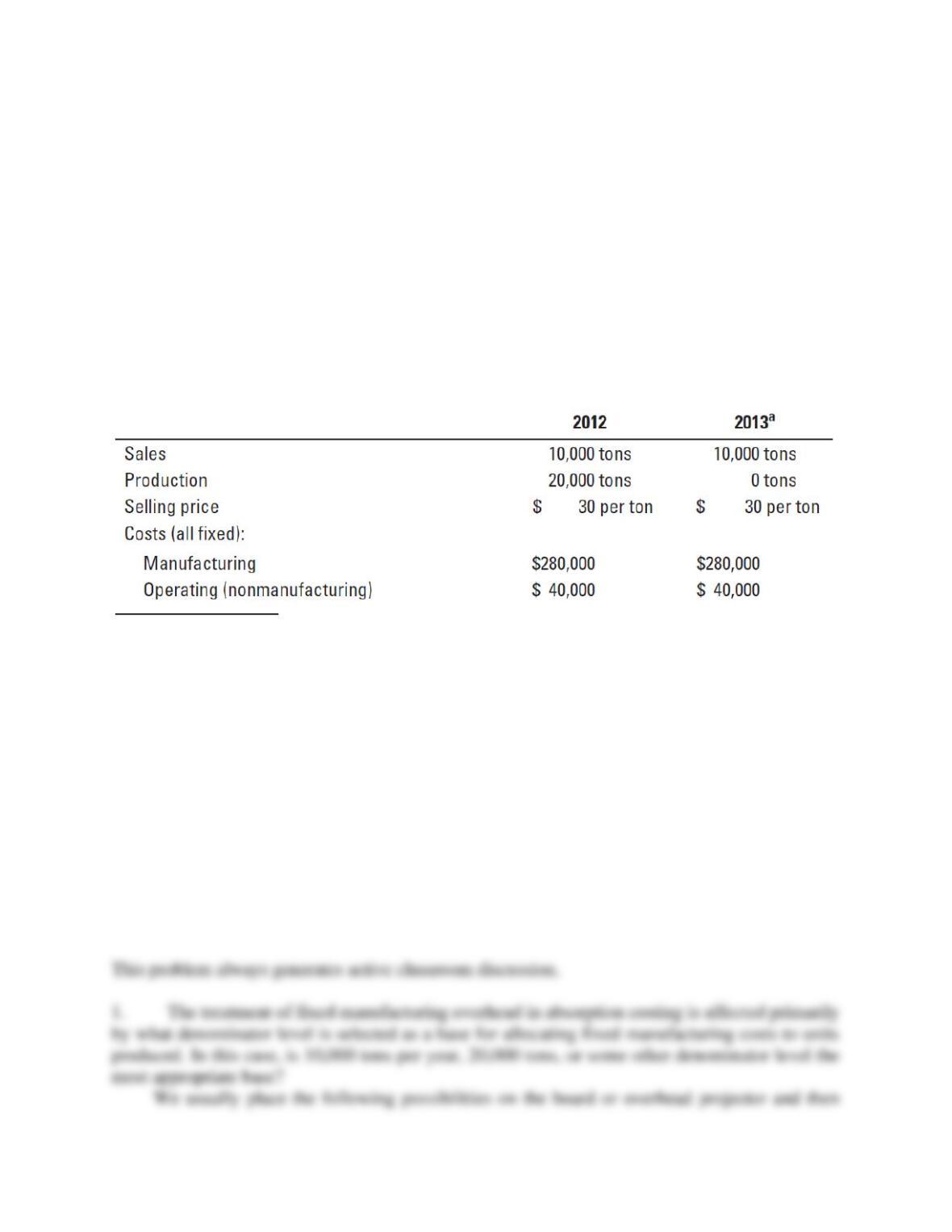
9-28 (40 min.) Variable costing and absorption costing, the All-Fixed Company.
(R. Marple, adapted) It is the end of 2013. The All-Fixed Company began operations in January
2012. The company is so named because it has no variable costs. All its costs are fixed; they do
not vary with output.
The All-Fixed Company is located on the bank of a river and has its own hydroelectric plant
to supply power, light, and heat. The company manufactures a synthetic fertilizer from air and
river water and sells its product at a price that is not expected to change. It has a small staff of
employees, all paid fixed annual salaries. The output of the plant can be increased or decreased
by adjusting a few dials on a control panel.
The following budgeted and actual data are for the operations of the All-Fixed Company.
All-Fixed uses budgeted production as the denominator level and writes off any production-
volume variance to cost of goods sold.
a Management adopted the policy, effective January 1, 2013, of producing only as much product
as needed to fill sales orders. During 2013, sales were the same as for 2012 and were filled
entirely from inventory at the start of 2013.
Required:
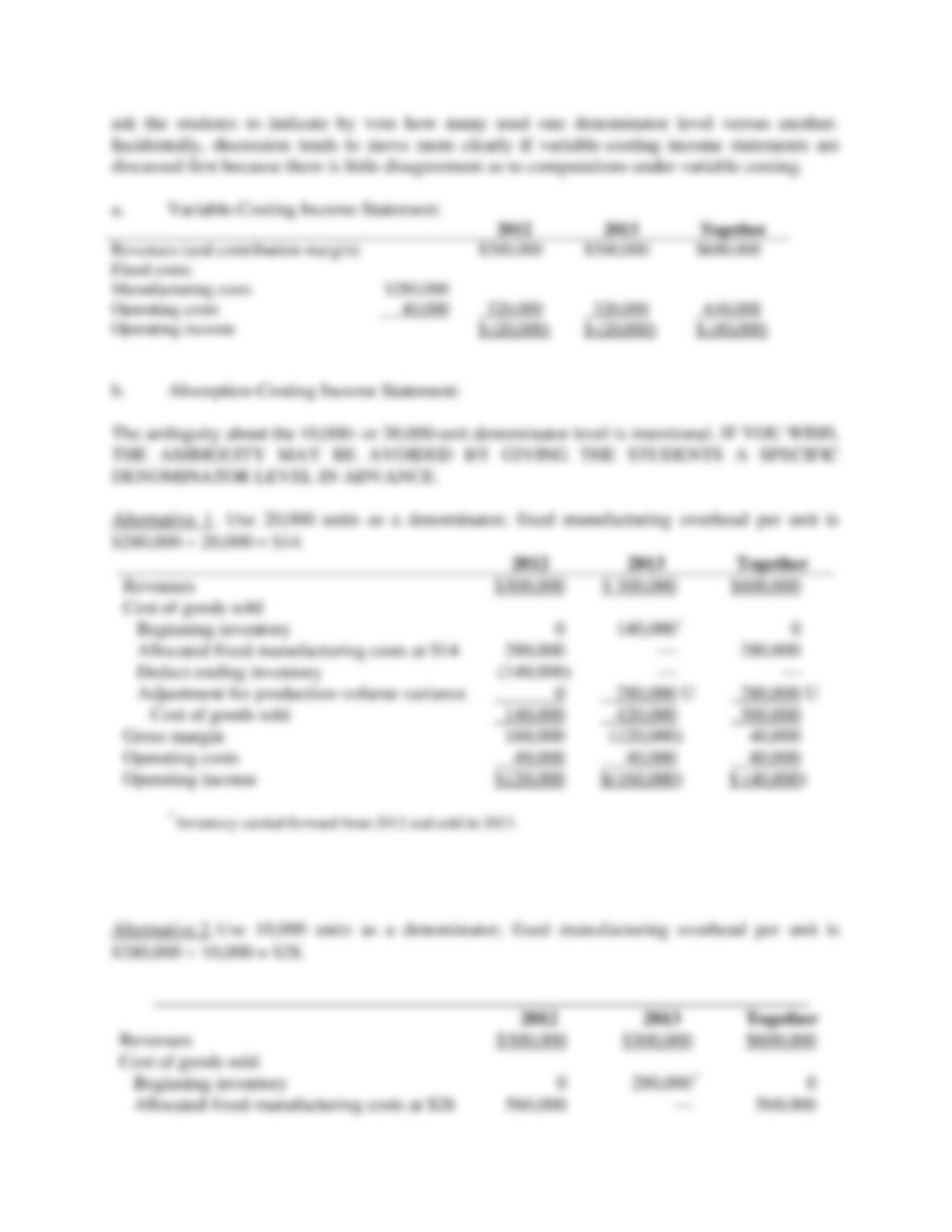
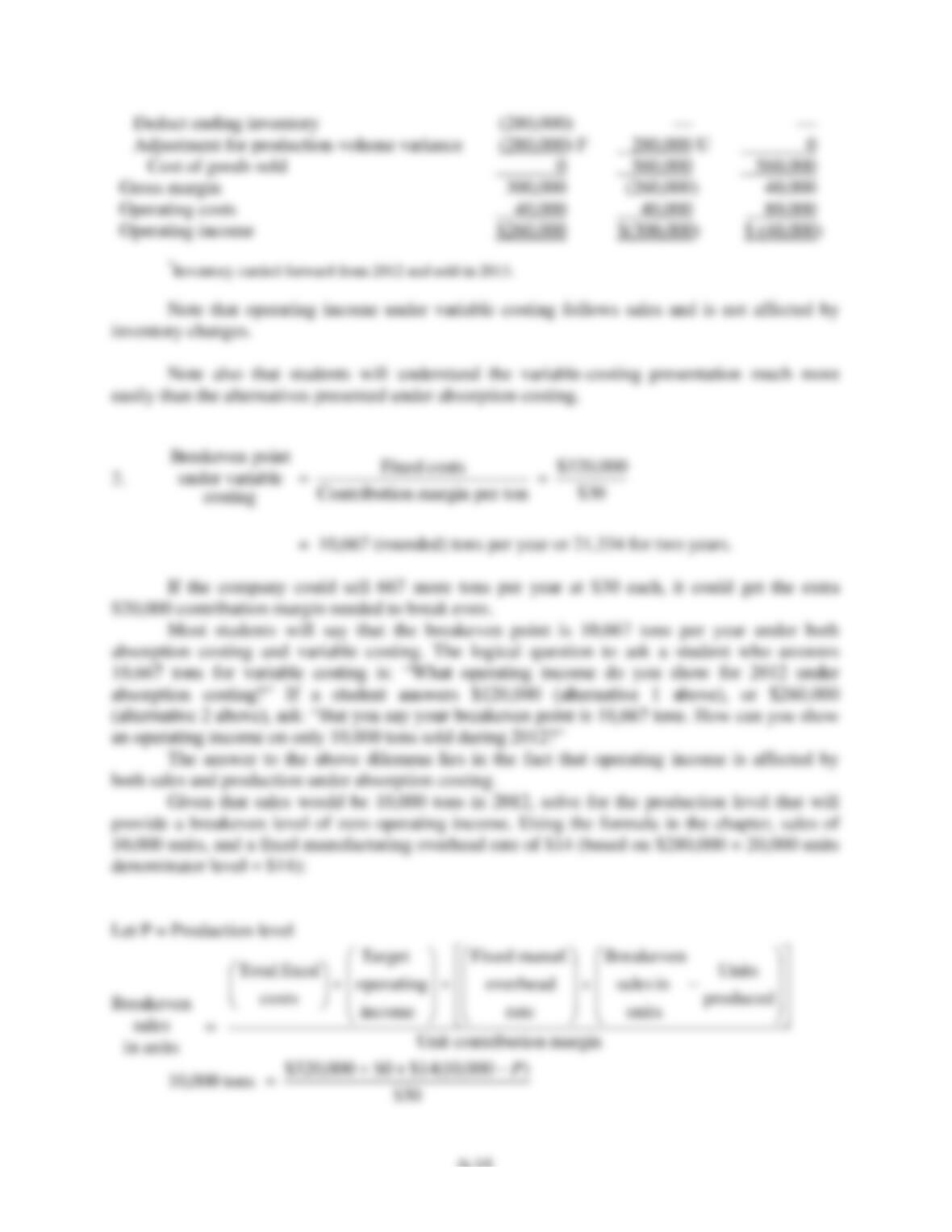
1. Prepare income statements with one column for 2012, one column for 2013, and one column
for the two years together using (a) variable costing and (b) absorption costing.
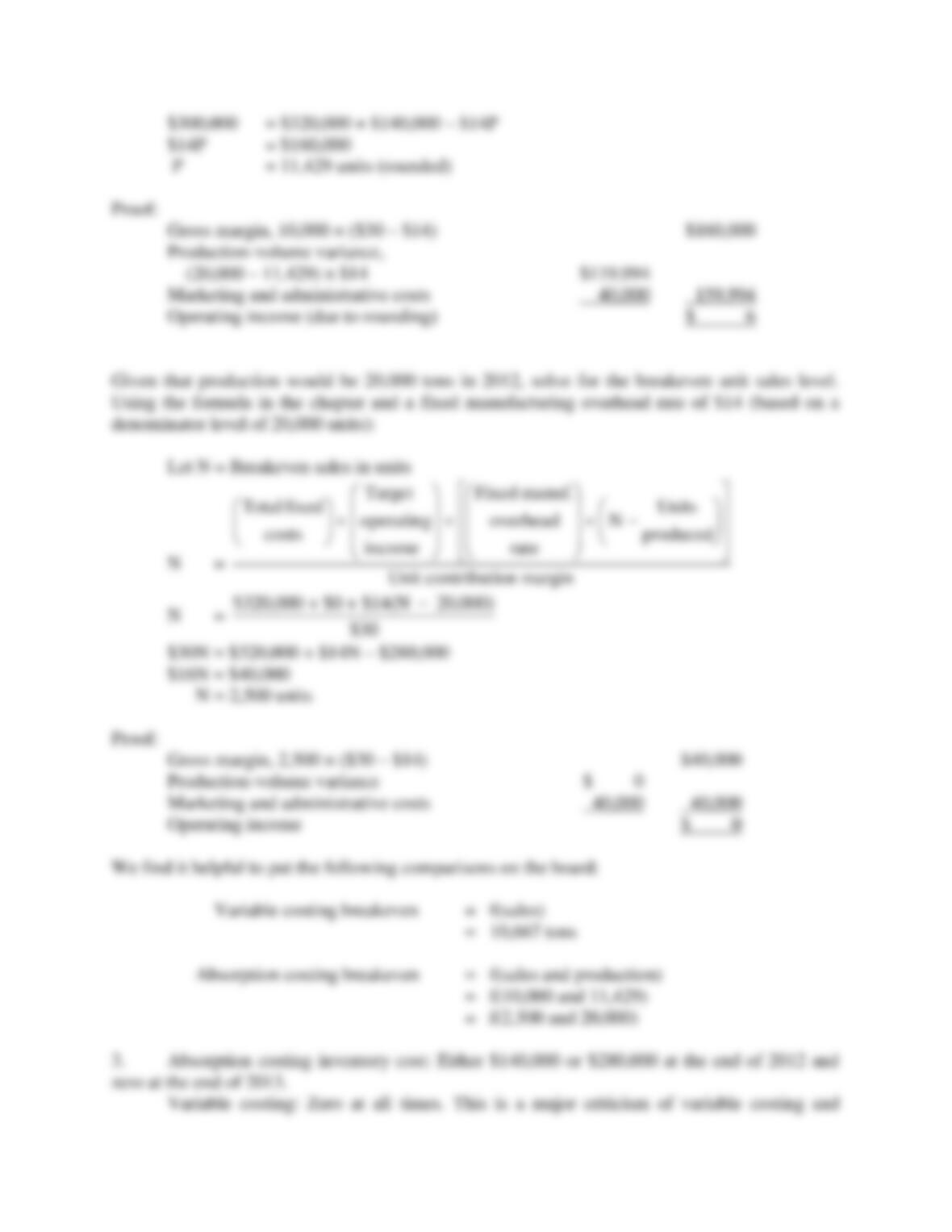
2. What is the breakeven point under (a) variable costing and (b) absorption costing?
3. What inventory costs would be carried in the balance sheet on December 31, 2012 and 2013,
under each method?
4. Assume that the performance of the top manager of the company is evaluated and rewarded
largely on the basis of reported operating income. Which costing method would the manager
prefer? Why?
SOLUTION
9-34
9-35
9-36
9-37
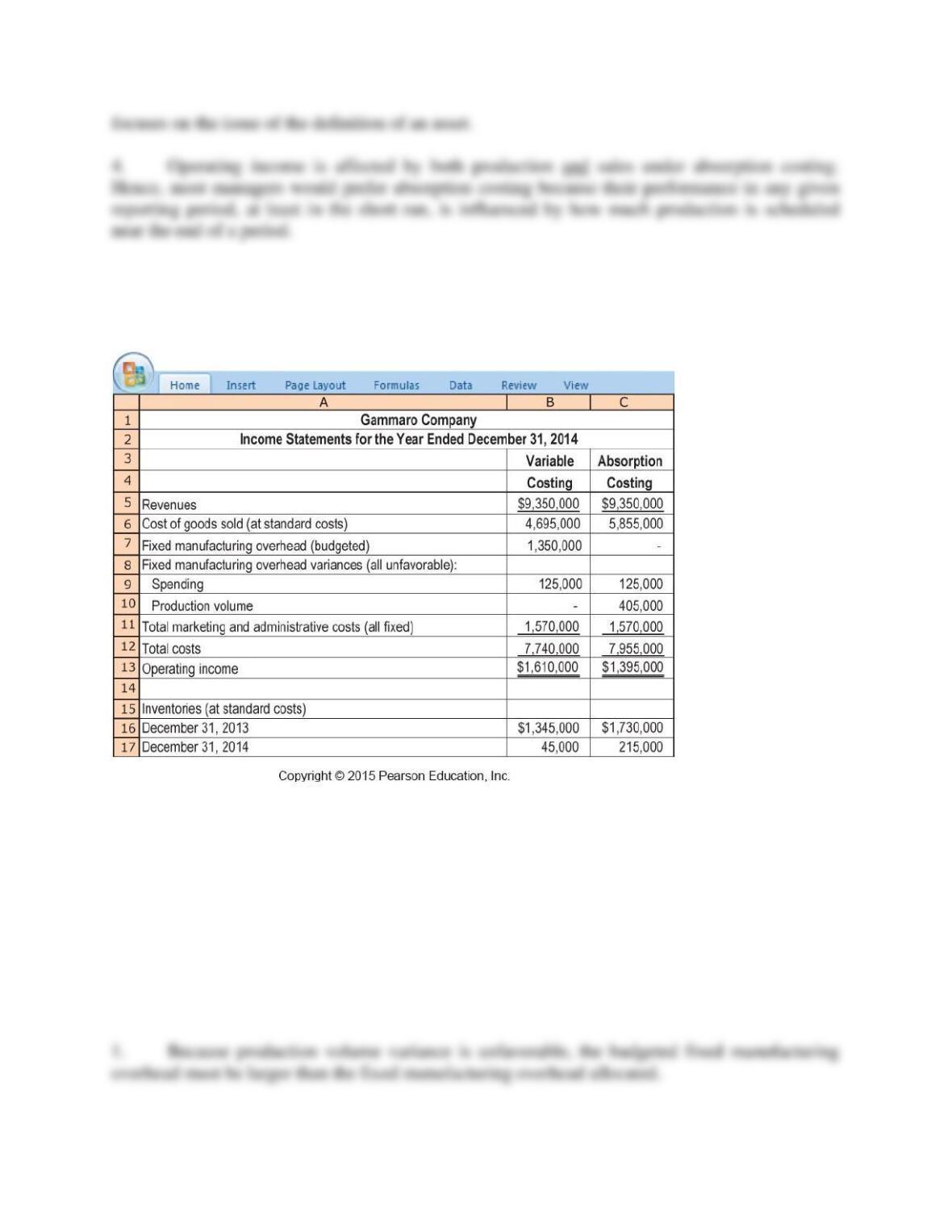
9-29 (30–35 min.) Comparison of variable costing and absorption costing.
Gammaro Company uses standard costing. Tim Sweeney, the new president of Gammaro
Company, is presented with the following data for 2014:
Required:
1. At what percentage of denominator level was the plant operating during 2014?
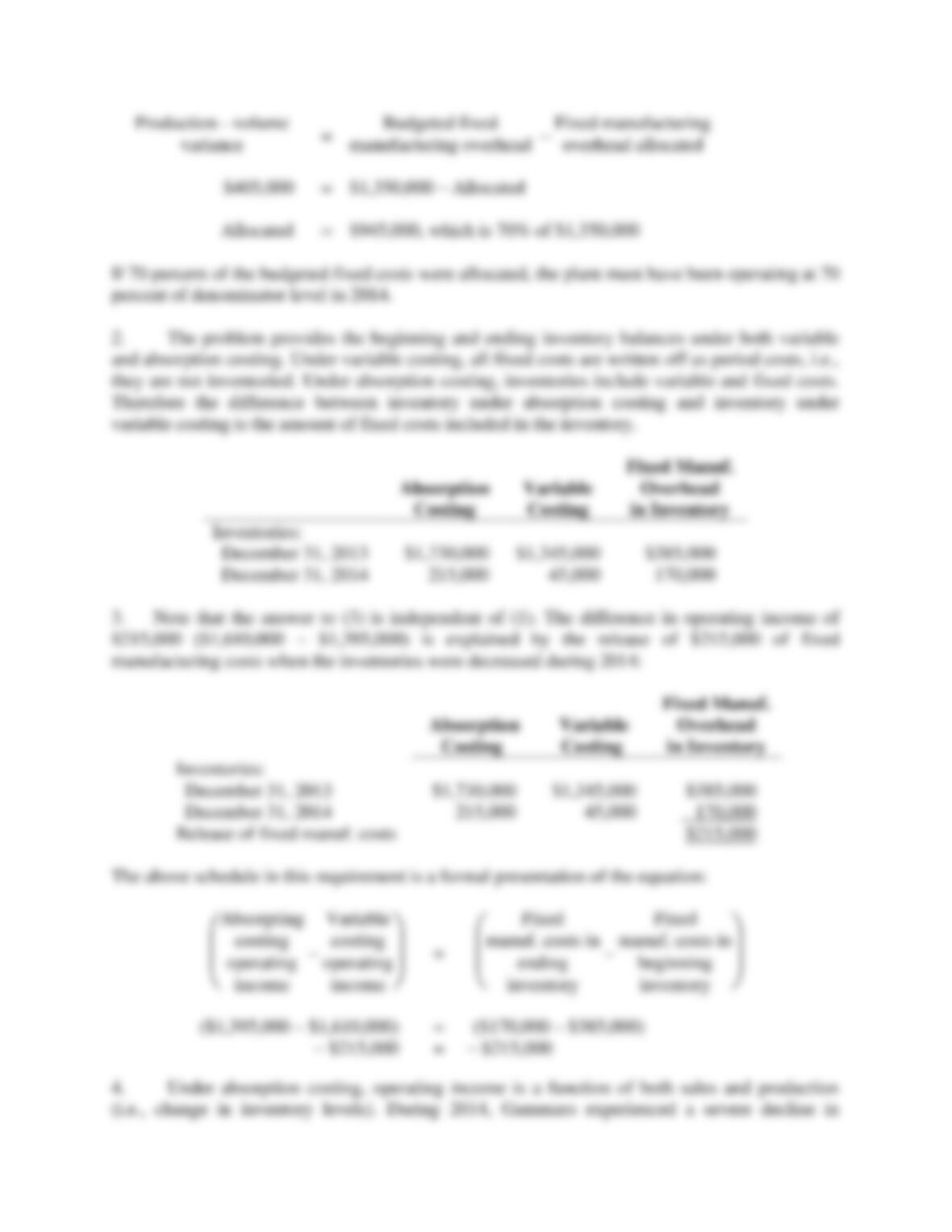
2. How much fixed manufacturing overhead was included in the 2013 and the 2014 ending
inventory under absorption costing?
3. Reconcile and explain the difference in 2014 operating incomes under variable and
absorption costing.
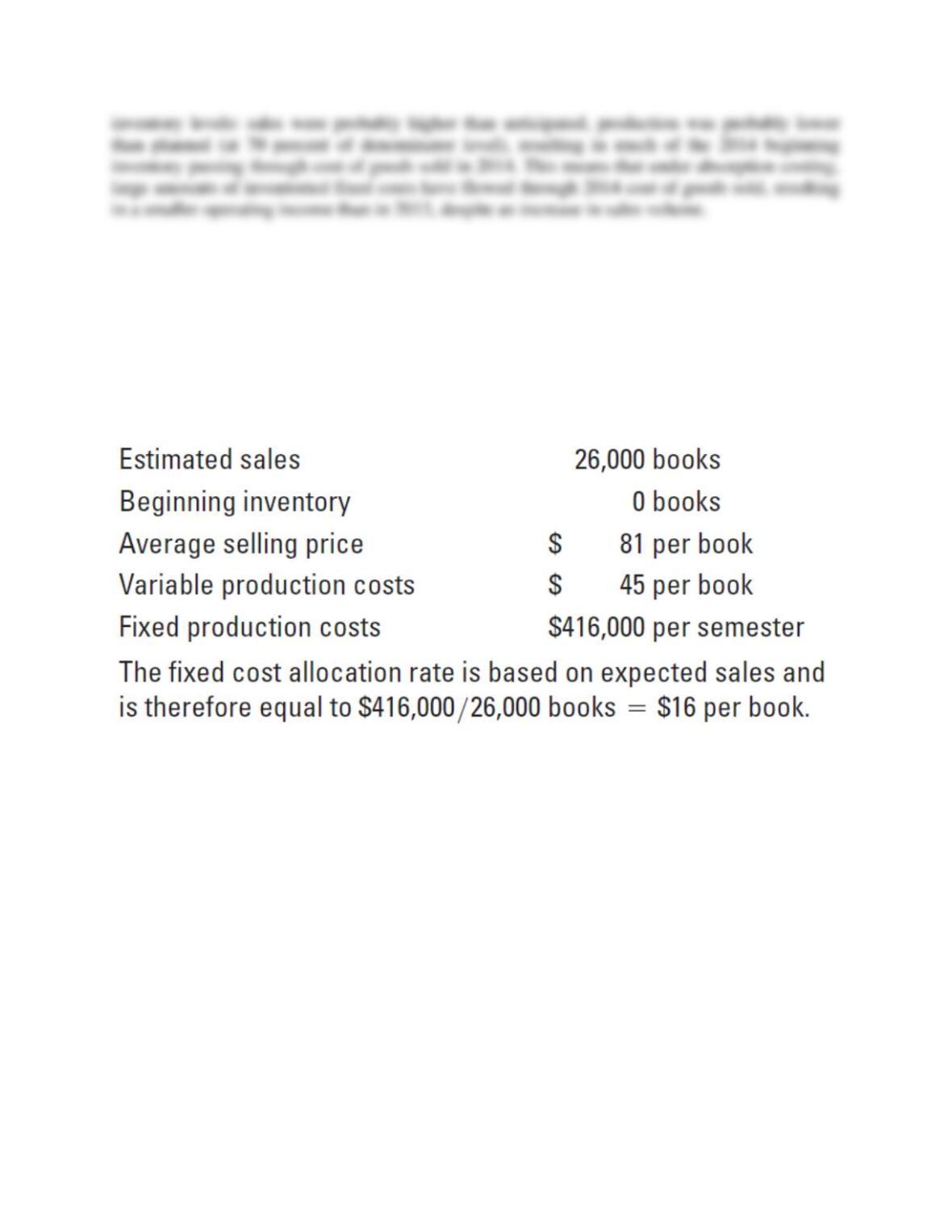
4. Tim Sweeney is concerned: He notes that despite an increase in sales over 2013, 2014
operating income has actually declined under absorption costing. Explain how this occurred.
SOLUTION
9-38
9-39
9-30 (30 min.) Effects of differing production levels on absorption costing income:
Metrics to minimize inventory buildups.
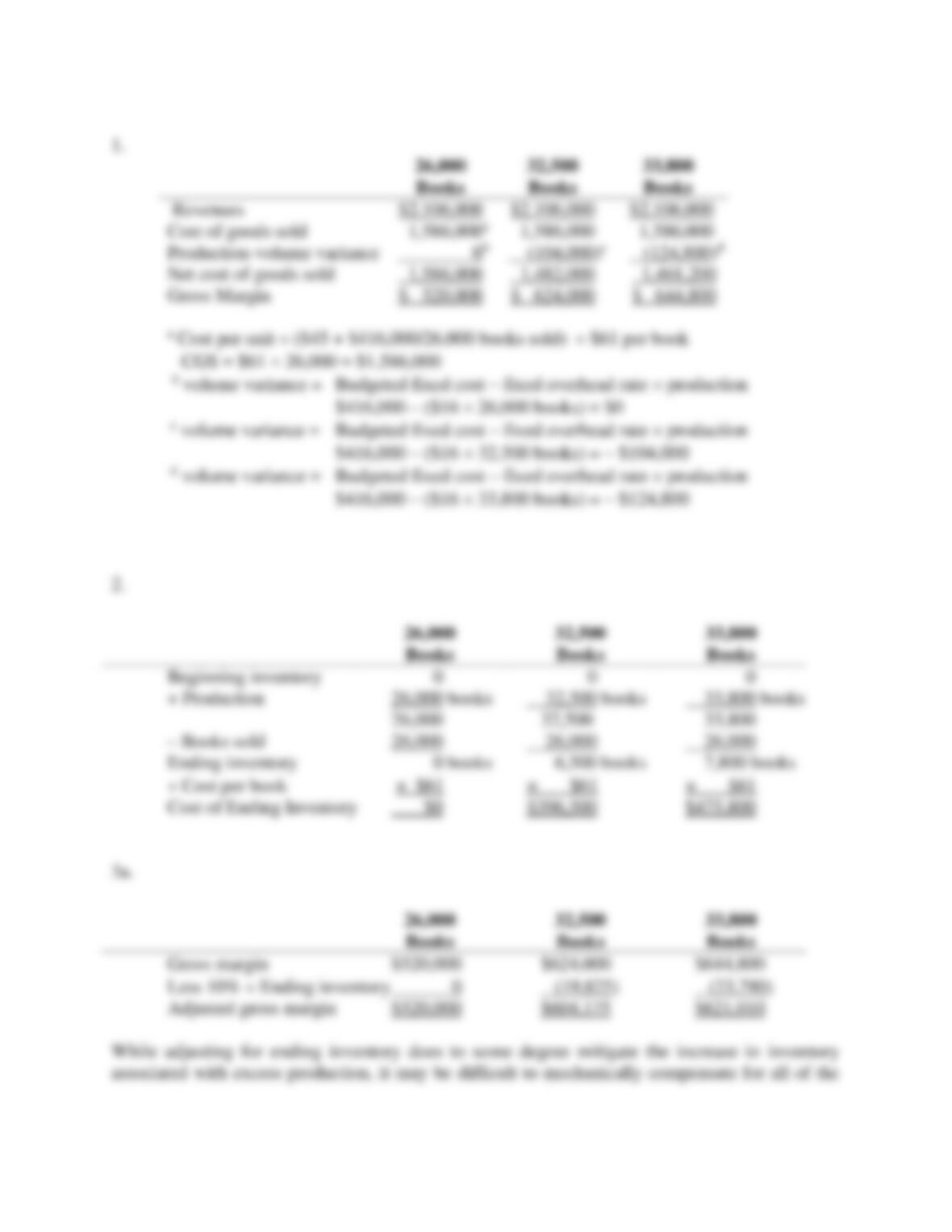
Horizon Press produces textbooks for college courses. The company recently hired a new editor,
Billie White, to handle production and sales of books for an introduction to accounting course.
Billie’s compensation depends on the gross margin associated with sales of this book. Billie
needs to decide how many copies of the book to produce. The following information is available
for the fall semester 2013:
Billie has decided to produce either 26,000, 32,500, or 33,800 books.
Required:
1. Calculate expected gross margin if Billie produces 26,000, 32,500, or 33,800 books. (Make
sure you include the production-volume variance as part of cost of goods sold.)
2. Calculate ending inventory in units and in dollars for each production level.
3. Managers who are paid a bonus that is a function of gross margin may be inspired to produce
a product in excess of demand to maximize their own bonus. The chapter suggested metrics
to discourage managers from producing products in excess of demand. Do you think the
following metrics will accomplish this objective? Show your work.
a. Incorporate a charge of 5% of the cost of the ending inventory as an expense for
evaluating the manager.
b. Include nonfinancial measures (such as the ones recommended on page 340) when
evaluating management and rewarding performance.
SOLUTION
9-40