Wild and Shaw, Financial & Managerial Accounting 9e Solutions Manual: Appendix D
Appendix D
Lean Principles and Accounting
QUICK STUDIES
Quick Study D-1 (5 minutes)
Quick Study D-2 (10 minutes)
1. L (Lean) 2. T (Traditional) 3. L (Lean) 4. T (Traditional)
Quick Study D-3 (5 minutes)
Work in Process Inventory …………………………...
28,000
28,000
Quick Study D-4 (5 minutes)
1.
Work in Process Inventory …………………………...
43,600
43,600
2. Conversion Costs ………………………………………….
43,600
43,600
Wild and Shaw, Financial & Managerial Accounting 9e Solutions Manual: Appendix D
Quick Study D-5 (5 minutes)
1.
Accounts Receivable …………………………………..
16,800
Sales ………………………………………………………
2. Cost of Goods Sold …………………………………….
11,760
Work in Process Inventory ……………………..
11,760
Quick Study D-6 (10 minutes)
1.
Accounts Receivable ……………………………………
33,250
Sales ……………………………………………………….
33,250
Cost of Goods Sold ……………………………………..
23,250
Work in Process Inventory ………………………
25,110
Quick Study D-7 (5 minutes)
Quick Study D-8 (10 minutes)
1.
2.
Work in Process Inventory ………………………..
40,625
Conversion Costs ……………………………….
40,625
Wild and Shaw, Financial & Managerial Accounting 9e Solutions Manual: Appendix D
D-3
Quick Study D-9 (5 minutes)
a.
Process time ……………………………………..
15 minutes
Move time …………………………………………
Cycle time …………………………………………
b.
Cycle efficiency (15 min./60 min.) ………
0.25
Quick Study D-10 (10 minutes)
a.
Process time ……………………………………..
2.10 days
Inspection time………………………………….
0.50 day
Wait time …………………………………………..
0.15 day
Quick Study D-11 (5 minutes)
Wild and Shaw, Financial & Managerial Accounting 9e Solutions Manual: Appendix D
Quick Study D-12 (15 minutes)
Cost of Quality Report
Quality Category
Cost
Category
Total
% of Total
Cost of Quality
Prevention
Training machine operators……
$50,000
$ 50,000
50%
Appraisal
Internal failure
External failure
Product recalls ………………………
Total cost of quality …………………
Quick Study D-13 (10 minutes)
Cost of Quality Report
Quality Category
Cost
Category
Total
% of Total
Cost of Quality
Prevention
Training cooks ………………………
$21,000
$ 21,000
35%
Appraisal
Internal failure
External failure
Free meals due to complaints ..
Total cost of quality …………………
Wild and Shaw, Financial & Managerial Accounting 9e Solutions Manual: Appendix D
D-5
Quick Study D-14 (5 minutes)
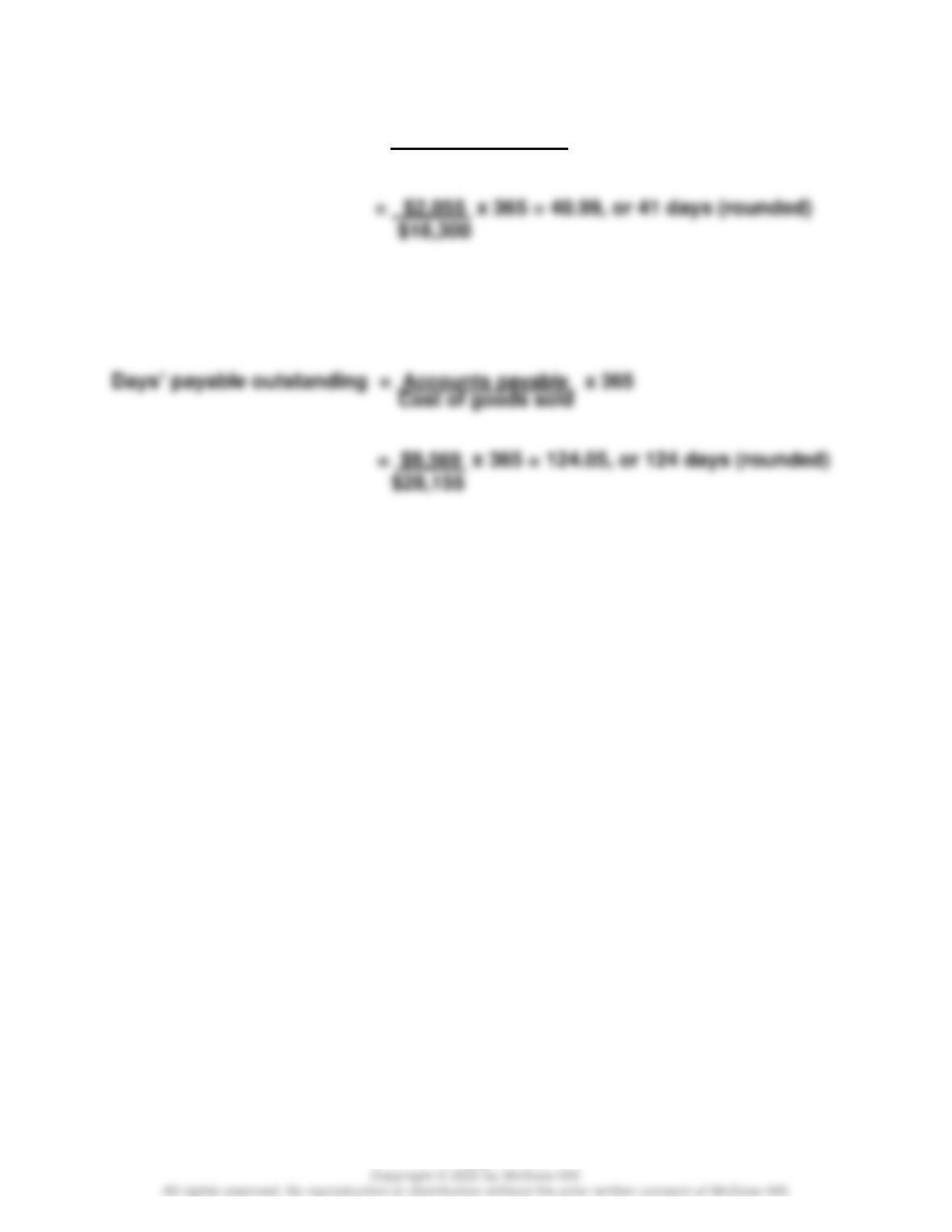
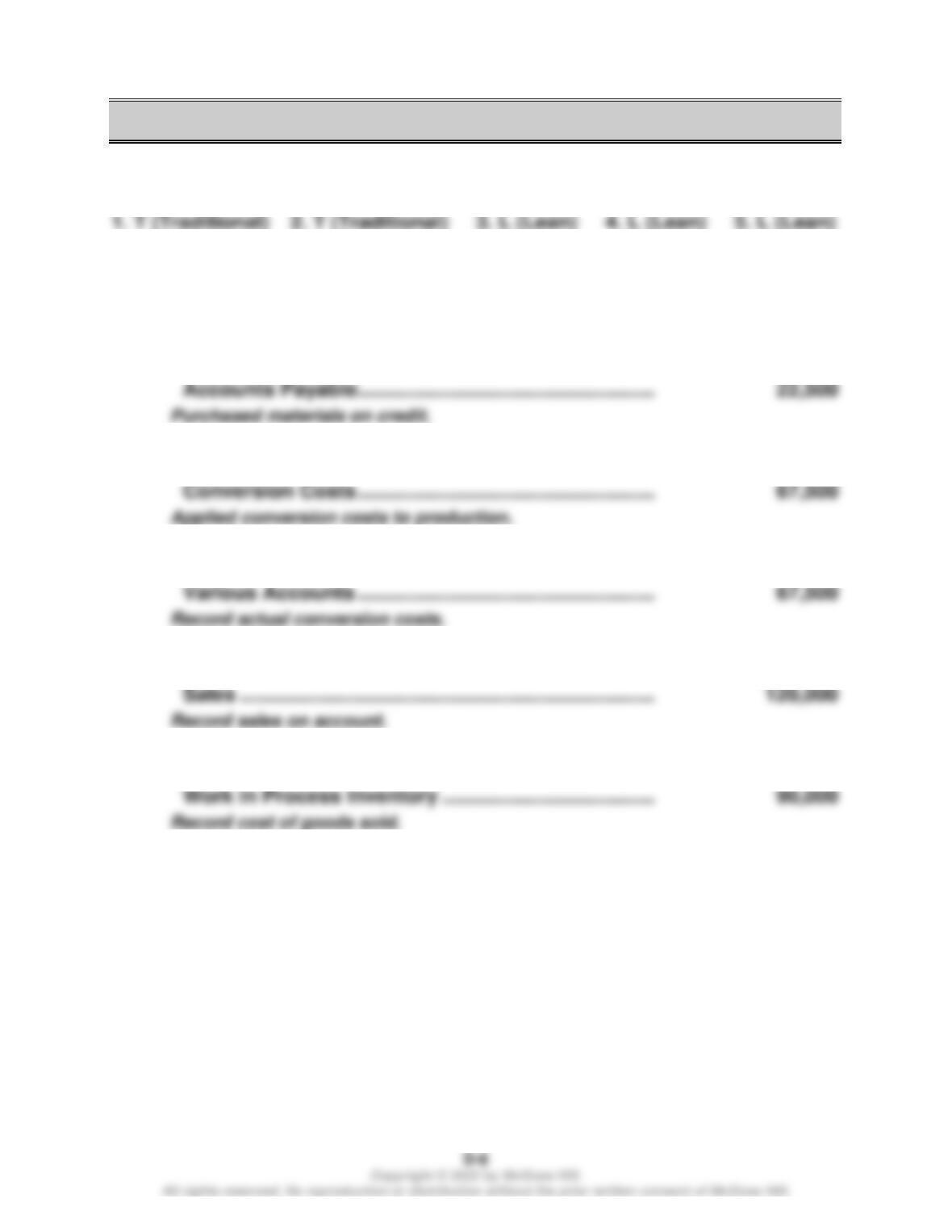
Days’ payable outstanding = Accounts payable x 365
Cost of goods sold
Quick Study D-15 (5 minutes)
Wild and Shaw, Financial & Managerial Accounting 9e Solutions Manual: Appendix D
EXERCISES
Exercise D-1 (10 minutes)
Exercise D-2 (15 minutes)
1.
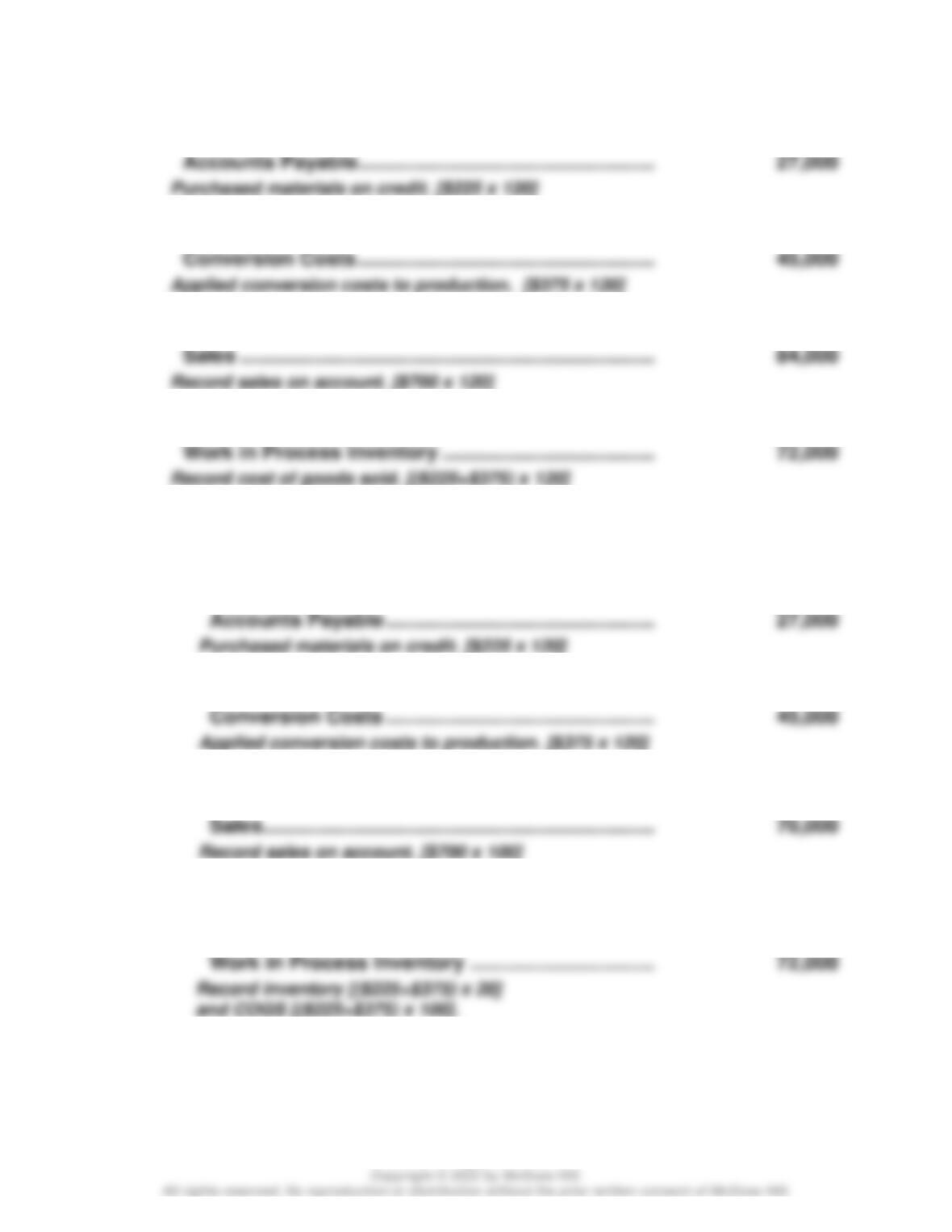
Work in Process Inventory …………………………………….
22,500
22,500
2.
Work in Process Inventory …………………………………….
67,500
67,500
3.
Conversion Costs ………………………………………………….
67,500
67,500
4.
Accounts Receivable …………………………………………….
120,000
5.
Cost of Goods Sold ……………………………………………….
90,000
90,000
Wild and Shaw, Financial & Managerial Accounting 9e Solutions Manual: Appendix D
D-7
Exercise D-3 (15 minutes)
1.
Work in Process Inventory …………………………………….
27,000
27,000
2.
Work in Process Inventory …………………………………….
45,000
45,000
3.
Accounts Receivable …………………………………………….
84,000
84,000
4.
Cost of Goods Sold ……………………………………………….
72,000
72,000
Exercise D-4 (15 minutes)
1.
Work in Process Inventory ………………………………..
27,000
27,000
2.
Work in Process Inventory ………………………………..
45,000
45,000
3.
Accounts Receivable …………………………………………
70,000
70,000
4.
Finished Goods Inventory …………………………………
Cost of Goods Sold …………………………………………..
12,000
60,000
72,000
Wild and Shaw, Financial & Managerial Accounting 9e Solutions Manual: Appendix D
D-8
Exercise D-5 (10 minutes)
Exercise D-6 (15 minutes)
1.
Process time ………………………………………………………
6 days
Move time ………………………………………………………….
Cycle time ………………………………………………………….
2.
Cycle efficiency (6 days/ 15 days) ……………………..
0.40
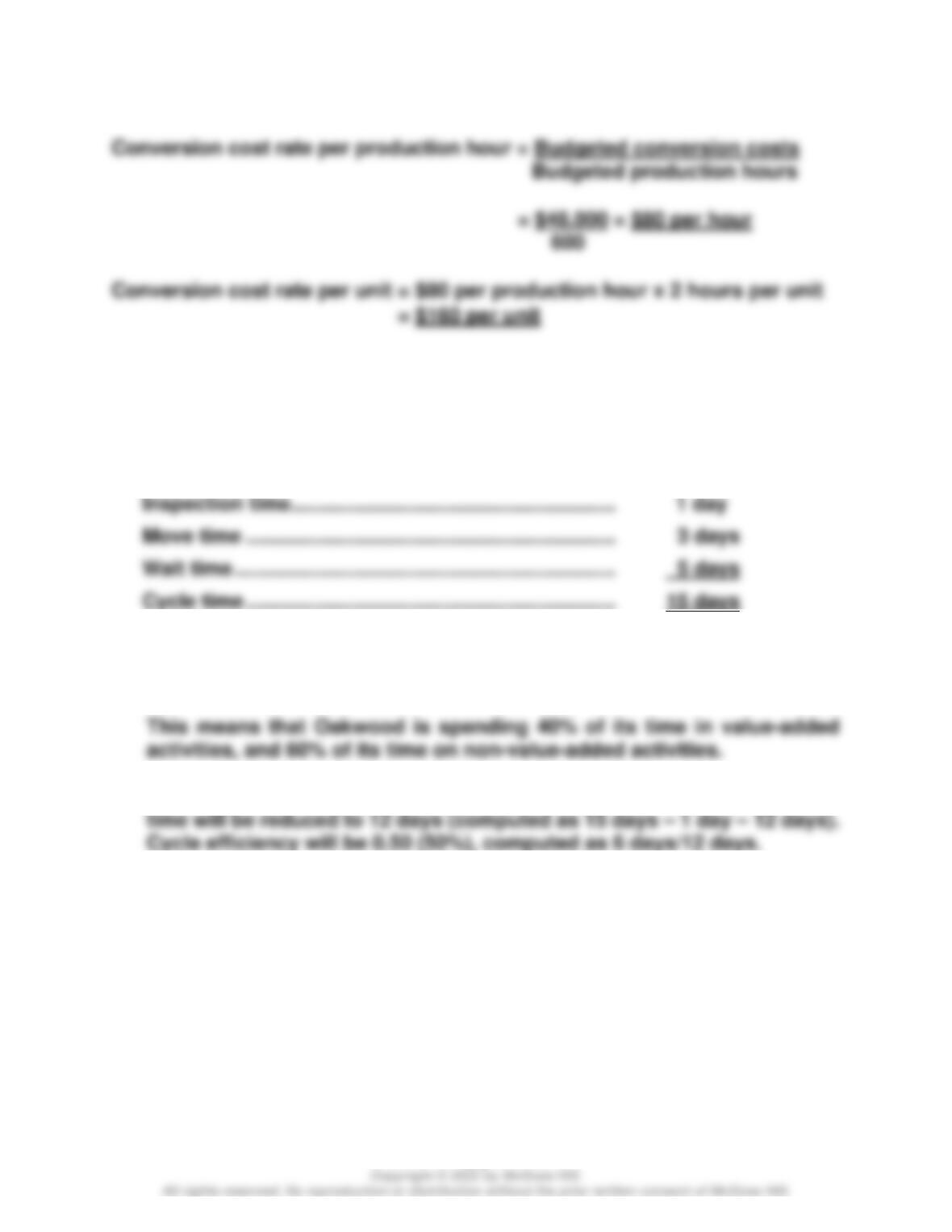
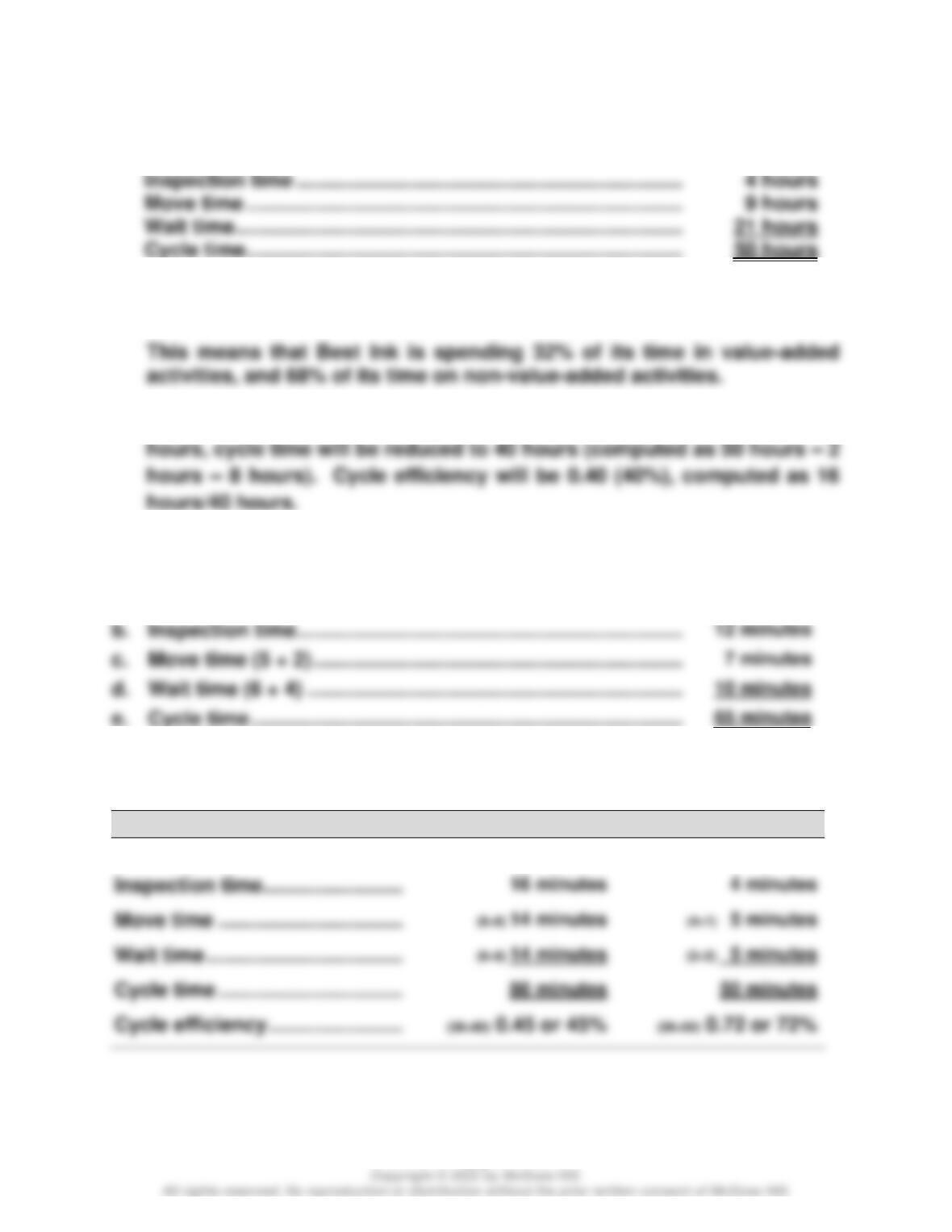
This means that Oakwood is spending 40% of its time in value-added
3. If move time is reduced by 1 day and wait time is reduced by 2 days, cycle
Wild and Shaw, Financial & Managerial Accounting 9e Solutions Manual: Appendix D
D-9
Exercise D-7 (15 minutes)
1.
Process time ……………………………………………………………….
16 hours
Move time ……………………………………………………….…………..
Wait time ……………………………………………………………………..
Cycle time ……………………………………………………………………
50 hours
2.
Cycle efficiency (16 hours/ 50 hours) ………………….
0.32
This means that Best Ink is spending 32% of its time in value-added
3. If inspection time is reduced by 2 hours and wait time is reduced by 8
Exercise D-8 (15 minutes)
a.
Value-added time = Process time (18 + 8 + 10) ……………..
36 minutes
c.
e.
65 minutes
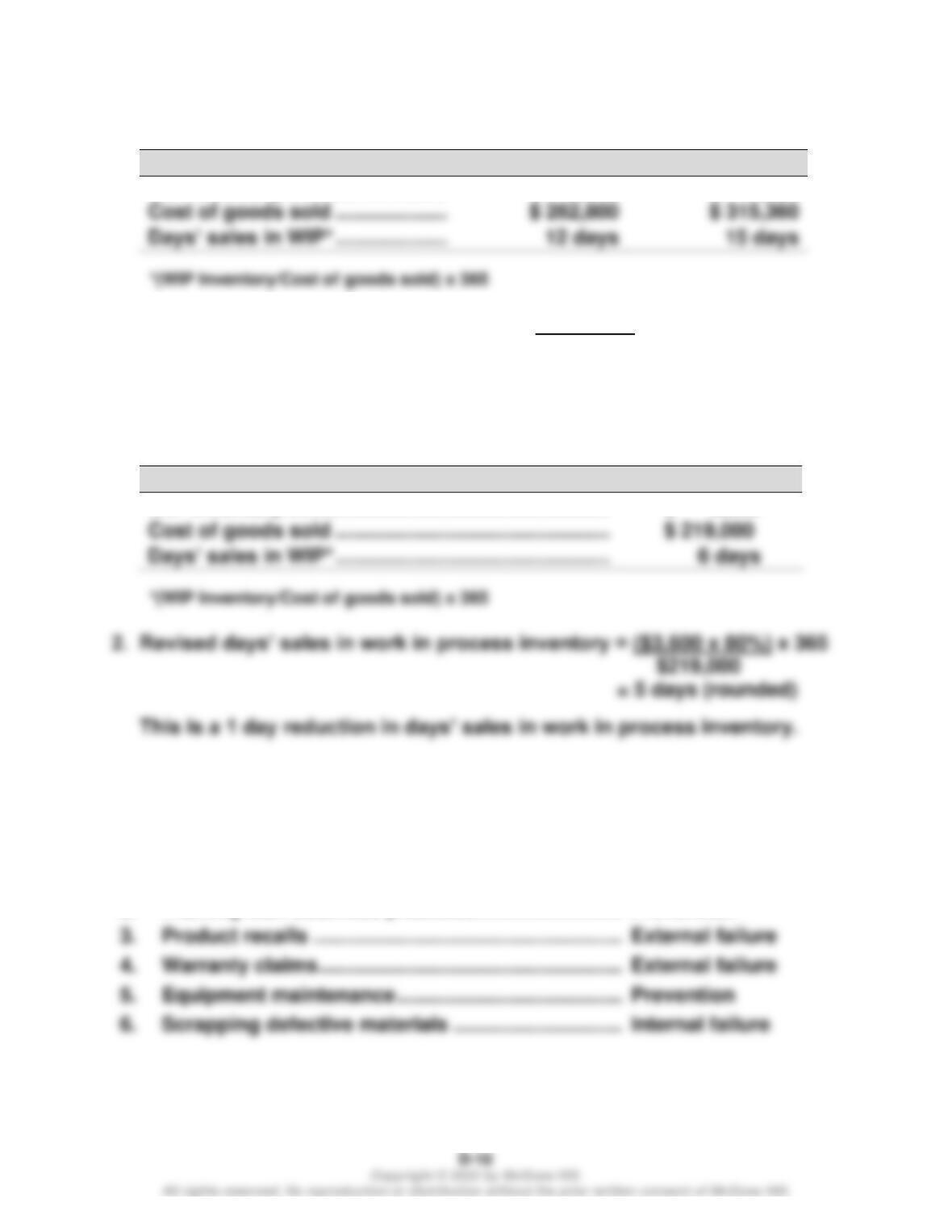
Exercise D-9 (20 minutes)
Activity
(a) Traditional
(b) Lean
Process time ………………………..
(18+8+10) 36 minutes
(18+8+10) 36 minutes
Move time …………………………...
Wait time ……………………………..
Cycle efficiency ……………………
Wild and Shaw, Financial & Managerial Accounting 9e Solutions Manual: Appendix D
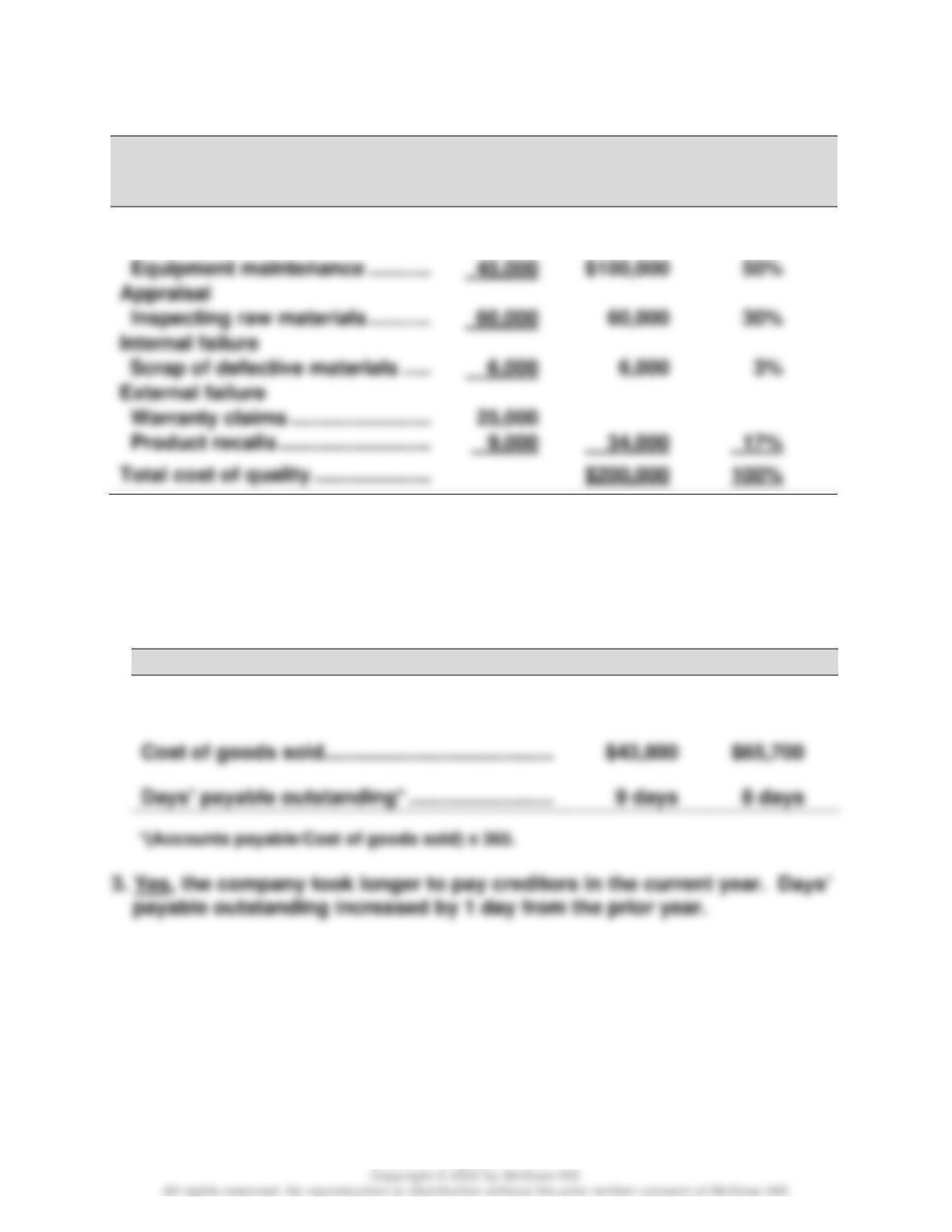
Exercise D-10 (10 minutes)
1. and 2.
$ thousands
Current Year
Prior Year
WIP Inventory ………………………..
$ 8,640
$ 13,284
3. Days’ sales in work in process inventory decreased by 3 days from the
prior year.
Exercise D-11 (10 minutes)
1.
Current Year
WIP Inventory ………………………………………………….
$ 3,600
$ 219,000
Exercise D-12 (5 minutes)
1.
Inspecting raw materials …………………………………..
Appraisal
2.
Training lean business practices ……………………….
Prevention
3.
External failure
4.
Warranty claims ………………………………………………..
External failure
5.
Equipment maintenance ……………………………………
Prevention
6.
Scrapping defective materials …………………………..
Internal failure
Wild and Shaw, Financial & Managerial Accounting 9e Solutions Manual: Appendix D
D-11
Exercise D-13 (15 minutes)
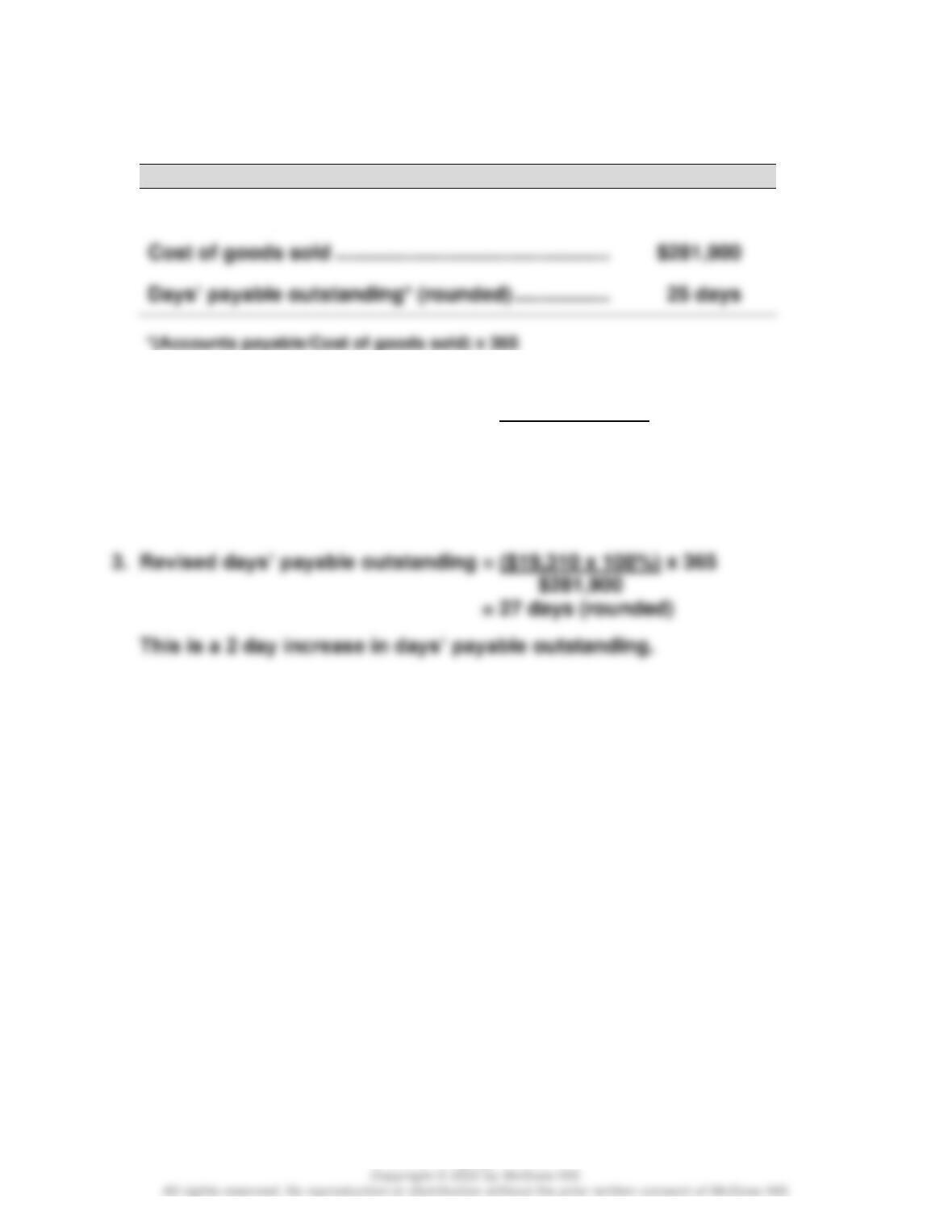
Cost of Quality Report
Quality Category
Cost
Category
Total
% of Total
Cost of Quality
Prevention
Training lean bus. practices …..
$55,000
Appraisal
Inspecting raw materials ………..
Exercise D-14 (10 minutes)
1. and 2.
Current Year
Prior Year
Accounts payable ……………………………………
$ 1,080
$ 1,440
Cost of goods sold …………………………………..
Wild and Shaw, Financial & Managerial Accounting 9e Solutions Manual: Appendix D
D-12
Exercise D-15 (10 minutes)
1.
$ millions
Current Year
Accounts payable ……………………………………………
$ 19,310
2. Revised days’ payable outstanding = ($19,310 x 92%) x 365
$281,900
= 23 days (rounded)
This is a 2 day decrease in days’ payable outstanding.
Wild and Shaw, Financial & Managerial Accounting 9e Solutions Manual: Appendix D
PROBLEMS
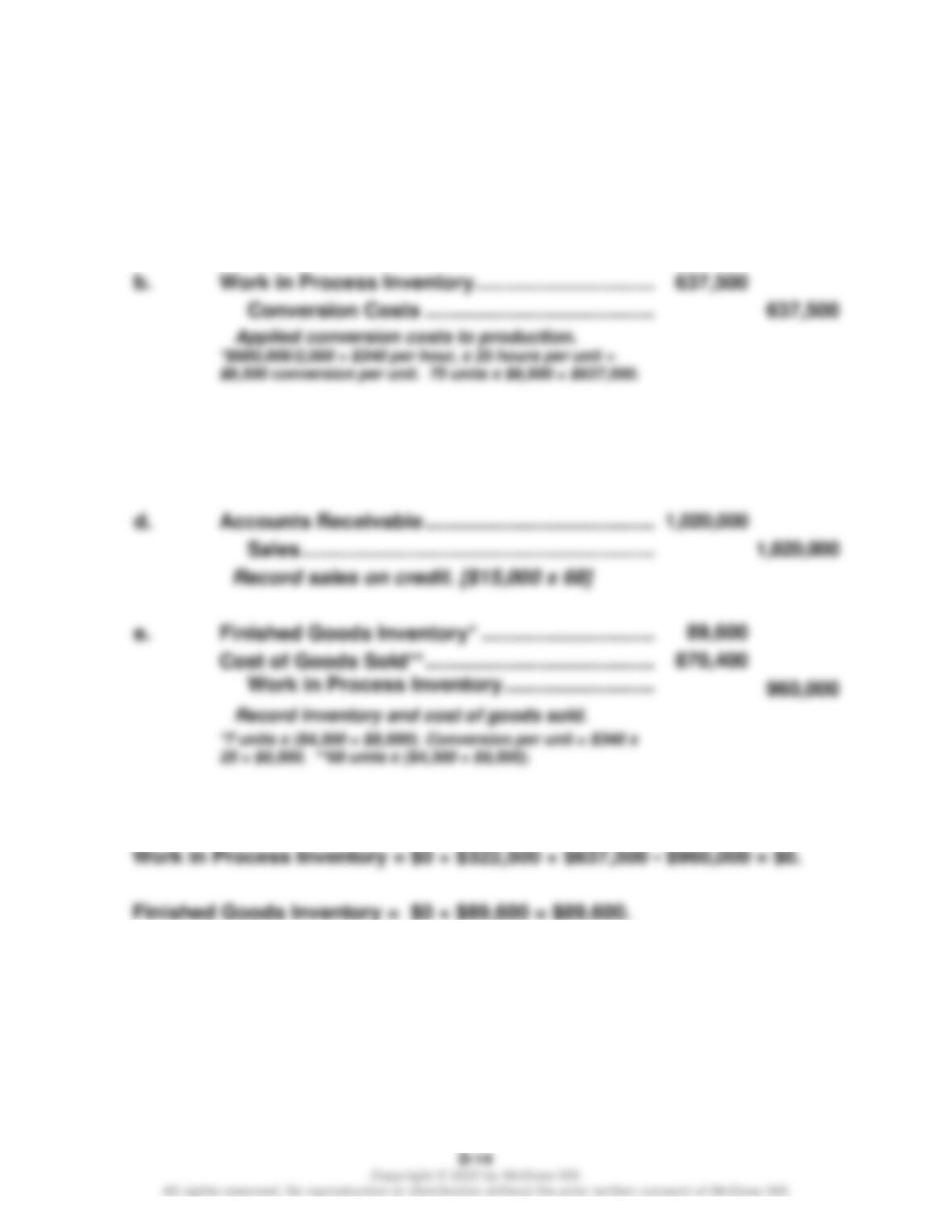
Problem D-1 (15 minutes)
2. Journal entries
a.
Work in Process Inventory …………………………..
150,000
Accounts Payable …………………………………..
150,000
Purchased materials on credit. [$250 x 600]
Work in Process Inventory …………………………..
240,000
Conversion Costs …………………………………..
240,000
c.
Accounts Receivable …………………………………..
Sales ………………………………………………………
Work in Process Inventory ………………………
390,000
Wild and Shaw, Financial & Managerial Accounting 9e Solutions Manual: Appendix D
Problem D-2 (25 minutes)
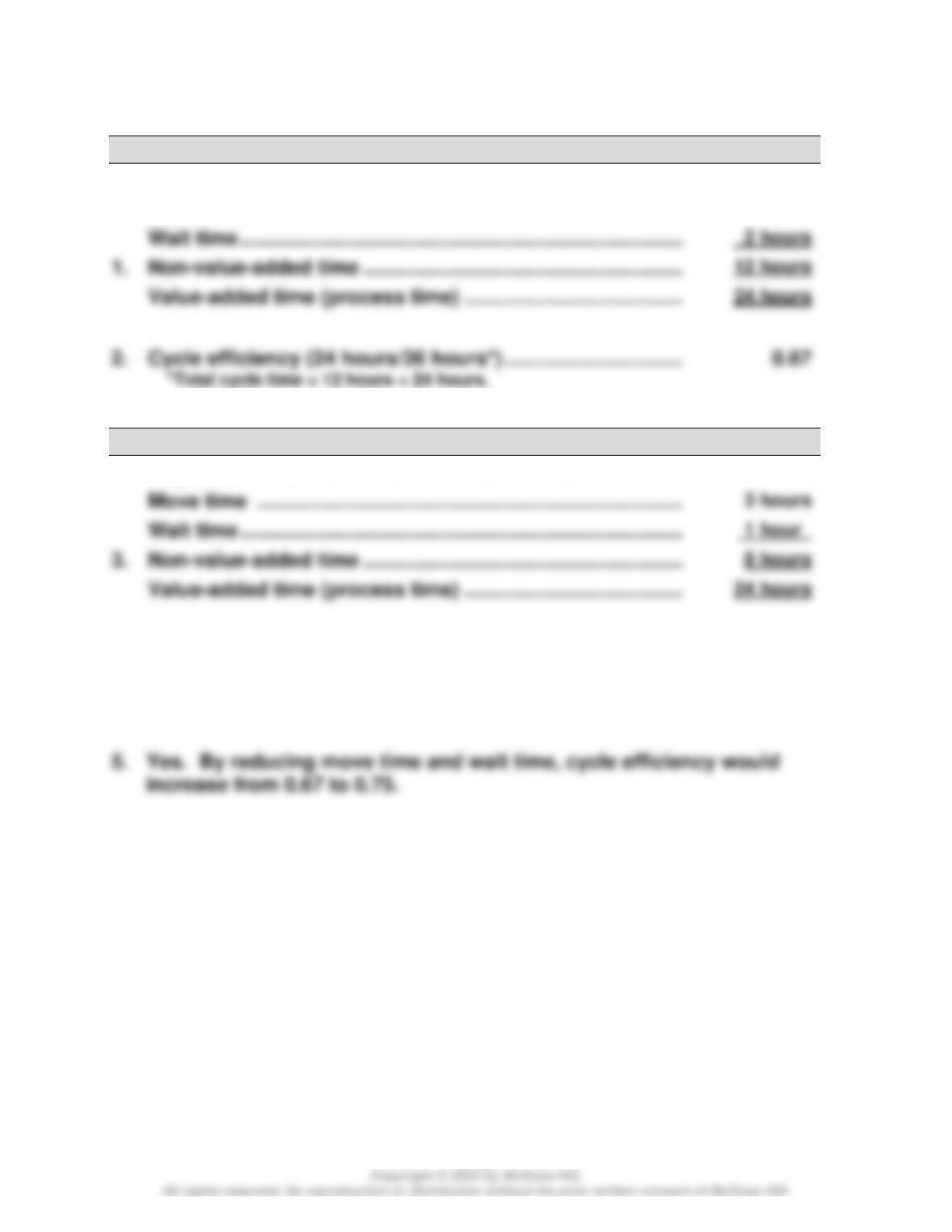
1. Journal entries
a.
Work in Process Inventory …………………………..
322,500
Accounts Payable …………………………………..
322,500
Purchased materials on credit. [$4,300 x 75]
Work in Process Inventory …………………………..
637,500
Conversion Costs …………………………………..
637,500
c.
Conversion Costs ……………………………………….
637,500
Various Accounts ……………………………………
637,500
Record actual conversion costs.
2. Ending balances
Wild and Shaw, Financial & Managerial Accounting 9e Solutions Manual: Appendix D
D-15
Problem D-3 (25 minutes)
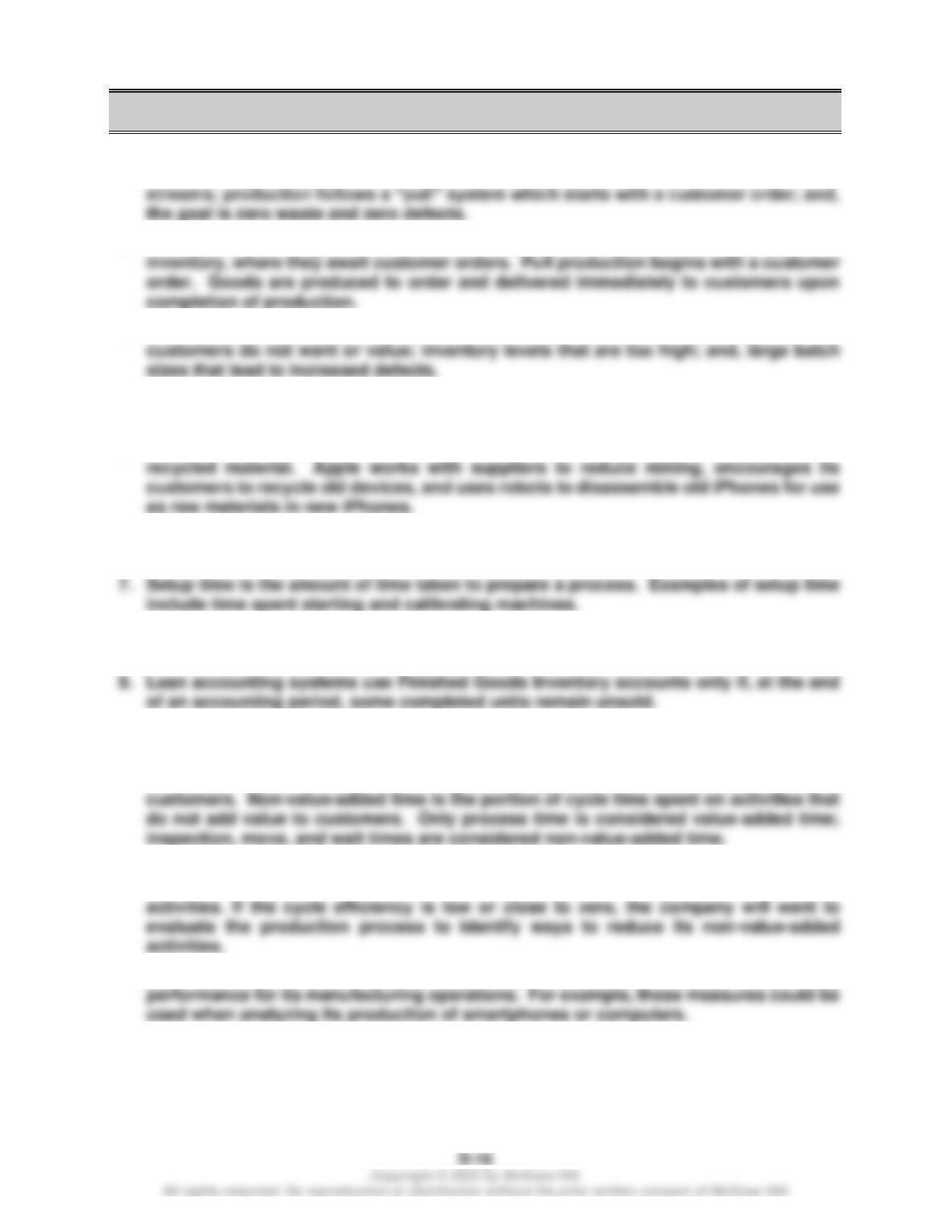
Traditional approach
Inspection time……………………………………………………………
4 hours
Move time …………………………………………………………………..
6 hours
2.
Cycle efficiency (24 hours/36 hours*) …………………………..
0.67
Lean approach
Inspection time……………………………………………………………
4 hours
Move time ………………………………………………………………….
3 hours
Wait time …………………………………………………………………….
8 hours
4.
Cycle efficiency (24 hours/32 hours*) …………………………..
0.75
*Total cycle time = 8 hours + 24 hours.
Wild and Shaw, Financial & Managerial Accounting 9e Solutions Manual: Appendix D
QUESTIONS
1. The three key principles of the lean business model are: Production occurs in value
2. Push production begins with a sales forecast. Goods are produced and pushed into
3. Three common problems of push production include the production of goods that
4. Supply chain management is the control of materials, information, and finances as
they move between suppliers, manufacturers, and customers.
5. In a closed-loop supply chain, products are built using renewable resources or
6. Yes. Retailers like Amazon can use lean techniques to improve their order fulfillment
and customer service processes.
8. Lean manufacturers immediately place materials into production, so there is no need
for separate Raw Materials Inventory accounts.
10. Cycle time is the amount of time it takes to produce a good or provide a service. Its
components include process time, inspection time, move time, and wait time.
11. Value-added time is the portion of cycle time spent on activities that add value to
12. Cycle efficiency is the ratio of value-added time divided by total cycle time. The closer
cycle efficiency is to 1, the more of a company’s time is spent on value-added
13. Yes. Samsung can use cycle time and cycle efficiency to measure operating