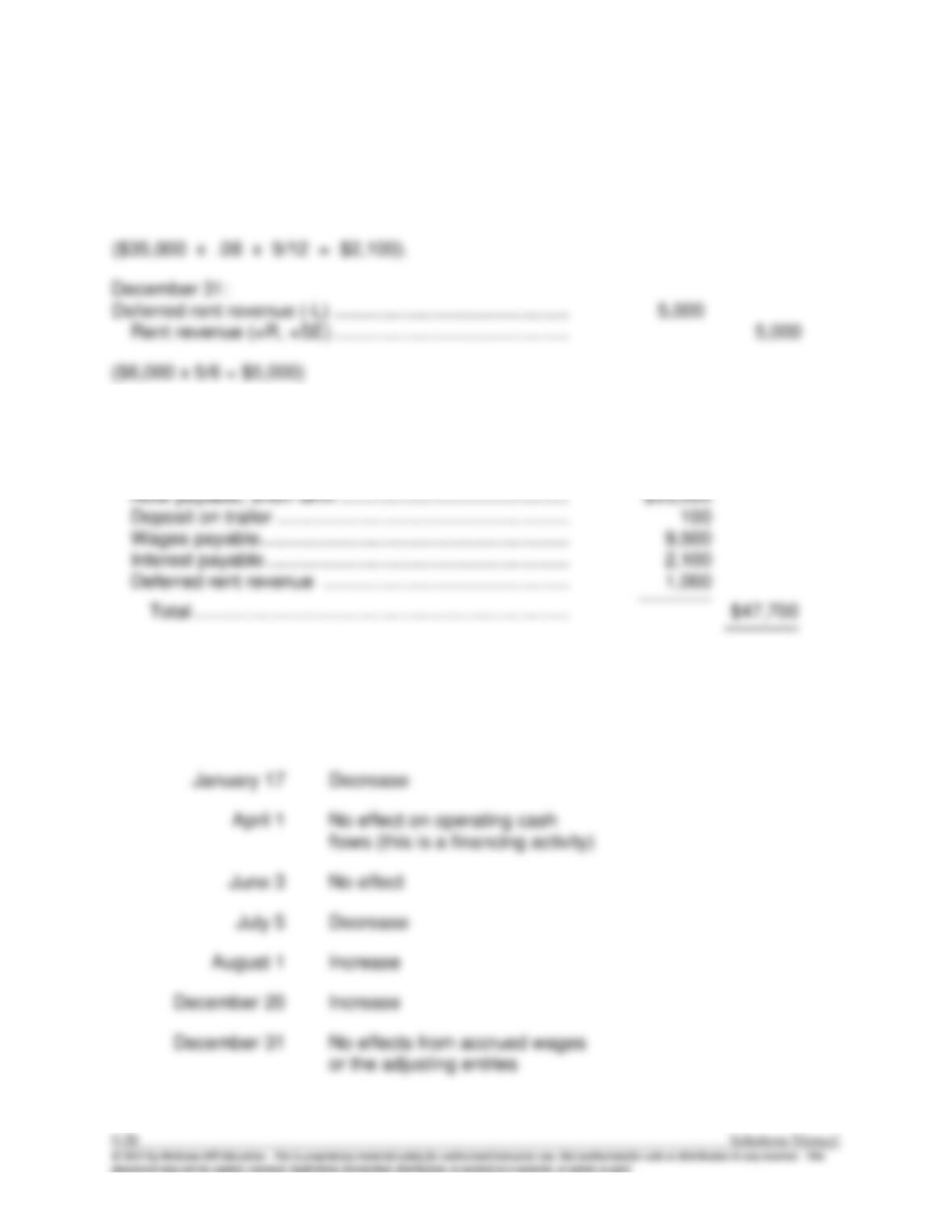
Req. 2
December 31:
Interest expense (+E, –SE). ……………………………………..
2,100
Interest payable (+L) ……………………………………………
2,100
Deferred rent revenue (-L) ………………………………………
5,000
Rent revenue (+R, +SE) ………………………………………
Req. 3
Balance Sheet, December 31
Current Liabilities
Note payable, short term ……………………………………..
Deposit on trailer ………………………………………………..
Wages payable …………………………………………………..
Interest payable ………………………………………………….
Req. 4
Transaction
Effect
January 8
No effect
Decrease
flows (this is a financing activity)
No effect
Decrease
Increase
December 20
Increase
or the adjusting entries
Financial Accounting, 10/e 9-21
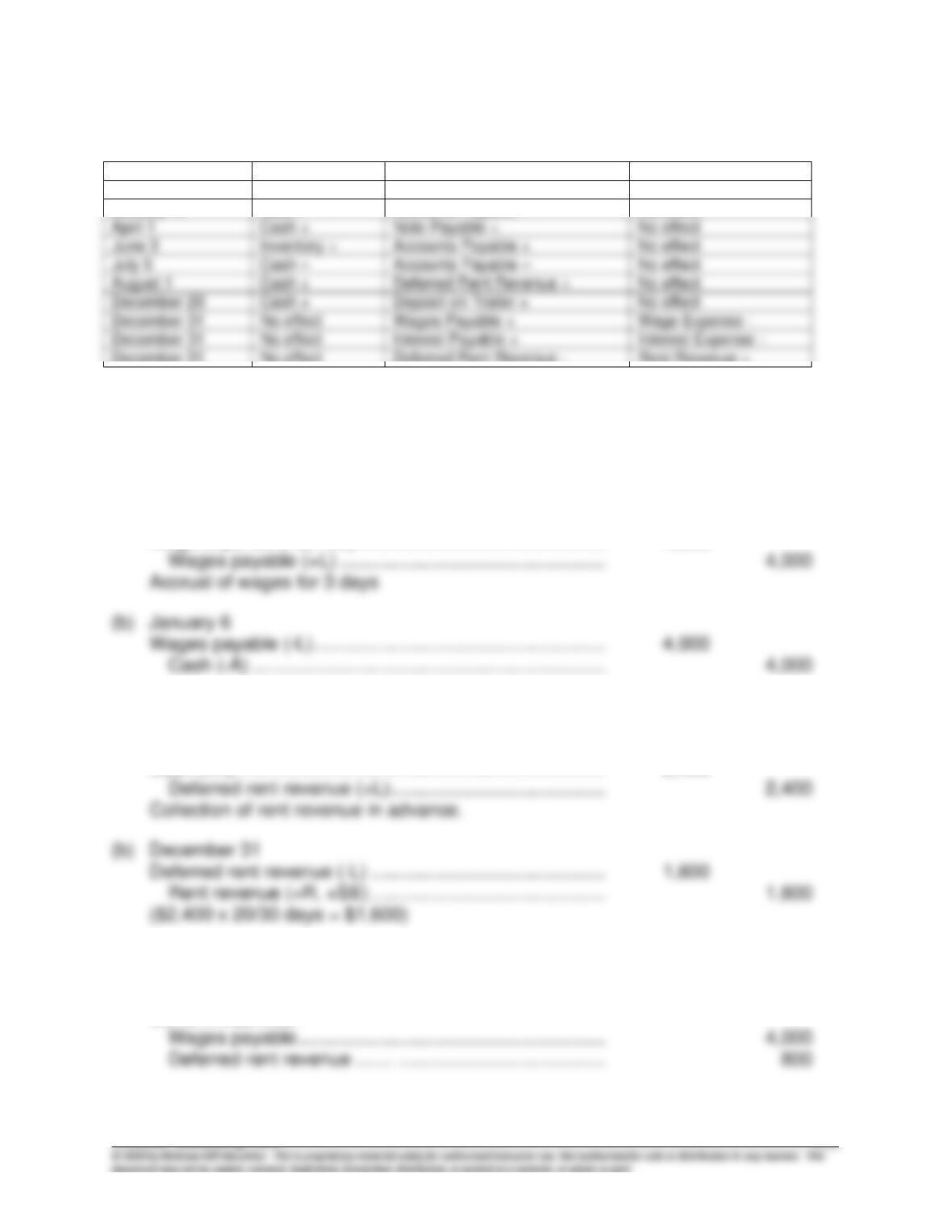
P9–3.
Date
Assets
Liabilities
Stockholders’ Equity
January 8
Inventory +
Accounts Payable +
No effect
January 17
Cash –
Accounts Payable –
No effect
April 1
Cash +
Note Payable +
No effect
June 3
Inventory +
Accounts Payable +
No effect
July 5
Cash –
Accounts Payable –
No effect
August 1
Cash +
Deferred Rent Revenue +
No effect
December 20
Cash +
Deposit on Trailer +
No effect
December 31
No effect
Wages Payable +
Wage Expense –
December 31
No effect
Interest Payable +
Interest Expense –
December 31
No effect
Deferred Rent Revenue –
Rent Revenue +
P9–4.
Req. 1
(a) December 31
Wage expense (+E, –SE) ………………………………………..
4,000
Wages payable (+L) ……………………………………………
4,000
Accrual of wages for 3 days
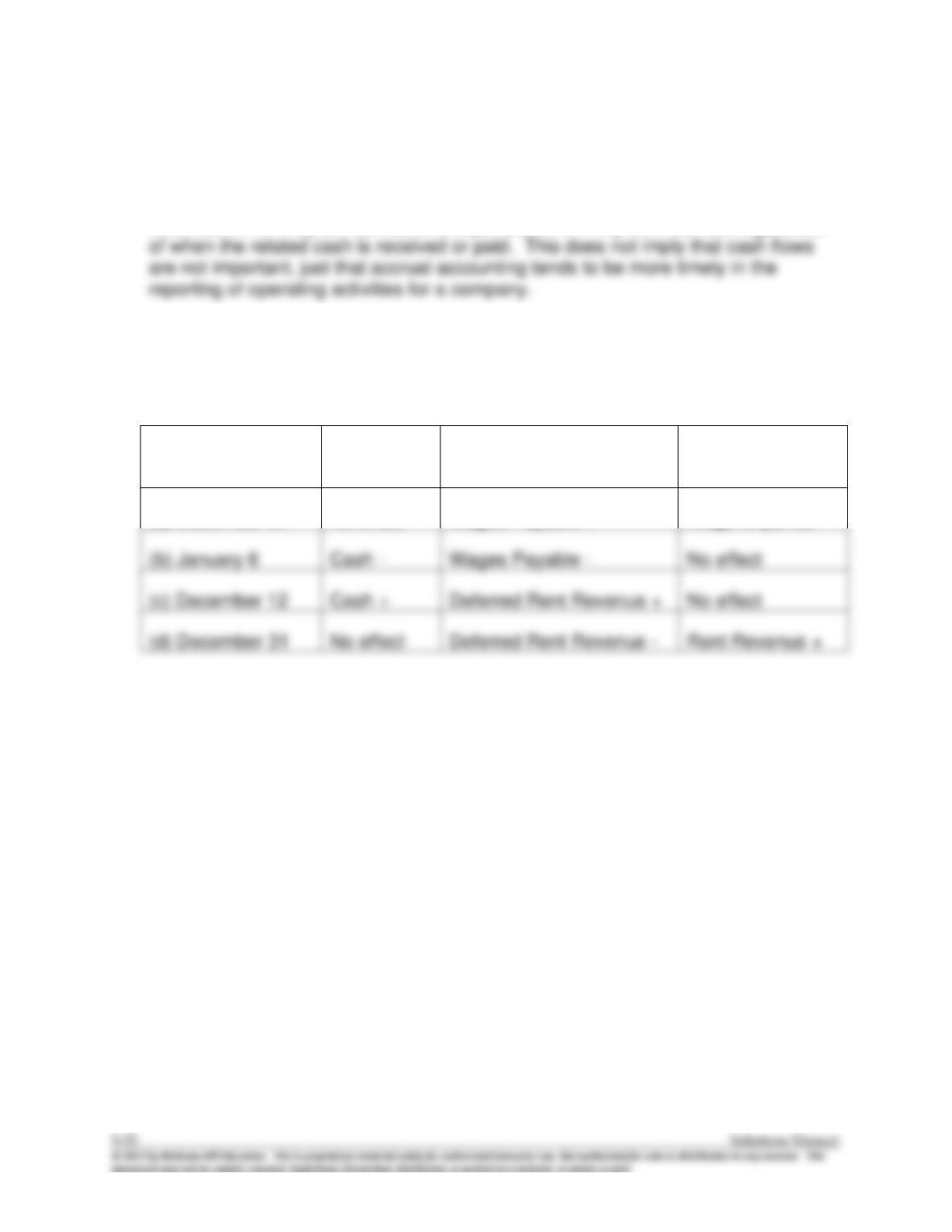
Wages payable (-L) ………………………………………………..
4,000
Cash (-A) …………………………..………………………………
4,000
Req. 2
(a) December 12
Cash (+A) ……………………………………………………………..
2,400
Deferred rent revenue (+L) …………………………………..
2,400
Collection of rent revenue in advance.
Deferred rent revenue (-L) ………………………………………
Req. 3
Balance sheet at December 31
Current Liabilities:
Wages payable …………………………………………………..
4,000
Deferred rent revenue ……. ………………………………….
P9–4. (continued)
Req. 4
Accrual-based accounting is more useful to financial analysts because it records
revenues when they are earned and expenses when they are incurred, regardless
P9–5.
Date
Assets
Liabilities
Stockholders’
Equity
(a) December 31
No effect
Wages Payable +
Wage Expense –
(b) January 6
Cash –
Wages Payable –
No effect
(c) December 12
Cash +
Deferred Rent Revenue +
No effect
(d) December 31
No effect
Deferred Rent Revenue –
Rent Revenue +
Financial Accounting, 10/e 9-23
P9–6.
1. Estimated warranty costs for the current year
Warranty expense (+E, –SE) ……………………………………
500,000,000
Warranty payable (+L) …………………………………………
500,000,000
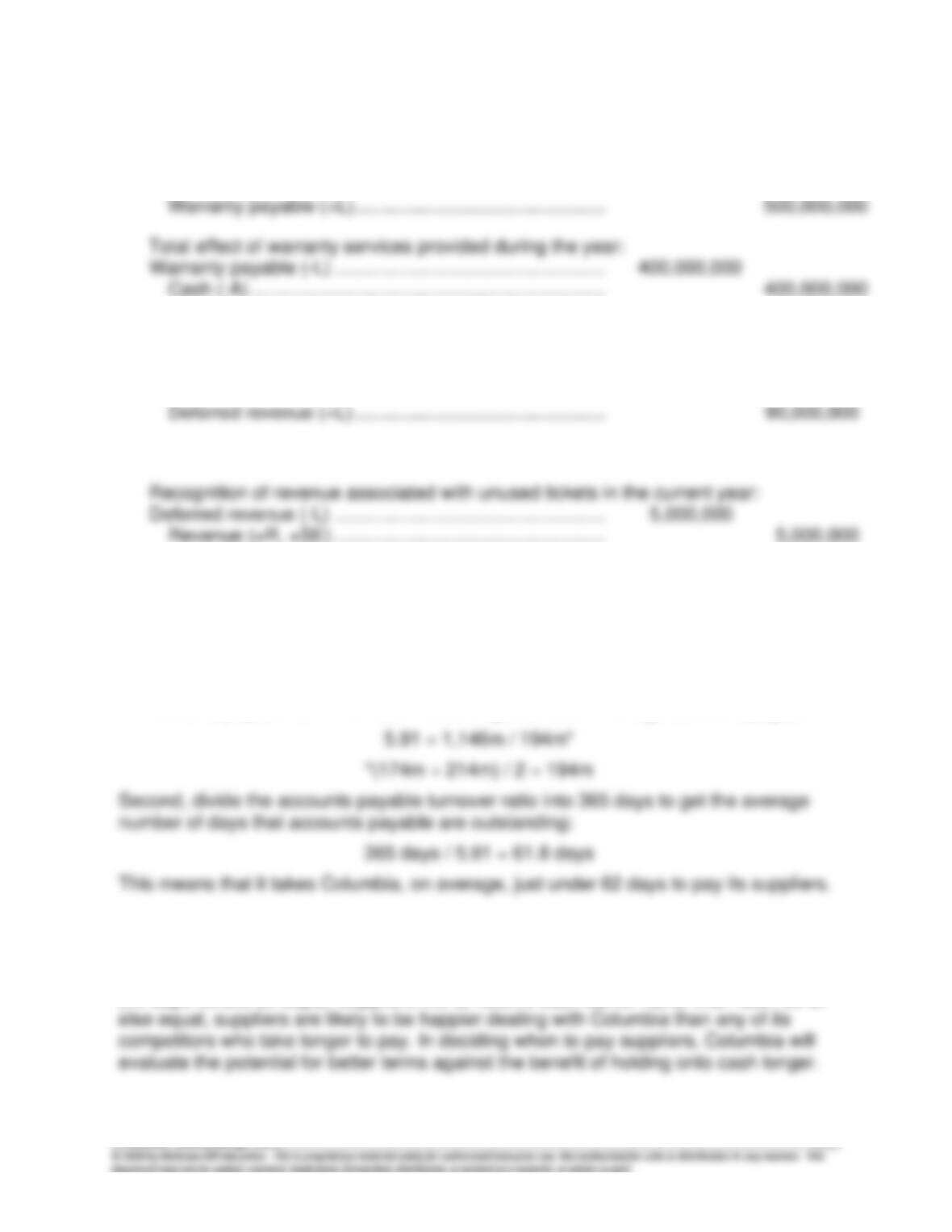
Warranty payable (-L) …………………………………………….
Cash (-A) …………………………..………………………………
2. Collection of cash for tickets sold in advance:
Cash (+A) ……………………………………………………………..
90,000,000
Deferred revenue (+L) …………………………………………
90,000,000
Deferred revenue (-L) …………………………………………….
Revenue (+R, +SE) …………………………………………….
P9–7.
Req. 1
To compute the average number of days that a company’s accounts payable are
outstanding, first compute the accounts payable turnover ratio:
Accounts payable turnover ratio = Cost of goods sold / Average accounts payable
Req. 2
On average, Columbia’s competitors take longer to pay suppliers than Columbia does
(72 days versus 62 days). Suppliers like to receive cash earlier rather than later, so all
P9–8.
The current liability classification is based on the expectation that the company will pay
the liabilities during the subsequent year. Analysts are interested in this classification
P9–9.
1. Disclose in footnotes—Loss is probable, but amount cannot be reliably
estimated.
P9–10.
a. Remain the same
b. Decrease
Financial Accounting, 10/e 9-25
P9–11.
Req. 1
Present value of debt:
$115,000 x 0.62275 = $71,616
$6,000 x 5.38929 = 32,336
$103,952
Req. 2
Req. 3
Present value of payments:
Req. 4
P9–12.
Option 1:
Option 2:
Option 3:
Option 2 is the best option because it provides the greatest present value when all
P9–13.
Req. 1
GAAP Depreciation: $1,000,000 ÷ 20 years = $50,000
Book Value of Asset:
Year 1 Year 2
GAAP Tax GAAP Tax
Cost $1,000,000 $1,000,000 $1,000,000 $1,000,000
P9–13. (continued)
Req. 1 (continued)
Req. 2: Income tax expense for Year 1:
Taxes payable $400,000
P9–14.
Req. 1
$112,000 x 1.33823 = $149,882 (amount available at end of five years)
AP9–1
Req. 1
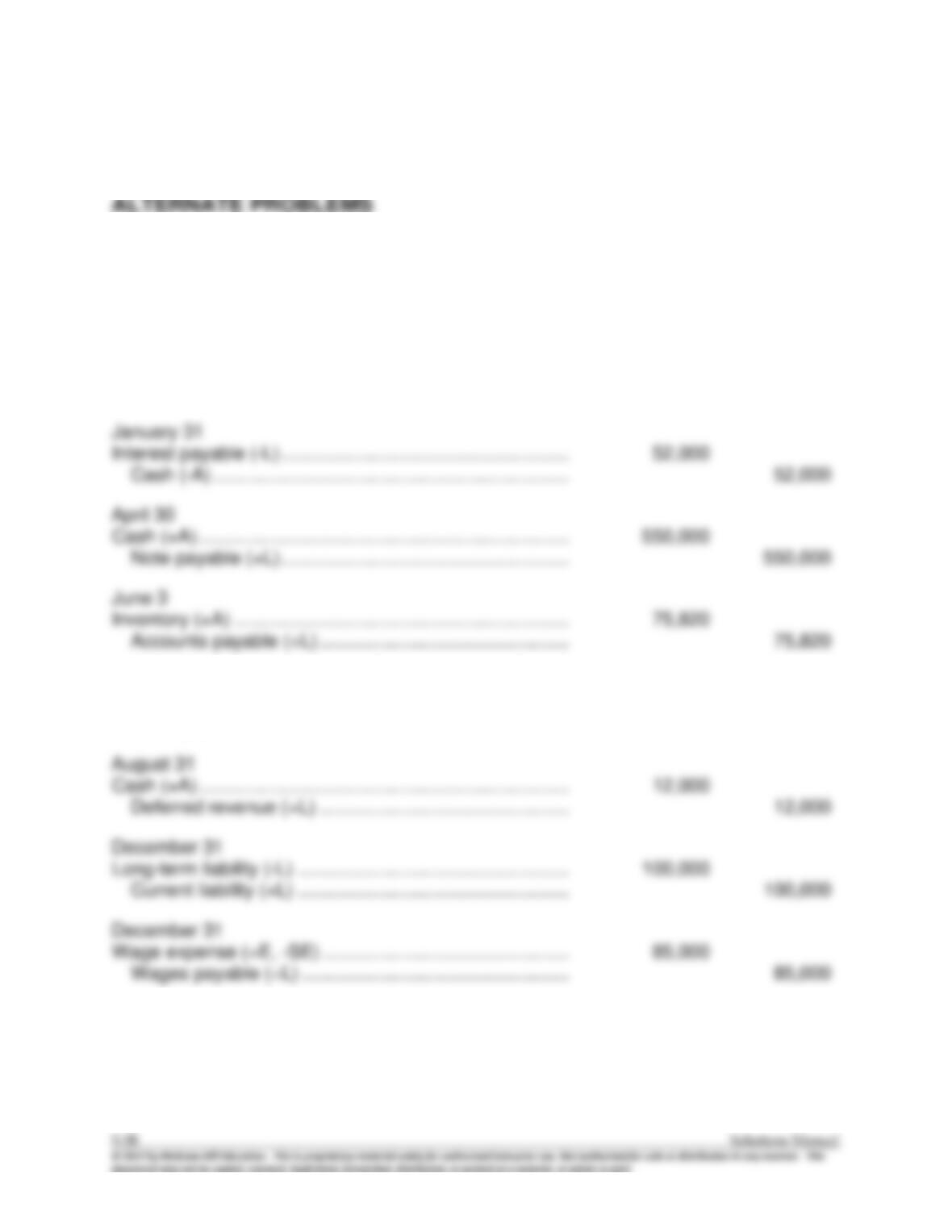
January 15
Tax expense (+E, –SE) ……………………………………………
125,000
Taxes payable (+L) ……………………………………………..
93,000
Deferred tax liability (+L) ………………………………………
32,000
Interest payable (-L) ……………………………………………….
52,000
Cash (-A) …………………………………………………………..
52,000
Cash (+A) ……………………………………………………………..
550,000
Note payable (+L) ……………………………………………….
550,000
Inventory (+A) ……………………………………………………….
75,820
Accounts payable (+L) …………………………………………
75,820
July 5
Accounts payable (-L) …………………………………………….
75,820
Cash (-A) …………………………………………………………..
75,820
Cash (+A) ……………………………………………………………..
12,000
Deferred revenue (+L) …………………………………………
Long-term liability (-L) …………………………………………….
100,000
Current liability (+L) …………………………………………….
100,000
Wage expense (+E, -SE) ………………………………………..
85,000
Wages payable (+L) ……………………………………………
85,000
Financial Accounting, 10/e 9-29
AP9–1. (continued)
Req. 2
December 31
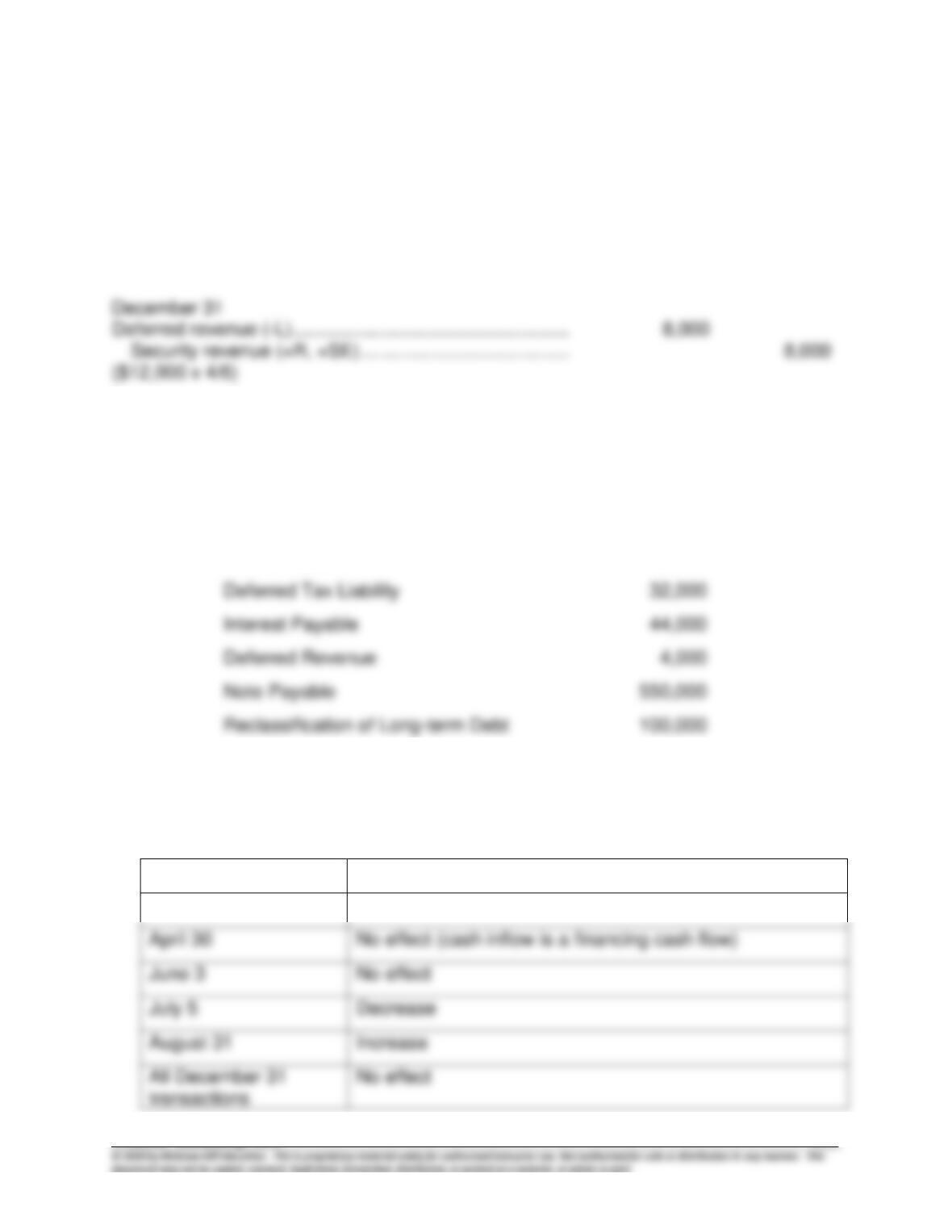
Interest expense (+E, –SE) ………………………………………
44,000
Interest payable (+L) ……………………………………………
($550,000 x .12 x 8/12)
44,000
Deferred revenue (-L) ……………………………………………..
Req. 3
Balance Sheet:
CURRENT LIABILITIES
Wages Payable
$ 85,000
Taxes Payable
93,000
Deferred Tax Liability
32,000
Interest Payable
44,000
Deferred Revenue
Note Payable
Reclassification of Long-term Debt
TOTAL CURRENT LIABILITIES
$908,000
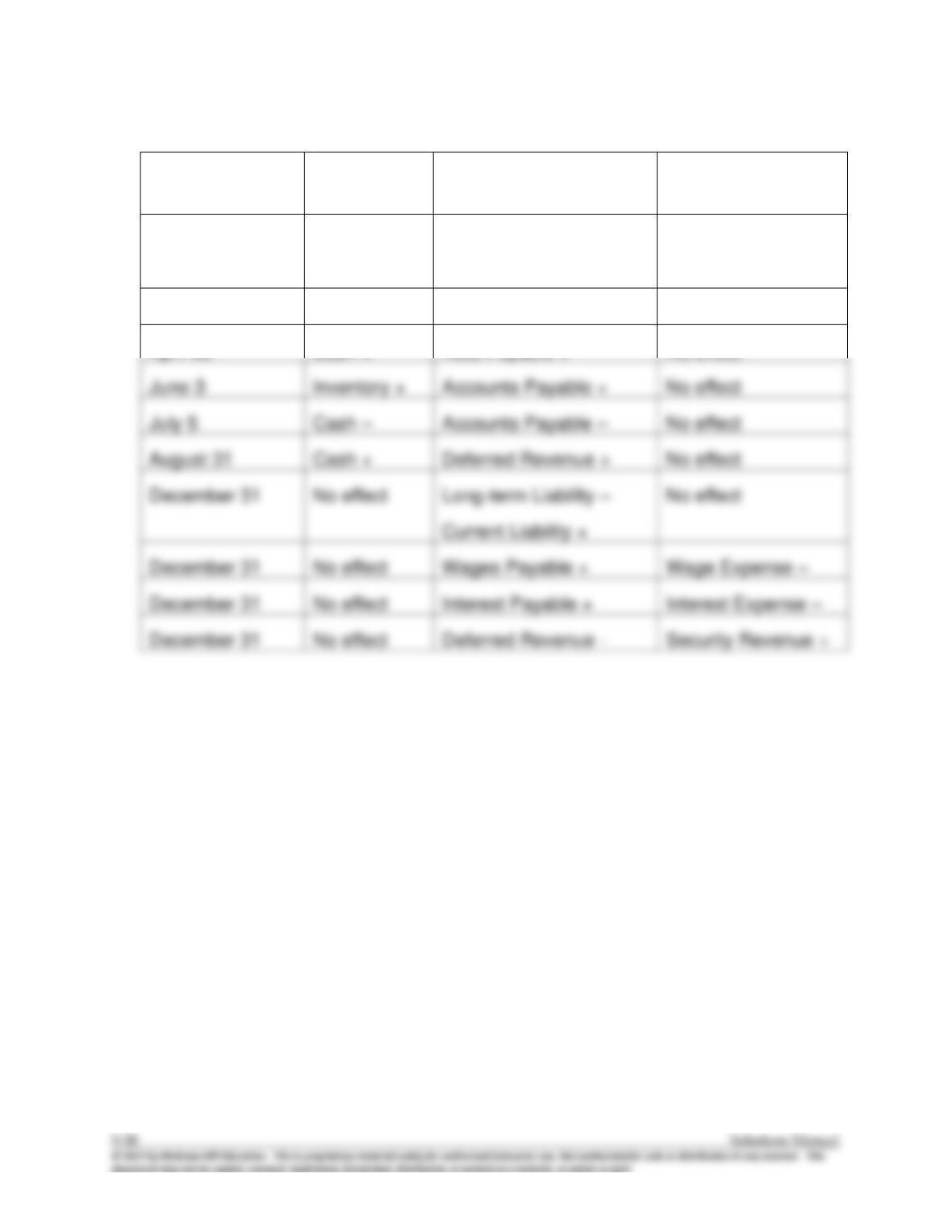
Req. 4
Cash from Operating Activities:
January 15
No effect
January 31
Decrease
April 30
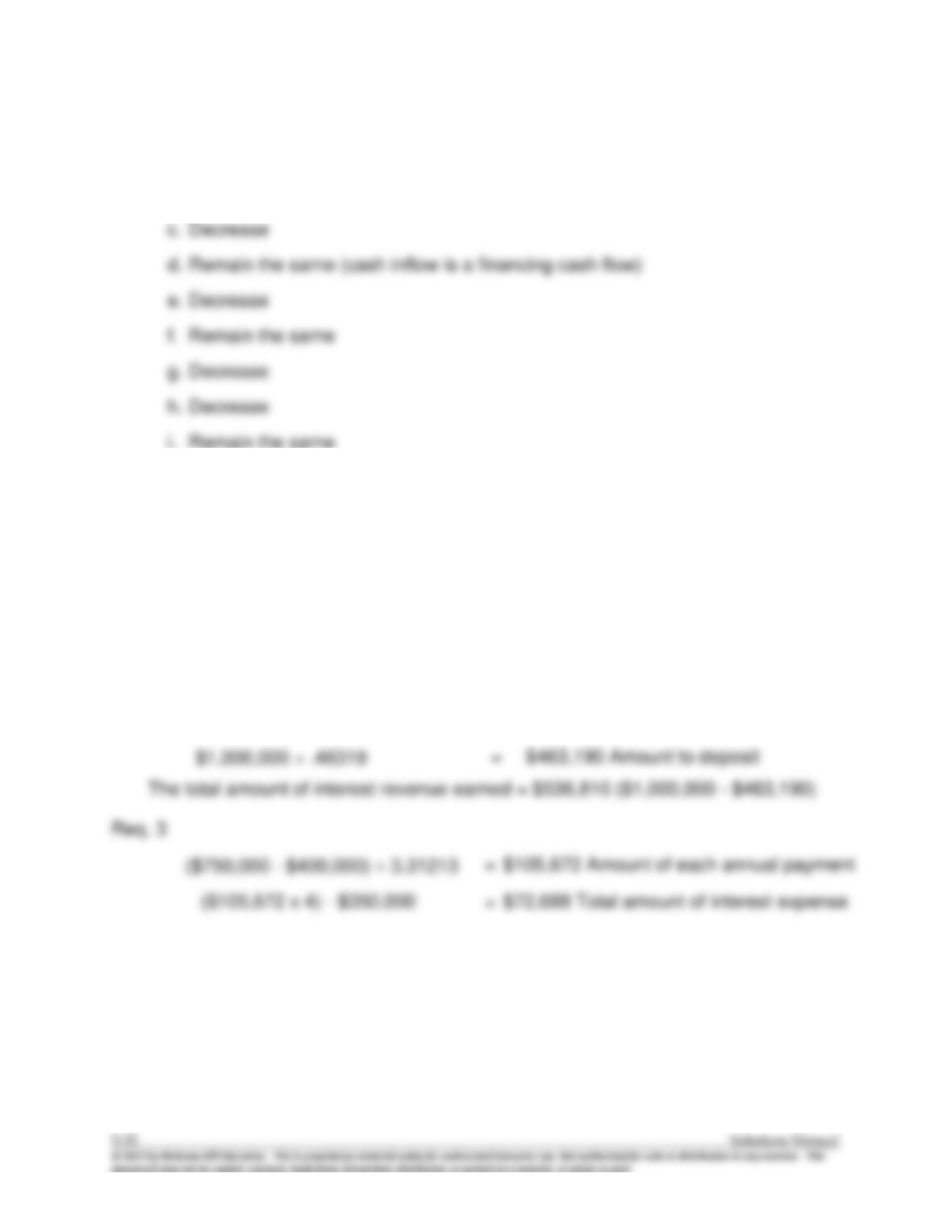
No effect (cash inflow is a financing cash flow)
June 3
No effect
July 5
Decrease
August 31
Increase
AP9–2.
Date
Assets
Liabilities
Stockholders’
Equity
January 15
No effect
Taxes Payable +
Deferred Tax Liability +
Tax Expense –
January 31
Cash –
Interest Payable –
No effect
April 30
Cash +
Note Payable +
No effect
June 3
Inventory +
Accounts Payable +
No effect
July 5
Cash –
Accounts Payable –
No effect
August 31
Cash +
Deferred Revenue +
No effect
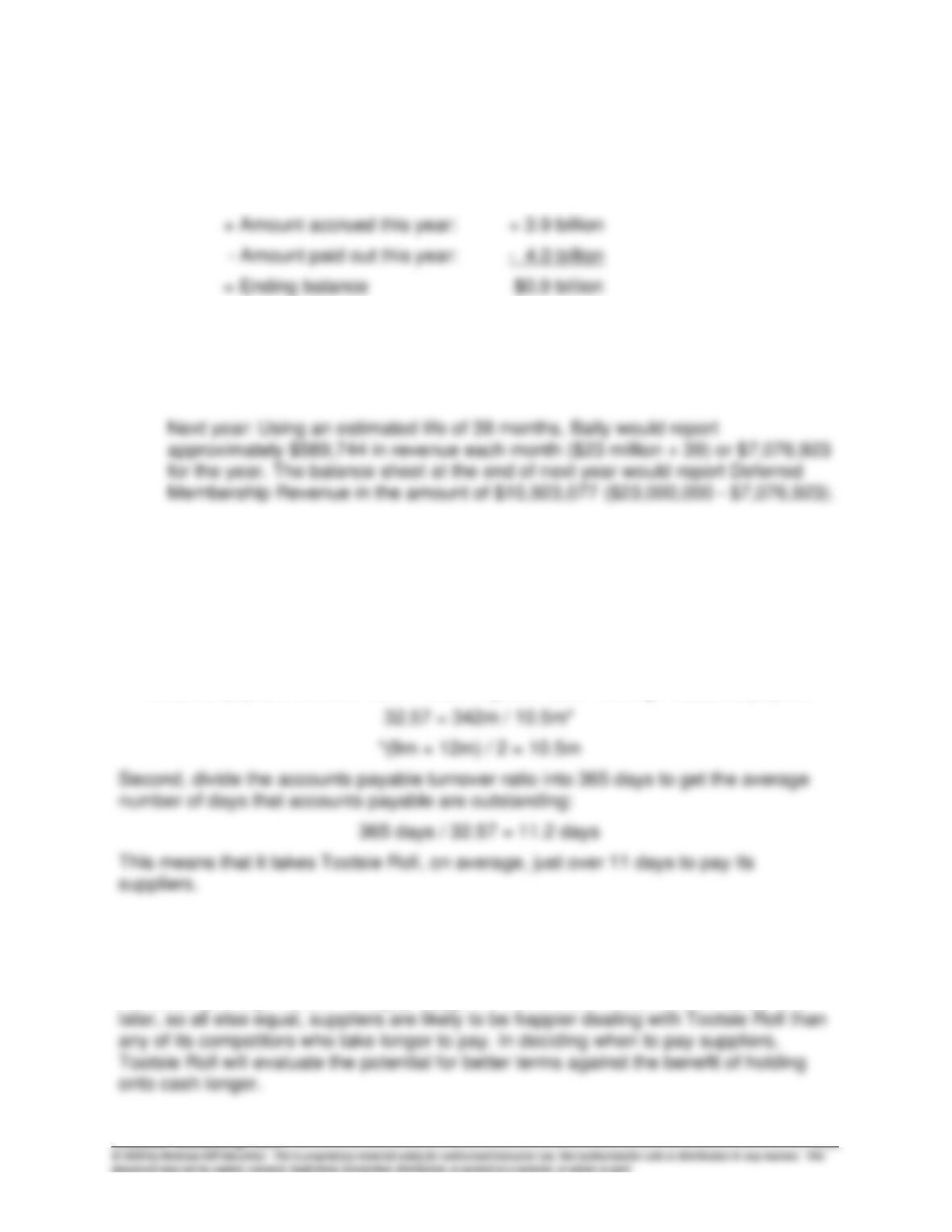
Current Liability +
December 31
No effect
Wages Payable +
Wage Expense –
December 31
No effect
Interest Payable +
Interest Expense –
December 31
No effect
Deferred Revenue –
Security Revenue +
Financial Accounting, 10/e 9-31
AP9–3.
Req.1
Beginning balance: $1.0 billion
Req. 2
This year: No revenue has been earned this year, so the entire $23 million
should be reported as deferred membership revenue.
AP9–4.
Req. 1
To compute the average number of days that a company’s accounts payable are
outstanding, first compute the accounts payable turnover ratio:
Accounts payable turnover ratio = Cost of goods sold / Average accounts payable
Req. 2
On average, Tootsie Roll’s competitors take much longer to pay suppliers than Tootsie
Roll does (30 days versus 11 days). Suppliers like to receive cash earlier rather than
AP9–5.
a. Decrease
b. Decrease
AP9–6.
Req. 1
$2,000,000 X 0.68058
=
$1,361,160
$150,000 X 3.99271
=
598,907
$1,960,067
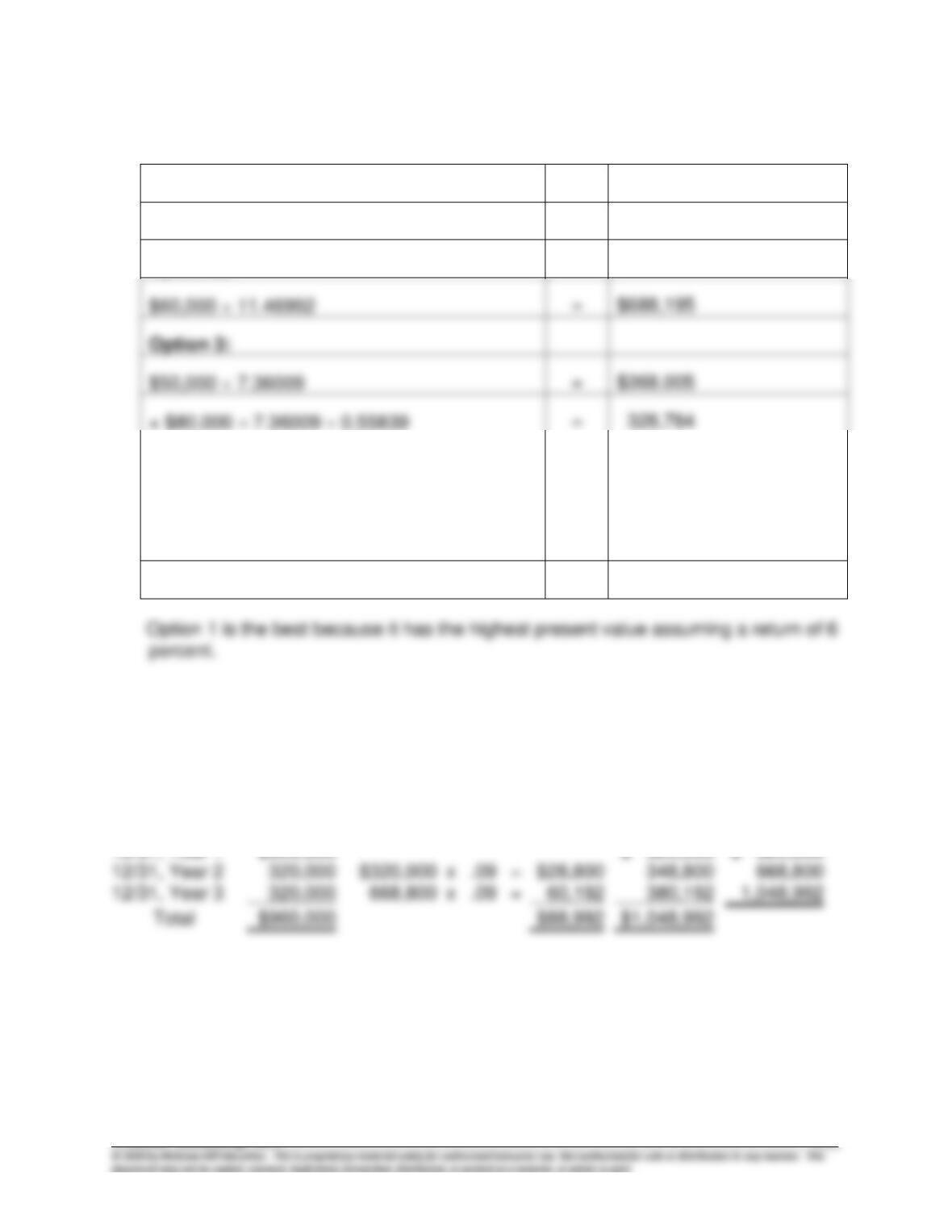
Req. 2
($105,672 x 4) – $350,000
=
Financial Accounting, 10/e 9-33
AP9–7.
Option 1:
$750,000
=
$750,000
Option 2:
Option 3:
* Life expectancy is 20 years, so the $80,000 payments
would take place from Year 11 to Year 20. The present
value of the $80,000 annuity is $588,807 ($80,000 x
7.36009). This is the present value ten years in the
future, so this amount has to be discounted back to
today to get $328,784 ($588,807 x 0.55839).
Total
=
$696,789
AP9–8.
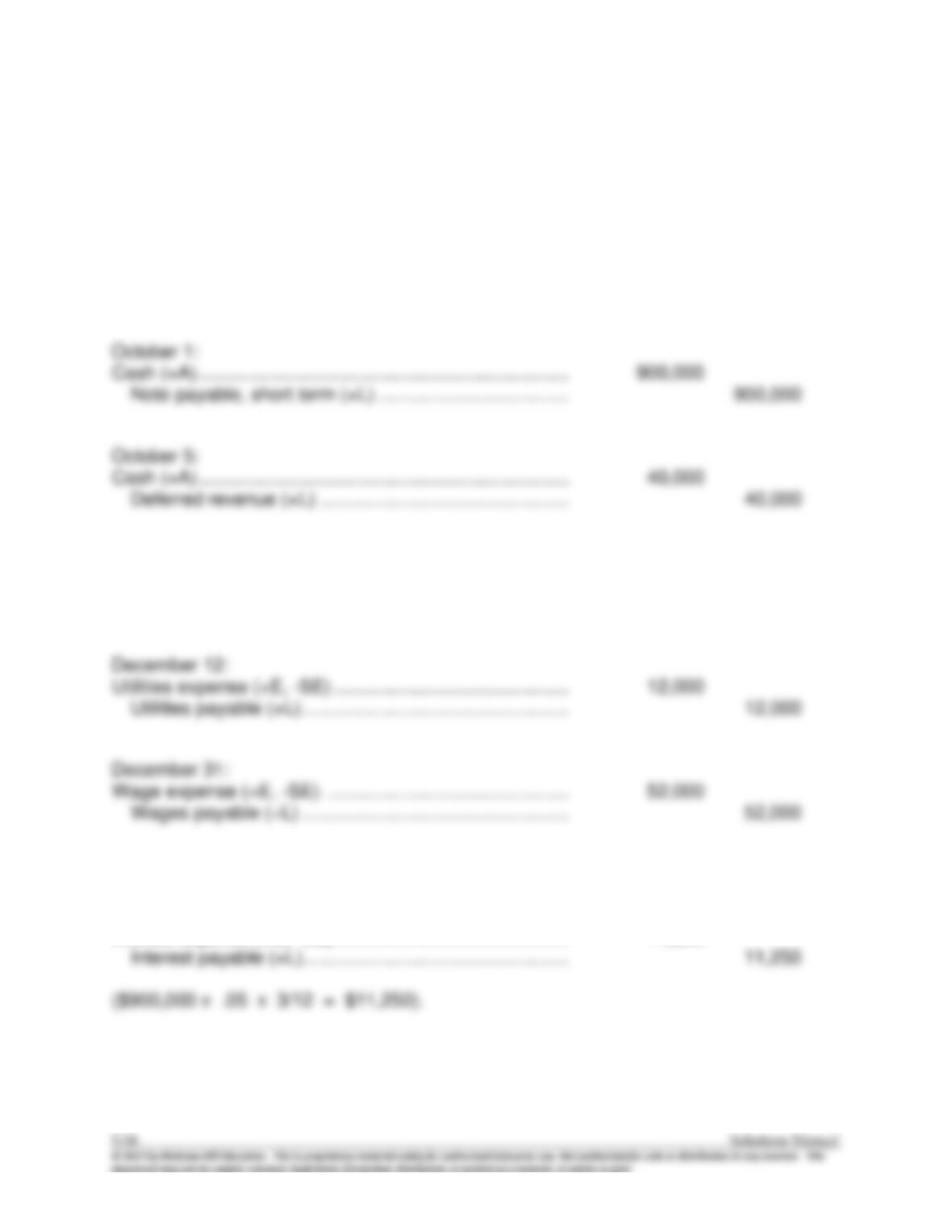
Fund Accumulation Schedule
Date
Cash
Payment
Interest earned
(prior balance x .09)
Fund
Increase
Fund
Balance
=
CONTINUING PROBLEM
CON9–1.
Req. 1
September 15:
Purchases (+A) ……………………………………………………..
125,000
Cash (-A) …………………………………………………………..
125,000
Note payable, short term (+L) …………………………..…..
900,000
Cash (+A) ……………………………………………………………..
40,000
Deferred revenue (+L) …………………………………………
40,000
October 15:
Deferred revenue (-L) ……………………………………………..
18,000
Service revenue (+R, +SE) …………………………………..
18,000
Utilities expense (+E, –SE) …………………………..………….
12,000
Utilities payable (+L) ……………………………………………
Wage expense (+E, -SE). ……………………………………….
52,000
Wages payable (+L) ……………………………………………
52,000
Req. 2
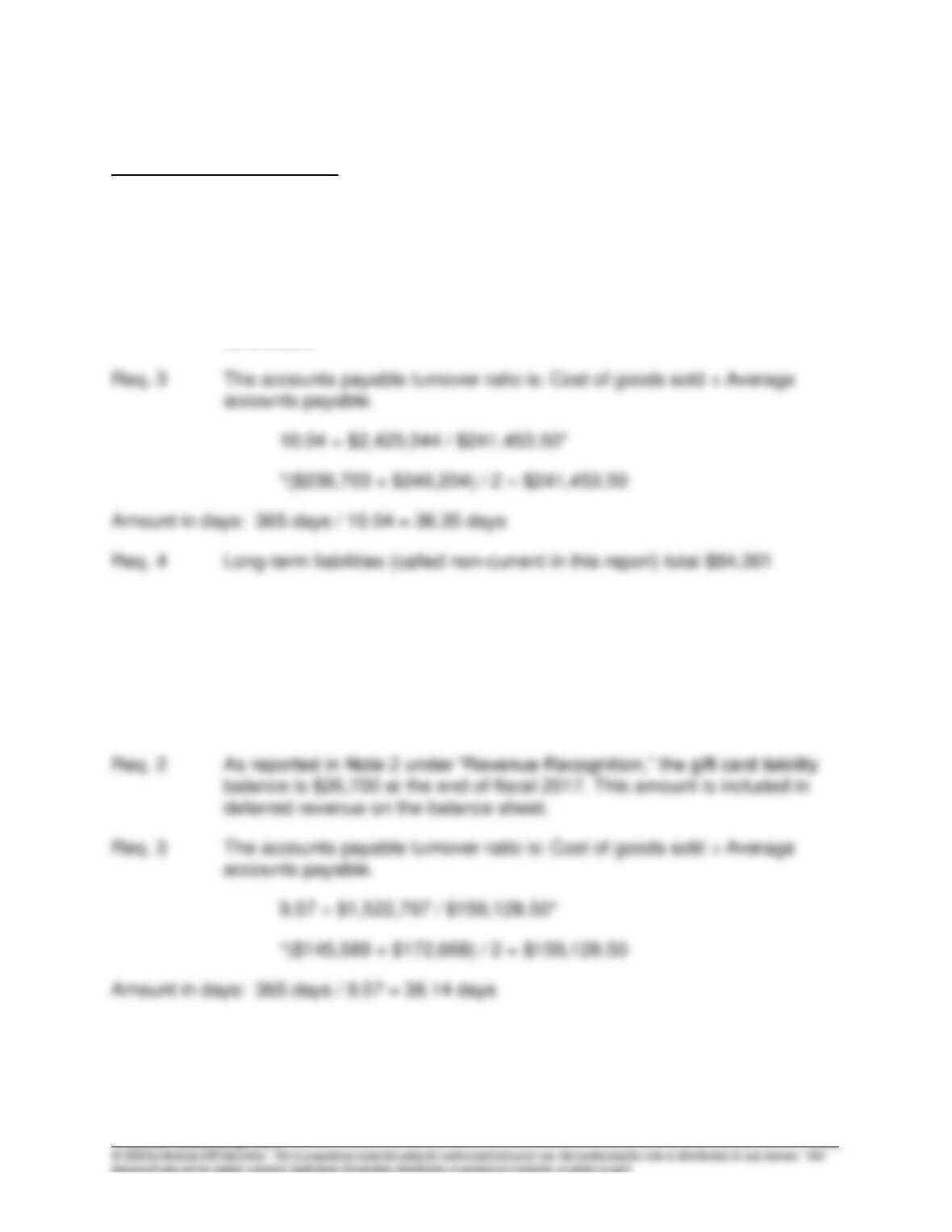
December 31:
Interest expense (+E, -SE). ……………………………………..
11,250
Interest payable (+L) ……………………………………………
11,250
($900,000 x .05 x 3/12 = $11,250).
Financial Accounting, 10/e 9-35
CASES AND PROJECTS
ANNUAL REPORT CASES
CP9–1. (Dollar amounts in thousands)
Req. 1 Accrued compensation and payroll taxes are $54,324.
Req. 2 American Eagle Outfitters uses the term “Unredeemed gift cards and gift
certificates.”
CP9–2. (Dollar amounts in thousands)
Req. 1 As reported in Note 2 under “Loyalty Program,” Express, includes the
liability associated with its loyalty program in accrued expenses on its
balance sheet.
Req. 4 There are two long-term liabilities listed:
Deferred lease credits: $137,618
CP9–3. (Dollar amounts in thousands)
Req. 1 Accounts payable turnover ratio for American Eagle Outfitters:
Accounts payable turnover ratio for Express:
Req. 2
The accounts payable turnover ratio for the industry is 14.60, which is higher than the
accounts payable turnover ratio for American Eagle Outfitters (10.04) and Express.
FINANCIAL REPORTING AND ANALYSIS CASE
CP9–4.
Req. 1
If the monthly payments actually include principal and interest, the price of the
home itself can be found by calculating the present value of the monthly payments:
Req. 2
Just like car dealerships that promise “no interest” loans, the builder is likely using
CRITICAL THINKING CASE
CP9–5.
The winner of the lottery will not receive $10 million today, but rather will receive 20
annual payments of $500,000 over 20 years. If we assume an interest rate of five
FINANCIAL REPORTING AND ANALYSIS TEAM PROJECT
CP9–6.
Questions one through six align with Learning Objectives one through six. Since