Chapter 9
Performance Measurement in Decentralized
Organizations
Solutions to Questions
9-1 In a decentralized organization,
decision-making authority isn’t confined to a few
9-2 The benefits of decentralization include:
(1) by delegating day-to–day problem solving to
lower-level managers, top management can
concentrate on bigger issues such as overall
strategy; (2) empowering lower-level managers
9-3 The manager of a cost center has
control over cost, but not revenue or the use of
9-4 Margin is the ratio of net operating
income to total sales. Turnover is the ratio of
9-5 Residual income is the net operating
income an investment center earns above the
company’s minimum required rate of return on
operating assets.
profitable investment opportunity whose rate of
return exceeds the company’s required rate of
return but whose rate of return is less than the
investment center’s current ROI. The residual
income approach overcomes this problem
9-8 An MCE of less than 1 means that the
production process includes non-value-added
9-9 A company’s balanced scorecard should
be derived from and support its strategy.
9-10 The balanced scorecard is constructed
to support the company’s strategy, which is a

The Foundational 15
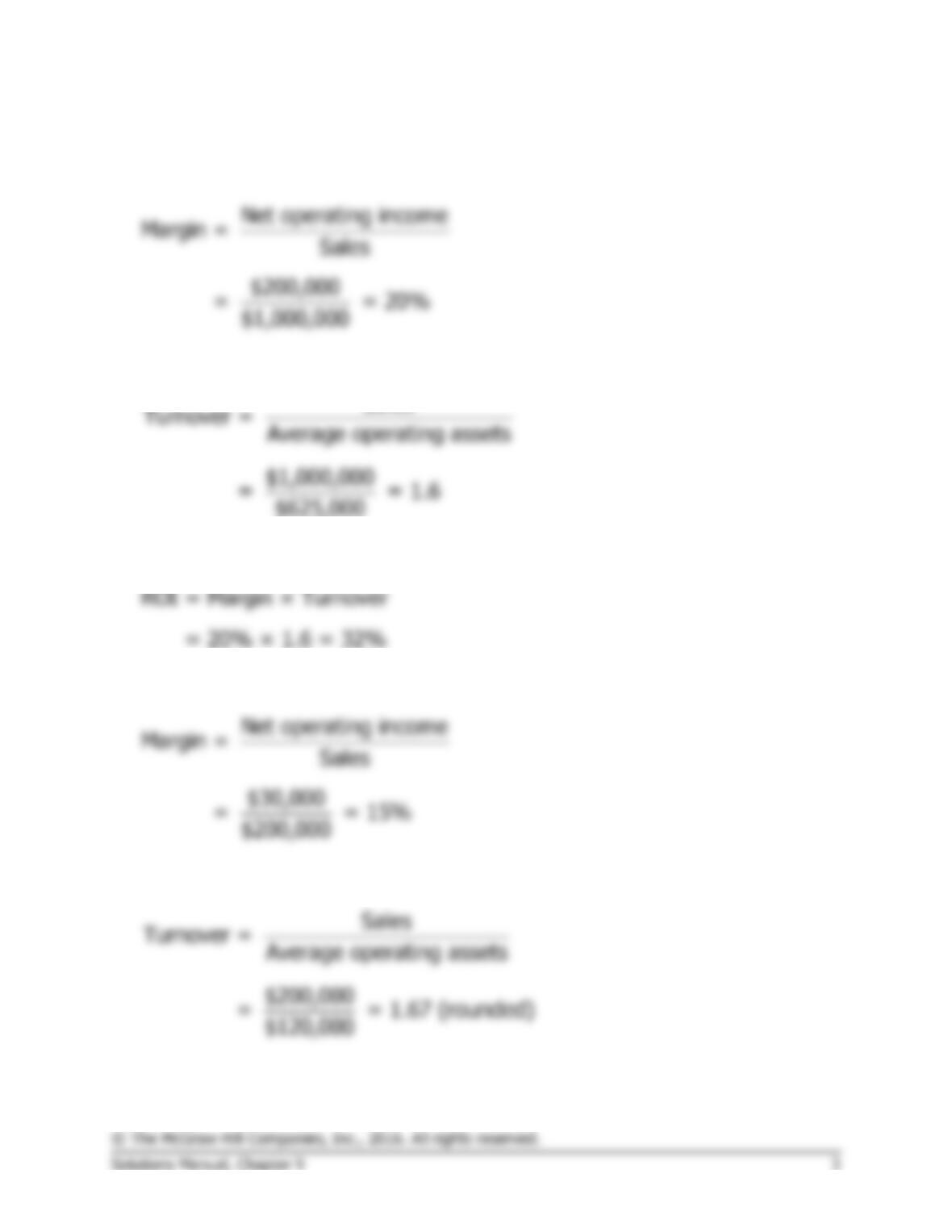
1. Last year’s margin is:
2. Last year’s turnover is:
Sales
3. Last year’s return on investment (ROI) is:
4. The margin for this year’s investment opportunity is:
5. The turnover for this year’s investment opportunity is:
The Foundational 15 (continued)
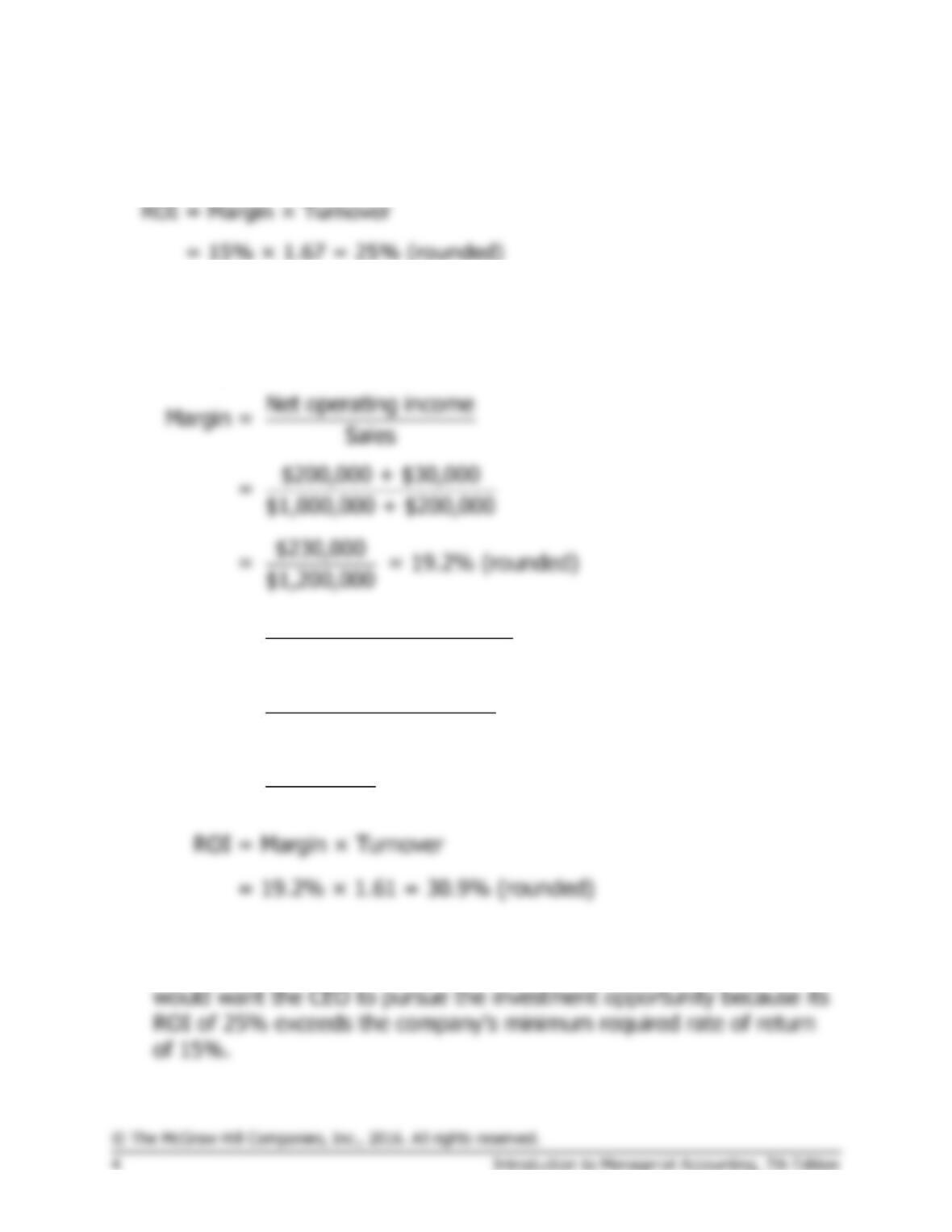
6. The ROI for this year’s investment opportunity is:
7., 8., and 9.
If the company pursues the investment opportunity, this year’s margin,
turnover, and ROI would be:
Sales
Turnover = Average operating assets
$1,000,000 + $200,000
= $625,000 + $120,000
$1
= ,200,000 = 1.61 (rounded)
$745,000
10. The CEO would not pursue the investment opportunity because it
lowers her ROI from 32% to 30.9%. The owners of the company
The Foundational 15 (continued)
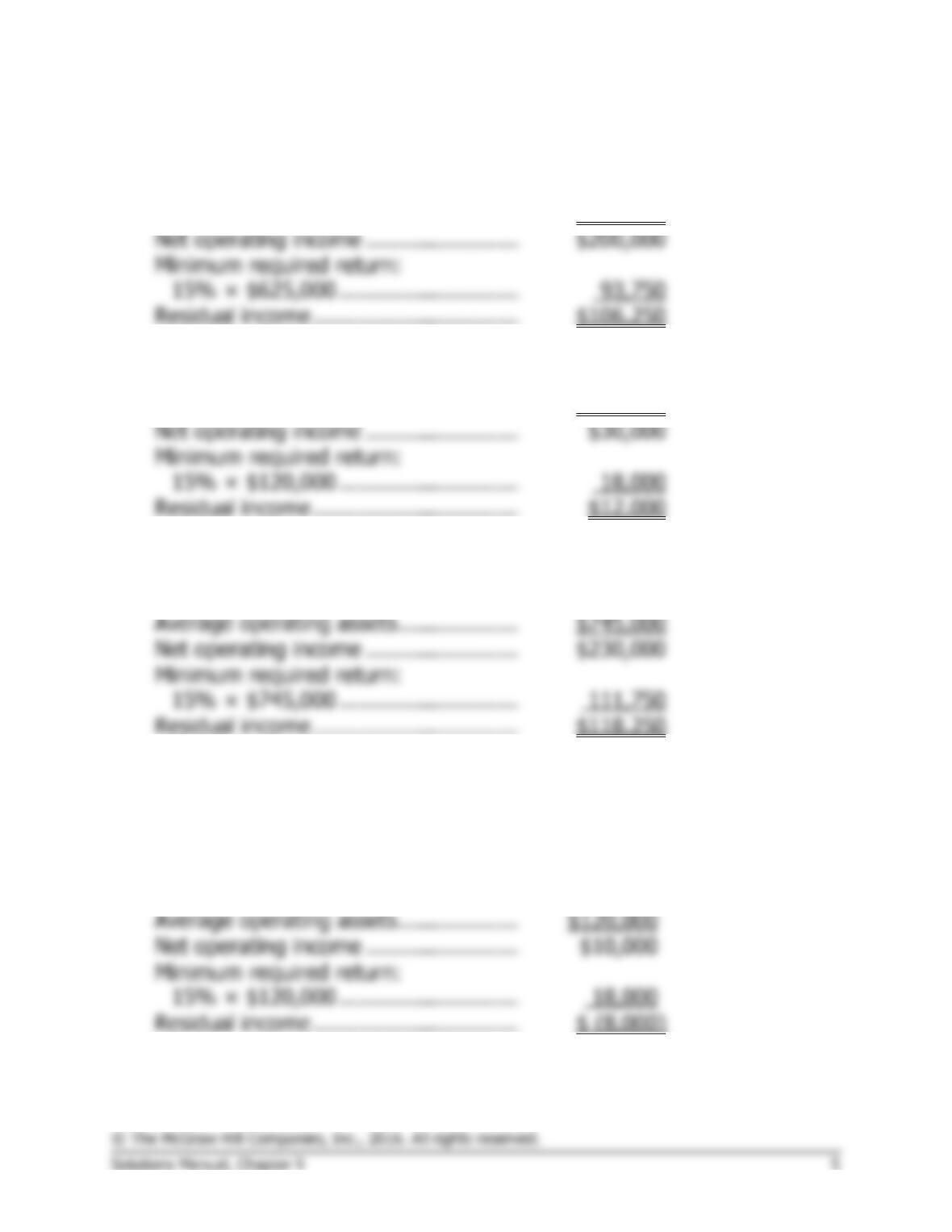
11. Last year’s residual income is:
Average operating assets ………………….
$625,000
Net operating income ………………………
$200,000
Residual income …………………………..
$106,250
12. The residual income for this year’s investment opportunity is:
Average operating assets ………………….
$120,000
Net operating income ………………………
Residual income …………………………..
13. If the company pursues the investment opportunity, this year’s
residual income will be:
Average operating assets ………………….
$745,000
Net operating income ………………………
$230,000
Residual income …………………………..
$118,250
14. The CEO would pursue the investment opportunity because it would
raise her residual income by $12,000.
15. The CEO and the company would not want to pursue this investment
opportunity because it does not exceed the minimum required return:
Average operating assets ………………….
Net operating income ………………………
Residual income …………………………..
$ (8,000)
Exercise 9-1 (10 minutes)
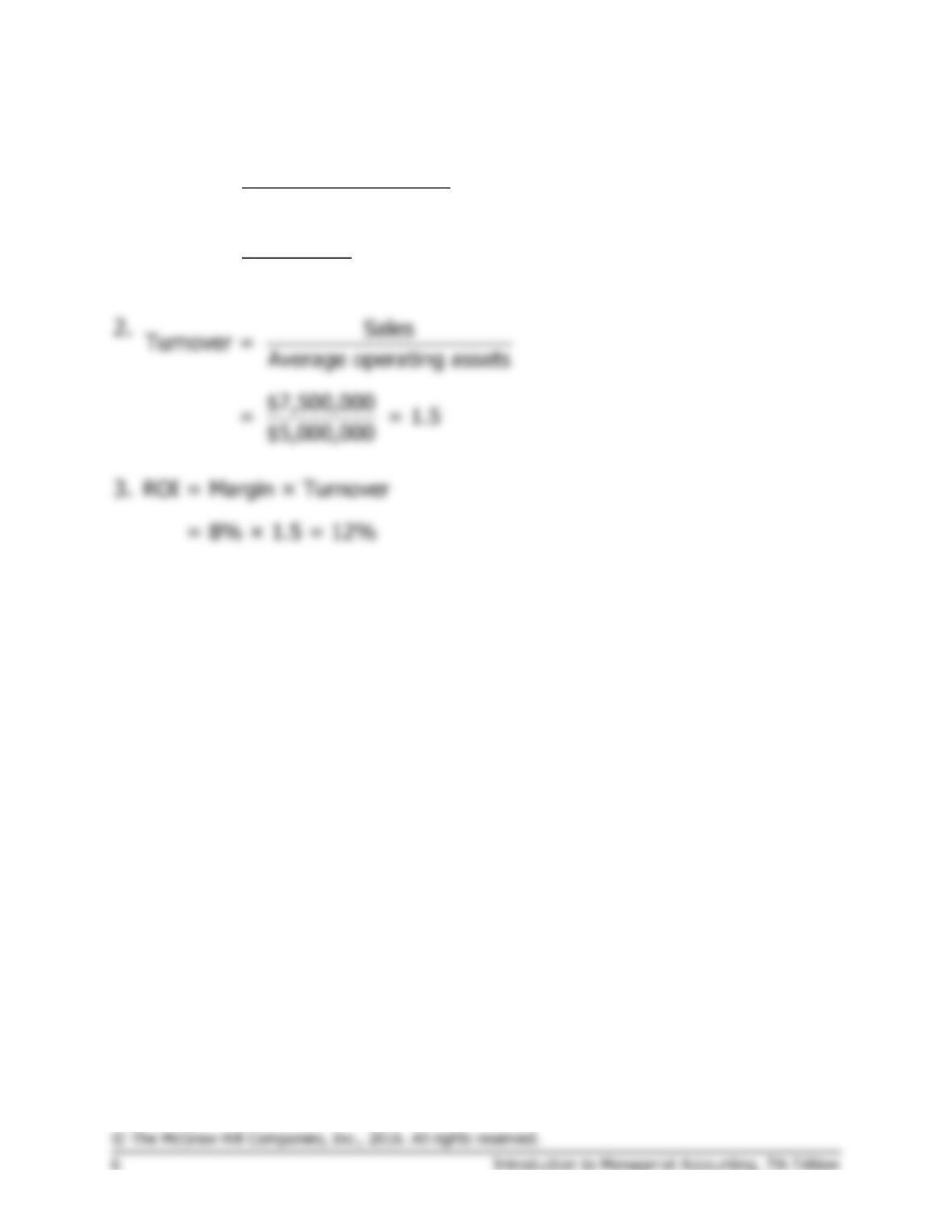
1.
Net operating income
Margin = Sales
$600,000
= = 8%
$7,500,000
Exercise 9-2 (10 minutes)
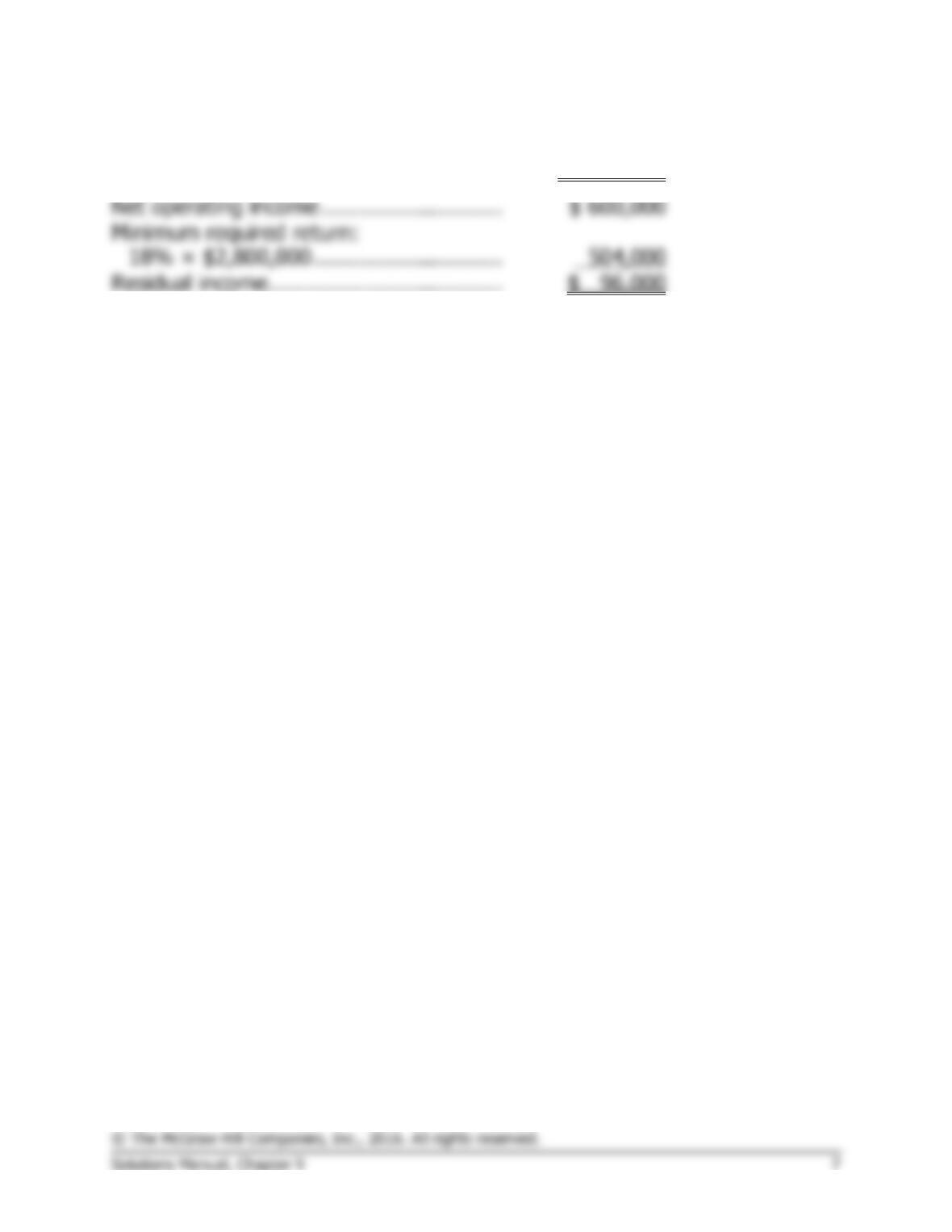
Average operating assets ………………….
$2,800,000
Net operating income ……………………….
Exercise 9-3 (20 minutes)
=
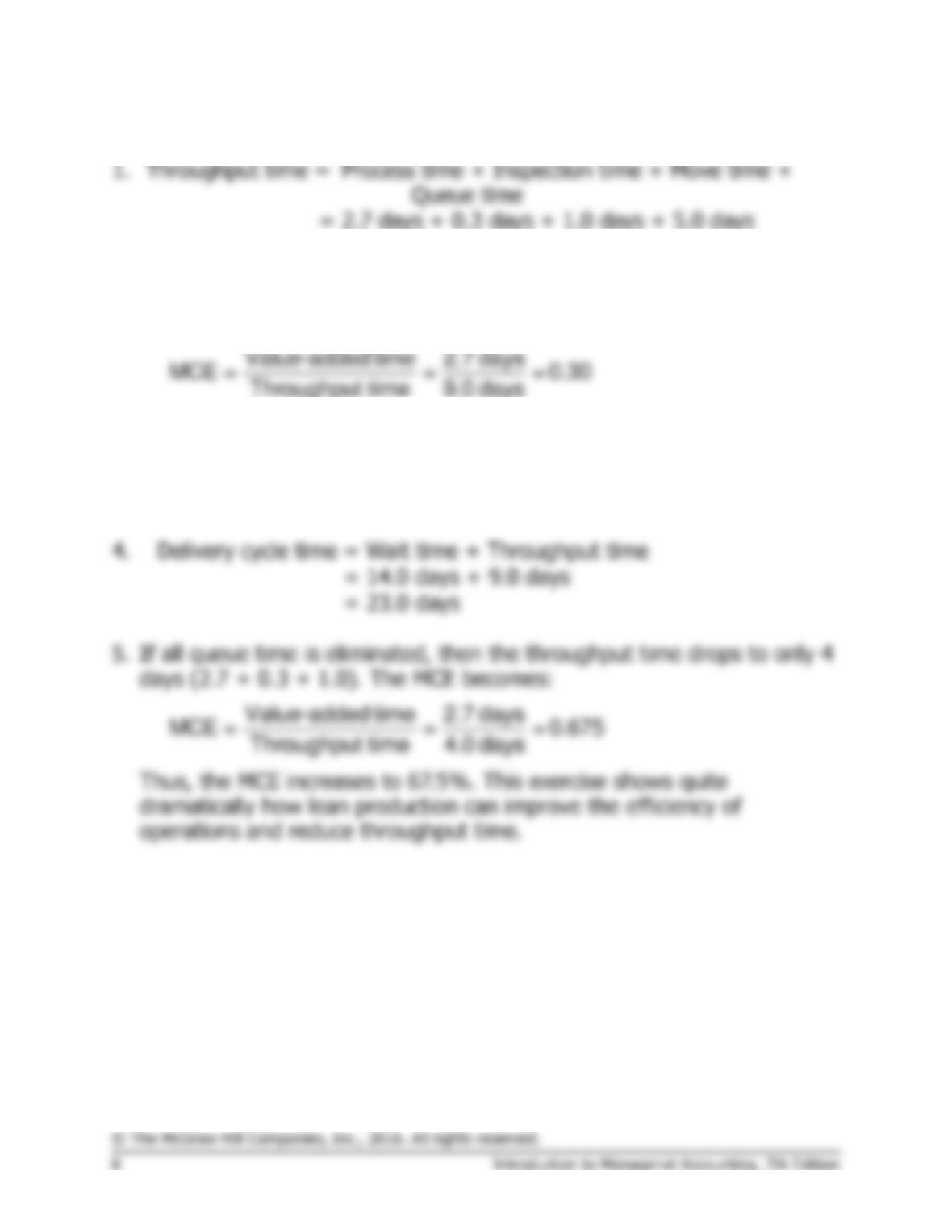
9.0 days
2. Only process time is value-added time; therefore the manufacturing
cycle efficiency (MCE) is:
3. If the MCE is 30%, then 30% of the throughput time was spent in
value-added activities. Consequently, the other 70% of the throughput
time was spent in non-value-added activities.
Learning
and
Growth
+
+
Financial
Customer
Exercise 9-4 (45 minutes)
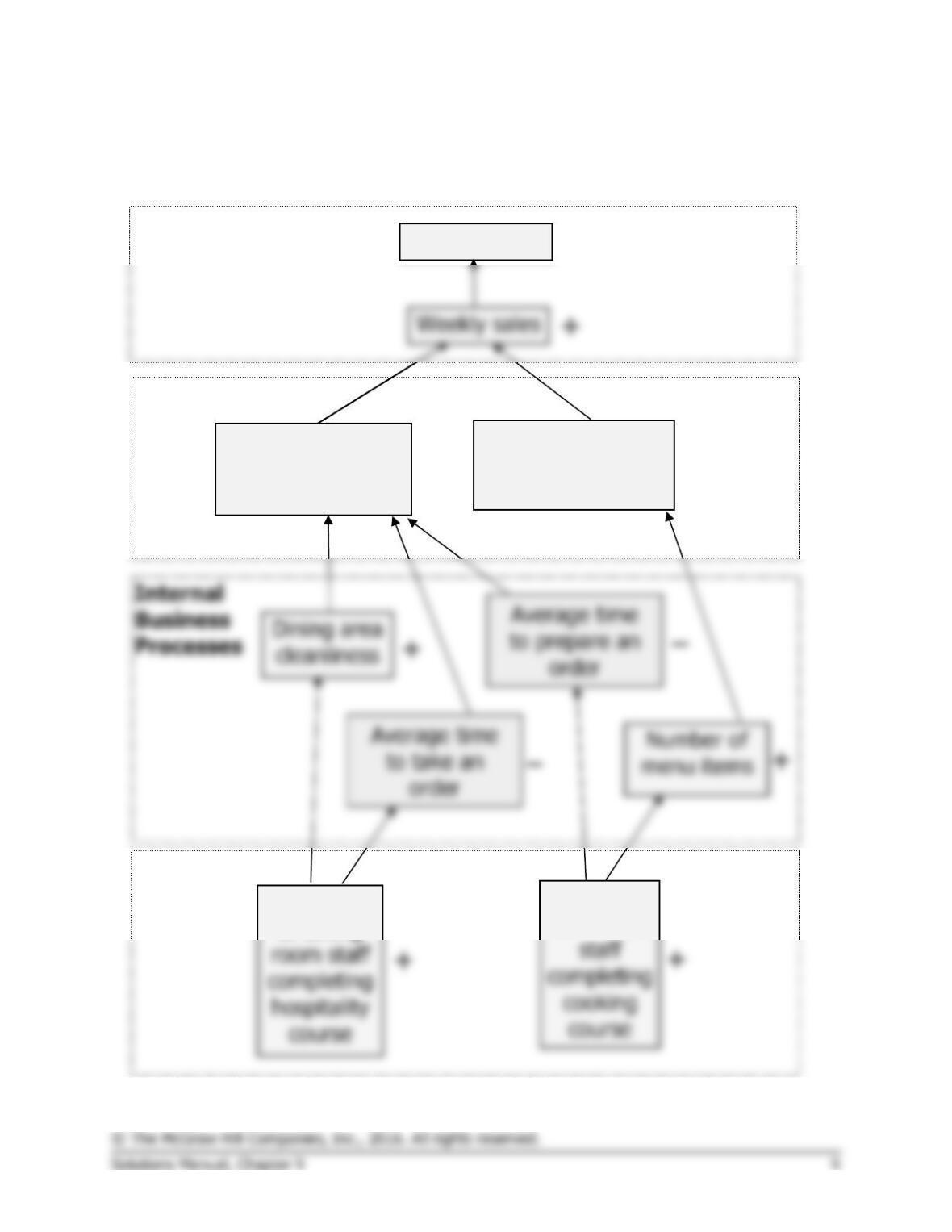
1. Students’ answers may differ in some details from this solution.
+
+
+
Weekly profit
Percentage
of kitchen
+
Customer
satisfaction with
service
Customer
satisfaction with
menu choices
+
+
Percentage
of dining
Exercise 9-4 (continued)
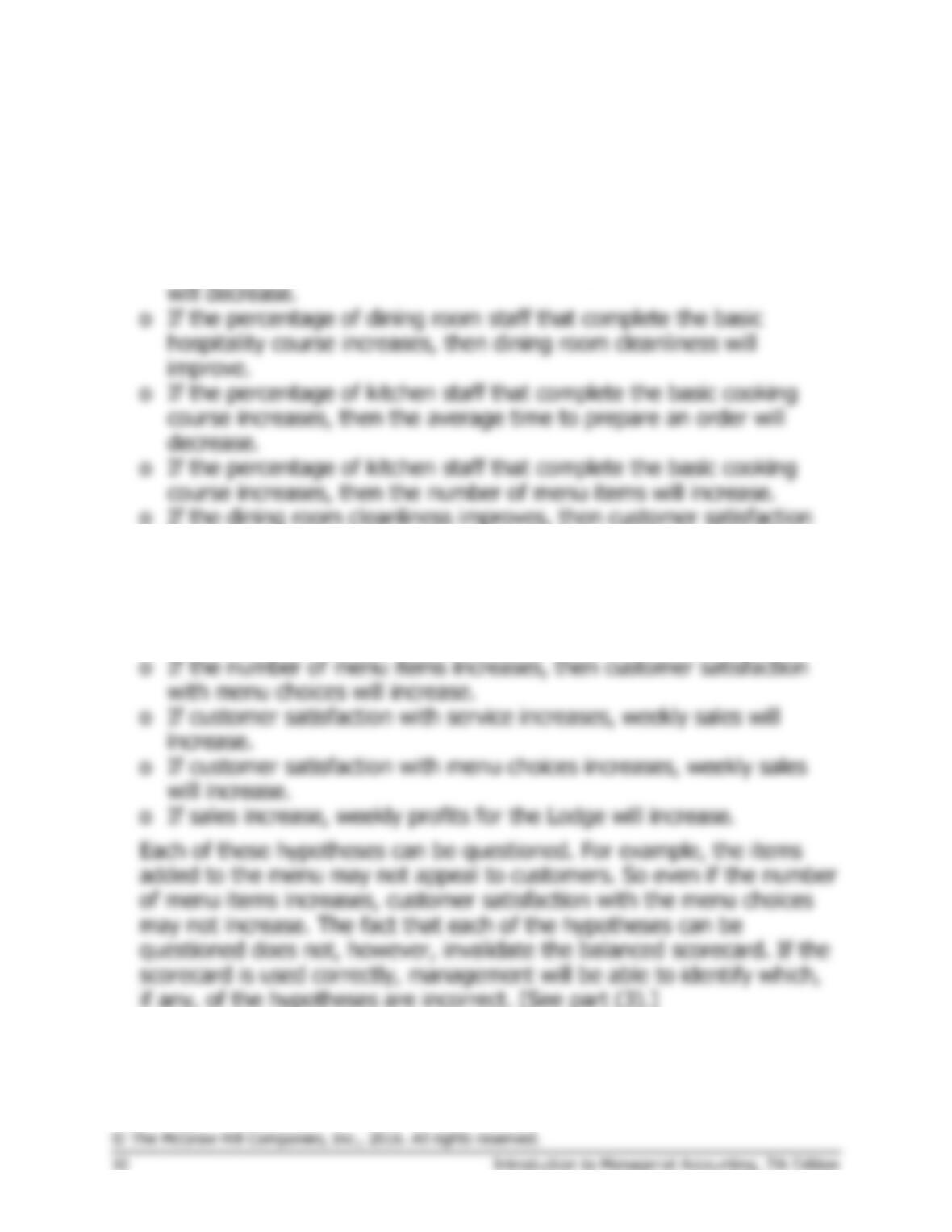
2. The hypotheses underlying the balanced scorecard are indicated by the
arrows in the diagram. Reading from the bottom of the balanced
scorecard, the hypotheses are:
o If the percentage of dining room staff that complete the basic
hospitality course increases, then the average time to take an order
with service will increase.
o If the average time to take an order decreases, then customer
satisfaction with service will increase.
o If the average time to prepare an order decreases, then customer
satisfaction with service will increase.
Exercise 9-4 (continued)
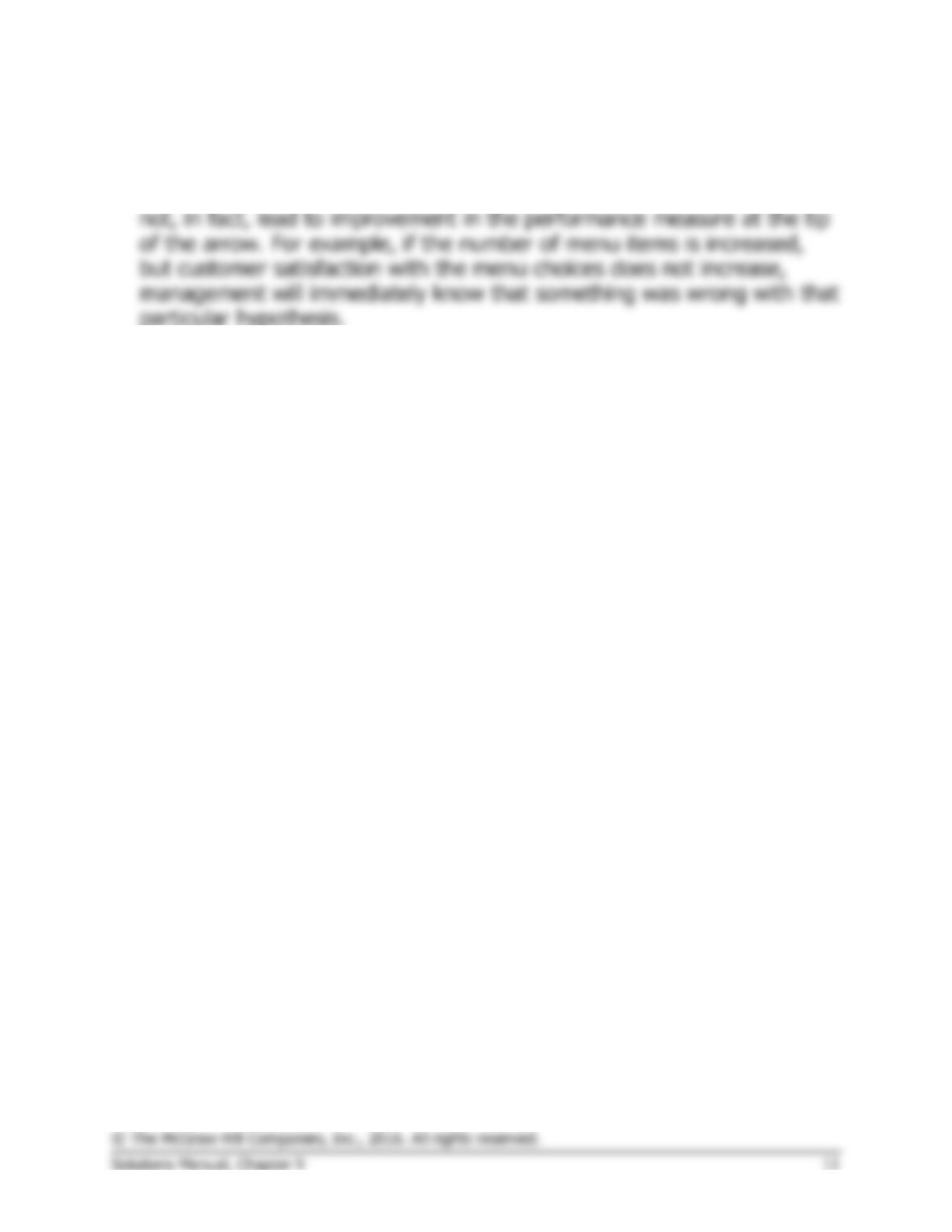
3. Management will be able to tell if a hypothesis is false if an
improvement in a performance measure at the bottom of an arrow does
Exercise 9-5 (15 minutes)
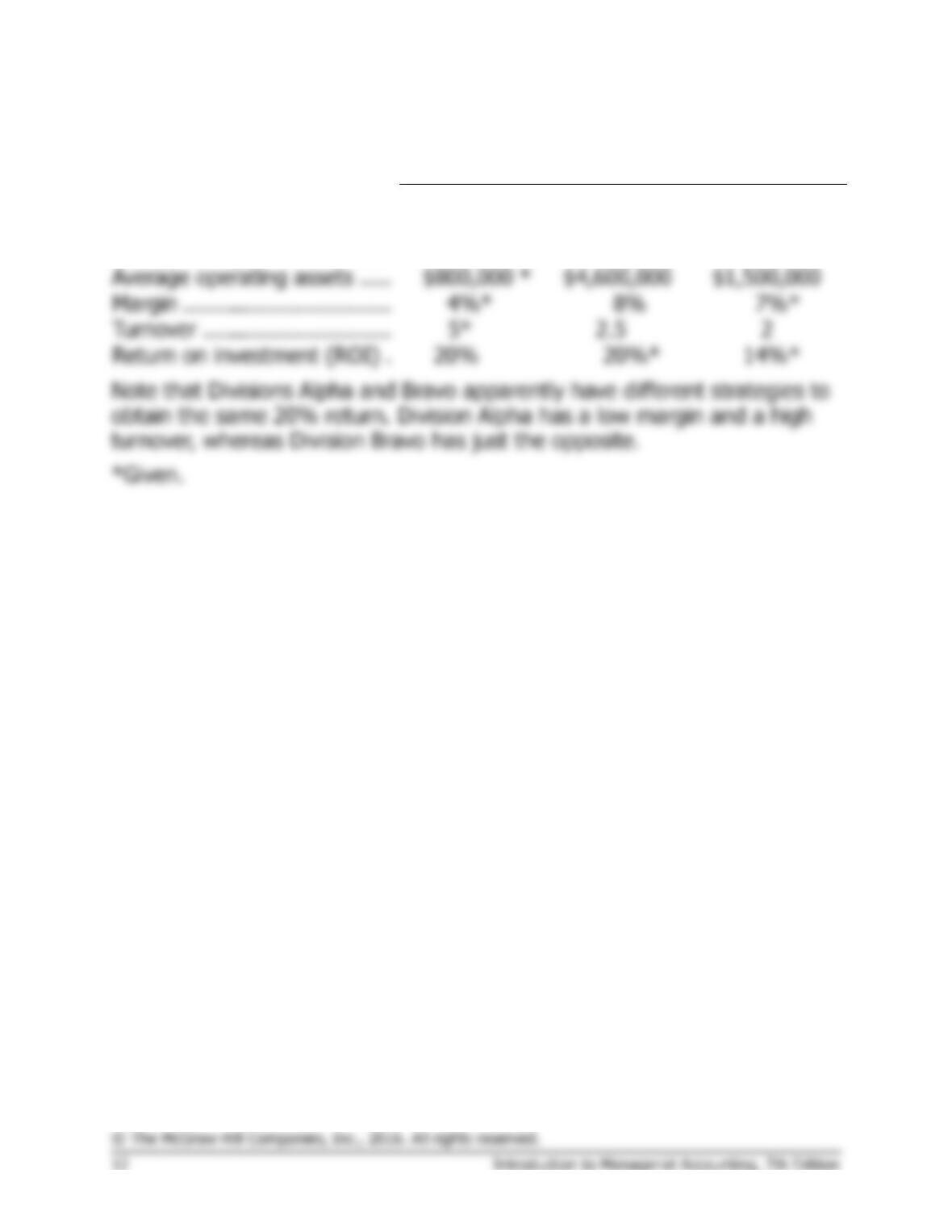
Division
Alpha
Bravo
Charlie
Sales ……………………………..
$4,000,000
$11,500,000
*
$3,000,000
Net operating income ………..
$160,000
$920,000
*
$210,000
*
Average operating assets …..
$800,000
*
Margin …………………………..
Turnover ………………………..
Return on investment (ROI) .
Exercise 9-6 (20 minutes)
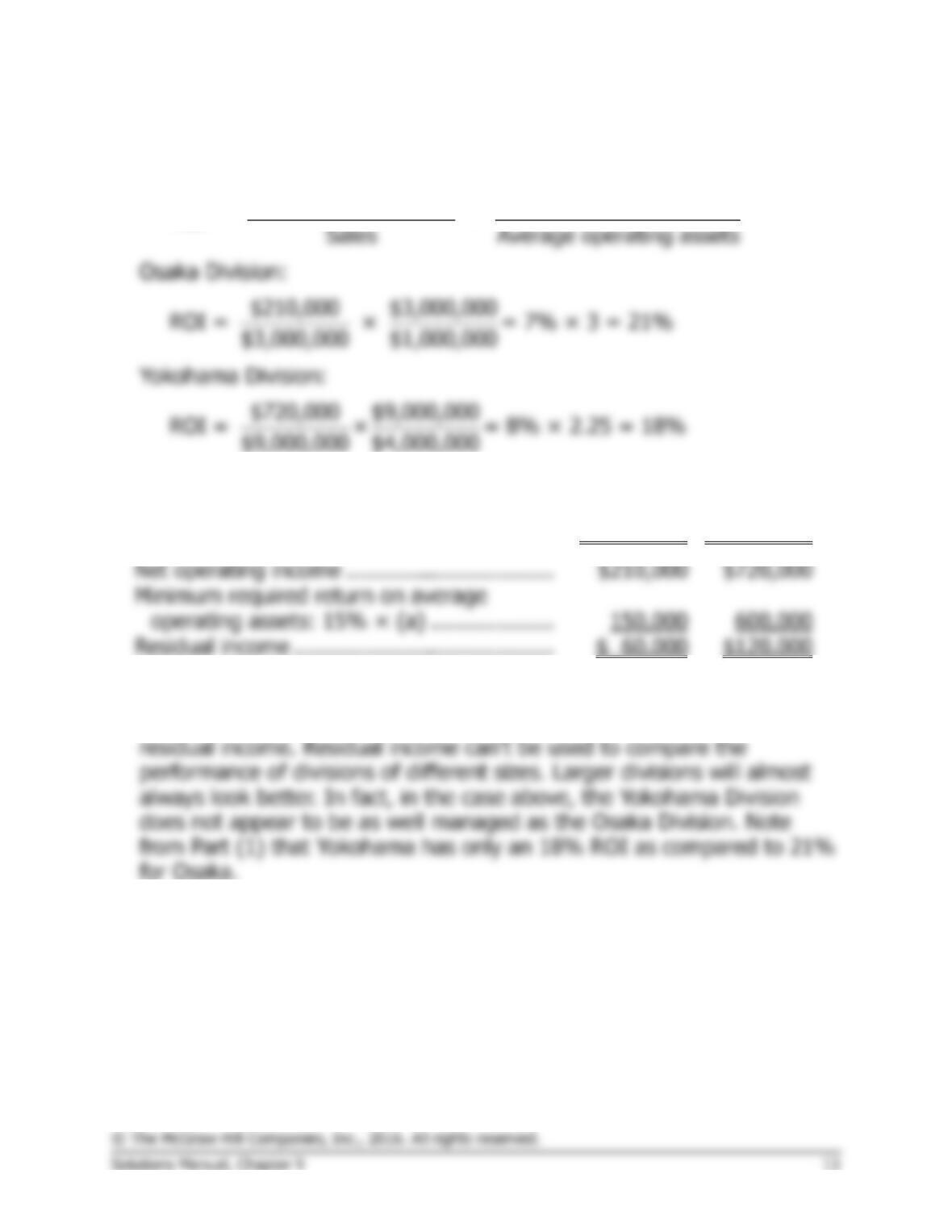
1. ROI computations:
Net operating income Sales
ROI = ×
2.
Osaka
Yokohama
Average operating assets (a) ………………….
$1,000,000
$4,000,000
Net operating income …………………………..
Residual income ………………………………….
3. No, the Yokohama Division is simply larger than the Osaka Division and
for this reason one would expect that it would have a greater amount of
Exercise 9-7 (45 minutes)
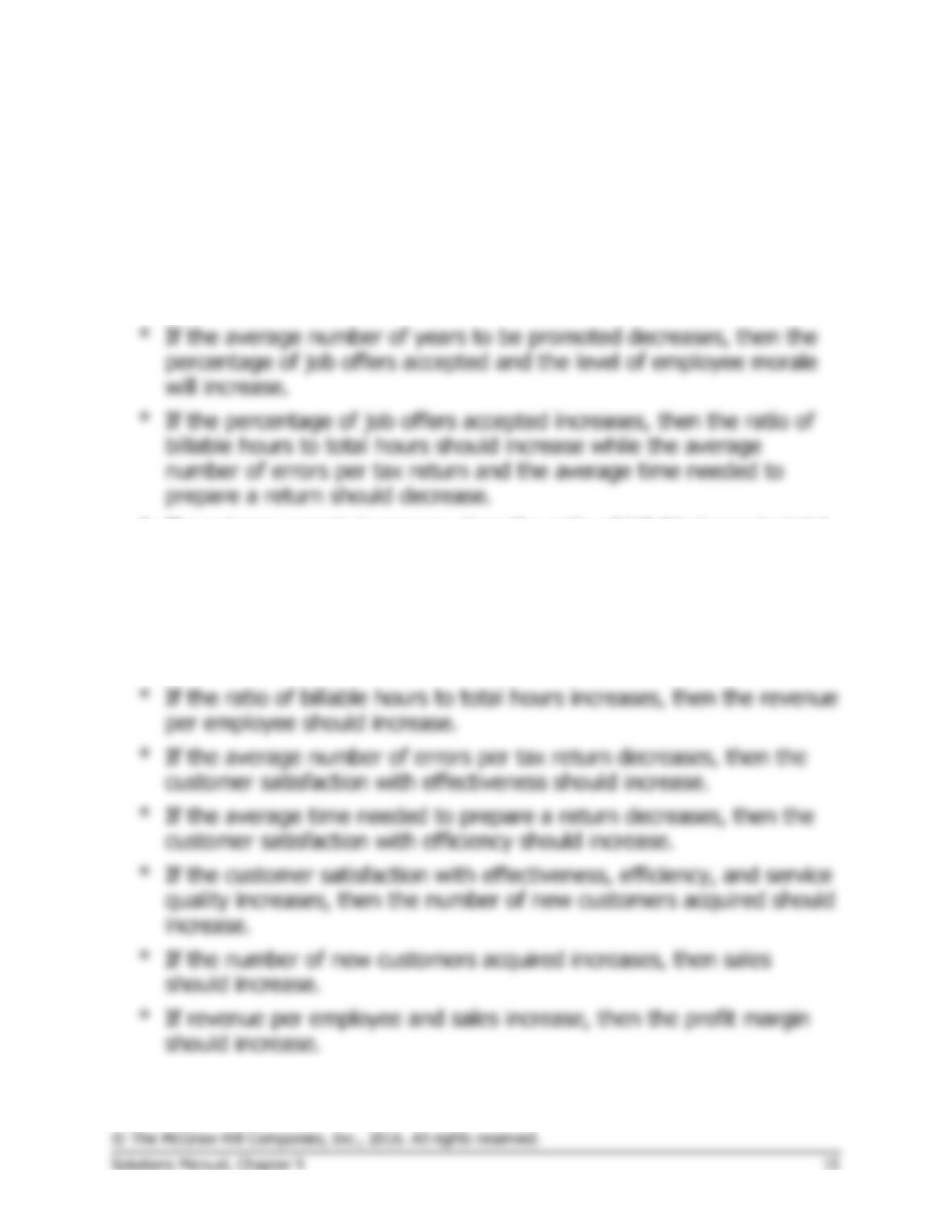
1. Students’ answers may differ in some details from this solution.
+
+
+
+
+
+
Profit margin
Financial
Customer
Learning
And Growth
Customer
satisfaction with
effectiveness
Customer
satisfaction with
efficiency
Customer
satisfaction with
service quality
Number of new
customers acquired
+
+
+
+
+
Exercise 9-7 (continued)
2. The hypotheses underlying the balanced scorecard are indicated by the
arrows in the diagram. Reading from the bottom of the balanced
scorecard, the hypotheses are:
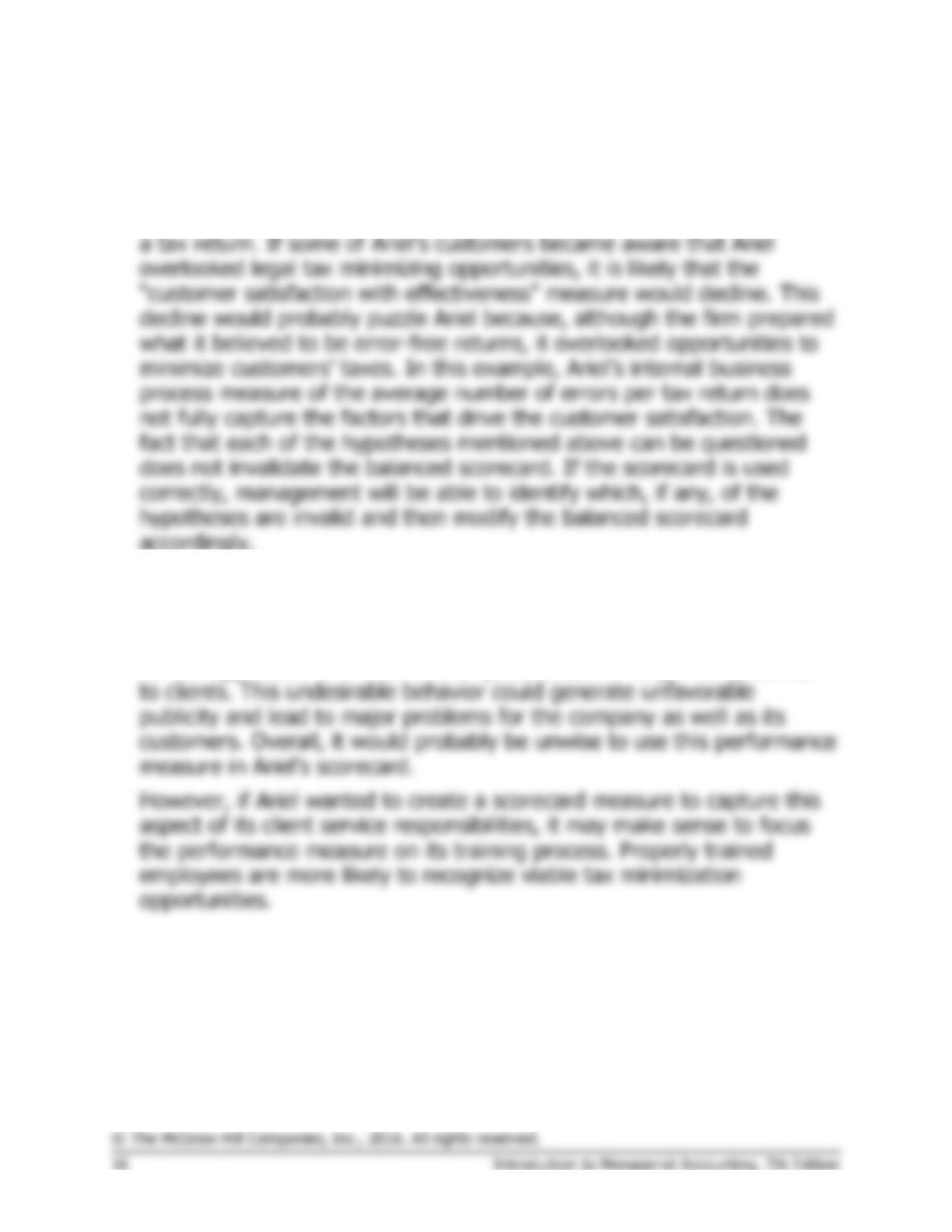
° If the amount of compensation paid above the industry average
increases, then the percentage of job offers accepted and the level of
employee morale will increase.
° If employee morale increases, then the ratio of billable hours to total
hours should increase while the average number of errors per tax
return and the average time needed to prepare a return should
decrease.
° If employee morale increases, then the customer satisfaction with
service quality should increase.
Exercise 9-7 (continued)
Each of these hypotheses can be questioned. For example, Ariel’s
customers may define effectiveness as minimizing their tax liability
which is not necessarily the same as minimizing the number of errors in
3. The performance measure “total dollar amount of tax refunds
generated” would motivate Ariel’s employees to aggressively search for
tax minimization opportunities for its clients. However, employees may
be too aggressive and recommend questionable or illegal tax practices
Exercise 9-7 (continued)
4. Each office’s individual performance should be based on the scorecard
measures only if the measures are controllable by those employed at
the branch offices. In other words, it would not make sense to attempt
Exercise 9-8 (15 minutes)
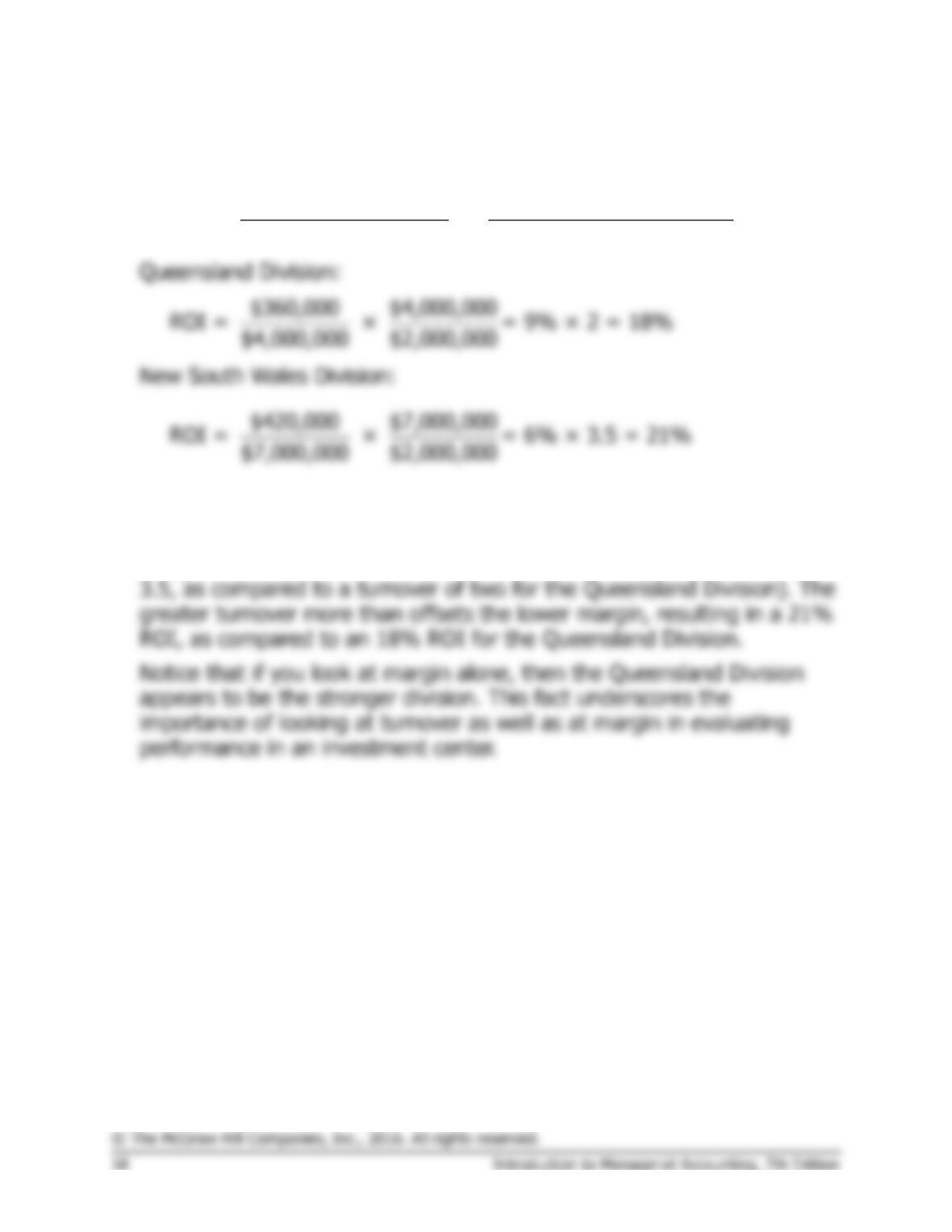
1. ROI computations:
Net operating income Sales
ROI = ×
Sales Average operating assets
2. The manager of the New South Wales Division seems to be doing the
better job. Although its margin is three percentage points lower than the
margin of the Queensland Division, its turnover is higher (a turnover of
Exercise 9-9 (15 minutes)
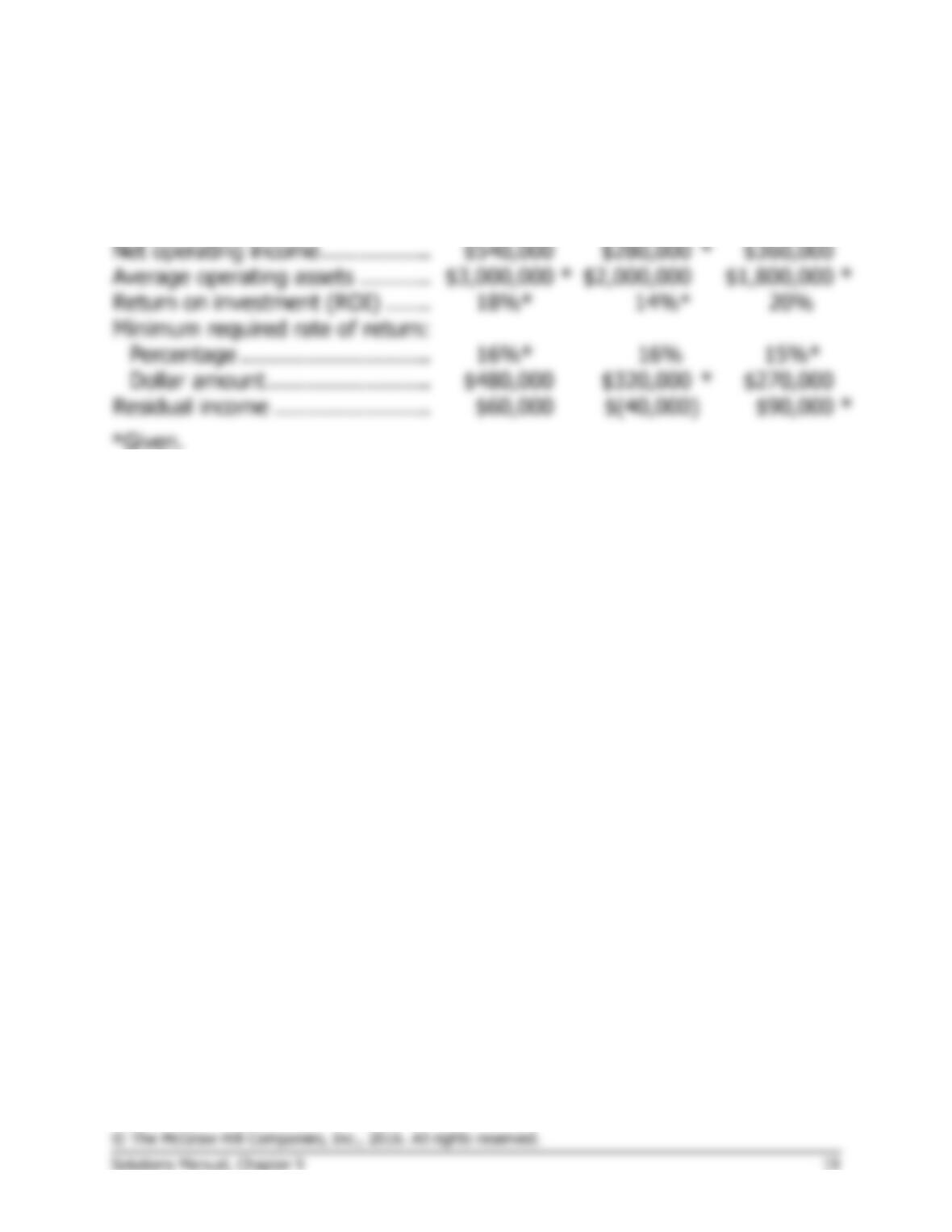
Company A
Company B
Company C
Sales …………………………………..
$9,000,000
*
$7,000,000
*
$4,500,000
*
Net operating income ……………..
*
Minimum required rate of return:
*
Residual income ……………………
*
Exercise 9-10 (20 minutes)
1.
(b)
(c)
Net
Average
(a)
Operating
Operating
ROI
Sales
Income*
Assets
(b) ÷ (c)
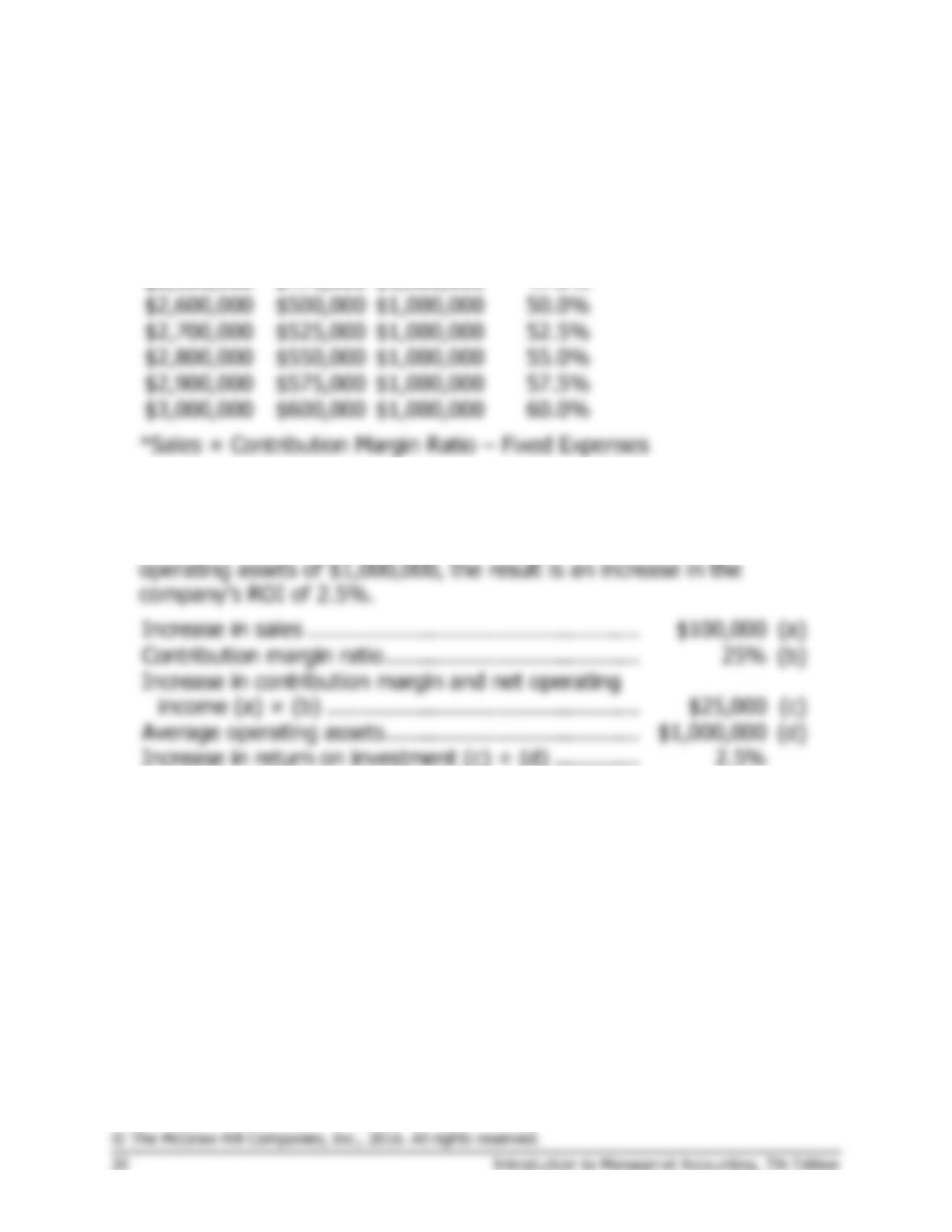
2. The ROI increases by 2.5% for each $100,000 increase in sales. This
happens because each $100,000 increase in sales brings in an additional
profit of $25,000. When this additional profit is divided by the average
Increase in sales ……………………………………………
Contribution margin ratio …………………………………
Average operating assets …………………………………
Increase in return on investment (c) ÷ (d) ………….