EXERCISE 8.10 (15–20 minutes)
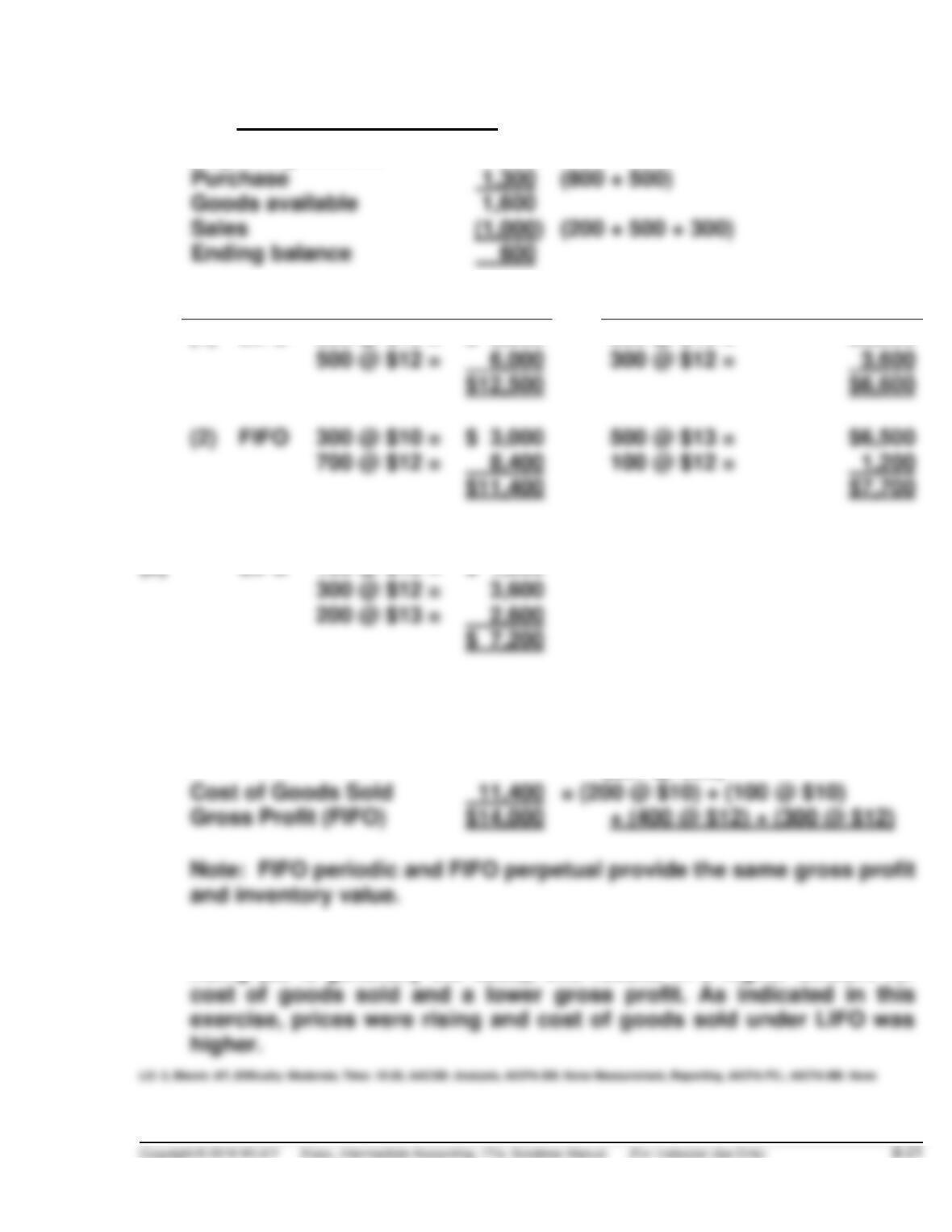
(a)
Units in ending inventory
Beginning balance
300
Purchase
(800 + 500)
Goods available
Sales
(200 + 500 + 300)
Ending balance
Cost of Goods Sold
Ending Inventory
(1)
LIFO
500 @ $13 =
$ 6,500
300 @ $10 =
$3,000
500 @ $12 =
6,000
300 @ $12 =
(2)
FIFO
300 @ $10 =
$ 3,000
500 @ $13 =
700 @ $12 =
8,400
100 @ $12 =
(b)
LIFO
100 @ $10 =
$ 1,000
300 @ $12 =
200 @ $13 =
2,600
(c)
Sales revenue
$25,400
= ($24 @ 200) + ($25 @ 500) +
($27 @ 300)
Cost of Goods Sold
= (200 @ $10) + (100 @ $10)
Gross Profit (FIFO)
+ (400 @ $12) + (300 @ $12)
(d)
LIFO matches the most current costs with revenue. When prices are
rising (as is generally the case), this results in a higher amount for
EXERCISE 8.11 (20–25 minutes)
(a)
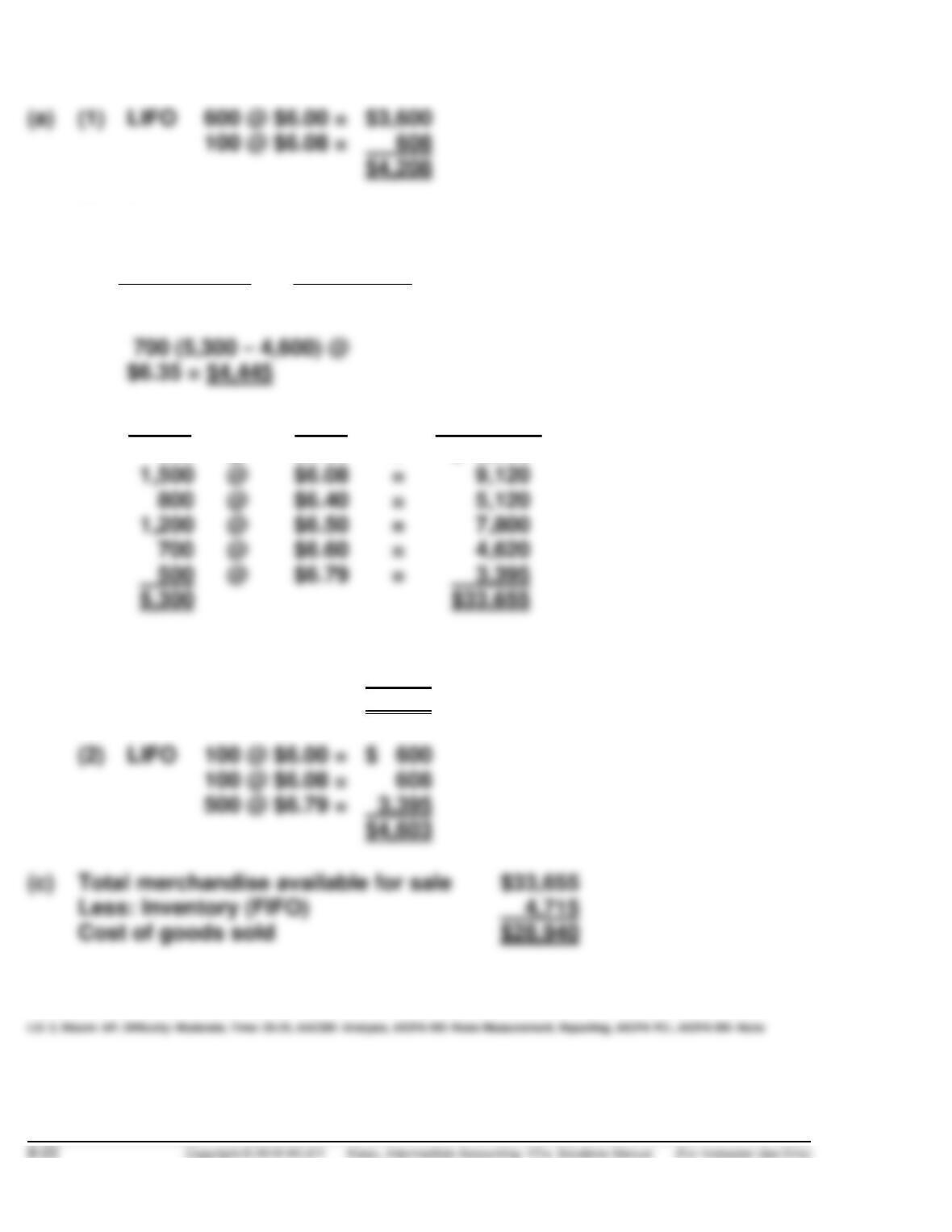
(1)
LIFO
600 @ $6.00 =
$3,600
100 @ $6.08 =
608
$4,208
(2)
Average cost
Total cost
=
$33,655*
= $6.35 average cost per unit
Total units
5,300
*Units
Price
Total Cost
600
@
$6.00
=
$ 3,600
800
@
@
@
3,395
(b)
(1)
FIFO
500 @ $6.79 =
$3,395
200 @ $6.60 =
1,320
$4,715
(2)
LIFO
100 @ $6.00 =
$ 600
100 @ $6.08 =
608
500 @ $6.79 =
3,395
$4,603
(c)
Total merchandise available for sale
$33,655
Less: Inventory (FIFO)
4,715
(d)
FIFO.
EXERCISE 8.12 (15–20 minutes)
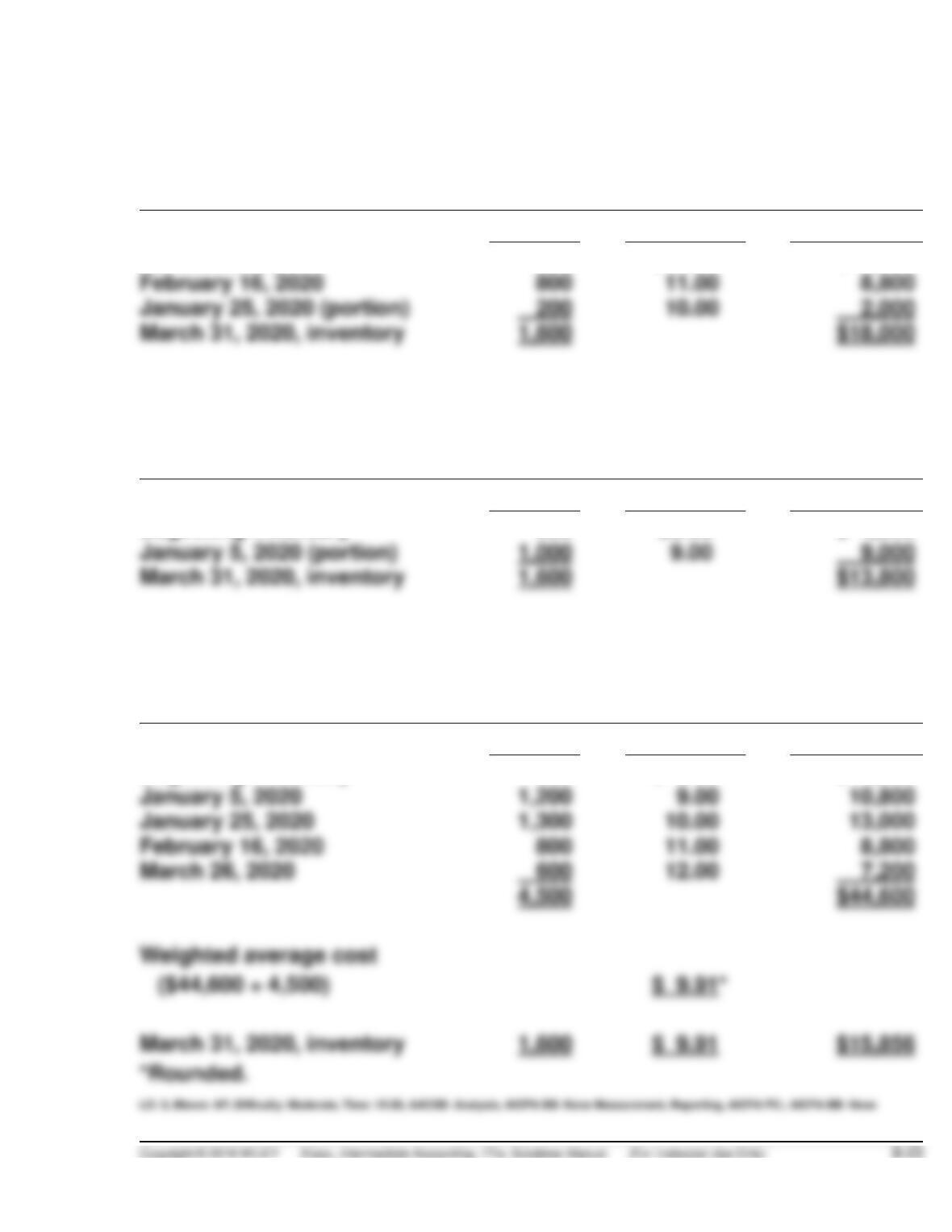
(a) Shania Twain Company
COMPUTATION OF INVENTORY FOR PRODUCT
BAP UNDER FIFO INVENTORY METHOD
March 31, 2020
Units
Unit Cost
Total Cost
March 26, 2020
600
$12.00
$ 7,200
February 16, 2020
January 25, 2020 (portion)
2,000
(b) Shania Twain Company
COMPUTATION OF INVENTORY FOR PRODUCT
BAP UNDER LIFO INVENTORY METHOD
March 31, 2020
Units
Unit Cost
Total Cost
Beginning inventory
600
$8.00
$ 4,800
January 5, 2020 (portion)
(c) Shania Twain Company
COMPUTATION OF INVENTORY FOR PRODUCT
BAP UNDER WEIGHTED-AVERAGE INVENTORY METHOD
March 31, 2020
Units
Unit Cost
Total Cost
Beginning inventory
600
$ 8.00
$ 4,800
January 25, 2020
February 16, 2020
March 26, 2020
EXERCISE 8.13 (15–20 minutes)
(a)
(1)
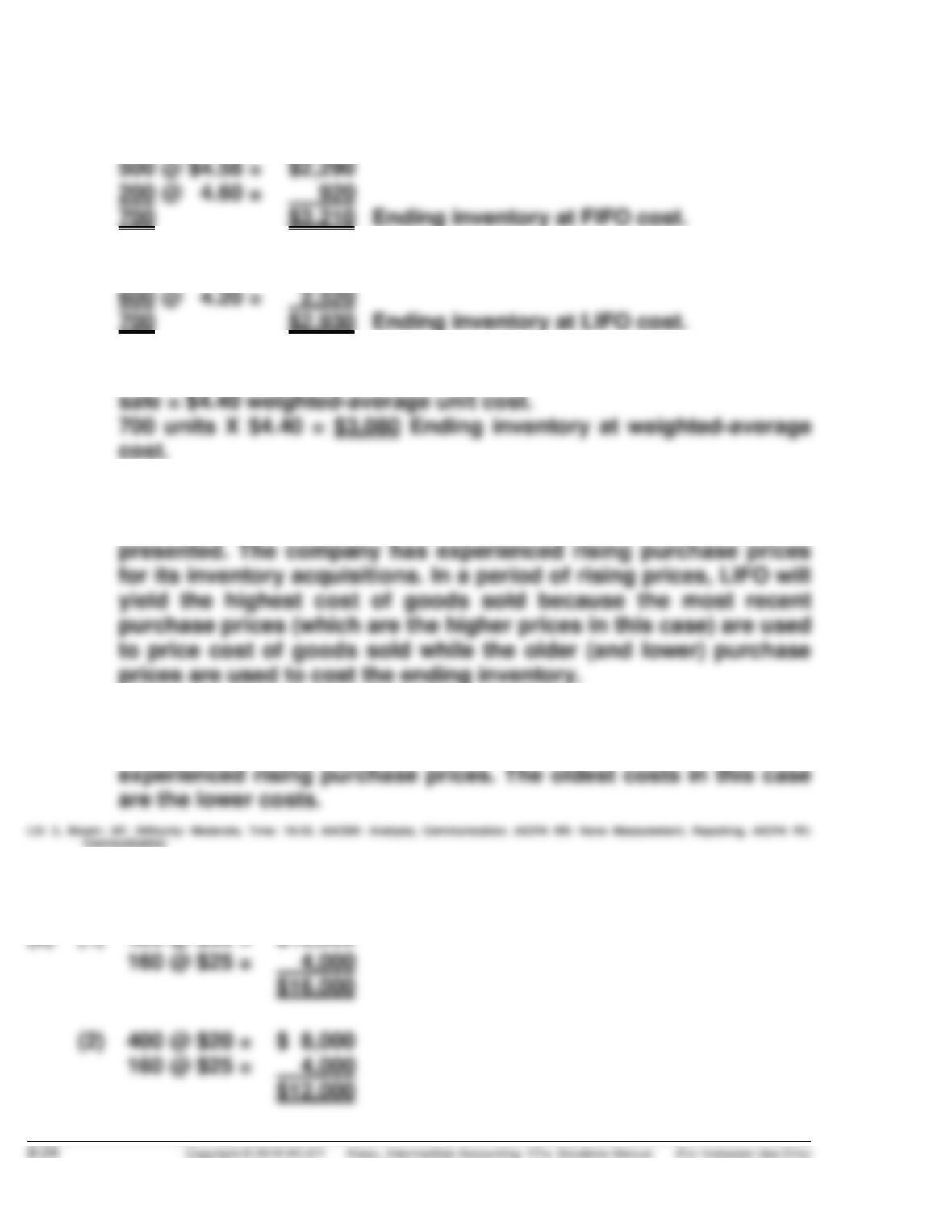
2,100 units available for sale – 1,400 units sold = 700 units in the
ending inventory.
500 @ $4.58 =
$2,290
920
(2)
100 @ $4.10 =
$ 410
(3)
cost.
$9,240 cost of goods available for sale ÷ 2,100 units available for
(b)
(1)
LIFO will yield the lowest gross profit because this method will
yield the highest cost of goods sold figure in the situation
(2)
experienced rising purchase prices. The oldest costs in this case
LIFO will yield the lowest ending inventory because LIFO uses the
oldest costs to price the ending inventory units. The company has
EXERCISE 8.14 (10–15 minutes)
(a)
(1)
400 @ $30 =
$12,000
160 @ $25 =
(2)
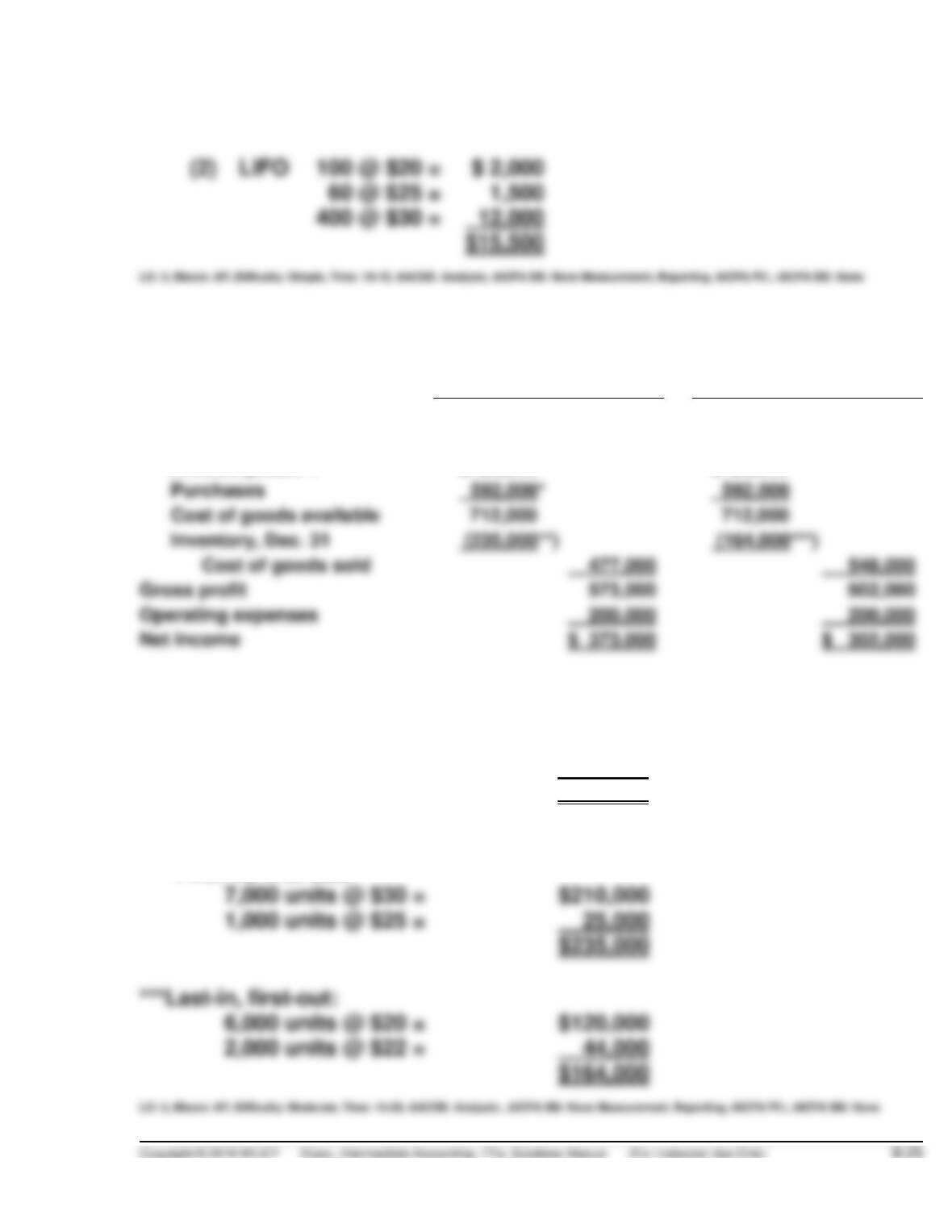
400 @ $20 =
EXERCISE 8.14 (Continued)
(b)
(1)
FIFO
$16,000 [same as (a)]
(2)
LIFO
100 @ $20 =
400 @ $30 =
EXERCISE 8.15 (15–20 minutes)
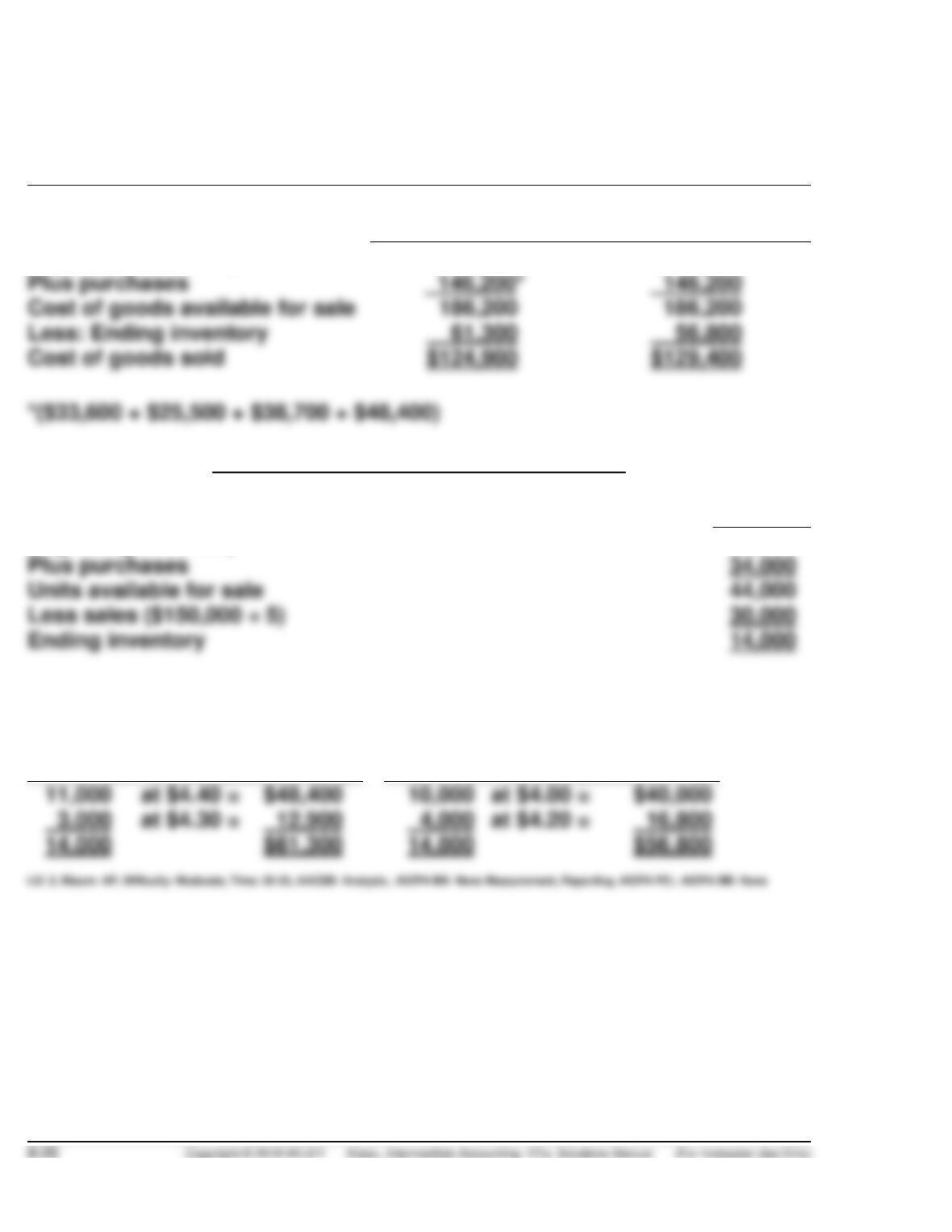
First-in, first-out
Last-in, first-out
Sales revenue (21,000 $50)
$1,050,000
$1,050,000
Cost of goods sold:
Inventory, Jan. 1
$120,000
$120,000
Cost of goods available
Inventory, Dec. 31
(235,000**)
Cost of goods sold
Gross profit
Operating expenses
*Purchases
6,000 @ $22 =
$132,000
10,000 @ $25 =
250,000
7,000 @ $30 =
210,000
$592,000
**Computation of inventory, Dec. 31:
First-in, first-out:
1,000 units @ $25 =
$235,000
***Last-in, first-out:
6,000 units @ $20 =
2,000 units @ $22 =
EXERCISE 8.16 (20–25 minutes)
Sandy Alomar Corporation
SCHEDULES OF COST OF GOODS SOLD
For the First Quarter Ended March 31, 2020
Schedule 1
First-in, First-out
Schedule 2 Last-in,
First-out
Beginning inventory
$ 40,000
$ 40,000
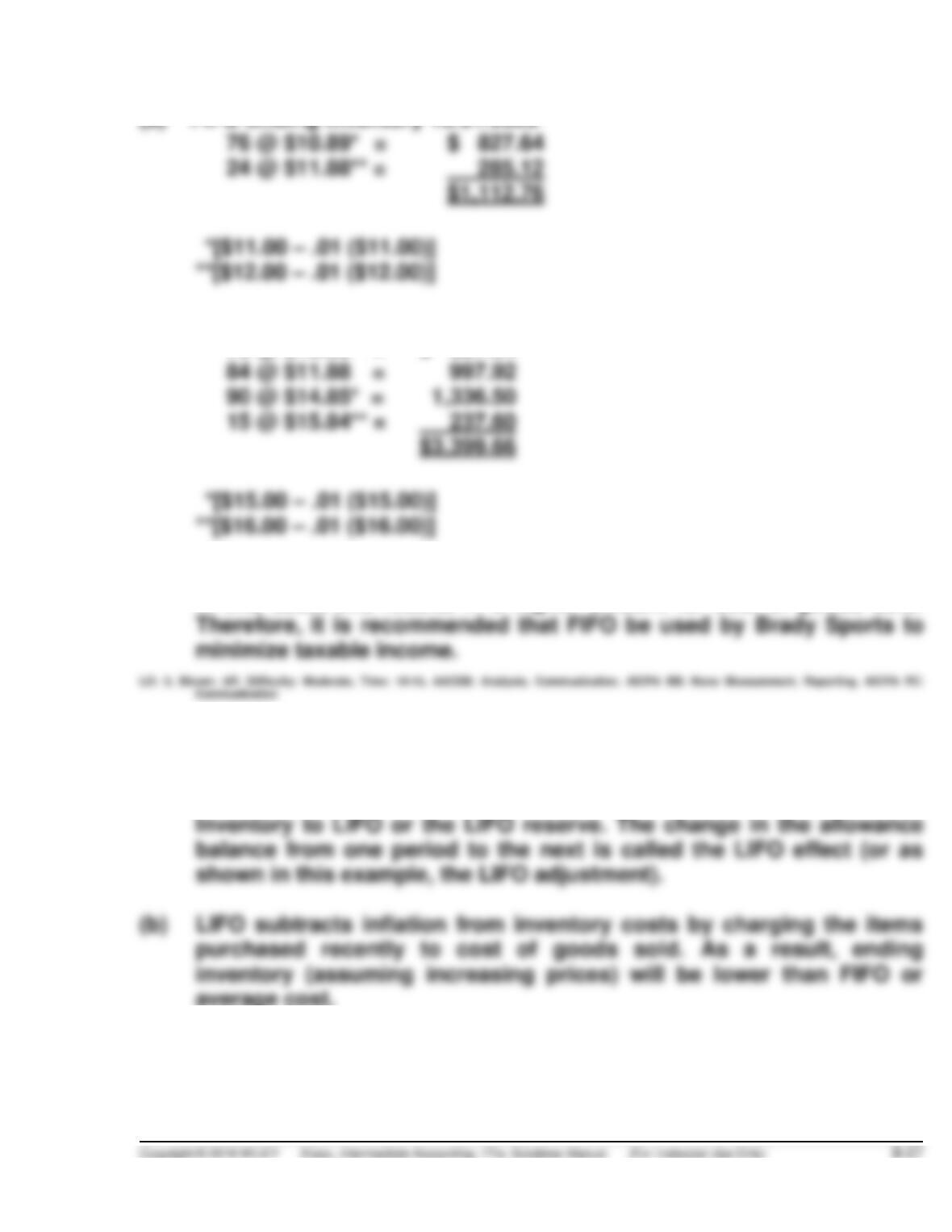
Cost of goods available for sale
Schedules Computing Ending Inventory
Units
Beginning inventory
10,000
Plus purchases
Units available for sale
Less sales ($150,000 ÷ 5)
30,000
The unit computation is the same for both assumptions, but the cost
assigned to the units of ending inventory are different.
First-in, First-out (Schedule 1)
Last-in, First-out (Schedule 2)
at $4.40 =
at $4.00 =
at $4.30 =
at $4.20 =
EXERCISE 8.17 (10–15 minutes)
(a)
FIFO Ending Inventory 12/31/2020
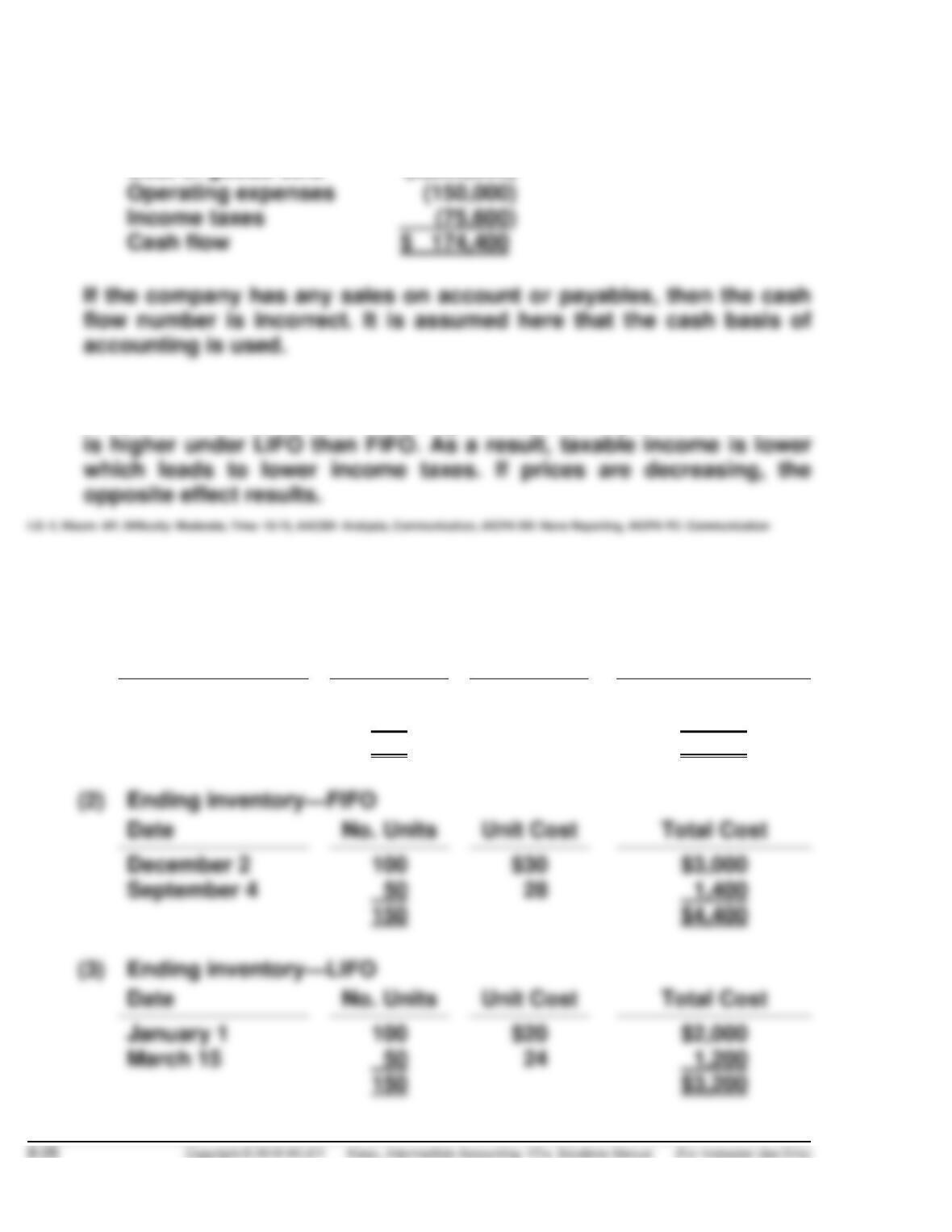
76 @ $10.89* =
24 @ $11.88** =
(b)
LIFO Cost of Goods Sold—2020
76 @ $10.89 =
$ 827.64
90 @ $14.85* =
15 @ $15.84** =
237.60
(c) FIFO matches older costs with revenue. When prices are declining, as
in this case, this results in a higher amount for cost of goods sold.
EXERCISE 8.18 (10–15 minutes)
(a) The difference between the inventory used for internal reporting
purposes and LIFO is referred to as the Allowance to Reduce
EXERCISE 8.18 (Continued)
(c) Cash flow was computed as follows:
Revenue
$3,200,000
Cost of goods sold
(2,800,000)
Operating expenses
Income taxes
(d) The company has extra cash because its taxes are less. The reason
taxes are lower is because cost of goods sold (in a period of inflation)
EXERCISE 8.19 (25–30 minutes)
(a)
(1)
Ending inventory—Specific Identification
Date
No. Units
Unit Cost
Total Cost
December 2
100
$30
$3,000
July 20
50
25
1,250
150
$4,250
(2)
Date
No. Units
Unit Cost
Total Cost
December 2
100
$30
$3,000
September 4
(3)
January 1
100
$20
$2,000
March 15
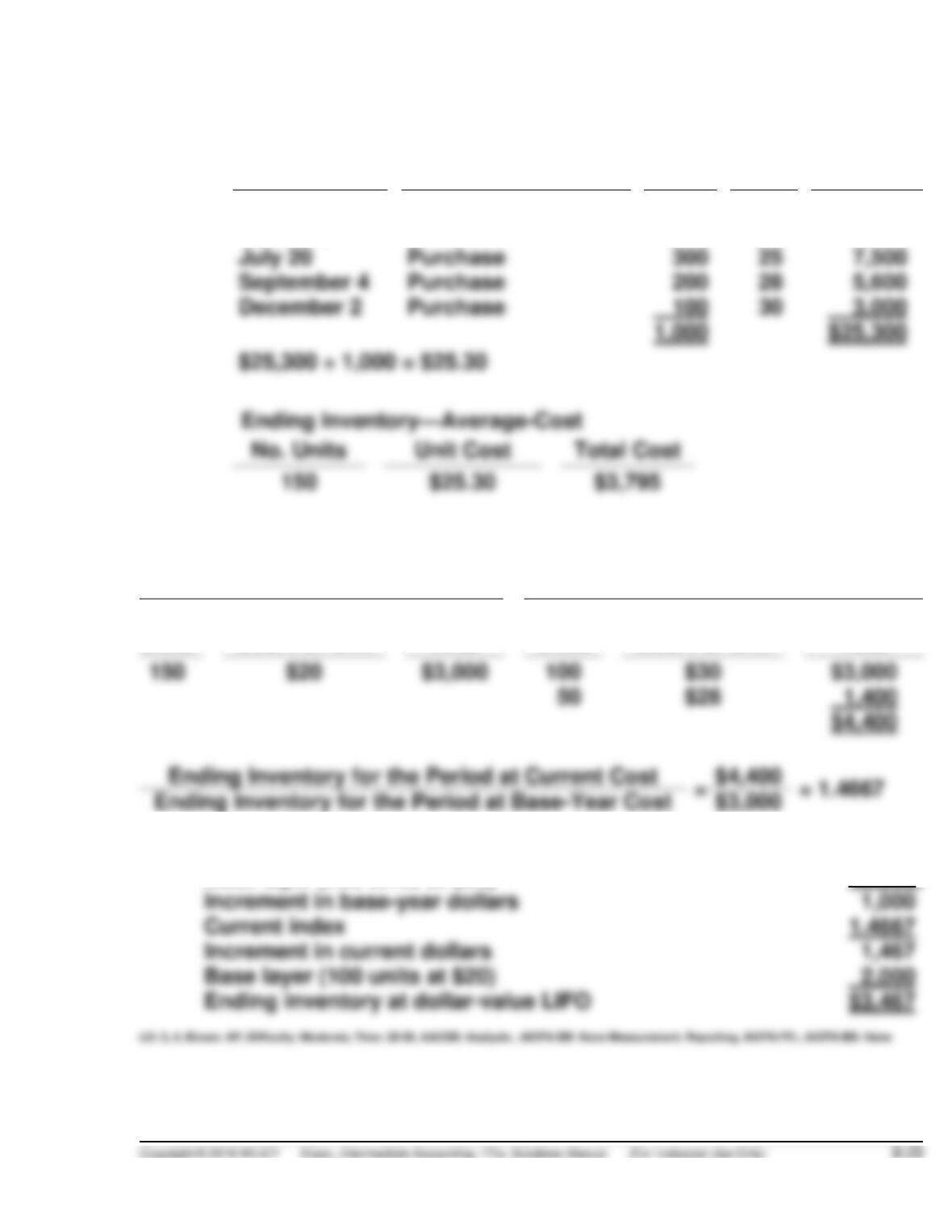
EXERCISE 8.19 (Continued)
(4)
Ending inventory—Average-Cost
Date
Explanation
No.
Units
Unit
Cost
Total
Cost
January 1
Beginning inventory
100
$20
$ 2,000
March 15
Purchase
300
24
7,200
300
200
December 2
Purchase
100
30
3,000
1,000
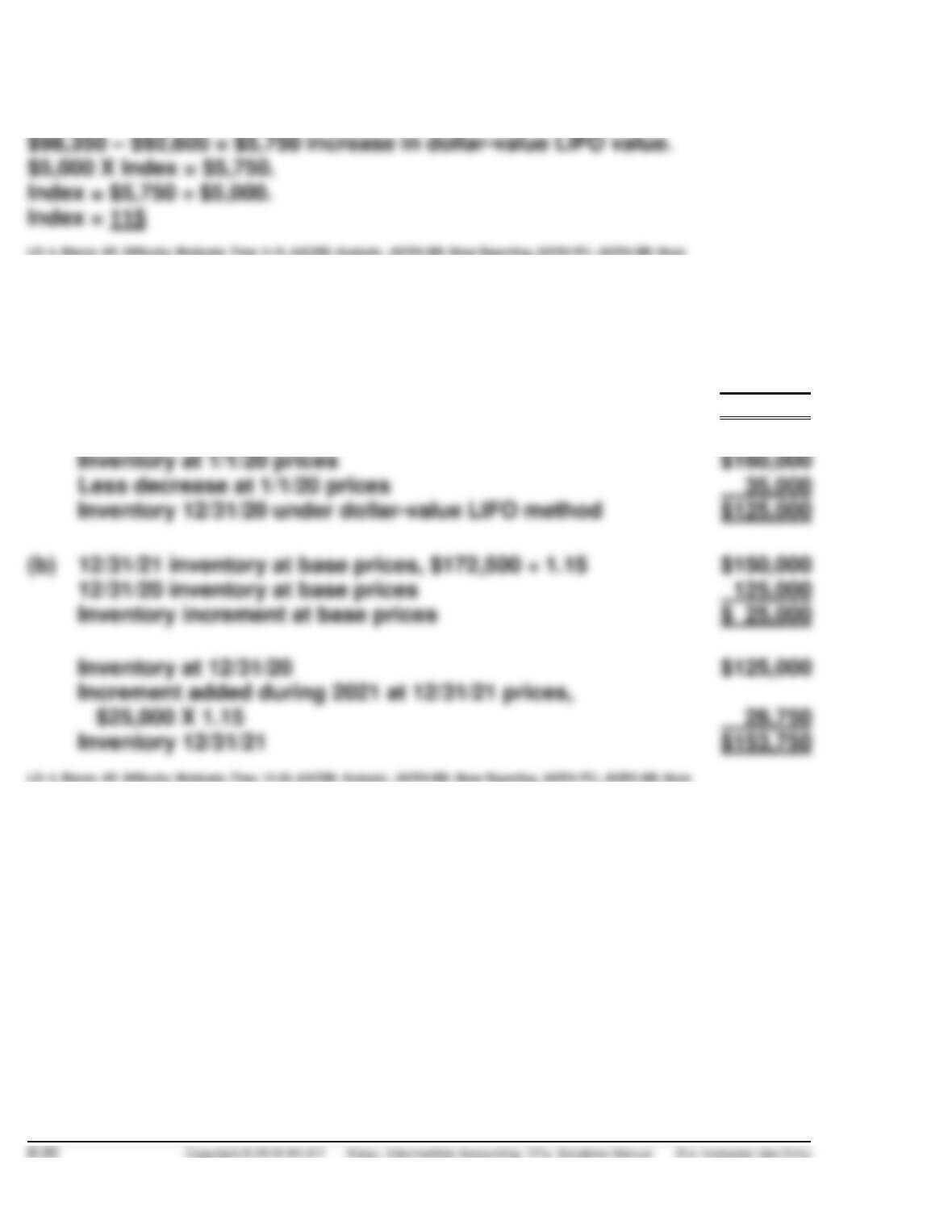
(b) Double Extension Method
Base-Year Costs
Current Costs
Units
Base-Year
Cost Per Unit
Total
Units
Current-Year
Cost Per Unit
Total
$3,000
$4,400
$3,000
Ending inventory at base-year prices ($4,400 ÷ 1.4667)
$3,000
Base layer (100 units at $20)
(2,000)
Increment in base-year dollars
Current index
1.4667
Increment in current dollars
Base layer (100 units at $20)
Ending inventory at dollar-value LIFO
EXERCISE 8.20 (5–10 minutes)
$97,000 – $92,000 = $5,000 increase at base prices.
EXERCISE 8.21 (15–20 minutes)
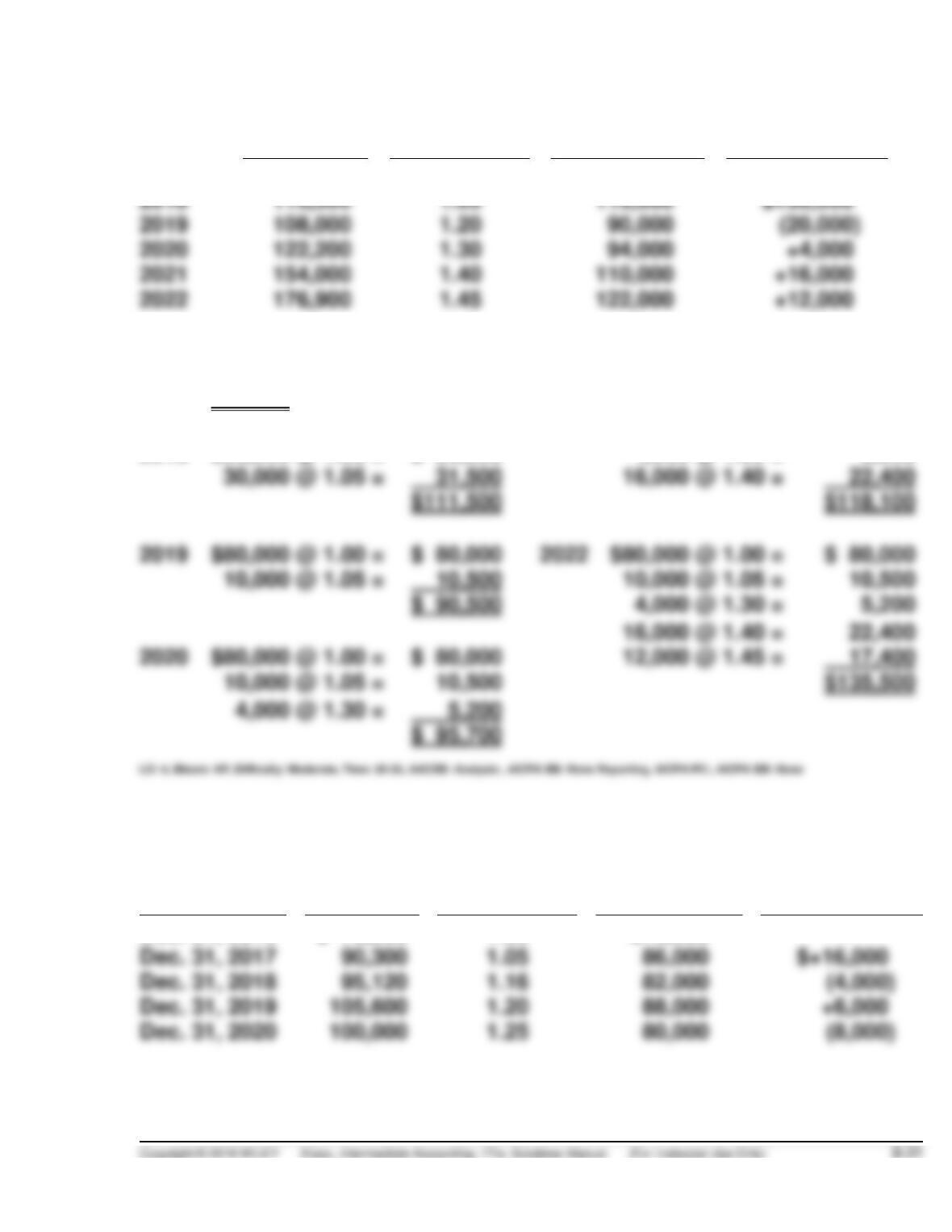
(a)
12/31/20 inventory at 1/1/20 prices, $140,000 ÷ 1.12
$125,000
Inventory 1/1/20
160,000
Inventory decrease at base prices
$ 35,000
Inventory at 1/1/20 prices
$160,000
Less decrease at 1/1/20 prices
(b)
12/31/21 inventory at base prices, $172,500 ÷ 1.15
12/31/20 inventory at base prices
125,000
Inventory increment at base prices
$ 25,000
Inventory at 12/31/20
EXERCISE 8.22 (20–25 minutes)
Current $
Price Index
Base Year $
Change from
Prior Year
2017
$ 80,000
1.00
$ 80,000
—
2018
1.05
2021
1.40
Ending Inventory—Dollar-value LIFO:
2017
$80,000
2021
$80,000 @ 1.00 =
$ 80,000
10,000 @ 1.05 =
10,500
2018
$80,000 @ 1.00 =
$ 80,000
4,000 @ 1.30 =
5,200
30,000 @ 1.05 =
16,000 @ 1.40 =
$118,100
2019
$80,000 @ 1.00 =
$ 80,000
2022
$80,000 @ 1.00 =
10,000 @ 1.05 =
10,000 @ 1.05 =
10,500
4,000 @ 1.30 =
2020
$80,000 @ 1.00 =
$ 80,000
$135,500
4,000 @ 1.30 =
EXERCISE 8.23 (15–20 minutes)
Date
Current $
Price Index
Base-Year $
Change from
Prior Year
Dec. 31, 2016
$ 70,000
1.00
$70,000
—
Dec. 31, 2019
1.20
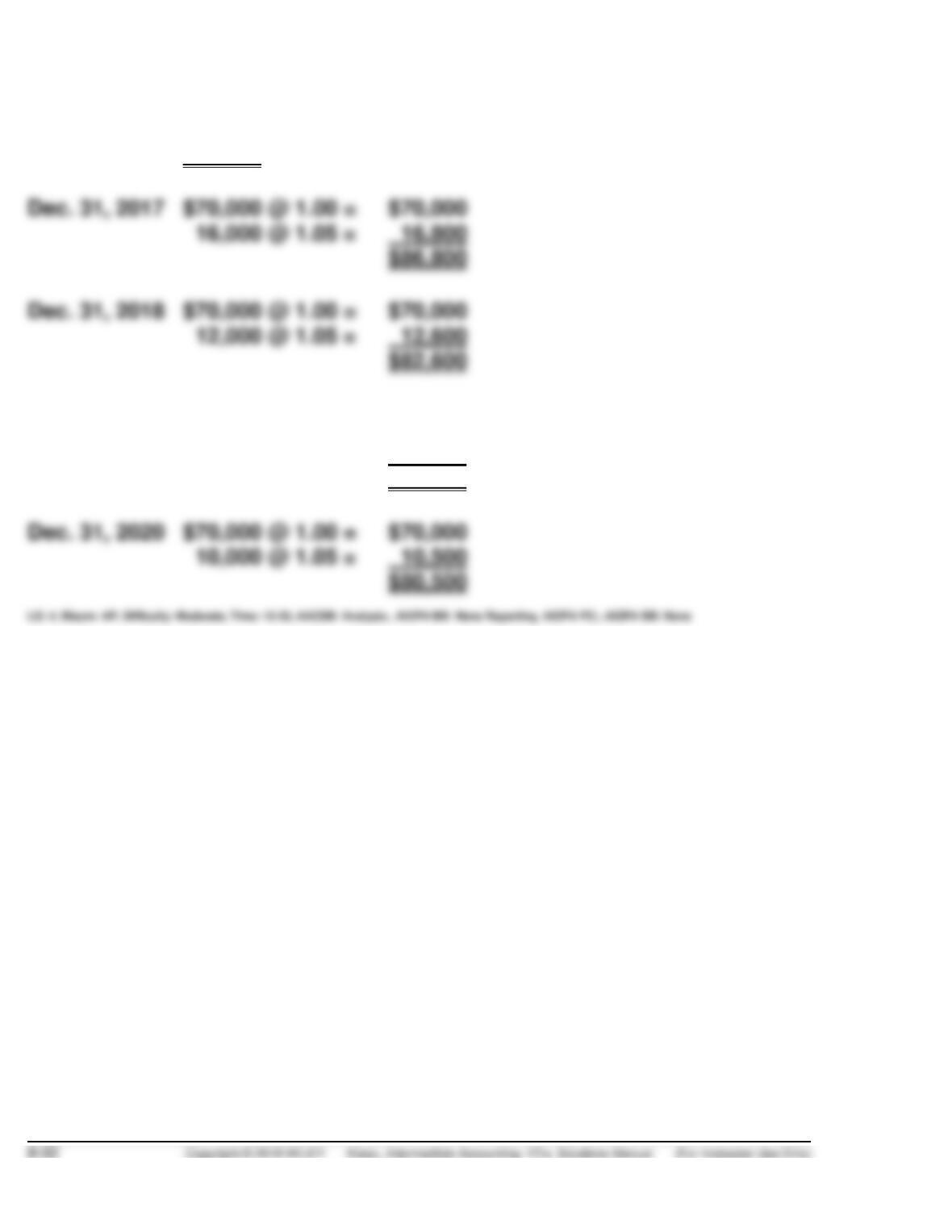
EXERCISE 8.23 (Continued)
Ending Inventory—Dollar-value LIFO:
Dec. 31, 2016
$70,000
Dec. 31, 2017
$70,000 @ 1.00 =
$70,000
16,000 @ 1.05 =
$86,800
Dec. 31, 2018
$70,000 @ 1.00 =
$70,000
12,000 @ 1.05 =
$82,600
Dec. 31, 2019
$70,000 @ 1.00 =
$70,000
12,000 @ 1.05 =
12,600
6,000 @ 1.20 =
7,200
$89,800
Dec. 31, 2020
$70,000 @ 1.00 =
$70,000
10,000 @ 1.05 =
$80,500
EXERCISE 8.24 (10–15 minutes)
Current Year
Subsequent Year
1.
Working capital
Overstated
No effect
Current ratio
Overstated
No effect
Retained earnings
Overstated
No effect
Net income
Overstated
2.
Working capital
No effect
Current ratio
No effect
Retained earnings
No effect
Net income
No effect
Working capital
Overstated
No effect
Current ratio
Overstated
No effect
Retained earnings
Overstated
No effect
Net income
Overstated
EXERCISE 8.25 (10–15 minutes)
(c)
Event
Effect of Error
Adjust Income
Increase (Decrease)
1.
Understatement of ending
inventory
Decreases net income
$22,000
3.
Overstatement of ending
Increases net income
EXERCISE 8.26 (15–20 minutes)
Errors in Inventories
Year
Net
Income
Per Books
Add
Overstate-
ment Jan. 1
Deduct
Understate-
ment Jan. 1
Deduct
Overstate-
ment Dec. 31
Add
Understate-
ment Dec. 31
Corrected
Net Income
2015
$ 50,000
$3,000*
$ 47,000
2018
56,000
45,000
TIME AND PURPOSE OF PROBLEMS
Problem 8.1 (Time 30–40 minutes)
Purpose—to provide a multipurpose problem with trade discounts, goods in transit, computing internal
Problem 8.2 (Time 25–35 minutes)
Problem 8.3 (Time 20–25 minutes)
Purpose—to provide the student with an opportunity to prepare general journal entries to record pur–
Problem 8.4 (Time 40–55 minutes)
Purpose—to provide a problem where the student must compute the inventory using a FIFO, LIFO, and
Problem 8.5 (Time 40–55 minutes)
Purpose—to provide a problem where the student must compute the inventory using a FIFO, LIFO, and
Problem 8.6 (Time 25–35 minutes)
Problem 8.7 (Time 30–40 minutes)
Purpose—to provide a problem where the student must identify the accounts that would be affected if
Problem 8.8 (Time 30–40 minutes)
Purpose—to provide a problem which covers the use of inventory pools for dollar-value LIFO. The
Problem 8.9 (Time 25–35 minutes)
Purpose—the student computes the internal conversion price indexes for a LIFO inventory pool and
Problem 8.10 (Time 30–35 minutes)
Purpose—to provide the student with the opportunity to compute inventories using the dollar-value
Problem 8.11 (Time 40–50 minutes)
Purpose—to provide the student with an opportunity to write a memo on how a dollar-value LIFO
SOLUTIONS TO PROBLEMS
PROBLEM 8.1
1. $175,000 – ($175,000 X .20) = $140,000;
$140,000 – ($140,000 X .10) = $126,000, cost of goods purchased
3. Because no date was associated with the units issued or sold, the
periodic (rather than perpetual) inventory method must be assumed.
FIFO inventory cost:
1,000 units at $24
$ 24,000
1,000 units at 23
23,000
LIFO inventory cost:
1,500 units at $21
$ 31,500
500 units at 22
11,000
Average cost:
1,500 at $21
$ 31,500
2,000 at 22
3,500 at 23
1,000 at 24
24,000
$180,000 ÷ 8,000 = $22.50
PROBLEM 8.1 (Continued)
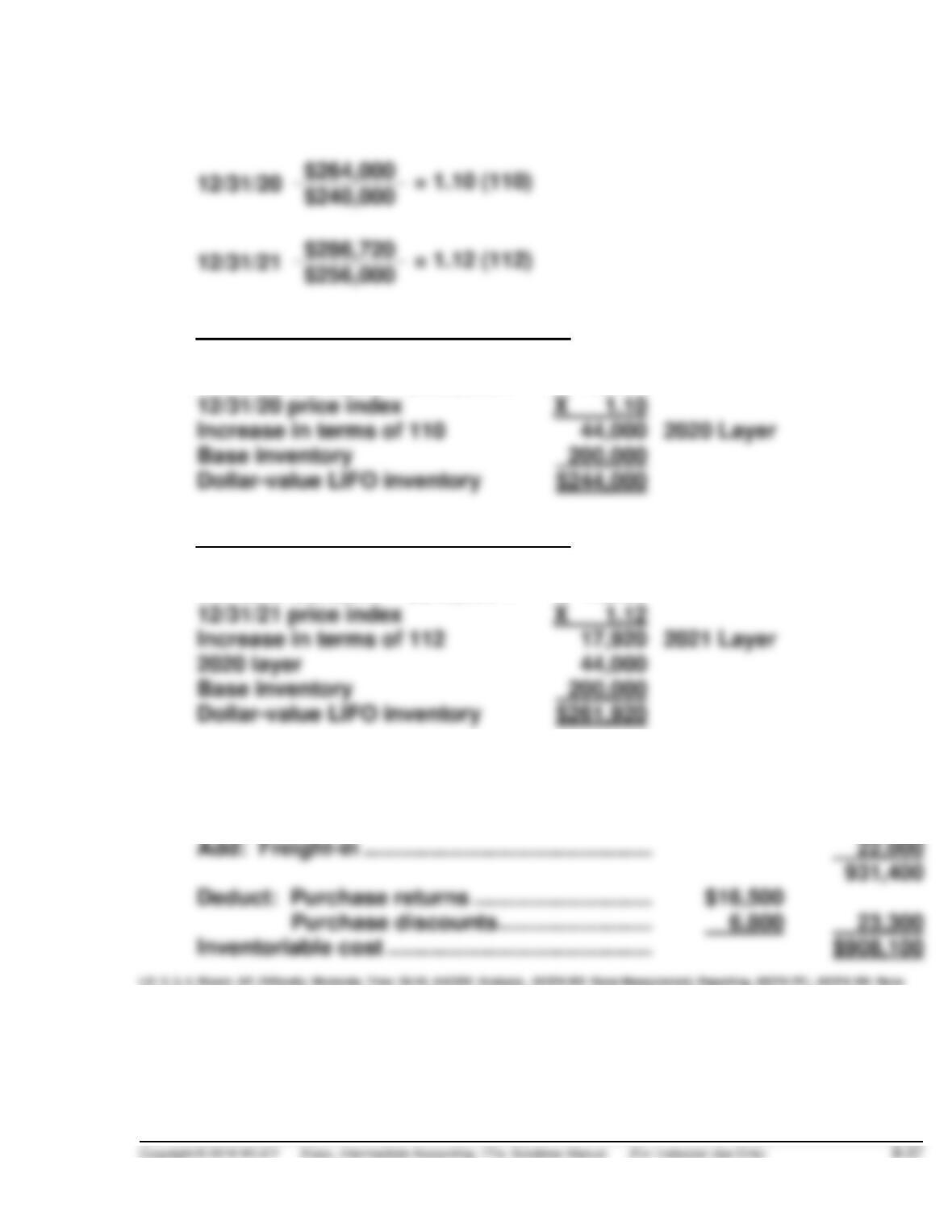
4. Computation of price indexes:
Dollar-value LIFO inventory 12/31/20:
Increase $240,000 – $200,000 =
$ 40,000
Increase in terms of 110
2020 Layer
Base inventory
Dollar-value LIFO inventory 12/31/21:
Increase $256,000 – $240,000 =
$ 16,000
12/31/21 price index
Base inventory
5. The inventoriable costs for 2021 are:
Merchandise purchased …………………………...
$909,400
Add: Freight-in ………………………………………..
22,000
Deduct: Purchase returns ………………………..
Purchase discounts …………………….
PROBLEM 8.2
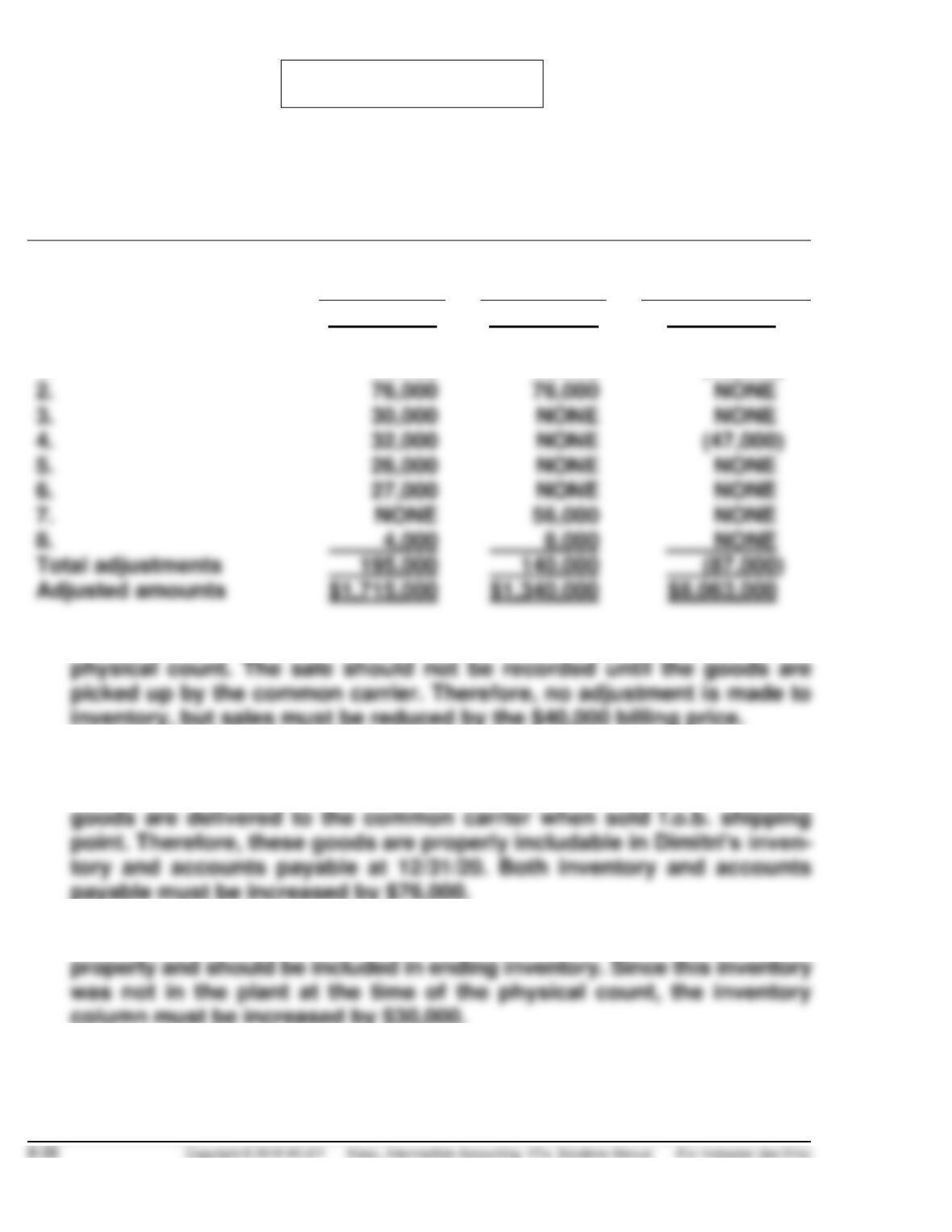
DIMITRI COMPANY
Schedule of Adjustments
December 31, 2020
Inventory
Accounts
Payable
Net Sales
Initial amounts
$1,520,000
$1,200,000
$8,150,000
Adjustments:
1.
NONE
NONE
(40,000)
2.
NONE
4.
NONE
(47,000)
5.
NONE
6.
NONE
7.
NONE
8.
8,000
Total adjustments
195,000
140,000
1. The $31,000 of tools on the loading dock were properly included in the
2. The $76,000 of goods in transit from a vendor to Dimitri were shipped
f.o.b. shipping point on 12/29/20. Title passes to the buyer as soon as
3. The work-in–process inventory sent to an outside processor is Dimitri’s
PROBLEM 8.2 (Continued)
4. The tools costing $32,000 were recorded as sales ($47,000) in 2020.
However, these items were returned by customers on December 31, so
5. The $26,000 of Dimitri’s tools shipped to a customer f.o.b. destination
are still owned by Dimitri while in transit because title does not pass on
6. The goods received from a vendor at 5:00 p.m. on 12/31/20 should be
included in the ending inventory, but were not included in the physical
7. The $56,000 of goods received on 12/26/20 were properly included in
8. Since one-half of the freight-in cost ($8,000) pertains to merchandise
properly included in inventory as of 12/31/20, $4,000 should be added
PROBLEM 8.3
(a)
1.
8/10
Purchases ………………………………………………………
12,000
Accounts Payable……………………………………
12,000
8/13
Accounts Payable …………………………..………………
Purchase Returns and Allowances …………..
8/15
Purchases ………………………………………………………
16,000
Accounts Payable……………………………………
16,000
Purchases ………………………………………………………
20,000
Accounts Payable……………………………………
20,000
8/28
Accounts Payable …………………………..………………
16,000
Cash ………………………………………………………
16,000
2. Purchases—addition to beginning inventory in cost of goods
sold section of income statement.
(b)
1.
8/10
Purchases ………………………………………………………
11,760
Accounts Payable ($12,000 X .98) …………….
11,760
Accounts Payable …………………………..………………
Purchase Returns and Allowances
($1,200 X .98) ………………………………………..