
Time and Purposes of Concepts for Analysis (Continued)
CA 8.10 (Time 30–35 minutes)
Purpose—to provide the student with an opportunity to analyze the effect of changing from the FIFO
CA 8.11 (Time 20–25 minutes)
Purpose—to provide the student with an opportunity to analyze the ethical implications of purchasing
SOLUTIONS TO CONCEPTS FOR ANALYSIS
CA 8.1
(a) Purchased merchandise in transit at the end of an accounting period to which legal title has
(b) Inventory ………………………………………………………………………………….. 35,300
Accounts Payable (Supplier) ……………………………………………………. 35,300
CA 8.2
(a) If the terms of the purchase are f.o.b. shipping point (manufacturer’s plant), Strider Enterprises
should include in its inventory goods purchased from its suppliers when the goods are shipped.
For accounting purposes, title is presumed to pass at that time.
CA 8.3
(a) According to FASB ASC 330-10–30–1:
“As applied to inventories, cost means in principle the sum of the applicable expenditures and
charges directly or indirectly incurred in bringing an article to its existing condition and
location.”
The discussion includes the following: “Selling expenses constitute no part of the inventory costs.”
To the extent that warehousing is a necessary function of importing merchandise before it can be
sold, certain elements of warehousing costs might be considered an appropriate cost of inventory
(b) It is correct to conclude that obsolete items are excludable from inventory. Cost attributable to
such items is “nonuseful” and “nonrecoverable” cost (except for possible scrap value) and should
be written off. If the cost of obsolete items was simply excluded from ending inventory, the resultant
(d) The transaction is a product financing arrangement and should be reported by the company as
inventory with a related liability. The substance of the transaction is that inventory has been
purchased and the fact that a trust is established to purchase the goods has no economic
CA 8.4
(a) Cash discounts should not be accounted for as financial income when payments are made.
Income should be recognized when the company sells the inventory. Furthermore, cash discounts
CA 8.4 (Continued)
(b) Cash discounts should not be accounted for as a reduction of cost of goods sold for the period
when payments are made. Cost of goods sold should be reduced when the company sells the
CA 8.5
(a) 1. Inventories are unexpired costs and represent future benefits to the owner. A balance sheet
2. Beginning and ending inventories are included in the computation of net income only for the
purpose of arriving at the cost of goods sold during the period of time covered by the
statement. Goods included in the beginning inventory which are no longer on hand are expired
costs to be matched against revenues recognized during the period. Goods included in the
ending inventory are unexpired costs to be carried forward to a future period, rather than
expensed.
(b) Financial accounting has as its goal the proper reporting of financial transactions and events in
accordance with generally accepted accounting principles. Income tax accounting has as its goal
the reporting of taxable transactions and events in conformity with income tax laws and regulations.
(c) FIFO and LIFO are inventory costing methods employed to measure the flow of costs. FIFO
matches the first cost incurred with the first revenue produced while LIFO matches the last cost
incurred with the first revenue produced after the cost is incurred. (This, of course, assumes a
CA 8.6
(a) Inventory profits occur when the inventory costs matched against sales are less than the replace–
CA 8.6 (Continued)
(b) As long as the price level increases and inventory quantities do not decrease, a deferral of income
taxes occurs under LIFO because the items most recently purchased at the higher price level are
CA 8.7
(a) The average-cost method assumes that inventories are sold or issued evenly from the stock on
hand; the FIFO method assumes that goods are sold or used in the order in which they are
purchased (i.e., the first goods purchased are the first sold or used); and the LIFO method
CA 8.8
(a) 1. The LIFO method (periodic) allocates costs on the assumption that the last goods purchased
2. The dollar-value method of LIFO inventory valuation is a procedure using dollars instead of
units to measure increments or reductions in inventory. The method presumes that goods in
the inventory can be classified into pools or homogenous groups. After the grouping into pools
the ending inventory is priced at the end-of-year prices and a price index number is applied to
CA 8.8 (Continued)
(b) The advantages of the dollar-value method over the traditional LIFO method are as follows:
1. The application of the LIFO method is simplified because, under the pooling procedure, it is not
2. Base inventories are more easily maintained. The dollar-value method permits greater
The disadvantages of the dollar-value method as compared to the traditional LIFO method are
as follows:
1. Due to technological innovations and improvements over time, material changes in the com-
position of inventory may occur. Items found in the ending inventory may not have existed
(c) The basic advantages of LIFO are:
1. Matching—In LIFO, the more recent costs are matched against current revenues to provide a
better measure of current earnings.
The major disadvantages of LIFO are:
1. Reduced earnings—Because current costs are matched against current revenues, net income
is lower than it is under other inventory methods when price levels are increasing.
2. Inventory understated—The inventory valuation on the balance sheet is ordinarily outdated
because the oldest costs remain in inventory.
CA 8.9
(a) A LIFO pool is a group of similar items which are combined and accounted for together under the
LIFO inventory method.
(b) It is possible to use a LIFO pool concept without using dollar-value LIFO. For example, the specific
goods pooled approach utilizes the concept of a LIFO pool with quantities as its measurement
basis.
CA 8.10
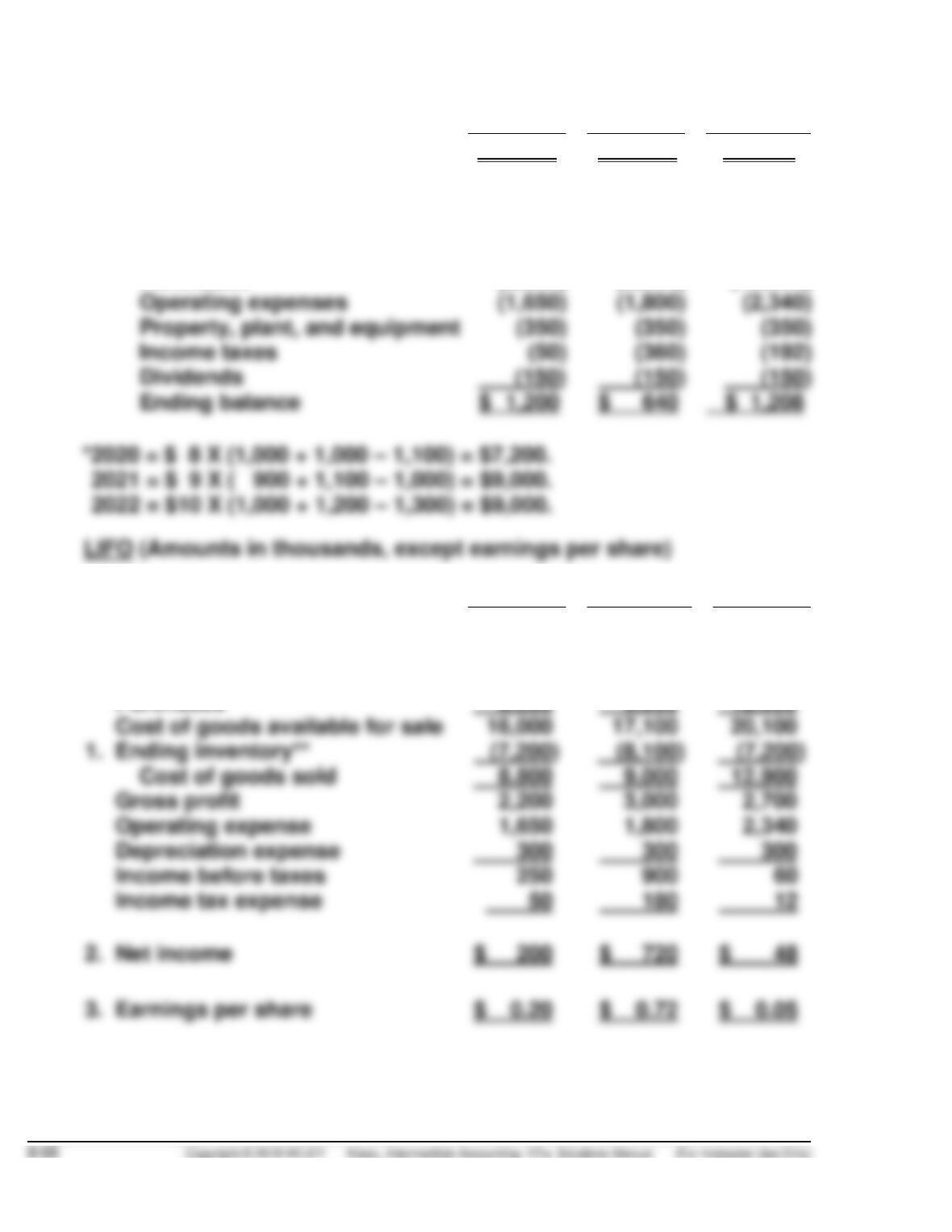
(a) FIFO (Amounts in thousands, except earnings per share)
2020
2021
2022
Sales revenue
$11,000
$12,000
$15,600
Cost of goods sold
Beginning inventory
Cost of goods available for sale
1. Ending inventory*
(7,200)
Gross profit
Operating expense (15% of sales)
Income before taxes
Income tax expense (20%)
2. Net income
$ 200
$ 1,440
CA 8.10 (Continued)
2020
2021
2022
3. Earnings per share
$ 0.20
$ 1.44
$ 0.77
4. Cash balance
Beginning balance
$ 400
$ 1,200
$ 640
Sales proceeds
11,000
12,000
15,600
Purchases
(8,000)
(9,900)
(12,000)
Operating expenses
Property, plant, and equipment
(350)
(350)
Income taxes
(50)
(360)
Dividends
(150)
Ending balance
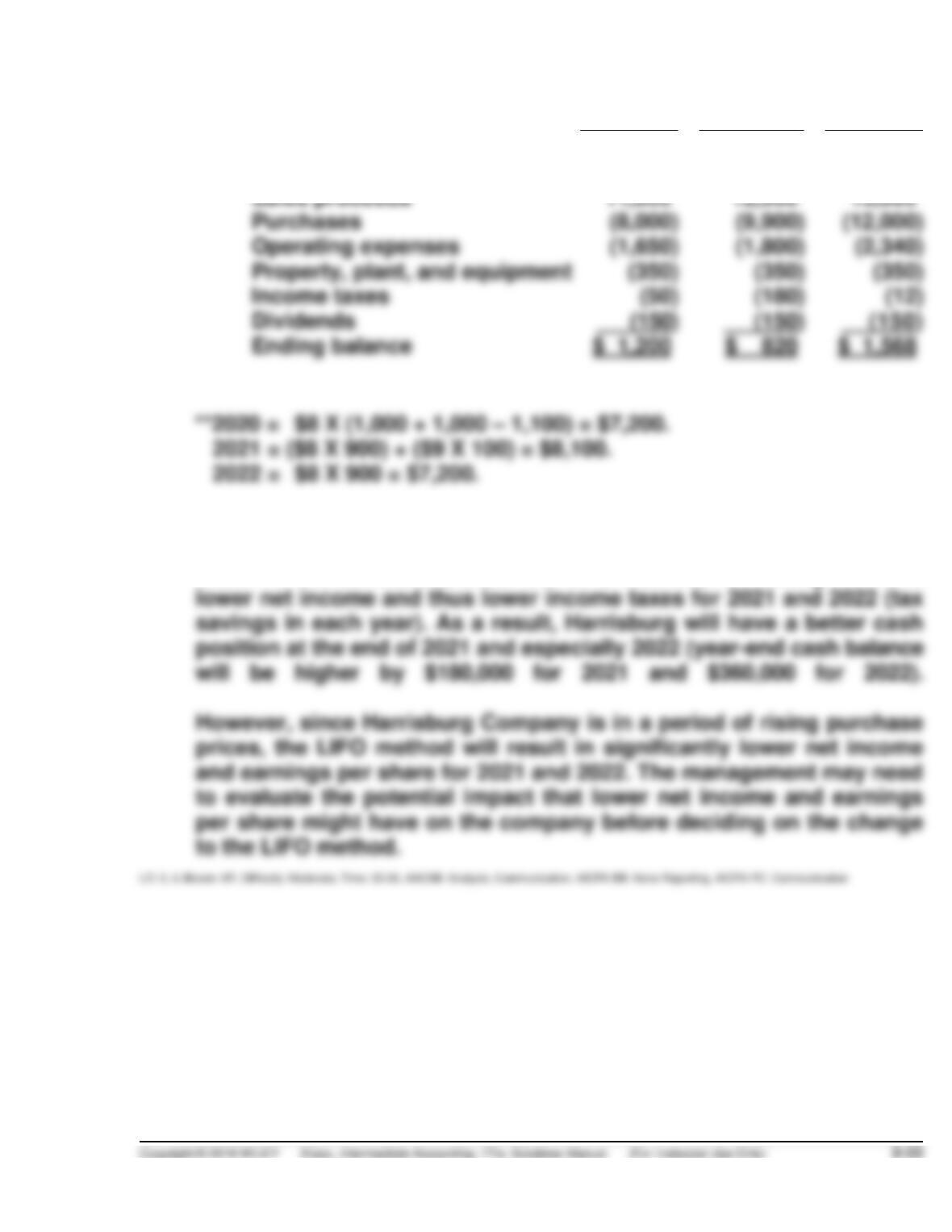
2020
2021
2022
Sales revenue
$11,000
$12,000
$15,600
Cost of goods sold
Beginning inventory
8,000
7,200
8,100
Purchases
8,000
9,900
12,000
Cost of goods available for sale
16,000
17,100
20,100
1. Ending inventory**
(7,200)
Cost of goods sold
8,800
9,000
12,900
Gross profit
2,200
3,000
2,700
Operating expense
Depreciation expense
300
300
300
Income before taxes
250
900
Income tax expense
180
12
2. Net income
$ 200
$ 720
$ 48
3. Earnings per share
$ 0.20
$ 0.72
$ 0.05
CA 8.10 (Continued)
2020
2021
2022
4. Cash balance
Beginning balance
$ 400
$ 1,200
$ 820
Sales proceeds
Purchases
Operating expenses
Property, plant, and equipment
Income taxes
Dividends
(b) According to the computation in (a), Harrisburg Company can achieve
the goal of income tax savings by switching to the LIFO method. As
shown in the schedules, under the LIFO method, Harrisburg will have
CA 8.11
(a) Major stakeholders are investors, creditors, Wilkens’ management
(including the president and plant accountant), and other employees
of Wilkens Company. The inventory purchase in this instance reduces
net income substantially and lowers Wilkens Company’s tax liability.
Current stockholders and company management benefit during the
(b) No, the president would not recommend a year-end inventory pur-
chase because under FIFO there would be no effect on net income.
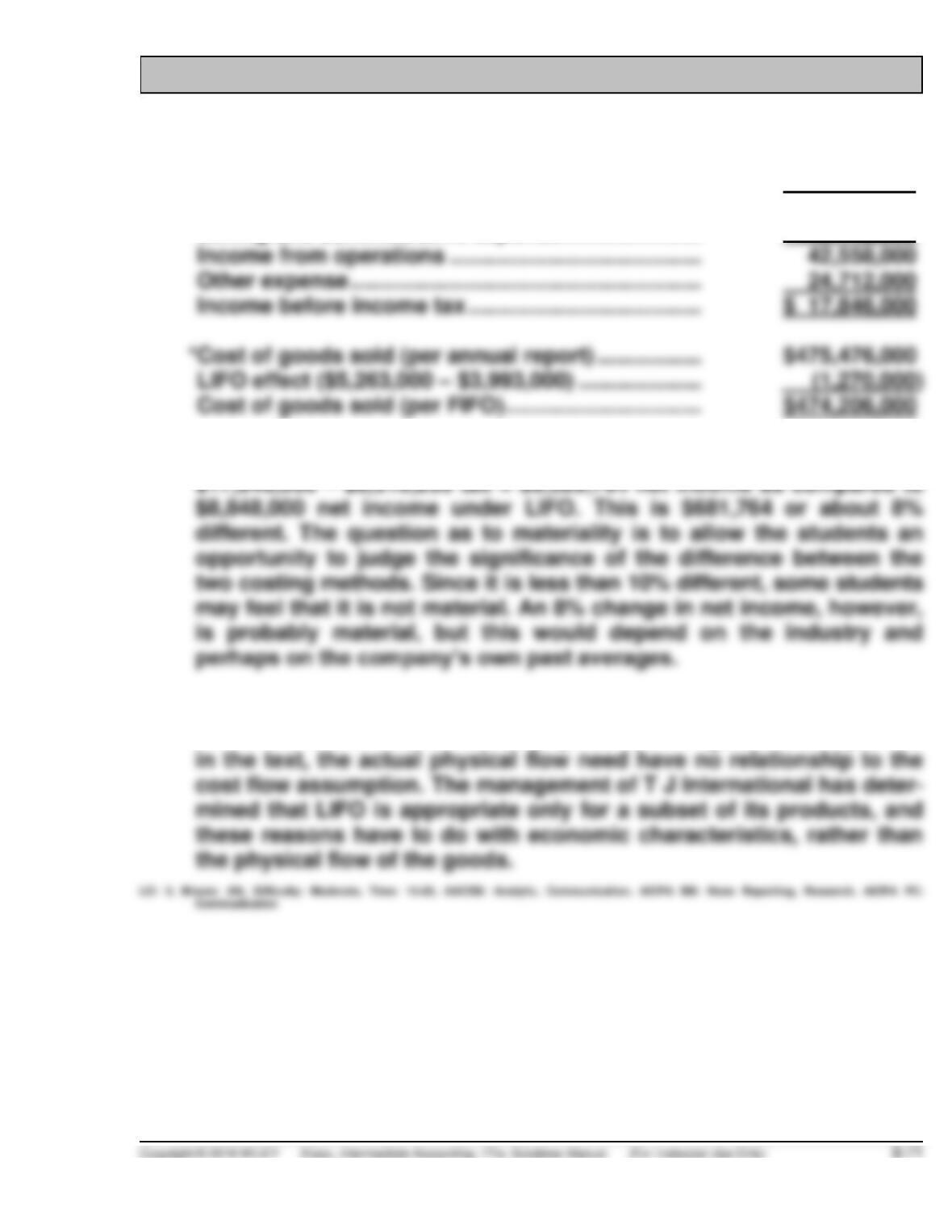
FINANCIAL STATEMENT ANALYSIS CASE 1
(a)
Sales ………………………………………………………………
$618,876,000
Cost of goods sold* …………………………………………
474,206,000
Gross profit …………………………………………………….
144,670,000
Selling and administrative expense …………………..
102,112,000
Income from operations …………………………………..
Other expense …………………………………………………
Income before income tax ………………………………..
LIFO effect ($5,263,000 – $3,993,000) ………………..
(b) $17,846,000 income before taxes X 46.6% tax = $8,316,236 tax;
(c) No, the use of different costing methods does not necessarily mean
that there is a difference in the physical flow of goods. As explained