218 Chapter 8
Month
Present
Value (Beg.)
Interest
Expense
Total
Payment
Principal
Payment
Value (End)
May
$600,000.00
$6,000.00
$53,309.26
$47,309.26
$552,690.74
June
552,690.74
5,526.90
53,309.26
47,782.36
504,908.38
July
504,908.38
5,049.08
53,309.26
48,260.18
456,648.20
August
456,648.20
4,566.48
48,742.78
407,905.42
September
407,905.42
4,079.05
53,309.26
49,230.21
358,675.21
October
358,675.21
3,586.75
53,309.26
49,722.51
308,952.70
November
308,952.70
3,089.53
53,309.26
50,219.73
258,732.97
December
258,732.97
2,587.33
53,309.26
50,721.93
208,011.04
January
208,011.04
2,080.11
53,309.26
51,229.15
February
1,567.82
53,309.26
51,741.44
105,040.45
March
105,040.45
1,050.40
53,309.26
52,258.86
53,309.26
52,781.44
1Note: Students may observe slight rounding errors between their solutions
and the solutions presented here. Rounding errors typically occur because of
the number of significant digits Excel uses in its calculations.
B. Interest expense for the 2007 fiscal year would be the sum of interest
rate applies to the other years also.
The Time Value of Money 219
P8–12 A. $147,763 PVA = Payment × Interest factor
B. The amortization table follows.
Period
Amount
Interest at
5%
Payment
Payment of
Principal
Balance
at End of
Period
Year 2007
$750,000
$37,500
$147,763
$110,263
$639,737
Year 2008
Year 2009
Year 2010
Year 2011
Year 2012
P8–13 A. $13,529 PVA = Payment × Interest factor
B. First-year interest = $5,500 $50,000 × 11% = $5,500. The differ-
220 Chapter 8
C.
ASSETS
=
LIABILITIES
+
OWNERS’ EQUITY
Date
Accounts
Cash
Other
Assets
Contributed
Capital
Retained
Earnings
Other
Assets
Contributed
Capital
Retained
Earnings
P8–14 A. $305.98 The amount of monthly payments can be determined
from the present value of an annuity equation:
The Time Value of Money 221
Period
Amount
Owed at
Beginning
1% Interest
Expense
Payment
Amount of
Principal
Paid
Amount
Owed at End
1
$6,500.00
$65.00
$305.98
$240.98
$6,259.02
2
6,259.02
62.59
305.98
243.39
6,015.63
3
6,015.63
60.16
305.98
5,769.81
4
5,769.81
57.70
305.98
248.28
5,521.53
5
5,521.53
55.22
305.98
250.76
5,270.77
6
5,270.77
52.71
305.98
253.27
7
50.17
305.98
255.81
4,761.69
8
4,761.69
47.62
305.98
258.36
4,503.33
9
4,503.33
45.03
305.98
260.95
10
4,242.38
42.42
305.98
263.56
3,978.82
11
3,978.82
39.79
305.98
266.19
3,712.63
12
3,712.63
37.13
305.98
268.85
3,443.78
Therefore, the amount owed at the end of the first year would be
$3,443.78.
Alternatively, it could be pointed out that the amount owed at any point in
the life of the loan is equal to the present value of the remaining pay-
P8-15 A. Column (i) refers to the year. This is customary. Column (iv) has to
be the annual cash payment because that is the only item that is
constant over time. If column (iv) is the annual cash payment, there
222 Chapter 8
The complete amortization table is as follows:
(i)
Year
(ii)
Beginning
of Year
Balance
(iii)
Interest
at 8%
(iv)
Annual
Cash
Payment
(v)
Reduction
of Principal
(vi)
End of Year
Balance
D. Cannot tell This table fits either side of the transaction. A note
amortizes exactly the same way for the borrower (Note
G. $50,444 Cash outflows totaling $50,444 will be reported by the
The Time Value of Money 223
This problem must be split into pieces. One approach is to assume
two different annuities. The first annuity is $4,000 for 12 years. A
Alternatively, one could treat the two annuities completely separate-
ly. The first annuity grows for eight years (to $39,589.88) and then
continues to grow as a single sum for four additional years (to a total
P8–17 A. $8,856.77 The four equal annual withdrawals constitute an annui-
ty. The $30,000 gift is the present value of that annuity.
C. $7,659.13 Balance after 1 year, just before
224 Chapter 8
P8–18 A. $13,490.05 To determine the maximum purchase price for the in-
PVA = Amount of annuity × IF (Table 4)
PVA = $1,050 × 5.78637
PVA = $6,075.69
C. The investment in part B has the higher cost. The cash flows to be
more for the investment.
P8–19 A. 0.007 8.4% ÷ 12 = 0.007 interest rate per month
The Time Value of Money 225
E. Interest = $1,316 Amount of payment $1,432.25
G. $192,217 30-year mortgage:
Total payments ($1,432.25 × 360) $515,610
P8–20 A. Bob and Lisa can calculate the sales price of the vehicle as follows:
B. The dealer’s behavior is not ethical because he is not telling Bob and
C. Unscrupulous businesses can take advantage of customers who do
226 Chapter 8
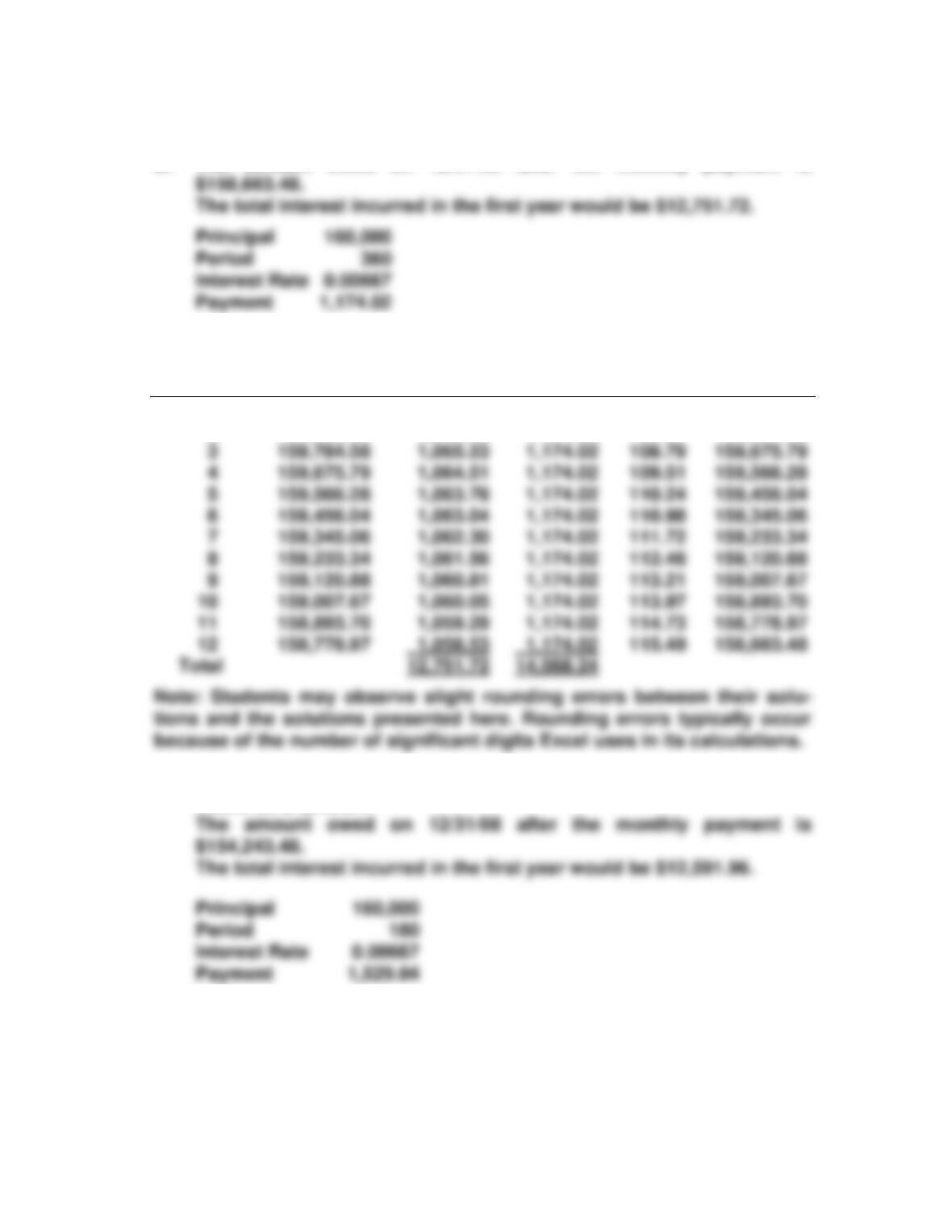
P8-21 A. If the loan is paid off over 30 years at 8%, the monthly payment
would be $1,174.02.
B. The amount owed on 12/31/08 after the monthly payment is
Month
Present Value
at Beginning of
Month
Interest
Incurred
Amount
Paid
Principal
Paid
Value at
End of
Month
1
160,000.00
1,066.67
1,174.02
107.35
159,892.65
2
159,892.65
1,065.95
1,174.02
108.07
159,784.58
3
159,784.58
1,065.23
1,174.02
108.79
159,675.79
4
159,675.79
1,064.51
1,174.02
109.51
159,566.28
5
159,566.28
1,063.78
1,174.02
110.24
159,456.04
6
159,456.04
1,063.04
1,174.02
110.98
159,345.06
7
159,345.06
1,062.30
1,174.02
111.72
159,233.34
8
159,233.34
1,061.56
1,174.02
112.46
159,120.88
9
159,120.88
1,060.81
1,174.02
113.21
159,007.67
159,007.67
1,060.05
1,174.02
113.97
1,059.29
1,174.02
114.73
158,778.97
158,778.97
1,058.53
158,663.48
12,751.72
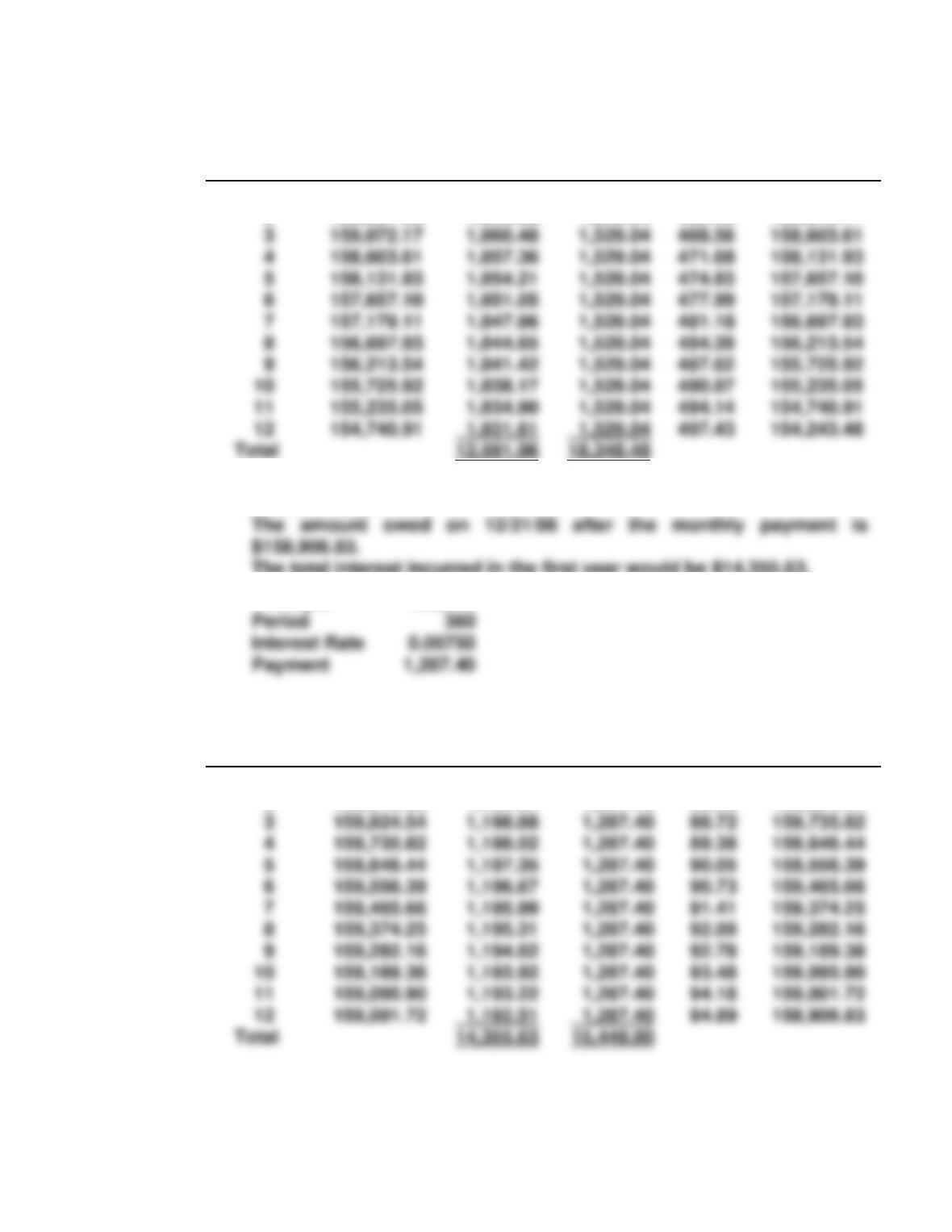
C. If the loan is paid off over 15 years at 8%, the monthly payment
would be $1,529.04.
The Time Value of Money 227
Month
Present Value
at Beginning
of Month
Interest
Incurred
Amount
Paid
Principal
Paid
Value at End
of Month
1
160,000.00
1,066.67
1,529.04
462.37
159,537.63
2
159,537.63
1,063.58
1,529.04
465.46
159,072.17
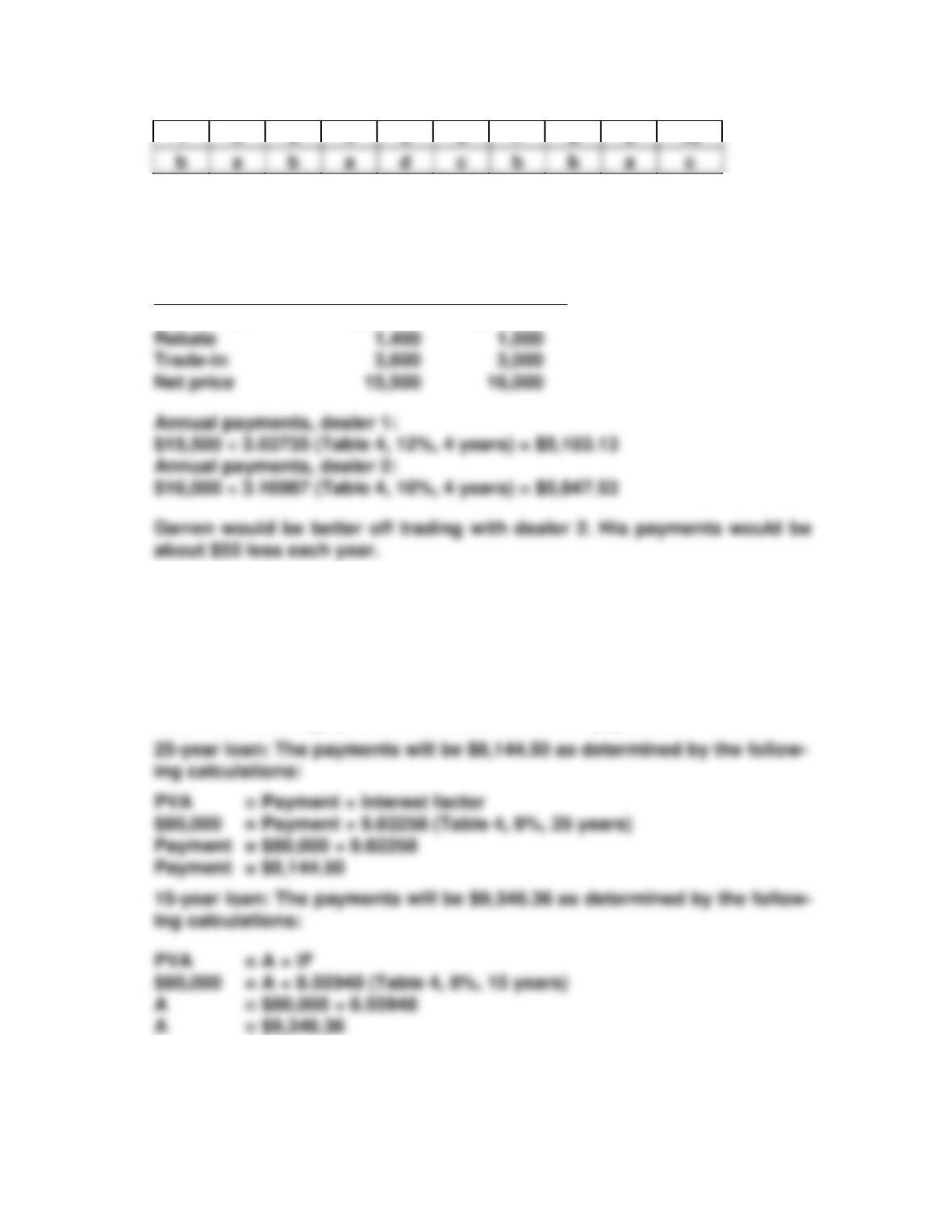
D. If the loan is paid off over 30 years at 9%, the monthly payment
would be $1,287.40.
The total interest incurred in the first year would be $14,355.63.
Principal 160,000
Month
Present Value
at Beginning
of Month
Interest
Incurred
Amount
Paid
Principal
Paid
Value at End
of Month
1
160,000.00
1,200.00
1,287.40
87.40
159,912.60
2
159,912.60
1,199.34
1,287.40
88.06
159,824.54
3
159,824.54
1,198.68
1,287.40
88.72
159,735.82
4
159,735.82
1,198.02
1,287.40
89.38
159,646.44
5
159,646.44
1,197.35
1,287.40
90.05
6
1,196.67
1,287.40
90.73
159,465.66
7
159,465.66
1,195.99
1,287.40
91.41
159,374.25
8
159,374.25
1,195.31
1,287.40
92.09
9
1,194.62
1,287.40
92.78
1,193.92
1,287.40
93.48
159,095.90
159,095.90
1,193.22
1,287.40
94.18
159,001.72
159,001.72
94.89
158,906.83
3
159,072.17
1,060.48
1,529.04
468.56
158,603.61
4
158,603.61
1,057.36
1,529.04
471.68
158,131.93
5
158,131.93
1,054.21
1,529.04
474.83
6
1,051.05
1,529.04
7
1,047.86
1,529.04
156,697.93
8
156,697.93
1,044.65
1,529.04
484.39
156,213.54
9
156,213.54
1,041.42
1,529.04
487.62
155,725.92
155,725.92
1,038.17
1,529.04
490.87
155,235.05
155,235.05
1,034.90
1,529.04
494.14
497.43
154,243.48
228 Chapter 8
P8-22
CASES
C8-1 The essential facts of the two alternatives can be summarized as follows:
Dealer
1
2
Cost of car
$20,500
$20,000
Rebate
Net price
C8-2 M E M O R A N D U M
DATE: (today’s date)
TO: Harold
FROM: (student’s name)
SUBJECT: Evaluation of loan options
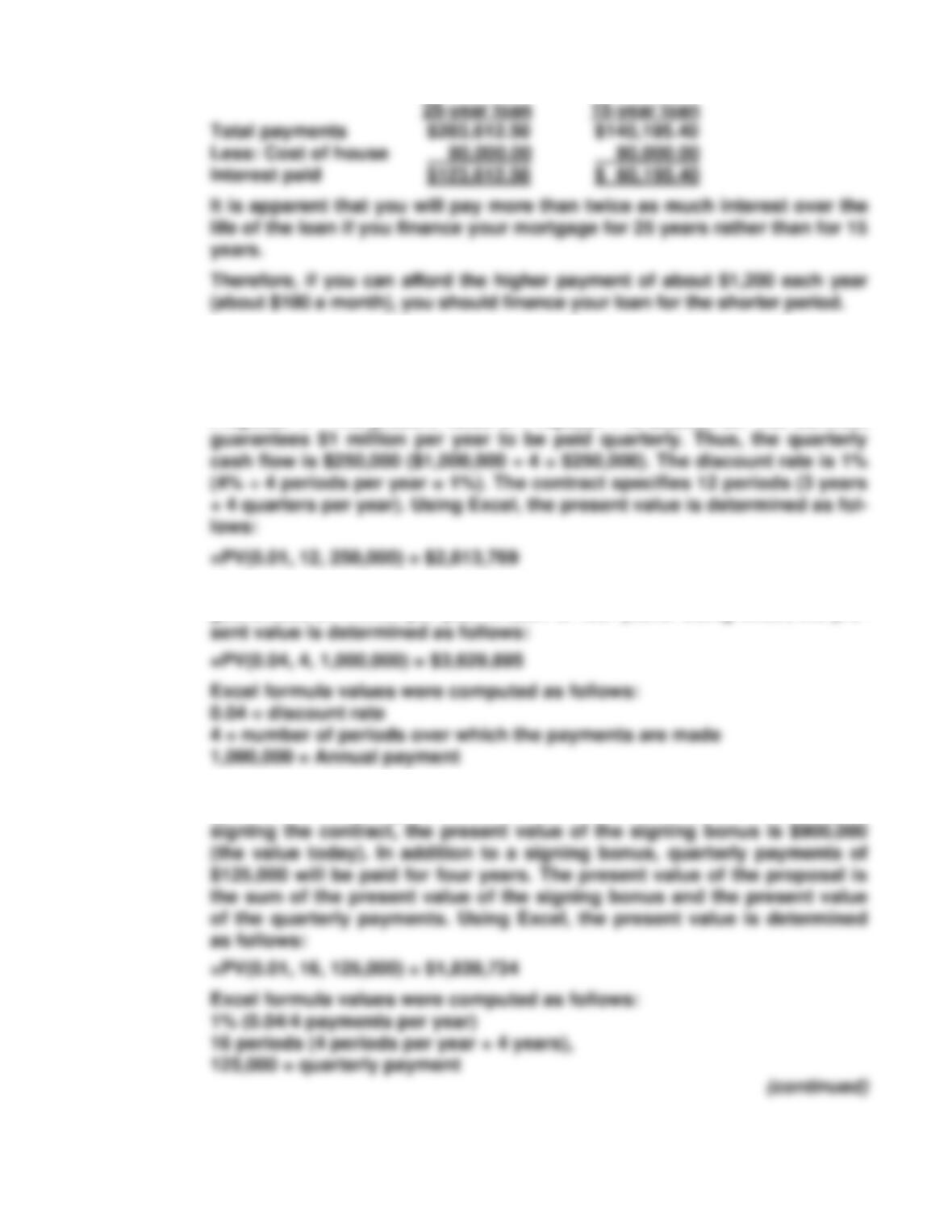
Your two financing options will result in different payments.
As a result of these payments differences, the total payments over the life
of the loans and the total interest associated with them will be quite dif-
ferent:
The Time Value of Money 229
C8-3 To analyze the various contract proposals, we use present value con-
cepts. We used Excel for our analysis; however, present value tables also
can be used. The following analysis assumes a 4% discount rate.
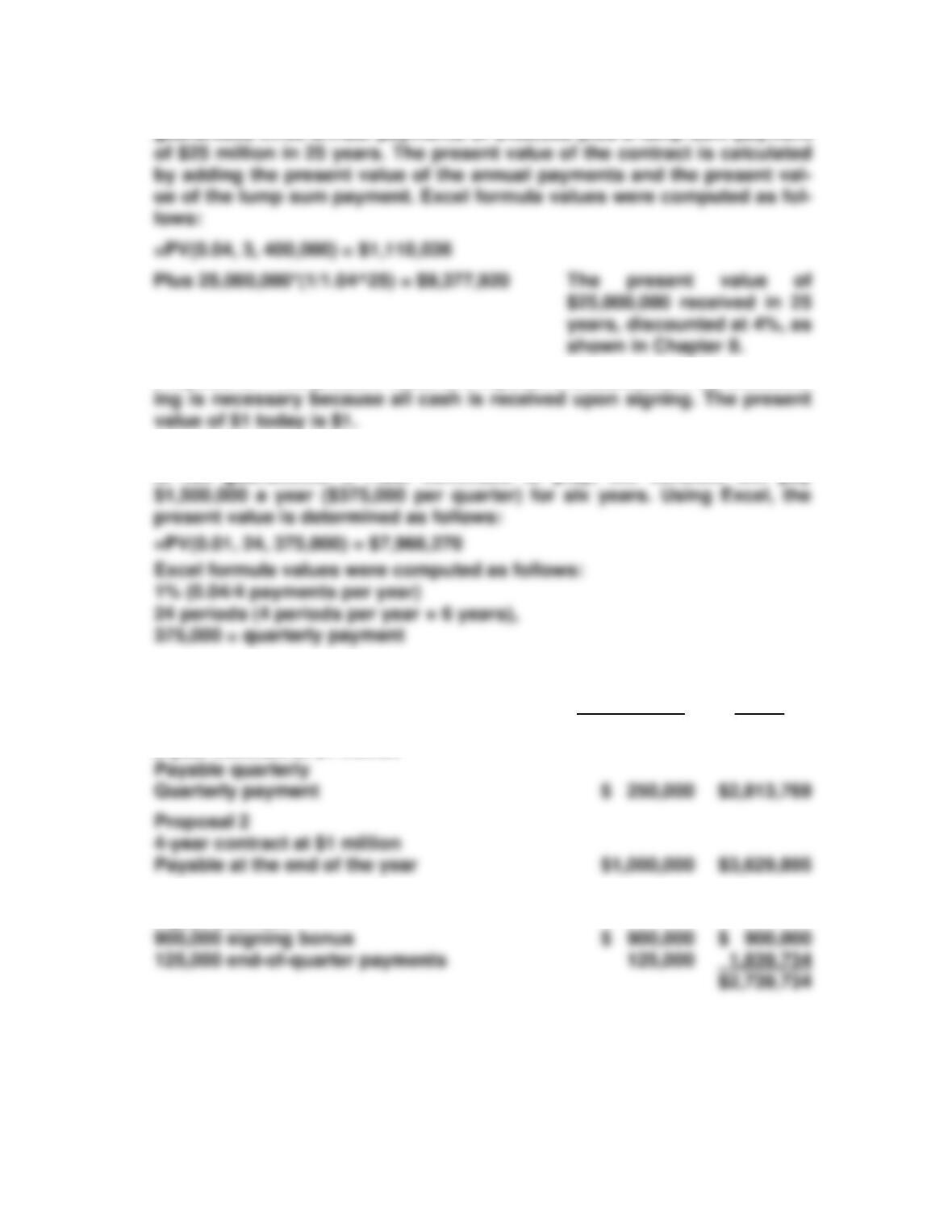
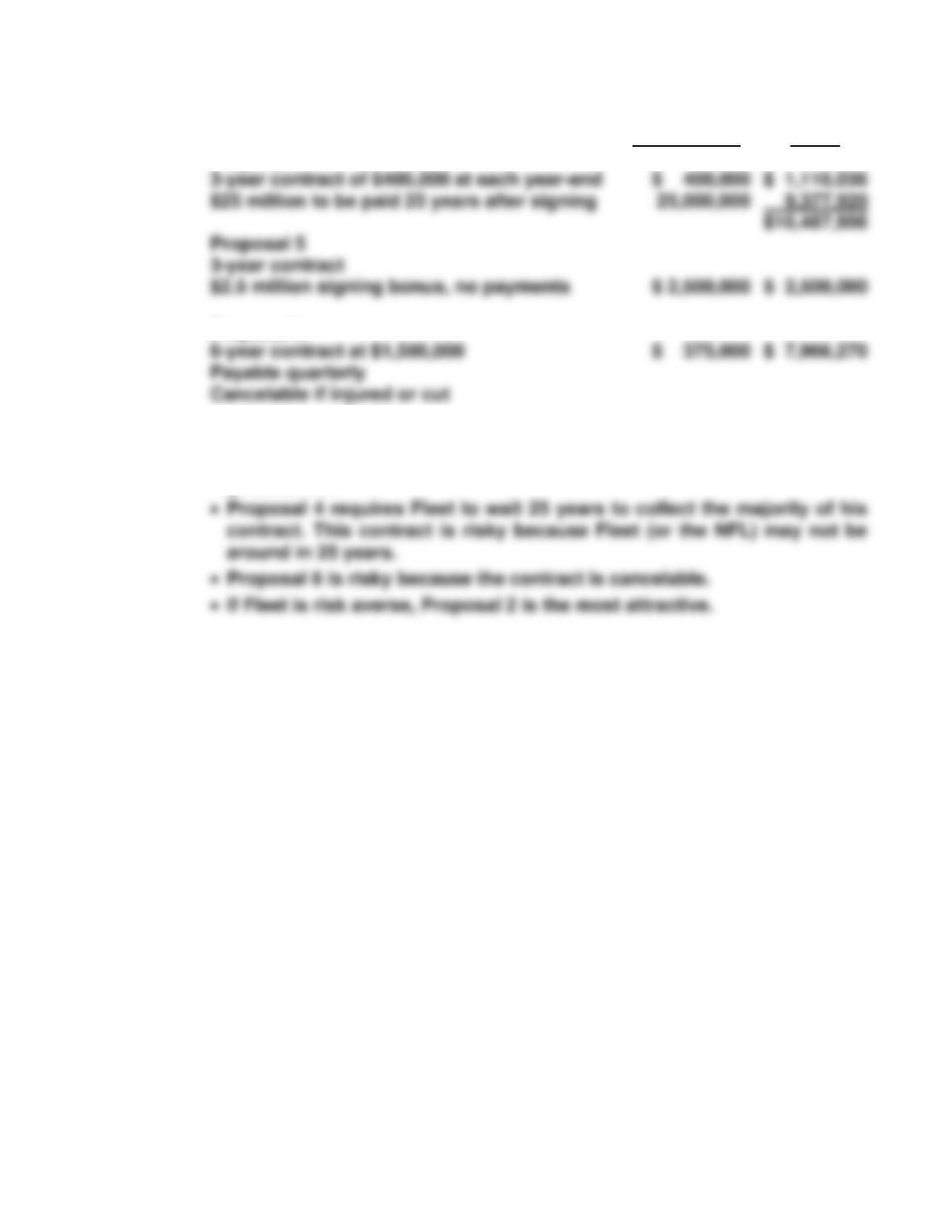
Proposal 1. The present value of Proposal 1 is $2,823,769. The contract
Proposal 2. The present value of Proposal 2 is $3,629,895. The contract
guarantees $1 million per year in each of four years. Using Excel, the pre-
Proposal 3. The present value of Proposal 3 is $2,739,734. The contract
guarantees a signing bonus of $900,000. Since the bonus is paid upon
230 Chapter 8
Proposal 4. The present value of Proposal 4 is $10,487,956. The contract
guarantees three annual payments of $400,000 plus a lump sum payment
Proposal 5. The present value of Proposal 5 is $2,500,000. No discount-
Proposal 6. The present value of Proposal 6 is $7,966,270. The contract
is not guaranteed. If Fleet continues to play, the contract will pay
Cash Flow
Each Period
Present
Value
Proposal 1
3-year contract at $1 million
Payable quarterly
Quarterly payment
Proposal 2
4-year contract at $1 million
Payable at the end of the year
Proposal 3
4-year contract
900,000 signing bonus
$ 900,000
125,000 end-of-quarter payments
The Time Value of Money 231
Cash Flow
Each Period
Present
Value
Proposal 4
Proposal 6
6-year contract at $1,500,000
Cancelable if injured or cut
Key points:
• The proposals with the highest present value (4 and 6) also have the
greatest risk.
3-year contract of $400,000 at each year-end
$25 million to be paid 25 years after signing
Proposal 5
3-year contract
$2.5 million signing bonus, no payments