FINANCIAL STATEMENT ANALYSIS CASE 2
(a) The most likely physical flow of goods for a pharmaceutical manufac–
turer would be FIFO; that is, the first goods manufactured would be the
(b) Noven should consider first whether the inventory costing method
will make a difference. If the prices in the economy, especially if the
(c) This amount is likely not shown in a separate inventory account
because it is immaterial; that is, it is not large enough to make a differ–
ence with investors. Another possible reason is that no goods have yet
FINANCIAL STATEMENT ANALYSIS CASE 3
January 28,
January 30,
January 31,
2017
2016
2015
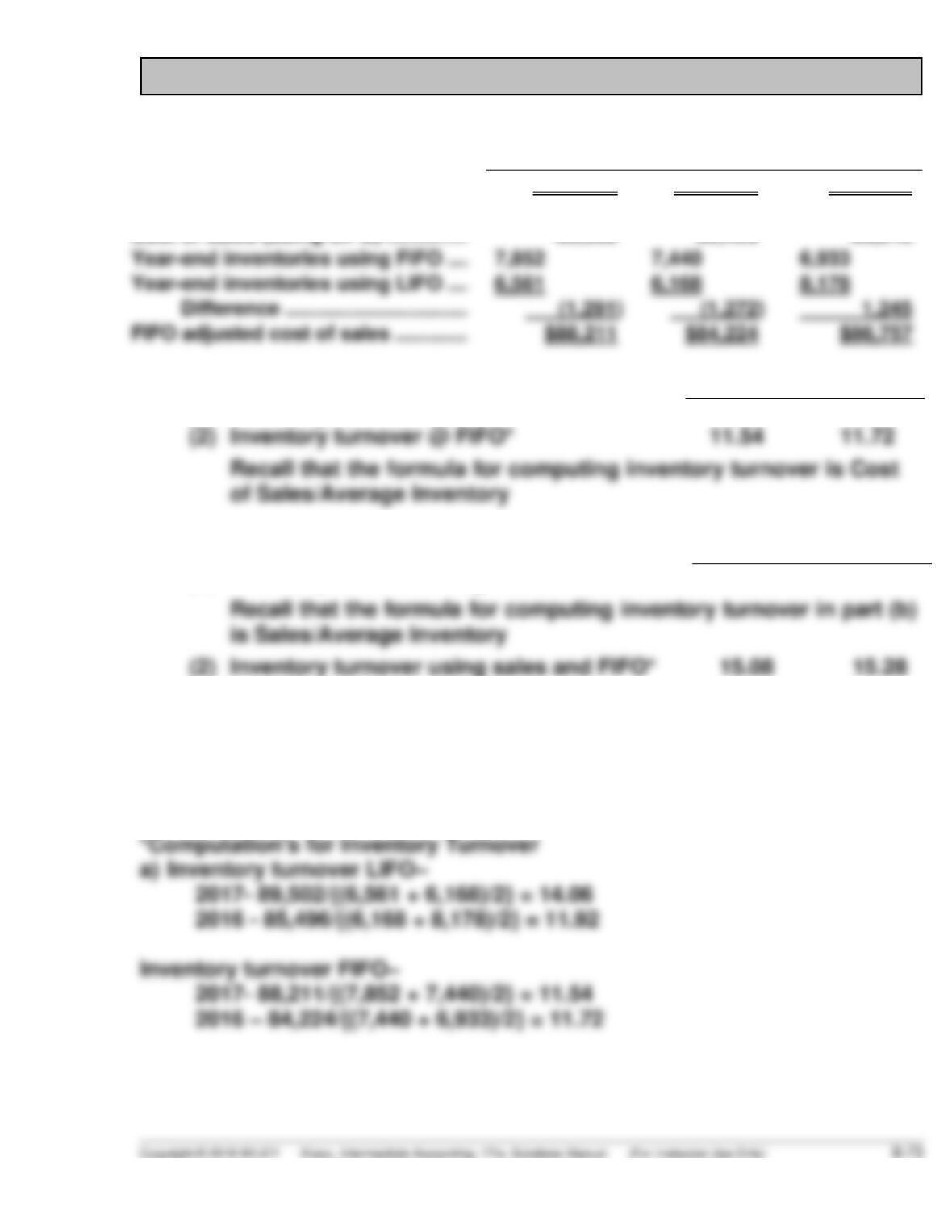
Net Sales ………………………………………
$115,337
$109,830
$108,465
Cost of sales (using LIFO) …………….
89,502
85,496
85,512
1,245
FIFO adjusted cost of sales ……………
(a)
2017
2016
(1)
Inventory turnover @ LIFO*
14.06
11.92
(2)
Inventory turnover @ FIFO*
(b)
2017
2016
(1)
Inventory turnover using sales and LIFO*
18.12
15.31
(2)
Inventory turnover using sales and FIFO*
(c) Using sales instead of cost of goods sold accounts for the mark-up in
the inventory. By using cost of goods sold, there is a better matching
of the costs associated to inventory, and should result in more useful
information.
FINANCIAL STATEMENT ANALYSIS CASE 3 (Continued)
b) Inventory turnover LIFO–
2017-115,337/{(6,561 + 6,168)/2} = 18.12
ACCOUNTING, ANALYSIS, AND PRINCIPLES
Accounting
(a) FIFO
Residential pumps:
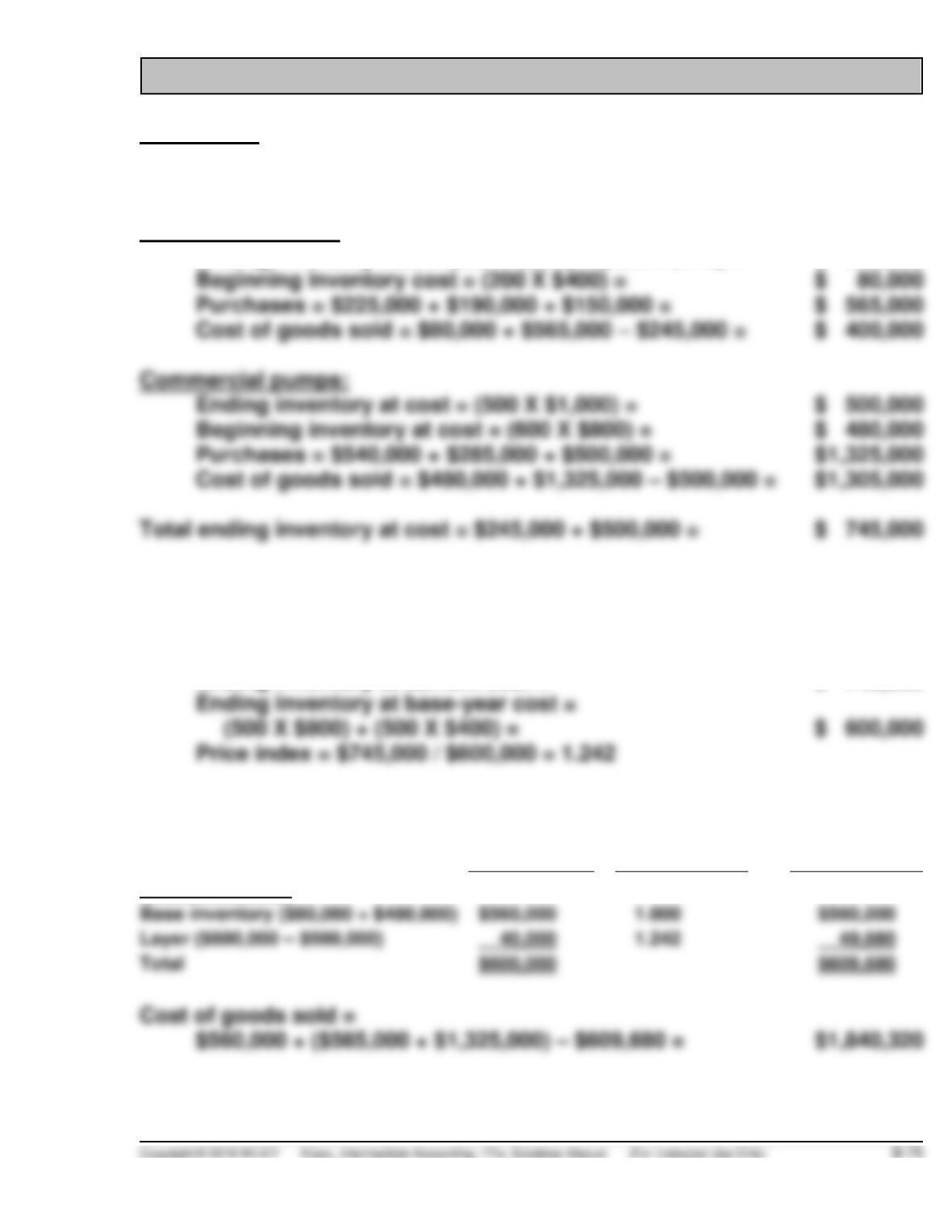
Ending inventory cost = (300 X $500) + (200 X $475) = $ 245,000
Total cost of goods sold = $1,305,000 + $400,000 = $1,705,000
(b) Dollar-value LIFO (one pool)
Ending inventory at current cost = $ 745,000
Current
Inventory at
base cost
Conversion
price index
Inventory at
LIFO cost
Ending inventory
ACCOUNTING, ANALYSIS, AND PRINCIPLES (Continued)
Analysis
(a) The purpose of a current ratio is to provide some indication of the
resources the company has available to meet short term obligations,
(b) The U.S. Securities and Exchange Commission requires companies
Principles
Companies can change from one inventory accounting method to
another, but not back and forth. Changes in accounting method (when
CODIFICATION EXERCISES
CE8-1
(a) Inventory is the aggregate of those items of tangible personal property that have any of the
following characteristics:
a. Held for sale in the ordinary of business.
b. To process of production for such sale.
c. To be currently consumed in the production of goods or services to be available for sale.
The term inventory embraces goods awaiting sale (the merchandise of a trading concern and the
finished goods of a manufacturer), goods in the course of production (work in process), and goods
(b) A customer is a reseller or a consumer, either an individual or a business that purchases a
vendor’s products or services for end use rather than for resale. This definition is consistent with
paragraph 280-10–50-42, which states that a group of entities known to a reporting entity to be
CE8-2
According 606–10–25-18A
An entity that promises a good to a customer also might perform shipping and handling activities
606–10–25–18A
If shipping and handling activities are performed after a customer obtains control of the good, then the
CE8-2 (Continued)
An entity that makes this election would not evaluate whether shipping and handling activities are
CE8-3
35-1 A departure from the cost basis of pricing the inventory is required when the utility of the goods
is no longer as great as their cost. Where there is evidence that the utility of goods, in their
35–15 Only in exceptional cases may inventories properly be stated above cost. For example,
precious metals having a fixed monetary value with no substantial cost of marketing may be
CE8-4
FASB ASC 330-10-S99-3 (SAB Topic 11.F, LIFO Liquidations) The following is the text of SAB
Topic 11.F, LIFO Liquidations.
Facts: Registrant on LIFO basis of accounting liquidates a substantial portion of its LIFO inventory and
as a result includes a material amount of income in its income statement which would not have been
recorded had the inventory liquidation not taken place.
Question: Is disclosure required of the amount of income realized as a result of the inventory liquidation?
Interpretive Response: Yes. Such disclosure would be required in order to make the financial
CODIFICATION RESEARCH CASE
(a) A search using “right of return” and revenue indicates that FASB ASC
606 Revenue from Contracts with Customers is the relevant literature.
(b) At ASC 606-10–55-201, the codification indicates that the examples
following:
(c) Example 22 at FASB ASC 606–10–55-202 through 207 provides an
example of Right of Return as it relates to Constraining Estimates of
Variable Consideration (as of March 21, 2018, these are marked as
pending content):
55–202
An entity enters into 100 contracts with customers. Each contract
55–203
The entity applies the guidance in this Topic to the portfolio of 100
CODIFICATION RESEARCH CASE (Continued)
55–204
Because the contract allows a customer to return the products, the
consideration received from the customer is variable. To estimate the
55–205
The entity also considers the guidance in paragraphs 606–10–32-11
through 32-13 on constraining estimates of variable consideration to
determine whether the estimated amount of variable consideration of
55–206
The entity estimates that the costs of recovering the products will be
55–207
Upon transfer of control of the 100 products, the entity does not
recognize revenue for the 3 products that it expects to be returned.
CODIFICATION RESEARCH CASE (Continued)
Cost of sales $5,820 ($60 97 products not expected to be
returned)
(d) The general guidelines for “Constraining Estimates of Variable
Consideration” are found at FASB ASC 606-10–32-11 to 12.
32–11
An entity shall include in the transaction price some or all of an
32–12
In assessing whether it is probable that a significant reversal in the
amount of cumulative revenue recognized will not occur once the
uncertainty related to the variable consideration is subsequently
resolved, an entity shall consider both the likelihood and the
CODIFICATION RESEARCH CASE (Continued)
d. The entity has a practice of either offering a broad range of price