Chapter 08 – Reporting and Interpreting Property, Plant, and Equipment; Intangibles; and Natural Resources
8-13
intangible assets for possible impairment
3. Two steps are necessary:
b. Step 2: Compute Impairment Loss – If impaired, asset
a. Step 1: Test for Impairment—If net book value >
dr Asset Impairment Loss
cr Flight Equipment (–A)
Flight Equipment (A) – 2,500,000 = Asset Impairment
4. Southwest has an aircraft with a net book value of
$10,000,000 and fair value was $7,500,000; the
impairment loss = $2,500,000 ($10,000,000 net book
LO 8-5 Analyze the disposal of property, plant, and equipment.
E. Disposal of Property, Plant and Equipment
1. Disposals (whether voluntary or involuntary) seldom
2. As a result, the disposal of a depreciable asset usually
requires two journal entries:
a. An adjusting entry to update the depreciation expense
and accumulated depreciation accounts
b. An entry to record the disposal
3. At the end of year 17, Southwest sold an aircraft for $11
million cash; cost of $30 million was depreciated using
the straight-line method over 25 years with no residual
value ($1.2 million depreciation expense per year)
a. The last accounting for depreciation was at the end of
Chapter 08 – Reporting and Interpreting Property, Plant, and Equipment; Intangibles; and Natural Resources
8-14
(+XA, –A)
Assets = Liabilities + Stockholders’ Equity
Accumulated Depreciation (XA) – 1.2 mill =
Depreciation Expense (E) – 1.2 mill
b. Computation of gain (or loss) on sale:
Cash received
c. Record sale (in millions):
dr Cash (+A)
11.0
dr Accum. Depreciation
(–XA, +A)
20.4
cr Flight Equipment (–A)
30.0
cr Gain on Sale of
LO 8-6 Apply measurement and reporting concepts for intangible assets and natural resources.
III. Intangible Assets and Natural Resources
A. Acquisition and Amortization of Intangible Assets
1. An intangible asset has value because of certain rights
and privileges often conferred by law on its owner
a. Unlike tangible assets, however, an intangible asset
has no material or physical substance
2. Acquisition
they have been purchased
a. Intangible assets are recorded at historical cost only if
3. Amortization––upon acquisition, managers determine
whether the separate intangibles have definite or
indefinite lives:
Chapter 08 – Reporting and Interpreting Property, Plant, and Equipment; Intangibles; and Natural Resources
8-15
statement each period
iv. Intangible assets are reported at cost less
accumulated amortization on the balance sheet
dr Patents Amortization
Expense (+E, –SE)
Accumulated Amortization
+XA, – A)
v. A company purchases a patent for $800,000 and
Assets = Liabilities + Stockholders’ Equity
Patents (A) [or Accumulated Amortization (XA)]
–40,000 = Patents Amortization Expense (E)
–40,000
b. Indefinite Life
i. Intangible assets with indefinite lives are not
amortized
written down (decreased) to its fair value if
impaired
3. Types of Intangible Assets:
a. Goodwill (cost in excess of net assets acquired)
i. For accounting purposes, the excess of the
purchase price of a business over the fair market
value of the business’s assets and liabilities
financial standing
iii. Reported as an asset only if another business is
purchased
iv. Considered to have an indefinite life; must be
tested for possible impairment
b. Trademark
i. An exclusive legal right to use a special name,
image, or slogan
ii. Rarely seen on balance sheets; intangible assets are
not recorded unless they are purchased
c. Copyright
musical, or artistic work
an author; for anonymous authors, the limit is 95
years from the first publication date
i. Exclusive right to publish, use, and sell a literary,
Chapter 08 – Reporting and Interpreting Property, Plant, and Equipment; Intangibles; and Natural Resources
8-16
programs are expensed as incurred to research,
development, and engineering expense
product after technological feasibility has been
feature; it is included in the
ii. If an intangible asset is developed internally, the
cost of development normally is recorded as
chapter outline for emphasis
ii. Costs that are incurred to produce the finished
f. Patent
granted to a person who invents a new product or
discovers a new process
because GAAP requires the immediate expensing
i. An exclusive right granted by the federal
government for a period of 20 years, typically
g. Franchises
activities in a geographical region
i. A contractual right to sell certain products or
services, use certain trademarks, or perform
contract
h. Licenses and Operating Rights
Accounting for Tangible and
i. Obtained through agreements with governmental
units or agencies, permit owners to use public
See International Perspective
B. Acquisition and Depletion of Natural Resources
1. Natural resources––Assets that occur in nature, such as
mineral deposits, timber tracts, oil, and gas; often called
wasting assets because they are depleted (i.e., physically
used up)
a. When acquired or developed, they are recorded in
conformity with the cost principle
b. As used up, its acquisition cost must be apportioned
Chapter 08 – Reporting and Interpreting Property, Plant, and Equipment; Intangibles; and Natural Resources
8-17
2. A timber tract costing $530,000 is depleted over its
estimated cutting period based on a “cutting” rate of
approximately 20% per year
dr Inventory (+A)
cr Timber Tract (–A) (or
Accumulated Depletion (+XA, –A)
LO 8-7 Explain how the acquisition, use, and disposal of long-lived assets impact cash flows.
C. Focus on Cash Flows—Productive Assets and Depreciation
1. Operating Activities
b. Any gain (or loss) on the sale of long-lived assets (an
a. Because depreciation expense (a noncash expense) is
subtracted in calculating net income on the income
See Financial Analysis
feature “A
2. Investing Activities
b. Cash inflow (+) equals proceeds from sales of long-
a. Cash outflow (–) arises from purchase of long-lived
IV. Chapter Supplement: Changes in Depreciation Estimates
A. Depreciation is based on two estimates: useful life and
residual value
1. Estimates are made at the time a depreciable asset is
these initial estimates may need to be revised
B. Prospective change in estimate
current year into the future
1. When either estimate is revised, the undepreciated asset
balance (less any residual value at that date) should be
apportioned over the remaining estimated life from the
Chapter 08 – Reporting and Interpreting Property, Plant, and Equipment; Intangibles; and Natural Resources
8-18
a. Assume that Southwest purchased an aircraft for $60
million with an estimated useful life of 20 years and
estimated residual value of $3 million. At start of
4. A change in depreciation method requires significantly
more disclosure because it violates the consistency
principle, which requires that accounting information
reported in the financial statements should be comparable
across accounting periods
5. Under GAAP, changes in accounting estimates and
Refer students to Pause for
Chapter 08 – Reporting and Interpreting Property, Plant, and Equipment; Intangibles; and Natural Resources
8-19
Supplemental Enrichment Activities
Note: These activities would be suitable for individual or group activities and class discussion.
1. Handout 8-1
Use Handout 8-1 for an in-class to review acquisition cost, depreciation computations using all four
2. Handout 8-2
If you used Handout 8-1, use Handout 8-2 for an in-class discussion of the results of the calculations
Chapter 08 – Reporting and Interpreting Property, Plant, and Equipment; Intangibles; and Natural Resources
8-20
HANDOUT 8–1
DEPRECIATION METHODS AND GAIN (OR LOSS) ON SALE
Joel Harvey Florists ordered a truck at an invoice price of $11,000. On the date of delivery, January 2,
Year 1, the company paid $1,000 on the truck, with the balance on credit at 10 percent interest due in six
months. On January 3, Year 1, the company paid $500 for freight on the truck. On January 4, Year 1, the
On December 31, Year 5, Joel Harvey sold the truck for $3,000 cash.
1. Compute the acquisition cost of the truck.
2. Compute the annual depreciation expense for each of the years 1 through 5 using each of the following
methods:
• Straight-line
3. Compute the gain (or loss) on sale.
Chapter 08 – Reporting and Interpreting Property, Plant, and Equipment; Intangibles; and Natural Resources
8-21
HANDOUT 8 – 1 SOLUTION
DEPRECIATION METHODS AND GAIN (OR LOSS) ON SALE
Joel Harvey Florists ordered a truck at an invoice price of $11,000. On the date of delivery, January 2,
Year 1, the company paid $1,000 on the truck, with the balance on credit at 10 percent interest due in six
On December 31, Year 5, Joel Harvey sold the truck for $3,000 cash.
1. Compute the acquisition cost of the truck.
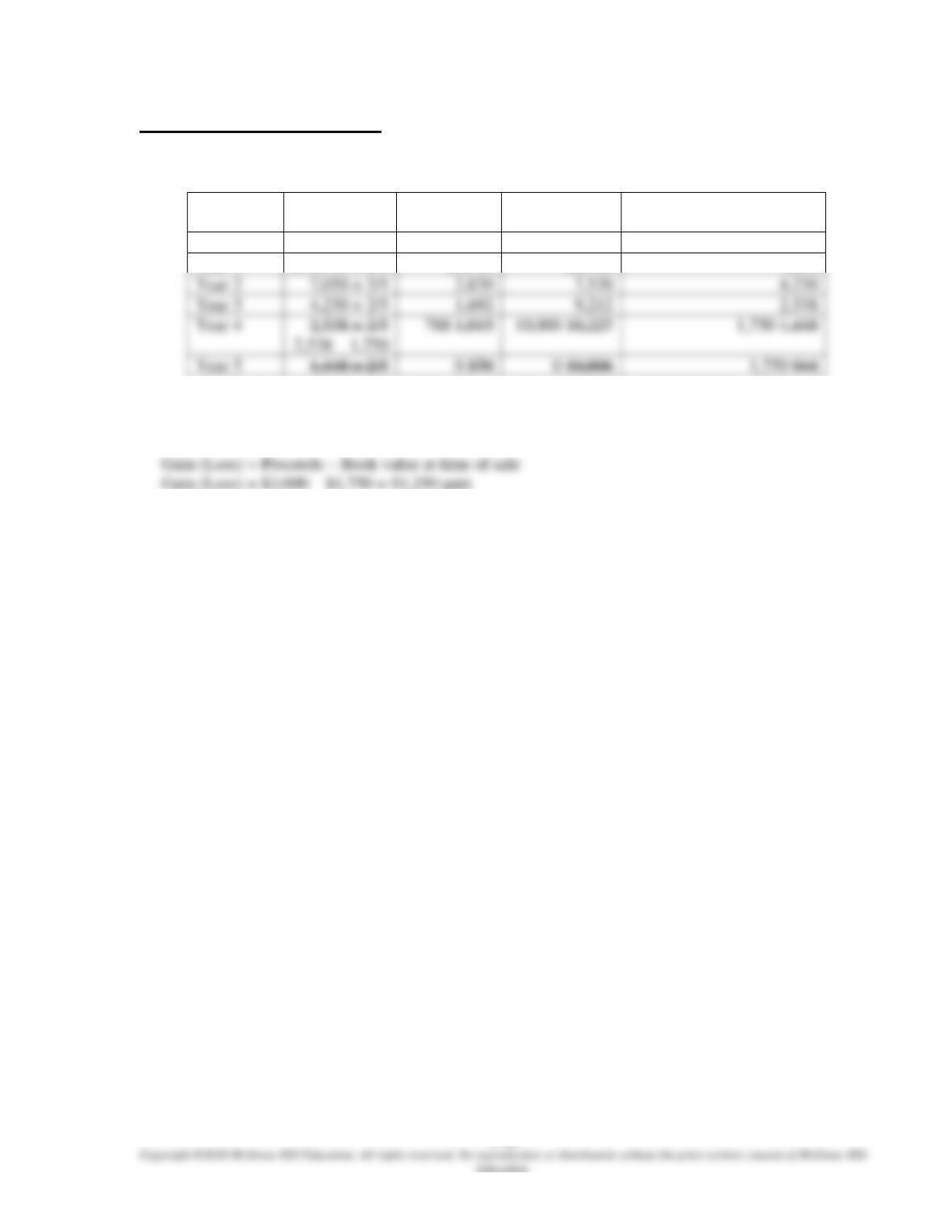
Acquisition cost = Purchase price + Freight + Painting cost = $11,000 + $500 + $250 = $11,750
2. Compute the annual depreciation expense for each of the years 1 through 5 using each of the following
methods:
• Straight-line
• Unit-of-production
Depreciation rate per unit of production = (Cost – Residual value) ÷ Estimated total production
Year 5: 5,000 miles × $0.10 per mile = $500
Chapter 08 – Reporting and Interpreting Property, Plant, and Equipment; Intangibles; and Natural Resources
8-22
HANDOUT 8 – 1 SOLUTION
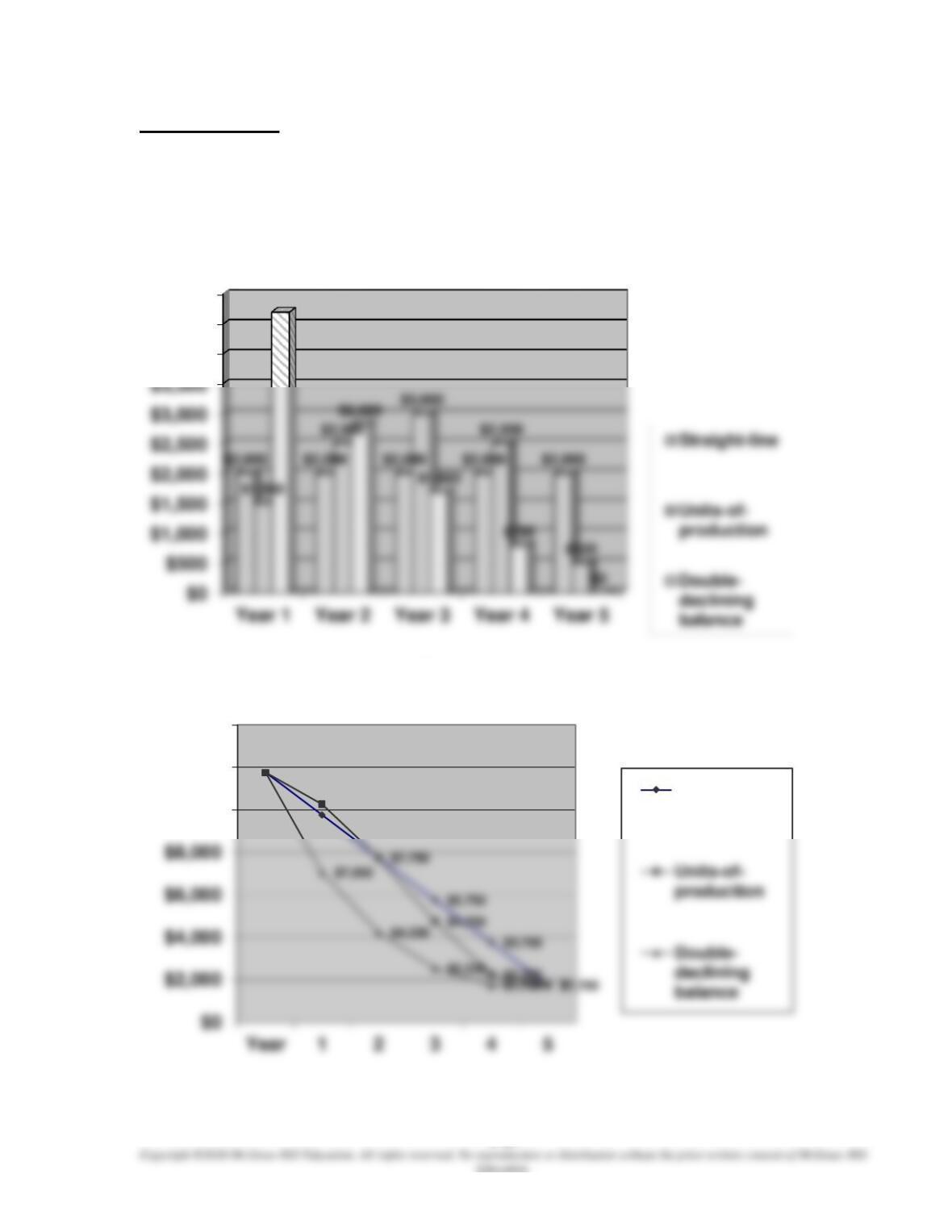
• Declining-balance
Year
Computation
Depreciation
Expense
Accumulated
Depreciation
Net Book Value
Acquisition
$11,750
Year 1
$11,750 × 2/5
$4,700
$4,700
7,050
Year 2
Year 3
2,538
Year 5
3. Compute the gain (or loss) on sale.
Chapter 08 – Reporting and Interpreting Property, Plant, and Equipment; Intangibles; and Natural Resources
8-23
HANDOUT 8 – 2
COMPARISON OF DEPRECIATION EXPENSE AND NET BOOK VALUE
$4,000
$4,500
$5,000
$4,700
Depreciation Expense
$11,750
$9,750
$11,750
$10,250
$11,750
$10,000
$12,000
$14,000
Net Book Value
Straight-line